We are living in a time when there are no gentlemen.
So, women stand for hours without being offered any seats.
It’ s a privilege which they have laboured for and for centuries,
It appears! Madness, I know, but you must respect them.
As you watch their small fists tightening on the headrests,
And the veins on their slight wrists seeming to almost split…
That is just at the point when you must resist to offer them a seat
And rather plant your own arse further into it!
As I have said before, we are living in a time without any gentlemen
And highly vocal women, who apparently know exactly what they want.
The children are so dissolute you could be forgiven for not showing!
Resist, resist, resist! Resistance, apparently is the source of all Art.
Resist recapitulating altogether. And whatever you do,
Don’t Fart!
On 55th West between 8th and 9th Street I just miss getting mugged. I hear them coming up behind me, two street kids and I speed up. They hit the next guy, take his phone and break his arm. I back off, slipping between parked cars as they run away. He’s just sat there on the pavement in his neatly pressed suit, cradling his broken arm. This is a quiet street, neatly trimmed hedges, expensive apartments. I say something like “Can I help?”, but he doesn’t speak English. The cops arrive and I give them a vague, racist sounding description of ‘the perps’. Two days ago I would have helped.
Two days ago I owned a can of pepper spray, picked up for fifteen bucks on Venice Beach because Inglewood felt dangerous. But they scan you and pat you now, before they let you board the ferry to Ellis Island, so I trashed it. I sit on a rock in Central Park and call friends in Ireland and Russia on the last of my credit. These calls last a surprisingly long time. I am completely alone.
So I get a ticket for the Tonight Show. If Letterman looks a little orange on camera, then he’s ruddy as a horse under the lights. Tonight’s guests: Sean Lennon, Billy Bob Thornton and a girl who hypnotises lizards and poses them in hand sown outfits. I feel sorry for Lennon, this nerdy, yupster kid, born overshadowed. Billy Bob’s here promoting a movie. He’s brought along a picture of himself as a fat toddler. We laugh as instructed. ‘The CBS orchestra’ make a good house band, tight session musicians in loud ties and late 30’s paunch. I watch Dave’s hands shake during the ad break, as pages coo and pamper him. Is he still nervous after all this time? Is it Parkinsons, rattling through the L-dopa? Is it the DTs?
Up and down the Upper East Side stalk little old ladies with pointed faces. Their midget pooches, humiliated in booties, snap against their leads like bobbinhead Johny Rottens in the CBGB’s gift shop. I pick up a naggin in 7-Eleven, mixing it with the too sweet remains of a Big Gulp. Tiny grocery stores are selling mountains of outsize pumpkins. Jews for Jesus thrust leaflets at passing Hasidim, angry under their beards. Columbia is a squall of grey bricked buildings splashed onto a sandstone thoroughfare. I don’t know if it’s a good school, but I’ve read about the naked campus parties. I am titillated and terrified in equal measure. The campus is quiet, and I potter about the swollen crypt of St Paul’s chapel, come to rest on the steps of the library and wish I went here.
Laura and I are mid-conversation. One of those drunken transitions you can’t remember happening. I’m talking up the Aran Islands, staring at this fake pearl necklace on her tan wrist. She’s a senior, majoring in Neuropsych, and we talk about functional imaging and the new Girl Talk record. She hop skips and jumps before me down the steps, right out of the college and across to a red brick hall of residence and it’s happening finally, that manic pixie dream romance.
At the party she tells me to wait. I stand in a dark room containing an actual keg that no one actually drinks from. Minutes go by and I think of leaving to buy condoms. I wonder how I’ll get back in. I worry about us finding a room, I wonder if I can sneak her back to my hostel, if I’ll have to bribe whoever’s on the desk. I wonder how long it’s been since I jerked off, and whether I’ll be able to last with a stranger. I lick my palm to check if my breath stinks.
Laura is kissing a tall Indian kid in t-shirt that reads ‘Cover me in Chocolate and feed me to the Lesbians’. I am crammed on a couch, beside a heavy freshman with a dyed blonde goatee. He reads aloud from his first novel. No one is listening.
Charles, Charlie, Chuck, had been dead for a very long time. Music had become little more than sound. He gathered and collected films that he did not watch. He purchased books that he never found the time to read. He feared the theft of these collections, though they gave him little pleasure. He carried paperbacks like stowaways in his leather satchel, wearing away the covers on unbroken spines. He had walked through pairs of shoes in the time between reading one book and the next. Periodically he would attempt to consume something; some item of narrative literature, some important work of cinema, some critically acclaimed contemporary composition. Books were too long. Songs were too kitsch or too sincere. Films simply frightened him. It was as though, long ago he had run out of a burning building and into the snow, and he could not remember how to return or find a place to escape the cold.
In my mind the East Village is an all night street party, tuned in dropped out business men sleazing on boho bimbos in dyed pashminas and lambswool ponchos. I am disappointed. At 14th St, yuppies are replaced by respectable gay couples and hipsters. The air gets smoky, moleskins appear, even the homeless wear designer cast offs. Disneyland Manhattan. I watch a twenty something couple eat day old burgers from the twirling, spoiling windows of an Instamat. I puke in front of them on purpose.
They show midget porn in the Double Down Saloon. We drink Coronas and the house cocktail, Ass Juice. The money shot in midget porn comes after the action, when the burley stud zips up his little person partner and fucks the suitcase out the window. I am flirting with a roller derby queen. We have consumed great quantities of some cheap imitation of falafel, which demands drink in its roiling savoury language, and on its own bowel wrenching terms. On the street her Disney princess miniskirt and whiffle bat get catcalls. I line up shots at the wing mirrors of parked cars and strike out.
Rain falls my last morning in Manhattan. It drops in fat wet polyps that hit and burst as I drag my sodden case across Midtown, heart of a heartless empire. I spend my last damp dollars on American candy for my Irish girlfriend. I take the Long Island Railroad from Penn Station, watching the neighbourhoods get shorter and poorer. These carts were once crewed by gangster taggers in matching costumes. They’d rob you and stick you and keep on walking. Eyes like scissors, riding high over the low down world. They’re gone now, civilised. I am fifteen hundred feet up in the air. Outside, the wingtips blink clouds purple, and the ice wind wracks this comfortable shell.
* * *
Feature Image: view of the stage with David Letterman’s desk and guest seats.
Poets may be divided into three types: those of us who must be and are, or have been, suppressed, at least until after we are dead; those whose subject matter is so commonplace/banal that it doesn’t matter either way; and then those who become pure decorations of the Regime.
One key qualification for a poet becoming a pseudo-poetic decoration for the Regime – a quality much on display this week – is to know when not to say that a terrible, long poem taking one side in a war in a most crude and unthinking way, is exactly as terrible as it is because he/she hopes to be published in the future (or again) in the same venue, suspecting, probably correctly, he/she would be less likely to achieve such publication if he/she doesn’t keep his or her beak strategically shut on such occasions.
Indeed, indiscreet beak-opening might make an invitation to participate in an upscale literary cabaret or two less likely. This is what it has come down to.
As I sit/lie on what might turn out to be my death bed – I am doing everything I can to survive and haven’t at all given up hope but really have no idea if I’ll be here this time next year – I find myself laughing at the Irish poetry world.
The phenomenon is not unique to contemporary Ireland, though its Irish branch has particular characteristics, usually involving a special relationship with NATO and the sacred 12.5% corporate tax rate. But such tendencies are spreading like an international fungus. Every part of the English-speaking world has a local variant of concern.
Congratulations after Zbigniew Herbert
A few will be obliterated
but in an nice way.
We don’t like the word censorship,
abolished it yonks ago.
Certain word combinations must be
nudged to the bottom of the basket
until after we’ve all safely
choked to death in our dressing gowns.
Though, worryingly,
they always find their way back out again.
Others, we can leave optional.
You know the drift:
the suffering of academics, their divorces
after the regrettable entanglement with the student;
how it felt to phone the crematorium
to book a spot for their ninety five year old father.
But for having so successfully helped it
deny its own existence
the regime has made you
compulsory.
Your personage will be strapped
into an airplane seat, exported
to Asia and beyond,
like a Bangladeshi made t-shirt in reverse.
Your metaphors and similes will be at the service
of the International Happiness Corporation –
Diversity Department –
currently headquartering here for tax purposes.
You will walk through all the right doors
secretly wearing their logo.
Life will be mostly festivals
of enforced grinning,
during which you’ll pass the hours
counting each others’ teeth.
To meet ex-prison officer Sean O’Brien for the first time I drove through a sparse landscape of family homes, outside the town of Clara in County Offaly. Miles of narrow roads ran through cold and wet pasture, bog, and occasional patches of woodland, typical of the Midlands.
On June 14, 1988, Sean O’Brien disclosed to the Department of Justice various wrongdoings he claims to have witnessed over his years of service in Portlaoise Prison. During his time as a prison officer, between 1981 and 1989, the Northern Troubles were raging, and what went on in the prisons was generally hidden from public view.
Behind locked doors, staff and prisoners alike endured a parallel conflict, requiring physical and psychological resilience.
As is already in the public domain, there was a “Heavy Gang” among members of An Garda Síochána operating at that time. There was also a group of prison officers who went by the same name operating in Portlaoise Prison, and which enjoyed the tacit support of prison management. They were notorious for ‘unconventional’ methods, embedded in the prison system.
Unsafe and alienating working conditions, widespread bullying from top prison officials, as well as being pressurised, Sean claims, to produce a falsified report about a shooting incident in which he was involved, all left their marks on his mental health. Like many others that served as prison officers, he still suffers from those experiences.
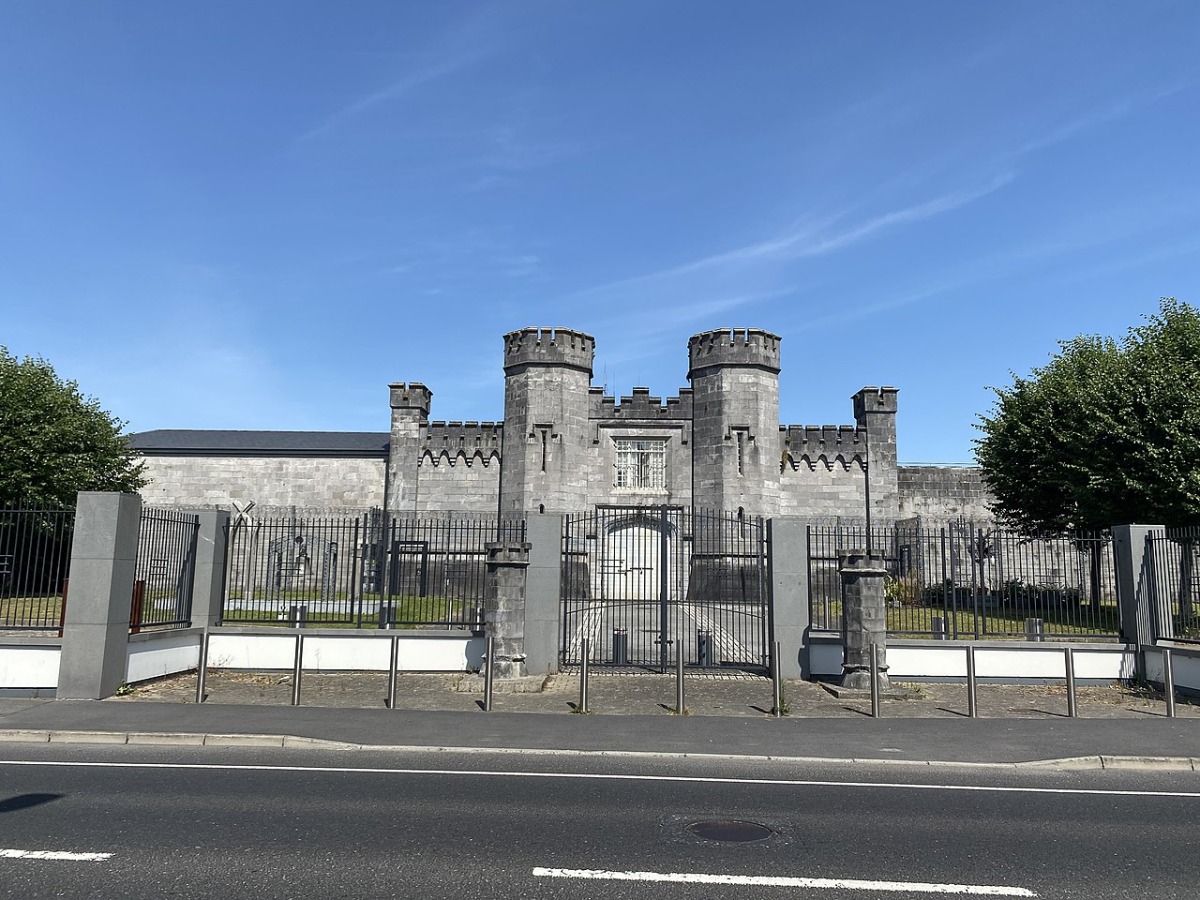
Portlaoise Prison.
The Prison
The Portlaoise high security prison complex is one of the oldest penitentiaries in the State. Built in the 1830s, it is still fully operational. Regarded as one of the toughest prisons in the world, it contains the notorious E-Block: a wing dedicated to dissident Republicans, predominantly ex-members of the Provisional IRA (PIRA) and the INLA.
Parallel to the prison’s official organization, during the Troubles prison officers had to understand and operate alongside the Republican’s own strict command structure. In the case of the E-Block, the prisoners’ relations with staff were filtered exclusively through the highest-ranking members of the PIRA. In 1988 that was Martin Ferris, who went on to become a T.D. for Kerry North between 2002-2020.
The history of Portlaoise Prison is chequered with multiple escape attempt, riots and blanket hunger strike campaigns. Allegations of prisoner mistreatment by a Heavy Gang first appeared at the Prison Officers Association convention of 1984.
On that occasion a delegate from Portlaoise Prison, Larry O’Neill told the Prison Officers’ conference in 1982: “If Hitler wanted generals today, he would find plenty of them in Portlaoise. After the war the Nazis said many of them were doing their duty and that is what the management in Portlaoise are saying today”.
Away from the public eye, the working conditions of prison staff, especially South of the Border, have rarely been covered. An official inquiry was carried out in the wake of the Good Friday Agreement, but for reasons that remain unclear, Sean O’Brien’s testimony was excluded after he had initially been invited to testify. The resulting report falls short of exploring the extent of the human rights abuses that seem to have occurred behind the prison’s walls.
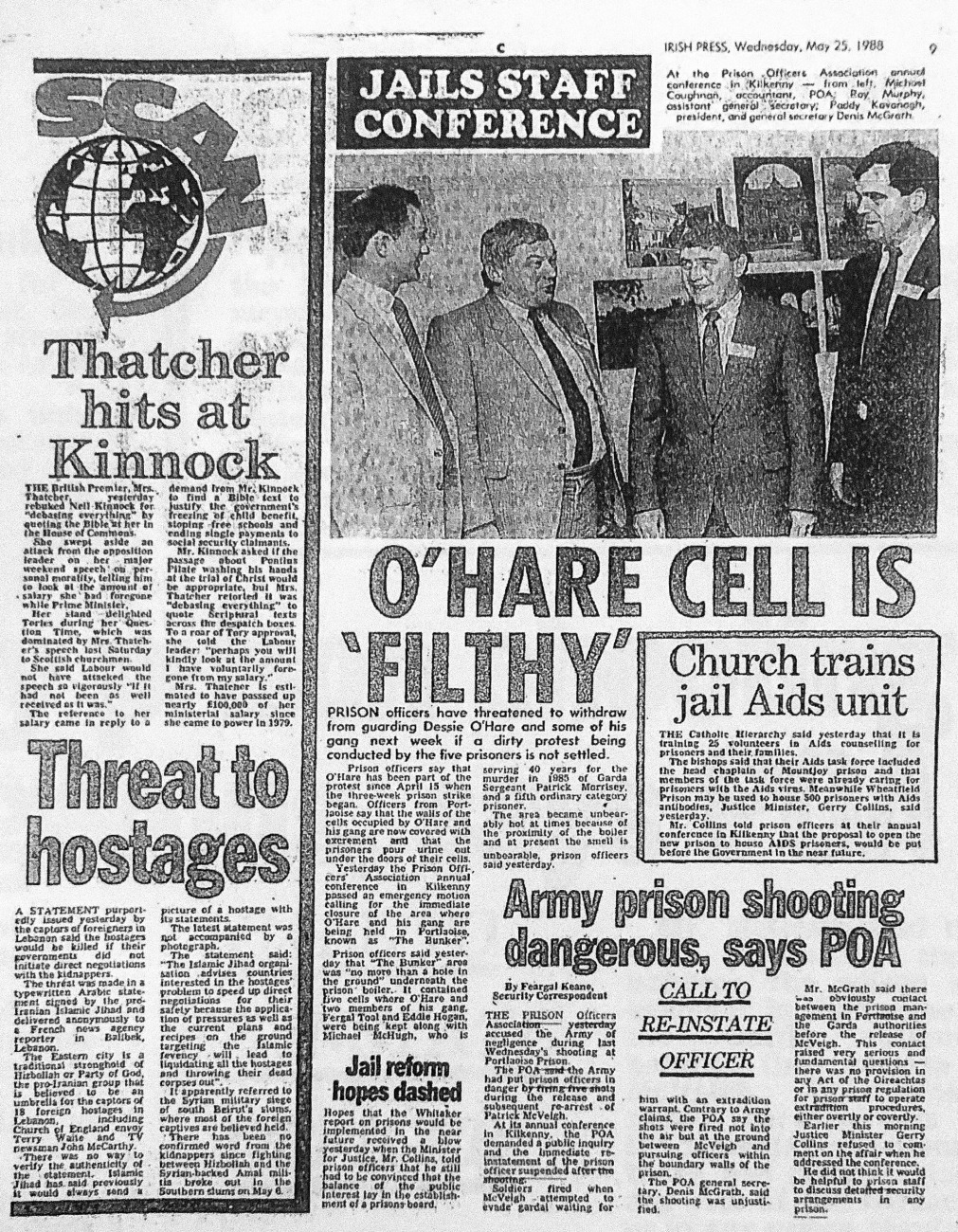
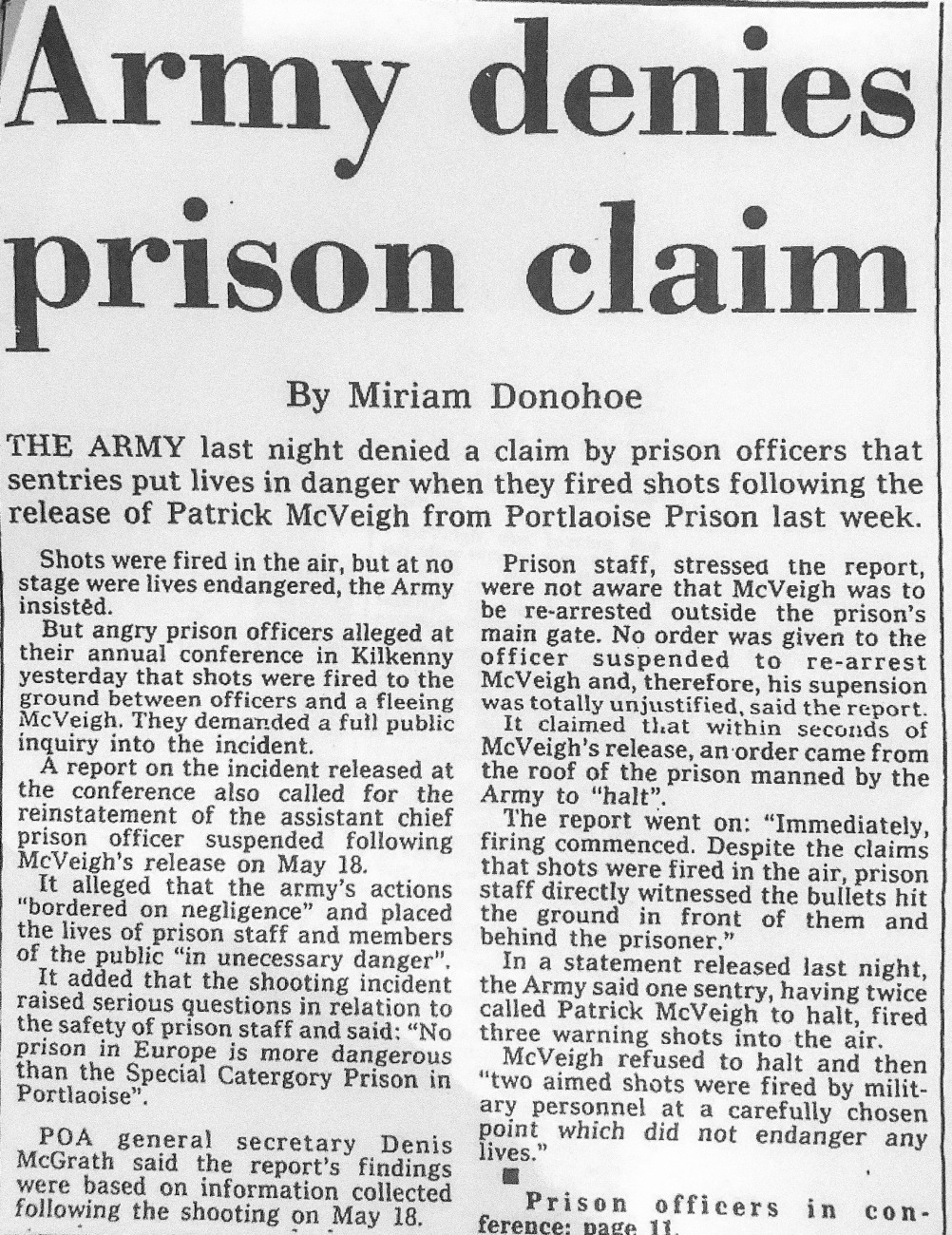
Irish Press, May 25, 1988.
PO Sean O’Brien
From a working-class family, Sean O’Brien began his career as a prison officer on February 16, 1980, aged twenty. The ‘job’ consisted of dealing with the most problematic, and in some cases dangerous, individuals in Irish society. Due to staff shortages, this work was mostly given to young and inexperienced men in their late teens or early twenties.
The training was basic, lasting just a few weeks, and involved a few meetings, active service in different prisons, physical exercise, and simple inductions on the regulations of the institution. None of this offered much value to someone beginning their work in the State’s prisons.
Sean clearly recalls spending his twenty-first birthday on duty with colleagues; as well as when he had to wear riot gear for the first time during a protest, despite having received no training for what to do in that event.
He also recalls working through the so-called ‘dirty protests’, when officers were forced to use power washers to clean inches of prisoners’ faeces off the walls; and when he was involved in, and witnessed, prisoners receiving unwarranted strip searches, punishment beatings and enduring conditions which he describes as contrary to the Geneva Convention.
After one such strip searches, he recalls the Governor at the time, Bill Reilly – a man with a reputation for being particularly hard on Republicans – telling him and the late Chief Officer Brian Stack, who was working with him at the time, to “bait them again,” after Stack told him they had completed the searches. Sean recalls being reluctant to obey the order as his arm was exhausted from already meting out such beatings.
As a result of such distressing episodes, Sean claims that many prison staff turned to heavy drinking to cope with the stress that the ‘job’ entailed.
We cannot ascertain the extent of the human rights abuses in Irish prisons at the time as a veil of secrecy, or outright omertà, still hasn’t been lifted. In all likelihood, many episodes have never been made public, as it would involve the State accepting liability for its shortcomings.
What prison officers endured as a consequence of this environment ought to become public knowledge to ensure it does not re-occur, and so that the necessary redress process is put in place to assist victims of the State’s past failings.
Flash
In 1988, Sean O’Brien was living in a housing complex built by Portlaoise prison for officers and other employees a few yards away from the main gate.
Every morning on May 18, after the customary substantial bowl of porridge and large mug of coffee, the shift began as usual with a security search between the first two gates. This was followed by a meeting at the ‘Parade’, the canteen room, where all the officers on duty lined up to be assigned their positions and tasks for the day by the Duty Chief Officer.
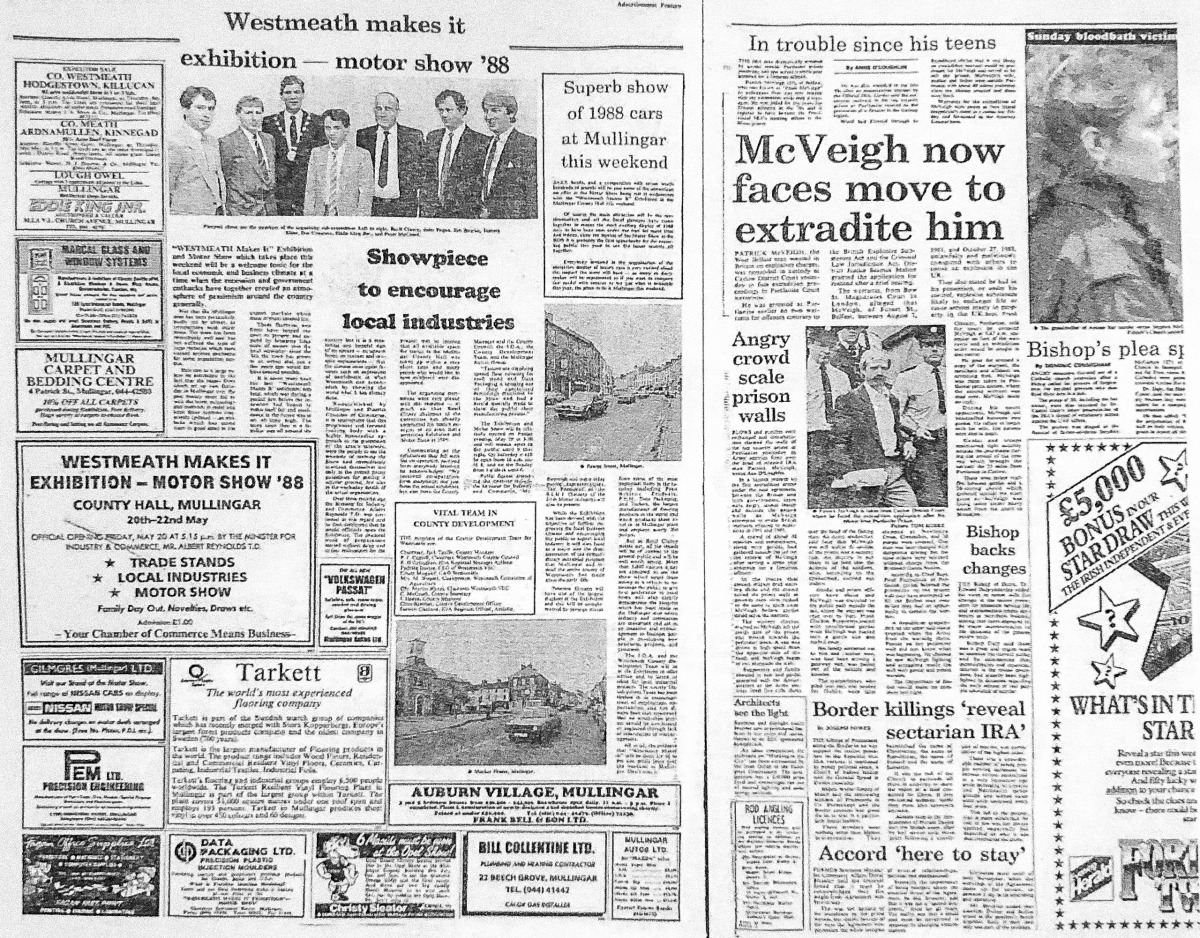
That morning a crowd of protesters and foreign media had gathered at the main street entrance in front of the prison on the Dublin Road. Patrick McVeigh, a member of the PIRA – known as Flash – was scheduled to be released that day. However, he was expected to be re-arrested by the Gardaí as soon as he stepped outside the main gate, before being extradited to Northern Ireland.
Tensions were running high in the prison at the time, and the issue had garnered considerable public attention. McVeigh was a political prisoner, and extradition laws did not cover prisoners with such status. Nonetheless, the extradition machine was in motion, as well as another machine attempting to find a way to save McVeigh from the extradition.
As Flash left the building, a crowd of his sympathisers greeted him at the gate, along with media reporters and a Garda van, with doors open ready to receive the newly freed prisoner. Why there was no other way to handle the exchange remains unclear.
Sean had elbowed his way in through the unfriendly crowd a few minutes before McVeigh was escorted to the Gardaí waiting for him outside the gate. From there he would be conveyed to Court to finalize the extradition.
At this point McVeigh somehow evaded his escort and began running along the inner perimeter of the outer wall in the hope of jumping out on to the Dublin Road.
Contrary to the Governor’s orders, his Deputy Mick Horan physically pushed Sean and illegaly ordered him into a shoot-to-kill area of the prison operated by the Army, shouting, “after him”. Sean obliged along with prison officer Frank Muldowney.
McVeigh had earned the nickname Flash from his speed of foot. He ran along the inner perimeter of the outer wall, reaching the place where, from the outside, accomplices were hanging off the wall to lift him out, where a motorbike awaited.
It was then that Irish Army personnel, stationed on the roof of the prison at all times, shot a sequence of five shots, which can be clearly heard from RTÉ footage of the scene.
Sean felt the reverberations through his body from the flying bullets which, he says, only narrowly missed him. On the ground a few metres away, shots landed in a puff of smoke. Adrenaline overcame fear, and he managed to stop McVeigh before he could leap out on top of the wall.
With the help of Muldowney, Sean brought him into the custody of two Gardaí, and he then made his way into the main prison building to resume his shift.
Apart from O’Brien’s testimony, as of November 2022, we came into possession of two additional eye witness accounts of the events.
One is from Martin Ferris himself. In a letter he writes:
From where I was watching in recreational room E3, a number of bullets hit the space between Officer O’Brien and McVeigh. Pat McVeigh attempted to climb the farm wall onto Dublin Road with the help of some supporters from outside and certainly, would have succeeded only for Officer O’Brien grabbing his legs and preventing his escape.
The second source says he witnessed bullets hitting the ground and bits of tarmac flying up around Sean, and that the distance from Paddy McVeigh was seven feet. However, he wishes to remain anonymous, unless an official inquiry is carried out into why this version of events has been consistently denied by the Department of Justice, the Prison Service, and the Department of Defence.
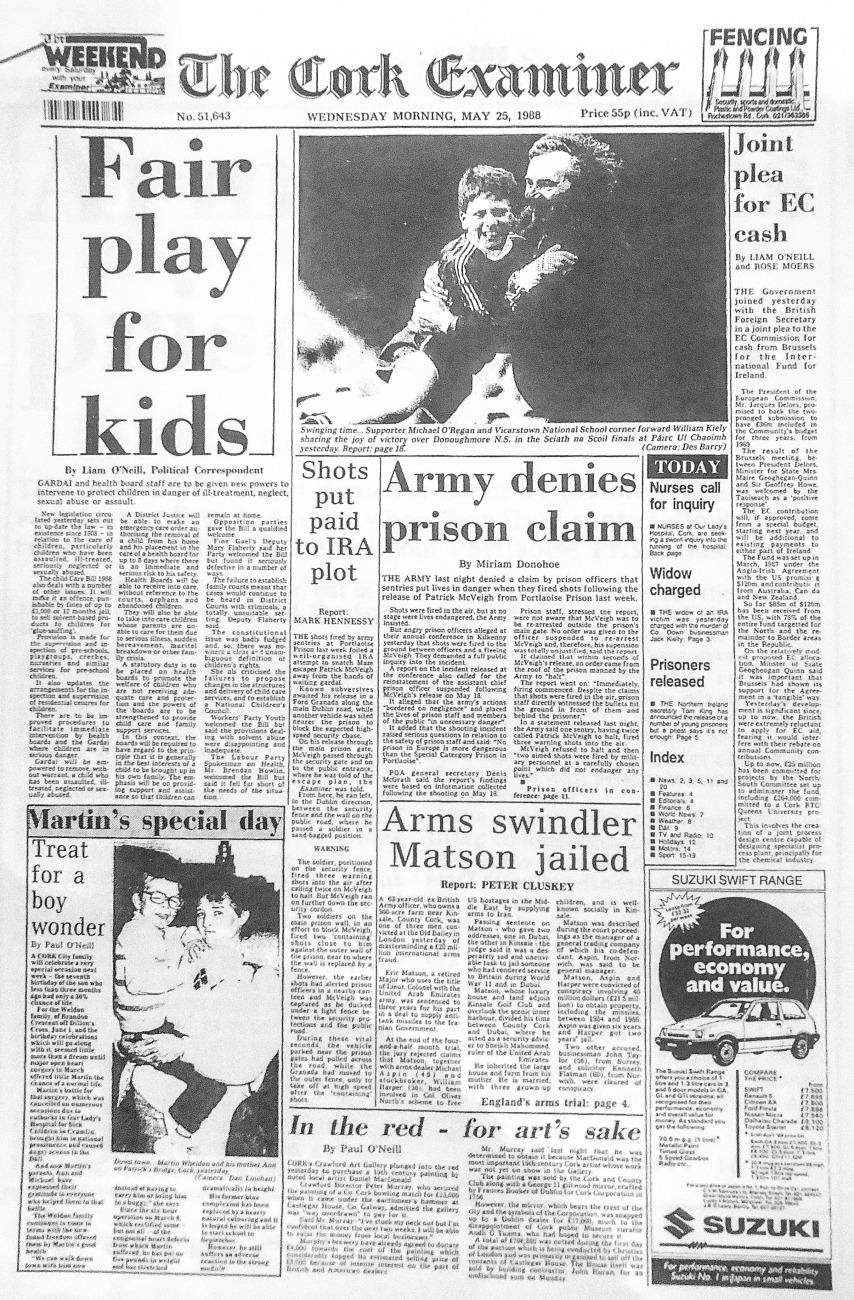
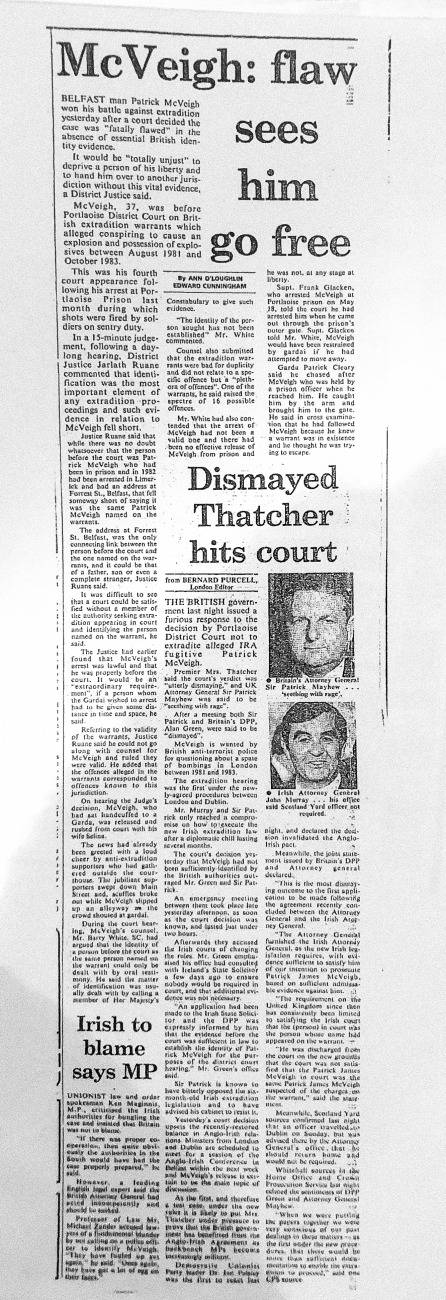
Cork Examiner, May 25,1988.
Half Sheet and the Governor
Not long after Sean had caught his breath, he received an order from the radio room of E-Block to report to Governor Ned Harkin’s office. As Sean was on his way there he recalls being praised and cheered by some colleagues.
He had just prevented an escape. That would surely lead to a commendation. Instead what welcomed him as he walked into the Governor’s office was a freshly typed false version of that morning’s events, which Sean was ordered to make a copy of in his own hand-writing, right then and there.
That version of events – insofar as Sean recalls – would have protected Deputy Governor Mick Horan, the officer in charge that morning of the release (and re-arrest) of McVeigh, and would attribute most of the blame to another prison officer Paddy Dunne, who was by then already being suspended, as a suspected accomplice to the escape.
Sean refused to comply then, and on dozens of occasions during subsequent days.
According to O’Brien’s protected disclosure:
The purpose of the Prison authorities ordering me to collaborate with their account as to ACO Dunne was to have him dismissed as not to shine a light on Deputy Horan who would have whole responsibility for Prisoner McVeigh escort on that day. Deputy Horan did not chase after the escaping prisoner. This is what Governor Harkins was covering up.
In response to Sean’s refusal to provide a false testimony, threats of dismissal such as “leave your uniform at the gate on the way out” from the Governor Ned Harkin became more and more frequent.
From then on he was not allowed to work on the landings where the prisoners were held. This meant that he was left doing nothing during shifts; waiting in a backroom for the end of the day to arrive. Day after day.
In that situation the first indications of deteriorating mental health became evident. This included frequent nightmares and strong paranoia, which started to make his days unbearable.
Sean knew that he wasn’t meant to catch McVeigh, and besides it would be normal to expect animosity towards him from some Republican prisoners. On top of being bullied for carrying out his job, he sensed a target on his back.
As Martin Ferris, in the aforementioned account, dated 12 November 2022, writes:
Tensions were high within the prison in the aftermath of this incident, and I, as the spokesperson for the republican prisoners, suggested to prison Governor Harkins that Officer O’Brien should not return to the prison landings until things calmed down. I personally never saw prison officer Sean O’Brien within the confines of Portlaoise Prison from that day forward.
It was at that stage that he asked the Prison Officer’s Association Representative Noel Touhy for assistance. He was told that it was not possible for the prison to dismiss him in that fashion. The Association was already pressurising the Department of Justice to reinstate Paddy Dunne, and trying to bring to light the dynamics at play in the attempted escape.
The Department of Defence consistently denied that the shooting could have endangered an officer on duty, as reported by the Cork Examiner on May 25, 1988.
Cork Examiner, May 25, 1988.
As recently as July 2022, Brian Stanley T.D. and Chair of the Public Accounts Committee asked the Minister for Justice “if there are any files being withheld for national security reasons that relate to the attempted escape of a prisoner on May 18 1988 at Portlaoise prison.”
The Minister responsed: “I am advised that the record in question was previously considered as not suitable for release by the Irish Prison Service.” (05/07/2022, Question number: 539, Question Ref: 36042/22)
The Office
On June 14, 1988, Sean O’Brien attended a meeting with Noel O’Beara in the Department of Justice in Dublin in order to: ‘[…] make them aware that the “Prison Administration” in Portlaoise Prison were ordering me to make a false report surrounding Assistance Chief Officer (ACO) Paddy Dunne’s involvement in the escape, to have him dismissed.’
Prior to the meeting, Sean O’Brien says O’Beara shook his hand and congratulated him, stating words to the effect of “you are going to get a medal, what type we don’t know, as one does not exist yet. The equivalent for the Gards is a Scott medal. You are the first prison officer to capture an escaping PIRA prisoner.”
But by this stage O’Brien was feeling his options were running out. The office to which he had been invited felt wrong from the moment he entered. He found no sign of personal effects – a family portrait, postcards, a sporting trophy or anything of that sort – such as one would expect in a regular office.
Despite a suspicion of being recorded without his consent, Sean gave as many details as possible, as well as disclosing the many wrongdoings he had witnessed during his years of service.
Essentially, he blew the whistle on what his superiors wanted him to do, and the wrongdoing within the prison system, while O’Beara listened and took notes. The meeting ended with a promise the matters would be investigated.
Sick Record
After this meeting, Sean O’Brian patiently waited for a change in his circumstances. Then he went on sick leave on September 12, 1988, for a stress-related illness. At that point his previous poor attendance record, in part due to a certified injury he had received while on duty, suddenly became an urgent matter within the Department of Justice and Prison Service.
Sean had already been referred by the Prisoner Governor and the Department of Justice to a psychiatrist (who also wishes to preserve his anonymity). He visited for the first time on September 8, 1988. This resulted in the first suggestion of a diagnosis of post-traumatic-stress-disorder (PTSD), following the shooting incident.
Nonetheless, behind the scenes, in a correspondence between the prison welfare office and the Department of Justice, his dismissal was being considered; while the full diagnosis of PTSD, resulting from a consultancy sought by the Prison Management itself, was completely ignored.
Correspondence which we have obtained includes a letter dated February 13, 1987, one year prior to the shooting, where the prison management tell Sean O’Brien that although the Minister had considered his dismissal, he also ‘noted the improvement in your sick leave record.’ It also states that his ‘late attendance has been unacceptably high since September 1986,’ and that his case will continue to be closely monitored.
Any management is likely to deal with a poor attendance record, but Sean O’Brien’s prior record seems to have been used to inform a response to his attendance after the shooting incident. It blatantly ignores the diagnosis of PTSD, or any other duty of care mandate that the prison service welfare office would have, or ought to have, had at the time.
A letter, dated March 29, 1989 directly from the Department of Justice, outlines the reasons why it cannot any longer accept the standard of the previous evaluation of a ‘marked improvement on an already atrocious pattern of sick absence.’
It continues by saying: ‘The result, if such a standard became the norm, would be to push the cost of absenteeism in the Prison Service from its present £3m. (approx) per annum closer to £4m.’
Thus, despite referring to sick absence, there is no sign of any attention to his medical condition to be found in this letter, which reads like a preparation for a dismissal.
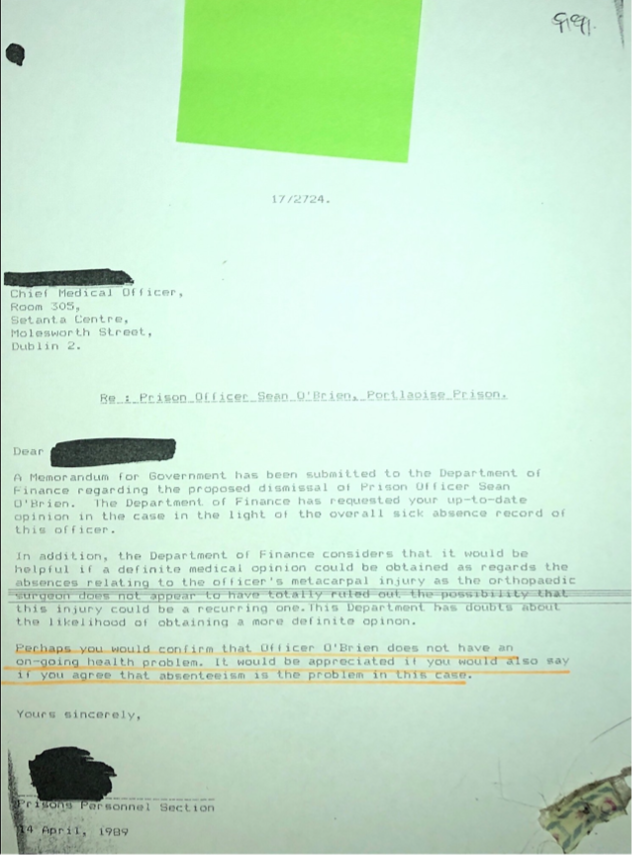
In a subseqent letter, dated April 14, 1989, O’Brien’s dismissal was actively being sought. The prison’s Personnel Section writes to the Chief Medical Officer that:
It would be helpful if a definite medical opinion could be obtained as regards to the absences relating to the officer’s metacarpal injury as the orthopaedic surgeon does not appear to have totally ruled out the possibility that this injury could be a recurring one.
This injury occurred in 1983 and since then he had required recurring treatment and suffered constant pain. Thus, some of the absences being used to prove his poor record seem to have been a direct consequence of this injury.
The letter ends with a pointed request:
Perhaps you would confirm that Officer O’Brien does not have an on-going health problem.It would be appreciated if you would also say if you agreed that absenteeism is the problem in this case.”
Apart from the recurring physical injury, the year between the shooting incident and his dismissal is constellated with absences, arguably caused by his deteriorating mental health.
Debilitating insomnia, extreme paranoia, crippling anxiety, flashbacks; all these symptoms have led to a diagnosis of PTSD, but again there’s no sign of a duty of care wherein the psychological damage received while on duty is recognised.
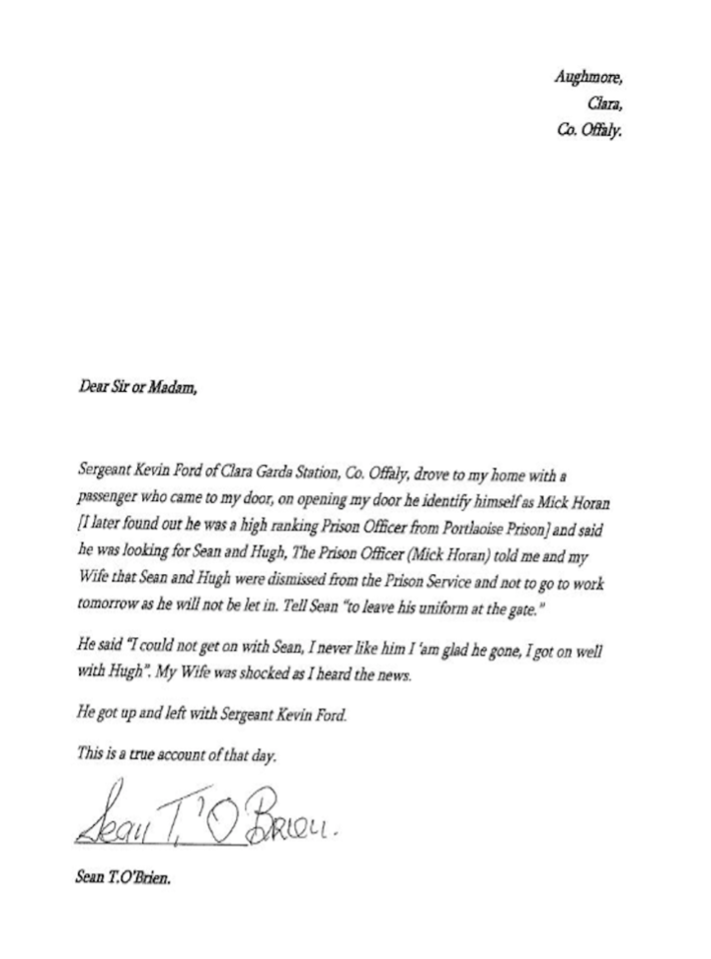
Instead, on May 23, 1989, at approximately 3pm, a knock arrived on the door of O’Brien’s parental home. It was Senior Prison Officer Mick Horan and Garda Sergeant Kevin Ford. They are looking for Sean and Hugh O’Brien (Sean’s brother, also employed at Portlaoise Prison) to tell them that they were both being dismissed. They are asked not to turn up at work the following day. His parents are instructed “to tell Sean to leave his uniform at the gate”.
So Sean O’Brien and his brother were dismissed from the Irish Prison Service with a verbal notice delivered to their bewildered parents, without any official document being issued by the Cabinet of the Irish government.
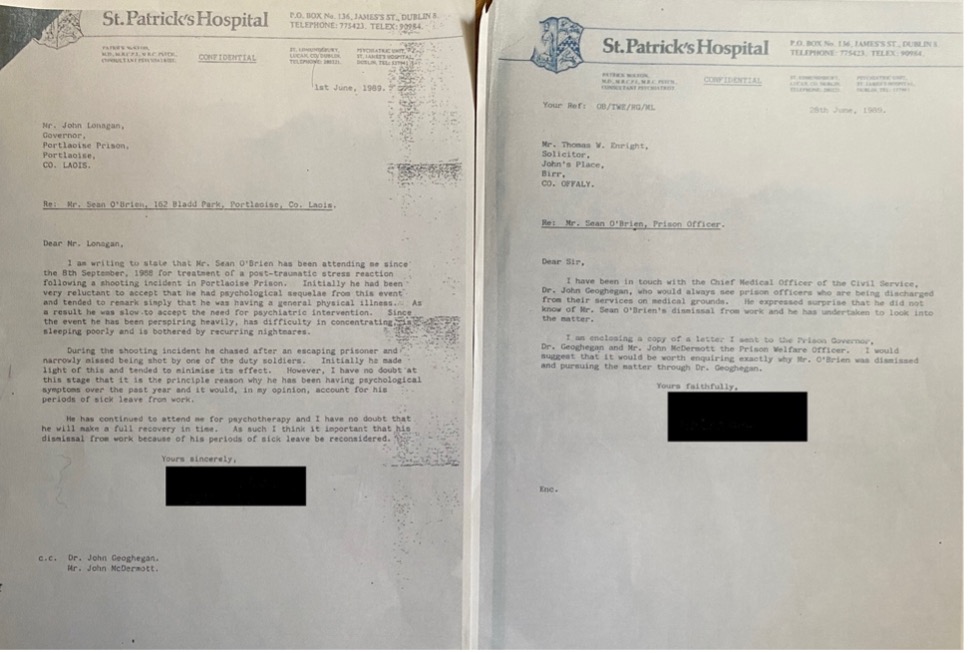
Following this we discover from the letters obtained from St. Patrick’s Hospital that the prison’s chief medical officer John Geoghegan did not even see Sean O’Brian before his dismissal had been finalized. And we find more indications that his mental health injuries suffered while on duty had been completely ignored by the Prison Service in considering such a dismissal.
The Void
At the beginning of my interaction with Sean O’Brien, I timidly inquired about the long period running from his dismissal in 1989 to 2017, when he was approached by the former President of the Prison Officers’ Association P. J. McEvoy, who instructed a solicitor to pursue his requests for a Duty of Care under the 1956 Regulations, and recognition for his actions on duty, at a point when Sean’s mental health inhibited him from pursuing the case.
During that period, Sean O’Brien claims he was not in the right mental state to follow up on his case. It seems he let it slide. What he had endured by then in terms of psychological distress he is reluctant to recollect, apart from to liken it to hell.
After his dismissal, an alter ego emerged in his personality. All we know is that this alter ego opened a security firm with his brother and that at some point in 2007, he landed a helicopter onto the roof of a shopping centre, in his own words, to “collect a set of keys”.
The Missing File
The proceedings against the DOJ that began in 1991 were interrupted in 2008 when O’Brien’s solicitor, David O’Shey was placed under arrest.
Then, O’Shey’s documents, including those in relation to the case of Sean O Brien vs The Department Of Justice no.14045P, came before the Law Society.
Since then the file has disappeared without a trace.
It was only in 2017 that he was able to instruct another lawyer to pursue the case. By the time he served a notice of an intention to proceed, in 2019, twenty-six year had elapsed.
Thus far, efforts made by his new solicitor, Kevin Winters to find the file have been unsuccessful.
In the Court of Appeal Judgement, delivered on 27/01/2022 we read that ‘witnesses for the defence (Minister for Justice) cannot reasonably be expected to give evidence that could be regarded as reliable after such an interval.’
The Minister of Justice again denied many of the claims made by Mr O’Brien, including that he recaptured a prisoner who escaped and that he suffered PTSD after nearly being hit by bullets shot by the Irish Defence Forces, which also continues to deny responsibility.
Over the last few years, the case has gained a certain amount of media coverage, mainly concerning the dismissal and sick days. However, very little attention has been paid to Sean O’Brien submitting a protected disclosure to the same Minister of Justice two months after the shooting incident denouncing grave misconduct.
Nor has anyone considered that although O’Brien’s attendance record was certainly not exemplary – 682 days absent between 1980 and 1989 – some of these were due to an injury on duty which occurred in 1983: a fractured hand, and subsequently from 1988, symptoms of a psychological nature.
It would undoubtedly be difficult for any court of law to establish precisely what happened well over thirty years ago in such a complex and volatile environment, but this story seems to contain another lesson.
For many whistleblowers who feel that they have been wronged one of the most difficult challenges is simply to let go. To move on. The obsessiveness associated with their behaviour is often due to a lack of closure.
That Sean O’Brien is still pursuing a judgment in his favour thirty years on from his dismissal reflects this condition.
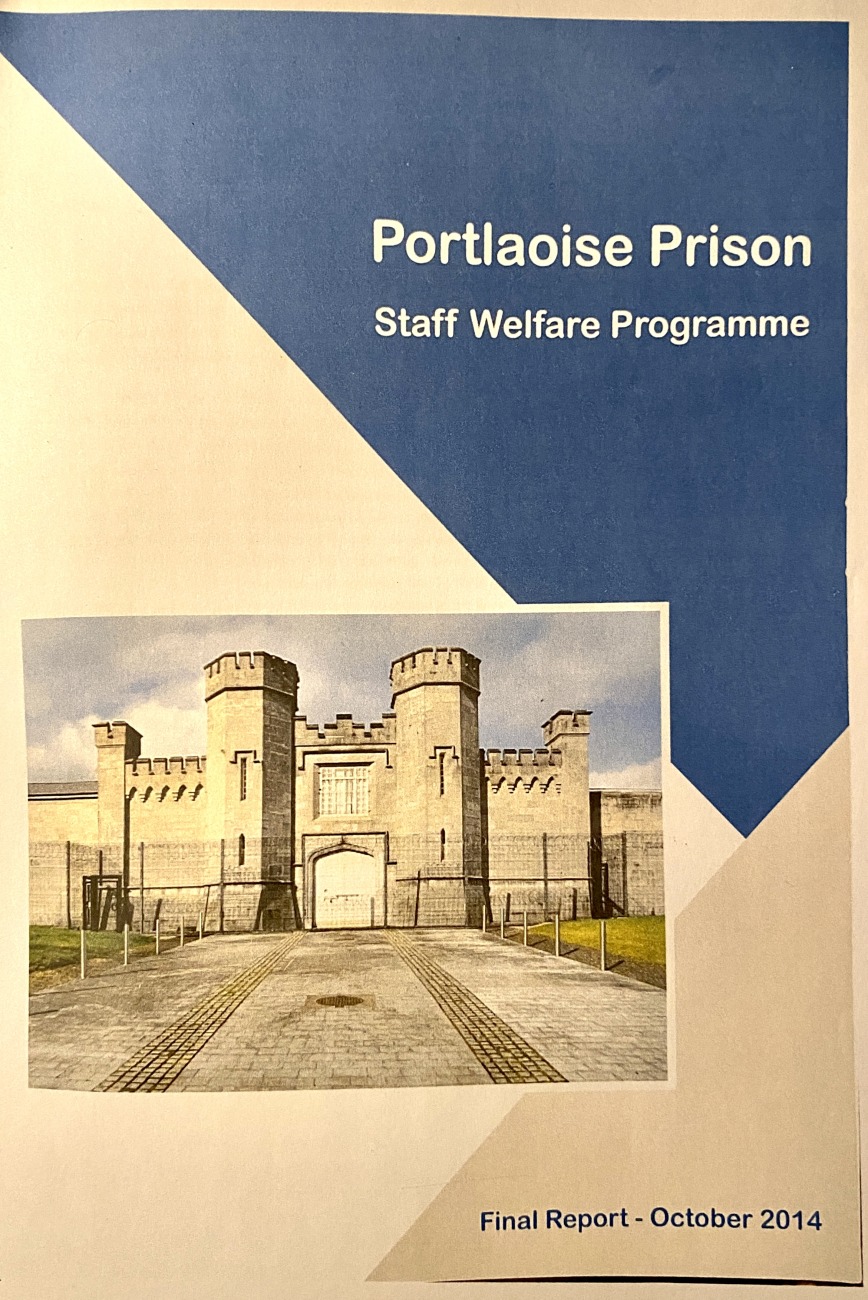
Only after an attempt is made by a State agency to delve into the historical context of these events can a sense of closure be achieved. A proximate attempt to do so by the Prison Service is what can be found in the Final Report of the Portlaoise Prison Staff Welfare Programme.
This a project carried out by the Prison Service, which recorded the testimonies of almost two hundred Prison Officers who served between 1973 and 1989.
Here we read that:
Portlaoise gave rise to practices that could only have existed in that particular context and the challenges it presented
…
In that time Knowledge and awareness of the lasting impact of occupational stress, of role ambiguity and role overload and of requirements for healthy, sustainable work practices have been transformed. Such knowledge and awareness were not widely available at the time. It is important to avoid judging the past solely in terms of present-day knowledge.
Thus, from this official source we learn that the working conditions were, indeed, unsuitable and outright damaging to officers.
It is reasonable to say we should not cast moral judgement on past practices during war time, but it still only seems fair that there should be compensation available for breaches of a duty of care that applied at that time.
Some respite from the silence that still engulfs this traumatized country should be available. Such is the long tail of war. You still see it slithering through the streets, long after the last shots have been fired.
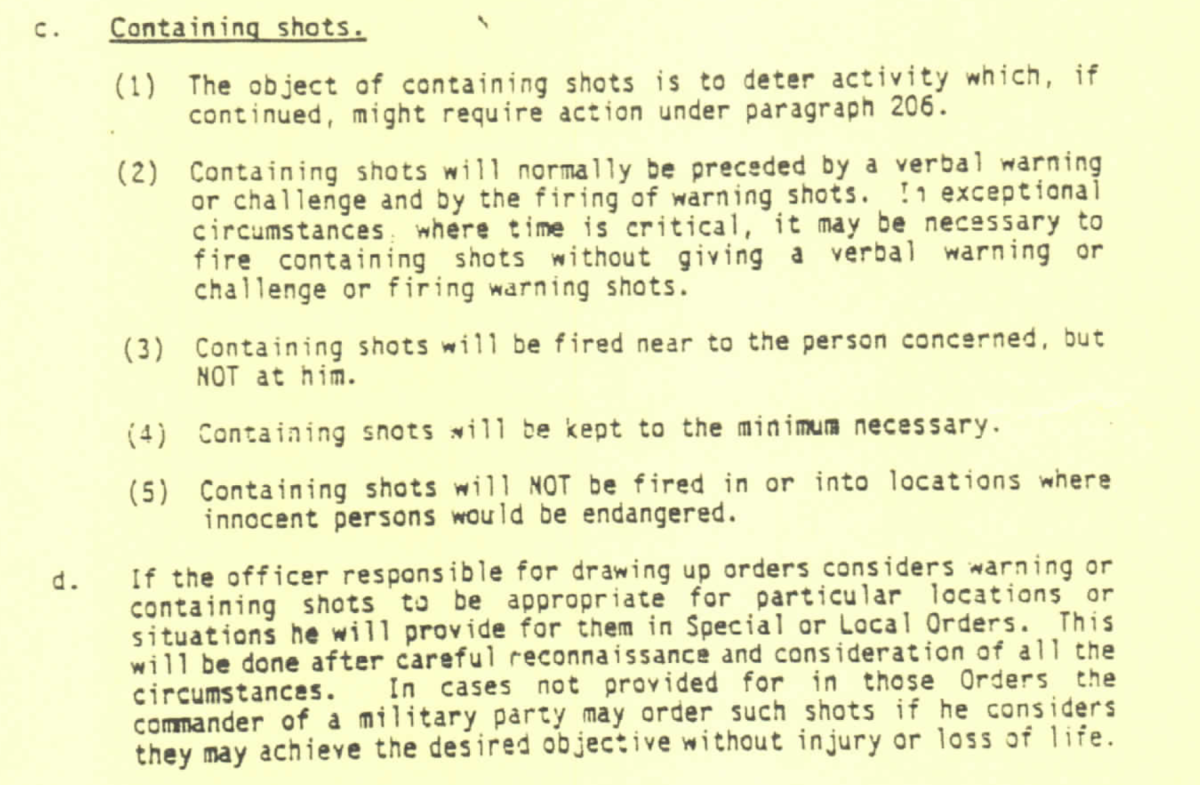
Regarding the shooting incident, it is instructive to examine the Irish Army’s Rules of Engagement from this period (below). This differentiates between warning and containment shots. The first, as one would expect, are ordinarily fired into the air, posing no danger to anyone’s life, while the second ‘will be fired near to the person concerned,’ but ‘NOT’ ‘into locations where innocent persons would be endangered.’
Based on Sean O’Brien’s account, corroborated by other witnesses, it would appear that these Rules of Engagement were breached, including a prohibition against firing at a target that is running away.
The Irish Army’s Rules of Engagment/ Use of Force in effect in 1988.
Conclusion: Whistelblowing in Ireland
The title image for this article, was taken towards the end of our first in-person encounter. The names of the dogs are Squirt at the front, Maxine on his right arm and Freddy – who was the most protective of Sean as I recall – Beauty hiding in the background and Mighty Man, named in honour of Noel Tracy TD. Treacy has always been very supportive of Sean. Apparently he always started and ended a sentence with “Mighty Man” when talking to anyone.
Having the company of dogs has been an important coping mechanism for O’Brien, while he deals with the effects of PTSD to this day.
We can say that the context of the Troubles legitimately required a certain level of secrecy. There’s obviously more then meets the eye to the events that ultimately led to the non-extradition of McVeigh, which Margaret Thatcher herself was very keen to achieve.
The Department of Defence, to this day, refuses to release the records in relation to the shooting incident, requested through a Freedom of Information Request in 2016, saying:
The release of this information may potentially compromise the security of the Defence Forces in preparation for peace and security operations at home and overseas.
Meanwhile, the first legal file in relation to O’Brien’s case has disappeared without a trace.
Whistleblowers suffer repercussions all over the globe, but Ireland’s reputation for mistreatment of whistle-blowers has worsened inexorably.
In 2021 Ireland’s Protected Disclosure Act undertook reforms to comply with a European Directive. Even then, according to some stakeholders, the new legislation still falls short of providing adequate protection from the inevitable repercussions of such a radical act.
Beyond the legal frameworks, better outlined in David Langwallner’s article “Whistleblew in the face”, which appeared in Village Magazine in November, 2021, the corrosive effects on a whistleblower’s mental health is often overlooked.
All too often, when an instance of whistleblowing reaches the mainstream media, these negative mental health consequences are used implicitly to discredit the disclosures. One of the first questions the media tends to pose to whistleblowers is “Why did you do it?”; followed by: “Would you do it again, knowing the consequences you would face?”
Both questions, somewhat deviously, shift the focus away from any wrongdoings that have been exposed to the action of whistleblowing itself; subjecting the whistleblower to moral scrutiny. Those kind of questions seem designed to suggest a hidden motive for why an individual has become a whistleblower.
Being subjected to such questions – including from oneself – might lead most of us to assume a defensive posture. Over time one may construct an elaborate justification for one’s action, as if the disclosure was itself a crime, and not, only, a testimony to a crime.
With thanks to Ben Pantreyfor editorial assistance.
Wingform is an hour-long piece of music I composed for Crash Ensemble between 2017 and 2020. Scored for twelve musicians, it has four ensemble movements connected by my own solo electric guitar passages, which act as a kind of connective tissue for the whole body of the work.
In 2017 I was invited to join Crash as a Composer-in-Residence as well as an electric guitarist, after which Wingform was commissioned. Being embedded in the group and growing as a musician during that time has made it the largest and most personal piece of work I’ve ever put together. I’m fortunate to have been able to work so closely with a hugely talented, open-minded and creative ensemble of players, and to have the opportunity to push the boat out in my own approach to the electric guitar as a solo instrument and as voice within a modern chamber orchestra.
Beyond the raw sounds themselves, Wingform’s biggest influence is like that of a lot of art: that overwhelming feeling of awe that comes from being confronted with nature in all its beautiful and grotesque and serene and scary forms– especially from its more hidden corners – and wanting to somehow channel or rebuild those found natural sounds and structures through the medium of music. While this is destined to fail in any literal sense the moment it is mediated through humanity and technology, the hope is that some of that uncanny non-human musicality carries through into the final work, giving that mystic sense of having plugged into nature in some small way.
The sonic seed of the piece is a short recording of a tiger mosquito swarm, stumbled upon at the beginning of the composition process. Putting aside initial preconceptions toward the sound and listening, you can hear in this mass of wing vibrations a strangely haunting, melancholy chord. Providing the root note is an electrical hum which in most situations would be unwelcome, but here it creates a striking quality of animal merged with machine that captured my imagination.
I scored out this wave-like, gliding mosquito chord for the instrumentation of Crash, in an approach borrowed from French spectral composition. I then messed around with the orchestration, creating all kinds of variations and contortions: glacial subterranean groans; double-speed Doppler flashes; delicate shimmers; and vertical chords broken into horizontal melodies. After workshopping and recording these with the players of Crash, they became the sonic palette that I would use throughout the whole piece, like a sort of shape-shifting mantra.
The piece as a whole tries to feel like a living breathing organism, and the electric guitar runs through and between movements like connective tissue. I constantly asked myself how could I make the guitar behave and sound less like itself and more like a piano or a percussion instrument, and embraced alternate tunings and unusual techniques to help unlock this. This went on to influence the winds, string, piano and percussion, which interacted with the strange sounds of the guitar to form new kinds of flavour combinations.
The opening movement is a slow-burn: it’s based on the idea of a slowly descending line, introduced via slide guitar, that gradually unspools from high shimmers into a really big snaking melody. Ebbing and flowing below this, like a tide, are the mosquito chords.
Movement II feels like faulty machinery reclaimed by nature. A tense and glitchy groove, played amazingly by pianist Máire Carroll, holds together a lattice of sounds. There are a lot of loops on the verge of collapse, and a sense of windows opening briefly into parallel musical worlds only to be slammed shut.
Movement III also plays with loops on the edge of stability, and constant forward motion with a rickety handmade feel. It combines some nods to the language of jazz and post minimal music with more hard-edged and sometimes grotesque sounds, often playing with the contrast between them as if turning a dial to a point of intensity.
The fourth movement is glacially slow, with a floating sense of grief to it, like the end of a life cycle for the organic whole. It’s an emotional and structural climax, bringing us right back to the original mosquito chord and finishing out on that initial electrical hum, the whole ensemble droning along with two oscillators.
Wingform really brought together the various threads of my musical life like nothing else I’ve done: the hands-on, aural approach to electric guitar as my native instrument; the traditional composer’s sketches with pencil and manuscript paper; audio and MIDI collage on Logic software; and a constant back and forth dialogue between all of these things before the final project was typeset in score for players to make a reality. Going hand-in-hand with this is the hybridity of the sound world, which absorbs elements of many musical languages I’ve worked in over the years.
Composing a score like this is a long, solitary process, and by its very nature you often have to take a leap of faith in believing that what you have written down will sound as good as your inner ear did when you imagined it, and that some of that magic gets through to listeners on a visceral level at the other end. This kind of music can be dense with a lot of moving parts, but for the audience it’s really there to be felt and experienced, not over-analysed.
In my other experience as part of a band, there is always a collaborative mixer where everyone ends up giving feedback and co-authoring in real time, regardless of whose original demo was brought in. It’s different with a score like Wingform,where you are the sole composer, and more needs to be decided and structured before you ever send it to players, with whom time is scarce. The development workshops I did have with Crash players, who were totally supportive and engaged, were crucial not only for test-driving bits of material but also for keeping my morale alive.
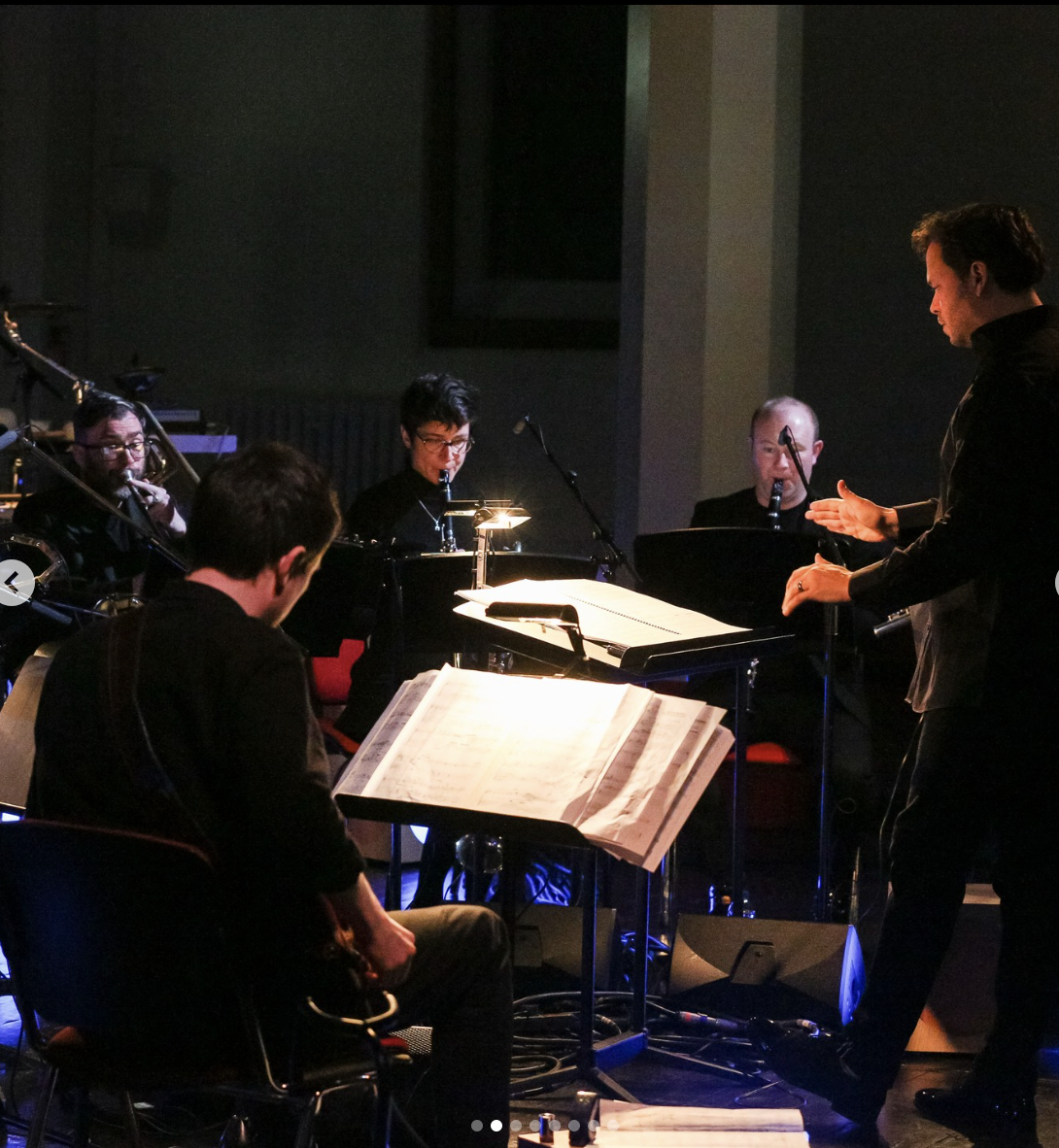
Huddersfield Contemporary Music Festival 2022 (Image: Simon Marshall).
Wingform was completed at the beginning of 2020, right as the pandemic was beginning and the certainty over when it would see the light of day suddenly evaporated. It was cruel timing, but the gut punch was softened by the solidarity with every musician internationally experiencing something similar. It was all the more cathartic when we premiered it streaming at New Music Dublin 2021, and this year with a live audience for the first time at Huddersfield Contemporary Music Festival 2022 followed by Crash’s 25th birthday celebrations in the National Concert Hall in Dublin. It’s also toured as an installation, created by video artist Jack Phelan (pictured).
Installation, created by Jack Phelan (Image: Charlie Joe Doherty).
By the time we reached the end of each performance, the drones vibrating through our bodies, it felt as if we as an ensemble had been through a long, vivid and disarmingly emotional journey, in the work itself and beyond. I hope that Wingform evokes something similar in listeners.
When I’m Allowed Leave The Cancer Ward with thanks to Claire Higgins for four of these lines
When I get out of here
I plan to open a factory
that manufactures miniature guillotines
which will be given away gratis
to bullied schoolchildren
to keep hidden in their bedrooms
until I give the signal.
When I get out of here
I plan to finally take that evening class
in Industrial Espionage for Beginners
where I’ll learn to break into laboratories
to steal the antidotes
to Elon Musk and
Ursula von der Leyen.
When I get out of here
things will be given their proper names;
the centre of every town re-titled
Oppression Square, during a ceremony
in which the Mayor (or someone prepared
to dress up as the Mayor)
tells the truth about who died,
how, and why.
Worst of all,
I’ll start a new Irish Literary Awards
to be held annually at an imaginary hotel.
Categories will include: least authentic
poetry collection, most intellectually empty
novel, most cowardly book review,
publisher who made the biggest
eeijt of themselves this year,
most over obvious networker,
most irrelevant but self-important
anthology, most incestuous
“My Books of The Year” list
in which the author chooses
pals who’ve all given him
fab reviews too.
And you’ll sit there constricting
the exact same muscle
Auntie Mary did when she was in fear
someone was about to take
the Archbishop’s name in vain.
Did you a struggle to understand and navigate your way through events surrounding our response to Covid-19 in Ireland? Did what at first appear to make sense, as a reasonable and decisive reaction to a dangerous virus, seem, over time, to become increasingly absurd?
Even cursory examination of the data shows large inconsistencies in our response, which at the very least warrants further investigation. The facts and primary data kept pointing to a counter-narrative, very much at odds with the official line relentlessly and consistently being pushed on us from the media and official sources.
From mask mandates, lockdowns, the media campaign against Ivermectin, mass vaccination and finally and most chillingly, the vaccination of children and pregnant women. Policies did not appear to stand up to even the most basic medical or scientific scrutiny. Yet few appeared to be questioning them. Apart from a few dissenters who were cast away as heretics, there was a complete absence in traditional Irish media, or the medical and scientific communities, of scrutiny or challenge.
So we now find ourselves, almost three years from the start of this unprecedented event, in a world that seems to want to move on, and forget what happened as fast as possible. There is little appetite for reflection, or any possiblity of individuals acknowledging mistakes and suggesting we will respond differently in future.
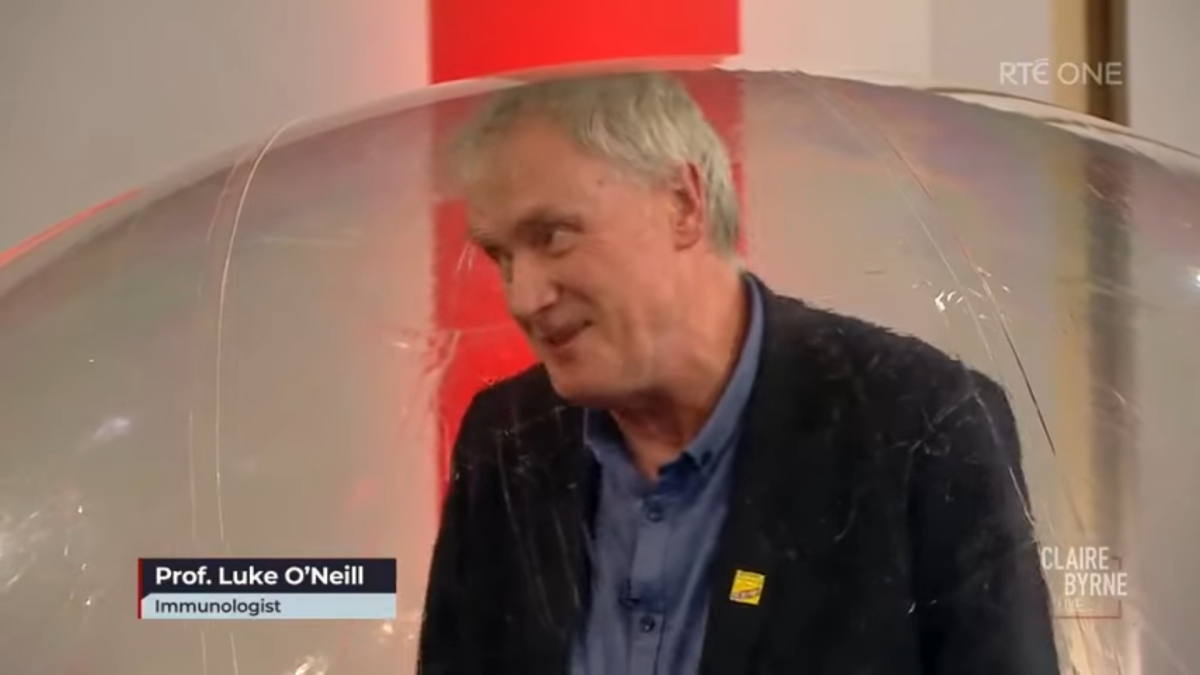
Indeed, in a recent interview on RTE’s Brendan O’Connor Show, when gently prodded by the presenter as to whether we might have been a bit stringent, Professor Luke O’Neill claimed ‘the only option we had at that time was to lockdown’ in March, 20202, otherwise ‘a lot of people could have died’. As this was on radio it was impossible to know whether he was saying it with a straight face, but he is surely aware that Sweden, despite refusing to lockdown, had one of the lowest death rates in Europe over the course of the pandemic.
Across the political spectrum, there is almost complete denial of errors and even less appetite to take responsibility for the long-term consequences of policies. Yet, as more and more facts emerge showing the fundamental flaws in our response to Covid 19, the larger questions that remains are: why did policies that were clearly not in the public’s best interest become government policy, and how did this come about?
Unless we understand why this happened the questions on how it was handled will be candles in the wind. Untethered to a motive it makes no sense. This requires an understanding of context and motive.
Mattias Desmet’s theory of Mass Formation offers an extraordinarily insight into both why and how this kind of event can happen. Desmet, a Professor of Clinical Psychology at Ghent University, draws on his clinical experience of the behaviour of crowds and group think, as well as the work of others in the field, in particular Hannah Arendt.
Unsurprisingly, Mass Formation and its role in our response, did not occur as a result of Covid nor is it the first time in human history it has happened. The roots and causes have been emerging for many years with the growth in what Desmet describes as the mechanistic society.
Since the Industrial Revolution began in the late eighteenth century, the Western world has seen continuous improvements in wealth, living standards and health. No matter what the problem, there seems to have been a scientific solution or medicine to solve it.
However, we have become increasingly averse to risk and uncertainty as technology has solved problems and cured illnesses.
In parallel, the steady decline in organised religion and a spiritual dimension to our lives has left us increasingly adrift and rudderless. We have been left without a north star of substance, dependent on a mechanistic world to deliver food, entertainment and pleasure in never-ending supply.
In that mechanistic world there are no grey areas. There is either a solution or no solution. The application of the mechanistic model to social and philosophical questions has left no space for ambiguity. The nuances and complexity of life that our poets express is lost in a world where you are either right or wrong.
It is within this social milieu that Mass Formation can occur, but for it to take hold requires a number of specific conditions. Desmet outlines the first condition as generalised loneliness, social isolation and lack of social bonds in society.
The digitalised society we live in has given us immense connectedness with our fellow humans, from next door or the other side of the world, but the quality and texture of that connectedness does not compare to direct human-to-human contact, which we have been drawn away from.
That lack of connection to a religious or spiritual grounding has left people in a constant state of underlying anxiety. Desmet talks about the vibrations of a people and how this anxiety is a constant in their lives, as evidenced in the relentless increase in the use of antidepressants and anxiety medication.
The global market for antidepressants in 2020 grew from $11.7bn to $14.9bn representing a 28% increase in a single year. At a time when we have never had such abundance, we have never been more unhappy. The more we own and can do, seemingly, the more unhappy we have become. The connectedness, sense of purpose and spirituality we enjoyed, has been replaced with an ‘always on’ digitised anxiety.
Finally, there is the search for meaning in life. As our worldly needs and desires are met, we are confronted with a more fundamental question as to the meaning of our lives. The connectedness we had in the past, where we interacted with the people who manufactured a product or povided a service has almost completely disappeared. Most of us are now small cogs in the global supply chain. We are part of a mechanistic world, which seeks efficiency and productivity, but which leaves the human cogs feeling soulless and lost.
Image (c) Daniele Idini.
Suggestive Story
So how does Mass Formation emerge from this world? Desmet describes how the catalyst for Mass Formation can be a suggestion or story in the public sphere. With society so conditioned, any suggestive story causing anxiety and fear can be the ignition point. The process leads to psychological gain. The anxiety that roamed through society like a fog can attach itself to a specific cause. It is no longer free-flowing but has a cause to attach to and draw energy from.
As the level of fear increases, the cause developing it draws in the masses with a call to solidarity and collectivism. Those refusing to participate are accused of lacking solidarity and civic duty. “You don’t want to kill granny” was levelled against offenders as an unarguable fact that only the most callous would ignore. As the Formation deepens it no longer relies on facts or data. The masses believe the story, not because it is accurate, but because it creates a new social bond.
The strategy of dealing with the perceived object of anxiety creates ritualistic behaviours. The function of ritualistic behaviours is always to create group cohesion. They are symbolic and aimed at subjugating the individual to the group. The more absurd the ritual, the more power it has in forming group cohesion. We think of space markers in public parks, fences around concert goers and Ireland’s most renowned scientist appearing on prime time TV in a plastic bubble, as only some of the ridiculous ritualistic behaviours we were sucked into performing. Few questioned them: the more outrageous they were the more we adhered.
The psychology of crowds is well researched and to those that ask well ‘surely all the doctors and scientists can’t be wrong’ one can point to the well-known conformity experiment by Solomon Asch. Participants are asked which line from A B or C is the same length as Exhibit 1. The experiment is set up with a single participant in a group of 8 where the other 7 members are Asch’s employees. The 7 employees declare that line B is that same length as 1. Faced with the pressure of the crowd 75% agree to what a blind man could see to be untrue. Group formation is more important than the accuracy of the story.
Enemies of the People
Finally, the masses need an enemy. The dominant group needs to contrast the virtues of good citizens with the demonic followers of a counter-narrative. Pent-up frustration and aggression are released. Those that do not go along with the Mass Formation feel the brunt of this behaviour. There evolves a rapidly reduced empathy and intolerance towards those not in the group.
Statements from public figures that those who choose not to take vaccines should be denied hospital care were greeted by the mob with relish. Ursula von der Leyen, the EU Commission president stated in Dec 2021 that the “EU must consider mandatory vaccination”.
The Nuremberg Code of 1947 and codified into law by the UN in 1966 was built on the principle of informed consent, yet this fundamental human right was jettisoned without debate or question.
Statements from ‘liberal’ Prime Minister Trudeau in Canada and Ahern in NZ intimating they would make the life difficult for the unvaccinated difficult contained an explicit menace and threat that is not normal in our society. It betrays a shocking abuse of power.
Frank Armstrong reviews a new book on the Irish government's response Covid-19 and wonders whether it will be said once again: “We didn’t know, no one told us”https://t.co/vikPQsuFMa@broadsheet_ie@danieleidiniph1
So, the remaining question is whether those in power knowingly planned and executed the greatest breakdown and dismantling of some of the most cherished values in Western society? Was there a master plan with covert meetings and messages shared among the key players? The answer is probably no, or at least that’s not necessary for it to happen in what appears to be a cohesive manner.
The world was ripe for a Mass Formation and the leaders of the Western world, one by one, consciously or unconsciously, seized on the fear and anxiety that Covid generated to exercise extraordinary power.
They stood by and allowed power to move from elected officials to technocrats who previously held no authority. Their technocratic authority, Holohan in Ireland, Fauci in the US, Whitty in the UK, made them unchallengeable. The most benign questioning was met with a cry of being anti-science and idiotic.
Hannah Arendt used the term the ‘banality of evil’ to describe the dull bureaucrats who participated in the Holocaust, and who wielded extraordinary power without a moral or ethical compass. They were just following orders. There may not be a conscious awareness of the harm being done, as most of these technocrats, and leaders, will have bought into and have been victims of the Formation themselves. What they were conscious of, however, were the levers they could exercise to deepen and extend it.
As soon as it started it became very obvious, they could exercise almost unlimited power over the public without challenge. Almost no force was necessary. The number of occasion where police were needed to enforce lockdown rules were very rare. Mass Formation ensures self-governance. Those who disagree are forced by the crowd to comply or face being banished as outcasts.
So where to now? Covid has subsided for now, but the costs and damage have yet to be fully accounted. It will take many years to tally that human suffering and the financial bill. It may require the current actors to leave the stage to allow the facts to become readily available, and for the public to see the full tragedy of our self-inflicted wounds.
The possibility arises that this will reoccur in the event of another pandemic. Are those who tasted almost complete power really satiated?. Unfortunately it’s hard to imagine the crack-cocaine-appeal of that kind of power will not draw them in again. The question is what event will they weaponise, what fear will they jump on as the catalyst for the next Mass Formation and the return to a totalitarian regime?
Despite all the controversies in the run-up, and as with the last World Cup in Russia, most people are now looking beyond the politics, and enjoying the feast of football.
For many of those attending sporting fixtures, this is akin to performing a religious duty in a secular age. The rest of us generally slouch in front of TV sets and even squint into smartphones to satisfy compulsive appetites. In Ireland we have a particular grá for team sports as participants but mostly viewers, or even as virtual participants, with the advent of video games.
The rewards for sportsmen, in particular, are staggering, but many are left on the scrap heap at an early age, while others count the cost in later life with psychological and physical trauma.
"the World Cup itself is a bizarre and inexplicable thing. It temporarily requires even the most autocratic and despotic regimes to drop tools and play nice."https://t.co/ymOH6ZZPxB This report from the 2018 World Cup in Russia is worth revisiting!
The popularity of sports entertainment stretches far back into European history. The gathering of crowds for sporting occasions was a feature of Classical antiquity, when these spectacles were explicitly connected to religious worship. Held in honour of Zeus, the king of the gods, the Panhellenic Olympics of Ancient Greece ran from 776BC until 393AD, and attracted participants from across the Hellenic world.
Later, Romans were fanatically devoted to circus, which featured gladiatorial duals to the death. A note of caution was sounded, however, by the poet Juvenela c. AD100, who witheringly identified panem et circus (bread and circus) as the primary concern of the people:
iam pridem, ex quo suffragia nulli / vendimus, effudit curas; nam qui dabat olim / imperium, fasces, legiones, omnia, nunc se / continet atque duas tantum res anxius optat, / panem et circenses.
[… Already long ago, from when we sold our vote to no man, the People have abdicated our duties; for the People who once upon a time handed out military command, high civil office, legions — everything, now restrains itself and anxiously hopes for just two things: bread and circuses.]
Sport remained an important feature of life in medieval Europe, where knights tested their valour and prowess in vainglorious jousts. Hunting was also popular among the aristocracy at the apex of the feudal pyramid. Pursuit of animals, referred to as ‘game’, was generally not motivated by their value as food: consumption conferred status beyond gastronomic pleasure.
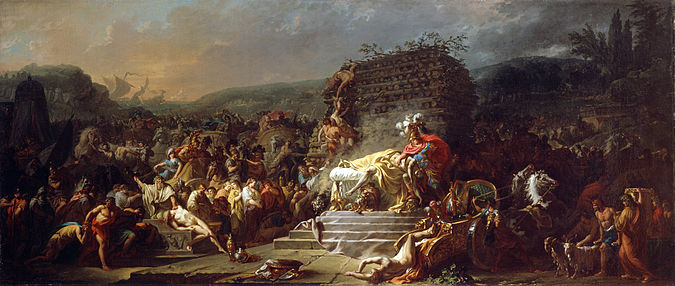
Pre-modern sports bore a close resemblance to warfare, and, the conditioning of a participant overlapped to a large extent with a warrior’s training, as one sees in ancient epic, such as with the funeral games of Patroclus in Homer’s Iliad. Tests of physical prowess, advantageous on the battlefield are evident, as well as skills such as archery and javelin, which are clearly a preparation for warfare itself.
The Funerals of Patrocle, oil on canvas. Jacques-Louis David, 1778.
Fight or Flight?
At a sporting event, an audience could experience the thrill of battle without risking dismemberment, although the qualities esteemed in the heroic athlete may have whetted a thirst for blood.
This may lead to an assumption that sport fosters a destructive, competitive instinct. George Orwell was of the view that: ‘sport is an unfailing cause of ill-will’. But denial of the amusement seems curmudgeonly. Sport can bring us together rather than tear us apart. Perhaps it depends on the underlying psychology of the crowd.
The nineteenth century incubated most of the sports that are now prevalent in our culture, including the GAA. It was in Britain, where the Industrial Revolution began in earnest, however, that mass attendance of sporting events by a new working class originates, as stadiums accommodating tens of thousands of people sprang up in a newly urbanised society. Here we find the codification of now global sports such as Association Football, Cricket, Rugby (Union and League), tennis and field hockey all of which now have a global reach. Others, such as golf and motor racing emerging in more rarefied environments.
Interesting, it is in the anglo-sphere that alternative sports emerged to confront the British invasion; in the United States, basketball, American Football and baseball; in Ireland the GAA developed our distinctive sports; even Australia and Canada developed or adapted their own codes. This demonstrates the importance of sport as a source of identity in the English-speaking world where other cultural markers such as food seem to have been of less importance.
The popular sports in our time depart from Classical and medieval precedent – notwithstanding the revival of the Olympics in 1896 – in the skills demanded of the participants. Although most contemporary sports still demand serious athleticism, their skills sets would be of no particular use to a soldier, especially one engaged in modern, technological warfare; although the skills of the gamer might prove very useful indeed.
Nonetheless, modern sports are still animated by martial fervour, accessing, and perhaps controlling, that primal instinct to compete and, for men especially, to discuss the competition. Orwell opines that: ‘At the international level sport is frankly mimic warfare’, but at that time most men, unlike today, had trained to be soldiers.
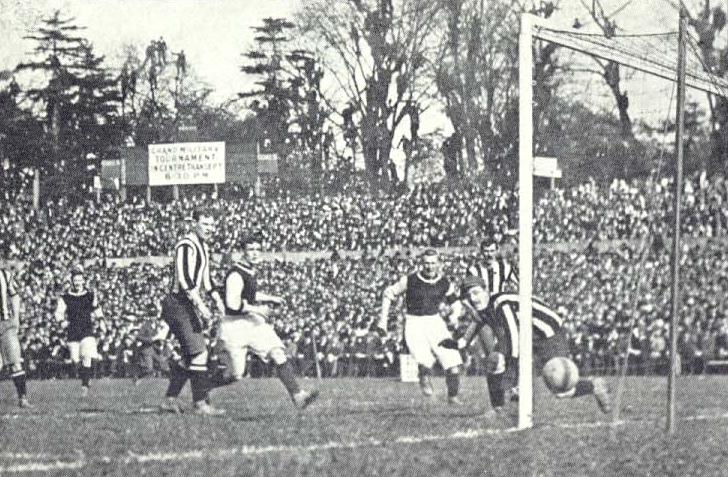
Harry Hampton scores one of his two goals in the 1905 FA Cup Final, when Aston Villa defeated Newcastle United.
Judgment
The demonic ‘Judge’ Holden in Cormac McCarthy’s no-holds-barred novel Blood Meridan (1985) describes war as ‘the ultimate game because war is at last a forcing of the unity of existence’.
He argues that:
Men are born for games. Nothing else. Every child knows that play is nobler than work. He knows too that the worth or merit of a game is not inherent in the game itself but rather in the value of that which is put at hazard. Games of chance require a wager to have meaning at all. Games of sport involve the skill and strength of the opponents and the humiliation of defeat and the pride of victory are in themselves sufficient stake because they inhere in the worth of the principals and define them. But trial of chance or trial of worth all games aspire to the condition of war for here that which is wagered swallows up game, player, all.
The ‘Judge’ is right insofar as the higher the stakes the more gripping a sporting fixture becomes for an audience that puts aside its daily trials to vent their passions.
The worth of the participant is defined by their success or failure at crucial moments. But ‘the Judge’ is mistaken to assume that defeat is always a humiliation, as any crowd may honour a team or individual who loses with good grace, and sport is not only about winning; ‘greatness’ is also measured by how a loser conducts himself in defeat. Thus Harry Kane is above criticism despite missing a (second) penalty, while the Argentinian team are roundly condemned for rubbing defeat in their opponents’ faces.
It is striking that Swiss psychologist Carl Jung regarded games as being of the utmost importance for the wellbeing of societies. He said that ‘civilisations at their most complete moments … always brought out in man his instinct to play and made it more inventive’. Sport, he proffered, connects us to our ‘instinctive selves’.
Sporting success can really raise the morale of a nation, such as the Irish after World Cup Italia 1990. The connection to a team or individual should not be dismissed lightly. Even in defeat, fans can summon a spirit of togetherness that is not necessarily oppositional.
The popularity of sports may be connected to the decline of religious worship, but the religious origins of sport have not faded entirely – fans often pay homage to virtues of self-sacrifice and togetherness associated with spiritual traditions.
Moreover, with lives increasingly sedentary and indoor, sport returns us to the idea of a challenge that melds innate athleticism and skill. This is both a natural gift, and the product of training.
The audience also enjoys the mental side of the game, considering how a team or individual will triumph or fail in advance of a contest, and assessing why a particular outcome has occurred in the aftermath. It can be the springboard for discussion between complete strangers, generally leading to camaraderie rather than conflict.
Sport has also become one of the last redoubts for mythology at a time when this generally operates on the margins, or in childhood fantasies. Commentators are given licence to rhapsodise about the divine characteristics of participants. We bow before sporting gods, satisfying a latent desire for non-rational explanations, and a taste for supernatural interference, deus ex machina: ‘the hand of God.’
Sports journalism, unencumbered by constraints imposed on ‘serious’ journalists, vents superstitions and often casually averts to curses; ‘legends’ abound in sporting parlance.
Why did Messi not get a yellow card? Listen people, let's settle this once and for all. When a football God like Maradona or Messi handles the ball, it is not his hand at work but the "Hand of God". This is football theology 101. pic.twitter.com/GRvXrhIRwc
All this serves to enhance the appeal of ‘titanic’ battles, but sadly we are, increasingly, lured by the theatre away from examination of the vexed political questions of our time.
The assessment of Bill Shankly the former manager of Liverpool FC is worth revisiting: ‘some people say that football is a matter of life and death. I assure you it’s much more serious than that’.
It was therefore fitting then that when Jose Mourinho arrived in British football as manager of Chelsea FC in 2004 he chose to present himself as the ‘Special One’. For a time he carried all before him, with a little help from Russian billionaire Roman Abromovich.
Sporting occasions also offer a Dionysian alternative to lives that are increasingly constrained by social conventions. In what other arena of life can a grown adult scream and shout with unrestrained fervour, orr even streak naked across a pitch?
Sport imports a communal sense of belonging, evident in the crowd at a huge stadium and in the often transnational ‘imagined community’ of fans of a particular franchise. Support for national teams affirm a sense of belonging to the ‘imagined community’ of the nation.
The medium is the message. First television, and now increasingly the Internet, allows individuals, living thousands of mile away to support teams, often comprised of players from around the world.
Mythological themes are played out in real time. The truly great teams, it is said, are those that learn from defeat, just as the heroes of epic returns from the trial of Hades the wiser. We also encounter the tragedy of the flawed hero whose indiscretions are captured by the ravenous paparazzi, and attributed to the wider failings of youth.
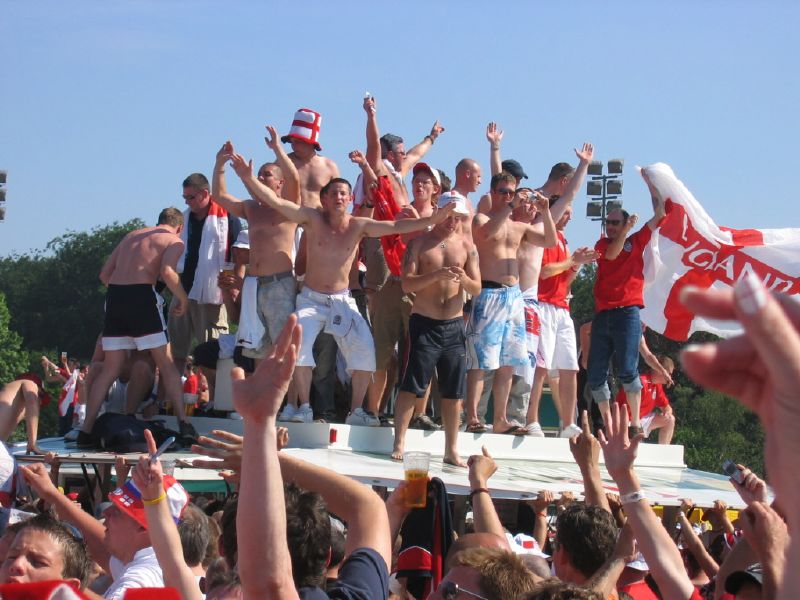
English football fans at the 2006 FIFA World Cup.
Too Much of a Good Thing?
Yet we can have too much of a good thing. Attention to sports has reached pathological intensity. Slick marketing has moved an instinctive pleasure into a compulsive and easily-satisfied desire, activating demand in a manner that is almost pornographic.
In particular, the multi-billion euro football industry uses every available opportunity to lure child and adult alike into compulsive purchasing of television channels and merchandise that is gaudily flaunted. More troublingly still is the expansion of online gambling.
Young men are now paid unconscionable fortunes for playing games, which many would happily participate in for far less, or no financial reward at all. Televised sport used to inspire kids to imitate their heroes, now with gaming technology they don’t have to leave their couches, and the obesity pandemic carries all before it.
Rupert Murdoch recognised that sports would act as a ‘battering ram’ for his pay TV, an example most newspapers have followed. Sports coverage underpins a neoliberal zeitgeist by providing an alternative, apolitical, space with elements of tragedy and farce; villains and saviours; loyalty and betrayal.
Grandeur is evoked through metaphors such as the ‘trench warfare’ of a tight contest or the ‘phoney war’ of a friendly fixture; ‘citadels’ are ‘stormed’, and ‘no quarter is given’, along with specifically supernatural ideas such as ‘demons’ being ‘exorcised’. Stress is laid on the grandeur and importance of the events unfolding: thus we regularly learn that ‘history is being made.’ Too much of our lives, my own included, are absorbed by the spectacle.
With the degree of psychic energy devoted to the affairs of circus, it is hardly surprising that political involvement is increasingly the province of the paid-up professional; that the percentage voting has declined precipitously; that elections are explained by analogy with sporting fixtures; and that often warfare itself is relegated to the periphery. The widespread obsession is barely questioned by a media that feeds the fervour, and certainly not by politicians that display their colours to appear like regular guys.
It was Saturday morning. Maher was lying in bed. He had just woken up. It was early yet, before eight he could tell. When he had been a much younger man, he had been able to lie in for hours on end but ever since he had passed 30, which was almost twenty years ago now, he had found it impossible to sleep on once he had woken, which was typically before eight on the weekend, maximum, and 5 or 6am minimum on the weekdays.
He looked around him. Light was already beginning to filter through the dark yellow curtains that he had bought particularly for his bedroom. This had been one of his greatest discoveries in terms of interior decoration, as the soft light they diffused helped him to acclimatise gently to his surroundings. And, considering he was such an early riser, he needed this bit of morning douceur. It was the first in a complex and methodical line in his defences against the onslaught of the day. For Maher, life was an unending struggle, or at least, series of struggles. War in short. He had always felt this, ever since he was a young boy. So, when he finally came across the figure of Heraclitus, in his first year in university while majoring in philosophy, he had been endlessly consoled to read fragment 64, literally translating as the thunderbolt steers all things. In other words, from out of conflict came everything!
As he lay lying there on his bed watching the wedge of light widen a little through the gap in the heavy curtains, Maher could not but help think of the unending cosmos. This was reflexive. Maher, obviously, was a morning person. It was, without any doubt, one of the plethora of reasons why he was single. His ex-wife used to joke to him, after they had separated of course, of the years of abuse he used to subject her to with cosmologically ruminations like this, first thing in the morning. She would joke, sometimes almost seriously, that she was sure that she would be open to pursuing a claim for psychological abuse after the years that they had spent together and all the subsequent trauma she had faced after being subjected to Maher’s monologues.
She had a rich sense of humour, Maher smiled, thinking about her now. However, obviously not rich enough.
As Maher finally lifted himself up off the bed, he heard the pitter patter of Dave, the dog. Dave was a Jack Russell. Mad as a box of Jacks! Maher had read somewhere that the breed was rather particular as they were convinced, apparently, that they were human, not canine, which as far as Maher could tell kind of helped to explain their rather anti-social behaviour vis a vis their four -legged brothers and sisters. Dave, for example, basically wanted nothing to do with other dogs. Except of course when he had an urge, and that was basically it. Apart from random acts of sodomy, typically rather perversely involving a rather aged mongrel, Dave, as far as Maher could see, did not particularly give a shit about his fellow quadrupeds.
Maher sat on the side of the bed, half contemplating the face of his pet who was, as was his systematic habit, sitting in the most physically endearing position imaginable, for human empathy at least. That was another character trait, Dave the dog had a most uncanny knack how to make himself cute as possible, somehow shrinking himself by adapting a very specific posture, typically first thing in the morning, making his shoulders go in, contracting every part of himself so that he appeared physically as small and so as defenceless as possible. The head would tilt then slightly, that was when he really wanted to work on Maher, he would tilt his head in this impossibly cute angle, the eyes then would look appealingly at him so that the invisible bubble-like memes above his head would float up.
“I need you.”
And Maher would just look on, indeed as he always seemed to, helplessly with some amazement at the eternal ingenuity and downright cleverness of the creature. Only that very year, animals had been granted sentient status in a government bill, in the UK. Maher had greeted the news with incredulity. After two thousand years and counting, finally, they were now recognised legally as being thinking creatures! Christ, Maher, could not think of any human who met a Jack Russell’s level of conniving and sheer trickery. Personally, such attributes he found rather admirable.
“Okay, Dave, I’m with you man!” he addressed the dog.
All too often, Maher observed, Dave was the instigator of communication. Non-verbal, of course. Dave was only prone to bark on two occasions. Firstly, when someone approached the front door, typically in the form of a courier or the postman and secondly, when they were down on the beach and Dave wanted Maher to play fetch, typically with a common stone that Maher would throw for him along the beach.
Maher sat in a face-off with Dave for a further few moments before Maher eventually capitulated and got up off the bed.
In the kitchen, Maher approached the coffee machine. He had ordered it from Italy directly from the manufacturer. Oh, it was nothing fancy. It was more like something from the nineties, Maher’s favourite decade. In other words, it was still quite mechanical, rather than electronic. Maher didn’t trust technology, at the best of times. He was of that generation that was somehow in between both worlds. Not quite wholly 20th century, not quite wholly 21st century. Born on the cusp, as it were. And, fundamentally so.
He ground the coffee which he retrieved from the big golden foiled packet which he also ordered online. It came from Naples. The Neapolitans were great blenders, and particularly of coffee. Maher had once visited the city with Claudia when they were still in their honeymoon period. Oh yes, the days of magic they still remained in the great storehouse of the mind. Golden memories reflected back to him now in the reflection of the light on the coffee packet, such were the unholy correspondences. There was never any escape from memory. It was Proustian, that equation.
After grinding the beans, he filled the cartridge with five spoons of the precious powder, before screwing it in place. He prayed that the filter was clean before pressing the start button. Miraculously, it sprung to life and poured, literally, into life. When the espresso cup was three quarter’s full, he flicked the switch and admired the colour of the coffee against the white quartz of the counter top. It was a thing of beauty, he told himself. Then, he filled a mug with soya milk and placed it in the microwave heating it for 75 seconds. It was the same beautiful ritual every single day. Finally, when the latte was ready, Maher versed the content of the espresso cup into the mug of warm soya-milk. It turned a beautiful tan. The first sip was always delicious. This is what he needed. Such continuity. Every single morning. It was, after all, the only thing he could be certain of each and every day. This, along with the incredibly rich taste of the coffee in the warmed milk, was what made his morning ritual so particularly special. Maher stood in the kitchenette staring down at Dave. Mornings never got any better, he thought.
Once Maher had taken Dave outside the front door, the usually circus started. Every time it was the same. Dave, the minute the collar was placed around his neck, would start barking and jumping about. I had forgotten, there was indeed a third criteria for Dave when it came to barking. This was inevitable, the barking. Also, the omission. Maher, considering himself to be a prisoner himself, in the most global existential terms, he had nothing but sympathy for Dave’s predicament, and what is more, rather than get frustrated by Dave’s constant frustration and ultimately his persistent rebellion, Maher openly approved of it. It only cemented, at least for Maher, their already precious bond.
“Good man Dave, that’s it!” Maher would encourage him.
“Don’t take any shit, from any of them!”
It was almost as if by addressing the dog thus, Maher was in fact talking to his alter-ego.
Up in the castle grounds, Dave, typically, was in his element. Maher had taken him across the cove as the tide had been out and then they had walked across the sandy expanse of coastline, which was usually completely devoid of any human activity. Maher found it was a real tonic as it helped to clear away all of the white noise that still lay combusting in the furnace that was still his mind; all the accumulated stress of the commute, the apparently unending tension which earning a monthly paycheck necessitated, life being reduced as it was to a strict timetable and series of schedules involving train times, scheduled appointments with customers or clients and all of the countless minutiae that made up a working day X 5.
So, in this way, just watching his dog run about the castle grounds without so much a care in the world somehow seemed to ease Maher’s peace of mind. It was almost as if the dog’s delight was a symbol or sign of Maher’s own peace and contentment so that he began to see Dave almost as an extension of him, in some way.
Typically, Maher would then take Dave through the small wood which ran alongside the edge of the cliff looking down onto the beach below, although you couldn’t see the cliff’s edge from the paths as they were too far inland, approximately 25 meters or yards away from the edge and whose visibility was also blocked by so many trees and plants and other forms of vegetation.
Maher loved to walk under the great boughs of the trees and while Dave typically would scamper about the wood, going in and out between the trees just enjoying the general feeling of freedom of movement without having the leash attached to him, Maher would, at the same time, stare up at the sky directly above his head and marvel at the colours that would confront him. The deep azure of the sky contrasted sharply by the verdant colours of the leaf in spring and summer say, although now it was midway through Autumn and there was a slight chill in the air as if someone had switched on the fridge.
There was a certain section of the wood where the path joined two others and some beautiful old trees formed a kind of island in the center of the junction forming a clearing, effectively, where the sunlight would stream in, particularly during the summer months, but even in the Autumn too like right now. Maher stood there as if appraising the phenomenon of the light pouring into the clearing almost as if in liquified form. It was a phenomenon that he really enjoyed as it made him think of Heidegger who likened these kinds of clearings, for he too was a great woodsman, or Lichtung, to the spaces in the mind where thought could occur in illumination…
Maher thought it was an extremely poetic analogy or idiom and he often thought of the German thinker when he passed this clearing in the wood. Thinking, in general, is one of the reasons why Maher would come up here as he found the great expanse of space and time, the unlimited acreage of the demesne allied to the timeless nature of the walk, in that he was, for once in the week, not bound to some schedule be it train or academic (Maher was a Lecturer in a third level institute in the city), brought a truly metaphysical dimension, in the proper meaning of the term that is, in other words when spatial and temporal notions collided in a rather fortuitous manner, so actual thought, as opposed to mere reaction, could actually take place.
Indeed, Maher often found himself engaging in discourses with Dave his dog, in other words, while he was up walking in the local castle grounds, which most of the time were devoid of people, Maher found that it helped him to actually give physical embodiment to his thoughts in the form of his own voice using Dave the dog as a receptacle. It was the old Socratic method of uttering what one thought, (or was it Platonic?) and by doing so one could actually physically embody one’s thoughts in one’s voice so that one could clearly see them better, as opposed to just leaving them unvoiced in the cocoon then of one’s mind.
“The current situation, it seems to me,” Maher began, throwing cursory looks around him there in the wood to make sure once again that he was in fact alone and seeing that he was he felt further emboldened so that he could continue his discourse proper.
“Concerning the sexes, that is. It would appear to be really quite clear that there is a profound discord in the nature of popular discussion today between the sexes, that is to say between men and women. Why is this? Well, first of all, let’s try to clarify further what it is exactly we mean by this statement. So, when I say that there seems to be a rupture in communication between men and women I really want to further specify between heterosexual men and heterosexual women as public discourse between the two seems to have become completely splintered or fragmented into the overall discussion of identity politics which seems to be interminable now and which is really strange as both heterosexual couples would appear to be completely excluded in current popular debates, having been taken over by fifth wave feminists now and queer ideologues.”
Maher laughed aloud at this pronouncement as he imagined the startled sighs of dismay if he had actually dared to utter such a statement on an unsuspecting public in a public forum, it would go off above their heads rather like an invisible bomb. This was good, he imagined himself now preparing to support his thesis before them, standing behind the rostrum. Dave his dog, meanwhile, ran on through the vast expanse of fields embracing, without question, the unlimited nature and scope of physical freedom.
“I mean, take poetry, for example. In the current context, here in the Republic of Ireland today, you have an almost ludicrous situation where heterosexual men have almost been banished from the public spectrum of debate and in many public readings because of the extremely predominant nature of identity politics which indeed has completely taken over the realm of all public discourse and particularly in the arts, poetry, always being the poorest medium, being the place where the damage has been almost terminal. What are the reasons for this? Well, without a doubt, poetry was always the preserve of white male middleclass privilege in this country, especially since the origins of the state right up to the 1980’s and nineties. You only have to look at an anthology of Irish poetry from this time, take John Montague’s Faber Book of Irish Verse, for example first published in 1974 and you can see that the representation of Irish men to Irish women is 52 white male Irish poets, and generally hetero, to 2 Irish female poets covering the period from W.B. Yeats (1865 – 1939) to Montague, which is a truly shocking figure, I grant you. The two Irish women poets represented in the book were Evan Boland and Eiléan Ni Chuilleanáin. That ratio is worth repeating so as in order to better take it in.
52 / 2
That’s covering a period of say, 100 years.”
Maher let some time pace, as he walked with his dog, in order to let the content of the figures sink in. This was the country that he had grown up in, after all. If this wasn’t a sign of patriarchal orthodoxy, he didn’t know what else to call it. And it certainly existed, until the sudden war of feminism, which started in the eighties, and then the other voices entered in the nineties. First Gay, Trans, and then Lesbian. Maher remembered it all well and clearly growing up in Cork and the arrival of the first gay bars and vegetarian coops. They were the original pioneers in the new quest for cultural and personal identity.
Maher stopped to take in the view of the Irish Sea before him, the vast expanse of mercury tinted liquid shimmered before him in the breeze.
Those were such very different times, he thought. The shoe now was very much on the other foot. Maher was representative of the white middleclass heterosexual poet personified and completely sidelined to such an extent that he couldn’t even get a book published in the country, so under-represented was the nature and style of his work. The situation was actually bordering on the ludicrous. He remembered only just a few weeks previous sitting in a public park where the Arts Council had installed a screen with a number of black and coloured poets reading their work, all women of course with a token gay or other ‘under-represented minority’, that was the preferred terminology, wasn’t it? And this was all happening as a response to the Black Lives Matter protests that had recently happened in the USA and also in the UK. Here was the thing, the percentage of black Irish nationals in the country was hardly similar to the percentage per head in the populations of both the UK and the USA. But that point, extremely relevant you would think in the context, did not seem to occur to the blessed powers that were. No, they were just conforming to the international zeitgeist of identity politics, as opposed to actually considering the literary value of the work. Maher had watched the lectures and talks of Harold Bloom dating from as far back as the nineties when he had seen the whole catastrophe of identity politics taking over. And, he had been right. Look at the situation today!
Maher just laughed and continued his walk with an even greater vigor. He wanted to go to the walled garden where the flowers were, they were his quarry. He wanted to savour the aroma of a carnation, whatever type of flower was currently on display, Maher wasn’t discriminating, flowers after all were flowers. Though some, it is true, had a greater, or better, aroma than others, it was fair to say.
Upon entering the enclosure, Maher kept a firm hold of Dave as he seemed to grow even wilder within the enclosed formal garden tethered to the leash once again.
From the corner of his eye, Maher saw the first flourish of orange roses. These were the L’oreal Trophy which were being buffeted by the breeze. Maher could barely contain himself any longer, he approached the first big carnation, the superlative as it were, which could be clearly distinguished by its vibrant colour. Dave seemed to become even more agitated as he approached the flower. Les Fleurs du Mal. Its many-formed leaf burst in a dazzling display of rich and light orange hues depending on the intensity of the sunlight and the degree of strength of the individual pigment of the leaf. Maher stooped down placing his nostrils firmly yet gently over the flower. The aroma or perfume emitting from the flower penetrated in an unmistakable scent of vanilla with hints of tea. Yet, Maher only thought of her cunt, and how he missed it so!