We have endured long in the dark.
It is a burden (A magic? A madness?) particular
To us. Long endurance of darkness is not light,
But speaks of a belief that light’s radiance
Merits enduring long in the dim we know—
In the dusk we are.
The world is a bone
Full of Christ-marrow; its sun a merely
Mortal star, spending itself to lighten
What it can, just as the Godman upon
Entering our long dark did, except
In his mortality—no mereness.
He will put flesh again on this
Old bone, the world, his own
Milk-fed flesh in the great
Stable dark, a holy darkness:
All the void
Is not.
This is, and has been,
And shall be.
What Mary treasured up
In her heart was Death
Leaving the carcass of the world
At his arrival. She treasured up
The world alive, all alive
With a brightness
That turns the noble sun
To pitch.
Feature Image Advent and Triumph of Christ by Hans Memling, 1480.
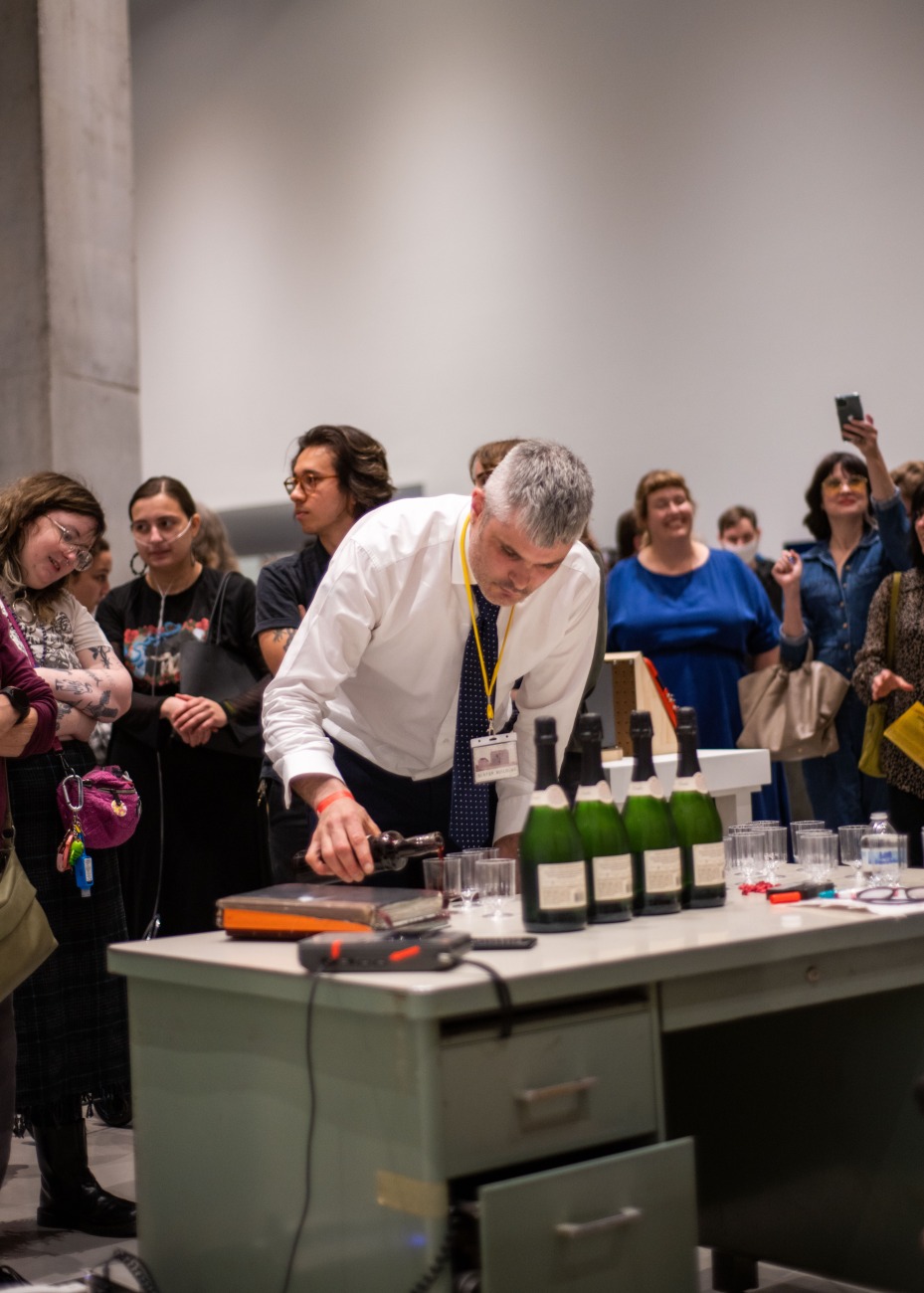
Over the last seven years, I have been reshaping my practice from being primarily hermetic, manual and materially fixated into a more fugitive, performative state. Around 2015, I had a rising feeling that my drawings, prints and collages no longer had the capacity to hold the kinds of storytelling and speculation that I needed to transmit. I was frustrated that my core desires: to communicate, speculate, pronounce, denounce, seduce and lead up the garden path, were being limited by what I had come to view as the chicanery of my materials.
Contemporary Art Center, Cincinnati in 2022, image Teresa Burkey.
One of very few consistent back-channels to my material practice that stayed open during the rearrangement process was a project called Going Postal. In 2013 I had entered into an iron clad arrangement with the MSURS – the Museum of Contemporary Art of Republika Srpska (the Serb part of Bosnia). I had solemnly committed to sending them a flat artefact, unenveloped in the postal system at least four times annually until my projected year of death in 2077. I have faithfully maintained this undertaking over the years and when the project concludes on 19/11/2077, 256 items will have been integrated into their collection.
Dispatch 2015112 (2015) courtesy of the Museum of Contemporary Art of Republika Srpska.
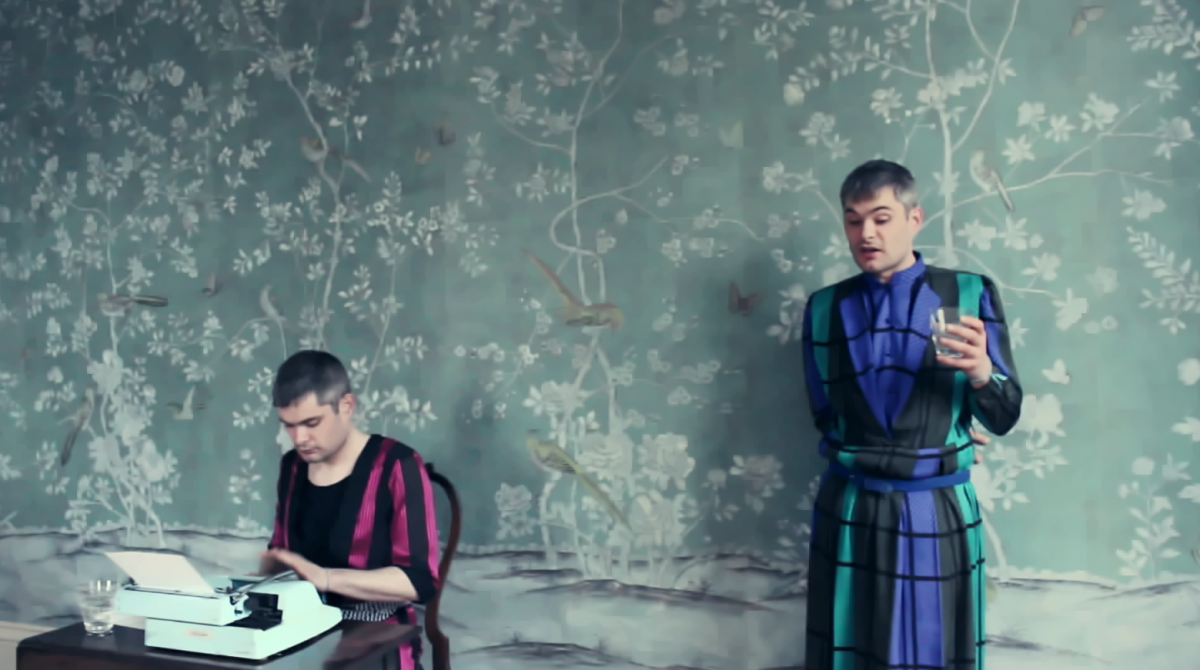
Around the time I was taking a sabbatical from the physical manufacture of artworks, I was deep in the guts of a multi-annual film project called GLUE with my dear friend Oisin Byrne. We had both left Ireland a couple of years earlier, I went to Brussels, and he relocated to London. For over half a decade, the making of GLUE was the structure that kept us embedded in each other’s everyday lives. The final shape of GLUE was a semi-fictional concoction of my experiences of the sleep disorder narcolepsy told through manic and confessional monologues. The project was the first time I positioned my verbal and physical performativity as tip of the spear of my work. The public premier of GLUE was in Salzburger Kunstverein in the summer of 2018.
Angry letter scene from GLUE (2017) directed by Oisin Byrne
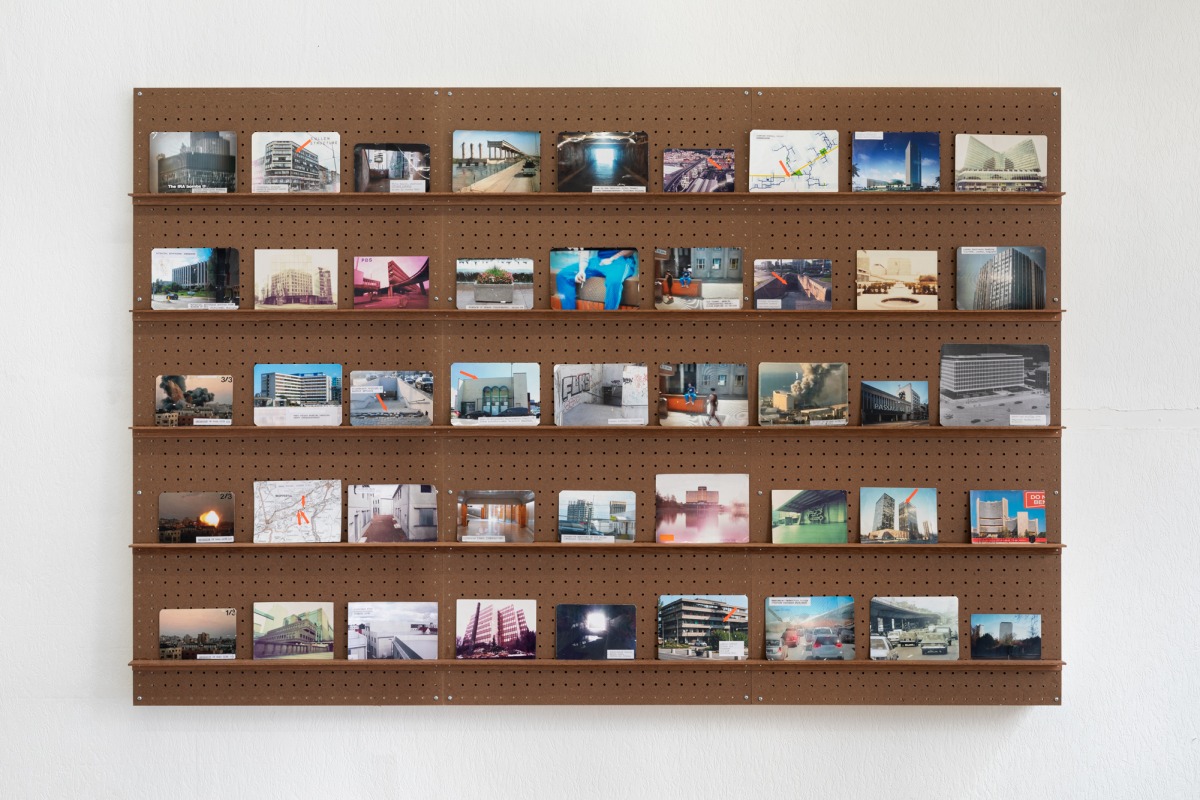
In January 2015, I met Berlin based photographer and sound artist Chris Dreier. We were introduced to each other over dinner in the Germany city of Wuppertal. Our first conversation was about Charleroi, the mangled capital of Belgium’s post-industrial rustbelt. Our alliance was instantaneous. Since then, we have been sending each other weekly postcard briefings obsessively focused on our shared interests in corporate architecture, finance, disasters, institutions, political assassinations and magic. From the beginning, we always understood the correspondence as a receptacle for some shared knowledge we were both trying to capture. On October 3rd, 2015 we codified our relationship into an institution and established the Office for Joint Administrative Intelligence O.J.A.I..
A selection of Office for Joint Administrative postcard correspondence. Image Fabrice Scheider.
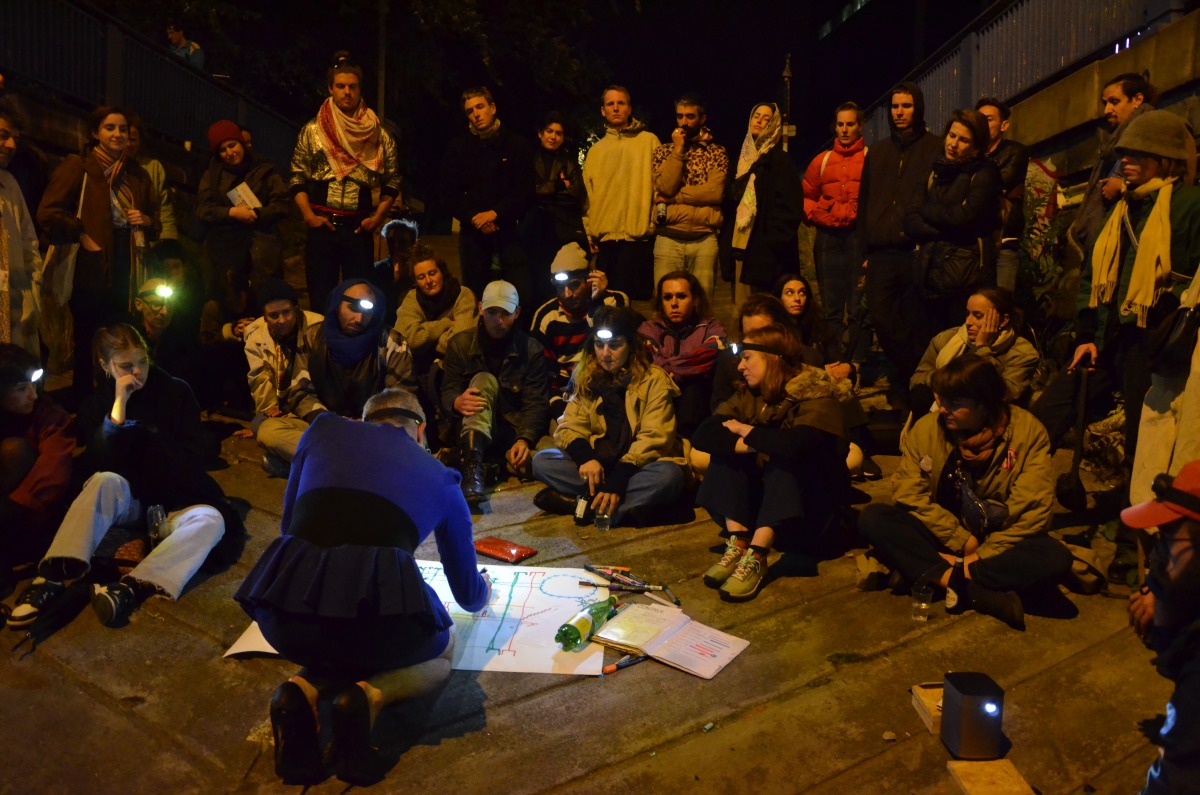
Office for joint Administrative intelligence is configured as a DIY para-intelligence agency operating between Brussels and Berlin. I would describe our process as having some research components, in that we gather knowledge based on hyper-specific fields of enquiry – pedestrian tunnels, market shocks, plane crashes, dried up fountains, lonely office blocks, pornography staged in modernist architecture and public announcements (over Tanoy). The research component is not an end in itself. We use the information mined from economic, political and architectural sources as a departure point for uncanny speculation and highly subjective fiction making.
This process manifests in the public space as performances, fieldtrips, audits, annual reports, office installations, audio wallpaper, vinyl records, architectural plans, psycho-cartography and our monthly radio show transmitting on Dublin Digital Radio and Cashmere Radio Berlin.
In 2021, I enrolled at a.pass in Brussels, an artistic research environment coalesced around performativity and scenography. My project, in close cooperation with the office, departed from the work of deceased American conservative conspiracy theorist William Milton Cooper. Cooper’s work was a precursor to QAnon and encountered the public through the polemical Hour Of The Time radio show which synthesized economic and political ‘research’, occult knowledge, personal grievance, and manic episodes into a paranoid tsunami designed to undermine public confidence in institutions.
During my time at a.pass, I developed various performative versions of myself as an agent for disinformation, including: the bureaucrat, the crossdresser, the seducer, the charlatan, the guide, the joker, the devil’s advocate, the instructor and the Cassandra.
a.pass end performance, Brussels (2022). Image Karolien Chromiak.
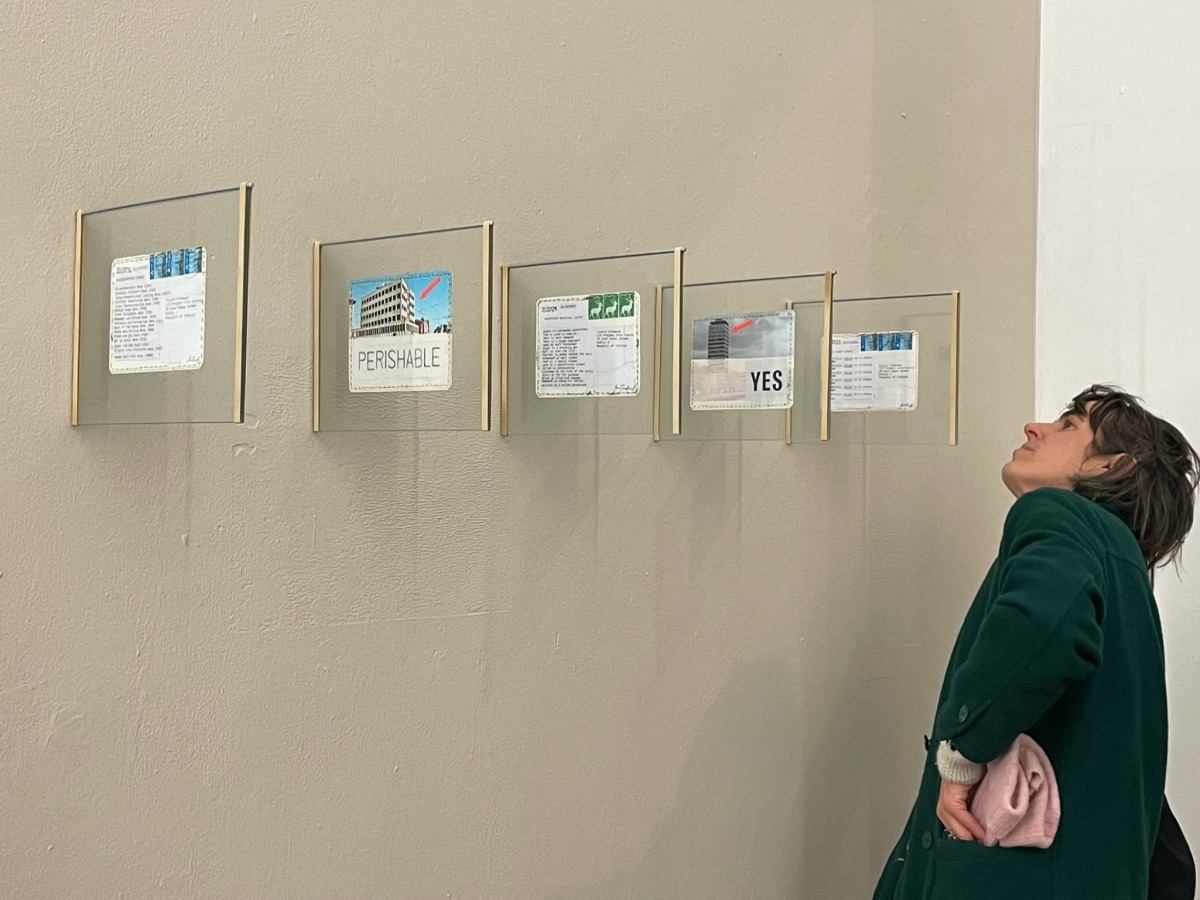
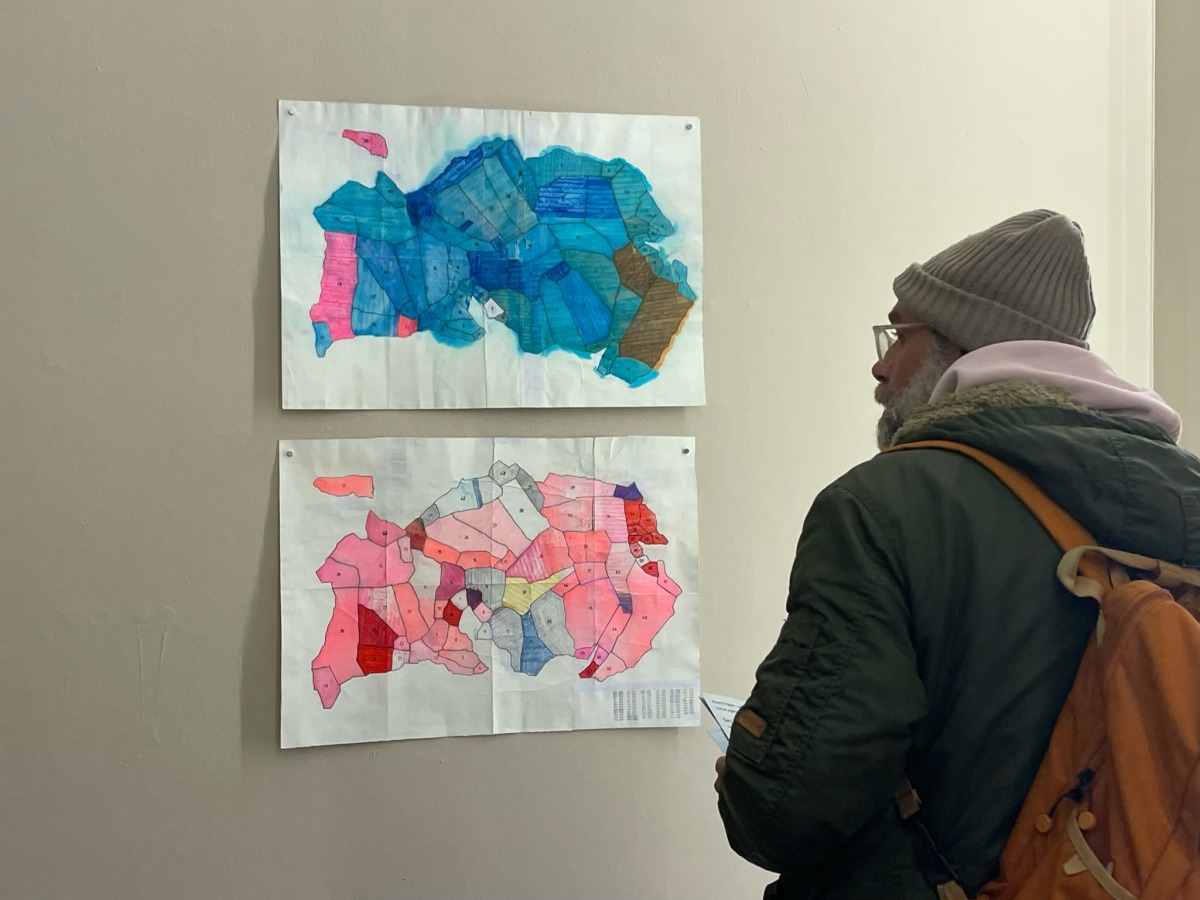
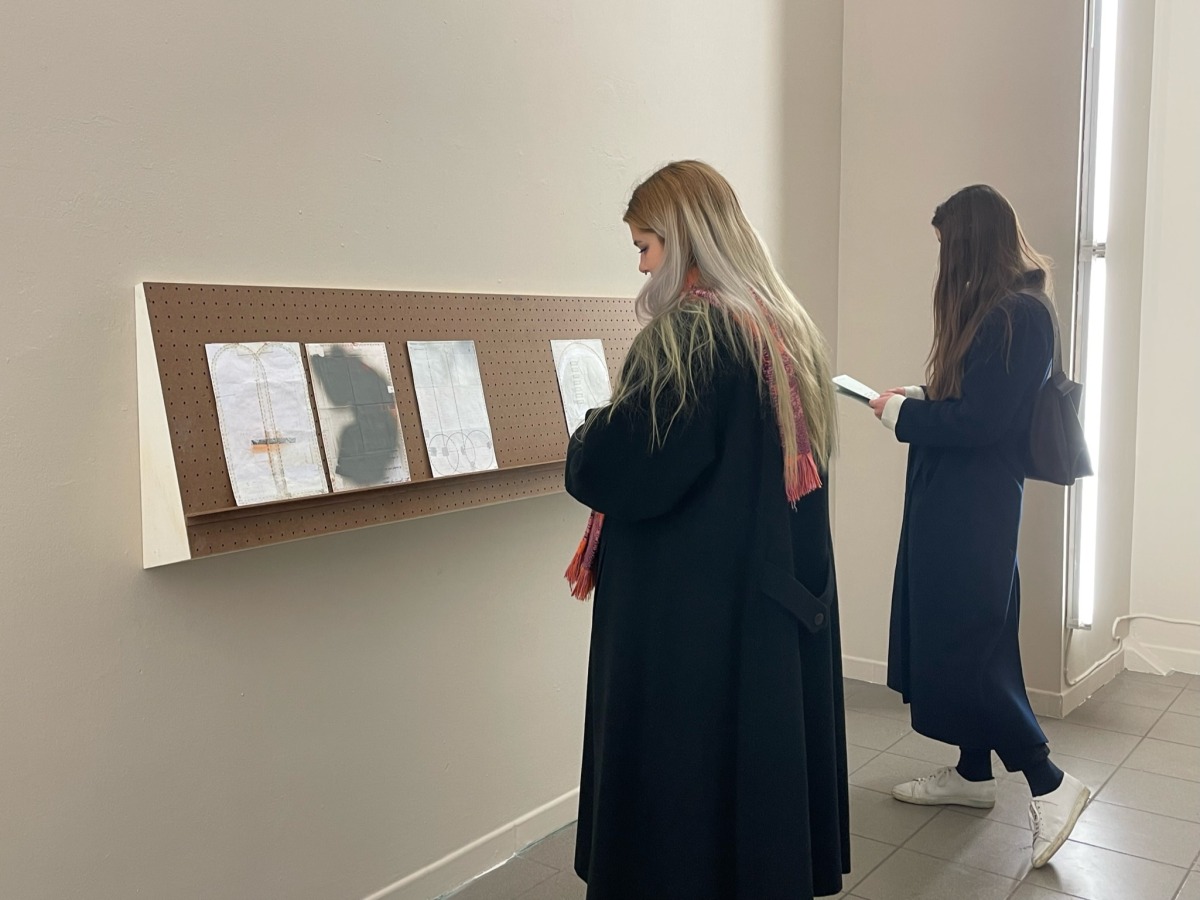
My current exhibition Proximity Papers – new works from an organisational self – is my first solo exhibition since 2015 and my first major project outside the office in as many years. On the curatorial initiative of Various Artists, the show signals a reignition of my attraction to slow and repetitive processes of hand manufacture such as stitching, stencilling, typing, folding, labelling and redacting. Channeling the same set of political and architectural imaginaries that inhabit the more bombastic performance work, the pieces in the show are encoded with systemic fictions, self-referencing data, geographical imaginaries and lots of modernist ghosts.
Proximity Papers invitation postcard
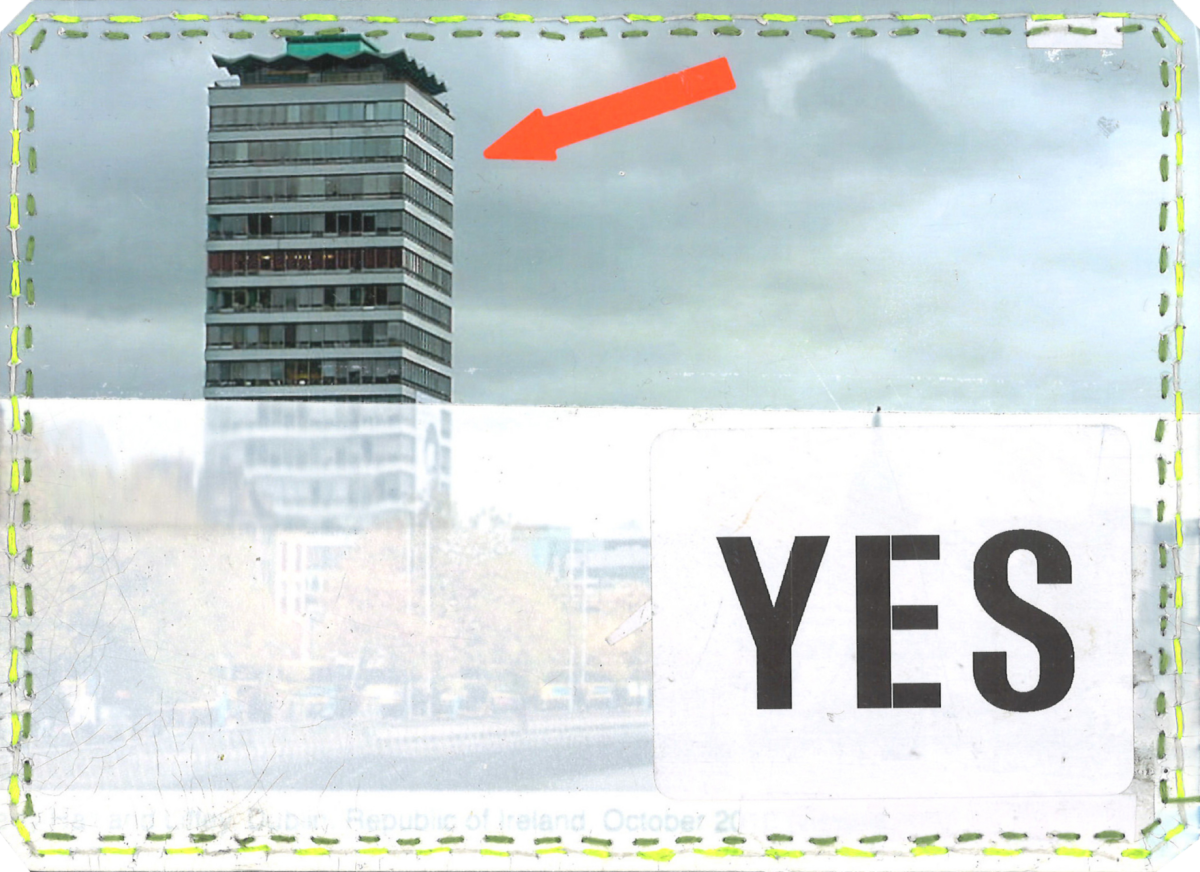
My starting point was a series of postcards that I made for the Project Arts Centre BAE publication a couple of years back. They depict Dublin’s most iconic modernist office blocks: Liberty Hall, the civic offices, Apollo House, the Irish Life Centre etc. These were the first buildings I ever loved.
I have always been perversely attracted to the unequivocal, disciplinarian presence of post-war buildings in cities. Even as a kid, I knew that these erections were encoded at a genetic level with simultaneously seductive and coercive political instructions. Buildings are dangerous. I have spent my adult life pondering the question: what subliminal messages are these structures asserting into the public space? What do the buildings want?
Proximity Papers opening night at Nadine, Brussels. Image An Goovaerts.
Most of the materials in the show were subjected to prolonged direct physical contact with my body. I carried the A4 drawings folded up in my pocket for prolonged periods, larger works were digested at the bottom of my tote bag or flattened under my mattress. I took the two main pieces of the show – a set of watercolour election result maps – into the shower with me every day for a month, carefully bleaching the constituency areas to simulate transitions of power. These processes were extremely destructive to the integrity of the materials and at some stage the works risked disintegration. The second set of processes consisted of repairing, restoring and devoting care to the surfaces. Bringing them back from the dead.
Proximity Papers opening night at Nadine, Brussels. Image An Goovaerts.
The work is characterised by a jaded bureaucratic, architectural sensibility. Some of the works consist of repetitive text piled up to look like tower blocks ‘IT IS OFFICIAL POLICY TO APPEAR UNMOVED’.
The only human presence in the show is a screen-grab from a gay pornographic film where a young heterosexual male hustler is paid to receive oral sex from a gay protagonist. He doesn’t like it. I intervened in the image with delicate rows of my patented embroidery pattern the quasi-autonomous stitch. This work is part of straighsploitation – my ongoing ‘research’ into representations of straight male bodies in gay porn. Other works in the show include: Teri Garr International Airport, Grosser flughafen verspätung taurigkeit (Big Airport Delay Sadess), Systems Merger, Gray Parliament and Regional Conflict Map.
The word ‘YES’ is recurring throughout the show, part act of self-encouragement/partially ironic. All the works are stamped on the rear with my name, date of birth and projected expiry date- Gary Farrelly (1983-2077). I will be ninety-six-years-old if the prediction is accurate. Specially constructed display units were designed and built by Remy vanderhaegen. The show was executed with the generous support of The Arts Council and Fingal Arts Office. Sincere thanks to Various, Phyllis, An and Loes and Remy vanderhaegen.
Proximity Papers opening night at Nadine, Brussels. Image An Goovaerts.
Not since Byron awoke one morning to find himself famous has there been such an example of world-wide celebrity won in a day by a book as has come to Upton Sinclair.
The New York Evening World, 1906.
Perhaps others, better acquainted with the genre, may argue to the contrary, but Upton Sinclair’s 1906 novel The Jungle is surely a contender as the Great American Novel. Though far from an ideological bedfellow, Winston Churchill nonetheless wrote admiringly that Sinclair had marshalled his forces like the general of an army on the attack.[i]
That the work is not better known today is probably on account of the butcher’s blade it takes to the American Dream, and the presentation of an alternative vision for humanity. Thus, Socialism is described as ‘the new religion of humanity – or you might say it was the fulfilment of the old religion, since it implied but the literal application of all the teachings of Christ (p.346)’.
The Jungle is generally credited with the swift passage of the Pure Food and Drug Act in June 1906 – eventually leading to the creation of the FDA – after laying bare to the American public the unsanitary practices of the Beef Trust in Chicago’s Packingtown.
Notably, however, action was only taken when the health of the US population at large seemed at stake. Sinclair claimed the “embalmed beef” scandal ‘killed several times as many soldiers as all the bullets of the Spaniards(p.105)’ in the war of 1898.
The Act did not, however, address the frightful working conditions of mainly immigrant workers in the meat packing industry; let alone the millions of animals subjected to industrial slaughter. Moreover, in certain respects, the industrial food system is now more disturbing than ever, while the FDA has long been subject to Regulatory Capture.
At least we have The Jungle to remind us of ongoing fraudulent misrepresentations:
The storekeepers plastered up their windows with all sorts of lies to entice you; the very fences of the wayside, the lamp-posts and telegraph-poles, were pasted with lies. The great corporation which employed you lied to you, and lied to the whole country – from top to bottom it was nothing but one gigantic lie(p.82).
A Time of Hope
The opening chapter introduces an unlikely hero, Jurgis Rudkus – ‘he with the mighty shoulders and the giant hands (p.4)’ who is ‘the sort of man the bosses like to get hold of(p.23)’ – a recent Lithuanian immigrant to ‘Packingtown’, Chicago, along with an extended family group, who are being ground down by unrelenting work and squalid conditions.
In spite of abject poverty the family nonetheless insists on a proper occasion for Jurgis’s wedding to his beloved Ona: ‘these poor people have given up everything else; but to this they cling with all the power of their souls – they cannot give up the veselija(p.15).’
At that point, still imbued with optimism, Jurgis’s response to any of the multiple challenges he confronts is to shrug his broad shoulders and say he will just have to work harder. It makes him an early model for Boxer in George Orwell’s Animal Farm. His love for Ona – recalling in certain respects Odysseus’s journey towards Penelope – means he resists the lure of the saloons, which most workers frequent.
But in a pedagogic aside – after the family are confronted with a higher than expected bill for the wedding – Sinclair intimates that the brutal nature of the work in Packingtown erodes moral as well as physical beings: ‘for men who have to crack the heads of an animal all day seem to get into the habit, and to practice it on their friends, and even on their families.(p.20)’
At the time about ten thousand head of cattle and as many hogs and half as many sheep were disposed of every day, amounting to eight to ten million live creatures turned into food every year.
It was ‘the greatest aggregation of labor and capital ever gathered in one place’, employing thirty thousand men, supporting directly two hundred and fifty thousand people in it neighbourhood, and indirectly half million, and ‘furnished the food for no less than thirty million people(p.45)’ – or at least whatever could be passed off as such.
In what is a distressing account, the reader is introduced to a succession of despicable practices that drain away human life by degrees, while imperilling consumer health. One such is “speeding up the gang”, where a foremen alternates picked men to set up a hectic pace ‘and if any man could not keep up with the pace, there were hundreds outside begging to try(p.63)’.
As he works, Jurgis finds numerous examples of shoddy corruption. Thus, a good many so-called “slunk” calves turned up every day:
Any man who knows anything about butchering knows that the flesh of a cow that is about to calve, or has just calved, is not fit for food … if they had chosen, it would have been an easy matter for the packers to keep them till they were fit for food.
This inconvenience would lead to a loss of revenue however, thus:
whoever noticed it would tell the boss, and the boss would start up a conversation with the government inspector, and the two would stroll away. So in a trice the carcass of the cow would be cleaned out(p.68).
There were also “Downers”: cattle that are injured or die on the long journey to slaughter. These too are surreptitiously placed alongside healthier specimens.
Shockingly, the meat of tubercular cattle is also permitted to enter the food chain, in return for ‘two thousand dollars a week hush money.(p.104)’ It is hardly surprising, therefore, that the book triggered a political scandal.
Property Swindle
On arrival in Chicago the family find a dilapidated boarding house to reside, but strive to purchase a property in fulfilment of their American Dream – assuming this will be a saving in the long run for a working family.
Jurgis chances on an advertisement featuring a brilliantly painted house, under which there is a picture of a husband and wife in warm embrace. Underneath is written – helpfully in Lithuanian – “Why pay rent?” “Why not out own your own home.(p.51)”
When they view the house, however, it is not ‘as it was shown in the pictures(p.52)’ –albeit it has been freshly painted. Despite the agent’s exhortations that the sale must be closed without delay, or they risk losing the opportunity, they follow their gut instinct and hold off from purchasing. They are eventually duped into signing on the dotted line by a dodgy lawyer who assures them it is a perfectly regular deed.
So, they part with their savings, leaving them on the hook for a monthly repayment that stretches them to the limits of endurance.
As if this isn’t hard enough – especially in return for what they soon discover is a house that is barely fit for human habitation – a few months later they are presented with an annual insurance bill that threatens to starve them into submission.
Predictably, after Jurgis gets into trouble with the law and cannot work, the family loses the home – and their hard-earned savings – and are forced to return to the boarding house from whence they came, where further trials await.
Ironically, a century later millions of Americans, and others, had a similar experience of losing their homes, and savings, in the Financial Crash, in large part due to banks offering easy credit.
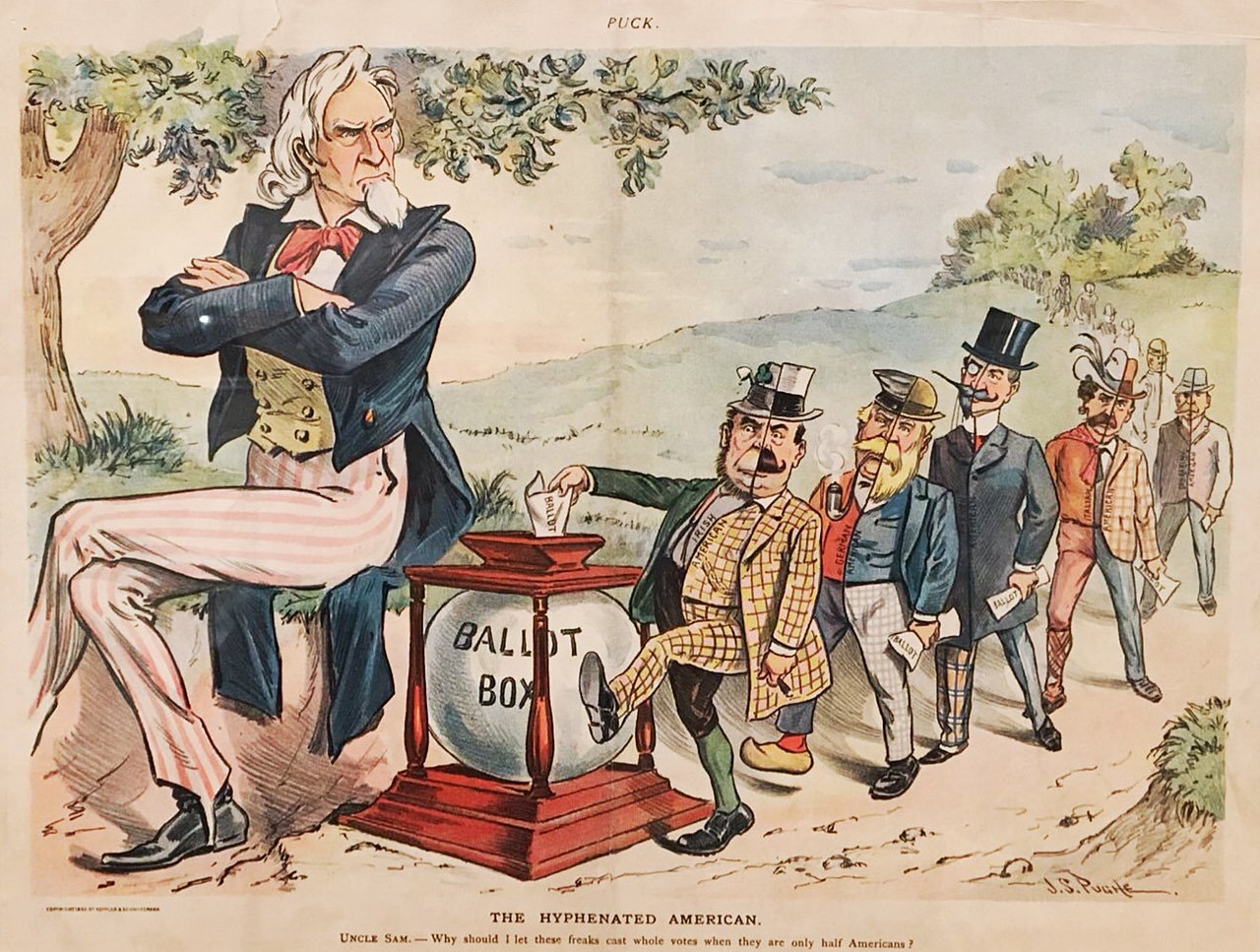
Cartoon from Puck, August 9, 1899 by J. S. Pughe. Angry Uncle Sam sees hyphenated voters and demands, “Why should I let these freaks cast whole ballots when they are only half Americans?”
Shenanigans
The novel explores the ethnic composition of Packingtown’s workers. Waves of cheap foreign labour have fed an industry which, Sinclair argues, is ‘every bit as brutal and unscrupulous as the old-time slave-drivers(p.117).’ Based on this account, it would be hard to disagree.
First came the Germans, and afterwards the Irish, who Sinclair generally casts as profiteers and political fixers. After that came Bohemians, followed by Poles, then Lithuanians, who were then giving way to Slovaks.
Having ascended a grease-laden pole, many of the Irish in the novel seem determined to keep others from scaling the heights. Sinclair’s is perhaps demonstrating that success in Packingtown depends on a willingness to embrace corruption and exploitation; at the behest of the Beef Trust itself, ‘a gigantic combination of capital, which had crushed all opposition, and overthrown the laws of the land(p.346).’
Some are damaged souls, however, such as Tommy Finnegan, ‘a little Irishman with big staring eyes and a wild aspect’, who expounds on ‘The method of operation of the higher intelligence’. Finnegan informs Jurgis that ‘shperrits … may be operatin’ upon ye(p.97-98)’
Far more sinister is the ruler of the district, Mike Scully who, ‘held and important party office in the state, and bossed even the mayor of the city, it was said; it was his boast that he carried the stockyards in his pocket.’ As a result, ‘He was an enormously rich man(p.101)’.
Eventually we learn:
It was Scully who was to blame for the unpaved street in which Jurgis’s child had been drowned; it was Scully who had put into office the magistrate who had first sent Jurgis to jail; it was Scully who was principal stockholder in the company which had sold him his ramshackle tenement, and then robbed him of it(p.287).
Yet when we do finally encounter Scully he is ‘a little dried up Irishman, whose hands shook’; who is ‘but a tool and puppet of the packers(p.288).
Jurgis’s beloved Ona is also raped and beaten by Connor ‘a big, red-faced Irishman, coarse featured, and smelling of liquor(p.167).’ In revenge, Jurgis violently assaults him, landing him a spell behind bars.
This brings him before another Irish-American, ‘the notorious Justice Callahan’:
“Pat” Callahan – “Growler” Pat, as he had been known before he ascended to the bench – had begun life as a butcher-boy and a bruiser of local reputation; he had gone into politics almost as soon as he had learned to talk, and he held two offices at once before he was enough to vote.
Unfortunately for Jurgis, Callahan had developed a ‘strong conservatism’ and ‘contempt for foreigners(p.173).’
Yet another Irishman called “Buck” Halloran, ‘was a political worker and on the inside of things(p.281)’. He employs Jurgis to enlist fictional voters for forthcoming elections in a sham democracy.
At last, we meet one Irishman, working in an enterprise owned and managed by a socialist who pays a decent wage and sets reasonable hours. He explains to Jurgis ‘the geography of America, and its history, its constitution and its laws; also he gave him an idea of the business system of the country.’ Sinclair seems to be showing that in circumstances where labour is not alienated, even an Irishman is capable of decency and culture.
How were immigrants persuaded to work in such appalling conditions? Sinclair tells us that ‘old man Durham’ (the proprietor of the Beef Trust):
was responsible for these immigrations; he had sown that would fix the people of Packingtown so that they would never again call a strike on him and so he had sent his agents into every city and village in Europe to spread the tale of the chances of of work and high wages at the stockyards(p.72).
The grotesque lie places naïve workers such as Jurgis at the mercy of a system that degrades its victims by degrees. Sadly, it was not just adults who are engaged. Thus, even the young children in Jurgis’s family group are obliged to work – and die – joining the million and three-quarter of children who were at the time similarly compelled.
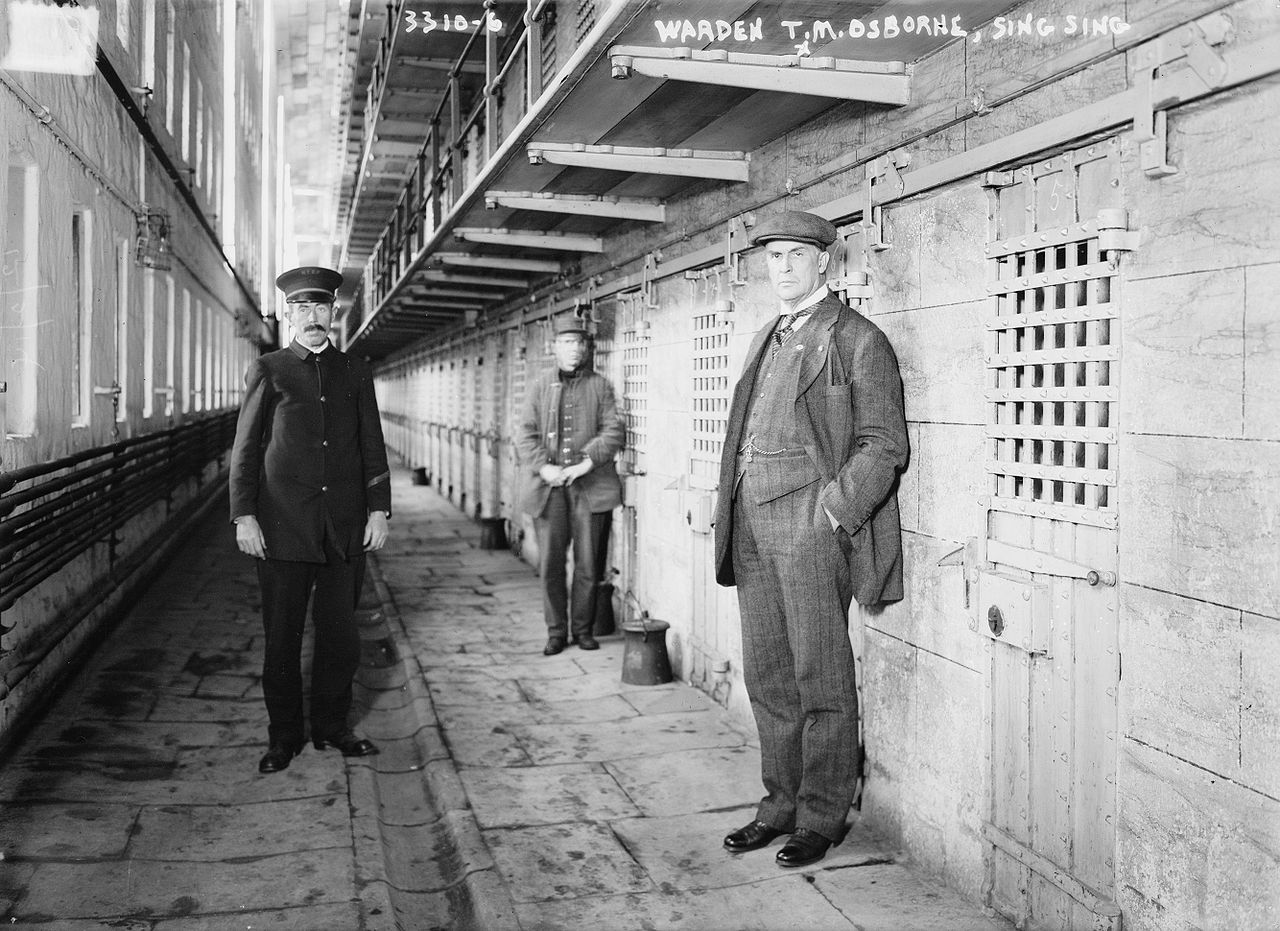
Sing Sing prison (New York). Date unknown.
Off the Rails
While incarcerated Jurgis encounters men for whom, ‘love was a beastliness, joy was a snare, and God was an imprecation.’ He shares a cell, and befriends Jack Duane, a likeable, though ultimately callous, rogue, who reveals the possibilities of a life in crime. Jurgis avoids this temptation for he still has a wife and child to keep him on the straight and narrow.
After being released from his first stretch, Jurgis is black-listed and thus unable to work. He then loses his beloved Ona to childbirth. From that point on – like so many others of his class – he numbs his pain with alcohol. He remains with the extended family group, nonetheless, on account of his baby son Ananas. But the tragedy is complete when the infant dies too – drowning in a puddle in an unpaved street.
At that point, Jurgis is a lost soul, with his dreams of a new life in shreds: ‘So he went on, tearing up all the flowers from the garden of his soul, and setting his heel upon them(p.235).’
He leaves Chicago in the spring as a hobo, working for farmers and foraging wild berries along the trail, which restores his health, but he cannot escape reminders of the old life:
Ah, what agony was that, what despair, when the tomb of memory was rent open and the ghosts of his old life came forth to scourge him!(p.244)
Thus, he returns to Chicago in the fall – like a moth to flame – where further obstacles and humiliations await. There he reconnects with Jack Duane, who introduces him to a life of crime. On their first outing they mug a man who, they learn afterwards, has suffered a concussion on the brain. This troubles the conscientious Jurgis, ‘but the other laughed cooly – it was the way of the game, and there was no helping it.’
Duane assures Jurgis, “He was doing it to somebody as bad as he could, you can be sure of that(p.279).” Duane seems to assume that ‘behind every great fortune lies a great crime.’
Jurgis’s moral descent is complete when he takes on a job as a foreman and then a scab worker during a general strike.
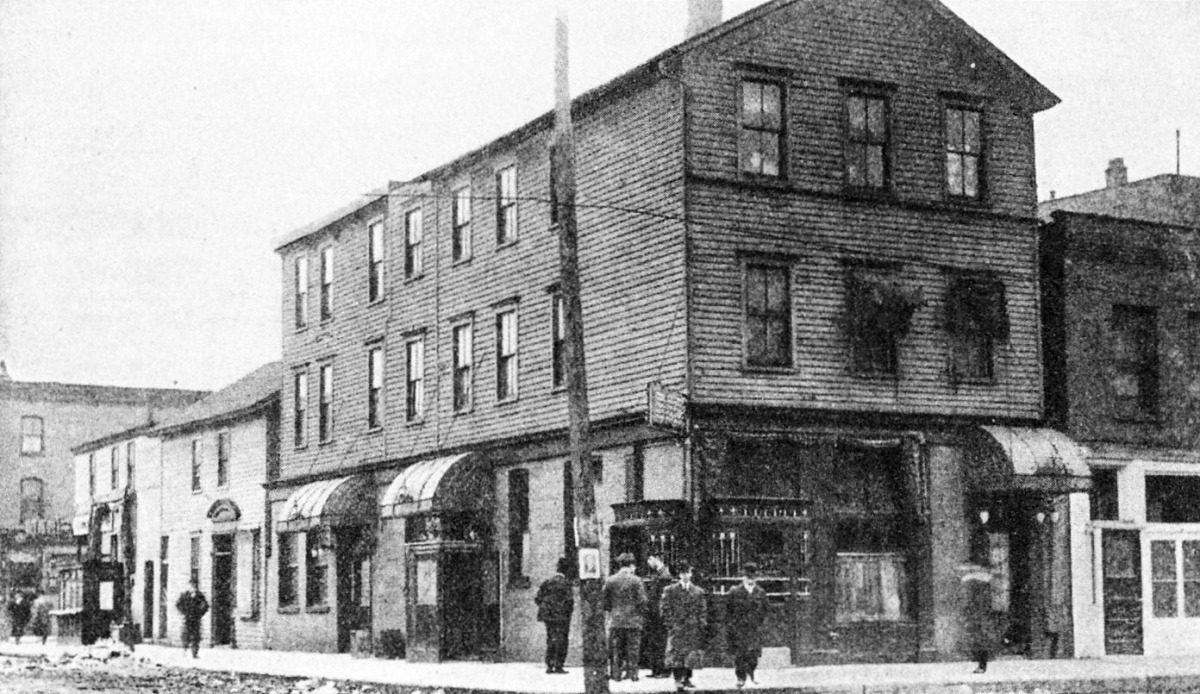
Brothel “The Paris”, 2101 Armor Street, Chicago.
The Only Way to Get Ahead
Jurgis’s career as a thief and strike-breaker brings a measure of financial success, implying the only way to get ahead in Chicago is to debase oneself. By then, however, having lost all family connection – and lacking a belief system – he cannot develop a stable existence. Instead, he frequents the saloons and sprawling flesh pots.
Earlier we learn of Chicago: ‘there was no place in it where a prostitute could not get along better than a decent girl(p.116)’:
Thousands of them came to Chicago answering advertisements for “servants” and “factory hands,” and found themselves trapped by fake employment agencies, and locked up in a bawdy-house(p.282).
One of the saddest episodes, among many, is Jurgis’s reconnection with Marija Berczynskas, Ona’s stepsister. At the beginning of the novel, like Jurgis, Marija displays all the characteristics of a model worker, but by the end she has been forced into prostitution in order to feed the family, and is addicted to morphine.
Prior to this Marija conducted a touching love affair with the fiddler Tomaszios, who previously spell bound the wedding party with his music. But Packingtown is no place for an artist – or romance. Marija tells Jurgis that Tomaszios has left her, having ‘got blood-poisoning and lost one finger(p.320)’ in a work place accident, meaning he cannot play the violin any longer.
Marija has interesting insights into her fellow prostitutes:
Most of the women here are pretty decent – you’d be surprised. I used to think they did it because they liked to; but fancy a woman selling herself to every kind of man that comes … and doing it because she likes it(p.327).
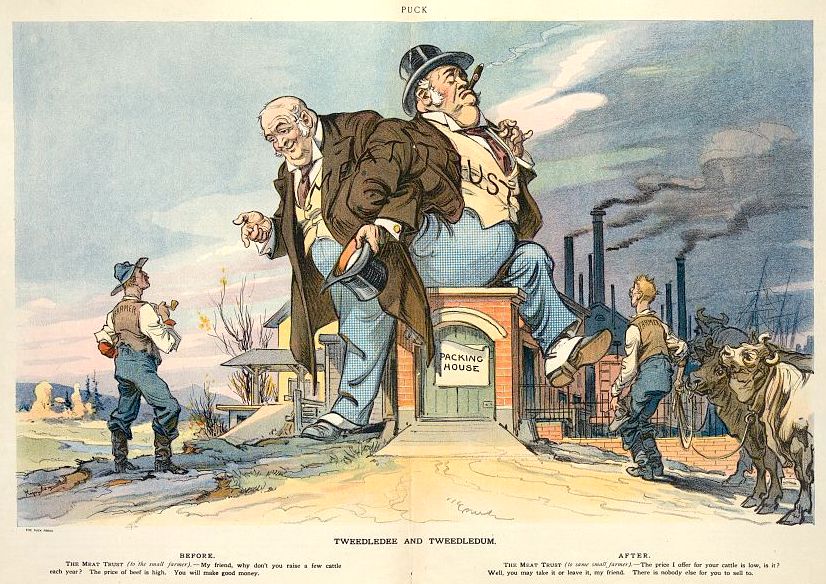
Cartoon by Udo Keppler, first punlished in New York by ‘Puck’, 15 October 1913.
Commercial Competition
Towards the end of the novel, after a quasi-religious conversion to socialism, and securing a steady job with a socialist proprietor, Jurgis meets a number of talking head intellectuals in a kind of underworld sequence.
Here he learns that the Beef Trust are just one part of the capitalist system:
There are other trusts in the country just as illegal and extortionate as the Beef Trust: there is the Coal Trust, that freezes the poor in winter – there is the Steel Trust, that doubles the price of every nail in your shoes – there is the Oil Trust, that keep you from reading at night.
This character asks rhetorically, ‘why do you suppose it is that the all the fury of the press and the government is directed against the Beef Trust?’
He informs Jurgis: ‘the papers clamor for action, and the government goes on the war path’, then ‘poor common people watch and applaud the job’, but this is ‘really the grand climax of the century-long battle of commercial competition.(p.355)’
The hysterical reaction of so many in the media to Elon Musk’s purchase of Twitter suggests that this age-old “battle of commercial competition” continues – as the billionaire class squabble over the spoils.
Campaign poster from his 1912 presidential campaign featuring Eugene Debs.
Much Abides
The Socialist Party of American became a powerful political force around the turn of the last century – at least until it was beaten into submission. But already by mid-century, in response to the excesses of the Soviet Union, the socialist ideal had become to many in the English-speaking world ‘The God that Failed’. A hybrid social-market ‘New Deal’ emerged under FDR in the 1930s, but neoliberalism has reigned ascendent since at least the Reagan Presidency. In today’s muddled era of identity politics, activists often lack commitment to countering the structures that produce an ever-widening gap between rich and poor.
Today, US workers are afforded far greater protection compared to Sinclair’s day, and child labour has largely been eliminated. However, in ‘the most health-obsessed society, all is not well.’[ii] Sixty percent of adults suffer from a chronic condition, and over forty per cent have two or more of such conditions.[iii]
Most Americans still live on the edge of financial ruin. A recent poll found 63% are living from paycheck to paycheck — including, remarkably, nearly half of six-figure earners, as the cost of living continues to rise.
The stress caused by this precarious existence seems to lie behind ongoing substance abuse, including an Opioid Crisis that has killed hundreds of thousands, while enriching Big Pharma that preys on the country’s pathologies. Other self-destructive behaviours – such as over-eating – are normalised in a rigid two-party political system that leaves little room for dissent.
Alarmingly, there is little sign of political change in the US, while many other countries appear to be embracing neoliberal norms. Since the 1970s inequality has spiralled, and most political radicalism seems more inclined towards self-reliance than cooperation, but as Gabor Maté points out, in what could be a commentary on The Jungle:
If I see the world as a hostile place where only winners thrive, I may well become aggressive, selfish and grandiose to survive in such a milieu … beliefs are not only self-fulfilling; they are world-building[iv].
The Jungle characterises US society as being one where willingness to participate in a “gigantic lie” underpins success. This deceit goes on, as people continue to be persuaded to buy things they don’t need, while a successful boss still extracts as much as possible from workers. It means that even some of the best, like Jurgis Rudkus and Marija Berczynskas, are still being ground down – unless they too are prepared to display the required “aggressive, selfish and grandiose” qualities that success depends on.
[i] Hugh J. Dawson, “Winston Churchill and Upton Sinclair: An Early Review of The Jungle,” ALR, 1991.
[ii] Gabor Maté with Daniel Maté, the Myth of Normal: Trauma Illness & Healing in a Toxic Culture, Random House, London, 2022, p.1.
[iii] Christine Buttorff et al, Multiple Chronic Conditions in the United States, Santa Monica, CA RAND Corporation, 2017.
Amy Gallagher, nurse and psychotherapist, has initiated legal proceedings against Tavistock and Portman NHS Trust for religious discrimination; racial discrimination; discrimination on the basis of philosophical belief, harassment and victimization.
While the story has appeared in British newspapers, mainly the right-wing press, it has not been covered in Ireland. I came across it when Gallagher was interviewed on the right-wing podcast The New Culture Forum. Her story was, however, unhelpfully flagged in a partisan manner that might have the effect of alienating people in the centre.
Amy Gallagher’s troubles came about when she was on a final two-year training course in a Tavistock Trust training centre to complete her psychotherapy credentials. She was struck by the emphasis on so-called Woke ideology in the lectures and seminars, often to the exclusion of psychotherapeutic instruction, involving handouts guiding students towards ideological harmony.
She found this curious and irritating at first, since these diversions had little to do with the discipline she was there to study. Two lectures in particular caused her to more seriously question what she was hearing. One was based on the assumption that Christianity was a racist religion, while the other was titled “Whiteness-A Problem For Our Time,” which was summarized in the online description thus: “The presentation is rooted in the assumption that the problem of racism is a problem of whiteness.”
Ideas and Perspectives
Gallagher had studied Arts and was aware of the ideas being promulgated: a strange amalgam of French intellectualism married with Freudianism and Marxism to form “perspectives” that will be familiar to anyone who has studied English, Sociology or the now compulsory Gender Studies in university.
During an interview, in response to the interviewer saying, we all know that there is “Inherent racism in all white people,” this stated as a fact, without any backup, Gallagher objected and said she didn’t believe that. The interviewer gave her a look of impatience and said it’s like the way “sexism is inherent in all men”. Gallagher said she didn’t believe that either. Gallagher was immediately seen as “difficult” and a “problem”.
During a later interview, called to assess her as a “problematic” individual, when she continued to hold her ground, simply asserting her right to disagree with the various tenets of the ideology, she was directly ordered to “stop speaking”.
As a psychotherapist Gallagher realized that she couldn’t simply take such blanket group judgements as fact. You just couldn’t say that all people in a certain identifiable group are this or that, based entirely on their skin colour or appearance. Her job as a psychotherapist is to treat individuals, who tend to be quite unique, regardless of group identity. To accept the prejudices being pressed on her by management would mean that she would be claiming to know her patients just by looking at them, judging them entirely by appearances and group identity, which, in her view, undermines the core idea of psychotherapy.
Ideological Crimes
Gallagher researched the material being promulgated by management and found that the ideas were essentially ideas taken from critical race theory populist Robin DeAngelo, ideas which Gallagher describes as academically irrelevant, backed up by nothing, and little more than racist propaganda.
She claims that the Tavistock Trust, in seminars, refers only to this material and not to any other relevant academic material. When she queried this approach, she was told she was not up to speed on anti-racism, that she had “problematic views”, the implication being that she was racist for having queried some of the odd assertions quoted above.
It was assumed by management that in questioning the ideology, she had committed some kind of “crime” against it. Attempts were made to strike her off the nurse’s register. But the nurses and midwifery council defended her, saying simply that nurses are entitled to disagree with ideas.
She was then accused by a member of management of racial harassment, of making that person feel “unsafe”, and of having a twitter account that made that person feel “unsafe”. Gallagher had started a stand-up-to-Woke twitter account which was then described as putting out “hate speech”, apparently just by sheer dint of its existence.
She was then prohibited by the faculty head from entering the main reception area any longer, based on the idea that the sight of her might re-traumatize certain people offended by her views.
The Psychotherapist
Then it gets really odd, and even a bit comical. Having studied psychotherapy, her training kicked in and she began assessing the various individuals in management she was dealing with.
So, after being reprimanded for speaking her mind, and after being warned off bringing “personal opinion” to bear on what the management regarded as self-evident truths about racism and white privilege and so on, she realized that the ethos of the antiracism ideology she was facing bore all the hallmarks of neuroticism, the very conditions that she was trained to treat, to move people away from. For instance, she says:
The ideology itself…goes against all the things that I’ve been taught as a mental health professional. It’s hysterical, it catastrophises, it jumps to conclusions about certain things, it assumes what is going on in the other person’s mind, it’s very all or nothing black or white thinking, excuse the pun, it’s kind of, you know, there’s baddies and there’s goodies. These are all psychological mechanisms that I’m generally trying to help people move away from…It’s like they’ve embraced neuroticism and they’re advocating for it…Critical race theory and woke ideology is negative thinking, essentially.
Legal Challenge
She says she wants her legal challenge to be as impactful as possible. That she isn’t just taking the Tavistock Clinic to court for the what they did to her, but that she is taking critical race theory itself to court.
She describes the people who essentially bullied her as being out of control, believing themselves to be above the law and above institutional procedure. For instance, they would verbally threaten her with certain procedures of reprimand, but then wouldn’t follow up, since to do so would have required putting this in writing and on the record.
One of the bizarre assertions made to her by a member of management was that “Christianity is responsible for racism because of its use of the words light and dark.” This is the type of observation that might be acceptable in an undergraduate essay, but it is hardly a foundation for serious philosophical progress on any front.
The forthcoming court case should make for an interesting spectacle, assuming it is even reported on in mainstream media. In many ways, Gallagher’s action, will for some, mirror the case taken by writer Deborah Lipstadt against the holocaust denier David Irving. On the other hand, it might also mirror the case taken by Oscar Wilde against the Marquess of Queensberry.
Formation of a Young Irish Intellectual after Nazim Hikmet
You will go far young person
if as soon as you enter this building
you follow standard operating procedures
and stop thinking altogether.
We will do the thinking for you.
For the more intellectually curious of you
this will be as difficult initially
as nailing yourself to a chair.
But the appropriate doses
of the right sort of alcohol will ease
you into it.
Before long, you’ll find yourself
not thinking a thing.
In your lunch break, you’ll write poems
that are secretly okay with NATO
and won’t know where they came from.
But we’ll know,
and that’s all that matters.
We have a library of pre-existing think pieces
from which you can choose your opinions,
which we’d like you to massage
so they seem different at first
but end up being exactly the same as the rest of us.
For there is no opinion worth having
that someone in here hasn’t already had.
You will be in favour of all the right wars
without having to sweat the niceties
and put the appropriate flag
on your Twitter handle
without us ever having to mention it.
You have no idea yet
the thoughts we have in store for you.
this is tropical truth this is celtic truth this is Hy Brasil in the Kerribrasilian sea
for Joan, Bríd, Ezimar and Tereza
Sometimes the dead do not die. Those of us alive can fall into shadow until we learn how to listen to the voices of the dead, and the hermetic messages they transmit. The signs are here and there, although with each passing decade in this paradoxical age of amnesia, they become harder to access. Yes, it is so, the present is absent until we penetrate the absence that is present.
In 2020, I made a journey, travelling thousands of kilometres to reach the town of Iguatu in the interior of northeast Brazil, known as the sertão [a hinterland or backcountry] in the Caatinga biome. This was where I would find out more about my cousin Patrick. I arrived in Fortaleza, the capital city in the state of Ceará on 3rd February. I was still dressed in white after attending a celebration of Iemanjá, the spirit of rivers and queen of oceans, in Salvador da Bahia the previous day, which was also the birthday of James Joyce, author of the great river-book Finnegans Wake. There are no coincidences when we allow ourselves to be entangled with places, temporalities and creative practices.
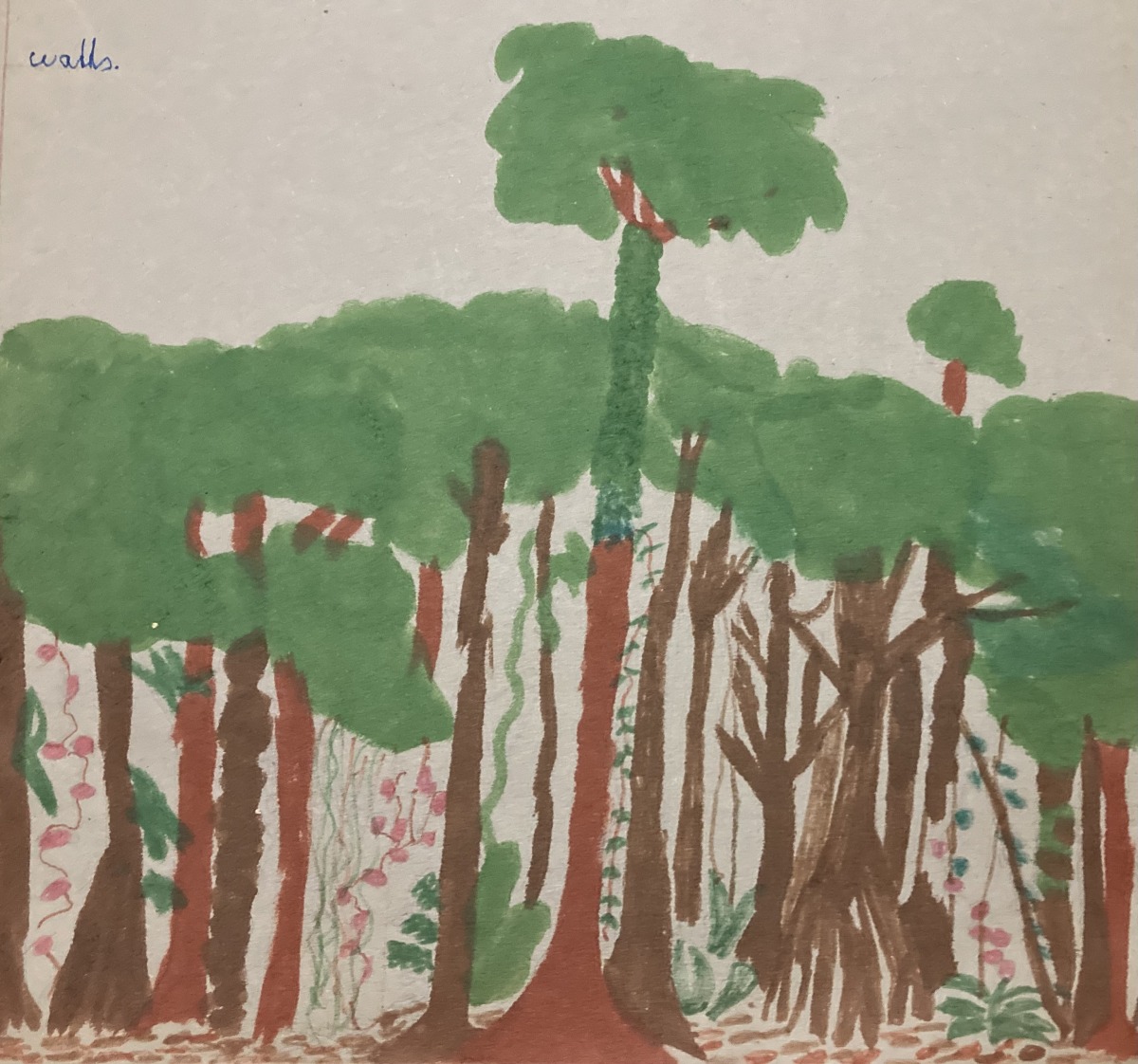
Saying aloud the word ‘Brazil’, and dreaming about what that vast land may be, has resonated in me ever since I was a boy. For my first school project at eight years of age, I decided to dedicate my time to drawing and writing about the Amazon Jungle, as my young imagination was dazzled, from afar, by the overflowing matter that all seemed so alarmingly alive. In the books I found everything seemed to be flourishing and decaying along the moving floors and rustling canopies of that great forest of the earth through which many rivers flowed.
My drawing of the Amazon jungle from a school project as an 8-year-old.
Much of the area along the enormous coastline of Brazil was once called Pindorama (‘land of the palm trees’) by the Tupi-Guarani indigenous peoples. When Portuguese navigators landed, accidentally, on the shores of Bahia in 1500, they called it Ilha da Vera Cruz (‘island of the true cross’). Today, the country is referred to as Brazil, named after a dye wood called ‘brazilwood’ or pau-brasil, which once grew in abundance along that coastline. The word ‘brasil’ probably derives from the Latin brasa which means ‘ember’ (with the suffix ‘-il’), as the wood was red like embers.
But there is another story: the name may have a connection with the lost island of Hy Brasil, which once upon a time was located off the west coast of Ireland and appeared on European Medieval and Renaissance maps.
The word probably comes from the Old Irish Uí Breasail, which means descendants (Úí) of the island (il) of beauty, worth or might (bres). With the arrival of the Age of Reason, the age of magic faded into song and oblivion and into the earth, or transferred into science, and Hy Brasil disappeared off all maps to become an obscure myth. But I follow the trail of the Portuguese poet Fernando Pessoa, who wrote: “myth is the nothing that is everything”.
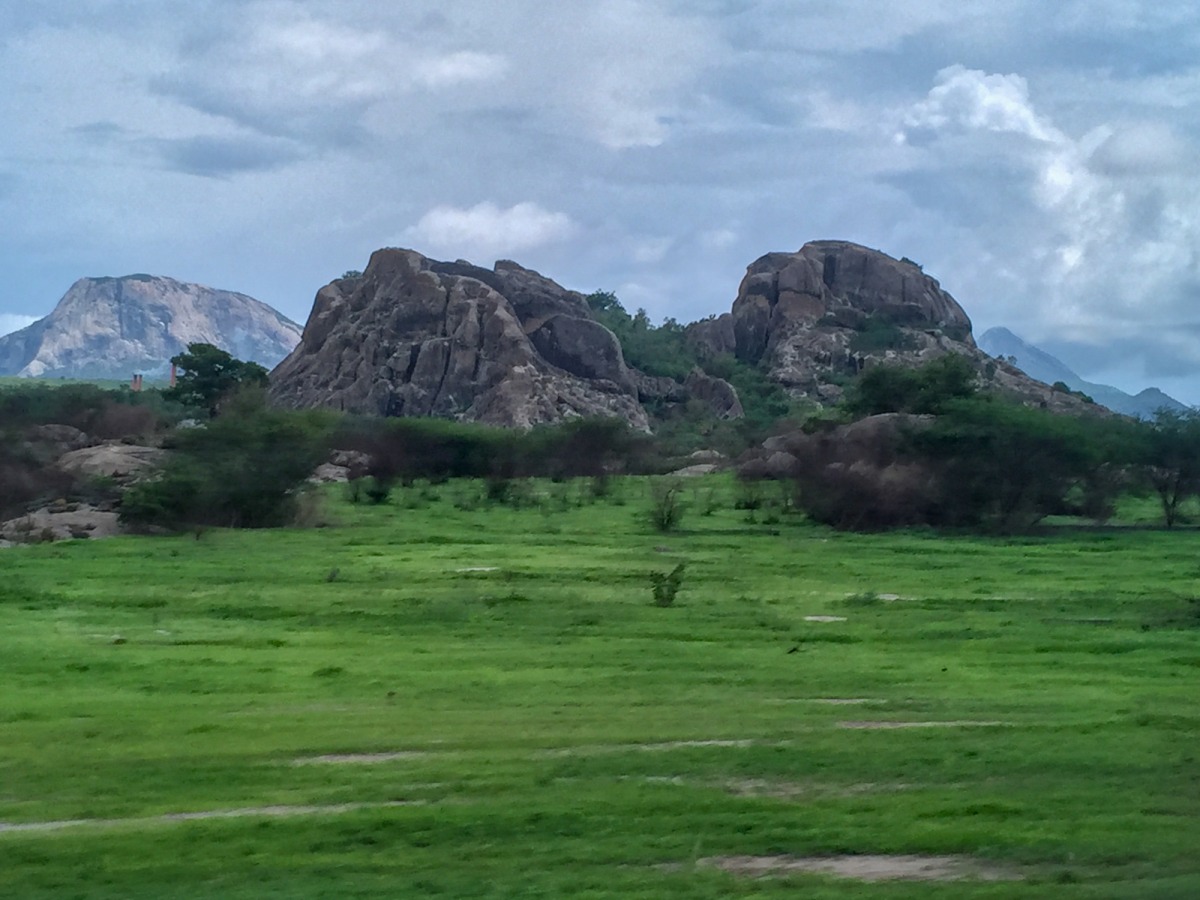
Hy Brasil were on my mind when I took the seven-hour bus journey from Fortaleza to Iguatu through a prehistoric landscape of uncanny rock formations jutting out of the earth. I found out much later these were the Quixadá monoliths. My great capixaba friend Fabricio, who had roadtripped with me by land from Vitória to Salvador, called this ‘profundo Brasil’. As we got nearer to Iguatu, the landscape began to remind me of the west of Ireland. I was getting closer to the heart of the story, and to an encounter with my cousin.
The Quixadá monoliths.
‘Some Say the Devil is Dead’
Let me tell you a little of what I know of Patrick and his story, which is what stirred me to write this text. This story shows the effect the land can have on us and the effect we can have on each other. It reverberates through my own inner and outer journeys to Brazil over the years, and resonates emotionally and spiritually. This story is a way into an absence that has become vibrantly present.
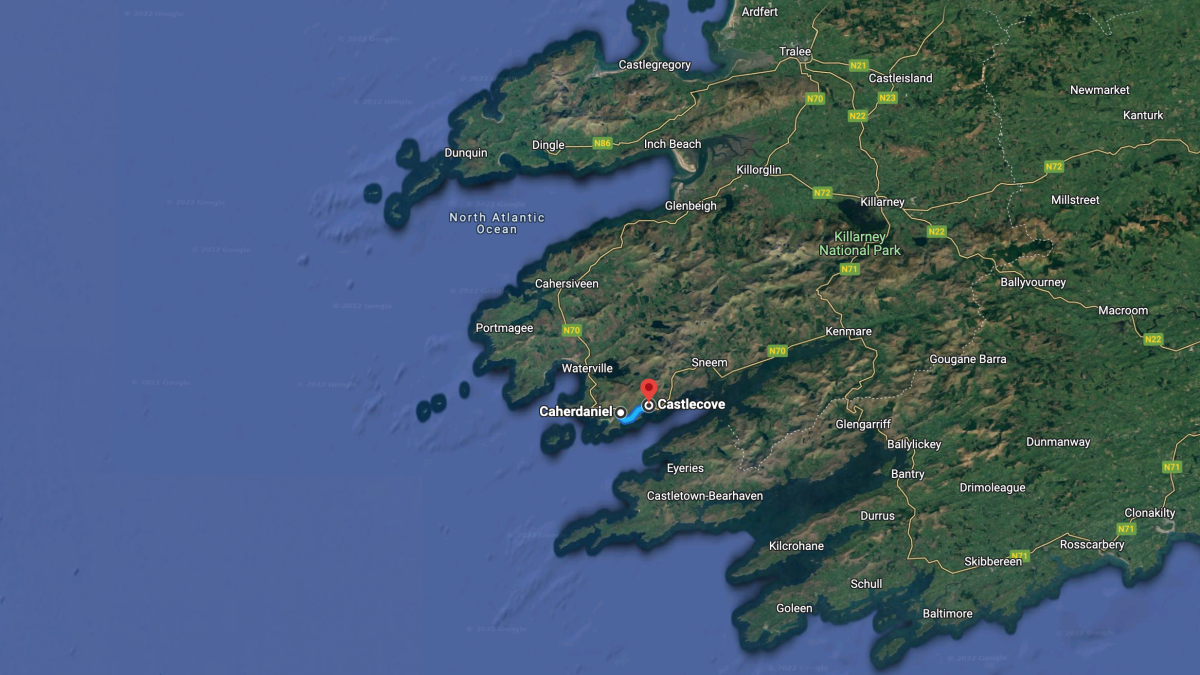
Patrick was born in Scart House in Castlecove in Kerry, on the south-west coast of Ireland. He was the son of Maurice Fitzgerald and my grandfather’s sister Lil O’Sullivan. My grandfather (my namesake), known as Batt, was born at home in Caherdaniel, six kilometres from Castlecove.
Patrick had three older sisters – Mary, Joan and Bríd. Mary, the oldest, died in 2007, and Joan and Bríd are alive and well in Kerry today. He also had two younger siblings: Maurice – born in 1949, and Eilis – born in 1951. Both died very young: Maurice in 1951 of pneumonia after a small surgery; and Eilis in 1953 of spina bifida and hydrocheplus. Born on 8th June 1945, Patrick was remembered as a joyful, gleaming boy, much loved by all, who went on to be ordained as a Redemptorist priest on 5th July 1970. Patrick left Ireland in 1972 (a year that began with Bloody Sunday and had the highest death toll of the Troubles in the north of Ireland) and arrived in Brasilia with his luggage and guitar.
Patrick’s sister Joan Rayle, in Castlecove, in front of Scart house where all the six children were born.
Brasilia had been founded twelve years previously and, like so often in Brazil, the mystical and ancient fused with extreme modernism in the new capital. Something similar can be seen in the astonishing novel by João Guimarães Rosa called Grande sertão: veredas, which was published in 1956, the same year Brasilia was proposed as the new capital by Brazil’s new president Juscelino Kubitschek. This visionary masterpiece begins with the word ‘Nonada’ [which can mean ‘into the nothing’ or ‘it is nothing’], and ends with the word ‘Travessia’ [‘crossing’ or ‘passage’], and whose protagonist’s name is ‘Riobaldo’ (literally river [Rio] deficient [baldo]. After three months in Brasilia to learn something of Brazil’s language, history and culture, Patrick was sent to Iguatu in the summer of 1972. Iguatu derives from the Tupi-Guarani words ‘ig’ or ‘i’ – meaning ‘water’; and ‘catu’ – meaning ‘good’. In a landscape so dry for much of the year, its name indicates an inviting location. It seems by all accounts that he fell in love with the place instantly. At a congregation, he said to his superior Padre José: ‘Sempre quero ficar em Iguatu’ [I always want to stay in Iguatu]. His wish would be granted.
Ireland in the 1960s and 1970s was for the most part a closed-in space. There was no electricity in parts of Kerry, and there was extremely high emigration. To suddenly be in Iguatu must have felt like being transported into another dimension. What was going through Patrick’s mind as he made his way across the Atlantic and crossed over to the Southern Hemisphere? What was it like for him taking the same journey I made through the Quixadá landscape? Such exhilaration and wonder must have filled the soul of this ebullient man. Everything around him would have seeped into his outlook and inner thoughts: the extreme weather conditions from Biblical rainfall to drought; the cacophonic sounds of all the bichos [creatures] throughout the night; the electric energies in the earth and air so close to the Equator; the rapid sunrises and sunsets; the mixed communities of indigenous peoples, Africans and Europeans. At this time, the music of bossa nova, MPB and Tropicalia, which would seduce the world, were exploding, not only down south in São Paulo and Rio de Janeiro, but also in the northeast in Bahia and Pernambuco. And the Brazilian football team, with Pelé as the poster boy, had won the World Cup in Mexico for the third time in 1970. All these elements would have dazzled any visitor.
But there was also a very disturbing current running through Brazil at the time (which continues to this day). A military dictatorship had ruled Brazil since 1964, and people opposed to the government were being tortured. There was an aggressive vision to quickly modernise Brazil, which meant cutting down the Amazon Jungle at a relentlessly accelerated rate. The population was starting to increase rapidly but lacked access to material resources, and there was a massive disparity in monetary wealth, which resulted in huge poverty across the country. This was Brazil: dance and music everywhere; a military dictatorship; mass poverty; Catholic beliefs fusing with Candomblé and Umbanda; indigenous communities (many still uncontacted) living profoundly with the land; and the beginning of the Christian evangelical movement. And then there were the distinct landscapes of the vast Amazon rainforest, the interior of the sertão regions, what remained of the Mata Atlântica, the endless coastline of golden and white sandy beaches, and the Pantanal wetlands to the west. I heard someone say that the US didn’t really have a name but it had a country while Brazil had a name but didn’t really have a country. When Tom Jobim (co-writer of ‘The Girl from Ipanema’ and one of the pioneers of bossa nova) was asked about the differences between living in New York and Rio do Janeiro, his response was: ‘Morar em Nova Iorque é bom, mas é umamerda; morar no Rio é uma merda, mas é bommmmm’ [living in New York is good, but it sucks (literally ‘it’s a shit’]; living in Rio sucks, but it’s so good].
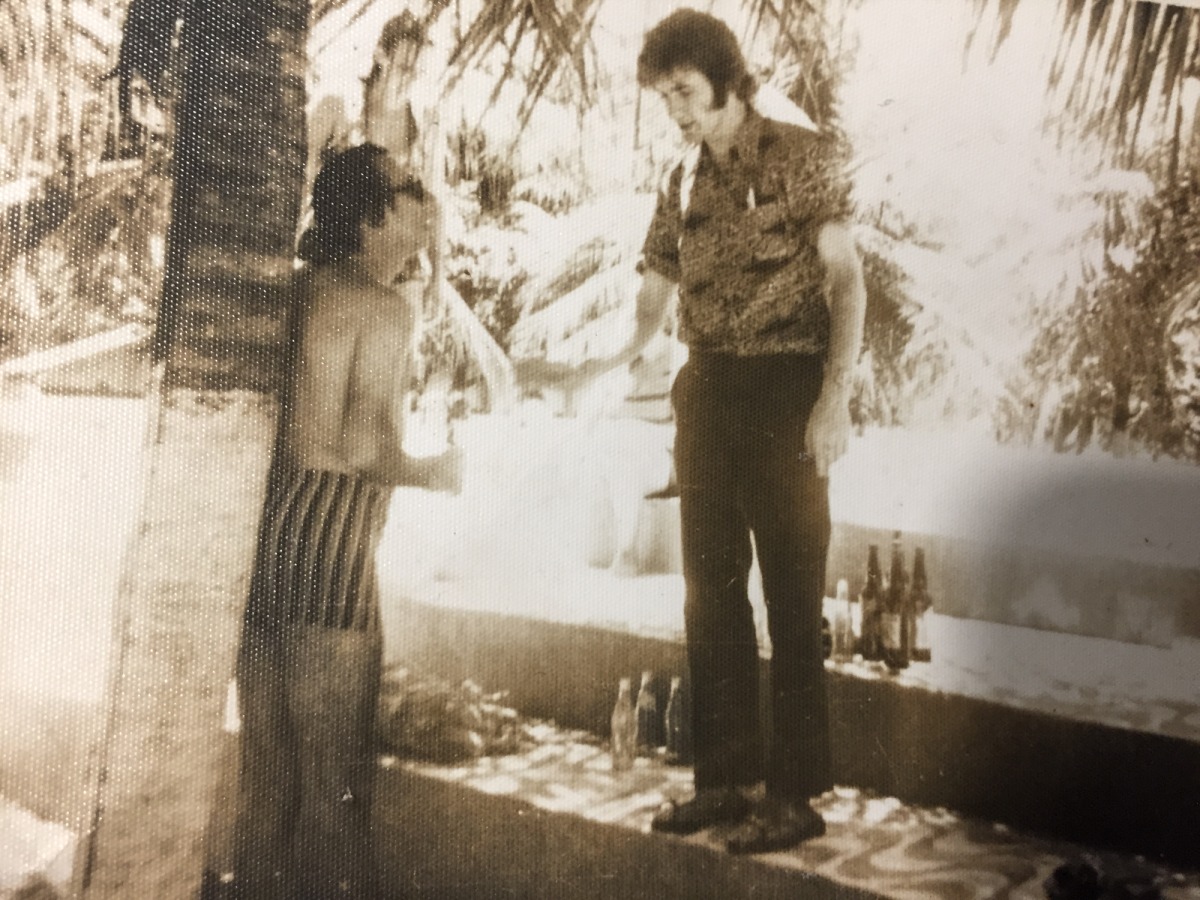
In Iguatu, the youth were immediately drawn to Patrick. He was energetic and exotic; he wore funky shirts and loved to crack jokes. He sang folk songs on his guitar. He got to know a kid who had a band and they become great buddies. Endearing himself naturally to the people and culture, he listened avidly to singers such as Dalila and Roberto Carlos (another capixaba)- known as ‘o Rei’ [the King] (who has the same birthday as my brother, though he was born thirty-four years before him). Patrick was soon playing Carlos’s song ‘Jesus Cristo’, which was released in 1970, and he was always listening to another religious rock classic called ‘A Montanha’, which came out the year he arrived. Roberto Carlos was at his peak, having found God and adapting brilliantly to the grittier sound of the 70s – a perfect combination for a new generation of Brazilians.
Before visiting Iguatu, Patrick’s sister Bríd gave me the number of Father Dick Rooney, who was living in Dundalk after spending decades in the northeast of Brazil. Over the phone, Father Rooney fondly remembered Patrick and recounted how he used to be always singing an Irish folksong called ‘Some Say the Devil is Dead’whose chorus tells of the devil supposedly buried down in Kerry, and who then rose from the dead and joined the British army. Whether unconsciously or not, I felt that Patrick had tapped into something of the soul of Brazil through this song: in the proximity of humanity with God and the devil in the land; of the displacement and mixing of influences and peoples; and of the ever-present reality of vivid death and life residing side by side.
On the afternoon of 16th April 1973, at the end of a two-day retreat with more than fifty kids from the Iguatu area, Patrick decided to take a plunge in the Jaguaribe River, which runs alongside the town. It was to be his first and last swim in the volatile river. It was the beginning of Easter Week, the day after Palm Sunday or Domingo de Ramos. His body was found by fishermen three days later further down the river. He was twenty-seven years of age.
Fourteen years later, Bríd came to Iguatu, thinking to bring his remains back to Ireland. Sister Bríd was a trained nurse and member of the Mercy Order in Trujillo and Lima in Peru from 1984 to 1990, and made the visit to Iguatu during this time, staying in the same room as Patrick. She decided that he should stay where he was in Iguatu, as that is what he had requested. Some of Patrick’s nephews and nieces also visited Iguatu later on backpacking trips.
Patrick in funky shirt standing by the river.
Amhdhorchacht
Years later, it was my turn to go to Iguatu. I also sauntered there with a guitar, and could speak Portuguese after living in Lisbon for almost a decade. A few years previously, Bríd had sent me a bunch of phone numbers for priests from the Redemptorist order out in the sertão who had known Patrick. I had gone to Brazil in 2017 with the idea that I might investigate this old family story, but after teaching for a few weeks at the federal university, I ended up following the trail of the humanitarian and Irish revolutionary Roger Casement, which took me down 3000 kilometres of the Amazon River. I only rang the numbers Sister Bríd had given me in 2019, from Lisbon, which led me to Tereza Cavalcante, the current parish secretary. She had never met Patrick, but offered to introduce me to the people in Iguatu who had known him.
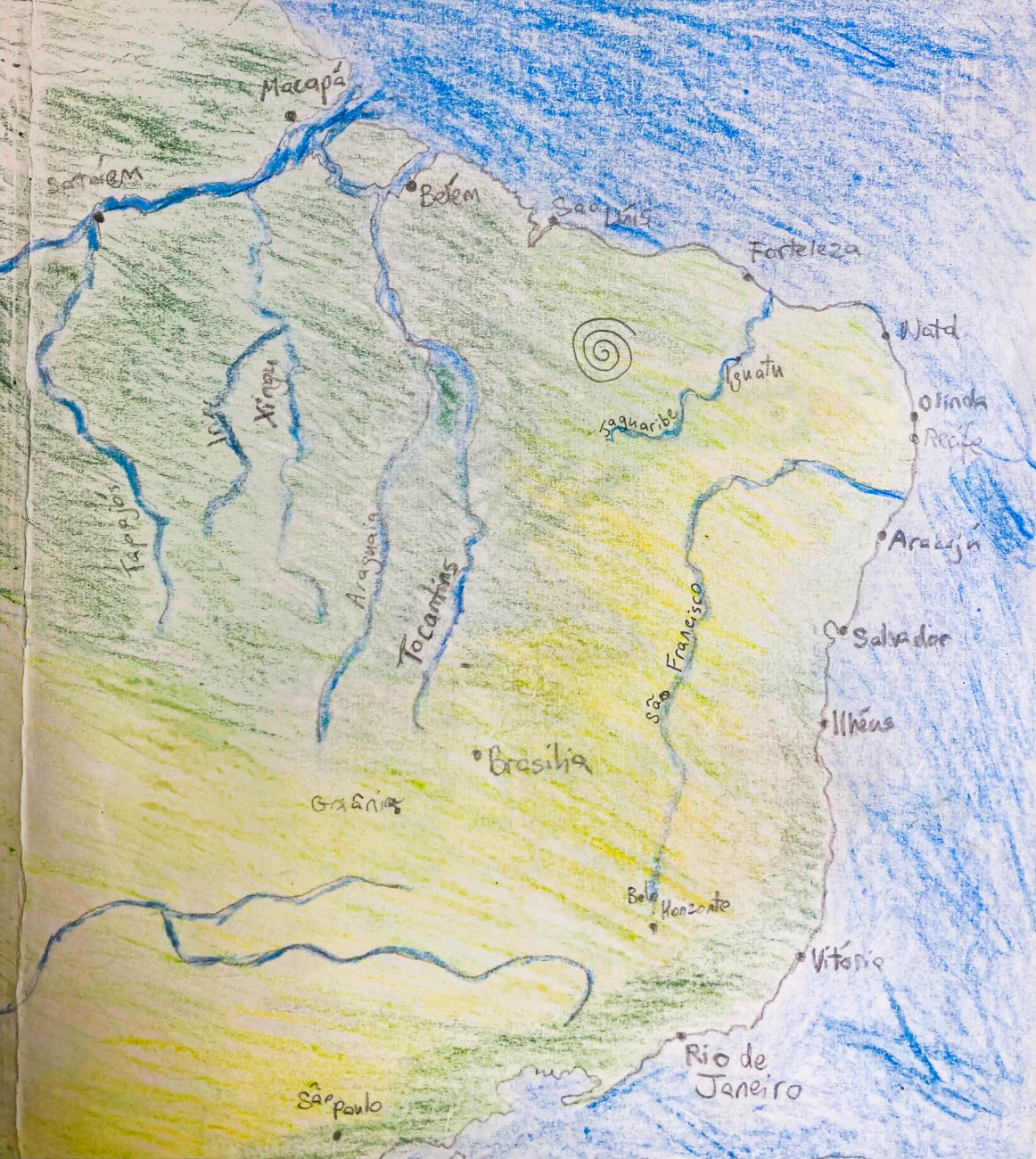
My drawing of northeast Brazil. The Jaguaribe can be seen running into the sea at Fortaleza on the top right of the map.
Tereza sent a taxi driver to pick me up at Iguatu bus station and take me to the Diocesano Hotel. The taxi driver’s name was Ishmael. ‘God hears’. Nomen est omen. Every name carries a message. Call me Ishmael. The human protagonist of that great wandering American novel Moby Dick that begins with the word ‘Call’ and ends with the word ‘orphan’. Ishmael didn’t speak to me. His company and silence were calming. I said goodbye, got out of the car, and checked into the hotel. I will never forget the sounds I heard that first night. The dark damp air was emphatically awake to me, the noises and rhythms were weaving in and out of each other in call and response, sounds that I had never heard in my life. I suddenly felt the urge to say aloud a favourite Irish word – amhdhorchacht – which can be translated as raw darkness, gloaming or dusk. Although the sun sets very quickly in this part of the world, the sound and meaning of this word at that moment invoked another way of seeing and hearing. Forty-seven years after the death of Patrick, arriving and sleeping here with all those intensified sounds closing in, I felt a sort of homecoming. The spirits in the trees and in the water had heard me coming.
The next morning, Tereza picked me up and took me to the parish office in the centre of the town. Three people were waiting for me there: a young parish priest called Padre João Batista, an older priest called Mons. Queiroga, and a woman called Ezimar Araújo. Ezimar was the former secretary of the parish. She had fourteen brothers and sisters and was the daughter of Mãe dos Padres [‘mother of the priests’] (I will return to her later). She was just a few years younger than Patrick and had spent a lot of time with him during his brief time in Iguatu. She could remember so much – dates, places and what people had said. We immediately began talking in Portuguese about Patrick – or Padre Patrício, as he was known. Our mutual enthusiasm helped us understand each other despite my thick Irish-Portuguese accent and her regional Ceará accent. Ezimar and Mons. Queiroga told me stories. They talked about Patrick’s joy and youthful vigor, and how he looked like Elvis with his big mop of hair. They had lovingly kept a photo album full of black and white photographs. To me, these were precious illuminations, time-travelling portals into the past.
There was even a photograph of two of Patrick’s nieces, twins Hilda and Colette, now 56 years of age as I write these words. I had met two more of his nieces, Siobhan and Bridget, by chance on Derrynane Beach in Kerry only a few months before going to Iguatu (Patrick’s sister Joan had six children: four girls and two boys). Patrick must have travelled with this photograph, or it had been sent to him.
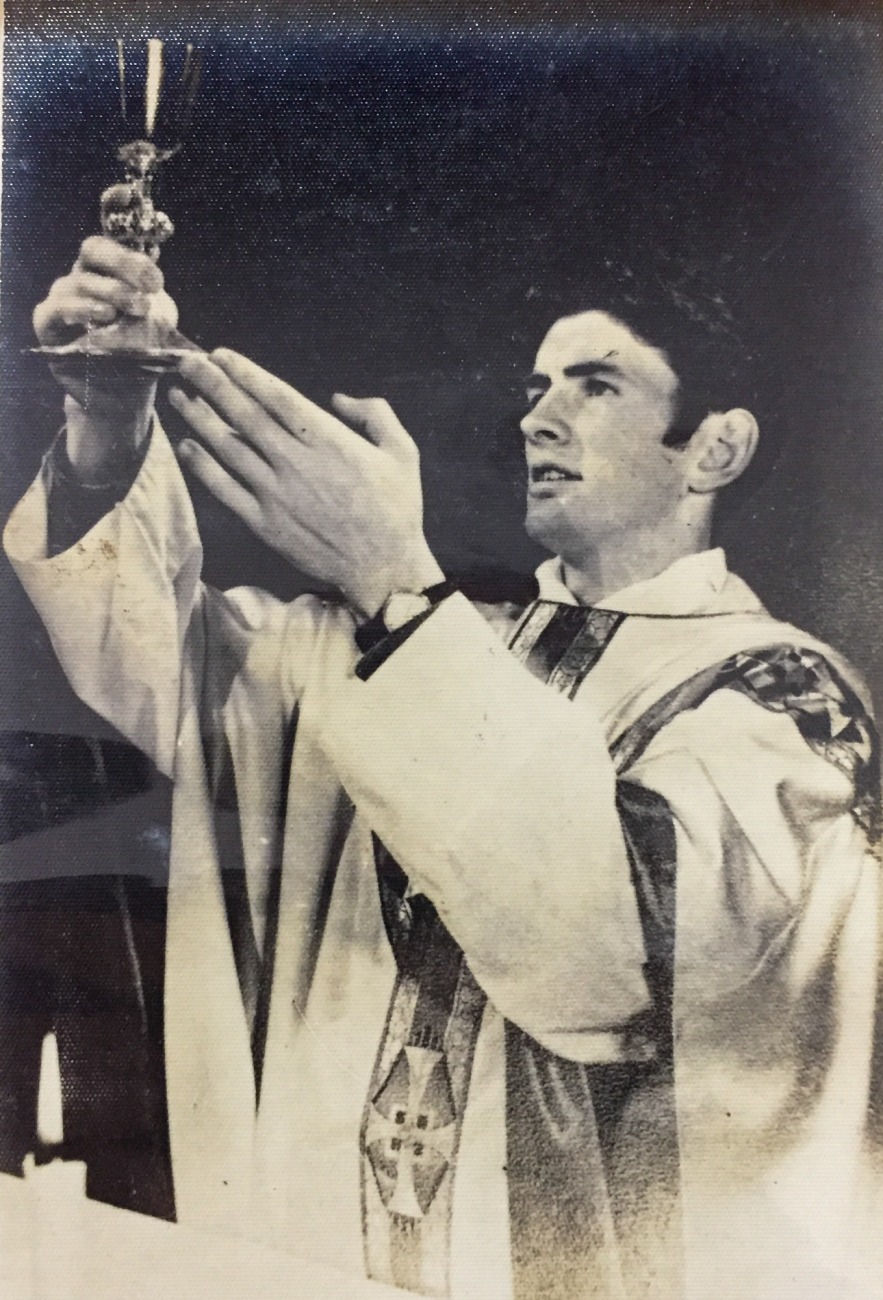
There was also a photo of Patrick in priestly attire, holding up the chalice:
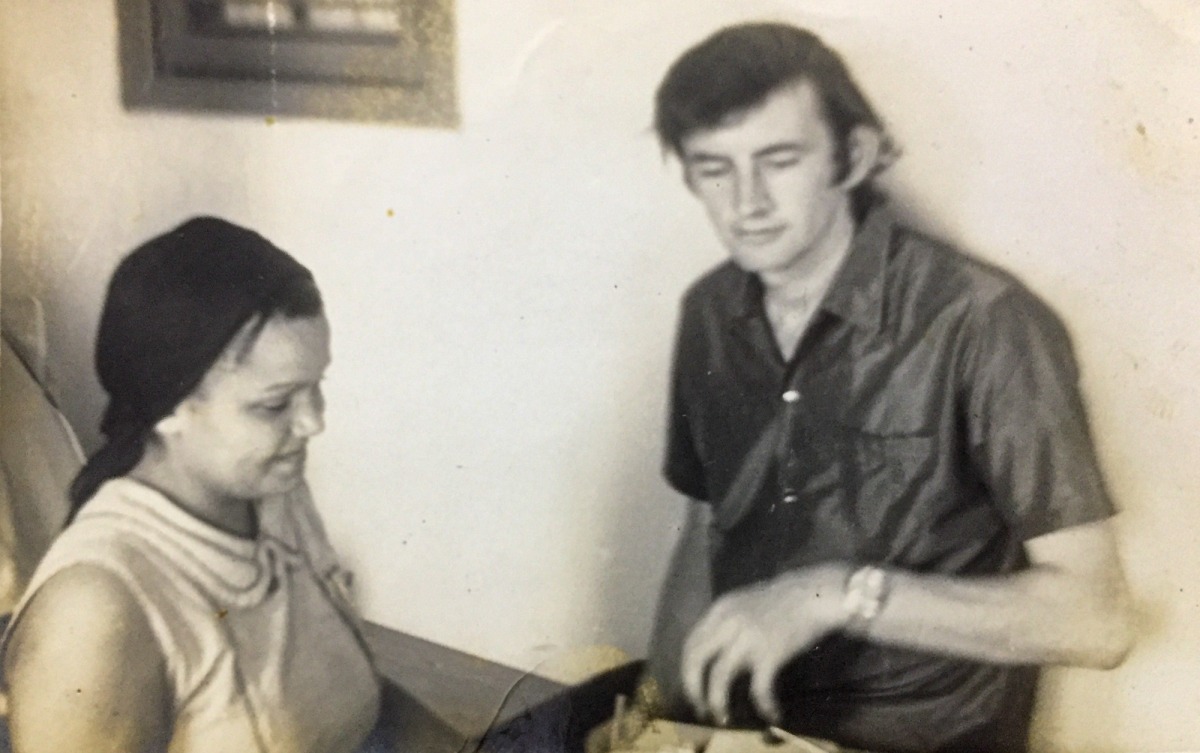
A photo of Patrick and Ezimar where they were clearly unaware they were being photographed:
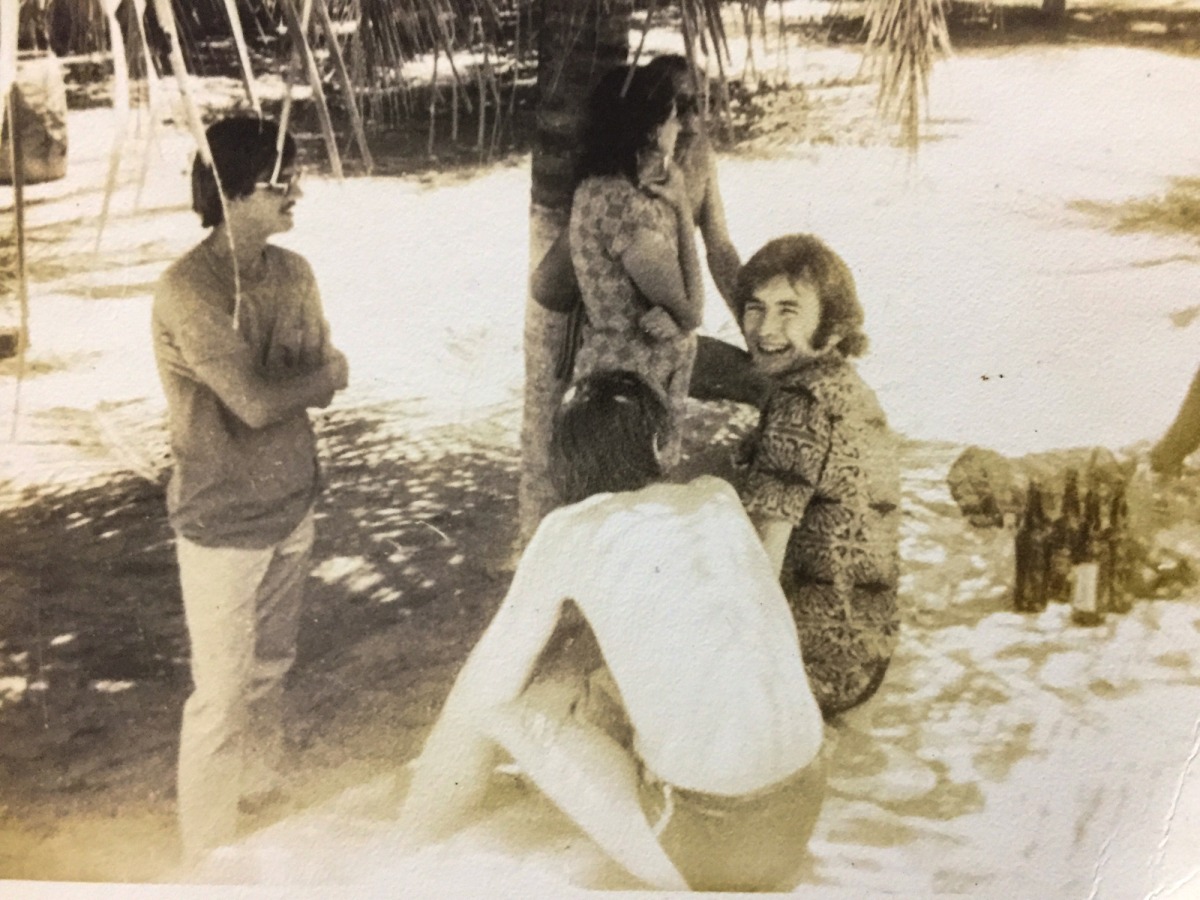
And another of Patrick sitting by the Jaguaribe River with a bunch of people. Squinting and laughing heartily, he is wearing one of his colourful shirts and his sideburns are long and shaggy. He is the only one looking at the photographer.
Ezimar recalled a Christmas party that Patrick had organised in 1972. It was his first and only Christmas outside Ireland, so it must have been a big occasion for him and he obviously wanted to show his new friends in Brazil how it was celebrated back home. He decorated a tree, wrapped up presents, and sang songs. They ended up listening to Roberto Carlos for the rest of the night. Ezimar gave a big warm smile after finishing the story, and then looked at me directly as if trying to see who I really was. I saw determination and hardship in her eyes, a will to live and to give. I listened and recorded Ezimar and Mons. Queiroga. Tereza and Padre João Batista made sure we were all comfortable.
The plan was to take me to the church, Igreja Nossa Senhora do Perpétuo Socorro-Prado-Iguatu, then down to the river, but as we were leaving the parish office, I noticed Patrick’s portrait on the wall. I was stopped dead in my tracks. It was the only portrait on display, and here he was staring out at me with a good old Kerry glint in his eye. I was struck by a resemblance to my nephew Barra and for a second I saw myself in the image. It suddenly seemed very right that I was here now. Ezimar placed her hand on my shoulder. Then we left the building and walked together to the church.
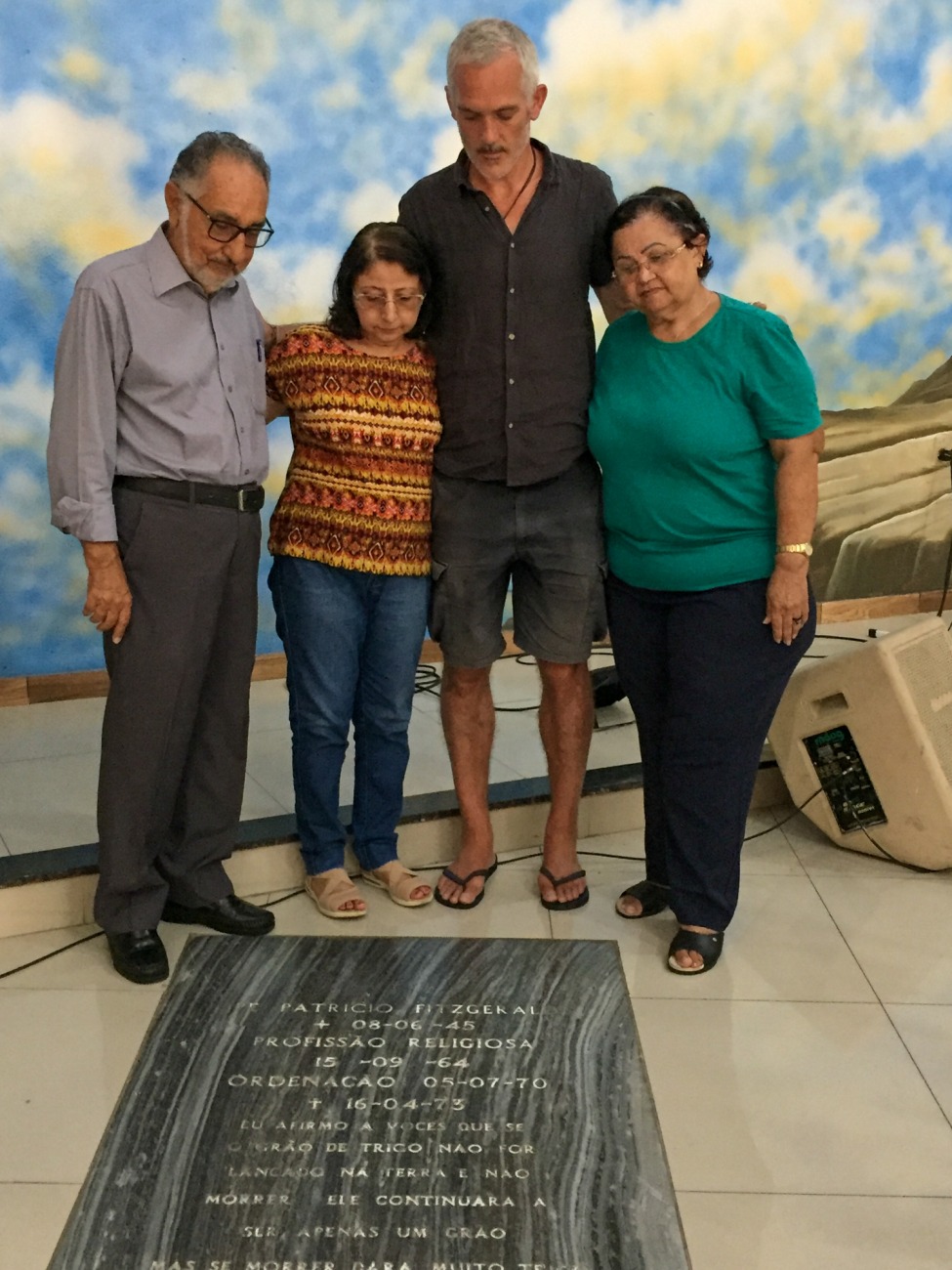
There on the altar was Patrick’s gravestone for all to see. I had no idea that he would be so present. Real absence. Each step of the way on this day seemed like a natural unfolding with Patrick as our host. Ezimar, Mons. Queiroga, Tereza and I are captured in a photograph, showing us embracing, looking down at the gravestone on the altar. For a fleeting moment, I wondered whether this magnanimous memorial to Patrick was a kind of post-colonial gesture, a bowing down before a European visitor. But looking around, feeling the atmosphere, and hearing Ezimar speak, this thought quickly dissipated: I knew this was much more. It was a tragedy for the town and for Patrick; and now it was a joy and healing for Iguatu, for Patrick, and, ultimately, for me. We had crossed the Kerribrasilian sea. It was time to go down to the river.
At the gravestone on the altar. From left to right: Mons. Queiroga, Tereza, myself and Ezimar.
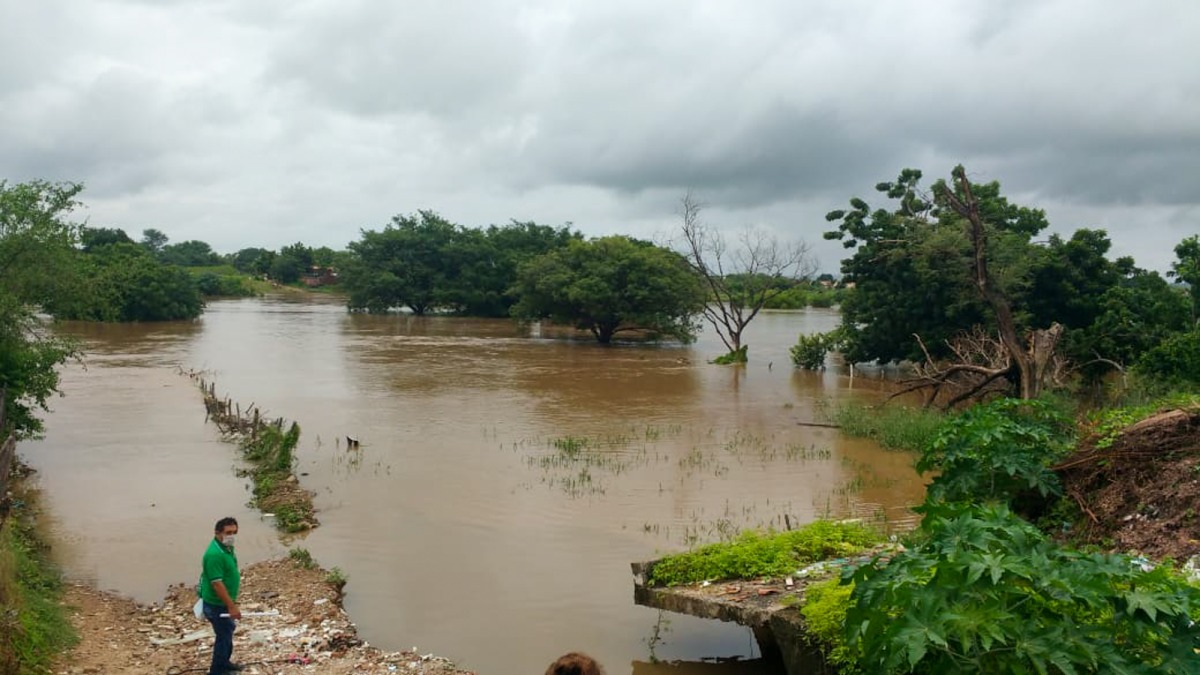
The Jaguaribe River is the largest dry river in Brazil. But as Patrick’s sister Joan said to me down on Derrynane Beach six months before I arrived in Iguatu: ‘there was nothing dry about it that day’. For half of the year there is no water, and then suddenly the rains come down and the river rises and rises, usually bursting its banks and flooding the town, before swerving and flowing east into the Atlantic Ocean. River of Jaguars. The word Jaguar derives from yaguara in Tupi-Guarani, meaning ‘wild beast that overcomes its prey at a bound’. But jaguars and onças have not been seen in this region for a long time.
At the river that afternoon in April 1973, along with the young kids and teenagers, there were three men, all Irish: Father Anthony Branagan (Padre Antonio), Father Michael Lavery (Padre Marcelo) and Patrick Fitzgerald (Padre Patrício). Both Anthony and Patrick went in for a swim. Some of the children were already in the water and warned them of the danger. Antony assured them that Patrick was a champion swimmer. But that was in a swimming pool. This was a river in Brazil. Minutes later he was caught in a whirlpool. Father Anthony and the children thought he was play acting as his head bobbed up and down and then down again, then up and down. Then he disappeared. The third of the three men watched helplessly from the shore.
Father Michael Lavery worked at Iguatu and then later went to work in Fortaleza. In January of this year he died in Fortaleza aged about eighty-seven. Father Anthony Branagan was in Brazil (in Ceará and then Goiás) from 1963 to 1995, and then went to work in Siberia (in the region of Kemerovo Oblast) from 1996 to 2020. With the breakout of Covid-19, he returned to Ireland to live in Clonard Monastery in Belfast. As I write, Father Anthony is eighty-eight years old. There were others who came to work in the parish during the 1970s, a generation of Irish missionary priests and volunteers. Ezimar vividly recalled more details with each passing moment I spent in her company. She told me that there was another man called Father Brendan Callanan who arrived in Iguatu a few months after Patrick’s death. They called him Padre Brandão. She said that Brandão was now living in Ireland, working in a parish somewhere but she didn’t know the name of the place. She also knew Father Dick Rooney; and there was a priest called Brian Holmes (known as Bernardo in Iguatu) who had been a close friend of Patrick’s. They had studied together back in Ireland. He is now living in Mozambique. Father Holmes, originally from Cork, was travelling from Fortaleza to Iguatu to visit Patrick on the day he died.
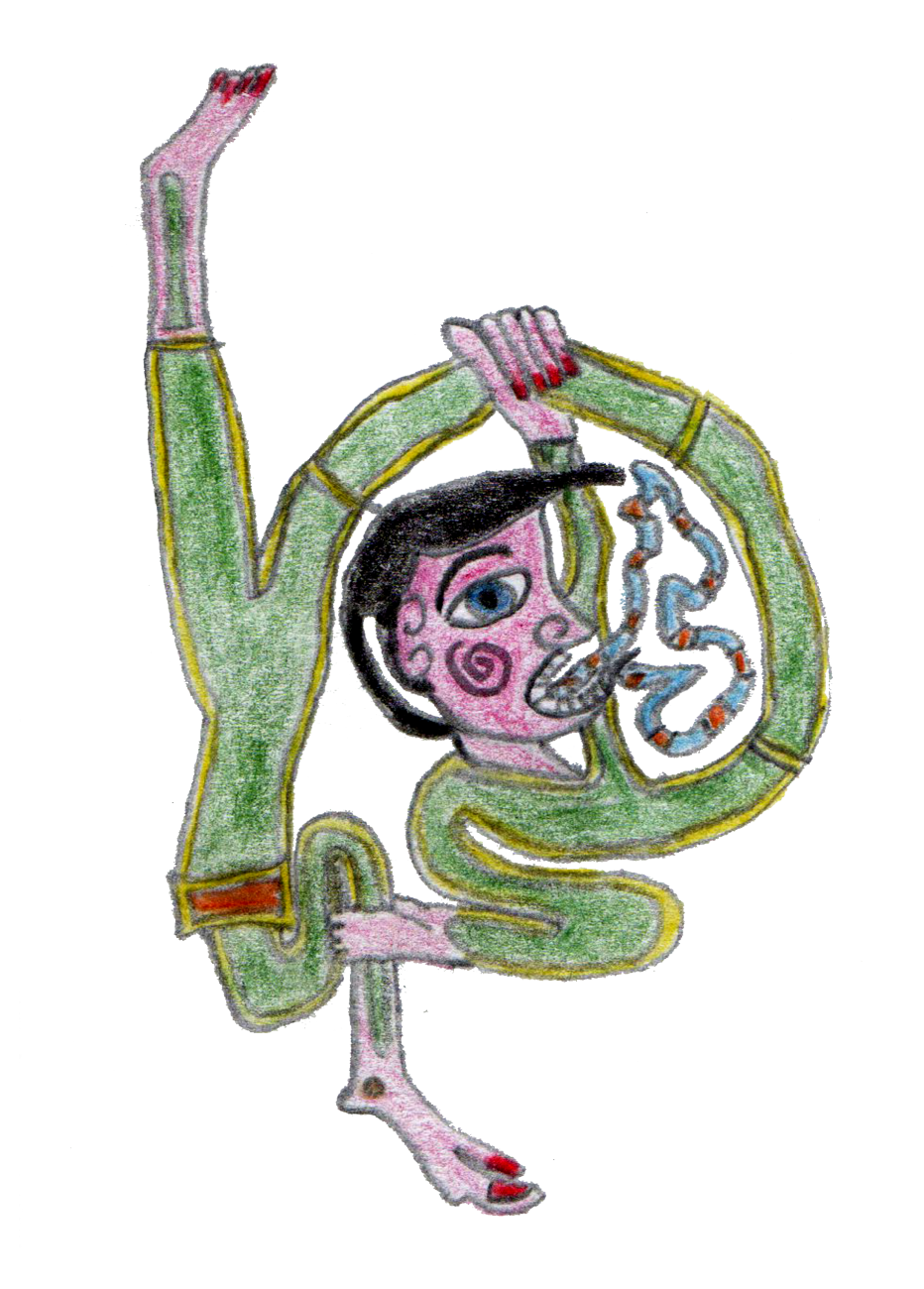
One of my drawings imitating an image from The Books of Kells, an Irish illuminated manuscript Gospel book in Latin from ca. 800 AD, now kept in the Trinity College Library in Dublin.
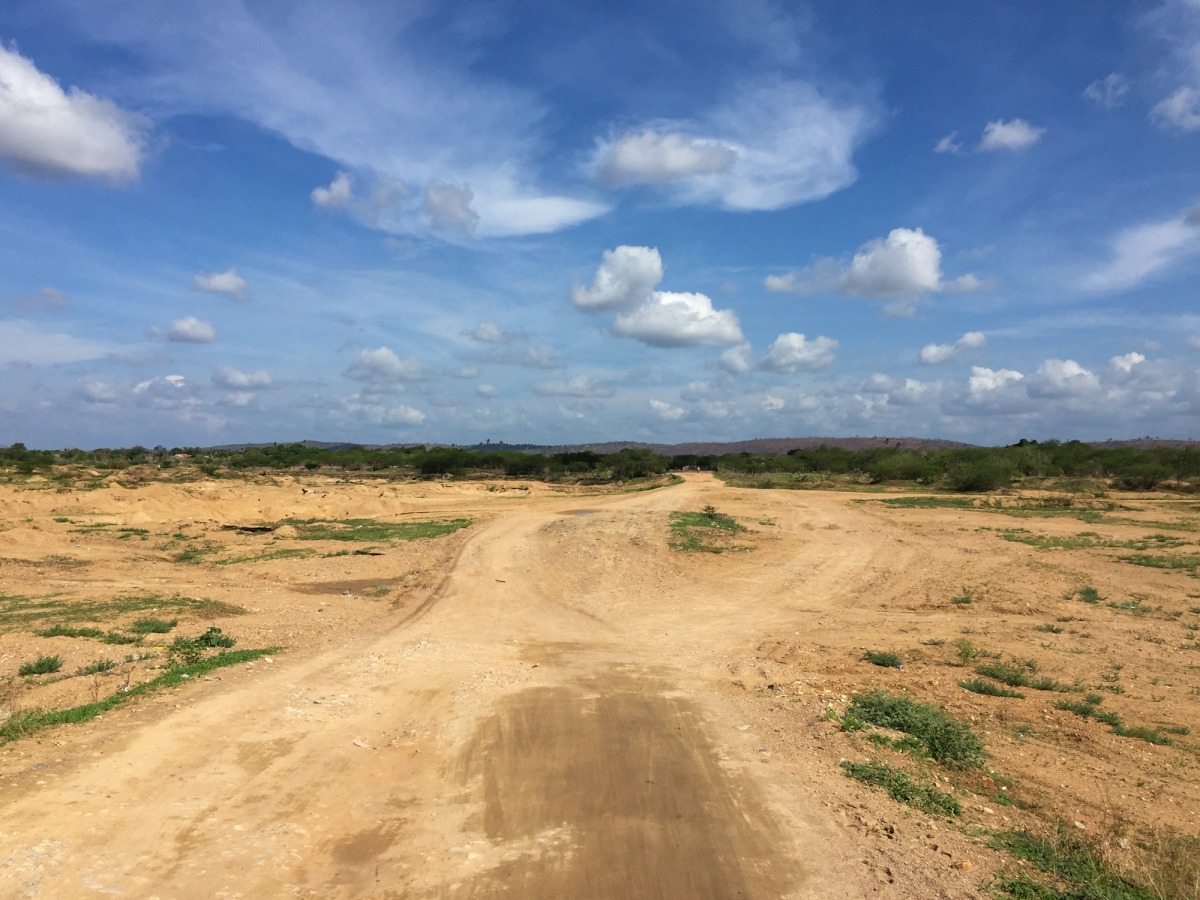
Four of us got into a car – Ezimar, Tereza, Mons. Queiroga and I – and we drove out of town for about ten minutes, following a road with shrubs, or mata, and buriti palm trees on either side. Raindrops began to fall for the first time in eight months. We stopped the car and walked the rest of the way along a dusty path littered with plastic waste with a rotting wooden fence on one side. Patches of mata were everywhere until we came to a wide-open treeless space where the Jaguaribe would soon be filling up again. No one spoke. I walked lightly out onto the cracked earth where Patrick had gone swimming. Each of us was in our own space, each of us dwelling on the same subject. After a while, I walked over to Ezimar. And then she broke the silence by telling me that the people of the Iguatu pray to Patrick and ask grace from him, like one does with the saints. She came close and said: ‘I pray; I ask things of him, and he intercedes. I receive my wishes in my prayers, thanks to him.’ [Eu peço; eu faço pedidos a ele, e ele intercede. Alcanço, graças por ele]. Then she said wistfully: ‘he always wanted to live here [ele queria sempre morando aqui] … He played guitar and he was happy’.
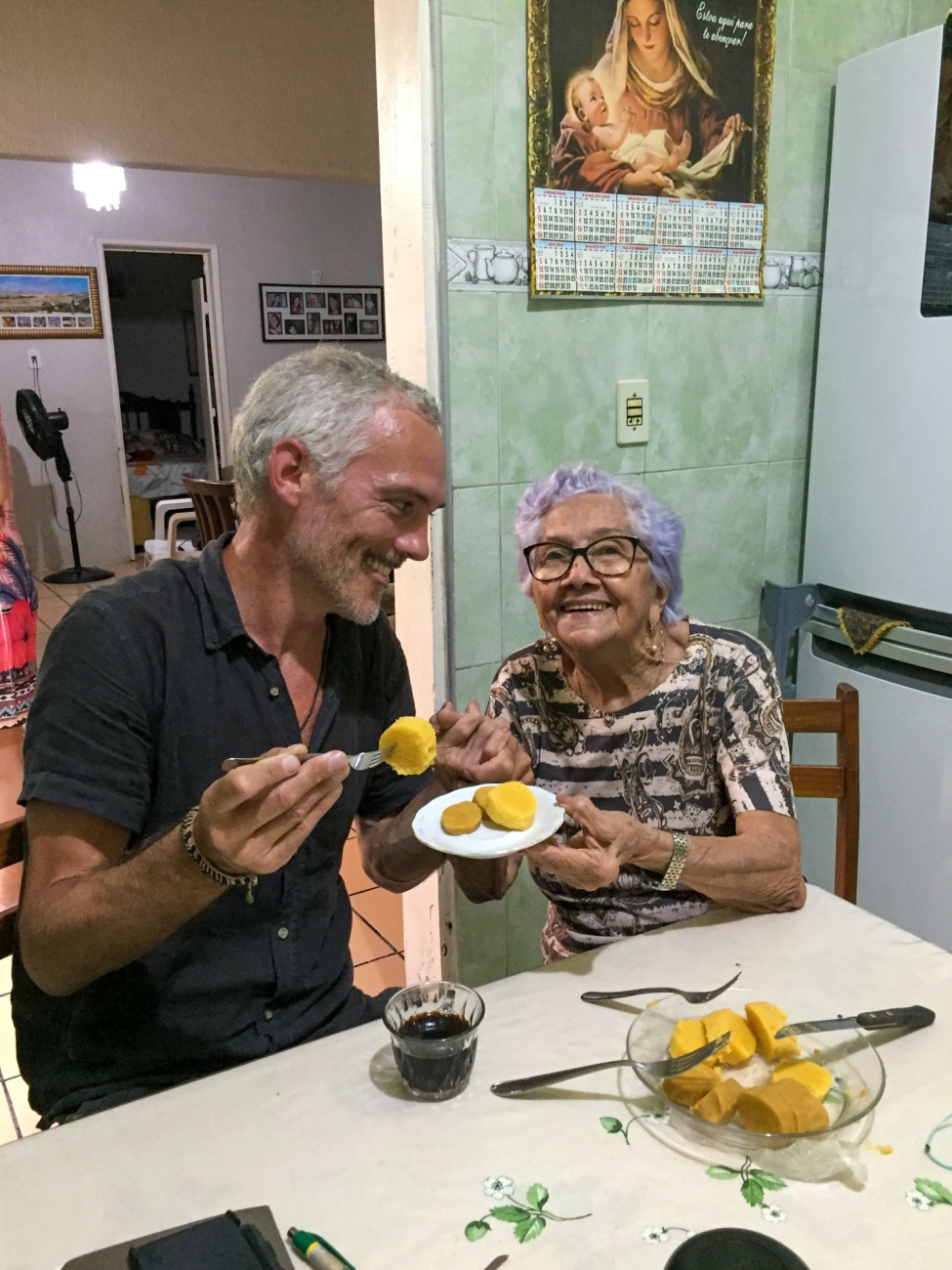
Dona Laurenise Araújo and I.
We drove back into town to visit Dona Laurenise Araújo, mother of fifteen children including Ezimar, and known in the town as Mãe dos Padres and mother of Brazil. She served me some snacks and coffee. Radiant and welcoming, with dyed purple hair, she must have been in her late eighties, and we laughed and flirted with each other. She told me that Patrick was beautiful. She was too, with her enormous hospitality, and the way she carried the weight of her ancestors with lightness and joy.
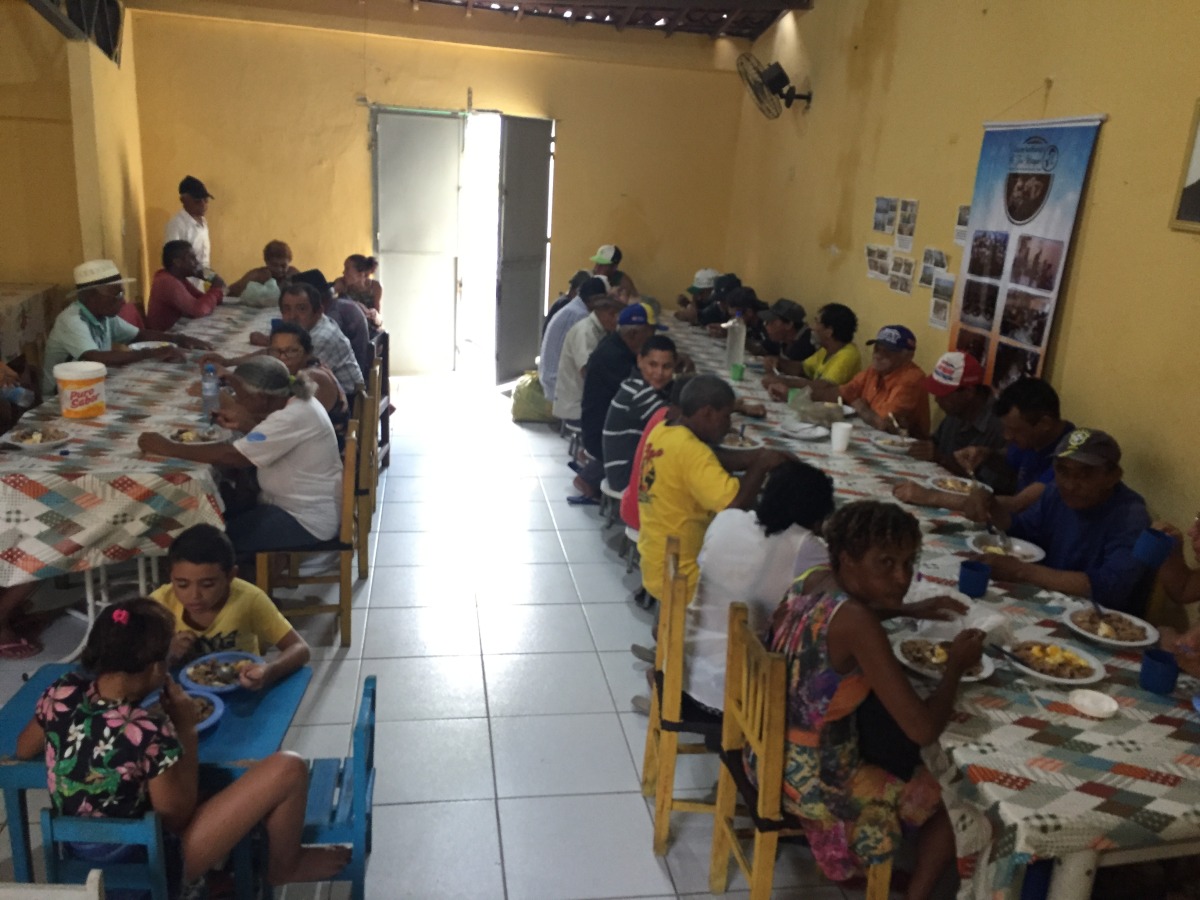
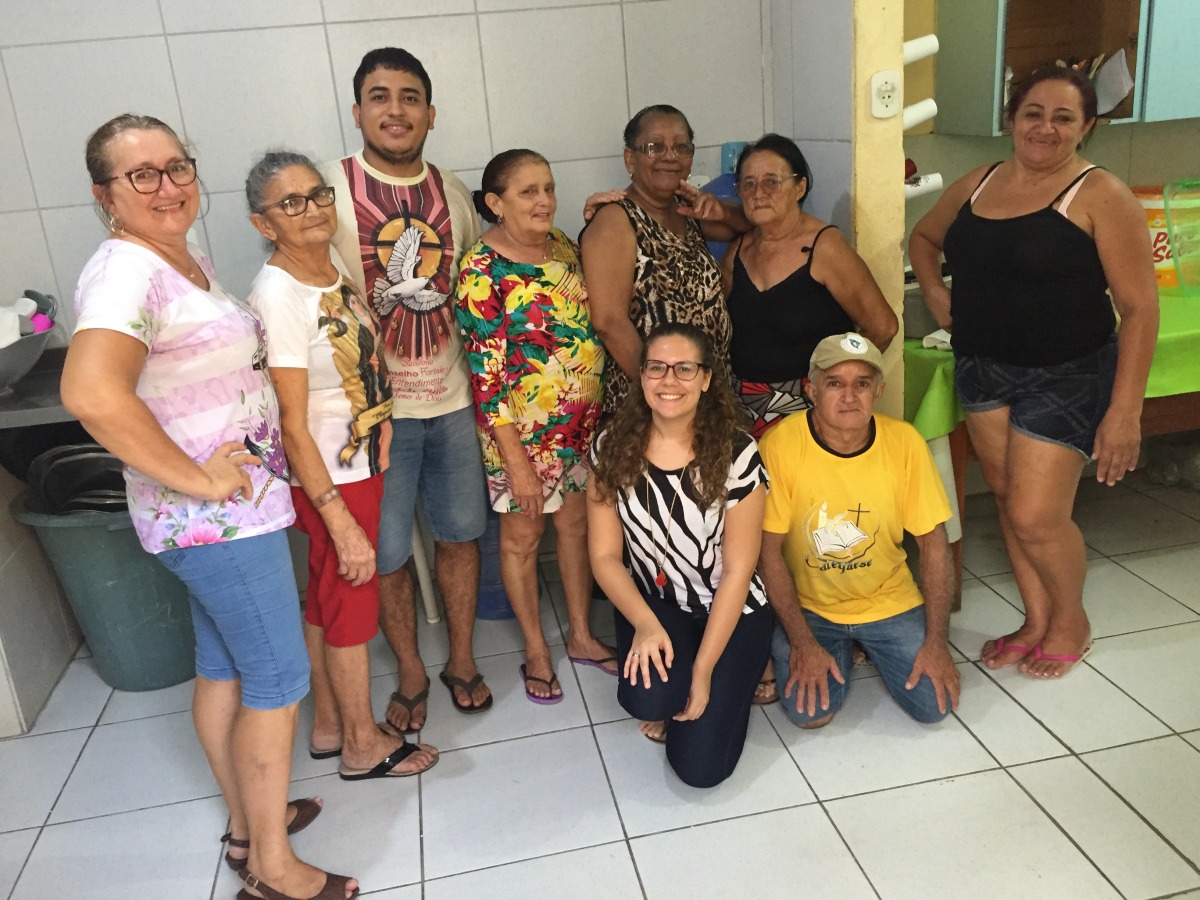
Lunch is served at the parish centre.
Then the four of us walked back to the parish office where volunteers were serving food for nearly one hundred people from the community – volunteers from the parish prepare a meal every day for those who need it. I was struck again by the kindness and tough life here. The words of the writer Jan Morris echoed in my head: ‘kindness, the ruling power of nowhere’. This is a region that has been abandoned by the Brazilian establishment, a place where liberation theology would be welcome. A proponent of this movement from Ceará, Padre Hélder Pessoa Câmara, once said: ‘When I give food to the poor, they call me a saint. When I ask why they are poor, they call me a communist.’ Here lies a deep tragedy in attitudes in Brazil and the world.
The volunteers who prepared lunch.
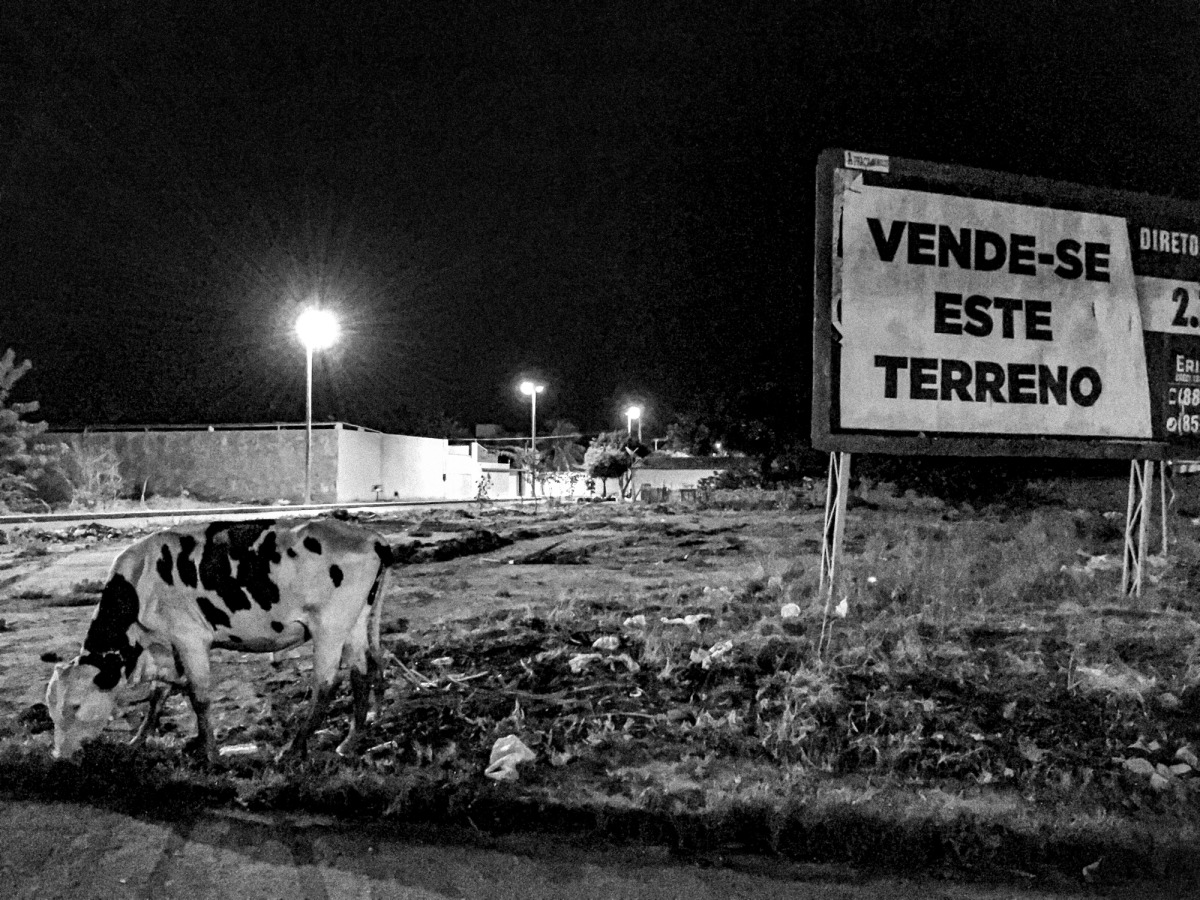
That night, Padre João Batista held a mass in the church. At the end of the sermon, he invited me up to the altar to face the full congregation and everyone stood up and gave a long round of applause. Later, when it was already pitch dark, I walked the quiet streets and passed by a gym filled with sweating human bodies working in motion with the exercise machines. I stared through the large window and watched. Most people were on running machines, half of them had earphones in, and some commercial pop music was blaring out into the street. I moved along. Ten minutes later, I was already at the edge of town. There were mounds of rubble and dirt on either side of the road, and only a few streetlights working. A cow was munching on the last tufts of grass available. In the middle of the dirt, there stood a sign that read “Vende-se Este Terreno” [This land is for sale] . After keeping the cow company for a few minutes, I briskly made my way back to my lodgings, longing to hear nature’s night orchestra once more. Outside my room I listened again to the sounds out there in the dark. Was that the spirit of the long gone jaguar growling into the night sky and through the trees? Calling out to me through Patrick?
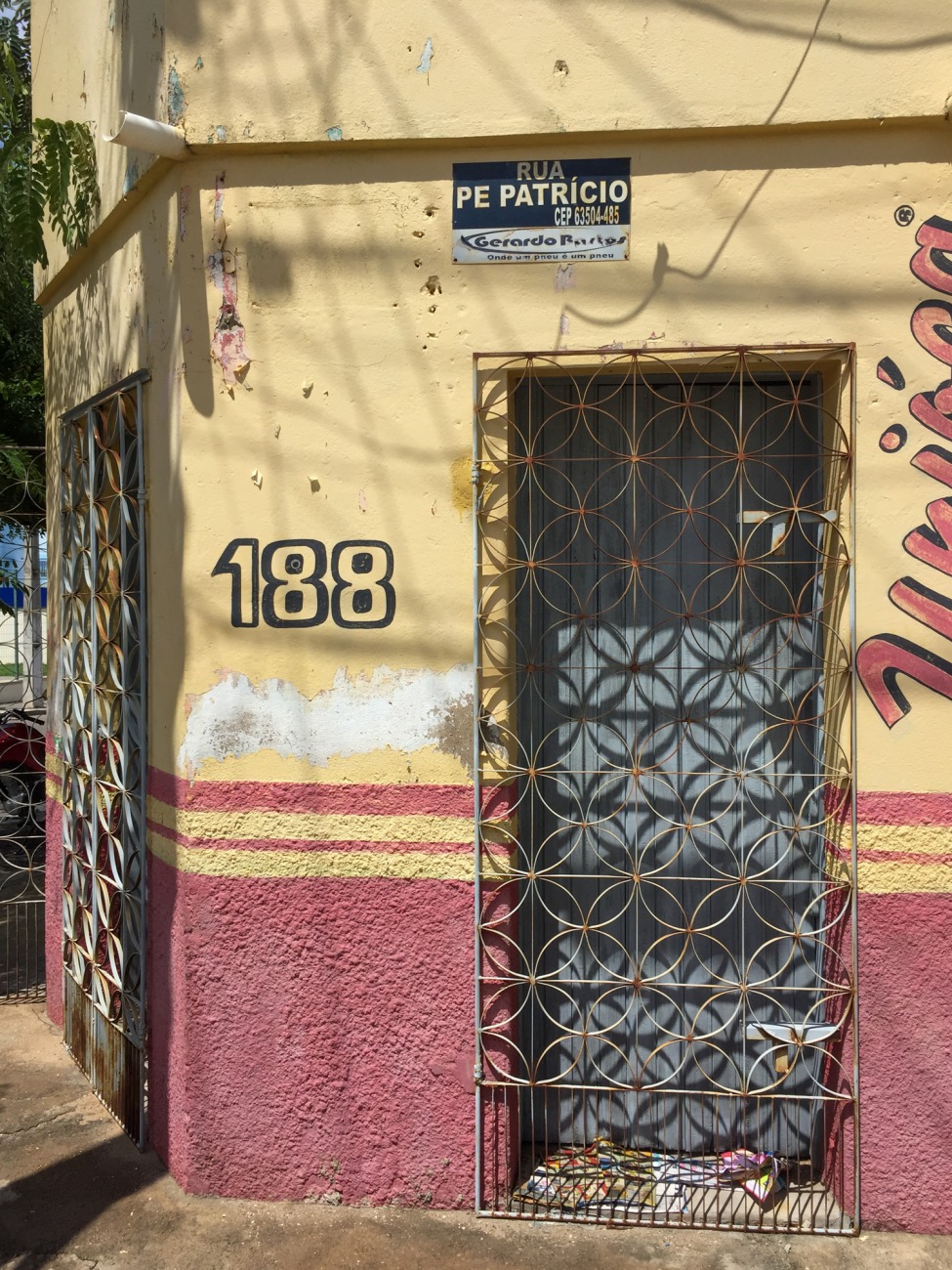
“Vende-se Este Terreno” [This land is for sale]The next morning, Tereza arranged for another taxi driver to take me to the bus station to return to Fortaleza. His name was Joaquim and we immediately began chatting. As soon as I told him why I was there, he pulled the car over to the side of the road. He was only nine years old at the time but he vividly remembered the day Patrick faleceu, and when fishermen found his body further down the river a few days later. There was silence for almost a minute as I listened to the hum of the taxi’s idling engine. Then Joaquim spoke again, this time to say that he wanted to show me something. He took me to an area of Iguatu called Vila Centenário, which was mostly constructed in 1974. We drove down one of its main streets. This street is named Rua Padre Patrício. I got out of the car and touched the street sign and smiled. Joaquim then took me to the station, and I was back in Fortaleza that night.
The Retirantes – from Ceará to Curitiba to Espírito Santo
Time for one more intermezzo before I conclude this tale. It is another shock, a rupture of real absence, showing me perhaps how I was on the right caminho, beyond trained knowledge or logical articulations. As the Irish saying puts it: Éist le fuaim na habhann agus gheobhaidh tú breac [Listen to the sound of the river and you will get trout]. In 2017, I was invited to teach philosophy and literature at the federal university of Espírito Santo in the capital city Vitória by Professor Jorge Viesenteiner who was a good friend of my friend and colleague Marta in Lisbon. They had met while studying in Germany during their doctoral studies. Marta was meant to go to Vitória but she had to cancel and suggested that maybe I would like to go in her place. So off I went, landing in Brazil for the third time.
The state of Espírito Santo is wedged between Bahia to the north, Rio do Janeiro to the south, and Minas Gerais to the west. Anyone from Espírito Santo is called a capixaba. It is a Tupi-Guarani word meaning ‘cleared land for planting’ [upi caá and pixaba]. The indigenous peoples who lived in Espírito Santo called their corn and manioc plantations capixaba. The name stuck. During the time I spent in Vitória, I became good friends with Jorge. We stayed in contact afterwards and happily saw each other again in 2019 in Lisbon. When I released my solo album in March 2022, which was written in Brazil, I sent it to Jorge, and told him a little bit about the final song called ‘Iguatu’. On 12th March, I received a voice message from Jorge. He had listened to the album, and was particularly drawn to ‘Iguatu’, as his mother had been born there, which was news to me. He said he couldn’t understand some of the details and words of the song but that it moved him profoundly. He decided to share the song on his WhatsApp family group, saying it was a friend’s song about a cousin who was a priest who had drowned there. His mother – who didn’t understand any English – wrote back to say that she remembered a priest who had drowned in the river Jaguaribe a long time ago. Jorge was amazed. ‘You knew this priest?’ he asked her. ‘Of course I knew him!’ she said. ‘Padre Patrício. I worked with him in Cáritas.’
Jorge’s mother, Francisca Iranilda de Lima, was born in Iguatu in 1951 only five years after Patrick was born. She told Jorge that Patrick was young and beautiful (‘jovem e bonito’). In the voice message, I could hear Jorge laughing. His mother remembered so many details from what seemed so long ago. They had had formed a close relationship working together in the parish. She recounted to Jorge that on the day Patrick arrived in Iguatu, he was taken to the parochial centre, where a reception and lunch awaited him. Jorge’s mother and her superior Expedita Alcântara (affectionately called ‘nenzinha’) had prepared potato puré with peas and stuffed turkey, which was served with malt beer. After drinking the beer, Patrick suddenly felt very sick. It may have been an allergic reaction, and he had to be taken to hospital. Francisca Iranilda remembered that day very clearly. Jorge said that his mother began to cry softly as memories flooded back of the land she had left a long time ago. A life before another life.
At the end of 1974, Francisca Iranilda left the northeast, like so many others at that time, for the south of Brazil. Curitiba is the city that Francisca Iranilda moved to, where Jorge was born, and also where a girl I fell in love with is from; the town’s name is said to come from old Guarani ‘kur’-‘ity’-‘ba’. ‘Ty-ba’ is a suffix for ‘many’, and ‘kur y’ refers to the pine tree, which points to the large number of Araucaria brasiliensis pine trees in the region. Francisca Iranilda still has cousins in Iguatu, but the majority of her family left. They were part of the so-called Retirantes – a large movement of peoples who came down from the sertão regions because of drought, and extreme poverty. Iguatu was just another small town in the sertão, a land of forgotten people in Brazil. After teaching in Vitória, I voyaged down the Amazon River, and I came to understand why the Amazon represents the lungs of Brazil (and maybe the world). But now I understand that the sertão is the heart.
I could feel and hear in the audio message that Jorge was getting emotional. How was any of this possible? Had some strange energy called me to Espírito Santo in 2017 so we could become friends? Did Jorge know unconsciously something else was going on? To whom am I speaking? Jorge began and ended his audio message by repeating words I had said to him from the marvellous poem ‘Le souffle des ancêtres’ by Senegalese poet Birago Diop: Os mortos não morrem. Les Morts ne sont pas morts. The dead do not die.
Jaguaribe River, 5 February 2020.
Riverrun
Language is like a river: starting with a stutter, springing up, then moving under and over stones, building up speed and increasing volume, meandering and digressing, curving and slowing down, gathering and carrying dirt and grime and rubbish, becoming stagnant, getting wider, then picking up rhythm again before emptying out into the open sea. ‘The water of the face has flowed’, as Joyce writes in Finnegans Wake. Rivers and languages are states of wandering. I am a wanderer too. Iguatu – that ‘good water’ – becomes a song of call and response, where singing is existing, and where the jaguar’s breathing rises and falls in the night.
I hear the Minas Gerais poet Carlos Drummond de Andrade’s words: A ausência é um estar em mim [Absence is a presence in me]. I hear Patrick on the streets of Iguatu. I hear him in the voices of Ezimar, Francisca Iranilda, Joan and Sister Bríd. I hear him in the stones of the church where he is buried. I hear him in the hum of the taxi and its drivers Ishmael and Joaquim taking me home. I hear him in the children playing and laughing together by the dirty, dusty roadside. I hear him in Roberto Carlos’s pop songs of salvation from 1972. I hear him in the bichos’ sounds in the amhdhorchacht. I hear him in the rivers, an ever-changing space of whirlpools, deep as a human soul.
Jaguaribe River, 18 March 2020 at the bottom left corner is Djalma, the sacristan of the Prado-Iguatu church.
Zagreb, October, 2022.
Many thanks to Tomica Bajsić and Croatian PEN Centre for supporting me and giving the space and time to write this text.
In the midst of the pandemic in 2021, Marc McSharry TD – an ardent supporter of whistleblowers – tabled a number of parliamentary questions (PQs) on my behalf. These mostly concerned the apparent widespread use of bogus medical doctors across state agencies.
All of these questions were shot down, however, under Standing Order(SO) 45, which inaccurately claimed they weren’t questions of ‘fact of policy’.
The final PQ was euphemistically ‘amended’, but was in reality an entirely new PQ, drafted so as effectively to give legislative approval to the practice of using bogus doctors, fraudently claiming to hold medical council registrations.
These doctors are used, in particular, in the Department of Employment Affairs and Social Protection (DEASP) and are paid a sum for each client they cut off disability payments. All doctors reviewing cases in the DEASP are obliged to be registered with the medical council.
The PQs raised on my behalf were signed off on by Leas-Cheann Comhairle, Catherine Connolly whom I implored not to put the replies on the Dáil record, as I explained it would be a violation of Standing Order 45 to alter a PQ without consent.
However, Catherine Connolly doubled down, claiming PQs can be ‘amended’ under SO 45.
Yet the provision of SO 45 states that PQs can only be amended in ‘consultation’ with the Deputy raising them, which did not occur.
Despite being furnished with a copy of standing order 45, Catherine Connolly bizarrely wrote to me and Deputy McSharry that the replies were going on the Dáil record, and she was ‘not re-visiting’ the matter. This effectively gave Dáil blessing to serious malpractice.
I was entitled to an appeal before the Committee for Parliamentary Oversight and Privileges (CPPO) but, before I could make a submission, I received an unsolicited letter from the Cheann Comhairle Seán Ó Fearghaíl erroneously claiming I had no right to an appeal to the CPPO.
I then engaged the service of a solicitor (at my expense), and only after two solicitors’ letters was my right to a CPPO hearing established with the Cheann Comhairle, who wrote to say he had given my submission to the clerk of the CPPO.
Matters did not end there. After this I encountered the sinister entity that is OPLA.
Seán Ó Fearghaíl TD
Case Closed
I had requested that another committee member chair the CPPO for this case, as the usual chair Seán Ó Fearghaíl, and his deputy, Catherine Connolly, had questions to answer. My request was refused, however, by the Office on the Parliamentary Legal Advisor (OPLA).
Then I sought to appear as a witness. This too was denied. Finally, I received a brief email from the Committee clerk, a middle-ranking civil servant, saying the case had been heard on April 6, 2022, and had found against me, and that the Cheann Comhairle had chaired it.
I received no reply from the Committee clerk to further enquiries such as whether the requisite quorum of eight committee members were in attendance. I did, however, receive a high-handed reply from a ‘legal counsel’ in OPLA, conveying what I now know to be an inaccurate account of the hearing.
Having checked with members of the Committee, it appears my case was never heard and, my submission was not circulated to the Committee members. This is a breach of Standing Order 118.
OPLA circulated a number of further authoritarian letters defending the Cean Comhairle’s right to chair the meeting, while maintaining that there had been a hearing by the CPPO in the first place.
On June 10, 2022, the deputy head of OPLA, Ramona Quinn wrote a letter to me citing ‘laws and conventions going back to 1923.’
In response, I challenged Ms Quinn and OPLA as to what Dáil Standing Order allowed the unit to intrude on – and indeed unconstitutionally usurp – the work of any Committee of elected representatives of Dáil Eireann? To this I received no reply.
I did, however, receive a number of further, intimidating, letter from OPLA, thereafter unsigned.
In response, I put them on notice to the effect that this constituted harassment and pointed out that they were trespassing into the constitutionally sacrosanct domain of the Ceann Comhairle, and the Oireachtas. I asked the head of OPLA for the Dáil Standing Order allowing for it. To this I again received no reply.
Further enquires reveal that the OPLA quango evolved from containing just one legal advisor, Melissa English, in 2007, to twenty-four legal experts in 2018!
English had been a sole independent legal advisor in the Houses of the Oireachtas but, according to a March 2019 article in Eolas magazine, ‘under her stewardship it is now a statutory office comprising a multi-disciplinary team of barristers, solicitors, legislation drafters and specialist researchers.’
The article goes on to quote English saying, ‘the OPLA unit had to be structured and resourced over the last 12 years.’
Eolas magazine reveals further that OPLA emerged from ‘a report of a retired civil servant Dunning in December 2016’, and it led to a Dáil sub-Committee headed by the Cheann Comhairle for the establishment and vast expansion of OPLA, including the provision for the head of OPLA to be appointed a deputy Secretary General in the Houses of the Oireachtas.
The function of OPLA is supposed to be tripartite: to give legal advice to Oireachtas members; to help draft legislation in Private Members Bills; and to defend the Houses of the Oireachtas in court challenges.
However, given English and her unit are part of the Oireachtas, and as she is a civil servant reporting directly to the civil servant and Top-Level Appointments Committee (TLAC) appointee, Dáil Clerk, Peter Finnegan, how can she defend herself and her unit in court, as it is now an integral part of the Oireachtas?
Furthermore, English flagged the ‘colliding rights of parliamentarians to absolute privilege in respect of their speeches in the Dail and the, sometimes competing rights of outside persons whose personal constitutional rights can be adversely affected by this speech’ as part of the justification for her bloated unit.
I maintain that English and her legal heavy gang have copper-fastened gross medical malpractice implicit to the use of unqualified medical practitioners by State departments and agencies.
So much for the constitutional rights of citizens, English appears to have seen no problem giving parliamentary blessing to a seriously problematic practice.
Furthermore, English appears to have seen nothing irregular about government Departments and Oireachtas civil servants distorting PQs, or the Cheann Comhairle apparently misleading me in correspondence.
The Leas Cheann Comhairle Catherine Connolly who signed the PQ responses ought to be aware that OPLA has exceeded its remit, violated the Oireachtas and conveyed falsehoods about a phantom hearing at the CPPO in April this year. I argue that she is deepening her original violation of SO 45, and failing to correct the records of the Dáil arising from the distortion of the PQ. She is also failing to correct the erroneous assertions of OPLA.
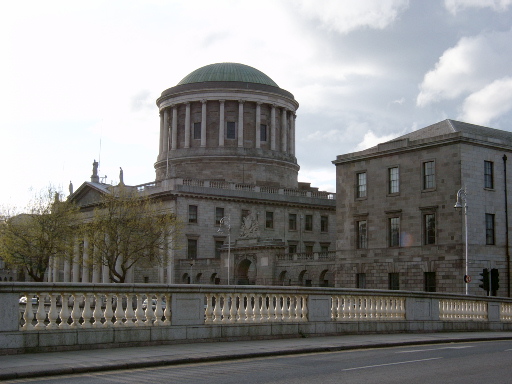
Four Courts Quay.
Violation of Separation of Powers
I wrote to Melissa English on October 15, 2022 regarding the intrusions of OPLA into the workings of a Dáil Committee.
English defines herself as ‘being central to the defence on behalf of parliament of the cornerstone of the constitutional separation of powers’, but she seems unaware that OPLA violates the constitutional separation of powers. As a civil servant under the Dáil Clerk, English is obliged to respond in ten working days to queries from the public.
Yet, to date, I have received no response from her to these questions I raised.
What is your defence of the violation by OPLA of Dail SOs and the Constitutional Separations of Powers in taking over the CPPO committee from its clerk designate and its elected members?
Sinead Fitzpatrick, legal counsel, conveyed un-retracted inaccuracies in two formal letters to me and my solicitor on 20 April 2022 to the effect that the case was heard by the CPPO on 6 April 2021. It was not heard and, the submission was not even circulated in further violation of SO 118.
Why am I still being harassed by unsolicited and unsigned communications from OPLA whom I have requested to remain outside of my dealings with elected members of a Dáil Committee – a constitutional process in which OPLA has no role or jurisdiction?
Are the Cean Comhairle and the Leas Cean Comhairle being consulted and informed about these communications, and do they approve of the ongoing communications I am receiving from OPLA at your direction?
I have separately put these questions to the Cheann Comhairle and the Leas Cheann Comhairle, similarly without reply.
I notified Taoiseach Micheál Martin in late 2021 to the effect that there is a constitutional crisis in the Oireachtas because of the ongoing conduct of the Cheann Comhairle and Leas Cean Comhairle. I also informed him that OPLA and the Dáil Clerk are violating the constitutionally sacrosanct realms of the Cheann Comhairle and the Oireachtas.
Micheál Martin responded that the Cheann Comhairle’s office was independent. It begs the question: who exactly will deal with the constitutional impasse that has emerged in this case?
It appears that OPLA is ensuring that in certain circumstances a PQ cannot be asked on behalf of a citizen. Nor can a citizen access a Dáil Committee to redress the injustice of a wrongful PQ.
How, one wonders, did the Oireachtas ever function before the recent creation of OPLA and its band of twenty-four legal heavy hitters?
The answer seems obvious. OPLA is designed to muzzle the Oireachtas. That is perhaps why no press release attended its creation on a statutory footing and its wide expansion in 2018.
It is an authoritarian quango which has mushroomed from one legal advisor to twenty-four in the space of twelve years. Masquerading as a helpful entity, its real purpose is to snuff out a crucial function of our parliamentary democracy.
So how did the legislation creating OPLA slip through parliament in 2018 and, how much does it cost the taxpayer? Having spoken to a number of TDs, none seem to recall the 2018 legislation creating OPLA in its current guise passing through the Houses of the Oireachtas.
Given OPLA’s total staff, including clerical and twenty-four legal officers amount to thirty-six, we may assume it costs at least €5 million per annum.
The spend was signed off on by the Department of Public Expenditure and Reform under Robert Watt as Secretary General and Accounting Officer. Perhaps this explains Robert Watt apparent contempt for Dáil Committees.
Democratic accountability compels a total dismantling of OPLA in its present guise. One does not need to be a constitutional lawyer to see that it is glaringly unconstitutional.
I immediately twitch with an almost intolerable discomfort when I hear the words freedom and equality. Alas, they have become quite meaningless.
Let’s take freedom for starters. Where does such a notion come from? Freedom implies choice and yet we are offered so few, in this world or ours.
For example, did you have a say in your birth? No, you didn’t. This singular event, without a doubt the most tumultuous and catastrophic in a whole litany of debacles you call your life – the one which possibly defines you the most – you have had absolutely no say in it.
So, right from the beginning you were forced, without any choice, to take part in the whole abominable exercise called Life. And, when you think further about it, the choices did not grow from thereon in, they only diminished all the more.
Your family, your country, your social background, your people’s history, again, you were not consulted in any of this. Nor in your sex, creed or language, might I add. All of these profoundly important features were thrust upon you.
Look at your body? Listen to your heart beating. Who determines that? And your lungs. Are you in control of them? Is it not that whole horrendous mechanism that houses that thing you call a spirit? Isn’t your body but a vast cell entrapping you in its ghastly prison?
As a language teacher, again not by choice, I call it the Grammar of Being! For, as in language there is very little freedom – if none at all – until the day arrives when you have mastered the extremely complex mechanisms of any language.
Anyone who has learned a foreign language will attest to how difficult this endeavour is; there are grammatical and lexical rules, as well as social rules, conventions and idioms – culture in a word – that you must also be aware of. There is Very little freedom until you have mastered all the systems.
Freedom? Where is the freedom in any of this, I ask you? Will you choose the day that you die? Well yes, only if… Camus spoke of suicide as the ultimate act of freedom, and, on this, he was of course totally correct.
And what about that other word: equality? I am reminded of the Spartan at Thermopylae who turned to his immediate neighbour, upon hearing him utter the word, and laughing at him pointed to the oncoming Persian army and said that one single Spartan was worthy of a thousand of ‘them.’
So, what does freedom mean here in twenty first century Ireland, the Republic of Ireland at least? That idea of a country we have.
What does freedom mean to us here? When we think of freedom, for example, what do we see? Do we see a rainbow-coloured flag? Sometimes this appears to be all it represents.
I work in a school, for example, and outside my classroom door (I teach foreign students who are obliged to learn English as a foreign language for their visas) there is a notice board which I instigated. Although originally it was to be a place for student messaging, there is now a lone flyer explaining the origins of the rainbow flag, which we see so prominently all over our towns and streets.
Indeed, on Culture Night one inevitably sees a veritable sea of multi-coloured rainbow flags, which come from the government-backed Arts Council. Indeed, when you attend any Arts Council-funded event these days, you come to expect the usual plethora of rainbow colours everywhere you go.
So, I hear you ask. What is the problem with this? Are you asking: “Is he one of them – a homophobe?”
On the contrary, as a writer and artist, I have been profoundly influenced by gay-lesbian- trans and bisexual writers and artists since I was an adolescent: William Burroughs, Jean Genet, John Cocteau, Marcel Proust, Lee Miller, Mae West… the list just goes on and on.
So, on this point, I can assure you, I am not against the LGBT community at all. What I am against, and profoundly so as an artist, is the notion of equality that the Arts Councils, and arts groups in general, would appear to be promoting. I am against this for an important reason that is often lost sight of.
A few days ago, I was on my way to catch a train when I bumped into an acquaintance. The man was familiar to me through certain public readings – open mics as they are called – as I sometimes had the occasion to join him at them.
The open mics that we both attended at the time promoted very strongly the ideas that I am now fundamentally opposed to, so much so that I have now adopted an anti-open mic policy.
This notion is that all writers and artists (just like all lesbians, gays, bisexuals and transexuals – who decides who goes first?) are equal and so should have the same time frame allotted to them at a public reading (usually a mere four minutes).
This means that a complete novice, who wouldn’t know a stanza from a portmanteau, is given the very same amount of respect as, say, a translator and poet who has had multiple books published and has been working very diligently on their art for over thirty years.
A professional musician asked me the other day if I had been attending any open mics recently. In return I asked when was the last time that he had shared a stage with a bunch of amateur musicians for free?
He suddenly smiled and about-tracked, finally realising what it was he had been asking me. And yet open mics are now all-pervading.
Where once they were regarded as a rather harmless exercises promoting ideas of inclusivity, now they are the absolute norm. Yet they are only considered normal in the world poetry.
Why is this? My friend, the musician, understood very well my situation. He knows me as a semi-professional writer and translator that is expected to share the stage with any newcomer at any number of so-called arts festivals.
I attended one recently for which I was very generously compensated. It had been funded by the Arts Council, but when I looked at the website after the event, to see what kind of photographs had been taken etc., there were simply thousands of photos of so called ‘poets’, meaning the actual poets who had attended were lost in an absolute avalanche of amateurism.
My friend at the train station also asked me what I had been up to of late. I mentioned that I was going down to Cork to present a paper at a Beckett symposium, but that I would be deliberately present on James Joyce, just to annoy the Beckett aficionados.
In response, my acquaintance looked at me with a kind triumph in his eyes – a look he could never have had twenty years ago – and declared that his opinion on James Joyce was just as valid as anyone else’s.
He made this boast with such firm conviction that I assume he actually believed what he was saying. I remained mute.
What could I say? After all, both of us knew he had never read Ulysses not to mention Finnegans Wake. As I watched my acquaintance shuffle on – with some bravado I might add – I couldn’t help, there but for the grace of God, go I!
The Stone Age didn’t come to an end because they ran out of stones. Similarly, we should be building an economy where we ‘use’ resources rather than ‘use them up’. The human species must change its profligate ways, and radically reduce the level of extraction required to fuel our needs and desires.
The economy is a part of society, and society is inextricably bound to the environment. In the living world there is no landfill; instead, materials simply flow. The waste of one species is food for another. Things grow, fade in time, and nutrients safely return to the soil. We, humans, however, generally ‘Take-Make-Dispose’.
With increasing consumer demand, we continue to eat into finite resources and waste more and more. It begs the question: how can we turn waste into capital?
The idea of the circular economy is move to ‘Make-Use-Return’, both in mindset and practice, and for this to become natural. A circular world economy would marry resourcefulness, design thinking for products built to last and be recyclable, retrieve raw materials, and alter current ownership models.
We have a waste problem. Globally, we generate about 1.3 billion tons of trash per year, leading to environmental atrocities like ocean plastic pollution. This may even become a source of future conflicts, as countries search for new places to stash their trash.
The UN International Resources Panel projects that our use of natural resources will double by 2050. A study by the OECD shows that the flow of materials through acquisition, transportation, processing, use and disposal accounts for about fifty per cent of greenhouse gas emissions.
The circular economy is a model of production and consumption, which involves sharing, leasing, reusing, repairing, refurbishing and recycling existing materials and products as long as possible. In this way, the life cycle of products is extended.
This helpful definition should make us consider how we reduce waste to a minimum, and disassemble raw materials after a product reaches the end of its life cycle.
A circular economy is an industrial system that is restorative or regenerative by intention and design. It replaces the end-of-life concept with restoration, shifts towards the use of renewable energy, eliminates the use of toxic chemicals, which impair reuse and return to the biosphere, and aims for the elimination of waste through the superior design of materials, products, systems, and business.
The challenge is to change our mindsets: how we think, behave, and consume collectively and individually.
Can the goods of today become the resources of tomorrow? This could involve, for example, changing the way we recycle valuable alloys, polymers and metals so that they maintain their quality and continue to be useful beyond the shelf life of an individual product. It would certainly make a lot of commercial sense.
We must move away from the ‘use and throw’ culture that operates today, consciously pivoting towards a more ‘return and renew’ approach, where products can be easily disassembled and regenerated.
The circular economy isn’t about one manufacturer changing one product, it is about all of the interconnected companies that form our infrastructure and economy coming together.
Therefore, across industries, the idea is to design products that can be disassembled systematically once the consumer has finished using them, re-manufacture and offer them out again.
The focus then moves to ‘cradle to cradle’ rather than ‘cradle to grave’ and the production cost should decrease drastically. For example, in the clothing industry, instead of garments lying as waste in a landfill, clothing companies could collect them and reuse them to make new products; potentially profiting out of the waste.
Everything is healthy food for something else. Everyday products from shoes to mattresses can be manufactured in a way that could be fully recyclable. For example, the fast-fashion brand H&M has made a commitment to use 100% sustainably sourced material.
The circular economy is an inevitability. It is not simply about fixing a particular problem, but redesigning an entire system to address the interconnected challenges of climate change, pollution and waste.
The concept of ‘sustainability’ is often used interchangeably with the Circular Economy. This is rather misleading. Although both of the concepts address issues around decarbonization, energy transition, and the waste minimization narrative – amongst other points that include local and ‘glocal’ actions and strategies – the two concepts remain quite distinct.
Sustainability, to a large extent, is a systems-level approach that encompasses environmental, social, and economic factors and assesses how they interact.
We can also include the concept of the Triple Bottom Line (i.e., people, planet, profit) in the context of business organisations, and how this can contribute to the cause of sustainability.
The concept of sustainability also helps us to evaluate the risks, trade-offs and externalities (positive or negative), from a life-cycle perspective, across the entire value chain. This is what leads to long-term system balance.
Fundamentally, however, sustainability is an umbrella term addressing a wide range of scenarios and issues, and not only focusing on conservation, choosing eco-friendly options, or switching to renewable energy.
Research by the MacArthur Foundation argues that sustainability does not have a singular focus on any individual part of the chain; rather the concept helps us to understand how the parts interrelate to enable effective overall outcomes.
In other words, ‘individual parts cannot be optimized without optimizing the whole’. Thus, an electric vehicle is not sustainable if we factor in the unquantified and unaccounted for social and environmental externalities that span the lifecycle of the lithium-ion battery that powers the vehicle, from mining, processing, smelting, trade, and transportation across the globally networked supply chain to the lack of recycling and reuse options for the battery at its end-of-life.
Certain industries have taken the lead in terms of rethinking and redesigning how they manufacture; choice of raw materials; and how they recollect products once consumers have stopped using them.
BSH sells home appliances-as-a-service promoted reuse, repair and extend product lifecycles. It now offers a full service, delivering, installing, repairing, moving, adjusting and picking up the appliances again at the end of the contract.
In the agriculture sector, there is growing availability of affordable bio-based solutions for recycling nutrients from agriculture. Using Hybrid Biofilter is a scalable solution that prevents nutrient leakage from fields, thereby improving local water quality. At their end-of-life, the biofilters can also be reused in several applications to release the captured nutrients back to their natural cycle.
Similarly, Nike launched the recycled-content version of the Converse Chuck Taylor All-Star series and introduced ‘exploratory footwear collection’ made from factor and post-consumer waste. At the Tokyo Olympics, the athletes representing US, France, and Brazil used Nike-sponsored uniforms made with 100 per cent recycled polyester.
Another closely related example would be Adidas, which has rolled out fully recyclable version of the Ultraboost running shoe collection made from a single material without glue. Similar initiatives are going on in Puma and Timberland.
Likewise, IKEA launched a buy back programme where customers can receive up to 50% of an item’s original price in the form of a store voucher. Also, unsold items are recycled or donated to local community projects.
Philips design products for hospitals, including medical equipment such as MRIs and CT Scanners. They are currently offering trade-ins on their old equipment for a discount on new systems. The company disassembles the collected equipment, refurbishing and upgrading them to sell these again.
This is a ‘win-win’ model since hospitals get financial returns from their older equipment, while also efficiently upgrading to the latest technology. This also addresses the e-waste recycling challenge that we face today.
H&M, the leading fast-fashion brand, now encourages customers to return used clothing to stores, who receive discount vouchers for future purchases at the store. The company classifies the collected used clothing into a) Rewear; b) Reuse; and c) Recycle categories, and they work across partners to continue with their sustainability measures.
In 2015, the Ellen MacArthur Foundation demonstrated that a circular economy could boost Europe’s resource productivity by 3 per cent by 2030, generating cost savings of €600 billion a year.
The following are three sector specific examples:
(a) Clothing businesses have actively taken steps towards embracing circular economy practices. Some firms in the apparels industry have formed coalitions to promote nontoxic chemicals, improve cotton farming. Others are developing standards for garments that are reused or recycled. There is great scope in investing in the development of new fibres that lower the environmental impacts of production.
(b) Recovering the material value of bottles, from mixed recyclables or bottle-to-bottle recycling, could lead to a much higher pay out. Metals, meanwhile, are commonly extracted from tires in open backyard fires – at great cost to both human health and the environment. Aggregating tires for use as industrial fuel could increase their value almost tenfold, while crumbling them to make road-paving material yields even higher returns.
(c) Dell has incorporated recycled plastics into its products, using the world’s largest takeback program for used electronics. Their cloud service lines provide customers with computing capabilities, while eliminating the need for physical assets, reducing costs and carbon footprints. All these practices, as mentioned above, can help companies extract additional value from leakages or waste in the production process.
A study by the World Resources Institute (WRI) identifies certain operational barriers in the functioning of the circular economy.
Creating a changed mindset is a major challenge. Thus, for example, we use twenty times as much plastic as we did just fifty years ago. This is despite a strong push from the market to use linen as the material for shopping bags.
Unfortunately, shoppers still choose single-use plastic bags and packages that often wind up at the bottom of the ocean. This requires a change in consumer attitude as well as a more stringent regulatory push on this matter.
Another related aspect to this is how we understand the ‘expiry date’ of a food product. Expiration dates are designed to protect the consumer, but it is not contingent on how a particular foodstuff is stored. Thus, the expiration date on eggs in India may be labelled for pantry storage, but these will last longer when refrigerated.
So, while an expiry date can mean that a food is inedible in certain circumstances, it may still be safe to eat while not necessarily meeting the manufacturer’s quality standards. This is currently being addressed in several markets.
Waste management and recycling infrastructure differ from country to country, which is another difficult factor to control. For example, studies project that there could be more plastics than fish in the ocean by 2050.
There are certain limitations in how plastics are sorted by chemical composition and cleaned of additives. Better technology can maintain quality and purity so that product manufacturers are willing to use recycled plastics.
Once there is some incentive, companies and users will be more inclined to act responsibly. This is an area where nations can work together during international conferences on partnerships and share research and development.
The global population is projected to reach 9.5 billion by 2050, with far fewer living in poverty than today. Emerging countries such as the BRICs (Brazil, Russia, India, China, South Africa) have an expanding middle class – with increasing purchasing power.
Clothing and apparel sector needs to lessen their environmental externalities by using non-toxic dyes and recycling cloth scraps.
As discussed earlier, the ‘rental and resale’ model has to succeed against fast fashion preferences which produce far more waste. Also, with increasing demand for electric cars, lithium-ion battery manufacturers must design products with a similar mixtures of chemicals, allowing more processed recycling possibilities.
A Harvard study reviewing the manufacturing sector, in particular the clothing and furnishing sectors, provides an understanding of the different strategies that embed a functioning circularity.
First, the study suggests that companies should consider leasing products instead of selling them. This would retain the continuity or circularity.
Moreover, from a stakeholder perspective, this would mean that the companies remain responsible for the products, even after consumers are finished with them.
Xerox, for example, over the years have followed a model where they lease their printers and photocopiers to corporate clients rather than selling them. It entails after-sales and repair costs but is still more sustainable than replacing the devices after their life cycle ends.
Since time immemorial the robes used at graduation ceremonies have been rented rather than sold. Similarly, the company ‘Rent the Runway’ also leases designer clothes for one-off events’
The second example follows from the first: companies designing products that have a longer product life cycle. A longer life span means there are fewer repeat purchases and, at the same time, companies can leverage ‘durability’ as a competitive advantage over rivals.
This can also give them access to new markets and price their products higher given the premium nature of the offering.
For example, Bosch Power Tools extends the life of its used tools by remanufacturing them. This enables them to compete with cheaper products from competitors.
Thirdly, companies can embed the recycling aspect during the product development stages and planning process. The idea here is to maximise the recoverability of materials used in products.
For example, Adidas partners with Parley. The latter company makes textile thread using plastic waste from which Adidas manufactures its shoes and apparel. The end result is less plastic at the bottom of the ocean.
We urgently require innovative public-private partnerships, where companies, investors, governments and academia offer the intellectual, financial, and operational assets to solve big problems
We also require a mindset shift to dream of ‘prosperity in a world of finite resources’, and where over a third of all food is wasted, even as the Amazon is deforested to produce more.
We have to move to a situation where we are ‘users’ of services, rather than ‘consumers’; to pay-for-use (like we do in the Gig and Sharing economy) rather than ‘owning’ a service.
The choice is as much individual as it is collective, as the Dalai Lama once put it: ‘if you think you are too small to make a difference, try sleeping with a mosquito.’
Feature Image: Shade-grown coffee, a form of polyculture (an example of sustainable agriculture) in imitation of natural ecosystems. Trees provide resources for the coffee plants such as shade, nutrients, and soil structure; the farmers harvest coffee and timber.
I’d emailed, left messages, and read their mission statement: To free the innocent, prevent wrongful convictions, and create fair, compassionate, and equitable systems of justice for everyone.
No. I have no idea what I’m doing, but I’m doing it. Walking downtown to the office of The Innocence Project in Manhattan. On my way, I look up to see the spike of the Freedom Tower cutting through dense spring clouds. It makes me wonder, in this country of income disparity, prejudice, and Proud Boys, is there indeed justice for all?
“Well, I’m here now and I’d like to speak to an attorney.”
I fucked up. No one is coming to speak with me.
Within minutes, I’m greeted by an affable intake attorney named Dara, who gives me her full attention. I explain that I’m a writer advocating for a wrongfully accused inmate at Cumberland Prison. Emmanuel Clark is serving a life sentence for first degree murder. After letting her know that Emmanuel’s files were given to their office by his cousin four years ago to no conclusion, she agrees to take my 16-page typed transcript and assures me the office will again give his case … a look. I’m informed it will take time. That there are no guarantees. With profuse thanks, I’m gone.
For months now, I’ve interviewed Emmanuel Clark. An inmate serving a life sentence with no parole at Cumberland Prison in Baltimore. He went in at age 19. Now he’s 46 years old, serving time for a crime he claims he did not commit. We communicate by prison pay phone, trying to untangle a web of injustice. One that is all too common when you’re young, poor, and not white.
I learned about Emmanuel through my friend Greg. Someone who knows what it’s like to be incarcerated. But for the past 10 years, Greg has focused his life on sobriety, and making people laugh, while attempting to make a difference in the world. He heard about Emmanuel’s plight through his cousin, felt compelled to advocate for him, and solicited my help in the process. Both my friend and I have had our share of family dysfunction. Probably what lead us both to stand-up comedy and a decade-long friendship. But we’re here now. Meeting once a week, to put together this complex puzzle that a corrupt legal system once scattered.
A robot operator asks us to accept the call, “From an inmate at Cumberland Correctional Facility.”Press zero, and you’re connected. Allocated a strict 30-minute time limit for which the inmate has to pay. At 90 cents an hour on a jail work program, one phone call per week is a significant expense. But after two decades of no one listening to his story, Emmanuel decides it’s worth it. He’s excited. There’s a lot to tell and not much time. Greg in his raspy, Good Fellas voice repeats, “Very simple, Emmanuel, go slow and don’t give us too many details all at once.” As he speaks, I’m reminded of Denzel Washington in the movie, Philadelphia and his unforgettable line, “Tell it to me like I’m five.”
Born Emmanuel Clark,in a rough section of Baltimore City, neither the Greek American father he never knew, nor a Native-American mother were capable of raising him. Both parents had a dependency on drugs and alcohol which would later prove lethal for their son. What followed was foster care, juvenile detention centers, and homelessness. Out of desperation to survive, 16-year-old Emmanuel started selling crack on the street. And by 1997, he was convicted of murder one. A life sentence. Without parole.
Emmanuel had been selling in Patterson Park. An area of Baltimore known as Butcher’s Hill. His customers were, for the most part, prostitutes and petty thieves. There, he met a woman named Bonnie Felicetti who worked as an admin for a lawyer. But Bonnie was also a known prostitute and crack addict. She lived with her husband Tony, also a drug user, and a 38-year-old friend called Louis Koch. Emmanuel didn’t know Louis well but described him as follows:
“When you talked to him, you knew he was kind of…slow. Bonnie would get high and use Louis to buy drugs when she didn’t want to leave the house.”
On Sunday, June 16th, the night before the murder, Emmanuel gave his last gram of crack to Bonnie with the promise that she’d pay him back. 60 bucks. Within the next couple of days.
Next morning, Monday, June 17th, Emmanuel got breakfast at Hardee’s, before walking to Patterson Park, where his cousin would re-up his supply. He was there for several minutes when Louis showed up, saying Bonnie would be home from work. And had his 60 bucks.
“I figured I’ll hang out there, get my money, wait for my cousin and get off the streets.”
When Emmanuel followed Louis home, he was led through an alleyway. Not the front entrance.
“Louis went through the gangway. I didn’t think anything of it at the time. I just followed him.”
As the two enteredBonnie’s backyard, Emmanuel saw panes of glass on the lawn. He noticed the outside windows were broken, but the inside windows were intact.
“Louis asked me to hand him the glass and I did. Whatever was in the yard, I gave him. Some of the glass I handed, he put on the kitchen table and then threw it away.”
Both men then entered through the window. Emmanuel was there for maybe five minutes, when he heard his cousin’s whistle.
“We had calls to let us know we were looking for each other. When I left Louis, he was alive.”
Responding to the call, Emmanuel headed back to his cousin’s, re-upped his supply, then proceeded to where he’d been staying at his girlfriend Tonya’s house.
“When we’d made it back into the neighborhood, there was police everywhere. I didn’t find out Louis was dead until the next day.”
Tonya and her mother didn’t like Emmanuel selling drugs. So, he’d applied at Teddy’s Roofing and got the job.
“It was my first day of work and when I got home that night, Tonya was in our bedroom crying.”
“What did you do?”
“What do you mean what did I do? I didn’t do nothing!”
“The police was here asking questions about you.”
Louis was pronounced dead on June 17th, stabbed with a screwdriver over 100 times. Fingerprints on the glass pointed the police to Emmanuel, and the weight of these accusations triggered a psychological breakdown. 400 milligrams of Thorazine and Tegretol were administered. Both antipsychotics.
“I had a mental snap.”
“I was given heavy doses of drugs.”
“I was a zombie.”
After ten days of treatment, Emmanuel was back at the regular detention center where he faced hours of grueling questioning.
“I was scared terribly. The cops said I would never see my girlfriend again. Eight hours later, I repeated everything they told me. I just wanted it to be over.”
If Emmanuel got something wrong, if something didn’t fit the detective’s narrative, they would correct him. Under the influence of drugs, he was coerced into giving a false statement.
“The confession I gave the cops didn’t match the evidence. This was in my taped confession. Which, years later, they claim they lost.”
Reading through Emmanuel’s case file, I noticed a few things. Fingerprints on the glass belonged to both Emmanuel and Louis. Glass found placed in the trash. The cops told Emmanuel to confess that he broke in through the window. But the question remains: What kind of robber breaks in and then places the glass in trash bins? There were also a pair of pliers and knife found near the window which fits with Emmanuel’s narrative that Louie was being locked in the house by Bonnie and Tony.
After his arrest, Emmanuel awaited trial, locked up in Baltimore City Detention Center for a year and a half. Feeling his fate was sealed, he attempted an escape.
Digging his way out of jail through a catwalk, he was caught just as he jumped the barbed wire fence. Photographs taken of him that night show scrapes, cuts from a fence and his hard fall. These pictures from his failed escape were then transferred into evidence for his impending trial. Evidence which was conflated, to make it appear as if those injuries occurred the night of Louis Koch’s murder, as a result of a struggle between the two. At trial, Emmanuel’s public defender never questioned those images detectives and a prosecuting attorney presented to the jury.
“I kept telling my lawyer the photos they were using were from the escape, NOT from the crime scene. All he could say was, “I don’t know Mr. Clark. They went into evidence.”
Emmanuel was convicted of first-degree felony murder. For 26 years he’s been a model inmate at Cumberland Prison with no history of violence. He went in barely out of his teens and is now a middle-aged man who spends his days in a cell no bigger than the average American bathroom. Days when the prison goes on lockdown, for lack of staff or bad behavior from a prisoner, Emmanuel spends 22 hours in his cell.
“It’s a fishbowl. They can see everything we do. There is no privacy.”
On more than one occasion, I’ve asked Emmanuel how he has spent so many years like this, and the answer is always the same.
“You don’t want to know.”
I’ve asked my friend Greg too, how he dealt with being incarcerated for the stint that he did. And on every occasion his answer is always the same.
“When you’re in prison time stops.”
With our interviews completed, Greg and I had limited choices. We could wait for someone to take the case, or solicit another pro bono office. At Emmanuel’s suggestion, I contact Project Six, and The Integrity Unit, two Baltimore agencies with similar missions of reversing and/or reducing sentences for the wrongfully accused.
In the interim, I go back and forth withThe Innocence Project, inquiring about the status of Emmanuel’s case. When I get the same response every time, that they have limited staff, massive caseloads, and thousands of pages to read and review, I have to let it rest. But my last email was a doozy. An article I sent on Robert Patton, one of the three detectives in Emmanuel’s case. Patton had been accused of four different types of misconduct. Including, but not limited to, withholding the testimony of key witnesses.
The decision to devote two of his podcasts to Emmanuel’s predicament, resulted in Greg’s phone lines lighting up with calls from distant family members and intrigued listeners. For the duration of his segment, there is full support but no funds with which to move forward in a tangible way. To retain a lawyer worth his or her salt. An intricate case, such as this, would cost at least 50 grand. Emmanuel’s family doesn’t have that. What they do have are jobs, kids, worries, and bills.
Emmanuel has confessed many times that even though he often feels forgotten, he understands. For people on the outside life goes on, but for him time has, in a word, frozen.
Six months after my downtown visit, Emmanuel received a letter that could change his life. I’m paraphrasing, but it went something like this: “We’re pleased to inform you that The Innocence Project has agreed to take your case. Please fill out the attached form. Upon our receipt, you will be assigned a lawyer and a legal team. There is no fee for our services.”
The odds are still stacked against Emmanuel. When a system puts you in prison, they are unyielding. Unwilling and unlikely to admit their mistakes. Prisons are big business. The city of Baltimore spends roughly 300 million dollars every year to incarcerate people. There is no promise Emmanuel will ever see the outside of a prison wall. Nor is there a set time frame for the re-trying of his case. The legal road back to equanimity is a long and winding one. But for the first time in decades of unimaginable suffering, these clouds of despair have been pierced. By hope. For justice.
Featured Image: Butchers Hill Historic District on the NRHP since December 28, 1982 The historic district is roughly bounded by Patterson Park Ave. and Fayette, Pratt, Chapel, Washington, and Chester Sts. in southeast Baltimore, Maryland.