Blog

  • A Variety of Voices

    ‘I have never met a man so in love with the written word – provided he himself has written it’
    Vincent Mercier on his editor at The Bell Sean O’Faoláin.

    In this second and final instalment, Frank Armstrong reviews Periodicals and Journalism in Twentieth-Century Ireland 2: A Variety of Voices edited by Mark O’Brien and Felix M. Larkin and published by the Four Court Press in Dublin this year.

    It follows his review of Periodicals and Journalism in Twentieth Century Ireland: Writing Against the Grain (2014) edited by the same authors.

    This book delves deeper into the canon of dissenting Irish journalism and weighs up the consequences of the arrival of the internet for critical journalism in this country.

    Digital Flood

    John Horgan observes in Great Irish Reportage (Random House, Penguin, London, 2013) that ‘Writing about current events will have been transformed by the rise of digital media in ways we can only guess at.’ This may seem an obvious statement, but we can surely hazard a guess as to some consequences for journalism that goes against the grain, in particular.

    If the invention of the printing press in Europe in 1450 germinated a diverse range of ideologies and religions, signs are a distracted and smart-phone-addicted civilisation arising out of the technological rupture of the Internet is inclining towards homogeneity and conformity – not least in terms of the sub-Americana patois increasingly mouthed in the Podcast-verse.

    Thus, we have just witnessed widespread uniformity in the response of governments around the world to Covid-19, as dominant – group-thinking – academic scientists, doctors, NGOs and pharmaceutical companies harnessed traditional and social media to manufacture consent for unprecedented curbs on civil liberties to contend with a contagious respiratory pathogen.

    We may argue into the night over whether the response was right or wrong, proportionate or disproportionate, motivated by mamon or otherwise, but no one can now doubt the global reach of digital power, controlled especially from Silicon Valley. A latter-day Napoleon would not consider four hostile newspapers to be more formidable than a thousand bayonets. Rather he would surely recognise the capacity of social media to mould opinions and frame political choices: concluding the algorithm to be mightier than the best opinion writer.

    Moreover, the profound challenges legacy publications contend with pale in comparison to that faced by dissenting journalism that in Ireland has generally appeared in the marginal periodicals explored in these reviews.

    Thus, the editors of A Variety of Voices find it ‘hard to envisage that it will be possible – or profitable, in intellectual or any other terms – for historians of the future to compile two volumes on twenty-first century Irish periodicals like we have done on the twentieth-century ones.’

    Contemporary dissenting journalism that is not dependent on the financial largesse – and whims – of wealthy institutions and individuals faces extinction. This point is driven home by the recent demise of www.broadsheet.ie, a resolutely independent news and satirical website, representing no fixed political abode, apart from exhibiting a deep suspicion of state and corporate institutions that left it subject to charges of being informed by conspiracy theories, but which on a number of occasions displayed a willingness to publish purportedly defamatory material that mainstream publishers shied away from.

    Revealingly, the recently published Tolka – ‘a journal of formally promiscuous non-fiction’ – displays the logo of the Arts Council. A first edition lacks any obvious political intent, and hosts among other contributions a whimsical essay by Irish Times funny man Patrick Freyne on the origins of his attachment to list-making. It contains no advertising, so we may safely assume it will last as long as its annual grant applications proves successful.

    Other magazines funded by Arts Council in 2022 include: Banshee, €75,000; Comhar Teoranta, €46,800; Crannog Magazine, €18,000; Cyphers Magazine, €13,000; Dublin Review of Books, €25,000; The Dublin Review, €75,000; The Journal of Music, €75,000. Such magazines are not necessarily apolitical, but generally do not directly address political questions or engage in investigative journalism.

    The huge problem attendant to the public-private RTÉ model, emphasises the difficulty with the State directly funding political journalism and investigative reporting. With readers generally unwilling to pay for content, however, publishers are increasingly beholden to advertisers, including the state. This insulates powerful institutions and individuals from investigative journalism and critical commentary.

    Finding a Voice

    According to the editors A Variety of Voices the periodicals featured in their second volume ‘are mainly organs of important communities within Irish society – not always mainstream, but significant communities nonetheless that would not otherwise have a voice in Irish media.’ The authors acquaint us with important titles representing a feminist outlook that has remained distinctly marginalised until recent times, as well as publications emanating from a gay community whose sex lives were only decriminalised in 1993.

    There is also a strong analysis of myriad religious periodicals representing the full spectrum of views on the political, social and economic questions of their times. This includes the Catholic Bulletin (1911-1939) under firebrand editor Timothy Corcoran SJ as editor, who, according to Patrick Maume, considered the leader of the Blueshirts General Eoin O’Duffy insufficiently fascist.

    There are also accounts of other Jesuit publications from Declan O’Keefe that challenged the illiberalism associated with the Catholic Church in Ireland, under Archbishop of Dublin John Charles McQuaid especially; and an analysis of the shifting outlook of the Church of Ireland Gazette from Ian d’Alton.

    This volume also finds room for more contemporary publications such as the resilient Phoenix and In Dublin, although it is disappointing to find no entry for the literary and intellectual publication The Crane Bag (1979-1983) edited by Richard Kearney, and others including Ronan Sheahan; or for that matter, Envoy Magazine (1949-51) edited by the late John Ryan; although there is a passing reference to his correspondence with J.P. Donleavy, discussing the prohibitive cost of publishing.

    Ryan went on to become the author of a wonderful memoir celebrating Baggatonia, entitled Remembering How We Stood (1975). It provides intimate accounts of writers such as Patrick Kavanagh, Brendan Behan and Flann O’Brien, and a memorable description of the first Bloomsday in 1954, organised by Ryan himself along with Flann O’Brien. He was, coincidentally, the father of his namesake former editor of www.broadsheet.ie.

    In eschewing self-consciously literary publications, the authors perhaps draw too firm a line between the political and the poetic. It might suggest to a contemporary editor that the two do not mix easily, but Irish history suggests that an emulsification of forms – especially evident during the Irish Revival at the turn of the last century – animate political action. Empiricism or strictly factual journalism has its limitation, if we acknowledge as Percy Bysshe Shelley put it: ‘the poets are the unacknowledged legislators of the world.’


    The Fourth Estate

    This volume draws attention to a remarkable series of articles (1944-5) in The Bell by Vincent Mercier and Conor Cruise-O’Brien (under the nom de plume ‘Donat O’Donnell’) assessing the Fourth Estate in Ireland, including dominant titles the Irish Independent, Irish Times and Irish Press. Mercier also attempted to define the timeless nature of Irish humour in his assessment of Dublin Opinion.

    In his account Felix M. Larkin describes it as a ‘dramatic intervention’ for a series of articles to critically assess fellow newspapers and periodicals, including itself.’ Recalling a contemporary reluctance on the part of Irish journalists to criticise directly one another, Larkin argues that

    to dig deeper into the affairs of other organs might delegitimize the status of the press generally, diminish its influence and give ammunition to those wishing to circumscribe its freedom. There was also a certain esprit de corps within the press, notwithstanding often fierce competition between individual newspapers and periodicals – a sense of ‘dog doesn’t eat dog.

    He further opines that ‘The idea linking all six articles is that the Fourth Estate was accordingly complicit in the stagnation that followed the revolution.’

    Mercier identified the Irish Times as the newspaper of the Protestant professional classes rather than of landowners ‘the true ‘people of Burke and of Grattan’, but observed how ‘slowly but surely it is becoming the organ of the entire professional class, Protestant and Catholic.’ He characterized the politics of the Irish Times as ‘on the left’ but qualified this by intimating it had ‘its own particular brand of conservative progressivism’. He nonetheless regarded its journalism as ‘ten times more alive than its rivals in the newspaper world.’

    O’Brien argued that the Irish Independent was first and foremost a business undertaking. He observed how: ‘Middle class Catholic families who were reading the Independent ten years ago are reading the Irish Times today’. He anticipated that it might react by using ‘its commanding financial position to get better features that other papers could afford.’ One such contributor would be Cruise-O’Brien himself!

    The now defunct Irish Press – of which then Taoiseach Eamon de Valera was still the principal shareholder – was also analysed by Mercier. According to its first editorial in 1931 the publication stood ‘for independence, for the greatest temporal blessing a nation may enjoy, the full liberty of all its people … Our ideal, culturally is an Irish Ireland.’

    By the mid-1940s, however, Mercier believed ‘it could justifiably be described as ‘the Government organ’ and that it was ‘almost as closely linked with the new Big Business of Ireland as the other two daily papers’. Nonetheless, he conceded that it is ‘mainly read on its merits as a newspaper rather than on any political count.’

    The same writer also analysed the Bell itself under Sean O’Faoláin as editor. Among O’Faoláin’s uncompromising articles was one entitled ‘The Stuffed Shirts’, where he fumed: ‘[T]he final stage of the Revolution was – and is to this day – a middle-class putsch. It was not a society that came out of the maelstrom. It was a class.’

    In a refreshingly iconoclastic piece Mercier wrote of Sean O’Faoláin: ‘I have never met a man so in love with the written word – provided he himself has written it’; but asserted that he ‘is not just a figurehead, he is the magazine.’

    In his essay ‘The Parnellism of Seán O’Faoláin’ O’Brien described O’Faoláin as ‘parochial’

    He [O’Faoláin] neither affirms nor denies anything of universal importance… His stories are illuminating about Ireland; an anthropological entertainment to the curious foreigner, an annoyance and a stimulus to the native. To Ireland, the stimulus is of great value; in a time of sleepy stimulation Mr O’Faoláin’s irascible and dissenting temperament has struggled, not without success, to preserve some honest intellectual life among his people.

    It is hard to imagine a contemporary Irish publication subjecting its own editor to such stern critical analysis.

    Irish Humour

    According to Larkin, Vincent Mercier’s The Irish Comic Tradition (Dublin, 1962) asserts that ‘comedy is the central tradition of Irish and Anglo-Irish literature and can be traced back to oral Gaelic roots in the ninth century.’ Mercier identified apparently timeless elements of this tradition as ‘a bent for wild humour [and] a delight in witty world play.’

    His article: ‘Dublin Opinion’s Six Jokes’ represented a foretaste of later scholarly work. These include the Civil Service Joke, which is also the Cork Joke: ‘if you took away the Corkmen, where would the civil service be? And if you took away the Civil Service, where would the Corkmen be?’

    There was also the Where Were You in 1916 Joke, the Irish Navy Joke’, emphasising its miniscule size, the ‘New Ireland Joke’, a ‘back-handed cut at the more absurd manifestations of the Gaelic Revival’; the Ourselves-As-Others-See-Us Joke, ‘usually located in Hollywood, and pigs in the kitchen generally figure in it somewhere.’

    And finally, The Farmer Joke, depicting the archetypal Irish farmer ‘filling up forms, submitting to inspection, resisting inspectors, selling his cattle, giving them away the price goes to hell etc.’

    Mercier regarded Dublin Opinion as ‘one of the most political funny papers in existence’. ‘The real secret’ he argued was its impartiality. He believed that ‘its sympathies were with the losing side [in the Civil War]’, but that it could not ‘attack those in power, who then had the majority of the people behind them. At least … if it wished to keep its circulation, or even, perhaps, some freedom of speech. On the other hand, it had no desire to persecute the unhappy Republicans.’

    However, he criticized the magazine for ‘failing to address such issues as unemployment and the Dublin slums’, at least since the end of Arthur Booth’s Cassandra-like prophecies of war and famine.’

    Fortnight

    Another important contemporary magazine covered in this edition is Fortnight, which emerged as an important voice of moderation during the Northern Ireland Troubles under the stewardship of an academic lawyer Tom Hadden in 1970. The article in A Variety of Voices was written by a former editor Andy Pollack, who reveals how he valued the opportunities it gave him to use controversial material he could not publish in ‘a more risk-averse national broadsheet newspaper’. This included accounts from the notorious Kincora boys home in east Belfast.

    At times the magazine experienced embedded resistance to its human rights advocacy, as when staunchly Unionist Lurgan printers made it clear that they did not want to continue to print it after an issue came out strongly against internment.

    Fortnight also contained one prescient critique of the Northern Ireland Peace Process from David Guelke who warned that that – unlike its South African equivalent – by concentrating on securing and sustaining ‘ceasefires by paramilitary actors at the margins’, it could actually make the situation more difficult by freezing in place ‘a Cyprus-type bloodless conflict’, where there would be ‘no incentives for cross-community collaboration’

    The publication received ‘substantial grants from the British charity the Joseph Rowntree Reform Trust.’ However, according to Pollack the advent of a social media – which spelt ‘the death knell for small, radical print publications everywhere’ – led to its demise. It did, however, resume publishing in September, 2020.
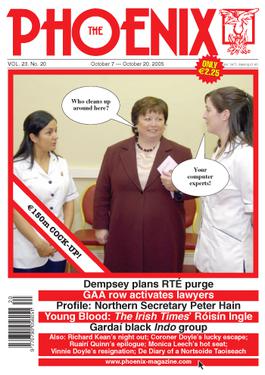
    Phoenix

    In his article on Phoenix Magazine Joe Breen cites a warning from Tony Harcup’s Journalism: Principle and Practice (London, 2009)] to the effect that investigative journalism, while achieving notable results might be seen as ‘perpetuating a myth that society is divided into a large number of fundamentally good people and a smaller number of fundamentally bad people’.

    Harcup asks where the investigative journalism is into structural forces in society answering: ‘Largely notable for its absence. Instead, particularly on television, we tend to have personalised stories of goodies, baddies and heroic reporters’.

    Nonetheless, the achievements of The Phoenix under the control of John Mulcahy and with Paddy Prendevilll as editor (a bulldog quality, untainted by ideology is also attributed to deputy editor Paul Farrell) in this vital sphere are arguably unsurpassed in the history Irish journalism.

    Fittingly, an Irish Times obituary describes John Mulcahy as ‘one of the most significant journalists and publishers of the last half century in this country’. Phoenix’s major scoops have included: Charles Haughey receiving £1 million from Ben Dunne; the pension of £27.6 million paid to Michael Fingleton; Father Michael Cleary fathering a child with his housekeeper; and Anglo-Irish bank being technically bankrupt

    In October 1991, Dick Spring quoted a Phoenix article at length in the Dáil. It had been pulled from the magazine when Smurfit Web Press refused to print it.

    The magazine’s investigations are still accompanied by a Private Eye-infused humour, where Breen argues ‘laddish sexual innuendos were a staple’: as with the cartoon: ‘How’s the queen?’ Queen Elizabeth: ‘Edward’s fine, thank you’. The magazine has also displayed an unusual sympathy – in an Irish journalistic context at least – for the Republican cause in Northern Ireland.

    Despite its achievements, Breen warns that that ‘it is notable that with the rise of social media, where people play fast and loose with facts, rumours and innuendo, The Phoenix has lost some of its traction.’
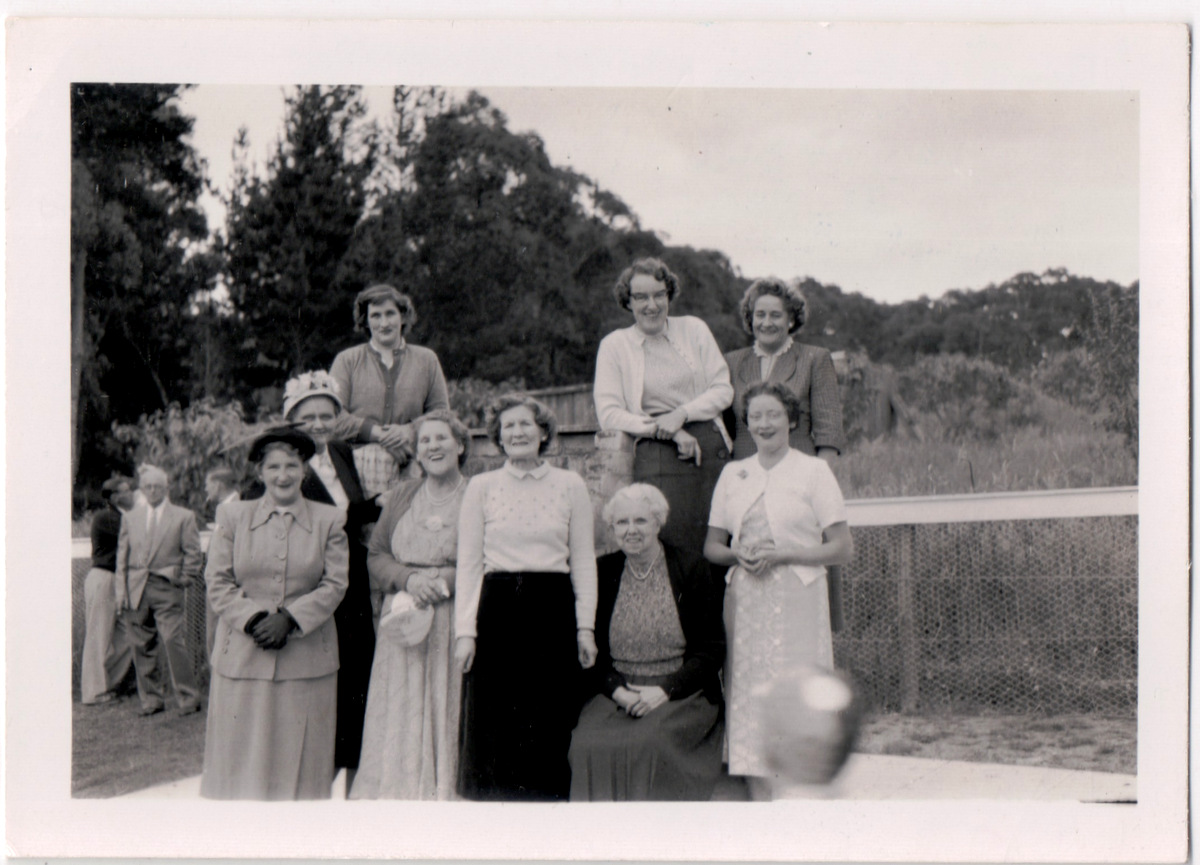
    Second row: Far left: Hilda Tweedy

    The Irish Housewife

    The origins of the unradical-sounding The Irish Housewife magazine can be traced to a public ‘Memorandum on the Food and Fuel Emergency’ authored by Hilda Tweedy, Andreé Sheehy Skeffington; Marguerite Skelton and Nancy Simmons in 1941. According to Sonja Tiernan they ‘drew up an economic plan urging the government to ration all essential foodstuff, control prices and supress black-market sales.’

    In response it was denigrated by journalists as ‘a housewives’ petition’. The authors appear to have inverted these prejudices by using ‘housewife’ in the title of the Association they founded, which went on to publish the magazine.

    It is instructive that after Hilda Tweedy ‘applied for a teaching job in a Protestant girls’ school, she was told that as a married woman she was unsuitable; the headmistress said it would not be nice for girls if their teacher became pregnant.’

    Importantly, according to Tiernan the Irish Housewives Association ‘had made a rather astute business deal with an advertising agency: The agency printed and distributed the magazine and in return they kept all of the advertising income.’ As articles were contributed for free it was kept at an affordable price.

    Among its contributions, Katherine Watson recorded her experiences of visiting female prisoners in Mountjoy, while George Yeats (the daughter of W.B.) published an article entitled ‘Can Your Child Draw’ in which she warned: ‘don’t be too cautious! Beware of all that restricts a child’s boldness of hand and of imagination. More is at stake than his future as an artist.’

    The advertising market began to slow down in the 1960s and by 1966 it was no longer viable for the agency to print the magazine. Nonetheless, it had provided an important outlet, and Tweedy later mused: ‘Who would have thought in 1942 that women would move from the kitchen to Áras an Uachtaráin.’
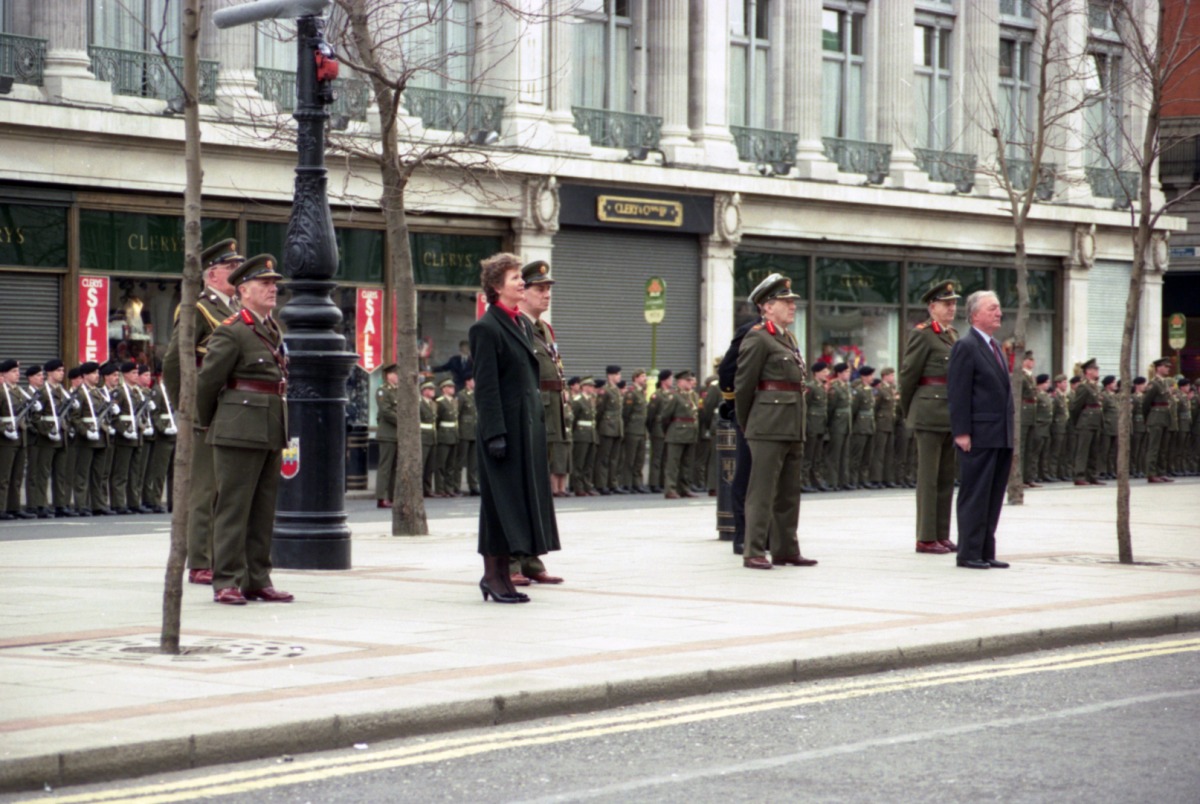
    75th Anniversary of the Easter Rising, O’Connell Street, President Mary Robinson. Source: Dublin City Library Archive.

    Status

    Signs of the rise of future President Mary Robinson’s generation of successful and ambitious women can be identified in Status Magazine, a short-lived feminist news magazine from 1981.

    Its origins lie in in the gathering of about 1,000 women and several men at a conference in Liberty Hall, which led to the founding of the magazine with Marian Finucane as editor. She was already a well-known Irish media personality. 31,500 copies of the first issue of Status were printed and these sold out quickly; yet curiously ten months later Status closed down.

    The decision to launch a magazine squarely focused on women’s rights had come from the proprietor of Magill Magazine Vincent Browne’ who said: ‘News coverage and investigative journalism from a woman’s perspective is what we are aiming for.’

    Cutting-edge reportage included Nell McCafferty writing from inside one of the mother and baby homes where single, pregnant women effectively went into hiding until their babies were born.

    One regular feature that scared advertisers was a page headed ‘No Comment’, which reproduced snippets of sexist nonsense sent in by readers including advertisements and articles from national newspaper. This included one from the Irish Times, which observed that ‘sitting TDs, Mr Eddie Collins and Mr Austin Deasy, are regarded as “Garret men”, though not fanatically so: the young and pretty Mrs Bulbulia is taken for a dedicated “Garret woman”’.

    Without adequate advertising revenue it was, however, doomed. Vincent Browne felt from the start the magazine was ‘gratuitously offensive to advertisers … There was too much sniping which antagonises people to no purpose.’ He noted that ‘marketing managers are male dominated and – dare I say it – some of them maybe, a little frightened’. Status was, he felt, a ‘bit too aggressively women’s lib’.

    According to Tiernan: ‘The usual rules did not apply: Those controlling these decisions did not want to see their advertisements in Status no matter how many educated women were buying the magazine.’ Eventually, even those stalwarts of magazine advertising – cigarette companies – abandoned ship.

    A Future for Hard Copy Journalism?

    A final word goes to John S. Doyle the former editor of In Dublin, which was inspired by Pariscope, the New Yorker and London’s Time Out. It remained largely removed from the cut and thrust of national politics, apart from assessing the planning decisions of Dublin Corporation, and then providing an outlet for the campaign against the development of Wood Quay.

    Intriguingly, Doyle revealed that

    none of the people who started In Dublin, or who came to in the first few years, considered themselves to be journalists, or had thought of that as a career. They were people who, in their different ways, wanted to write, and one of the strengths of the magazine was that it attracted so many of them.

    It may be that through some such formula – involving those with a desire and even need to write – we may revive dissenting journalism.

    The challenge may be to find a broad-based platform that is not dependent on an increasingly commercialised and censorious social media for citizen journalists to publish. In this respect we mourn the demise of www.broadsheet.ie, which showed an usual willingness to court controversy, even if this occasionally placed them in the company of characters who apparently set out to cause offense.

    A future for dissenting hard copy journalism that is not funded by an emanation of the state or philanthropy is difficult to identify, but it may be – just as music connoisseurs are now purchasing vinyl which was once considered obsolete – that readers will revert to a tangible format as the promblems with the digital medium become increasingly apparent.


    Help keep this show on the road! We depend on readers’ support. You can contribute on an ongoing basis via Patreon or through a one-off contribution via Buy Me a Coffee. Any small amount is hugely appreciated.
  • A Brief History of My Father

    In 1960 when I was seven, before TV, Radio Éireann was our window on the worId. I understood the gist of rumblings on the news over breakfast in the kitchen. The Congo. It used to be called the Belgian Congo now it was just the Congo. My father intimated, buttering a piece of toast at the kitchen table before whacking the top off a boiled egg with the knife, that the Belgians were still sticking their noses in.

    His remark was to no one in particular, almost sotto voce. Over the years on matters of the Irish nation you’d be listening out a long time without a single revelation concerning his party-political pedigree. Years after his passing, my adult siblings had no idea was he a de Valera man or a Michael Collins man.

    On global affairs he was only marginally more loquacious. Maybe, I inferred in this case, the Belgians were the Congo’s version of the English only not as big. Over the radio newly familiar names resonated across our kitchen. Patrice Lamumba- he had something to do with it. Lamumba was the new man in charge over there and he didn’t want any English or Belgians or outsiders of any sort coming over and interfering in the newly decolonized country. That seemed fair to me.

    Katanga, that was another new name on the news. It was a province, like Leinster. They wanted to rule themselves; the Katangans didn’t want Lamumba running things at all. Tshombe was the big man in Katanga. Congo, Lamumba, Katanga, Tshombe; distant names were rendered close by the radio, formed part of the backdrop to the morning kettle steaming, bobbing eggs boiling in a pot on the cooker and toast smoking aromatically under the grill.

    Source: http://www.curragh.info/congo/congo1960/UN1960.jpg

    Balubas

    Irish lads were to be sent off with other U.N. troops to keep the peace; stop the Katangans and Lumunba’s army from getting stuck into each other. The Baluba tribe in Katanga, it turns out, were also very unhappy about the whole situation – so we heard another new name on the radio. Baluba.

    Two Irish battalions were being dispatched. I hadn’t a clue what a battalion was only it was a lot. My father took me into town on the 13 bus to see them off.

    Our journey started at the terminus behind Beechwood Avenue Church, officially the Church of the Holy Name. I loved hopping onto the open-backed bus, straight up the narrow stairway to the front seat at the top, to wait a few minutes for the busmen to finish their cigarettes and start her up to head into town via Ranelagh, Appian Way, Leeson Street, Stephen’s Green and Dawson Street.

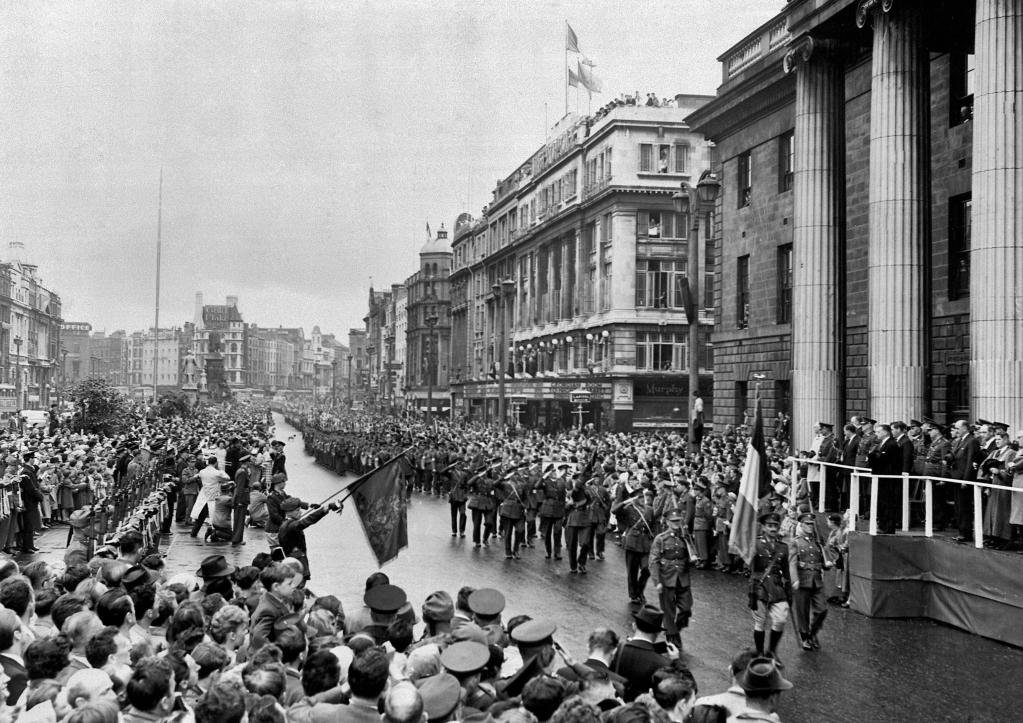
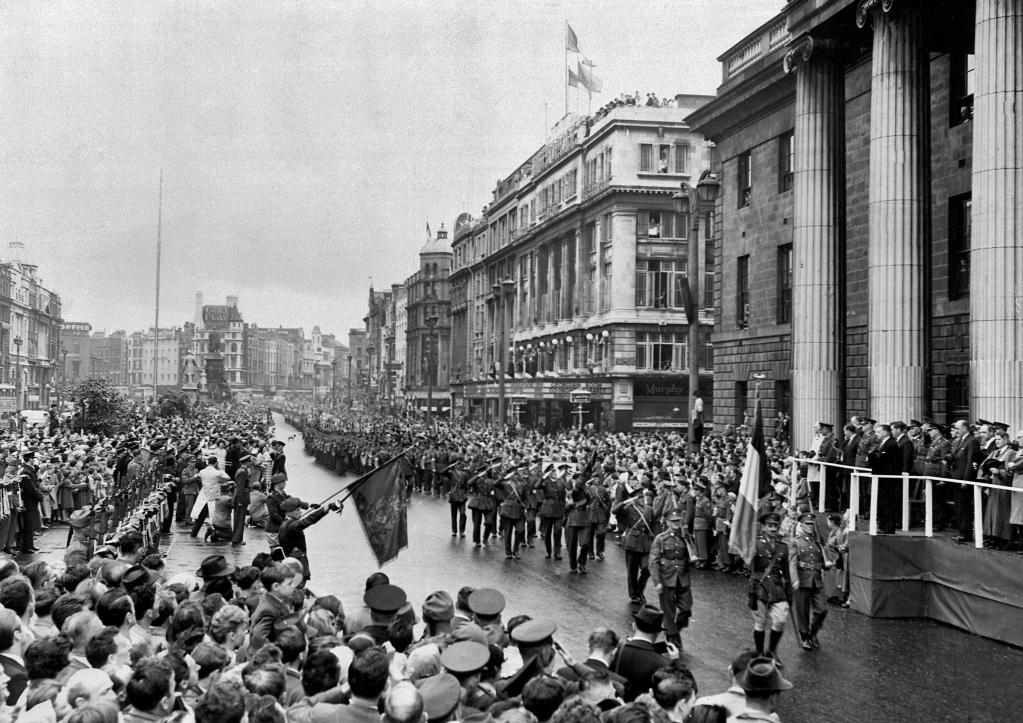
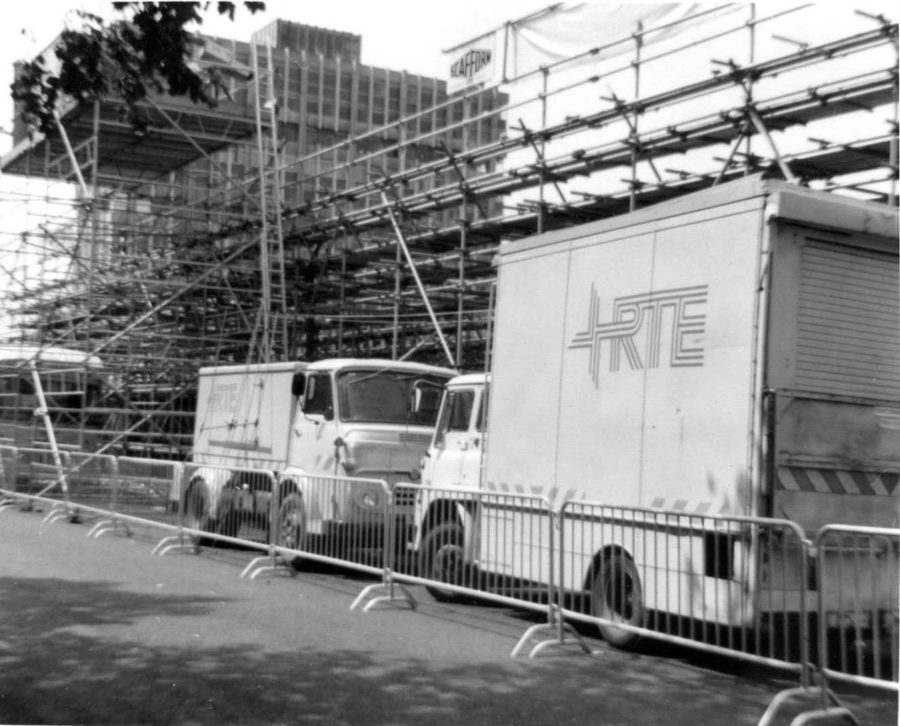
    The soldiers’ journey from Ireland to the Congo started with a march down O’Connell Street (picture above) to mark this moment of significance in our national life. After marching, the troops were to be loaded onto gigantic transport planes along with armoured carriers at Baldonnel airfield outside Dublin.

    We got off the bus on Dawson Street near the Hibernian Hotel and joined the masses walking along Westmoreland Street, kept going and got across O’Connell bridge. Near Daniel O’Connell’s statue, in the middle of the street where cars usually parked, up toward Clery’s department store, my father was trying to squeeze me up to the front row but he couldn’t get by with me so we sandwiched in as best we could, he lifting me up from time to time.

    Throngs crammed the streets and footpaths to gawk or cheer the column of soldiers marching by, their hob-nailed boots clattering along with a metallic after-sound. A man said the Garda Band had led the way with big brass instruments but we missed it. We couldn’t get near the GPO; people were jammed ten thick or more. Dignitaries, someone said, were on a platform in front of the GPO reviewing the troops.

    A woman said there were Guards and soldiers holding the crowds back. Some lads had climbed up near the top of lampposts – to the part where two iron handles stuck out near the light. How they got up there was something of a marvel; I envied them the birds-eye view.

    “They’ll roast in them outfits,” one woman said presciently. (It transpired that the troops were woefully unprepared – with not enough gear or the wrong gear, wooly dark green uniforms that would hamper them in the ferocious equatorial heat).

    A man asked if they’re walking all the way to Africa and people laughed. Another wag said they’d be getting a free trip in a Yankee plane blessed by his Holiness John Charles McQuaid, a reference to the fearsome Archbishop of Dublin.

    Archbishop John Charles McQuaid (1895-1973)

    I joined my father in frowning at that bit of disrespect for the lofty bishop while wondering did we not have our own planes. I was a bit confused by the parade, unsure what the Army was doing parading down the middle of the street – though I got a look in between the adults in grey coats at bands of red-faced soldiers bunched together swinging their arms, stomping their way down O’Connell Street with intent. There were swarms of them – hundreds- and they had guns over their shoulders, real guns. I had never seen real guns before, never mind so many.

    It was a new thing for Irish soldiers to be sent off into the middle of an African civil war. The last civil war any Irishman took part in was our very own one in 1922 and the contemporary national army, such as it was, hadn’t seen combat of any kind. But they were dispatched off anyway because everyone knew Irish people were respected the world over.

    Irish Army Jokes

    As a boy, I only heard of the Irish Army in jokes – passing around the one gun like a shared cigarette; halting maneuvers in the Furry Glen because the missus forgot to pack the sandwiches.

    That we were Irish I knew, but there was an accompanying feeling that Ireland was barely a country. For decades government ministers made an art of going on the radio insisting that nothing could be done about anything ailing the nation: dire poverty; a shite economy; high unemployment; mass emigration.

    Sure Ireland is a small country, they’d say, the message being we should not get our hopes up about ever approaching England’s standard of living, never mind row in with the U.N.

    We’re a small country – for years that was the party-political consensus for upholding and excusing a mediocre status quo. We were scarcely a country so every family, including ours, had relatives who had been forced to climb aboard trains, boats or planes, to England, America or as far away as Australia. American wakes they used call the send-off parties for emigrants in towns and villages across the country.

    UN Membership

    Despite being underdeveloped, Ireland the fledgling republic had joined the U.N. at the end of 1955 just like a proper country. England had nothing got to do with it this time. The troop deployment bypassed England and the uncomfortable fact of our complete economic dependence on trade with and emigration to England.

    This was U.N.-led, strictly international. Our soldiers representing the U.N. were to wear blue helmets. I had a plastic replica of a blue helmet for playing war down the end of the back garden with a bit of rifle-shaped ash.

    Though I couldn’t know it, this was a big moment in the emergence of Ireland into nationhood. As relatively new members of the U.N., we were taking on an international commitment, helping out in a fight not of our making.

    For my father among the many who turned out, to go and bear witness in O’Connell Street must have been important. He was born in 1906 into the last throes of the British empire in Ireland, bore witness to the civil war as a teenager.

    To have me along was to teach me about Ireland, to affirm that we had our own place among the nations of the world. To the legions of gallant nuns and priests that routinely went off to Africa on the missions to spread the one true faith, we could now add battalions of our very own troops.

    Outings with my father for big occasions were rendered all the more significant by their rarity. He was distant though affirming and not lacking in affection for his offspring; unquestioned Lord of the household, ministered to and royally fed by my mother, who mediated and did what she could to prevent occasional eruptions of his anger, though it simmered like a bubbling stew more often than exploded.

    Always impeccably dressed, his black brogues shined to a sheen, he was not around much during a work week, just one evening and week-ends.

    Weekday Routine

    The family just got on with the weekday routine, ended the day listening to Radio Éireann, later it would be watching American TV shows on Telefís Éireann.

    When it arrived into the house, my mother thought the TV was no harm, a bit of diversion. My father worried quietly to her that we would get notions from American rubbish like the Donna Reed show with its idealized portrayal of privileged, prosperous suburbia. Luckily for me, cowboys like Bonanza were fine all around.

    Appointed County Manager of Meath, adjacent to Dublin, in 1959 he had moved the family from Sligo where he had been manager to 42 Merton Road in Dublin’s Rathmines, down the road from our grandparents Joseph and Margaret Hynes of 72 Cowper Road.

    Commonly, houses were given names – Ivydeane, Cospicua. As we were moving in a man came to paint the name on two concrete pillars by the front gate, black Gaelic lettering on a white painted background – Dún Mhuire, the fort of Mary.

    I suspect my mother was the instigator but it seemed natural enough. We were a Catholic household in a Gaelic Catholic culture. Clear but unspoken messages were conveyed to me – nobody sat me down to declare it explicitly – that being Irish and under the auspices of a dominant church whose parish Mass we attended faithfully every week along with crowds of our neighbors, offered a form of protection, a kind of psychic immunity, from the seeping depravity of England.

    People in England, unsanctioned, could get a divorce and skip Mass if they were Catholics or not even attend church at all if they were Protestant. The English were more likely than the Irish to be in danger of falling off the cliff edge we all traverse that overlooks the fires of hell.

    Middle Class Respectability

    My father had landed us squarely in the emerging professional middle class respectability of 1960’s Dublin, my siblings and I in the best schools. Gifted with brains he had forged his own road, starting off as a lowly clerk in the Port and Docks Board in the Custom House, going to night school in Rathmines Tech to qualify as an accountant.

    His big break into the civil service as County Secretary in Kildare came after winning the 1938 Gardener Gold Medal for attaining first place in Ireland in accountancy subjects – I still have the medal. He progressed from County Secretary to an appointment as County Manager of Sligo, a place I still love deeply having been born there, then Meath.

    Throughout the 1960’s, unprecedented in those days, he commuted along country roads to Navan, the County seat, taking the guts of an hour to get there. Nowadays, thanks to urban sprawl, Navan is a dormitory suburb of the capital.

    Throughout the 1960’s he would stay one or two nights a week at the Headford Arms hotel in Kells, “the Manager” becoming a well-known local fixture. We had no idea what his life there was like. Instead of watching TV in the bosom of his family he would, no doubt, be in the hotel bar nursing a pint or a snifter, getting the full Irish served up for his breakfast of a morning before driving over to the town hall in Navan.

    I remember precious little dinner table conversation about his work. Meath had the richest grassland in the country – cattle would be moved from the West to fatten them for export, we were told. Sure, wasn’t Irish beef the envy of the world? The inference being that it was a more prestigious County to manage than Sligo.

    He would arrive home on Wednesdays and on Fridays with a prime side of beef for the Sunday roast, set aside by the butcher especially for the Manager. At Christmas, he would land home with seasonal fruitcake, the kind it takes ages to make with marzipan and white frosted icing to look like snow courtesy of the nuns who ran the hospital. There was never a question, let alone a debate, about whether he should be home more often.

    Though absent a lot, he seemed no more distant than the fathers of my friends who were always at home. That was the way things were; the mothers were warm, the fathers diffident, to be addressed formally. Without exception my pals’ fathers were cut from the same cloth. Like my own, most of them were not native Dubliners but were making it in Dublin.

    Entrepreneurs, lawyers and civil servants, they had roots in rural Ireland, including rugged Western counties like Mayo and Kerry. They wore greatcoats and sported hats, didn’t smile much and enquired how we were doing in school, thinly disguising a suspicion that there was too much playacting going on and not enough knuckling down to study.

    A weekend stayover in a small caravan in Donabate North of Dublin by the perpetually grey-clouded seaside – a treat hosted by my mate’s old man for a couple of pals – involved a degree of tension as the ogre-like father complained crankily about the poor quality of the boiled egg served up by his son at breakfast, while the other guest boy and I stifled tense giggles behind the curtain drawn across the caravan.

    We were accustomed to our eggs and toast or cornflakes being served up by our mothers; we weren’t called upon to service our fathers. We surely didn’t envy our mate his role as butler to his old man. Shortly after breakfast, relieved, stepping out the caravan door into the morning wind, we scarpered and stayed gone for most of the day.

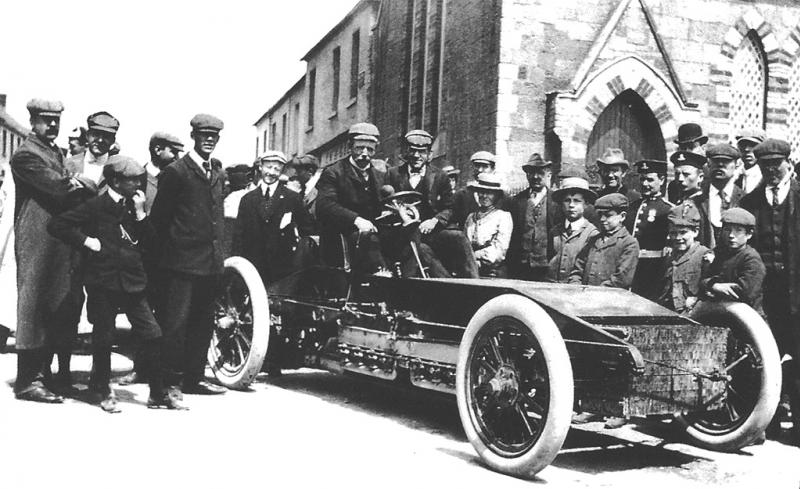
    1903 Gordon Bennett Trophy. Athy. Alexander Winton in the Winton Bullet 2.

    Athy

    It was far from the middle class that my father was reared. He was the seventh of nine to be born in a single room in a one-up-one-down two roomed place, 15 Leinster Street, Athy, Southwest of Dublin in County Kildare, for years a British garrison town where the grand canal from Dublin meets the river Barrow.

    My grandfather Michael was a carpenter employed as casual labor in a local factory while my grandmother, a Doyle, labored at home, trying to manage the scarcity of necessities including food and shoes, her home caught in abject poverty.

    As an adult, I stood in the claustrophobic upstairs room with my Aunt Patricia and two cousins, one who had bought the place, another who grew up and still lived in Athy. You couldn’t swing a cat in the place.

    We cousins shared awed glances as my devout aunt Patricia sprinkled holy water about in honor of her parents. “They were great people, God bless them,” she said as the hair raised along my arms.

    A cousin recalled a story his mother – another aunt of mine – had told once about remembering as a girl a visit from a priest who offered a blessing to the household – perhaps someone had been newly born or more likely was very ill as a clerical visit would have been rare to a poverty stricken household.

    Protocol dictated that the priest be offered money when leaving, money he had no hesitation in accepting despite the blindingly obvious. He was pocketing the last note and bits and pieces of coins from the household cash tin. The little girl looked on knowing they would miss a meal as the priest stuffed the note and coins into his pocket on his way out the door. Such callous treatment would have been the norm; people were “read out” from the pulpit at mass, poor families shamed as donation amounts were publicly announced by the priest.

    “I’m going places.”

    There’s a photo – a family portrait (see featured image above) – grandfather looks resigned, grandmother holds a vacant stare; to me they appear defeated. A sheet hangs precariously forming a partial backdrop to the scene. One of the standing elder sisters rests her arm on my father’s shoulder who sits in the center with arms crossed – twelve years old maybe- as he beholds the camera with a confident look as if to say, “I’m going places.”

    Indeed, he was and he did. But growing up we knew little of his roots or the road he had travelled from poverty to the middle class. I had an inkling, a feeling that he felt he had escaped, broken free of Athy, and wanted to leave all that behind him.

    For years I never knew how many siblings he actually had. We had lots of contact with my mother’s family – I knew all of my cousins on her side.

    Silence enveloped the partial story emerging about our Kildare roots. He was close with Patricia in Dublin and her husband John O’Brien of Kimmage Road West, a gentle uncle to us who, smoking Sweet Aftons, held court in their dining room at the top of a large table squeezed into the room, with barely enough space for chairs and a sideboard.

    My hospitable aunt doled out scaling tea, sandwiches and fruitcake. We grew up connected to our O’Brien cousins. Visits from them or my mother’s family were occasions of joy and celebration, especially the Christmas night gathering around our piano played by my aunt Ita and lubricated by my father as barman, conductor and on rare occasion warbler in chief.

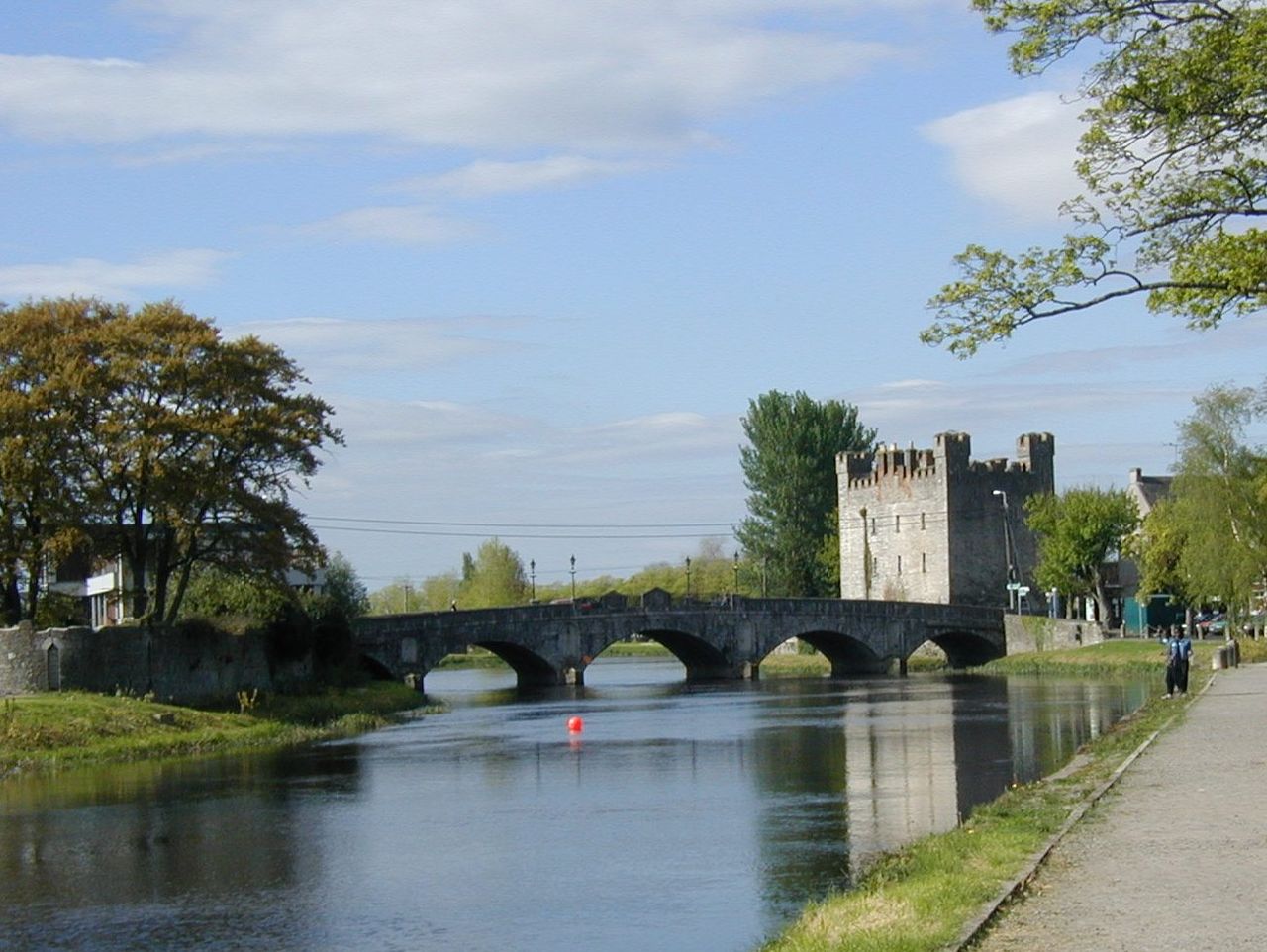
    River Barrow, Athy.

    Kildare Connection

    The Kildare connection though was opaque. As a boy, I remember from time to time – once or twice a year – my mother and father would get all dolled up and go off for a Sunday drive to Athy.

    No account of their day would later be offered. As an adult, I learned that one of the nine siblings had been institutionalized – but where, more to the point why? Were they put in the county home or mental hospital? We never knew.

    As children we had overheard whispers. The lore I picked up as an adult was that one sister had unspecified mental health issues but was really put away for falling in love with a British soldier. That didn’t add up. Such romance would hardly have been an aberration in a garrison town, surely?

    Despite emerging Home Rule and fledgling republican movements Athy had, per capita, one of the highest rates of young Irishmen volunteering themselves into the British army for the great war of 1914 – 1918.

    For the survivors, participation would end up placing them on the wrong side of Irish history.  Whether generally tolerated or frowned upon, surely at least a few local young women were forming liaisons with working class squaddies in barracks in the town. Or perhaps the very presence of soldiers billeted in the town lends plausibility to the narrative I received – Irish families clamped down on liaising with British troops, even locals. To this day, a blank canvas remains where that story should be.

    Ardagh Chalice

    In Dublin, rare paternal expeditions are preserved to me as wisps of memory, incomplete fragments encased in my mind like the gold ornaments in the glass cases of the archeology section of the National Museum in Kildare Street, where he took me and my sister once or twice when we were eight or nine to see the Ardagh Chalice.

    Some young lad dug it up out of the ground over a hundred years ago, he said. I was thinking I would have held on to it if I were him, or maybe flogged it for a new bicycle. At least once he dragged us around the National Gallery, frog marched us past white marble sculptures on plinths to a gallery beyond to eyeball the Jack B. Yeats paintings.

    Jack B. and his more famous brother the poet had Sligo connections, developed a love of the county while spending youthful time with relatives there. Jack had painted Memory Harbour in Rosses Point and was known as the painter who chronicled the emergence of Ireland into nationhood, representing Sligo fishermen going about their hard labor as “men of destiny.”

    As County Manager, my father had walked behind the painter and Yeats family members in the procession to reinter the remains of W.B. Yeats in the churchyard at Drumcliff. Whether on approaching our pre-teen years we balked or he abandoned the cultural outings based on a sense of having completed our cultural education or maybe felt it a waste of his time “casting pearls before swine” was never clear.

    Impromptu Visit

    The blank page of his family narrative dramatically came alive in three dimensions one routine winter early evening enshrouded in the usual darkness and damp. I was around ten, waiting for my mother to dish up the tea when she, my sister and I were stunned into incredulity, the lot of witnesses.

    I answered a ring at the door to find an uncle from Kildare, brother of my father, smilingly arriving for an impromptu visit. The doorway banter drew my mother from out of the kitchen. She welcomed him in officially and directed me to sit with him in the living room to the left off the hall while she improvised a pot of tea and a few of her prized home-made sweet buns.

    The brother, a bit disheveled, sat in front of the fire in one of two chairs with the red covers; asked me how was school going, wasn’t completely sure who he was looking at, not distinguishing me one hundred percent from my older brothers.

    I got that a lot; my elder brothers were six and seven years older; occasionally relatives lost track of me. I was happy enough to pour him a cup of tea, the better to get my hands on a one of the old dear’s prized buns; after baking she typically hid them to prevent their rapid disappearance.

    He took a sip of tea from his mug; kept smiling with a slightly vacant, almost wondrous glint in his eyes. My mother excused herself, explaining that she was in the throes of cooking the teatime meal, though she didn’t automatically invite him to stay for it. That would have been the usual protocol; insisting over the mild protests of guests that of course they’ll stay for a meal; we wouldn’t hear of you stepping out the door on an empty stomach. We were anticipating my father’s arrival for tea – our supper; dinner was the midday meal.

    I heard him pulling the black Ford Cortina in the front gates and was waiting in the hall when he turned the key in the front door, eagerly on hand to give him the good news, “Dad, your brother is here!”

    Far from the joy I was expecting, his jaw dropped as the news registered. Failing to acknowledge or greet me, he brushed by without removing coat or hat, almost dived in the living room door.

    Left behind in the hall, suddenly without warning I could hear him erupt on the brother, shouting and roaring at the top of his lungs. I poked myself just inside the door as my father continued unloading, upbraiding him from a height, what the hell was he doing here, how dare he, get out this minute, called him a right blackguard showing up in that state – an uninterruptable diatribe that went on for several minutes.

    “Sure, I only stopped by to see you,” the taken aback brother said defensively. My father had completely lost the plot. I froze in shock, wanted to head for the hills.

    My sister remembers hiding in another room scared by the roar of unrestrained anger. Our household followed the Irish norm, emotions were kept bottled up tight, corked. Like the seafarers of the Aran islands, their curraghs bobbing on a rolling sea, we lived with the awareness, unspoken, that a storm induced wave could any minute sweep us away without warning.

    But a deadly wave was a rare phenomenon, feared yet far from the normal run of things. My father’s emotion was a storm unleashed, out in the open, triggered we’d call it today, and landing not only to sting him and his brother but collaterally to unnerve my mother, sister and I. M

    y upset father marched out of the living room, disappeared up the stairs, his part in the drama for now complete, to stew in his own upset. Mother was left to pick up the pieces. She had to drop everything – never mind the meal. She surely felt rattled, perhaps herself annoyed at having to mop up after him, because she asked me to accompany her as she loaded my uncle into her brown Austin A40. I sat in the back.

    We never did this, drop our daily routine to drive into town in the darkness of the early evening. She drove down Palmerston Road, then over the canal and into town via Camden and Georges Streets, around by College Green and Westmoreland Street where animated neon advertising lit up the city, to turn left down the quays near McBirney’s department store where he could get a bus back to Kildare.

    There was quiet in the car but tension had abated. She was concerned for him. “Are you all right,” she asked him as he alighted, “do you have enough for a sandwich and the bus?” He thanked her and got out to walk across to a parked bus. I hopped into the front seat wondering if that was the right bus, who would meet him at the other end.

    We drove home wordlessly through the Dublin rush-hour, ate our teatime meal in silence, my father quiet, not a word out of anyone. The visit, the anger, nothing was alluded to. He turned to the newspaper. A calm had redescended.  Later that night I came upon her practically whispering into the phone, ringing a relative to make sure he had made it home in one piece.

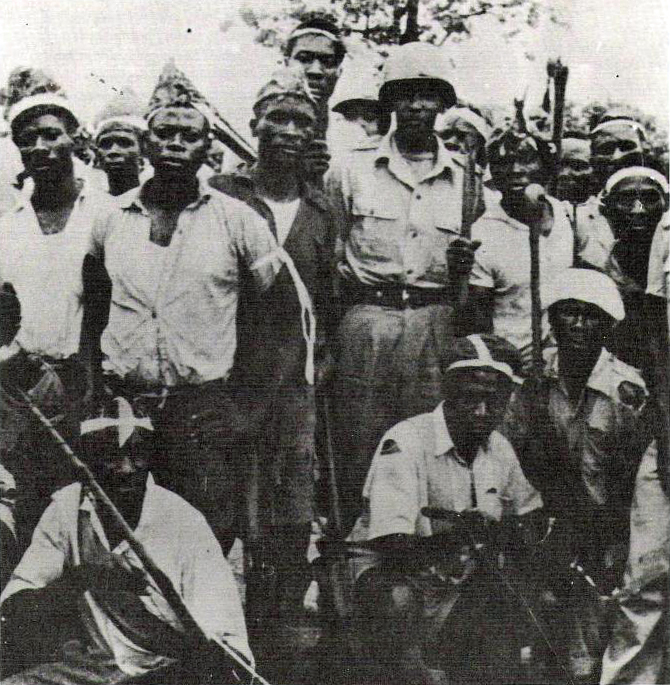
    Baluba militiamen in 1962.

    The Niemba Ambush

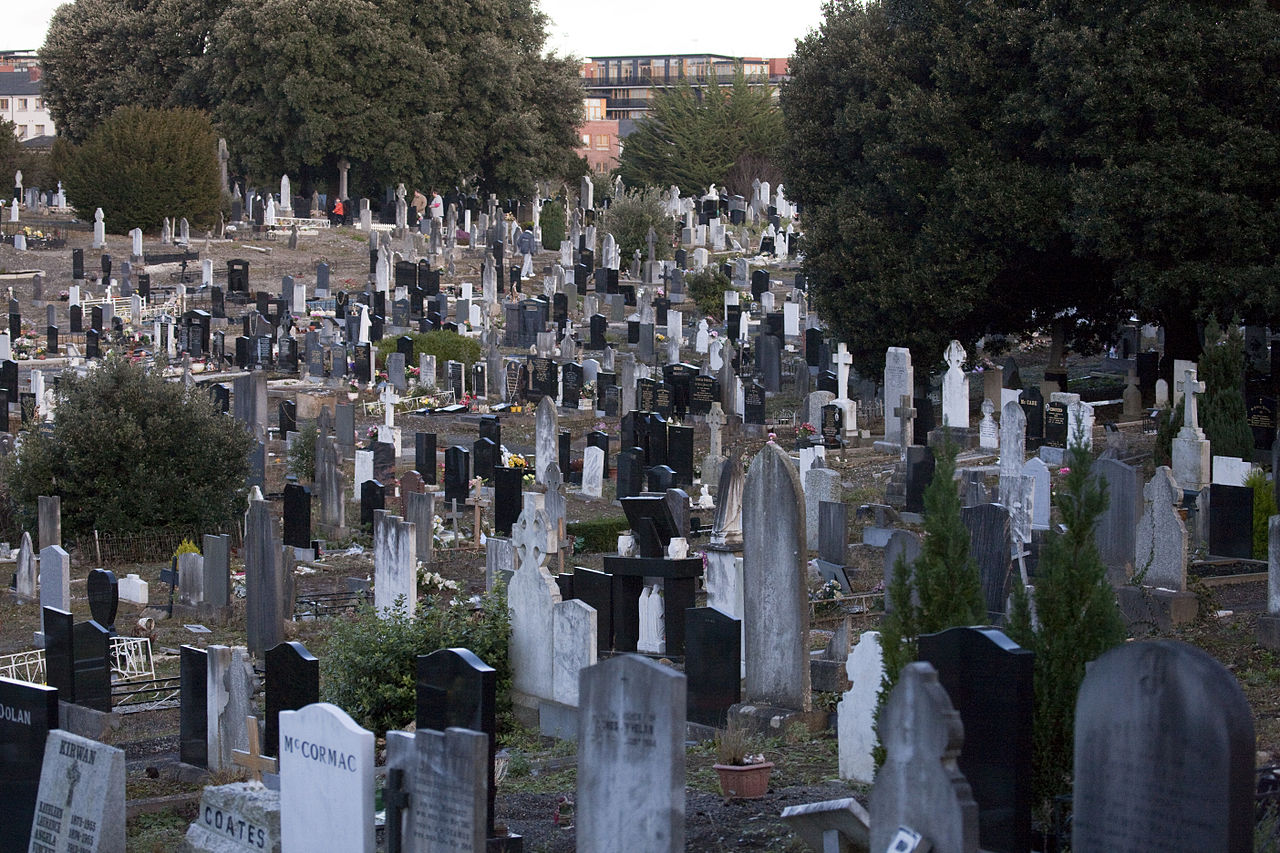
    Having seen the soldiers off to the Congo my father made it his business to take me up to Phibsboro in November 1960 for the second massive gathering in Dublin in a single year. Once again, we joined thousands, this time crammed along a funeral route to Glasnevin cemetery. Nine Irish soldiers from the Congo were to be buried, the first to be killed in combat in the modern era. The Niemba ambush.

    I thought that nobody was supposed to really attack or shoot at soldiers with blue helmets- not guns nor poisoned arrows nor anything of the kind. Yet, eight of them had been wiped out in Katanga in a Baluba-led ambush, smitten by arrows we were told, in what was thought to be a case of mistaken identity, the assailants having possibly mistaken Irish U.N. troops for European mercenaries.

    A survivor wandered in the wrong direction only to be caught and killed later. The funeral after a solemn high mass led by the archbishop was massive. I’m not sure how I got chosen to accompany my father; my elder brothers tells me he would have made his own way there on the bus.

    My father and I set out in the Ford Cortina. I watched him closely as he as he worked the wheel-mounted gearshift. Crossing the Liffey near the Four Courts, he parked on a residential street before we walked to join legions of others gathering from all directions near Dalymount Park.

    The closer we go to Glasnevin the thicker the crowds got, thicker even than at the send-off parade only much quieter. When we could get no further, he huffed and puffed, tried to lift me up to see. Soldiers with blue UN shoulder patches and guards saluting solemnly lined the route in front of the crowds.

    Eventually, slowly, quietly, as the cortege drew nearer, all the men took their hats and caps off. A green jeep appeared pulling a gun carriage for the officer, with an honor guard astride at walking pace.

    The slowness of it, respectful, solemn, gave me a sad feeling, like a pang of hunger in my belly. Someone whispered the officer’s name, Gleeson. God be good to them, a woman intoned. Four huge open top lorries followed at that same slow pace and flanked also by the uniformed comrades of the dead.

    Four lorries with two coffins each for the ordinary soldiers. Nobody remarked on the different treatment for the officer and enlisted men. The coffins had Irish flags, with flowers and soldier caps on top, along with blue UN insignia.

    They were crawling toward Glasnevin cemetery and there was no talking or bantering going on this time– just silence in the crowd, everyone blessing themselves, straining to get a look at the coffins, then staring at the ground, a few people working rosary beads, reciting away in murmurs.

    The cortege passed in slow motion; slow marching soldiers’ accompanying the lorries to the sounds of their own boots and the low hum of engines. I got a really good look at the gun carriage. Gleeson.

    The mournful funeral procession gliding by, honored by the presence of thousands standing in respectful silence, made sense in my young boy’s world, a blend of reality and fantasy – national solidarity expressed in Catholic prayers.

    Glasnevin Cemetery.

    “You couldn’t get near Glasnevin with the crowds and dignitaries,” Dad told my mother later.

    “Daniel O’Connell, the Liberator, is buried up there,” he told me, “the soldiers will be up there with him.” I used to get mixed up between the multiple patriots across the seven centuries we were under the thumb of the English, except for the executed leaders of the 1916 Rising at the GPO – Pearse, Connolly, Joseph Mary Plunkett, Tom Clarke and all. They issued a proclamation to Irishmen and Irishwomen – lots of people had it framed on their walls but I never read the whole thing. “Imagine shooting a sickly poet or a wounded Labour man; that’s what the English did after the Rising. The gobshites,” I heard people say, even fifty years on.

    The crowd thinned away slowly after the last of the procession passed but my father lingered, knowing the funeral was still going on up the street at the cemetery where the Taoiseach, Lemass, and government ministers awaited hats in hand. Finally, we started the long trek to where he had parked the car, near the North Circular Road. He threw his shoulders back and walked quickly. I had to take big steps, nearly run, to keep up.

    When we got home, my mother doled out scalding hot tea, a rasher, egg and fried bread in the dining room. “God rest them and keep them, the poor divils,” she said. Later, the old man would  read the paper and smoke a Carroll’s Number One at the table when she cleared off his plate. I would have scampered out the back garden to kick a plastic ball with my black brogues or maybe donned the plastic blue helmet and marched in the twilight along the path to the bottom of the garden, keeping a sharp eye out for Balubas or Belgians.

    We hadn’t talked in the car on the way home – there was nothing to say. As the light faded in the garden, I was wondering if the soldiers would still be up there in Glasnevin now that everyone had left; were they glad to be home in Ireland; would they be lonely, miss being at home for their tea; were they in heaven or Glasnevin or where were they?

    We depend on readers’ support. You can contribute on an ongoing basis via Patreon or through a one-off contribution via Buy Me a Coffee. Any small amount is hugely appreciated.
  • Seamus Deane: An Appreciation

    John Calder spoke at the Abbey Theatre some years ago. The founder and director of Calder and Boyars had published a host of Nobel Prize winners, including Samuel Beckett. Calder stressed that Beckett’s early writing, his novels, had attained modest success. His reputation grew slowly…”Ideas take time” Calder explained.

    Seamus Deane was born in Derry on February 9 1940. In 1972 he was lecturing in English in UCD, when I, aged nineteen, studied English and Latin there. One lecture of his stands out in my memory.

    It had to do with Joseph Conrad’s novel The Secret Agent. Although there are no Irish characters in the story, Conrad records that the book issued out of the political milieu of late Victorian London in which the Fenian dynamitards featured.

    Conrad’s labyrinthine plot focusses on a plot to blow up the Greenwich Observatory. The anarchist Verloc, his wife Winnie, her somewhat retarded brother Stevie head a cast of characters which includes European conspirators and the British police.

    1972 was not short on political and military action.

    Seamus weaved the novel into the historic tapestry of Victorian London, and demonstrated how it foreshadowed some of what was happening in 1972. He unveiled an idea: politics and literature are closely linked.

    In 2021 that proposition might not cause a stir. In 50 years, its caught on. In UCD, in 1972, it was radical and novel. It struck me forcibly and changed how I viewed things. An image of the pale young man from Derry talking about Joseph Conrad remains with me.

    Featured Image is of (from left to right) Seamus Deane, Ann Kearney, Richard Kearney, Imelda Healy, Marion Deane and Ronan Sheehan in c. 1985.

    Help keep this show on the road! We depend on readers’ support. You can contribute on an ongoing basis via Patreon or through a one-off contribution via Buy Me a Coffee. Any small amount is hugely appreciated.
  • Ballad of Lucy Kryton

    Ballad of Lucy Kryton

    “There will not be a woman Prime Minister in my lifetime”, Margaret Thatcher

    The morning sun falls whitely on
    the lashes of Lucy Kryton.
    Her blondeness fully insured
    against theft, fire
    and termites. Her forehead
    the hard reality
    that care of both
    the elderly and the daft
    are best handled
    by entrepreneurs.

    Her navy dress
    an incentive scheme for foreign investors.
    Her compassion, a teenager taught failure
    to honour thy father and mother leads
    to a wet sleeping bag in a doorway
    the government won’t be
    rescuing you from. She knows
    hard cases make bad exceptions,
    of which she’ll be making none;
    that for many people in this country
    slavery and the right
    of Nigerian taxi drivers
    to marry each other
    are issues of conscience
    which transcend politics.

    Her fiscal policy is dampness moving
    down other people’s walls.
    The finest mind
    to come out of that part of Claremorris
    in a long time. Her Ireland of the future
    is an auld fella with a wig
    at Mass on a Monday
    somewhere in Mayo,

    as the evening sun bounces savagely
    off the achievements of Lucy Kryton,
    the day the laughter suddenly stops
    and she’s all that there is.

  • Featured Artist: Manar Al Shouha

    How would you define yourself as an artist?

    In fact I feel more like a researcher trying to find the truth about herself, her uniqueness and her art fingerprint. For me art is a kind of meditation where I reach the inner self.

    Each painting is not only a scene. It’s a journey through my deep self.

    I believe that the reason we are here as humans on earth is to try and reach our inner selves.

     Was there a particular moment in your life that you felt an artistic awakening?

    As a child I was slow to develop my speech and writing abilities. I always favoured drawing. Even at school, I used to sneak out of classes and go to the drawing room instead. Since I came to the realization of this art world, I can’t believe for a second that I can work in any other career.

    How did your teachers assist in the development of your artistic practice?

    My teacher is called Bassem. He taught me that my only teachers in life should be myself and books. He used to tell me that he is only there to encourage and guide me. By the time I started studying art at university, he had already left teaching because of the war conditions and had gone to another university. In order to reach him, I had to walk for miles, just to have him look at my work. His opinion was more important to me than the mark I received.

    Your mother is one of your recurring subjects. How did she influence your creativity and personality?

    She was a teacher of mathematics in the same school that I attended. She used to come and check on me during the day, any time she didn’t find me in the class. She would take me from the drawing-room. She used to get angry at my begging her to relent, but after a while she understood my nature and began providing me with materials and even booked me into art classes. She was always talking to me as a unique person and saying that when choosing anything I should follow my heart. She used to energize me mentally and physically. My mother used to help me prepare canvases before I started painting, organise my studio and tidy it up in a way that didn’t distress me. She always tried to interpret my work and was always happy with my achievements. More than I ever was.

    Ultimately, she is the reason I am here now.

     Which of your works do you feel best represents your oeuvre?

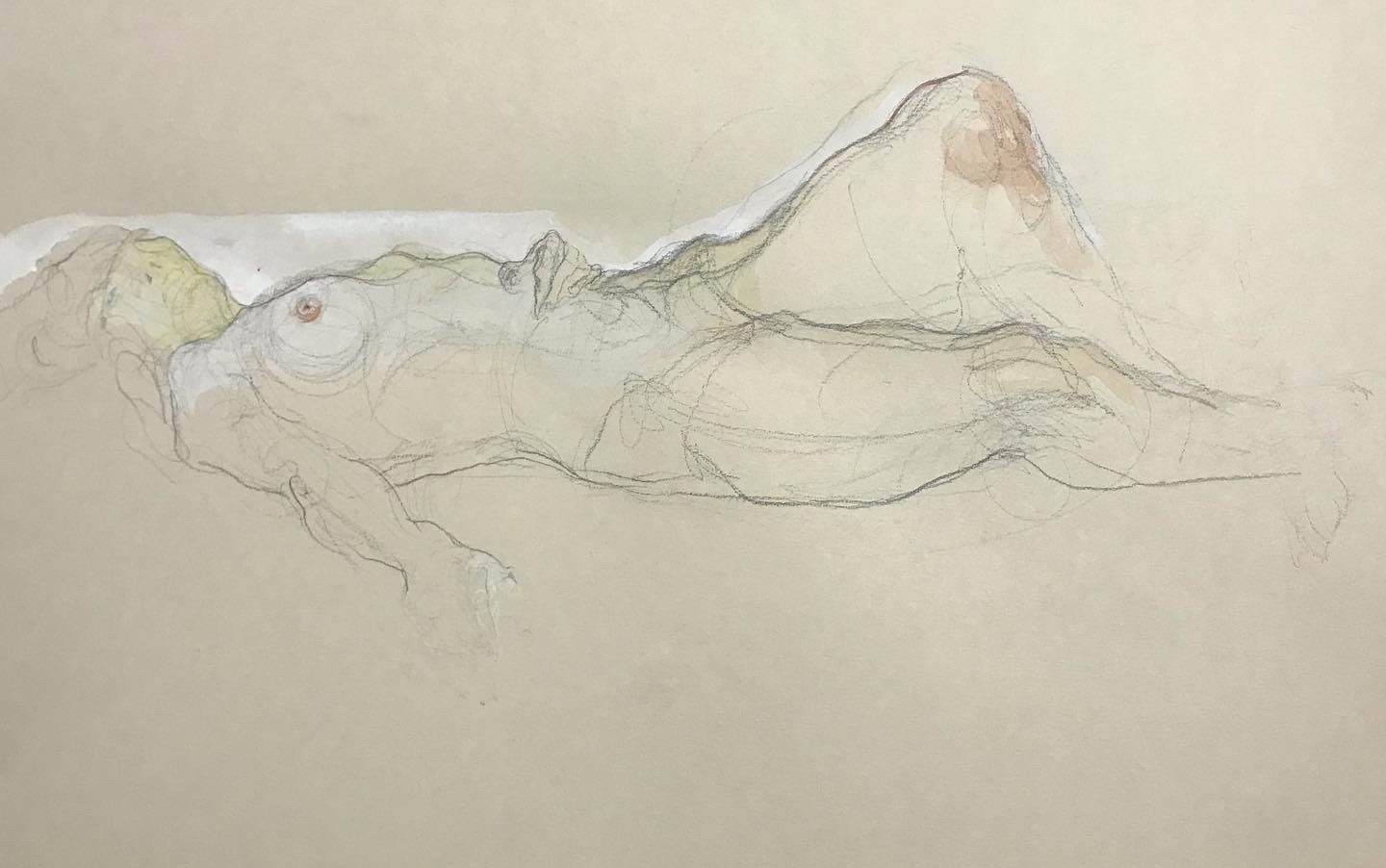
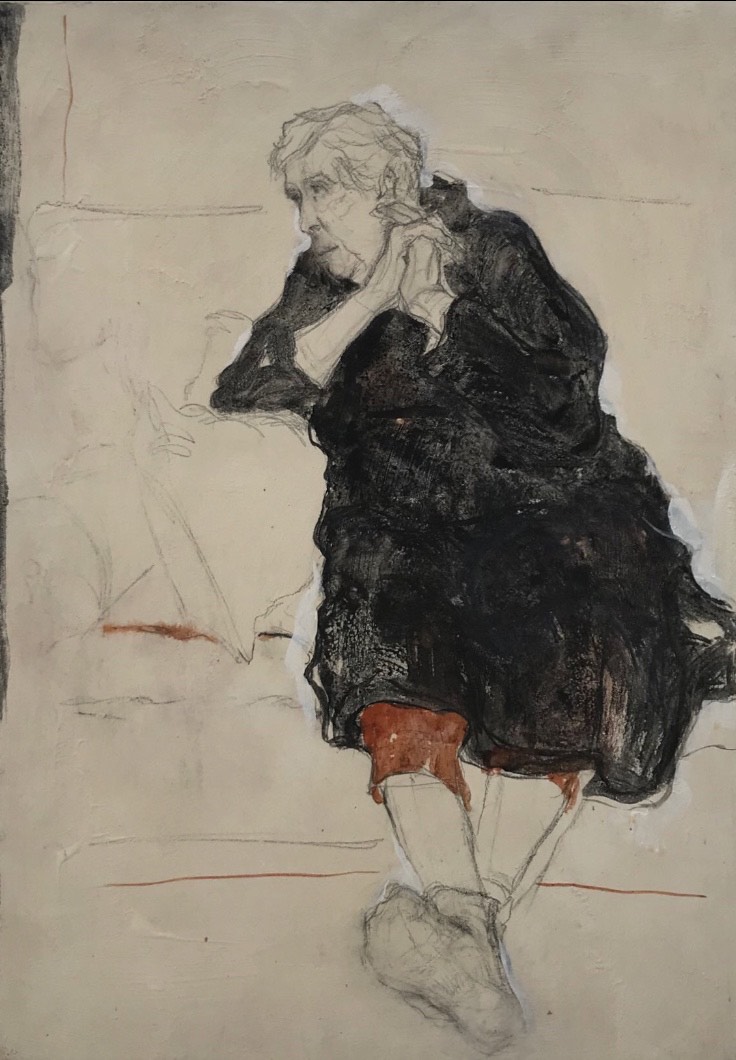
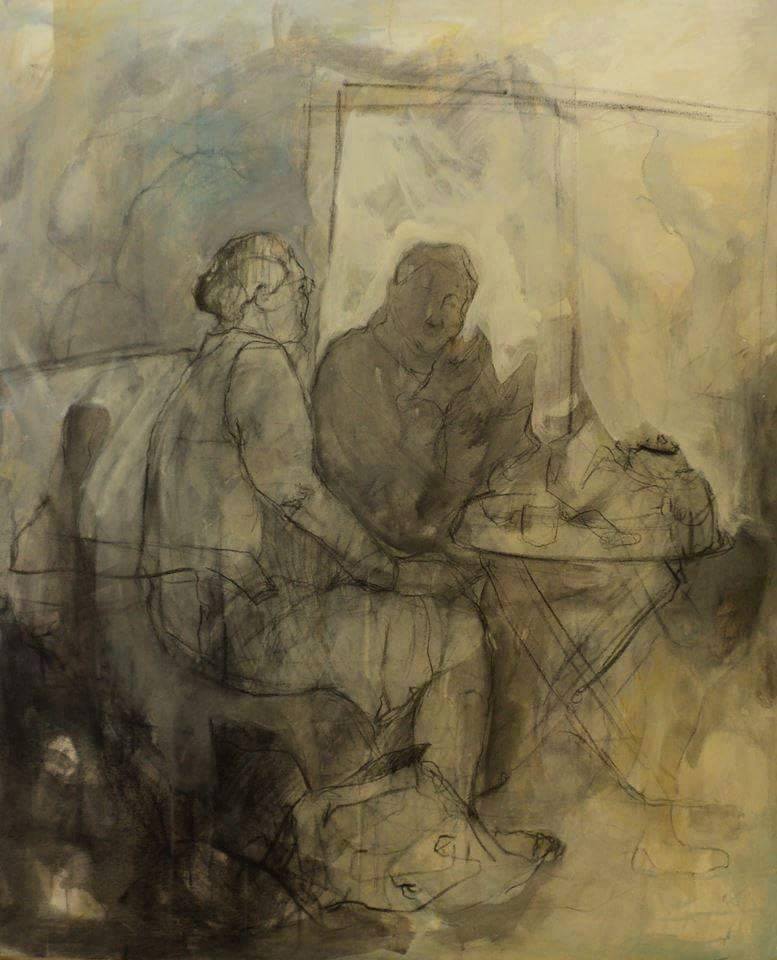
    There are two of them in particular. The first is one of a woman sitting down, painted with two colours only and a font. It’s painted in a highly impressionistic way. I completed this work in 2021.

    The second painting shows a social gathering for two women painted in a sketched style with warm neutral colours. I made this in 2016.

    In what way does politics enter your art?

    On account of my lack of freedom in expressing myself, and because the media doesn’t always show the more interesting angles in the news, I decided to reveal my nation’s suffering in my own distinctive way, through my art.

    Damascus is always appearing in your work and your thoughts, would you like to say something about this city?

    Damascus was the capital of the Umayyads, the dream of Abbasids, and is one of the oldest capital cities of the Islamic world.

    In spite of the war, I felt safe walking down its alleys and roads. This is not an ordinary city. It holds a lot of energy. Looking at the ancient monuments, I used to feel its greatness. I represent Damascus as a lady who has faced hardship through the years, but has managed to preserves an elegance. One day prosperity will return, as has occurred throughout the city’s history, for it possesses a wealth of energy.

    Has any artist from history had a particular influence on you?

    I like Henri de Toulouse-Lautrec, Pablo Picasso, Honoré Daumier and Egon Schiele.

    What particular technique is at core of your practice?

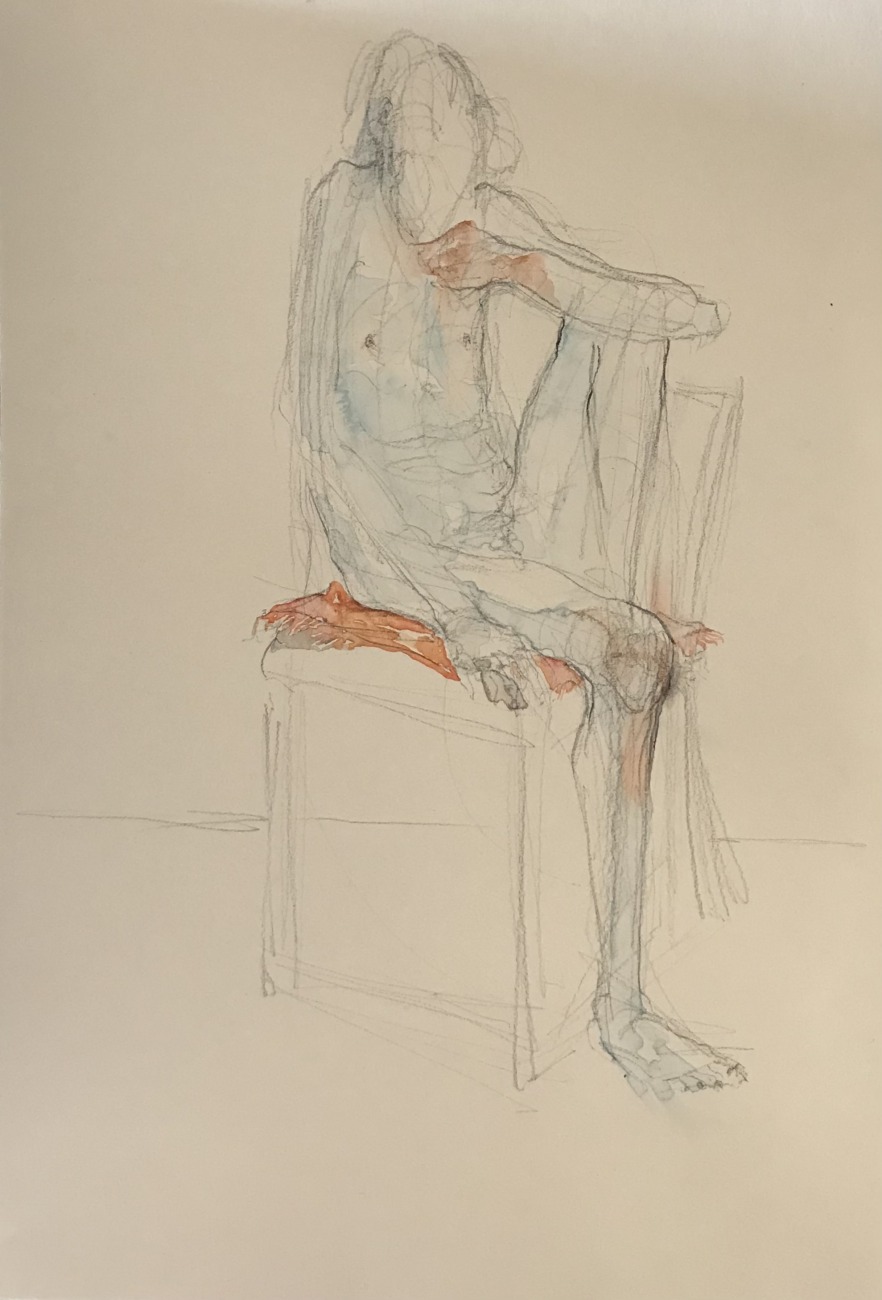
    Sketching. I like the strong impression of a sketch. I find myself attracted more to the expressive school, through the use of neutral translucent colours and heavy fonts.

    Have you integrated other disciplines or artistic forms into your painting?

    No, but in my first year of university I studied five general artistic fields. I liked sculpture and engraving, especially Honoré Daumier works. I think one day I will study this discipline more deeply.

    I particularly love your paintings portraying people commuting and traveling. What is so enticing for you about these subjects?

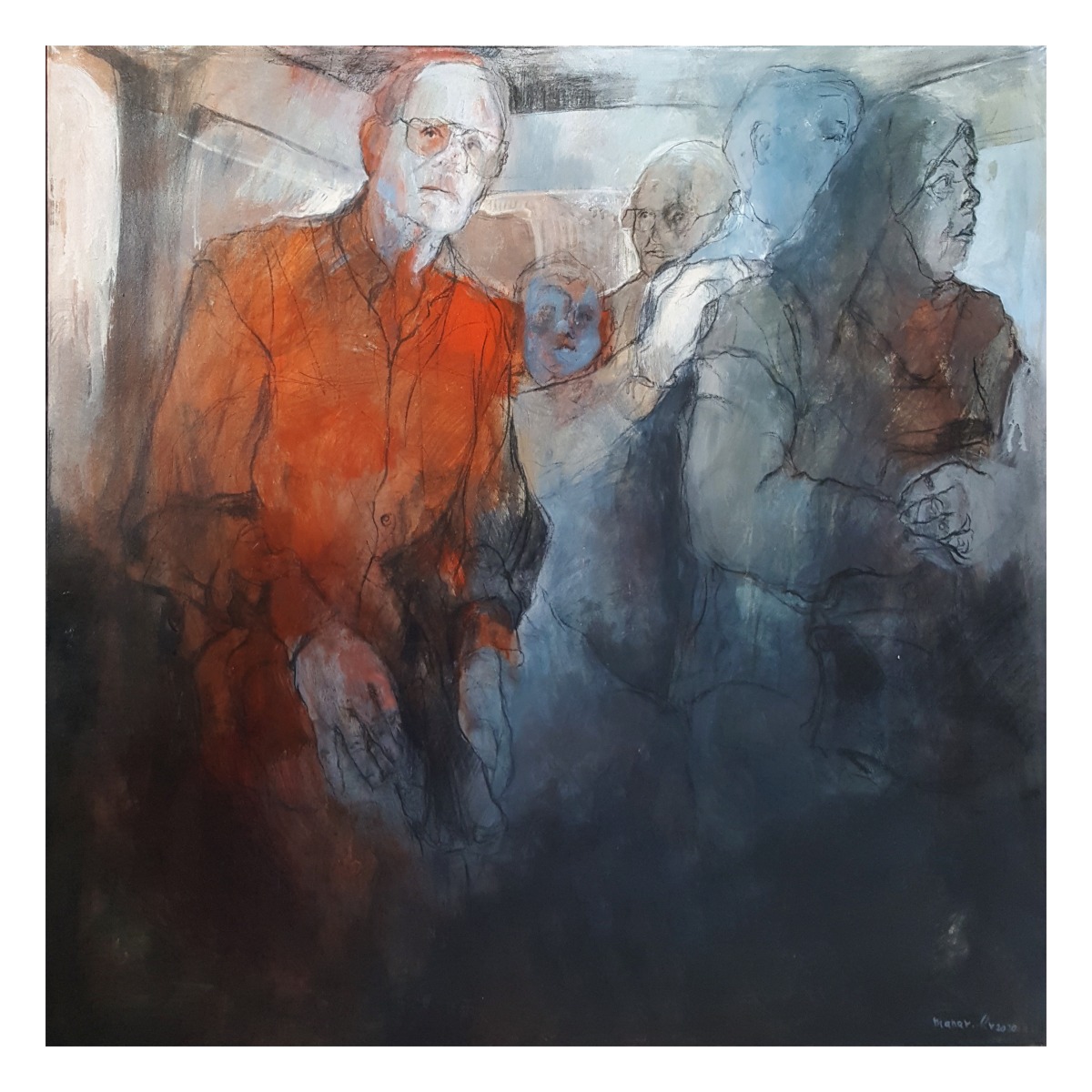
    Regarding the painting of the bus scenes, when I start painting, I always ask myself why I am doing it? When I used to take the bus, I watched people gazing out the windows, some were angry but couldn’t express themselves, and some were looking over their shoulders as if they were waiting for time to go back.

    I felt it was not a bus, but a boat taking us away from our country and away from our present and making us live in the past. Then I started painting it again. I wanted to apologise, but somehow I was painting to say that what happened wasn’t our faults.

    In future I want to make fingerprint through my art. I want my paintings to be alive so I can live through them. Not for a moment have I felt that I am Picasso or Goya. They are dead. But when I looked at their paintings, I always felt that I am talking to them.

    Follow Manar on Instagram

    Kindly translated by Jennifer Boktor and Nermine Abdel Malak

    Manar is preparing for a new exhibition in September in Rathfarnham Castle, and recently moved to the Lodge Studio with the organisation Common Ground.

    We are an independent media platform dependent on readers’ support. You can contribute on an ongoing basis via Patreon or through a one-off contribution via Buy Me a Coffee. Any small amount is hugely appreciated.
  • Adoring the Artifice of Paul Quin

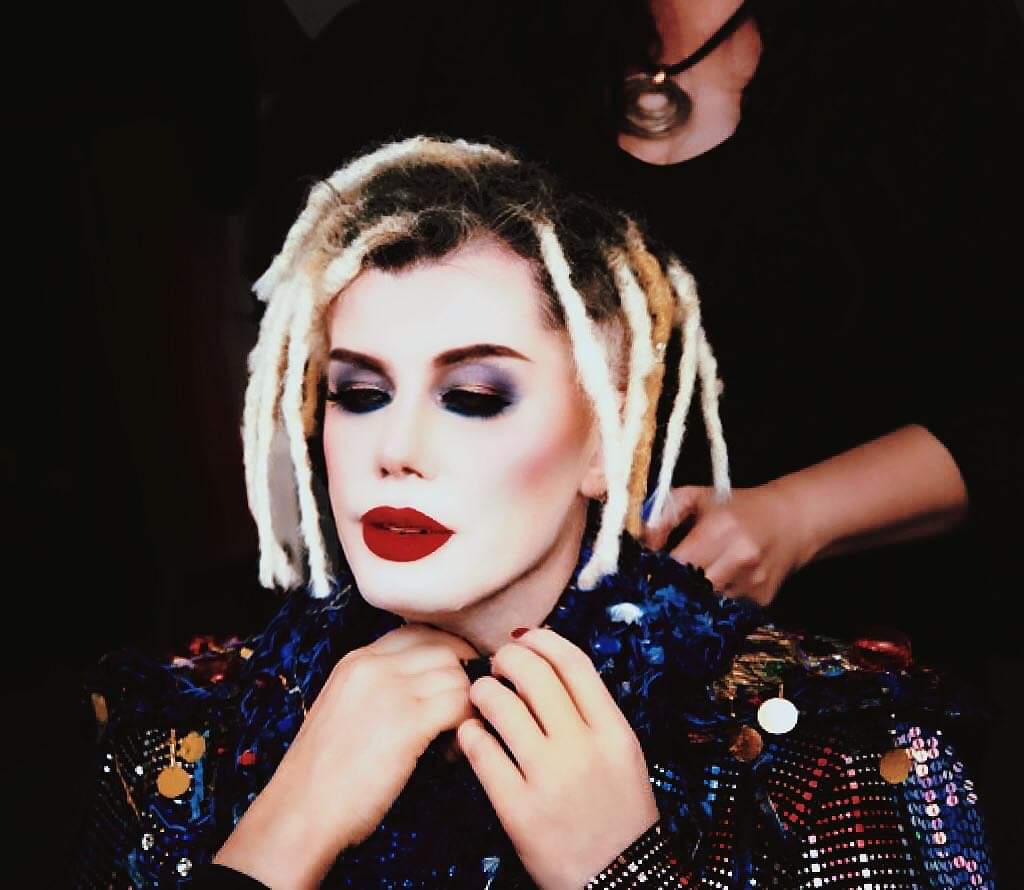
    Paul Francis Quin has proven himself an approachable enigma. The myriad glamour shots gracing the cover of his upcoming album ‘Life on Earth’ and various assorted publicity materials tend to portray him as otherworldly, a strange mixture of glamorous and uncanny. Nonetheless, he is quite happy to talk, in his wryly calm and personable manner, about any subject, no matter how taboo. In fact, taboo subjects are his speciality. They are fuel to his creative engine, and vital to his artistic expression.

    “It’s been an interesting journey, especially at this point in history,” he tells me over the first of several hour-long Zoom calls we have. “But I can’t deny I’m excited to see these songs released into the world at last.”

    Quin is a Wicklow native, born in Bray in 1971, and his serene, cut-glass accent is still inflected with the earthy intonations of that venerable seaside haven. The electro-pop singer-songwriter and exeperimentalist composer is on a homecoming journey of sorts. At the time of writing [note: this date has passed], his long-awaited solo album ‘Life on Earth’ will see its launch at Dublin’s Peppercannister Church with a gloriously disparate personelle, after a heady 2.5 years (“a slight exaggeration,” Paul purrs coyly) in the making. This represents a definitive return to music following an extended hiatus, although, it must be stressed, not a complete departure from it.

    The designated venue is an interesting one, not least for its former ecclesiastical status. Paul tells me, a few months following the Zoom call and in person this time around, that: “To be quite honest, I was gagging to get on stage in somewhere like the Grand Social or the Sugar Club whatever, and do some live work there. Generally, I don’t sing live very much, I much prefer to work in a studio. But once I resalised I was actually still capable of it, I just pushed myself to get back to it. I’m at least determined to get back up on stage and at least do an album launch, and do a proper show with creative design and costumes and all that. It’s a dream away at the moment, but dreams are how I run.”

    I jokingly suggest he do an alfresco gig, charging people a fiver per head; he politely laughs such a notion off. 

    “I mean, I am also just asking myself where did all the time go, really,” he says, laughing. “I didn’t do much music-wise, really. I mean, I had a nine-to-five job and then I went back to college, and all this time has flowed by. I remember how prohibitively expensive hiring out a recording studio could be back in the 80s and 90s, and I remember thinking I could never re-enter one again. Then again, I remember my Dad, who had a really philosophical take on life, saying to me. ‘You are going to be a very late starter. But you are going to get there’. Not sure where he meant. But I got SOMEWHERE, I suppose!”

    Image (c) Billy Cahill.

    EgoBoo Studios

    Thankfully, such a dismal outcome has ultimately not materialised for him. We are both in the control room of the subterranean confines of EgoBoo Studios on Fitzwilliam Street, having just been buzzed in. Next to me sits Greg Malocks, EgoBoo’s owner and chief sound engineer (and now, musical director of the entire enterprise) working through a series of levels with an air of close absorption. The ensuing conversation is punctuated by occasional clicks coming from the recorder console as he works his digital magic. This is no problem of course, Paul is happy to defer to his expertise. “I need to come into a place like this,” he admits. “In order to work with a more structured environment. Even if I had a home set-up, I don’t think I’d have enough gauge of quality control and I’d never get anything finished as a result. I need to be in an environment like this.”

    Paul himself lounges opposite on the studio couch, a punkish vision in a longsleeve shirt, docs and sleek denim, with long, serpentine Medusa-esque, peroxide dreadlocks and makeup stylishly pale enough to make David Bowie (were he still with us) envious. He is far from blase about the studio set-up, however, preferring it to a more home set-up favoured by many during the last two years.

    “I need to come into a place like this,” he admits. “In order to work with a more structured environment. Even if I had a home set-up, I don’t think I’d have enough gauge of quality control and I’d never get anything finished as a result. I need to be in an environment like this.”

    “You need a second ear, sometimes” Greg chimes in, without taking his eyes off the flashing blues and greens on the monito before him. “When Paul’s singing, he needs to be concentrating, and with a second ear, suggestions about what else he can try come about more easily. It definitely helps.”

    Paul nods. “I think when there’s someone else present, it brings something else out of you as well. There is essentially an audience there, albeit one I can bounce ideas off. The love of stacling harmonies is something me and Greg share. I’ve often worked with producers and engineers in the past who would say ‘I think you’ve enough harmonies now,’ and the fact is, I can’t get enough of them! If possible, I’ll have a full choir of hamrony behind my vocals.”

    A Breath of Fresh Air

    Right now, he’s listening intently to the latest mix of a new untitled song, a pure 1970s disco-tinged track which, as it transpires, is actually for an entirely different project. Despite the studio’s confined, almost windowless space, Paul describes it as ‘a breath of fresh air’, allowing him to experiment with sounds quite divergent from his usual style, which has been nebulously described as very ‘eighties-esque’ in style, tightly syncopated and synth-heavy.

    “People are always saying to me, ‘your music is very ‘eighties’, and no matter what I do I can never seem to get away from that. Or maybe that’s just because of the way I sing, I don’t know. But this other friend [dreampop songwriter Keeley Moss, who will also be opening for Paul at the Peppercannister gig on the 11th] had a track that was a bit more of a disco groove to it, and I thought it’d be interesting just to try to adapt a style that also manages to retain a bit of an indie feel as well.”

    I mention The ‘Weeknd’, and his similar use of synth and uptempo beats in tracks such as ‘Blinded by the Light’ and ‘Save Your Tears’; songs that manage to simultaneously sound retro and futuristic. “It’s almost like a pastiche,” Paul says, “taking that sound and refitting them for a new generation. Even just listening to the instrumental [of ‘Save Your Tears’], you can tell it’s amazing track even when denuded of vocals. I’d have different lyric and vocal ideas for it, but it is a superb piece of pop music. And pop music is often the hardest to do because it has to hit the ear almost immediately. Whereas soul and R’n’B you can let grow on you more organically, but pop must have that instant grab for people. Almost like Eurovision, in a way.”

    I ask why in hell he’d stoop to comparing himself to Eurovision, to general amusement of all present company in the studio.

    “One can always hope,” he smiles.

    https://twitter.com/danwadewriter/status/1337890686029402119

    Behind Closed Doors

    Everything happens underground now. Or at least, behind closed doors, within spaces impounded by our boundaries, with face-to-face communication kept to a minimum, as tablet, mobile and laptop screens now stand in for sociability. We are visible to each other only through screens, our voices reduced to garbled, disembodied transmissions over a Zoom audio feed. Even those of us who may live a few miles away from each other, even short distances, seem, at times, impassable.

    Lockdown has been an atomising experience for virtually everybody: the blurring of the work-life balance, to the government-prescribed restrictions over not being able to leave one’s home, then one’s county, and finally with an inability to fly overseas, as well as the basic need to socialise in large groups (though this slowly but surely starting to change). The daily monotony, shot through with a vague tension of perhaps being next in line to be claimed by the pandemic, was once described in a half-joking fashoin as ‘the new normal’, a phrase many have abandoned as mounting imaptience. A sense of unreality has slipped into the very fabric of reality itself. The very autonomy we take for granted as adults has been brutally curtailed. Many of us wonder when and where we might see our friends and loved ones again. News of the impending climate collapse and a resultant creeping sense that the world is on the brink of an ill-defined but very imminent oblivion aren’t helping.

    A lot of this is doomsday thinking as well: the temptation to fall into it is on the increase.

    At the time of writing, the most recent restrictions have been tentatively lifted – though right now, it feels better to be discussing something, anything, other than the pandemic, lockdown restrictions and vaccines. News of the Delta and other assorted variants make for distressing reading, even with the rollout of a multiplicity of vaccines and much of the populace having received their jab (though, the presence of anti-vaxxers and anti-maskers keeping the pandemic of life support remains an ever-present worry).

    Many artists on the P.U.P. now face having thiers cutoff unless they branch out into separate industries. Impatience with extended closures mandated by the Irish government’s directive to keep all indoor music events effectively cancelled. This was estimated to last no more than a fortnight. Now, nearly eighteen months on, live music in smaller venues remains illegal, with no roadmap for the event industry in sight. For many artists and creatives, ‘first to close, last to reopen’ has become a defining mantra of the Covid era.

    The results of this are manifold. It seems we are at the risk of losing much of what made the nightlife so exhilarating. The unique intoxication that rises not just from a few pints and a spliff but from the very of sociability and togetherness itself, of being in the company of one’s peers and engaging in a shared sense of communal euphoria and solace. Dublin’s streets on a weekend evening are as likely to be deserted as they usually are in the midweek. The possibility that many of us are beginning to forget that unique euphoric rush of fellowship brought on by  is now a horribly real one.

    Of course, it is slight exaggerration, at least in the Anglophone sphere, to call this the apocalypse in easy mode, and there are far more urgent problems at hand than the halting of live performance and msic events. There is also an idea circulating that, post-Covid, there will be a flowering of creativity comparable to that of the Renaissance, which itself came gradually about in the wake of the bubonic plague. A generalised reaffirmation of life may come about from so much isolation, so much togetheness relinquished.

    Suspended Animation

    It could be argued that lockdown is comparable to being in suspended animation. For many people, not just creatives, this has been a strange period of working from home and thereby taking it upon themselves to make a project happen. Dispiriting as the last year and a half has been, many creatives have demonstrated their endurance and the commitment to their art. Moreover, the technological advances of 2021 have permitted many artists to create and work unimpeded by limitations as studio time and costs. Nonetheless, this isn’t ideal either.

    Yet, we are alive. We have survived a pandemic and all its accompanying madness. I consider myself healthily cynical about most things, but I doubt I am naive for being thankful to be alive, with my loved ones still here and my work still invigorating me.

    It’s an overcast afternoon in early July of 2021. Gunmetal clouds lurk sluggishly overhead, the air heavy with the threat of rainfall. Overcast days in the city centre are nothing new or unusual, but for the last year they’d taken on a grimly hazardous feel. Even in summer, flurries of chill air can come blasting out of nowhere, as if to remind the average pedestrian of the universe’s innate precarity even at street level. The vague sense that perhaps one should not be out in broad daylight for too long was constantly hovering at the base of my skull.

    Being out of the city centre for large swathes of time had also rendered it slightly unfamiliar. The buildings that hovered above me seemed alien. I felt like I was passing through a town I’d no previous knowledge of, having to stop every few minutes to check my Google maps and see if I still had the right place – even though a year ago I could traverse multiple streets and backlanes without having to even look up sometimes. The ongoing operatic thrum of traffic and buskers, bike couriers and people generally getting on with their lives had all but ceased, save for a few meagre pockets of people also going about their business.

    Working to a Deadline

    After eighteen months, the album is more or less finished, though with some quite-necessary mixing still underway. Working to a deadline can be as good a motivator as any, and the focus has thus far been sustained toward that goal. As any muso worth their salt will tell you, a spirit of collaboration is key to ensuring any album is the best it can hope to be, and ‘Life on Earth’ is no different, boasting a sizable personnel on a very disparate plethora of instruments.

    And Paul, for one, welcomes the opportunity to be able to work in-studio again. His determination to see the album completed is heartening – as is his (ithin reason) refusal to be deterred by the pandemic and its attendant restrictions. I ask him what, if at all, effect the pandemic had on the albm’s production.

    “I think lockdown actually helped!” he laughs. “It allowed me to focus on one thing (i.e. writing and making a record) without any other distractions like pubs, parties and the need for new clothes, new hair, new shoes. When all the background noise was taken away, it allowed me to hear the music in my head. At the same time you know they say the whole world was in suspended animation and that created it’s own little creative zeitgeist. You plugged in or you dropped out completely!”

    Despite the relative freedom offered by advances in recording technology, enabling   most people to theoretically record, mix and finaise entire albums from the safety of their living rooms, this is no guarantee of a high quality finished product or even of quality control: “I need to come into a place like this in order to work,” he says, “because, otherwise, I wouldn’t structure it well enough, because even if if I was recording at home with all of my equipment set up, I still wouldn’t possess enough gauge on quality control, and therefore would never get anything finished.”

    “Much of the songs are more synth-pop, with some orchestral elements mixed in as well,” Paul tells me. The latter elements, he asserts, is largely the influence of the aforementioned and ever-prolific Aidan Casserly, the maestro behind such recent albums as ‘Incubus’ and ‘Ballads of Sorrow’. Aidan’s hand in co-writing “Be Yourself Girl” has proven vital to ‘Life on ‘Earth’s longevity.

    “I never got to do a full album with Aidan,” Paul clarifies. “Prior to that, we’d done little demos here and there, though I’d alway wanted to do something a little more substantial. This album really started with that song ‘Be Yourself Girl’, which Aidan added both the keyboard and sax to. From there, he hept sending me bits and pieces until eventually it began to take shape.”

    At the time of writing, Paul is currently in the promo phase of putting the album forth, doing the usual round of interviews and trying to see it gain airplay across as many platforms as possible. A Herculean task, some would argue, but also doubly complicated in that he has been trying to do so in the midst of a global pandemic as well. He is certainly far from alone in this.

    In that time, he’s also managed to amass a formidable crew of collaborators and other musicians to join him onstage when the big night finally rolls around. If the measure of a man lies in how his peers speak of him, there is no shortage of  hossannas being directed Paul’s way by his tribe. The aforementioned Keeley Moss is especially forthcoming in her praise of him, telling me: “Paul is a flamboyant force of melodic magic, who delivers a torch song like few others. There’s a lavish grandeur to his Art-Pop that brims with all the tasteful grace of a sonic connoisseur.”

    Meanwhile, Pheonuh Callan-Layzell, bassist and co-songwriter of heavy metal outfit Beyond the Cresent Moon, and Paul’s longtime friend and designer, tells me: “There’s a lot of creative symbiosis with what we do. Paul’s very aware of what he wants and how he wants to present his work, and he tends to be really spot-on with what he’s aiming for. He’s quite magical as well. I mean, the Paul that I know and the Paul that I see, whether on stage or in a music video, say, are to very different people, which is applicable to a lot of artists, I’d say. The Paul I’d chat to and the Paul in ‘show-mode’ if you like, are almost complete inversions of one another.”

    ‘Sebastian and the Dream’ Fame

    As a full-length album, ‘Life of Earth’ originally started production under the auspices of singer, composer, producer, electronica wunderkind and multi-instrumentalist Aidan Casserly, of ‘Sebastian and the Dream’ fame. Of Paul, Aidan tells me: “I’ve always seen Paul as a very unique individual and free spirit/thinker. I’ve only met a few people similar in my life and they always bring out great creative energy in creative people such as I. His humour is pitch perfect and generous and cutting when necessary. I think we may have met in a previous lifetime, but that’s another conversation!”

    If the two have a shared thematic concern, it is with the underdog, the outsider, and anyone generally unmoored from mainstream society, in particular the many upheavals experienced by the queer community and the often-seismic changes that Irish society has undergone in the last three decades. ‘Be Yourself Girl’ addresses such themes directly, insofar as, lyrically, it depicts the struggles of a young trans-woman coming to terms with the vagaries of an increasingly mercurial world. July saw the release of ‘Be Yourself Girl’, the first single off the album, but there is little time to be euphoric. In a seperate track, ‘A Better place’ lyrical approach and the album’s cover, Paul assumes the aloofly compassionate role of a guardian angel, assuring the listener that

    IF I COULD CHANGE THE WORLD
    you know I’d make it a safer place, for you

    As the title suggests, the song is a hymn to love at its most altruistic, and that the hope for a better world is not only possible, but also quite plausible. Despite his often-acidic wit, Paul’s music in fact comes from a place of deep compassion and empathy for such corners of the human experince, corners, that, despite the progress of even the last ten years, still remain sidelined. That sense of being sidelined is something Paul himself knows very well.

    If electro-pop could be deemed culturally subterranean in the contemporary Irish music scene, this is not to say it is not rich in its variety of acts. If it is treated at best as niche genre of oddity or, at worst as a target for critical ridicule, Paul will soon prove otherwise on both counts.

    Covid or not, the work can often feel neverending for most musicians, an endless round of recording, mixing, promo on both social media and regular media outlets (if you’re lucky, that is), trying to land a performance slot at any venue you care to name, as well as plugging the album before, during and after its release. Lack of media coverage, whether in Hot Press or in more mainstream publications, remains another hurdle, though, to Paul’s credit, he has embarked on an interview campaign with as many forums as he can. For his part, Paul has not shied away from this necessary evil. If anything, he has taken to it with a certain dogged gusto:

    “I just wonder how many singles get released every week, but every time you’re doing, you’re trying desperately to be heard along with everything else that’s been unleashed on the airwaves. And it’s been extra hard to grow an audience and excite some interest in your work with no gigs and venues. So basically, all you’ve got is radio and, I suppose, to a lesser extent, the livestream gigs that people are doing at home, although I’m not quite prepared for that at the moment.

    “This time around, putting something out there just feels in equal measure exciting and daunting. You ask yourself, in moments of doubt, is anyone going to be even vaguely interested? And then you realise, you have to make them interested, hence all this social media stuff. And it is very easy to do it that way, but then, of course, so is everyone else, and it’s a tough job. I’m in this first and foremost for the love of it, and the passion I had once before, that has been gobe for years, has been rekindled. I have been extending my pool of co-writers and collaborators, and i now have three or four different songwriters helping out.”

    It must be stressed that none of this is any mean feat. The last few months have seen the restrictions of Covid finally lifted nationwide and a hesitant return to normalcy after two years of lockdown, quarantine measures, and the months of seemingly interminable isolation and uncertainty that accompanied them.

    Paul manages to remain philosophical about the entire ordeal. “Covid seems to have brought people into communicating in a slightly different way,” he muses. “I’ve noticed people have been more open to collaborating than they might have been before. Some benefit has come out it, I’d say.”

    It is these same changes in communication and understanding on a wider social level in the years preceding the pandemic that similarly have influenced Paul’s return to music.

    While advances in music technology and methods have made the recording process comparatively easier when working in isolation, the roadblocks set in place by our inability to work together face-to-face has lessened such opportunities. This is before we even mention inflation, the ongoing conflict in Ukraine and resultant food shortages that have occurred. To be able to see such a bleak period in human history through and to emerge with a fully-fledged work of art on one’s hands is testament to both one’s resilience, the indomitable will to endure, and perhaps even live again once the dust has settled.

    No Stranger to Tests of Character

    Yet Paul is no stranger to such haphazardly-inflicted tests of character. His personal history, a crucial spur to the overall composition and recording of ‘Life on Earth’, is riddled with such tests. Paul is a proud member of Dublin’s gay community and has been so from a very young age; the album serves as something of a songbook for the gay experience as Paul knows it, contemplating the length and breadth of social change that has occured within Irish society over the last two decades.

    After singing at family gatherings and being encouraged to sing his local choir upon his discovery that he had effortlessly perfect pitch, Paul turned his musical attentions to guitar and piano before eventually joining up with John Butler, with whom he formed the electronic synthpop duo BiaZarre. Their first single ‘A Better Place/The Colour of Rain’, recorded in Windmill Lane, was released as a double A-side in 1989. “It did well on the Irish airwaves for most that year,” Paul recalls. “Or, at least, it was on the radio every day for at least a month. We played gigs in Sides DC, Blondes on Leeson Street. We were very influenced by synthpop, all that New Romantic styliings, which, little we realise at the time, was starting to go out of fashion.”

    As it turns out, the first of that single, ‘A Better Place’ is making something of a comeback along with its maker: it has received a full reimagining and recording on ‘Life on Earth’. There is a poignancy to this development, however; John Butler’s untimely death in 1998 is what the song pays ultimate tribute to.

    Much more than just a collection of songs, the album stands as a social document,

    Artifice has long been a part of Paul’s aesthetic and personal philosophy. While mostly an aesthetic choice, it was also in part a consciously-developed survival and defense mechanism The album, therefore, is coming thirty-plus years after he left music behind and when attitudes toward LGBTQ+ people began to undergo quite the seismic sea change, from decriminalisation to eventual acceptance in the form of the 2015 Marriage Equality Referendum, which saw same-sex marriage fully legalised within the Republic. In an op-ed for Northern Irish political weblog Slugger O’ Toole, written several days after that historical day, Paul writes:

    Those I had held in check for at least a couple of decades came freely and easily. Without any sobbing. They were simply tears of relief. And joy. It was now safe to cry. What had once seemed impossible was finally and unarguably here. Yet taking it all in was practically impossible… After a dirty tricks campaign against equality that must surely have reminded every LGBT person in the land of both the latent, and the blatant, homophobia that had followed several audible paces behind them through their lives, honesty and decency had won. The people of Ireland had seen through the thick smog of lies, distractions and fear mongering to the dawn of a new day.

    This is not to say equality for queer people has been fully achieved: at the time of writing, the homophobic double-murder of Aidan Moffitt and Michael Snee in Sligo in mid-April still confounds the nation. Such an act of brutality serves as an unfortunately harsh reminder that small, if insidious, pockets of ignorance continue to blight Ireland’s supposedly enlightened socio-cultural landscape. Renewed calls for a comprehensive Hate Crime legislation have been made by organisations such as LGBT Ireland in the wake of the murders.

    Violent Homophobia in ’80s Ireland

    For Paul, the spectre of overt, violent homophobia, so prevalent and normalised in Ireland throughout the ’80s when he first came of age, seems to once again rear its head, as if in a gesture of grotesque reminding: I haven’t gone away, you know.

    In the aforementioned article, Paul writes: ‘Back then, the fight for expression of identity was a huge battle that I personally had waged upon my world and theirs. The heterosexuals. The grand majority. Aged seventeen I was now illegal but I wore my queerness like a suit of armour. Making myself highly visible and inscrutable all in one smart move. And it worked for me. But only up to a point. One had to run the gauntlet of a very real series of dangers, threats and annoyances. People mumbled discreetly about the young man [Declan Flynn, who was gay-bashed to death in Fairviw Park in September of 1982] who had been beaten to death in a park just a few years before. Ireland was a place entrenched in a deep mire of homophobia and gay love truly was consigned to the shadows. Love was not fit for public consumption, if you were queer.’

    This same darkness, very real and very destructive, is one he wishes to stand against with ‘Life on Earth’. Paul remembers a time when the process of coming-out was (and for many, remains), a deeply painful experience; when the homophobic stigma endured by gay men of his generation was the norm. Ireland in the late ’80s was a far cry from the world of today where the first openly gay Taoiseach was elected into office and rainbow flags adorn virtually every shop front during Pride month.

    The shame of being fundamentally unloveable over a perceived sense of difference is quite a universal one, but one felt acutely by many LGBTQ+ people, past and present. Arguably, it is actively manufactured by a society still slowly unloosening itself from the socially conservative trappings of the Church.

    It must be noted at the time that homosexual activity remained illegal in Ireland. Reprehensible as its existence may seem to the contemporary mind, the infamous the Offences against the Person Act, 1861 (“the 1861 Act”) and the Criminal Law Amendment Act, 1885 (“the 1885 Act”) threatened a life sentence of penal servitude and a decade-long sentence of same respectively (itself an outdated concept and judicial practise even by late twentieth-century standards) for what each referred to as acts of ‘buggery’.

    By the mid-80s, according to Paul, these acts of legislation were not very effectively enforced. Speaking on the Extraordinary Souls podcast, hosted by Mark Haslam, he elaborates: “When I first started going to bars, they would have been raided by the guards and so forth. So men were not supposed to be having sex with men. The act was considered to be illegal on the statute books. That said, I don’t think the law was enacted very strongly. But… for a long time, myself and my friends were technically illegal by our very existence. At least, what we were doing and the gatherings we had were, technically speaking, illegal, because of our desire for one another. It’s simply another version of the many ways society moulds and shapes sexuality.”

    Conversely, he also was never a stranger to that subterranean world that arose in covertly defiant response to the aforementioned laws: a world where queer people could mix and mingle freely, without fear. Moving through Dublin in the mid-80s, a city and era both markedly different to now in terms of attitudes to queer people, he discovered it was also home to a vibrant-if-underground gay scene, with queer-friendly nightspots such as Flickers, Sides DC and the George [the former two now long since gone]. Paul described such a scene as: “A tiny little world of lingering stares of furtive glances. Apparently, I was home. I had no idea what to make of my new home, but there I was, regardless.”

    Velvet Rage

    In his fascinating 2005 book The Velvet Rage: Overcoming the Pain of Growing Up Gay in a Straight Man’s World, clinical psychologist Alan Downs, himself an openly gay man, writes: “One cannot be around gay men without noticing that we are a wonderful and wounded lot. Beneath our complex layers lies a deeper secret that covertly corrodes our lives. The seeds of this secret were not planted by us, but by a world that didn’t understand us, wanted to change us, and at times, was fiercely hostile to us.”

    Paul knows this hostility, which, as Downs points out, was and remains systemically enshrined across much of the western world.  As with many an artist before him, whether gay or straight, Paul’s own wounds feed into his work. Shame and pride go hand in hand for him, but it is not simply limited to his own experience. His track “Everything I Loved I Lost (That Day)” is a paean to his his long-dead father who, Paul movingly avers, did everything he could to ensure his children grew up knowing they were loved.

    “My dad was consigned to a 1940s industrial school in Glasnevin,” he tells me, “and only after he died did we discover the extent of his physical and psychological and other trials, simply because he was a poor child with no parents or guardians. Instead of turning his heart to stone, my father channeled all his terror and rage into ferociously loving and protecting his family. His heart turned to gold. Having lost both of his parents by the age of seven or eight his greatest fear was not being there for his children. And he always was. He stayed young both inside and outside and died swiftly without any fanfare and with tremendous dignity. I think he knew very well what it was to suffer adversity from all sides, but to keep going in the hope of a better day.”

    This same desire to keep hope ever-enkindled and passed on to any and all who need it is one of the chief driving forces behind the album; at the same time, the wounds it seeks to remedy are rarely ever so easily healed. I am reminded of a line in a Gerard Manley Hopkins poem, No Worst, There Is None, that I think applies to this question:

    O the mind has mountains, mountains of fall:
    Frightful, sheer, no man fathomed:
    May hold them cheap who never hung there.

    Essentially, it’s very easy to be cavalier, dismissive or even outright contemptuous of someone’s perceived vulnerability (“may hold them cheap”), especially if one has never undergone or been made aware of the other person’s struggle. Whether grief or worry or depression or extreme anxiety (“mind has mountains”), an inevitable toll is taken upon one’s emotional state, in turn affecting how they interact with the world.

    Returning to Downs, he clarifies his point by saying: “Velvet rage is the deep and abiding anger that results from growing up in an environment when I learn that who I am as a gay person is unacceptable, perhaps even unlovable. This anger pushes me at times to overcompensate and try to earn love and acceptance by being more, better, beautiful, more sexy – in short, to become something I believe will make me more acceptable and loved.”

    With ‘Life on Earth’, however, Paul will see the wounds caused and exaserbated by such rage finally overcome. My only hope is that it is the beginning of something better.

    We depend on readers’ support. You can contribute on an ongoing basis through Patreon or on a one-off basis via Buy Me a Coffee.

    Feature Image Image: Billy Cahill

  • Ecstasy of Truth Finally Spoken

    Kevin Higgins’s sixth poetry collection under the sardonic title Ecstatic starts with a dedication to the recently married Julian and Stella Assange, and this initial gesture is a perfect set-up for the poetic world we are about to enter.

    Prepare to be disillusioned, experience embarrassment for your government, mourn the death of journalism (and common sense at large), only to get to the core of the human condition and be inspired to choose love over gold, fear and power.

    Ecstatic is your reality check and a test to face the truth, however ugly, without a flinch. Just like a wedding ceremony in a London high-security prison, in Higgins’s poems our life becomes a celebration of humour, devotion and the beautiful mundane in confinement of global politics and oppressive social circumstances.

    The collection opens with the figurative lines: ‘The dread of being together / forcing us back to sleep’. And from there we are continuously forced to wake up and examine the world, look attentively at things that disconnect us, even if it is painful.

    This book is asking the reader to question not just their biased views, but the nature of thinking itself.

    Kevin Higgins is the Daniel Kahneman of poetry, human behavior and judgement are scrutinized through the lens of his uncompromising language. Sharp as a razorblade, not a line missing, his poems are full of what could be idiomatic phrases but are actually invented by the author: ‘no one hates Holocaust denial more / than the old woman who runs a bed and breakfast / five miles from Auschwitz.’

    These harsh truths could be overheard in an honest conversation between two old friends in a local pub, but instead they are now made available to a large audience of readers. We are dealing with the author brave and authentic enough to balance on the edge and take the risks to preserve the integrity of true art, so rare in our conformist times.

    Occasionally, it leaves you wondering if the expressions so easily coined all throughout the collection have always been part of colloquial speech, which might be the highest achievement for a poet. Being so close to the vernacular, that at times their voice is hardly distinguishable from that of the people.

    That being said, while perfectly attuned to the national discourse, Kevin’s poetry remains culturally multi-layered and intellectually challenging, often metaphysical. With the focus on Higgins’s signature ruthless satire, this collection will make you laugh, bitterly and loudly, and you will hate yourself for it.

    Immune to inertia, his wit will keep you on your toes. From absurdist poems verging on the surrealist aesthetic (‘Not time yet / to commit suicide again…’) to the beautifully shameless and staggeringly funny erotica (‘Her spine is a repossessed grand piano / you still play to yourself in your sleep’), this eclectic collection covers a surprisingly broad range of subjects. Its structure develops from the specific to the general, as an extensive metaphor for inductive reasoning.

    We are allowed to take a peek at images of personal history, masterfully conveyed childhood memories in Coventry, 1973; share private yet universal grief for lost friendships; embrace the inevitability of aging and sickness; and tenderly reflect on how our lovemaking changes as we grow older.

    Via the domesticity made precious and exhilarating, this collection teaches us to be vulnerable and aware of how fragile we are and how little time we have left.

    What gives it a special depth are incredibly lyrical poems with the mental imagery of lungs and breath, trees and leaves. Together they create an almost therapeutic effect, like a blues song that helps relieve emotional tension.

    This sublime landscape of a rich individual inner experience comes in stark contrast to the social and environmental issues explored further on, and the entire poetic impulse of the book erupts into an anti-war, anti-capitalist and anti-colonial sequence concluding with a merciless poem called ‘Past’ that can be read to relate to both a particular life and the chronicle of humanity.

    As a poet, on a personal and societal level Higgins is fighting the battle that can’t be won, and he knows it. Nonetheless, this is his job and Kevin proceeds with courage and self-irony to expose hypocrisy in ourselves and our communities.

    In ‘Serial Killer Dies’ we are once again reminded of the corrupt nature of any government and our suicidal tendency to let the psychopaths in power decide our destiny; there is no hesitation in it to call things what they are.

    Many poignant lines from other poems will stuck with the reader for long and will be widely quoted without doubt, such as ‘someone dies of politically necessary starvation’, or the tragically accurate commentary on the George Nkencho’s resonating case: ‘coming at Gardai with a chemical imbalance, / what some people are calling a machete / and a totally inappropriate post code…’.

    For me, as a Russian-born Irish resident, who writes in English, Ecstatic offered consolation and understanding, as well as leading me to acceptance of the familiar world crumbling down time and time again.

    I spent my childhood on Coventry Street in Volgograd (formerly Stalingrad), which is no longer twinned with the English city over the current Russian invasion of Ukraine.

    Now that those links of solidarity are gone due to the psychotic unjustified actions of one man (and criminal complicity of others), severing an eighty-year connection of two hero cities heavily bombed during the Second World War along with thousands of innocent Ukrainian lives, Kevin Higgins’ sixth collection emphasizes even more that there is so much in common between ordinary people of different nationalities and such an unthinkable abyss between us and the ruling class.

    The lies and agendas we are buying into, the false narratives and propaganda imposed on us are always a mass product, whereas ‘Truth is a paper-cut / no one but you knows is there.’

    We depend on readers’ support. You can contribute on an ongoing basis through Patreon or on a one-off basis via Buy Me a Coffee.

  • Musician of the Month: Sebastian Reynolds

    I have been passionate about music from a very young age. I felt an urge to play the saxophone thanks to the theme from The Pink Panther. Unfortunately, a four-year-old can’t hold let alone play the sax, but it turned out that the recorder has the same basic fingering as the sax. So I diligently turned up to lunchtime recorder lessons throughout primary school until I was rewarded with a sax on my twelfth birthday.

    I played the usual gamut of classics in the school orchestra and wind band but it was really the formative tinkering in the music rooms after hours with equally curious friends with a nascent interest in Brit Pop of the day that really creatively fired up.

    I was part of the generation who started their teenage interest with Oasis, Blur, Pulp, Suede et al, but then came into contact with the weirded side of things when Radiohead brought out Kid A. What an important record that turned out to be in terms of bringing whole new genres of music to a new generation of music lovers.

    I’ve played in bands since my teenage years, inspired by Jonny Greenwood and his weird noise making.

    I always felt like I had to be in a band, I never had a clear role model for the kind of artist that I am now, or found a trajectory for how to become a solo act, which I’ve only come to in recent years.

    For my solo work I’ve drawn on material that goes all the way back to when I was teenager. The opening track Amoniker from my EP The Universe Remembers is named after the band I was in when I was seventeen. It is based on samples from a cassette demo me and my band mate Nick made back in 2000.

    The title track of my EP ‘Nihilism is Pointless’ features samples from a cassette recording of our first Amoniker gig in the suburbs of Oxford:

    I had the idea for HAL’s Lament – a reference HAL from Space Odyssey – in this form of a musical track when I was nineteen years old.

    And I also came up with the original piano motif that eventually formed the basis for my piece Holy Island when I was a teenager.

    There are other references, ideas and samples from my early years that I will continue to draw on. The facility to preserve sound over decades is a truly magical phenomena, and it’s so cool to have twenty years-worth of musical exploration and ideas to be able to draw on for inspiration.

    Conversely my recent EP Athletics features material that I made from scratch in the last few months. In general, I have such a large catalogue of material to draw from that I can leave tracks to one side and revisit them at a later date, which is a great luxury.

    There’s nothing more stressful than making something at the last minute and having to commit to it being finished and ready for mastering and release. The track ‘Hammering’ from Athletics EP was completed as I was sending off for mastering, though I think it turned out ok in the end!

    Talking of long-standing influences, since early childhood I was brought up by my dad with a passion for sports and athletics, particularly running.

    The Athletics EP is the first of my releases that has been directly inspired by this passion. I happened to see the great Ugandan runner Joshua Cheptegei break the 5000m world record at the Monaco Diamond League in August 2020. Sadly I was watching it on TV; if only I’d been there in person!

    Joshua Kiprui Cheptegei at the 2014 World Junior Championships in Athletics

    The excitement and surprise in the commentators’ voices was as remarkable as the run itself. No one had any idea that Joshua was going to give it a go that night, let alone pull it off.

    I channelled this energy into my track ‘Cheptegei’, and I’m very grateful that the commentators Steve Cram and Tim Hutchings gave me their permission to use the samples from their commentary.

    Other influences and inspirations for me have been on the sadder end of the spectrum. My mother lost her battle with cancer in 2016, and I sit typing this article at her old desk and chair. Her incredible being and courageous passing has inspired a great deal of my work, including this piece: ‘My Mother Was The Wind’.

    The other track I released this with, ’Heartbeat’, is dedicated to my son Noah, who was born asleep in July 2020. Heartbeat features the sound of Noah’s heartbeat recorded in the womb during a check-up. It is shared with love and solidarity to all who have suffered this heartbreak, and with thanks to the medical staff and our friends and family who gave us their love and strength through the grieving process.

    My recent single ’Crows’ is a celebration of my love for retro rave electronica, acts such as Chemical Brothers and Broadcast. It really lit a fire in me for the more upbeat end of electronica in my teenage years.

    Hazy memories of seeing the Chemical Brothers at Glastonbury fused with an element of live instrumentation inspired by the likes of Battles, who I caught relatively early on at Truck Festival. Those were the days!

    I used to perform with a couple of great electronic acts from Oxford where I’m from, shout out to Keyboard Choir and The Evenings. I’m getting misty-eyed!

    Aside from this string of solo EPs and singles, I’ve also worked on commissions for original scores for dance company par excellence Neon Dance. We worked together on Mahajanaka Dance Drama, an Anglo-Thai collab with Thai dancers and musicians.

    The show toured the UK and I released two EPs of material from the show. The track Mahajanaka seemed to really strike a chord with people, and the music video is made with footage that came out of our research trip to Thailand.

    I also worked on the stage show Puzzle Creature with Neon Dance:

    And have performed and collaborated with the German musicians Alex Stolze (violin) and Anne Müller (cello) as Solo Collective. We released two records together via Alex’s Nonostar Records, and have more in the pipeline!

    In terms of my next solo releases I have a bunch of amazing remixes and reworked tracks from the Athletics EP, and am planning to release my debut album Canary in 2023. Keep an eye on my website: www.sebastianreynolds.co.uk

    Athletics EP out now on Faith & Industry

    Feature Image of Sebastian Reynolds by Ed Nix.

    Support Cassandra Voices on a one-off basis via Buy Me a Coffee or ongoing through Patreon.

  • Mysticism for the Modern Skeptic

    Five takeaways from my experience at Sattva Yoga Academy in india: 

    • Have an experience without using words to describe the experience at least once a day.
    • I am much more than my mind.
    • My ego is not the center of me, my heart is.
    • Miracles and mystical experiences happen all the time – be open to them and life will become richer,and more abundant.
    • There are no avocados in India. People ask: was there anything you missed while you were there? Yes, I did. 

    Questioning

    One of the most influential lessons I learned from my parents was the value of the question.  Always ask why. I clearly remember learning this in school as well: who, what, when, where, why (and sometimes how). These are the basics of problem solving. When a problem presents itself, ask the questions,answer them and you have your solution.

    This thinking was so influential for me that over time these questions became automatic in every interaction I had with others and myself. I didn’t have to consciously ask these questions, my mind just did it. They became a habit, a reaction to every event, stimulus, interaction and emotion.

    Asking questions has helped me greatly. This mindset helped me succeed in areas we might consider beneficial and desirable: I got a good education; I have a great job; I have a house of my own; I am healthy; I have many loved ones in my life. Much of that is due to how I frame the world and see people in it. If I lived my entire life without anything else, many, including my parents, would say I did a good job (and I would say they did a good job raising me-thank you mom and dad. I love you.)

    And yet, I have questions. Constantly. Because of my conditioning, I feel I don’t have a choice.  These questions encompass most of my thoughts during any given day. So much so that when someone starts talking I immediately start thinking: why? when? who? what? when? As if the only reason people talk to each other is when there is a problem. Even if there isn’t one, I create one to solve in every situation I find myself in.

    So I am a seeker.

    But I am also a skeptic. I want answers but am only willing to accept them if I am satisfied they meet the criteria of logic, reason, and experience in the database of my mind. Every question, from the mundane to the existential must be answered before I can rest and let it go. Rest easy, knowing that the question is answered for all eternity. And I never have to ask the question again.

    And yet I don’t. I keep asking questions. I keep being skeptical of my answers. I must ask questions or I get bored, distracted or worse, become self-destructive.

    And so while I have all the things one would want in life, my day to day experience is one of relative suffering. I can’t answer all the questions no matter how much I think. But I must try continually because my conditioned existence demands answers with the end goal that one day I will know them all.

    And so I began the practice of yoga. Not to find all the answers, but to stop asking the questions.

    I’ve been practicing yoga for ten years now,asana mostly (or the practice of postures or poses). I liked it so much I became a yoga teacher. I always knew that asana was only a small fraction of the tradition of yoga and wanted to learn more. So I went to India to Sattva Yoga Academy, a small yoga center outside of Rishikesh in the foothills of the Himalayas.

    In one of our last lectures Anand Ji (the lead teacher at Sattva Yoga Academy) suggested we keep a Wisdom Journal instead of an Emotional Journal because Emotional Journals are just ways to help us believe the lies we tell ourselves. I agree. What is wisdom and what is emotion are not always easy to separate though. So I wrote it all in the moment and left the parceling of Wisdom and Emotion for later

    Below is my Wisdom journal from the trip as I see it now. With a little emotion.

    Note on the use of “I” and “you” in the Journal entries – we occasionally use these terms as a way to separate ourselves from each other as distinct forms of being when we speak to each other. In written, journal form this changes. Sometimes when I use “you” in a sentence, “you” is really my mind I am addressing and “I” is my intuitive experience or my Self. Sometimes when I use “I” in a sentence I may mean my mind and “you” as my Self. Keep that dynamic in mind when you read these words and let the thoughts you have about “I” and “you” be fluid.

    The mind likes to see and then make the world around it static and finite but experience is dynamic and infinite. Consciousness exists within and beyond the boundaries of thought, sense, memory and reason. So, if it helps, let the distance between our distinct forms of being dissolve and let “you” and “I” be One.

    April 9th 2022

    Plane flight to India. Departure 9:30pm and landed 9pm April 10th

    Ate paneer on the plane. Super tasty. I am now a vegetarian

    Business class is awesome.

    April 10th 2022

    Mysticism. The words we use to describe a thing say more about us than the thing.  It’s impossible to describe a thing in it’s entirety. The more we try the more we reveal our thoughts about a thing rather than the thing we wish to describe.

    No one wears shorts at the airport in India. Except me. I might have packed the wrong clothes.  All I packed were shorts.

    The experience speaks for itself in the moment.  Everything else is your reaction from that instant pulled through time.

    Lots of cows here.

    Lots of Indian tourists white water rafting on the Ganga. It’s sort of like Northern Virginia but with huge shrines and statues of deities at major intersections instead of fast food restaurants. More like Maine. In fact, this is definitely Maine. Only its 99 degrees here.

    No one wears black. I may have packed the wrong clothes, all the clothes I own are black

    Anand Ji welcomed us during an opening ceremony where we all shared whatever we wanted to share. That was cool. The recovering lawyer phrase I usually use when people ask me to describe myself got laughs. Told them I was a fitness professional and had been leading teacher trainings. Some people are wandering and left their lives wherever they were to go on a journey. I guess I am too. From a variety of countries: Romania, Australia, Philippines, India, Germany, Norway, Sweden, Kuwait, India. The United States has a lot of folks here.

    The food is great. Very nourishing and light. I am definitely not going to get enough to eat to sustain my current physical shape. And I’m okay with that.

    April 11th

    Got 3 hours of hardcore sleep the first night and woke at 2am. Tried reading the Economist and Wikipedia but stopped since it wasn’t helping my mind.

    Pretty sure I heard monkeys screaming last night. Better than the fucking crows we have in the States, although I’ll probably want to shoot them after a week or two as well.

    I must remember that I came here of my own volition to learn what is offered. It is a much different world here than the one I am used to. I feel like an outsider, a visitor. Hopefully in a week or two I will feel more in tune.

    Morning Puja: offering of flowers, food, water and fire. Mantra.

    Morning mediation. I hate meditating but I’m pretty sure that’s the main thing that will make my meditation practice awesome.

    Everyone talking at morning fruit and juice despite the rule that we must be silent until after breakfast. I wonder if they are making spiritual progress even though they are not following the rules. Then I wonder why I care what they are doing and I stop the judgement. I’m not as hungry after puja and meditation. My mind does seem less cluttered and I am not pressed for time or thought.

    I smell like the donkey that hangs out down by the river. I am gonna stink bad after 26 days.

    First yoga practice- pranayama. Lots of pranayama. Kundalini yoga with lots of Kriya work.  Pranayama, then kundalini with a few vinyasas. Repeat.

    Donkeys wear bells. Unclear what the donkeys do besides drink from the river. I wish I was a donkey sometimes. I probably am most of the time

    Breakfast was good. They serve hard boiled eggs. All is not lost. Lots of Chai too- will help me stay alert.

    Morning wisdom session, origins of Yoga lecture was amazing. Spent the month prior to this training reading the Tao of Physics. Its main theme is that you can’t reduce mysticism to a single thing just like atoms/quanta and then we spent two hours categorizing yoga in this lecture. Lol.

    So much breathing today. I’m utterly exhausted. Can’t remember the last time I had so little sleep.

    Evening Asana practice, slow vinyasa class. So many kriyas. So much pranayama. Thought my hips were gonna fall off. They still might. This was only day one.

    April 12th

    Went to bed at 9pm and woke up at 4am. Dead asleep. I feel much better. My third eye is throbbing. That could also be my prefrontal cortex just not knowing what to do with all this new information. Or jetlag. Probably all of those things.

    I have no idea how I am going to use what I am learning here in my classes back home. The practices here are so much different than the usual vinyasa class in DC.

    April 13th

    Yesterday I felt 100% better. The energy was there and I felt more at ease with the Kriyas and meditation. Especially the Kriyas, I am starting to get it. They induce a type of euphoria that is pleasant for me. The instructors say we are forming new neural pathways (samskaras) with this work and as we tread the path it gets deeper and deeper into our consciousness. This makes sense to m: by forming new habits, we drop old ones. A new habit must contain an element of pleasure for us to pursue it and if not pleasure then a faith in the principles set forth that will lead to a result we seek once the habit is formed as related by those who have tread the path before. This is no different than telling a person new to physical fitness that they need to workout for six weeks to see results: sometimes the workouts will produce endorphins that make us want to return. Other times this won’t happen. The key is to stay on the path.

    Some may say It is better to have bees circle around your body than flies.  Bees are attracted to honey and flies are attracted to shit. The flower is only one manifestation of the plant. 90% of the plant is needed to produce that beauty. Beauty which is very fleeting for most plants.  Flies are attracted to the shit in the soil.  Soil that feeds the roots.  Roots that feed the plant that make the flower possible.  So don’t be worried if you attract flies.  Without the shit there is no flower. Start to worry if you never feel like a flower. Or you only attract bees.

    April 14th

    Skipped Puja today. It now starts at 6:15am. I’m like, 6:30am I can be there. But 6:15am? No way. That’s too early.

    Meditation sucked less worse than it usually does. I didn’t look at my watch once. I’m very proud of myself but, strangely, there wasn’t a trophy waiting for me at breakfast.

    Then the hippie stuff started. Morning Journey was 45 mins of seated kriya and pranayama.  Then 30 mins of dancing with our eyes closed. Then staring into people’s eyes. Then hugging. Then face holding. Lots of crying. More hugging. More crying. Then singing. Giving up all ego, giving fully to others, creating an energy that is quite literally beyond words and left me speechless. A mystical experience. Which is what I came here for. It was truly lovely. I am a hippie.

    I think to myself, the same class probably wouldn’t fly in Washington DC. There’s just too many personal and legal boundaries. But, what the hell, I’ll give it a try anyway.

    Morning talk entitled “what is the Self” was a good one. Most of it was stuff I was aware of and had read elsewhere.I it is good to have that validation. I feel a little less like a fraud or at least if felt good hearing it from someone other than a yoga teacher in DC or Bryan Kest or the 30 guests I had on my podcast or a book I read whose author I don’t know. I guess I shouldn’t feel like a fraud after all.

    Memory is linked to time in a linear way. And so life can seem linear but it isn’t. That’s just memory. And time is both a way for the ego to distract us and a thing for us to use because without time there is no growth.

    April 15th

    One week down. Three to go. Time flows differently here, especially in classes. Our morning journey seems to last longer than a 90 min class. Meditation has become a little more enjoyable. I don’t look at my watch every 5 mins anymore.

    April 16th

    Received a mantra yesterday based on my energy, date of birth, place of birth and time of birth.  I may not have gotten the time right. I wonder if that will make a difference?  Probably not – it was a good faith effort on my part though

    Downward facing dog is also upward facing Donkey. Think about it for a second.

    Drum circle and fire pit tonight with the full moon out. Dancing and singing mantras. A little taste of home. There was a time when I would have felt pretty awkward dancing and singing but after doing Zumba auditions for the last 8 years nothing is embarrassing.

    The people here are super kind, supportive, and loving. I fucking love them.

    April 17th

    You’ll never find the right answers if you keep asking questions. Sit with the experience and you will gain wisdom. “Learn to be wise instead of right.” – Anand Ji

    Chasing the right answer is an intellectual addiction. Like any zealous addiction, it feeds itself and not your Self.

    Sometimes the temptation is to “figure it out” and then make a conscious choice to believe or not believe “it.” “figuring it out” may only be building an intellectual outcome you are comfortable with based on your own superimposed structure, your learned behavior. “It” then becomes a product of your mind instead of the observance of reality. And your memory is then one of you instead of the experience.

    April 18th

    Day off from training. Morning Meditation and Journey and then taxi into Rishikesh.

    Lots of shopping. Got scarves for people back home and for myself.  Got white clothes for the closing ceremony.

    Lunch at a cafe overlooking the Ganga. Then more shopping.

    Aarti in the evening at the Ganga. There’s a elephant that bathes on the other side of the river.

    Took off my shirt and went in the Ganga. It was really cold but not so cold that I went numb. Growing up at the New Jersey shore where the water is so cold it makes your testicles crawl up into you stomach comes in handy sometimes.

    April 19th

    Went back to Puja this morning. 6:15am isn’t so bad after all.

    We get angry at ourselves for making mistakes as if we shouldn’t. Without mistakes there is no growth. It is arrogance to think the last mistake will be your last. You’ll come face to face with this arrogance the next time you get angry at yourself for making a mistake.

    There are limits to what you can know if you are only using your mind.

    April 20th

    Meditation continues to be a challenge. There is much resistance from my mind which is not surprising- I have spent a lot of time making my mind fit a certain pattern that sustains me.  Unfortunately that pattern hasn’t brought me peace. So meditation it is!

    A group of cows came down the path this morning by the river. One of them ate the apple core out of my hand. When I went into the river to clear trash out of the small dam, another cow drank my Chai.

    During class today I rolled my eyes further than I ever have in Agni Mudra. Felt like I was looking into my brain. How can the brain look at the brain through the eyes? Like placing a mirror in front of another mirror?

    When you ask a question are you inviting an opinion or an experience? If an opinion, can you let that pass and accept or do you feel the need to argue? If you argue what is your goal? If you want an experience can you let that pass without judgement? If so, you’ll finally be listening.

    April 21st

    Started the day off with a hike to a waterfall. We walked up a mountain and I never felt out of breath. Sat under the waterfall and after someone said it looked like I was being baptized. It was an apt observation.

    I asked Anand Ji a question during our session on the Koshas.

    “How do we know the difference between reaction from learned behavior and insight? How do we know we aren’t manifesting deep learned behavior?”

    Answer: “insight comes from stillness and conditioned activity comes from a place of disturbance.”

    Word.

    My follow up question was “how does this relate to Dharma?”

    Answer: “Dharma is to live a life of spontaneous right action”

    Which fits nicely: if you have stillness Dharma will flow because insight will always lead to right action.

    April 22nd

    A Pundit is a learned person or keeper of knowledge and they are usually advisors to leaders in India. Ironic that we call experts on television who yell at each other Pundits. I haven’t seen a Pundit do that here.

    April 23rd

    Meditation isn’t getting any easier to do. My mantra brings up certain images that are repetitive. My mind goes elsewhere to avoid the images and when I bring my mind back to my mantra, I see the images again. I will try to see past the images until they no longer arise in my mind.

    “I think, therefore I am” is taking on new meaning for me. I have always understood the phrase to mean, to think is to exist as a human. It has been interpreted that rational thought derived from the mind makes us human and separates us from other life forms. And Descartes may have indeed meant the saying as meaning: we have rational thought, therefore we are human. It has been acted on frequently as a rejection of any action that isn’t logical or rational. But I can  recognize the mind and so as an observer of that intuition, I must be more.  I think therefore I am becomes the whole of the human, not just the mind, I experience, therefore I am.

    What they teach here is- when you have an experience you can’t explain, don’t try just because your mind needs to put the experience into words Wait until you have more insight/knowledge. Know that you don’t know and let that be okay until you do KNOW instead of rejecting the experience or putting the experience in a box limited by your current knowledge. Grow from the experience – evolve.

    It’s quite liberating actually. We always want to know the answer Now. And if we don’t have the answer now, we just go with reacting with what we know. We put words to experience that frame the experience with our accumulated knowledge. We put the experience in a box before letting the experience settle. When we do that we stagnate. To grow and understand we sometimes need to let experience settle.

    Growth (and understanding) take time to happen. A tree doesn’t grow in a day. I always knew that, now I know that.

    At least that’s what I’m experiencing. Try this: if you want to teach a baby language, you need to show them meaning. You can’t explain English by using baby language. The baby has to accept that arm means arm. You have to accept the new learning on its own terms, not on the reference points you have in your current conditioning. If you never do that, then there is a limit to what you can know because language is a crude (and artificial) way to describe experience. For example: how do you describe subatomic particles like electrons?  As a wave?  As a particle? It’s both actually. But if you only accept waves and particles, then you’ll never know what an electron actually is.

    Of course, you don’t have to accept that subatomic Quanta are waves and particles. That’s your choice.

    And a baby can go through life just babbling. But it doesn’t. So why are you?

    April 25th

    There are some who walk up the stairs and trip on the first step because they aren’t looking directly ahead of them. There are some who put the first foot down successfully but trip as they place the second foot on the first step because they are only looking ahead and don’t know what is behind. There are some who look ahead AND know what’s behind and realize that you need to do both without tripping. That is being present.

    Sadhviji (Sahvi Bhagawati Saraswati)  from Parmarth Niketan came to speak to us yesterday at Sattva.  She gave the speech about Earth Day at Arti last week. She has a grace and vibration about her that I could feel very strongly. I asked her: why do toxic people seem to be rewarded for their behavior and do not suffer. A topic I wrote a little about in my Article- Compassion for Trump. Her answer was that they may be rewarded financially but not spiritually. They are not happy: “when you feel joy you make others happy. When you feel toxic you make others around you toxic.” I feel the truth of that statement. I’ve been there

    April 26th

    I realize now I can only help others if they ask. It isn’t up to me to decide that someone needs help. I can no longer assume that everyone I see with a problem wants my help in solving it.  And I can no longer accept responsibility for the solution. I can give advice and support but I can’t make someone else’s problem go away with the force of my will.  Will has limits

    May 3rd

    200 hour YTTs graduated today. Was delightful to see everyone so happy and full of wonder.  The spiritual path is a river, always there in the Self. Every once in a while, no matter who you are, your mind becomes aware that it is swimming against the current of Self. When your mind awakens to the spiritual path your mind struggles even more to stop the struggle because it does not know how to stop and doesn’t have the courage to learn how. As You become fully aware that the mind struggles and not the Self there is an even greater awakening. The struggle with the mind ceases and you feel the flow of the river. You let it take you downstream. Flowing downstream, you make adjustments to your Self so that the river doesn’t overwhelm you. The mind is now your ally. You make ever more refined movements with the mind that lead to stillness without effort as you float. Every once in a while you will need to readjust and regain the flow. But you never feel the need to turn around and start struggling again. That is yoga.

    May 5th

    Pointing out that someone is a hypocrite is like going to a baseball game and filling out the scorecard and then bringing that scorecard to the next game and getting pissed off when the teams don’t play the same exact game as they did the day before. The teams have the same names, the players have the same names, the rules are the same but everything else has changed from the day before:the weather, the line up of the teams, the individuals who make up the teams, and most importantly, you have changed (whether you admit it or not). All those changes result in a totally different game that is played by others and perceived by you.  It’s the reason we go to games, to see the unexpected, to be an active participant in the unexpected. Not to be an observer from afar who judges every action. If we go expecting the same game as the day before we are deluding ourselves and playing the role of an all-knowing God, which we are not.

    If a person says they believe or act in one way on Saturday and then don’t act the same way on Monday, from your point of view, they are a hypocrite but from their point of view they may be acting or believing based on a new set of circumstances that you are unaware of. Who are you to keep score of their lives? Are they just part of a game in your mind for your entertainment?  If they did care that you are keeping score then don’t you become the master of their future actions? To approve what they do based on your scorecard? Why would a person want that? Why would you want that? That’s an awful lot to keep track of. And who keeps your scorecard? You?  If so, maybe you should pay more attention to yourself and keep score. If someone else, then be prepared to give up your own agency to that person. If that is God then great. But who are you to be God for someone else? They didnt authorize you to be that for them so you have no right to take on that role from their point of view.

    You could spend your entire day keeping the scorecard for other people and then making sure they aren’t hypocrites tomorrow. But you would only be an observer and never a true participant. Going to the game but never being a part of it. Where’s the joy in that?

    May 6th

    I can here not knowing what to expect but trusting in every way. I wouldn’t have believed a future me who came back in time and tried to tell me what would happen. I guess that’s what a Journey is: an experience beyond what you could have predicted then when you look back. Evolution is the Journey in the present moment. Flight home. A little over half way through the 15 hour flight dawn started. And for the next seven hours it stayed dawn until we landed. The most amazing thing. I’ve never seen dawn last that long.

    After flying for 14 hours at 30,000 feet The most comforting thing in the world is seeing the ocean at 1000 feet. a grey, early morning where the Sea is tinted dark green, blue and white- the lights on the container ships, the fishing boats, the white caps framed by low lying clouds complete the tapestry entitled “Welcome Home.”

    We depend on readers’ support. You can contribute on an ongoing basis through Patreon or on a one-off basis via Buy Me a Coffee.

  • Poetry: Haley Hodges

    Kyrie 

    Rotten fruit, rotten root. Hands up
    Don’t shoot. Kyrie eleison.
    By the waters of Columbine, of
    Blacksburg, of Newtown, by the
    Waters of Parkland and Uvalde,
    There I sat down beneath my desk
    (Don’t shoot) to weep.
    Christe eleison. My soul to take.
    Kyrie eleison. My soul to keep.

    Gloria 

    There is no
    No utterable Gloria
    In excelsis Deo—there is
    Only the unutterable.
    There is He, qui tollis
    Peccata mundi, but also
    He that brings them, and
    Brings them so
    Unutterably.

    Credo  

    “Of all things visible and invisible
    The rifle is king. I believe
    In one gun, in One Gun Almighty.
    How fast can you run?” Thus
    Spake Death, and these, even
    These are the conditions in which
    Expecto resurrectionem mortuorum.

    Sanctus 

    Sanctus Sanctus Sanctus
    Dominus Deus Sabaoth!
    And precious in His sight the
    Little children He bid come.
    Stop of the mouths of your
    War machines this hour—
    Strike them dumb. Let
    Heaven and earth be full
    Of their silence, lest every
    Hosanna perish in violence.

    Agnus Dei

    Agnus Dei, who takes away
    The sin of the world, what
    Can it profit the Most High
    If you take our sin but leave us
    To die? Miserere nobis. Lord
    Of the cellar, (hide!) Lord
    Of the attic, let it be mercy
    Falling semi-automatic.

    Dona

    Dona nobis pacem.
    Lead us beside quiet
    Waters, no more to bury
    Our sons and our daughters.
    Peace. Grant us ceasefire.
    Grant us peace.

    Feature Image: A memorial set up outside Robb Elementary school for the victims of the shooting in Uvalde, Texas, US.