Blog

  • Writing Against the Grain

    This is the first of two articles occasioned by the recent publication of Periodicals and Journalism in Twentieth-Century Ireland 2: A Variety of Voices, edited by Mark O’Brien & Felix M. Larkin and published by the Four Court Press in Dublin. Here, Frank Armstrong reviews the first instalment in this illuminating study, Periodicals and Journalism in Twentieth Century Ireland: Writing Against the Grain (2014) edited by the same authors.

    In their introduction to the first volume the editors stress the importance of what were often minority publications – generally with brief lifespans – to cultural and political developments in the Irish State and beyond; describing them as ‘the fulcrum on which the intellectual foundations of Irish society moved – slowly, but irrevocably.’ Their contents often anticipated ideas and movements that would go on to gain greater popular adherence, and their varied approaches remain an inspiration to contemporary journalists.
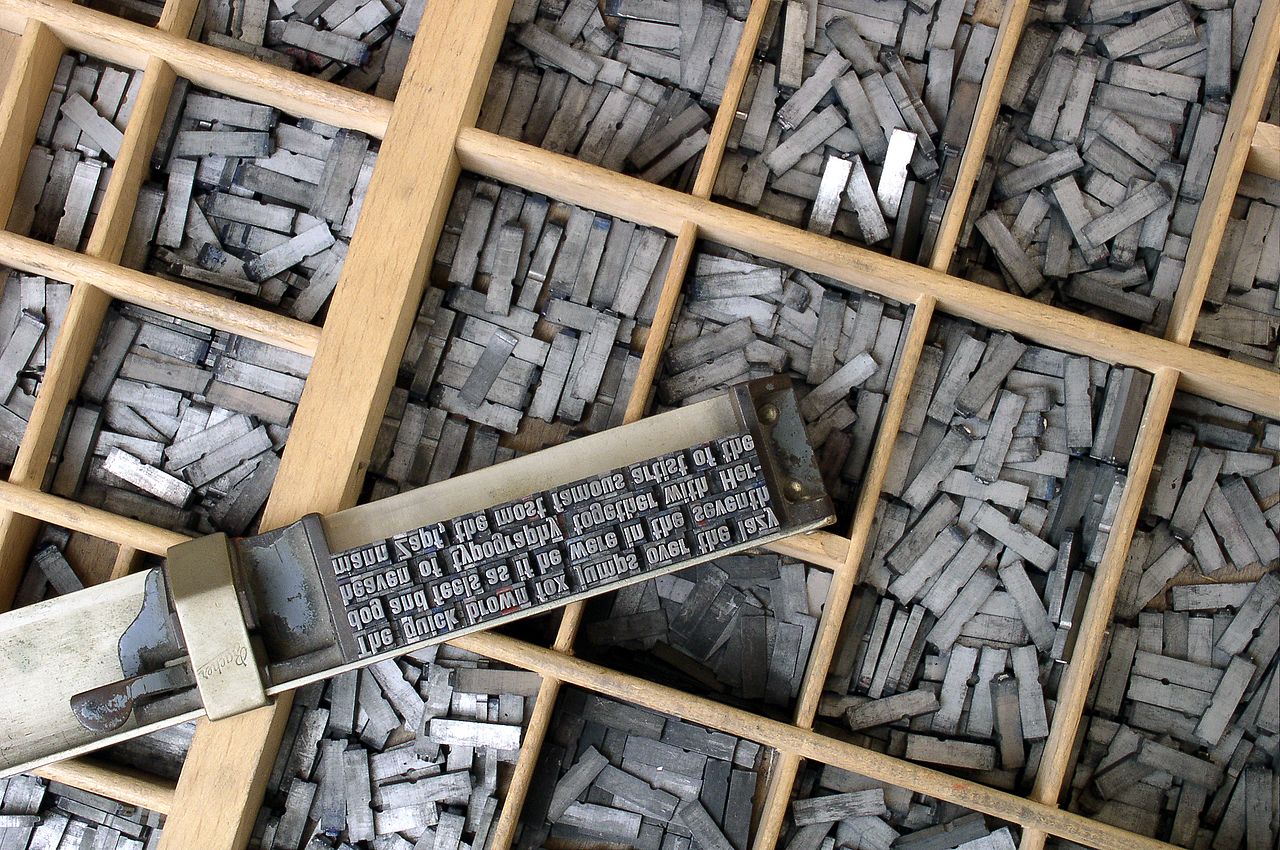
    Movable Type.

    “More formidable than a thousand bayonets”

    Most of those living through a Print Revolution in Europe after 1450 were unlikely to have been awake to seismic changes occurring in how information was being distributed and absorbed. Johannes Gutenberg’s invention, the first of its kind in Europe, as well as increased availability of paper, foregrounded the Renaissance and Reformation; increasing literacy levels and consolidating a few dominant vernacular languages through new literary forms, especially the novel and then, increasingly, newspapers, magazines and periodicals.

    From as early as the seventeenth century newspapers, magazines and periodicals were being published. A newspaper is printed matter acknowledging – unlike haughty books – its obsolescence ‘on the morrow of its publication’[i], as Benedict Anderson put it. Ireland’s first newspaper, devoted to foreign affairs and political intelligence, The News-Letter was published in Dublin in 1685.

    By the early nineteenth, Napoleon described a journalist as ‘a grumbler, a censurer, a giver of advice, a regent of sovereigns, a tutor of nations,’ concluding that ‘four hostile newspapers are more formidable than a thousand bayonets.’ Newspapers were crucial to directing or even forging collective identities such as the nation.

    Unsurprisingly, therefore, the powerful – whether state bureaucracies or dominant corporations – have long sought to control their offerings, and by extension journalism itself, through the carrot of patronage and advertising, and the stick of censorship and outright suppression.

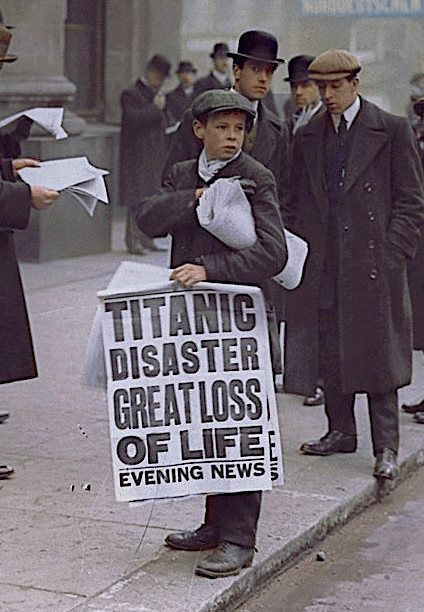
    Traditional newspapers are also tangible products to be sold. Thus, proprietors stimulate demand especially through headlines demanding attention. The daily cry of the newspaper boy summoned a new scare or disaster – yellow journalism has long antecedents – downplaying or ignoring certain facts, while amplifying or even inventing others; often preying on fears and prejudices, just as click bait does today.
    Becoming a Thing

    Alongside meretriciousness and outright propaganda journalism provides an opportunity for visionary – or delusional depending on your outlook – editors and writers who believe in the capacity of collections of regularly published print materials – generally containing short form articles aimed at the general public – ‘to speak truth to power’, ‘move hearts and minds’ and expose hypocrisy and corruption.

    This form of idealistic journalism most frequently appears in magazines or periodicals that may succeed in eschewing obsolescence, even if it is ‘printed on lavatory paper with ink made of soot’, as Sean O’Faolain the former editor of the Bell memorably described the low-cost approach of his publishers.

    With a longer shelf life, the magazine or periodical falls somewhere between the immediacy of the contents of newspapers and the greater durability of ideas contained within books. As Joe Breen puts in his article on Hot Press: ‘One of the great strengths of periodicals is that by operating outside the routines and demands of 24/7 news-flow, they are afforded the space and grace to react thoughtfully to events.’

    To succeed, such publications usually require the guiding hand of a charismatic, single-minded and tireless personality as editor. The social historian Edward Hyams once observed how:

    When a journal is started, a number of minds combine under the dominion of one, the editor’s, to bring it into existence … What the editor and his colleagues have to do is contrive to make such disparate materials as news, views, fiction, criticism, poetry, even competitive word-games, jell into coherence … if this be done successfully then, after… a certain number of issues, the new paper takes on a quality, which is indefinable, and which is apparent, for example, in a work of art or well-designed machine … At that point the paper, to exaggerate a little, becomes a thing…

    Thus, in their introduction to the first volume of Periodicals and Journalism in Twentieth Century Ireland the editors observe of their subject matters covered: ‘The most obvious common feature is the omnipresence within each of them of a dominant personality, or two – as editor and/or proprietor.’ The problem with such an approach is that if the guiding hand is lost these publications may struggle to endure.

    A Docile Lot

    Michael O’Toole observed that up to the 1960s in Ireland journalists had been ‘a docile lot, anxious to please the proprietor, the advertiser, the prelate, the statesman’. This era was, he argued, characterised by ‘an unhealthy willingness to accept the prepared statement, the prepared speech, and the handout without demanding the opportunity of asking any searching questions by way of follow-up.’ The fundamental defect of Irish journalism during this time was, he noted, ‘its failure to apply critical analysis to practically any aspect of Irish life.’

    Terence Brown was harsher still, noting that ‘almost all Irish journalism in the period had contented itself with the reportage of events and the propagandist reiteration of the familiar terms of Irish political and cultural debate until these categories became mere counters and slogans often remote from actualities’. While in 1935, the novelist Frank O’Connor declared that Irish daily newspapers were ‘intolerably dull’, were ‘not trying to educate the public’, and ‘trying to camouflage reality.’

    The editors of Periodicals and Journalism in Twentieth Century Ireland, however, assemble those rare, eccentric, publications ‘providing an outlet for those writing against the grain of mainstream Irish society’, who ‘made freedom of expression a reality’ and created a ‘space for diversity of opinion’.

    Importantly, they argue that ‘the influence they had via that readership was entirely disproportionate to their circulation levels and profits, if any. They were the fulcrum on which the intellectual foundations of Irish society moved – slowly, but irrevocably.’

    Prior to the Irish Revolution ultimately led, as Kevin O’Higgins memorably put it by ‘the most conservative-minded revolutionaries that ever put through a successful revolution’ an ideological ferment was articulated through a variety of seminal publications. Certain contemporary political strands can be traced to the twilight of the British administration in Ireland. At that point journalism was characterised by anything but the grey philistinism of the post-independence era.

    Articles by Colum Kenny, Regina Uí Chollatáin, Patrick Maume, Sonja Tiernan, James Curry and Ian Kenneally in this volume consider Sinn Féin, the United Irishman and others under Arthur Griffith’s editorship, Irish language publications such An Claidheamh Soluis edited by Eoin MacNeill, D.P. Moran’s The Leader that lasted until the early 1970s, the suffragette Irish Citizen, primarily edited by Francis Sheehy-Skeffington, and James Connolly’s The Worker.

    Finally, there is The Irish Bulletin, a publication produced by the first Dáil, offering what might be described as well-intentioned propaganda – insofar as its (truthful) contents was aimed at a particular readership and served a clear strategic purpose.
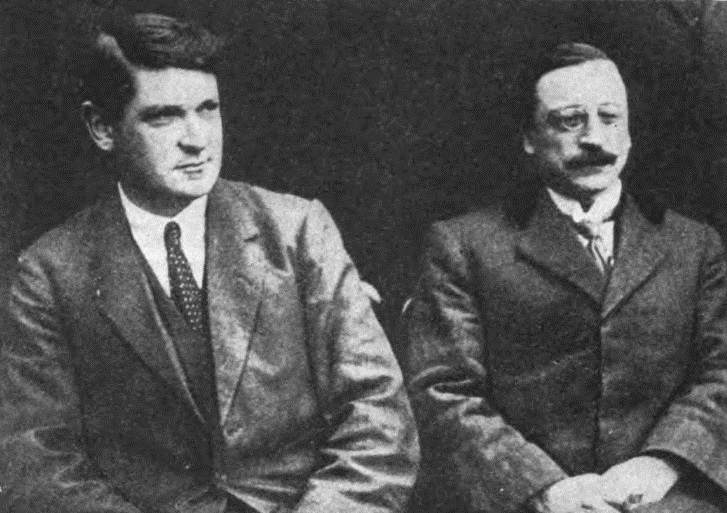
    Arthur Griffith (right) with Michael Collins.

    Arthur Griffith

    James Joyce ‘said that the United Irishman was the only paper in Dublin worth reading, and in fact, he used to read it every week.’ Griffith, according to Joyce:

    was the first person in Ireland to revive the separatist idea on modern lines … A great deal of his programme perhaps is absurd but at least it tries to inaugurate some commercial life in Ireland … what I object to most of all in the paper [Sinn Féin] is it is educating the people of Ireland on the old pap of racial hatred whereas anyone can see that if the Irish question exists, it exists for the Irish proletariat chiefly

    Mischievously, Joyce had a character in Ulysses claim that Bloom ‘gave the idea for Sinn Fein to Griffith to put in his paper.

    Undoubtedly, Griffith was a formative influence on Irish nationalism, and it is indicative that his paper incubated the most enduring political movement – Sinn Féin (ourselves) – on this island. This combined, at times uneasily – hence the splits – a somewhat fuzzy ethnic nationalism with a go-it-alone petit-bourgeois mentality, alongside a visceral anti-colonialism that eschewed strict ideology.

    Griffith was a bundle of contradictions. A great writer – ‘an inspired journalist who combined style and temper in a way no one else could match’ according to F.S.L. Lyons – disinterested in literature that did not strengthen the nationalist outlook. Thus, he disdained Synge’s Playboy of the Western World that dared to question certain nationalist orthodoxies.

    Moreover, Griffith wrote sympathetically about the plight of colonised Africans, while excusing his hero John Mitchel’s reactionary views on slavery. His anti-Jewish statements leave him open to a charge of antisemitism, and even proto-fascism, yet he argued in favour of a Zionist state in Israel.

    Despite highlighting poverty, Griffith was antagonistic towards international socialism, suspecting British trade unions of weakening nationalist statements. If he had lived into the 1920s, however, it is questionable whether he would have supported the free trade policies of the first Cumann na nGhaedhal administration.
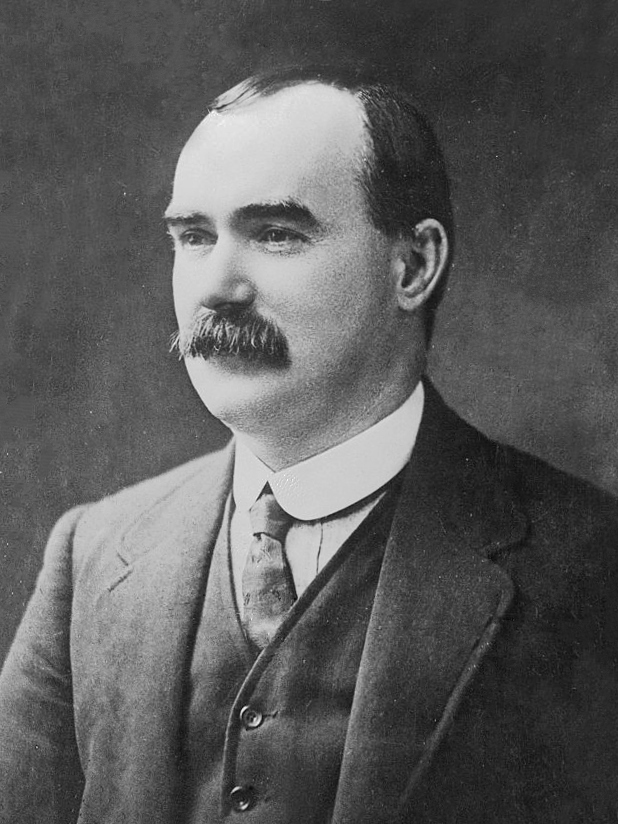
    James Connolly

    Challenging Authority

    The more radical political strains that emerged at this time were less evident in the post-independence period. Nonetheless, they provided a lasting body of opinions that served as an inspiration for future movements: the fulcrums “on which the intellectual foundations of Irish society moved – slowly, but irrevocably.”

    According to Sonja Tiernan the suffragist Irish Citizen was ‘edited by men [notably Francis Sheehy-Skeffington] so that women could devote their energies to political campaigns’. It combined feminism with a radical pacifism that put it at odds with, among others, Emmeline Pankhurst (though not her daughter Sylvia) who supported the British government’s recruitment drive.

    Francis’s wife Hannah pointed to the sacrifice of mothers who had todeliver up the sons they bore in agony to a bloody death in a quarrel of which they know not the why or the wherefore, on the particular side their Government has chosen for the moment.’

    Francis organised anti-military meetings in Dublin, at which he argued that the leader of the main nationalist party in Westminster, John Redmond, simply ‘sold Irish people to the British army for nothing’ Recalling the old nationalist cry of England’s difficulty being Ireland’s opportunity, on 23 May 1915 he declared ‘Anything that smashes and weakens England’s domination of the seas is good for Ireland. Germany has never done us any harm. The only power that has ever done us any harm is England.’

    He would be arrested under the Defence of the Realm Act, and was ultimately murdered by a deranged British officer during the 1916 Rising.

    Another revolutionary editor of this period was one of the leaders of the 1916 Rising itself, James Connolly, who would later rage about how he had been the editor of ‘the only paper in the United Kingdom to suffer an invasion of a military party with fixed bayonets and to have the essential parts of its printing machine stolen in defence of freedom and civilisation.

    According to James Curry his ‘Irish Worker was a crusading paper of vitality that adopted a forcefully direct journalistic style to ensure readers understood its stance at all times’.

    The industrialist William Martin Murphy – apparently ‘the most foul and viscous blackguard that ever polluted any country’ – was regularly in its crosshairs.

    In response to alleged German atrocities, Connolly instead concerned himself with those perpetrated by ‘capitalist barbarians’ closer to home, arguing that the Dublin housing crisis was destined to be forgotten ‘amid the clash of arms, and the spectacular magnificence of international war’.

    In his article ‘The Huns in Ireland’, which led to the paper’s suppression, he argued:

    The steadily increasing cost of the necessaries of life since the war began brings home to the mind of even the most unreflective amongst us, the utterly heartless nature of the capitalist class … The enemy is within our gates. We need fear no Hun from across the waters of the North Sea.

    It is notable that James Connolly’s anti-war rhetoric is recalled by Irish activists today.
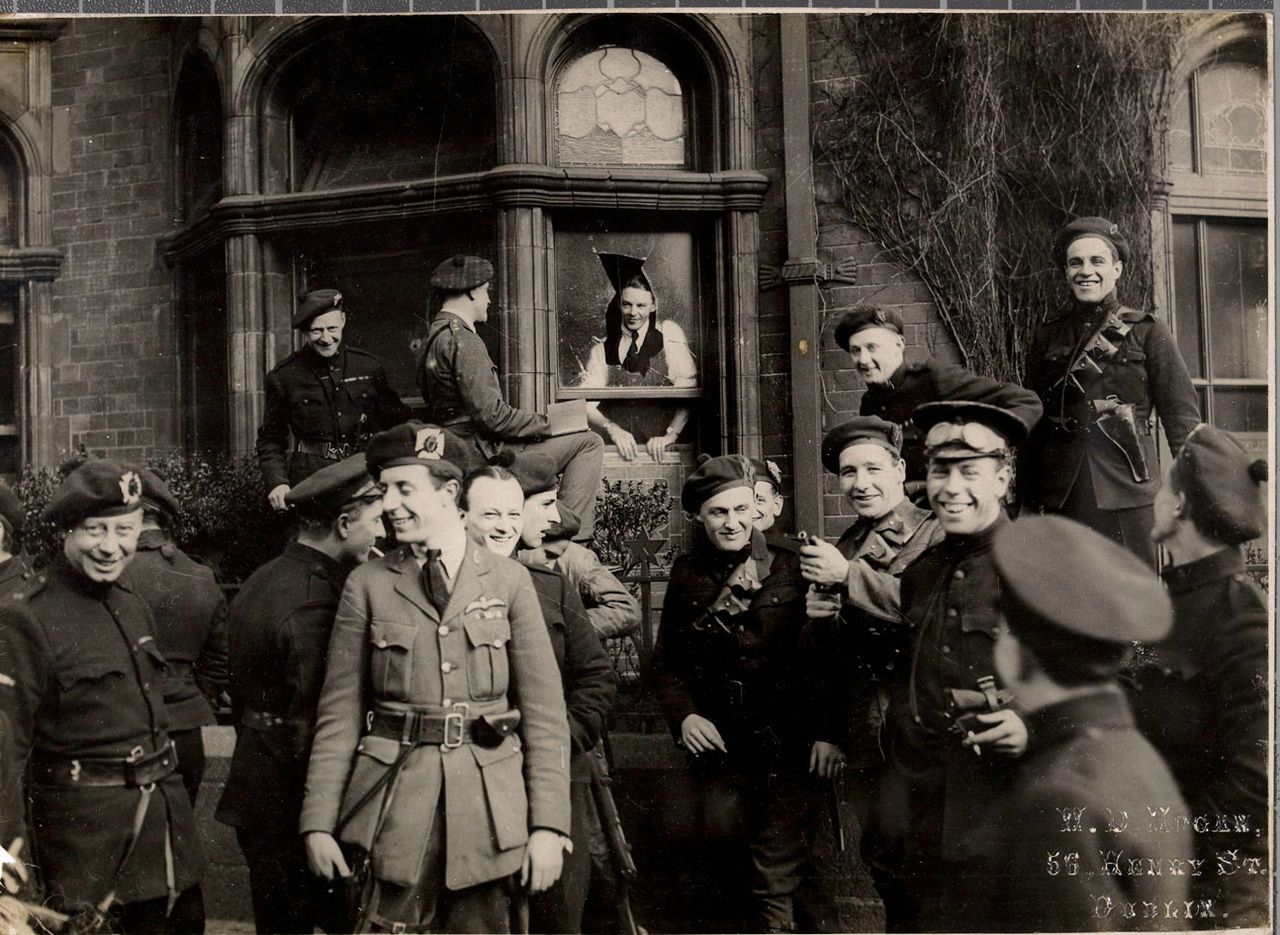
    A group of Black and Tans and Auxiliaries outside the London and North Western Hotel in Dublin following an attack by the IRA, April 1921

    The Irish Bulletin

    To achieve independence the government of the first Dáil dedicated significant efforts to garnering sympathy from an international, including moderate British, audience by highlighting the atrocities committed by British forces: the dreaded Black and Tans and Auxiliaries. This was achieved primarily through an underground publication: The Irish Bulletin, 1919-21, which apparently caused consternation in British government ranks. Thus, in Parliament, the chief secretary for Ireland, Hamar Greenwood, claimed that ‘critics were being duped by a mendacious Irish periodical’

    Unsurprisingly perhaps, Arthur Griffith was active in its early days, but Desmond FitzGerald became a guiding influence thereafter. Its power lay in its credibility. Ernest Blythe recalled how FitzGerald:

    resisted the pressure to which he was constantly subjected from most quarters in favour of painting outrages by British forces in a blacker hue than was justified by the facts …. The result of this attitude and the personal impression that he made was that independent foreign pressmen who admired and trusted him did ten times as much to make Ireland’s case known throughout the world as would have been done if the advocates of heavy expenditure had their way or if a less transparently honest man had been in charge of propaganda.

    It goes to show that facts can speak for themselves, and that exaggeration may only diminishes a publication’s credibility.
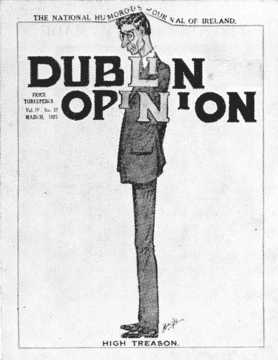
    Taste for Comedy

    Dublin Opinion (1922-68) styled its humour the ‘safety vale of a nation’. Its relative success attests to an enduring appetite for humorous takes on serious political events, such as we still see today most obviously in publications such as Waterford Whisperers. This apparently timeless Irish tendency to laugh at absurdities on the political stage is, however, often to the exclusion of more serious assessments. Thus, Felix M. Larkin argues that Dublin Opinion‘s humour ‘concentrated on the political to the detriment of the social and economic.’

    Nevertheless, there is some truth to the couplet carried in early issues: ‘Not seldom lurks the sage’s cap and gown / Beneath the motley costume of the clown’.

    Dublin Opinion played an important role in puncturing the reputation of Eamon de Valera, scorning his ‘professed belief that he had a unique insight into what the people of Ireland wanted.’

    Larkin argues that the publication ‘probably saved proportional representation in 1959, and it inspired T.K. Whitaker to write his seminal ‘Grey Book.’

    The renowned civil servant T.K. Whitaker said that he was impelled to undertake his famous white paper the First Programme for Economic Expansion in response to the cover cartoon in the September 1957 edition of Dublin Opinion in which the young female figure of Ireland instructs a fortune teller, peering into a crystal ball: ‘Get to work! They’re saying I have no future.’

    It also, arguably, exhibited a healthy suspicion of farmers, who are ‘seen filling out forms for grants… duping government inspectors, joining myriad associations to protect their interests, smuggling cattle across the border with Northern Ireland and constantly complaining.’
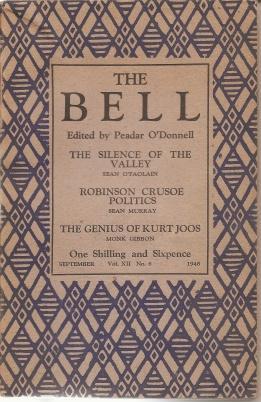
    The Bell

    Probably the most important publication of the post-War period in terms of its inspiration to future journalists was The Bell, under Sean O’Faolain as editor.

    Ironically funded in part by an investment by sweepstakes millionaire Joe McGrath, it was inspired by leftist UK publications that emphasised the importance of factual reporting. O’Faolain opined that ‘Generalisation (to make one) is like prophecy, the most egregious form of error, and abstractions are the luxury of people who enjoy befuddling themselves methodically’. Contemporary editors are still inclined to advise journalists “to show it, don’t tell it.”

    Covering generally overlooked themes such as the ongoing challenge of tuberculosis, many of its articles were created, according to O’Faolain, by ‘somebody [who] had to out with a notebook and listen, and encourage and make a record. The poor would for ever remain silent if people did not, in this way, wrench speech out of them’

    O’Faolain also bemoaned an enduring disconnect between academia and the general public: ‘with only one or two honourable exceptions our professors never open their mouths in public.’

    Mark O’Brien concludes that it ‘played a central role in prompting journalism to develop beyond the confines of party affiliation’, an endeavour ‘taken up with gusto by the Irish Times  in the early 1960s’, especially through Michael Viney.
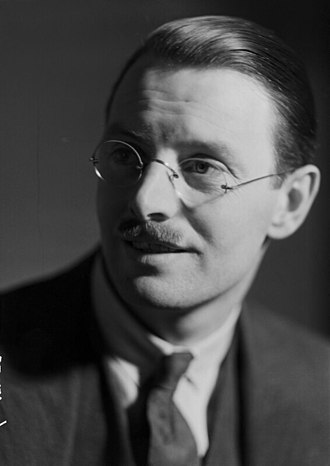
    Sean O’Faolain

    Hibernia

    According to Brian Trench under John Mulcahy Hibernia, became a strong presence in Irish media as an independent, frequently dissenting voice. Indeed, ‘by 1973 it was already carrying articles alleging conflicts of interest and possible corruption in relation to the activities of local politicians in the Greater Dublin area.

    The magazine became a platform for dissenters such as Raymond Crotty, Desmond Fennell, Ernest Blythe and Proinsias Mac Aonghusa.

    Terry Kelleher a Hibernia journalist between 1970-75 recalls Mulchay’s ‘questioning approach to everything and everyone, but especially towards those in a position of authority. Every institution, whether it be a political party or financial grouping, artistic clique or academic ivory tower, all must be challenged, their continued existence questioned.’

    The magazine gave particular attention to stories of’ bad planning, illegal property development, councillors’ conflicts of interests and related issues,’ as well as the mistreatment of prisoners by the Royal Ulster Constabulary at a point when an anti-Republican Revisionism was increasingly prevalent in Irish intellectual circles.

    Hibernia went where most newspapers dared not go, at one point revealing that a sitting member of the Special Criminal Court was falling asleep on the job. According to Trench, ‘Irish Times journalists Peter Murtagh and Joe Joyce later dealt with this incident … though they omitted to mention that their own newspaper – like the other dailies – chose not to refer to what was happening in front of them.’

    Mulcahy’s unschooled approach of relying on tip offs brought criticism. Vincent Browne claimed the publication had ‘a style that may lack the investigative edge required by a serious paper.’

    However, when the publication closed after one libel action too many, Pat Smyllie wrote in the Irish Times that ‘whether you liked it some weeks or not, it was brave, searching, cheeky outrageous but … essential to many of us’. He noted that it sometimes had to pay the price in court for uncovering ‘double dealing’.

    According to Niall Kiely the magazine was a ‘must-read’ for journalists in the mainstream media: it was a source of information and perspective not found elsewhere.’

    Another legacy, argues Trench is the ‘almost universally cynical tone of the anonymous journalism in The Phoenix may be considered an unfortunate and partial legacy of Hibernia.’ However, given the endemic corruption of the period, and beyond, and an apparent acquiescence to this in the mainstream media, such cynicism might be forgiven.
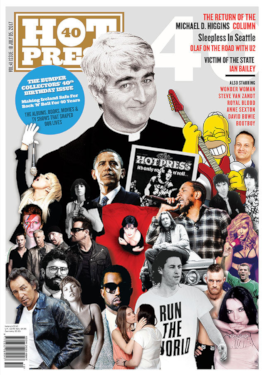
    Hot Press Magazine

    Rock n’ Roll

    Jon Street notes that ‘music plays a part in our constitution as moral beings and in our constitution as political ones. In responding to and in evaluating music we do not just give expression to our tastes, but to our political values and ideas. Music is, to this extent, part of the way we think politically.’

    According to Diarmuid Ferriter the value of Hot Press lay in ‘its value lies in the extent to which it highlighted the burgeoning youth culture of the era as well as new musical departures and a determination to embrace international influences.’

    Its remarkably durable editor, Niall Stokes acknowledged that 1977 – according to Jon Savage the ‘moment of high punk’ – was ‘not the most healthy climate in which to launch a newspaper.’ He championed a liberal social agenda – which was very much in the minority at that point – along with his editorial partner (and wife) Máirín Sheehy and brother Dermot Stokes.

    Stokes said: ‘We felt in particular that the deference shown to the Roman Catholic Church in all areas of Irish life, including the media, was entirely inappropriate.’

    The U2 connection is central to the story of Hot Press, while John Waters, a young aspiring journalist then living in remote Roscommon, was an important recruit. According to Stokes: ‘Back then, John, I think it is fair to say, saw himself as a leftist’. For his own part Waters reckons: ‘I can say with absolute certainty that I would not be writing today were it not for [Stokes].’

    An important feature was the Hot Press interview, where according to Waters: ‘The idea was to ‘get under the skin’ of people who were known in a certain context.’

    An interview with Charles Haughey ‘caused a huge reaction in the mainstream media as the Fianna Fáil leader’s use of expletives and colourful descriptions of opponents broke with convention.’
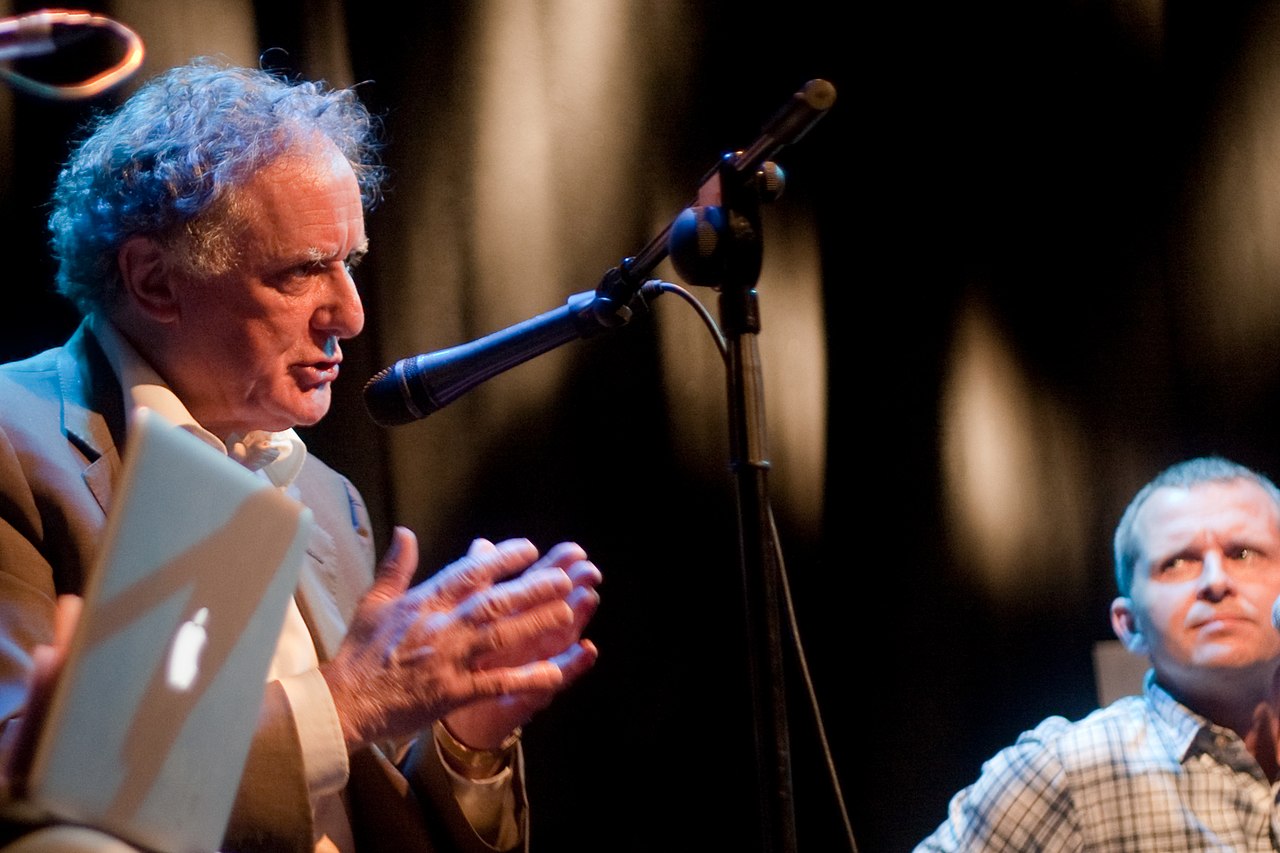
    Vincent Browne.

    Magill

    In 1986 The Guardian newspaper recorded that ‘Magill has gained a political influence that has no parallel in British or indeed European magazine publishing,’ while the Sunday Times credited it with ‘dragging Irish journalism out of its largely comfortable, unquestioning dullness’.

    According to Kevin Rater it was ‘shaped by the particular interests of its proprietor and founding editor, Vincent Browne’, who wrote in 1969: ‘In terms of its wealth, Ireland cares less for the weaker and poorer sections of its community than any other country in Europe with the exception of Portugal. Yet the popular myth is that there is no poverty in Ireland.’ Party politics, the redistribution of wealth and Northern Ireland would be its primary focus.

    Browne shared editorial responsibilities with Mary Holland, who later claimed Browne: ‘could be very cruel to people and didn’t seem to expect them to take it personally.’

    According to another journalist, Paddy Agnew: ‘the cover was the most talked about, and the most agonising thing, every month. It was torture.’ Britan Trench recalled: ‘He would snort and sniff at content ideas. And then his view of the would emerge’.

    At the end of Browne’s tenure as editor Colm Tóibín was appointed to the role. He was influenced by the ‘new journalism’ in the work of American writers such as Tom Wolfe, Gay Telese and Hunter S Thompson’. Another editor, Fintan O’Toole brought ‘an extraordinary range and depth of interests.’

    Ultimately, according to Rafter ‘It was outflanked on one side by The Phoenix with its mix of business and political gossip and on the other by the national newspapers that had adapted their editorial offerings to include longer articles, many by names who had first emerged in Magill.’
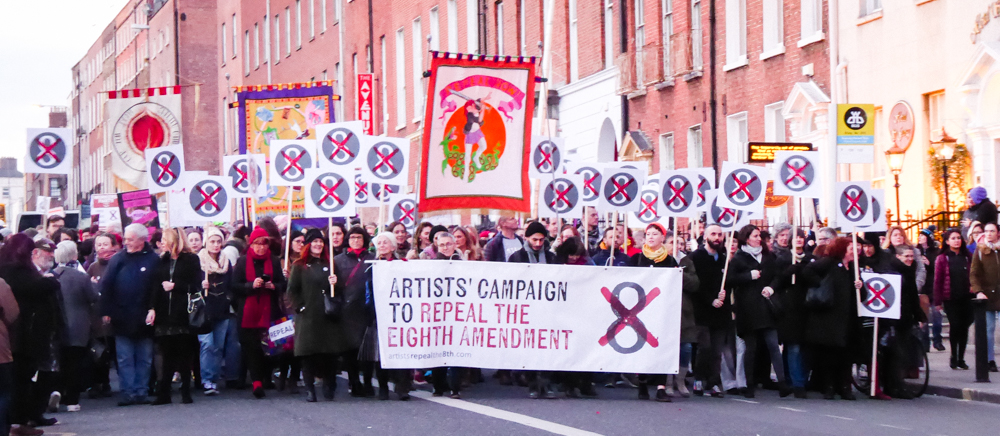
    Image (c) Daniele Idini.

    Granular Analysis

    Magazines and periodicals share certain features with independent restaurants, insofar as neither tend to last very long, and are often dependent on a dominant personality, who regularly loses their shirts. Like independent restaurants they perform vital roles for a cultural avant-garde, incubating new tastes and literary styles, which the fast or convenience daily newspaper purveyors often appropriate.

    Moreover, it remains the case in Ireland that most investigative journalism occurs at a remove from mainstream daily publications.

    As adverted to, a second review of the latest volume in this series provides a more granular assessment of these publications, including magazines representing feminism and gay rights, and focuses on particularly illuminating stories, such as the nature of Irish humour and the state of the press. It will also afford a chance to reflect on the challenges of publishing in our contemporary digital environment.

    [i] Benedict Anderson, Imagined Communities: Reflections on the Origin and Spread of Nationalism (Verso, New York, 2006), pp. 34-35

    Featured Image: Dublin, 1916, prior to the Rising.
  • It Is Good We Are Dreaming

    ‘We dream – it is good we are dreaming –
    It would hurt us – were we awake –
    But since it is playing – kill us,
    And we are playing – shriek –‘
    ‘We dream – it is good we are dreaming’
    Emily Dickinson

    There are quite a few things in life which I deem to be frankly repulsive – cancer, world hunger, terrible Twitter takes, right wing politics, capitalism et cetera but truly the worst thing of all is when a writer writes about their own work. So please forgive me, dear wonderful reader, because I’m about to do just that.

    It Is Good We Are Dreaming runs from May 31st – June 11th in the New Theatre here in Dublin. It’s the first in person play from a new emerging queer theatre company called LemonSoap (yes, we’re James Joyce fans) of which I am delighted to be a member.

    The play explores the relationship between two estranged siblings, Fionn and Fiadh. Unexpectedly one morning Fionn arrives at his elder sister Fiadh’s house and over the course of a morning they end up discussing everything from the man made of rock their mother fell in love with, the nature of inheritance, the ecological collapse of our world, Just Dance on the Wii and their respective love lives.

    It’s a strange little play about family and Irish mythology and how difficult it is to live in Dublin city and I’ve realised over the course of writing and rehearsing this piece that there were three impulses behind it’s creation. Three thoughts I wanted to think through in a play and of course being a writer of an utmost writerly disposition I find I do my best thinking while pretending to be someone else inside a literary framework of my own creation and so a play was born. See! Writers writing about their own work is horrific!

    Existence

    I have been thinking a lot recently (while pretending to be someone else, obviously) about living at a time when it feels like the world is ending. I can’t put my finger on when it became a part of my daily existence to wonder about these things – worlds ending, civilisation collapsing and the like.

    Maybe the pandemic, the recession, the wars or too much time during lockdown to bake brownies and stare at myself. But I think about them, the end of the world as we’ve known it, a lot now. Probably to an unhealthy amount really but then I am a writer so hopefully people (you) won’t call me crazy but rather contemporary or finger on the pulse or some such and I’m not a fan of doomsday talk in general really but my god how can you avoid it at this rate?

    I’m always it would seem thinking about Mary Robinson’s righteous anger and tears at COP26 or the rise in anti-LGBT hate across the globe or how there’s months left to avoid mass extinction events or how it seems the slow march towards oblivion for us doesn’t seem like it can be avoided anymore and I’ll tell you a secret: I lied earlier.

    I can put my finger on when Armageddon thoughts became daily daydreaming for me and it was while writing this play. Which is hilarious! But true. Existential despair caused by playwriting. I betya Beckett and Caryl Churchill would say the same thing. Well, I hope they’d say it anyway because that would make me feel better.

    With this show, I wanted to write about a brother and sister who have a frank and honest conversation about how to continue to exist in the world right now, how to push on and live and love despite the creeping sense that the life we’ve been sold, the life our parents and grandparents and great grandparents were able to afford, more than likely may never come true for us.

    Our two characters, Fionn and Fiadh, find very different ways to deal or not to deal with the dying of the light. Fiadh’s decided to learn to actually like oatmilk, to buy a pair of wellies and a gas mask too.

    Fionn’s taken to railing against the world and struggles to come to terms with the gross unfairness of it all and throughout the play we see these two siblings clash up against eachother as they attempt to navigate and explore their own relationship and the world around them.

    This is a play with two characters under the age of thirty at its heart and I’m excited and terrified to see how people, particularly older people, respond to the conversations these two are having. Conversations which firmly reflect the ones I am having with my peers, us much maligned Generation Zs.

    Questions about existence and living and climate collapse and how we emerge into and are meant to thrive when the notions of thriving we’ve been force fed are actually literally contributing to the world’s dying.

    While I don’t think literature can solve the climate crisis or housing crisis or stem the rising tides of inequality, I do think what it can do is provide voice and space to those concerns and provide some much needed catharsis for those of us who need it. That’s what, amongst other great things like funny and riveting and not boring, I hope this play is. A rumination on existing.

    Inheritance

    I am always and forever fascinated by how we as people are defined by what we inherit. How it’s written in our bones really from birth some things about us that we maybe in ways can’t really escape.

    There are countless studies out there about how traumas can be inherited from our forefathers and they all are eminently debatable and fascinating and so with It Is Good We Are Dreaming I set out to try and explore what can be inherited in many little ways. In the play we hear whispers from Fionn and Fiadh’s mother coming from the walls. She whispers bed time stories which the two siblings would have heard growing up, each of them with a decidedly Irish mythological bent to them.

    Their mother, played in a voice over role so mercurially by Fionnuala Murphy, is a complex enigmatic figure who spent her life chasing after the ghost of a man made of rock. She’s someone who in very many ways slips in and out of our known world and into another and the play explores the myriad ways in which that’s defined and repulsed her two children.

    Fionn and Fiadh too are half siblings, joined together in life by the mother they share. They were raised separate to one another, Fiadh raised by her father and Fionn by both his Mam and Dad. Because of that they come from very different material backgrounds. Fiadh was raised in a wealthy suburb and went to a private school while Fionn was raised in a working class environment and has had to work to put himself through college.

    I wanted to see in this play what happens when you place two people, two siblings, born into very different material circumstances together and how their difference in circumstance and class would manifest itself throughout.

    Class is something I don’t think is often represented enough or interrogated on Irish stages. We either see families falling apart in wealthy suburbs or peasant farmers from Donegal or Kerry fighting over land, rarely in Irish theatre do we see examinations of the material reality of class and how it impacts us today.

    With this play, I wanted to explore the subtle ways in which our class defines and differentiates us. These are two characters bashing up against each other who have inherited many different things from their families and the world around them. Their socio-economic status or a mother who dreams of another world or a planet riddled and rank with issues near even beyond their comprehension.

    The weight of history and family and their inheritance sits in this room with these two siblings and in ways they escape, subvert and succumb to that which they’ve had no choice in being given.

    F. Scott Fitzgerald wrote that we are all boats, borne back ceaselessly into the past. I’d like to think we are more than what came before us or at least that if we want to we can escape it. But I don’t know really and so I felt wrestling with the role of inheritance in our lives would be worthwhile subject for a play and I hope you’ll think so too.

    Image (c) Daniele Idini.

    Myths and Legends

    In case you haven’t noticed by now I am really fascinated by intergenerational trauma and the ecological collapse of our world. But what really and truly set me off on writing this play was the idea that it would in its way explore the vast array of rich and crazily original Irish mythological stories, legends and fairy tales which underpin this island we live on. We know the stories, we’ve read many of them as kids.

    The Children of Lir, Tir Na nOg, The Giants Causeway and The Fianna. We know of them as children’s stories but when you begin to discover just how rich and detailed and earthy and ethereal these Irish legends are you won’t be able to get enough of them. I wanted to capture the essence of the mythology of our Island and infuse it with this play and so it became about a mother who lives in the mythological realm and her two children who sit in the mundane one reaching out for the mythological, reaching out for her.

    It became a play about two siblings puzzling through the enigmatic myths and legends their mother told them. Stories of the man made of rock she fell in love with. The crystal fish that float in the sky. The person in the attic saying prayers late at night. The four swans taking flight.

    I think sometimes we are afraid in this country of the stories our ancestors told. I think that’s probably colonial and also the fault of the church who stole a lot of those stories to make saints.

    Yeats and Lady Gregory however brought our stories and our mythologies so vibrantly onto the stage with their Celtic revival in the early 20th century and today Marina Carr with her extraordinary body of work explores Irish and Greek mythologies with startling insights. But by and large we shy away from our legends, we leave them as stories to be told to kids and that’s it. I think they are too rich, too complex, too full to the rafters with brilliance to be hidden away because of some post-colonial theocratic embarrassment.

    So I’ve stuffed this play to the gills with obscure references. To the Children of Lir, the Fianna, Diarmuid and Grainne. To the Gods we worshipped once and the peoples our ancestors would say came to this land before us. In It Is Good We Are Dreaming the mythological joins us at the kitchen sink. It whispers from the walls in stories told by a mother who has always had one foot in either world.

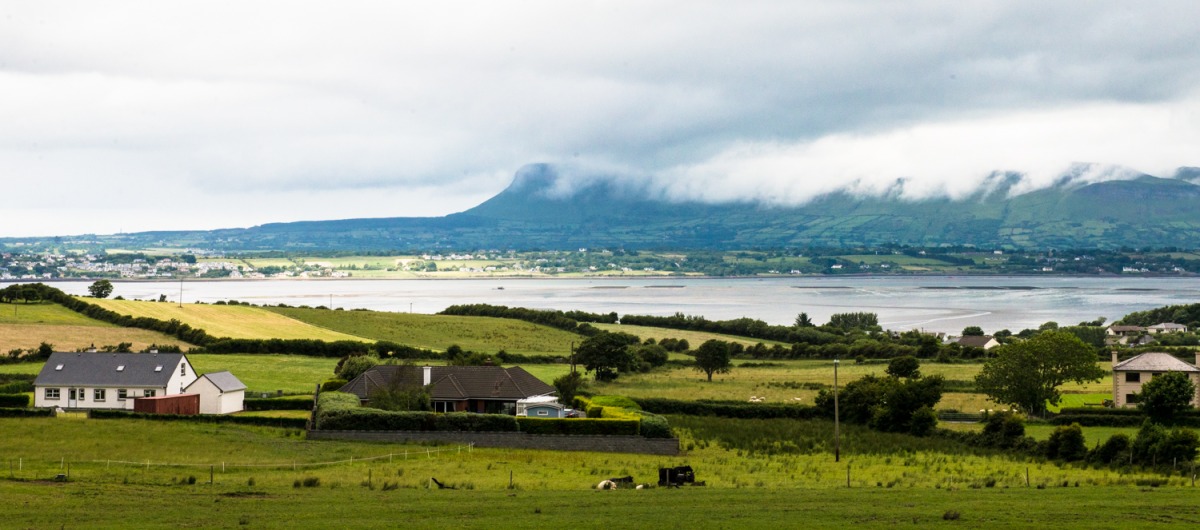
    The image of Ben Bulben looms large over this play, which in our mythology is said could act as a gateway to the other side. The third and final impulse for this piece was that it must be epic yet tiny in scope, it must be a naturalistic drama where the mythic bleeds in to warp and distort, it must pay tribute to the legends our ancestors gave to us while forging new ones that Fionn and Fiadh tell one another. It must be a play that in many ways is hard to define.

    A slippery complex piece about family and myth and climate change and more. And I think, dear reader, you probably have most of all gotten the impression that this play is hard to define after all of my ramblings. But that’s why you should come see it. To define it for yourself.

    One last thing. The title of this play, as you’ve probably noticed, is taken from the above quoted Emily Dickinson poem. I chose the title because I believe it’s a perfect encapsulation of in the end what this play is aiming to be. Because despite the many horrors of life right now, despite the inheritance that defines us or haunts us or the crises that besiege us, we continue to dream. We have to.

    To hope for better. To hope for change and for beauty and for joy. To dream so that all the future generations can too. It is good we are dreaming. And despite all that awaits us and the portents of doom ahead we can’t lose it, we mustn’t. Because even if everything else leaves us, we’ll always have and we always will be dreaming. And despite everything, I think that’s really beautiful.

    Feature Image: Laoise Murray as Fiadh and Luke Dalton as Fionn. Photo by Owen Clarke

  • Covid-19 in Ireland: Pandemonium

    Robert Fisk wrote: ‘we journalists try – or should try – to be the first impartial witnesses of history. If we have any reason for our existence, the least must be our ability to report history as it happens so that no one can say: “We didn’t know, no one told us.”[i]

    To be an “impartial witness” is, of course, impossible, as Fisk concedes, but this should not deter journalists from striving for objectivity. Inevitably, reporting on “history as it happens” involves choices as to what information is recorded in the annals of daily newspapers, and decisions over whose account becomes canonical. What is left out is often as important as what is included.

    Since independence Irish journalism has often failed to interrogate the structures of power and privilege. Thus, in his seminal Ireland 1912-1985, J. J. Lee notes ‘the intellectual poverty of Irish journalism … [and] the lack of public demand for serious analysis.’[ii]

    An older generation are sometimes heard to say, “we didn’t know, no one told us”, whether concerning the treatment of children in religious institutions, or corruption in the planning process. We may be revisiting a tendency to sugar-coat our reality in the Irish media’s broadly self-congratulatory response to Covid-19.

    Writing a first draft of history, in Pandemonium: Power, Politics and Ireland’s Pandemic Jack Horgan-Jones and Hugh O’Connell, Irish Times and Irish Independent journalists respectively, offer an insider account of truly unprecedented times. The book recalls how the spectre of a devastating pandemic gives way to a realisation that democracy and the rule of law were undermined amidst extraordinary rules that deliberately orchestrated social atomisation, with unpredictable consequences. But it avoids addressing whether we were duped into an apparently popular commitment to lockdowns.

    Anyone governing Ireland throughout the period of the pandemic would naturally wish for their choices to be vindicated, especially the approach of permitting civil servants and technocrats to make many, if not most, difficult decisions; while riding roughshod over fundamental rights to associate, travel and conduct business freely, seemingly with popular consent, however manufactured.

    As an early assessment, drawing on interviews with many key players, Pandemonium arguably suffers from its proximity to sources. After all, access is only granted to the chosen few. A reputation for being ‘difficult’ is not a recipe for a successful career in mainstream Irish journalism. This perhaps accounts for Pandemonium’s generally muted and conditional criticism.

    Nevertheless, the book brings to light important information, including an unpublished report cataloguing the catastrophe that ensued in many care homes in the early months of 2020.

    To explain the disproportionate – at times self-harming – Irish response to the pandemic a future historian might explore a Catholic inheritance conditioning acceptance of the Original Sin of asymptomatic spread; the Holy Water of hand sanitisers; the Heresy of the unvaccinated; and the Benediction of (repeated) vaccination. Our future historian, or anthropologist, might also note the Obscurantism of a dominant Hierarchy that denied the ‘snake oil’ of antigen testing; the extreme unlikelihood of outdoor transmission, and immunity conferred by natural infection.

    “The big calls”

    The authors maintain that ‘The majority of the big calls were correct.’ This judgment is made, notwithstanding the decision, ‘to clear out hospitals to prepare for a surge in admissions by decanting large numbers of elderly and vulnerable patients into nursing homes’. It should also be noted that CMO Tony Holohan ordered care homes to re-open to visitors in March, 2020. These policies contributed to Ireland suffering the second highest proportion of care home deaths in the world during the first wave.

    To arrive at a broadly positive assessment the main metric the authors use is comparative mortality attributed to Covid-19. However, besides serious questions over how mortality from Covid-19 has been assessed globally – dying ‘from’ or ‘with’ – this ignores how with Europe’s youngest population Ireland ought to have been the least susceptible to mortality from the disease.

    As a Nature article put it in August, 2020: ‘For every 1,000 people infected with the coronavirus who are under the age of 50, almost none will die.’ Indeed, from March to June, 2020, 96% of additional deaths related to Covid-19 in Europe occurred in patients aged older than 70 years.

    Europe’s youngest population were forced to contend with some of the most draconian laws in the world. An Author’s Note contains analysis of Oxford University’s stringency data which shows among comparator countries in the EU27 and UK that Ireland had the most restrictive regime for 121 out of 685 days, and was joint fourth overall behind Italy, Greece and Germany. Based on other criteria, the regime may have been even harsher.

    Initially, the old were to be sacrificed for the sake of the young, but ultimately it would be the young who would be compelled to put their lives on hold for the sake of the old. Some will never recover. The disgrace is that no serious cost-benefit analyses were conducted during what the authors accurately characterise as enduring pandemonium.

    The decision to empty hospitals in March, 2020 may have been medically justifiable; the real problem lay with the state of the health service, and an incorrect assessment of the danger posed by Covid-19. An ongoing failure to resource emergency medicine, resulted in a perceived dependence of lockdowns that failed to take account of seasonality.

    Rather than attempting to make a virtue out of what was surely possible in outdoor spaces the authorities adopted a no-can-do attitude that ramped up the misery.

    Deep Background

    A ‘Note on Sources’ says:

    The majority of interviews that took place for this book in 2021 and 2022 were conducted under the journalistic ground rule of ‘deep background’. This means that all the information people told us in interviews could be used, but it could not be said who provided it.

    In other words, political and senior civil service sources were at times unwilling to speak on the record, but nonetheless grasped an opportunity to manage the message, and offset any potential for reputational damage.

    We can only guess at who featured most prominently in these “deep background” interviews, but the imprint is unmistakable of core Fine Gael players in the initial, caretaker government; as well as senior civil servants, including the all-powerful Cabinet Secretary Martin Fraser.

    The authors do acknowledge that a very dangerous precedent was set in terms of powers being appropriated for long periods by unelected civil servants – and one man in particular – with only tenuous claims to expertise in infectious disease management.

    Perhaps the most shocking aspect – previously revealed in Richard Chambers’s account – was the exclusion of successive Ministers of Health from NPHET, the all-powerful group for which there was no cabinet approval or even a ministerial order underpinning its establishment.

    Yet we must wait until the Epilogue for the stark admission that ‘Some of the most drastic, expensive and cruel policies ever imposed by the State were arrived at within a system that was ad hoc and could be haphazard.’

    Dictatorial                                                                                                                        

    CMO Tony Holohan became the public face of the state’s response from early on, and this book confirms his dominance over decision-making. The CMO called the shots and assembled a team to carry out his orders.

    His decision to appoint Professor Philip Nolan – ‘The pair had known each other for years’– to oversee disease modelling ought to have prompted concern. Nolan was then President of Maynooth University, his ‘research was in physiology – specifically the control of breathing and the cardiovascular system during sleep.’ With no research background or expertise in infectious diseases Nolan’s wayward models – and bizarre commentary on antigen testing – informed Irish government decisions throughout the pandemic.

    According to the authors, ‘almost everyone who attended NPHET meetings agreed on one thing above all others: a Tony Holohan production.’ An unnamed source described his style as ‘very dictatorial and autocratic,’ and ‘intolerant of alternative views.’

    One NPHET member, Kevin Kelleher, was prepared to go on the record saying: ‘I felt the debate was controlled to ensure certain outcomes were achieved.’ Thus, he felt frustrated when arguing that testing policy should have look ‘more like how the HSE tests for other infectious diseases.’

    Holohan, the son of a Garda, enjoyed ‘a good relationship’ with Garda Commissioner Drew Harris, who baulked at the former’s early attempts to prevent people from leaving the capital. Harris was apparently unwilling to impose blanket travel restrictions ‘on the basis that it could lead to Ireland becoming a police state.’ Initial reluctance to impede free movement – and become a police state – appears to have receded as the pandemic went by. Police checkpoints became a familiar sight across the country.

    The relationship between Holohan and the Gardaí was put in sharp focus when a tweet by the CMO complained of scenes reminiscent of Jones’s Road on the day of an All-Ireland preceded a Garda baton charge on South William Street in Dublin.

    Young people were grasping a rare opportunity to socialise in bizarre circumstances where pubs were permitted to serve takeaway pints but not allowed to provide outdoor seating. It came after many months of having their lives drastically impacted by restrictions.

    The contempt of one deep source for the hoi polloi is unmistakable: ‘Tony might have phrased the tweet a bit better … Basically South William Street became scumbag central, for want of a better phrase, so that’s where we had to focus the policing effort.’

    Infection Fatality Rate

    As misleading accounts of the infection fatality rate of Covid-19 informed Western governments in spring, 2020 – especially via the famous, non-peer-reviewed Imperial College paper authored by Neil Ferguson which claimed an IFR of 0.9% – a global pandemonium of toilet roll buying proportions ensued. In early March Taoiseach Leo Varadkar’s forecast that 85,000 people could die from the coronavirus in Ireland (over three times as many as died during the Spanish influenza pandemic). Having initially downplayed the challenge, his caretaker government were seemingly inclined to induce fear, which generates its own pathologies.

    Based on what we now know were incorrect – duplicitous or otherwise – epidemiological assessment, many in positions of authority appear to have genuinely believed Neil Ferguson’s contention that Covid-19 represented “the next big one” – a re-run of the dreaded Spanish Influenza pandemic that took up to fifty million lives in 1918-19; as opposed to one similar to the Chinese and Hong Kong influenza pandemics episodes of the 1950s and 1960s.

    Excess death is the best measurement of mortality during a pandemic. According to a global analysis of Covid-19 by Professor Lone Simonsen this pandemic has had ‘nowhere near the death toll of the pandemic of 1918.’ In Ireland in just one year of that outbreak 23,000 died, many of them young, whereas the mean age of death in Ireland from Covid-19 was eighty just two years younger than the average age of death,  while the level of excess mortality is considerably lower than the number of deaths attributed to Covid-19.[iii] This has led the Mayo Coroner to object that Covid deaths were being skewed by other illnesses.

    Sadly, as the Swedish epidemiologist John Giesecke pointed out in an interview aired on Sky News Australia in April 2020, governments around the world seemed to be assuming that people were stupid. Giesecke also argued that authorities were failing to consider how they would end their reliance on lockdowns. He pointed to Swedish data showing that between 98 and 99% had either no symptoms or only mild symptoms from Covid-19, and guessed the IFR would turn out to be 0.1%, which now appears a reasonable approximation.

    In contrast, as late as September, 2020 RTÉ’s Fergal Bowers was stating: ‘The World Health Organization says data to date suggests 80% of Covid-19 infections are mild or asymptomatic, 15% are severe infection, requiring oxygen and 5% are critical, requiring ventilation.’ Remarkably, Bowers seems to have copy and pasted this from a seriously out-of-date WHO Situation Report from March 6th, 2020, stating ‘data to date suggest that 80% of infections are mild or asymptomatic, 15% are severe infection, requiring oxygen and 5% are critical infections, requiring ventilation.’

    It’s unlikely Bowers was working alone. Pandemonium reveals an early communications plan involving John Colcannon, indicating there would be ‘close collaboration’ with RTÉ in particular. This would be ‘critical to informing the public and helping in the national effort to respond.’ “Informing the public” did not necessarily mean a truthful account.

    It is also notable that Martin Fraser wrote that ‘RTÉ’s financial issues from the Covid-19 crisis will have to be dealt with.’ The state broadcaster acted as a conduit for government press releases and leaks, faithfully broadcasting case numbers and deaths in almost every bulletin, without questioning their reliance on a highly unreliable PCR test. The main newspapers, receiving tens of millions in government advertising throughout, also faithfully headlined the daily case numbers and death figures.

    The authors argue ‘the scenes from Bergamo were conditioning the State’s early response’, but it appears to have set the tone throughout, as politicians handed power to civil servants who tore up the social contract, amidst hysteria that owed a great deal to the penetration of social media in our lives.

    Although expensively assembled Covid self-isolation facilities and field hospitals went largely unused throughout the pandemic, the authors do not question a dominant narrative that without near-constant lockdown Irish hospitals would have been completely overwhelmed.

    Yet a recent ‘natural experiment’ carried out in the UK casts serious doubt on this orthodoxy. In a Guardian article clinical epidemiologist Raghib Ali outlines how, despite removing all, or most, restrictions in the summer of 2021, England actually had better outcomes than other UK regions:

    England has actually had a similar rate of infection and a lower rate of Covid deaths during the Omicron wave – and since 19 July 2021, England’s “freedom day” – than Scotland, Wales and Northern Ireland, despite having far fewer mandatory restrictions, and none after 24 February. This “natural experiment” shows that having more mandates did not lead to better outcomes.

    It seems that once a generally mild respiratory virus such as Covid-19 becomes endemic restrictions have only a marginal effect.

    Loss of Proportionality

    In Ireland once lockdowns were normalised proportionality went out the window. We learn that an early influencer in this regard was Kevin Cunningham, a Dublin-born, Oxford-educated statistician – with no expertise in infectious diseases – who had previously founded Ireland Thinks with Ed Brophy, then advisor to Paschal Donohoe. Brophy had previously served as Joan Burton’s chief of staff.

    Informed by erroneous early modelling that took no account of distinctive social and environmental conditions, Cunningham wrote a series of emails to Varadkar in February painting a doomsday scenario.

    Cunningham was also able to convince Brophy that ‘Nobody will blame the government for taking too many precautions on coronavirus.’ This led Brophy to text his Taoiseach Varadkar – who was receiving less stark advice from his own public health official – to the effect that ‘We really need to fucking move on this.’

    The calculation, cynical or otherwise, of the governing class in Ireland was that no one would blame them “for taking too many precautions.” This informed one of the most stringent responses of any country in the world. A cowed and misinformed public would accept whatever medicine was applied, with opponents castigated as libertarians or far-right conspiracy nuts.

    Fault also lay with the failure of the opposition to articulate alternatives to lockdowns, especially after the Utopian ideal of ZeroCovid zealots gained traction among smaller left-wing parties, while Sinn Fein seemed unwilling to gamble on an alternative strategy.

    It certainly didn’t help having a bumbling Boris Johnson promoting a herd immunity strategy, or Donald Trump musing on the benefits of bleach. Nor was any argument for moderation helped by a far-right extremist such as Gemma O’Doherty launching foul-mouthed tirades at Garda checkpoints.

    Thus, Ireland was locked down and ordered to await our Saviour: the vaccine. Yet according to Peter Doshi in an article British Medical Journal in October, 2020, trials were not even designed to tell whether it would save lives.

    Pharmaceutical Industry

    As a trained doctor, Varadkar commanded respect during a pandemic that saved his political career. Troublingly, however, Pandemonium reveals his contacts with Pfizer executives, a company which stood to profit enormously from any vaccine – notwithstanding that the benefits could be quite marginal. Notably, despite a widely lauded vaccination roll out, restrictions stretched on, seemingly interminably, from January 2021 until almost the entire population had been infected by the highly transmissible Omicron variety. This seems to have finally dispelled the sense of dread associated with the virus.

    We learn that in September, 2020 Varadkar ‘had been told by Paul Reid (no relation of the HSE’s Paul Reid) that a vaccine would be ready by the end of the year.’ Varadkar appeared to regard the regulatory process as a mere formality. Perhaps he was right.

    In an article for Forbes in September 2020, praising the ‘unusually transparent action’ for a Covid-19 vaccine trials, William A. Heseltine a former professor at the Harvard School of Medicine wrote: ‘close inspection of the protocols raises surprising concerns. These trials seem designed to prove their vaccines work, even if the measured effects are minimal.’

    He went on to point out that ‘prevention of infection is not a criterion for success for any of these vaccines.’ In fact, ‘their endpoints all require confirmed infections and all those they will include in the analysis for success, the only difference being the severity of symptoms between the vaccinated and unvaccinated.’

    He added that

    Three of the vaccine protocols—Moderna, Pfizer, and AstraZeneca—do not require that their vaccine prevent serious disease only that they prevent moderate symptoms which may be as mild as cough, or headache.

    Furthermore, in October leading health experts in the U.S. sent a public letter to Pfizer warning against a premature application that ‘would severely erode public trust and set back efforts to achieve widespread vaccination. In short, a premature application would prolong the pandemic, with disastrous consequences.’

    Yet Varadkar, like Trump, seemed convinced – based on his contacts with a Pfizer executive as opposed to analysis of trial protocols – that a panacea was on the horizon. What we may have got was a confidence trick, upholding the already tarnished reputation of evidence-based medicine.

    The orthodoxy that the vaccine represented the one and only solution became an article faith among the Irish governing and media class, justifying the stringency of restrictions and erosion of fundamental rights that culminated in vaccine passports and sinister broodings in leading newspapers on the mandating of vaccines.

    The authors maintain the party line that Pfizer’s vaccine was ‘incredibly effective’, yet seem perplexed that by late 2021 ‘Ireland was caught in the bizarre situation of having among the highest vaccination rates in the developed world, but again being imperilled by rising case loads and a health service that was struggling to cope.’

    Micheál Martin

    Taoiseach Micheál Martin played a less prominent role than his predecessor Leo Varadkar. He may be praised for lifting almost all restrictions at the end of January, 2022, when it could have been politically expedient to maintain a few in the face of continued hysteria. He also placed an ‘unrivalled emphasis on keeping schools open,’ which begs the question: how long would closures have continued otherwise?

    Less commendable, was Martin’s tendency to take refuge in sacred public health advice supplied by Bishop Tony. He also played a curious role in the introduction of face mask mandates. We learn that Martin’s phone had been ‘buzzing with texts from his sister-in-law in Singapore. ‘Masks, masks, masks,’ she told him.’

    Earlier, Martin Cormican informed NPHET that, ‘if there is a benefit, it is very small’, and that ‘widespread mask use also rapidly degenerates with poor practice, which could increase the risk of Covid-19 transmission.’

    Yet, desptie a broad scientific consensus as to their irrelevance prior to 2020, reiterated by the expert advice of Professor Carl Heneghan at the Dáil Inquiry in the summer of 2020, Ireland followed many countries in introducing mandates that summer. Here again, it is notable that the Swedish authorities adopted an alternative approach. Decisive evidence for the efficacy of face masks remains elusive. An analysis of six studies found a risk of bias ranging from moderate to serious or critical. Perhaps the public health rational was simply to induce fear of social interaction.

    We also learn of Angela Merkel ringing up the Taoiseach to air her concerns about the Irish case trajectory in the Christmas of 2020, and Martin recalling her bringing this up again ‘at the bloody EU Council meeting.’ Merkel appeared to be demanding a level of stringency in other European states that ignored wider impacts. Just as during the era of austerity, the Irish government would endeavour to be the best boy in the European class and disregard the consequences.

    Non-Sterilising Vaccines

    Non-sterilising Covid-19 vaccines, which do not prevent onward transmission of the virus, may have only made a marginal difference to the global mortality toll. Evidence to the effect that the main (Pfizer) vaccine saves lives, or even prevents hospitalisations, also remains equivocal.

    In January, 2021, Peter Doshi and Donald Light in the Scientific American objected to the undermining of ‘the scientific integrity of the double-blinded clinical trial the company—and other companies—have been conducting, before statistically valid information can be gathered on how effectively the vaccines prevent hospitalizations, intensive care admissions or deaths.’

    A Lancet article distinguishes an absolute risk reduction of approximately 1% from the relative risk reduction of c. 95%. Yet mainstream media outlets invariably quote relative risk reduction, while conspicuously ignoring reports of trial irregularities that emerged in the medical literature.

    Mainstream Irish media failed to interrogate the efficacy of these pharmaceutical products. In the Irish Times on October 28, 2020, Kathy Sheridan – before regulatory approval had been granted – went so far as to write: ‘One thing is clear, even when a vaccine emerges the mother of all marketing and reassurance jobs will be required.’

    That a member of the fourth estate considered marketing a medication to be her role is quite disturbing, especially given the adverse reactions that previously occurred in the wake of a vaccine being rushed to market in response to the Swine Flu Pandemic-that-never-was. Unsurprisingly, no attention was given in the Irish media to early reports of serious adverse reactions among elderly patients.

    Against the Grain

    The authors of a book such Pandemonium were unlikely to go against the grain, and question foundational assumptions that still underpin most Irish people’s understanding of the nightmarish years – at least for some – of 2020-2021. Nonetheless this is an important source explaining how Ireland was governed during the period.

    It should be acknowledged that the complexity of scientific debates underpinning the response to Covid-19 are challenging for over-worked journalists tasked with filing daily stories. Inevitably journalists rely on expert accounts. But this should be accompanied by an awareness that scientific discourses are never entirely objective, and that expertise is subject to regulatory capture and other forms of corruption, especially where the legendarily corrupt pharmaceutical industry is involved.

    A major problem, particularly during the crucial early stages of the pandemic, was a global scientific groupthink that came about through passive and active censorship of viewpoints that questioned the WHO’s global response of promoting lockdowns. Instructively in April, 2020 Stefan Baral, an epidemiologist and associate professor at Johns Hopkins Center for Global Health, wrote a letter about the potential harms of lockdowns which was rejected from more than ten scientific journals (and six newspapers). Baral recalls, ‘it was the first time in my career that I could not get a piece placed anywhere.’

    He also recalled that, ‘highly anticipated results of the only randomized controlled trial of mask wearing and COVID-19 infection went unpublished for months.’ Accordingly, the ‘net effect of academic bullying and ad hominem attacks has been the creation and maintenance of “groupthink”—a problem that carries its own deadly consequences.’

    The big lie was that we were all in this together. Notably the world’s top ten richest men doubled their fortunes during the pandemic, while the incomes of 99% of humanity fell. It was a particularly lucrative period for pharmaceutical companies, including one partly owned by Professor Luke O’Neill, a go-to figure for the Irish media, who emerged as a latter day Father Brian Trendy complete with guitar band.

    To date there has been an inadequate global reckoning over what happened in response to Covid-19. As in the wake of the last Financial Crisis, it seems that certain institutions and reputations are ‘too big to fail.’

    In Ireland, meanwhile, we appear to have “moved on” from the pandemic without any serious interrogation of what has occurred. It seems astonishing that the state could have spent close to €1 billion on PPE in 2020 alone without there being a serious inquiry into the procurement process.

    A proper national conversation might explore distinctive cultural tendencies that reasserted themselves in a period of crisis. That evaluation is left to future historians. Then we may well hear the cry once more: “We didn’t know, no one told us.”

    Feature Image: (c) Daniele Idini

    [i] Robert Fisk, The Great War for Civilisation, (Fourth Estate, London, 2005) p.XXV

    [ii] Joe Lee, Ireland 1912-1985: politics and society (Cambridge, 1989) pp.605-607

    [iii] Worldometre attributes 1,736 deaths to COVID-19 by December 31st, 2020. But the level of mortality through the years 2018-2020 (2018: 31,116; 2019: 31,134; 2020: 31,765) show little difference.

  • And the Flesh was Made Word

    Through Fernando Pessoa the flesh was made word. Reminiscent of the renowned Chinese painter Wu Daozi, who, as legend has it, vanished into one of his own landscape paintings, Pessoa (1888-1935), the great Portuguese poet, appears to have disappeared bodily into his written works. Dispersing himself into the many lives of others through the medium of writing, Pessoa became nobody and many others simultaneously.

    Pessoa called these many others ‘heteronyms’ (other names). These distinct others who discovered a voice through Pessoa have left behind a treasure trove of philosophically charged poetic works. Their wide-ranging and diverse works created by the ‘secret orchestra’ of Pessoa’s soul have given rise to a choral symphony whose resonance intensifies over time.

    One is left in a state of silent wonder and awe at the sheer scale and brilliance of what Pessoa managed to achieve while semantically composing the soul. The challenge for his readers is to break this silence and put into words what it is that Pessoa accomplished, thereby naming precisely his significance for how we humans understand ourselves, the way we see things, and how we dwell upon the earth.

    Astute Philosophical Experimentation

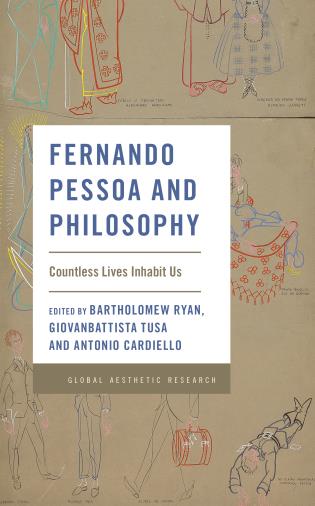
    A new book, Fernando Pessoa and Philosophy: Countless Lives Inhabit Us edited by Bartholomew Ryan, Giovanbattista Tusa, and Antonio Cardiello (Rowman & Littlefield Publishers, Maryland, U.S, 2021) takes on this challenge with gusto.

    Its aim is to bring to light Pessoa’s in-depth knowledge of philosophy and his ability to engage in astute philosophical experimentation, and at the same time highlight his capacity to confront, appropriate, synthesise, and strip bare complex ideas into art. Additionally, by focusing on Pessoa’s writings through different philosophical lenses the chapters included in this volume seek to reveal novel ways of interpreting some of the seminal problems of philosophy.

    Bartholomew Ryan alerts us to the relevance and urgency of this task in his Introduction, where he claims that if ‘philosophy is to survive the various crises of human civilization ahead of us, to respond and open up new pathways of thought’ we will need the assistance of ‘experimenters in literature, in order to help us reconnect with ourselves, others and all living species on the planet.’

    Structurally, Fernando Pessoa and Philosophy consists of an Introduction, Exordium, Notes for the Memory of My Master Caeiro, fifteen essays dedicated to Pessoa and philosophy, a detailed appendix, and a critical bibliography. The wide range of elements that make up this volume come together to create a joyous banquet of a book.

    Ryan opens this feast for the soul with a fast tempo-ed, polyphonous introduction, entitled ‘An Encounter between the Poet and the Philosopher’. He notes how it is the task of the philosopher not to read a poet in order to appropriate an idea for her/his own purposes. Instead, the philosopher is prompted to engage with literature so as to learn how to dwell in an uncomfortable and uncontrollable region.

    For in this strange region where philosophy and poetry meet something innovative can occur. As Ryan writes: ‘It is in this encounter between the philosopher and poet a vulnerability is opened on both sides to inspire the creating of a new concept in the philosopher and a new form and linguistic gesture in the poet.’

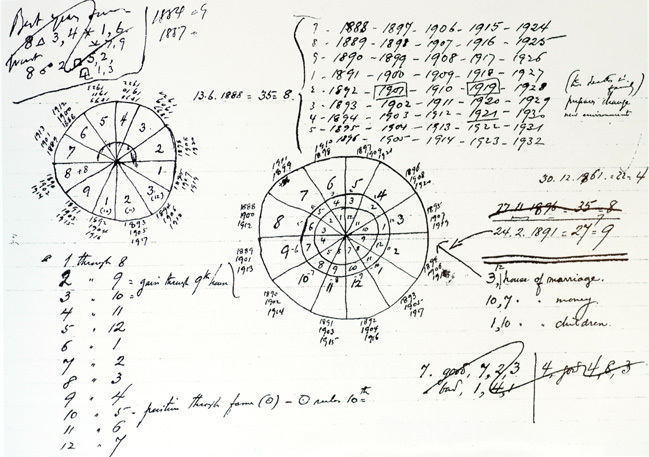
    One of Pessoa’s astrological charts from 1916.

    A Sense of Journey

    By entering into such an encounter with Pessoa, the philosopher has a lot to explore and discover. As a poet animated by philosophy Pessoa prioritises a sense of journey over notions of progress, development and evolution, as he writes: ‘I don’t evolve, I JOURNEY’.

    Besides his emphasis on journeying, the heteronym Álvaro de Campos shares a similar vision for both the philosopher and artist when he notes in his futurist manifesto ‘Ultimatum’, how the philosopher should contain ‘the greatest number of other people’s personal philosophies; and that the artist should write ‘in the most genres with the most contradictions and discrepancies.’ These insights offer rich food for thought for the philosopher.

    The Exordium and Notes for the Memory of my Master Caeiro come after the Introduction. These two marvellous sections are comprised of words from Pessoa and four of his heteronyms, namely, Alexander Search, Alberto Caeiro, Álvaro de Campos, and Ricardo Reis. They serve to attune and acclimatise the reader to the mood and atmosphere of Pessoa’s writings.

    Some sentences shine luminously in the Exordium, for example, ‘There is for me – there was –  a wealth of meaning in a thing so ridiculous as a door-key, a nail on a wall, a cat’s whiskers. There is to me a fulness of spiritual suggestion in a fowl with its chickens strutting across the road.’

    Notably, the Exordium and Campos’s Notes also reveal the humour and irony of Pessoa’s writings. Campos writes in his Notes of the fictitious nature of the orthonym Fernando Pessoa: ‘Even more curious is the case of Fernando Pessoa, who doesn’t exist, strictly speaking.’

    And when humorously critiquing the work of the great 19th century writer Giacomo Leopardi, Pessoa claims Leopardi’s philosophical pessimism and overemphasis on suffering stems from a shyness with women. Pessoa remarks: ‘“I am shy with women: therefore there is no God” is highly unconvincing as metaphysics.’

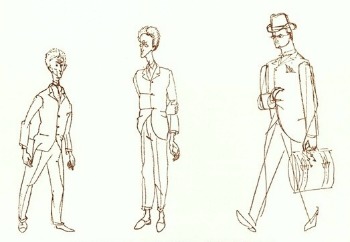
    Ricardo Reis, Alberto Caeiro and Álvaro de Campos seen by José de Almada Negreiros.

    Four Sections

    Fernando Pessoa and Philosophy is then divided into four sections: Spiritual Traditions, Metaphysics and Post-metaphysics, Philosophies of Selfhood, and Contemporary Problems and Perspectives. Each section has three to four chapters.  The volume has been arranged by philosophical themes which are both central to Pessoa’s work and to philosophy itself.  The first section, Spiritual Traditions, focuses on Neopaganism, Daoism, Indian, and Islamic philosophy.

    The first chapter by Antonio Cardiello, ‘Fernando Pessoa’s vision of Neopaganism as Life’s Supreme Art’ explores Pessoa’s project of reawakening polytheism and the Hellenic model of civilisation.  Cardiello observes how Pessoa, using his orthonym, calls for a ‘superior paganism’ for modern times in which ‘all protestantisms, all Oriental credos, all paganisms, dead and alive become Portuguesely fused.’

    In addition to a ‘superior paganism’ Pessoa makes reference to a ‘superior art’ that can ‘lift the soul above everything narrow, above all instincts, moral or immoral concerns.’, and liberate us from ‘life itself.’ Merging a superior paganism with a superior art, Cardiello claims it was Pessoa’s task to denounce two millennial of moral interpretation and substitute it for an aesthetic one that glorifies human life, thereby dispensing with unhealthy values for healthier ones that encourage humans to flourish.

    Paulo Borges’s ‘Fernando Pessoa, Daoism and the Gap: Thought of Insubstantiality, Vagueness and Indetermination’ is the second chapter in this section. It closely examines emptiness and the ‘gap’ in the writings of the orthonym Fernando Pessoa and the semi-heteronym Bernardo Soares, comparing these themes with Daoist principles.

    According to Daoist thought, emptiness allows the emergence of the ‘ten thousand beings’ or the infinity of possibilities and the possibility of an authentic life lacking self-centredness. Borges highlights how in Pessoa, the overabundance of becoming other and the experience of heteronymy emerges from that insubstantial emptiness of self and of everything.

    While the abyss of being prior to defining oneself by naming oneself, surfaces as the ‘gap’ that ‘is between’ the self and itself. Towards the conclusion he identifies a wonderfully apt quote from Tchouang Tseu to describe Pessoa. Tseu writes that ‘the perfect man is without any I, the inspired man is without work; the holy man leaves no name.’

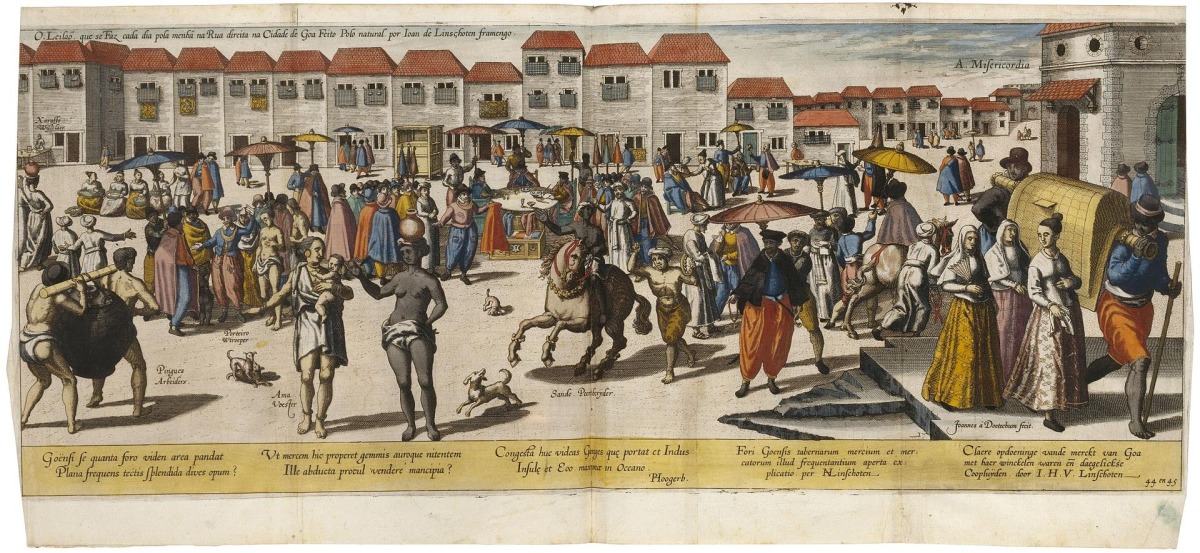
    Marketplace in Goa, as depicted in Jan Huygen van Linschotens Itinerarium.

    Imaginary India

    The third chapter, ‘Pessoa’s Imaginary India’, by Jonardon Ganeri, looks at Pessoa’s understanding of the ‘Indian ideal’ which he interprets as signifying the transcendence of the illusion that is living a human life.

    Pessoa regards the Indian ideal as ‘inhuman’ and speaks of ‘the principle, which we already know to be absurd, that the universe is an illusion.’

    Ironically, Hindu thinkers writing at the same time as Pessoa, such as Sarvepalli Radhakrishnan share Pessoa’s critical sentiments towards this ideal. Borrowing a phrase from Nietzsche, Ganeri acknowledges an ‘ironic affinty’ between Pessoa’s position that he occasionally assumes as his own contraposition to the ‘Indian ideal’, and the ideas of his contemporaries in India that he never knew.

    In the final chapter of this section, ‘Pessoa and Islamic Philosophy’, Fabrizio Boscaglia, brings to light Pessoa’s engagement with Islamic philosophy and its impact on his writing. Boscaglia draws attention to Pessoa’s interest in the philosophical thought of Omar Khayyām, through Edward Fitzgerald’s translations, and the possible connections of Sufism in Pessoa’s poetry.

    Boscaglia also demonstrates how Pessoa’s makes several references to the Islamic civilization as the keeper, interpreter and transmitter of Greek culture between the Middle Ages and the Renaissnance.

    In the second section of this book, Metaphysics and Post-metaphysics, the topics of time, nihilism and the nothing, transcendentalism, immanence and becoming-landscape take centre stage. João Constâncio opens the section with ‘Nihilism and Being Nothing in “The Tobacco Shop”’.

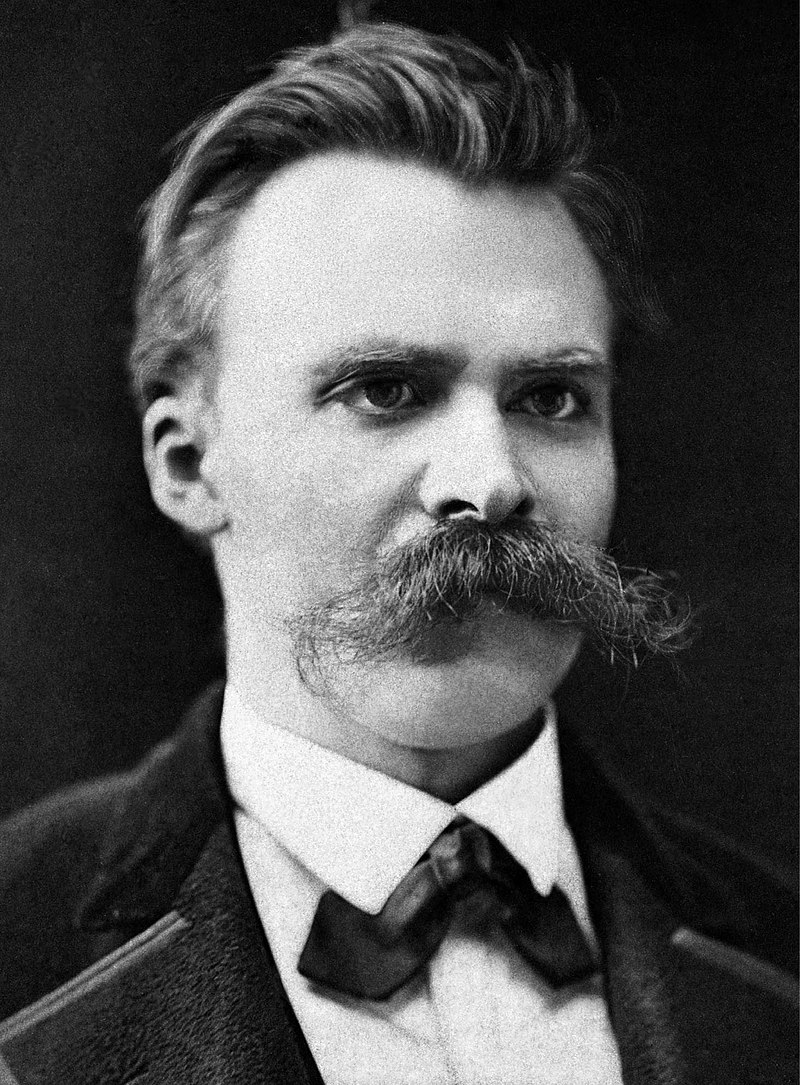
    The chapter seeks to respond to two significant questions: 1. What is the meaning for Pessoa, particularly in the masterpiece ‘The Tobacco Shop’ (by Álvaro de Campos) of ‘being nothing’ and 2. How can the study of Schopenhauer and Nietzsche’s philosophical writings contribute to the understanding of such a paradoxical way of being, which consists of ‘being nothing’?

    Constâncio delves into Campos’s despair for ‘being-nothing’ and reveals it to be tantamount to despairing for having to be a mask, for not being able to avoid adopting an identity that is a mere linguistic construction, regardless of whether it implies some ultimate metaphysical purpose implicit to life within society.

    Furthermore, Constâncio shows how Campos’s ‘conscious consciousness’ makes him envy those who, living by way of an ‘unconscious conscious’, manage to believe in an identity that is intersubjectively attributed to them.

    ‘Pessoa and Time’ by Pedro Duarte is the second chapter in this section. For Duarte, it is possible to grasp the individuality of each of the three heteronyms Caeiro, Reis and Campo, by studying their different approaches and responses to time.

    But Duarte also includes Pessoa, the orthonym, in his analysis. For Pessoa the past needs to be rediscovered, and not set aside, because it summons the present to build the future. Caeiro takes time out of things, through detachment and unlearning and to see without thinking. Caeiro writes ‘I don’t want to think of things as being in the present; I want to think of them as things’.

    Reis believed that ‘we pass like the river’ through life. For Reis, existence was all about adhering to this passage. Aging should be accepted. On the other hand, Campos desires to feel everything in every way, and find the beauty of the present moment, a beauty unknown to the ancients, hence electric lamps and factories are to be celebrated. Campos says ‘I who love modern civilization and kiss machines with all my soul.’

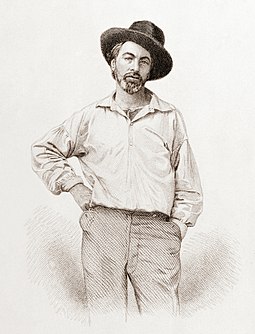
    Walt Whitman aged 35.

    American Transcendentalism

    Benedetta Zavatta’s chapter entitled ‘Pessoa and American Transcendentalism’, investigates the link between Ralph Waldo Emerson, Walt Whitman and Pessoa. Emerson’s influence on Pessoa had not received scholarly attention prior to Zavatta’s essay.

    Zavatta convincingly hypothesises that Pessoa was drawn to Emerson and Whitman by the notion, repeatedly articulated by these two authors, that every individual latently contains within herself/himself the seeds of an infinite number of different personalities.

    This in turn enables an individual to foster an empathetic connection with other humans, to the point where they ‘become them’. Enlarging this empathetic connection allows one experience how the whole world is seen and felt as these others see it and feel it.

    In the chapter ‘Bernardo Soares’s Becoming-Landscape’, José Gil explores the use of landscape in The Book of Disquiet. Gil’s philosophical approach to The Book of Disquiet opens up this impossible book for the reader, by revealing that each of its fragments is ‘a veritable landscape-state of emotion’, providing it with ‘both skeleton and flow’.

    Gil’s deft analysis of Bernardo Soares’s becoming-landscape culminates with an enquiry into what occurs when the plane of the landscape clashes with the plane of emotions. Gil suggests ‘all distances disappear, and the “I” itself, which functioned like a screen between sensations and the landscapes, explodes, disappears and ceases to exist’.

    What remains is the pure landscape of event-sensations. A ‘sensation-universe’. Literary description ceases, and ‘sensations attach themselves to the flow of the landscape because they result from them: it is no longer the sky yonder, or the I, here, like this sky: it is the sensation-sky or the sensation-light.’

    Philosophies of Selfhood

    The third section, Philosophies of Selfhood, examines the dissolution and plurality of the self and subject in Pessoa’s writings. It commences with Bartholomew Ryan’s chapter ‘Voicing Vacillation, Logos and Masks of the Self: Mirroring Kierkegaard and Pessoa’.

    Ryan argues that, in the journey of forging the human self or subject into writing, the achievements of the poet Pessoa and philosopher Søren Kierkegaard remain unsurpassed. Through Pessoa and Kierkegaard, Ryan investigates the making and unmaking the elusive self through vacillation, logos and masks.

    At the core of this study lies doubt, which Ryan claims both writers see as the sickness and heartbeat of modernity. Pessoa and Kierkegaard voice doubt and despair, as the poetic-philosopher and philosophical poet.

    According to Ryan, Pessoa delights in aesthetic melancholy and being allied to no one or no thing except literature. Describing Pessoa as an Argonaut of Modernity or the Argonaut of true sensations, Ryan envisages him journeying ‘to the abstract chasm that lies at the depths of things’ and questioning the philosophical problems of selfhood by voicing its vacillation, logos and masks. Buffeted by this tormenting journey, Pessoa vacillates between knowledge and faith, and experiencing the elusive moment.

    In ‘The Difference between Othering Oneself and Becoming What One is’, Maria Filomena Molder states that the dictum of ‘becoming what you are’ is nowhere to be found in Pessoa, and the concept of ‘othering oneself’ belongs in other waters.

    Drawing support from Nietzsche’s insight in Twilight of the Idols that the ‘I’ has become a fairytale, a fiction, a play on words’, Molder proposes that Pessoa has no need for a theory of the subject.  Molder then shows how Pessoa coined the term ‘othering oneself’ in order to account for the multiplicity of writers who are born out of his way of writing.

    According to Molder, othering oneself, ‘proceeds not from the plurality of the subject but from a precocious, childlike inclination to imagining oneself as multiple characters, a succession of dramatic scenes secreted by creative play.’

    This incisive and succinct chapter draws to a close with the claim that Pessoa and his heteronyms are not liberators. What is he, then? Molder asks, and answers through the mouthpieces of Ricardo Reis and Pessoa.

    The answer from Reis is: ‘I am merely the place/Where things are thought or felt’. And Pessoa responds: ‘I look at them. None is me, but I am their ensemble’. Not done yet, Molder asks: What does Pessoa want? And this time Pessoa replies: ‘I want to be the creator of myths, which is the highest mystery achievable by a member of the human race.’ And so Molder reveals the undecipherable mystery of the many in one, of the one in the many.

    Foucault

    Gianfranco Ferraro’s chapter ‘A Hermeneutics of Disquiet: Approaching Pessoa through Foucault’ concludes is final one in this third section. Ferraro tends to Pessoa’s Book of Disquiet through the ‘toolbox’ provided by Michel Foucault’s in The Hermeneutics of the Subject.

    Why Foucault? For Ferraro, Foucault’s terminology, specifically in relation to ‘technologies of the self’, greatly assist us in interpreting Pessoa. These technologies highlight, in Ferraro’s own words, ‘practices which permit individuals to effect by their own means, or with the help of others, a certain number of operations on their own bodies and souls, thoughts, conduct, and way of being,’ so as to ‘transform themselves in order to attain a certain state of happiness, purity, wisdom, perfection, or immortality’.

    Consequently, approaching The Book of Disquiet through Foucault’s hermeneutics of the self allows us to see how Pessoa recovered many of the ancient practices and technologies of writing and how modernity adopted them again.

    Borrowing from Foucault’s hermeneutic toolbox Ferraro reaches the conclusion that we can observe in The Book of Disquiet a work that summons one to oneself and to experimentation of oneself in revealing the many beings that lie dormant in our forms of life.

    Contemporary Problems and Perspectives

    The fourth and final section Contemporary Problems and Perspectives concentrates on value theory and secular capitalist modernity; the logic of seeing, ecological thought, and the fundamental relationship between poetry and some contemporary philosophers.

    ‘Pessoa’s “The Anarchist Banker” and the Logic of Value’, by J.D. Mininger offers a thorough reading of Pessoa’s short story ‘The Anarchist Banker’, which in part is supplemented by Nietzsche’s essay ‘On Truth and Lies in an Extra-Moral Sense’.

    Anarchism strives to vanquish all social conventions and fictions, and is thus in a sense morally and politically motivated. Yet it could also be understood as signifying the freedom from such conventions and fictions.

    In this story the anarchist achieves his own freedom by becoming a banker. According to Mininger, the essential politics of this story does not lie in the author’s construal of anarchism, but in the silent relation between philosophy and literature, between algebra and story, between proposition and performance, between constraint and freedom.

    For Mininger, Pessoa’s story is an anarchistic act to the extent that it expresses freedom through constraint – a paradox made possible by the literary surplus value that is both the story’s cause and effect.

    The second chapter in this section ‘For Your Eyes Only: The Logic of Seeing in Alberto Caeiro’s Poetry’, by Bruno Béu, opens with the words of the artist Kazmir Malevich, ‘I have transformed myself in the zero of form’ found on a leaflet distributed at the exhibition Last Futurist Exhibition of Paintings 0.10 (zero-ten).

    One of Malevich’s most famous works is his 1918 painting entitled White on White, showing a white square against a white background. As a work of art it calls into question the very possibility of form and representation.

    Bèu in this chapter draws connections between Malevich’s paintings, and Caeiro’s poetry, in which language is being forced to reach its zero ability to signify things, while our experience of things is ‘freed’ from any re-presentation that we make of them.

    Bèu demonstrates how Caeiro’s tautological discursive and logical performance is a radical negation of all possible predicates. This linguistic process leaves each thing absolute, indescribable and indefinable. As Bèu poignantly remarks ‘It is as if, through this process, each thing revealed itself and spoke from the top of Mount Sinai pronouncing the tautological and biblical words: ‘I am that I am’.’ As such no-thing is said for things to be seen, and ‘Poetry turns white on white’.

    Image (c) Daniele Idini.

    Ecological Dimensions

    In the chapter ‘Where Does Fernando Pessoa Dwell? The Economy and Ecology of the Heteronyms’, Michael Marder illuminates some of the ecological dimensions to Pessoa’s work. This is attained through an analysis of what Pessoa called ‘disquiet’, to outline what Marder names a new ‘economy and ecology of the heteronyms’.

    ‘Disquiet’, in the sense of being unsettled, describes the possibility that dwelling and the dweller no longer exist, or, perhaps, never have.

    For Marder, Pessoa is the place where dwelling might be reimagined, or, the placeholder for the lives of others. Turning his focus to Caeiro, Marder asserts that he wants to dwell in a world unspoiled by the ideal and idealising system of co-ordinates.

    For Marder, Caeiro’s poetic project is to liberate the ‘innocent’ green and flourishing earth from the imaginary lines that have divided its surface through social and political conventions.

    ‘So where does Pessoa dwell?’ Marder asks at the close of this chapter. Marder’s response:  ‘Between economy and ecology, between nowhere and everywhere’. Pessoa’s heteronyms outline an ‘economology’, where dwelling and unsettlement are not formally opposed to one another, a place where it is possible to dwell in the very unsettlement that acknowledges the impossibility of dwelling.

    Giovanbattista Tusa’s ‘The “Pessoa Event”: Notes on Philosophy and Poetry’ concludes this section. Tusa’s text articulates the fundamental relationship between poetry and philosophy through Fernando Pessoa and the works of Martin Heidegger, Jacques Derrida, Alain Badiou and Jean-Luc Nancy.

    Badiou in particular takes on a hugely significant role in this chapter, for it is he who notes that the poem far from being a form of knowledge, is the instance of thought subtracted from everything that sustains the faculty of knowledge.

    Tusa also cites Badiou’s Handbook of Inaesthetics in which he claims to be contemporaries of Pessoa is ‘a philosophical task’, and through the reading of his work, philosophy could experience its own incapacity or perhaps its own impossibility.

    After these four sections, Jerónimo Pizarro provides an appendix to the book called ‘Pessoa and Philosophy: Texts from the Archives’. This is a collection of selected Pessoa texts alongside images from the Pessoa archive referencing philosophy and various philosophers.

    Pizarro’s fine scholarly research gathers editions and studies on a series of documents from Pessoa’s archive to help with future comparative research. The volume ends with a critical bibliography of Pessoa’s own works published in English, books on philosophy that he owned and secondary works on Pessoa and philosophy.

    Fernando Pessoa and Philosophy sheds a remarkably illuminating spotlight on the wonderous writings of Pessoa, but most importantly it instils in the reader a sense that sections of his ‘secret orchestra’ have yet to be heard, and that future exploratory journeys await.

    Feature Image: José de Almada Negreiros, Retrato de Fernando Pessoa.

  • Musician of the Month: Martin Mackie

    Martin Mackie is a singer and music producer from Belfast who has been living in Dublin for more than a decade. His latest single The Ballad of Christy Moore is a tribute, with a comical twist, to the Irish musical legend from Kildare. It is from Martin’s new album Temperance Songs, which will be released later this year. All of the songs on the album are about drinking and the peculiar relationship the Irish have with booze.

    The songs are about my own experiences with alcohol. Not just me personally but my family and friends. Rollovers, lock-ins, early houses, hair of the dog, and the booze blues are just some of the subjects. But I’ve tried to add a bit of comedy to the misery.

    The Ballad Of Christy Moore is folk tune, one of two on the album. The other is The Ballad of Brendan Behan, which I wrote with Craig Walker from The Power of Dreams. The Christy song is about me coming back after a weekend of madness at a music festival. I was hanging, as they say in Dublin. I had this weird dream or maybe even a hallucination that the ghost of Christy Moore was in my wardrobe, even though he’s very much alive. Christy’s a famous ex-boozer. So in the song he jumps out and starts lecturing me on the evils of excess.

    I was a bit worried what Christy would think of the song because there’s a line in it that describes him as being all ‘sweaty and hairy’. So I sent it to him. I was absolutely delighted when he sent me back a lovely postcard that said: “Dear Martin, Sweaty and Hair! Ride on. Christy.” And he drew a little guitar beside it. I’ve framed that.

    William Hogarth – A Rake’s Progress – Tavern Scene

    I got the whole idea for Temperance Songs from a series of paintings by the artist William Hogarth. The Rake’s Progress is a set of eight paintings showing the rise and fall of young man who ends up in the Bedlam asylum because of his partying lifestyle. I was gonna write a song for each painting but I found out the composer Igor Stravinsky had beaten me to that idea. You can’t compete with him so I had to change things. Instead I drew from my own experience.

    The track ‘Drunk For Fifteen Years’ features vocals by Waterford singer Katie Kim, who is another friend. That song is about a guy in hospital after a mammoth drinking session. Again, there are ghosts and spirits in the lyrics; that seems to be a recurring theme. I think there’s a lot of mystery to booze, the psychological effect it has on you when you drink and the downer you can get if you overdo it. Nobody in Ireland really talks about this stuff, beyond platitudes and clichés, so I thought it would be nice explore it in an album.

    There’s other songs such as a Lock-in for The Damned about a famous Dublin venue where people end up leaving, completely twisted, when it’s daylight. That’s normal behaviour in the music world

    The first single off Temperance Songs was released before the pandemic. It is called Magic Potion and it features a host of well-known musicians.  Kate Ellis, who is the musical director of the Crash Ensemble plays cello, Conor O’Brien, from Villagers, plays bass guitar, Eleanor Myler, from the shoegaze band Percolator plays the drums with Mackie on guitar and vocals.

    The video was made by long-time friend and collaborator Laura Sheeran.

    It’s an incredibly well shot video. Laura is such a talent in everything she does and she does a lot of things. For the video she does what the song tries to do…find beauty in the misery. We’ve been pals for years and she sings backing vocals along with Niamh Lowe on another one of the tracks on the album called The Apple.

    In Magic Potion, there’s a line “we’re the ones who wish good health with a poison chalice.” It’s weird the way we all say ‘slainte’ or ‘good health’ when this thing is classified as poison. I’m not an anti-booze crusader at all. But nobody really talks about the downsides of it, the ‘booze blues,’ or ‘the fear’ — the negative aspects.

    I was in Conor O’Brien’s house, from Villagers, and got chatting about the song. I recorded a demo with Ellie from Percolator and sent him it. This fantastic bassline came back in a style I would never have thought of in a million years. Kate from Crash Ensemble got involved and I went to Laura Sheeran’s house and recorded cello in her living room.

    So I went into the studio with Ellie’s drums, Conor’s bass, Kate’s cello and my vocals and guitar — and it sounded really good. Laura then shot the video for me.

    While Magic Potion is slow and menacing,, A Lock-in for the Damned whizzes along with the whimsical feel of a 1980s indie track in the vein of Orange Juice or Josef K and the tension between the jocular music and the slowly unfolding madness of the storyline was deliberate.

    Martin sings in the chorus, ‘I’d like to flee the madness but the door and me are locked’ — and most people in Ireland have found themselves in similar situations.

    I suppose A Lock-in for The Damned represents the party before the disaster and the following day of hell. It’s about me and my friends who would often have lock-ins at various pubs. You’re there all night. It’s just a free-for-all, and the spirits and the black pints flow and you’re leaving when it’s daylight.

    There’s something very, very odd when you’re walking along the street in the morning and you’re half-pished and there’s people jogging past you, or going to work, and living their everyday life. I thought it was something that’s not written about really.

    Alcohol can be a wonderful drug if used correctly, and we all enjoy times together and it’s good for relaxing, but it’s only good if you’re in a good space. But it never works, for me anyway, if you’re trying to escape your troubles or you’re feeling a bit down.

  • On (the) Money

    If you follow me baby I’ll turn your money green
    I show you more money Rockerfeller ever seen
    Furry Lewis, ‘I Will Turn Your Money Green’ (1928)

    First of all, it is good to have some of it. Second of all, it is good to have enough of it – which means not too much. I define ‘enough’ as that which allows you to avoid having to have any dealings with bank managers or landlords, or debts or debtors in general.

    No one should have to live in constant fear of the spectre of homelessness. No one should have to tie themselves to a twenty-five year mortgage, simply in order to avoid the precarity of the private rental sector (by entering the equal precarity of perhaps not being able to keep up their mortgage repayments to a bank or other lending institution – which are here acting as de facto landlords). No one should have to worry about where their next meal is coming from.

    Is an elephant big? Is a mouse small? They are only big or small relative to each other (or to some other object or objects, bigger or smaller than they are). Enough is sufficient. But, given the cost of living where I live (including the cost of somewhere to live where I live, whether renting or buying), ‘enough’ has come to mean ‘a lot’.

    Ostensibly, this is a problem of human greed, but its real roots are meretriciousness. Does it really matter whether you live in a multi-bedroom mansion in Killiney or in a two-up, two-down in Stonybatter or Ballybough (from the Gaelic, ‘Poor Town’); in a four-story Georgian house on Fitzwilliam Square or in a two-bedroom apartment anywhere? Is it necessary or desirable to own multiple properties?

    The only reason for dwelling in one of the former over one of the latter – outside of having many dependents to shelter, or lots of ‘stuff’ to store – is simple showing off. It is the flaunting of conspicuous wealth and consumption, an ostentatious one-upmanship which betrays an underlying insecurity.

    Is it the safety of living in a ‘good neighbourhood’ that you seek, or the status? I suspect that most instances of greed stem from snobbery, which then becomes a vicious circle feedback loop, with snobbery engendering more greed. Which is all the more risible when one considers that most snobbery – social or intellectual – is merely tuppence ha’penny looking down on tuppence.

    Image: © Daniele Idini

    Hard Working

    ‘But I have worked hard for it’, say those who have it, sometimes aggressively and other times defensively, and maybe they have. But, under the present dispensation, most people work at something, unless a) they are independently wealthy enough not to have to work, or b) they cannot find or make work. How hard they work is difficult to determine, given the variety of walks of life, and the disparity in their relative financial rewards. Are we talking about physical or mental work? And what about ‘labours of love’?

    Many people work less and earn more than others who work more and earn less – mostly because the latter are exploited by the former. Also, implicit in the argument of those who claim to be worthy of their earnings is the idea that they should therefore be allowed to keep most if not all of what they have accumulated to themselves. (One thinks of a former President of the United States boasting that dodging his taxes ‘makes me smart’. It is also worth remembering that we live in a country where Bertie Ahern and Mary Harney think they are deserving of their more than generous state pensions.)

    They prize their individual wellbeing, and that of their charges, over the common good, with the masses of ‘other people’ invariably dismissed as too stupid or too lazy to make something of themselves and do well for themselves (and thus, in their terms, they are contributing to society by not taking anything out of it). The premise of ‘When you’re not doing so well, vote for a better life for yourself. If you are doing quite nicely, vote for a better life for others’ would be alien to them, as they believe a better life for others would dimmish a better life for themselves.

    So don’t even try quoting the familiar Marxist motto, ‘From each according to his ability, to each according to his needs’ to them, unless you expect short shrift.

    But, as David Foster Wallace hypothesised in his last, unfinished novel The Pale King (2011), tax payment and collection is an excellent index of civic virtue. As unlikely hero Mr. DeWitt Glendenning Jr., the Director of the Midwest Regional Examination Center, puts it: ‘If you know the position a person takes on taxes, you can determine [his] whole philosophy. The tax code, once you get to know it, embodies all the essence of [human] life: greed, politics, power, goodness, charity.’

    Musk

    Juxtapose this attitude with Elon Musk’s warning that President Joe Biden’s proposed ‘billionaire tax’ would eventually increase taxes on everyone else, quoting the hoary monetarist mantra, ‘eventually they run out of other people’s money and come for you.’

    FYI, it would take someone on the average industrial wage 800,000 years to earn what Mr. Musk made on a single day in October 2021, a cool $36.2 billion. But, in the eyes of the right, I am ‘just envious’. No, I’m not. Really, I don’t need that much – even if I would quite like to try ‘Life On Mars’ someday – and, given the extent to which our home planet has been run into the ground, may well have to do so. Although, clearly, as a faint-hearted socialist trying to survive in an aggressively late-capitalist world, I would never be able to afford the ticket – not even one-way, let alone return.

    Besides which, the glorification of the Protestant work ethic is just a neat trick to get some people to slave their guts out for other people’s profit (cue easy signifiers such as ‘wealth creators’, ‘employment opportunities’, ‘increased productivity’, ‘trickle down’, etc.). Everyone actually, if secretly, knows that – unless you are doing something you like – ‘work’ is vastly overrated.

    As Les Murray has it, in his gloss on The Book of Common Prayer, ‘In the midst of life we are in employment.’ Or, as Dennis O’Driscoll recast it, ‘We are wasting our lives, earning a living.’

    The whole dream of winning the lottery is that of never having to work for a living again. This is the real meaning of ‘hitting the jackpot’: being able to tell the boss what you think of him or, if you are self-employed, not even having to be your own boss anymore.

    As David Graeber contends in his book Bullshit Jobs: A Theory (2018), over half of societal work is pointless, and becomes psychologically destructive when paired with a work ethic that associates employment with self-worth. He credits the Puritan-capitalist work ethic for making the labour of capitalism into religious duty: that workers did not reap advances in productivity (or technology) as a reduced workday because, as a societal norm, they have been indoctrinated to believe that work determines their self-worth, even as they find that work pointless.

    Graeber describes this cycle as ‘profound psychological violence’ and ‘a scar across our collective soul.’ Yet, as he notes, people are not inherently lazy: we work not just to pay the bills, but because we want to contribute something meaningful to society. The psychological effect of spending our days on tasks we secretly know do not need to be performed, or could be performed by anyone, or by a machine, is deeply damaging.

    LinkedIn

    This abuse is internalised at the level of language itself. Have you ever read people’s job descriptions of their own career summaries on LinkedIN? An example, taken at random:

    – – is the M.D. of the European branch of the Australian boutique consultancy – -, where she leads the delivery of impactful and sustainable organisational diversity models, promoting inclusive leadership, collective intelligence, and creative innovation. – – has over 15 years of programme delivery experience and success in the development of cross-sectoral, scaled innovations for learning, informed by evidence-based research. She has a keen interest in interdisciplinary team approaches that promote diversity and inclusion, creative problem solving, leadership development, and change expertise. A former Research Fellow at Trinity College Dublin, – – is an expert on social impact and has a proven track record in the strategic development of pioneering creative innovation models and has presented her research internationally, including at the European Parliament. She is part of Trinity College Dublin’s Women Who Wow mentorship scheme which promotes an ideal collaborative environment to launch new start-up ventures.

    What does any of this mean? Lest you conclude that this type of balderdash is the product of Civil or Public Service speak, be assured that it more than extends to the Private Sector too:

    I am a Dublin-based Customer Success Manager, with experience across Mid-Market, Enterprise and Global accounts in both Corporate and Search & Staffing industries. I am a trusted partner to my clients and cross-functional internal stakeholders. I use data and insights to mitigate churn, demonstrate ROI and encourage utilisation of the product suite in which they have invested. I am proactive, customer-centric and thrive in fast-paced environments.

    This is the worst kind of gobbledegook going. Naturally, it is de rigueur to be ‘passionate about the industry’, rather than stating you have a major concern about putting food on the table and keeping a roof over your head. If you are not a grafter you are surely a grifter.

    Time Millionaires

    Add to Graeber’s analysis the concept of ‘time millionaires’. First named by Nilanjana Roy in a 2016 column in the Financial Times, time millionaires measure their worth not in terms of financial capital but according to the seconds, minutes and hours they claw back from employment for leisure and recreation. ‘Wealth can bring comfort and security in its wake,’ writes Roy, ‘but I wish we were taught to place as high a value on our time as we do on our bank accounts – because how you spend your hours and your days is how you spend your life.’ Here she is near-plagiarising Annie Dillard’s brilliant aperçu from The Writing Life (1989), but this idea has a long and noble historical tradition.

    In ‘Of Idleness’ (1574), Michel de Montaigne cautions against the dangers of idleness, yet his essays are the product of someone who retired to his country estate at the age of thirty-eight, ‘to spend in privacy and repose the little remainder of time I have to live’ in order to meditate and write, yet it is the ‘thousand extravagances, eternally roving here and there in the vague expanse of the imagination’, of which he is so fearful, which are the fuel for the depth and variety of the essays he wrote.

    Samuel Johnson founded a magazine called The Idler (1758-60) and told his readers: ‘Every man is, or hopes to be, an Idler.’

    Kierkegaard, in Either/Or (1843), wrote:

    Idleness as such is by no means a root of evil; on the contrary, it is a truly divine life, if one is not bored… Idleness, then, is so far from being the root of evil that it is rather the true good. Boredom is the root of evil; it is that which must be held off. Idleness is not the evil; indeed, it may be said that everyone who lacks a sense for it thereby shows that he has not raised himself to the human level.

    Learning how to use one’s free time well is the problem, not the leisure itself.

    Perhaps the most famous refusenik of them all is the central character in Herman Melville’s short story, ‘Bartleby the Scrivener’ (1853). Bartleby is hired as a copyist, and initially is diligent and hard-working, doing all that is asked of him. Then, shortly afterwards, he presents the narrator, his new boss, with what is to become his catchphrase: ‘I would prefer not to’.

    There are several takeaways from this wonderful piece of fiction, but for my purposes let’s emphasise its focus on the dehumanisation of the copyist, the nineteenth-century equivalent of a photocopying machine.

    In classic Marxist terms, the story is an exposition of the working man’s existence: oppression under the system of capitalism, in which he is alienated from his labour, offered only subsistence level wages, and is ultimately destroyed by that system if he cannot either conform to it, or change it.

    Wilde reclining with Poems, by Napoleon Sarony in New York in 1882.

    The Soul of Man Under Socialism

    In his great essay ‘The Soul of Man Under Socialism’ (1891), incidentally a pre-twentieth century masterpiece in its reconciliation of aesthetics and politics, dandyism and left-wing thinking, Oscar Wilde argues that:

    And as I have mentioned the word labour, I cannot help saying that a great deal of nonsense is being written and talked nowadays about the dignity of manual labour. There is nothing necessarily dignified about manual labour at all, and most of it is absolutely degrading. It is mentally and morally injurious to man to do anything in which he does not find pleasure, and many forms of labour are quite pleasureless activities, and should be regarded as such. To sweep a slushy crossing for eight hours, on a day when the east wind is blowing is a disgusting occupation.

    To sweep it with mental, moral, or physical dignity seems to me to be impossible. To sweep it with joy would be appalling. Man is made for something better than disturbing dirt. All work of that kind should be done by a machine.

    Walter Benjamin’s vast, and sadly unfinished, Arcades Project (1939) is predicated on his wanderings of Parisian streets, and according to him, ‘Basic to flânerie, among other things, is the idea that the fruits of idleness are more precious than the fruits of labour.’ He also notes, ‘Idleness has in view an unlimited duration, which fundamentally distinguishes it from simple sensuous pleasure of whatever variety.’

    Bertrand Russell in 1954

    In Praise of Idleness

    Meanwhile, unsurprisingly, in his extended consideration ‘In Praise of Idleness’ (1932), Bertrand Russell has much to offer on the topic:

    Work is of two kinds: first, altering the position of matter at or near the earth’s surface relatively to other such matter; second, telling other people to do so. The first kind is unpleasant and ill paid; the second is pleasant and highly paid. The second kind is capable of indefinite extension: there are not only those who give orders, but those who give advice as to what orders should be given. Usually two opposite kinds of advice are given simultaneously by two organised bodies of men; this is called politics. The skill required for this kind of work is not knowledge of the subjects as to which advice is given, but knowledge of the art of persuasive speaking and writing, i.e., of advertising.

    Russell’s most compelling point is the most counterintuitive – the idea that reclaiming leisure is not a reinforcement of elitism but the antidote to elitism itself and a form of resistance to oppression, for it would require dismantling the power structures of modern society and undoing the spell they have cast on us to keep the poor, poor and the rich, rich.

    To correctly calibrate modern life around a sense of enough – that is, around meeting the need for comfort rather than satisfying the endless want for consumerist acquisitiveness – would be to lay the groundwork for social justice.

    Derek Mahon echoes this theory in his essay ‘Montaigne Redivivus’, from Red Sails (2014), a eulogy to the kindred spirit he finds in his predecessor Cyril Connolly, whom he is anxious to rescue from undeserved obscurity. Mahon fulminates against ‘dumbing down’ (‘done to protect the market economy from criticism and to sell more junk’) and, if leisure is still regarded as a luxury, proposes in place of the lowest common denominator, a concept he calls ‘élitism for all’.

    Jenni Odell has expressed similar ideas in her anti-productivity tract How to Do Nothing (2019): ‘In a situation where every waking moment has become the time in which we make our living,’ she writes, ‘and when we submit even our leisure for numerical evaluation via likes on Facebook . . . time becomes an economic resource that we can no longer justify spending on ‘nothing’. It provides no return on investment; it is simply too expensive.’ Odell exhorts readers to recognise that ‘the present time and place, and the people who are here with us, are . . . enough.’

    Related themes have been explored, and comparable conclusions reached, in contemporary essays and creative non-fictions such as A Field Guide to Getting Lost (2005) by Rebecca Solnit, and Flâneuse: Women Walk the City in Paris, New York, Tokyo, Venice, and London (2016) by Lauren Elkin; and in fictions like Pond (2015) by Claire-Louise Bennett and My Year of Rest and Relaxation (2018) by Ottessa Moshfegh. But the most pleasing up-to-date reiteration of this viewpoint comes in Ms. Bennett’s Checkout 19 (2021):

    There’s a fine art to being idle in fact. That’s right, there is an art to it, and very few people are naturally in possession of the gumption and fortitude necessary to pull it off.

    Russell accounts for the difference between boredom and idleness in leisure by acknowledging:

    The wise use of leisure, it must be conceded, is a product of civilisation and education. A man who has worked long hours all his life will be bored if he becomes suddenly idle. But without a considerable amount of leisure a man is cut off from many of the best things. There is no longer any reason why the bulk of the population should suffer this deprivation; only a foolish asceticism, usually vicarious, makes us continue to insist on work in excessive quantities now that the need no long exists.

    However, it is regrettable that both Wilde and Russell were unfortunately overoptimistic in their belief that mechanisation would free us all to lead more fulfilling lives. Wilde elaborates his vision of a technological utopia:

    All unintellectual labour, all monotonous, dull labour, all labour that deals with dreadful things, and involves unpleasant conditions, must be done by machinery. Machinery must work for us in coal mines, and do all sanitary services, and be the stoker of steamers, and clean the streets, and run messages on wet days, and do anything that is tedious or distressing. At present machinery competes against man. Under proper conditions machinery will serve man. There is no doubt at all that this is the future of machinery, and just as trees grow while the country gentleman is asleep, so while Humanity will be amusing itself, or enjoying cultivated leisure – which, and not labour, is the aim of man – or making beautiful things, or reading beautiful things, or simply contemplating the world with admiration and delight, machinery will be doing all the necessary and unpleasant work. The fact is, that civilisation requires slaves. The Greeks were quite right there. Unless there are slaves to do the ugly, horrible, uninteresting work, culture and contemplation become almost impossible. Human slavery is wrong, insecure, and demoralising. On mechanical slavery, on the slavery of the machine, the future of the world depends.

    Russell simply states: ‘Modern methods of production have given us the possibility of ease and security for all (but) we have continued to be as energetic as we were before there were machines. In this we have been foolish, but there is no reason to go on being foolish for ever.’

    Hi-tech Nightmare

    Such late 19th century/early 20th century sanguine sunniness now seems woefully wide of the mark, from the standpoint of our early 21st century hi-tech nightmare. Computers were supposed to make all our lives easier. Instead, because of the co-option of these means of production by the forces of Capitalism, they have made our lives immeasurably harder, or at a minimum our working lives – which now don’t stop when we knock off, but continue 24/7. If computers save us time at work, we must do some other work during that time saved. Otherwise, we are shirking.

    Nevertheless, it is important to acknowledge that entrepreneurship is a specific talent, and those who choose to spend their time engaged in it should be rewarded appropriately. But some people have this gift, and some people don’t, just as artistic or scientific inclination and aptitude is not equally distributed to everyone – even if, arguably, a certain level of functionality can be acquired.

    So why should entrepreneurship as a calling be recompensed more generously than others? Why, for that matter, should tech workers earn colossal salaries, while writers, artists and musicians are driven out of the cities they grew up in, because they can’t afford the rent? For the businessperson, Time is Money; for the artist, Money is Time.

    But there are more business people exploiting artists than there are artists exploiting business people. As William Burroughs has it in The Job (1969): ‘And what does the money machine eat to shit it out? It eats youth, spontaneity, life, beauty, and above all it eats creativity.’ Incidentally, upon graduating from Harvard in 1936, the privileged Mr. Burroughs was in receipt of a monthly parental allowance of $200 – a considerable sum in those days – which he used to underwrite his corporeal and psychic travels. Arriving with welcome regularity, it guaranteed his survival for the next twenty-five years, and was a ticket to freedom which allowed him to live where he wanted to and to forego employment, and to pursue his psychotropic investigations and reports. As J. G. Ballard has commented, ‘Never has a research grant been put to better use.’

    Of course, art – especially of the less commercial variety – has always depended on patronage, whether private or public. No Medici or Borgia families, including the Popes they produced = no Italian Renaissance.

    Harriet Shaw Weaver funded James Joyce to the extent of over €1 million in today’s money. Samuel Johnson’s ‘Letter To Lord Chesterfield’ (1755) signalled a shift in relations between artists and private patronage, with Johnson chaffing against what he considered ill-treatment by someone who claimed to be his patron, but did nothing to help him during the years spent working on his Dictionary, but instead tried to steal the glory when it was published. These days, we may thank the Gods for state-sponsored Arts Councils, and place our trust in their judgements.

    So, where is all this free money, to finance all the pleasure of all this (un)productive leisure, going to come from, I hear you ask? In my book, Universal Basic Income is a great idea. Food and shelter are basic humanitarian and constitutional rights. In proclaiming ‘By the sweat of your brow you will eat your food’, the Old Testament was wrong, as it was wrong about so many things. To have to work for most of your life, simply in order to keep food in your belly and a roof over your head, will in two hundred years’ time be regarded as a mode of social organisation as ludicrous as the divine right of kings, sponsoring a feudal system. As Ursula Le Guin has written:

    Books aren’t just commodities; the profit motive is often in conflict with the aims of art. We live in capitalism, its power seems inescapable — but then, so did the divine right of kings. Any human power can be resisted and changed by human beings. Resistance and change often begin in art. Very often in our art, the art of words.

    Indeed, what is most depressing about the plight of the current under-30s (or is it under-40s?) generation (or ‘millennials’, as they are (un)affectionately known), is their hopelessness in the face of the impossibility of home ownership and an independent adult life, as though they have internalised and are thoroughly resigned to what the late Mark Fisher termed ‘Capitalist Realism’, and have no sense of any possible alternative.

    After all, they could rebel, stage a revolution – or even just vote, for all the good it will do, if only just to register a protest – instead of stagnating in frustration and self-pity. In any case, people should be free to do nothing if they wish to, and still have at least a minimum level of security as regards the animal needs for food and shelter. If we can arrange things thus during a pandemic, why can’t we do it all the time? Because it is not sustainable in the long term? I beg to differ. Going to university is essentially doing nothing for three or four or five or six or seven years – except read books – and getting a piece of paper or two or three at the end of it, for your trouble.

    Universal Basic Income

    But what would happen if everyone relied on this Universal Basic Income? Well, they won’t. ‘Communism doesn’t work because people like owning stuff’ Frank Zappa told us. I don’t know about ‘owning’ stuff, but I like having stuff, or rather, having access to stuff. But there are many avenues of access to stuff.

    Mostly, what is in dispute is how long you have to wait your turn. However, if there was enough stuff to go around, waiting would not be an issue, and neither would ‘owning’, per se. Do you have a mortgage on your home? Then you don’t ‘own’ it: a lending institution merely lets you have access to it, until your make your final payment. But if you really must call stuff your own, then work for the money for your consumer durables, and satisfy your commodity fetishism, when you want to, not when you need to; and don’t when you don’t want to, not when you don’t need to.

    But even if everybody did rely on such a subsidy (just as many businesspeople and industrialists already do), it would be no bad – or undoable – thing. For if we institute Universal Basic Income as a minimum at one end, surely we should also implement a Universal Maximum Income at the other, thus having reasonable limits at either end of the scale. The excesses of one will pay for the deficiencies of the other. This is only the next logical step in our current conception of the redistribution of wealth through taxation – or, more plainly, how we move money around to help each other.

    Who wants to be a billionaire? I really can’t imagine every filthy rich plutocrat in the world suddenly giving up their extravagant earnings and lifestyle, and settling instead for a modest stipend, simply because they are debarred from infinitely growing their millions.

    To be fair, after hitting maybe the 1 billion mark, or 10 billion, or whatever astronomical sum you care to nominate, the monied magnate should simply be taken aside and, like a contestant on a game show, given a prize – a big gold cup, say, or a fancy watch – and told, “Congratulations, you’ve just won Capitalism. Now, we hope you enjoy your retirement. You know, spending more time with your family.” Although, given that there will be more than one winner, and so no outright Number One, the competitive streak in such people may go ungratified, and so atrophy into seething frustration. But, we can throw in the necessary course of therapy – or ‘re-education’ – for free too. I can just see the headlines: ‘Billionaires’ Rights Infringed.’; ‘Freedom For Poor Billionaires.’

    Furthermore, so much of the defence of, and endorsement of, mega-wealth is predicated on spurious notions of progress, or planning for the future – but isn’t really any kind of growth at all, except for the advancement of various small groups of vested interests, to the detriment or even outright ruination of the majority of people, and the environment.

    At the same time, people in receipt of social welfare payments are frequently characterised as stupid or lazy or both, and dubbed the ‘undeserving poor’ – as though there is suddenly a class of ‘deserving poor’ at whom charity should be directed.

    As Wilde has it, in the aforementioned landmark essay, ‘As for the virtuous poor, one can pity them, of course, but one cannot possibly admire them. They have made private terms with the enemy, and sold their birthright for very bad pottage.’

    The most egregious local example of this kind of poverty porn was RTE Radio 1’s documentary series Queueing for a Living, which ran from 1986 to 1997, and featured presenter Paddy O’Gorman interviewing people in dole queues and outside prisons. (From poverty porn to property porn – and good, old fashioned porn porn – one has almost run the entire gamut of the western mediascape.)

    It is rivalled only by the memory of the farcically counterproductive fiasco that was 1986’s Self Aid, both telethon concert and theme song. Meanwhile, as conservative politicians the world over rail against ‘state-sponsored idleness’, landlords produce absolutely nothing for the income they receive. They don’t even have to do very much to provide the temporary and insecure service they render.

    My last landlord – when I was having a break from domestic bliss/strife – was one such specimen. When the bathroom sink in the cottage I was renting from him broke, through no fault of my own, he refused to repair it unless I paid for it. I took the case to the Residential Tenancies Board, and it turned out he was not even registered with them. He then had the gall to upbraid me with the taunt, “You cost me my pension”, and promptly issued me with an eviction notice, under the pretence of selling the property. Of course, in public, this fly-by-night presented himself as a socially-concerned community worker. My nomination for the ugliest word in the English language: ‘rent’ – it tears me apart.

    Was Alcohol Involved?

    Or consider the presentation of drug and alcohol addiction in the media: it’s all ‘inner city deprivation’, ‘youth unemployment’, ‘gangster drug lords’, etc. (for example, one of the aforementioned Paddy O’Gorman’s most frequent inquiries of his marks was, ‘Was alcohol involved?’), when the majority of the regular cliental for Class A drugs are the white collar professionals who can afford them.

    The same wilful blindness applies to the investigation and prosecution of white collar, as opposed to blue collar, crime. The same double-standard runs through the arts and its practitioners: the only difference between the consciousness-altering psychic experimentation and stress relief practiced by William Burroughs, Keith Richards, and other master addicts, and the guys burgling your house for drug money, is relative income – that is, money. Oh, and talent. Or rather, different kinds of talents.

    What is perhaps most interesting about money is how people behave around it, and what lengths they will go to in order to get it. ‘Put money in thy purse’ counsels the villainous Iago in Shakespeare’s Othello. What makes banker/industrialist Mr. Bounderby such a bounder in Dickens’ Hard Times? Why is John Self so messed up in Martin Amis’ Money? Attitudes to money and its pursuit are perhaps the greatest litmus test of a character’s propensity to virtue or vice, in life as in literature. It is the chief barometer of the capacity for Evil. Most people are ‘funny about money’, in some way or another. (Where there’s a will, there’s lots of relatives.) ‘Money is the root of all evil’ is a cliché more commonplace than most, but if we return to Samuel Johnson, he fulfils Alexander Pope’s definition of wit as ‘What oft was thought, but ne’er so well express’d’, in his great poem The Vanity of Human Wishes (1749) – itself an ‘imitation’ of Juvenal’s Satire X – particularly, for our purposes, in the passage on money:

    But, scarce observed, the knowing and the bold
    Fall in the gen’ral massacre of gold;
    Wide-wasting pest! that rages unconfin’d,
    And crowds with crimes the records of mankind
    For gold his sword the hireling ruffian draws,
    For gold the hireling judge distorts the laws;
    Wealth heap’d on wealth, nor truth, nor safety buys,
    The dangers gather as the treasures rise.

    Watch what people do to make a (dis)honest buck. Or what they’ll do in order to avoid, in due course, having to toil to make a buck. Or if they’ll continue wanting to make even more big bucks, by fair means or foul, long after they have more than any one person, or their dependents, could possibly need. In which case, they are most likely much more interested in power than they are in money, money being merely a means to an end. And the wielding of power is just another way of showing off, or protecting what you have.

    Of course, I cannot get through an essay (or piece of ‘creative non-fiction’, or whatever term you care to employ for these ramblings and rants) without making it personal, so I will now refer to my own family background. My father had a strong work ethic, and worked hard all his life in the state transport company ‘to support my family’ – even if his earnings were relatively meagre and his eventual non-contributary pension derisorily small.

    But, in those days, so did everyone, since as the old Italian adage has it ‘Chi non lavora non mangia’ (Who does not work does not eat.) Nevertheless, watching him retire, when I was nineteen, I couldn’t help but find it both outrageous and disheartening that he had put in a lifetime’s worth of hard slog for such a paltry payoff. He had missed out on a lot of familial activity (including seeing me), due to doing the overtime he thought was necessary to ‘keep the show on the road’.

    Again, as Russell has it: ‘The idea that the poor should have leisure has always been shocking to the rich.’ This perception was accompanied by my late mother – having spotted my burgeoning creativity during my adolescence – inculcating in me the notion that, ‘Art is for rich people.’ Of course, she was wrong. But, in another sense, and certainly from her perspective, she was right. Nor would she have been alone in having such an attitude, which was widespread at the time – one thinks of John Lennon’s Aunt Mimi telling him: ‘The guitar’s all right, John, but you’ll never make a living out of it’ – not that she actively hindered his pursuit of his dream of doing so.

    After all, artistic production, and its attendant activities and industries – academia, media, publishing, curating etc. – are still predominantly middle-class occupations, filled by middle-class personnel, who become the gatekeepers to acceptance or rejection. Some will raise the cavil that this perception depends on one’s definition of what constitutes middle class and working class, and if one even allows for the reality of the class system at all.

    Typically, these people hold that merely by achieving a college education (however easy or difficult that may be, depending on the personal circumstances you hail from), you automatically enter the hallowed mansions of middle-class heaven. But, apart from being a self-fulfilling prophecy, this is simply untrue, because it takes no account of what has happened before college and what will happen afterwards: your social and cultural capital (what networks and contacts your immediate and extended family have and the milieu it inhabits – i.e ‘who Daddy and/or Mommy know’); and certainly not of your economic capital (how rich your parents – if you have them – are).

    For who can finance the ubiquitous internships (free labour for successful companies), without independent economic support, usually from family, without incurring huge debt, on top of student debt? At least rock’n’roll used to be egalitarian, and along with football, recognised as a ‘working-class escape’.

    Nowadays, you can go to college to learn how to be a rock star, or go through an academy to develop the necessary footballing skills – which makes either endeavour seem rather more anodyne. Everyone may now be entitled to a degree – but only because you can pay through the nose at a private college in the event that you did not achieve the necessary academic requirements for entry to a ‘proper’ university.

    Seventy percent of the world’s population may live three pay cheques away from financial disaster – but life is definitely easier when you have a safety net. If worse comes to worst, some people can always ‘move back in with the folks’.

    Others have no folks to move back in with – or the prospect or the reality would be just too difficult, for either or both parties. All of the foregoing makes it hugely problematic for people of working class origin to establish themselves in any profession, but it is especially and acutely true for writers, artists and musicians, particularly if they are producing challengingly avant garde work. Racism, sexism and homophobia are all terrible prejudices, but can they exceed the obstacles created by the structural inequality of being working class – the poor, often elided, back-of-the-bus section of intersectionality?

    Launching a career in literature was and is a more onerous undertaking for university educated women writers like Jeanette Winterson forty years ago, or Claire-Louise Bennett more recently, in contrast with their middle-class counterparts, because familial understanding and support may be minimal or unforthcoming or non-existent. Then, if you do happen to gain some recognition, you have to deal with the condescension of being made a token example of: if they can do it, anyone can. When I think of the undeveloped or underdeveloped potential of so many exceptional people, juxtaposed against the developed or overdeveloped potential of so many average people, it can fair make my blood boil.

    Bye the bye, even further back, during my prepubescent boyhood, my maternal unit also gave me the lowdown on the evils of Russian Communism. Russia was this dreadful place where everyone was forced to believe the same thing and behave in the same way (so unlike Ireland, where we had freedom!), and they didn’t believe in God, and they were just waiting for a chance to invade Ireland, and make the whole world Communist, and they would surely martyr me for trying to defend my Catholic faith and preserve my immortal soul. I can see now that she was just another victim of the paranoid Yankie Cold War propaganda that was rife at that time, since Ireland was a vassal state of the U.S.. Still, it was quite a heavy and fearsome burden to lay on a small, impressionable lad with an active imagination. Thanks Mom.

    Read history, any history. It is essentially the repeated story of the stronger exploiting the weaker, so that they can become richer while the others become poorer. You can dress it up with any fine justifying notion you like – crusades against the infidel, the white man’s burden, survival of the fittest, bringing the benefits of ‘progress’ to backward, uncivilised people, protecting ‘the gentle sex’ – but it doesn’t say very much for human nature. In fact, when I consider the outlandishness of the excuses usually trotted out, I prefer those with an eye to the main chance who are honest enough to admit that they are just self-seeking, self-serving, land-grabbing and fucking everyone else over for the money, without bothering to proffer any fancy reasons for their rapacious cruelty. The capitalist is at base a common or garden playground bully; the rest is just PR to cover up the fact.

    Yes, Communism doesn’t work, because people like owning stuff. But Capitalism doesn’t work either, because it means too many people cannot own stuff, because other people own lots of stuff, at their expense. Mostly, neither of them work because of human frailty and venality – but Capitalism grants much more free reign for these traits and their spawn – aggression, callousness, selfishness, deviousness – to run rampant. Indeed, it is difficult to imagine that it could function as designed without encouraging them, however covertly. Flaubert, as Julian Barnes tells us in Flaubert’s Parrot (1984):

    thought democracy merely a stage in the history of government, and he thought it a typical vanity on our part to assume that it represented the finest, proudest way for men to rule one another. He believed in – or rather, he did not fail to notice – the perpetual evolution of humanity, and therefore the evolution of its social forms: ‘Democracy isn’t mankind’s last word, any more than slavery was, or feudalism was, or monarchy was.’ The best form of government, he maintained, is one that is dying, because this means it’s giving way to something else.

    Wilde, again in ‘The Soul of Man Under Socialism’, presciently agrees: ‘High hopes were once formed of democracy; but democracy means simply the bludgeoning of the people by the people for the people. It has been found out.’

    But of all the governmental systems humanity has already devised and tried, European-style social democracy would still seem to be the best bet yet. (Ireland, alas, in spite of E.U. membership, remains part of the Anglosphere, having thoroughly embraced the neoliberalism of the U.K. and the U.S..) Not that it couldn’t be improved upon – in ways I am ill-qualified enough to know I should not expostulate on here.

    For it is certain that the first economic strategist who comes along will undoubtedly point to the fact that I am suspiciously short on detail in my surely flawed and embarrassingly naïve socio-economic analysis. I freely admit that I am no dismal scientist – in Carlyle’s sense of advocating for slavery, but rather a gay scientist – in Nietzsche’s sense of the art of poetry; or at least or at best, a sceptical artist. In the classical humanist tradition, I am basing my report on my lived experience, and that of those around me.

    I have never flown first-class. I have never even purchased a first-class train ticket. I have no idea or experience of what it must be like to live as one of the super-rich, although fictions like the HBO television series Succession, to say nothing of practically every nostalgia-fuelled costume drama that has ever been commissioned, try to give us some inkling. Some people watch to ogle the wealth and lifestyle; I feel dirty after watching all those horrible characters doing terrible things to each other – but I keep coming back for more. To quote from Beckett’s Endgame (1957):

    CLOV: What is there to keep me here?

    HAMM: The dialogue.

    Money Doesn’t Exist…

    Ultimately, money doesn’t exist as a tangible entity. It is merely an abstract medium of exchange for goods or services rendered. A €20 note is not worth more than a €10 note, except by mutual agreement between interested parties as to what is written on them signifies.

    Similarly, the stock market, and all such investment, is a giant, reciprocally arranged, confidence trick: if everybody buys in, regardless of external influencing factors, then values increase, or at least remain steady; if some people get nervous, and pull out, then others will follow suit, and the whole shooting match comes tumbling down. That’s why we have an incessant cycle of booms and busts – not because there is too much oil or not enough oil, or even because we no longer need or want oil.

    The invention of credit (and its consequent debt) is what keeps people in thrall to this system. One thinks of the anecdote about Donald Trump pointing to a homeless man one day when he was $1 billion in debt, and telling daughter Ivanka, ‘See that bum? He has a billion dollars more than me.’ Not that this observation was of much consolation to the tramp – however much it may have been to Trump.

    This is what makes the ending of F. Scott Fitzgerald’s The Great Gatsby (1925) so poignant: of all the things we strive for, money seems the least essential. Gatsby, the self-made ‘new man’ millionaire (and how did he make his money? – everyone has some dark, speculative theory about his past), has sacrificed everything for financial success and status, and achieving the American Dream has destroyed him. To put it simplistically, when it comes to his infatuation with Daisy: ‘Can’t Buy Me Love’. ‘And so, we beat on, boats against the current, borne back ceaselessly into the past.’ The vanity of human wishes, indeed.

    Like the Philip Larkin of the eponymous poem, I cannot help rueing the extent to which money controls and limits most people’s lives – those who attach much importance to it and strive, successfully or unsuccessfully – after it, as much as those who, through either ineptitude or lack of interest or a surfeit of basic human kindness, do not make a priority of pursuing it and so rarely have enough. And how it also separates us, where we live, and where we live in where we live, and how we live in where we live, while great impersonal institutions hoard, indifferently, merely dispensing charity occasionally, at their whim – after they have taken care of the shareholders. The business of business – in fact the whole money game – is, indeed, ‘intensely sad’.

    I listen to money singing. It’s like looking down
    From long french windows at a provincial town,
    The slums, the canal, the churches ornate and mad
    In the evening sun. It is intensely sad.

    N.B. Desmond Traynor gratefully acknowledges the assistance of funding from the Arts Council of Ireland towards the completion of this and other essays.

    Featured Image: © Daniele Idini

  • New Music Out of Lesbos: Erantzun

    Basque rapper Zekan Askalari’s latest track ‘Erantzun’ is directed by Yaser Akbari, an Afghan asylum-seeker from Iran. It was produced by Leah Rustomjee while volunteering for ReFocus Media Labs an NGO on the Greek island of Lesvos that trains asylum seekers in filmmaking, photography and journalism skills.

    ‘Erantzun’, is a rap song in the ancient European language of Basque calling on ordinary people to wake up to the injustices and corruption happening around the world.

    In the video, Yaser represents a state of being controlled by a dominant neoliberalism through warehouse and product imagery. As the song progresses, we witness the ‘products’ unboxing themselves to reveal individual identities. This is clearly a metaphor for the masks we assume in order to operate in today’s social structures.

    Askalari has been Rapping since aged seventeen, in both Spanish and Basque. He has been involved in squat culture and anti-authoritarian movements in Barcelona, having moved there over ten years ago,

    That was until he moved to the Greek island of Lesvos as a volunteer with No Borders Kitchen a non-hierarchical, anti-capitalist and self-organized group of ‘cooking activists’ comprising locals, asylum-seekers and international volunteers. He now organises rap shows on Lesvos, ‘Rap Against Borders’ featuring a mix of rappers from Afghan, Greek and European backgrounds.

    Video director Yaser Akbari is a twenty-year old asylum seeker from Afghanistan, who has been living on Lesvos for the past two years, waiting for the Greek authorities to approve his status, which thankfully has just occurred.

    He joined ReFocus in 2019 as a student and has since gone on to produce work for BBC, Al Jazeera and National Geographic. He now works for the organisation as a teacher. This video was his first opportunity to produce work apart from the refugee crisis – which he was finding exhausting and boxed in by.

    Whilst the number of refugees on the Lesvos has decreased significantly from 18,000 to 2,000 over the past year, with many having been moved inland or are now on their way to Germany, the inhumane conditions inside the camps persist.

    Greece has employed Frontex officers, detention sites and undercover police officers to strengthen its pushback regime since the Taliban’s takeover of Afghanistan in order to create a hostile environment.

    Organisations like No Borders Kitchen and ReFocus exist in Lesvos to allow rare moments like this to happen, which bring together people from different backgrounds to build connections and create together despite the challenges.

    Making the video was a community effort; locations were provided by an NGO warehouse; the cast and crew that feature in ‘Erantzun’ were a mix of volunteers, asylum-seekers and local Greeks; and transport and tech support were provided by local NGO’s Maker Space and #LeaveNoONeBehind.

    English translation

    Sick of the daily lives
    the voice: broken, the strength: renewed,

    we only have one chance left,

    you have generated our response.

    After so many scams, so many tricks,

    so much corrupDon, now it’s our turn,

    so many scoundrels, so many fascists,

    I finally took the pencil in disgust.

    Innovative poems against the system,

    because the losers are always the same.

    it is clear who shuffles the cards here,

    But stop that, things are going to change.

    It’s enough,

    the years go by and the difference is greater,

    the rich man laughing and we in chains,

    While the fucking rich go up the poor go down!

    Time to change your attitude

    it is a clear reality, not an opinion.

    After reflection, yes, action comes,

    That is why we are clear about it, the answer has begun.

    ANSWER to their lies,

    ANSWER to blows and insults

    ANSWER to the leaders

    ANSWER how? ANSWER like this!

    This is going forward; it cannot be stopped.

    Each of our actions has a purpose.

    We have a firm intention, listen:

    bring down your system, crush it, destroy it.

    Ready for conflict, rest assured.
    We are not afraid, we are anxious.

    We learned from past struggles

    that we have to give our lives for our dreams, eh!

    It’s time to hit hard,

    let them taste the anger of the people.

    Your comfortable life is fine

    but after eating the full menu, it’s time to pay.

    Straight from the streets,

    different initiatives from each area,

    we have organized, there will be no ceasefire,

    win or die, there is no more.

    ANSWER their lies,

    RESPOND to blows and insults

    RESPOND to the leaders

    ANSWER how? RESPOND like this!

  • RTE Kitsch: Room to Improve

    Patrick Freyne’s satirical 2020 Irish Times article ‘It is now late-period Dermot Bannon. He is on the verge of losing it’ was an unusually humorous appraisal of the kitsch that state broadcaster RTÉ tends to dollop out.

    In his novel The Unbearable Lightness of Being Czech author Milan Kundera explains that kitsch is an aesthetic ideal ‘in which shit is denied and everyone acts as though it did not exist’. This he argues, ‘is the aesthetic ideal of all politicians and all political parties and movements.’ The Montrose cultural bubble has long served a crucial political purpose: denying shit while everyone acts as though it does not exist.

    Through no fault of his own, the feel good factor of Dermot Bannon’s show obscures the suffering associated with an enduring and arguably preventable housing crisis, and also, more broadly, provides an insight into how the Irish overreaction to Covid-19 occurred; which has done incalculable damage to the lives of children especially.

    It seems that our best, and perhaps only, response in Ireland to these traumas is comedy, but this has clear pitfalls.

    Image (c) Daniele Idini

    “fronted by classical pillars”

    Patrick Freyne reveals:

    Dermot Bannon is my muse. I would write about him in every column if I could (God knows I try). If I were the arts editor I would make the arts pages of this paper entirely Dermot Bannon-themed. If I were taoiseach, I would declare a Dermot Bannon day …

    He observes that

    On every episode of Room to Improve, Dermot Bannon goes into battle with the plain people of Ireland in the cause of justice and light. Mainly light, to be honest. In his philosophy, there’s nothing that can’t be fixed by turning a wall into a window. He’d build all of his houses from windows if he could. The man is a martyr to big windows.

    Explaining that Bannon:

    is creating a metaphorical window into the heart of the Irish people, who are for the most part entirely unco-operative, ungrateful and obsessed with dark holes fronted by classical pillars and filled with Ikea furniture …

    He also marvels at how:

    Ireland is the only country with a celebrity quantity surveyor. Patricia has no time for any of Dermot’s nonsense, which is why we like her. He wants to double the size of his new house for just €350,000. The nation scoffs at this even before Patricia has a chance to say: “Not a hope.” In fact, we all say it along with her, panto style.

    As one of the jesters permitted to ply his trade in the national media, Freyne exposes RTÉ’s consistent denial of shitness – which perhaps accounts for a prevalent uncooperativeness, ingratitude and obsession with dark holes “fronted by classical pillars.”

    Much of the Irish landscape bears testament to the tragedy of the commons. It is a sad reality that most of what has been built since independence is inferior to what came before it.

    Moreover, a programme such as Room To Improve, and it’s not the only one in this genre, is devoted to the improvement of private dwellings in the possession of a shrinking middle class still transfixed by the ups and downs of the Irish property market. It is instructive that according to the website www.daft.ie at the start of May, 2022 there are just over one thousand properties available to rent in all of Ireland at a point when the Irish government has just committed to welcoming tens of thousands of refugees from Ukraine. Is it any wonder so many people are disinclined to have children.

    In essence Room to Improve translates into: how can someone increase the market value of their property. The lurking presence of the celebrity quantity surveyor ensures that any project is seen in terms of adding financial value to the holding.

    It is particularly tone deaf as we reach another high-water mark in an ongoing housing crisis. Missing on RTÉ is serious engagement with the corruption of a planning process, which lies behind enduring inequalities and sprawl, or the financial structures that embed generational inequalities, and permit a creeping dominance of transnational capitalism.

    It is not that housing dysfunction is denied on RTÉ – that we are lied to as such – it is that the issues are almost completely ignored amidst the day-to-day mixture of light entertainment and vox pop nonsense that are their mainstays. Room to Improve is a form of kitsch because it denies the shitstorm going on in the society around it.

    And like the rest of their programming, it appears to rely to an ordinate extent on advertising from a motor car industry that allows for the trail of bungalows that blight our landscapes. After all, living in one of the detached houses that Bannon mostly works on would be very difficult without a motor car.

    It also appears that RTÉ’s longstanding tendency to bury shitness – which is also evident in legacy print media – led to the catastrophic handling of Covid-19 in Ireland.

    Ongoing Kitsch

    It will be many years before we come to terms with what happened during Covid-19 around the world, and confront the traumas, especially to children, of living through lockdowns. It is instructive that despite having the youngest population in the EU, Irish children were subjected to among the longest school closures in the world. Simply blaming teaching unions ignores how teachers were subjected to relentless fear messaging that made them reluctant to do their jobs, despite international data from early on showing that their concerns were generally misguided.

    Yet for RTÉ ‘The deadly virus’ of COVID-19 seemed to arrive as a godsend – and an advertising windfall, or so-called Covid bounce. A slavish devotion allowed the channel to almost completely ignore all other difficult news for the best part of a year-and-a-half. The daily totals of cases and deaths, uncritically conveyed, became the staple of every radio and television news bulletin and headline on their website.

    Then, almost overnight, the issue vanished from sight, without any kind of meaningful post-mortem or reflection on the damage inflicted on the patchwork of communities that make up our society.

    It gives way to relentless coverage of Russia’s invasion of Ukraine – thick on spectacle and almost devoid of critical analysis. Images of wasted buildings now bury discussion of other stories.

    A lack of intellectual rigour – albeit their Brainstorm section is a notable exception – that is essential to RTE’s kitsch reaches right to the top it would appear. Thus, RTE’s head of news Jon Williams claims in article ‘For the first time in Europe since the end of World War Two, one country had been invaded by another.’ The mind boggles.

    Comedy appears to be the only response available; it’s just that the consequences are quite serious. Simply because political protestors aren’t subjected to imprisonment or torture as under other regimes doesn’t mean that the Irish state isn’t failing its people, and that the state broadcaster isn’t complicit for failing to interrogate our inadequacies that surely begins with a deficient education system.

    Nietzsche

    In Laughter All Evil is Compacted

    Freyne is one of a number of comedic writers and performers – Oliver Callan is another working for RTÉ itself – operating in legacy media who are permitted ‘to take the piss’ out of our national obsessions. Comedy has its advantages but arrives with a health warning.

    Theodore Zeldin traces its historical trajectory: ‘since truth cannot be easily swallowed whole or raw, jesters were usually also poets, magicians or singers, able to convey unpalatable insights in an epigram, a witty story or a song.’

    But this routinely slips into cynicism, as comedy can reinforce conformity ‘by being its safety valve.’ Zeldin points out that carnivals, such as the medieval festival of fools: ‘have throughout history made fun of authority, and turned hierarchy upside down,’ but ‘did so only for a few days.’ In a sense, comedy normalises the damaging excesses of a culture by turning it into a humorous spectacle.

    Jokes can be truly sick, as the history of totalitarianism demonstrates. Jonathan Glover notes that ‘In the death camps the Nazis turned the cold joke into an art form, with increasingly imaginative embellishment on the themes of cruelty and humiliation.’

    Friedrich Nietzsche provides a psychological insight into how this occurs when claiming that ‘in laughter all evil is compacted, but pronounced holy and free by its own blissfulness.’ The gay release of laughter allows depraved participants to evade consideration of their actions. Thus, humour may confront tyranny, but it may also reinforce it.

    A parade of tanks of the ČSLA in Prague on Victory Day, 9 May 1985.

    Not Dangerous In Itself

    In Kundera’s view political kitsch is not dangerous in itself. Indeed, most democratic politicians cultivate a clean-cut, artificial, image. The real danger lies in totalitarian kitsch such as that encountered by the character of Sabina in the aforementioned novel, who recalls the Communist parades of her youth.

    These projected an idealised vision of the worker removed from the corruption, suspicion and cruelty that had by then infected her society. Indeed, it is recalled in Czechia that under Communism love for one’s family required some of form of theft in the course of one’s professional career.

    Kundera contrasts totalitarian airbrushing with the plurality of voices that he believed still lay in Western democracies.

    Those of us who live in a society where various political tendencies exist side by side and competing influences cancel or limit one another can manage more or less to escape the kitsch inquisition: the individual can preserve his individuality. The artist can create unusual works. But whenever a single political movement corners power, we find ourselves in the realm of totalitarian kitsch.

    Prior to Covid-19 RTÉ’s kitsch could largely be avoided, but when the state followed the example of its European partners in imposing undifferentiated house arrest we entered the dangerous territory, as we were subjected to a form of mass formation.

    Ireland Inc has returned to business as usual. Room to Improve carries on with an architect that looks suspiciously like Ryan Tubridy, as the housing crisis continues to the benefit of a few, and all we have are tears of laughter for consolation.

  • Musician of the Month: Giulia Gallina

    Music is a language and languages are musical. My life has always been about that: an exploration of these two elements and how they are deeply connected and influenced by one another: music and languages perpetually coexisting in balance. 

    I grew up in Milan, Italy, and as a child I remember constantly being exposed to classical music: my parents got me a piano and arranged a teacher when I was six; I was then sent to music school to learn violin and sang in the La Scala children’s choir.

    That went on until I realized that I preferred to play and sing my own compositions having become curious about other genres.

    I was always attracted by introspective and melancholic yet dreamy melodies, which reflects a part of my character. Although I can’t recall what came first in my life – the gloomy piano composers or a contemplative, silent nature.

    In contrast, another part of my musical formation was deeply influenced by electro, new wave and indie music, which turned me into a devotee of underground clubbing back in the Milanese period, and then Birmingham (!), and later on – when I moved to Lisbon I started to work as a DJ, which went on for quite a few years.

    DJ Cat Noir.

    In the meantime, I managed to find similarities between synchronizing different beats while spinning records at night, and simultaneously listening to one language and translating into another when working as an interpreter during the day; in a way it all made sense, except the lack of sleep.

    However, I felt like I had space for more. As soon as I arrived in Lisbon, I enrolled in the city Music Academy to take up the piano again. Soon afterwards I joined the band The Loafing Heroes to play concertina.

    With Barholomew Ryan of the Loafing Heroes.

    The idea of wandering and loafing in slowness in the fashion of French flâneurs always appealed to me, and I have remained a member of this morphing, dream-folk collective for the past seven years.. Along the way, I have added the autoharp, keyboard, vocals and percussion to the mixture

    I never imagined focusing on a single activity in life, as our society often suggests , or narrowing down my field of interests. At times I struggle when friends or family look askance at this way of being, but I try to listen to an inner voice, which is always whispering in my ear, not to surrender, and follow my instincts in calm or stormy weather, as the time we are given in life is too short to do otherwise.

    I believe human nature needs more sources of inspiration and these can come in many different forms.

    For example, without traveling far and or to different places outside the culture that I grew up in, there would hardly be any music in my life (or languages, for that matter).

    The simple act of moving from one place to another, getting out of our usual space and time conceptions, leaving aside our constructed identities and comfort zones for a while and experiencing alterity or otherness, makes us see reality in different ways and leaves us open to unexplored fields of imagination and art.

    We are often held back by our holding blindly on to assumptions about reality. In many cases, it is these uninspected assumptions which are the root cause of our living in a painful state of perpetual contraction, of fear.

    It is not only Indian music that inspired my spirit and techniques, but the experience of India itself (in the day-to-day living and travelling with its smells, sounds and images); it is not only traveling around Greece that influenced the way I compose but also embracing Greek poets through the ancient and modern Greek languages, recalling the myths and traditions of their soil, feeling a sense of wholeness and synthesis in the elements; then everything becomes undivided and starts revealing in an uncontaminated way, in the form of inspiration.

    That is how my recent project Storm Factory was born, which is a duo with the Portuguese musician Rui Maia.

    The idea was to develop a new aesthetic path from the fusion of my neoclassic and minimalist piano compositions with Rui’s experimental and ambient electronics.

    It is a dialogue between different universes, the search for a dreamy and cinematic soundscape where a sensory piano inspired by sea travels and ancient myths encounters a full set of industrial and unsettling sounds.

    Aesthetically reframed objects and materials come together as with completing a puzzle, drawn by the noises of cities, factories, people, water, abandoned houses and crushed leaves.

    Storm Factory. Image by Hugo Santos.

    Most of these piano compositions were born during the first lockdown, when I also started painting and longing for the places I still hadn’t been to.

    My CoronaCity, 2020.

    This yearning for places that I couldn’t travel to led me to come up with another project called Zephiro. It is a podcast that I decided to create, produce and release by myself.

    It is about travel literature and contains original music and sound effects, which I capture with special field recording equipment.

    In each episode I talk about a travel book that inspired me and that can motivate people to read and travel. The book selection is made according to the following criteria: alternative ways of traveling; spirit of adventure; inner transformation of the traveller; and getting out of their own comfort zone.

    The music component of the podcast is of great importance, as I composed ad hoc music for each episode which is inspired by the countries and characters appearing in the story. The sound design is specifically forged to accompany the travels to help create a unique listening experience.

    Zephiro. Design by Hugo Santos.

    In this period, I also dedicated a lot of time to meditation, to the understanding that all the activity of our minds is not who and what we think we are. It is tragic how we are taught since the beginning of our lives to identify with the activity of our minds, our thoughts and feelings, their related turmoil.

    It is important for me to get a sense of the space within which all this activity is taking place and recognize the silence in which all our inner sounds can arise.

    Fernando Pessoa’s said: ‘my language is my homeland.’ I feel the same about my mother tongue of Italian, and also about music. I bring these with me anywhere I go, like rivers flowing in an eternal, sacred space that mean I only very rarely feel lonely.

    Morocco. Image: Hugo Santos.

    Feature Image by Hugo Santos.

    Links to Projects

    The Loafing Heroes

    Zephiro

    Storm Factory

    https://www.youtube.com/watch?v=4gtK5-YWwBE&feature=youtu.be

  • Looking for Scraps

    Rushing down the lane to the beach, I race in the direction of clarity; the compliment of sand and sea. We have all been there, a tractor to our right, sheep to the left and the walk, the walk to a fantasized destination. On occasion, the way is filled with hope. Other times there isn’t an absence of hope, but an emptiness overrides any enthusiasm. Conflicted in the inner space… of a Sunday.

    Often, my mind has already arrived at the beach, tuned out from the hedging hawthorn, resilient nettles, and therapeutic dock leaves. Distant from the morning sunlight, that gurgle of machinery, and waft of sillage. There’s a battle of brambles, and satisfying chop of secateurs. My march renews me at the altar. I’m rushing towards a release only provided by sanctuary.

    Sometimes, on the way down the lane, I think to myself… Walk slower…, and then I don’t. In a hurry, I scale to the top of a dune. Sand, stones, and sticks intermingled, create a perch. My eyes follow a seal slumping into the waves, a limp stillness in the ebb and flow. A carefulness not to exert himself in the grey torrents. Not at all fazed by that unceasing nature found in the mother of all beasts. Blindly following this seal’s faith in his safe return to the shore, I entirely miss the fox scoot up behind me, in arm’s reach from my shoulders. Sensing a shift nearer a natural haven, I then lock eyes with its wildness. Silent footprints, black tips at the ears, and that marvelous tail.

    Looking for scraps, he probably came to the right place.

    Historically speaking, humour wasn’t welcome at a sanctuary, shrine or holy place. The joke might undermine meaning or take away from teachings. In writing, it can be seen as using a security blanket, as always relying on a joke when navigating near feelings, to lessen the seriousness, in case the subject is too raw. To act as an airbag on impact. Humour is a powerful coping mechanism, a tool for thinking and expression. It doesn’t have to take anything away from anything. It can actually provide perspective and contribute to the spirit of the place. There is a time to be serious, and a time to have a laugh. I might misread the appropriate response, so to be safe, I bring both. In truth, sometimes I don’t know which one is which.

    Feature Image: Common Seal (Phoca vitulina vitulina)