Blog

  • The Importance of Public Debate

    At a recent debate organised by the English-Speaking Union (ESU) at its HQ, Dartmouth House in London, we considered whether the British government’s response to Covid placed too great a priority on security rather than liberty. Naturally I took the liberty side of the argument.

    I expressed the fear that such a public forum as the ESU had convened could represent an interregnum, or lull in the storm, but hope springs eternal.

    A central hallmark of a democracy is freedom of speech. In terms of the First Amendment to the US Constitution, Anthony Lewis argued free speech should act as a search engine for the truth. Ronald Dworkin argued that free speech is a condition for legitimate government, and a counterweight to hysteria and unreason. Stephen Sedley, an eminent English judge, called it the lifeblood of a democracy. Freedom of speech also opens government and private enterprise to intense scrutiny. Above all, it encourages diversity and tolerance.

    Christopher Hitchens.

    Right to Ridicule

    It is not for the faint of heart. Christopher Hitchens remarked that freedom to speak inoffensively is meaningless, while Dworkin insisted on a right to ridicule.

    The overarching argument for speech rights was expressed beautifully in extremis by Hitchens when he said, ‘if you disagree with me that is your prerogative, so stand in line while I, rhetorically, kick your ass.’

    Conflict is resolved best through argument with the truth sacrosanct, ideally via open-ended public debate.

    This should not merely be rhetoric, but include arguments of substance. And the ESU provides, or can provide, that forum. Perhaps uniquely so. Indeed, it was heartening to encounter a multi-generational debate that included insightful youthful interventions.

    In retrospect, Hitchens represents the tail end of a tradition beginning with his hero Thomas Paine, mediated through his other great hero George Orwell, and culminating in him through a rich tapestry of public intellectuals and journalists, who fundamentally believed the pen to be mightier than the sword: that speech and words matter.

    Alas today speech has degenerated in the popular press into public titillation and gossip. It is also noticeable that the great traditions of investigative journalism, evident during the golden era of the Washington Post under Katherine Graham and The Times under Harold Evans, is in serious decline. Today most investigative journalism is a sham. The intellectual culture of the press has been degraded beyond belief.

    Social media is now a form of speech-driven pornography, where legitimate and illegitimate expressions of speech are proving impossible to disentangle. Character assassination and casual defamation have become the order of the day. The Internet may be a force of liberation in some respects, but also permits public display of ever more bizarre and outlandish commentaries. Mark Zuckerberg has unleashed a Promethean conflagration that remains untamed.

    Today’s emphasis on brevity and soundbites in politics conceals how the truth often requires explanation, as it is often nuanced.
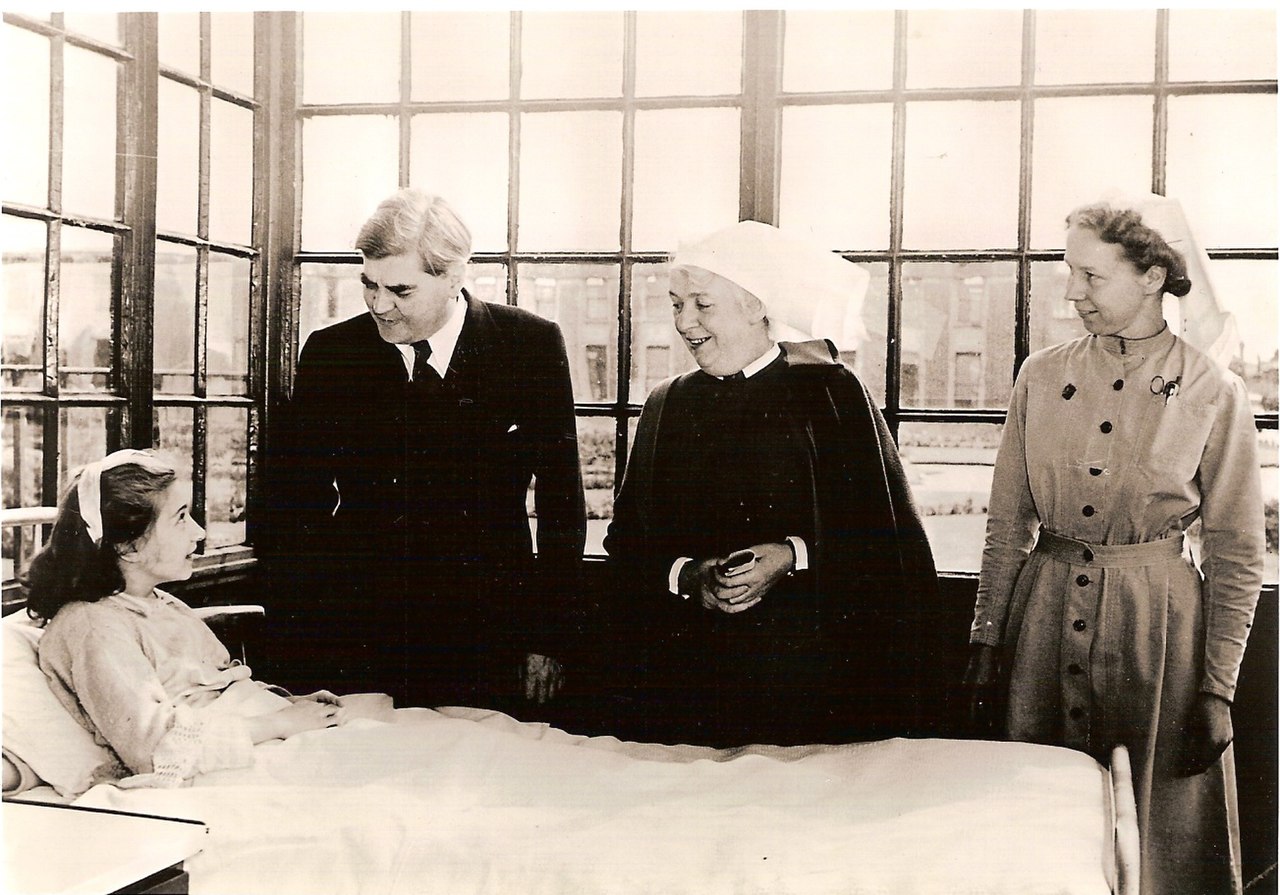
    Aneurin Bevan talking to a patient at Park Hospital, Manchester, the day the NHS came into being in 1948.

    Like paying a visit to Woolworths…

    Aneurin Bevan, as good an orator as Churchill, once remarked that listening to a speech from Labour leader Clement Atlee was like paying a visit to Woolworths: ‘everything was in its place, but nothing was above the value of sixpence.’ To be convincing speech should have the necessary brio to rouse an audience.

    From Jeremy Bentham’s Speech Acts, Jürgen Habermas, develops the crucial idea of Ideal Speech or Communicative Action. This is an idea that speech should be formal, and not tainted by an unthinking recourse to ideology. He also suggests that such dialogue in the tradition of the Enlightenment salon will provide technical outcomes that are also morally purposeful.

    In Communicative Action he wrote: ‘Speakers coordinate their action and pursuit of individual (or joint) goals based on a shared understanding that the goals are inherently reasonable or merit worthy.’

    It succeeds:

    insofar as the actors freely agree that their goal (or goals) is reasonable, that it merits cooperative behaviour. Communicative action is thus an inherently consensual form of social coordination in which actors “mobilise the potential for rationality” given with ordinary language and its telos of rationally motivated agreement.

    Although not all speech should have to be taken seriously, it is important that a forum such as Dartmouth House is maintained for popular shibboleths to be dismantled in public debate.
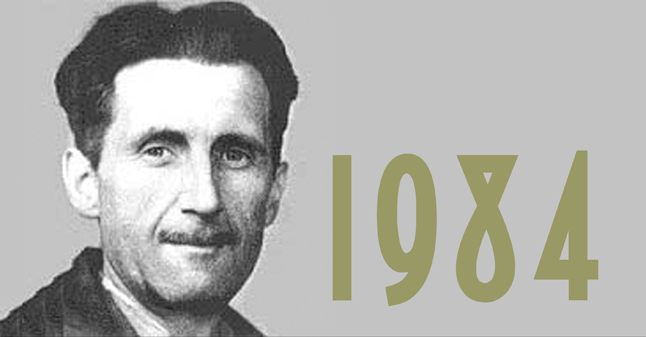
    George Orwell.

    Doublespeak

    So, propaganda should not be taken seriously, nor modes of advertising, without close and detailed inspection. The opinions of many putative experts fall under the same category. Certainly, a little knowledge is a dangerous thing.

    The use of language – however cloaked in notional expertise – to undermine freedoms is a very worrying development. The employment by officialdom of complex legal discourse and manipulation of language may represent the onset of what George Orwell referred to as ‘doublespeak’. This can be exposed in civilised public debate in a neutral forum.

    A certain degree of puff and blow will always be found among business-people. Advertising lubricates the wheels of commerce, but when almost non-existent standards permit multinational corporate entities, including the pharmaceutical sector, to fabricate, falsify and frankly lie, thus precipitating financial and environmental collapse, this may represent a return to the dark ages.

    Sadly, mainstream political debate has disintegrated. Notably, Donald Trump and Hilary Clinton engaged in a travesty of a public debate before the US Presidential election of 2016. It was more like a staged reality TV show. Its nearest equivalent was the format of a farcical game show, such as the Jerry Springer Show.

    Thus politics has become part of the entertainment industry. Despite his Classical education, Boris Johnson invokes Peppa Pig before business leaders.

    So, an unconditional respect for freedom of speech should be offset by an understanding that certain speech does not warrant protection. Nonsense is best resolved by forensic debate – cutting through crap in common parlance.
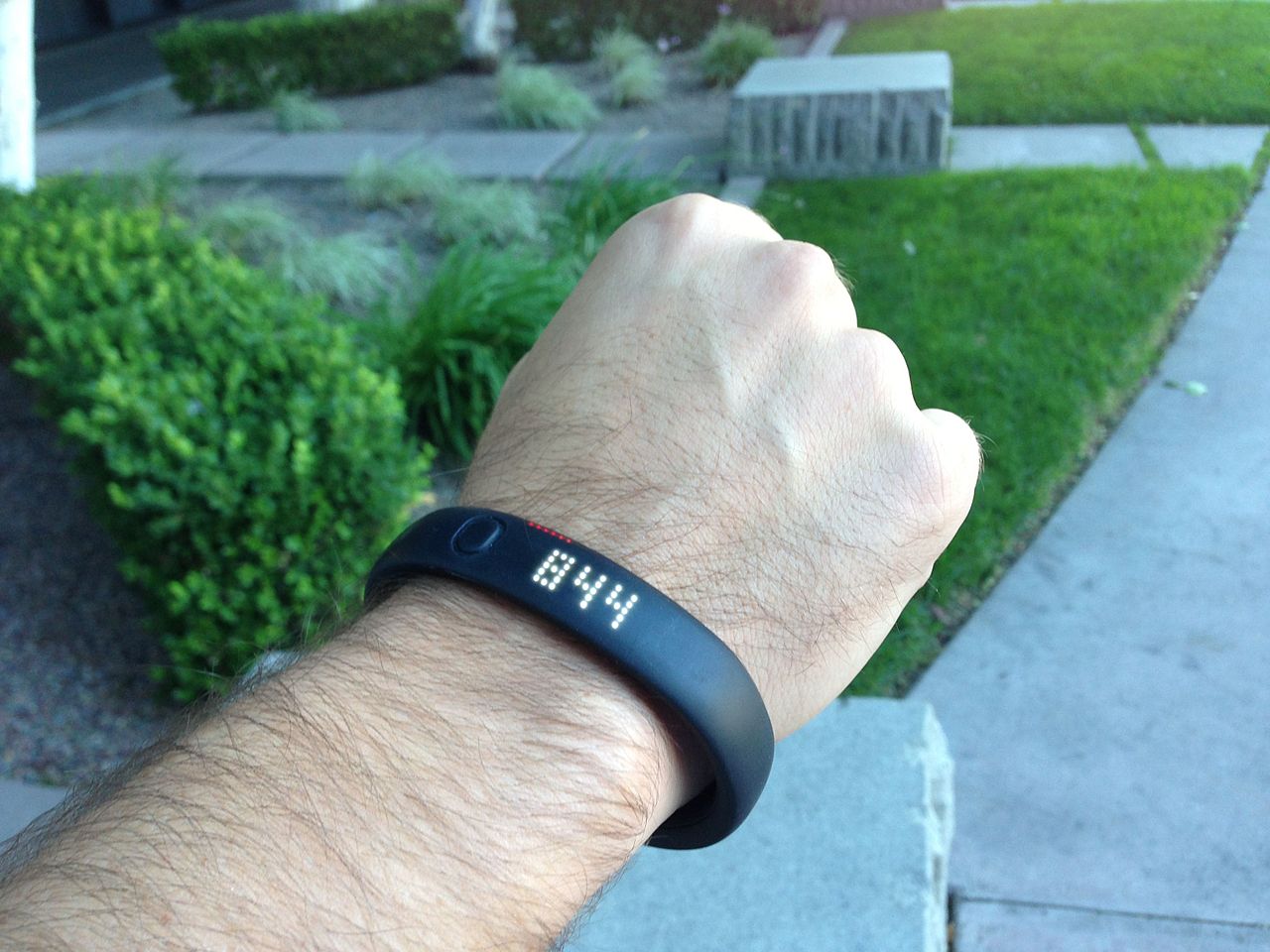
    Surveillance Capitalism

    The criminalisation of unpopular opinion is a worrying feature of our times, and it is ‘subversives’ such as Julian Assange – along with those who dared to hold a referendum in Catalonia – that are accused, prosecuted, and convicted of treason. It is these dissidents that need protection.

    Under the Facebook and Google dispensation people become products to be profiled and mined, a point made brilliantly in Shoshana Zuboff’s The Age of Surveillance Capitalism.

    Moreover, political correctness has also led to the intensification of extremism. I would argue that this includes attempts by the transgender lobby to ban esteemed academics from the airwaves or campuses. ‘No platforming’ undermines public debate, as do unsubstantiated complaints to academic authorities that lead to the removal of a radical professor.

    So, when in Georgetown University certain radical professors indicated they were far from unhappy at the death of the arch conservative Judge Scalia, their conservative colleagues sought their removal on the basis that the ‘snowflake’ generation of easily upset students would be offended at the disrespect.

    We must maintain a right to protest, engage in civil disobedience and crucially – in an increasingly controlled and technocratic age – the right to offer truth-bearing, fearless and independent criticism.
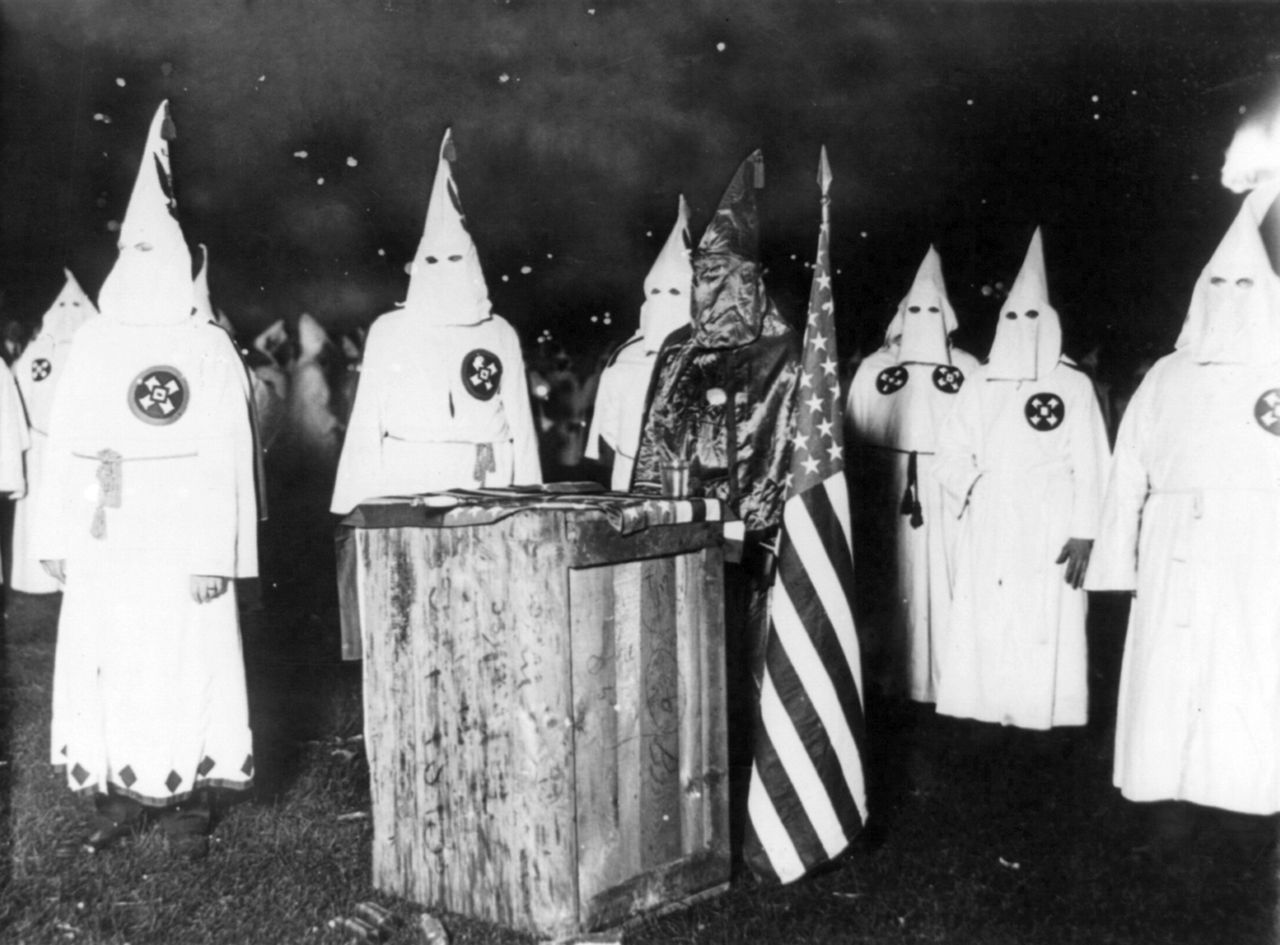
    KKK rally near Chicago in the 1920s.

    The Limits of Freedom of Expression

    Speech has its outer limits, where there is a clear and present danger of imminent lawless action. This tension is explored in Snyder v Phelps, where a fundamentalist Christian group demonstrated outside a gay serviceman’s funeral.

    Upholding speech rights, the Court concluded that:

    Westboro believes that America is morally flawed; many Americans might feel the same about Westboro. Westboro’s funeral picketing is certainly hurtful and its contribution to public discourse may be negligible. But Westboro addressed matters of public import on public property, in a peaceful manner, in full compliance with the guidance of local officials. The speech was indeed planned to coincide with Matthew Snyder’s funeral, but did not itself disrupt that funeral, and Westboro’s choice to conduct its picketing at that time and place did not alter the nature of its speech.

    Speech is powerful. It can stir people to action, move them to tears of both joy and sorrow, and—as it did here—inflict great pain. On the facts before us, we cannot react to that pain by punishing the speaker. As a Nation we have chosen a different course—to protect even hurtful speech on public issues to ensure that we do not stifle public debate. That choice requires that we shield Westboro from tort liability for its picketing in this case.

    Moreover, in Brandenburg v Ohio 359 U.S 44, the Court went so far as to protect even racial abuse at a Ku Klux Klan ‘rally’ held at a farm in Hamilton County.

    One film showed twelve hooded figures, some of whom carried firearms. They were gathered around a large wooden cross, which they burned. No one was present other than the participants and the newsmen who made the film. Most of the words uttered during the scene were incomprehensible when the film was projected, but scattered phrases could be understood that were derogatory of African-Americans and, in one instance of Jews.

    The Supreme Court concluded that this was speech protected under the First Amendment on the principle that the constitutional guarantees of free speech and free press do not permit a State to forbid or proscribe advocacy of the use of force or of law violation, except where such advocacy is directed to inciting or producing imminent lawless action and is likely to incite or produce such action.

    In contrast, the ECHR will not protect either racist speech or Holocaust denial. And even the ESU may feel the Americans went too far.

    But the detailed US decisions show how far the US courts are prepared to travel to protect speech. It is an important point that it is the speech we most dislike and most disagree with that needs the most protection.
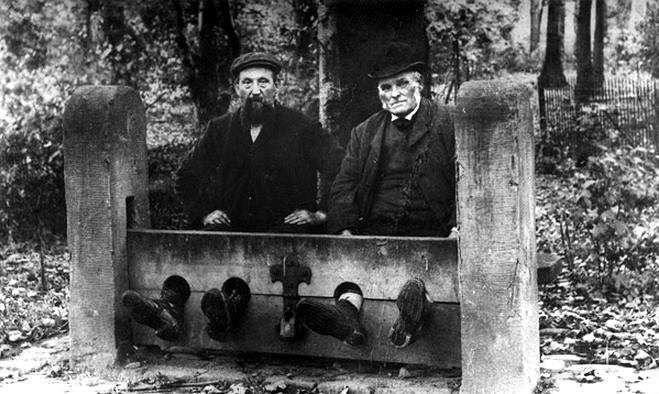
    Village stocks in Bramhall, England c. 1900.

    Enemies of the People

    Whistle-blower legislation protects those who want to expose official corruption and protects speech. However, as I have found, the spectre of criminal prosecution under Official Secret’s legislation is always a suspensive and possible threat. Anyone blowing the whistle must evaluate the risk of prosecution, including the almost inevitable consequence of job loss and ostracism.

    Henrik Ibsen’s Enemies of the People – perhaps uniquely in his oeuvre – was overtly political. The premise is simple: a prominent and well-connected local engineer whose brother is the town mayor is asked to conduct a survey of the waters of the town. The town in question has become famous as a spa resort attracting a great deal of tourism, but when he tests the waters, he finds that they are polluted and informs the town and indeed his brother.

    It is the reaction to this that is interesting. Rather than lauding him and complimenting him for his finely attuned sense of ethics and correct analysis, they turn on him with ever-increasing ferocity. A storm of hatred is unleashed.

    He will destroy the local economy. Their livelihoods will be affected. The industry of the town will be negated. He is shunned, ostracised, victimised. His family is torn apart, and he becomes an ‘Enemy of the People’. The mob descend in all their unfettered glory. Sound familiar?

    Thus, we must protect freedom of speech as it vitalises a democracy, but we must also recognise the rules of civic discourse.

    Yet I fear that a great tradition of oracy, public communication, rationalist discourse and generalist interest is in decline: usurped by the purveyors of false information, false speech acts and blandishments.

    If the English-Speaking Union can revitalise the young with a passion for genuine public communication, it will be performing a great service, training a new generation of professionals in the essential and transferable skills of advocacy, public communication and, above all, respect for the truth.

    Feature Image: Presidential debate between John F. Kennedy and Richard Nixon for the 1960 election in the United States.

    The English-Speaking Union (ESU) is an international charity and membership organisation underpinned by Royal Charter working to give all young people – regardless of background – the speaking and listening skills and the cross-cultural understanding to enable them to thrive.  

    Our programmes are underpinned by over 100 years’ expertise in the field of debate and public speaking delivery, policy and research. 

    Founded in 1918 by the author and journalist Sir Evelyn Wrench, the ESU brings together and empowers people of all cultures and nationalities by building confidence and shaping communication skills, so that individuals can realise their full potential.  In our 36 branches in England and Wales and 54 international branches, the ESU carries out a variety of activities such as: competitions, debating, public speaking and student exchange programmes, teacher training, classroom outreach, research and scholarships. All of these encourage the effective use of the English language around the world.

    To find out more about our work, please go to: https://www.esu.org/ and so consider joining the ESU: https://www.esu.org/support-our-work/become-a-member/.  Please contact Matthew Christmas, Head of Engagement, if you would like to know more or to volunteer with us: matthew.christmas@esu.org.

    Dartmouth House, in the heart of Mayfair, is our International Headquarters and, as Covid recedes, we are delighted to be re-starting our regular public debates where we encourage civil discussion and informed debate where all ages can get involved. 

    The next Dartmouth House Debate is on Monday 09 May 2022 at 1830 hrs to debate the motion that “This House believes that cryptocurrency and NFTs are a hyped-up fad.” 

    We hope that will want to find out more and get involved with the ESU.
  • Refugee Pushbacks in the Balkans

    On the last day of February, the first Ukrainian refugees arrived in Serbia. Radoš Đurović, the director of the Center for the Protection and Assistance of Asylum Seekers in Serbia believes that approximately 600,000 Ukrainian refugees will come to Hungary and will be expecting them to come to Serbia, once Hungary has reached capacity.

    Despite the Russian National anthem being played at train stations in Serbia and pro-Russian protests happening in Belgrade. Nonetheless, Radoš Đurović states that ‘Ukrainians think of Serbia as a friendly country.’ The question is where is this friendliness to other nationalities?

    Medical Volunteers International have been providing medical care along the EU borders in the Balkans and have witnessed the abuse that is being carried out at the hands of the EU, as well as those whose job is to protect the people.

    A press release by UNHCR just last month states: ‘What is happening at European borders is legally and morally unacceptable and must stop. Protecting human life, human rights and dignity must remain our shared priority.’

    But after the influx of refugees over six years ago, shouldn’t this be something we should have improved on greatly? With the current EU policy, razor-wired fences, brutal pushbacks and the prevention of the right to claim asylum, sadly things are getting worse, not better.

    Frontex states that they have seen a 148% increase on the western Balkan route in January 2022 alone. Serbia is known as an important transit country for people on the move (POMs). It is estimated that 60,000 people moved through there in 2021, heading to the EU to seek safety from war, persecution, poverty and many other human rights violations.

    Yet the Višegrad Four, an alliance that has been set up between the Czech Republic, Hungary, Poland and Slovakia, have on the one hand deployed more police to the Serbian/Hungary border to assist with the violation of EU laws in pushing back refugees from Afghanistan, but, on the other hand, has declared how they will be accepting refugees from Ukraine, along with Serbia and Romania. All of these countries are involved in the mistreatment of refugees from countries such as Afghanistan, Syria and Iraq.

    In 2015, Hungary built a four-metre high razor wire-topped fence along its borders to Serbia and Croatia. This spans the 109 miles (175 km) length of northern Serbia and all the locations this report mentions are within this area. With first-hand documentation of wounds caused at the hands of the Serbian police and those involved with the pushbacks from Hungary and Romania, the human rights violations at our borders seems to be going unnoticed, or perhaps uncared about by our governments.

    Many POMs have spoken about how they have made it across Hungary but have been caught at the Austrian border, then pushed back without the opportunity to claim asylum or any type of documentation to Serbia. This is due to the pushbacks in Hungary being made legal. A report found here gives in a lot more details however in short, due to a state of emergency declared in Hungary in March 2016, pushbacks have been allowed. Many people are returned through special gates built in the border fence however reports of robbing, beatings, and humiliations by the police are regularly being reported to the team. This has been criticised by the EU and violates international treaties such as the Geneva Convention which Hungary has signed yet Hungary has now been getting away with this for 6 years.

    During 2020/2021, 22,204 people were pushed back from Hungary. Most of these people are from Syria and Afghanistan. There were also increased reports towards the latter end of last year of people being pushed back from Austria to Hungary, then Hungary to Serbia. This report talks about the places along the Serbian/Hungary borders, and what exactly is happenings to the people who are seeking safety in the EU.
    A young man uses his phone to contact family after using Collective Aids generator to charge his phone.
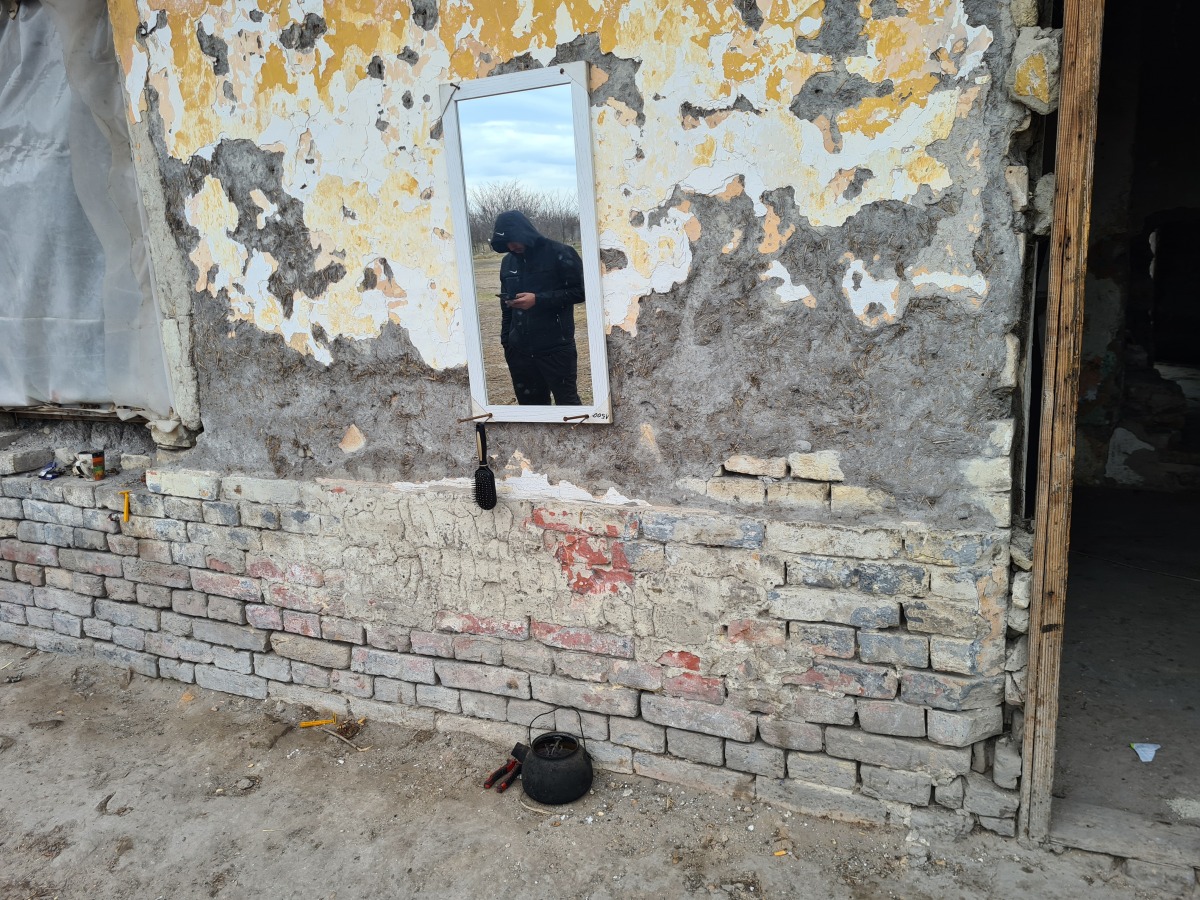
    A registered organisation called Collective Aid also works along the northern Serbian border giving showers, non-food items and uses a generator to help POMs to charge their phones and even offers the basic requirement of a shaver for a haircut to maintain people’s dignity.

    Evictions by the police are common in these locations which are mostly squats within abandoned buildings. Mass raids happen every couple of months and are mostly linked to protests from the local fascist group.

    Recently a mass eviction happened where police hit each place along the Northern border one after the other. A few hundred people were taken but many also managed to escape.

    People messaged stating that the police smashed open the doors and some people escaped out the window. They beat the people, robbed them of their money and phones then they were loaded onto buses and driven to a camp in the south of Serbia. They even hit the hotels where sick and vulnerable POMs stay. The injuries from these evictions are evident for weeks following this, and also the psychological effects on already scared and vulnerable people are massive.

    Horgoš

    Horgoš is a small town next to the border of Hungary in North Serbia. There are two main locations where POMs live. One squat is against the border fence and near a road checkpoint for crossing the border which can be easily viewed from the watchtower.

    Here there are mostly Arabic-speaking people from Morocco and Tunisia but some from Syria, Iraq, and Palestine. In recent months there have been approximately seventy people living here, but this is set to increase again in the warmer weather. The people living here, like all locations spoken about, are very transitional.

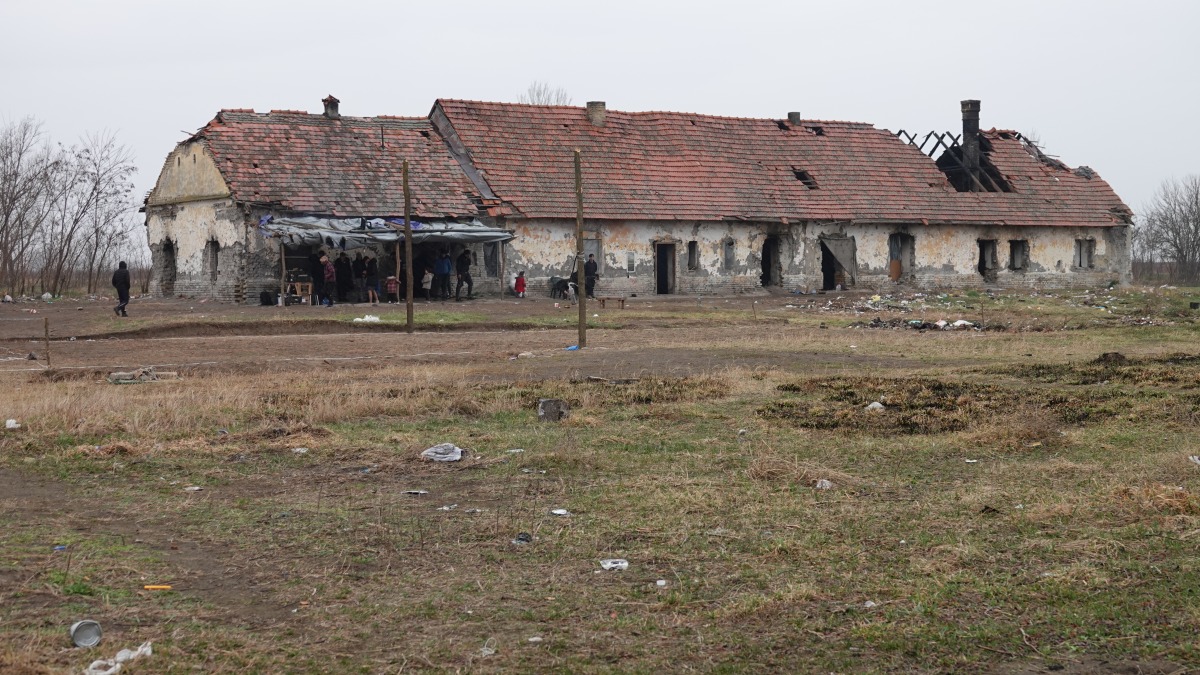
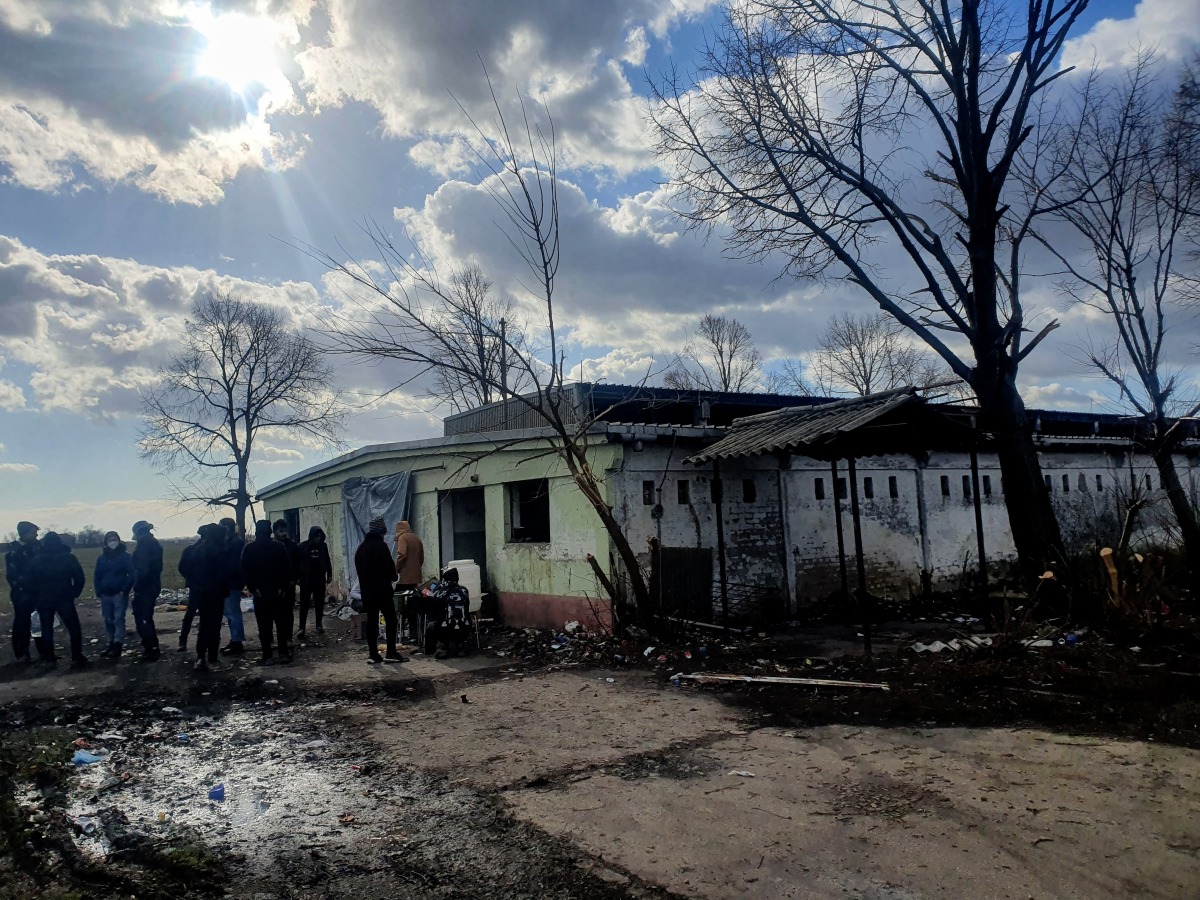
    The second location is at an old farm. Here there are many squatted buildings and it is more spread out over the area. There are normally 90-110 people here. Here there are mostly Farsi, Urdu, etc. speakers from Afghanistan, Pakistan, and India. It is very rare to find Arabic Speakers staying here however in the past week a Kurdish-Turkish group have been staying there as well as a young family from Syria.

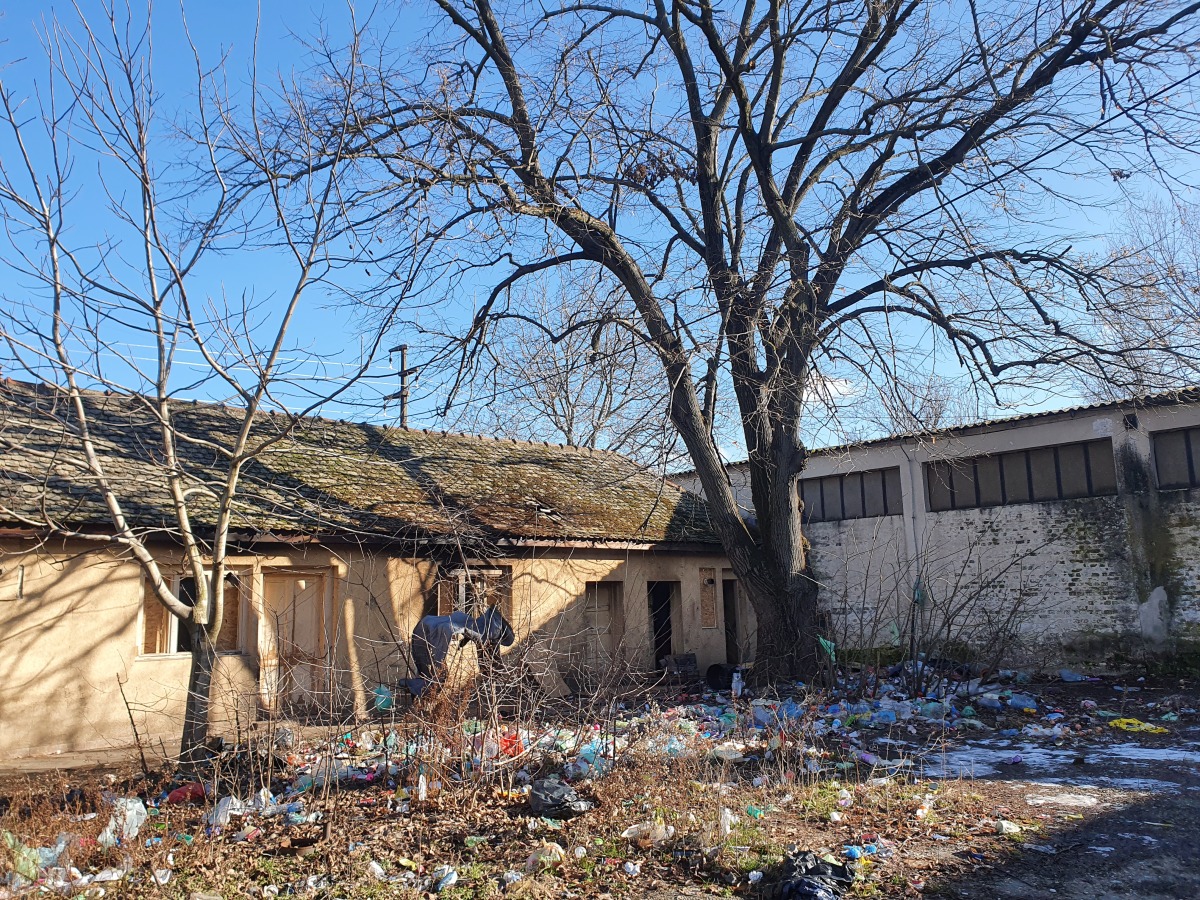
    One of several abandoned buildings that people on the move are living in, Horgoš Farm, North Serbia.

    As with the border area, living conditions are very poor here. With the abandoned buildings being used as squats, with leaking roofs, many tired and weary people sleep off their exhaustion after spending the night on “game”, the name given by many to the act of crossing the border and arriving at a destination where there is no risk of being pushed back from.

    It becomes a game when night after night is spent trying to achieve this. There are many reports of phones being smashed and money being stolen during pushbacks by Hungarian and Romanian authorities.

    As with most of the squats, due to such a high transition of people, there is a major outbreak of scabies, particularly with people coming from the refugee camps which are commonly referred to by POMs as a place that is highly infested with scabies mites. With open sores caused by the reaction to the mite, many of the people living here are in dire need of treatment.


    Abandoned farm near Horgoš

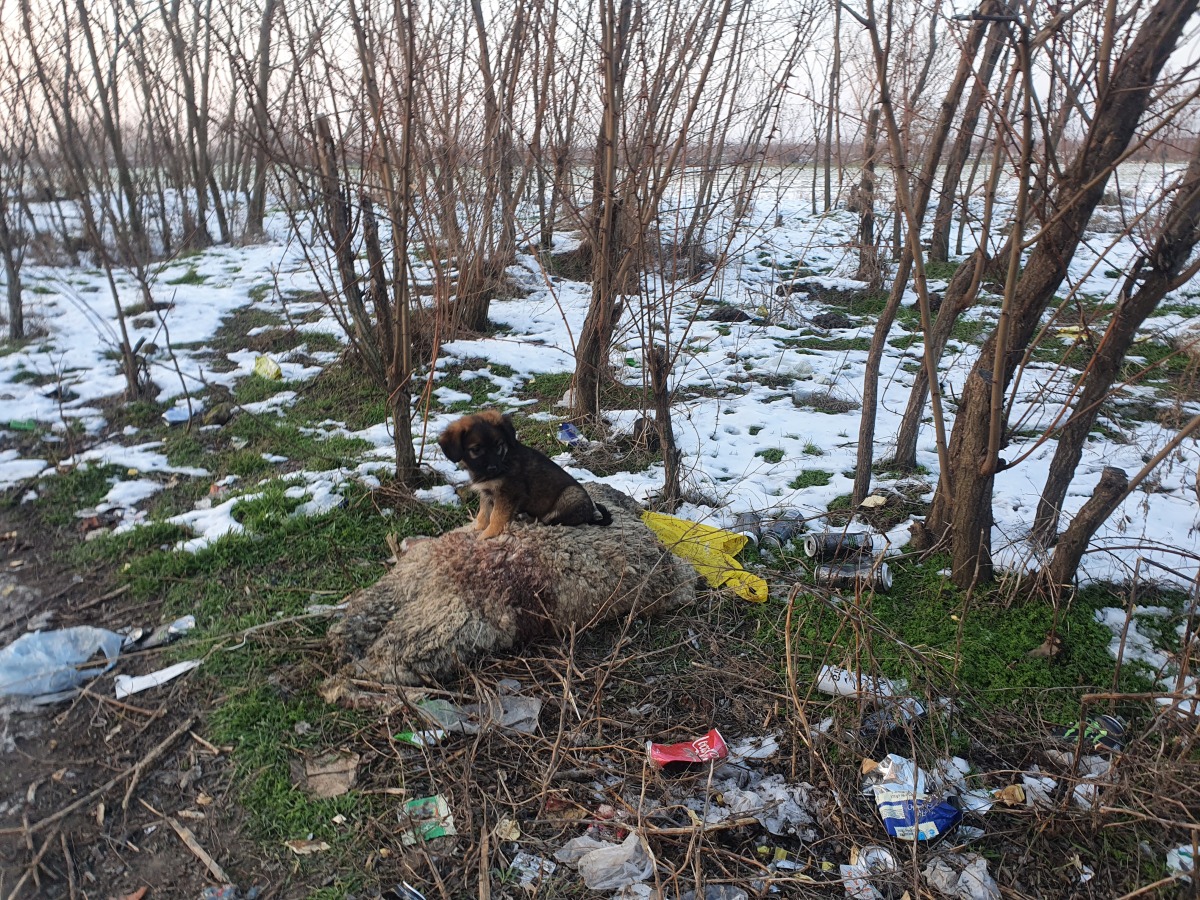
    Taxis are regularly driving to this location bringing people back from the “game”, bringing people food/supplies, and also delivering live sheep to be killed. There are many fleeces around the property from slaughtered sheep that the POM’s have purchased from local people.

    One of the many stray puppies sitting on slaughtered sheep to stay warm.

    At the farms, the crossing of the border is very well organised where groups hit the fence at the same time with ladders. We see many injuries to hands from the razor wire on the top of the fence as well as injuries to knees and ankles from jumping down the opposite side.

    You see many people going on “game” with thick gloves to protect their hands. Building barriers is not going to deter people who are fleeing their homeland but makes the lives of the POMs trying to make it to a safe country to ask for protection much more difficult, forcing them to take dangerous routes across Europe or into the hands of smugglers.

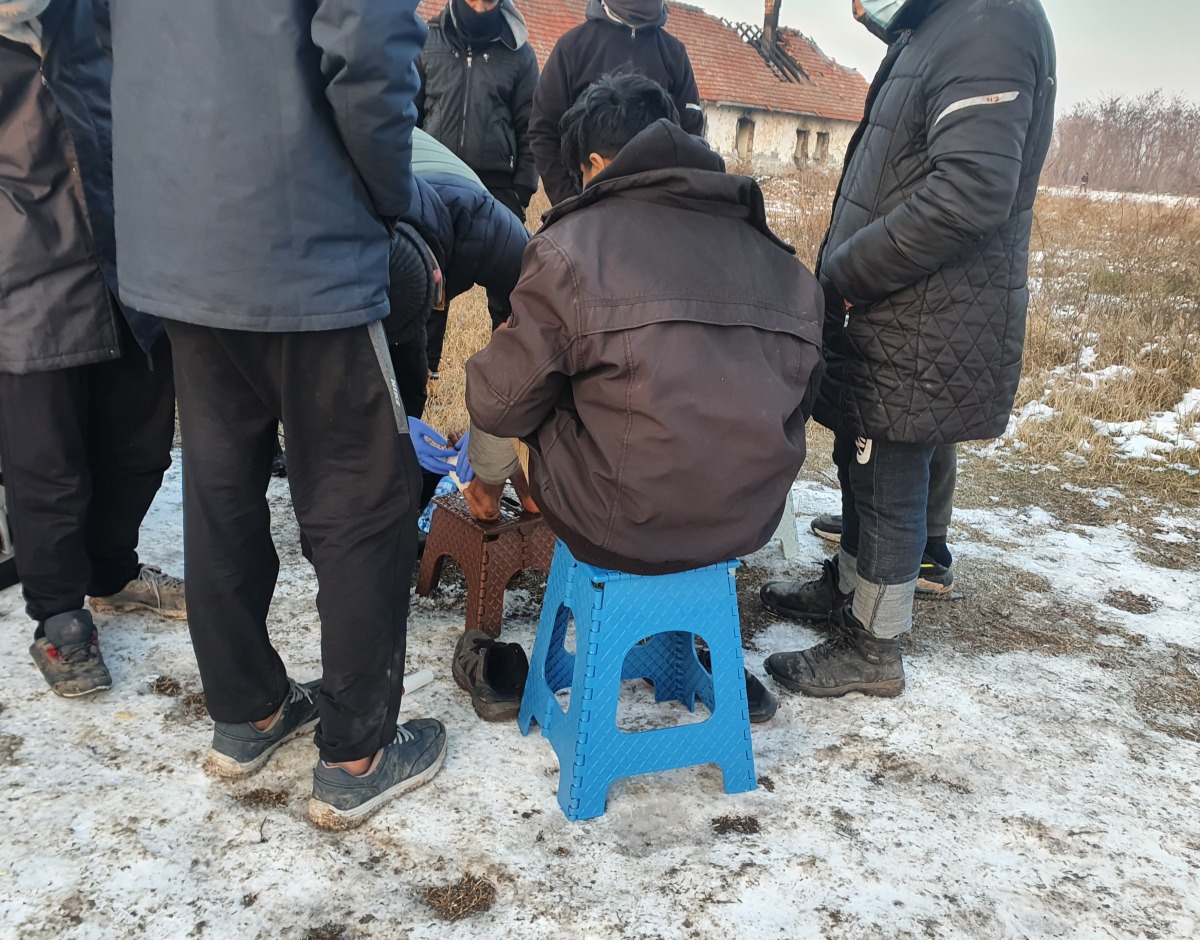
    Giving wound care to a young man who has frostbite to his feet from walking in the snow in inadequate shoes.

    There are many pushback stories from this location. One man from India tries every single night to go across the border. If he makes it into Hungary, he is typically gone for a few days before being returned through gates in the fence by police. If he makes it and is gone for a few days then pushed back, he has one night of rest before attempting again.

    When I spoke to him, he had been in Serbia for 80 days and his only focus is getting through Hungary to prevent a pushback. He told me that if the border police know you speak English then they will beat you more to try and get information from you such as your route, how you crossed the border etc. After experiencing this a few times, he now pretends he cannot speak English.

    He is trying to reach Spain as he has family there. He isn’t safe at home and he describes how his life is in danger if he returns home. He entered Serbia legally with his passport. He said that there is now an increase of advertised travel packages offered by travel agencies in India also to Belarus. As his passport was stamped and he would soon become illegal by overstaying his days, he then posted his passport to his family in Spain so that he is undocumented.

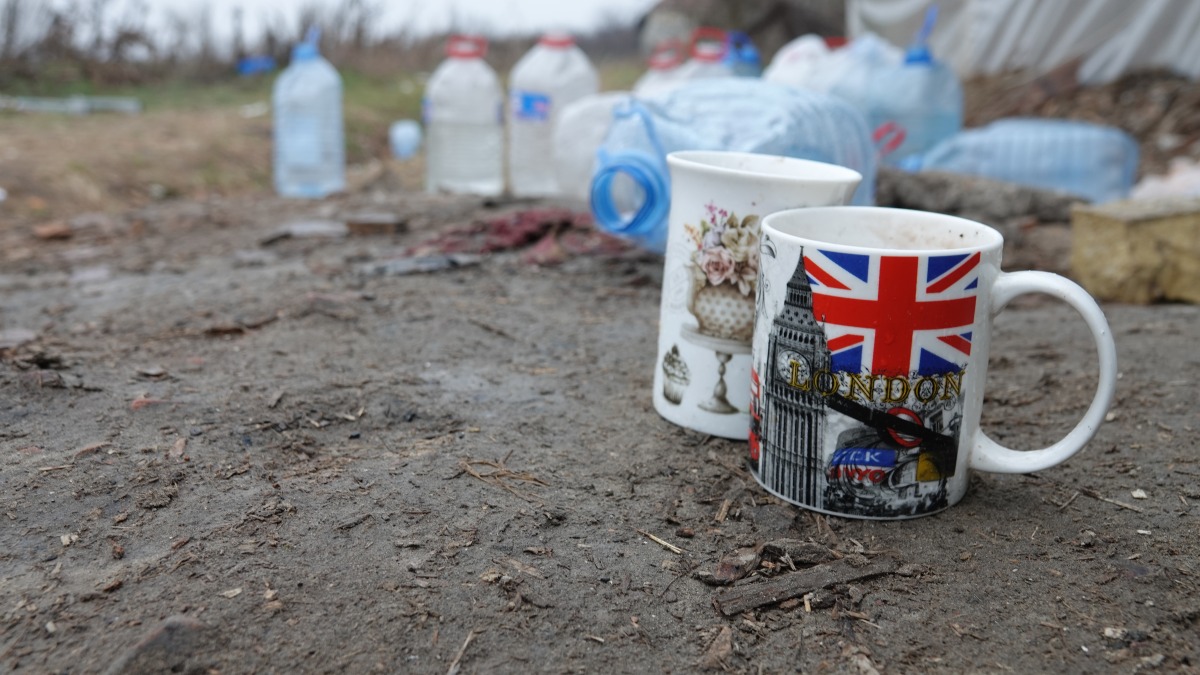
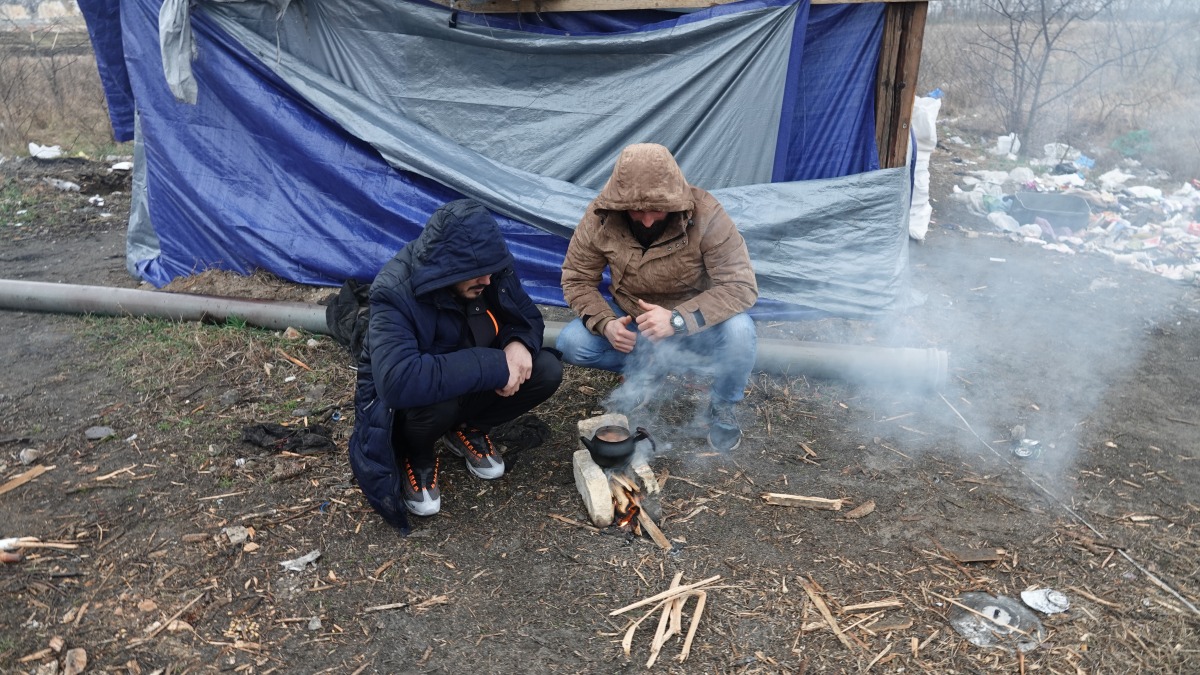
    Turkish-Kurds huddled around a fire to keep warm whilst boiling two eggs.

    We see many people who have been subjected to police brutality. One Moroccan man at the border was caught by the Hungarian police who saw our bandages on his feet, therefore, beat his toes. He has a major wound there caused by frostbite.

    Police brutality cases are referred to Collective Aid who takes Border Violence Monitoring Network (BVMN) Reports from every case that they have time to do so to document the police brutality situation.

    Subotica Train Tracks

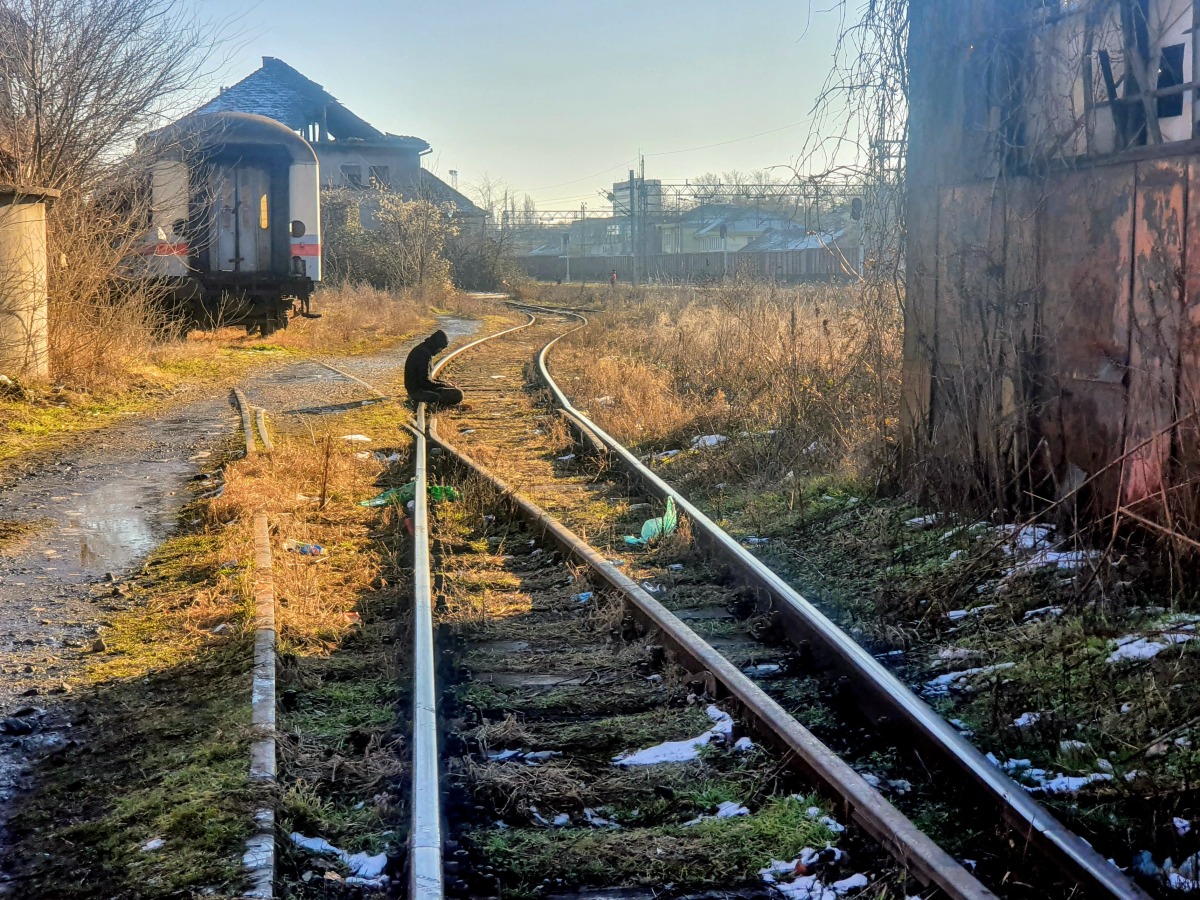
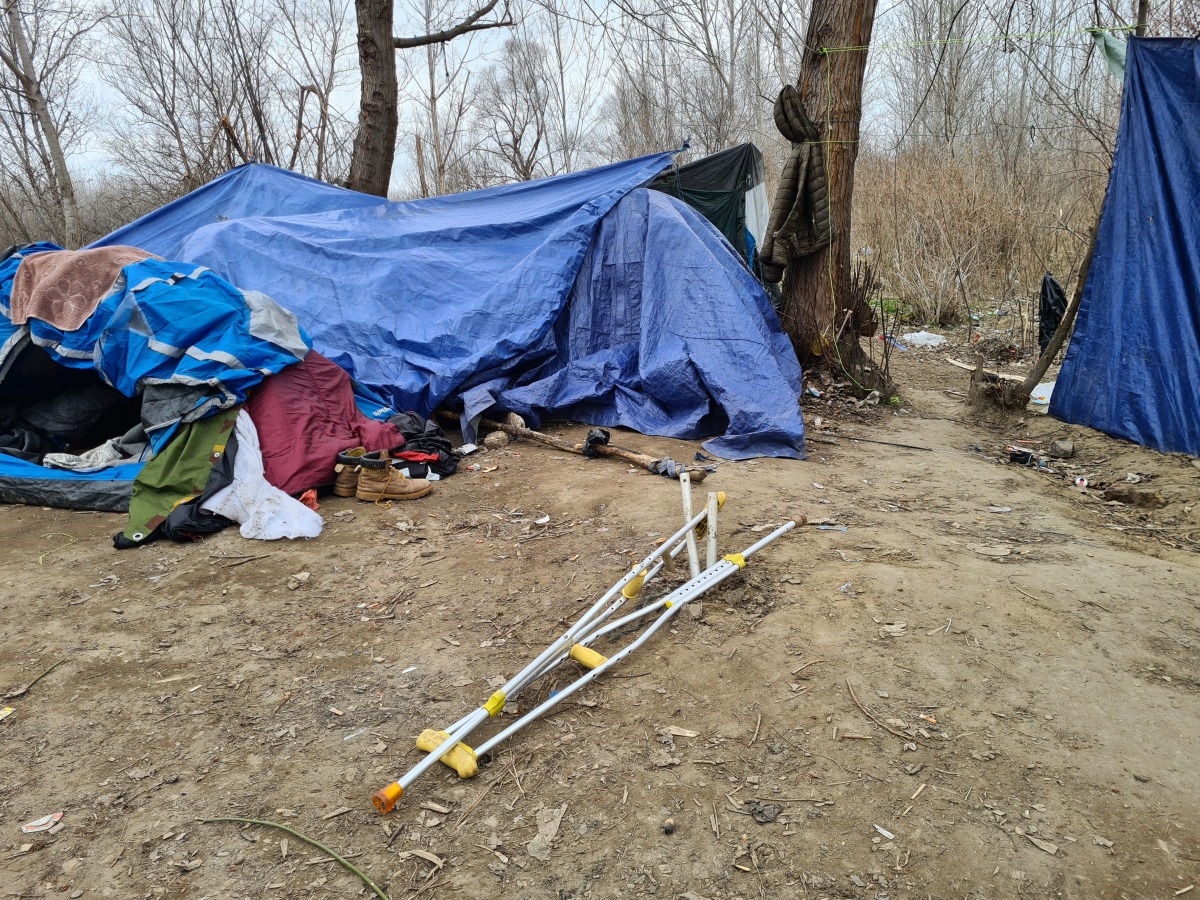
    The train tracks run through the city. Many people from Afghanistan and Pakistan live in abandoned buildings along the train tracks. There are many minors living here but we never come across families here as the conditions are too poor. There are approximately one hundred and fifty people living along the railway.

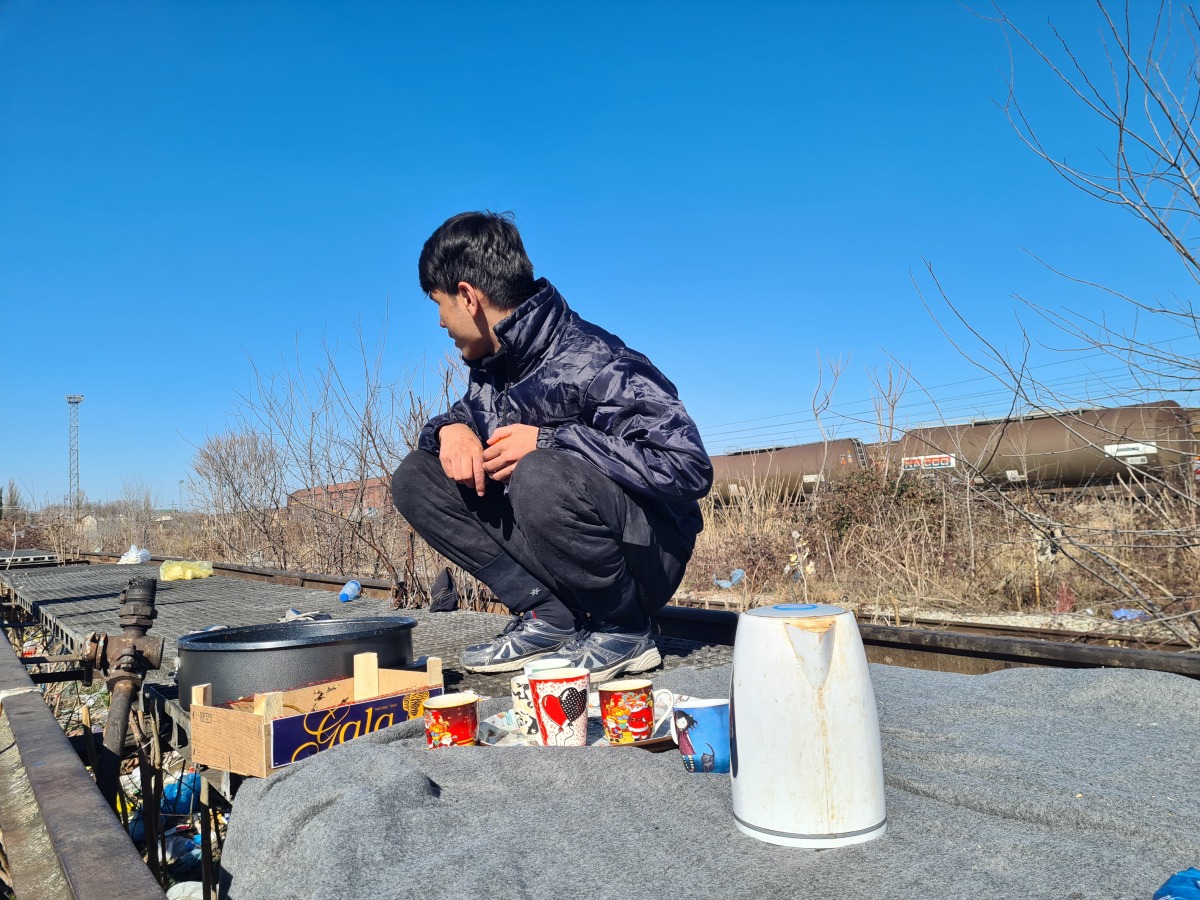
    Minor warming himself in the sun. The kettle was boiled at the electric box that has been tampered with to get electricity.

    As this area is in the city, they are regularly targeted by the police. The police often raid the places in the early hours of the morning and beat and rob the people. They seem to do this for a few nights and then leave them alone for a week or so. Perhaps it is to do with when they get paid as they only rob the people of money rather than belongings. With no way of making a complaint, these POM have no option but to accept that this will happen.

    Recently these raids and cases of police brutality are becoming more and more frequent. During the day on the 1st of March, police raided the train tracks and took the people to the police station and told them they should either pay a fine or they would be taken to the camp in the south. Over one-third of the POMS that the team saw that day had signs of police brutality. Many people arrived back from being transported to camp three hours away in taxis with many injuries which the medical team assisted with.

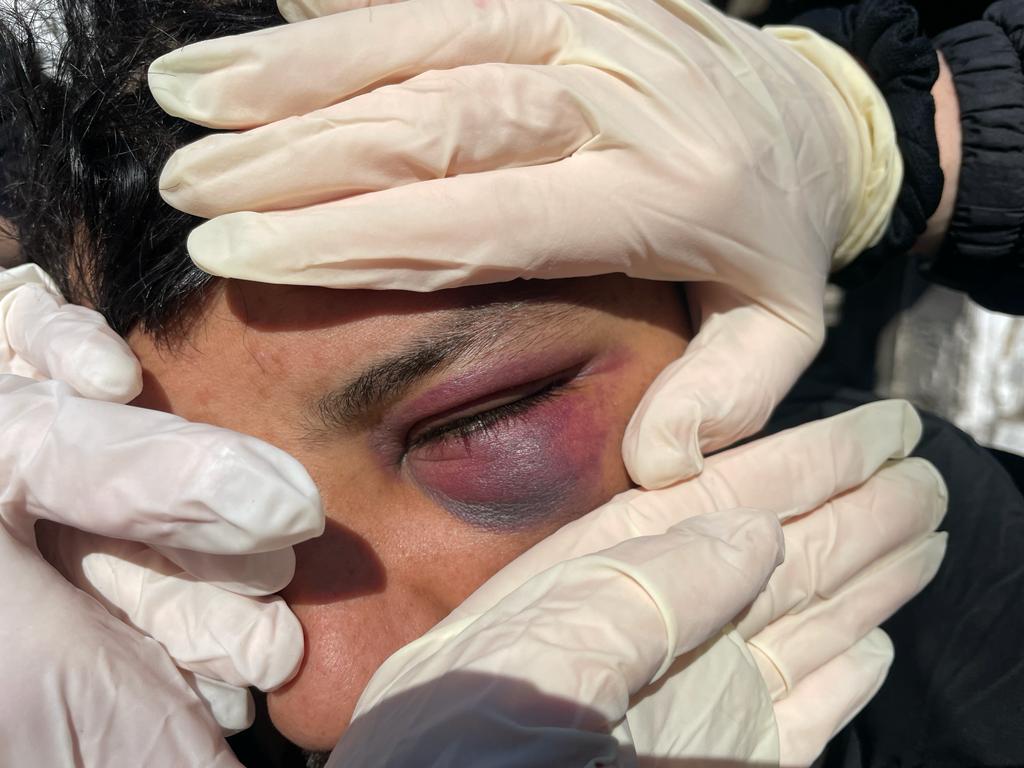
    18-year-old boy from Afghanistan’s injuries following Serbian police brutality on 3rd March 2022. Photo taken on 10th March 2022

    One had what he thought was a receipt for the money he had paid at the police station however it was a Decision on Return. Unbeknown to him, this is a declaration that he entered Serbia without legal grounds and therefore legally has to leave Serbia within thirty days. If he does not leave then he can be forcibly removed and in addition following this decision, he cannot apply for asylum in Serbia.

    A lone refugee from Afghanistan sat on the train tracks trying to stay warm in the afternoon sun.

    Two days later, evictions were carried out in this same location. The police openly in broad daylight beat the POMs as they put them in their vans. One of these locations was very public outside a supermarket with many local people around. The POMs were forced into the vans. There were approximately three police vans, six police cars, and around fifteen police personnel, so ample opportunity for one of the law enforcers to speak out about the brutality used against the POMs.

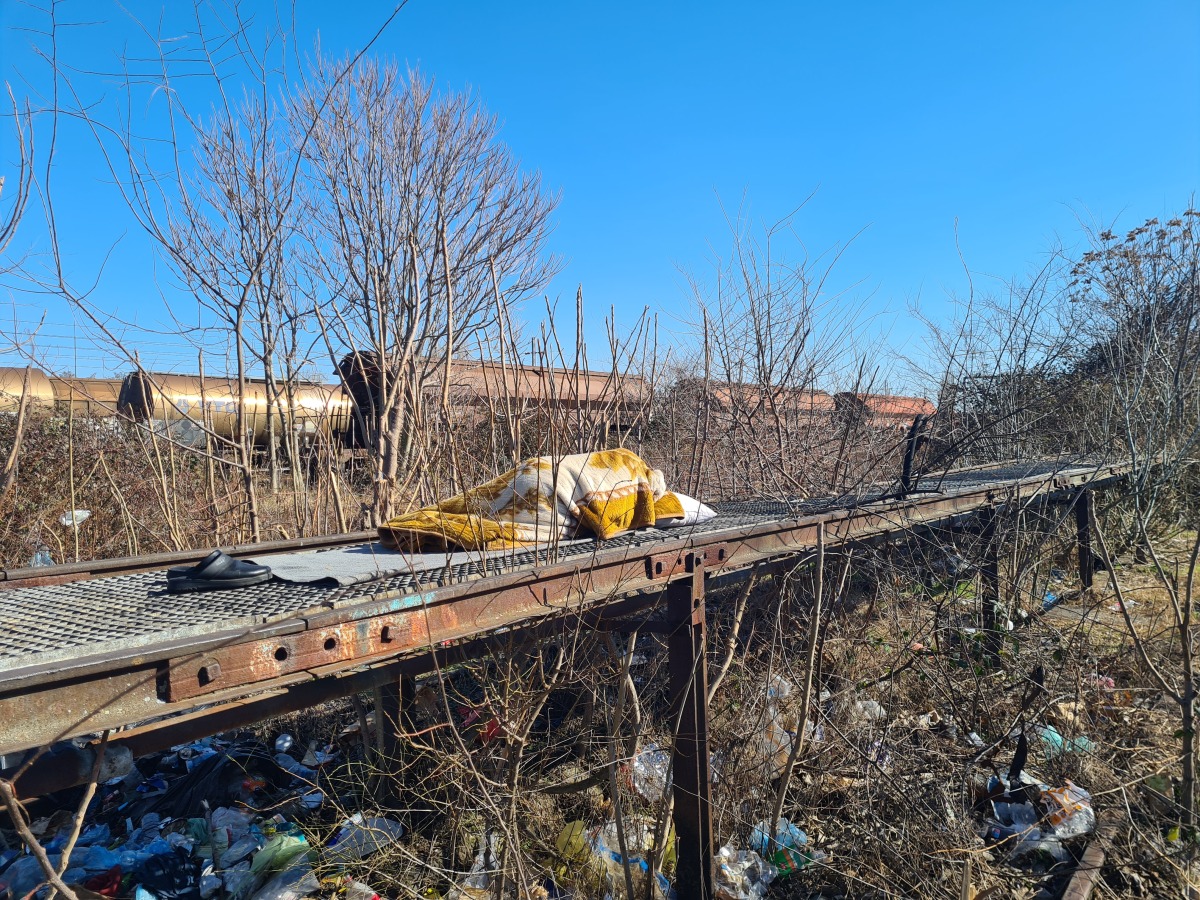
    A young man from Afghanistan sleeping on a disused area of the train tracks after spending the night on the “game” and being pushed back.

    Then again on the 8th March, the police had been and targeted the young men living here. They beat and robbed them. One man has a bandage wrapped around his head and a large bruise under his eye. No one wants to stay here, but again these people have no choice after being pushed back night after night.

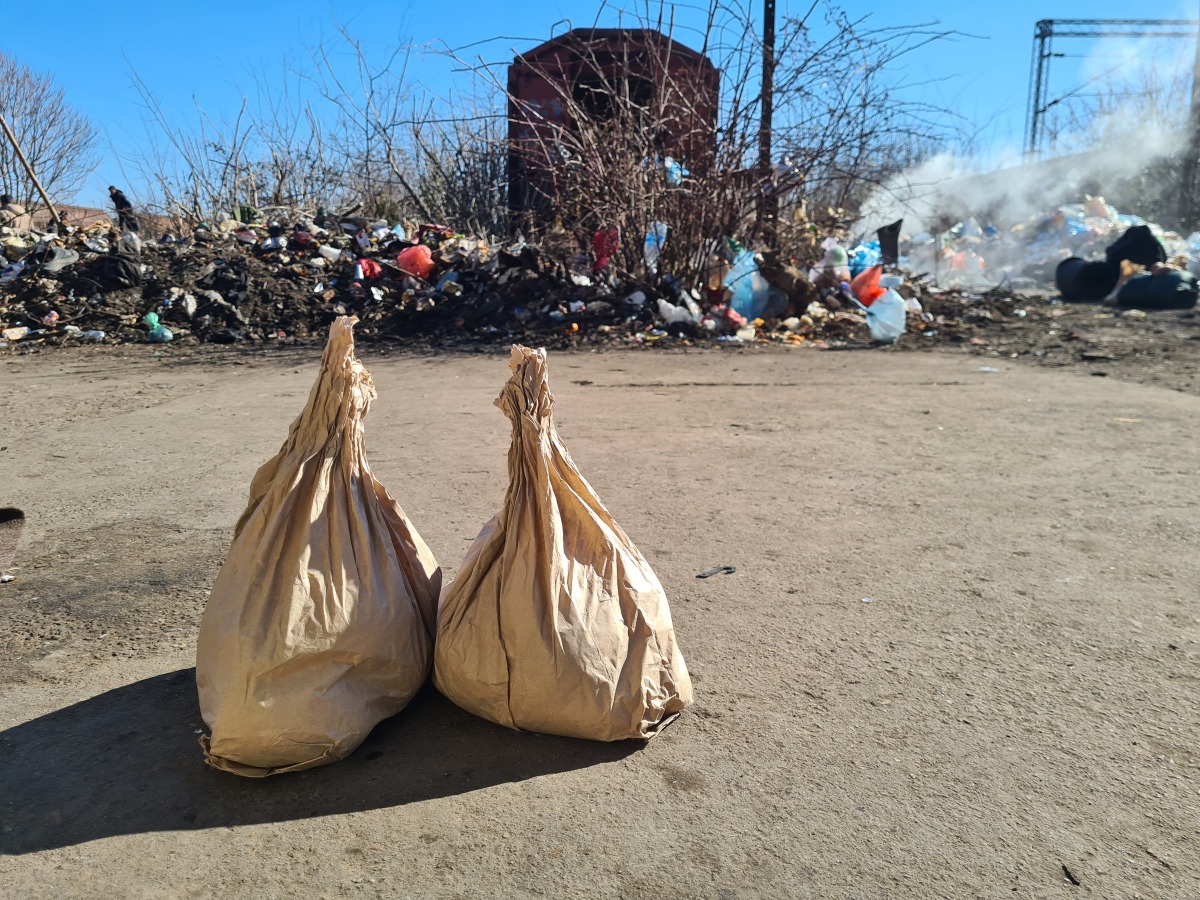
    Distributions of much-needed bags of food outside a squat.

    We find many people in this area who are without warm clothing, sleeping bags, and even shoes. Additionally, at the end of last year, a POM was killed on the train tracks. It’s a dangerous place to live. Not only due to the trains but also due to the extremely poor living conditions but also due to the frequent police and fascist attacks. They sleep with their shoes on ready to run from the police. Not having any shoes is a big problem as the train tracks are littered with broken glass, nails and oil from trains.

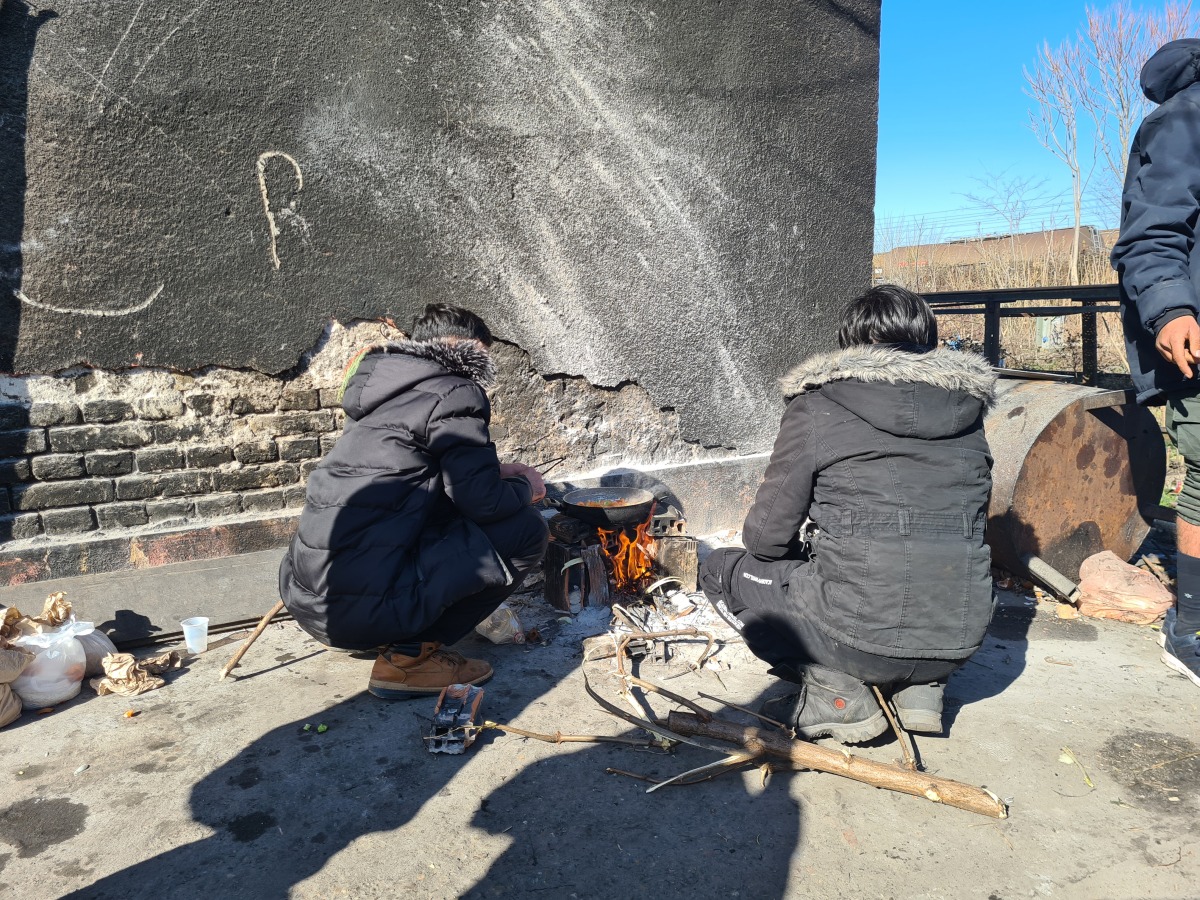
    Two Afghan minors cook over a fire whilst other members from the squat await their turn to cook.

    One story from a minor from Afghanistan is a young man aged fifteen years who we met on the train tracks. His English was perfect and he helped with much-needed translation for the team. His family invested everything they have in him so he could make the dangerous trip to the EU in the hope that his asylum claim is accepted and that family reunification would allow them to be together again in a safe place. He has been stuck here for nearly a month now and has been subjected to many beatings from the police.

    Srpski Krstur

    In Srpski Krstur, there is an informal camp where many people live in tents in a wooded area along the river. Here the river is used as part of the Serbia/Hungary border therefore there is no fence. Many people live in tents in this area so over winter, many people left for official camp or hotels that accept POMs but also a number remained. The numbers are now increasing here. They are all Arabic speakers here and a good mix of Syrians, Iraqis, Tunisians, Moroccans, and Palestinian.

    Currently, about seventy people are living here. It is a long walk to the local village here so access to drinking water is not readily available. Many people drink from the river here and we see many gastrointestinal illnesses. During January, the temperature was always below zero during the day. You would see people walking along the riverbank with bags of food that they had bought in inadequate clothing. Tissue damage due to the cold in this area is a problem.

    We have started seeing an increase in families in this location and will no doubt see many more in the warmer weather. They generally cross the river here in inflatable boats provided by someone that works for a smuggler. The river here is deep and fast flowing so is very dangerous.

    Djala

    Last year, the number of families living in Srspski Krstur decreased due to mounting repression by the police. Many relocated to an abandoned house on the outskirts of the village. This squat is where Arabic families stay, mostly from Syria but a few people from Iraq. There are normally ten to twenty adults here with children and young babies at any one time. It is very close to Srpski Krstur so they use the same way to cross the border in boats. This is better for families with young children who cannot climb the fence but also very dangerous in terms of the fast-flowing river.

    Here there was a malnourished baby called Yousef. Yousef was just twenty days old when he was found to be very low in weight. With education to the mother about increasing feed and close monitoring of the weight, Yousef became a lot stronger.

    It took a lot of coordinating to see Yousef in this time due to his mother desperately going on “game” very regularly. At one point they were gone for several days and made it to the Austrian border to be caught and pushed back to Serbia. During this time they were held outside in freezing conditions by the Hungarian authorities despite the mothers pleading for the month-old baby to be taken inside out the elements.

    Yousef, unfortunately, developed a respiratory condition and conjunctivitis following this experience which was successfully treated by the medical team. Recently it was heard that she has made it with her two children to Austria.

    It is in the area of Djala and Srpski Krstur that there is a very angry Commissariat. The Commissariat is here to protect the needs of the refugees but this female officer is very difficult. She aggressively speaks to organisations who are there to help and sets them time limits for how long they can be in an area despite the needs of the people.

    Sombor

    Sombor is on the Serbian/Croatia/Hungary border and is known for its fascist area involvement. People have been photographed who help the POMs here and posted on a Facebook page and death threats have been issued.

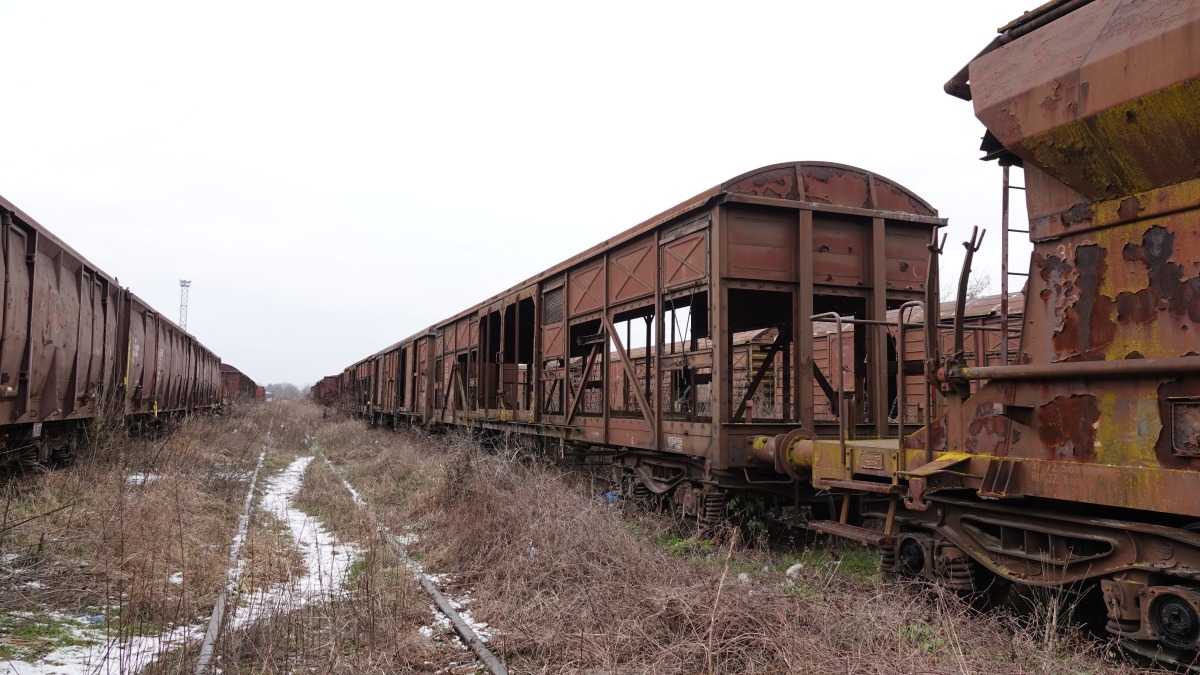
    Old train carriages on Sombor train tracks where people on the move live.

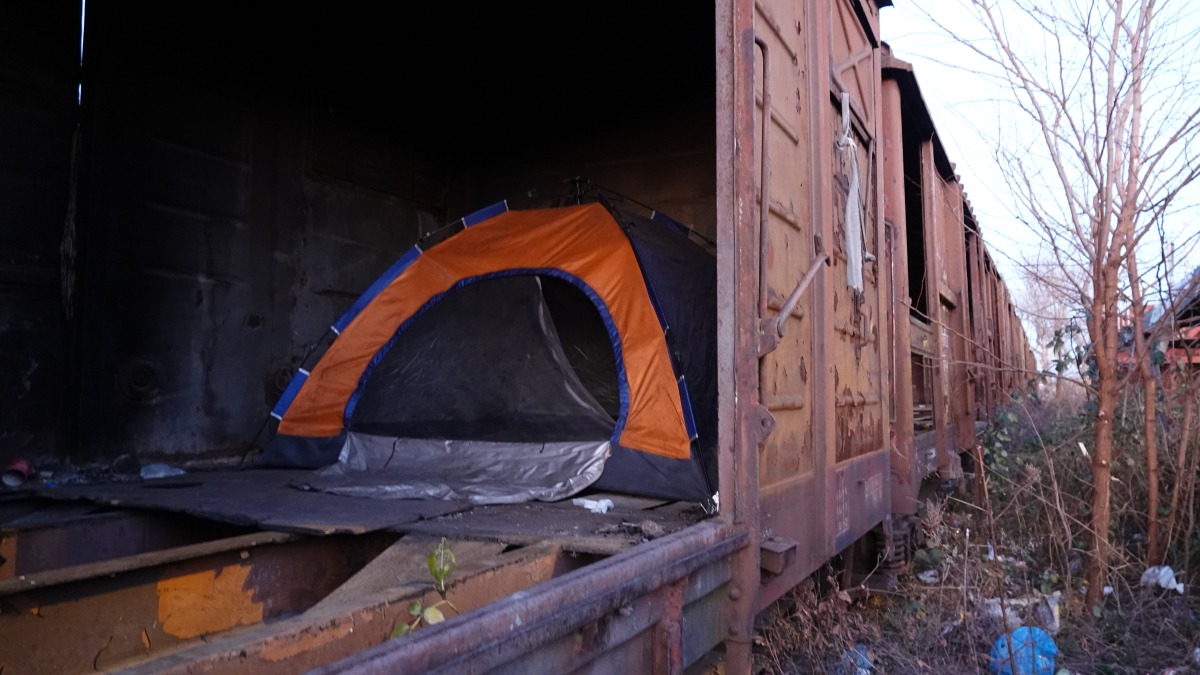
    There is a group of people living in abandoned train carriages most of which are from Afghanistan but some from Pakistan. At the moment about forty people are living here but it has been very few over winter as it is extremely cold to live here. Numbers can raise to between 100 -150 during the spring and summer months.

    A tent in one of the many abandoned train carriages at Sombor where people on the move live.

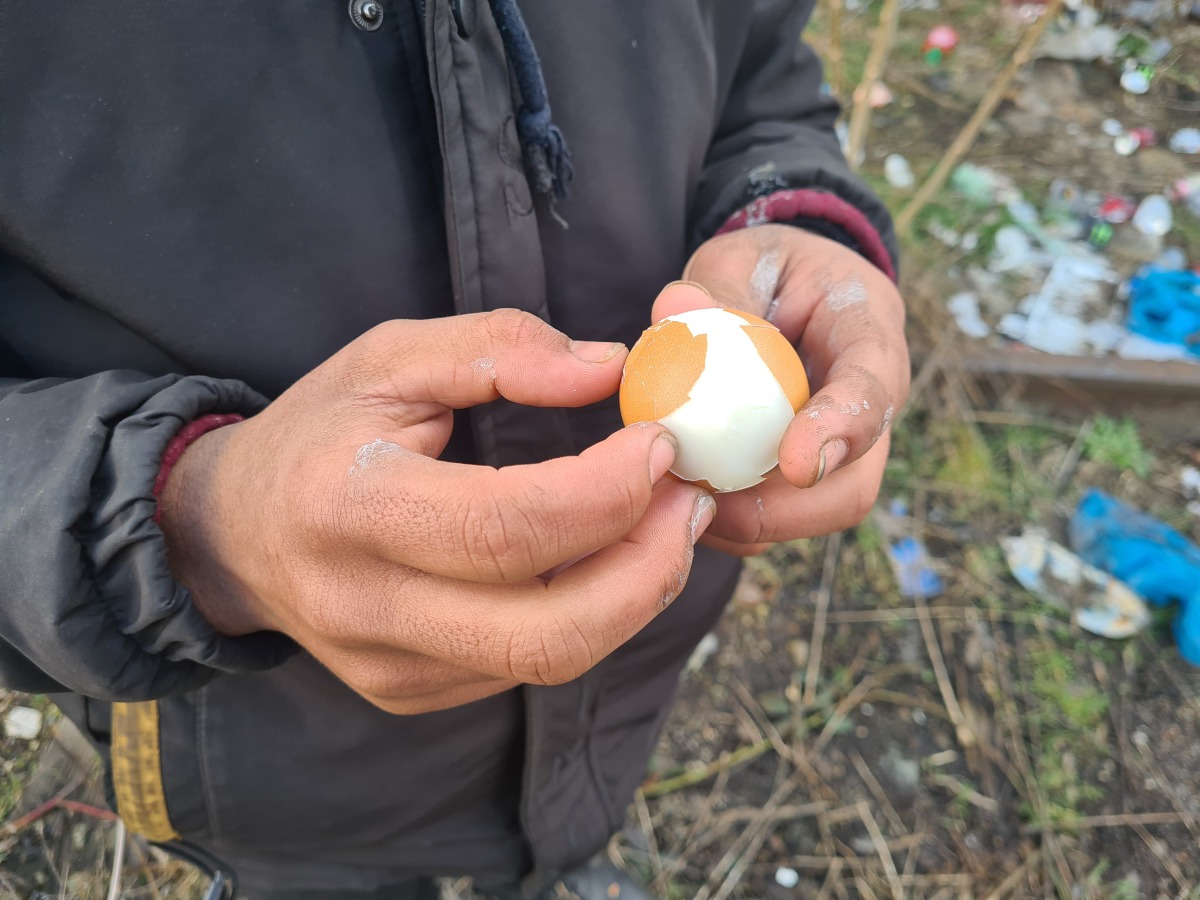
    There are a group of minors aged just thirteen years old here. They have been here for some time and are completely alone. You see them playing in amongst the carriages and on the tracks as well as cooking boiled eggs for themselves. The eggs are provided by Collective Aid during their once-weekly food distribution here. This is a horrendous place for these children to be.

    Rough hands of a 13-year-old child as he peels an egg he has boiled for himself.

    This area is targeted a lot by the police. During raids, they smash the sides of the old train carriages so that in winter it is impossible to stay out of the elements. There are areas along the train tracks where people have wired plugs into the electric boxes so they can charge their phones.

    This is common in a lot of squats but is exceedingly dangerous as its mains electricity. There is a squat in the middle of Sombor next to Lidl and a bus station. Here there are a lot of Indians, Pakistani, and Afghans. Numbers are around thirty people in recent weeks and set to rise in spring. It is not a very nice place at all and everyone has respiratory problems due to the cooking being done inside without ventilation. Also. there is a massive scabies problem here.

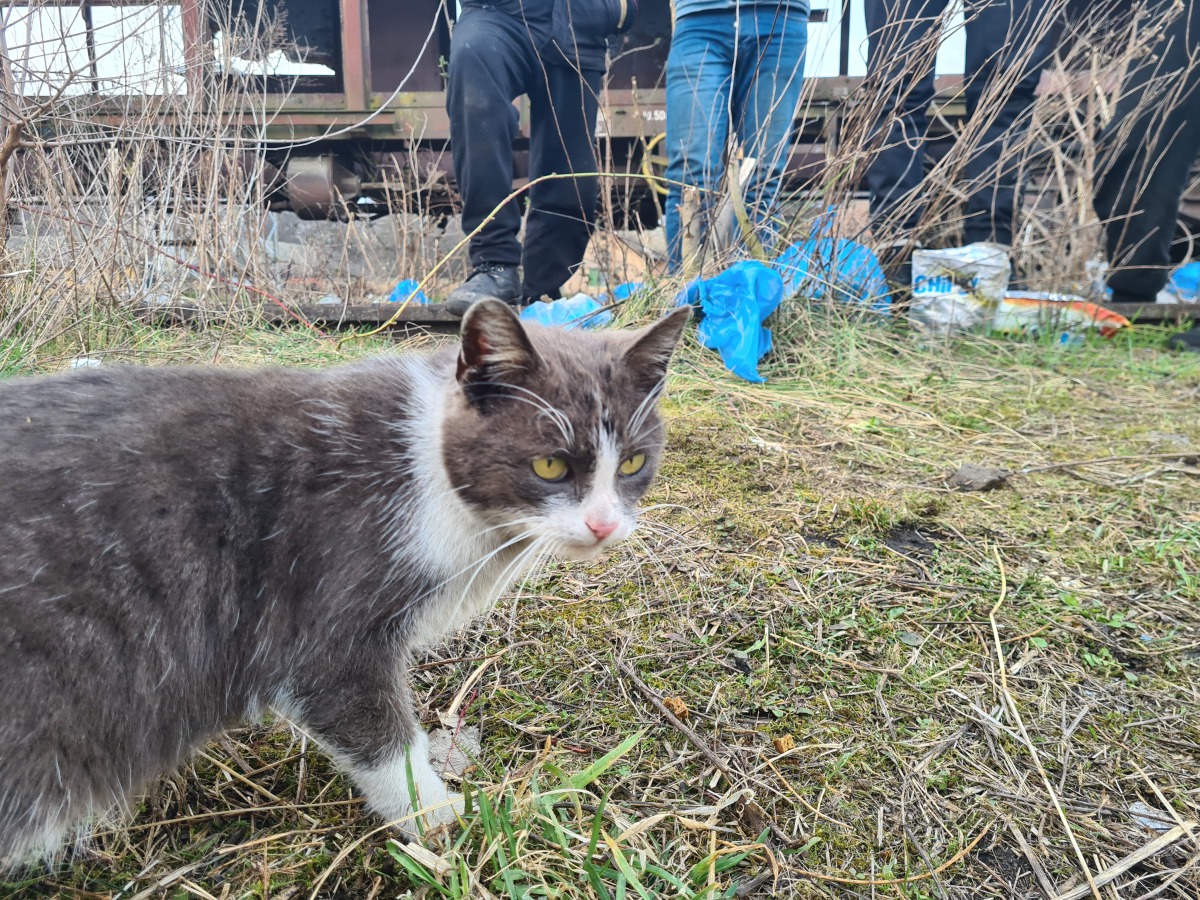
    The cat that lives with the minors in the train carriage with the youn boys, all from Afghanistan in the background.

    An old factory outside of town has many people living around. It is mostly Arabic speakers. There can be over one hundred people here but over winter there is on average of about 40-60 people. There is a large amount of rubbish here and a massive rat problem. A few weeks ago, part of the factory where people lived fell down, luckily no one was hurt.

    Old abandoned buildings at the factory where many people on the move live, North Serbia

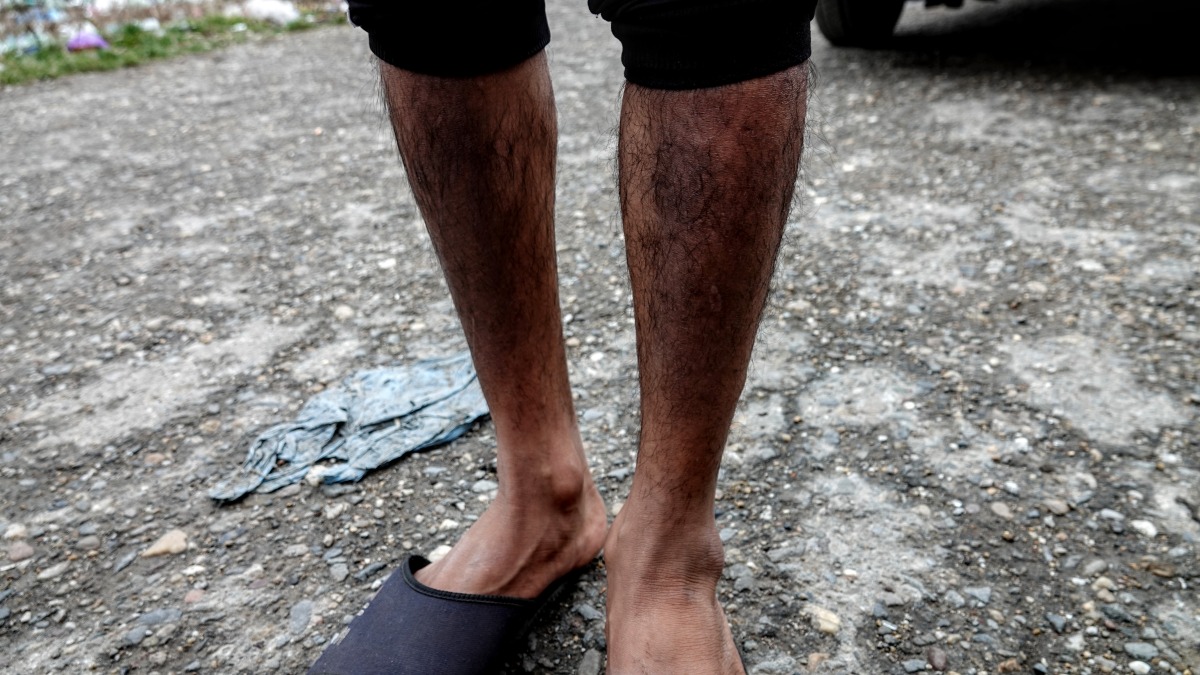
    Here a group of young men from Syria who were attempting to cross the border at Kladusa, Bosnia spoke at length about how they had been pushed back and beaten so many times by the Croatian police that they decided to come to try at this border instead. They also experienced this same brutality from the Hungarian police. Here, a young man shows his bruises on his shins following the Hungary authorities catching him, then beating them with batons before pushing them back to Serbia.

    Bruises on the shins of a young man from Syria who was beaten by the Hungarian authorities, North Serbia.

    Majdan

    Majdan is a village on the Serbian/Romanian/ Hungary border which has become an increasingly set route in the winter of 2019/2020. During this time, pushbacks were mostly unheard of so POM’s didn’t ever collect at the border in squats attempting the game, as the passage into Romania was accessible. It was during the summer of 2020 that reports of Pushback materialised and POMS started staying in abandoned houses and a milk factory in this area to attempt the game.

    We see a lot of police brutality wounds here mostly due to the Romanian police. People try and get around the fence on the Hungary border by crossing into Romania and then moving upwards. There seem to be more broken bones due to police brutality here than in any of the other places. It is also very poor living conditions with no access to running water and with the nearest official camp fifty kilometres away.

    People on the move collecting outside the milk factory as a distribution happens, Majdan North Serbia.

    Arabic speakers live in an abandoned milk factory in poor conditions in tents within the building. There are normally approximately fifty people here but this will continue to rise as it gets warmer. There are so many reports of violence from the Romanian police during pushbacks where they use tricks of humiliation as well as violence to try and deter POMs from crossing the border here into Romania.

    Additionally, Romania, during pushbacks are denying the people fleeing persecution in Syria and Iraq, the right of claiming asylum. Instead, they were taken to the bordered and told “no asylum here” and whilst being beaten, robbed, their personal belongings destroyed and in some cases attacked by dogs.

    This is another place, where if POMs are handed over to the Serbian police by the Romanian authorities after they are denied the right to claim international protection, they receive a Decision on Return, giving them thirty days before they can legally be removed from Serbia.

    During some mass evictions in February, a POM managed to conceal his phone. He was on the bus heading south to a camp and messaged to see if it was known where he was going and if there was any assistance for him. He reported a raid at the milk factory by Serbian police. All the POMS were beaten, robbed, hands cable-tied behind their backs and loaded onto buses. They were humiliated and beaten throughout the seven-hour trip south. They were put in a camp and the very next day he left and got the bus back to the north. The polices had slashed all their tents and destroyed his belongs including his asthma inhaler.

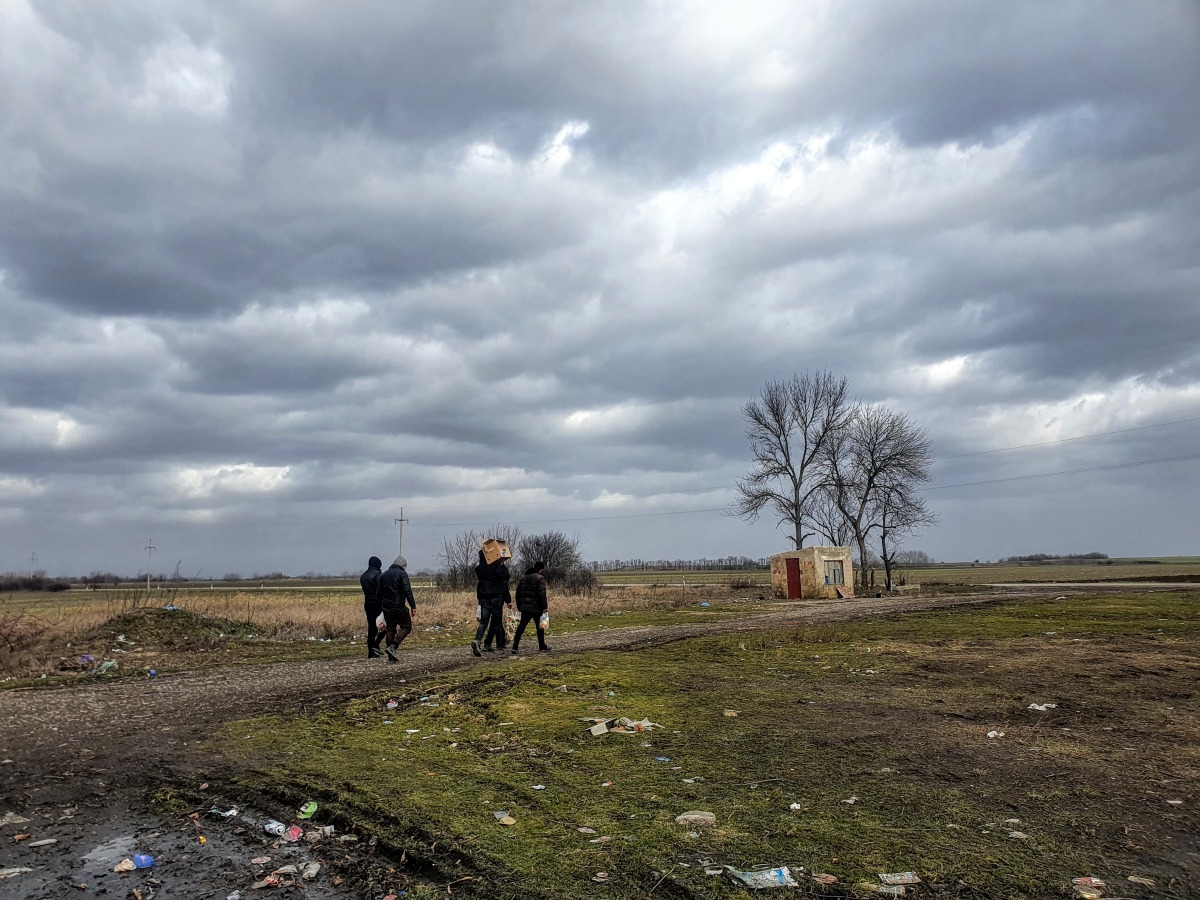
    A group walking back to Rabe with their food supply given to them at Majdan, North Serbia.

    Hotels

    Several hotels across the north of Serbia open up their doors to POMs giving them a safe and warm place to stay but obviously like all hotels, at a cost. Many of these places are criticised by local people and may have to pay money to the Serbian mafia to continue providing accommodation to these people in need. The medical teams visit a couple of these hotels, providing much needed medical care to these at-risk people.

    Many people with serious frostbite wounds were seen over the cold winter months after being forced into paying for a room as they are unable to live in the cold, poor conditions of the squats due to extreme tissue damage. Many people share a room to reduce the cost but the hotels that accept the medical team do genuinely tend to care greatly about the human suffering they are seeing.

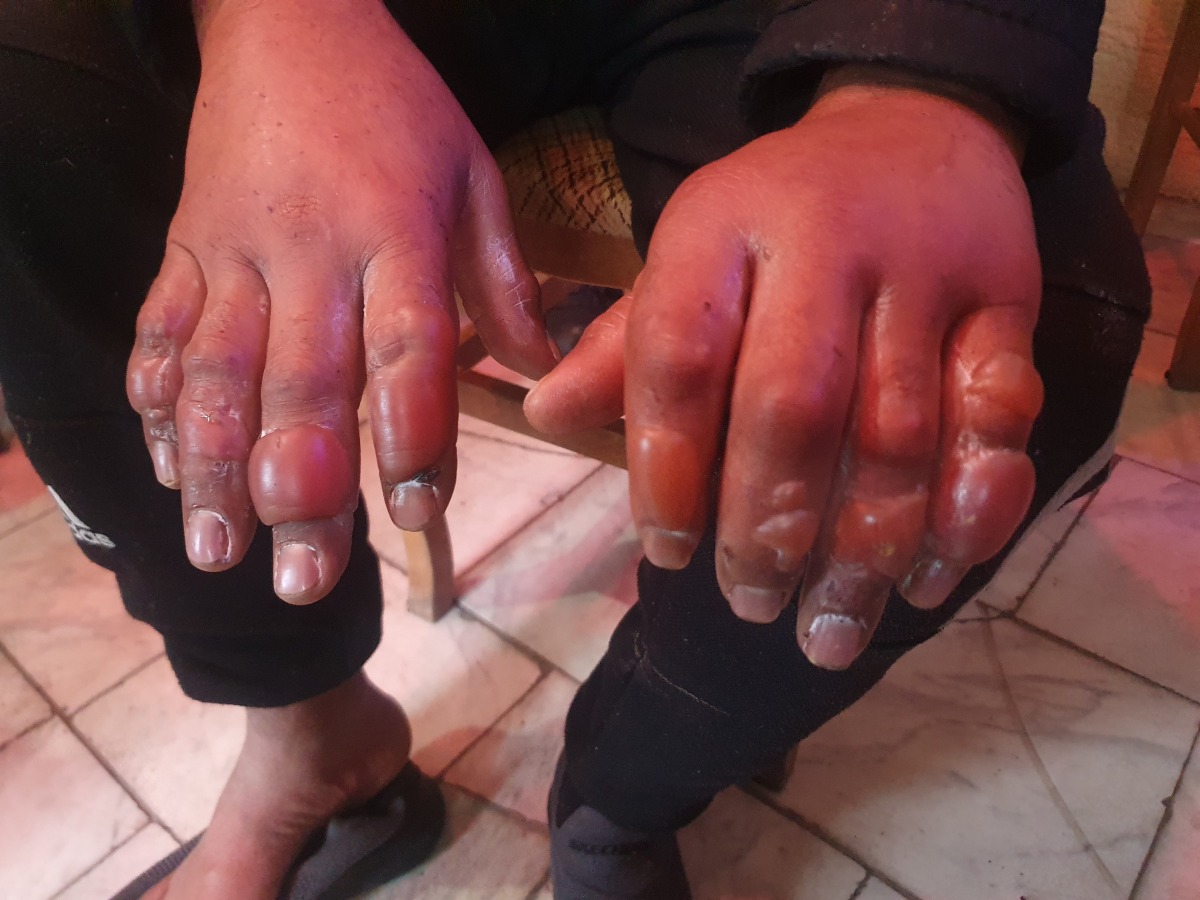
    First photo of frost bite injuries to refugee from Syrias hands in North Serbia. The follow up images are too severe to show.

    A lot of patients were seen this past month with frostbite due to exposure to the cold. A Syrian man has been seen for the past four weeks after having severe frostbite on all his fingers. He is likely to lose the end of two of his fingers to one of his hands and will need support to access the hospital when the time comes to operate.

    The police do come and raid these hotels and like all places they mistreat the POMs, rob them and transport them to camps in the south of the country. Many people return from their trip on the game with injuries caused by brutality from the Hungarian authorities. Again resting their bodies from the beatings before attempting the game again.

    Recently a young man from Syria showed us a dog bite. He spoke about the beating he received from the Hungarian police after he was caught. He thought the torture was over and he was free to go but as he walked away, they released the border dog on him and he received a dog bite to his upper arm.

    Two men from Syria were assessed who had jumped from the fence between Serbia and Hungary and damaged their ankles. As they couldn’t mobilise during their pushback, they had an x-ray whilst in Hungary, and their ankles were found not to be broken. However, as they could not walk at all, they were given blood thinning injections to prevent blood clots before them being returned to Serbia through the gate and left out in the cold on the other side.

    As the refugees from Ukraine are welcomed into the EU borders, these forgotten people stuck at the EU external border of Serbia continue to be the forgotten ones. Left bruised, robbed and traumatised time and time again, frustration amongst humanitarian workers grow as they watch limited but much need funding moved from here to the borders of Ukraine. Our hearts break for the people trapped here, whose only crime is in the eyes of some, is their lack of white European features. I ask myself regularly where is the compassion?

  • What is Freedom?

    Last week, the Russia-Ukraine-NATO tensions reached a crescendo when Russia decided to recognize both Luhansk and Donetsk as independent states. Shortly after that, Putin proceeded to launch a full-scale invasion of the Ukraine.

    The day the news broke I felt great sadness.

    You see, although I’ve never been to either Russia or Ukraine, I have met a great deal of Ukrainians and Russians on my travels and I have a great many friends in that region of the world. Through them, I have been able to learn about both countries’ culture, language, history and incredible natural beauty. It is that personal connection I have to the people that brought me great pain when learning of Russia’s invasion.

    What we often forget is that no matter what geopolitical games are being played at the highest levels, it is the innocent civilians on the ground who are most affected by war. People’s lives are disrupted, families are torn apart and, yes, people die. Whether “enemies”, “allies”, civilians or military personnel, people die. That is the nature of war.

    As I sat down at my desk, struggling to concentrate on the work in front of me, I began to think of my friends in Ukraine who have endured so much over the last few years. I began to think of the young men, guns and ammunition in hand, ready to risk their lives for their country, ready to die at the request of their leaders. And I began to ponder the true significance of this war and how it relates to the overarching globalist agenda.

    This led me to contemplate the nature of freedom and what it means to be free.

    Most people would agree that there is another war being waged on virtually all humanity and that is the war on freedom. The problem is that you could ask ten different people to define “freedom” and receive ten different answers.

    The yogi would say that freedom is not something to be attained, rather, it is our natural state. Freedom, for the yogi, is the very nature of the Self, something that can never be taken away. The problem is that it’s veiled by ignorance. For the yogi, spiritual practice is a way to remove such ignorance, and shatter the illusion that we are not free.

    The monotheist would disagree with the yogi, claiming that freedom comes when evil has been defeated, and that siding with God is the first step to nullifying such evil. This dualistic position sees “evil” as originating from some greater power. Therefore, devotion to God is the only path to complete freedom.

    At this point, the Buddhist might decide to chime in, arguing that, in fact, there is no independent self and therefore there is nothing that can attain “freedom”, and no “god” that can grant it. Rather, he might say, we should focus our efforts on removing suffering and aligning our actions and thoughts with the teachings of the Noble Eightfold Path (the Buddha himself taught that we should identify the nutriments that feed our suffering and make an effort to remove them).

    The lawyer might define freedom as the absence of legal and political restraints; he may see freedom as a right that enables one to be exempt from the arbitrary exercise of authority in the performance of certain actions.

    The philosopher, on the other hand, might see freedom as being synonymous with free will – the ability to make spontaneous choices that are not predetermined or fixed by nature in some way. And he may question whether such a thing even exists at all.

    Do you see the problem?

    Fighting for freedom is difficult when everyone has a different take on what freedom is and what it means for the individual.

    So how should we go about answering the question “What is freedom?”

    It seems to me that when tackling such a philosophical question, we must start by defining what we are talking about. When we speak of being free, are we talking about being free from some unpleasant reality or some inconvenient truth? Or are we talking about total and utter freedom?

    Most of us want to be free from pain, free from unhappy experiences and negative emotions while still clinging to our ideologies, beliefs and identities. But therein lies a problem, for, “freedom” implies the absence of any defining boundaries, including those created by our own psychological sentiments.

    Therefore, we can’t probe the nature of freedom without asking the fundamental question: do we really want to be free? It would appear that being free from something is different to being completely free.

    Freedom, by its very definition, requires no ideology, revelation, stimulus or special knowledge. Perhaps we could describe freedom as an inalienable right, bestowed unto each of us by virtue of being born into this world. Thought about in this way, freedom becomes our source of power.

    Striving to be free from something is a reaction to an unpleasant situation, such as an authoritarian leader, a debilitating illness, a toxic relationship or a war. Dare I say, this desire is built into us. It’s part of our evolutionary makeup, it’s a survival mechanism. Being free from negative influences brings temporary relief, which is good in itself, but it’s not freedom.

    Therefore freedom cannot come from reacting to your environment. That is instinct, that is self-preservation, even desperation. Freedom, it stands to reason, must come from action that is entirely self-initiatory, without deliberation or cerebration.

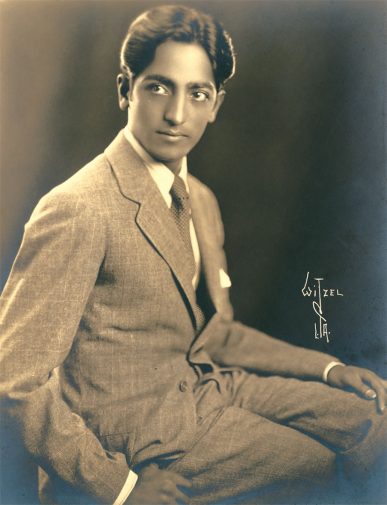
    Krishnamurti in the early 1920s.

    In a previous essay, I wrote about the conversations between philosopher Jiddu Krishnamurti and quantum theorist David Bohm, two men who thought an awful lot about the concept of freedom. I will lean on their insights once again here to help us probe deeper into the nature of freedom and how it relates to the mind. Here is a short extract from one of their many enlightening conversations (emphasis added)[1]:

    K: I have been watching for many years people attempting to become free from certain things. This is the root of it, you understand? This psychological accumulation which becomes psychological knowledge. And so it divides, and all kinds of things happen around it and within it. And yet the mind refuses to let go.

    DB: Yes.

    K: Why? Is that because there is safety or security in it?

    DB: That is part of it, but I think in some way that knowledge has taken on the significance of the absolute, instead of being relative.

    K: I understand all that, but you are not answering my question. I am an ordinary man, I realize all this, and the limited significance of knowledge at different levels, but deeper down inside one, this accumulated knowledge is very destructive.

    DB: The knowledge deceives the mind, so that the person is not normally aware that it is destructive. Once this process gets started, the mind is not in a state where it is able to look at it because it is avoiding the question. There is a tremendous defensive mechanism or escape from looking at the whole issue.

    K: Why?

    DB: Because it seems that something extremely precious might be at stake.

    K: One is strangely intelligent, capable or skilled in other directions but here, where the root is of all this trouble, why don’t we comprehend what is happening? What prevents the mind from doing this?

    DB: Once importance has been given to knowledge, there is a mechanical process that resists intelligence.

    At the beginning of their exchange, Krishnamurti makes the observation that knowledge itself can block us from attaining freedom (he goes so far as to call it “destructive”). Why? Because it distracts, it fragments, it fractures.

    Knowledge, which is nothing more than information, can influence our thinking and manipulate our actions. That is the entire premise of psychological warfare.

    Bohm’s next statement is supremely important, “I think that knowledge has taken on the significance of the absolute instead of being relative”. Bohm notes that knowledge is given too much stake in modern society, an incredible statement for a physicist to make. But he is right, knowledge is seen as a vehicle for greater and greater achievement. Knowledge fuels technology, progress, and material gain.

    Looking deeply at our present world, it’s clear that we do not live in a society that is conducive to freedom. Knowledge, which is binding, is put above freedom. Knowledge is “sold” to us as a way of getting a good job, progressing up the corporate ladder, earning a higher salary and effecting lasting change in the world.

    But knowledge does not bring freedom because knowledge can be controlled, twisted, contrived and manipulated.

    Krishnamurti, too, was critical of this quest for knowledge and condemned competitive education systems for engendering fear. He also noted that knowledge was necessary for accumulating memory, which forms the basis for thought.

    While Krishnamurti recognized the necessity of thought (and therefore knowledge) at certain levels, he was very clear that when thought begins to project itself psychologically as the future or the past, this creates fear which in turn dulls the mind, leading to inaction.

    And as we discovered, attaining freedom requires action (even the Yogi would somewhat agree with us on this point, as he would remind us that spiritual practice is necessary for lifting the veil of ignorance).

    Krishnamurti then asks Bohm why people cannot see the tremendous destructive potential of knowledge. According to Bohm, the answer is simple: because knowledge deceives.

    Again, think about psychological warfare, think about how knowledge causes people to do things that undermine their own physical and mental health. Think about how knowledge can compel people to follow bloodthirsty tyrants, how it can compel people to kill their neighbouring brothers and sisters.

    Bohm goes on to state that within the mind is a strong defensive mechanism, which often leads one to neglect the potentially destructive nature of one’s accumulated beliefs. Bohm’s insights ring true, for, as we have seen, all throughout history people have been willing to sacrifice everything in defence of their chosen ideology. The nature of the mind is such that it always wants to be right.

    Perhaps this defensive mechanism is driven by fear – the same fear that causes people to deny unwanted realities (or brand them as “conspiracy theories”).

    When Krishnamurti asks Bohm why this is, he responds, “Because it seems that something extremely precious might be at stake”. Perhaps it is this seemingly “extremely precious” thing that becomes a shackle, preventing one from being completely and utterly free. And perhaps this seemingly “extremely precious” thing is our conditioning, our programming, our political allegiances, our self-identity.

    Krishnamurti then asks why, as human beings, we can be so skilled and capable in so many areas and yet hopelessly clueless when it comes to discerning the destructive potential of our own psychological accumulations.

    Bohm’s answer is thought-provoking. He says the importance we give to knowledge initiates a mechanical process that resists intelligence. Mechanical processes are machine-like, devoid of emotion, devoid of deep insight and most importantly, reactionary.

    But it’s Bohm’s use of the word “intelligence” here that is most interesting. After all, Bohm always chose his words extremely carefully. He was not one to use a word without being absolutely clear about its meaning.

    As it turns out, the origin of the word ‘intelligence’ is the Latin ‘intelligere’ which means ‘to read between’. In other words, intelligence refers to one’s strength of discernment, one’s ability to “read between the lines”.

    Is it the cultivation of intelligence that leads to freedom? Perhaps.

    If we take that to be so, then it stands to reason that freedom is a state of mind – one free from the boundaries of belief, ideology and fear.k

    Freedom is the ability to doubt and question everything without any form of dependence, conformity, authority or tradition.

    Feature Image: Rosa Parks being fingerprinted by Lieutenant D.H. Lackey on February 22, 1956, when she was arrested again, along with 73 other people, after a grand jury indicted 113 African Americans for organizing the Montgomery bus boycott.

    References

    [1] Jiddu Krishnamurti & David Bohm. The Ending of Time. Chapter 11: “The Ending of Psychological Knowledge”

  • Spina Bifida Parents Demand Treatment

    The HSE, and health care access more generally in Ireland, has never been under such scrutiny as has been the case in recent times. From the handling of the pandemic to the chaos witnessed during last year’s cyber attack, we now face recent revelations about utter confusion in the handling of funds and a recruitment crisis, exposed in leaked tapes published by the Business Post.

    HSE CEO Paul Reid also admitted in a recent News Talk interview how, particularly recruitment issues, were “not going to be solved in one year.”

    It is reasonable to assume that addressing structural dysfunctions in health services will take time, but we often forget the real impacts, and often irreversible damages on our most vulnerable members of society, caused merely by the passage of time. This applies especially to the treatment of complex conditions requiring a multi-disciplinary approach.

    A most striking example is the effects on those children awaiting treatment for Spina Bifida/Hydrocephalus, and their parents.

    We recently spoke to Amanda Coughlan Santry, the co-founder of the parent-led advocacy group Spina Bifida & Hydrocephalus Paediatric Advocacy Group, which has been active since 2017. It raises awareness around the lack of access to care for children affected by the condition, and actively engages with the institutions to address what seems one of the worst failings by the State in contemporary Ireland.

    Amanda, along with other parents Una Keightley, Stefania Opinto, and Orlaith Maher Lalor, joined us for an in-depth interview which we hope can draw further attention to the current situation.

    The group have recently launched a website www.sbhpag.com in which sixty-nine children’s stories are presented. Here one can discover the scale of the challenges surrounding their access to treatment.

    We heard of children being left on waiting lists for surgeries for over a year for treatments, which in other European countries are urgently attended to. There have been years of complaints, which went for the most the most part unanswered and, most distressingly, in the last few months, parents of children in pain, have felt compelled to refuse to leave A&Es for days on end until their children were treated.

    Daniele: Can you tell us more about this condition?

    Amanda: Spina Bifida is described as one of the most complex conditions compatible with life; a baby’s spine and spinal cord does not develop properly in the womb, causing a gap in the spine. Spina bifida is a type of neural tube defect. The neural tube is the structure that eventually develops into the baby’s brain and spinal cord.

    Most people with spina bifida can have surgery to close the opening in the spine. But the nervous system will usually already have been damaged, which can lead to problems such as weakness or total paralysis of the legs, Urological, Bowel and Renal issues.

    Many babies will be born with or develop hydrocephalus which is a build-up of fluid on the brain. This requires a V.P or a shunt to drain the excess fluid from the brain into the abdomen or the heart.

    There are about approximately 550 children under 18 living with Sb/Hydro in Ireland. Ireland has one of the highest rates of neural tube/SB birth rates in the developed world.

    Daniele: Can I ask you for a little bit of context to give an idea of the extent of the services needed?. What are the types of care that your children need?

    Amanda: Our children need proactive care and what they are receiving is often reactive care via emergency intervention. This is often too late and results in long term damage and loss of function. These children need timely access to care particularly in relation to Orthopaedics, Urology, Ophthalmology, Neuropsychology and Neurosurgery.

    Daniele: How are these types of care being delivered in Ireland and is the capacity in the health service enough to address the scale of the problem in Ireland?

    Amanda: Currently the care in Ireland is sporadic, chaotic, under-funded & under-resourced. Some children have access to a Multidisciplinary Spina Bifida Clinic, others do not. There is no clear pathway of care for children living with Hydrocephalus alone. An annual MDT SB clinic is international best practice. We estimate 85% of SB children are not receiving this and the percentage is higher in children born prior to 2009.

    Daniele: I gather that the waiting times are causing actual daily pain and suffering. If someone breaks a bone or a dislocation, he gets treated in a fairly short time. How’s that different from the pain that your children suffer? And what happens if you go to the A&E?

    Amanda: I know of a child that received her surgery last month because the mother took the drastic measure of taking her daughter to accident and emergency and refusing to leave. She dug her heels in the A&E in Temple Street, until she was admitted. And once she was admitted sat for two and a half weeks before the child had her surgery.

    In that process, the CEO of the National Children’s Hospital Group, Joe Gannon, subsequently wrote to one of the politicians in government who had been trying to fight for this child’s case, and told the politician that she was currently an inpatient and that she was going to have her surgery on the 17th of January.

    He made it sound that it was a planned admission and that she had been given a date and they had come in.

    Actually what happened is that the mother refused to leave until her daughter’s medical needs were met and also the child did not have her surgery until a week later. The mother is very grateful to all the doctors involved as they all told her that she was doing the right thing not to leave and were very supportive. She was supported in that sense by us as well but she should have never had to take such a drastic step.

    We’ve had another number of families that have had to do this since last September.

    Another mother went in on a Saturday with her son, who had dislocated hips for four years, the child is six, and she refused to leave until they were admitted. And once they were admitted, they couldn’t see the surgeon because he wasn’t there. They refused to leave and sat there for 10 days until their child had the surgery. 

    Daniele: How did your organisation come into being?

    Amanda: We’re all parents of children with spina bifida or hydrocephalus that came together to advocate for better services for children, under the age of 18, living with Spina Bifida/Hydrocephalus in Ireland.

    Our group was formed in 2017 and have been trying to work in a proactive and collaborative manner with all relevant stakeholders since then.

    My own son was one of the children failed, he sat on a waiting list from 2014 to 2016, and by the time he’d seen a spinal surgeon in 2016, we were told it’s too late.

    So my son lives with inoperable scoliosis and he cannot be helped by this campaign or anything else but I wanted to do something to stop this from happening to other children. Una Keightley was one of the very first to come on board when we formally launched the paediatric advocacy group.

    Daniele: Una Keightley, what pushed you to take a more proactive role in dealing with the issue?

    Una: I suppose it did become quite apparent that no matter how many letters you wrote, like what Amanda had said, the situation didn’t improved. She wrote to everyone, she had highlighted it. And it just really concerned me. And I’m a health care professional. I’m a radiation therapist and it was just unbelievable to me that this was going on. And I suppose at that stage my child was younger when we came together. Once we talked to more and more parents we realized that people were actually lodging complains but they were going nowhere.

    So we started to proactively inform the powers that be and Children Health Ireland asking them to do something about it.

    Amanda: There is a cohort of children born prior to 2009 who had no access at all to this to the Spina Bifida team in Temple Street Hospital because there was no urologist on that team. So it was decided it was safer to leave the children in Crumlin Hospital and move them at a later stage. A urologist didn’t come onto the team at Temple Street until 2014, and the children were never moved. So a lot of our children were receiving inadequate services are no service at all.

    We highlighted this problem in 2018 with the CHI board. In that meeting, they asked us, our advocacy group, to go back to the families and identify whether they felt that they weren’t receiving a timely access to services or any services at all. So we did, which was a big job being undertaken because we’re volunteers.

    There was also a cohort of families who thought that their children were being treated but many other that did not.

    Una: In the beginning of 2019, we gave Children’s Health Ireland a list of 133 families and children who felt that they weren’t receiving a proper service. There was then so many e-mails back and forth between Amanda and CHI. We asked them: When can we meet? What are we going to do about this? And the answers were like: “We’re verifying the list.” “We are analysing the list.”

    We have screen shots of these emails.

    That one way communication continued for probably 18 months until, after March 2020 they just ignored us.

    Entering 2021 we felt we had to do something but, on top of that, I need to say that I suppose a lot of parents were fearful. If they talk out, maybe the care standard that would be provided to their child would be diminished. Now, I wouldn’t have that fear, and I don’t think any of us would.

    It was especially after Professor McCormack and Prof Connor Green had presented before the Oireachtas health committee in November 2021 that things were very desperate, that it became blatantly obvious that it was a systemic failure for our children.

    It was then when we decided to publish online our children stories. Which is something that distressed us greatly but we felt we were left with no choice.

    We had requested to meet the Minister ever since he took up office. He wouldn’t meet us. The Minister for Children wouldn’t meet us. The Minister for Disability wouldn’t meet us. Nobody would take up and highlight what was happening to these children. So the parents as a group decided that we were going to have to do something fairly drastic to get their attention. So that’s what we did.

    Daniele: I have noticed an increase in media attention to the issue in 2021, also thanks to your campaigning. Are you hopeful that increased scrutiny could move things in the right direction?

    Amanda: Yes, people now view our children as the vibrant individuals they are as opposed to a number on a list or a medically complex child that is unrelatable. The support received initially from media, County Councils, and local representatives across all 26 counties has been immense. This has stemmed from the proactive and

    drastic measures taken by the Paediatric Advocacy Group and the families to highlight the failures in care for their beloved children.

    People have been shocked by the current state of medical neglect that has

    been inflicted by the Irish state on our children. They are not willing to allow a further generation of children to be failed and to turn a blind eye to the historical neglect that has been allowed to happen.

    Daniele: After years of campaigning, countless letters to TDs and local councillors, you have finally met with Minister Donnelly along with Spina Bifida Hydrocephalus Ireland and other stake holders last February in relation to the abnormal waiting times that are now in place for paediatric orthopaedic treatments. Plans have been presented and funding – as much €19 million that the HSE made available to CHI –, albeit with little information on the specific break down. The Minister also set some clear goals, including to limit the waiting time to four months at first with the aim for this to be reduced to zero, and to provide a number of additional treatments. What’s the reaction from you and your organization to these pledges?

    Amanda: There aren’t many details released yet, and there is still a draft in formation. What they told us is that they have ring fenced €19 million for children with spina bifida, but also to children with scoliosis.

    They have also said that clinically no child should wait for more than four months for surgery. So that is very ambitious and while we’re glad about these pledges, we’re not blindly trusting. There’ve been promises made before not only to us, but to the scoliosis advocacy groups as well. So yes, the funding is great, but we need to see that the funding is going to make a real difference in these children’s lives.

    One of the government target is to “treat an additional 107 Spina Bifida cases” but we don’t know how they come up with that particular number. There is no database within CHI of how many children are living with the condition. So how do you come up with a number if you don’t know how many children you’re treating, do you know? So we’re a little bit dubious about it and we don’t want to be tied to that number. What we want is to fund and to reach as many children as possible.

    Daniele: Did the Minister agree to regularly update your organisation while they endeavour to deliver these pledges?

    Amanda: We do have a commitment from Stephen Donnelly and Children Health Ireland, to regularly engage with us and we do now have a contact with one of the Minister’s special advisers. So if an issue comes up or we want to speak to Donnelly, all I have to do is give the special adviser a ring and he will relay any information and if need be  we speak to the Minister directly. So that’s the promise we have. So we are we’re optimistic and he seemed very genuine when we spoke to him. But don’t intend to take the pressure off until this gets sorted. We intend to stay very, very focused.

    Daniele: Are there any kind of league tables or other international comparisons that can be drawn on?

    Una: It would be difficult because we have such a high rate compared to a lot of the world. What we do know is that in Ireland it is not the expertise that is missing but proper funding and organization. Cases are picked up in pregnancy here more than they are in other countries, probably because the stenographers are looking for them due to the high incidence.

    Daniele: What kind of challenges are you dealing with as mothers and what are the support needed for families at large?

    Stefania: My daughter’s name is Aurora and she’s just turned three. From her birth in February 2019 until August 2019 she was in hospital as she was born with Hydrocephalus.

    I found out about that on my 26 week scan here in Ireland and to be honest with you I didn’t know what it  meant so I had to do my own research. They didn’t explain to me exactly what it was. So I had to go back to Italy, and I went to the hospital in Genoa to try to get different opinions.

    Once she was born, here in Ireland, she needed to go straight for surgery because there was too much pressure on the brain because of these fluids. And so we got transferred first to Temple Street, and after two weeks to Crumlin.

    I just want to clarify that doctors and nurses were fantastic to me, to my husband and to Aurora. She wouldn’t be here if the surgery hadn’t been successful.

    Having said that there definitely gaps in the communication between the two hospitals. They were relying on the parents to get the information, which is not ideal because I’m not a doctor and that created frustrations and fears.

    When our daughter was released from hospital we were pretty much left to  our own devices. She had just one appointment in Temple Street during  her first year. And after that, I’ve been told that I needed to wait another year. Initially I thought that such a long time between visits was just because she’s doing well but It’s not the case. There was lots of information that I had to get elsewhere, and not from the professionals. In terms of psychological support for parents, we were very much left on our own. So you either cope and become resilient or probably you’re not going to make it mentally. I’m grateful I found this group and that these  ladies became my source of knowledge.

    Una: In terms of the financial support as well, like. Many of us received no financial support because our husbands or partners were too high earning So although your child has very high medical care needs – you could have a child who’s on oxygen 24 hours a day – you won’t get one penny from the government.

    Orlaith: In my case, my daughter is 20. We were under a multi-disciplinary team but with only three consultants in it. And after 2008, Crumlin finished up its spina bifida clinic. We then ended up being spread over four hospitals which don’t share files. So as Silvana said earlier, it is up to the parent to bridge the gap.

    When she was born she was very ill for the first four and a half months. We lived in the hospital paying for parental accommodation.

    I had my dream job. I worked in the Irish Times and I was part of the first team to ever bring in supplements into a broadsheet newspaper. I went on carer’s leave and eventually ended up leaving my job.

    There was no support for children with hydrocephalus. It’s not considered an intellectual disability. So, you know, you’re very much left on your own. My husband had a good job. I’ve never received Carer’s allowance after the first four or five months that we spent in hospital with her.

    When my daughter was seven they took away her medical card. In this country, when the medical card is taken away, your medical hardship scheme is directly attached. So a lot of the equipment you need you have to pay for it yourself.

    At nine she had three failed shunts, and two brain bleeds ending up spending nearly four months in Beaumont Hospital. I had to pay for my parking every day, for my accommodation and my food. Thousands of euros. I can’t claim back anything on that. And we still had to pay our bills and our mortgage.

    There’s a lot of stress around dealing with the child that’s sick and sure, you’re not failing your special child as you’re doing the best you can. On top of that, you’re fighting for everything. You’re fighting for therapy, you’re fighting for access to care, you’re fighting for basic things like my daughter’s incontinence and the allocation of nappies. It compounds into a heavy psychological weight. It’s not the disability alone, it’s the lack of support; the lack of access to timely care and that constant heavy worry all the time. They need help. I can’t get them help. I can’t force my appointments. I can’t force the consultant to do this or that. My daughter has now aged out of paediatrics and there’s no transition pathway. So now my job is going to my GP all the time. She had her first orthopaedic appointment in five years two weeks ago, and that took 16 adult consultants to refuse her before we got that orthopaedic consultant. So there’s lots of stress on you all the time.

    Here in Ireland, we have great nurses, we have great doctors, and I wouldn’t made it without them, but they’re not resourced and there doesn’t seem to be a willingness to accept we have such a high rate of these cases and that it needs to be invested in.

    Amanda: In the space of 18 months, my son went from needing care to becoming completely inoperable. For the first couple of years. He had a lot of appointments. Then it that stopped.

    My relationship with my partner deteriorated and broke down, very early on due  to the stress and the strain of trying to care for a very medically vulnerable child. I suddenly became a single working mother with two children, one with massive medical need and not financially supported by the state. I worked full time, paid a huge amount of rent. I’ve subsequently remarried and have gone on to have other children. Thankfully, my husband came into this with an open eyes.

    We wouldn’t change our children, what we would do and what we want to do is to change the services for them. They can become independent within their capabilities, and live their lives to the fullest without the need to be in pain or to have their parents struggling and fighting for services.

    https://twitter.com/BillyRalph/status/1458052402372923392

    Daniele: Over the last two years of pandemic, and with the HSE coming under cyberattack, your stress levels must have been almost unbearable. Having said that it is quite evident that these dysfunctions were there prior to these. How have you coped?

    Amanda: I’ve spoken to numerous families about this and we acknowledge that the pandemic and the cyber-attack happened, It was very scary and nobody had to protect our children more than we did.

    But what happened in the pandemic? The small amount of services and extra curriculum activities that our children were receiving stopped.

    Physiotherapists, occupational therapists were all redirected to COVID services and we understand the need for that. But there was also a huge recruitment drive by the HSE up thousands of health care professionals, like myself were ready to help but weren’t called up.

    We know now that during the pandemic, orthopaedics accident where less frequent so why weren’t our children’s needs met within this timeframe when obviously there was the space to meet them given the cessation of extracurricular activities?

    As parents,  we would call the pandemic and the cyberattack, the new great excuse for not giving us an appointment.

    Our children didn’t just freeze their conditions for two years or three years. You know, they continue to deteriorate.

    Stefania: My daughter Aurora, she has malformation of her ribs and she has never seen an orthopaedic surgeon in the last 3 years.

    It’s not that the doctors aren’t aware. Her Cardiologist took her case to his heart and did his best to advocate within Crumlin Children Hospital and he really fought for me but it’s not his job to organize a better multidisciplinary care structure.

    Daniele: That would be the job of the administration I presume. To conclude, how do you think Irish society perceives disability and how can awareness be promoted?

    Amanda: Irish people generally would be viewed as very laid back and positive.

    Therefore, there is an element that “disability cannot happen to me!”. It is only with an ageing population, inaccessible public transport, inaccessible housing, and educational facilities that the message is relayed to the ordinary person about how vast the inequality is between the non-disabled & disabled communities in Ireland.

    Over the last few decades Ireland has become a more diverse nation. Our children are exposed to more languages, ethnicity and religions than has ever been present on this island.

    These are the children of a new and inclusive Éire and as such, they do not have the same prejudices and intolerances as those who have gone before them. Our children living with disabilities are accepted by their peers and integrated more within society.

    It is deeply distressing for us that the relevant stakeholders within government and the Irish health care system, have not adopted the same attitude and continue to treat our children like second class citizens.

  • On the Nature of Evil

    I met Vladimir Putin once. 

    Or, at least, I was in the same room as him, no more than thirty or forty  feet away, for several hours. Not much further than Macron recently in Moscow.

    In August and September 2000, the last time Ireland was lobbying for a seat at the UN Security Council, I was an intern of the Irish diplomatic corps at the United Nations in New York.

    My job was to record the speeches of the Heads of State. I was present for the speeches of the heads of state and government at the Security Council and General Assembly, including Bill Clinton, Yasser Arafat, and Fidel Castro.

    I felt, even then, that Putin’s energy was very dark – a psychopath perhaps, devoid of empathy.

    There is no doubt in my mind that this war is morally unjustifiable and wrong, despite the questionable wisdom of expansionist Western foreign policy (from a Russian perspective).

    At the same UN summit in 2000, Tony Blair gave the most incredible speech. I was taken in, hook, line and sinker, by his incredible rhetoric and passion. His forked tongue only became apparent later. How could we be so manipulated?

    A false representative of the light you could say. That which appears to be of the light, but is deceiving.

    Whether by intent, or design, is another question, but nonetheless he is a man with the blood of many on his hands. Of course, he can still argue that the war in Iraq was justified.

    That’s what they alway say, these power-hungry men, as the blood of innocents flows. For the victors, that is how history is written.

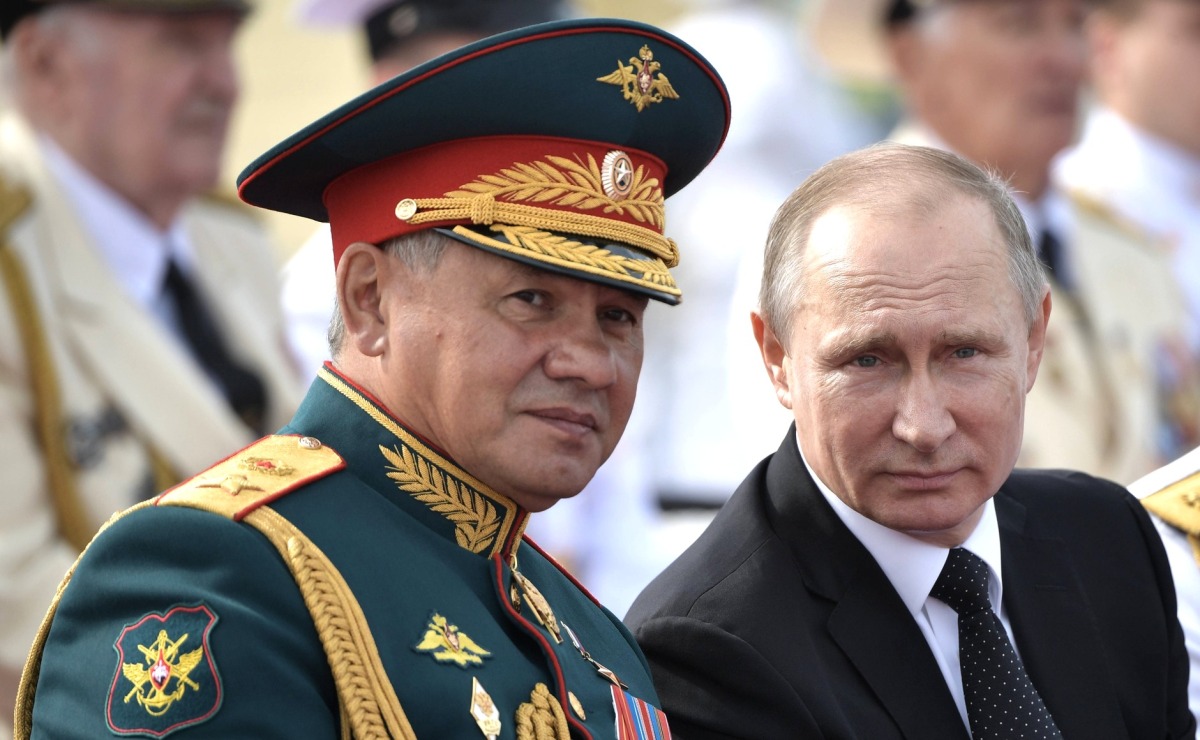
    Putin and his long-time confidant Defense Minister Sergei Shoigu.

    Evil in the World

    There is no doubt in my mind that evil exists. The light exists, the dark exists, and the false light exists. The false light is that which masquerades and deceives: a complex Luciferian archetype.

    We like to believe that we are on the side of good, and the ‘other’ side is evil. The truth is much more complex, and permeable. In a world where we like to define things as black or white, there are many shades of grey.

    Good people can do unspeakable acts of evil, while even evil acts can have positive consequences.

    Anger is sometimes a necessary and appropriate emotion when our boundaries are violated, on a personal or national level. Sometimes, in the face of unprovoked aggression, the only option is to fight back.

    When we are feeling strong emotions, however, we are open to manipulation. Any time I feel a strong emotion of anger or fear due to a situation in my life or through what I see in the media – as I am feeling now – I ask myself, am I being manipulated? If so, by who, and for what end?

    Who will benefit, if due to my anger and dismay at the brutal and morally wrong treatment of Ukrainian civilians, I somehow begin to fear or hate Russia or Russians?

    What if I decide, in my anger, to fan the flames of hatred, anger, and war, rather than douse them? Are we to support the spread of this conflict, rather than hope for peace?

    If there is one thing I have learnt over many years of diving deep into the metaphysics of light and dark it is that there is much that we are unaware of. We are all pawns in a greater game than we are aware of, you could say.

    If it turns out that the game is rigged, and no matter which side seems to come out on top, the house always wins, then the only option is to stop playing the game.

    Hitler’s prophecy speech of 30 January 1939.

    What is the Influence of Evil?

    The genius of evil is that it influences us through our deepest fears and weaknesses. If, for example, your deepest fear is failure, being attacked, overwhelmed or destroyed. Perhaps this is the result of an unsafe and traumatic childhood.

    This could manifest as paranoia, fear, or deepest shame at the loss of personal or national prestige, as is perhaps the case with a ‘strongman’ such as Putin. This is perceived as a threat to your very existence.

    When some external event triggers this terrible internal fear, the very personal and overwhelming nature of this trigger is how evil influences a person. Evil finds our unconscious hidden weaknesses, and exploits them ruthlessly.

    How do we recognise the influence of evil on ourselves? By hating another person, race, or nation, we are acting under the influence of evil.

    This is the genius of evil: it realizes our deepest fears through the prism of our distorted perceptions. It preys on our weaknesses, separates us, divides us, makes us hate instead of love.

    It is rare indeed, for someone to wake up in the morning saying “today I choose to be evil”. There are also those who can be described as pure evil – consciously evil – in the sense of acting with intentional malice, but these people are rare.

    For the most part, evil slides in unseen, unconsciously, through our psychic blind spots. What lengths would you go to, to avoid your deepest fears? To avoid a perceived existential threat to you, your family or nation? This is how ‘normal’ people do the most terrible things. Evil locates our deepest fear and weaknesses, plays on them, magnifies and exploits them.

    Like a computer virus exploiting a line of faulty code, evil exploits the faulty code of the human race. Shame, fear, anger, and trauma are the gateways into the body, poisons, faulty code, through which evil may stem, if allowed.  These are known as the three kleshas or poisons of Mahayana Buddhism: ignorance, attachment and aversion, from which evil arises.

    Projection of the Shadow

    The great psychiatrist Carl Jung elaborated on the projection of the shadow being the greatest moral threat of our age.

    A threat to the very future of humanity, and one the majority of people are utterly unaware of.

    We psychologically project that which is disowned, unbearable and unconscious in ourselves, onto the other, thereby ridding ourselves of the need to make conscious decisions, take responsibility for our actions and integrate our experiences.

    Thus Jung writes in Archaic Man that ‘Projection is one of the commonest psychic phenomena… Everything that is unconscious in ourselves we discover in our neighbour, and we treat him accordingly.’

    He adds in Visions: Notes of the Seminar Given in 1930–1934:

    Modern people … are ignorant of what they really are. We have simply forgotten what a human being really is, so we have men like Nietzsche and Freud and Adler, who tell us what we are, quite mercilessly.  We have to discover our shadow. Otherwise we are driven into a world war in order to see what beasts we are.

    If we do not acknowledge and own our shadow, we project our inner darkness onto the unfortunate recipients of our projections, as human beings have been doing for millennia of wars and cycles of destruction.

    Ballads of bravery (1877) part of Arthurian mytholog by Lorenz Frølich.

    Mythology and Psychology

    Invariably, humans fall pretty to some great mythology, whether it is nationalism, tribalism or religious belief, which assures them that their cause is just.

    We are not far removed from the Crusaders in this regard, who believed they were saving Jerusalem from heathens – in the twenty-first century as much as in the twelfth.

    The psychological projection of the shadow is how mostly men are capable of inflicting barbarous acts of evil onto the ‘other’, who has generally already been thoroughly dehumanised and demonised.

    Recently, a former officer of the US Navy Seals Special forces, one of the men who led the hunt for Bin Laden, told me how easy an operation this was to undertake.

    He said that one of his main responsibilities in Afghanistan and Iraq was to keep his men in line, reminding them of the humanity of the enemy. In a warzone, how easy it must be to forget.

    In his book on evil The Lucifer Effect, the psychologist Phillip Zimbardo, who also designed the Stanford Prison experiment, wrote:

    I don’t believe anybody’s inherently evil. I believe we’re inherently good. And until they get put in a bad barrel. And there are a lot of bad barrels. A lot of jobs that we take encourage us to cheat, to lie…. If you’re a prison guard, afraid that prisoners are going to attack you and you have to create a false illusion that you’re domineering, you’re dominating them, you’ll shoot to kill then that’s the image. I believe in the goodness of human nature. And it’s being put into situations that corrupts that.

    Zimbardo defines evil as exercising power to intentionally harm (psychologically), hurt (physically), destroy, or commit crimes against humanity.

    From his psychological analysis of the US soldiers at Abu Ghraib who committed atrocities on the Iraqi POWs, Zimbardo shows that evil is situational.

    Like it or not, we all have the potential to be a Nazi prison camp guard in us, given the right situation and dehumanisation of the enemy.

    The Russian people have perhaps a greater understanding of this than most, given their brutal history and capacity for resilience and suffering. As one of their greatest novelists, Aleksandr Solzhenitsyn, put it: ‘the line dividing good and evil cuts through the heart of every human being.’

    Sabrina Harman poses for a photo behind naked Iraqi detainees forced to form a human pyramid, while Charles Graner watches.

    The Red Peril 2.0

    How easy it is for us in the West to demonize the Russian threat, the hapless Slavic soldier from the steppes, conscripted as they have been for centuries to die as cannon fodder in a war they did not want.

    This appears to be a reawakened Communist threat. Indeed, the idea of invading hordes from the east is a deep fear ingrained in the West, since the time of Genghis Khan and beyond.

    In recent times it has been the threat of militiant Islam, the Muslim horde overrunning Europe, but our collective Western shadow is now projected elsewhere.

    In some bizarre, surreal joke of history, we are apparently witnessing Chechen fighters, suffering from severe historical amnesia, from a land so terribly brutalized by Putin, take part in the invasion of Ukraine.

    Likewise, and in a perfect mirror of a paranoid Putin – a dinosaur whose thinking is conditioned by bipolar geopolitics of the Cold War and Great Game of the nineteenth century – the West with its expansionist foreign policy represents a threat to the very survival of his beloved Russia.

    Apparently, this existential threat is to be countered at the cost of total war.

    Ukraine and the West believes it is protecting itself from the threat of Russia, as has proved to be the case.

    Putin and his acolytes believe they are protecting Russia from military encirclement as a result of the eastward expansion of NATO since the end of the Cold War. These have become two disastrous self-fulfilling prophecies. Thus both perspectives have turned out to be valid on their own terms.

    It’s history repeating itself, even so far as Putin making the same strategic mistakes as Napoleon in 1812 and Hitler in 1942 in greatly underestimating the vastness of Ukraine and over-extending supply lines.

    Hitler, of course, committed the same folly in reverse in the 1930s, emphasizing the need for Lebensraum, living space, for the German people, who were apparently threatened by the great Slavic hordes to the east.

    Hidden Forces

    What would you do, if you felt as if your nation or family was under an existential threat, and only you had the vast power to stop it?

    Do you think you would commit acts of evil to ‘protect’ yourself, believing this to be for the highest good in the circumstances?

    There are hidden forces at play here. I use the word hidden intentionally, knowing that some will understand what I am trying to say. Those who have ears to hear will hear.

    How else can we make sense of the ritual of bloodletting that so-called rational actors seem to periodically engage in, most clearly perhaps in the massacres of the First World War, when the most ‘civilized’ of nations sacrificed their best and brightest.

    For what? How could humans behave in such a barbaric and irrational way?

    Human beings often operate like actors on a stage, contending with forces greater than we can imagine. These might be described as the anabolic and catabolic forces of nature, involving endless cycles of growth, death, decay and rebirth.

    My first experience with ayahuasca on Maui, Hawaii many years ago, demonstrated this to me very clearly. For whatever reason, I did not fear looking into the darkness. That night I left the safety of the ceremony and went out alone to stare into the unknown of the dark jungle.

    Instead of fearing the dark, I wanted to understand it.

    Nietzsche warned: ‘Beware that, when fighting monsters, you yourself do not become a monster … for when you gaze long into the abyss. The abyss gazes also into you,’ but this was not my experience. I found that looking into the abyss gave me a greater understanding of the world.

    Jung, so well versed in ancient knowledge and metaphysics, brought these themes to a psychological level, writing

    The sad truth is that man’s real life consists of a complex of inexorable opposites—day and night, birth and death, happiness and misery, good and evil. We are not even sure that one will prevail over the other, that good will overcome evil, or joy will defeat pain. Life is a battleground. It always has been, and always will be (Carl Jung, Approaching the Unconscious).

    The Metaphysics of Light and Dark

    We live in a world characterised by duality – light and dark, good and evil. These are two sides of the same coin; you cannot have one without the other.

    Irrespective of anyone’s spiritual beliefs, you may still find useful insights in spiritual traditions on the nature of evil.

    In the ancient Zoroastrian tradition, it was believed that the universe is a battleground between Good (Ahura Mazda) and Evil (Angra Mainyu). Angra Mainyu is not God’s equal opposite, but the destructive energy that opposes God’s creative energy.

    It is essential for us to remember that this battle is not external to us as humans. It is an internal process in everyone.

    Even in the Bible, Isaiah 45:7 says, ‘I form the light, and create darkness. I make peace, and create calamity. I am Yahweh, who does all these things.’ In other words, according to an Old Testament view, Yahweh (God) is the source of all things, light and dark.

    The Taoist yin yang symbol captures the essence of this most beautifully. The seeds of light grow in the dark, the seeds of dark grow in the light.

    Other metaphysical systems were all too aware of this too – that too much of anything becomes its opposite. The Mediaeval Jewish Kabbalists saw evil as a result of unbalanced force. For example, the benevolent dictator, motivated by the seemingly altruistic aim of protecting his people, can easily become a tyrant. The road to hell is paved with good intentions, as the folk wisdom goes.

    In a tremendously complex world bedevilled by unintended consequences, we are often unaware of the full consequences of our actions, yet we are still responsible for them. A classic example is the arming of the Taliban, formerly the mujahideen, by the U.S. in pursuit of its geopolitical ambitions of bringing about the demise of the USSR in Afghanistan the 1980s.

    In the Bhagavad Gita, one of the sacred texts of Hinduism and a treatise on the ethics of war, we are told that Krishna (God) gave humans free will so they would have the volition to choose love, but ‘impelled by material desires, the souls engage in evil deeds and are subjected to others’ evil actions, as per the inexorable law of karma.’

    Comanche Indians Chasing Buffalo with Lances and Bows, by George Catlin.

    Wetiko

    Jungian analyst Paul Levy, in his seminal work on the origins of evil Dispelling Wetiko: Breaking the Curse of Evil brilliantly describes how humanity is suffering from:

    a spiritual disease of the soul, a parasite of the mind, that is currently being acted out en masse on the world stage via a collective psychosis of titanic proportions. This mind-virus—which Native Americans have called “wetiko”—covertly operates through the unconscious blind spots in the human psyche, rendering people oblivious to their own madness.

    Many traditions speak of a concept similar to that native American idea of wetiko. The Jewish- Christian gnostic mystic tradition, for example, draws on descriptions in the two-thousand-year old writings known as the Dead Sea Scrolls – found in 1945 at Nag Hammadi – of the archons, who have imprisoned the divine spark of human souls in material creation.

    Likewise, the Bible speaks of a ‘counterfeiting spirit’ deceiving humanity. The Tibbetan Buddists speak of humanity trapped in the matrix of samsara, of suffering.

    The essence of evil is that it helps continue the illusion of separation of souls from universal consciousness, from source.

    This is perhaps the deepest symbolic interpretation of the story of Adam and Eve. The fall of matter from spirit, the loss of our connected state of original innocence.

    Evil prevents us from recalling who we truly are. It separates us from each other and from whence we came.

    A destroyed Russian BMP-3 near Mariupol, 7 March.

    What can be done?

    First, on a macro level, the consciousness of the human race must evolve to a point where war is no longer acceptable, for any justification, under any circumstances.

    Otherwise, paranoid, wounded, power hungry men, for it is almost always men who start wars, will inevitably find a justification for their actions.

    As the astrophysicist Carl Sagan said:

    Think of the rivers of blood spilled by all those generals and emperors so that in glory and in triumph they could become the momentary masters of a fraction of a dot.

    It will be necessary to make war an absolute taboo and to ostracize those who participate in it. It may take many generations and even millennia for this to occur, but happen it must.

    Peace must be a conscious choice for humanity. As Margaret Mead put it: ‘Our first and most pressing problem is how to do away with warfare as a means of solving conflict?’

    There are some encouraging signs that in this first European war of the social media age, this may be happening – via the compassion and condemnation of the international community.

    But this cannot only apply to wars started by the ‘other’ side, it must apply equally to wars started by or supported by the West in Iraq, Afghanistan, Libya, Syria and Yemen. Otherwise, Western hypocrisy and privilege continues.

    For this to happen, a global shift in consciousness is required, if not rogue actors will easily take advantage of a more peaceful world.

    It will also require a much more equitable world, one where justifiable grievances can be addressed and resolved equitably, before violence is resorted to.

    Is it naive to believe such a world is possible? Perhaps, but in a world of nuclear weapons, we surely have no choice but to evolve and ensure our long term survival.

    It will also be necessary to change the current structures of power, so that the concentration of political power no longer allows the egos of weak, wounded men to force wars and mayhem on their people.

    As part of this evolution of human consciousness, some form of collective healing will be required to address the psychological wounds of the human race, the majority of which is traumatized as a result of centuries of war and oppression.

    Otherwise, wounded man-children will continue to play out their traumas and pathologies on a world stage; handing these down to the next generation.

    We would do well to remember the indigenous wisdom that the seven generations to come inherit the traumas of the past seven generations.

    Carl Gustav Jung (1875-1961).

    Personal Responsibility

    Secondly, on a micro level, as individuals, we must take personal responsibility for the psychological awareness of our shadows. Becoming aware that we are not always as good as we imagine ourselves to be.

    As Jung put it:

    Unfortunately there can be no doubt that man is, on the whole, less good than he imagines himself or wants to be. Everyone carries a shadow, and the less it is embodied in the individual’s conscious life, the blacker and denser it is. If an inferiority is conscious, one always has a chance to correct it. But if it is repressed and isolated from consciousness, it never gets corrected.

    We need to educate people on the need to make conscious what is unconscious, unhealed, unprocessed, unowned in them, before they find someone or something else to project their deepest fears and darkest thoughts on to. This is of the utmost importance for the survival of the human race, and not talked about nearly enough.

    How can we expect peace in the world when we are at war with ourselves? If we want to change the world, we must first change ourselves.

    Our outer world reflects the state of our own inner psyche, individually and collectively. That our currently external reality is in such dire shape reflects the inner collective reality.

    If we do not mend our ways the great ritualistic dance, the great cosmic game of growth, death and rebirth, construction and destruction, with human beings as mere unconscious pawns, will begin again, as it has for many of the past millennia, but this time with the threat of nuclear annihilation.

    Feature Image: Mushroom cloud from the explosion of Castle Romeo in 1954.

  • Travels in Ukraine 2015

    Frank Armstrong recalls two overland trips into Ukraine in 2015. The first was through the former Czechoslovak territory around Uzhhorod, as well as the former Polish city of Lviv or Lviv. Later that year he travelled by bus as far as Kiev and then east as far as Dniperpetrovsk.

    Part 1 Summer, 2015

    Crossing from Slovakia into Trans-Carpathian Ukraine at the Çop junction, trains from the West halt in deference to the different rail gauges used on the other side. Stalin contrived this to prevent easy entry for invading armies; or escape. Crossing the frontier into the former Soviet Union might instil a little trepidation even into a seasoned traveller.

    Çop train station.

    An illuminating mural in the cavernous train station depicts heroic scenes of a triumphant Socialism. Beyond at the platforms, trains retain wooden benches that recall another age. I knew I had left a rapidly converging Europe when the conductor smilingly declined payment after I presented too large a denomination.

    I was among three other visitors to Ukraine arriving by train from Slovakia, although a border guard told me frequent car trips are made to avail of cheap petrol. The frustration of waiting inside a stationary carriage – akin to a panelled sardine tin – during a heatwave was offset by the friendliness of customs officials who simply checked for contraband medicines. No visa is required for EU visitors but the continued low-level warfare in the faraway east is deterring visitors despite a favourable Euro to Hryvnia exchange rate.

    The River Uzh in Uhherod.

    Borders are often a legacy of ancient battles or coincide with impassable mountain ranges or rivers that deterred conquest and absorption. A change in topography often gives rise to socio-economic boundaries; shifts from upland, semi-nomadic pastoralism to settled arable land bringing larger settlements: different political regimes and ethnic compositions may arise.

    On the road between Uzhhorod and Lviv.

    But twentieth-century Europe brought more artificial borders imposed by distant remote peace treaties or later omnipotent Superpowers, and saw the decline of multi-ethnic empires. Thus, Hungary was reduced from one part of a dual Austro-Hungarian Empire to a disgruntled rump that ruefully surveys its over two million ethnic brethren in neighbouring countries. The hated Treaty of Trianon after World War I was reflected in that country’s alignment with Nazi Germany during World War II. Revanchist Hungary remains a potential source of instability.

    Traditional hay stacks between Lviv and Uzhhorod.

    There is no obvious difference in terrain between Trans-Carpathian Ukraine and eastern Slovakia, and the region contains a sizeable Hungarian minority. Yet as one travels into the surrounding countryside a different agriculture becomes apparent: a shift from the ubiquitous cash crop of maize on the Slovak side to traditional hay stacks in Ukraine, seemingly gathered in traditional manner with scythe and pitch fork. Since the twentieth century, political frontiers have acted like natural boundaries accentuating patterns of development.

    On the road between Uzhhorod and Lviv.

    In Eastern Europe north of the Balkans, the legacy of Soviet victory in World War II remains largely intact. Apart from the relatively amicable separation of Czech Republic from Slovakia in 1993 the frontiers are unchanged. The recent land grab by Russia of Crimea and incursion of irregular troops into Donetsk may herald a more turbulent phase in European history. Borders rarely shift without an accompanying tide of blood, even more perilous in an era of mutually assured destruction.

    Lviv

    The most dramatic territorial legacy of World War II was Poland’s westward shift, forcibly ceding significant territory to the Soviet Union in return for large swathes of eastern Germany. Millions of Poles were removed from their ancestral homes and re-located in the west. Among the territory lost was the historic city of Lviv (Lvov to Poles) to Ukraine.

    Prior to World War II, it contained a population two-thirds Polish. It is now almost entirely Ukrainian although reminders of the Polish period include a statue to their national poet Adam Mickiewicz, who was actually born in Vilnius, the capital of Lithuania.

    Lviv.

    Lvov was annexed by the Austrian Hapsburg Empire (and re-named Lemberg) in 1772, in the first Partition of Poland, becoming capital of Galicia which was the poorest province of the Empire. But this period left a remarkable architectural legacy that prompted UNESCO to designate the historic centre as ‘World Heritage’.

    Today Lviv as it is now called is relatively prosperous, drawing a large number of tourists from neighbouring Poland. Predictably the old city is fringed by a swathe of functionalist Soviet-era apartment blocks, but it retains an abundance of old world charm and the hum of cafés that spill onto carless streets.

    Lviv.

    There are nonetheless signs of a country at war with stands erected by the extreme nationalist Svoboda Party supporting the war effort and offensive toilet roll featuring a picture of Vladimir Putin available in souvenir shops. I spoke to one women of student age who railed against a terrorist, separatist threat to the integrity of the state. She could have been mistaken for someone referring to the existential threat posed by ‘enemies of the people’ in Soviet times. The uncompromising language of extremism is unmistakable.

    Lviv.

    The demise of the archaic, multinational Hapsburg Empire after World War I might be seen as the death knell for so-called Mitteleuropa. Most successor states that emerged in the Versailles settlement were inspired by a nationalist vision promoting a singular cultural identity, and hostile to diversity within the confines of the state. In contrast during the imperial era cities at least were a mosaic of religious and linguistic groups.

    Market stall, Lviv.

    The population of ethnically variegated Mitteleuropa was particularly unsuited to the identification of a nation with a single state that reached a violent apotheosis with the Nazi ideology of the master race.

    Lviv.

    Transnational Jewry were the most obvious victims, but anti-Semitism was not limited to the Nazis, continuing into the Cold War-era: as late as the 1960s thousands of Jews fled Poland in the wake of a number of purges.

    Jews had flocked to Poland in great numbers at the end of the Middle Ages due to the tolerance shown there compared with in the rest of Europe. It became known as paradisus Iudaeorum (paradise for the Jews) and contained two thirds of the continent’s Jewish population. Great centres of learning were establish in cities including Lviv, and agrarian settlements known as shtetl that contained many layers of Jewish life dotted the countryside. There Yiddish, a Germanic language written in Hebrew script, found its highest expression.

    Lviv.

    The writings of Joseph Roth (1894-1939) recall the extraordinary cultural diversity of the Austro-Hungarian Hapsburg Empire. Born a Jew in the city of Brody near Lviv in the province of Galicia, The Radetzky March is a paean to the fallibility of that Empire; his journalistic account of Eastern European Jews, The Wandering Jews, remains a valuable insight into the remarkable diversity of the Jewish populace.

    Roth despised the numerous frontiers erected in his lifetime, that impeded his passage and that of many others throughout Europe. He wrote

    a human life nowadays hangs from a passport as it once used to hang by the fabled thread. The scissors once wielded by the Fates have come into the possession of consulates, embassies and plain clothes men.

    The possession of a particular passport at that time was indeed a matter of life or death.

    A melancholic alcoholic, Roth committed suicide in Paris in 1939 just before the Europe he knew was consumed by the fires of hatred.

    The Versailles settlement also created what now seems the curious state of Czechoslovakia, stretching almost a thousand miles from east to west, as a homeland for Czechs, Slovaks and Ukrainians (or Rusyns as they were then known), but also containing large and disgruntled German and Hungarian minorities.

    In the aftermath of the Munich Agreement of 1938 which dismembered that country, the far eastern province of Ruthenia containing most of that Ukrainian population was annexed by Hungary, but was transferred to Ukraine itself after the arrival of the Red Army in 1945.

    The First Czechoslovak Republic was a microcosm of the Hapsburg Empire with republican institutions. Although clearly dominated by its Czech constituent, many of its first leaders such as Thomas Masaryk were socially progressive, and eschewed narrow-minded nationalism.

    It is perhaps Europe’s tragedy that his vision of a multi-ethnic democratic state did not endure.

    The Europe of Joseph Roth and Thomas Masarky was torn asunder by the twin hydras of Nazism and Stalinism. Ironically one of the groups that suffered most was the German populations who were forced out of their ancestral lands across Eastern Europe, many thousands perishing in the process.

    Europe is the poorer for the homogeneity of many states.

    Perhaps the arrival of the idea of a political and cultural Europe might generate a more accommodating reaction to minorities, but unfortunately attitudes in Ukraine suggest the idea of Europe itself can be exclusionary, as if humans feel the need to find an oppositional Other.

    Lviv.

    This exclusionary idea of Europe is not limited to Ukraine as vociferous Hungary and several nearby states also identify enemies within. The Romany people remain a pitiable underclass in most places they live.

    Latterly migrants fleeing political turmoil in the Middle East have been greeted by barbed wire fences on the Hungarian border.

    We have yet to reach an epoch when cultural diversity is seen as a boon. It would be tragic if the political idea of a Europe, a response to the conflagrations of the early twentieth century could become the case of further conflict.

    Part II, Autumn, 2015

    Ukrainians like to say they live in the largest fully European country. That scale is enhanced by a transport infrastructure relying on unwieldy, Soviet-era rail and roads that are mostly potholed outside of a few stretches of motorway, as I discovered to my discomfort on a recent trip into eastern Ukraine. Moreover, with average salaries less than €200 per month travel is a rare luxury for most in this profoundly unequal society. In a country of great diversity and relative youth, national identity is fragile.

    Kyiv.

    The depredations of the Soviet era when Ukraine was theoretically an autonomous republic but really an integral part of a vast imperium are apparent in the unforgiving architecture of its cities. In the outskirts of Kiev, as elsewhere, tower blocks loom at heights unknown in Western Europe, and inside the capital concrete monoliths sully the splendour of a pre-Revolutionary heritage that includes the UNESCO medieval site of Santa Sophia Cathedral.

    Kyiv.

    The deadening weight of the Communist aesthetic recalls the advice of Marxist theorist George Lukács:

    What is crucial is that reality as it seems to be should be thought of as something man cannot change and its unchangeability should have the force of a moral imperative.

    In the long shadow of imposing structures and heroic monuments people would accept the inevitability of the triumph of Communism. Alas, since independence in 1991 the trend has been to replace this with the brash sheen of American capitalism, an implicit genuflection to the Cold War victor and its consumerism.

    Kyiv.

    Obviously architecture was the least of the excesses of Communism in Ukraine. That mantle is reserved for their great famine known as Holodomor when Stalin’s policy of de-kulakization (1929-1932) killed something between two and seven million Ukrainians and annihilated the social fabric of village life: either you took a job in a collective or went to a city elsewhere in the Soviet Union.

    Kyiv.

    Simultaneously, entire nations, including the Tartars who once occupied Crimea, were forcibly relocated to different parts of the empire. This destruction was compounded by the German invasion in World War II, although Ukrainians had an ambivalent, and in some cases collaborative, relationship with the Nazis during over two years of occupation.

    Kyiv.

    Today in Ukraine most cities in the south and east are Russian-speaking. Parentage is often, unsurprisingly, mixed: a group of young professionals I met in the city of Dniperpetrovsk revealed ancestry Ukrainian, Russian and even Tartar. All spoke Russian as their first language but considered themselves Ukrainian. Even religion, historically, did not separate Ukrainians from Russians as both followed the Greek Orthodox rite. It evoked the question: what does it mean to be Ukrainian beyond living within the borders of that state?

    Kyiv

    A civic nationalism divorced from the kind of destructive ethnic identification that bedevilled the break-up of Yugoslavia would minimise lethal divides. But the current taste for symbols of Ukrainian identity, such as the surge in popularity for traditional dress, suggests this is not on the agenda. Pride in cultural inheritance can easily be skewed towards atavistic violence.

    Kyiv.

    I discovered an increasing despondency among my new-found friends at the capacity of Ukraine’s politicians to bring meaningful improvement to the country. Each revolution, including the latest Euromaidan against the staggering corruption of former President Victor Yanukovych has brought disappointment. The oligarchs remain dominant, led from the front by billionaire President Petro Poroshenko, the richest man in the country.

    According to a recent report from the Kharkiv Human Rights Protection Group a desultory one in five cases against high-ranking officials ends with conviction and imprisonment.

    River Dniper, Dniperpetrovsk.

    The aspirations of the young and dynamic quivering at the possibility of joining the European mainstream remain frustrated. Inevitably in some quarters there is nostalgia for a more authoritarian era proximately represented by Vladimir Putin’s Russia. According to my friends in Dniperpetrovsk the divisions in Ukraine are often generational.

    Dniperpetrovsk.

    Nearby Donetsk is still controlled by Russian-led insurgents. An unsteady ceasefire has held there since September. There have even been attempts, as in Russia, to rehabilitate Stalin. The city was previously called Stalino. Nostalgia for the Soviet Empire is being incubated.

    Russian aggression feeds extreme Ukrainian nationalism. Military build-ups have pernicious effects wherever they are found. In Kiev an array of tanks is parked outside the foreign ministry and the distinctive grey camouflage of the Ukrainian army now seems a fashion accessory, most of all for supporters of the far-right Svoboda (Truth) party.

    Kyiv.

    An encounter I had with one character in a Kiev hostel was revealing. When I said I was Irish he proclaimed his admiration for the IRA, and was a little put out to hear that I was not a supporter of what he perceived as another underdog fighting an imperial foe. The fighters against the Russian-led rebels in Donetsk were his heroes.

    Ukraine offers huge rewards for Russia. It is an agricultural powerhouse, once the bread basket of the Soviet Union, and today is the world’s fifth largest corn producer and the largest producer of sunflower oil. Further, although corruption even extends to the awarding of degrees, its educated population especially in technical disciplines are an important asset.

    Kyiv.

    All nations have their myths that bind disparate groups together inside one state. The complication for Ukraine is that its history is deeply entwined with that of Russia’s. Even the name ‘Rus’ originates in the medieval kingdom with its capital Kiev established by Viking colonists before it was gradually Slavicised. Ukrainian identity was forged through contact with neighbouring empires: first the Polish-Lithuanian Commonwealth that once stretched from the Baltic to the Black Sea, and afterwards the partitions of Poland beginning in the eighteenth century, under the Austro-Hungarian Hapsburg Empire which served as a hothouse for numerous nationalist identities, including Zionism and Nazism.

    Memorial to victims of the Holocaust, Dniperpetrovsk.

    As their language crystallised in a form and with a script different to that of Russian, and poets especially Taras Shevchenko illuminated a national character, nineteenth century nationalists turned to the Cossacks as a distinguishing source of identity.

    Historical Museum, Dniperpetrovsk.

    Translated as ‘free man’, Cossacks were bands of escaped serfs that resisted the Catholicism of their Polish landlords and established military settlements along the Dniper and elsewhere, in the late Middle Ages. Their indomitable spirit strikes a chord with modern Ukrainians and is resurrected in re-creating of their settlements in Dniperpetrovsk’s impressive historical museum. The tragedy for the Cossacks was that after throwing off the shackles of the Polish nobility they succumbed to the Russian Empire. This has an obvious contemporary resonance.

    Passing through the interior, where vast fields stretch beyond the horizon, one sees the great possibilities for this country. Encountering the wide-eyed interest of people in world affairs, their knowledge generally beyond that of their Western European counterparts, fosters a visitor’s optimism; witnessing small kindnesses from those with few possessions is touching. But the current system is failing people and the longer that endures the further the already pronounced wealth inequalities will grow, and with that the entrenchment of petty tyrannies.

    Russian Dolls, Kyiv.

    Membership of the European Union is not a panacea for Ukraine. Ensuing emigration could lead to a crippling brain drain, and a free market could be problematic in some sectors. But equally Europe cannot allow a new Iron Curtain to develop. In the end Ukraine needs to find an accommodation with its Russian neighbour to whose fate it is bound.

    Young Ukrainians need reassurance that their country can be reformed. Countering Lukács: reality as it seems to be ought to be thought of as something we can change.

    Versions of these articles were originally published in Village Magazine.

  • Poetry: Peter O’Neill

    Poems in the Manner of the Devil
    After Alexandar Ristović
    (1933-1994)

    If you can’t chew on oxtail, eat knuckles instead.
    The bounty of bedlam,
    Let these crumbs be your Thanksgiving,
    Or Last Suppers.
    Imitation is always the greatest form of flattery.
    See the world now through the light of wine.

    Do you have confidence in the morning?
    Do you have faith in toast?
    Each morning, do you spread marmalade
    Under the clouds in the sky?

    Here, drink this little cup of coffee.
    Taste the bitterness brewed in countless suns
    And raise your little finger, subconsciously,
    To honour the martyrdom of little buns.

    These trees that surround you,
    Why do there branches rise like accusatory fingers
    Holding peaches up to the clouds?
    Where have all the flamingos flown?
    Into the jaws of baboons in hell.

    Columns, arches… shit!
    Commerce herself is dizzied by the sun.

    But know also this,
    That within all of this madness
    There is one alone who sleeps quietly
    Nestled in dreams like a bird
    And she dreams of housing owls
    While presiding over countless committees.


    Break  Fast 

    The table- cloth was a souvenir from Turkey.
    It had a very simple olive pattern,
    The kind you might find in a good café
    Or restaurant where the meals were affordable.
    The kind you might find your hands floating over
    Stirring spoons of sugar or lifting glasses
    And bottles of water and wine, picking up bread
    And paper napkins or surely raising to take out
    Bank cards, in order to settle the bill.
    In order to settle the bill.

    Hardly is this last phrase out and everything,
    The whole panoply of artifacts,
    Suddenly is in freefall before you,
    Like that last joke you heard before leaving.


    The Familiar  

    Don’t talk to me about storms in teacups,
    Speak rather about the dervish in your espresso.
    For your idioms and metaphor are tired,
    As tired as my crocs worn out from pacing
    Over the same old living space. Here, then,
    Is where I dwell in both the word and the poem.
    And, in memory! The ontological shifts
    Which we must surely feel as much as the pedal
    Pressing down on the pianoforte, sustaining the SOUND
    The words vibrating, each particular element,
    Each particular word, key, shape or movement
    Given the proper attention it deserves.
    Such is modality. Yes, I would speak to you of modality,
    And the ontological shifts in taking a coffee!

    Janus  

     I will Putinize you, you know what I mean!
    As I think it say it my reptilian eyes roll over
    Blocking out momentarily the carrion tinted sun.
    For, each encounter is a potential existential threat.

    So, I repeat it again as I move closer to you
    Physically and you will have the opportunity
    Of understanding what it is I am now telling you again.
    If you do Not do as I ask, I will Putinize you!

    Putinize – a verb designated to describe
    The systematic annihilation of either a person,
    A place, an animal or a thing so that the object

    Is no longer physically recognisable anymore.
    Just as the city will be left in rubble, the person
    Will no longer be recognisable instead left lifeless; like himself.

    Kyiv 

    After the heroic age there are only two options remaining,
    for hatred can only burn for so long before eventually capitulating
    to either madness or so- called reason.

  • Lessons from the Great Depression III

    Don’t you ever read the papers? Roderick Spode is the founder and head of the Saviours of Britain, a Fascist organization better known as the Black Shorts. His general idea, if he doesn’t get knocked on the head with a bottle in one of the frequent brawls in which he and his followers indulge, is to make himself a Dictator.’ ‘Well, I’m blowed!’ I was astounded at my keenness of perception. The moment I had set eyes on Spode, if you remember, I had said to myself ‘What Ho! A Dictator!’ and a Dictator he had proved to be. I could not have made a better shot, if I had been one of those detectives who see a chap walking along the street and deduce that he is a retired manufacturer of poppet valves named Robinson with rheumatism in one arm, living at Clapham. ‘Well, I’m dashed! I thought he was something of that sort. That chin…Those eyes…And, for the matter of that, that moustache. When you say “shorts,” you mean “shirts,” of course.’ ‘No. By the time Spode formed his association, there were no shirts left. He and his adherents wear black shorts.’ ‘Footer bags, you mean?’ ‘Yes.’ ‘How perfectly foul.
    P.G. Wodehouse, The Code of the Woosters (1938).

    The above quote may offer a certain hope for those of us who see in each crisis a foretaste of worse to come; that hope is that Fascism can be undermined by ridicule – even while it is gaining traction – as long as a Dworkinian right to freedom of speech abides.

    But I next turn to a writer not noted for his sense of humour, George Orwell, who is central to our understanding the Great Depression, at least from a British vantage. His 1946 essay ‘How the Poor Die’ is a also crucial text for this austerity period, when social supports are being steadily withdrawn and a public health crisis looms large. Such are the consequences, unintended or otherwise, of an awful ideology that has put the NHS into freefall, and the Irish health service into near collapse.

    Animal Farm and 1984, with their simplification of language and distortion of truth from 2 =2 =5 to Newspeak – or in present parlance News International – are curiously prescient for our age. The Communist dystopia Orwell envisaged is not what we have now. Our own is of a different character altogether.

    Lowry, Laurence Stephen; Coming from the Mill; The L. S. Lowry Collection; http://www.artuk.org/artworks/coming-from-the-mill-162324

    Army of Managers

    The great painter of the Depression-era L.S. Lowry once remarked:

    A really efficient totalitarian state would be one in which the all-powerful executive of political bosses and their army of managers control a population of slaves who do not have to be coerced, because they love their servitude.

    This is the kind of Stockholm Syndrome that we have witnessed throughout the pandemic, when even left wing parties previously noted for their resistance to corporate authority, rolled over to have their bellies tickled, as the one percent almost doubled their wealth.

    Lowry, as much as Grosz and Dix, chronicled working-class existences in painting, but as a prose artist he also captured the era beautifully in Coming From the Mill (1930). ‘As I left [Pendlebury] station I saw the Acme Spinning Company’s mill,’ Lowry would later recall. Describing:

    The huge black framework of rows of yellow-lit windows standing up against the sad, damp charged afternoon sky. The mill was turning out hundreds of little pinched, black figures, heads bent down. I watched this scene – which I’d looked at many times without seeing – with rapture.

    His matchstick men and women are best seen in the Lowry Gallery in Salford near Manchester, an area much gentrified now but still recognisably working class. And if you turn away from the main paintings, one still finds the bitter fruits of economic depressions: drunken brawls and young children in virtual rags.

    Brave New World!

    Aldous Huxley’s Brave New World (1932) is a core text of our time. The soma-induced compliance replicates our non-critical consensus of disinformation. Bernard the anti-hero wishes to leave for Iceland, a psychological state many of us wish to flee to now. Like Wittgenstein, I have a preference for a good Fjord.

    In mainland Europe the contradictions of the European Depression are well etched by the greatest of all American writers, F. Scott Fitzgerald. He was an incurable alcoholic by the time he penned his second masterpiece Tender Is the Night, to mixed reviews, in 1934. The lead character Diver is redolent of a lost parvenu generation, a parable for how many of a certain class lose their way on the French Riviera.

    It is cautionary tale of a loss of relevance, context and credibility. In a way, we all must resist a decadent urge to act like Tory grandees on the fiddle amidst the booze at Number 10.

    And what about other European literature for those who want us to “stay safe by staying apart”? Well, the antisemitic Louis-Ferdinand Céline is responsible for at least two prose masterpieces of the Great Depression that lay bay his own hypocrisy.

    His 1932 Journey to The End of Night is a phantasmatic horror story chronicling the Great Depression. It contains a piquant quote that goes some way towards explaining his own moral descent: ‘I warn you that when the princes of this world start loving you it means they are going to grind you up into battle sausage.’ We ought to be wary of artists that achieve great success in their own time, or journalists for that matter.

    He also refers to the “necessary” distance the rich must develop from the sufferings of the poor:

    I hadn’t found out, yet that humankind consists of two quite different races, the rich and the poor. It took me … and plenty of other people . . . twenty years and the war to learn to stick to my class and ask the price of things before touching them, let alone setting my heart on them.

    Jean Renoir

    More than Céline, along with Albert Camus, the greatest French intellectual artist of that period was the film director Jean Renoir. His most significant film ‘La Règle du jeu’ is situated at the precipice of collapse.

    Set in an aristocratic milieu just before the outbreak of the Second World War, it is decidedly jittery, with a real sense of fin de siècle. We find attractive though silly people on the brink of a calamity. It seems now quite relevant as we face unprecedented times, where chaos and uncertainty rule.

    Renoir views the characters sympathetically with Octavia – the voice of moderation – central to the film. Renoir was acutely conscious of being on the brink of disaster, and expressed  an objective humanism with the famous line ‘that everyone has his reasons.’

    In the subjectivity of our time that quote remains a clarion call for a heightened perception of danger, especially as moral relativism gains traction.

    Renoir elaborated in commentary on the film that all cultures are cliquish and have their own rules and protocols of dealing with those who do not observe the rules of the game, or the rule of law. But that is prior to seismic change where brute force supersedes civility.

    Renoir touched a raw nerve. When it opened a right-wing French audience went berserk, in a way similar to the reception in the Abbey Theatre in Dublin to J.M. Synge’s The Playboy of The Western World in 1907.

    Renoir’s acid comment was in effect that these people were doomed, and that the audience reaction showed that ‘people who commit suicide do not do so in front of witnesses.’

    The film has an astute sense that class or poverty more than race or ethnicity is the ultimate determinant of social division. That idea remains vitally important in these absurd politically correct times, and indeed victimhood or assumed victimhood as it is now. Our priorities should be to maintain access to housing, health care and legal representation.

    Welles and Buñuel

    Another of the greatest creative artist of the twentieth century toured around Ireland at the end of the Depression, before taking a job at The Gate Theatre. Later, in ‘The Third Man’ (1949) he made a guest appearance as Harry Lime. One, less celebrated speech. captures the existential dilemma of our time

    If I offered you twenty thousand pounds for every dot that stopped, would you really, old man, tell me to keep my money, or would you calculate how many dots you could afford to spare? Free of income tax, old man. Free of income tax – the only way you can save money nowadays.

    This is a logic that appears to have been adopted by pharmaceutical companies in recent times.


    The great surrealist film maker Luis Buñuel was another of the great anti-fascist artist of the Depression-era.  He attacked the prevailing mores of clerics, sexual repression and state authoritarianism with utter clarity and savage wit. This led, unsurprisingly, to periods of exile from Spain and a final hideaway for eighteen years in Mexico.

    The stunning and very brave 1950 film about poverty and child criminality in Mexico ‘Los Olvidados’ (the Forgotten Ones) caused a sensation at the time. Its theme reflects a drift into criminality among the youth in many parts of London and Dublin. Today’s child poverty, exploitation, crime and even slavery were also a feature of the Great Depression era.

    Tell Me Why?

    How does Fascism come about? Well it’s a product of inequality and poverty. You could say: “It’s the economy dummy!” In the period we can find evidence of this emerging among the workers in Upton Sinclair’s The Jungle, or the disenfranchised on the streets of Weimar, or the representations of Orwell and Céline who suffer most due to the naked expropriation “adults in the room.”

    Economic depressions create conditions for fascism, or even the new-fangled corporate fascism of our age which represents a triumph of demagoguery and disinformation. So be wary of manipulation and stay flexible, if not unsafe. Facebook and the mass media augment Orwellian tendencies and a campaign of compliance and of induced consent is creating serf capitalism and a potential Malthusian population cull.

    Alas, there is no New Deal or Marshall Plan on the horizon. World leadership is lacking and often far from benign and corporate-led. Apart from resisting manipulation, what all of us at the sharp end of the stick can do is protest to avoid obliteration and not be participants in our own self-abnegation.

    Resist decadence if you can. Survive the new depression: this Great Reset Depression. It will require optimum coping skills not to be culled. And if all else fails, poke fun at the fascists and observe how uncomfortable they become.

  • Musician of the Month: Ian Fisher

    Foreword

    Sometime in early 2022, in the middle of the fourth or fortieth wave of the corona virus, I got a message from my old friend, Stefano Schiavocampo.  He told me that he was editing for a magazine in Dublin and he’d like me to contribute.

    “Me?” I thought, “What would anyone need to hear from me?” In finishing this abstract essay now, that thought still hasn’t changed much. 

    To be honest I basically just wrote it for him. I hadn’t seen Stefano in over five years. In my memory he’ll always be on fire in the eyes and still at heart. The eternal street musician, at home in the overgrowth of roads less traveled and Tuscan villas. The tarred fingers rolling Belgian anarchist squat cigarettes. The boules champion of mid-evil French castles with a perennial beer frothed mustache grin forever fresh from an Irish dive. 

    Though the thought of him is once again on my mind, I still don’t know where he and his family are today. Let’s say Dublin for lack of a better guess. I like to put him there, so I can dream myself back to that place. That rough little city of rain and song. The idea of an audience has become too abstract to imagine over the last two years of separation, so I write these words less to the faceless you and more for my old friend Stefano and my city of maybes; Dublin.

    Before the Storm

    I’m going to assume that you don’t know me. There are pretty few justifiable reasons why you would unless you were in south-eastern Florida in the late 1980’s. If so, then do you remember that hospital by the beach where it was forever womb warm? Where it’d get so hot it’d cook up thunder every afternoon like the one I was born on before the storm. If you weren’t there, then do you remember being out on that pier while I was making my first memory looking up at a spaceship drawing a cloud into the sky when the wind threw my hat into the waves and I was caught right before jumping in by my mom. Remember that skateboarding Mickey Mouse hat? It was great, right?

    If you were there, then you obviously can’t forget dad’s accident and mom’s cancer. The Damocles Sword and an uprooting from coast to corn fields. Canned laughter on TV. Being a big brother. Fitting in and testing boundaries. Rejection at a grade-school dance. Starting a band in your basement. Remember those Nirvana covers and a new name every week (Sideburns Magoo, Brothers from Different Mothers, etc…)? Power chords turned to fingerpicking.

    Time went marching and the coddled underwing turned to an opening curtain on the other side of the world. Graduating from structure to be reborn and blinded drunk talking Marx smoking through every bar and backstage back and forth between Berlin and Vienna, with something to prove and not much to do it with.

    You might have been there and might remember more than me. If you weren’t, then there are songs I forget that we can use to remember.

    So, so many songs. Used to show you my world. Used to make me what I wanted to be. Used to understand what I was feeling. To put words to the wordless. Then sing and sing and sing again till hoarse. Surrendering nightly to and follow behind powerlessly contorting to the shape of a stage-light shadow of a past me or a mimicked subconscious idol.

    Pic ©Andreas Jakwerth

    Onwards the Same

    Remember when all the hope of youth ran out of greener grass to graze on? Maybe it happened to you too. Waking up in a small room of a shared apartment wondering “why here and how forward?”

    Stubbornly stagnated sticking to a dream no longer dreamt and fattened by vices lazing low below the horizon of what dreams may come. Onward the same. Onward the same. Feet in a world changing and a skull shat full by boomers. Heavy-headed limbo walking closer and closer to the ground. Raging inside rolling and worming across a world of drying sidewalks. The friction of blue-eyed ambitions rubbing up against obstacles of age.

    Sparking and humming the subtle melodies sap slowly out of fall trees. We have felt the fretboard for a resolving chord. Not knowing the notes we play, but knowing only if they sound right. Those human feelings passing from you to something beyond.  Slowly they launch like drops of sweat evaporating up into clouds to rain on far off fields. The songs faintly rumble in the internal distant thunder of night. The sound of little universes being born. A world of meaning in a moment.

    Pic ©Andreas Jakwerth

    Though I have assumed that you don’t know me and I not you, a storm is born from all but itself and a creation never comes alone. Creation is an act of sharing. To sense is to share. To share yourself. To share in someone else. To give and receive simultaneously. To connect. In spite of the distance between us now. In spite of this world where we are all apart. To bridge the gaps in the voids inside of us and between us with an honest act of creation is one of the few real beauties we have. Where we are a part of each other. To remember we are one. I’m trying to remember. Do you? Remind me.

    — Ian Fisher is a songwriter, performer, and recording artist raised in Missouri, USA, and living between Germany and Austria. Rolling Stone magazine describes his music as “half Americana and half Abbey Road-worthy pop”.  He has written nearly two thousand songs while touring Europe, the USA, and Africa.  You can listen to his most recent album, “American Standards”, on his website (www.ianfishersongs.com/music) or on any streaming site and you can support his music by joining him at www.fanklub.com/ianfishersongs. Fisher is currently working in Sicily on a new collection of intimate songs for an album to be released this November.

    All Images © Andreas Jakwerth

  • The Fog of Law

    You enter here a taut quintet
    Where theorists can shift or shape
    How we make sense of market flow;
    How men and how it’s mostly men,
    Explain the ways our commerce works.
    No Flash of insight, more a slow
    Encroachment that in turn creates
    Our understanding how by stealth
    New certainties of common sense
    Construe the weave of life and wealth.
    Micheal O’Siadhail, The Five Quintets, Dealing, Canto 1, Mechanisms, p.67.

    Is what is written on a piece of paper worth the paper it’s written on?’ was the simple question posed by the Master of the High Court, Edmund Honohan, at the beginning of a recent Decision, delivered on the 9th of February, 2022 in the case AIB PLC vs Gary Lennon.

    Curiously, unlike other Decisions, this is still unavailable on the court’s website, and certainly didn’t make many headlines; although an article in the Irish Times provides a simplified account.

    Could this be because of its seemingly complex legal arguments; or perhaps because it reveals too much about how banks and Vulture funds are taking advantage of Ireland’s permissive legal environment?

    The Decision relates to a case in which AIB were claiming payment of an outstanding debt, from Mr Lennon. However, Mr Lennon counterclaimed that AIB had not furnished the necessary evidence to the Court entitling them to substantiate or prove the claim.

    The first thing that a bank or vulture fund needs to do when claiming payment of an outstanding debt or repossess a house, is to prove, with supporting hard (’probatory’) evidence, that it owns the rights to that property or debt.

    Unsurprisingly, this often proves a difficult exercise after the individual debts are bundled up (securitised) and sold on the international market via ever more and more complex financial structures; Section 110 companies, SPVs, Subsidiaries of subsidiaries. These structures allow our banking system to handle non-performing loans, but also to facilitate a lot more capital outflow, often in the form of un-taxed profits.

    AIB PLC vs Gary Lennon

    In this Decision (which to be clear is not a judgment) by the Master of the High Court we find, apart from the case in question, some serious warnings in relation to the use in courts of the Civil Law and Criminal Law (Miscellaneous Provisions) Act 2020, which now allows business documents, previously considered mere hearsay – out of court statements that are generally inadmissible in proceedings – as evidence in financial cases.

    Simply put, when it now comes to such cases, it has become acceptable for a bank to adduce hearsay evidence, laying claim to a property or debt, and for this to be accepted in good faith.

    Thus, according to Honohan’s Decision, creating a situation where:

    In banking cases, the plaintiff has deep pockets and a reputable firm of lawyers to present the case. Is there any risk of an overarching judicial prejudice in the plaintiff’s favour?  The lay litigant thinks there might be.

    We cannot overlook, either, the alarming phenomenon of banks telling the courts to not even think of requiring their witnesses to come to court and submit to cross examination. A belief that summary judgment is there for the asking?

    Confusion around what actually constitutes acceptable evidence and the institution of legal procedures that overwhelmingly favour big financial institutions over ordinary citizens, could be yet another channel for regulatory capture.

    There is currently €16 billion worth of loans on this roulette table in Ireland, all of which are in some way securitised and being traded as we speak.

    With politicians and the media are now furiously engaging with more accessible aspects of the housing crisis, like simplistic explanations of supply and demand, and the necessity for foreign investment, it is also important to look into how the law has been altered to give more leeway to banks and Vulture funds.

    Citizens, as much as the financial institutions, should demand a justice system that satisfies basic criteria of fairness and impartiality. This should make it realistic for any citizen to challenge a bank or Vulture fund.

    This ought to be regardless of how deep, shallow, or broken, your pockets are.

    “Wolf of Golfgate” Country

    Readers may be familiar with a movie about the 2008 subprime market collapse called ‘The Big Short.‘ It is constellated with explainers like Margot Robby in a bubble bath illustrating subprime mortgage backed securities, and chef Anthony Bourdain making a fish soup with left over mortgages with low values to explain securitisation.

    The financial collapse, as described in the movie, actually happened, after some twenty years of head spinning financial innovations. In that period, investment banking went from being a relatively boring and stale career into what may be referred to as the “Wolf of Wall Street” life.

    Fast forward about a decade, banks get bailed out, while austerity cripples the most vulnerable. 2013 is the year that Reits and Cuckoo Funds came to Ireland and begin to dictate the kind of supply of housing the Irish should have. This has led to the artificial inflation of prices in the housing market.

    In the Land of the Wolf of Golfgate there are thousands upon thousands of loans being bundled together, as we speak, and traded around the world like you would soya beans or any other asset. The reality on the ground is that these are mostly homes that many of us are living in, or should be.

    Securitisation and other complex financial structures to recover outstanding debts, are not always a bad practice and are actually an essential tool to limit banks’ exposure to risk; thereby ensuring a country’s financial stability.

    But if financial predators go unchecked, especially when it comes to housing, and the courts are not up to speed with the financial innovations involved in the cases that it encounters, the country offers fertile ground for those financial entities, and their money, to become overwhelmingly more powerful than the ordinary citizen.

    As Edmund Honohan warns in his recent Decision:

    Courts are not yet up to speed with the byzantine multiple-player transactions in the capital markets. Even the Financial Times, in a full page ad in the edition of 27/28 November 2021 warned “Fakery is now everywhere, Regulation has failed.” Our courts are still exploring the mechanics of securitisation. Wait till we start getting “synthetic” securitisation! And as for encryption and blockchain software, who will interpret the “hash”? (77)

    Moreover, in this often unbalanced relationship between the judiciary and high finance, the use value of a house is deemed to be superseded by its exchange value.

    Another explanation is that unequal access to quality legal representation creates a great disparity between individual citizens and these institutions when it comes to access to housing stock and credit.

    This is an issue for which a petition has recently been launched to address a problem that could affect over 200,000 people. It is called ‘Legal Support for possession proceedings on homes.‘

    Extra Virgin Political Oil

    For the above to happen as smoothly and quietly as possible, you need lubricant in the machinery, which normally comes in the form of extra virgin political oil. This speed up things and make sure the machinery of claims and repossessions works like clockwork, and without any unnecessary impediments.

    As we previously mentioned, one of the widespread practices for banks, Vulture funds and Cuckoo funds, to lubricate the passage of cases, is to present hearsay evidence, something somebody says out of court, and for it be accepted in good faith: This practice now seems even easier despite ad hoc clarifications in the Civil Law and Criminal Law (Miscellaneous Provisions) Act 2020.

    The Act was passed shortly after the case, Promontoria (Aran) vs Burns, wherein Promontoria, a notorious investment fund, often referred to as a Vulture, (I didn’t say it, it’s hearsay) was barred from presenting business records in evidence, and therefore lost the case.

    At that point most people in the country were absorbed with dealing with a pandemic, and shortly afterwards there was the Golfgate Scandal, which included Brian Hayes, CEO, Banking & Payments Federation of Ireland; a prime examples of Ireland’s revolving door between politics and the private banking sector.

    With an urgency rarely seen for other problems, such as the homeless and healthcare crises, the Act was fast-tracked through the Oireachtas.

    Here is how Minister of Justice and Equality, Deputy Helen McEntee introduced the Act in the Dáil debate on the July 30 2020:

    The commission’s report recommends that records compiled in the course of business, because they are generally reliable, should be admissible in civil proceedings as an inclusionary exception to the hearsay rule, subject to the safeguards that have been set out in the Bill. Separately, the Court of Appeal was called in a recent case, Promontoria (Aran) Ltd. v. Burns, to interpret and apply the law as it currently stands regarding the admissibility of business records in civil cases. Both judgments delivered by the court last April were clearly of the view that the law in this area needs to be updated by legislative reform. More recently, the Judiciary has specifically identified legislative reform of the civil law rules on business records to my Department as among the most urgent priorities for it to be able to advance cases fairly and without unnecessary delays and costs to all parties concerned.

    It introduced the possibility, or rather encourages the use of business documents as evidence, even if they are mere hearsay, although it does allow the other party to challenge the validity of such evidence.

    But best of luck if you are a lay litigant, without legal aid and in a precarious financial situation, attempting to challenge a skilled team of lawyers pitted against you, by the bank or Vulture fund in question, full of good faith.

    The inherent risk to private citizens posed by the the misinterpretation of this new law in front of the disarming power of the law firms which the banks rely on, was articulated in an earlier decision by Ed Honohan, AIB PLC vs McGrane, on the 9th June 2021, under the heading EU Charter of Fundamental Rights:

    Given that at least some of these issues – contract terms, debt restructure etc. – are now the subject of EU Directives, the courts will have to satisfy themselves, under Article 47 of the Charter, that the defendants are given “effective access to justice” and, for cases of complexity of the sort above described, that “Legal Aid shall be made available to those who lack sufficient resources insofar as such aid is necessary.

    Most litigants in person just show up in court on the day the case is listed and it may then be too late to make up for lost ground. The chances of framing and corroborating a second bite at the cherry, on Appeal, may be vanishingly small, even if they manage not to miss the ten-day deadline for an Appeal (which many do).

    Writing in Prospect Magazine in 2018, David Neuberger, former President of the UK Supreme Court, said: “Without the rule of law society becomes unjust, violent and poor. It is of fundamental importance that courts are open and accessible.

    “Accessibility means that people with grievances and those being sued must get access to legal advice and to courts. It is an affront to justice if people cannot understand or enforce their rights.

    It’s always a difficult task to communicate to a wider audience how the intricacies of the law, full of carefully crafted language, are at play in underpinning how our society, and economy operates.

    Especially when true complexity arises, actual trials are needed and the public needs to know it can trust their judicial public servants “the adults in the room”, in the making of these key decisions.

    The thicker the blanket of legal fog, the more political “good intentions” and “good faith” are but a faded image of what people’s actual needs are.

    This leads to a society dominated by cynicism, unable to envisage any change, and politically impotent.

    Feature Image by Gareth Curtis