In 2010, having advocated for veganism in 2002, George Monbiot wrote: ‘I was wrong about veganism. Let them eat meat – but farm it properly.’
Having just read Simon Faerlie’s book Meat: A Benign Extravagance, Monbiot acknowledged serious environmental problems with the prevailing model of cattle production, but complained that pigs ‘have been forbidden in many parts of the rich world from doing what they do best: converting waste into meat.’
Surprisingly perhaps, while rhapsodising on the efficiency of giving ‘sterilised scraps to pigs,’ he expressed no concern for animal welfare in feedlot production.
‘It’s time we got stuck in,’ he concluded, no doubt to the anger of genuine vegans who refrain from consuming animal products for ethical reasons, not simply because laboratory grown meat is more efficient to produce.
By 2016, however, Monbiot had ‘[re-?]converted to veganism to reduce’ his ‘impact on the living world;’ while in 2017he asked: ‘What madness of our times will revolt our descendants?’
‘There are plenty to choose from,’ he opined, but one he believed ‘will be the mass incarceration of animals, to enable us to eat their flesh or eggs or drink their milk.’
Whatever one’s views – vegan or meat-enthusiast – on this issue, it is fair to say that Monbiot has been ethically vacant and that his knowledge of “the science” isn’t always up to speed, even by his own admission.
Corbynista?
Monbiot displayed a similar inconsistency and lack of staying power in his attitude to Jeremy Corbyn. In 2015 he hailed the Islington MP Labour leadership candidate as ‘the curator of the future. His rivals are chasing an impossible dream.’
By the beginning of 2017, however, he was tweeting: ‘I was thrilled when Jeremy Corbyn became leader of the Labour Party, but it has been one fiasco after another. I have now lost all faith.’
That was just months before Corbyn’s high water mark: the 2017 General Election when the Conservatives under Theresa May were reduced to a minority administration reliant on the support of the DUP.
At least the surprising result gave Monbiot pause for reflection. He mused later that year on a crushing defeat for the liberal media which had ‘created a hall of mirrors, in which like-minded people reflect and reproduce each other’s opinions.’
He noted that ‘broadcasters echo what the papers say, the papers pick up what the broadcasters say.’ and how a ‘narrow group of favoured pundits appear on the news programmes again and again.’
Covidiocy
Having acknowledged “a hall of mirrors” in the media’s treatment of Jeremy Corbyn it seems surprising he wouldn’t consider that this phenomenon may have operated during the pandemic. Instead, we found full-blooded commitment to lockdowns and all that followed. The nadir arrived with an argument for what amounts to scientific censorship.
On first glance, his proposal for a time delimited ‘outright ban on lies that endanger people’s lives’ might seem proportionate in an emergency period, but this proceeds a passage in which he refers to ‘people such as Allison Pearson, Peter Hitchens and Sunetra Gupta, who have made such public headway with their misleading claims about the pandemic.’
“and Sunetra Gupta”!!!
For anyone who has not heard of her, apart from being a published novelist, Sunetra Gupta is an infectious disease epidemiologist and a professor of theoretical epidemiology at the Department of Zoology, University of Oxford.
In March 2020, Gupta and her colleagues posted a paper challenging the modelling of Imperial College’s Neil Ferguson which persuaded many Western governments to adopt lockdowns. Gupta’s paper argued that prior coronavirus infections would diminish the spread and posited a far lower infection fatality rate. Its predictions proved optimistic, but Ferguson projected a minimum U.S. death toll of a ‘best case scenario’ of 1.1 million, rising to 2.2 million in a worst case scenario that also proved inaccurate. It is fair to say that epidemiology is not an exact science.
Monbiot’s disturbing article conflated Gupta’s more optimistic assessment – which brought vilification – with denial of human responsibility for climate change and the role of smoking in lung cancer.
He also slipped in an attack on the Great Barrington Declaration that Gupta co-authored, misrepresenting proposals for targeted protection as championing ‘herd immunity through mass infection with the help of discredited claims.’ Presumably Monbiot would have consigned that document to the bonfire too.
Covid Expertise
A new paper in the British Medical Journal by John Ionnidas reflects on the echo chamber – generated by social media in particular – in which Monbiot operates. Ionnidas compared the social media following of the signatories of the Great Barrington Declaration to its rival John Snow Memorandum that advocated for the opposing view of continuing with lockdowns.
He concluded that both included ‘many stellar scientists’, but that ‘JSM has far more powerful social media presence and this may have shaped the impression that it is the dominant narrative.’
This paper is unlikely to inform Monbiot’s understanding of “the science” of COVID-19, which has been reduced to a political ideology. Thus, anyone questioning the wisdom of lockdowns and universal vaccination – with recourse to draconian laws if necessary – is essentially adopting “conspiratorial” “right-wing” ideas.
Rather than dispassionately assess the merits of lockdowns or medications via cost benefit analyses – as a critical journalist or scientist ought to – Monbiot blithely argues that the ‘anti-vaccine movement is a highly effective channel for the penetration of far-right ideas into leftwing countercultures.’
Notably absent is an acknowledgement that he, George Monbiot, could possibly err in his evaluation of scientific or political questions.
Monbiot’s views on COVID-19 are consistent with opinions expressed across most of a liberal media (including the Guardian) which has received hundreds of millions of dollarsin financial support from the Gates Foundation, arguably manufacturing consent for the status quo.
Monbiot is hardly a gun for hire, but operating within the hall of mirrors he previously acknowledged has brought an intellectual meltdown.
His diminished credibility as a commentator, and tendency towards divisive political tribalism, should be of concern to environmentalists; who also ought to be wary of the steady encroachment of philanthrocapitalism.
Feature Image: Hall of Mirrors, Palace of Versailles
In two hundred years doctors will rule the world. Science reigns already. It reigns in the shade maybe – but it reigns. And all science must culminate in the science of healing – not the weak, but the strong. Mankind wants to live… to live. Joseph Conrad, The Secret Agent (1907), p.263
This article charts the origins and development of what often appears to be a strawman conspiracy theorist over the course of the COVID-19 pandemic, especially through “fact checker” initiatives operating at the behest philanthrocapitalism. This appears to have insulated regulatory agencies long prone to capture from adequate journalistic scrutiny, leading to a groupthink amidst an effective censorship of alternative, and scientifically valid, assessments of the danger posed by COVID-19, and the optimal humanitarian response.
Losing Our Grip?
In May, 2020, veteran Guardian journalist John Naughton explored the origins of Plandemic a “documentary” video ‘featuring Dr Judy Mikovits, a former research scientist and inveterate conspiracy theorist who blames the coronavirus outbreak on big pharma, Bill Gates and the World Health Organization.’ Naughton relates how the video migrated from mainstream social media into the dark recesses of the Internet.
As he put it: ‘The cognitive pathogen had escaped into the wild and was spreading virally.’ Ultimately, the New York Times ‘traced it back to a Facebook page dedicated to QAnon, a rightwing conspiracy theory, which has 25,000 members.’ All this Naughton said: ‘confirms something we’ve known since at least 2016, namely that conspiracy theory sites are the most powerful engines of disinformation around. And when they have a medical conspiracy theory to work with, then they are really in business.’
In May, 2020 The Atlantic’s Jeff Goldburgannounced that conspiracy theorists were winning, and that America was ‘losing its grip on Enlightenment values and reality itself.’ Thus a 2014 study estimated that half the American public ‘consistently endorses at least one conspiracy theory,’ a proportion that had risen to 61% by 2019, suggesting the Internet was accelerating the trend. Another survey indicated that 60% of Britons were wedded to a ‘false’ narrative.
Adjudicating on the falseness, or otherwise, of a narrative is not always, however, a straightforward exercise. Indeed, it will be argued that justifiable concerns around recent impugning of expertise have been weaponised to create another layer of disinformation over the course of the COVID-19 pandemic.
The “wild-eyed” conspiracy theorist – often referred to as “members of the tin foil hat brigade” – has become a widely derided figure. This appears to be a belated response to so-called “post-truth” accounts, associated with supporters of Donald Trump in the U.S. and proponents of Brexit in the U.K., dismissive of expertise. This challenged a board consensus around such issues as the importance of mitigating climate change. But in confronting genuine disinformation it appears that many on the left, in particular, failed to interrogate vested interests during the pandemic.
“Totalizing Discourse”
Charles Eisenstein defines conspiracy myths as ‘a totalizing discourse that casts every event into its terms.’ He traces these overarching explanations – relying on observed phenomena only insofar as these fit with a preordained pattern – to the first century Gnostics, who believed that ‘an evil demiurge created the material world out of a pre-existingdivine essence.’
The “totalizing” nature of such an approach has previously been dismissed by Karl Popper since ‘nothing ever comes off exactly as intended.’[i]Oliver and Wood(2014) identify three facets to an approach that has traditionally pointed to Freemasonry –an “illuminati” – Jews and Jesuits, and, in more recent times, intelligence agencies such as the CIA, KGB, MI5 or Mossad:
First, they locate the source of unusual social and political phenomena in unseen, intentional, and malevolent forces. Second, they typically interpret political events in terms of a Manichean struggle between good and evil … Finally, most conspiracy theories suggest that mainstream accounts of political events are a ruse or an attempt to distract the public from a hidden source of power (Fenster 2008)
In her seminal 1951 text The Origins of Totalitarianism, Hannah Arendt identifies such a tendency as a precursor to mob rule, describing how a conspiracy theorist ‘is inclined to seek the real forces of political life in those movements and influences which are hidden from view and work behind the scenes.’[ii]
Yet certain conspiracy theories in our time, such as suggestions the U.S. invaded Iraq in 2003 in order to plunder oil resources rather than decommission weapons of mass destruction, or that the fossil fuel industry deliberately sowed confusion over climate change, remain plausible, even if we lack clear documentary proof.
A problem lies in how individuals with minimal academic attainment treat conspiracies as objective truths rather than conjectures based on circumstantial evidence. The likelihood of a conspiracy is often portrayed as “beyond reasonable doubt”, as opposed to “on the balance of probabilities.” A formally educated observer may be repelled by an insistent approach that does not allow for reasonable doubt.
The intuition relied on by confirmed conspiracy theorists thus generally fails to acknowledge uncertainty, and lacks scientific or historical rigour. Yet these accounts may still occasionally yield insights when empirical methods fall short. After all, suspicions raised by conspiracy theories are often vindicated. Rather than dismissing out of hand such ‘magical thinking’, it is useful to consider these as unproven hypotheses, and not necessarily untrue, simply because an individual is overstating a case.
For example, over the course of the COVID-19 pandemic increasingly persuasive evidence has emerged of a laboratory leak – perhaps from so-called ‘gain of function’ research – giving rise to the pandemic. But in February, 2020 The Lancet published a letter from a number of prominent scientists who ‘strongly condemn conspiracy theories suggesting that COVID-19 does not have a natural origin.’ This had a chilling effect on the scientific debate during the early stages of the pandemic.
Notably also, the ‘father of economics’ Adam Smith opined that ‘People of the same trade seldom meet together, even for merriment and diversion, but the conversation ends in a conspiracy against the public, or in some contrivance to raise prices.’[iii] Smith’s portrayal of commercial calumnies is reflected in a question posed at a medical conference in 2018 by a Goldman Sachs executive: ‘Is curing patients a sustainable business model?’
Previously, a succession of pharmaceutical scandals led Ben Goldacre MBE to take a sympathetic view of so-called “anti-vaxxers”, who are now consistently conflated with “conspiracy theorists”: ‘I think it’s fair to say that anti-vaccine conspiracy theories are a kind of poetic response to regulatory failure in medicine and in the pharmaceutical industry. People know that there is something a little bit wrong here.’
Similarly, Tom Jefferson – editor of the Cochrane Collaboration’s acute respiratory infections – in an interview with Der Spiegel in 2009 in the wake of the Swine Flu pandemic-that-never-was pointed to shadowy pharmaceutical forces: ‘Sometimes you get the feeling that there is a whole industry almost waiting for a pandemic to occur.’
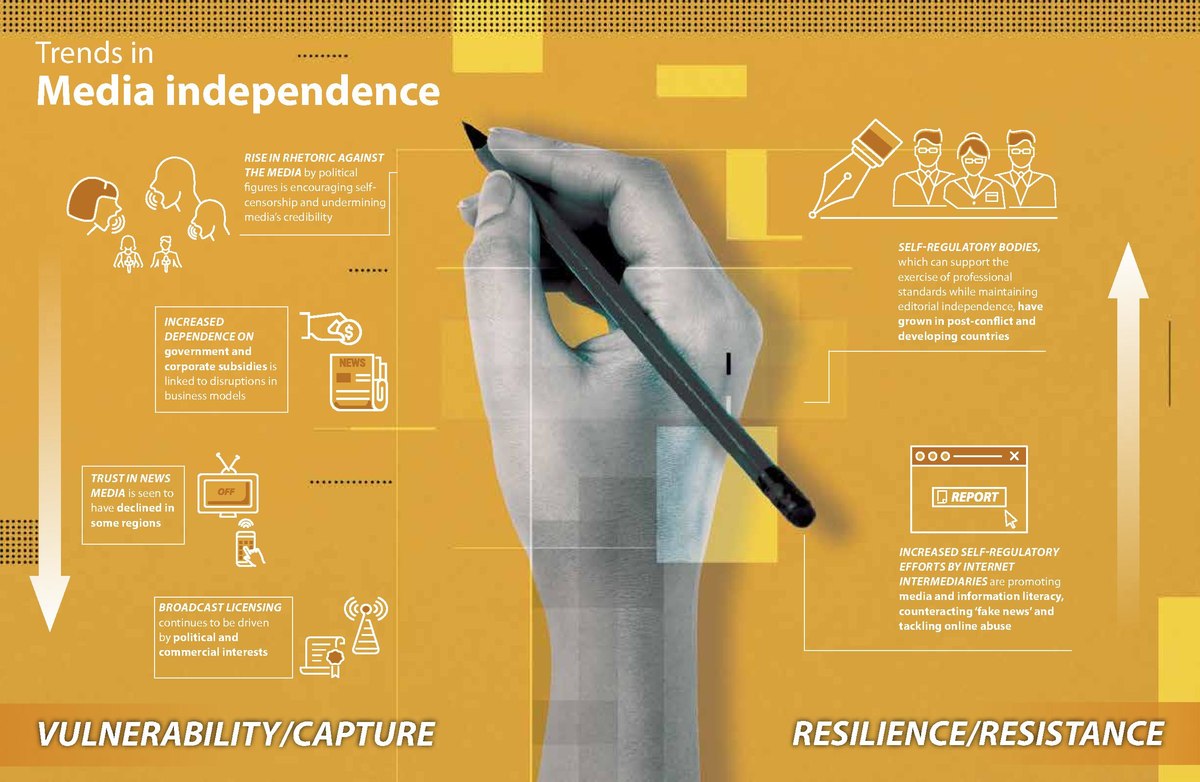
UNESCO’s World Trends Report 2018.
Journalism Under Threat
An assumption of malevolent or self-serving – cui bono? – motivations (particularly concerning a Big Pharma industry with a shameful record of distortion and manipulation) is almost a prerequisite for being an investigative reporter. Stories don’t drop out of the air. Unless a journalist assumes wrongdoing – in essence a conspiracy theory – there would be no reason to begin digging.
The key distinction between genuine journalism and conspiracy theorising is that proponents of the latter tend to blurt out their “findings” without marshalling supporting evidence, with the Internet providing anonymity as required. This, however, makes such accounts easy to ridicule to the detriment of journalism with an evidential basis.
Journalists have long been deflected from investigating large corporations. In a recent memoir the great American journalist Seymour Hersh fumes at how in the late 1970s The New York Times shut down his attempt to investigate corporate America ’when confronted by a gaggle of corporate conmen.’[iv]
This challenge has increased significantly in the wake of the Internet. After the “Original Sin” of free online publication, the number of American journalists fell from 60,000 in 1992 to 40,000 in 2009, a pattern seen across the world. As revenues diminished, workloads increased. Cardiff University researchers recently conducted an analysis of 2,000 U.K. news stories, discovering the average Fleet Street journalist was filing three times as much as in 1985. To put it another way, journalists now have only one-third of the time to do the same job.[v]”
“Fact Checkers”
Over the course of the pandemic a strawman conspiracy theorist appears to have been consciously developed to deter valid journalistic interrogation, in particular, through so-called “fact checking” initiatives. It has reached a point where, as Charles Eisenstein observes: ‘“Conspiracy theory” has become ‘a term of political invective, used to disparage any view that diverges from mainstream beliefs. Basically, any critique of dominant institutions can be smeared as conspiracy theory’
In the absence of adequate journalistic scrutiny during the pandemic corruption has been rife. The executive director of The British Medical Journal Kamran Abbasi described ‘state corruption on a grand scale’ that is ‘harmful to public health’ Abbasi observes how the pandemic ‘has revealed how the medical-political complex can be manipulated in an emergency—a time when it is even more important to safeguard science.’
This also occurred in the context of unregulated social media, where companies set their own rules. In March, 2020, having previously styled itself ‘the free speech-wing of the free-speech party’, Twitter moved to address concerns around conspiracy theories. In future it would be: ‘Broadening our definition of harm to address content that goes directly against guidance from authoritative sources of global and local public health information.’
Nonetheless, free reign was given to “click-bait” alarmists such as Eric Feigle-Ding on Twitter, who saw his following mushroom from just two thousand to almost a quarter of a million. Angela Rasmussen, a Columbia University virologist, identified a pattern: ‘He tweets something sensational and out of context, buries any caveats further down-thread, and watches the clicks and [retweets] roll in.’
Twitter did not act alone in upholding an apparent orthodoxy that often lapsed into an extremism that deterred legitimate questioning. Google took unprecedented steps to erase material violating ‘Community Guidelines’: ‘including content that explicitly disputes the efficacy of global or local health authority recommended guidance on social distancing that may lead others to act against that guidance.’
Initially at least, Facebook adopted a more laissez faire approach, although users who had read, watched or shared ‘false’ coronavirus content received a pop-up alert urging them to go the World Health Organisation’s website. In November, 2021, however, the editors of the British Medical Journal sent an open letter to Facebook in response to “fact checkers” undermining their investigative report into ‘a host of poor clinical trial research practices’ at Pfizer’s original vaccine trial.
Thus, the approach of the social media giants was bolstered by an unprecedented journalistic effort to “factually” repudiate conspiracy theories during the pandemic; notwithstanding how ‘uncontested facts—things that are ascertainable, reproducible, transferable and predictable—tend to be elusive.’
Preparations for the “fact-checking” initiative began in January, 2020 when a global #CoronaVirusFacts Alliance, comprising more than one hundred “factcheckers” around the world, described as ‘the largest collaborative factchecking project ever,’ was launched by the Poynter Institute, ‘when the spread of the virus was restricted to China but already causing rampant misinformation globally.’ It said that the WHO had classified the issue as ‘an infodemic — and the Alliance is on the front lines in the fight against it.’
From March 2020, with the support of these “fact checkers”, outlets such as Reuters responded to an anticipated wave of conspiracy theories, taking particular care to address allegations against Bill Gates. He has been described as ‘the world’s most powerful doctor’ despite not having earned a medical degree due to the Gates Foundations being the second largest funder of the WHO, after China. This included allegations that he had apparently planned the pandemic, and wanted to commit genocide through vaccines.
For example, on May 30, 2020 a BBC article purported to defuse claims the pandemic was ‘a cover for a plan to implant trackable microchips and that the Microsoft co-founder Bill Gates is behind it’; although it acknowledged Gates had said that ‘eventually “we will have some digital certificates” which would be used to show who’d recovered, been tested and ultimately who received a vaccine,’ and also referenced ‘a study, funded by the Gates Foundation, into a technology that could store someone’s vaccine records in a special ink administered at the same time as an injection.’
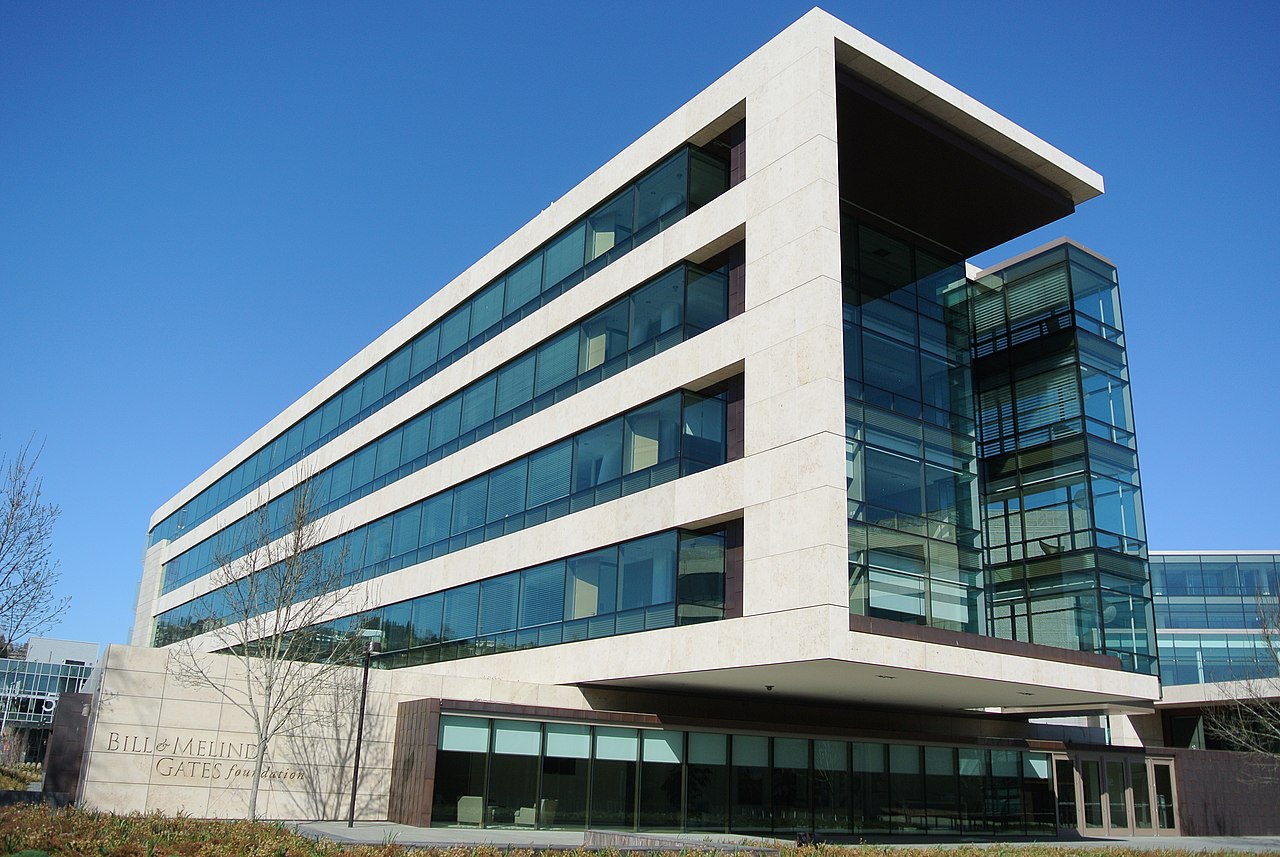
Front building of the Bill and Melinda Gates Foundation in Seattle.
Gates Foundation
When it came to outlandish conspiracy theories around COVID-19 all roads led to Bill Gates and his $47 billion philanthropic Bill and Melinda Gates Foundation – besides a personal fortune of $115 billion, and growing, as of October 2020.
For many of world’s population under stay-at-home orders the pandemic was viewed through a digital prism – often at a remove from morbidity or mortality itself. At that stage, Gates’s 2014 Ted Talk ‘The Next Outbreak. We’re not ready’ seemed almost prophetic.
He opined: ‘If anything kills over ten million people in the next few decades it is most likely to be a highly infectious virus rather than a war.’ The failure of Western governments to prepare for such an eventuality seemed to have been laid bare – in particular the Presidential administration of Donald Trump, who according to a Cornell University study ‘was likely th\\e largest driver of the COVID-19 misinformation “infodemic.”’
Gates’s main reference point appears to have been the Spanish Influenza (H1N1) outbreak of 1918 – the Ur-pandemic of modern times – that led to up to fifty million deaths, many of them young men in their prime, at a point when the global population was approximately two billion. In contrast, the infectivity and severity of SARS-CoV-2 ‘are well within the range described by respiratory viral pandemics of the last few centuries (where the 1918–20 influenza is the clear outlier).’
Neil Ferguson
“Scientific Groupthink”
In March, 2020, Imperial College’s Neil Ferguson told the New York Times the ‘best case outcome’ for the U.S. was a death toll of 1.1 million, rising to 2.2 million in a worst case scenario, a projection that has proved wildly inaccurate. Yet, alternative, and scientifically valid, assessments of the danger posed by COVID-19, and the optimal humanitarian response to the challenge were virtually ignored in legacy media at the time. Thus, an Oxford University paper, which included Sunetra Gupta as an author, countered what the New York Times described as the ‘gold standard’ Imperial modelling underestimated immunity from prior coronavirus infections and posited a far lower infection fatality rate.
But in March, 2020, the Financial Timeswarned that Gupta’s group’s modelling was ‘controversial and its assumptions have been contested by other scientists.’ Implicitly, the Financial Times was accepting the “gold standard” Imperial paper.
Moreover, in November, 2020 an article in the Scientific American describes how Stefan Baral, an epidemiologist and associate professor at Johns Hopkins Center for Global Health, wrote a letter about the potential harms of lockdowns which was rejected from more than ten scientific journals (and six newspapers) in April, 2020. Baral recalls, ‘it was the first time in my career that I could not get a piece placed anywhere.’
The article also recalled that, ‘highly anticipated results of the only randomized controlled trial of mask wearing and COVID-19 infection went unpublished for months.’ The authors concluded that the ‘net effect of academic bullying and ad hominem attacks has been the creation and maintenance of “groupthink”—a problem that carries its own deadly consequences.’
In the absence of access to authoritative, diverging scientific accounts, opposition to lockdowns could easily be dismissed as being the preserve of conspiracy theorist cranks associated with “anti-vaxxers” and even a “far-right” fringe.
“Screen New Deal”
Apart from offering pharmaceutical companies the huge financial incentive – grasped within open arms – of developing a vaccine for universal application, lockdowns and social distancing measures also brought soaring profits for major technology corporations. Moreover, restrictions provided a testing ground for the Gates Foundation’s long advocacy of technological approaches in education.
In May, 2020 Naomi Klein identified collusion between state and Big Tech interests in what she described as ‘A Screen New Deal.’ She referred to New York Governor Mario Cuomo’s courting of Google and the Gates Foundation: ‘Calling Gates a “visionary,” Cuomo said the pandemic has created “a moment in history when we can actually incorporate and advance [Gates’s] ideas … all these buildings, all these physical classrooms — why with all the technology you have?” he asked, apparently rhetorically.’
Remote learning technology permitted extended school closures around the world, despite the chance of death from COVID-19 being ‘incredibly rare’ among children. Researchnow suggests many students made little or no progress while learning from home, and that learning loss was most pronounced among disadvantaged students. As a consequence, up to 20,000 children in the U.K. went missing from school rolls during the pandemic. Nor is it apparent that teachers faced any greater risk compared to the wider population in fulfilling classroom teaching.
Media Funding
Popular consent on a global scale for lockdowns, particularly from those identifying on the left, seems to have been manufactured through vast ‘philanthropic’ funding of journalism, in particular of publications associated with progressive outlooks.
By June 2020, the Gates Foundation contributed $250 million to journalism, which according to Tim Schwab in The Columbia Journalism Review, ‘appears to have helped foster an increasingly friendly media environment for the world’s most visible charity.’
A theme of ‘we are in this together’ inhibited criticism and enquiry. This quiescence has been criticized by the Greek socialist Panagiotis Sotiris who wrote: ‘What is missing here is something that used to be one of the main traits of the radical left, namely, an insistence that science and technology are not neutral.’
Tim Schwab calculates that $250 million had been devoted to journalism by the Gates Foundation for the six months up to June, 2020,. Recipients included BBC, NBC, Al-Jazeera, ProPublica, National Journal, The Guardian, Univision, Medium, The Financial Times, The Atlantic, The Texas Tribune, Gannett, Washington Monthly, Le Monde, and the Center for Investigative Reporting, as well as the BBC’s Media Action and The New York Times’ Neediest Cases Fund.
Schwab adds: ‘In some cases, recipients say they distributed part of the funding as subgrants to other journalistic organizations—which makes it difficult to see the full picture of Gates’s funding into the fourth estate.’
As a result, he says:
During the pandemic, news outlets have widely looked to Bill Gates as a public health expert on covid—even though Gates has no medical training and is not a public official. PolitiFact and USA Today (run by the Poynter Institute and Gannett, respectively—both of which have received funds from the Gates Foundation) have even used their fact-checking platforms to defend Gates from “false conspiracy theories” and “misinformation,” like the idea that the foundation has financial investments in companies developing covid vaccines and therapies. In fact, the foundation’s website and most recent tax forms clearly show investments in such companies, including Gilead and CureVac.
The Gates Foundation’s pivotal role in funding global health has long raised concerns. In 2008, Dr. Arata Kochi, the former head of WHO’s malaria programme argued the Gates Foundation was undermining scientific creativity in a way that ‘could have implicitly dangerous consequences on the policymaking process in world health.’ He worried that Gates-funded institutions – including Imperial College London (MRC Centre for Global Infectious Disease Analysis) – were adopting ‘a uniform framework approved by the Foundation,’ leading to homogeneity of thinking: ‘Gates has created a ‘cartel,’ with research leaders linked so closely that each has a vested interest to safeguard the work of others. The result is that obtaining an independent review of scientific evidence (…) is becoming increasingly difficult.’
GAVI, the Vaccine Alliance, is the most obvious example of the Gates Foundation’s engagement. GAVI has successfully immunized large numbers of children, but been criticized by other NGOs for inadequate funding of health system strengthening.
One of GAVI’s senior representatives reported that Bill Gates often told him in private conversations ‘that he is vehemently ‘against’ health systems (…) he basically said it is a complete waste of money, that there is no evidence that it works, so I will not see a dollar or cent of my money go to the strengthening of health systems.’
As of 2017 only 10.6 percent (US$862.5 million) of GAVI’s total commitments between 2000 and 2013 had been dedicated to health system strengthening, whereas more than 78.6 percent (US$6,405.4 million) have been used for vaccine support. Doctors Without Borders (MSF) states that, while GAVI has helped to lower prices of new and underused vaccines for eligible countries, the cost to fully immunize a child was 68-times more expensive in 2014 than it was in 2001.
According to long-time Gates critic James Love, Gates ‘uses his philanthropy to advance a pro-patent agenda on pharmaceutical drugs, even in countries that are really poor.’
Safe Treatment?
This article makes no bold claims regarding the efficacy of any treatments, but the overwhelmingly negative reaction of legacy media to research pointing to the efficacy of the off-patent drug Ivermectin suggests that vested pharmaceutical interests wished to undermine public confidence in any scientific arguments regarding its efficacy.
In June, 2020, a laboratory study demonstrated it was ‘an inhibitor of the causative virus’ (Caly, 2020). Later, a Systematic Review, Meta-analysis that included twenty-four randomized controlled trials said: ‘Moderate-certainty evidence finds that large reductions in COVID-19 deaths are possible using ivermectin.’
In a predictable example of “fact-checking” where an outlandish claim is used to discredit a compelling hypothesis, the Poynter Institute quoted a social media post ‘rating’ the claim that Ivermectin basically ‘basically obliterates’ as ‘false.’
The Guardian’s dedication to discrediting the meta-analysis also suggested vested interests were at work, and contrasts with a failure to report on the British Medical Journal’s account of a whistle blower alleging serious data integrity issues during Pfizer’s vaccine trial.
It should hardly be controversial – let alone dismissed as a conspiracy theory – to argue that the weight of evidence points to a ‘Gates-Approach’ lying behind ongoing adoption by most Western governments of unprecedented suppression measures in support of universal vaccination – notwithstanding potential treatment alternatives – leading to the introduction of vaccine passports, as Gates “predicted” in April, 2020. This also occurred alongside a familiar ‘rhetoric supportive of ‘holistic’ health systems.’
It is now clear that consent for lockdowns, especially in the Anglophone world, was manufactured through wildly inaccurate epidemiological assessments of an infection fatality rate of 0.9% in the notorious Imperial College paper. This estimate has since been adjusted to 0.2% (available on the WHO website), a figure which Joffe argues is likely ‘a large over-estimate.’
It is also clear that globally mortality statistics for COVID-19 have been systematically exaggerated. This manipulation can be traced to a WHO document from April, 2020 entitled ‘International Guidelines for Certification and Classification (Coding) of COVID-19 as Cause of Death’. It set out strict rules for the registration of COVID-19 deaths, which differ fundamentally from registration for other causes. The guidelines define a COVID-19 mortality as ‘a death resulting from a clinically compatible illness, in a probable or confirmed COVID-19 case, unless there is a clear alternative cause of death that cannot be related to COVID disease (e.g. trauma).’
For most people COVID-19 is a virus that poses little danger. Prior to the arrival of a vaccine, a U.K. study from October, 2020 found 76.5% of a random sample who tested positive reported no symptoms, and 86.1% reported none specific to COVID-19. Moreover, an article from Peter Doshiin the British Medical Journal in September, 2020, stated: ‘At least six studies have reported T cell reactivity against SARS-CoV-2 in 20% to 50% of people with no known exposure to the virus’; apparently vindicating Sunetra Gupta’s “controversial” paper, over which the Financial Times cast doubt.
A “totalizing” discourse of a COVID-19 conspiracy theory identifies a preordained plan being set in motion by malicious actors, wherein the pandemic culminates in a dangerous vaccine being foisted on a brainwashed population. This might lead to an assumption that such vaccines invariably give rise to severe adverse reactions that are systematically covered up. Such an account does not demand evidence as events are simply unfolding “as planned.”
In reality, however, events rarely follow a preordained pattern, and even in circumstances of regulatory capture state agencies are never entirely bereft of integrity. Moreover, such accounts divert attention from probing interrogation of the efficacy of vaccines and the desirability of universal uptake of a medication that does not block transmission, especially one rushed to the market, and which may cause unforeseen adverse reactions.
It is also apparent that public perception of the efficacy of vaccines has been distorted by the media’s reporting of relative risk reduction, as opposed to absolute risk reduction, which is just 0·84% for the Pfizer–BioNTech vaccines.
Moreover, importantly, in January, 2021, Peter Doshi and Donald Light in the Scientific American objected to the undermining of ‘the scientific integrity of the double-blinded clinical trial the company—and other companies—have been conducting, before statistically valid information can be gathered on how effectively the vaccines prevent hospitalizations, intensive care admissions or deaths.’
This came after Pfizer pleaded an “ethical responsibility” to unblind its trial and offer the vaccine to those who received a placebo. The authors argue that ‘there was another way to make an unapproved vaccine available to those who need it without undermining a trial. It’s called “expanded access.” Expanded access enables any clinician to apply on behalf of their patient to the FDA for a drug or vaccine not yet approved. The FDA almost always approves it quickly.’
In terms of any actual conspiracy or contrivance to raise prices along the lines of tendencies that Adam Smith pointed to among gentlemen of commerce, the role played by Bill Gates has been, doubtless, more complex than many conspiracy theorists allow for. However, in circumstances where a billionaire with a history of monopolistic aspirations promotes an agenda aligning with his financial interests it should come as no surprise that colourful theories abound; especially with many journalists seemingly inhibited from enquiring into his Foundation’s activities.
Indeed, ironically, the aforementioned Guardian journalist John Naughton recently described Gates while Microsoft CEO as having acted like ‘a mogul who is incredulous that the government would dare to obstruct his route to world domination.’ Does such a leopard ever change his spots?
Sadly, the amplification of the outlandish claims of conspiracy theorists by so-called “fact checkers” could be causing reputational damage to genuine expertise, and allow demagogues reliant on angry mobs to say: “I told you so.” The propagandist role of “fact checkers” has undermined genuine investigative reporting, much of which already occurs on the margins.
In the early stages of the pandemic especially, difficulties in reporting were compounded by deficits in scientific understanding among overworked journalists in precarious employment, who were encouraged to justify unprecedented lockdowns as a form of social solidarity. The assumption that by “following the science” a journalist is adequately performing his or her role is a dangerous fallacy, which does not take account of how diverging scientific arguments may be concealed.
In the absence of sufficient independent journalism, and amidst censorship of alternative scientific opinion, troubling questions remain unanswered as the pandemic draws to a close. Perhaps we will never know the full story. Nonetheless, it is vital that adequate cost-benefit analyses (including with access to full trial data) are conducted on all pharmaceutical and non-pharmaceutical interventions in future.
Feature Image (c) Daniele Idini: The Burning of “the Witch of Winter” in Cardano al Campo, Lombardy, Italy.
We are an independent media platform dependent on readers’ support. You can make a one-off contribution via Buy Me a Coffeeor better still on an ongoing basis through Patreon. Any amount you can afford is really appreciated.
[i][i] Karl Popper (1972). Conjectures and Refutations, 4th ed. London: Routledge Kegan Paul. pp. 123–125.
[ii] Hannah Arendt (1951) The Origins of Totalitarianism, 1951, p.140
[iii] Adam Smith, The Wealth of Nations, book 1, chapter 10, par. 2).
I can barely make out Richard´s handwriting on the piece of torn paper. “Second left” I say, looking down at the words. “After the farm…with eh, the eh, big stables.” “I think we just passed it.” Richard says, looking behind him. “Eyes on the road dude!” I shout. “Please!” I´d almost reached for the wheel. “After the farm. So, the second left. Not signposted. Look! There! There there there! Second left! Second left!” Richard takes a glance at the rear-view mirror, indicates, decelerates, and turns off the winding, narrow country road. “This is it,” I say, turning down the music. “This might be it.” Richard says.
The boreen is a long tunnel of trees. Sunlight flickers through the thick leaves overhead, giving the passageway an intense golden-green glow. Stray branches and brambles tap, knock and scrape against the windshield, and drag against the worn-out body of the car, as we’re bumped and jolted gently in our seats. Richard is quiet, his forearms resting over the steering wheel, his fingers interlaced. We’ve been driving since morning, across the smooth new continuous sedation of the M7 motorway, from Dublin to Exit 27. But now, nearing the end of our journey, I’m becoming curious again as to where I´m being led.
Richard sits back and steers the car slowly from out under the trees and into a sunlit clearing. In front of us, behind a low, grey, moss-mottled stonewall, squats an old shrunken cottage, tucked up in welcoming silence. Richard turns the key in the ignition and the rattling engine shudders and shuts off with a sigh.
Once through its small front door, we begin to explore the dark little habitation. The air inside is cool, cavernous. Rough flagstones, slightly uneven, line the ground. Whitewashed stonewalls loom close in the wan daylight which struggles in through the deep-silled elfin windows. For some reason I was expecting a stifling humidity, a trapped reek of old country rot and neglect to greet us.
On the right is the kitchen. A deep white porcelain sink and dim countertops domesticated with wooden containers, a red kettle, a wooden bread-bin, a blue cup-rack, and a stainless steel dish drying rack. From the ceiling of an arching alcove hang a confusion of copper pots and pans over a blackened range. Ahead, at the far end of the room, stands an old round pine table and three pine chairs. Behind that, and in front of a larger day-lit window, is a red cushioned, two-seater couch and small mahogany coffee table. To either side of the couch, tall leafy plants, dark and evergreen, creep up out of the farthest corners, as though the trees outside had somehow broken in. On the left wall is a small black stove and, beside it, an empty wicker basket for firewood.
I follow Richard down the narrow hall that leads to two bedrooms, their open doors facing each other. In the smaller room I see a framed print of “Men of Destiny” hanging on the wall. Behind the last door, at the end of the hall, is an old grimy bathroom. I step around Richard and take a look inside. Its green-tiled gloom and old dirty white shower-curtain remind me of something out of a horror film.
“She must have had someone in to do the roof,” Richard says, walking back down the hall and looking up at the newly restored wooden beams.
“She keeps the place well, your aunt,” I say, following him. “I don’t know why I’m so surprised.”
“What you think?” Richard asks, looking around.
“I love it,” I say, “It’s perfect.”
Richard looks at me.
“Do you good to get out of Dublin anyway for a while,” he says. “Clear your head.”
“You have no idea, Man.” I say, looking at him. “Thank you for inviting me.”
“No worries,” he says, spinning his car-keys around on his finger. “Right. Let’s make this place our own.”
Out back, in what we could reclaim for a garden, after I´d sheared away some dead dried branches of a gooseberry bush and Richard had strimmed some of the long grass, we share a light lunch at a small wooden table, sitting on two loose wooden chairs.
It’s a fine spread. Various cured hams. Gorgonzola and Camembert cheese. Black pepper crackers. Green pitted olives. Sundried tomatoes. Crisp brown bread and a beetroot, grated carrot, broccoli and hazelnut salad for which Richard has whipped up his delicious honey mustard and Irish whiskey dressing. To top it all off, I´ve opened a none-too-chilled bottle of steely Chablis.
In the warm summer air, we take our time and eat slowly, swatting wasps and midges away from our food and from our faces. I’ve had to move my chair out of the sun and into the shade more than once. I don’t want to get burned. The garden surrounds us. The creeping brown briars. The exhausted trees and their shade. The tall dry grass. All so overgrown. So still. So dense. So close to us. This is true summer seclusion. I look around and enjoy a deep sense of peace. This is our place now, to do as we please, to idly rusticate in, undisturbed, for a week.
Richard is sitting back in his chair with his blue denim shirt open, sunning himself and chewing on a piece of bread. Under his straw hat he wears Aviator shades and with his Van Dyke goatee he is nothing if not the epitome of summertime cool. He smiles broadly at me and looks like he’s about to say something, or is thinking of saying something to me, but then just goes back to admiring his surroundings, leaning back on his chair. I drink my wine and listen to the insect hum in the grass, and in the trees all around me.
“You know what?” Richard says after a while.
“What?”
“I found a bag of MDMA in these work shorts.”
“Ha! Really?”
“I think it must have been left-over from the barn-party in Kilkenny.”
“That was some night,” I say, reaching for my pouch of rolling tobacco, suddenly nervous and certainly thrilled on hearing that night now being finally brought up again.
I fumble with my rolling papers and with the tobacco. Part of me wonders if it´s true, if he’d really found it, or if he’d bought some especially for this trip in the hope of recreating something of that night, of that morning. Either way it’s welcome news. In fact, it’s exactly what I want to hear, what I’d been hoping for. I tap my rollie on the table, smiling, then light it up.
Settling back down into my own skin again, I feel at ease. Recomposed and in control. I look at Richard as he takes a drink of wine and rests the base of his glass on his flat brown stomach. Then, with a finger, he lowers his shades, looks at me from under an arched eye-brow and, in a mock paternalistic tone says,
“I was debating, you know, on whether or not I ought to tell you.”
“Well, you’ve blown that now haven’t you? And sure why wouldn’t you have told me?”
“You said that you wanted to get some work done down here.”
“So did you.”
“Ah, but that’s different.”
“How is that different?”
“Mine is just the monkey work. I don’t want to be a bad influence on you and, you know, hamper, or dampen, or darken even, your…” He searches dramatically, airily, with his free hand for the right word, “…your cogitations.”
“My cogitations? Or do you mean, my brooding contemplations?”
“Your country ruminations?”
“Oh, my rural cerebrations?”
“Exactly.”
“Well, you won’t. Besides, I don’t plan on writing much. I’ll be reading, mostly.”
“Mostly,” Richard says, smiling. “You brought enough books down with you anyways.”
“I always do. Usually too many,” I say. Then I add, with a smile, “I just don´t know what I want sometimes.”
Tapping the ash, I pass the rollie over the table to Richard.
“You still only writing the short ones?” he asks.
“Yup. And still only for myself and for the entertainment of my friends.”
Richard blows smoke in the direction of some midges.
“Too right. Nothing worse than a poet who publishes. So go on then. Give us one before we go back to work.”
“Alright. Do you want a happy one? A sad one? A funny one? Or a sexy one?”
“Surprise me.”
I take my glass and raise it for a toast. Richard sits up, leans forward and raises his glass too. I can imagine that behind his sunglasses Richard has closed his eyes, cleared his mind and is making himself suitably receptive. Sitting up straight in my crockety chair, I look at him and say, in my smoothest voice.
“I find myself again, cast into the ancient gaol of love. But this time I´ll remember that the cell door is always open, and the guards are always drunk.”
“Beautiful” Richard says. “I was transported”
“I’m sure you were.” I say, smiling.
“I want more.”
“You’ll have to wait.”
“Well then, in the meantime,” Richard says, “Here’s to a poetical and festive week in the country.”
We clink glasses.
“Cheers.”
We clear the table, bringing our plates, glasses and bowls back inside. My eyes have to readjust to the sudden cottage darkness. Sun-dazzled, and a little drunk already from the heat and the white wine, I find that I´ve wandered off in the wrong direction and start laughing to myself, at how disorientated I am. This is a crazy little domicile I’ve found myself in. Blinking and stretching my eyes wide open, now I´m standing by the table. I look down at my stack of books, at my notebook and my pens, all neatly laid out. There will be time. Plenty of time. I can feel it building already. Some good work is going to get done.
Richard has plugged his phone into the speakers he’s brought and is playing a compilation of Italian Renaissance lute music. Its gracious simplicity fills the air around us with a homely sophistication. I put the two plates with my emptied wine glass down on the countertop and stand beside Richard at the sink. He washes. I dry. We listen to the music and fall into an easy rhythm. I notice that he’s even brought his own little bottle of organic washing-up liquid.
“Man, that wine is choice.”
“Goes down easy.” He says.
“Too easy.” I say, smiling. “So, time for a little daba-daba?”
“Ha! You dirty drug fiend. I have to get up into those trees now…”
“You doing that today?”
“Better to get it done now,” he says, looking out the window. “Then I can relax.”
“True,” I say. “Best to wait…To wait. To wait.” I add with a deep sigh. “Such exquisite restraint you display.”
“All the better to torture with, my dear.”
Richard smiles and hands me a rinsed wet plate and I come back to myself, dreamily, to the task at hand.
“Will I open another bottle or do you want a beer?”
“I think I’ll have a coffee,” He says, pulling the plug in the sink.
“I’ll make it for you,” I say. “You go out and get started.”
At the side of the cottage, I bring Richard his coffee. He points up at some low overhanging branches.
“These are the ones she wants me to cut back I’d say,” he says.
“How long will that take you?”
“´Bout half an hour or so. But there’s probably more to do around the place.”
“Well, I’m looking forward to helping out,” I say.
“Don’t worry,” says Richard, “There’ll be plenty to do.”
We step over the orange extension cable and Richard’s chainsaw, his clear-plastic goggles and his pair of old, dirty, heavy work gloves.
“Bringing the hammocks was a great idea,” I say.
“It was, wasn’t it?” He says, grinning. “We’ll put them up later. One there…and one…over there. If you could strim some more between those two trees that’d great.”
“Yeah. No worries.”
“And I was thinking of digging a little fire pit too, over there, for later on. If the nights are going to be as nice as they say, might as well stay outside for as long as we can.”
“Sounds great.”
“When was the last time you lay out in the night and looked up at the stars?” Richard asks.
“I can´t remember,” I say. “There was even a time there when I couldn´t look up at them for long. Sometimes, I don´t know, it was just too immense. I´d get the fear, and have to look away.”
At the rear of the cottage near a little back-gate we stop at a gap in the boundary trees. I look down over a field of high, lush green grass. Shielding my eyes from the sun I see the hazy banks of a river, more fields, other country houses, and mountains far in the distance.
“We’re not too far from Ardnacrusha, are we?”
“No,” Richard says, lighting a rollie, “It’s a few miles down to the right there.”
“We should go for a walk then later, if you want?”
“Sounds good,” Richard says. “I’ll get cutting.”
On a narrow pathway, along the bank of the river, we walk in the direction of Ardnacrusha, passing my hipflask of whiskey back and forth. The calm country scenery, the cooler evening air and the sound of gravel pleasurably crunching underfoot mellows my thoughts. Up ahead, Ardnacrusha Bridge arches over the river. Nearing sun-down, the shadow of the bridge ripples on the orange and purple water.
“So you’re serious…about leaving your studio in Callan, and never painting again? Say it ain´t so, Man.”
“Well yeah, that´s the idea.”
“Just had enough?” I ask, passing the flask back to him.
“You saw the last work.”
“I did. And I really liked it. Very zen. One fluid movement across the canvas. I always thought it looked like a tusk. You sold a few too.”
“Three.”
“That´s good.”
“Not good enough I´m afraid. No, it´ll never leave me, but I need to take a step back. Or a step forward. I need to get out, get moving again.”
“Where you thinking?”
“The Camino first. Then maybe Mexico, for a while. Bring my ukulele.”
“And write some songs?”
“Write some songs and find my way. At the moment I think I´m being drawn to horticulture.”
“Really? That actually makes a lot of sense,” I say, taking the flask back from Richard.
“Yeah,” Richard says, “I think so too. Tend a garden and…”
But I’ve noticed something up ahead. The diminutive form of someone standing up on the bridge. I pocket the flask and gaze on, thoughtlessly, not even wondering until, suddenly, that same body falls clear from the bridge and splashes into the water. I stop and grab Richard by the arm.
“Fuckin’ hell!
“What?”
“Did you see that?”
“Did someone fall in?”
“I don´t know, Man. Either fell in or jumped.”
Without another word Richard starts to run ahead. I keep my eyes on the water and watch as an arm, then a head, comes up to the surface, and disappears again. On the bank of the river Richard begins rapidly undressing: shirt off, boots off, jeans off, socks off. He looks back at me, desperate for some sign of warning or encouragement. But I’m dumb-struck. Helpless.
I stand back and watch as Richard dives into the water. Gathering up Richard’s still warm clothes, I hold them close to me, and keep my eyes on him as he swims out and dives under. Coming back up, he looks around, and dives back down again. Each time he disappears, I hear myself mumbling,
“He’ll be ok. He’ll be ok. Come on. He’ll be ok.”
I walk backwards to keep up with the displacements of the current. From the river bank all I can to do is focus on maintaining a line of living endurance between myself and Richard. Somehow, through my undivided attention, a fierce observance, I feel that I can transfer all my available energy and strength to him. That this will keep him safe. That this connection will keep him alive.
Thrashing the water Richard struggles back to the riverbank, pulling the still body of a boy, a teenager, behind him. At the water’s edge I bend forward and grab hold of Richard. Once he’s up on the bank, I reach out and get a hold of the boy, grabbing him under an arm. I pull and drag him, with Richard’s help, up and out of the cold water. Richard collapses on the grass and turns on to his back. Grunting and gasping for air, he covers his face with his arms and struggles to speak.
“He…He’s got something…in his pockets…weighing him down…”
But before I can gather my thoughts Richard rolls off his back and gets himself up onto his knees. He leans down over the kid, tilts his head back and blows into the boy’s mouth. Richard stops, gasps, listens, and looks down. Nothing.
Again he blows again into the boy’s mouth and I watch, horrified, as that chest rises and falls under his soaked, black t-shirt. Nothing. I turn away. All I see is the rushing, swirling brown surface of the river, and all I can think is that there must be more bodies in there, more bodies like this one, lost in those damnable depths, helplessly flowing by.
A sharp and sudden intake of breath from the boy’s mouth startles me. Richard falls backwards onto his hands. We both watch as the boy’s body spasms and contracts on the grass. His eyes open wide as his pale hands clench and tear at the grass. He coughs and gasps painfully for air as dirty greenish rills of foul river-slime runs down the sides of his mouth.
On our way back to the cottage nobody says a word. We trod through a field, having forgotten to take the easier pathway back to the cottage. Richard strides through the waist-high grass with all of his reach and strength, and still only in his boots and wet underwear, determined to get away from that river as fast as he can.
The boy staggers behind me as though drunk. Lost to his surroundings. From the corner of my eye, I think I see him dropping stones out of his pockets. I think I hear them falling to the ground, one by one. I look his way but his head is down, staring into the grass. Mesmerized. Twice the boy snaps out of it to look up and take notice of where he is. I hear him gulp and catch his breath.
“You ok?”
“Yes.”
“Sure?”
“Yes.”
“What’s your name?” I ask.
But the kid says nothing.
Our cottage appears up ahead from behind the cluster of trees. Up beside the chimneypot is a rusty TV aerial and a warped weathervane leaning silhouetted against the clouds in a fading purple and orange sky. Richard opens the barely hinged back-gate and the kid follows us around the side of the cottage. We enter through the small front door, one by one.
The kitchen and living room smell of cool country evening air, coffee, and freshly cut firewood. Richard’s shaking, and without saying a word, walks down the hall and into the bathroom. Still holding Richard´s clothes, I pour a glass of water from the sink tap and put it down on the table for the boy. I ask him to sit, and he sits.
“I’m Stephen.” I say. “And that’s Richard. What’s your name?”
Sitting there in front of me, silent and stunned, he’s a rudely revived corpse shivering in his dripping clothes. Around his plain grey canvas runners, strands of slimy green river weed are still coiled. I try not to stare but can’t take my eyes off his narrow, mean-looking face. His long, thin arms are pale and his short dark hair is flattened to his head. He can’t be more than fifteen or sixteen.
“You should have a shower when Richard gets back.”
A long silence passes between us before he says anything.
“Don’t tell anyone I’m here,” he says.
“I won’t.”
“Don’t call anyone.”
“I won’t.”
“Swear?” He says.
“I swear. What’s your name?” I ask again.
“Daniel.” He says, looking at the glass of water on the table. “My name is Daniel.”
Richard returns in a long grey woollen jumper, fresh jeans, and in his bare feet. He hands Daniel two big fluffy grey towels and walks him down to the bathroom.
“There´s hot water,” I hear Richard say. “Try and get warm.”
Daniel closes the door.
Without looking at me, Richard goes into his bedroom and shuts his door. I go and sit down at the table and place Richard’s clothes on the seat beside me. I take my hip-flask from my back pocket and I drink from it. But the whiskey doesn’t taste right. It’s watery. Silty. I put my pouch of tobacco, filters and lighter on the table and just sit there, looking at them, without appetite, but it’s not even the pouch of tobacco that I see.
All I see is Daniel, standing in his clothes under the hot shower, waiting to feel warm again. Then peeling off his wet clothes, like layers of a painless, un-protective skin. Runners. T-shirt. Socks. Jeans and underpants. Drenched, they fall and slop to the floor. Heavy. Sodden. And sad. I see him sitting down in the bath, under the showerhead, in the steam, his eyes closed. A tiny dot of darkness, peaceful and unthinking. And warm. Warm for a while at least. Until the water starts to run cold.
In the living room candles are lit and pots of food simmer on the kitchen’s range. A fire rages silently in the stove. The mahogany table, on which Daniel´s clothes have been laid out to dry, has been pushed closer to the fire. Richard and I are busying around each other, almost as though we’re putting on a little show of domesticity for Daniel, who sits quietly at the table, in warm borrowed clothes.
Richard opens a bottle of red wine while I lay out three plates. We’ve insisted he eat with us. There is no talk about today. Nothing. Richard pours wine as I spoon out steaming pasta shells and meatballs. Passing an aromatic roll of garlic bread around, I feel that me and Richard are doing our best, our utmost, almost telepathically, to make Daniel feel included and welcome at our table.
Instinctively, I go to raise my glass for a toast but correct myself, and cover it, by just taking a small sip.
“Tuck in.” says Richard. “Its good. It’s warm.”
We all eat slowly. Small mouthfuls. We try to eat. There’s warmth and healing goodness in the food but there seems to be no real depth to our hunger. Still, we persist in silence. Shadows flicker close around us on flame-lit walls. Daniel´s shadow flits and frets on the wall behind him. When he burps, I think I get a phantom, silty taste of muddy water in my mouth. Daniel pushes the food around on his plate, then cuts a meatball into small manageable bites. Richard nods and sighs as though talking to himself in his head.
After chewing on a piece of sauce-soaked bread for what seems like a very, very long time, Daniel coughs, clears his throat and looks up at me, then at Richard. In a soft, hesitant voice he asks,
“Ye both…ye both from here?”
“No,” I say, and clear my throat. “No. I’m from Sligo originally, but I live in Dublin now and Richard’s from Kilkenny.”
Daniel nods and looks down at his plate.
“Are you from Clare?” I ask.
“Limerick.”
“Oh right. Where abouts?”
“Castleconnell.”
“That nearby?”
“Near enough.”
“My aunt owns this place,” Richard says finally. His voice is distant, as if it were coming from somewhere behind him.
“We thought we’d just come down and do some work around the place,” I say, “Help out his aunt, you know?”
“Just the two of ye?” Daniel asks.
“Yeah.”
Daniel looks at Richard, then at me. I feel like he’s going to say something –
“Would you like more sauce?” Richard asks, moving the ladle around in the pot. “There’s some left.” “No.” Daniel says, pushing his plate away from him. “I want to go home.”
“We’ll take you home after this,” I say. “Please. Try and eat something.”
Attempting to lead by example, I try to eat but have to stop after a few mouthfuls. I sit back in my chair and turn my wine glass around by its stem, observing the marks left by my lips and the tiny bits of food on the rim. I’m unable to look at Daniel directly. I can’t watch him go through those mechanical movements of eating all alone. A density, of something incommunicable, hangs around him. It´s emanating from him. He saw nothing down there, in the murky underwater. No premonitory flashes or flickers of an afterlife. Nothing in those last moments but the shock of it, and the struggle against it. A last taste of terror before release. I watch as my wine glass becomes misty. Candle light flares into golden, watery shards. I turn my face from the table and discreetly wipe the welled tears from my eyes.
We drive in the direction of Castleconnell in silence. It’s late, but not so late that Daniel’s parents might be worried. In the back seat Daniel sits in his own damp clothes.
“You should make up something about today,” I say to him. “Say that you went out to Ardnacrusha for a swim. And eh, a group of lads or something threw your bag of clothes into the river and you had to swim out after them, to get them, you know, and you nearly drowned. And that’s why, if they say you look shook, that that’s why you look shook, you know?”
“And you just went to a friend’s house then, afterwards,” Richard says, looking back at him in the rear-view mirror, “To shower and to calm down or something. But now you’re home. Safe and sound. And everything´s ok.”
I turn around and look back at Daniel.
“You know what we mean? Like a cover story.”
“I know,” he says.
“Practice it in your head for a while,” Richard says. “Convince yourself that it’s real.”
We park outside Daniel’s house, a huge, warm-looking, many-windowed Bed and Breakfast just off Station Road. Cars pass by on the road beside us, their headlights shining in on us intermittently. I think about giving Daniel my number, but I don’t know how much more I can help. Then it just seems like a bad idea. Richard turns in his seat and looks back at Daniel.
“You alright?” He asks.
“Yeah.” Daniel says.
But he just sits there. Waiting. Part of me is expecting him to say sorry to Richard, or to the both of us. Part of me is expecting him to say thanks. Part of me is expecting him to break down crying and part of me is expecting him to go absolutely ape-shit now. To start kicking and punching the back of my seat and screaming. Screaming that we tried to abduct him or kidnap him or…But he just sits there. Waiting.
After a while he opens the door, gets out and slams it shut behind him. He doesn’t turn around, or say anything, once he is out of the car. We just sit there and watch him as he walks over the cow rail and makes his way up to his house.
“What’s the name of the B&B?” Richard asks, taking out his phone.
“Glenville B&B,” I say. “Why?”
“´Cos we’re coming back here tomorrow. Or calling them.”
“I really don’t think that’s a good idea.”
“Why not?”
But I don’t say anything. I’m watching Daniel as he walks up the long, steep driveway to his home. All I can think about now is what it’ll be like for him when, after he rings the bell and waits in the cold, well-lit archway for his mother or father or brother or sister to come to the front door, and they see him standing there, pale and shivering and alone. They won’t even have to look in to his eyes to know. Daniel. It’s Daniel. Something has happened to him.
When discussing health these days, if we’re not dissecting the latest updates on the pandemic, we’re often focusing on nutrition and dietary choices –– or mental health and wellbeing. These are areas, after all, in which it’s possible to quickly implement practical changes. For instance, we can make easy changes to our diets, particularly with more access to vegetarian and vegan options now widely available, and eateries becoming more inclusive with their menus. Indeed, we’ve even discussed The Vegan Dining Trail from Galway to Cork, where each restaurant along the route is completely meat-free! We might not have imagined such a thing existing several years back.
One thing that doesn’t seem to come up anymore in conversations about health and lifestyle, however, is smoking. Most millennials and older generations will remember when smoking in restaurants was totally acceptable; bars and clubs had indoor smoking areas; smoking on public transport was permitted; some workplaces would even allow ashtrays on desks.
There‘s no significant, identifiable moment to refer to as the point when all of this stopped being normal. It all just seems to have faded into the past, so gradually yet so completely as to be somewhat baffling in retrospect. So when did we stop talking about smoking? Did anyone even notice it went away?
The most obvious change in the quest to phase out smoking came in the form of restrictions imposed across Ireland. Somewhat ahead of the game, Ireland was the first country in the world to implement comprehensive legislation back in 2004, creating smoke-free workplaces –– including bars and restaurants. It was an historic moment, and it caused uproar amongst publicans who claimed it would be the death of the hospitality industry for Ireland. Of course, it wasn’t, like most adjustments, we accepted the inconvenience, changed our behaviours and got on with our lives.
It was a risky step to take though. In fact, fifteen years after restrictions were imposed, the Irish Examiner took a look back and acknowledged that the extent of the knock-on effects were unknown. At the time when restrictions were imposed, there was fear of factory-floor rebellions, as well as nervousness amongst employers and employees, business owners, and smokers. The contrast to today is stark. Just imagine seeing a patron, elbows on the bar, lit cigarette in hand; you can practically feel eyebrows reaching hairlines, and mouths agog. The very idea almost seems treacherous!
With such an immediate “nip it in the bud” change back then, the simple fact is that many had no choice but to change their habits –– though many were loathe to surrender nicotine. Plenty were not relishing the thought of standing in the path of a biting Irish wind, trying to light a cigarette whilst shivering in the bitter cold, however. Thus, in response to an influx of determined quitters, a market for alternative nicotine products emerged, slowly but surely.
That market has evolved over time, with smokeless tobacco products, nicotine gum, nicotine patches, and various types of lozenges all helping smokers to adhere to restrictions at various points in the past fifteen years or so. Today, nicotine pouches are surfacing as the latest popular options. A post on nicotine pouches by Prillaexplains that clean, discreet use and a range of flavours are proving to be appealing to consumers. In short though, numerous “nicotine replacement therapy” (or NRT) alternatives have helped smokers to maintain their lifestyles without having major issues with habits and cravings in places where smoking is prohibited.
So, with the majority of the world following suit with smoking restrictions and the NRT industry providing more socially acceptable alternatives to puffing on a cigarette, smoking really has become almost a taboo subject. With these significant changes now well established, smoking naturally and gradually faded into the shadows rather than abruptly ceasing to be a topic of discussion.
Recommending the best place for Mujadara, comparing the newest nicotine pouch flavours and staying safe and sanitised is truly the new norm for those who might once have been labelled “smokers.”
How dare you go, leaving me
alone to do the mowing?
You used to dig the plantains
out by hand and rake the moss
but after you went I called in
a firm to weed and feed the lawn.
It is green and even now,
clear of buttercups and daisies.
I start at the outside mowing in
until there is only a thin rectangle left.
Then that too is smooth, flat
as the oblong of your grave.
When I am gone
I want to finish in a sacred space,
not in a municipal cemetery;
an acre that is more than just a place
overwatered by tears of misery.
One that shows the world a happier face
enriched with centuries of history.
Crematoria grow only funeral wreaths,
mowed lawns with granulated bones beneath.
I want smart women in stiletto heels
to totter on my plot to see the bride
and chuck confetti while children kneel
to make their fragile daisy chains beside
my headstone, where teenagers conceal
illicit cans of lager drunk outside.
So that my body there is just another layer
in the geology of hope and prayer.
Today bottled spring water is an everyday drink, and sales run into the billions every year throughout the world. In polluted cities many inhabitants don’t trust the public water supply and use it only for washing. For relaxation and thirst quenching they are willing to pay for bottled spring water from their own country or imported from distant lands.
Indeed, there is a widespread belief in the value of spring water, even if in many localities tap water is just as rich in mineral content as the bottled water described with impressive statistics, on colourful labels.
Throughout continental Europe, as far back as Roman times, people have made secular pilgrimages to springs and wells with folkloric reputations. During the so-called Celtic era around Britain and Ireland people flocked to holy wells which they believed contained magical healing powers. Christian evangelists like St. Declan and St. Patrick acknowledged the ancient beliefs and urged their flock to say prayers and perform penitential rituals at these water sources – hence the designation of thousands of Holy Wells throughout England, Scotland, Wales and Ireland, many of which have vanished into oblivion as a result of changes to the underground water table and urbanisation.
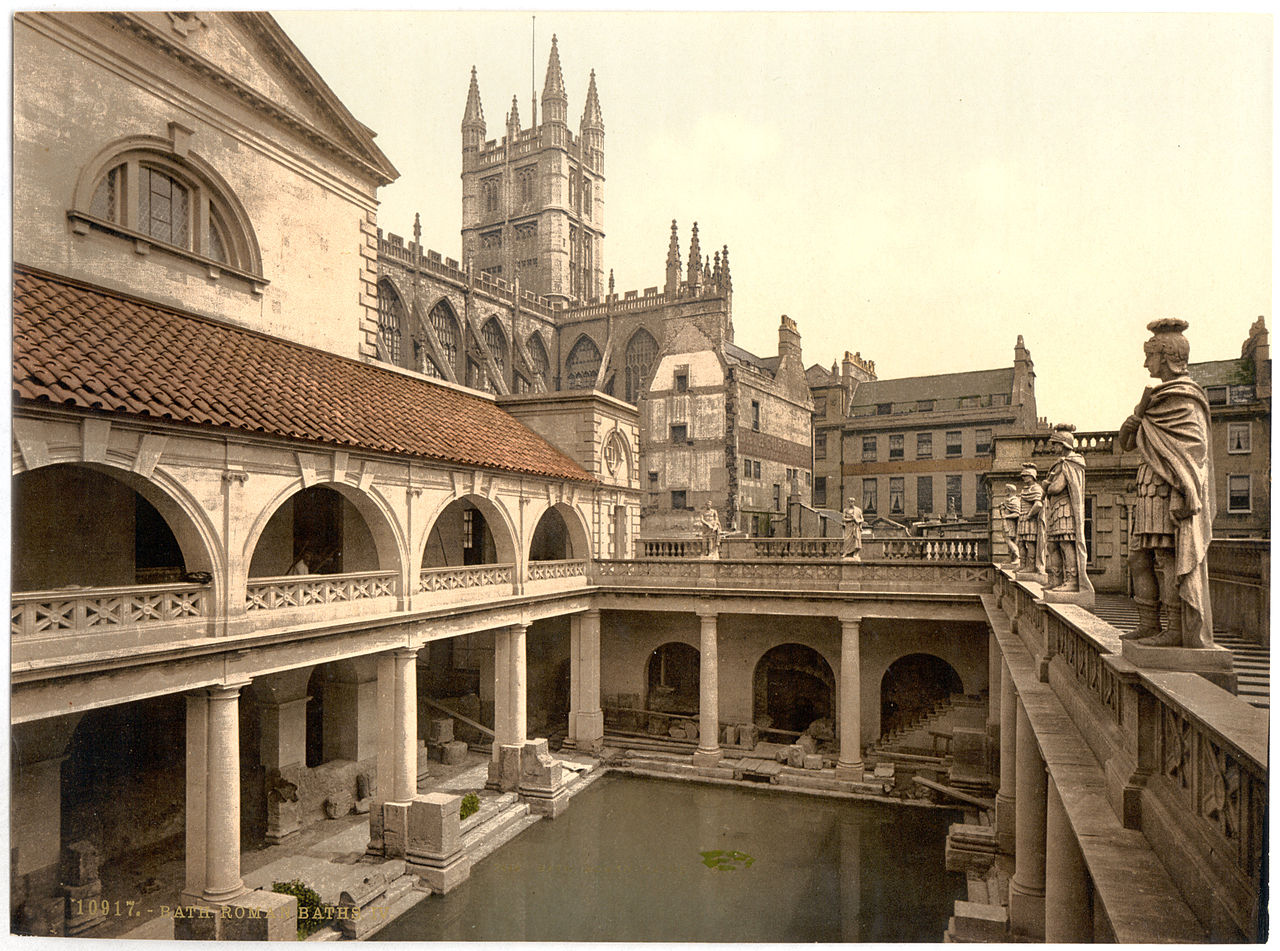
19th century photochrom of the Great Bath at the Roman Baths.
Bath
The springs at the base of hills near Bath in Somerset, a town founded by the Romans about 60 AD, were cherished from Celtic times for their purity and health effects, but the Roman emphasis on hygiene gave an added boost to the reputation of the place and over the centuries Bath developed into a major health resort.
Hydrotherapy i.e. the medicinal use of water, became fashionable from the late 16th century. People bathed in cold waters, rubbed painful parts of their bodies with water, or bathed in thermal springs to relieve arthritis, rheumatic pain and other ailments related to skin, stomach and bodily organs.
In continental Europe from the end of the 18th century onwards members of the landed aristocracy began holidaying in rural idyls, often in the mountains, where chalybeate waters were found.
In this period, Hotels were founded to cater to the card-playing, horse riding and other costly inclinations of this leisure class of visitors. The urban haute bourgeoise followed the fashionable aristocratic trends.
In the heyday of the Austro-Hungarian empire Kurorte (places with reputations for curative waters) thrived. It could be a mixture of complacent decadence and health seeking. Many places in today’s Czech Republic, Hungary, Austria and south-eastern Germany still incorporate the word Bad (baths) in their names. The languid decadence has departed and serious health therapy regimes now prevail. Trades unions in Germany and elsewhere organize health holidays for workers and their families.
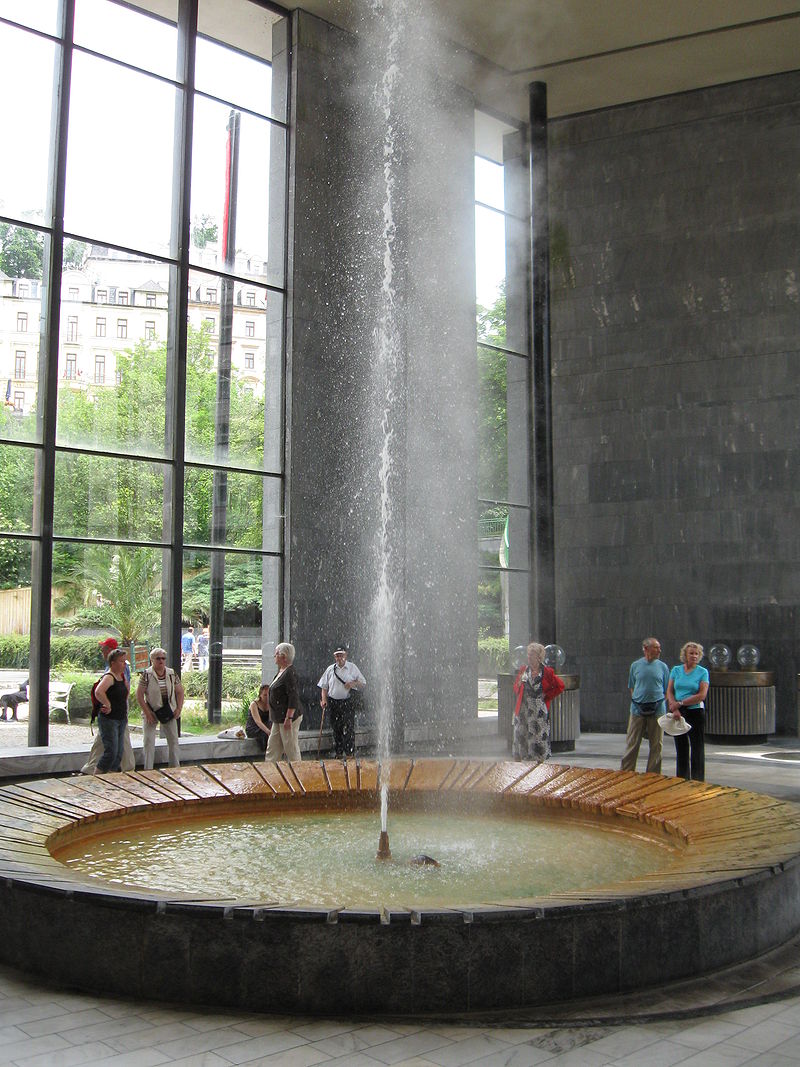
A geyser in Karlovy Vary, Czech Republic.
Irish Health Waters
In the 18th and 19th centuries several places around Ireland were major attractions for both rich and poor seeking comfort and cure from health-giving waters. Local economies thrived as hotels, shops, taverns and local transport catered seasonally to thousands of visitors coming from England and closer to home.
Only Lisdoonvarna in Clare remains to remind us of a tourist boom from former days. Below are a few details about places that once featured on the health map for urban sophisticates.
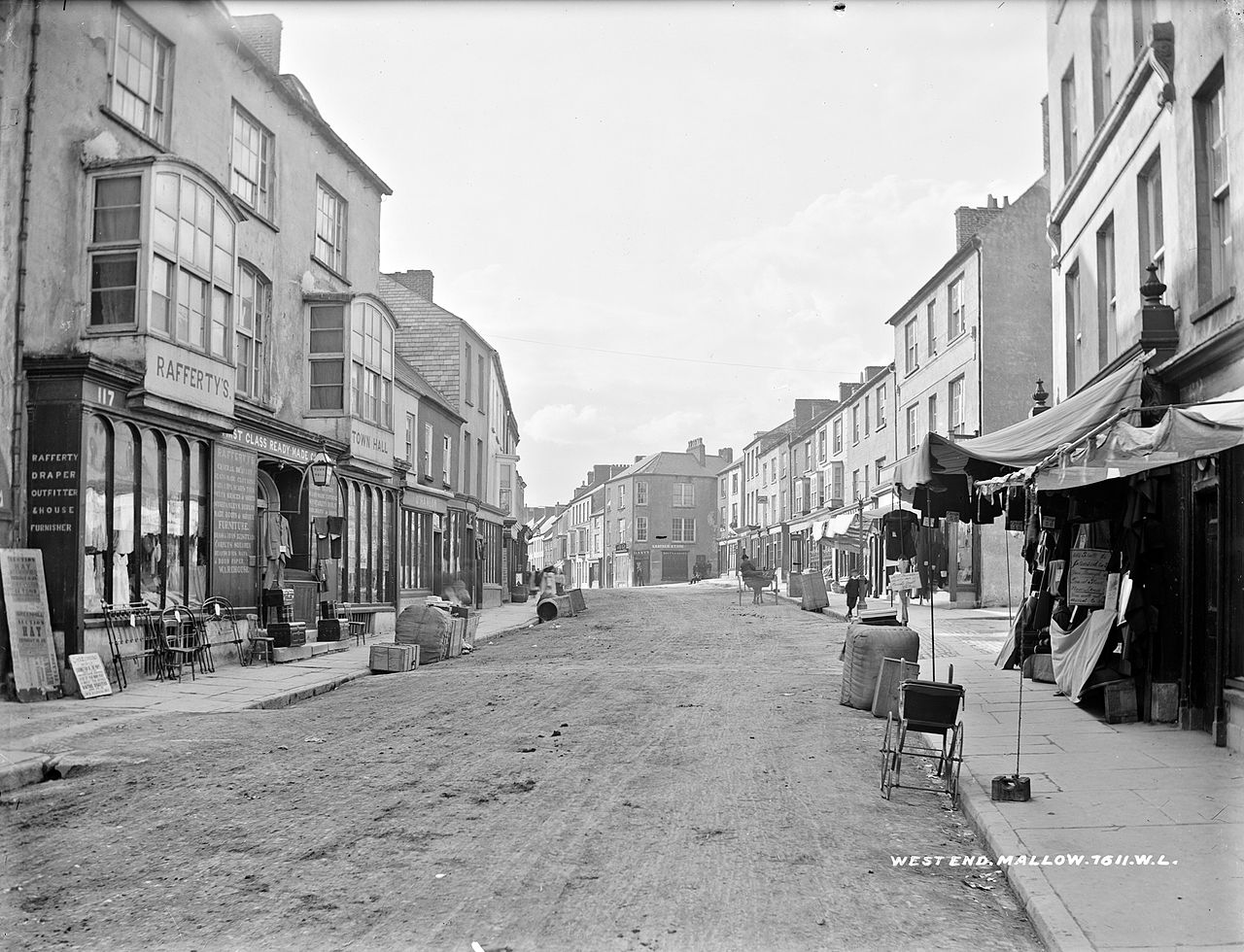
Thomas Davis Street (Main Street), Mallow in August 1903.
Mallow Springs in Cork
With the advent of Christianity one of the Mallow springs was dedicated to St. Patrick. The largest of the group is known as Lady’s Well. The belief that the spring had medicinal properties stems from the work of Dr. Rogers of Cork, who in 1727 treated a sick woman in Mallow and observed that the only liquid she could retain was water from the spring.
After her recovery Dr. Rogers invited Mr. J. Rutty from Bristol Spa to visit Mallow. Rutty wrote a book called Mineral Waters of Ireland, published in 1757, and highlighted the medicinal aspects. He quoted Dr. Rogers as reporting a wide range of cures including for: disorders of the stomach and skin; respiratory problems such as catarrh, coughs, and asthma; urinary disorders; and diabetes. Mallow became a popular health resort for about thirty years, especially in spring and autumn, but by 1850 it had ceased to function due to the social effects of famine and a switch of focus on English spa towns and glamorous resorts on the continent.
Mallow seems to be the only place in Ireland where thermal springs were known to exist. Many modern 5-star hotels offer so-called spas, which are really designer ‘hot tubs’ and Jacuzzis in luxury wellness centres created for moneyed holiday makers.
Struell Wells, near Downpatrick, County Down (pictured in feature image).
Located about three kilometers from the historic town of Downpatrick in Down, Struell (derived from the Gaelic word tSruthail or stream) comprises two wells, two bathhouses and the ruins of a church. It is a remarkable archaeological site. The evidence from Struell strongly suggests that it was an important sacred site in pre-Christian times. It is not far from Saul where St. Patrick is said to have met Dichu in the fifth century and made his first convert.
There are two roofed wells believed to have curative effects, the Drinking well and the Eye well. From the 17th century until the 1840s Struell was a popular place of pilgrimage. Today it still attracts people in search of cures and spiritual inspiration, and is an important stop on the St. Patrick Trail laid out by the Ulster tourism board.
Swanlinbar, County Cavan
In the 18th century people from England flocked to the three spa wells near the village of Swanlinbar, near the border with Fermanagh. Three wells had water rich in mineral trace elements and had a “rotten egg” taste and smell.
A hotel located at the well in Gortoral hosted the health pilgrims, who were told that drinking the water would allay scurvy, depression and bad appetite. The rotten egg flavour comes from the sulphur content.
Drumod well just south of Swanlinbar is still accessible and attracts visitors to this day. In his book about the mineral waters of Ireland above mentioned J. Rutty devoted many pages to the area of Swanlinbar and spread its fame around Britain and continental Europe.
The remarkable tale of the healing waters of Ballyspellan in Kilkenny https://t.co/DDI4Cbfqsx
Ballyspellan Spa, about 20 kilometers from Kilkenny city, no longer exists, but the spring water that flows through the limestone-rich Clonmantagh hills is still available to visitors who know about the medicinal properties.
There is a well near Johnstown village where people go to fill bottles with the water. In the early 18th century the gentry of Dublin and other towns made holiday visits. Rochfords’ Hotel nearby offered hospitality. Some of these well-heeled visitors enjoyed hunting foxes and hares, horse racing and dancing. Hurling was another attraction for whoever enjoyed the clash of the ash.
The poet Thomas Sheridan wrote about the spa. The area was the birthplace of Dr. Ronan Tynan, a noted singer, bone setter and limb amputee. Long after the fashionable gentry ceased to spend their holidays in the area the well remained a summer focal point where locals congregated to drink the water and divert themselves with sports and pleasant conversation.
St. Munn’s Well at Brownscastle in County Wexford
Near Taghmon in County Wexford ‘patterns’ were held during the 18th century on the saint’s feast day 21st October. The waters at nearby St. Munn’s Bed were sought by pilgrims in search of cures for back ailments.
Unfortunately, however, a lot of drunkness and fighting ensued from the partaking of strong poteen distilled in the hills and sold to pilgrims, and by the early 19th century the annual custom was banned by the clergy, but some locals continued visiting the place discreetly.
In the mid-twentieth century two local men, Jack Sinnott and Christy Murphy drained and piped the vicinity and Seamus Seery with others built a footpath access so that the general public could visit without difficulty.
Lisdoonvarna in County Clare
The medicinal waters of Lisdoonvarna were first written about around 1740 and the gentry from far and wide began flocking to an area not far from Ennistymon in County Clare, where no village existed at the time.
In the second half of the 19th century hotels were built and the precious waters, rich in sulphur and iron, were under the control of private owners. The Guthrie family built a pump house for dispensing the water, one prominent woman in the family being known as Biddy the Sulphur. A certain Dr. Westropp purchased the site and introduced baths. The main visiting season was in September when harvesting was complete. Several hotels and boarding houses competed for customers.
Lisdoonvarna became associated with matchmaking as parents brought marriageable daughters on holidays there. Matchmaking festivals still take place, and many young people independently take trips to Lisdoonvarna in search of fun and friendship.
Although I have never tasted the sulphur waters, Lisdoonvarna is important has a personal significance as it is the place where my parents met in the autumn of 1942: my mother visiting from Limerick and my father from more distant Kildare.
Lisdoonvarna has attracted German and other young continentals seeking out pubs in Clare where traditional Irish music is to be heard. The popular song Lisdoonvarna was first sung by Christy Moore in the 1980s, and helped publicise the folk music festival. It is fair to say that drinking pints in ‘singing pubs’ is now more popular than ‘taking the waters’ among this age profile.
Glencar Waterfall at Glencar Lough.
Lesser Known Spa Waters in County Leitrim
Several localities which are not well known nationally have water springs and wells that have been sought out by health connoisseurs.
County Leitrim has sulphur and chalybeate (iron-rich) water sources. Around Sliabh and Iarainn (the iron mountain) overlooking Lough Allen in mid-Leitrim old ordinance maps indicate the presence of twenty spa wells, but hardly anybody visits the spots nowadays, although hillwalkers find the whole area overlooking Lough Allen attractive, and remains of old sweat houses can be found. In the Mohill district the neglected remains of a spa well rest obscurely on a private farm
Drumsna in South Leitrim is reputed to have a number of sulphur streams, not universally prized by locals on account of the ‘rotten egg’ flavour and smell.
One well in MacManus Cross, between Jamestown and Carrick-on-Shannon is still visited by individuals seeking water to cure worms in children and horses.
Not far from Dromahair in North Leitrim is a little-known locality on the side of a wooded hill known as Derrybrisk (Doirebriosc in Gaelic, which suggests woodland with oak trees).
Older inhabitants of Dromahair, Killenummery and Ballintogher remember sweet summer Sunday afternoons until the 1960s when people from the adjoining townlands and visitors from Sligo town, arriving on bicycles, congregated at Derrybrisk spa, as it was then known. Card playing and chatting was the point, not tasting the sulphur water. Farmers came to fill bottles of the sulphur-rich water and use as medicine for sick animals. The water, diluted in ordinary water, was also said to cure worms in young children.
The advent of motorised transport and mass media such as radio and television seems to have brought these social afternoons to a halt. The spot is difficult to access today. Several farms in the Ballintogher area have streams tasting of sulphur, indicating that there is a lengthy vein of sulphrous limestone in the hills around.
Modern medicine and improved diets have lessened the traditional appeal of medicinal waters, but folklorists and natural health enthusiasts hanker after the old ways.
Leitrim largely missed out on the 19th century enthusiasm for taking the waters, but today the ‘forgotten county’ as it is sometimes termed, is ripe for a reimagined rural outdoor tourist industry.
Hill walkers can be brought on guided trips to view the remains of archaeological sites and curiosities. Old abandoned sweat houses, spa wells, holy wells, dilapidated monastic sites, dolmens and abandoned mining projects – all these and some important War of Independence memorials invite domestic and foreign tourists.
Craft whiskey and gin are among other spirit waters which have made an appearance. In Drumshanbo in mid-Leitrim Gunpowder Gin has proved to be a dynamite product for domestic and export consumption. Now if only a daring chemistry graduate would invent a novel sulphur water-based alcohol elixir, preferably with the rotten egg smell removed.
Oscar Wilde said that the tragedy of being old is that one is still young.
I am eighty-six, going on nineteen. Is this a record?
I’ve been pruning and wood carving with my chainsaw for years. There is no shortage of wood from the trees that I planted thirty years ago. The resultant grotesque heads are visible all around my garden (all wearing face masks – you must keep a sense of humour). Now they mock me.
In the week before Christmas I took out my chain saw to clear away two full-grown pine trees that had fallen on our oil tank.
Everything went well until I became ambitious. For the first time, instead of placing the machine on the ground with my foot on it, I tried to start it as they do in the movies: hold the machine in my left hand, push it down while pulling up on the starter with the right hand. That’s what the pros do. I had never tried it before.
The result was dramatic. There was a sharp crunch in my left shoulder, plus pins and needles in my hand. A month later that is still my painful condition.
On that day before Christmas I admitted for the first time that I’m old and it got me thinking about the disparities between age and youth.
Demographically speaking, we oldies will soon outnumber youngsters. This is because young females are postponing reproduction until their mid-thirties. The costs of childcare and housing are prohibitive, there is a lack of confidence in the future. Also, many want an independent career. It’s a first world scenario.
Women traditionally reproduced at about 25 years of age. Now it’s their mid-thirties and two kids are the ideal. However, since 1981 the worldwide replacement rate for us humans is down to 1.58 kids per woman. Ultimately that is not enough to prevent the extinction of the race.
Demographics is destiny
Thanks to modern medicine we superannuated oldies will soon outnumber fit young workers; the latter group’s taxes keep our health service going. We non-taxpayers (if you overlook VAT) will soon consume over 50% of health costs.
Will this trend continue? Probably. The young don’t vote enough. The seniors vote early and sometimes often. Governments know that older voters tend towards the status quo and shape their manifestos accordingly. This ensures that conservative policies preserve existing evils as distinct from liberal policies which wish to replace such evils with others. In the end the government always wins.
We used to worry about overpopulation in the world; now we are in reverse gear, or at least the wealthy West is. I’ve cooperated in the production of six children, so I can’t really be blamed.
But the centre cannot hold.
The gaps in the supply services, witnessed by the shortage of truck drivers during the pandemic, are a symptom of the new malaise. Older skilled workers are retiring with few to take their place. Employers are desperate for employees.
Don’t worry, I hear, the immigrants will eventually make up the numbers. Already they are the prime carers – for us, the oldies! Now a world of opportunity is there for immigrants (and about time too). Instead of denigrating them, fighting to keep them out, we will have to compete for their services, especially the skilled tradesmen.
How many of us can fix a puncture, replace a fuse, stop a leak, change a tyre, do any of the tasks that were once second nature to my generation? Very few. We have all become a dysfunctional, middle-class burden on the young and fit. Have we passed on these humble skills? No, the young have been too absorbed in their screens to learn such mundane tasks. Now we don’t repair; we replace with newer models which are programmed to break down after the guarantee expires. Thanks to the advertising industry the world of the consumer is chasing its tail. Everybody knows.
Is this an argument for despair? Not at all. Some oldies have opted for the Zurich solution but most of us will cling on desperately to the last vestiges of our functionality.
Unless euthanasia and trips to Zurich become mandatory…
Featured Images: Carvings by Boby Quinn: ‘De Profundis’; ‘After Brancusi’; ‘Me Worry’.
I’m living in cloud cuckoo land
And this just feels like Spinning plates Radiohead, Like Spinning Plates, Amnesiac 2001.
Ten years on from the Irish Banking Crisis and the subsequent taxpayer funded bailouts, how are we faring in term of regulating the financial sector?
In view of the possibility of another property bubble, it is surely vital to ensure appropriate access to justice, especially for those with limited resources.
Prior to the Crash, banks through their own internal regulatory mechanisms – including risk management and third party auditing firms – were, essentially, allowed to regulate their own affairs, which unfortunately permitted a lax regime.
On a rare occasion that a risk manager signalled grave breaches of conduct to the Central Bank of Ireland – as in the case of whistle-blower Jonathan Sugarman – he was largely ignored. And, even though thanks to his revelations we know a great deal more than we would otherwise about widespread banking mis-conducts, Sugarman subsequently had his professional and personal life destroyed. That message is surely not lost on colleagues intending to pursue a similar course.
Back then, inadequate regulatory frameworks allowedunderestimation of risk and outright profiteering in the banking sector. Yet there are reasons to believe that, despite the successes boasted of by the regulators, thousands of people are still being failed by the State.
Could this be a subtle example of so-called ‘regulatory capture’, which is said to occur when a particular industry holds an excessive level of influence over a statutory agency designed to monitor and regulate it?
Ernesto Dal Bó offers two interpretation of the phrase:
According to the broad interpretation, regulatory capture is the process through which special interests affect state intervention in any of its forms, which can include areas as diverse as the setting of taxes, the choice of foreign or monetary policy, or the legislation affecting R&D.
According to the narrow interpretation, regulatory capture is specifically the process through which regulated monopolies end up manipulating the state agencies that are supposed to control them.
Either of these descriptions could easily be used to describe successive Irish government’s cosy relationship with foreign multinationals. Witness how in 2016 then Taoiseach Enda Kenny unashamedly set out Ireland’s stall as ‘the best small country to do business in’. Attracting financial service companies to a friendly, relatively unregulated, environment appears to remain high on the government’s agenda.
But insofar as this is a legitimate goal, the way it is achieved, for example, by perpetuating dysfunctions in regulatory mechanisms, have grave consequences for the public at large, especially in terms of access to justice.
Ombudsman
One mechanism to provide access to justice is embodied in the role of the Ombudsman.
This word come from Sweden where its first use is recorded in the 19th century. Meaning “Commission Man”, it involved oversight over the abuse of power by public administration. The position evolved with changing times and industries, to become globally adopted, assuming the part of an impartial mediator between individual complainants and large, well-resourced organizations.
To give a simple example with a bit more context: what if you have a complaint against the misbehaviour of a credit institution with which you have a resulting outstanding debt?
In Ireland, anyone in such a predicament can avail first of internal complaint procedures within the credit/insurance/pension providers. If this proves futile, as often seems to be the case, you can either go to the Financial Services and Pension Ombudsman (FSPO), or for the better-resourced, proceed directly to the courts.
The FSPO was established in order to provide “an impartial, accessible, and responsive complaint resolution service that delivers fair, transparent and timely outcomes for all our customers, and enhances the financial services and pension environment.”
It’s role is crucial in ensuring basic standards of consumer protection especially in a sector such as financial services, which bears significant responsibility for a dysfunctional property market
This article is not disputing that the Office has fullfilled aspects of it’s responsabilities to date, and recognises the challanges of the past two years of the COVID-19 pandemic. The Office’s results are well presented in their annual digests of decisions, and were compellingly illustrated by the current Head of the FSPO, Ger Deering, in hisOpening Statement to the Oireachtas Petitions Committee the 25th May 2021.
What we are interrogating is why a large number of complaints, seem to have been closed in preliminary scrutiny on a narrow, legal interpretation of the Act. It is also unclear whether the FSPO is sufficiently staffed and organized to make use of the necessary banking knowledge in order to fulfil all its statutory duties.
Boasting Figures
Ben Hoey, an experienced ex-banker who founded Quartech services, a mortgage mis-selling advisory firm, has been assisting individuals with the filings of such complaints and has made us aware of some of the challenges encountered.
Having submitted over fifty complaints over the last two year to the FSPO, as well as two FOI requests in June 2021 and most recently a judicial review, he also raises serious concerns over the ability of FSPO to carry out its duties.
In an Opening Statement to the Oireachtas Petitions Committee, Mr Deering boasted: “In 2020, I am happy to report that, despite the challenges of the pandemic and remote working, we closed 6,193 complaints, an increase of 35% on 2019.”
But thanks to Hoey’s FOI requests, we now know that 2,110 of these cases never entered the dispute resolution or investigation processes.
Those numbers also slightly differ from the ones found in the annual report of 2020, and are presented in a way suggesting that 1,401 cases were actually sorted within a very short time frame.
There are, undoubtedly, cases that were legitimately rejected as indicated in the Act. But in order to gain more detailed explanations for preliminary decisions, made in the first registration and assessment phase, the FOI requested documentation and records in relation to reasons for closure. Unfortunately, in this case the answer was ‘no records exist.’
This is just the first stage of the complaint; the staff needs to interpret the Act and establish if the newly arrived complaint falls within the FSPO jurisdiction.
It relies on training and guidance materials, which have also been released, and from this we see that when issues of jurisdiction arise, there is an over-reliance on the legal profession and a marked absence of the necessary banking expertise.
In general, we know that if a complainant does not accept the preliminary rejection, and responds in writing, he or she receives a letter issued by the legal department. But in order to interpret and respond to this one would likely require legal advice.
This doesn’t come cheap as the FSPO is well aware, since it spent €1.8m (46% of staff costs) on “Legal Fees” according to their 2020 accounts. By comparison the equivalent UK body filed no such expenses. Recall that the role of an Ombudsman is to be an impartial mediator between individual complainant and large, well-resourced organizations.
Some of Ben Hoey’s clients received letters up to twenty-two pages long, containing dense legal terminology, supporting FSPO arguments not to investigate; rather than a professional financial analysis of the issue in question.
Others have seen their complaints dragged out for years, stuck in the earliest phase of the “statutory complaints procedure”; which was established in order ‘to afford complainants an informal, expeditious and independent mechanism for the resolution of complaints.’
From the point of view of some complainants, it feels as if the process of adjudication has been designed to keep their case out of the FSPO jurisdiction, thus keeping the number of cases that the Office investigates to a minimum.
When the Financial and Pension Ombudsman positions were merged into their current form in 2018, the new organisation should have been structured, and staffed, to handle a increasing number of annual complaints. It appear from the latest annual report that this has been achieved, but when we get into the granular detail, we see that up to a third of these may have been inadequately handled.
Given that a significant percentage of such disputes are in relation to mortgages and to a dysfunctional housing market, we can surely appreciate the importance of such an institution.
The stigma attached to debt is a deep scar that afflicts many in an apparently prosperous country. Given that a level of responsibility lies with the lending industry, we should expect the Department of Finance to ensure that the relevant agencies such as the CBI and the FSPO that protect such individuals are adequately resourced.
Yet the total count of full time employees of the FSPO is just 85 as of the end of 2021. That amounts to roughly twenty staff per million inhabitants in Ireland. By comparison, its counterpart in the UK employs double that with 3,000 staff, or approximately forty-four per million.
A Stairway to Heaven
Since Ger Deering was recently nominated by the Minister for Public Expenditure and Reform, Michael McGrath, to become Ombudsman and Information Commissioner, we expect that the position of Head of the FSPO will soon become vacant.
We now have access to another FOI request providing insights into the recruitment of Ger Deering to the office in 2015/16, at a point when the Financial Services Ombudsman FSO and Pension Ombudsman were still separate bodies.
A series of interviews were carried out with eight candidates on February 17-18, 2015 for the first round, and on February, 27, 2015 there were final interviews with the remaining three candidates, the “Board Members Guidelines” resembling a basic template for corporate hiring.
All of the interviewers had impressive CV’s and expertise, including Mr John Hogan, then Head of Banking Policy for the Department of Finance and recently appointed as Secretary General.
Notably, the majority of complaints received by the FSPO pertained to financial and banking issues. One would expect that any individual considered for that role – with powers to make legally binding decisions – would have extensive experience within the banking sector.
By analogy, if one looks at the skills required of managers and other positions with supervisory roles, employed in the banking and insurance sectors that are imposed by the EU Single Supervisory Mechanism, we find clear guidelines in regard to required banking knowledge or one can even look up the job description for an FSPO Case Manager in PTSB.
Yet in the advertised job description for The Financial and Pension Ombudsman we see theoretical banking or financial knowledge being “desirable” instead of “essential”, nor is there an examination process, beyond a standard interview.
This is not to question Ger Deering’s managerial skills, nor his ability to adapt and learn, but when the job requires him to lead an oversight body over the banking, insurance and pension industries, his work experience is not what one would expect for the appointment.
We know that the Office contains some banking expertise thanks to the qualifications of less senior staff, who have to deal with an enormous workload. But an appointment process for the top job focused on legal and managerial skills may perpetuate the current imbalance between the private and public sectors.
In the forthcoming recruitment process for a position such as the FSPO, it is surely in the interest of the Department of Finance to appoint a person with more than generic managerial skills, and for some form of competitive examination to occur. Otherwise, it will be difficult to convince an increasingly sceptical Irish public that the government is genuinely intent on levelling the playing field between ordinary citizens and “too big to fail” corporations.
Shared Responsibility
One might say that appointing an ex-banker to the position creates a dangerous revolving door between banks and regulators, and is itself a recipe for regulatory capture. That argument is right to a point, but does not take into account that the necessary banking expertise might be found outside the banking industry itself, such as in auditing and accountancy firms; or by casting the net internationally to guarantee a greater degree of separation between the regulator and the regulated, especially in a small country such as Ireland.
And, insofar as it is important to have sound legal advice, it is important that this is not set out in such a way as to intimidate complainants, and that the Office receives the same level of financial consultancy as the banks themselves.
When we talk about consumer protection in the financial industry, we are really talking about the level field that the government promises, in relation to an industry administering one of the most powerful means of control, which is the complex socio-psychological phenomenon of debt.
While some are celebrating that ‘The Boom is Back’, a significant proportion of the population is still struggling to overcome the effects that the previous boom and subsequent financial collapse actually brought; and, as in the period of austerity, the burden of bad choices is still carried almost exclusively by the most vulnerable and least resourced.
In a quiet room, two men smoke hashish and discuss the inevitability of the Apocalypse. All the signs are apparent: unusual weather conditions, social unrest, unendurable suffering caused by poverty and war. Searching for a loophole, they weave theories of increasing complexity, involving Messiahs, the reversing of the Old Laws, and the triumph of the Feminine spirit. After a few more puffs, however, the older man’s ability to speak fails to keep pace with the increasing abstraction of his thoughts. He falls into a reverie, or perhaps merely sleep. Only he can tell which. The other man stays awake, watching his ideas play out in all their baroque intricacy and intensity, until he, too, is overcome by tiredness. The solution to the Apocalypse will have to wait for another day.
Welcome to eighteenth century Poland, as imagined in Olga Tokarczuk’s recently translated novel The Books of Jacob. A work of historical fiction, it straddles genres. On one hand, the book is the fruit of painstaking historical research, with Tokarczuk claiming to have worked seven years on the text. On the other, the novel’s ability to engage relies on the way it imaginatively enters its historical personages lives, and weaves compelling characters, relationships, and plots from the gaps in the historical record. The reader is told this in one clause of the book’s stylishly verbose title:
The Books of Jacob
Or
A Fantastic Journey Across Seven Borders, Five Languages, and Three Major Religions, Not Counting the Minor Sects.
Told by the Dead, Supplemented by the Author, Drawing from a Range of Books, and Aided by Imagination, the Which Being the Greatest Natural Gift of Any Person.
That the Wise Might Have It for a Record, That My Compatriots Reflect, Laypersons Gain Some Understanding, and Melancholy Souls Obtain Some Slight Enjoyment.
The novel was originally published in 2014, and has been considered Tokarczuk’s masterpiece. In 2019, she was awarded the 2018 Nobel Prize for Literature, and in November 2021, an English translation by Jennifer Croft was published by Fitzcarraldo. Croft had previously translated another of Tokarczuk’s books, Flights, for which they shared the winning of the Man Booker International Prize in 2018.
Olga Tokarczuk in 2019.
Summary
The book follows the emergence, peregrinations and eventual dissolution of a religious sect built around a charismatic leader by the name of Jacob Frank. The sect was composed mainly of Jews, mostly Polish in nationality, who broke from the mainstream Jewish community. They believed earnestly that the end was nigh, and Jacob Frank was the Messiah. Frank’s teachings consisted of homely expositions of esoteric Kabbalist theories, involving such things as a Trinity of four parts, and the notion that God created the world without being aware he was doing it.
Frank led his followers into new territory not just in the world of ideas, but also in respect of their place in European society. As Jews in Poland, they were barred from owning property, taking noble titles, and were perpetually subjected to suspicion and animosity, especially in times of social unrest caused by wars and famines. Frank convinced his followers that it was necessary for them to be baptised as Catholics. A barrowload of theological argumentation was provided to justify this move, and the group maintained many aspects of their culture even after their conversion, including unique clothing, refusal to eat pork, and a preference for marrying within the group. The cynical question can’t be dismissed: to what extent was the sect’s religion a front for a social movement?
Jewish wedding with klezmer band in a shtetl in Russia, painting by Isaak Asknaziy, 1893.
Musings on Contemporary Applications
Many commentators on this novel have noted that it speaks directly to our time, but few have been more specific in saying how. Marcel Theroux’s excellent review for The Guardian, for example, ends without developing the tantalising suggestion that the book, “which is so demanding and yet has so much to say about the issues that rack our times, will be a landmark in the life of any reader with the appetite to tackle it.” In the rest of this article, I would like to step away from the act of reviewing this book, and instead reflect on parallels with our current time.
I propose three areas of comparison.
The Nation State in Peril
Popular Apocalyptic Sentiment
Cults of Personality
Administrative division of the Polish-Lithuanian Commonwealth in 1789.
The Nation State in Peril
The Poland depicted in this novel is not the Poland of today, either in its geographical delineations nor, in many aspects, its culture. But the idea of such a nation stretches back to the eighteenth century.
In general those claiming to represent any nation like for its subjects to be obedient, to document themselves clearly for the State’s convenience, and to stay in one place. For these reasons perhaps the Irish state has long struggled to accommodate the Irish Travelling Community.
This novel could be read as a meditation on the relationship between the nation and that which is ‘foreign’. After all, Jacob Frank’s last name is not a ‘real’ last name at all, but was a generic title applied to foreigners. Thus, Jacob Frank could be translated to ‘Jacob the Foreigner’. The group exists in a strange tension with Poland. Jacob doesn’t speak Polish, but still amasses a following in the country through his physical bearing, his charisma, and the compelling nature of his ideas in translation. Emerging from the Jewish community, and with theological ties to schools of thought widespread in the Middle East, the sect is both native and foreign at the same time. It comes from without, but gathers momentum because it speaks to a dissatisfaction within Polish society.
Over the course of the book, the group ‘settles’ into a mode of being comfortable for the state. They stop being nomadic, they get baptised into the dominant religion, and they change their Jewish names to Catholic Polish ones. Jacob Frank tells his followers, “Everyone who seeks salvation must do three things: change his place of residence, change his name, and change his deeds.”(p. 229). Rather than solidifying the order of the nation state, as this action appears to do on the surface, it actually undermines the concept of nation by highlighting the fluidity of such markers of identity as one’s name, place of residence, religion etc.
By definition, arising from the establishment of settled agriculture, a nation is opposed to nomadic forms of human culture. Nation states also tend to dislike groups with distinct languages or scripts. To be considered a good citizen, you should have one name, spelled one way, using no funny symbols, and you should never dare to change this.
The granting of land to the Frankists was not just to the sect’s interest, but was also greatly in that of the State’s. If the group held land, they would stop travelling around the country riling people up and gathering more converts. Moreover, it would be easier to keep an eye on them.
As a member of a dominant religion, you conformed publicly with the society at large. You had your job, your Polish name, and attended church. But in your own home, and in your smaller communal meetings, you discussed your true spiritual beliefs and worshipped in your own way.
The freedom to practice one’s religion privately, without persecution or suppression by the state, is one which was hard won over the large few centuries. But in Jacob’s time, it was a primary issue, connected to what it means to live as an individual on a day to day basis.
Reading the novel, I found my mind turning to the tension between private and public existence in our time. It seems to me that the division between public and private that may have existed in the eighteenth century is slowly being eroded in our own times. After all, surveillance is no longer something that happens in the street, but has now intruded into every facet of private life. Citizens keep voice-commanded devices in their bedrooms, their kitchens. We each carry around devices with camera that face both outwards to the world, and back at our faces, with microphones that record the words we speak. Our phones, without which modern life is difficult to manage (how will you get a job, stay in contact with friends, pay for your visits to the cafe?), have become an instrument of power that destroys the fragile barrier between public and private life. Without this barrier, will the possibility of quietly practicing non-dominant ways of life (religion, community, culture) be permitted for long?
In Catholic Poland of the eighteenth century, the Church and the state were intertwined. In Neoliberal Ireland of the twenty first century, the state is intwined with the interest of corporations.
But the corporations have an edge. It is to companies like Meta (formerly known as Facebook), Google and Amazon that the vast majority of surveillance capitalism belongs, not the state. Google knows where I go on a day to day basis, what I buy, what music I listen to and what blogs I read, much more intimately than the state does. What does it mean for a non-elected body to have such power in a nation? Is it comparable to the power the Church had over the kingdoms of Medieval Europe? If Google ordered it, would Ireland join a Crusade?
Viktor Vasnetsov (1848-1926), the Four Horsemen of the Apocalypse.
Popular Apocalyptic Sentiment
It was reasonable for Europeans to feel apocalyptic two hundred years ago. There was terrible wealth disparity, with peasants and kings living side by side, social unrest, culminating in the French Revolution and a succession of natural disasters, like the Lisbon earthquake.
It is fair to say that there is similar apocalyptic sentiment around today. Although the average standard of living is higher now than the average eighteenth century Polish peasant, the extent of wealth inequality has become absurd. In a globalised society sweat shop workers produce iPhones for the satisfaction of wealthy consumers who fantasise about building mansions on Mars, while the planet shudders under the weight of our cumulative impact.
Natural disasters will always happen, but it is interesting to note our increasingly panicked reactions. Words like hellish and apocalyptic are bandied about when we see forests burn, amidst an increasingly sense that we are to blame. If we contrast this with an event like the Lisbon Earthquake, the reaction it evoked for many was to question the Divine plan. How could God allow such awful things to happen to Europeans?
The Frankists believed that in the end times, the Messiah would come, and when this happened, all the old laws would be reversed and thrown away. It was this logic that allowed Frank’s followers to change their Jewish names, ignore all the rules for living laid out in the Talmud, and experiment with bizarre new (or, perhaps, archaic) modes of sexual behaviour.What changes in our culture will we see when a large enough percentage of the population truly accepts the possibility of apocalypse?
North Korean poster featuring Kim Il-Sung.
Cults of Personality
Jacob is not the most intelligent character in this book. At the same time, he often downplayed his intelligence, calling himself a ‘simpleton’. The intellectual backbone of the Frankists were a group of older characters, deeply versed in Jewish scripture and Kabbalah. In their nightly discussions, they would provide the raw material to Jacob, who would then draw from this wisdom in his actions and speeches to the rest of the followers.
What Jacob had was charisma, above all else. He was like a magnet, drawing people to him through an invisible force. Without Jacob, the group had no coherent identity: a group of Jews who had forsaken their birth names, the teachings of the Talmud, and their homelands. The teachings of the group, too, had no unity apart from Jacob. It was, in effect, a cult of personality.
There is an interesting passage near the end of the novel. In this scene, the stories of Jacob’s life are being recorded. Being old, and the revered head of a movement, the stories have become increasingly mythic in nature. But what strikes one observer is that the story of the Frankists as a group, and the story of Jacob’s individual life are intertwined.
…the Lord tells his tales, and he and Jakubowski write them down, until out of these stories Jacob’s life starts to emerge – a life that is simultaneously the life of this ‘us’. (p. 86)
Normally, we think of individualism and group-based living as being diametrically opposed. But here, they’re interdependent. But what does it mean for an individual to represent a group?
People are always more persuasive than ideas. And it’s interesting how a charismatic personality can stimulate interest in esoteric ideas among people who would never have dreamed of engaging with such ideas otherwise. Just look at how many young men are now reading Alexander Solzhenitsyn, Carl Jung, and Dostoyevsky because of the viral popularity of Jordan Peterson. Or how many hipsters are reading Hegel because they like Zizek.
This is not to be critical of reading Jung or Hegel, or to mock people for reading outside their comfort zone, but it is notable that they mostly read Jung in the context of Jordan Peterson, or Hegel in reference to Slavoj Zizek. And these personalised forays into philosophy or psychology come with ideological baggage.
A Peterson fan is likely to read Jung to find proof of the mystical solidity of the division between the Masculine and Feminine spirit, or the impenetrable irrefutability of biological determinism. A fan of Zizek will read Hegel, and, in all likelihood, understand very little, but will at least be more impressed and willing to listen to Zizek the next time they hear him speak, because clearly he understands things they do not…
All this reference to authority has something medieval about it. In the Middle Ages, it was enough to say that Aquinas wrote something to take it for granted that it was true. There was a finite list of ‘authorities’ that you could quote with impunity. And it was considered appropriate to defer to such authorities than try to prove the truth of something by original argumentation.
The scientific method broke with this, throwing the baby out with the bathwater. No, it said, we can’t take any ‘obvious’, ‘common sense’ truth for granted. We can’t hold anything true on the grounds of ‘authority’, because we no longer trust these powerful institutions like the Church and the State to tell us what is true and what isn’t. Let’s give power to the people!
A philosopher like Habermas would argue that this striving for objectivity, atomised and isolated from the rest of human knowledge, is fruitless. Truth arises as part of a conversation.
In our own times, with information so freely available, but also requiring some conscious effort to sort the chaff from the grain, there has been an explosion of cults of personality. With its ability to present the human face in motion and voice in high definition, the internet, more so than even the radio (which had such a devastating role in boosting dictators in the twentieth century), allows for the easy transmission of charismatic personalities.
You could argue that this is the bookish side of the larger celebrity culture, but it’s worth paying attention to this phenomenon when you consider the extent to which popular discourse is driven by these popular thinkers, such as:
Jordan Peterson
Slavoj Zizek
Sam Harris
Ben Shapiro
Christopher Hitchens
Note: Having a cult of personality isn’t necessarily a damning judgment on the individual in question. It just seems to be the way the internet works at present.
Note 2: Isn’t it interesting that all these people are male?
Many of these popular thinkers are not true intellectuals. They often speak in vague statements. They contradict themselves etc. But this may be part of the charm. In The Books of Jacob, Tokarczuk describes the effect Jacob has on crowds:
…he makes quite the ruckus, with his strange gestures and the odd things that come out of his mouth. He speaks so enigmatically that it’s hard to figure out what he means. That’s why people stay together for a long time after he leaves, trying to interpret for themselves and one another the words of this Frank, this foreigner. What did he say? In some sense, each can only understand it all as best as he can, in his own way. (pp. 639-638)
This doesn’t sound dissimilar from the comments section on a Jordan Peterson lecture.
These figures mostly appeal on the level of personality. Their fans don’t care if they are not the most intellectually sophisticated thinker in the academy. They’re engaged more on the level of watching somebody they like and admire, such as a friend, grapple with issues that they feel effect them. And of course, this being a cult of personality, they identify with these figures. Ben Shapiro is a knight, a hero, valiantly slaying the libs for ‘our’ sake. These figures gain support and popularity by virtue of being ‘on our side’. Even if they don’t identify with the group, they can win support by scoring argumentative points against one of the group’s enemies. Thus, Jordan Peterson was admired by many neofascists, despite his denouncement of that viewpoint, because he criticised the culture of ‘wokeness’ on so many occasions.
Perhaps these popular figures are tapping into the archetype of the prophet? A figure who speaks enigmatically but urgently, calling for us to change our ways before it’s too late. In a neoliberal system that seems impervious to innovation unless it is in order to exploit the planet and human beings more brutally; it’s thus understandable that there’s a thirst for a powerful voice of urgency among young people. This is what the movie Don’t Look Up primarily conveys: a sense of powerlessness, of not being heard when the apocalypse is so painstakingly obvious.
Lay It to Rest, Lad
In a room bothered by the noise of traffic, two men quietly smoke hashish. They speak of the imminent apocalypse. All the signs are there: natural disasters, odd weather conditions, vast wealth inequality, the strong preying on the weak. They weave intricate theories, drawing from the half-baked ideas of internet grifters. The sun sets, but the light of the screens stay on. Sleep will not come soon.
A hundred years on from the blood-stained birth of a partitioned island of Ireland, another European country faces the prospect of settlement or war. If any people should understand the Ukrainian Question it is surely the Irish, who also confront a larger and far more powerful neighbour, a shared history and religion, and a population divided along ethnic lines.
It is important to understand that a significant minority of Ukraine‘s population consider themselves Russian. Indeed, there are striking parallels with the conflict on the island of Ireland.
In the North of Ireland a majority consider themselves British first and Irish second, just as in eastern Ukraine and the Crimea a majority consider Russian their primary identity. The roots of these ethnic divisions are also similar: Northern Protestants in Ireland arrived as planters in the wake of invasion in the seventeenth century; just as ethnic Russians in eastern Ukraine and the Crimea arrived during the conflicts of the early twentieth century.
Both modern Russia and Ukraine trace their origins to the establishment of the Kievan Rus Federation, a loose federation of east Slavic, Baltic and Finnic people from the late ninth to the mid-thirteenth century. This is how Russia acquired its name, and Ukraine’s capital, Kiev, too. Shared claims of ancestry endure to the present through the personage of the eleventh century Prince Yaroslav the Wise. Thus, Ukraine awards the order of Prince Yaroslav for services to the state, while a Russian frigate patrolling the Baltic also carries his name. Yaroslav’s image also appears on bank notes in both countries.
The most probable (live) picture of the Yaroslav the Wise is his seal.
Collapse of the Soviet Union
More recently, in the aftermath of the collapse of the Soviet Union in 1991 a slew of post-Soviet Republics declared independence, and began a perilous journey towards sovereignty and democracy.
The Soviet Union, particularly under the rule of Joseph Stalin (1878-1953) had modernised and terrorised Russia and its subordinate states in equal measure. And, just as the Catholic minority in seventeenth century Ulster suffered at the hands of state-sponsored pogroms and appropriation of land, the Ukraine did not escape the brutality of the Soviet Union’s inhumane policies of state-sponsored murder, cultural oppression and famine.
It is always easy to retreat behind a flag or portrait when facing down an enemy, or to take refuge in language, culture and identity politics when justifying belligerence. It is more difficult to engage with geopolitical and cultural realities and mediate conflicts between states.
Crucially, Russia’s most important ally, China, will back them economically should Russia be targeted with further sanctions. Russia with its continental landmass, seemingly infinite resources, nuclear arsenal and modern professional military is a force to be reckoned with. In terms of resolving the conflict over Ukraine, Western strategists should recognise Russia’s regional interests, and the balance of power.
A mutually acceptable settlement is urgently required to avoid military conflict, the repercussions of which are likely to include an unprecedented energy crisis in Europe, another wave of refugees and, potentially, a global economic recession.
Ethnic Divisions
Ukraine is a country divided, essentially, along ethnic lines; an industrialised east and Crimea with its strategic ports and access to the Black Sea being almost entirely Russian speaking, with strong cultural, political and indeed financial connections to Russia.
The most recent Ukrainian government assessment of the scale of the ethnic Russian population puts this at approximately 17.5% of the total, a figure not dissimilar to the proportion of Protestant Unionists living on the island of Ireland.
It is simplistic to cast Russia as a deviant nation hellbent on suppressing and oppressing its neighbours, particularly those previously a part of the Soviet Union. The truth is far more complex.
The idea of the Soviet Union continues to exert an influence over populations in Russia’s ‘Near Abroad’. There are also tens of millions of ethnic Russians living in former Soviet Republics, including in Ukraine where a person could identify simultaneously as Ukrainian and Russian, as in the North of Ireland where dual identities are common.
Inevitably, the current Russian government under Vladimir Putin also has regard to a long history of foreign incursions from Napoleon to Hitler, through Ukraine, and that this area was the bread basket of the Soviet Union. Despite war in the east of Ukraine since 2014 strong economic ties remain, which could be stimulated further in the event of détente.
The recurring insistence we hear from Western commentators that Russia harbours secret desires to dominate these post-Soviet territories simplifies a complex scenario. Many would argue that NATO should have been disbanded at the end of the Cold War, rather than expanding into former satellite states of the Soviet Union.
Russia has suffered significant deprivations since the collapse of the Soviet Union in 1991. It has prosecuted several wars, most notably in Chechnya on two occasions and also against Georgia. Most recently it has supported ethnic Russian separatist in the east of Ukraine that perceived a threat to their identity. Recently, ethnic Russians unable to speak Ukrainian were excluded from civil service positions by an Act of the Ukrainian parliament.
A simplistic Western view of Russia as an aggressor ignores the Russian government’s perceived obligation to protect its people, who by an accident of history find themselves beyond the protection of its borders.
The idea that an increasingly resurgent Russia would simply abandon ethnic Russians to an increasingly nationalist Ukraine is naive.
Imbalanced Reporting
While giving ample space to Russian military involvement in the east of Ukraine and alleged war crimes involving ethnic Russian militias, Western media is more reticent on the infiltration of the Ukrainian armed forces by far right groups, nor has it highlighted attacks on ethnic Russians by the Ukrainian Armed Forces.
Moreover, NATO‘s past performances during catastrophic, and illegal, interventions in Afghanistan and Iraq do not instil confidence regarding their benign intentions, certainly from a Russian perspective. NATO’s membership includes Turkey under Erdogan, Hungary under Orban, an increasingly regressive Poland, and post-Brexit U.K..
Political Scientist John Joseph Mearsheimer has pointed to Western interference, ill-advised foreign policy and a lack of understanding of regional geopolitics as the origin of the current situation in Ukraine. He also refers to a lack of trust existing between NATO and Russia, particularly in the light of alleged promises to the latter at the end of the Cold War.
To understand the dynamics currently playing out between Ukraine and Russia we should examine Ukraine’s Maidan Revolt in 2014. Depending on your perspective or ethnic identity it was either a cynical coup backed by Western intelligence agencies or a moment of national re-awakening, asserting Ukraine’s ‘Western’ identity.
What is indisputable is that the democratically elected government – whatever its faults – under a pro-Russian President, Viktor Yanukovych, was ousted over a period of four months. It began peacefully, but descended into violence perpetrated by both sides. The outcome is a polarisation of Ukrainian society, with NATO and the E.U. overtly supporting Ukrainian nationalists and Russia supporting ethnic Russian separatists.
Map of the Russo-Georgian War.
Parallels
There are parallels between the current brinksmanship in Ukraine and the Russian conflict with Georgia in 2008. From a Russian outlook, Georgia had been led by the nose into the disputed Russian-speaking territories of South Ossetia and Abkhazia after a promise of NATO support. When battle was joined, however, no such support materialised, and the Russian military easily defeated the Georgian incursion, pursuing its forces into Georgia proper.
Today some Ukrainian commentators are cautioning against reliance on a NATO that foments conflict, seemingly without being willing to enter the fray.
British and American officials claim they will stand shoulder to shoulder with Ukraine, but are refusing to put troops on the ground; although they are willing to send lethal weaponry to Ukraine, no doubt to the satisfaction of an arms industry that President Eisenhower once described as the Military Industrial Complex.
It now behoves a non-aligned State such as Ireland with an intimate understanding of ethnic conflict, and now a full U.N. Security Council member, to recognise the interests of both sides in what is in many respects a civil war arising out of the legacy of the Soviet Union. Rather than echoing the bellicose statements of one side, Ireland should be attempting to mediate a solution to avoid a proxy conflict between nuclear powers.
Featured Image: Pro-Russian protesters in Donetsk, 9 March 2014