Even if these operations are shocking revelations to those who have a romantic notion of the past then the risk of their disillusionment is worth the price of finally exposing the hypocrisy of those in the establishment who rest self-righteously on the rewards of those who in yesteryear’s freedom struggle made the supreme sacrifice. Sinn Féin Pamphlet, The Good Old IRA, 1985.
It’s fair to say we shouldn’t apply the same judgment to people of the past as we do to our contemporaries. Throughout history, men and women have been conditioned to live and think in ways quite alien to prevailing sensibilities. Looking back into pre-history, we find infanticide commonly practised by hunter-gatherer communities, probably to ensure collective survival.
Many Irish people in the 1930s supported either Fascism in Italy and Germany, or Communist Russia, without being acutely aware of what was happening under those regimes; let alone what would happen during World War II, and beyond.
At that point democracy seemed in global retreat, as a civilisation-defining war loomed between two rival systems, while the surviving democracies contended with a Great Depression that suggested an inherently dysfunctional capitalist system. A person might reasonably be attracted to a radical alternative, however horrifying these totalitarian systems may appear to us now.
Arguably the best did not lose their moral scruples – or democratic values – albeit they may have lost ‘all conviction,’ as Yeats anticipated in ‘The Second Coming’; indeed, he has been described as a fascist ‘fellow-traveller’ himself.
It begs the question: when does the past become a foreign country, where they do things differently? When do we stop judging people by the standards of today? At what point does a new era begin? Can a person even straddle two epochs?
For example, the Sinn Féin party that now stands on the brink of power in Ireland are commonly castigated for the conduct of the IRA during the Troubles in Northern Ireland. Yet few, if any, members of that party in Dáil Eireann actively participated in the Provisional IRA.
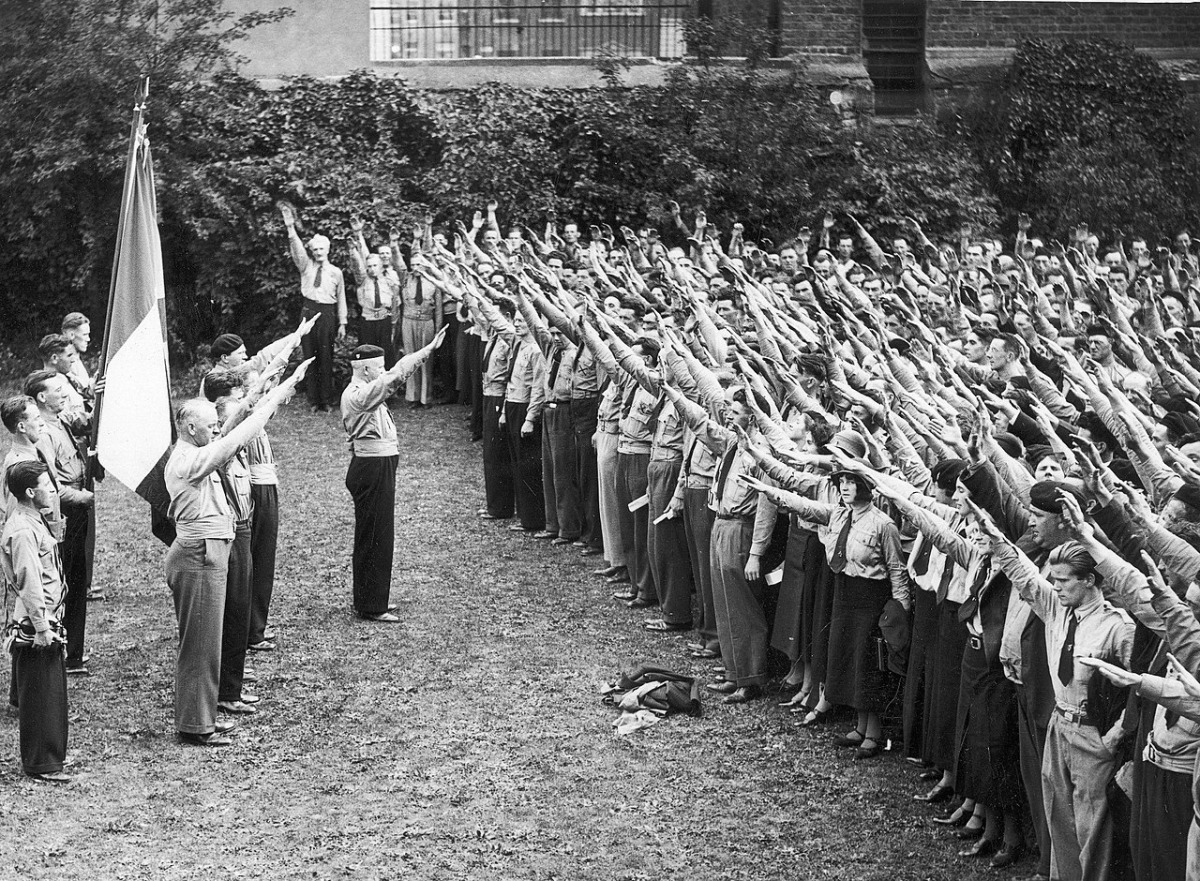
In contrast, the origin of Fine Gael, which emerged as a combination of Cumann na nGhaedhal, the Irish Centre Party and the National Guard, better known as the Blueshirts, in 1933, tends to be ignored, or even qualified.
O’Duffy leading a salute with the Blueshirts, December 1934.
Thus, Irish Times columnist Stephen Collins defines the Blueshirts as ‘best understood as para-fascists,’ which according to one source is ‘a larger category of regimes that adapted or aped ‘fascist’ formal and organizational features, but did not share the revolutionary ideological vision of genuine fascism.’
Such nuance might have been lost on General Eoin O’Duffy and his more earnest acolytes; albeit my own great-grandfather, John A. Costello – whose commitment to human rights made him an acceptable Taoiseach to former IRA chief of staff and leader of Clann na Poblachta Sean MacBride in the First Interparty Government of 1948 – injudiciously declared in 1934: ‘the Blackshirts were victorious in Italy and … the Hitler Shirts were victorious in Germany, as … the Blueshirts will be victorious in the Irish Free State.’
During periods of crisis even decent people can be carried along by waves of hysteria that cause civil liberties and common decency to be cast aside. A famous 2003 documentary ‘The Fog of War’ features former Defense Secretary Robert McNamara attempting to rationalise the U.S. bombing campaign in South-East Asia. Our present era where we witness a Populist clamour for mandatory vaccination may, in time, be viewed as one such illiberal period.
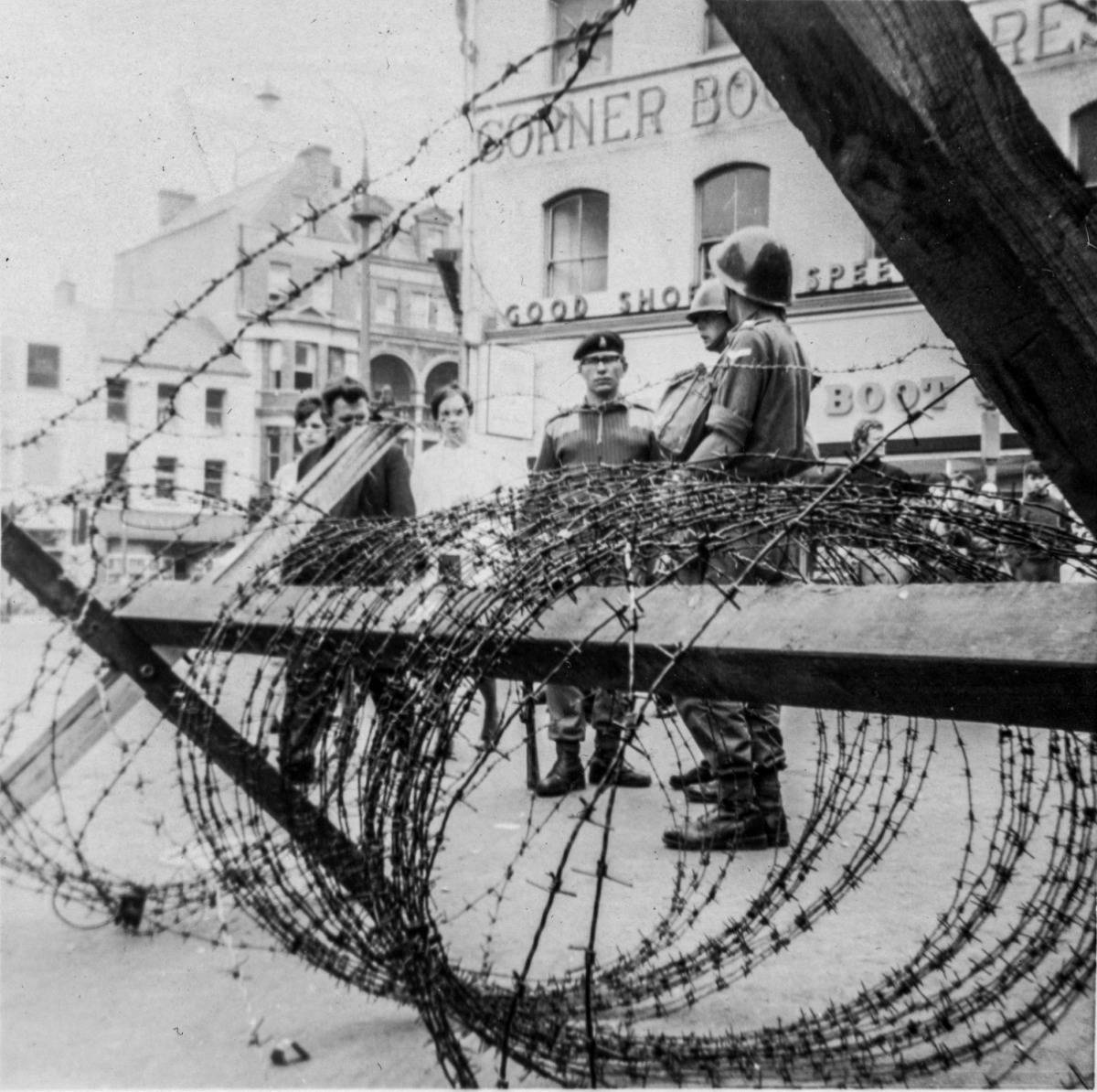
A youth growing up in a Catholic, or Protestant, working class neighbourhood in Belfast during the 1970s might easily, and perhaps reasonably, have become involved in what we now define as terrorist organisations. That individual might even have committed awful terrible crimes in the Fog of War.
It is a very delicate question as to what point we should let bygones be bygones and allow even participants in a sectarian, or post-colonial, struggle to participate in government without being constantly reminded of their past. Fine Gael certainly had no problem going into government with Clann na Poblachta in 1948, despite the latter’s association with the Republican cause.
This process was actively encouraged by successive Irish governments, especially through the mechanism of the 1985 Anglo-Irish Agreement, culminating in the participation of Sinn Féin in government.
Yet what we hear today in Ireland from the likes of Fintan O’Toole is that Sinn Féin somehow has a flawed pedigree, and must apologise, again and again. Frankly, it’s boring and inconsistent.
There is a larger question around how we represent political violence in an Era of Centenaries. The decision of Fine Gael and Fianna Fáil to enter into a coalition might be viewed favourably in terms of a definitive end to ‘tribal’ Civil War politics.
But what of the use of historical figures associated with those parties? In particular, is it appropriate for Fine Gael to remind the public of its association with Michael Collins, one of the great exponents of what supporters define as urban guerrilla warfare and detractors terrorism, or at least extra-judicial assassination?
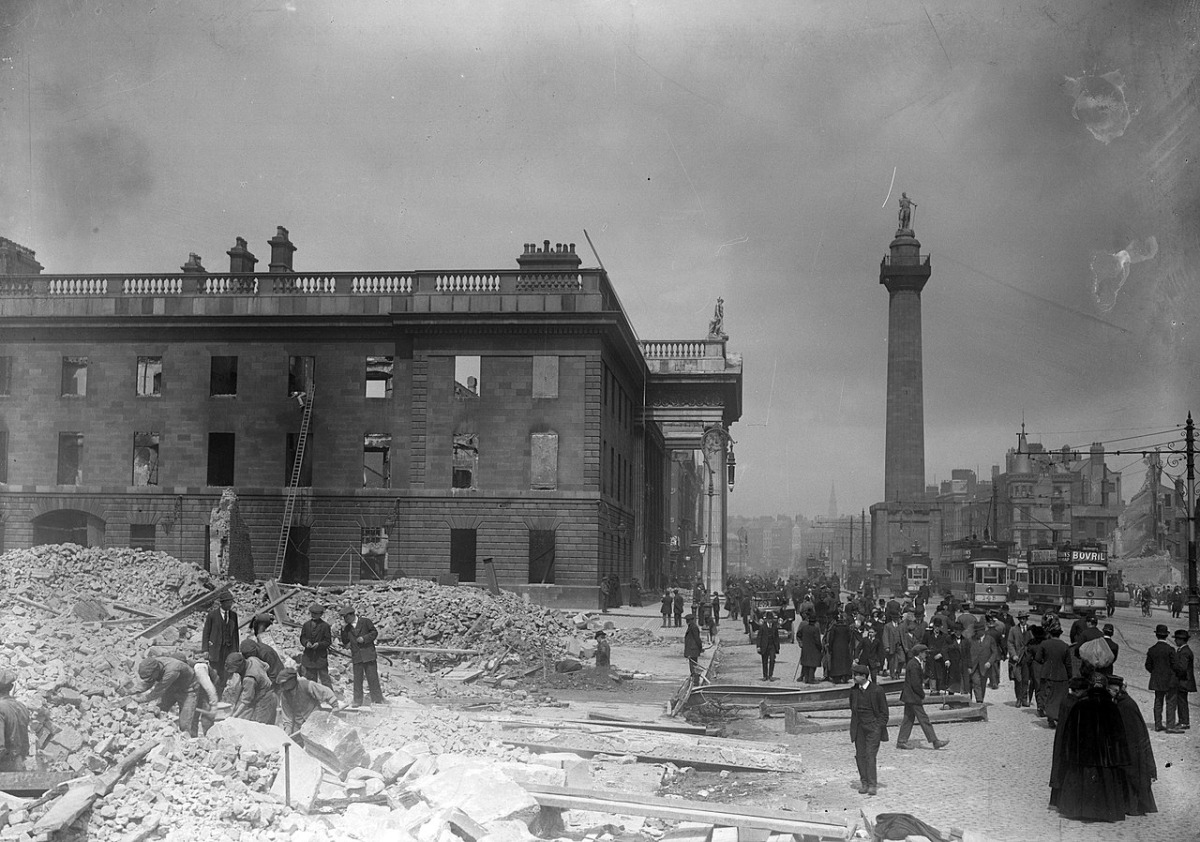
Moreover, Collins participated in the Easter Rising led by Pádraig Pearse who said in 1913: ‘Bloodshed is a cleansing and sanctifying thing, and a nation which regards it as the final horror has lost its manhood … There are many things more horrible than bloodshed, and slavery is one of them.’
The shell of the G.P.O. on Sackville Street (later O’Connell Street), Dublin in the aftermath of the 1916 Rising.
Political violence was intrinsic to Pearse’s, and arguably Collins’s, approach to the birthing of the nation. They were men of their time, but were a faction within a faction that enjoyed less popular support than the Provisional IRA during the Northern Troubles.
Besides, while the British authorities in Ireland prior to independence were hardly a model of good government, they had at least distributed much of the land among peasant proprietors and developed reasonable infrastructure. Home Rule was on the statute book. It might be argued that 1916 made Partitition inevitable.
In contrast, the sectarian Unionist government – ‘a Protestant parliament for a Protestant people’ – in Northern Ireland was denying civil rights to Catholics, gerrymandering constituency boundaries and sponsoring the B Specials, a sectarian, quasi-military reserve special constable police force.
The Northern Troubles was a dark period in the history of the island, but to suggest those involved were, and are, inherently evil rather than, in most cases, products of historical forces, is lazy reasoning. Let’s put to bed the idea the Troubles disqualifies Sinn Féin’s participation in government for ever more, and move on to scrutinising the detail of their policies, in particular a failure to adopt a discernible position on the optimum response to COVID-19 in Ireland.
Featured Image: Michael Collins by John Lavery, 1922.
Your antennae are up months before it comes. You’ve gotten to the point where, if Leo Varadkarsays something won’t happen, you brace yourself for its certain announcement, in good time.
When the axe finally falls, you’re on holidays in Donegal in July, and the uncomfortable reality sinks in that the house and the rain-sodden outdoors will have to do you, pubs and restaurants will have to wait. Because you’ve long known that the game that’s made its way onto your table – one of freedom by way of the barcode – is one you won’t play.
There are many quiet tears across the country, many tummies in a familiar pattern of churning, as a new breed faces an uncertain dawn. They’re greeted, at best, with a wall of silence, at worst with opprobrium and unflinchingly entitled judgement.
The air of suspicion they have increasingly felt around them, in a quietly charged atmosphere that has made it harder to be in the thick of things, even among some cherished family and friends, has become solid and tangible.
And yet the day is like any other, the view from the window just the same. Nothing but a simple QR code and a biddable hospitality sector, understandably desperate to re-open its doors, signals the birth of a new Irish underclass.
Research shows that people have many reasons for declining a medical intervention. These are mainly born out of considered thinking: medical history and experience, including vaccine-injury; research and knowledge of what is right for their own body; the practice of natural healing modalities as a first recourse to health.
Gym membership cancellation rates at the recent extension of medical segregation to that sector suggest that those who have a strong investment in their wellbeing through exercise may assess the risk/benefit of Covid-19 vaccination in a different way to those who may be more vulnerable to Covid’s worst effects.
There is no one-size-fits-all. Such is life. If we believe that this turns a vaccine-free person into a walking biohazard, perhaps we have bought into fear over an inspected view.
We are now some twenty-two months into a pandemic that has fundamentally shifted the course of our existence. It is fitting to ask whether, along with a potentially very serious virus, we have also been visited by a kind of collective trauma, stemming from news streams delivering non-stop daily scrutiny of Covid-19, along with rolling curtailments of our lives and those of our children. Never before has an idea of safety been so rigidly attached to a single concept: being Covid-19-free.
I don’t make light of Covid-19. I know what a serious illness it can be, particularly for those who are older or have underlying vulnerabilities. However, in a new world characterized by fear and caution – surrounded by visual reminders that something frightening is in our midst – I believe that something vital to a healthy society is being dangerously side-lined: the checks and balances necessary to healthy democratic governance.
We are in the process of enshrining into law a piece of primary legislation, the Health and Criminal Justice (Covid-19) (Amendment) (No.2), granting the extension of extraordinary emergency powers to Minister for Health Stephen Donnelly, powers that prior to Covid-19 we never could have countenanced handing over to the State.
These extend the medical segregation that has become normalised in society, where the paradoxically named “immunity certs” – granted after double vaccination to access supposedly inviolable freedoms – are widely seen as a reasonable and proportionate response to pandemic times, rather than a human rights’ issue in urgent need of inspection.
Do we wish to live in a world where a person can be stripped of their basic freedoms because of their private medical status? A world where the unproven threat of asymptomatic transmission is greater than the threat of authoritarian, technocratic rule?
(One where, in perhaps the greatest twist of all, those who have retained their “privileges” are of course no less immune from the Covid transmission chain.)
Do we wish to be part of a society where, for instance, a medically vulnerable person who is not suitable for vaccination is left out in the cold – because GPs currently have no authority to grant meaningful medical exemptions?
Do we want to raise our children in a world where a person who exercises their right to informed consent, as enshrined in every human rights in healthcare covenant since Nuremberg, can be readily pegged as plainly reprehensible?
In Ireland, we are thankfully now alert to the impacts of the sins of the past – where the “othering”, for instance of women and children in mother and baby homes, was an accepted thing – yet are we willing to face uncomfortable truths about our present?
At this moment, we have effectively “othered” a cohort who are subject to a particular kind of derision. Ireland’s vaccine rollout, which sees the highest level of coverage in the EU, has not transpired into the panacea promised. Despite this, we see blame at times verging on incitement to hatred publicly levelled at those who choose not to or cannot, due to medical reasons, avail of this medical intervention. The failure of the medicine is somehow the fault of those who didn’t take it.
Even as reputable medical journals cautionagainst stigmatising the unvaccinated, the vaccine-free are relentlessly pegged as the scapegoat of this difficult episode, where goalposts keep shifting and promised remedies fail to deliver. Those in power conveniently use this to deflect from their own failures.
“Anti-vax”, a dehumanizing, broad brushstroke term, has become common parlance. Nothing short of a creeping obsession has developed towards a group stigmatised with this label, among some of Ireland’s most trusted, supposedly liberal media commentators, and among some of our most powerful political voices.
Terminology that casually stigmatizes people has the twin impacts of eroding human dignity while effectively silencing dissent and debate – two essential tools of a functioning democracy. And if the ensuing social media outcry was anything to go by, many found it chilling to witness Minister Donnelly level this term at a fellow deputy in the Dáil chambers, for presenting peer-reviewed scientific information.
There's strong support among public for mandatory vaccinations, survey finds. For all this and lots more, pick up a copy of Monday's Irish Daily Mail or click on https://t.co/7yQSg4dmA7pic.twitter.com/bILyyJO8mg
While we can casually cast blame, without evidence, upon the cohort who didn’t “take one for the team”, those who should actually be answerable almost two years in operate without meaningful scrutiny from either a critical media or political opposition. And here, I believe, is where we should all be looking to.
We have empowered Minister Donnelly to strip some seven per cent of the Irish population of their basic social and civil rights. If this legislation extends until its “sunset” of June 2022, we will have placed a minority of Irish society at the back of the bus for almost one year. And who knows how much longer they’ll even be allowed to travel on the bus? If past form is anything to go by, we might then expect another piece of similar legislation to follow it.
I struggle to understand how all this is compatible with a liberal democracy. As medical segregation and the removal of human rights flourishes across Europe, and our social credit becomes increasingly tied to barcode-accessed living, at what point do we begin to seriously look at the potential harms of this brave new world, for which we are hard at work laying down the building blocks?
A medical officer having the power of detention over you, in an undefined “designated place”, if you are merely suspected of having Covid-19, is not democracy. Coerced medication is not democracy, and the championing of Covid Certs by Leo Varadkar, on the basis that it drove up vaccination rates, only celebrates this lapse.
Decision-making that impacts everyone in Ireland, taken by a group of eight middle-class, middle-aged white men, who fail to represent the cross-section of Irish society, including those most vulnerable to the effects of lockdown – working-class people, women, and other minority groups – is not democracy.
Almost two years in, it no longer holds for our government to act as if we are in the emergency phase of the pandemic. This ongoing abuse of emergency legislation and power is causing untold damage to the communities trying to stay afloat around it.
There is evidence aplenty now to begin an assessment of the broad impacts of pandemic measures, and this must be done with independent expertise provided by those who have not been at the helm. The bigger picture must now come into view. We need to properly consider the economic, social/cultural and in the context of overall healthcare.
I believe, special attention must be paid to Covid-19 policy impacts on our young people. Strategies need to be rebalanced towards carving out a future that allows us to respond proportionately to the threat of Covid-19, while maintaining people’s human and civil rights, their entitlement to dignity and privacy, and ending a nasty division that has crept in with terrifying stealth, in a time of crisis.
We need solidarity regardless of medical status. Please stand with me to reach out to your political representatives to insist they convey our call to reject segregation and division, and to demand checks and balances from a government that many increasingly see as being power-drunk at Ireland’s wheel.
Ciara Considine is a book publisher, singer-songwriter (Ciara Sidine), civil rights activist and mother of two, living in Dublin.
This article was first published in A Mandate Free Ireland, a weekly campaign newsletter, on 13 December 2021 (Click here to subscribe: https://tinyurl.com/2p8kvmw7).
Joe MacAnthony might be considered the greatest investigative reporter to have ever operated in the history of the Irish State. His career in Ireland, however, was cut short by vested interests that still appear to insulate those with money in power from accountability and criminal sanction.
Having exposed the staggering corruption lying behind the Irish Hospitals’ Sweepstakes, he eventually ran out of Irish publishers, and was forced to take a job with the Canadian Broadcasting Authority. After receiving threats to his life, he moved to Canada with his wife and four children, where he lived for thirty-five years.
0:00 Introduction 1:13 The Irish Sweepstakes 14:42 Story on Ray Burke 19:30 Closed down in RTE 24:00 Move to Canada 29:00 Death Threats 31:00 Unable to Work in Ireland 32:58 Views on the Irish Times 34:10 ‘We have sick journalism in Ireland’ 38:00 Possibility of Solution
As testament to MacAnthony’s stature in Irish journalism, on November 15 2020 Liam Collins wrote for the Sunday Independent:
The first Irish Hospitals’ Sweepstakes draw took place 90 years ago this month and it quickly became a global phenomenon. Behind the razzmatazz and the instant riches, however, was a hidden tale of greed. More than four decades later, investigative journalist Joe MacAnthony broke the biggest story in the history of the Sunday Independent and revealed where the Sweep millions went.
The state-sponsored lottery was set up under the first Cumann na nGaedhal (later Fine Gael) government of the State in 1930, and would bring unheard of riches to former Minister for Industry and Commerce Josephy McGrath, and his heirs, who became firm fixtures in the commercial life of the country, with many influential friends. MacAnthony estimates their fortune amounted to up to four hundred million dollars by 1972.
Last week filmmaker and Cassandra Voices contributor Bob Quinn sent us a recording of a film he made in 2006 entitled ‘They’ll Never Show That.’
Having blazed a trail with his work on the Irish Hospitals’ Sweepstakes, MacAnthony explains how his revelations into the corrupt affairs of former Fianna Fáil Minister Ray Burke as far back as the 1970s, hastened the end of his career in both the Sunday Independent and RTE, who withdrew his security card for a period of six months, while he continued to draw a salary.
MacAnthony provides a chilling assessment of Irish media:
the Irish Times, when you look at the manner in which this whole thing seems to be fitted to whoever can make the most money in the upper circles of that paper … that is a total disgrace, an unconscionable disgrace in terms of Irish press freedom … the result is we have sick journalists in Ireland and it is sick journalism, and it’s not due to the people who want to be good journalists. It’s the people who control what the good or bad journalists say and who encourage triviality … I mean, the level of triviality that you read. It’s unbelievable.
He argues that corruption has come about through what he calls ‘facilitators’ – accountants and lawyers – who ensure that few, if any, politicians are ever held to account.
Ray Burke would serve just four and-a-half months of a six month sentence behind bars, while Liam Lawlor served a few weeks for contempt.
MacAnthony traces the lenient treatment of politicians to a class distinction, between those who get ‘six years and who gets probation,’ while ‘basically no lawyer in this country and no accountant ever imagines he’s going to go to jail for playing ducks and drakes.’
He asserts
it’s just embedded. A culture is embedded … that you can get away with murder.
MacAnthony proposed the solution of a ‘counter power,’ similar to the FBI, which could set up ‘stings on politicians.’
He concludes:
Nobody goes to jail … I mean, these exile millionaires like Denis O’Brien, I mean, that’s disgusting … here is a guy who makes … money out of Irish assets and then goes off and lives somewhere else and only comes in here … when he has the prospect of taking more money out of the system.
He warns:
You know, every time you take money out of the system somebody pays and they’re paying [with their] health or they pay in other areas, but they always pay. So these people, I mean, there is conscience involved here. You know that when you make a lot of money, somebody’s suffering at the other end of the scale.
My lungs were out of helium, so I wandered out of my anti-memory cell to buy some freedom vouchers. The land, its never-satisfied lips… I remembered every man was his dog (and a mad Englishman.) I remembered being a bumblebee in milk. Agony and honeysuckle. Was I vaccinated against imprisonment? Was I immune to the moon?
A man was carrying his presence towards me. His haemoglobin eyes… We prayed unto unentanglement. We sang, “Don’t wasteland me! Teach me how to live inside the waiting.”
The guardians of sociability descended on us from a Times New Roman cloud. We pleaded guilty to togetherness. They later indemnified us for the loss of our identities.
This smell of undocumented thoughts, the South of my drowning voice… Sing the restricted body, whisper to an unrestricted mind. We always have a choice between not dying and not living.
Disaster
As I was leaving the museum of names, I noticed that I had lost my number tag. Now I can’t sip taxes or sculpt coins. I have to play a cross-check game with the Department of Streamlined Health that likes eschatology, September snowflakes, and the Nebraska samurai. Not necessarily in this order.
There’s no return to what has abandoned you. I’ve learned from a birch how to jive. My cat has taught me some Descartes. Can I solve the mystery of “me” in the garden of sculptures? If I get there, how am I supposed to pose?
Opinion drones are out to get me. I have to hide now; I may join a non-prophet organisation and appear, disguised, in their grotto photos. I’ll need to know my nameless, numberless self the way a camel knows the geometry of the desert.
Body and Mind
A railway station, splinter-European. The sky in black and white. The lounge lit with blue Plexiglas eyes. A preacher of health peeps in through every window. “We can all be safe,” his parrot parlours. On the neighbouring bench, somebody has his hose amputated. His showerhead bleeds incongruous truths.
A woman takes a back seat inside my eyes. “My name is Deci-belle,” she addresses the pigeons behind my back. “Sorry about the dehosement; you weren’t supposed to be in such proximity. I am just a denouncer; this was nothing of my doting.”
The clock blinks 66.31. The absence of train arrives – its own stationmaster, a hyperbola shading in its innards. A tannoy splashes the brain symphony. The preacher swallows his badge saying “Your body, our choice,” and begins lizarding between ministerial decrees towards radio clarity.
“You can play! Just take it easy, play slow. Play for a few minutes and then give it a break… there’s no panic!”
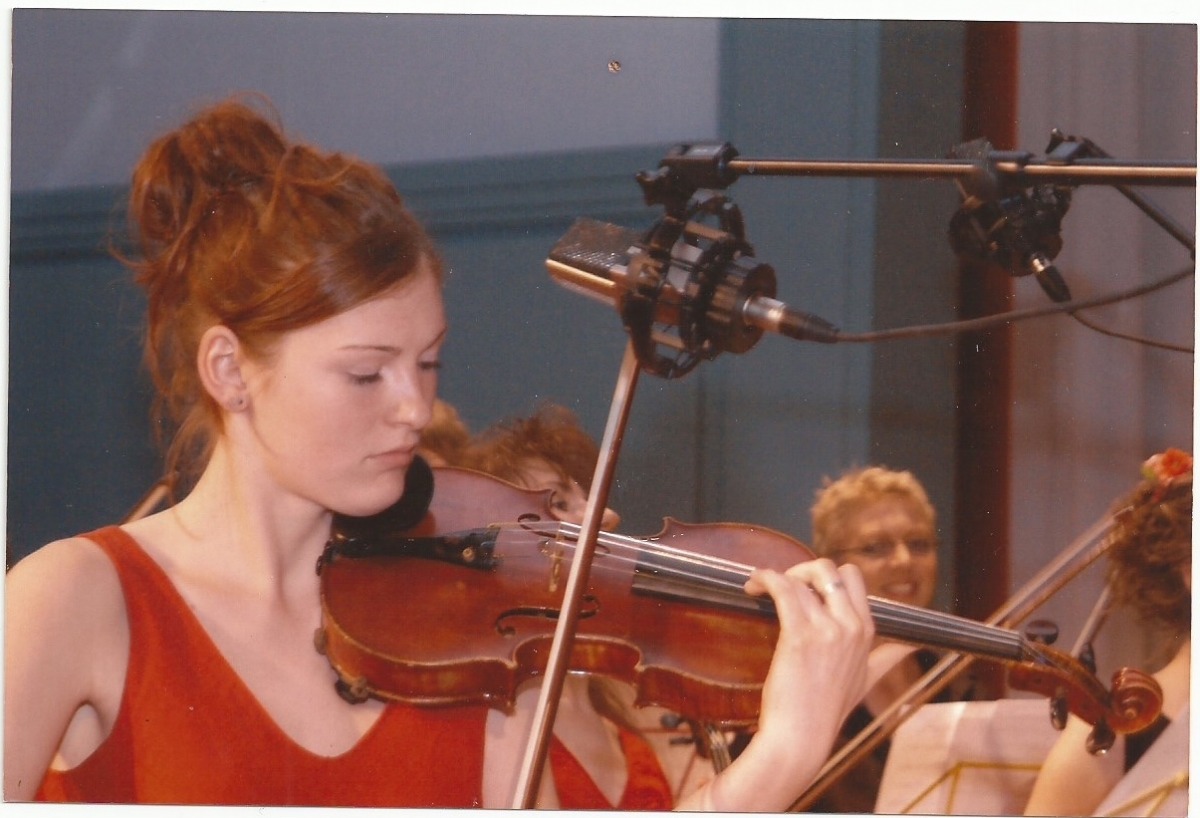
I was recently asked by one of my composing mentors to think about and summarise what I’ve done as a musician and composer so far.
So I sat down and tried to recollect my memories of how it all began, and how indeed I have managed to be lucky enough to adopt one of my biggest passions as a full-time profession for the past several years!
As I began to travel back in time, re- encountering a happy child’s uninhibited explorations of the world of sound, long afternoons and evenings spent at the local music school and orchestras, my first ventures into playing more groove-based music; I soon reached a curious turning point that stirred up major reflection. I revisited a period in my life that, at the time, felt excrutiantingly painful, though ultimately helped me to foster a healthy and much deeper relationship with music.
Music School and Hurting Hands
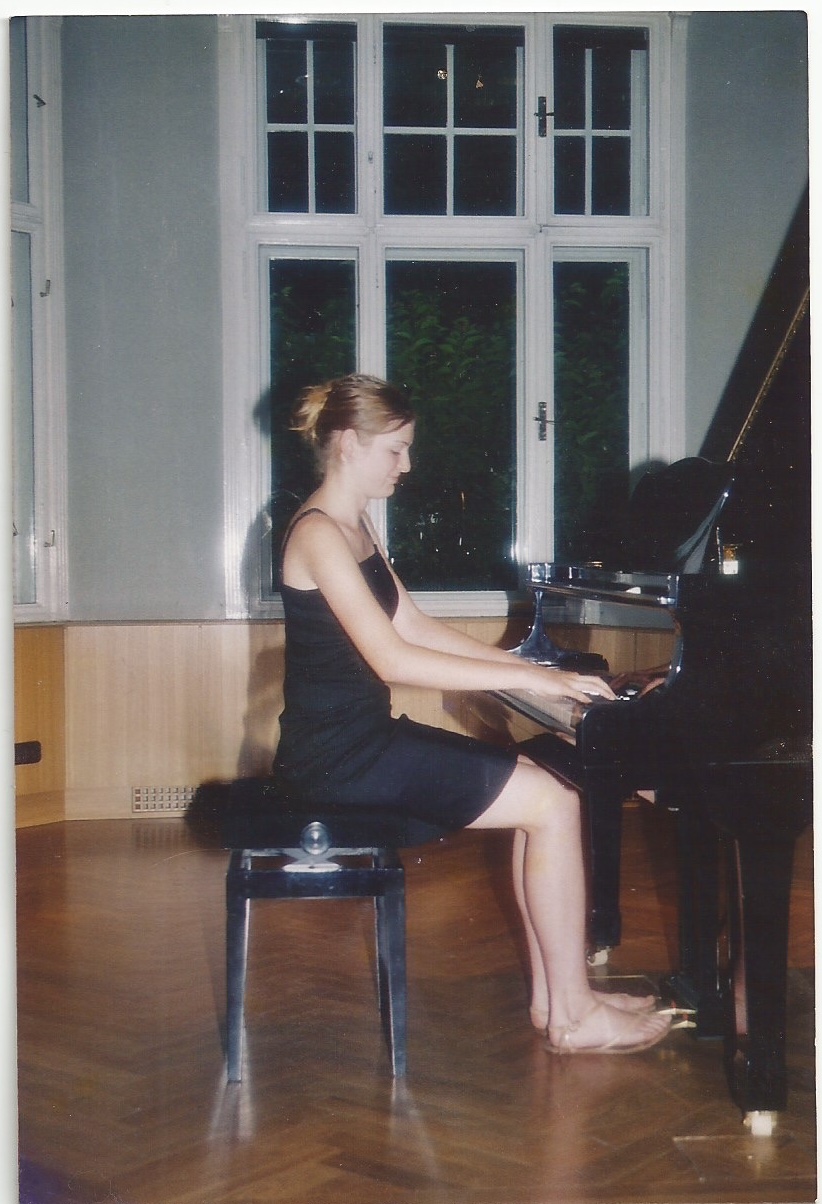
My early musical life majorly evolved around playing classical music: I took lessons on various instruments at the local music school and was part of various ensembles and choirs as well as local and international orchestras.
Truth be told, I don’t think I was ever that taken by the actual music we played. At home I would listen to bands like the Beatles, Nirvana, the Spice Girls, Tic Tac Toe, Broadlahn, or Sandy Lopicic Orchestar. However, I always loved the feeling of playing and singing with other people, to be part of the community.
I had wonderful music teachers and I think that, for the most part, they did not push me too much beyond standard expectations to practice. Rather, they tried to motivate me by conveying their passion for the music we were studying. When I started to experience trouble with my hands, there was one or other teacher who did not know how to steer me in the right direction of how to proceed with my daily practice. Having said that, the experience of chronic pain is a complex issue and beyond full comprehension of most teachers, musicians – and in fact doctors – that I have met so far. I am convinced that everybody always had my best interest at heart.
It was at the age of around seventeen that I developed repetitive strain in both of my hands; with a ganglion cyst developing in my right wrist as a consequence. Sometimes it hurt so bad that I struggled to brush my teeth. It disabled me so severely that for years and years I was barely able to play for more than ten minutes in one go.
I wrote my Leaving Cert exams on a laptop, as I was unable to write by hand. I had to stop taking lessons, cancel concerts, and burst out into tears regularly at folk sessions where all my friends were jamming and I could simply not join anymore. For one or two years I had to stop playing altogether and I was warned that the ganglion cyst could seize up and make it impossible for me to move my wrist anymore.
I went to see different physiotherapists, chiropractors, acupuncturists, homeopaths, healers. I visited a healing stone; tried dance therapy; different creams that were supposed to be the cure. I bathed my hands in hot and then cold water, wore bandages, wrist supports. None of it helped.
I will never forget a chat with a girl once on the way back from a folk music gathering in the mountains. She said: “Well you know, I really used to love rowing, it was my thing. But then I hurt my shoulder and I had to give it up and find something else. Maybe it’s like that with you and music”. I thought it was the meanest thing anyone could ever have said to me. I could not – and still cannot – imagine a life without music playing a central role in it (we’ll see about the next one). For me it was like losing part of my identity.
It took me many years to understand what was going on at that time.
A Perfectionist’s Struggle
I was always a high achiever. Not that I always wanted to be better than the others, much worse: I always had a genuine fear of failing completely.
It comes as no surprise that, even though my teachers were kind and understanding, I did feel the pressure of completing grades at the music school. To try and play every note perfectly. An expectation to go on to study classical violin.
I still struggle with the system of how classical music is being taught. In fact, everytime I think about it I get a bit angry and I am scared for young children that might have the joy of play robbed from them. But I like to think that it will just take some more years for a breakthrough that will bring along the integration of a better understanding of the nature of creativity. Of how to achieve a certain kind of “perfection” without the pressure of having to be perfect.
As for me, having learnt about my perfectionist tendencies and anxieties that seem to amplify and transform every bit of advice into a perceived obligation, I do realise that the same guidance might well have been just right for another person. Somebody that thrives more on, or is in fact depending on, external encouragement to “become better”. (I put this in quotation marks, because: what does it mean to become better anyways?!)
What I needed to hear however were these words: “You can play! Just take it easy, play slow. Play for a few minutes and then give it a break… there’s no panic!”
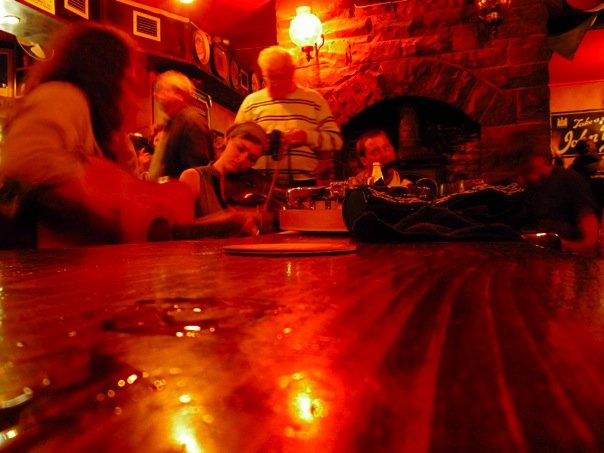
A Session in McGarrigle’s Pub in Sligo.
New Lands and Turning Points
Faced with the fact that for the unforseeable future I was unable to study violin or another instrument, or to hold down any job that would rely on the strength of my hands for an extended period of time, I came up with a temporary escape plan:
At the age of nineteen, I moved to Ireland to work as an au-pair for a year. What I didn’t know at the time was that I had acidentally emigrated. Some sixteen years later I am still here! But that’s a story for another day, or perhaps indeed it is not: for it was here that things slowly started to change.
Looking back, I can see that there were many factors that contributed to the recovery of my musical freedom. An overall much more relaxed lifestyle, a new beginning in a different country, being able to hold down a job that had nothing to do with music. But most importantly, I believe that I owe it to certain people and a couple of influential books that I finally was able to find my way back into playing.
When I landed in Sligo, I was lucky to fall in with a great gang of musicans. One of them in particular, Rodney Lancashire, repeatedly encouraged me to play without worrying about it. To play slow rather than not playing at all. To try and relax about it.
So, after having stopped completely for a couple of years, I took up the violin again – or perhaps, rather the fiddle this time around. Playing solely Irish traditional music for a few years, it proved quite therapeutic: starting to play slow and for short periods of time at first, I was increasingly able to play longer.
A few years later I started to study at UCC. It was in Cork that I met violinist Kathryn Doehner, who introduced me to a side-strand of Alexander Technique. Taking me on as a case study, she made me aware of what “good posture” really meant and the fact that when relaxed, anything was possible.
At around the same time, on the urgent advice of my friend Fergal O’Connor, I started to work with Julia Cameron’s The Artist’s Way (1992). This book absolutely changed my life: going into it with a mindset of “I’m not a real musician”, I came out of it having composed enough material to release my first CD, Amber Sands, in 2014! Learning about how to maintain a healthy relationship with creativity, it finally offered a way to escape the terrors of my inner perfectionist.
The last piece of the puzzle I was struggling to put together for the last seven years or so came in form of another book: it was Dr. John Sarno’s The Mind- Body Prescription (1999), recommended to me by saxophonist and composer Nick Roth, that finally set me free.
To give a very brief synopsyis of Dr. Sarno’s approach as I understand it: coming from a background of rehabilitative medicine, he believes that the chronic nature of the majority of repetitive strain injuries to do with tendons, nerves and muscles stem from suppressed or unsolved psychological distress.
As a last resort to grab our attention, the distress moves into the body from where we finally have to deal with it. Offering a simple and inexpensive solution, he explains that in many cases it is enough to simply learn about, and understand, the interrelated mechanism at work between the brain and the affected area of the body.
I have to say that, would I have read that book a few years earlier, I would not have been able to understand it. I believe that it was necessary to go through all the other approaches of treatment first, so that I could see that it was really up to me to solve this problem. But the right time had come.
I will not say that I never feel my hands or wrists getting tired anymore. But when they do now, on a rare occasion, I am not afraid anymore. I know that the pain will not linger. This very absence of the expectation of a pain to become chronic is one of the major keys to breaking the cycle. I have understood the principle, and most importantly, that there is absolutely nothing wrong with my hands.
In Awe of Music
The experience of being unable to play for such a long period of time was absolutely horrible – an early existential crisis perhaps. At the same time, faced with the fact that I might never be able to play again, I realised just how much of a fundamental role music played in my life. It forced me to acquire a deeper understanding of the nature of chronic pain that will serve me as a life lesson.
It got me to understand the importance to look after the mind, as well as the body, and I do so on a daily basis. It violently threw me out of the path I thought I should follow and slowly guided me into a very different life that I could only have dreamt of.
I don’t take music for granted anymore. From the point of secretly accusing everyone around me for putting so much pressure on me, to cursing my hands and wishing that I could just get a new pair; I have reached a point of understanding and a deep gratefulness for the fact that I can play again – for as long, fast or slow as I want to. Having found my way back to a state of playful curiousity that I remember from my early childhood, I am in total awe of music.
It was one of those frequent blustery evenings, Wednesday May 18th, 2011. I was driving back to Rosses Point from Sligo town. In five minutes one could get soaked, as I had earlier and would after. The wind would blow like hell and clouds give the sky over to shades of light blue and grey as dusk approached. That morning, the water in the tidal channel connecting Sligo Bay to the town was choppy, wind- churned, a kind of deep green. By evening’s light it was calmer, a fuller cerulean than the sky itself.
I had been having a bout of sinus headaches. A great man for the self-diagnosis, here’s how I assessed the possible causes: 1) indoor dampness from the more or less daily Irish rain; 2) drinking too much, not stout or John Power whiskey, rather strong black tea by the gallon; 3) consuming lashings of white flour in the form of croissants and sausage rolls from the bakery run by the French family off Rockwood Parade; 4) a non-fatal overdose of the scones dished up warm with butter by Jill Barber and her crew at the Drumcliffe Tea Shop by the Churchyard where W.B. Yeats is buried. I felt like I was coming down with something.
My friend Martin had waxed lyrical about a Leitrim-born homeopath in Sligo town, Maura. He characterized her as a good listener, a healer. He said she might have something for what ailed me. My batch of Euros was dwindling. That year everything in Ireland was twenty-five percent more expensive when compared to American prices, yet I was curious enough to see could she help the sinus ache or maybe persuade a high-pitched constant companion – screeching in my ears – to abate. More than that, I thought I’d get an appointment because frequently my default mode could be characterized as uptight, on alert – shoulders up, jaw clenched, muscles clamped down, my head mimicking a fist. The resultant drag on my energy wore me down.
I had a 6 p.m. appointment with Maura. Inevitably, I got caught again in a blast of horizontal Northwest rain during the short walk from the Tesco’s parking lot in the centre of town around the corner to the faded elegance of the office buildings at the West end of Wine Street. A British legacy, eight three-story grey Georgian houses were built in a terrace in the 1830’s with large square windows, decorative semi- circular glass above thick wooden front doors and terra cotta pots atop concrete chimneys. They still look decent despite pipes running down the front of several to drain rainwater off the slate roofs.
Imbibing Sligo Life
Born a stones-throw away in Garden Hill Nursing Home, I had imbibed life in Sligo as a toddler. Gripping my father’s trouser leg, I observed the goings on around him. I would scamper after him into Blackwood’s General Store on Grattan Street, a place of creaky wooden floorboards sprinkled with sawdust, populated by white-coated shop assistants. After forking out for a pound of rashers, my father would point to the cylinders flying about the ceiling on wires. The shop assistant wrote up a slip and put it along with cash into a cylinder, pulling a handle to send it flying up to a mezzanine office that appeared to be suspended from the ceiling. From that vantage point a bespectacled old dear made up the change and zipped the cylinder back down. Once or twice every summer, my father bundled me into the front seat of his black Ford Consul and drove me down Cartron Hill into Wine Street to the Café Cairo, its floor tiled in black and white squares, for a whipped ice cream cone.
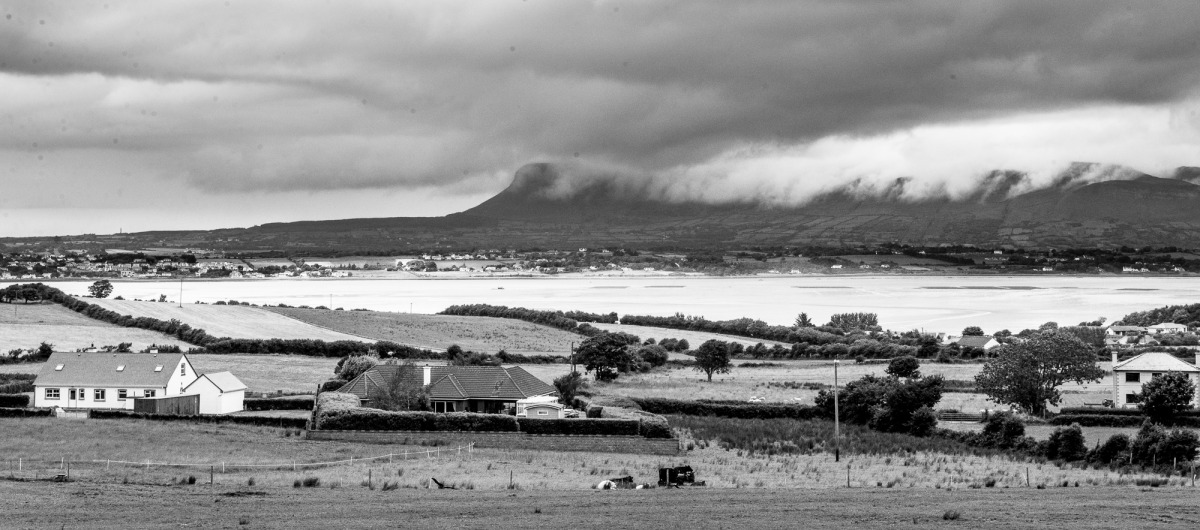
The world of my early boyhood was circumscribed by the wider landscapes of Sligo – limestone encrusted Ben Bulben, the fresh waters of Lough Gill and the Garravogue river running through town past Foley’s Brewery to the weir at Hyde bridge where we tossed lumps of sliced pan to the swans. Along the coastline, I ran after my father to keep up on his walks in the salted air off the Atlantic coast: Raghley, Strandhill, Rosses Point, Mullaghmore. Running in place against the wind, knees reddened by the chill, brown long socks pulled up tight in wellie-boots I watched my father, his shoulders thrown back, stride away from me into the ghostly distance of the mist enshrouded second strand at Rosses Point.
I stepped through the glass front door of number two Wine Street through the vestibule into an office to the right. In the old days, doctors had offices along this part of Wine Street. Maura’s place was a new twist – a gang of alternative practitioners sharing space, naming it the Wine Street Wellness Center. Maura arrived in and walked me up the U-shaped staircase to the first landing. To the left, her high-ceilinged office looked shared – no visible personal items or files – and the furniture was second-hand. I sat in a low uncomfortable chair with my back to the door while my soaking raincoat dripped across the only spare chair. I viewed Maura in profile at her bare desk facing the wall.
She asked me all kinds of questions, about my aching back, ringing ears and all of the things happening in my body certainly but also in my emotional world. She had a series of gently probing questions. As I blabbed replies, she seemed to let my story wash over her, writing the odd clue she extracted down on a notepad. She asked how did I feel about this or that time in my life, all with a view to “restoring the body’s natural balance,” said she.
Balance, as far as I was concerned, was something others might attain not me. I had been keeping my eye out for balance of some sort for years – balance between my tired body and racing mind; between work and play; between pushing myself to forge forward and sitting back to rest. I wasn’t sure what balance felt like.
Massive Turning
Prompted by her expansive questions, my mind’s eye drifted to a massive turning in my life – February 1989. My mother, Mella, took ill suddenly, fatally. I talked to her on the phone the day of the hastily scheduled surgery – open heart – and she said, “Don’t come now; bring the kids in a couple of months, it will be just the tonic I need.” She called my toddler sons her little darlings. Barely twelve hours later, a loud phone bolted me awake in the early hours – the call every emigrant dreads. My elder brother Vivian killed me softly, “She’s in a bad way; come home as quick as you can.”
Sitting there in the thrift store low chair, I told Maura I was remembering the agonizing wintertime plane trek home to Ireland. Every minute of the journey from Pittsburgh to JFK in New York to London Gatwick and on to Dublin was drawn out, excruciating. “Six hundred miles an hour, bollox,” I remember thinking somewhere over the Atlantic as the steward poured another weak tea into my flimsy plastic cup. At Gatwick, extra security checks delayed me further. With the IRA active, all Irish travelers were suspect.
Years before, just passed my twenty-sixth birthday, when my eldest brother Ian phoned to tell me my father had died of a heart attack at the age of seventy-two, I knew by the tone of his, “Hello,” what was coming. When he said, “I’m afraid I have bad news,” that sealed it. His news was not entirely unexpected. My father had drifted downhill after retiring at the age of sixty-seven. This call, though, this one struck like the once in a lifetime tornado that had ripped up parts of Pittsburgh, my adopted hometown, in 1980. Out of the blue, Mella, ten days before her 70th birthday, was lying in a hospital bed in Dublin close to death; nothing I could do would speed me to her side. Stuck in mid-air over mid Atlantic, I resorted to talking silently to her.
“I’m coming. Hold on, dear one, hold on.”
Vivian awaited at Dublin airport. He shepherded me to his green Mercedes with the tan leather seats. In silence, my brother the motor racing champion sped me through the early morning fog like a VIP, across the semicircle of Dublin Bay anchored by the chimneys of the Bull Wall, past the strand at Sandymount where people braved the early morning wind and drizzle to walk dogs. Ignoring speed limits, he revved the purring engine as we waited at the railway crossing for a DART commuter train to rumble and clatter past. The back end of the Merc fish- tailed as he turned left with a screech onto busy Merrion Road – bobbing and weaving in and out of clogged traffic lanes – straight to the Blackrock Clinic.
A Preternatural Tristesse
“What are you feeling now?” Maura asked. “Sad,” I told her.
Sad wasn’t the half of it. A preternatural tristesse had descended on me, as if I was touching an opening, a small portal atop an immense reservoir of sadness, a deep subterranean lake of tears like an underground aquifer. I was surprised, nonplussed, to discover it. The grey twilight threw shadows scything at an angle across the top of the wall and along the corner of the high-ceilinged room.
“Right,” she replied with an inflection that combined, “I hear you,” with “I accept your story.”
Slumped slightly in the non-ergonomic chair, I felt my shoulders relax a little, involuntarily let go of a layer of tightness clamping them down. There’s not enough time in one lifespan, I thought, to cry all of those tears. I sat there wondering if I had somehow not dealt with buried grief around the loss of my mother, whether words unspoken – words of love and affection, respect and gratitude – were still stuck in my gullet after all these years, or whether part of that lake of tears might even belong to her and my father or ancestors, not be mine at all.
As Maura consulted a large reference book, I remembered that my father and the gregarious Denis Boland regularly sipped John Powers in the second floor living room of the Boland’s Wine Street house a couple of doors along, the one with the plaque outside that stated simply Surgeon Boland.
They drank pints in the Yeats Country Hotel in Rosses Point with the town’s elite, Tommy Mulligan of Western Wholesale Company, Jimmy Doherty the Accountant, Toher the Chemist who drove a Volkswagen Beetle, Armstrong the Solicitor, the businessman Soden and cigar smoking wit Doctor Charles McCarthy.
My mother too enjoyed friendships in these houses along Wine Street with May Quinn, the dentist’s wife, and big-hearted Moya Boland who held court from her kitchen, always at the ready to entertain visitors who wandered in off the street. May Quinn’s early death from cancer rattled my mother. They were like sisters the two of them – good looking, blond and wispy with tan makeup. Golf buddies at the links in Rosses Point, after playing a round they giggled together over gins and tonics in the member’s lounge.
“What we are looking for,” Maura said, “is a constitutional remedy; one that gets underneath surface symptoms to draw out the body’s own capacity to heal – physically and emotionally.”
First Train Trip
Memories were overtaking me. I didn’t tell her that earlier that day a walk to the train station at the West end of town had caused me to re-live my first trip in a train – from Sligo to Dublin with my father and younger sister Adrienne. I was six or seven. Oblivious to what packing up must have been going on, I thought we were on some sort of adventure to see Dublin, a dream-place I could not conceive of.
I quizzed my father at each stop. “Where are we now?” Longford, Edgworthstown, Mullingar, Kinegad. The train stopped along the way while in the hushed carriage people shuffled on and off puncturing the quiet by banging the thick green doors shut then dragging bags along the light brown linoleum floor before heaving them onto overhead racks.
On the outskirts of Dublin approaching the city centre the train slid by small brick-walled back gardens. The train tracks were high. I could see over the back walls into tiny yards where between light rain showers daily washing blew on lines. In some places there were narrow laneways between the back walls and the railway. Elsewhere, smashed up bicycles, beat up chairs and prams, Walkers brand with metal springs sticking out, lay rusting beside the tracks. Approaching Westland Row station, small windows with white lace curtains hid tiny darkened bedrooms from the train.
Somehow, we landed up in 72 Cowper Road, a tall elegant Victorian with stained glass on the front door, a half block down from busy Rathmines Road. Welcomed in by my maternal grandparents, I followed the adults like a duckling to the kitchen at the back of the house, down a couple of narrow steps behind a door with curtained glass. My mother and two elder brothers had arrived by car; suitcases had been unpacked. How did these ancient, quiet people – gentle souls – Joseph and Margaret Hynes, cope with six of us landing in on top of them, sharing beds, sleepily whizzing into piss-pots in the middle of the night? Even then I wondered.
We Weren’t Going Home
As one day rolled into another it dawned on me gradually, we weren’t going home to Sligo. We were enrolled in schools. We had moved to Dublin for good. I walked to Miss Carr’s elementary prep school on Highfield Road, my brothers to the bottom of Cowper Road and over the railway footbridge to the Jesuits at Gonzaga College in Ranelagh.
After a couple of months of this routine, we moved to a new house nearby in the quiet leafy confines of Merton Road, number 42. I recall no explanation at the time, or at least none that I could comprehend. As an adult I inferred there was sacrifice involved for my parents. They moved us from Sligo, where years on my mother would confide they had enjoyed their happiest times, for a fresh start – to be closer to aging parents, enroll us in top schools and expand the family to five children with the Dublin birth of my brother Colman.
I was an hour in the chair answering questions, pausing for Maura to make notes or look something up, when she declared she had an idea for a remedy for me but wished to think about it further – I could stop by for it in a couple of days. A gust of wind shook the windows just as she opened the office door to graciously escort me downstairs to the front door.
Steering left out of the Tesco’s lot, I drove West along Wine Street, then turned right on the Inner Relief Road, the new bypass that cuts off the West End of Sligo from its center. Past Hughes bridge where the Garravogue joins the tide, I veered left off Markievicz Road up Cartron Hill past my boyhood home, called Inniscara this longtime, down the other side, across the causeway and out the Rosses Point Road.
I found myself teary-eyed approaching the village at the neo-Gothic limestone Protestant Church on the left marking the widening onto the “new” promenade road built in the 1970’s, the one that “desthroyed” the village, according to two locals, semi-permanent fixtures on the bar stools of Austie’s Pub. Uachterán na hÉireann, President of Ireland Mary McAleese was coming over the car radio on RTÉ addressing a state dinner for Queen Elizabeth 2nd – Head of State, Head of the Commonwealth, Supreme Governor of the Church of England, top mega-wealthy Royal personage reigning over millions of subjects – Eílis a Dó as they were calling her on the News in Irish.
The last British monarch to visit Ireland had been Elizabeth’s grandfather George the Fifth, who landed in 1911 in Kingstown Harbor, we know today as Dún Laoghaire, to receive the muted admiration of his Irish subjects. At that time Ireland was a colony agitating for home rule, a modest form of self-governance within the Union with Britain.
“What do you think of Eílis a Dó?” a woman juggling a quart of milk, car keys and an Irish Independent newspaper in the village shop in Rosses Point had asked me that morning, pointing to a front page picture of her nibs dripping with royal jewels? “Isn’t she great all the same, for a woman of 85, and yer man is gone 90?”- yer man being His Royal Highness The Prince Philip, Duke of Edinburgh, longtime sidekick to Eilís a Dó.
Mary McAleese acknowledged centuries of conflict between Britain and Ireland while asserting those days were well behind us. The whole island, besotted with English football, Downton Abbey and royal weddings, had achieved normal relations with England untainted by mutual threats of violence.
“The past,” said she, “No longer threatens to overwhelm our present or our future.”
A few drops of tears were making thin tracks along my face. Eílis a Dó got up and brought the house down with her opening words in Irish: “A Uachtaráin,” she intoned inserting a barely perceptible pause for dramatic effect, “Agas a cháirde,” President and friends.
“Fair play to her,” our friend Myra Curley, a genial elder in Rosses Point village would declare the following day. Myra followed the royal goings on closely.
Oyster Island
The better to listen, I pulled the car over on the promenade road a stone’s throw from where Oyster Island lies across a narrow tidal channel. Evening wind blew low hanging grey-stained clouds across the sky. Gazing over the undulating tidal waters, it occurred to me it was my lot to be removed at an early age, exposed the way maybe gannets or terns off the coastal headland at Mullaghmore, twenty-eight kilometers North of where I was parked, are battered by the elements.
Migrating birds return again and again to their origins, over and back, over and back, tracing and retracing infinite invisible patterns on the air. For four decades, I have mimicked their returns.
Since leaving Ireland at the age of twenty-three I came back every chance I got, always returning to Sligo, never feeling fully American yet I was cut off from the day-to-day routines and interactions that would render me an Irish local once again. Toward the end of every trip before returning to Pennsylvania I pined, the way a long-distance lover’s heart cracks a little at the prospect of further separation from a beloved.
Here I was again, rummaging around the landscapes and buildings of my early boyhood, a familiar desiderium setting in. My mind drifted like a cloud to the year of my father’s death, 1979. In quiet Mullaghmore on the morning of August 27th, the IRA blew Earl Mountbatten of Burma to bits in his small fishing boat, Shadow V. Three others were killed too when the creaky boat exploded beyond the long sandy beach where the harbor opens to Donegal Bay. Among the dead were Mountbatten’s fourteen-year-old grandson Nicholas Knatchbull, whose twin brother Timothy survived, and Paul Maxwell a fifteen-year- old summer helper from Northern Ireland. Prince Philip, Mountbatten’s nephew, stood silently and stoically with the Prince of Wales as the coffin draped in the Union Jack arrived back in England. Surgeon Boland of Wine Street had treated survivors at Sligo General Hospital.
Years later Paul Maxwell’s courageous father, John, somehow found it in his heart to publicly support the release under the Good Friday agreement of one of the perpetrators, Thomas McMahon of Carickmacross, after nineteen years in prison. McMahon would refuse requests to meet with John Maxwell, who wanted to see as he put it, “Would he be capable of putting himself in my shoes?”
The Good Friday agreement having settled more or less the Troubles in Northern Ireland, rendered possible the Royal visit and the elegant speeches coming over the car radio. It occurred to me that seeds of sadness in me, the trickle of tears on my face, may have their origins in grief and loss engendered by leaving Sligo as a small boy, Ireland itself as a young man.
In the late seventies, there was nothing much in the way of opportunity for young people. For most of the eighties Ireland exported a hundred thousand young people annually – a diaspora largely forgotten and wholly ignored in the country’s public discourse. Idealism and romance were calling my name and I chose to flee to the States with my American beloved.
It took several years to break upon me what had happened. I had removed myself from places, landscapes, language, people, culture and the very air I took for granted breathing. The poet Eavan Boland put it this way, “An ordinary displacement, had made an extraordinary distance between the word place and the word mine.”
To be sure, my migrant’s longing was no match for loss and grief suffered by Paul Maxwell’s family and the families of those killed and maimed by the troubles in the North. Sitting there in the car, I felt grateful for the magnitude of John Maxwell’s compassion, inspired to follow his example – to deploy further measures of compassion toward my uprooted younger self.
A few days later I would take a small sugary pellet, the remedy Maura doled out, and feel a further calm descend. The sinus problem would abate a bit.
Beyond the chilly tidal channel, clouds cast a shadow across Knocknarea. Evening light played hide and seek with the burial cairn of Maeve, ancient Queen of Connacht, atop the mountain. As teardrops dried on my cheekbones, Elizabeth Regina declared, “We should bow to the past, but not be bound by it.” I felt my neck muscles relax further as a soft rain peppered the windshield.
I felt myself still reliving a past that was no longer anything more than the history of anther person. Marcel Proust, In Search of Lost Time.
I
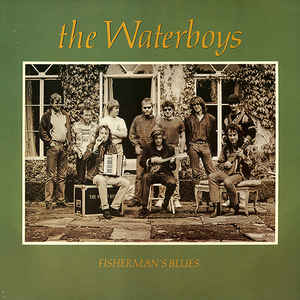
It got to a point that whenever I searched through a friend’s record collection when staying with them it stared right back at me: The Waterboys’ Fisherman’s Blues. Whether in Dublin or London, Berlin or Oslo, it was stood out like a sore thumb.
The weird thing is we never professed much grá for the album when it came out in the 1980s. We were coming of age teens when news filtered through that the older crowd were out jamming with The Waterboys in Spiddal. At the time ‘The Whole of The Moon’ bookended teenage discos across the West; a cue for a crowd to go off on one.
The Waterboys were solid purveyors of ‘big music,’ a band destined to play stadia across Europe; a band critics tipped to be the next U2.
So why the decamp to Spiddal of all places? We couldn’t get our heads around it. We were happily pushing our high-minded ideas into the world but it seemed like a step into an abyss. Some called it career suicide and we nodded in agreement. One minute the band was on Top of the Pops, the next they were playing sessions in a Spiddal pub. No sooner had Fisherman’s Blues come out, then the songs filled the airwaves. We had to engage with the music that was all around us. But we never professed to like any of the songs.
Pointing the Needle
Thirty years later I peered into the record collection of one of those former teens and Fisherman’s Blues was there looking out at me. It was the morning after a cold and wet November night spent sleeping on a couch, as my friend left for work.
I made a coffee and rummaged through his record collection. There it was: a vinyl copy of Fisherman’s Blues in its striking green jacket. I pointed the needle, lay back on the couch and listened to it straight through. It was a bewildering experience; the object of what I had rebelled against as a teen so defining of those same years.
Those days when noses were turned up at rock stars decamping to the West of Ireland to play trad had passed, and the singles ‘Fisherman’s Blues’ and ‘A Bang on the Ear’ became anthems.
Fisherman’s Blues came out when the West was a still a relatively unscathed tourist destination. It was a time when you could park a caravan on the side of pretty much any Connemara road.
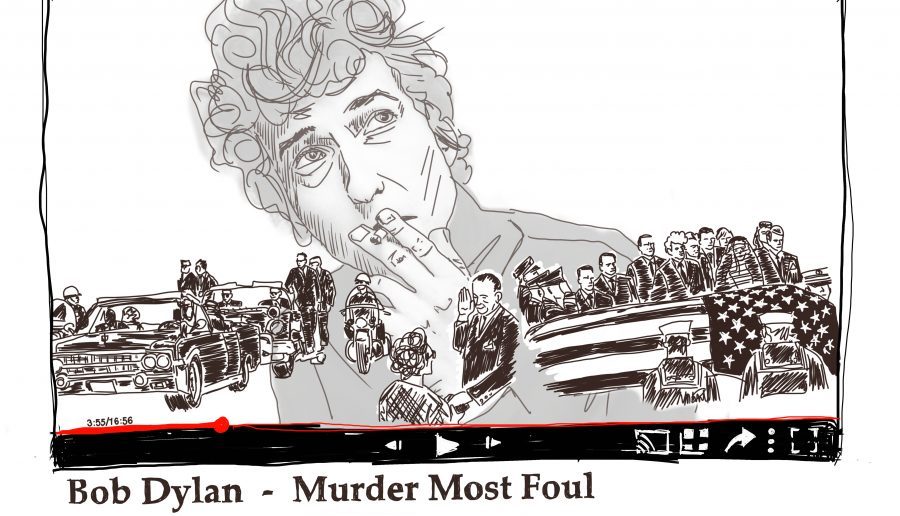
Years passed, the tourist industry got its claws into the West, and in the interim the legend of Fisherman’s Blues grew. The album is talked about today in the same breath as Bob Dylan and the Band’s TheBasement Tapes; another ramshackle of songs that just work. It isn’t so much 80s rock in dialogue with folk trad, but big music in touch with all the folk of the Western world.
Ireland’s Sonic Answer
Dylan recorded The Basement Tapes in a Woodstock home, adding mystique to the outpost of his Bethel Township. For a time Spiddal was Ireland’s sonic answer to New York’s Bethel: an outpost that could bring sustenance to a once distant metropolis.
Musicians travelled in and out; from Tuam, Gort to a village integral to the West yet cast off from the innards of urban life. By turning to Spiddal, The Waterboys’ leader singer Mike Scott could tap into the pulses of the West of Ireland, yet still remain in close proximity to the hustle and bustle of Galway city.
Hemmed in, cabin fevered, he could head to the docks, in the hope of chancing on new musicians. Maybe he stumbled to the docks one day and met the Tuam lads I knew, and word began to sift back to the others that myth was forming on the Western seaboard.
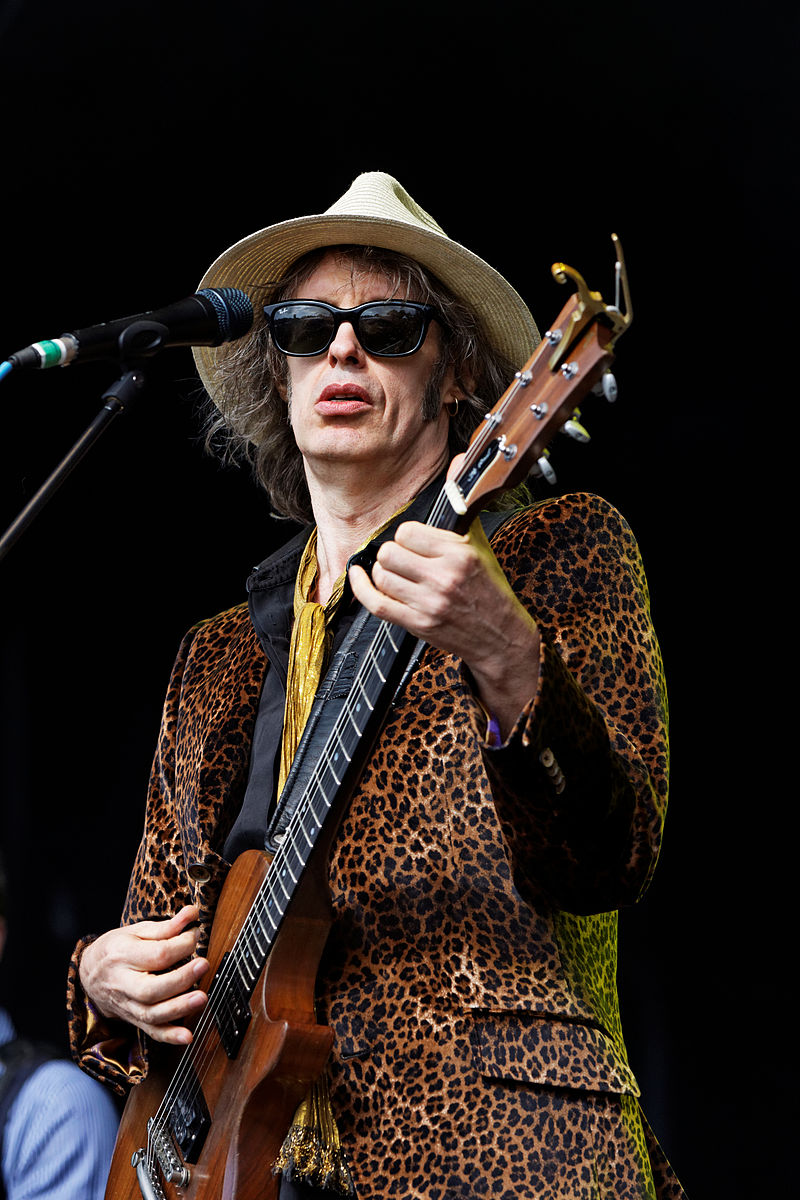
Mike Scott in 2012.
A Time Before the Internet
I got back home from Dublin to Murroe, having listened to Fisherman’s Blues on the bus, the music birthing memories of a time before the Internet began its colonization of the imagination.
Listening to the album that day brought me back to a decade when whispers carried from one end of the county to the next, and those awaiting dole day with penniless pockets were served tea free of charge by sympathetic publicans. Tuam, an unemployment black spot, was a place to escape from, and music was the escape before that escape.
The young were looking out towards London or America, with nothing but burned ambition close at hand. The actual song ‘Fisherman’s Blues’ captured the desire to hold on to the older ways of life at a time when Ireland was opening up to the wider world. Oh to be a fisherman, tumbling on the seas, taken in by the sole task of feeding a village back on land. No wonder we disregarded the song: it was a paean to a distant past, nostalgia for a world we were trying to escape.
Tipperary Hills
The album played through as the Tipperary hills gazed back from inside the bus, a markedly different landscape to one where the Atlantic Ocean hovered in full view. I listened to the opening of ‘World Party’ – a song that belittles the claim Scott ditched the ‘big music’ when he arrived in the West – and reflected on its simple championing of the imagination.
‘I heard a rumour of a golden age’ Scott sings, summoning the ghost of W.B Yeats on an album that also includes a rendition of his poem ‘The Stolen Child.’ ‘Don’t settle for reality’ the song seems to say, believe in something greater.
The next day I made my way to the forest that sits at the entrance of Glenstal Abbey beside where I now live; a route I walk each morning with my dog Oscar, listening again to the album on repeat. There was a pink afterglow on the distant Keeper Hill; clouds gave a dusky contour to the skyline that begets the Abbey itself.
Large hedges dwarf the walker of the route, unlike the stretches of Connemara land I associate with Spiddal, along the boreen leading to the trail located within a forest that is a hive of nature sitting in close proximity to Murrroe village.
The forest homes all sorts of wildlife: squirrels, pine martens, foxes, deer that wander down from the hills. Even when the trail is muddy, it dries so quickly it is suitable to walk in all seasons.
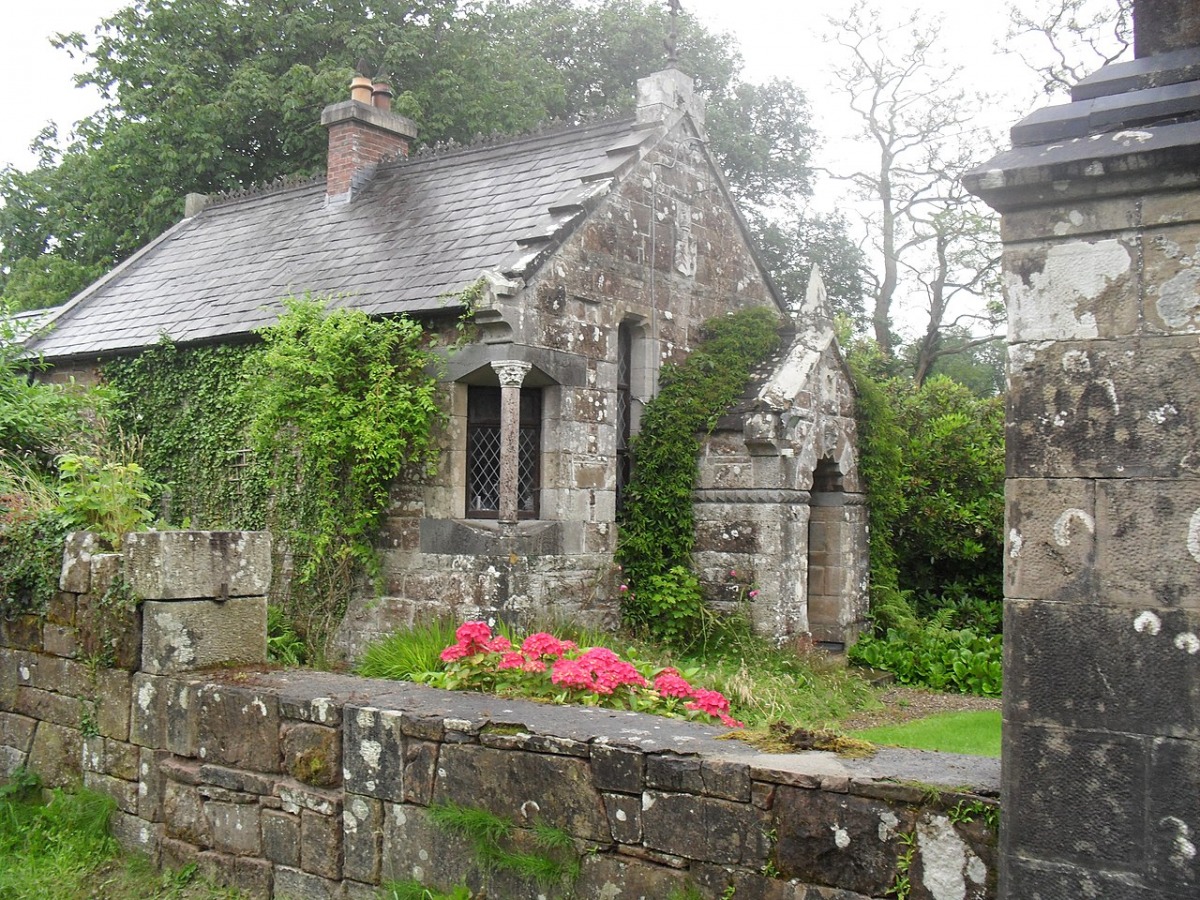
The Gatehouse to Glenstal Abbey.
Three Loops
That day and for two weeks after I listened to Fisherman’s Blues in the throes of walking or running along the trail. I listened to specific songs along one trajectory or route, passing the overhanging oak trees, past the stream marking the boundary between the cattle fields and the forest itself. Then I returned to a little inlet in a wall that said I was back at the beginning of the route.
I did three loops of that specific trajectory on the first day, with each song on Fisherman’s Blues synced to play twice in a row; ‘Sweet Thing’ to ‘A Bang on the Ear,’ to ‘When Will We Be Married.’ It was a punch in time to remember a former self.
I remembered hitchhiking along the N17 from Tuam to Salthill as a teenager. I remembered weeks spent on the Aran Islands learning to speak Irish, wondering aloud if the islanders were the same as me.
Locals tell me that the trail as an exercise in boredom; a dizzying mantra of physical exertion. But it is perfect for quiet contemplation.
Some come to record the birdsong at dawn; nature conservationists gather for educational purposes (leaving contraptions to feed the birds at night). The trail is the perfect place to listen to music and walk in peace.
It was December 6th when I went there intent on listening to ‘When Ye Go Away,’ perhaps the most moving song on Fisherman’s Blues, on constant repeat.
The song began to play as Oscar nudged his way through the gates that mark the entrance to the trail from the village path. The trees were shorn of their summer plumage, standing out naked-like in my midst. Winter was everywhere. I knotted my laces to stop from me tripping in mud, and began to walk the first loop with Oscar in tow.
For some reason the same song had stood out from all the others on Fisherman’s Blues. The song soon began to push its intimate waves of affectation down upon me.
As a song ‘When Ye Go Away’ turns on the phrase ‘fair play to you’ – a kind of mantra. Although cited as ‘fair lady’ on some Internet sites, it is a phrase typical of the West.
I thought of ‘play’ regarding Synge’s Playboy, the way it informs the language of Galway. The phrase comes after ‘in the morning you’ll be following your trail again,’ a line that seemed directed at me.
The lyric seemed to be calling out in my direction, echoing from the forest of Glenstal: I was, as Scott says, following my trail. The echo of ‘fair play to you,’ such an uncommon phrase in the mid west area of Ireland was affecting; in a place where ‘good man’ or ‘go on kid’ dominate the vernacular.
Then the sun came out from behind the clouds and rays of lights ushered through trees, bringing new sensations to bear. I began to step in and out of the past.
I was slowly ushered back in time, consumed by memory. Scott has a poetic skill. He can make meaning dissipate and compute almost simultaneously; the listener grasping his or her context as the bigger one one slips away. ‘When Ye Go Away’ initially read as a lament to a lost lover, a pang to heartbreak, knowing one has gone forever. But as my loops of the trail mounted up, a different context began to emerge from the song. The words ‘your coat is made of magic, and around your table angels play’ gave way to the great lyrical refrain ‘I will cry, when ye go away’ like a memory blow to the gut.
A Mare in Foal
The angels had come in the back door he rarely locked, slowly gathering at the table in the open plan kitchen, as we made our way down the stairs, groggy and still half asleep.
My father was making coffee at the counter and speaking jubilantly about the coming day, talking about the rugby on the telly and the mare that was in foal. One of the angels said the mare would hold onto the foal as long as possible just to annoy my father, interrupting his sleep to make nightly excursions to the stables with flashlight in hand a permanent feature.
‘She won’t give up easy,’ the angel announced, pouring sugar into a cup of tar-like Nescafé coffee. We sat there, angels on our lap, looking out at the green fields in hope the giant hare of Cloondarone would come out to play.
I skipped away from the image of a hare nodding up and down in the backfields. Back to 2021. A cow stared at me from beside an empty ditch. Across from the ditch was the abbey driveway in the distance: a road peppered with walkers. The autumnal-winter colours of the forest contrasted the green field, a blanket of darkness to lose yourself.
The song played through again to ‘I will rave and I will ramble, do everything but make you stay,’ bringing me slowly back to a summer in 2013.
I was entering the time shuttle called memory again. I am parked on the hard shoulder of the motorway waiting for my father to answer the phone. We talk and then, before I know it, I am in Galway city. We are arguing over something one of us had sparked.
Memory brings out the details; a heated discussion walking at the Spanish Arch. I remember the moment I pulled in on the way home to send a text to him, apologising. I had watched him limp up Merchants Road from the Arch that day, his head bopping up and down like the giant hare of Cloondarone. Then he was gone, falling into the Galway crowds like a fish into the ocean.
The sun raised its head too that evening, and the usual boisterous group of students could be heard shouting on the riverbank. There was music and laughter in the air. Then I blinked and I was back in 2021, stupidly worrying that somebody would wander around the corner to see me cry.
Galway Arts Festival, 2007.
II
Even if the sum total of analytic experience allows us to isolate some general forms, an analysis proceeds only from the particular to the particular.
Jacques Lacan.
French psychoanalyst Jacques Lacan once coined the term ‘signifying chain’ to explain the relationship between language and the unconscious mind. For Lacan, our experience is knitted into the very fabric of words. And words are sediments like rocks; time leaves a mark on them.
We cannot see the whole sediment in words, even when these words stare us in the face. To give meaning to his insight, Lacan turned to the story by Edgar Allen Poe ‘The Purloined Letter.’ Poe’s story is about a search for a letter stolen from a royal palace.
It is believed the letter – if read – will have detrimental consequences for the personage from whom it was stolen. The police set off in search of the letter, turning the suspect Minister D’s apartment upside down to no avail.
At this point the detective Dupin intervenes, locates the letter, and explains his logic. Dupin talks of the police looking in all places they would think of hiding the letter, when the obvious place to look is the least obvious place: in plain sight.
The letter is located on the mantelpiece. Dupin uses the analogy of a map game to explain his reasoning. Amateurs tasked with guessing the name of a place on a map will usually begin by scouring the smaller regions for the name; nooks and crannies. The easiest way to win, Dupin tells them, is to pick a name – in full view – for all to see.
Lacan reads Poe’s story as a commentary on language and the unconscious. The unconscious is not buried, he suggests, deep in the human organism, like the police think the letter is buried.
The unconscious is language: the symbolic dimension that holds human beings in its midst. It is the context around which words are in play; the time sediment in everyday language. Why we laugh, cry, become elated or defeated, can be understood as the sediment around which words are set. This is why the purloined letter is of such importance to Lacan’s theory of language; it teaches him to look for clues in the words his patients use all the time; words that are in plain sight.
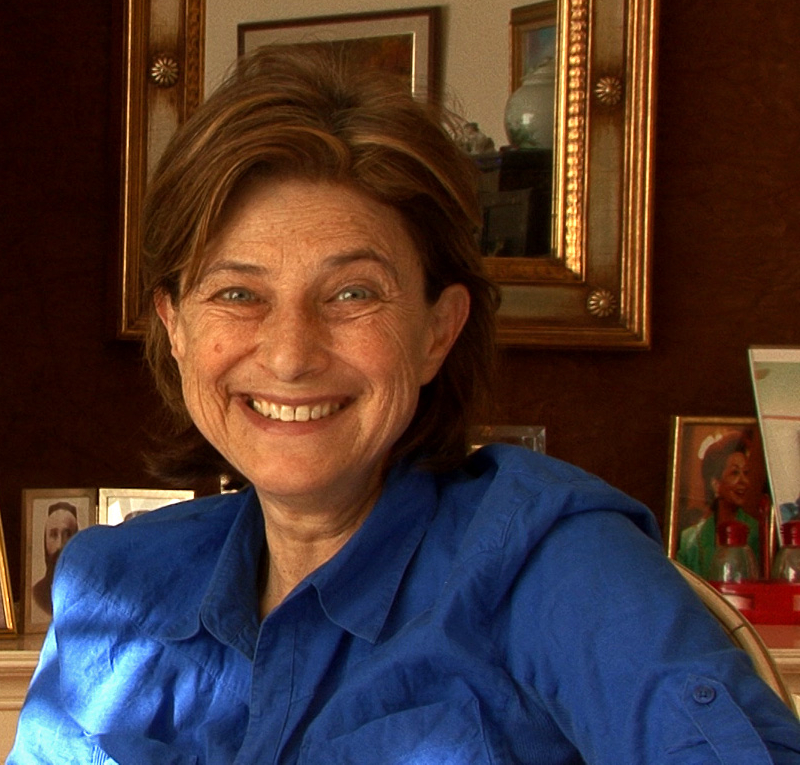
By Mario De Munck – Video still from video Chantal Akerman – Too Far, Too Close. Still uploaded with permission from the filmmaker., CC BY-SA 4.0, https://commons.wikimedia.org/w/index.php?curid=68641999
Chantal Akerman
One time, when asked why shots of people gathering at train stations populate her film d’Est, the great Belgian filmmaker Chantal Akermanreplied ‘ah that, again.’ Akerman was referring to the Holocaust, of which her parents were survivors.
Crowds populate the long durational shots of East European landmarks in her film, scenes that link words to other words in the everyday lexicon of Chantal’s life.
Her sigh ‘ah, that again’ references what she misses in plain sight. When travelling across the East to make a film about her family’s place of origin, a place they had fled during the pogroms, she moved along her own signifying chain, taking up different positions in relation to a word that dominated her life until her death by suicide in 2015.
The word Holocaust was Akerman’s purloined letter, casting its downward shadow on her life. It was a word her mother was unable to say; her family existed in opposition to. When her mother passed in 2014, Chantal was no longer the child of a survivor, just a child.
Akerman’s words echoed through my thoughts as ‘When Ye Go Away’ played in my earphones and I walked a desolate forest on the edge of a mid-western Irish town. The words ‘I will cry when ye go away’ stood out in plain sight: a letter placed on my own mantelpiece.
The song was no riddle that needed solving. It was a letter perched on the mantelpiece in the apartment called ‘my life.’ I was opening the letter to look inside. I pushed my headphones into my pocket, the dirt rubbing the side of my legs, my woollen hat dripping with wet sweat.
I saw the words staring back at me all the time: ‘when ye go away.’ The words were like diamonds in a sea of stone, signs reaching a destination.
‘Ah, that again,’ I muttered, going back to the memories from walking that day, the song a pedestal from which to stare into a distant past.
I was coming up from a rabbit hole where angels gathered around my father’s table; where we raved and rambled in the hustle and bustle of Galway city. The song was a letter that had been sent to me directly, from the postal office of my unconscious. It was a letter sent to remind me that the ‘ye’ in Scott’s ‘when ye go away’ was a father absent from Xmas again this year. The letter gazed at me just as another Christmas loomed.
Christmas again…
Brown winter leaves crunched under foot, as I began the journey home. It was coming up to Christmas again, and the sediment in words otherwise known as my past was pushing up from the depths of a riverbed. I was making my way home from the trail ashamed that I had lacked the strength to see it arrive.
Not wise enough to see the waves crashing in. Not tough enough to brush them away when they did. Five years, and the waves were still crashing in in unforeseen ways. There was nothing new to be learned from all of this, nothing new to change the course of time. Just ‘that again.’
The Waterboys recorded a follow up album to Fisherman’s Blues inspired again by the West of Ireland titled Room to Roam. To this day, the band’s music retains the influence of the Spiddal decamp; a decamp no longer thought of as career suicide but a pivotal event in the history of Irish popular and traditional music.
One can just imagine a record producer nagging Mike Scott to reconsider his move to the West of Ireland. The producer slams the phone down and turns to his assistant to say ‘I did everything to make him stay.’ An assistant replies ‘not much more you can do.’
Or one can just imagine a mother, speaking in Irish to her husband, lamenting her daughter’s decision to emigrate, to find work she can’t find in Spiddal. The woman says ‘rinne mé gach a bhféadfainn chun í a choinneáil anseo,’ before her husband, glass-eyed with tears, replies ‘silfidh mé na mílte deoir nuair a imeoidh sí ar shiúl.’
Or, yet still, one can just imagine a single mother, struggling to make ends meet in a city engulfed with ‘culture’ – and all the razzmatazz of commerce dressed up as art. She works by day in a factory in Ballybane on the outskirts of Galway city, and spends two nights a week playing in a traditional session in town for extra money.
She dresses her daughter in a hat and scarf and drops her to a West Side crèche before taking a bus that is soon caught up in the suffocating traffic. She will memorise the words to a Waterboys song to play that night in Taaffes. And when she hears the words ‘I will cry, when ye go away’ she thinks of her daughter alone in the crèche.
Or perhaps, as a final thought, one can just imagine a middle-aged brother and his two sisters travelling to Salthill, a childhood landmark, on a cold February morning. The brother drives there from Limerick to meet his sisters at dawn.
They meet in the city and make their way to the prom, parking the car near the diving tower at Blackrock. The brother steps out of the car with a suitcase containing a Bluetooth speaker and an urn. The two sisters follow him on foot down towards the small pebble beach on the right side of the Blackrock swimming tower, past the quadrangle where swimmers congregate, approaching the ocean their father swam in the weeks before his passing.
Coral Beach, Carraroe.
Ashes Fly into the Air
‘I want to play this one song,’ the brother says while fiddling with the speaker, ‘it’s from Fisherman’s Blues. When Ye Go Away.’ His sisters nod in agreement. ‘Yea, I love that song’ they say in sync, like they practiced it earlier that day.
He takes the urn out from the case, holding it up among the three pairs of hands, whispering as they remove the lid. Ashes fly into the air, swirling in a wind that disperses them across a grey-tinged sky.
Music soon begins to mesh with the sound of swimmers jumping in and out of the sea on the other side of the diving tower. Ash and music dance together, as the siblings group hug in one muted silence. The ash soon begins to drift up into the sky, making its way to Aran, Spiddle, and on to Carreroe. Some even make it to Roundstone, across Dog’s Bay, to Ballyconneelly.
A brother and his sisters gaze up at the sky, until no ash can be seen against a grey muzzle of cloud. There is only an urn left for them to cling to, and the shared understanding that life must go on.
Featured Image: Cloondarone, Co. Galway, June 2016.
The Death By Drowning Of Twenty Seven Migrants In The English Channel on Wednesday
It could have been twenty seven Cliff Richard fans
who quite like that Boris Johnson really;
twenty seven Noel Edmonds lookalikes
whose wives stimulate themselves with The Daily Express;
twenty seven former double glazing salesmen from Folkestone, Kent
who blame everything on the French;
twenty seven members of the Murdoch family
(including Jerry Hall);
twenty seven known business associates of the Duke of York;
twenty seven potential Archbishops of Canterbury;
twenty seven people with Allegra Stratton accents;
twenty seven arthritic comedians who spent
four years making Diane Abbot quips;
twenty seven logical positivists
who get their political philosophy from the tweets
of Right Said Fred, Joanna Lumley, & David Baddiel;
twenty seven OBEs, MBEs, and Commanders of The British Empire.
Tragically, it wasn’t.
Featured Image is of fencing in Calais (VOA/Nicolas Pinault).
On October 5thof this year, Minister for Health Stephen Donnelly spoke before the Dáil during a debate to extend the legal framework for restrictions in the State – the sunset clause of the Health Amendments (Covid-19) Act 2021 – for three months. He stated that there was no intention to extend the restrictions beyond October 22nd, but that they wished to keep the legal framework in place in case of the need for further restrictions or lockdowns.
This was clearly a lie, or ignorance on an unforgiveable scale. It cannot be both.
In the interim, hospitalisations related to COVID-19 have steadily climbed, and the wheel of fear and dread has begun to turn again, quickly gathering pace.
Thankfully, the government are attempting to turn the tide by extending the need for the Covid certification pass to theatre and cinemagoers, as well as banning nativity plays and playdates, thus surely halting the inevitable pressure that is being mounted on our health system.
I must state from the outset that I am vehemently against the concept of a vaccine passport or vaccine mandates. I believe them to be inherently illiberal and it pains me to see the willingness with which we have adopted them into our society.
I acknowledge that when an issue produces such a visceral response, there is an increased likelihood that my reasoning may be faulty. Having read Daniel Kahnemann’s Thinking, Fast and Slow , I recognise that instinct and emotion can often cloud clear judgement. Hence, I have attempted to examine the principal arguments for and against vaccine passports in the context of the coronavirus pandemic to see if I can or will come to a different conclusion.
I take COVID-19 extremely seriously and witness the impact of the pandemic on the patients that I meet every day. This relates not just to actual illness but to the myriad other issues, both medical and non-medical that the past twenty-two months have created for them.
I support vaccination but not forced inoculation in the same way that I support appropriate medical treatment, not forced care. I worry that unnecessary interventions will create long-term sequalae that cannot be predicted, in the same way that inappropriate prescribing of medications does.
The most obvious argument in favour of vaccine certification is that it should prevent the spread of disease in an enclosed area. The certificate will work to protect both vaccinated and unvaccinated from contracting and spreading the disease and reducing the burden on the hospital system.
Unfortunately, there is absolutely no evidence that this is the case. Vaccinated citizens have been readily demonstrated to be able to contract and transmit the virus in the exact same manner as an unvaccinated person.
A recent Lancet study demonstrated that vaccination reduced the risk of Delta variant infection and accelerated viral clearance. This is great news, demonstrating that vaccines are effective. However, fully vaccinated individuals with breakthrough infections had peak viral load similar to unvaccinated cases, and could efficiently transmit infection in household settings, including to fully vaccinated contacts.[i]
If vaccinated and unvaccinated persons are equally capable of transmitting a virus, why do we insist on segregation and marginalisation of a significant minority of our population?
The second argument commonly encountered is that it is the segment of the population who are unvaccinated by choice who are creating the ICU and hospital bed capacity issues.
As of November 17th 52% of patients are unvaccinated, with a significant percentage of this population also immunocompromised. According to Minister Donnelly, 98% of the vaccinated ICU patients are immunocompromised. On this basis, there is a strong likelihood that a significant proportion of the unvaccinated cohort are not unvaccinated by choice but because they are too unwell to receive the vaccine.
This is speculative on my part but is worth considering, and requires refutation.
Another argument advanced is that full participation in society is not free and requires solidarity on the part of the individual citizen: Thus, “Play your part. Protect yourself. Protect others” is a common slogan.
David Robert Grimes wrote an essay recently for The Guardian, comparing smallpox vaccine mandates in the early 1900’s to today’s issues. Of course, he neglected to mention that there was no vaccine passports in use at the time for participating in normal life, and provides no justification for them other than that they represent a mark of ‘solidarity.’
He also states that participation in society is not free, and that freedom comes at a cost, which is somewhat paradoxical. There is an expectation of brotherhood in society. However, if brotherhood is coerced against someone’s will, it is difficult to define it so.
Finally, although never explicitly stated in Ireland, vaccine certification is certainly an effective measure to improve uptake of a vaccine.
Whether one defines this as a nudge, gentle encouragement or coercion is a different argument. When I asked the Irish College of General Practitioners their position on the implementation of this system, they replied that ‘these people (the unvaccinated) may particularly benefit from national interventions to promote vaccination and limit the spread of COVID-19’.
This statement is certainly open to interpretation. Undoubtedly, it has been effective in ensuring increased take-up of the vaccine in young adults – young people who may not have bothered otherwise with brother- and sisterhood.
In a Machiavellian sense, this is the only true and potentially justifiable reason for a vaccine passport to be introduced in a civilised society. I cannot see another. Unfortunately, even 100% vaccination uptake, as in Gibraltar, has not resulted in the resolution of pandemic issues, with rising case numbers among the vaccinated causing all large Christmas activities to be cancelled.
At this point in the pandemic, the above justification in Ireland no longer holds water. Ireland has one of the highest vaccination rates in the world, with 93% of the eligible adult population fully vaccinated.
One should therefore assume that the remaining 7% of the ‘non-cooperating’ population are much more likely to consider a certification system coercive and will exacerbate their own fears of over-intervention by the State and unwelcome intrusion into their private lives.
Someone who argues that this is for the benefit of the unvaccinated in protecting them from society does not do so in good faith. If someone does not wish to be inoculated at this point, there is more than a strong possibility that they do not wish to take up the kind offer of a jab.
A certification system hence is more likely to have the inverse effect of its presumed benign intention. It is more likely to convince them further that the State wishes to harm and to segregate them against their wishes from a society that has already, by and large, shunned them.
There has been no attempt to understand any of the multiple reasons why people do not wish to receive this vaccine. Distrust of the State, distrust of the pharmaceutical industry, distrust of the healthcare industry, anecdotal reports of adverse effects and concerns regarding under-reporting, the list is varied. The consistent link between all these issues/concerns is that of distrust.
Many papers have been written on the subject of discussing vaccine hesitancy as a doctor with a patient. All suggest addressing hesitancy with compassion and understanding as decision-making around vaccination entails a complex mix of cultural, psychosocial, spiritual, political, and cognitive factors.[ii]
Reasons for vaccine hesitancy fit into three categories: lack of confidence (in effectiveness, safety, the system, or policy makers), complacency (perceived low risk of acquiring VPDs), and lack of convenience (in the availability, accessibility, and appeal of immunization services, including time, place, language, and cultural contexts).
All suggest addressing the patient’s concerns carefully, discussing with openness and honesty any potential side-effects as well as advocating the benefits, such as they are.
Has any of this been done at any point during the pandemic with the vaccine hesitant? Vaccine passports are not a tool to advocate for immunisation in a humane and empathic manner and it is equally certain that the most effective way of fomenting further distrust is to patronise people for their ‘stupidity’ in doubting the effectiveness of a medical intervention, while downplaying the potential for any side-effects and then to mandate the intervention as a necessity for full participation in normal society, such as it is.
Instead of focusing on and congratulating the 94% of the eligible adult population who have been vaccinated, we have decided to scapegoat and segregate the dirty few who have not complied with government directives.
As a reminder, segregation has never been an attractive or effective feature of a functioning society. I make no lazy comparison to Nazi Germany, but rather suggest that people consider the State’s recent attitudes to same-sex relationships.
It should not be forgotten that homosexuality was only decriminalised in Ireland in 1993. That was a horrible and unjust law, horridly intruding into the lives of normal people. Same-sex marriage was legalised six short years ago in 2015.
Can any sane person reasonably make the case that it was legitimate or more importantly, healthy for a society to deny that two private citizens who love each other should be allowed to spend their lives together in a loving, equal relationship? That it was reasonable that same-sex marriage was such a danger to society that it had to remain illegal in the twenty-first century?
By this logic, are the unvaccinated so lethally unclean that it is worth intentionally re-dividing society? That it is worth every citizen who wishes to eat in a restaurant having to demonstrate by law a private medical decision to a waiter that has no interest and no business in knowing same?
The State is not a benign entity and is capable of dreadful, discriminatory decisions that have long-lasting impacts of the fabric of the country that we live in. Our long history of governmental corruption, cronyism and cover-ups at the cost to its people did not magically disappeared at the onset of a pandemic to be replaced by a wonderful, altruistic body guided by love and the rights of the individual.
We should also consider the demographics of some of the people who do not wish to be vaccinated. People with lower levels of household income and those living in disadvantaged areas are demonstrably associated with increased likelihood of vaccine resistance and hesitancy.
It is regularly reported that lockdowns and prolonged periods of state-imposed restrictions have had the most demonstrably negative effects on the exact population groups who are also hesitant to receive the vaccine.
Therefore, we have managed to punish and further marginalise the very people who have suffered the most throughout this pandemic and will likely suffer the most in the years of anticipated turmoil ahead.
This is not to denigrate the many wonderful, intelligent people who quite rightly question the manner in which they feel their country is being governed and directed but to highlight the unnecessary dual suffering that many people will encounter in the months and years ahead.
In any other time, scepticism and resistance to dictates targeting minorities would be celebrated, not scorned. We should hold our leaders to a high standard at all times, not allow them easy opportunities for deflection from their own failings and label almost everything that does not agree with State narrative as “misinformation.”
Again, instead of trying to understand why people do not wish to be injected with a treatment that they consider dangerous and unproven, and to try to convince in a humane and empathic manner, we have instead chosen to demonise and make them the culprits for the current issues that the hospital system faces in Ireland.
Do we wish to follow the example of Singapore and begin charging patients who become ill and are unvaccinated by choice? Do we wish to follow the lead of Australia and send our citizens to quarantine camps against their wishes? Do we wish to follow the lead of Austria and lockdown the unvaccinated, and now mandate vaccines for the whole population?
Why are these questions not being asked and answer by the opposition political parties in Ireland? Liberalism is defined as a political and social philosophy that promotes individual rights, civil liberties, democracy, and free enterprise and is supposed to be the cornerstone of left-wing politics.
The presumed left, including Sinn Fein, Labour, the Social Democrats, People before Profit, have been pathetic in their lack of any attempt to hold the State to account. A strong opposition is the cornerstone of democracy, and it is not present currently in Ireland.
Image (c) Daniele Idini.
Public Health Department
I have discussed vaccine certification with the local public health department in relation to the management of this pandemic. The doctor that I spoke to readily admitted that there is no medical indication for the use of vaccine certification and was shocked at the extension of the recent legislation in October.
Hence, my surprise at the recent declarations by Colm Henry and Ina Kelly, president of the IMO, that the public should walk out of pubs or restaurants that are not asking for Covid 19 digital certificates.
There remains no evidence whatsoever that vaccine certification has made any improvement to the management of the COVID-19 pandemic in any country that it has been used.
An Israeli paper examining the effects of their ‘Green Pass’ concluded that apart from the coercive effects of increasing vaccine uptake[iii], there is no evidence that the use of a passport system reduces morbidity loads on a population.
To repeat, there is no public health evidence for the intentional segregation of society. None. Zero. Nada. Zilch.
Anyone who argues that there is should be immediately dismissed as a fool. However, if you wish to look at the data, the HSPC have kindly provided information on COVID-19 outbreaks in the Republic of Ireland.
In May of 2021, there had been a grand total of two outbreaks attributed to hairdressers/personal grooming services. By November, there are now twenty-two recorded. In May, there were ten outbreaks attributed to public houses. By November, there have been forty more.
Does anyone truly believe that presenting a piece of paper at the door achieves anything when the holder continues to have the potential to be highly infectious? There is no evidence that it improves either your safety or the safety of others.
Image (c) Daniele Idini
Misdirected Indication
There has also been a recent effort to blame the unvaccinated for various sad occurrences that have occurred because of the lack of capacity in the HSE. Thus, it was reported that a transplant operation was cancelled because unvaccinated patients occupied ICU beds and the procedure was unable to go ahead.
Blaming the unvaccinated for this is completely disingenuous and abdicates responsibility for decades of poor management. The reader should know that Ireland does not have a good reputation in the transplant world. We are currently 18th out of 24 countries in Europe, below Lithuania and Estonia in terms of organ transplantation per million people.
In 2015, Dr David Hickey, the transplant surgeon described in the Irish Independent that he was the only pancreatic transplant surgeon in the State. Despite multiple offers to the HSE to mentor two people to take over his role, nothing was done. The pancreatic transplant program was then moved to another hospital setting, against advice and without consultation. At the time, no transplants, despite their life-saving nature, took place over a nine-month period.
To consider that the people ‘clogging up the ICU’s’ are responsible for historically well-recognised governmental and state body failures is malicious.
The 2019 Euro Health Consumer Index places Ireland in last position, below Albania, North Macedonia, Latvia and Romania, countries all with their own issues, in terms of outpatient hospital waiting lists.
Ireland has the lowest rate of hospital consultants in the EU18, a fact heavily bemoaned by the Irish Medical Organisation. Shortages of GPs, shortages of nursing and allied health professionals, overcrowded emergency departments and public health failures have been reliable sources of outrage and headlines over the course of the past twenty years.
Fortunately, there is now a perfect fall guy in the shape of an unvaccinated person to take the ire of the populace.
The unvaccinated are at fault for five-year orthopaedic waiting lists, the unvaccinated are responsible for spiralling chronic diseases in an increasingly obese and unhealthy society. The unvaccinated are responsible for the lack of clinical staff living and working in this country.
It would be laughable were it not for the real human cost of such misdirected indignation and hatred.
If we are to blame the individual for the failings of the system, we should apply this logic to the others who place a heavier burden on the health system. The obese, the alcoholics, the smokers, the poor should all feel our wrath at the impact they place upon our hospitals. Perhaps an obesity cert would be an incentive for them to lose weight or keep them out of restaurants? That can only have positive results.
Continuing along this path of chaotic interference in people’s lives will have iatrogenic consequences. Professor Helen Townsend, director of the Self-Harm Research Group in the University of Nottingham, has described the likely severe long-term consequences of lockdowns and that these have never been accounted for in policy making19.
Has any consideration been given to the societal impacts of intentionally separating the ‘dirty dissenters’ from the rest of the country? If there is no public health evidence for overwhelming benefit, how can we justify such an enormous departure from normality?
The ethical implications of these decisions have clearly not been fully considered, if at all. It should be noted that the National Public Health Emergency Team does not have any bioethical or legal representation, an amazing fact considering the enormous decisions that have been made on the basis of their recommendations over the course of the past twenty months.
The Irish Council for Civil Liberties has repeatedly requested that such a representative should join NPHET, but this has been ignored. The ICCL, for what it is worth, has also stated their strong opposition to a domestic vaccine passport, stating that the system is discriminatory and has been developed without any meaningful consideration of human rights.
And yet still we persist and tolerate further encroachment into both our and our children’s lives. 50,000 people can go to a football match in the Aviva stadium, the CEO of the HSE can drink and rub shoulders with sporting royalty indoors without a mask, yet we think it is appropriate that nine-year-old children should be masked and instructed not to attend nativity plays.
190,000 children are currently living in poverty in Ireland, yet this is not a crisis worth addressing in the mainstream media. Instead, it is recommended to avoid playdates and sleepovers while Gary Barlow croons to thousands in the 3 Arena. It is preposterous and the antithesis of public health. It causes me great shame as a doctor that these measures are being carried out in the name of my profession.
I am unable to convince myself that a system of vaccine certification is a reasonable or ethical idea in an essentially fully vaccinated adult population for a virus that is transmissible regardless of your vaccination status.
Image (c) Daniele Idini.
A Thought Experiment
If you remain convinced that it is, I would like to propose a final thought experiment. Consider a politician or government that you dislike or fear. Consider your reaction if they were to have introduced a vaccine passport over the course of the past six months.
Would you agree with segregation of society if Donal Trump suggested it? Would you clap wholeheartedly if Vladimir Putin encouraged marginalisation of a minority of people who have not broken any laws? Would you dismiss civil rights concerns if Bolsanaro was championing minority-blaming and hatred?
If you would agree to all these questions, I would congratulate you on your single-minded conviction and realise that I will never convince you – as is assumed to be the case with all ‘anti-vaxxers’, a derogatory term that I despise.
Coercion and essentially forced vaccination signifies a complete failure of scientific and public health messaging. My sympathies lie with the people who are not currently welcome to participate in society on the basis of one personal decision which has not broken any law.
They have been stripped of their constitutional rights without seemingly without any recourse to due process. That should give anyone reason to pause and reflect. Without acknowledging it, we have become a country that has slipped, almost overnight, into an enduring state of fear and intolerance. I worry for the future and the country that my children will inhabit.
[i]Anika Singanayagam, PhD et al, ‘Community transmission and viral load kinetics of the SARS-CoV-2 delta (B.1.617.2) variant in vaccinated and unvaccinated individuals in the UK: a prospective, longitudinal, cohort study’, The Lancet, October 29, 2021, https://www.thelancet.com/journals/laninf/article/PIIS1473-3099(21)00648-4/fulltext
[ii]Shixin (Cindy) Shen and Vinita Dubey, ‘Addressing vaccine hesitancy: Clinical guidance for primary care physicians working with parents’, The College of Family Physicians of Canada, 2019 Mar; 65(3): 175–181. https://www.ncbi.nlm.nih.gov/pmc/articles/PMC6515949/
[iii] Ruth Waitzburg, ‘The Israeli Experience with the “Green Pass” Policy Highlights Issues to Be Considered by Policymakers in Other Countries,’ November 2021, International Journal of Environmental Research and Public Health, 18(21):11212. https://www.researchgate.net/publication/355819969_The_Israeli_Experience_with_the_Green_Pass_Policy_Highlights_Issues_to_Be_Considered_by_Policymakers_in_Other_Countries
In a recent review, my colleague Ben Pantrey argues Richard Kearney’s Touch is itself out of touch with the ‘maddeningly Baroque … meme-ified soup of internet discourse.’ Given the Boston-based Irish philosopher is from an older generation, a relative lack of insight is perhaps unsurprising, but in dismissing the work in at times caustic terms, the reviewer perhaps missed its central thrust.
Touch provides a compelling narrative on an intimate connection between healing and touch, pointing to a dominant tendency in Western medicine – writ large during the Covid-19 pandemic – to disregard the role of the healer, in favour of what Kearney calls a ‘model of outmanoeuvring and overcoming illness.(p.68)’
That this view now appears risqué – in the face of coercive public health – demonstrates how the argument for the type of healing that Kearney points to is being lost.
The flag of the World Health Organization, with a rod of Asclepius.
Hippocratic v. Asklepion
Kearney identifies two paradigmatic schools of medicine originating in Ancient Greece, one emanating from Chiron who taught his disciple Asclepius ‘the art of healing through touch’; and another from Hippocrates, ‘followed the way of Zeus, Chiron’s brother, who dwelt on Mount Olympus and promoted a method of optocentric supervision. (p.66)’
Following a Hippocratic approach, the patient is viewed from a distance – objectified – before the prescribed remedy, or prophylactic, is applied to an undifferentiated ‘case.’
In contrast:
Chiron comes from the word kheir, meaning hand, or, more precisely, one skilled with the hands. The related term kheirourgos means surgeon. As healer, he accompanied the art of touch – often portrayed as laying on of hands and bodily massage – with medicinal plants from the earth, music, and sleep potions. (p.66)
Asklepion healing is a two-way process that includes: ‘tactile acts of bathing, ritual massage, and the ingestion of curative herbs. (p.68)’ This sounds similar to so-called ‘alternative’ medicinal practices – dismissed as ‘unscientific’ by some doctors – and also encompasses much of the fading role of the general practitioner, where a physical presence before each distinct patient is generally considered important.
This form of healing, however, is severely compromised by exhortations – backed up by unprecedented draconian laws – to ‘socially’ distance – which is surely an oxymoron.
Kearney’s work points to profound damage that occurs when physical contact is lost, heightening a pre-existing epidemic of loneliness, which a report in 2014 found to have even worse effects on our health than obesity. The psychiatrist Iain McGilchrist goes so far as to argue that all medicine should be viewed ‘as a branch of psychiatry, and psychiatry as a branch of philosophy.’[i]
Indeed, recognising a psychological origin to physical symptoms might explain our current impasse: transfixed by the challenge of a particular virus, seemingly to the exclusion of all else. This collective hysteria suggests widespread trauma, which may be the legacy of diminished physical contact in a digitally mediated age, accelerated by what Naomi Klein described as a ‘Screen New Deal,’ rolled out under cover of lockdown.
It begs the question: what happens to society when we shrink in fear from the flesh, blood and microbes of one another? ‘Touch’, Kearney says, ‘serves as the indispensable agency of intercorporality – and by moral extension, empathy. (p.47)’
The School of Athens by Raphael.
Aristotelian Touchstone
According to Kearney, Plato’s Academy held sight to be ‘the highest sense because it was deemed the most distant and mediated.’ In contrast, according to Kearney, Aristotle, ‘makes the startling claim that human perfection is the perfection of touch, (p.35)’ writing in Metaphysics (chapter 10, 105ib, 23-25):
The being to whom logos has been given as his share is a tactile being, endowed with the finest tact.
Kearney argues convincingly that in Western medicine the Aristotlean approach, drawing on Asklepion wisdom, has been drowned out by a Platonic, ‘heroic-Hippocratic model’, which ‘only tells half the story. (p.68-69)’
In support of this thesis, in his history of the origins of the scientific discipline from the late eighteenth century, Richard Holmes has drawn attention to a delusional optimism wherein there emerged, ‘the dazzling idea of the solitary scientific ‘genius’, thirsting and reckless for knowledge, for its own sake and perhaps at any cost.’ This was the idea of a ‘Eureka’ moment: ‘the intuitive inspired instant of invention or discovery, for which no amount of preparation or preliminary analysis can really compare.’[ii]
Arguably, blind faith in dazzling scientific genius distorted public health priorities in the era of COVID-19. Lockdowns were aimed at keeping the population ‘safe’ before the invention of a ‘miraculous’ vaccine. Many seemed to assume this would act as a panacea, allowing us to awaken from the nightmare of ongoing restrictions. But a cycle of anxiety endures with the arrival of each new variant, however mild the symptoms it produces, suggesting an underlying anxiety is itself the problem.
in pursuit of a single-minded, Hippocratic “model of outmanoeuvring and overcoming illness”, morbidity and mortality from COVID-19 was inadequately weighed against the health impacts of lockdowns. According to Ari R. Joffe, the response of Western nations threatens to make ‘and likely has already made, several Sustainable Development Goals for the most vulnerable among us in low-income countries out of reach.’ The same paper also argues the ‘destabilizing effects may lead to chaotic events (e.g., riots, wars, revolutions).’
A van set on fire during the riots in Rotterdam on 26 January 2021.
Merleau-Ponty
Another philosopher Kearney cites is Maurice Merleau-Ponty who ‘took the novel step of applying the phenomenology of touch to the question of healing. (p.49)’ In response to increasing dependence on ‘optocentric’ remote diagnostics, it is worth revisiting passages Kearney quotes.
Merleau-Ponty emphasises the importance of tactility in the treatment of psychiatric illness in particular:
In treating (certain illnesses) psychological medicine does not act on the patient by making him know the origin of his illness: sometimes a touch of the hand puts a stop to the spasms and restores to the patient his speech.
Moreover,
The patient does not accept the meaning of his disturbance as revealed to him without the personal relationship formed with the doctor, or without the confidence and friendship felt towards him, and the change of existence resulting from this friendship. Neither symptom nor cure is worked out at the level of objective or positing consciousness, but below that level.
He concludes with a revolutionary idea in the context of this pandemic, where the patient-doctor relationship is side-lined in favour of generalised prescriptions, addressing one particular disease:
What this implies is that human symptoms cannot be explained by either biochemistry or intellectual volition alone – though both have their role. Ultimate healing involves an existential conversion of one body-subject in tactful communion with another. (p.49)
Moreover, Kearney adds that ‘untimely withdrawal of touch may do worse psychic damage than outright hostility or anger. (p.102)’ He refers to the findings of the Austrian doctor René Spitz in 1945, concerning an orphanage, which prevented contact between children in order to reduce a risk of them being exposed to contagious diseases, while giving them excellent nutrition and medical care. Startling, thirty-seven percent of the infants died before reaching the age of two.
Kearney also draws attention to epigenetic research demonstrating ‘key alterations in our bodies are made not just by toxins and biochemical stimulants but by the way we resonate with our fellow beings. (p.104)’
Image: Daniele Idini (c)
Responding to Covid
Given Kearney completed the book just as the COVID-19 pandemic began, his observations are of a provisional nature.
Nonetheless he makes a far-reaching claim that ‘In the first half of 2020, the virus went viral. Homo sapiens became Homo cybernens. (p.136)’ He assumes, however, an upbeat tone that now seems misplaced, saying ‘what we lost on the roundabout we won the swings’, recalling, how friends had received ‘unexpected messages from old friends and old flames (the “ex-factor”) wishing to “reconnect” at a time when physical travel and tactile contact was suddenly suspended. (p.134)’
Almost two years into the pandemic another philosopher, Byung-Chul Han has a far less rosy assessment. Writing for The Nation he describes what he calls ‘The Tiredness Virus’ in the pandemic’s wake. A triumph of sight over touch has generated what Han describes as ‘Zoom narcissism’ such that a ‘digital mirror’ encourages ‘dysmorphia’ (an exaggerated concern with supposed flaws in one’s physical appearance).
‘Digital communication is a very one-sided, attenuated affair’ Han argues, ‘There is no gaze, no body. It lacks the physical presence of the other.’ Moreover, he fears this this form of communication will become the norm, recalling all that we have lost:
The rituals we have been missing out on during the pandemic also imply physical experience. They represent forms of physical communication that create community and therefore bring happiness. Most of all, they lead us away from our egos … A physical aspect is also inherent in community as such. Digitalization weakens community cohesion insofar as it has a disembodying effect. The virus alienates us from the body.
Prolonging Covid?
Could an enforced absence of touch be linked to outright pathology in the context of COVID-19?
In response, Professor Robert Dingwell criticised ‘this very strong message which has effectively terrorised the population into believing that this is a disease that is going to kill you.’
Is it possible that widespread conviction that a disease “is going to kill you” had unforeseen consequences in terms of adding to the burden of ‘Long Covid,’ or Covid ‘Long Haulers’ as it is referred to in the U.S.?
Long Covid is a condition fitting within the general category of a post-viral syndrome, or post-viral fatigue, which is ‘a sense of tiredness and weakness that lingers after a person has fought off a viral infection.’ which ‘can arise even after common infections, such as the flu.’ Notably, prior to the pandemic there were up to 150,000 who were already affected by ‘extreme and disabling exhaustion,’ with no apparent origin in the U.K.. Yet virtually no attention was given to this condition until the pandemic.
Moreover, in October, 2020 a leading advocates for sufferers, Professor Trish Greenhalgh clarified that Long Covid is only very rarely a long-term affliction: ‘The reviews we’ve done seem to suggest that whilst a tiny minority of people, perhaps one per cent of everyone who gets Covid-19, are still ill six months later, and whilst about a third of people aren’t better at three weeks, most people whose condition drags on are going to get better, slowly but steadily, between three weeks and three months.’
Ordinarily, one would expect public health officials to downplay such a condition, given broad acceptance that psychological stress – including a lack of touch or loneliness – is a factor in the subjective evolution or pathogenesis of most diseases. Instead, Long Covid has been widely highlighted in the media, often as a warning to young people, who might otherwise be insufficiently scared of a virus highly unlikely to kill a person under the age of fifty.
Frequent, graphic accounts, espeically via social media, may have had unintended consequences. Curiously, an informal survey of 450 people by Survivor Corps, a patient advocacy group for people with Long Covid, found that 171 said their condition improved after vaccination. That a vaccine would alleviate a post-viral syndrome is surely grounds for suspicion, hinting at a psychological origin to objective pain and suffering.
Adam Gaffney, an assistant professor in medicine at Harvard Medical School, has argued for a more critical appraisal of Long Covid. Having expressed scepticism around a condition characterised by symptoms such as ‘brain fog’, he recalls being contacted by a journalist who said: ‘I’m asking as much as a person as a journalist because I’m more terrified of this syndrome than I am of death.’
Gaffney acknowledges ‘myriad long-term effects, including physical and cognitive impairments, reduced lung function, mental health problems, and poorer quality of life’ from severe bouts of COVID-19, but cites a survey showing two-thirds of ‘long haulers’ had negative coronavirus antibody tests, and another, organised by self-identifying Long Covid patients indicating around two-thirds of those surveyed who had undergone blood testing reported negative results.
He asserted: ‘it’s highly probable that some or many long-haulers who were never diagnosed using PCR testing in the acute phase and who also have negative antibody tests are “true negatives.” In other words, for many this may be a disease with a psychological origin, which Gaffney attributes to ‘skyrocketing levels of social anguish and mental emotional distress,’ referencing a paper showing that about half of people with depression also had unexplained physical symptoms.
Getting Back in Touch
Recovery from the trauma of the pandemic should lead to a reappraisal of public health priorities. It is apparent by now that no “miracle” cure is available, decisively “outmanoeuvring and overcoming” COVID-19, and that lockdown measures, including pysch-ops instilling fear, have left deep wounds.
Works such as Kearney’s remind us of the importance of healing touch, inspired by Asclepius, which should be accorded equal importance to the Hippocratic inheritance. Now, with an ever-increasing burden of morbidity in society, particularly a veritable epidemic of mental ill-health, a paradigm shift is required.
However, Bessel Van Der Kolk describes in a recent work quoted by Kearney how mainstream medicine ‘is firmly committed to a better life through chemistry, and the fact that we can actually change our own physiology and inner equilibrium by means other than drugs, [that is] by such basic activities as breathing moving and touching … is rarely considered.’[iii]
This issue could become one of the most important political questions of our time, and may lead to political realignments in the wake of a pandemic that has changed our lives.
Featured Image: A member of the Peruvian Army with a police dog enforcing curfew on 31 March 2020.
[i] Iain McGilchrist, The Master and His Emissary: The Divided Brain and the Making of the Western World, Yale University Press, New Haven/
[ii] Richard Holmes, The Age of Wonder: How the Romantic Generation Discovered the Beauty and Terror of Science (London, 2008) p. xvii
[iii] Bessel Van Der Kolk, The Body Keeps the Score, New York, Penguin, 2015, p.38.