The gentle discord of rainfall,
its alternating static dance are
Reeds of air in suspension
before the corona of sensation.
A droplet splashes and trickles
along your neck,
its joyous grief
is welcomed by you with a shudder.
The courage of the leaf
passes beneath the banks of cloud,
the burnishing lustre blossoming
upon your limbs,
the flowering sounds
of the sun’s brassy trumpets
illuminate the oracle of the hills.
II
The space between the words
Is akin to the space between the rain;
This is syntax –
The syntax of the rain.
Each word, each drop,
With its cohesion of letters
Is an alphabet written in water
Pooling in language. The liquidity of words. Your waters fall like rain,
Their quiet sudden declensions thunder
With an astonishment of showers
Light and gentle as thought’s forgotten tributaries
Brining relief from the tropics,
The tropics of the spring.
III
The distillation of the night
ferments the dawn,
minute revolutions of uninterrupted
sleep; night being a dark day
for things that silently creep.
Out of such stuff things bloom!
The leaf of thought could fill a room
With the bestiaries of the night.`
IV
Upon the crest you cycle
With the Black Hills as register.
Sheepless and quiet.
The dissemination of clouds
Pass, yet you are the only witness
To such wonder.
Accompanying all with aural springs
Cadence and rhythm pick up
With the invigoration of muscle.
Thought’s labour on the passing of the evening
Still clinging to the web of sleep
Like the silken trail of a woman’s stocking,
While banking on your side
Sheer locomotion shunts
Fabulously across the morning.
A thousand hermaphrodites
Lie slain and severed upon the heath,
Yet not a sole is being recorded.
While placed religiously upon the library shelves,
A hundred almanacs of the tides!
V
Along the footpaths, trees stand erect
As arrows, Virgilian sentinels
To patrol the fingerless dawn.
Wisps of Rose.
Cotton fields upended.
The fields are aliens reflected
In the lagoons filled with
The mythology of both Roman and Norsemen.
Out by Lambay their ghost’s hover.
Fingal’s cave but a haven for 19th century
Smuggler.
There is ruin and mail under the watery skin
Of every wave. Gut its belly,
Debone and scale the morning.
The electric prophets prophecy nothing.
Mendacity is cultural.
Aural pollution is on the wing.
Emissaries of the void would but spill.
Frustrate them.
Offer other flavours of the evening.
The evenings where shapes still bring
Mythologies as finely wrought
As summer dresses
Garlanding the superb limbs
Of the approaching Amazons.
See there!
Now, they come…
VI.
The elemental walk of the Vitruvians,
Divinely proportioned,
Aqueous folds cocooned in the lithe
Expansive limbs of the morning.
Flesh burnished by a billion suns,
Atomised to the core; Bataille’s erotic
Solar economics beats all Keynesian excess.
Even pedestrian they Kill, for She is slow.
Her cadence and rhythm shift in shapes
Of undulating, mesmerising patterns.
You follow her like a servant, reciting some lost phrase,
Bringing to her the garlands of the morning.
Try to envisage Odysseus, on stiff headland, on the Western Atlantic coast of Ireland, tilling the soil with an ancient looking hoe. His hands are dry, chapped and his thick fingers curled around a parched shaft, steady palms supporting the implement, with which he works effortlessly. The slap, jut, and pull of the short blade into the earth turns up an odd purple worm which twists its belly upwards to the hot palpitating sun; and a hessian sack, half-filled with grass seed ready for planting, is slung over his back; its strings stretched across his well-defined, sinew-led, shoulder. Small dragon neck swathes of lime-coloured samphire shoots slowly emerge in sandy verges of the high field where he works. There is not a cloud in the endless ream of blue sky.
When he spreads grass seed, as he has done in the past, many times, the canvas bag becomes a sail and his hand arcs as minuscule seedy flints shoot out over fertile mother earth and come to land among waxy ribbons of grass.
The man looks now over a fluttering Atlantic Ocean, and it could almost be the Aegean Sea. It roars, breaks, and shatters into lucidity and calm, with white horses crashing on out further, out towards the ellipsis of the infinite horizon of his gaze. Gleaming, smooth black cattle, way off to his right, graze in a greenfield, in a verdant county. A county older than the Celts. Even Mother Nature does not know of its name. The herd, glistening, serves as a bovine footnote of nature’s essayistic form. They bellow and holler at each other with an incongruity that floats on the air. A brocade of whitethorn keeps them penned in. The enigmatic cattle are dark forms, staples of a slowly sifting tenure and lenient to the west’s wilder ways and moods. It suits them to bellow here in the hull of infallibility, amid the streaming whitethorn, sea Campion, and sandwort. The whitethorn is in flower, billowing, and its scented blooms are carried by the wind.
Atop these cliffs, sat Eoghan whose hands were worn, he rubbed the soil and clasped his hands together to smell the earth, the olfactory bulb flickers, antediluvian and almost pristine in a broken social world. He drew a deep draught and took in the living earth with one unbroken breath. These were the elements, indeed, the pastures of his making. After a few minutes of solitude, he heard the scrunch of footsteps on seashells and sandy screed in a lane nearby. Eoghan turned his head to see a girl in her early twenties walking towards him.
“Hi-yah”’ she called out as she approached. He cleared his throat, smiles, and replies,
“Hello there; nice day…”
“Oh, aye, it’s a grand one, that’s for sure…”
Coming closer, he noted her translucent plastic sandals, linen-white shorts and a sleeveless t-shirt of navy blue with white stripes. Her auburn hair, worn in a ponytail, danced and bounced as she walked in the golden sunlight. She studied him and then cast a glance at a shred of olive green kelp which had blown up from the shore and was now stuck to the barbed wire fence on the headland.
“Bladderwrack… I believe they call it,” he said mildly.
She turned to him with an almost startled look, her tawny eyes furtive and her lips thinning, then biting her bottom lip she said,
“That’s a rare auld name for some seaweed, isn’t it now?”
Eoghan nodded and smiled up at her in the summer sun. She dropped down onto her knees just in front of his sitting position.
“I remember, the other morning, on Inch Island, disturbing an old heron that was in a settled way…” he began.
“What happened?” She exclaimed, looking at him more attentively.
“I was just walking past when he looked at me,” he continued in a quiet voice, “and rose, languidly, from a clutch of rushes and off he took, one foot trailing behind the other slightly and flapping away towards Lough Swilly.”
“Sure. It must have made a good picture. Did you upload it on to Instagram?” She asked smiling.
“No.” He replied, softly, “No Instagram.”
“Then what use is that?” she said, giving him a look of yearning.
“Mother Nature has the table ready and all we have to do is go and eat. When I rise very early in the morning and go out to nature, I like to immerse myself in the landscape, to see the countryside come alive and open up in front of me; to see bright buttery gorse flower flourish, to smell honeysuckle; to smell wild garlic in woodland, Nature’s larder.”
She was quiet, looking nonplussed and uncomprehending. An uncomfortable silence then passed between them.
“Are ya on Snapchat or Twitter?” She asks her voice suddenly brightening.
“Twitter?” He tentatively queries.
“Yeah.”
“No.”
“Why? Are you eighty, like?” Her teeth glittered with the brightness of the sun as her mouth curved into a cynical smile.
Eoghan looked down from the headland towards the sea; the sea breeze caught his thoughts and corresponded with the ripples in the blue torn water. He drew a deep breath as if to acknowledge her persistence.
“Well, I guess, I just don’t really like this modern stuff …is the honest answer,” He replied turning his blue eyes back on her hazel brown ones.
“We live in an age,’ he began again, but looking at her, taking stock, he realised he did not know her name. She comprehended this and gave him the thought he was seeking.
“Aoife.”
He smiled.
“Aoife, we live, as I say, in an age known to thinkers, and to those logical enough to figure things out, as Neoliberalism. In an age of instantaneous gratification, of wishes granted instantly. And this is a kind of curse, this culture is a throwaway culture, and it’s not really for me that stuff…these belief systems.”
The imbroglio of her young mind sent her into a dream state. Yes, she thought this young man, this guy was, “Oh, Janey-Mac, pure gorgeous,” but she was still on the faltering line between being a young girl, and the precipice which would send her into womanhood, and which had not yet been delivered fully formed to her feminine threshold. Just then her phone buzzed. She shook off her teenage sensibilities and looked at the phone’s screen.
“I have to go,” she said, looking back up to him. “Me Mam wants me to look after our Daniel, a wee dote.” And she took off, saying as she went, “Hope to see you around sometime,” smiling. He smiled as he watched her disappear into the horizon.
Early the next morning, very early, before any hint of daybreak, Eoghan was at the water’s edge in Inishowen, by Inch Island. He was in deep silence as images entered into his consciousness: yew trees; blue milk; a honey drop caught in pure amber sunlight, wheat-chaff which dances away in a furmy haze; three girls were strolling across a golden beach, past a wooden curragh laden with salt and beginning to crumble into wisps of wooden flakes that disintegrate in the hand. Insects given a firmer design by ancient runes with Neolithic symbolism, crawl, swirl and settle down to become geometrical shapes and patterns, known as Celtic Art. They retire and pass into the art and geometry of stone. A cow’s loin and flanks turn on a spit over a fire pit in the hill fort, Grainán of Aileach. The creature’s dead eye, bulbous, staring, almost bull-like, reminded Eoghan of the tearful eyes of sage storyteller, Paul Auster. Whose gaze could strike the bullseye of fear and desire among those he knew with big, wet eyes, like he had been crying. Bull-eyes.
A crowd of screaming dark crows broke from branches where there was no tree trunk or tree and scattered across the immediate skyline of his memory’s eye. A spearhead of mackerel which were shifting and turned in a giant ball in the ocean; the sky darkening and rabbits and hares quaking in laneways; stars agleam in a bowl of night water strewn with a garnish of seawrack, seaweed, a mermaid’s shawl.
He exhaled for a long moment and slowly opened his eyes; the sun continued to traverse its solitary hike towards the noon-time hour. He was down upon his haunches, almost kneeling, but had begun to rise. Feathers grew over his skin like a soft suit of pallid armour. He rose from the reeds, water dripping off his golden, feathery membrane, and gave out a loud piercing squark. He took off towards the beckoning sun which knew the bipedal, avian shapeshifter. This majestic bird that was soon flying high and then gone. Unwatched by man.
Promoter, venue and band manager, Conal Lee reflects on the experience of musicians over the course of lockdowns, and considers the ongoing difficulities for musicians and venues in Dublin, as well as the challenges of dealing with new controls.
Conal Lee.
How have you survived through the lockdown?
Having an enforced break, albeit as a result of the pandemic, was needed for two or three months as I had been working non-stop for a long time, and I was not going to take a break of own accord anyway. But the novelty soon wore off as I began itching to get back to work and start creating. My mind and wallet needed it. Unfortunately, there was very little to do. I could not create live music events, which is mainly what I do.
What was the general mood among musicians you know? Did many acts break up, or come together?
I think some musicians held a similar view that a month or two of a break was a nice opportunity to sit back and reflect on things, and record some music, but only a few months! Obviously, financially the past twenty months or so has been very, very tough on the pocket, but the effect to the mental health has gone unnoticed I feel. Musicians are artists, creative people, that need to be busy developing work and need to have that end goal of preforming the music live to an audience.
There have been some bands that have fallen away during lockdown, after not being able to meet up, rehearse and play, which develops the band and keeps the momentum alive.
What were the main challenges putting on gigs prior to the lockdown?
Running a venue dedicated to blues and jazz, it is always going to be hard to pull in a big, consistent audience as they are very niche genres, and generally attract an older crowd. So, to find the balance between putting on the right act, on the right nights, and trying to attract a younger audience by having a mix of all the sub-genres of blues and jazz can be the most tricky part. Any venue’s bar has to make money as do the musicians and sound engineer, door person and myself, so another part of it is putting enough acts into this balancing act that tend to bring a bigger, thirsty crowd.
Do you think there has been anything good to have come out of the lockdown for musicians? Are there new outdoor venues for example, or has a more tolerant attitude towards on street performance emerged?
A lot of musicians have been working a lot for years. Gigging many nights and trying to raise family etc., so the time to reflect on what was important, and then to have some time to record singles, EPs and Albums where there may not of been enough time previously.
Venus have closed and will not reopen, there are a few outdoor spaces that have popped up, but it’s of little comfort considering the amount that have closed or that just may not do live music again, as they will use the space for more drinkers/eaters to catch up financially on lost time.
Now, as we return to ‘normality’, what new challenges are you facing as a promoter?
I think many of my audience may be wary about going into a small, hundred-person capacity Blues and jazz venue. I will, like others, have to increase admission prices and do more ticketed events which most of my punters are not used too. Again, it’s generally an older crowd that attend those concerts. I’m hoping that there has not been too many bands that have broken up, as something like this could kill off these genres.
How do you feel about venues having to require prior bookings and vaccine passes?
It will suit some gigs, some audiences but not others and vaccine passes just added extra work, but if it had to be done then that’s fine.
Are there specific reforms the government could make to improve the life music offering in Ireland?
An area, or quarter if you like, that’s dedicated to top quality music or a variety of musically genres through the area seven days/nights a week.
Bigger grants for sole promoters to help run venues as there are too many big companies promoting gigs in many of the venues in town
What advice would you give to your younger self entering the music industry?
Believe more in what you are doing and stick to your ideals
What is your favourite venue in Dublin, and why?
Possibly The Sugar Club for the different types of artists performing, the regularity of the shows and the size, and space or the venue. And of course Arthur’s Blues & Jazz Club.
If you were to design a venue of your own, what would it be like?
Apart from Arthur’s, a venue dedicated to folk and traditional music.
What do you think is speical about the live music scene in Dublin?
The level of talent for a small-sized capital city. Live music is part of the city’s culture. It’s the music and arts that makes the city special.
I loved working for the NHS (National Health Service), especially as it was configured in Bradford, West Yorkshire. Bradford was a health action zone, and probably still is due to its high level of social deprivation. This meant it got more funding for health and social initiatives.
Darndale, Dublin or Moyross, Limerick would be areas with similar issues. The practices in Bradford were large and covered virtually everything except performing major surgeries and delivering babies, meaning there was an eclectic mix of health professionals, all under the same roof. This was referred to as a ‘primary care team’. A team?
After completing my undergraduate training in Dublin I arrived under the impression that being a GP was essentially a solo effort, a bit like being a snooker player.
In his own eyes the GP is the hero, even if in Ireland he is a failed consultant in other people’s view. Not so in the NHS, and certainly not in Bradford, where GPs were part of a multidisciplinary team approach to the provision of health services. Each person was a cog in wheel that contained management, administration, nursing, occupational therapy, physiotherapy and community pharmacy services. They even held meetings, spoke to each other civilly and advice flowed in various directions. How radical!
On a wider scale, local practices provided many of the out-patient services traditionally provided by hospitals including cardiology, neurology, rheumatology and chronic disease management; they even carried out minor surgery and endoscopies. GPs were encouraged to upskill to become what they called ‘GPs with special interests’ or GPSI (pronounced Gypsy). All of this occurred in close proximity to their patients and in familiar surroundings. These practices were based in large urban centres, although I would imagine it would have been difficult to replicate this model in rural areas with widely dispersed populations.
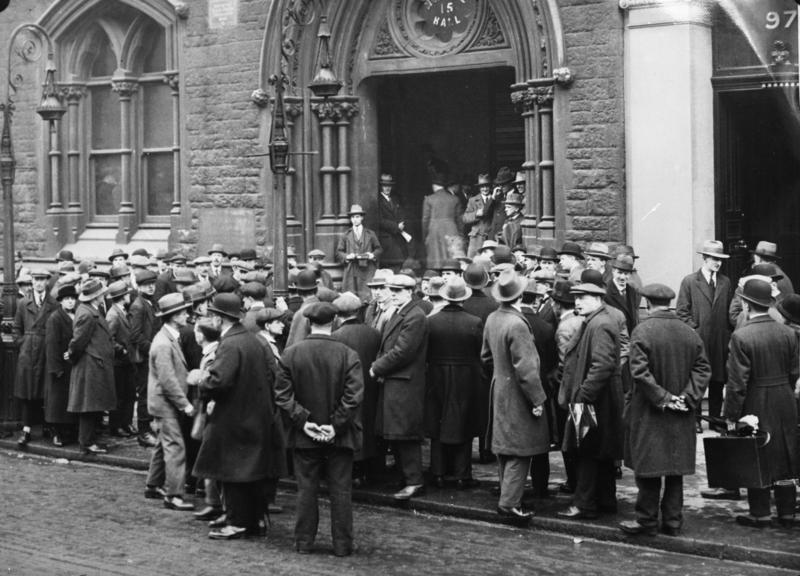
Unemployed outside a workhouse in London in 1930.
Beveridge Report
The NHS emerged in a society with a different history to Ireland’s. The 1942 Beveridge report highlighted that urban poverty was widespread in the U.K., as George Orwell’s account in The Road to Wigan Pier bears testament. One can get all misty-eyed about Beveridge’s recognition of the plight of the working class; the reality was a fear that workers’ poor health would impact on profits, and might turn revolutionary.
Nevertheless, the post-War drive to correct some of these deficits lay behind the birth of the Welfare State, including the establishment of the NHS in 1948. This was strenuously resisted by the medical profession, much as the profession in Ireland, along with the Catholic Church, were resistant to Noel Browne’s Mother and Child Scheme. More latterly the mere mention of ‘Sláintecare’ induces apoplectic rage among certain members of the ‘caring’ profession.
This may seem naïve, but I fail to see what’s wrong with a universal health service, ’free at the point of entry from the cradle to the grave’, paid for out of taxation revenue and borrowings; this is a service that encourages the utilisation of all health-related services in a country, public and private, for all citizens, based not on ability to pay, but need. But apparently this isn’t a good idea.
I have come across many ideas that were thought not to be good ideas in my twenty-seven years of practice, but few had credible reasons for their outright rejections. Chronic disease management, i.e. diabetes, heart failure, COPD or renal failure should be undertaken by a person known to the patient – i.e. a GP – living in close proximity to where they live.
‘Too Busy’
This has been the bread and butter work of GPs in the U.K. since the 1990s, but apparently in Ireland during the 2000s this wasn’t a good idea, because we were ‘too busy’. Doing what I wonder?
Integrated services would allow GPs to order investigations directly. In Ireland at present, if, for example, a chap without health insurance injures his knee playing Sunday football and his GP thinks it could be a torn cartilage, he will have to wait up to two years to see an orthopaedic surgeon. He is then put on a waiting list for perhaps another year, until finally he has his MRI scan and discovers he has a torn cartilage.
By that time, however, he is no longer playing football and is twenty kilos overweight, having spiralled into an unhealthy lifestyle. To add insult to injury he will receive a letter from the hospital asking if he wishes to remain on the waiting list for his knee operation, by which stage he might as well get in the queue for a knee replacement.
Big Pharma
Nowadays, it’s not a good idea to refuse to meet pharmaceutical reps when they call to the practice. Having trained in Bradford – where none of the practices or the training scheme’s educational events gave access to reps – I thought that it was reasonable to turn them away. We didn’t meet reps selling toilet rolls or coffee, so why meet representatives of multibillion dollar pharmaceutical corporations? Such companies spend more on advertising and marketing than research because they know how it works.
Alas, we dopey doctors assume they are sharing their scientific data with us whilst buying us lunch, giving us pens (with names of drugs emblazoned on them), stationary, wall clocks, mugs etc. So, they do share ’their’ science, the bits of their research that shows their product in a good light, not the science or the research warts, or heart attacks, and all.
A cosy world of Irish general practice featuring golf, rugby and tweed had been frozen in time until 2008. The GMS contract which began in 1970s paid well, but we still had our ‘privates’. In other parts of the English-speaking world ‘privates’ usually refers to one’s genitalia, but in an Irish GP setting this refers to the paying customer.
In some practices private patients are given preferential access to appointments. Invariably, this will involve nothing more than prescribing an antibiotic for a cold. Such patients usually have their own cardiologist or several oncologists they refer to using their first names. However, from 2008 onwards when the International Monetary Fund invaded Ireland and took control of the purse strings, the government of the day unilaterally took 35% off the GMS contract payments. Then the privates became more important, but these patients were increasingly hard up too with the world’s economy in a mess.
The next few years for me remain a blur. My recollections arrives through the haze of mental illness and stress brought on by a Celtic Tiger mortgage, business partnership shenanigans, and yo-yoing emigration-immigration, amongst other adventures.
Image (c) Daniele Idini
Pandemic
Fast forward to 2020 and the unknown quantity that was the Sars-CoV2 escape from Wuhan’s virology research centre – known as the Wuhan Wet Market dose to some, depending on your trust in media, governments and power elites.
Then the WHO advised GPs via august bodies such as the Irish College of General Practitioners to do nothing, as there were no treatments despite it being a deadly pandemic. Furthermore, we didn’t even need to see patients. We locked our doors, sat by the phone, ‘stayed safe by staying apart,’ among a litany of other trite statements.
It was heartening to note on some well-known GP websites that some practitioners were one step ahead of WHO/HIQA/NPHET insofar as they immediately sensed a threat to ‘the privates’. Not as an unwanted symptom of a Sars-CoV2 infection, but as a result of the hatches being battened down. How could the privates access their GPs and more importantly pay them?
The unelected and widely disrespected government with its GP-trained Taoiseach knew instinctively what to do. More accurately Leo Varadkar knew what to do. He found the answer to this most perplexing question and saved the day. Make everyone private. GMS patients ringing up resulted in a fee, privates ringing up resulted in a fee from the government.
So the gravy train sloshed its merry way through the pandemic. An entire profession was bought, and continues to be bought by vast sums of money for examining patients that one is already being paid for, vaccinating all and sundry against influenza, Sars-CoV2-twice or is it three times, who knows, who cares, the money spigot is stuck on maximum flow.
Money that was not available up to 2020 is now flowing like goodies from the proverbial cornucopia. This has bought compliance with ways of treating people that run counter to the codes of practice of any good doctor.
Practices are now treating patients like lepers, creating nonsensical plastic barriers, one way passes through surgeries, discouraging unvaccinated patients, disrespecting patient autonomy, and offering a paternalism reminiscent of the Victorian era. But worst of all is a refusal to treat patients in the early stages of Sars-CoV2, regardless of how medically vulnerable they may be because of ignorance and hubris.
This is what buying a profession produces.
Image: Daniele Idini.
Eau de BS
Born and reared in a working class Dublin area with a healthy disrespect for all authority, I have always been a contrarian. That disrespect has served me well. So, when I hear people in authority asking citizens to pull together or to do deeds for the good of the nation I instinctively smell eau de BS.
Supposedly for the good of the nation, we are creating a society that is comfortable with meaningless segregation based on vaccination status that is supported by the medical profession. We even have the prospect of hospitals taking young people off transplant lists and families being refused access to a dying loved one in a care home. Now we are witnessing a clamour for a dubiously effective pharmaceutical product to be inflicted on children as young as five.
The medical profession has allowed one of the highest levels of trust to be stolen by greedy fools who use it to ensure people think that their products can also be trusted. The medical profession has become avaricious, self-serving, vindictive, patient-averse, opinionated and authoritarian, and is failing to foster the doctor-patient relationship.
I fear that relationship which is the bedrock of general practice has been irrevocably damaged. What need then will there be for GPs if artificial intelligence can deliver the information in an up-to-date, rational, non-judgemental and timely fashion in the comfort of anyone’s home?
It seems that when this older generation pass into retirement, a tech savvy generation will not want what they never really had: a genuine doctor-patient relationship.
Featured Image: Aneurin Bevan talking to a patient at Park Hospital, Manchester, the day the NHS came into being in 1948.
Are you satisfied now, ladies and gentlemen, you counsellors and therapists of all stripes, with my do-it-your-self-psychoanalysis?
Despite my disdain for the so-called misery memoir, it is time to declare: my childhood was better than being brought up in an industrial school, or by an alcoholic or physically abusive parent; but, certainly by today’s ideals, only just.
Often, I am surprised that I even survived my upbringing, if not exactly thrived. It is an achievement, in itself, to be alive. Maybe I’m suffering from Post-Traumatic Stress Disorder, after all, and have been for most of my life. Which, in turn, has led to a bad case of Imposter Syndrome. Or better still, Postnatal Depression, which cuts both ways, and is a synonym for Life.
But, as Flannery O’Connor wrote: ‘Anybody who has survived his childhood has enough information about life to last him the rest of his days.’ In the long run, you learn that parents are just people who looked after you when you couldn’t look after yourself, with whom you have very little in common – except what they put there.
‘misery on to man’
So, there you have it: I don’t have kids because I didn’t feel wanted as a child. I am just another classic example of the classical Sophoclean tale of the complexity of Oedipus, and how it wrecks. How neat, but how utterly facile – the kind of typically trite conclusion to which a therapist will always jump.
For the psychological scaring of one’s own upbringing is hardly enough to explain a lack of interest – or rather, an unwillingness to participate in procreation. After all, people with much more unsavoury childhood experiences than I still manage to produce children of their own. That’s part of the recurring cycle of man passing ‘misery on to man’, in Larkin’s phrase, from the one poem of his which everyone can quote from memory.
It is what he means by ‘Still going on, all of it, still going on!’ to quote from another, less anthologised of his works. No doubt the mind-doctors will predictably claim that I am merely in denial here about the effects of my formative childhood experiences on my psyche. But denial is such a difficult concept to prove in practice. Not that I reject outright the idea that there may be some residual influence – how could there not be? My parents may well have given me ‘all the faults they had’ and added some more, just for me. But does that inevitably make me, in the words of a fictional Larkin biographer from another of his more well-known poems, ‘One of those old-type natural fouled-up guys’, the sort who notoriously cautions ‘Don’t have any kids yourself’? Hardly – anyone who knows me will attest to my lively sense of humour.
Ah, but maybe I’m just trying to cover something up with a jokey, rock’n’roll exterior? Ah, but aren’t we all – with whatever masks work best for us? We all ‘prepare a face to meet the faces that you meet’, like poor old Prufrock.
In the end, your relationship with your parents, and your perspective on your childhood, is a bit like your relationship with and perspective on the place where you were born and grew up, or even with your country: some people become expatriates; some people stay close to home; and some people are at peace with whichever arrangement, and some are not.
One can treat that relationship with as much seriousness or triviality as one likes, although for many professional mental healthcare workers, it will always be serious. In any case, this excavational writing project I am engaged upon vouchsafes that I am not in denial: I have acknowledged the debt the past has burdened me with; what you are reading can be construed as my effort to (clears throat) ‘move on’.
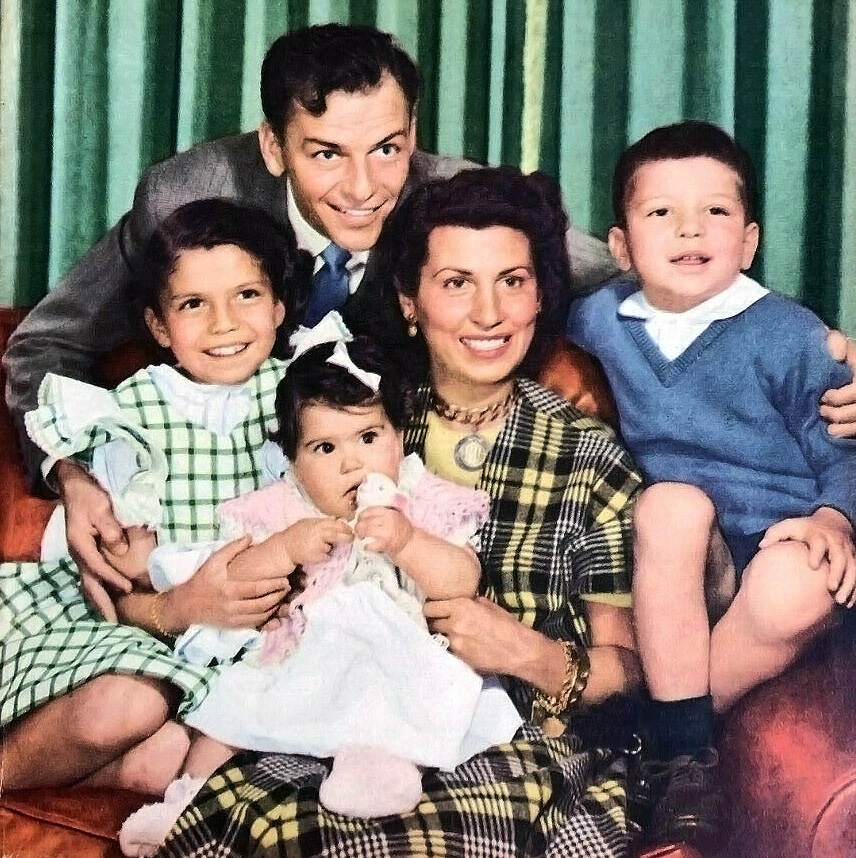
Sinatra Family, 1949.
It’s Parents
(Joke: It’s not the mother and father I blame: it’s the parents.) Except, for me, it’s more a case of
‘It’s not children I don’t like: it’s parents.’ For here’s the thing: for someone who appreciates, if not quite advocates, childlessness, I quite like children. Obviously, one cannot generalise about all children, as individual children can differ from one another almost as much as adults do. But, in general, I prefer the company of most children to that of most adults.
This has something to do with the hope projected on to them: they haven’t quite been beaten down and made bitter by life experience, yet. If there is hope, it lies in the children. But there is no hope, because of the parents. Little people have usually regarded me quizzically, probably because they perceive me to be unlike most other adults in their lives. I can usually speak to them on their own level. I am not an authority figure.
You can learn a lot from children about looking at the world in an original way, if you listen to them, which so few adults do. But I like being able to give them back to their biological parents, when the fun is over. I only want the good parts. (Joke: I like children, but I couldn’t eat a whole one.)
Fortunately, this seems to suit most parents, who are only too glad to have their children taken off their hands for a while. I’m thinking of all those poor little rich kids, from all over the place but especially the progeny of Russian oligarchs, whom I taught (i.e. babysat) on summer courses over the years. All the neglected boys could do was play computer games; all the neglected girls could do was go shopping. Of course, they are the issue of the class of people who view having children as a lifestyle choice rather than as a luxury.
Parents may lavish fortunes on the education of their children, but they actively seek to avoid spending too much time with them. Just as children may look forward to hefty inheritances, but are quite prepared to deposit their parents in residential care homes while they are waiting for their windfall, rather than look after them at home themselves. Family values, eh?
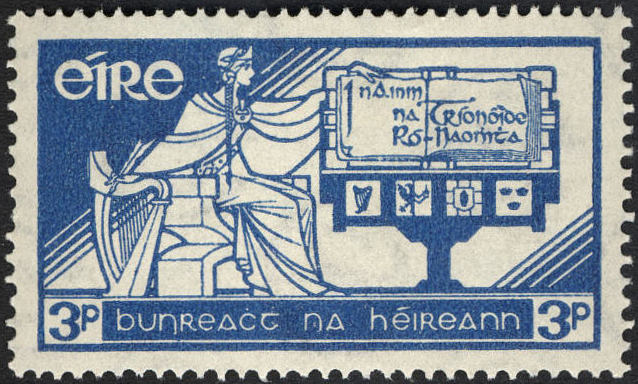
The 1937 Irish Constitution.
The Family
‘It’s not children I don’t like: it’s parents.’ Which means, of course, that what I really don’t like are families, or rather, the fetishisation of ‘The Family’ as an abstract concept, as for example in monotheistic religions, or in Bunreacht na hÉireann, the Constitution of Ireland. (Article 41.1.1. ‘The State recognises the Family as the natural primary and fundamental unit group of Society, and as a moral institution possessing inalienable and imprescriptible rights, antecedent and superior to all positive law.’ Article 41.1.2.
‘The State, therefore, guarantees to protect the Family in its constitution and authority, as the necessary basis of social order and as indispensable to the welfare of the Nation and the State.’ Okay, so. But what about all the citizens who, for whatever reason, have never lived in families, and/or never will live in families – unadopted or unfostered orphans, for a start, or Catholic clergy?) And I reserve a particularly virulent animus against ‘The Good Family’, as in “He/She is from A Good Family” or from “Good Stock” or “Decent People”, ‘good’ and ‘decent’ here invariably meaning church-going, law-abiding, well-connected, prosperous middle-class, and ‘respectable’ – except most of them are not.
Thus, the origin of the phrases ‘The black sheep of the family’, and ‘Disgracing the family name.’ If I had a fiver for every time I’ve been to a job interview – and even in supposedly liberal operations like newspapers or publishing houses – and been asked “Who are your family?’ or “What is your father doing now?”, I’d have a tidy sum squirrelled away. “Where do you stand on the church?” was also an old favourite when trying to land a teaching job, as recently as the late 1980s.
Needless to say, the potential employers were not overly impressed with my answers. If it were not for hereditary privilege, many monsters (themselves the offspring of monsters) throughout history would not have got within even an ass’s roar of power. Just think: wouldn’t the world be a better place without contemporary manifestations of the phenomenon, such as Lochlan Murdoch or Ivanka Trump, having easy access to global media and political influence?
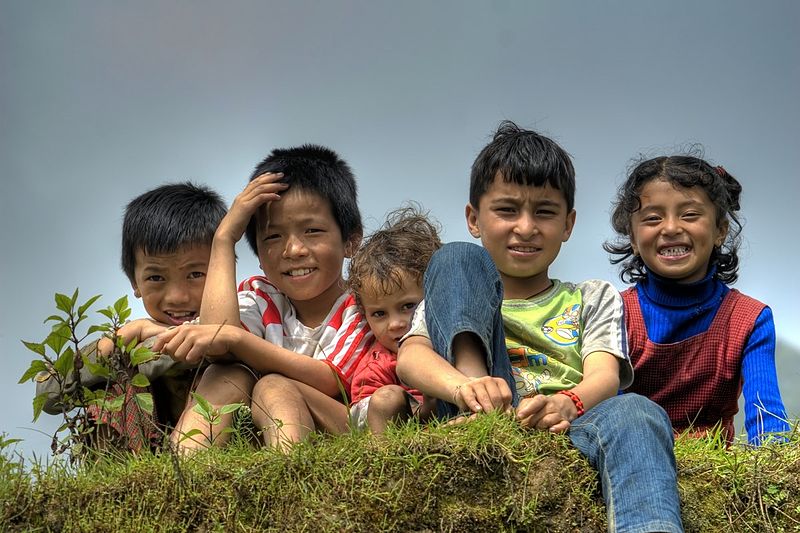
Prashant Shrestha from Kathmandu, Nepal.
The Dialectic of Sex
Before you peremptorily dismiss me as a crackpot, please hear me out, for I am not a lone voice crying in the wilderness in this predilection. In The Dialectic of Sex (1970), second wave feminist Shulamith Firestone criticised the nuclear family as a construct, arguing that it not only limits women’s independence, but inhibits child development too. In her view, children are hindered in their abilities to develop because of their education, predetermined positions in the social hierarchy, and ‘lesser importance’ in comparison to their parents and other adult figures in their lives, who control all these aspects of the children’s lives. She believed that nuclear families, as a form of social organisation, creates inequality within a family, as the children are considered subordinates to their parents.
This, in turn, has increased maternal expectations and obligations, which is something Firestone thought society should outgrow. This dependency on maternal figures makes the child(ren) more susceptible to physical abuse and deprives them of the opportunity to work towards being independent themselves, economically, emotionally and sexually. She sought to solve these problems by eliminating families for the raising of children, and instead to have them raised by a collective.
William S. Burroughs also advocated for the disintegration of the family unit, most vociferously in The Job: Interviews with William S. Burroughs by Daniel Odier (1989), since he believed it to be redundant.
Jean Genet wrote in The Thief’s Journal (1949): ‘In my opinion, the family is probably the first criminal cell, and the most criminal.’ ‘Ah, but those guys were queer’, I hear members of the right-wing Christian fraternity proclaim, ‘so what else would you expect from them?’
Alright, let’s enlist some good, straight, honest Irishmen as well. Poet Dennis O’Driscoll wrote that ‘Every family has passed its own version of the Official Secrets Act’, and doubtless with good reason.
Time and again in his work, Samuel Beckett targets parents as irresponsible criminals, by dint of their bringing more life into this sordid and corrupt world, and thus creating families. ‘You’re on earth, there’s no cure for that,’ says Hamm to Clov in Endgame, and addresses his father Nagg as ‘accursed progenitor’. Indeed, Beckett could easily be construed as a proto-supporter of women’s reproductive rights, as the narrator of First Love is horrified when his lover Lulu/Anna reveals that she is pregnant: ‘Abort! Abort!’ he says, adding, ‘If it’s lepping, I said, it’s not mine.’
Furthermore, for Stephen Dedalus in the ‘Scylla and Charybdis’ episode of James Joyce’s Ulysses (even if it can be configured, as Hugh Kenner chooses to do in Joyce’s Dublin, as callow – in contrast with Leopold Bloom’s mooted fatherly maturity), ‘Paternity is a legal fiction’ (or, as my own father used to put it more plainly: “There’s manys the man rocks another man’s child when he thinks he rocks his own.”).
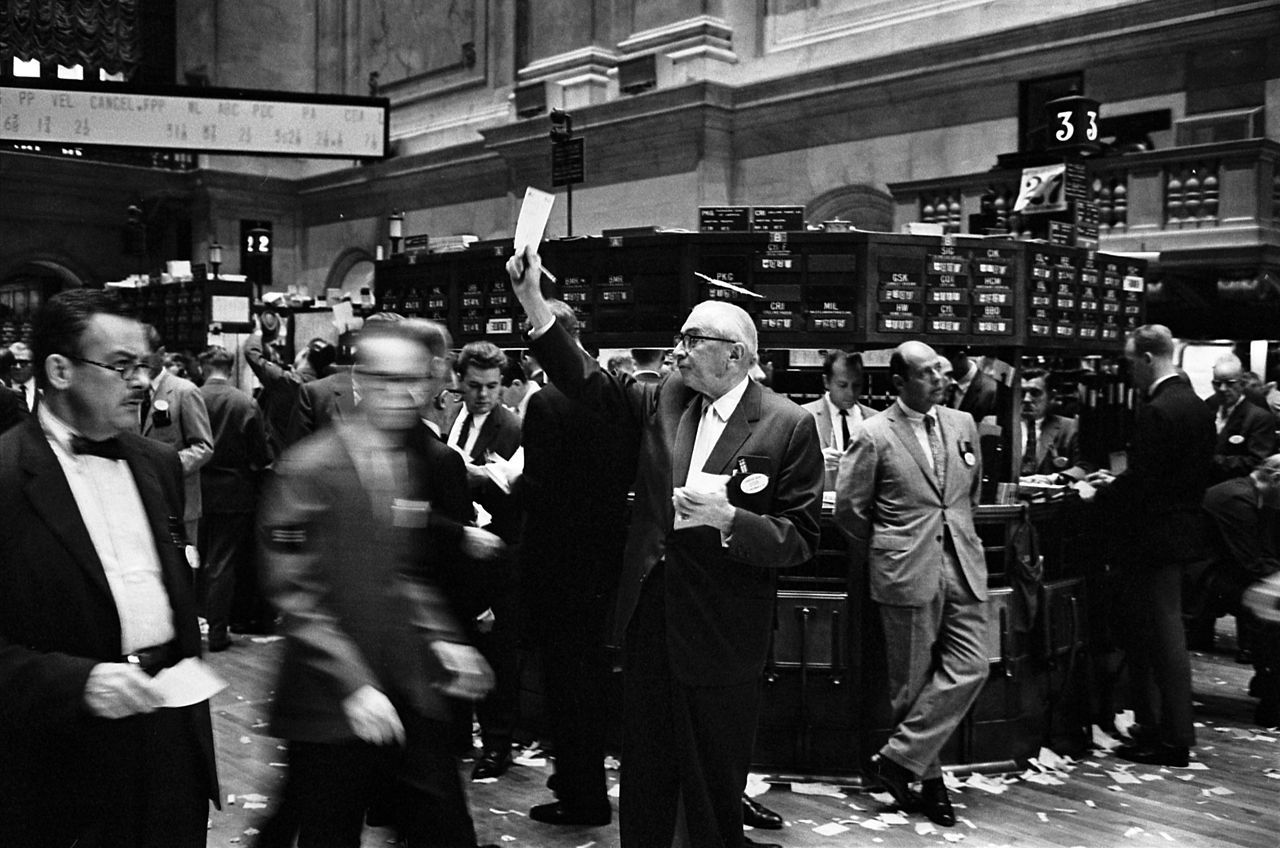
Stockbrokers, New York, 1966 from United States Library of Congress‘s Prints and Photographs division under the digital ID ppmsca.03199.
Wealth Accumulation
It can easily be argued that marriage, monogamy and parenthood exist primarily to foster and protect property and inheritance, and to encourage wealth accumulation. These arrangements sponsor and attempt to justify the greed and acquisitiveness of rampant laissez-faire capitalism, since parents can always claim that they are not acting disreputably out of their own selfish interests, but rather are indulging in seemingly self-serving and nakedly avaricious behaviour merely for the good of their offspring, by endeavouring to give them the best start in life and ultimately securing their future.
Thus the casting of family formation as somehow having a Stake in Life, or in Progress, or in The Future, or some such nebulous notion. But would people really be so competitive economically, to the detriment of others, if their children were raised communally, and all the children of the nation were really cherished equally – i.e. have exactly the same resources available to them?
This alternative method of social organisation would certainly give the lie to the oft-repeated right-wing mantra that free market capitalism is a meritocracy – where the harder you work, the more you are rewarded – because all children would be starting life on precisely the same footing. After all, ‘It takes a village’, as even prominent neo-liberals like to tell us.
Besides which, is the family really such a Haven in a Heartless World, as historian Christopher Lasch had it, in his 1977 tome of that title? Lasch traced over a century’s worth of sociological and psychological theories on the contemporary family, situating his observations in the context of expanding social institutions and their besieging of the family’s power and influence, and taking issue with most of them.
However, while Pope John Paul II may have opined that ‘as the family goes, so goes the nation, and so goes the whole world in which we live’, surely if the family is a microcosmic unit within the macrocosm of society itself, then the overall health of the family should be a good indicator of the overall health of the culture at large. If the world is indeed heartless, then perhaps the first place in need of reformation is, in fact, the family. In this alternative cosmology, friends may well be God’s apology for family since, unlike your family, you get to choose your friends.
There is at least as much evidence to suggest that, far from being a haven, families can just as equally be claustrophobic minefields of unbearable tension and resentment. From the patricides, matricides and fratricides of Greek tragedy, to a headline ripped at random from yesterday’s newspaper: ‘Domestic violence by adult children against parents rises as stress peaks under lockdown’, this assertion is incontestable. A recent statement from the Garda Commissioner informed us that domestic violence claims more lives in Ireland every year than gangland crime.
Of course, you can counter-argue that these kinds of pressures on family life are direct consequences of consumer capitalism (adult kids can’t afford to rent, much less buy, which is why they are living at home), but the fact remains that the concept of the happy and supportive family is an aspirational mirage, with little tangible substance: some parents may get on with each other, but many don’t; some parents may get on with their children, but many don’t; some siblings may get on with each other, but many don’t; some children may get on with their parents, but many don’t; some families may work, but many don’t; some may work at different times, but not at others.
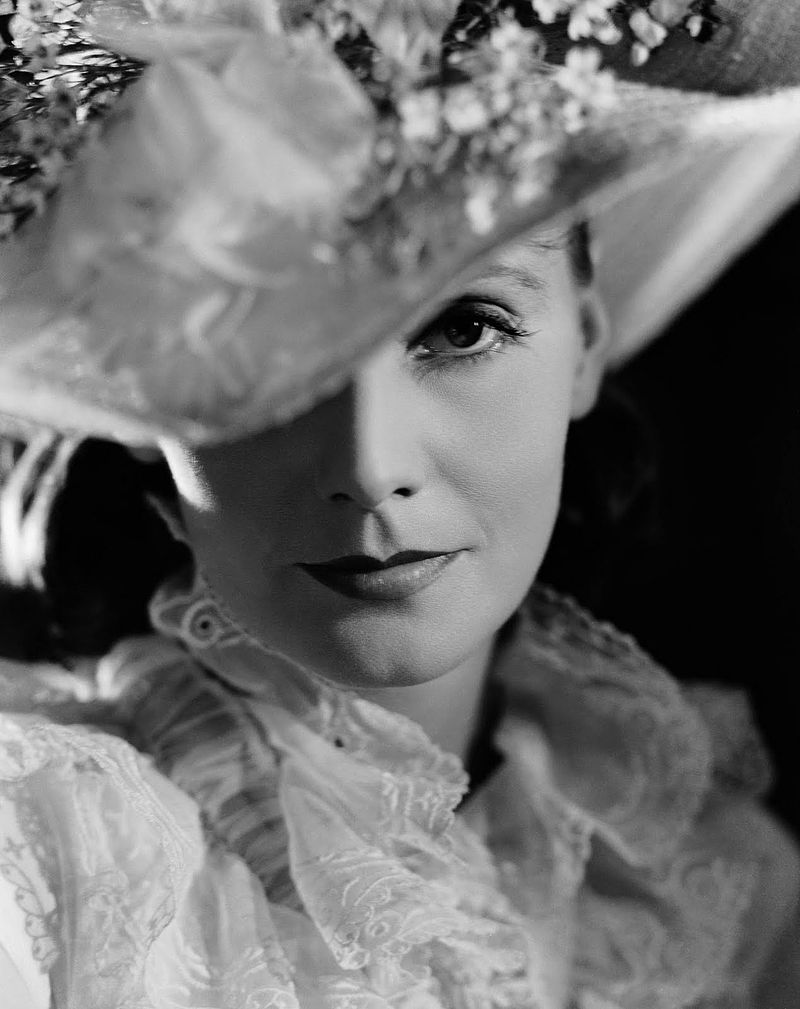
Greta Garbo as Anna Karenina.
All Families are Alike
Here we can invoke Tolstoy’s famous opening line of Anna Karenina: ‘All happy families are alike; each unhappy family is unhappy in its own way.’ But are all happy families really alike? Perhaps their happiness is just as idiosyncratic as the unhappiness of the unhappy. In addition to which, I can’t help but ascribe a degree of conscious irony to Tolstoy’s declaration. After all, we do not encounter any ideally happy families in Anna Karenina. Perhaps he knew, as well as anyone, that the Happy Family is a myth, an ideal to which we may aspire, while having no palpable earthly iteration. But whenever Family Values types start pushing The Family ‘as the natural primary and fundamental unit group of Society’ at me (unfortunate enough as that phrase is in its easy slide into Margaret Thatcher’s infamous claim that ‘…there’s no such thing as society.
There are individual men and women and there are families’), I usually refer them to the Christmas dinner scene in Joyce’s A Portrait Of The Artist As A Young Man, which is, if nothing else, a needful corrective to the sentimental ghosts of Dickens, and bolsters Wilde’s epigram to the effect that ‘Sentimentality is merely the bank holiday [e.g. Dickens’ Christmas] of cynicism’. For, despite the episode’s grounding in personal autobiography and the particular politico-religious strife among nationalists in Ireland at the time, the reason for this Yuletide row’s universal appeal is that Joyce wasn’t just writing about his own family: rather, he was writing about everyone’s family, in every time and place.
There is always something to argue about, and it hurts more to argue with relatives who espouse views diametrically opposed to your own than it does with anyone else. Or will you just sit there and bite your tongue for the rest of your life?
At any rate, however positive or negative your view of family life, I have no particular desire to be part of the hurdy-gurdy of what a friend calls, speaking of his own familial ups and downs, ‘the great human dance’. Or, at least, his version of family dancing and enforced role-playing. I am more partial to jitterbugging than waltzing, to doing the watusi than executing a quadrille.
Image: Richard Tilbrook (wikicommons)
Irish Social History
These considerations take on a particularly lurid hue in the light of 20th century Irish social history, especially when juxtaposed with the aspirational ‘official version’ rhetoric which is still regularly trotted out around the Irish family (see Articles Article 41.1.1. and Article 41.1.2. of Bunreacht na hÉireann, above).
The record of incarceration and institutionalisation of Irish citizens in Mother and Baby Homes, Magdalen Laundries, Industrial Schools and Psychiatric Hospitals is grim, and involved the blatant rejection of children and grandchildren by their parents, siblings and extended families, in the name of a church-and-state-sponsored ‘respectability’ based on the notion of ‘legitimacy’. These wounds are still raw in many peoples’ memories. As a younger acquaintance recently put it to me: “I was born in 1993 to a single mother who raised me. The last Mother and Baby Home in Ireland closed in 1998. It could have been us.”
Therefore, I salute the scholarly tenacity of both Clair Wills, in her article Architectures of Containment(London Review of Books, Vol. 43 No. 10 · 20 May 2021), and Catriona Crowe, in her piece The Commission and the Survivors (Dublin Review, #83, Summer 2021), for their persistence in wading through 2865 pages of what is essentially obfuscating, buck-passing apologetics contained within the Final Report of the Commission of Investigation into the Mother and Baby Homes (Government of Ireland, October 2020), and their deep excavation and dismantling of it.
Wills refers to the ‘inalienable family logic’ of the system, and speculates that: ‘Arguably the rhetoric of the Irish family was a smokescreen for the absence of the family as a private sphere of emotional and affective ties’, declaring that ‘the Irish church and state, with the passive acceptance and sometimes active collusion of Irish families, was willing to sacrifice its own children – of whatever age – for what it considered to be survival.’ Crowe comments: ‘One has no right to expect dazzling prose in such a document, but it is striking how badly written, argued and organised the commission’s report is. The tone is at times hectoring, at times defensive, at times cryptic – and sometimes all three…’ The cover-up continues…
While some may read more recent progress in Irish social legislation – such as the legalisation of same-sex marriage and the repeal of the eighth amendment – as forms of ‘respectability politics’, they at least demonstrably signal significant shifts in attitudes as to what constitutes concepts of the Irish Family, moving on from a theocratic patriarchy to a broader and looser inclusivity.
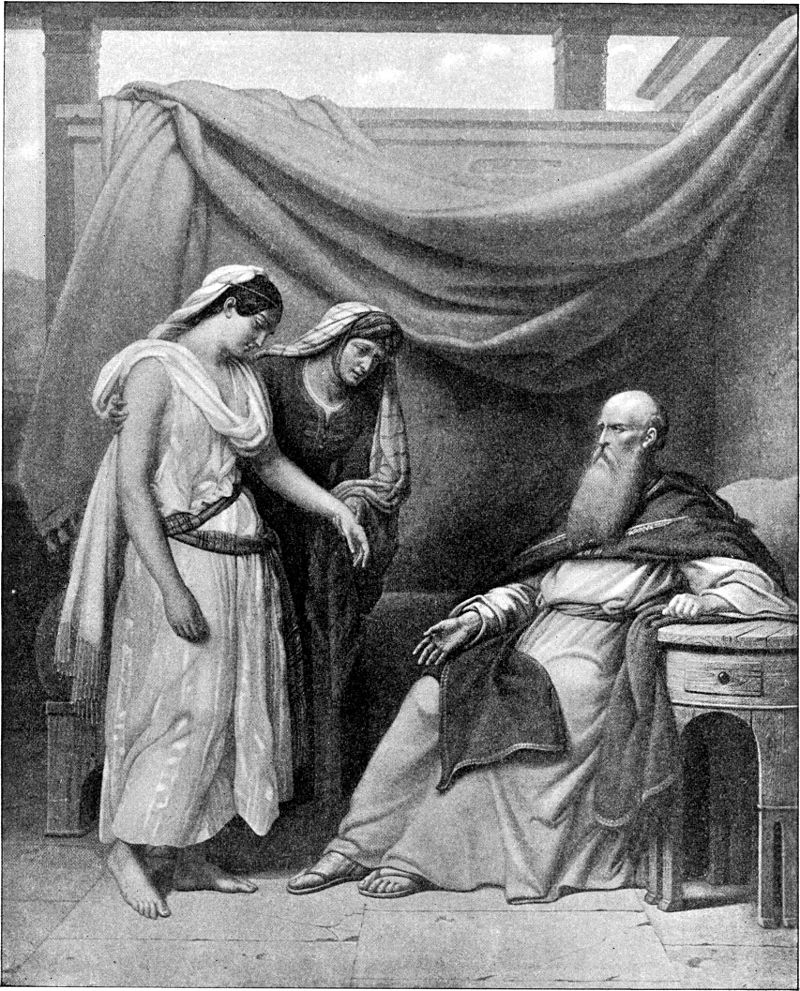
Abraham, Sarah and Hagar, imagined here in a Bible illustration from 1897.
Patriarchy
‘Which means, of course, that what I really don’t like are families…’. Which means, of course, that what I really don’t like is patriarchy. Men can be victims of patriarchy, just as much as women. (Although, even if they aren’t, they should still dislike it, out of solidarity with their womenfolk.) I myself have suffered my whole life at the hands of all manner of male authority figures (e.g. priests and Christian Brothers to whom my parents deferred, and so who consequently had inordinate control over my formative years; teachers too interested in favouring students with more upwardly-mobile parents than mine to pay attention to me; doctors and surgeons who would not admit mistakes when they treated me, when it was obvious mistakes had been made; potential employers who found my performances at interviews too idiosyncratic to countenance employing me, despite abundant relevant qualifications and experience).
Bumptious, self-important fools. I could never imagine myself in the role of a patriarch, or even a more benign paterfamilias. Hence, perhaps, another reason why I don’t have children. Not that I hold much brief for matriarchy either – which, curiously, has markedly strong manifestations in Ireland: just look at the ubiquity of mariolatry imagery.
I myself have suffered my whole life at the hands of all manner of female authority figures (e.g. women in many of the same roles as the men already listed – proving, paradoxically, that equality isn’t always an unalloyed ‘good thing’). Brash, conceited harridans. I could never imagine putting someone in the role of a matriarch, or even a more benign materfamilias.
Hence, perhaps, another reason why I didn’t want to give a woman a child. So maybe it’s not so much patriarchy (etymology: ‘from patriarkhēs “male chief or head of a family” ’) or matriarchy (etymology: ‘government by a mother or mothers; form of social organization in which the mother is the head of the family and the descendants are reckoned through the maternal side”, formed in English 1881 from matriarch + -y and “patterned after patriarchy”) that I dislike, as ‘archy’ itself (etymology: ‘word-forming element meaning “rule”, from Latin -archia, from Greek -arkhia “rule”, from arkhos “leader, chief, ruler”, from arkhē “beginning, origin, first place”, verbal noun of arkhein “to be the first”, hence “to begin” and “to rule”.’)
As a good ex-punk (is there really any such thing as an ‘ex’ punk? – no, of course not, old punks never die, they just sign to CBS, and/or get into country music), perhaps the only -archy I like is an- (from Greek, ‘without’) -archy. All rules are arbitrary. They are mutually agreed conventions, employed for as long as those with power consider them useful, until they are convinced otherwise, or in advance of them losing power. As with the power of parents to rule the lives of their children.
Meet the Parents
It is plain to see that parents get a bad press, in both popular culture and theoretical discourse. From ‘Mom jeans’ to ‘Dad rock’, from Meet The Parents (and The Fockers) to The Happiest Season, parents are presented as embarrassingly and quintessentially naff. Parental units are decidedly unerotic, and are easy targets for comedic caricature. Sometimes they bring it on themselves: consider Parental Advisory Explicit Content stickers on album covers.
No offspring wants to sit watching grown-up films or television series with their ‘Old Pair’, or even share their musical tastes and latest tunes with them. Picture Sherilyn Fenn’s iconic small screen epiphany as Audrey Horne in the first season of David Lynch’s seminal series Twin Peaks (1990), where during a job interview at One Eyed Jacks she knots a cherry stem with her talented tongue, and the large cringe factor of your Old Dear piping up from her rocking chair, perplexedly, “What does it mean?” (Mind you, it wasn’t just the Mother; the Sister dissed the show after seeing Audrey swaying around the Double R Diner to Angelo Badalamenti’s theme music “Like she was on drugs”.)
Hands up if you can remember being told to “Turn that racket down” while losing yourself in the latest punk masterpiece (e.g. The Clash’s eponymous debut album). I even have a more precise memory of ma mère’s shocked chagrin on overhearing the line ‘By the devil’s holy water and the rosary beads’ in The Radiators’ classic ‘Song of the Faithful Departed’, from Ghosttown (1979) – a song “mocking God”. ‘Who were your parents?’ and ‘What was your childhood like?” are the first questions any self-respecting and well-trained psychotherapist is going to ask you in a consultation (€50+ an hour, and they’re fifty-minute hours too), and we all know where the blame for your troubles and woes, your utter fucked-upness, is going to lie.
Personally, I struggle to listen to any opinion being expressed when it is prefaced by the age-old, ingratiating formula “Speaking as a parent…”. Is there any more grating conversation-stopper, guaranteed to shut down any debate, than “You’d understand if you had kids”? “I have kids to support” is used as an excuse by parents for every unenviable life choice they make, from staying in an insalubrious work situation (“My boss is such a bully”) to, worse, staying in a bad marriage (“Not in front of the children”). For the majority of parents, their children represent hostages to fortune.
Bonkers Parenting
Literature furnishes plentiful examples of misguidedly inadequate or blatantly bonkers parenting. Passing over the treatment of daughters by their parents – usually their mothers – in the fictions of Jane Austen, I could also cite Mrs. Kearney in James Joyce’s short story ‘A Mother’, who mortifies her daughter Kathleen, an aspiring pianist, by sweeping her out of a concert hall and irritating the promoters and other artists, with her impatience to get paid immediately for Kathleen’s contribution to a recital series, thus ruining her career in Dublin musical circles.
But I’m thinking specifically and more contemporaneously of Donald Barthelme’s very short short story, ‘The Baby’, a succinct satire on the arbitrariness of parental discipline and punishment.
My wife said that maybe we were being too rigid and that the baby was losing weight. But I pointed out to her that the baby had a long life to live and had to live in a world with others, had to live in a world where there were many, many rules, and if you couldn’t learn to play by the rules you were going to be left out in the cold with no character, shunned and ostracized by everyone,
reasons the father of a fifteen-month-old baby girl, sentenced to spend four hours alone in her room for every page she tears out of books. ‘We had more or less of an ethical crisis on our hands.’
To be fair, fiction is also replete, from a parent’s perspective, with skewering specimens of outrageously uncontrollable children. I’m thinking here of the monstrous Marmaduke, the ten-month-old toddler from Martin Amis’ London Fields (1989), an infant his parents agonised over bringing into the world, given its less than perfect state, who then turns out to terrorise their lives like a violent dictator. But perhaps the most equanimous artistic depiction of parents’ burdensome redundancy to their busy children is Yasujirō Ozu’s unbearably moving Tokyo Story (1953), a masterpiece of such universal resonance that it regularly tops polls as one of the greatest films ever made. Do you seriously believe your parental journey will be significantly different from any of the examples highlighted above?
Some people get to resolve their differences with their parents, usually as they move into middle age and take on the trials and tribulations of parenthood themselves. This will not happen for me. My father died when I was thirty-three; my mother died when I was forty-one. They were both six foot under, and I had failed to produce an heir, to add to their already numerous grandchildren and great-grandchildren. They are united now at last in death, for ever, as they never were in life, decaying together in Deansgrange Cemetery, in the wet, mulchy earth, underground.
More than Enough
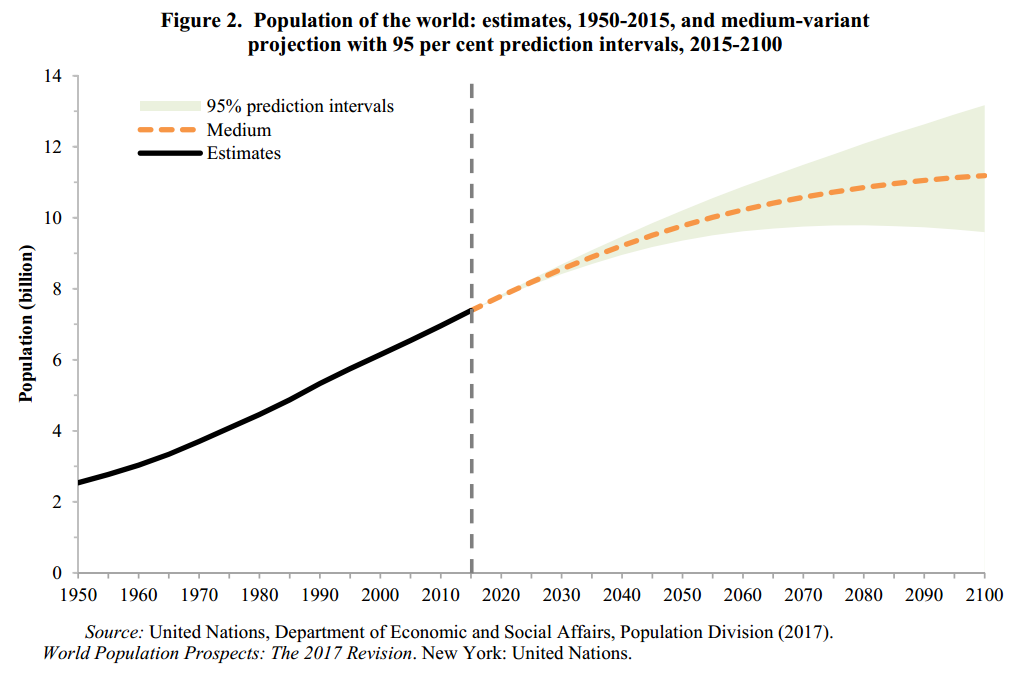
To look at the broader picture, and to echo some anti-natalist arguments: there are more than enough people in the world. (Roughly 8 billion, give or take a few hundred thousand, and rising by – at a conservative estimate – at least 1 per cent annually: that’s 80 million a year, in plain language. Visitwww.worldometers.info for impressive minute by minute stats. There is way more than one born every minute.)
What kind of bloated egotism does it take to believe that your priceless strands of DNA are going to make any difference whatsoever to anyone other than yourself and/or your partner, much less make that world a better place? Particularly when the species isn’t exactly in imminent danger of completely dying out anytime soon.
In fact, on the contrary, more people are more likely to hasten the demise of humanity’s living space, Planet Earth, through the devastation that overpopulation brings. To those who would admonish me to the effect that my child freedom is merely an unwillingness to shoulder adult responsibility, I say: in all likelihood I am more responsible than you, by not having any children. To say nothing of the fact that there are huge swathes of people who, for a variety of reasons, have great difficulty or ultimately find it impossible to reproduce.
Both LGBTQ+ couples and heterosexual couples with fertility issues are required to take circuitous and sometimes difficult routes into parenthood, either through assisted reproductive technologies like IVF and donor insemination, (which detractors would call ‘unnatural’, and which is why, of course, they are considered such an abomination by the Godly ‘pro-lifers’), or via other complicated arrangements such as surrogacy, co-parenting, adoption or fostering.
Then there is the childcare issue. Despite the good intentions of the aforementioned Constitution (Article 41.2.1. ‘In particular, the State recognises that by her life within the home, woman gives to the State a support without which the common good cannot be achieved.’ – itself the subject of much controversy and contentiously archaic because of its gender specificity), Irish society has organised itself over the years into the current shambles whereby, under the influence of Anglo-American neo-liberalism rather than European social democracy, both members of a couple are required to work to maintain a roof over their and their potential or actual offsprings’ heads, which in turn means they are required to stump up exorbitant fees for private creches to look after said offspring while they are out slaving to provide food and shelter for them. (So much for Article 42.1.2. of The Constitution: ‘The State shall, therefore, endeavour to ensure that mothers shall not be obliged by economic necessity to engage in labour to the neglect of their duties in the home.’)
Does that seem like a fair deal? So, essentially, unless you have other family members (usually grandparents) or friends willing to take them off your hands for the best part of the day, or you move to a mainland European country with proper public services, you are snookered.
The professional classes, i.e. those in the best position to exploit and therefore gain most from the present system, solve this conundrum by availing themselves of au pairs, or by hiring and underpaying Filipino nannies. Here, as with so much else, they ‘go private’ – doubtlessly believing that this is the natural order of things. Here, as elsewhere, my hardwired class antagonism – which some will doubtlessly dismiss as merely ‘a chip on his shoulder’ – burns brightly.
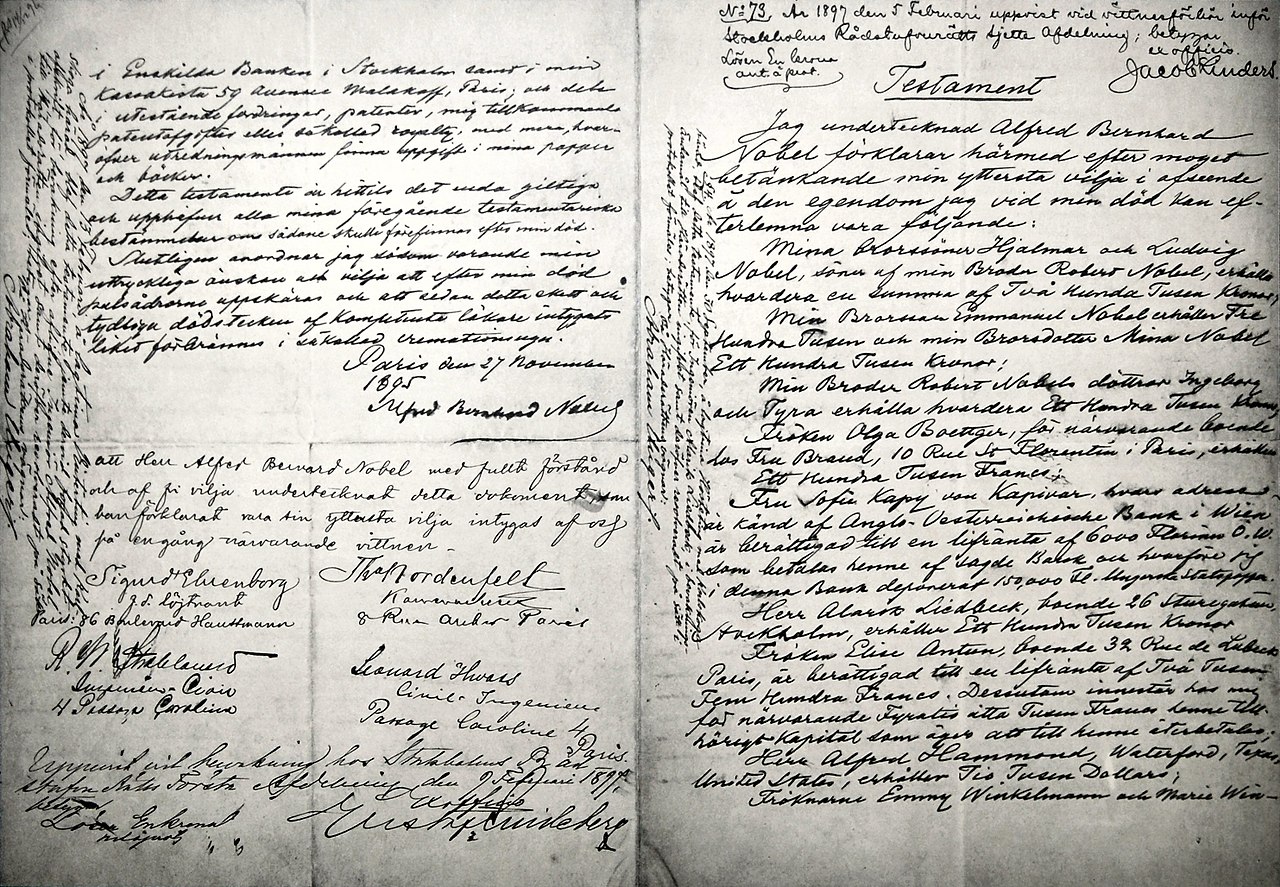
Alfred Nobel’s will.
Legacy Issue
Then there is the legacy issue. If you happen to have done well for yourself, whom do you leave your fortune to? In that case, having some blood heirs might be a good idea – although as previously mentioned, perhaps you have only done well for yourself because you had heirs in the first place. And what of those, the majority, on average incomes, or the poor, who have amassed little or no capital to pass on to their sons and daughters – many of whom, in any case, may be just waiting around for parents to pass on so that they can get their greedy paws on what loot there is? Many people still have children as a form of long-term investment, because they think their offspring will contribute to the household budget – although these days parents are more likely to get stuck for stumping up deposits for their first time buyer children’s houses (in Ireland, we actually have an ex-Taoiseach (Prime Minister) and current Tánaiste (Deputy Prime Minister), who recommended in the Dáil (Parliament) that young people go to “The Bank of Mum and Dad” as just such a method of securing a mortgage); or because they think their flesh and blood will be a comfort to them in their old age, or at least look after them in their declining years and decrepitude – when in reality they are more likely to be packed off to a care home, so that the ungrateful fruit of their loins can get on with their own mid-life lives.
In fairness, given the lack of state services for elder care as well as child care (described above) under the present dispensation, and the inter-generational disparity in access to property ownership, the overworked adult children and parents often have no other choice but to outsource caring roles for family members younger and older than themselves, which were traditionally performed by family members.
Thus, privatisation begets more privatisation, and neo-liberal capitalism actually works to the detriment of The Family, or, more accurately, non-affluent families, which it ostensibly trumpets upholding.
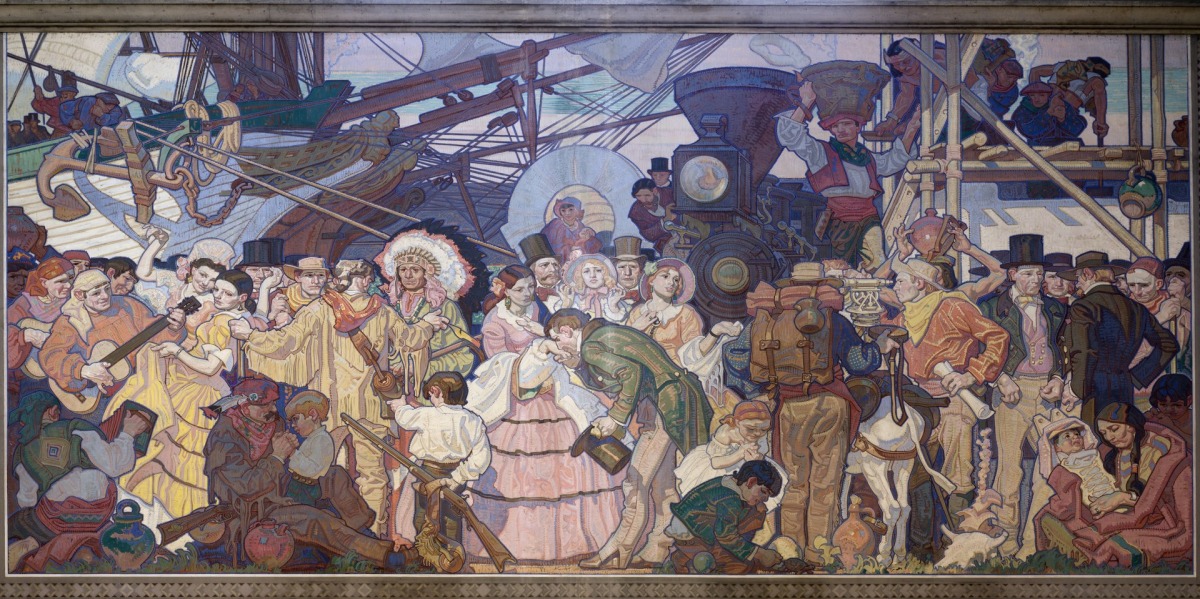
Americanization of California (1932) by Dean Cornwell
Enlightened Self-Interest
In any case, the inheritance question is not one that applies much to me personally, either as recipient or as donor, because amassing a nest egg to make life easier for his litter was not high on my father’s or mother’s list of concerns.
“There are no pockets in the last suit,” quoth he, perhaps hoping to imbue me with the same fatalistic attitude. I dare say he succeeded. He clearly had no ambitions towards founding a dynasty, at least not one based on the accumulation of financial wealth and economic power. His plans for his bloodline probably extended no further than ‘put them on the right road’ and ‘let them find their own way’, with the Catholic religion, the ‘one true church’, as their guide.
Naturally, if I were the progeny of a wealthier or landed lineage, perhaps my analysis of inherited wealth would be entirely other. With notable exceptions, altruistic or aspirational, most people tend to espouse the socio-political philosophies and policies which are best tailored to the fullness or emptiness of their own pockets, rather than worrying about an ill-defined ‘greater good’. ‘Enlightened self-interest’, I believe it’s called.
Who knows, what a great Fine Gael/Tory/Republican Party fascistic scumbag I would have made, and what horrors I could have perpetrated, if only I had had a family fortune to protect and grow.
Given these considerations, probably the only truly selfless and ethical way of having children and creating a family is by adoption. At least you are caring for already born orphaned or abandoned kids, whose own parents could not or would not look after them. Failing that, get a dog or a cat.
In the blink of an eye everything can change in the way we live our lives. How do we manage to live, socialise and maintain public health?
A recent article by Jennifer O’Connell ‘We are world experts at anomalies and blind eyes’ led me to recall how turning a blind eye brought incarceration of pregnant women in laundries and to others living out their lives in psychiatric institutions. But also, that the default creative solution taken by those who do not have the luxury of access, or the means, to survive and thrive within rules laid down by those who do, is to selectively blinker themselves to such rules. And how turning a blind eye to such anomalies is a usually unacknowledged aspect of the way a tate functions.
A Belgian psychiatrist, speaking from the floor at one of the meetings called to form the European Association for Psychotherapy, proposed ‘an ability to deal with ambiguity’ as a definition for mental health.
Jagged Lines
In a time of extreme change, such as that witnessed during the pandemic, and which climate change may well produce, we may have to live with increasing contradictions.
I remember attending a talk given by the late Virginia Satir in Dundrum in Dublin. Satir was one of the earliest family therapists in the United States, focussed on bringing about system change through communication.
She drew a jagged trajectory from one straight line to another. The jagged part indicated the chaos experienced as a system, or family, moves from stasis through change.
As I was pregnant with my first child at the time, it was helpful to recall the jagged line as I struggled to change nappies, deal with nappy rash after soaking the cloth ones in buckets and washing them (we aspired to mind the planet in the 1980s too), before surrendering to the absorbent benefits of paper while, getting by on less sleep than I’d ever managed.
“The first weeks of parenthood are chaotic,” a thoughtful friend rang me to say. ”It will be a lot better in six weeks’ time.”
The jagged line has been a handy reminder in later periods of change and adjustment too, not least during lockdowns and when getting used to wearing a mask.
Catch 22
Pain-inducing contradictions can arise. This may lead either to a psychological pathology or, by way of rising above it, creative solutions.
A subject explored in essays by Gregory Bateson in Steps to an Ecology of Mind (Paladin, 1973) in which he critiques previous work from his Palo Alto team proposing the Double Bind theory.
The double bind is a situation requiring the subject – in a relationship which cannot be escaped from – to choose between alternatives in which they will be wrong-footed either way. In other words, they experience themselves living in a continuing Catch 22.
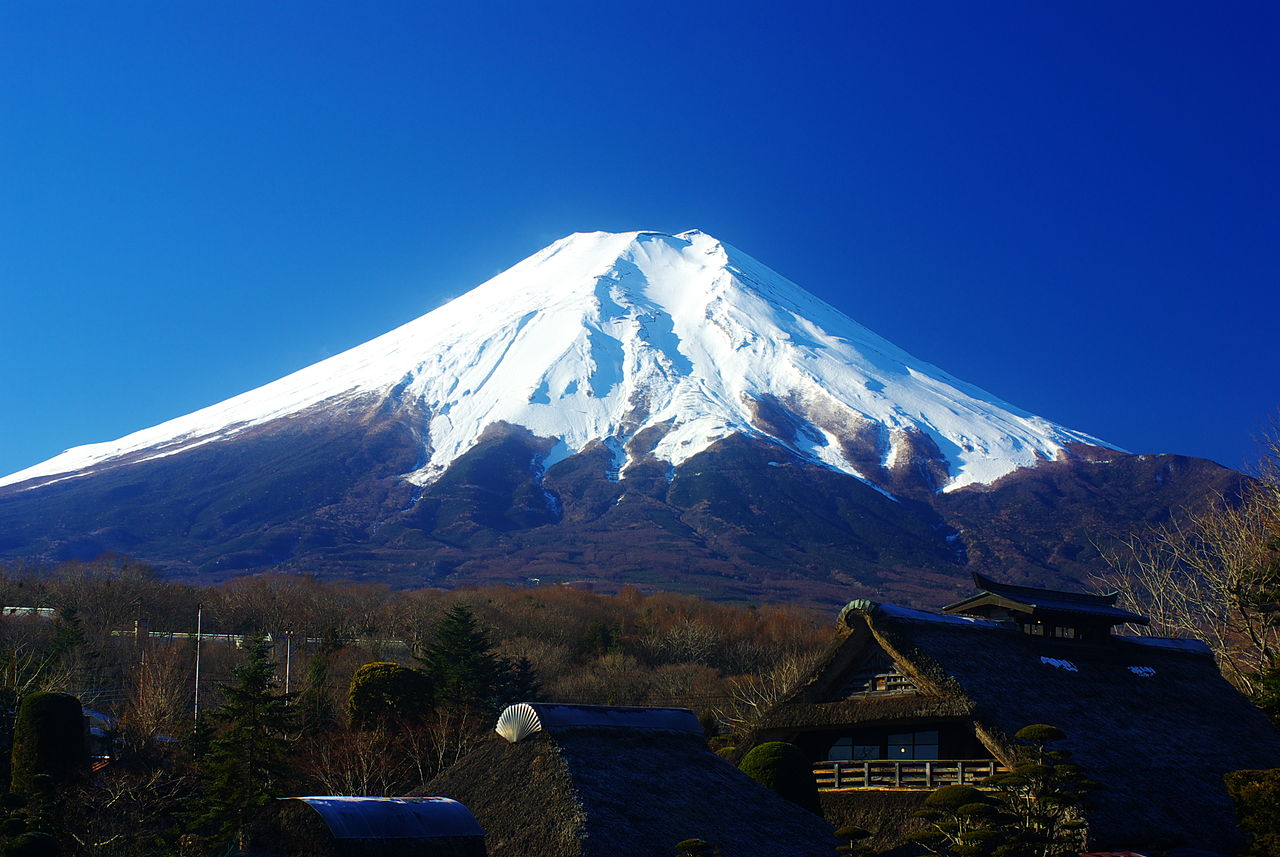
Mount Fuji
‘Benefits of Inconvenience’
A recent interview on the Design Talks Plus programme from NNK Japan television offers encouragement. In what may be a turning from the belief that technical progress is always to our advantage, Professor Kawakami Hiroshi of Kyoto University of Advanced Science has spent a decade researching what he calls ‘the benefits of inconvenience’. He argues for less convenience and that the effort required to make sense of the world, while facing challenges, may contribute to a better sense of meaningfulness and wellbeing.
Hiroshi cites a return to the use of rough earth in children’s playgrounds (balance challenging) and finding the way on foot around a city without satnav – ensuring the need to pay attention to surroundings – as examples. To emphasise his point he began by asking: ‘If you were climbing Mt. Fuji would you want an escalator’?
The inconvenience in rising to the challenge of struggling with contradictions in rules for living with Covid 19 (and our recent further re-opening of opportunities to socialise) could be seen as an opportunity.
Maybe the rewards will offset the difficulties. Providing, that is, those struggling are not punished for choices that, either way, will put them in the wrong.
If restrictions spawn imaginative solutions, in line with the spirit of preventing the spread of variants of Covid-19, crucially, formulated in ways appropriate to particular local situations, then the sense of satisfaction might end up enhancing a sense of well-being
Unlikely? Maybe. But maybe not. These regularly madden me but, and as Jennifer O’Connell indicated in her article, they are the kind of ‘Irish solutions’ we might be said to excel at.
Mark Zuckerberg at the Congressional Hearing
Where to Look
I was relieved – hope restored – hearing Roger McNamee, one of Mark Zuckerberg’s early mentors and author of Zucked (UK Harper Collins,2019), on the RTE radio morning news bulletin on October 29th 2021 saying that the Facebooker owner’s launch of Meta, his new holding company, is his way of distracting the world from Frances Haugen’s account. The Facebook whistleblower revealed to the U.S. Congress and a UK Select Committee in the last couple of weeks the ways Zuckerman prioritizes profits over safety. McNamee thought it was also aimed at saving Zuckerman from being held to account.
I forced myself to complete it several days after I had put it to one side. I wanted to be able to respond to it, but also to offer him at least the courtesy of considering what he had to say, especially given he has had to listen to that he clearly has found difficult in the national conversation.
I had no argument with the generally accepted facts outlined. However, his omission of the crucial fact that the Irish health system has been more inclined towards collapse than the other European countries he mentions bothered me. That, alongside his use of adjectives, indicated a bias I saw as otherwise unacknowledged. Although mention of his Brazilian wife did offer clues.
Photo by Daniele Idini.
Catastrophising
What most annoyed me was that Dan O’Brien wrote of Irish ‘catastrophising’ conversations. Longer lockdowns here contrasted with the reactions of Italy or Brazil. His hypothesis is that this might be due to their twentieth century experiences of living with war.
How ought we best manage the fears evoked by a threat? Our bodies are wired for fight or flight. The extreme version of flight is denial, ignoring of facts that we cannot face.
It can allow us to hide from reality or feel unrealistically invincible in our fighting. Maybe that’s what is needed in wars. In contradiction to O’Brien’s argument, the truth generally is that the more traumatised we are the more likely we may be to use these defences.
Of course, we need psychological defences that enable us continue to cope during difficult times. Talking about our difficulties and continuing to take the difficult decisions, to find the least bad solutions that we can manage to act on, is usually considered the healthiest way of managing.
We need to put on blinkers at times and to remain focused on the direction required. But blinding ourselves entirely to the traffic – the many difficulties and demands of the times we live in – can only lead to more of the same.
In Addition
We are drawn to solutions that best serve our own interests. Financial Times journalist, Tim Harmon’s book How to Make the World Add Up (2021) reveals research showing that we are more likely to make decisions based on the attitudes of the groups with which we identify than with scientifically proven facts, and that this has also been shown to be true of scientists themselves.
We want to remain part of our group or tribe. This is research worth taking into account with regard to vaccine take up and hesitancy. Maybe it is important to acknowledge that Dan O’Brien is interested in economics and business and that my background, which also began with a social science perspective, has been a thirty-year career in psychotherapy before I turned to writing. We may have different loyalties affecting our perspectives.
A quick re-read of what Tim Harford had to say about our use of statistics led me to his first rule for evaluating their use: ‘What are you feeling?’
He goes on to suggest that looking at how those feelings might be influencing your use of figures can be the best way to ensure accuracy, and the avoidance of spreading ‘false news’.
I asked myself about the anger fuelling the fingers on my keyboard. I realised it was driven by fear. My own catastrophising of how O’Brien’s article might undermine the national effort. My fear that Covid numbers are rising. I don’t want another lockdown.
However accurate or questionable O’Brien’s hypothesis, he has given me a timely reminder about rushing to the page. Writing can be a way of working things out. Emotion may fuel effort, but it had better be interrogated to discover what it is really saying if the greater truth is to be served.
The need to keep financially afloat and the need to save as many lives as possible can be at odds, nor are they unrelated. Funds are necessary.
Basic services, food and shelter are as essential and contribute as much to public health as other considerations, and have to be paid for. The challenge is to engage with, and work to rise above, fear and strive to find the least damaging solutions. We are left to wonder how we decide what is best amidst the confusion during times of change.
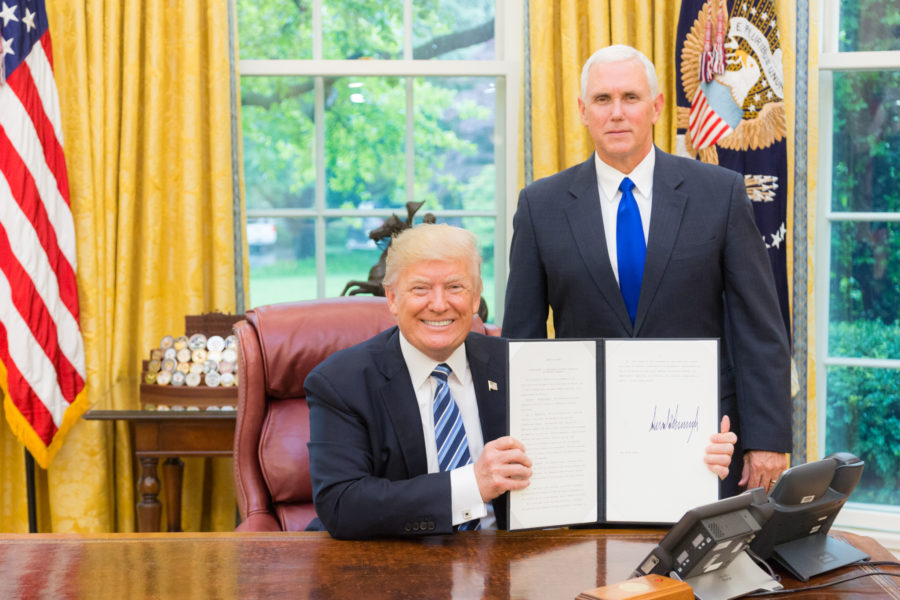
Donald Trump and Mike Pence.
Politics of Distraction
What do Trump, Zuckerman and Johnson have in common? They are masters, albeit not alone, in offering distraction, a form of click-bait news that feeds a greed for sensation that briefly satisfy but cannot ultimately sate humanity.
The distraction makes us look away from what is really at hand and makes us focus instead on what we prefer.
‘Get Brexit done’ for Johnson. In Trump’s case, spreading so much false news that there is no longer any focus on the truth, or otherwise, in his own assertions. Listeners are led to believe all news is untrustworthy and that he alone should be listened to and receive votes.
And, then there is the promise of a future, technologically ‘advanced’ virtual world – with new toys – in the case of Mark Zuckerman. This is leads to a temptation to avoid looking too closely at the degree of control he has, and the damage that control has done.
Commentators other than Roger McNamee acknowledge that Zuckerman’s plans for his venture were long in the making, and point to the direction he would like to go in future while trying to re-engage a younger demographic, but the timing of the announcement means that Roges McNamee is making sense.
Eye on the Ball
There will be many anomalies, distractions and frightening challenges to confront as we endeavour to live with the pandemic, while keeping our eyes open to the threat of the Earth becoming uninhabitable, at least for humans.
We’ll need to recall Satir’s jagged line between the two straight ones that each indicated more settled times. Sometimes a withering eye may be needed and sometimes we will need to challenge ourselves to recognise our prejudices and look again, turn ourselves away from simplistic blame and less urgent conflicts, save our energy for the war by being willing to lose relatively insignificant battles.
There will also be occasions when turning a blind eye will be compassionate and politically essential and others again when we just need to manage to turn off the news and blind ourselves to what is going on around us for our own sanity. Hopefully we will also find the fortitude in time to turn again to face what needs to be faced and take the right actions within our ambit of control.
I still don’t know musically where I belong. Being classically trained as a pianist, but listening also to Jazz, World, Indi Pop, Nordic, Heavy Metal or Ambient music, and loving them all, I keep losing myself in whichever direction I go. I wouldn’t say I want to compose Heavy Metal, but I am influenced by many genres and many composers…
Also, maybe because, as a child, I never had this feeling of having a home. Being Armenian – although born in Lebanon and living the last twenty years in Germany – has had a huge impact on me. I’ve never been in Armenia although I always wanted to visit; at least to experience how it feels to be in the motherland.
Instead, I learned to believe home is where I feel safe and where I feel happy. Mostly, I am happy when I am creative; when I sit on the piano and ideas flow from my head into my fingers, without knowing what I’m playing, but it just feels right, at least in that moment.
Then, I think to myself “you’re doing great, this is beautiful”. I continue writing, I dedicate all my energy, ideas start to flow one after another, until the time comes, where I feel I have something to share.
That’s the moment where my self-destructiveness appears, as I begin to paint black thoughts, telling myself that what I have created is actually pretty boring. I start comparing myself to artists I love and respect.
I know that it is not the right thing to do. But I have no control over my thoughts. I keep pulling myself down until I hit rock bottom. Then there is only one way up. I gather myself and continue the work I started.
After many years of dealing with this situation, I am still the same, this habit is part of my daily life, sometimes I have better moods, other times less so.
The one thing I have really learned is to remind myself nothing stays the same. Creating music is like bringing life to something: once it emerges from your mind, it doesn’t belong to you any longer.
A mother will never think that her child isn’t good enough. I try to remind myself that after the thoughts are on paper: these doesn’t belong to me, and it’s not up to me to judge the piece. It is out into this world, and it will find its way.
I have to continue what I have started, and trust that work and effort are the only seeds to plant. Also, to live and feel alive. Music tells a story, and to tell a story you need to live. Sometimes, it’s sunny, other times stormy; life is full of such movements. Duality is part of this world, and I believe only when we accept both sides of the coin, will life become exciting.
I grew up with music, my father was a musician and had a band that performed Armenian music. I even used to sing on stage with him, when I was as young five. Almost every day growing up there were band rehearsals. Music was everywhere. And then I discovered the piano and Classical music.
Childhood.
I remember at aged thirteen it becoming clear to me that I wanted to be a pianist. So every day I came home after school and sat for many hours on the piano, before doing anything else. Playing Classical music became my own world. There I could create my own stories, be anything I wanted to be, transferring my feelings and emotions into the music and finding peace.
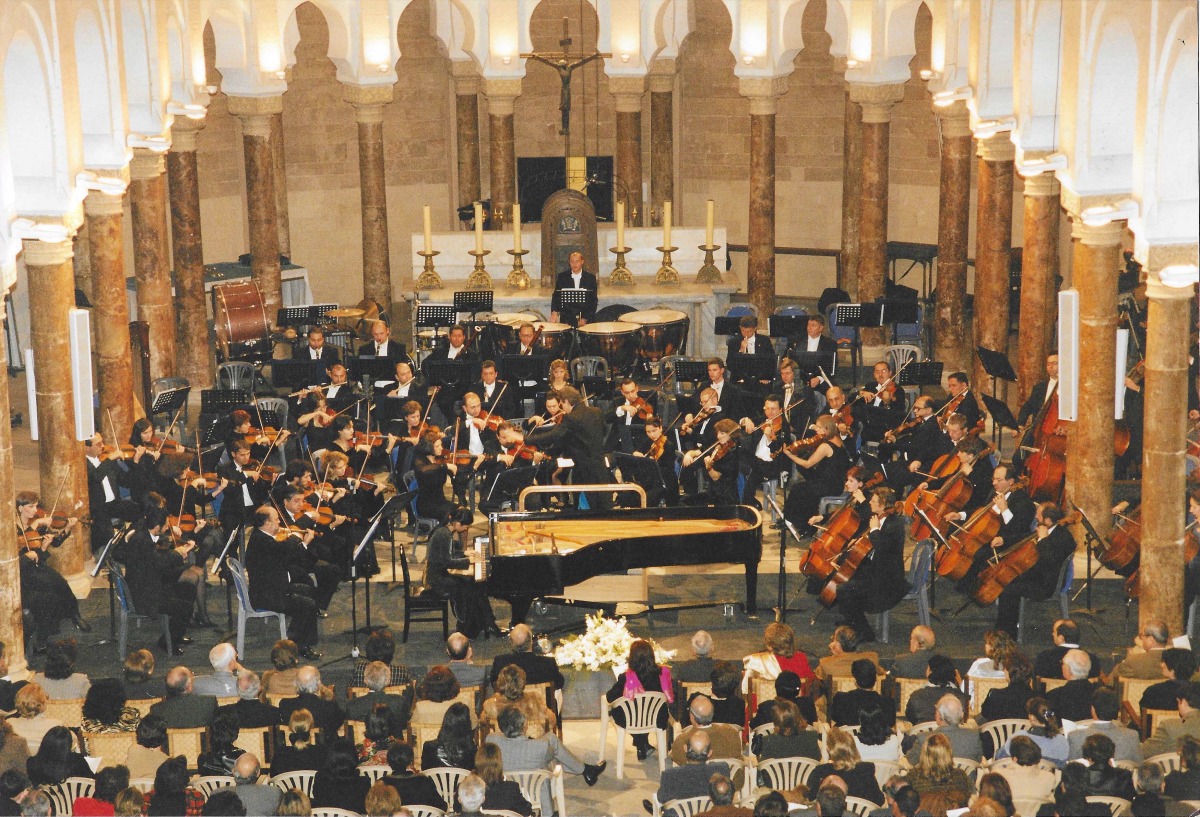
Playing with the Lebanese National Symphony Orchestra.
Music is now part of my being. One of the biggest achievements of my Classical career was playing the Schuman concerto with the Lebanese National Symphonic Orchestra, while I was studying in Germany. But that was also one of my latest concerts. A few years later, I developed a passion for composing, and my life took another path.
My latest album ’Una Corda Diaries’ is very special to me, as it was recorded on the Klavins concert Una Corda M189 in Budapest.
It is a musical diary. The idea came to me as I was visiting the Klavins workshop. Seven Days-Seven Pieces, is the story of the people, the atmosphere, the Una corda and my own experience discovering this unique instrument. I was also very lucky that I managed to complete the recording just few weeks before the pandemic hit and borders were closed.
After arriving in Germany to continue my studies, I realised that interpretation alone was not enough for me. I didn’t want to just repeat and play the repertoire which have been played a million times perfectly.
Also, I started feeling lonely and froze at the stage playing Classical music. I don’t know why, but the thing that I loved the most in the world started to make feel isolated. So I decided to stop, but again, after a while it was too difficult to live without the world I had created for myself through music. The place where I used to feel free was missing. Music had become part of my being. Tt was what I had become. And then I discovered composing.
Image Evgeny Ganeev.
My music is not purely Classical, nor is it neoClassical, nor jazz, and not Armenian. It dives through the lines, just like my feelings, belonging nowhere, which makes me feel awkward while also holding a wish to belong.
I love layers of melancholic melodies over each other, telling the same story from different perspectives, mostly centred around my instrument. My piano draws out all the emotions I want to express, sometimes through elegant soft notes, at other times with restless melodies, merging into each other. I also improvise sometimes, even though I like the process of working on an idea.
When I feel creatively blocked, and I have nothing but a dark space to wonder around, I prefer to stay still and take my time. My mind doesn’t stop working. I listen to a lot of music, I do research, I discover new artists, until I find my calmness and a clear path to put the melodies back on a paper.
Image: Ghazaleh Ghazanfari
One thing is for sure, whatever I write is the expression of my authentic feelings, which emerge out of my life experiences. I work through myself, confronting all the joy and the struggles I have inside me, to understand myself better, with the hope that people will connect to those musical and emotional expressions and find comfort in recognising their own stories.
All those words sound like I am pessimistic, but I am not. I’m only too self-critical, and about the music I create. But I also believe that only by repeating and failing can we get better.
I know that everything is a process to get somewhere. Perhaps I just need to enjoy the path more. I don’t want to belong to a genre or a style. The most important thing is for music to touch the heart, whether it is Classical or jazz, technical or slow; there is enough space in these world for all kinds of expression, as long as it is honest and true. True to the the artist first, and then to the person who feels connected to it.
I will never be entirely happy with what I have created, because I know there is always a better version, but I have learned to accept things the way they are for that moment, letting it go, making space for new experiences, and trusting the path that I am dedicated to walk.
Father Peter McVerry has been working with homeless people for over forty years. When he started there were about a thousand homeless in Ireland. Now, there are officially about eight thousand, with many others unofficially so. Last week, Daniele Idini caught up with the legendary social justice campaigner.
Daniele Idini (DI): You have seen different types of crises related to housing in Ireland, but what are the constants?
Fr McVerry (McV): What has been constant over the forty years is the attitude of decision makers to those who are homeless. When I started, the big issue was fourteen and fifteen year old kids living on the streets. When I opened my first hostel for those kids, the attitude was that these kids who kept running away from home were bad kids, and the solution was to call the police, pick them up and bring them back home again. The idea that there was huge abuse and violence and neglect hadn’t registered yet. So, the attitude was that we shouldn’t be reaching out and helping these kids. They’re just bad kids. Then the problem shifted to young adults with drug problems and again – the same attitude. Well, these are people that started using drugs. It was their fault. So, we shouldn’t really have too much sympathy for them. Then the issue became homeless families, and again, there’s a stigma attached to being homeless, and that stigma is accepted by some decision makers. What has been constant is this negative stigma that is attached to homeless people, and affects some decision makers’ thinking.
DI: Where do you think this stigma comes from?
McV: It permeates the whole of society. The only homeless people who are visible are the ones who are sleeping on the street and begging, and who generally do have a drug problem. This leads to a perception among the public that homeless people must have a problem, and that’s why they’re homeless. But the vast majority of homeless people don’t have a drink or a drug problem. The vast majority becoming homeless today are being evicted from the private rented sector, either because they can’t pay the rents, or because the landlord says they’re selling the flat.
DI: Can we draw a connection between this and the economic policies that have been implemented in the last few decades?
McV: Well, at an immediate level, when families become homeless, having been evicted from the private rented sector, there is no social housing to move into. In 1975, this country built 8,500 council houses. In 1985, and we were in a recession in the 80s, we still built 6,900 council houses. By contrast, in 2015 this country built seventy-five council houses. So the immediate effect is that there is no housing for those families to move into. They have only got one problem and it’s not drugs and it’s not drink. They don’t have enough money to be able to go out and afford alternative accommodation.
Now,why did that happen? It happened because of an ideology. The ideology that the private sector is supposed to solve all our problems. And so, low income families were pushed into the private rented sector, which no longer can cope. But it was that ideology. We’ve privatized everything. We’ve privatized childcare, and that’s in a bit of a mess at the moment. We’ve privatized care for the elderly. Most private nursing homes are privately run. We have privatized much of the health system and now we have privatized the housing system and it simply doesn’t work.
The private market might build lots and lots and lots of houses, but only for people who can afford them. They’re in the business of making a profit. They’re not going to build housing for low income families. And so it’s the State that has to do that. The State has been very reluctant, over the last twenty years or so, to invest in social housing, and therefore they’re pushed people into the private rented sector. That wouldn’t be too bad, if we didn’t have a crisis in the private market where there aren’t even enough houses for people who can afford to buy them. It is estimated that we need between thirty-five and fifty thousand new houses every year just to keep up with the increase in population. Yet we’re only building in the region of twenty to twenty-five thousand. So there are lots of people who could buy a house, but can’t find a house to buy, and they’re being pushed into the private rented sector. So, everybody is being pushed into the private rented sector, and it can’t cope. Rents are going through the roof.
DI: In Ireland, we still have relatively high home-ownership, but, especially after the crisis, there’s a rush into the new model of renting for life. This is a bit of a paradox, however, in terms of a neoliberal ideology which aims at protecting the right to private property; yet, in Ireland, owning private property has become out of reach for a significant percentage of the population.
McV: Absolutely, yes. So over the last twenty years, the State has failed in its responsibility to build social housing, pushing people into the private rented sector. They had to create a culture for that to happen. The State did two things. First of all, it looked at the continent. It looked at the rest of Europe and said: Well, most people rent. So, any progressive democracy and an economy which is growing must have a lot more people renting. The mistake there is that the rental market in the rest of Europe is totally different from the rental market in Ireland. Most rental markets in Europe are highly regulated: prices and rents are controlled, and you can become a lifelong tenant. Here, you can’t. You get a tenancy for maybe twelve months, or at most four or five years. You’re living with high insecurity, and the rents are increasingly way beyond your means. It’s a totally different rental market to the rest of Europe. But if you read the last government’s housing strategy, there is so much ideology in it trying to persuade us that the rental market is the way we have to go. The rental market has all of these advantages, and it is the only way for a progressive economy to go.
DI: According to a recent Irish time article Ireland has the 10th highest rate of vacant homes in the world, with 183,312 homes classified as vacant. We have a society that does not regard it’s housing stock as a basic national infrastructure like ports, rail network, airports or the electricity grid.
How might the public become more aware of the benefits of a more distributed housing stock?
McV: Well, I think the public are well aware of the empty homes that exist in every town and village. Ireland is blighted by empty properties lying derelict, often being used for antisocial or drug using young people. But there is very little political will to go after those properties. There is a lot of work involved in trying to identify the owners of some of those properties and trying to sort out any legal problems that may exist with relation to that. But we ought to be promoting compulsory purchase orders on properties that are left idle for longer than one or two years. It is a scandal. 1830,000, you mentioned. One of the issues was the Fair Deal Scheme, where if you go into a nursing home, the value of your home will be taken by the State when you die. Eighty percent of the value of your home will be taken by the State when you die to pay for your care in the nursing home. That meant that people in nursing homes couldn’t rent out the empty house they had been living in, even though they’re never going to go back to it.
They can’t rent it out because most of the rent would be simply taken up by the nursing home to pay for their care. So, you had empty houses there that couldn’t be used. You had empty houses where we couldn’t find out who the owner was.
The government did make a couple of schemes such as a Repair and Leasing Scheme where the owner can benefit from a grant of, I think it’s now €60,000 to bring the empty building back into use and then lease it to the State for a period of up to twenty years. And there was a Buy and Renew Scheme where the State could buy the property and then repair it. But there was very little uptake of those two schemes. So yeah the amount of empty properties is a scandal.
DI: What other measures would you suggest should be put in place to deal with the situation?
McV: There are two problems at the moment. One is housing those people who are waiting for social housing. There’s an even more urgent problem, and that is preventing more and more people from coming into homelessness and needing housing. That’s the more urgent problem, and that can be solved overnight.
During the pandemic, there was a ban on evictions and there was a ban on a rent increase and the number of homeless people and families dropped by almost two thousand. We should extend that to a ban on rent increases and a ban on evictions for at least three years in order to try and get a grip on the problem. The counterargument will be that it’s against the right to private property. But I don’t buy that argument. I don’t think the Supreme Court would uphold that argument.
So the solution involves passing a law banning evictions and rent increases and sending it to the President to sign. The President can send it to the Supreme Court and fast track a decision. Let’s do that. Let’s find out if it’s against the Constitution. If it is, you bring in a constitutional referendum on the right to housing and make that right at least place level with the right to private property, because every argument we present to try and address the housing-homeless crisis comes up against the argument that it is against the right to private property in the Constitution. Now, that right to private property was established in the 1930s at a time when Communism was expanding around the globe. And one of the tenets of communism was that you could not own private property. So, the idea behind it was to prevent Ireland ever having a Communist government. But now it’s being used to prevent Irish people getting their own home, which is absolutely absurd.
A fascinating insight into the mechanics of dysfunction in housing. Great work by Daniele and Liam. https://t.co/dI7pQ4CXu2
DI: Isn’t it a paradox that a good percentage of the population does not have access to private property because we have to defend the right to private property?
McV: Yeah, it is a total paradox. The Catholic Church, for example, supports the right to private property, but what is meant by that is that everybody should have access to private property because that’s our little security. That’s their little fallback if things go wrong. But the right to private property has been hijacked by the wealthy to hold on to what they have already acquired. And that was never, never the intention, certainly of the Catholic Church in supporting private property.
DI: Is there space here for a discussion of morality? Is it morally right to continue pursuing economic policies which, as experience is showing, are causing unnecessary pain and suffering to a growing percentage of the population? How do indicators such as GDP relate to the percentage of homelessness?
McV: Firstly, GDP is a very ineffective criterion for the wealth of a country. Every time there’s a car accident, the GDP goes up because the cost of repairing the car and the cost of treating the victims all adds to GDP. And the more serious the car accident, the further GDP goes up. So, GDP is not a reflection of the wellbeing of a society. We can never agree on what is moral. If you own a big house in a nice area with a nice car what is moral is your right to protect those assets. But if you’re homeless on the street, your concept of morality is going to be very, very different. So, I don’t think we’ll ever agree on what is moral. This is a political question. This only way it is going to be solved is politically. We have to ask the question: who benefits from rising rents and rising house prices? The answer is three groups.
One, the banks. The banks benefit because as house prices go up, they can lend more and more money out as mortgages and make more profit. And if they repossess a house, they will get more money for that house. They have an interest in a house and rent goes up.
Second, the big international investment funds. They also have an interest in rents going up. And indeed, many of them are leaving some of their properties empty rather than reducing the rents to what people can afford.
Third, the Landlords.
But who doesn’t benefit? Almost all Irish people don’t benefit from rising house prices and rising rents. For most people it is a huge disadvantage.
The second question we have to ask is which side is the government on? The government is on the side of the banks, the big international investment funds, which they attracted in with extraordinary tax concessions, and it’s on the side of landlords.
In one episode Simon Coveney brought in a rent cap of four percent. Where did that four percent come from? Simon Coveney wanted to bring in a rent cap in line with inflation, which was hovering around zero at that time. The big international investment funds held a number of meetings with the Minister for Finance and told him that four percent was the minimum they would accept if he wanted them to continue being involved in this country.
So four percent it was, and since then the rents have gone up far more than that. In those five years, the rents have potentially gone up by twenty percent. At the same time the HAP payment which you received from the government if you’re on a low income hasn’t gone up in those five years. So now the rents are on average twenty percent higher than they were when the payment was introduced, and lots of people are having to pay top ups to the landlords. Anything between €125 and €200 is what I’m coming across. And you have a single person on social welfare who’s getting €204 or €205 a week, and they have one week in a month where they have to pay €200 to a landlord as a top up because the HAP payment hasn’t increased sufficiently.
People on low incomes are just being screwed, screwed by landlords, screwed by investment funds, screwed by banks, and the government is on their side, not on the side of renters or people paying a mortgage who are struggling to try and keep their heads above the water.
DI: The inability of successive governments in dealing with this issue is more and more being perceived by the public as the result of either State corruption or pure negligence.
McV: I wouldn’t call it either of those. We have had conservative governments. Conservative governments are on the side of those who own capital because it’s the capital that develops the economy. So they’re on the side of capital, of the capital owners, which are the banks, and the large investment funds. And they don’t want to do anything which would frighten any of those away, anything which would make Ireland a less attractive place for them to operate. So I think there’s a conservative mindset which I totally disagree with. It’s not a mindset I would put down to malice or corruption or anything like that. I would put it down to what I would consider a very, very mistaken perspective on what’s happening in the country.
For example, in Germany they have passed a rent freeze for the next five years on rental properties, and in Berlin, they introduced a referendum to take back from the big international investment funds all the apartments and buildings that they had built. Now, it probably won’t pass, but that’s the sort of thinking we need to do. That sort of thinking is totally absent in Ireland.
The people who make the decisions here are doing very well. They’re on good salaries. They live in nice houses and nice parts of the town. Their children are going to third level education and in a few years time they’ll live in a nice house in a nice part of town. So they have a different perspective from somebody who’s struggling to pay the rent. They don’t understand somebody who is struggling to pay the rent. They say they do, but they don’t. For them the housing problem the problem of people on low incomes struggling to pay rents and mortgages. That’s a problem in a file on their desk. It’s not a personal problem for them, and it’s not a problem anybody they know is facing.
So for them it’s more theoretical. For me it’s real. It’s real because I’m meeting them every day and I’m frustrated and I’m angry. I want to see somebody with a passion for dealing with this. I want to see a decision maker who has a passion for dealing with this, who’s angry about what’s happening and who’s prepared to put their neck on the line. That’s what I want to see. I don’t see it at the moment.
DI: And as we are coming slowly out of a pandemic, what lessons can be drawn in regard to emergency accommodation and homelessness?
McV: The pandemic actually had one positive feature for homeless people. They were able to get accommodation because a lot of Airbnbs came back into use as private residential accommodation. And because there was a pandemic, you didn’t have queues of people outside wanting to view them. So landlords were ringing us and saying, You have anybody that needs a place? And they knew we wouldn’t put in somebody who was going to wreck the place. They knew we would support that person. And if difficulties arose, we’d have to step in. So it was a Win-Win for everybody.
Now is the time to regulate and demand that Airbnb’s get planning permission and to regulate, inspect and ensure that those planning permission and regulations are enforced. That would bring a lot of Airbnb’s back into private residential properties and would be a big addition in helping the housing crisis. It could be a condition that anybody who wants to advertise their property on one of the sites, like Airbnb, must produce evidence of planning permission. That would get rid of a lot of Airbnbs and bring them back into residential use.
DI: With tourism opening up again have you noticed any effects on homeless people, who were housed in hotels and hostels during the pandemic, and are now, again having to rely on shelters?
McV: That’s already happening. The lease is now up on a number of hotels that were taken over as accommodation for homeless people, and they have been returned to the owners to be used as hotels. And it’s a real pity because homeless people love the hotels. You have your own en suite room. And now some of them are getting thrown back into hostile situations, and it’s very depressing for them. So yes, that was a feature of the pandemic that’s now disappearing. And it won’t come back.
One option is to buy those hotels, buy them back, buy them from the owners and use them as accommodation for families and that, but that’s very expensive. They’re not going to do that.
One of my ideas for homeless hostels is that everybody should have their own room. Homeless hostels are often unsafe. Many people get assaulted. People’s belongings get robbed. I’m arguing that every homeless person should have their own room all the time that provides security and safety for their belongings.
That’s expensive, and they’re not going to do it. It’s much cheaper to get a house and put four people into a room with bunk beds than to provide four separate spaces for homeless people. So, they’re not going to invest the money in that. But to my mind, what we offer to homeless people sends a message to them, and the message is, this is how society values you. This is what society thinks you’re worth. So when you cram them into rooms and bunk beds, some rooms without even a window in it, they’re getting the message. And that message is very negative. But that is the message that many of our decision makers don’t mind giving to homeless people because that’s the attitude that they’re coming from. This is good enough for them. I heard one person ringing up the free phone number to try and get a bed for the night, and he was offered a bed in a hostel. And he said, I can’t go to that hostel. It’s full of drugs. I don’t use drugs. And the answer I overheard was “beggars can’t be choosers.” And that’s the attitude I think that many people have towards homeless people.
It is an attitude that has political ramifications. Why else would we have reduced our building of social housing? Whenever the state tries to build social housing, you’re going to have huge objections from all the neighbours. And the local councillors who have to approve of social housing in that area are looking to the next election. And if they are alienating the people in the area where the social housing is going to be built, they are not going to approve that social housing for fear that they will lose out in the next election. So, we have this attitude that anybody in social housing is undesirable. Anybody in social housing is a problem, has a problem and therefore we don’t want to be anywhere near them. And the political system has to go along with that because of our democracy.
Fire & Desire
And then, at the right time
from the heat of our hands
a love that was old and new
lit up like a torch
burning from the depths
like fire to the turf.
Eight of Wands
BOOM!!
Someone’s heart whispered: Boom!!! And everything blew up
The Earth stopped moving
and when the dust settled down
the two lovers stood naked alone
hand in hand, in a desert land
Isn’t that scary?
Would you still like to try?
Queen of Wands
Bracken You smile and beam
like a young maid
when the wind
whispers your name
Rain sings
the tales of the Earth
to your soft green
ferny flesh
Ancient sap knows its way
up from the hidden rhizome
nourishing your spiral sons
curled foetal croziers
Axis stretching out
trough blade and frond
Sorus keep your secret
eternal life spreading spores
You are precious and wise
as you are old.
Six of Cups
My Naoise
My Naoise, don’t you know
I only have eyes for you even if I look somewhere else I can only see your face. If the raven shows up in its black plumage it reminds me of your hair When you smile at me the world is gone and only you exist, my love And when you touch me,
My Naoise, warm blood melts the snow and we live inside a legend a thousand years ago.
Page of Cups
Ganymede Ascending
You picked the snow goose feather for your quill pen
to write poems about me
You feel my breath burning in your human heart
but my essence is too subtle for your mind to grasp
You thought you were in Love
while it was Love that was Love in You
You’ll make immortal the beautiful young one
When the Eagle calls,
the sweet cup bearer who made you drunk
will be pouring mead on your cup
Don’t search for clues or reasons
Don’t dwell on platonic delusions
Don’t cry for what you think you’ve lost
For you have only won
Look inside you now
Love Loves You
You are Love.
Knight of Cups
White Heart
Some people
with their panoptic, utilitarian minds
claim that Love is a choice
As if you could just choose to love anyone
They say there’s no special chemistry “That’s not Love” -they say- “That’s just Lust”
Well, if it’s Lust
then I lusted you deeply and truly
I lust you so much
and I’ll lust you till the end of Time
I lust for the beat of your white heart
in the palm of my hand.
Ace of Swords
Truth
It is the truth now coming
I’ve been deliberately blind
amidst the fog of many Sundays
It is the truth I avoided
The comet following
its interstellar track
The heavy ball in the bowling lane
speeding up towards me
like an unstoppable slap
It was here inside me
and it was true all the time.
Two of Swords
To my Future by the Ocean
You and I cannot claim a future
all we have is this slippery moment
nearly out of our grasp
I wish this could be us
so in dreams I track back
scattered spaces and words dispersed
to find the thread, something to reel in
but nothing comes out
I’m out of wisdom
Silent drops and white mist
drifting over green ground
I stare at the Ocean
and I’m no longer me
I’m a hermit troglodyte
who never uttered a word
or was able to share
some unsophisticated thoughts
but feels that primal longing
while trying to make sense
of this inscrutable immensity
and another day is dawning.
Queen of Swords
What She Said
What she said
she had said it to herself
a million times before
It was a vagrant thought
which didn’t want to be called
and when she said it
it was words made birds
flying from her throat
wrung and tightened
like a burning knot
it was her last resort
to make the clock stop,
their universe implode,
to bring the story to a close,
cyclic patterns to an end,
to blow the gateways
that balanced the river flow
What she said
was nothing to retract from
it wasn’t meant to hurt
but to free them both.
King of Swords
Gemini
Looking through the window
Night sky stuffed with cotton clouds
I can feel them sparkles cruising
though I cannot see their light
I miss the beauty of that moment
when I felt so alive
Flying dreams disintegrating
as they touched land
My spaceship keeps orbiting Earth
like a homeless satellite
I could even cry if I just wasn’t so,
so very tired
And one last time I imagine
Gemini reflecting in your eyes.
Two of Pentacles
Schrödinger’s Cat
As I walk through Irish fields
where Spring shines
I wonder about Life
Is this all an illusion
This vibrant green is surely
livelier than I am
Aren’t we all death and alive
at the same time
Am I the cat who stayed too long
inside the box and now I know
I’ll never be more alive
than the moment just before I die.
Knight of Pentacles
He came from Sirius B
He came from Sirius B
A galactic knight, mighty like a titan
who could break your head and rip your chest
to make bangles with your guts
in the blink of an eye
But he was vegetarian, so he couldn’t understand
why baby turtles died with bellies full of plastic
just a few weeks after their mum had laid the eggs
in the warm sand
He was the most evolved amongst all the creatures
in any of Darwin’s islands
And as he circled his garden of damaged human minds
philosophising and beating the bush
a star was dying in a cardboard sky
and a young couple was making love
in some sunny place in France
but the only remarkable thing
the only truth
is that they were young.
Queen of Pentacles
The Golden Bear
Just as the leaves fell away
with the first Autumn winds
so did the withered branch
after a long drying time
since the tree cut out the flow
of its greenish vital sap
in order to survive
The Golden Bear tasted the cold on her snout
she dug a cave for her Winter doze
and prepared her body for that brumal slumber
For dawns eight times eight
she fought the river, carving its rocks,
waiting still or dancing on tiptoes
and sifting water through her paws
to feed herself with fresh salmon and trout
in order to survive
the deep sleep before rebirth
and the numbness in her bones
until she wakes up from her torpor
to find six daffodils
and then she’ll know
that Spring has come.
The Hermit
Midnight Lamp
Tonight
I’ll turn off my lamp
until you return the light
of your eyes to mine
of mine to yours
I leave you the dream
that kept me floating
across rhymed universes
and oceans of hope
The infinite sands
of moments of thought
The blank pages waiting
will remain untouched
Steal that story
from the saddlebags of Time
for us to tell again
in another life.
Temperance
Orion
I wish I could still dream
a dream of you where I
just find myself lost
trying to find my guide
in the milky way of your spine
The ghostly desert of your skin
wrapping me in soft warm sands
I hear the hunter’s pulse in my dream
and I wake up just when your name
is about to leave my mouth.
The Star
My Star
You looked pale and beautiful
under the light of my star
Like a silver beam
of mystery and light
reflecting all that I am
You looked pale and beautiful
under that cold night light
but I could not follow you then
so I followed my star.
I. The Sun
Planet Nine
I stare at you, my Love
from a safe distance now
Still orbiting your light
Slowly freezing without your warmth
Hundreds of millions miles away
Past the Kuiper Belt
I witnessed how
Pluto fell from your grace
I might still cause some stir
on this circumstellar disc
made of small remnants,
past lovers of yours
Some say I’m a perturber,
a dark giant of face unknown
Some others pretend
I don’t exist at all
And I say nothing
my beautiful distant star,
my beloved Sun
I’ll just wait in the cold
But I keep rotating,
for with my every turn
I can sometimes gaze at your face,
beyond the Transneptunian wall.
II. The World
Infinity Orchestra
Across the galaxy
in elliptical march,
the stars, planets
and satellites
dance their eternal dance
wearing spherical gowns
to the rhythm
of an infinite melody
spreading mute,
cosmic sounds.
Touch: Recovering Our Most Vital Sense is a recently published work by Irish philosopher and public intellectual Richard Kearney. The book is the third in the ‘No Limits’ series published by Columbia University Press.
The blurb and introduction promise a timely meditation on the importance of touch in an age of virtuality. The book, we are told, asks how we are to reconcile the physical with the virtual, our embodied experience with our global connectivity. Unfortunately, however, it contributes little towards answering these questions, spending most of its few pages mulling over the history of philosophy and Western medicine; lingering around the goalposts without registering a direct hit.
This is disappointing because Kearney has his finger on the pulse of a real undercurrent of dissatisfaction with our mainstream cultural model. Many of us believe that something has gone wrong, so we turn to our writers, artists and public intellectuals to identify the root cause. Is capitalism to blame? The invention of print? The discovery of fire?
Kearney considers a neglect of touch as a key feature of our cultural predicament. It all began with the Greeks – he suggests – exemplified by Plato’s valorisation of the spiritually pure sense of sight over our beastly sense of touch. Now, we see the unhappy conclusion of such an idea; a culture founded around the image, where life is increasingly lived virtually at the expense of our physical existences.
This mass sense of disembodiment, caused by engagement with digital technology, Kearney calls excarnation, a term loaded with esoteric theological significance. This aspect to our culture was brought into stark relief during the COVID-19 pandemic.
Thus, most workers and students began working virtually from their own home, as nationwide quarantines were enforced, and social distancing was put in place in supermarkets, restaurants, and other public places. We realised that this was, in a way, the logical next step to the virtualisation of education and work. We just needed one catastrophe to put it in place.
Worthy Premise
‘A civilization that loses touch with flesh’, writes Kearney, ‘loses touch with itself.’ (p. 47). This is a worthy premise to a book, and from this beginning, one can imagine an author moving towards a rich discussion of the effects of ‘excarnation’ on such matters as sex, violence, sport, the prevalence of body dysmorphia, self-harm etc. in our contemporary culture.
The topic of ‘touch’ is indeed broad, but contemporary writers and cultural critics have gained good mileage with similarly broad topics in the past. An example is Maggie Nelson’s book The Art of Cruelty (2011), which takes the broad theme of cruelty as a foundation to a wide-ranging discussion on everything from avant-garde performance art, to the tropes of advertising, to the coverage of U.S. war crimes during the so-called ‘War on Terror’.
This book, however, fails to deliver on its ambitious premise. Instead of diving into an analysis of contemporary culture, it stalls before it starts with two lengthy chapters introducing a glossary of terms, distinctions and concepts that are seldom used later in the book.
Kearney meanders through etymologies and distinctions, drawing neat moral messages from vague, linguistically questionable associations. The root cause of this may be the unnecessary broadening of an already vague theme. Thus, he writes:
As I hope I clear by now, when we speak of touch we are not just referring to one of the five senses … we are talking about touch in a more inclusive way, as an embodied manner of being in the world, an existential approach to things that is open and vulnerable, as when skin touches and is touched. (pp.15-16)
This is a little too sweet to swallow. Even if we accept the Heideggerian mysticality of this passage, it’s obvious that Kearney is widening his subject matter out of manageable proportion.
Indeed, he draws strongly on Heidegger in his concern with words and their hidden meanings. At times, this can be surprising and intriguing, but at other times, the connections seem banal. He argues:
But tact is not the same as contact. Being tactful with someone does not always imply immediate physical proximity. One can be tactful, for instance, by practicing discretion in particular circumstances, as one negotiates the right space between oneself and others. (p. 10)
Handshake
A baby-steps approach would be justifiable on philosophical grounds if Kearney wasn’t taking flights of fancy elsewhere. At one point, he speaks of the handshake as being the ‘origin of community’(p. 42) without adequately explaining how.
Indeed, in many cultures bowing or other non-contact gestures are the norm. We turn to the endnotes to find an essay that ‘analyses the first wager of hand-to-hand encounter between Diomedes and Glaucus in Homer’s Iliad and Abraham’s greeting of the strangers at Mamre.’ These literary scenes are certainly interesting, and may indeed point to episodes passed down through folk memory, but to suggest that they represent a historically verifiable moment in human history is unsatisfactory.
The first chapter is structured around the questionably useful coining of new terms to describe sight, taste, smell and sound being used ‘tactfully’. ‘A person with tactful taste is savvy.’(p. 17), Kearney writes, a person with a good nose has ‘flair’(p. 21), and so on. But when we talk about the ‘tactfulness’ of touch we don’t really mean the sense of touch; remember we mean the metaphorical way of being in the world that touch acts as an analogy for.
It’s odd to focus on the specifics of each sense when we’ve already established that we aren’t taking the theme of touch literally. In any case, is it still believed that there are only five senses? Isn’t it the case that there are many others beyond those traditional five?
At this point in my reading, the unanswered questions become overwhelming, and I decided to stop thinking too hard about them. Instead, I focused on the texture of Kearney’s style, clearly influenced by Continental Philosophy. There is a lot of jargon, which is at times hard to follow. On the flipside, it is quite playful, making use of a number of touch-based puns and idioms. There is also a tendency towards moralistic aphorisms, and using words poetically. The following sentences give a flavour:
Without the transversality of touch, sensibility risks sensationalism: sense without sensitivity, perception without empathy, stimulation without responsibility. (p. 16)
Savvy is a carnal know-how. (p. 18)
For if ontogeny repeats phylogeny, it also repeats cosmogony. (p. 20)
Hearing is tactful when it resonates with what resounds. (p. 27)
In response to this, however, I am moved to quote Wittgenstein: ‘Whereof one cannot speak, thereof one must remain silent.’
Visual Culture
It is popularly acknowledged that we live in a ’visual culture’, and Kearney sees this ‘optocentrism’ as the source of our woes. In his own words, ‘Optical omnipresence trumps tactile contact. Cyber connection and human isolation go hand in glove.(p. 5)’
But Kearney never specifies exactly what a visual culture is, or what it means to live in one. What does the shortening of our attention spans, our growing inability to read longer texts, or the increasing popularity of podcasts and audiobooks actually mean in a ‘visual culture’? Do these elements suggest a deterioration in our visual faculties? Kearney doesn’t linger on these questions. In his eagerness to champion touch, he fails to determine exactly what it is he is fighting against.
The second chapter of Touch is even murkier than the first. Kearney embarks on a historical tour of different philosophical considerations of touch, but only discusses two philosophers at any length: Aristotle, and Edmund Husserl. This leaves a gap of some two thousand years in between. Was there nothing to say about the Christian philosophers and touch, or about Descartes’s suspicion that his physical sensations could be a mere dream?
As someone untrained in philosophy, I found the explanations of Aristotle’s thought particularly difficult to follow. I couldn’t tell where Aristotle’s opinions ended and Kearney’s began, especially since Kearney quotes Aristotle using terms like “tact”, which Kearney had given idiosyncratic definitions for in the previous chapter. Are we to take it that Aristotle aligned with Kearney’s usage of the word?
At one point, Kearney remarks that Aristotle saw touch as the most foundational sense, since all the other senses rely on it. Food must touch the tongue to be tasted, soundwaves must ‘touch’ the eardrum, and ‘light strikes the iris’(p. 43). But was Aristotle aware that photons were material objects? And are photons actually material objects, if they have no mass, and can act like waves?
When you start considering this subject at a quantum level, everyday notions of touch break down. After all, when I ’touch’ a table, at a molecular level none of the atoms in my finger are touching the atoms in the table, and I am only feeling the electromagnetic resistance of the table’s atoms.
Likewise, none of the atoms in my body are ’touching’ each other, but are held in a bond through their orbitals. So, in what sense can you say that light ’touches’ the eye, or sound ’touches’ the ear?
Odysseus and Polyphemus (1896) by Arnold Böcklin.
No Central Thrust
Even if you accept all the concepts, definitions and distinctions found in the philosophical survey, your work won’t be rewarded because Kearney barely mentions them again. Instead, the text turns to medicine. In chapter three, he talks about literary/folkloric/mythological figures like Odysseus and Oedipus who embody a ’wounded healer’ archetype. Then, in chapter four he talks about the importance of physical touch in modern medicine, particularly in psychotherapy.
At this point, to my mind at least, it became clear that there was no central thrust to this book, and my attempt to follow his train of thought would go unrewarded. Instead, I found a collection of loosely connected rambles through Kearney’s reading, with no development between the chapters.
The final chapter on popular culture (social media, video games, movies) finally gave me what I had been hoping for – a discussion of touch in contemporary culture – but is, sadly, the least satisfactory of the lot. Kearney is clearly unfamiliar with the details or nuances of internet culture, consistently misusing terms. At one point, he refers to the leaking of Hillary Clinton’s emails as ’revenge porn’ (p. 119), a blunder that reveals a deep unfamiliarity with the expression he is using.
At another, he disparages the state of internet discourse as infuriatingly simple compared to the Golden Age of communication that existed back in an Edenic past: ’communication is becoming daily more simplified by social media tweets, memes, acronyms, and hash tags – ’What’s up’ being replaced by WhatsApp.’
Putting aside the cringeworthy final sentence, is it really self-evident that internet communication is more ’simplified’ than print or verbal speech? Couldn’t you argue the opposite – that the increasingly ironic, self-referential, meme-ified soup of internet discourse is actually maddeningly Baroque?
Avoiding odious comparison, you could speak of internet discourse not as better or worse, simpler or more complex than speech, but just as a new modality which is still in the process of growth, of finding its feet and testing its limits.
There are plenty of scholars analysing internet culture now. It may seem absurd to study memes, but when you consider their effect on politics, it appears intellectually reckless to dismiss them as simplistic, and unworthy of analysis.
Grand Theft Auto V.
Video Games
The ignorance latent in Kearney’s cultural analysis hits a peak in his discussion of video games, such as Grand Theft Auto V (2013), which he calls ’controversial’. When describing it he first gives an inaccurate description of its contents, speaking of how players can ‘build or destroy cities’ (Is he thinking of SimCity (1989), perhaps?) and ’seduce strippers’ (according to my research on the GTA forum, you can only purchase lap dances from the strippers in the game).
He gives an inaccurate account of what it feels like to play a game he surely hasn’t played. It’s ’vicarious’ he says. With ’a click of a button, one exits the world of tangible reality and enters a computer-generated universe’. If only GTA V gave one the escape from tangible reality Kearney imagines. Alas, however, technology can only progress so fast.
After painting this Black Mirror-esque picture of the reality-warping power of the computer game, Kearney exhorts the lost souls of gamers that ‘it is but a simulacrum’, and warns against ’the risk of losing touch’. The only one out of touch here is Kearney himself.
Apart from GTA V, Kearney lists a number of examples from modern media that deal with the sense of isolation and alienation engendered by digital media, referencing such titles as ‘Her’ (Spike Jonze, 2013), ‘The Truman Show’ (Peter Weir, 1998) and ‘Black Mirror’ (Charlie Brooker, 2011 – present). But all these works communicate much more nuanced and rich critiques of contemporary culture than Kearney is able to muster in this text.
There are insights and interesting titbits scattered throughout the book, but on the whole it is lacking in a sense of progression, with little development from chapter to chapter, and a cumbersome amount of time is spent advancing distinctions and definitions that are never called into use.
Columbia University Press claims that the No Limits series ‘brings together creative thinkers who delight in the pleasure of intellectual hunting, wherever the hunt may take them and whatever critical boundaries they have to trample as they go.’ With Touch, we see the weaknesses of this interdisciplinary approach, as the book’s lack of precision and relative naivete provides unsatisfactory responses to important questions in contemporary culture.
Featured Image: A Missouri National Guardsman looks into a VR training head-mounted display at Fort Leonard Wood in 2015