This is the first instalment of a three part essay on the legacy of the Great Depression..
The Great Depression began in 1929, leading Wall Street bankers literally to throw themselves from windows. I was shown one such exit site on 45th Street 5th Avenue in Manhattan. Lives were destroyed as a favourable market collapsed. The fundamental point then, and now, about a favourable or unfavourable market is it is always an illusion. Smoke and mirrors.
Bull leads to Bear and back, and that cycle since 2008 is certainly where we are again, as confidence is lost in markets and neo-liberal non-interventionism. The effect in 1929 emphasised how when America catches a cold Europe contracts pneumonia. In the 1930s, the fragile, well-intentioned experiment in Wilsonian democracy collapsed virtually overnight. Now the effect is global.
We are now seeing unmistakable signs of stagflation and even hyperinflation, accentuated by the additional disease burden of the virus on health systems subjected to decades of sneaking privatisation; while health inequalities widen, as transnational organisations and Big Pharma – using so-called philanthro-capitalism as a front – collude at the expense of the population at large.
The prospect looms of fuel and food shortages, decreased life expectancies – already evident before the pandemic – repossessions, and evictions, with limited support in countries without social democratic support structures.
In terms of civil liberties, we are entering dangerous territory too, with compulsory vaccination and quarantines. A long winter is coming. And what are we to make of most non-essential court cases in the UK being adjourned until September of next year?
In 1932 at the height of its destitution, America elected its greatest ever leader the aristocratic bon vivant socialist Franklin Delano Roosevelt (FDR), who brought in the New Deal to save the country from ruin.
In contemporary America, no such leadership exists. Biden is no Roosevelt. He is unwilling to develop a true social market. All too many in America are ‘Bowling Alone’ as communities fall apart in a digitally mediated age of social atomisation.
The Great Depression represented a failure of the American idea of government. Apart from a few dissenters, such as the legendary Supreme Court judge Oliver Wendell Holmes, the business of America has always been business, until it goes bust.
In a tremendous refutation of free market economics in Lochner v. New York (1903) Holmes said: ‘The third amendment does not enact Mr Herbert spencer’s social statics’
Holmes was at least a quasi-socialist, who corresponded with Harold Laski. But neither an intellect like him or a proper social democratic deal maker and integrator like Roosevelt is evident in American politics today.
Obama received money and recruited Goldman Sachs alumni to his cabinet which is a bit like inviting a cuckoo into the nest.
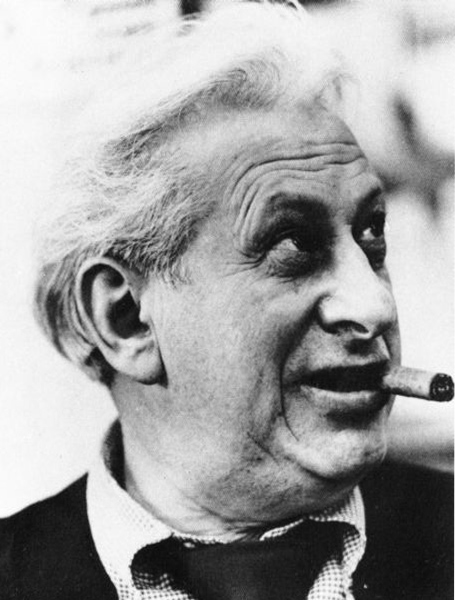
Studs Terkel
Hard Times
Another Chicago native and reporter of the last century, Studs Terkel chronicled American life in his book Hard Times, which is an oral history of the Depression era. Terkel argued that ‘the worst day-to-day operators of businesses are bankers,’ and quotes one source who has fallen on hard times:
We thought of the poor, at that time, as quite divorced from us, who were not poor. By the exercise of one’s charity, life could be made all right. You would always have the poor with you, they were the unfortunate, and you made donations. You could handle them. It was mildly unpleasant, but not fundamentally upsetting. Now, for the first time, we face the dreadful reality that we are not separated. They are us.
And another describes a scene of acute desperation:
They would just walk all over and kill each other. They got more than they ever need that they would just step on anybody to keep it. They got cars, they got houses, they got this and that. It is more than they need, but they think they need it, so they want to keep it. Human life isn’t as important as what they got.
The successful application of the ideas of the master J. M. Keynes generated a worldwide social democratic model in the wake of the Great Depression, which became the consensus before the resurgence of neo-liberalism. This has undermined humanity since the late 1970s, and its effect now appear irreversible, given the absence of an alternative Communist model that compelled even governments devoted to capitalism to maintain a basic standard of living and healthcare.
In contrast, the neo-liberal model of marketisation of human activity has intruded into all sectors of life. This has denuded and in some cases destroyed what Habermas describes as the public sphere.
A set of unworkable ideas have spiralled out of control, and are generating a disaster. Liberal democracy is failing and becoming unworkable. In effect, the End Of History is the acceptance of discredited ideas, which have led us to this impasse.
Capitalism is not working because capitalism is not allowing people to work. Joseph Stieglitz, a former economist for the World Bank remarked: ‘Socialism for the rich capitalism for the poor.’ And increasingly basic liberties are being sacrificed at the altar of security.
More than statisticians or economists, artists convey the individual effects of world historical events such as the Great Depression.
Although written in 1906, Upton Sinclair’s The Jungle is one of the core texts of the Depression, demonstrating the appalling work conditions in the Chicago meat packing industry. Many of his works including Oil, which became the film with Daniel Day Lewis ‘There Will be Blood’ attack unbridled capitalism and its depressing effects on the human spirit.
Two crucial quotes from The Jungle are as follows:
The rich people not only had all the money, they had all the chance to get more; they had all the knowledge and the power, and so the poor man was down, and he had to stay down.
And
Into this wild beast tangle these men had been born without their consent, they had taken part in it because they could not help it; that they were in jail was no disgrace to them, for the game had never been fair, the dice were loaded. They were swindlers and thieves of pennies and dimes, and they had been trapped and put out of the way by the swindlers and thieves of millions of dollars.
Sinclair paints a familiar scene, now throw in the disinformation of our post-truth universe and you have a neo-liberal Molotov cocktail. At least at that time there was vibrant social commentary, and a less captured media.
All little lives need protecting as Sinclair and above all John Steinbeck in his portrayals of the Okies in dustbowl America clearly recognised. His great novel The Grapes Of Wrath depicts a migration from the dustbowls of Oklahoma to California, which turns out to be no Promised Land, as any unionization or collective action is supressed, just as has been the case over the last thirty years.
More relevant than even Sinclair or Steinbeck as an evocation of the Depression-era in America is a book by James Agee, and photographer Walker Evans called Let Us Now Praise Famous Men, first published in 1941. The phrase originates in the Jewish religion. The complete sentence is: ‘Let Us Now Praise Famous Men and the fathers that beget them.’
The book, partially governmentally funded, chronicles dustbowl America. Evans adds the pictorial record of the devastation wreaked by the great economic depression in the dustbowl.
From the pictures of Walker Evans it is noticeable how grim the faces are. The anguished expressions on children is particularly harrowing. Lives lost by neglect and the degradation of poverty.
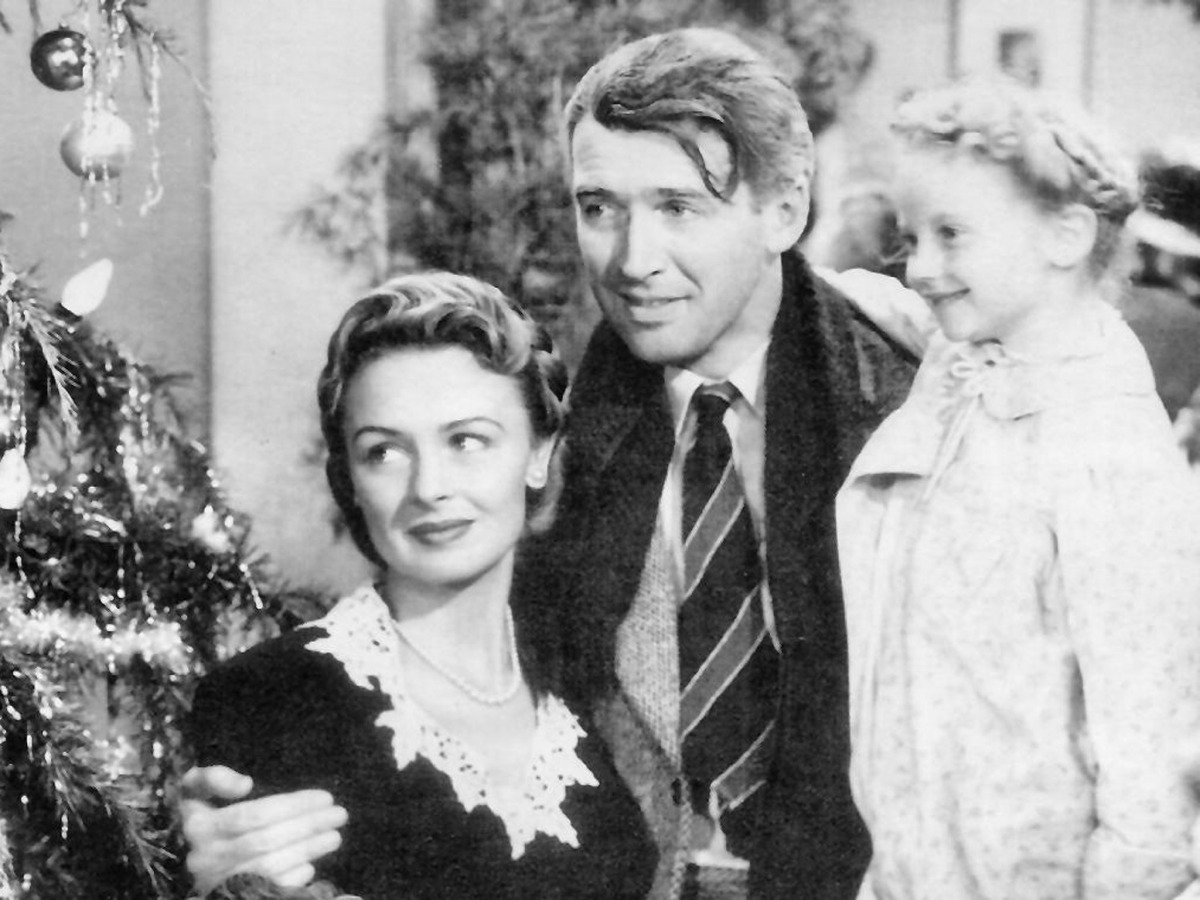
Any yet we cannot give up. Produced and directed by Frank Capra in the wake of World War II, ‘It’s a Wonderful life’ is about a good banker memorably played by Jimmy Stewart, who helps people to build new homes.
Capra, made many great films, but ‘It Happened One Night,’ which came out at the height of the Depression captures a spirit a popular spirit of defiance. So there is cause for optimism in poor folk.
Featured Image: Lunch atop a Skyscraper, Charlie C. Ebbets, 1932.
Souvent, pour s’amuser, les hommes d’equipage
Prennent des albatross, vates oiseaux des mers,
Qui suivent, indolents compagnons de voyage,
Le navire glissent sur les gouffres amers.
A peien les ont-ils deposes sur les planches,
Que ces rois de l’azur, maladroit et honteux,
Laissent piteusement leurs grandes ailes blanches
Comme des avirons traîner à côté d’eux.
Ce voyageur ailé, comme il est gauche et veule!
Lui, naguère si beau, qu’il est comique et laid!
L’un agace son bec avec un brûle-gueule,
L’autre mime, en boitant, l’infirme qui volait!
Le poète est semblabe au prince de nuées
Qui hante la tempête et se rit de l’archer;
Exile sur le sol au milieu des huées,
Ses ailes de géant l’empêchent de marcher.
IV – The Albatross
Often, to amuse themselves, ship crews
Brought aboard Albatross, those great birds of the sea,
And who often were their indolent companions,
As their ships glided upon the bitter waves.
And, almost as soon as they let them out on deck,
How these great sky kings suddenly then appeared ungainly and awkward,
Trailing piteously their great white wings
Like proud useless oars behind them.
These winged voyagers, how they appeared so out of place.
Once the superb plungers, now they looked only comical and stupid.
One shakes her beak about in frustration;
Another mimes, as she clumsily walks, the infirm who fly.
The Poet is rather like these Princes of the Clouds,
Those who would fly above the eye of the storm, smiling
As they look down. Yet, exiled upon the earth,
Their great wings impeding even the most local movements.
Consider the L’Albatros, that most ungainly bird alive, used by the poet as an unforgettable metaphor for when s/he is confined on Earth. Reaching the sky, its natural habitat, it glides for hours without flapping its great wings. This is analogous to the invigoration a poet feels when they are in the act of composition.
Verse Junkies, the name of a publication I came across some years ago, vividly conveys the idea, at least in English. Most proper poets – there are so many pretenders these days – see in this creative act a power, or force, that gives them the ultimate or peak sense of personal achievement; so much so that they come to see themselves –their most fundamental sense of self – as intrinsically bound to the role of poet/artist.
The thematic link with the preceding poem Bénédiction is also clearly evident. This is another singular element to Les Fleurs du Mal in that the poems follow a very close chronological order, almost like a novel.
I can think of no other work, barring Dante’s Commedia and Shakespeare’s sonnets, which approach Baudelaire’s ambition. Petrarch, Pushkin, Walt Whitman and Emily Dickinson come near in terms of scope, I would agree, but there is something all -consuming in Baudelaire’s project which somehow, at least for this reader, leaves those other illustrious poets in his wake.
Perhaps, it is the rather systematic way in which Baudelaire goes through the different topics, or the complexity of the interplay between the poems and the famous correspondences. Thus, after reading L’Albatros, with all its invocation to flight, you turn the page come across Élévation.
IV – ÉLÉVATION
Au-dessous des étangs, au-dessous des vallées,
Des montagnes, des bois, des nuages, des mers,
Par-delà le soleil, par delà les éthers,
Par-delà les confins des spheres étoilées,
Mon esprit, tut e meus avec agilité,
Et, comme un bon nageur qui se pâme dans l’onde,
Tu sillonnes gaiement l’immensité profonde
Avec une indiscible et male volupté.
Envole-toi bien loin de ces miasmes morbides;
Va te purifier dans l’air supérieur,
Et bois, comme une pure et divine liqueur,
Le feu clair qui remplit les espaces limpides.
Derrière les ennuis et les vastes chagrins
Qui chargent de leur poids l’existence brumeuse,
Heureux celui qui peut d’une aile vigoureuse
S’élancer vers les champs lumineux et sereins;
Celui don’t les pensers, comme des alouettes,
Vers les cieux le matin prennent un libre essor,
– Qui plane sur la vie, et comprend sans effort
Le langage des fleurs et des choses muettes !
IV – Elevation
High above the ponds, high above the valleys,
The mountains, the woods, the clouds, the seas,
Out there by the sun, out there by the ether,
Out there beyond the confines of the starred planets,
My spirit, bound with great agility,
And, like a superb swimmer it balms in the waves,
Plunging happily into the immense profundity
With an inexpressible and male voluptuousness.
Fly out far beyond the noxious air;
Go and purify yourself in the stratosphere,
And drink, as if from a divine and pure liquor,
The clear fire which replenishes the limpid spaces.
Leave behind the boredom and the vast sorrows
Which super charge our so unclear existence,
Happy is he who with a vigorous wing can
Fly upward to the luminous and serene fields;
Those which certain thinkers, like larks,
Converge to in the morning to partake in the flight to freedom,
– Who glide through life, understanding effortlessly
The language of flowers, and other mute things.
IV – CORRESPONDENCES
La Nature et un temple où de vivants piliers Laissent parfois sortir de confuses paroles; L’homme y passe à travers des forêts de nite s Qui l’obervent avec des regards familiers.
Comme de longs échos qui de loin se confondent Dans une ténébreuse et profonde nite , Vaste comme la nuit et comme la claret, Les parfums, les couleurs et les sons se répondent.
Il est des parfums frais comme des chairs d’enfants, Doux comme les hautbois, verts comme les prairies, – Et d’autres, corrumpus, riches et triomphants,
Ayant l’expansion des choses infinies, Comme l’ambre, le musc, le benjoin, et l’encens, Qui chantant les transports de l’esprit et des sens.
IV – Correspondences
Nature is a temple where living pillars
Utter at times confused words;
Man passes through the forest of symbols
Which observe him with familiar eyes.
Deep echoes from afar become mixed up
In a dark and profound unity,
Vast like the night and lit through with
Perfumes, colours and sounds respond.
And, they are as sweet as the scent off children,
As soft and as sonorous as the notes emitting from an oboe,
Verdant as prairies, and just as richly corrupted and triumphant.
Having the expanse of infinity,
Like amber, musk, benzoin and incense
Whose songs transport both the body, and the mind.
Correspondances is among the most discussed poems by Baudelaire, and one of the most influential, prefiguring the psychoanalytic schools of Freud, Jung and Lacan, which were to have such a profound effect on twentieth century art and thought.
This one, short poem gives a clear idea of how far ahead Baudelaire was of his time. Rimbaud is the only poet to come anyway close, in terms of mind-expanding conceptualisation. He also embraced the idea, embodied in the poem, of poet as savant and visionary.
The influence of hashish and other hallucinogens, such as opium, which Baudelaire was to graduate to, are in clear evidence in a poem that might explain his popularity in the English speaking world during the 1960s with the advent of the counter culture movement, as hashish and LSD became the drugs of choice among the hippies and beatniks.
Indeed I first came across Baudelaire while smoking hashish on a pretty regular basis just after leaving school. I was listening to the psychedelic music of poets, musicians and bands like Bob Dylan, Jim Morrison and Pink Floyd.
Perhaps, with the increasing popularity of cannabis, having been finally legalised in numerous U.S. States and elsewhere, we will also see a revival of interest in the poet. He might provide a wake up call to the sleep-inducing Woke culture!
Baudelaire wrote extensively on his drug usage, consciously following in the line of writers like Thomas De Quincey and Samuel Taylor Coleridge.
Growing up in 1980s Cork I recall the drug-induced visions, mind-bending in their scope, of William S. Burroughs, foreseeing, like Baudelaire, an apocalyptic future. This, surely, is one of the key signs of a visionary, which Baudelaire certainly was
Now looking around at the horrors of the twentieth century – ecocide, gross inequalities and more – it seems we are not so much inhabiting the world as living out nightmarish, drug-induced prophecies.
Helmut Newton
In the case of Baudelaire I remember very clearly, while living in Paris during the 1990s, the extraordinary images taken by the German photographer Helmut Newton for the Austrian hosiery company Wolford.
They had been lovingly framed and encased in the bus stop shelters used by advertising companies. These latter-day Amazonians, shot in black and white, were illuminated in such a way that at night, when observed from a distance on a passing train or bus, they appeared like ghost emerging out of the smokey haze of one of Baudelaire’s joints; clarifying young eroticised minds.
In these singular images, one could say Baudelaire’s ideal vision of Woman had been realised, and the world had become Baudelaire-ian.
This is another aspect of his genius. Most of us walk around completely unaware of how he shaped the world around us, in particular through the artifacts of the everyday, such as advertisements for women’s tights.
It is through such details that his poetry manifests in the world. Just like when you hear snatches of a song by Léo Ferré emanating from a café, or when a black cat sidles up to you on the street, or when, for example, you hear the ticking of an alarm clock and you imagine the two hands strangling you…
Unaware of the roaring cataract ahead, a small boy splashes in the dark river named Dodder, cheap buoyancy aids on his arms, flailing them in the manner called the dog’s paddle, eyes and mouth squeezed shut, neck stretched to keep his head above the surface. I shout a warning, which he must hear because he squints one eye open, manages an uncertain glance at me before he drops in slow motion towards the froth and blackness below, not screaming. An unseen piano makes clichéd sounds in the background and this musack is the main element that irritates me awake. I already know that all the children are safe in their beds, and this can only be a cheap movie scenario in which I am the small boy.
Even my nightmares are cinematic clichés, retribution for spending most of my life trying to avoid them. It’s a bit late for me to invent a new scenario in which life itself might be a dream, the music not potently cheap, the mise-en-scène not too close to the bone; too late to wake up and start all over again. Best to count my blessings and face the end of my ninth decade with equanimity.
Not much older than me, my island home has survived the past hundred, vaguely independent years before falling over the economic cliff. Despite having lived the greater part of my life in a contented region called Conamara in the waste of Ireland, it is impossible to avoid the suspicion that my personal and cultural identity are also falling to bits.
My fellow-citizens and I have shape-shifted from being the credulous members of an imperial Roman Church, then being shanghaied as reluctant subjects of the British Empire, finally citizens of an embryonic European Empire, which looks like ending up as the Fourth Reich. But unconsciously we are, and have been for many years, carriers of the most recent imperial virus, this time North American. Now, as Hubert Butler predicted many years ago, ‘…there is nothing but Anglo-American culture to unite us.’
In this chameleon state we exist, of course, less in the literal sense than imaginatively which, in the Irish psyche, certainly in mine, tends to be more real. Our new masters’ films – pardon me, movies – and TV shows have filled our waking hours and daydreams.
Not many years ago I counted ninety cinema screens in Dublin in which not a single Irish film was to be seen. The bulk were American. Although I now require subtitles for the more recent manifestations of their staccato, one-phrase dialogue I have not quite mastered the Tarantino fashion of peppering my scripts with four letter expletives. Must try harder.
The empire’s audio-visual avalanche has forged mine, my childrens’ and my grandchildrens’ dialects and tastes. We of an older generation cannot be excused; Jack Nicholson was for long my ideal actor and Humphrey Bogart taught me to smoke fifty years ago.
It should not upset me that my grandchildren prefer Rap to O’Riada. The truths of the three Williams – Faulkner, Saroyan and Goulding – were once gospel to me. American playwrights Arthur Miller and Edward Albee were in my mind long before Brian Friel became my favourite.
We are now fortunate to speak the American dialect of English because we need go no more with our bundles on our shoulders to Philadelphia in the morning. Philadelphia has come to us in the form of Google, Facebook, Pfizer, Hewlett-Packard and the rest of the multinationals, which are now the core of our island’s economic wellbeing as well as a reminder of our anxious dependency.
The fact that up to seventy five percent of the resident I.T. multinational employees are non-Irish, while four hundred thousand of our youngest and brightest have in the last five years slipped quietly away only confuses the matter, but must not be brooded over. At least the multinational surveillance company (SGS) from which I must beg renewal of my driving license is harmlessly Swiss.
Apart from the last exception, our cultural credentials are impeccable. If forty million United Statesians are deluded enough to call themselves Irish we must be entitled to return the compliment and claim documentation as Yankee Doodle Dandies. Unfortunately the US immigration authorities now screen us potential emigrants at source, literally on our native soil in Shannon airport. As Peter Fallon urged – and I know very well I am retooling his context – in a recent poem:
Say never again to The Wild Irish Rover,
No more to The Minstrel Boy.
Give us back our sons and daughters,
Say that Ireland is over.
How fragile our illusions of sovereignity have been, how transformed has been this trading post in the last century, since a teenager named James Toner – along with 200,000 other Irishmen who needed a job – ran away from his home in Dublin to join the British Army. As a private in the Royal Army Medical Corps young James’ task was to collect the body parts of his fellow youths killed among the bloomin’ roses in Picardy. He survived the horror and grew up to be my uncle Jim.
I just looked him up in the British Military Archives.
Conferment of the D.C.M. gallantry award was announced in the London Gazette (1920) and accompanied by a citation:
Award Details: 61586 Pte. J. Toner. During the period 17th September to 11th November, 1918, while acting as a bearer, particularly at the capture of Bohain. There being a congestion of wounded, he repeatedly led forward squads of bearers over very difficult country during the night and greatly assisted in the evacuation of them.
This means that Jim did something foolhardy, at least under cover of night, in the midst of a carnage that was never revealed to us, his nieces and nephews.
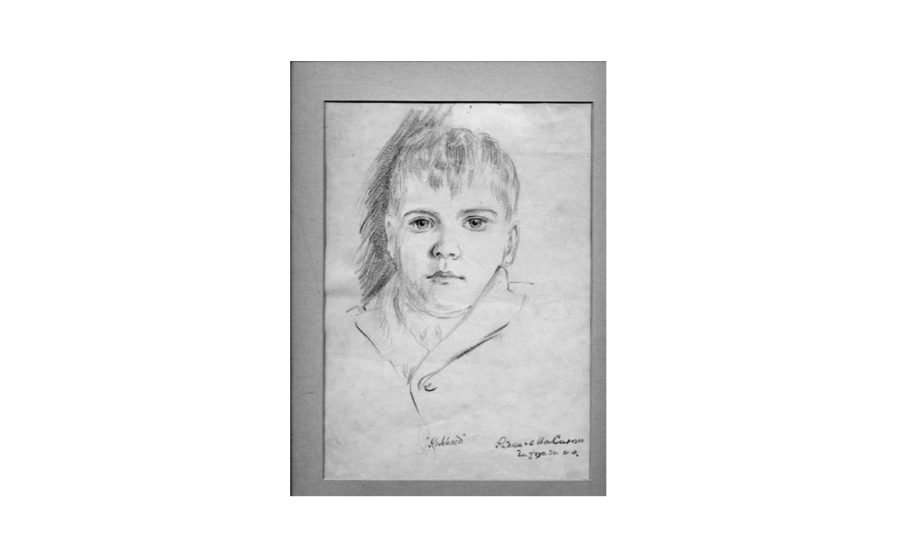
Back in Dublin with a small war pension, Jim married, begat no children and endured Irish patriotic resentment at his fighting for the Old Enemy. Even his brother-in law disapproved of him. When my father made the drawing of four-year-old me, Jim was not impressed. He acidly pronounced: “The boy may be alright, but he has the head of a bloody rogue.”
I overheard that remark and worried about it. Surely he was joking? Or was he envious because he had no children himself? I now surmise that it was general bitterness because nobody, especially not my father, wanted to hear about the horrors Jim had witnessed in France. He had been informally decreed an Irish traitor in the British army.
Sometime in the 1950s he decided to abandon his golf, at which he was local champion, and his buoyancy aid, whiskey, and put an end to the pain that was identified too late. It is now called post-traumatic stress disorder (PTSD) and is applied to the euphemism ‘veteran’. Uncle Jim put an end to his pain with the aid of a gas oven.
There are other associations. When the British army abandoned our sacred soil in 1922, Uncle Jim’s sister Kathleen ran away with her boyfriend, a Tommy named George Thomas.
A possible fatal attraction was the fact that both of their fathers kept pigs; science now says that personal odour is a most powerful sexual signal. I met the ageing lovers in their home at Abingdon, Berkshire in 1964 when Uncle George unexpectedly said to me: “I glory in you, Bob.”
I think he meant that I appeared not to have inherited my father’s prejudices against the English. He was wrong; our parents’ prejudices are lodged in our DNA but, as a form of energy, can happily be redirected at more fitting targets, such as the English Public School system and all their imitators closer to home. Oh, the bitther word!
When World War II (like War Number 1, a civil war between blood brothers, the Germans and the English) came along, one of Uncle George’s sons, Sidney, enlisted as a teenage frogman and acted, at nineteen, as one of those cockleshell heroes who attached limpet mines to enemy ships. He became a hero of mine and survived to produce a pretty daughter named Cathy whom I subsequently persuaded to elope with me briefly to Ireland where we had midnight swims at Killiney beach and were referred to as kissing cousins. Cathy later married a Red Devil, one of those RAF people who put on daring aerial displays.
These connections make me wonder if I am not still a bloody rogue and worse, a fellow-traveller of that suspect class, a West Brit rather than a putative citizen of America.
For a start, I was born in the Pale: Dublin and its environs. My first language was English, albeit in a dialect light years away from the BBC accent, whose Home Service provided most of my childhood listening pleasure; Radio Éireann broadcast only a few hours per day.
My early reading was what we called the comicuts, The Rover, The Hotspur, The Eagle, all published in England. My favourite authors were Robert Louis Stevenson, Arthur Conan Doyle, G.A. Henty, Agatha Christie, P.G. Wodehouse, John Wyndham, Leslie Charteris and so forth. Even the Irish language detective story writer Reics Carlo, who was obligatory reading in school, turned out to be English.
But as I grew up I betrayed them all for the likes of Irwin Shaw, Kurt Vonnegut, Norman Mailer and Hemingway, and now I know I’m a virtual Yank. I assure you that this is less a form of ingratiation with the American Chamber of Commerce than one of realisation and resignation. No problemo.
There are more ingredients in this cultural Irish stew.
Among our official heroes, Pádraic Pearse’s father was from Birmingham; James Connolly came from Edinburgh and James Larkin was a Liverpudlian. No wonder I am ambivalent about nationalism, Irish, English and American and still cling to that long-lost cause: socialism.
The last night of the Proms in the Albert Hall disturbs me, with its sea of Union Jacks and Hooray Henrys rendering Land of Hope and Glory – because I am moved by Elgar’s music (although he did not write the lyrics, which are as Kiplingesque and vainglorious as Deutschland Ueber Alles).
When filming American schoolchildren with their hands on heart, reciting the daily oath of allegiance to their flag, I am also uneasy. Indoctrination of the unruly young starts early on that continent but, by contrast, nationalism has in recent years become a vulgar word in Ireland.
How do the British and the Yanks get away with their jingoism? And where, apart from everywhere and nowhere, do we Irish really fit in? To those who, like myself, find all of this disconcerting I say, cop on, get a life, get the message, get over it, get with it, and other such novel and useful imperial edicts. No worries.
Staying for a moment with the phenomenon of British and American nationalism, I wonder if the answer may not be that they were both empires whereas Ireland’s only imperial conquest was spiritual – mainly among the black babies of Africa – and that appears to have been erased by our national amnesia. As very soon must happen to me as, dragging my feet like a reluctant schoolboy, I approach four score and ten, intending that looming watershed to be more an act of defiance than any petty celebration.
On my ninetieth birthday I shall beware of those who say: “You’re looking great, haven’t changed a bit.”
My exact contemporary, the late Ben Barenholtz, a survivor of Naziism and a New Yorker, who produced Coen brothers’ films and gave me a present of a book of all of Cole Porter’s lyrics, told me that he has an ex-friend, a liar who has said exactly the same thing to him every year for the past twenty years.
The astonishing thing about this compliment is that we ancients believe it. We skip and dance down the road until we are forced to pause, whereupon we resemble the silent nun in Elizabeth Jenning’s poem who was breathless with adoration. We oldies, by contrast, have merely run out of breath, full stop, or period, as I should really learn to say.
The truth of the above platitude, ‘yourelookingreathaventchangedabit’ is simply this: we are decommissioned. Joseph MacAnthony has described our aged generation as tourists in the departure lounge. We exist, persist, only in our anecdotage.
Who would have thought that little Riobárd, the boy in the drawing, would survive so long? Certainly not himself, whose life expectancy as a film and TV maker was long ago estimated by an insurance Actuary to be no more than forty five years.
What matter that this little Jackeen has spent more than half his life in the least colonised part of Ireland – the Gaeltacht of Conamara which, paradoxically, he has long known to be spiritually and economically closer to Boston than to Dublin.
Who gives a tinker’s curse that the Jackeen in question, having read so many comments, references, articles, essays, even PhD theses about his minor oeuvres, now dares to give his version of the story? But age confers a protective veneer of immunity, anonymity, even a kind of invisibility on the elderly so one is free to say what one likes.
As Kurt Vonnegut – who in one of his modest communications to me referred to himself as an old fart who smokes Pall Mall – put it: “Old men are obscene and accurate.” We can experience a kind of lightheaded bliss when we notice our fuel gauge moving towards empty and we can offload petty concerns.
The present words are thus an act of memory, which is equally an act of imagination and may be approached academically as sub-Proustian because although my life sentence has been long these sentences are, with a few exceptions, not.
I also possess unlimited memorabilia – photos, letters, diaries, the usual bric-a-brac of a life – which may save me from downright lying. Besides, there are those modest films which constitute aides-memoire and, not least, may be treated as having been personal buoyancy aids, otherwise described as vain aspirations.
I occasionally wonder, as I float towards the brink of the cataract, if I do not exist in some other, gentler person’s nightmare?
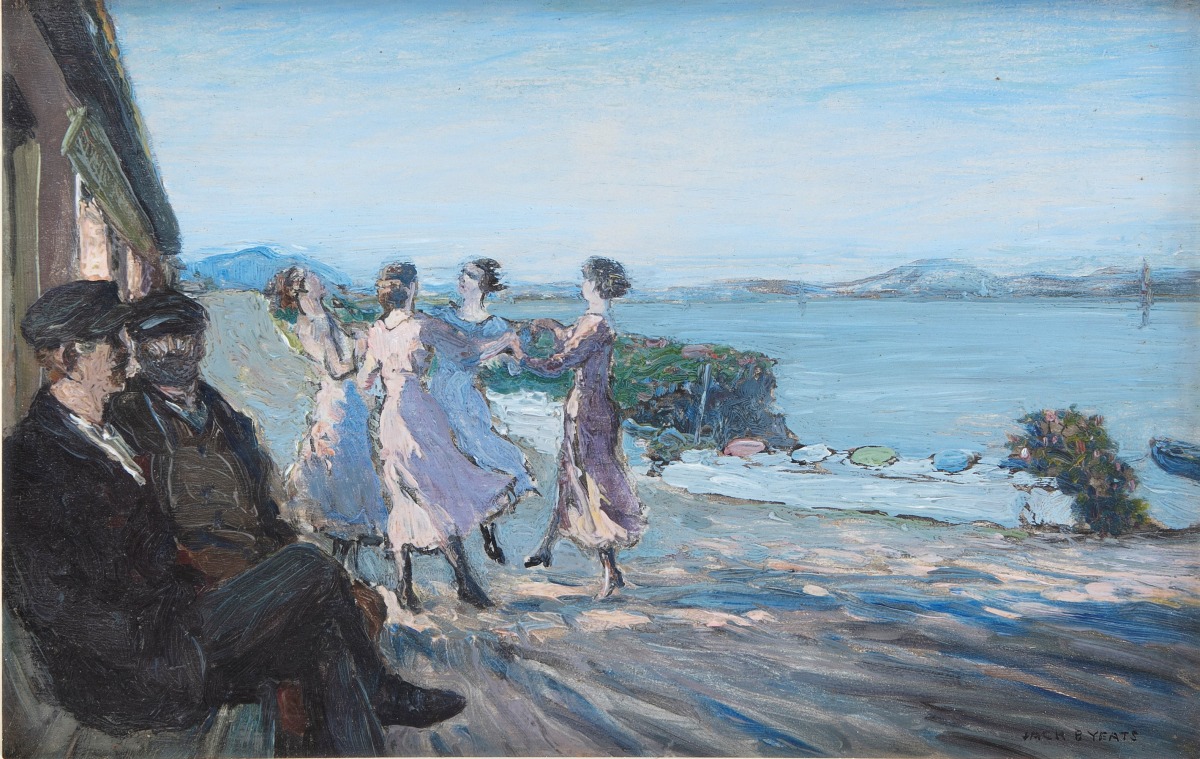
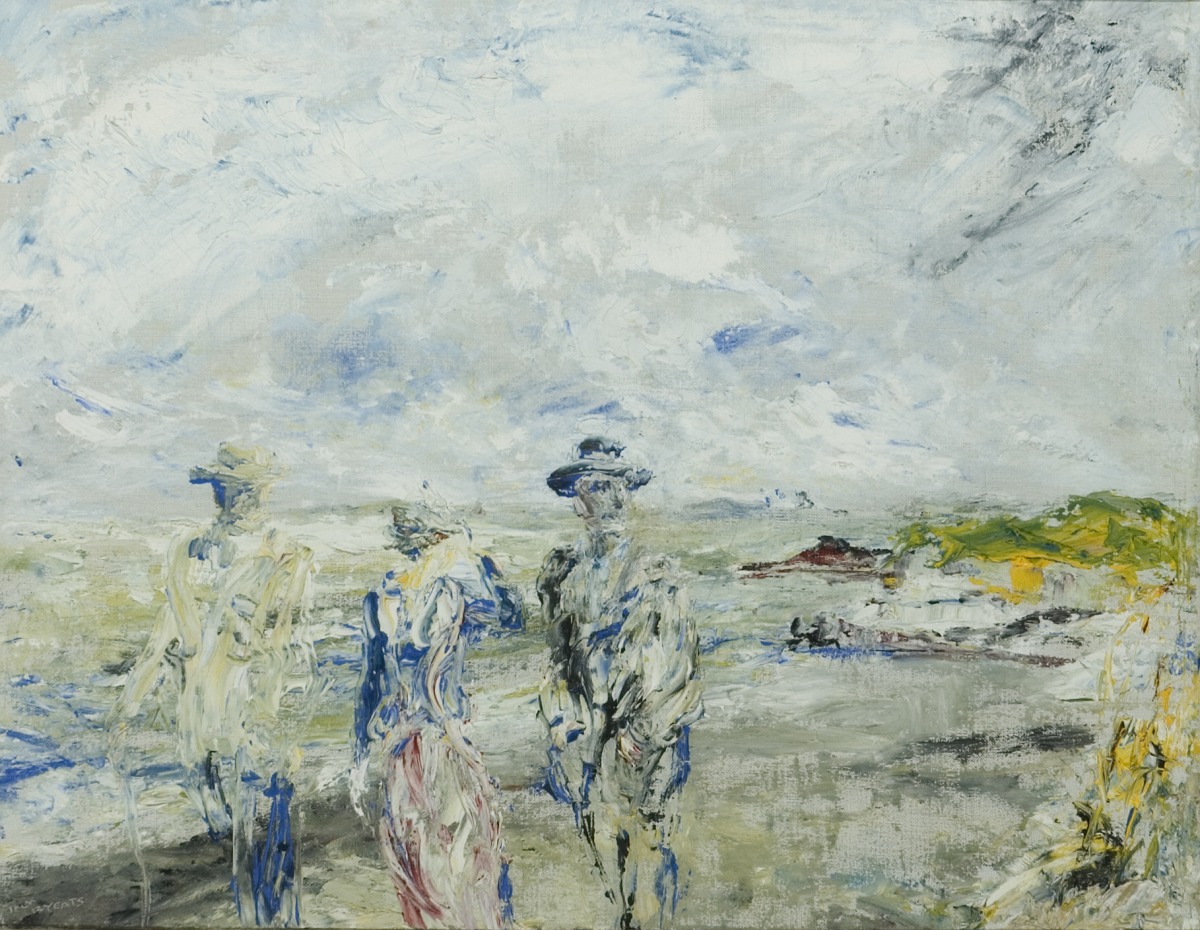
Often overshadowed by his elder, Nobel laureate, brother W.B., Jack Butler Yeats occupies an exalted position among Irish painters. ‘Jack B. Yeats: Painting & Memory’ is a new exhibition in the National Gallery commemorating the one hundred and fiftieth anniversary of the painter’s birth, and exploring a stylistic evolution that draws on both Irish and British scenes.
Jack was born on August 29th, 1871 into a marriage of two Irish Protestant families, the Yeatses and the Pollexfens. Whereas the Dublin Yeatses embodied a faded aristocracy, priding themselves on genealogically questionable claims of descent from the Dukes of Ormonde, the Pollexfens were of a more recent vintage, having come to Ireland in the eighteenth century, finding prosperity through their shipping interests.
Each of the surviving children of moderately successful portrait painter John Butler Yeats and Susan Pollexfen made significant marks in their respective fields, perhaps compensating for their father’s relative obscurity, and profligacy.
W.B. emerged as an illustrious poet, anointed by John O’Leary to lead the Celtic Revival, while Jack B. became a successful illustrator and painter from his early twenties, while their sisters, Lilly and Lolly, set up the Cuala Press and were leading lights in the Irish Arts and Crafts movement. All must be counted as important figures in what was an Irish Renaissance of sorts that sought, partly to distinguish and partly to create, an Irish cultural identity distinct from that of England’s.
Jack’s career sailed independently of his siblings, a state of affairs conditioned by his childhood. The historian R.F. Foster writes that Yeats’s ‘childhood was disrupted by his removal for eight years to Sligo, where he was brought up in close proximity to his grandparents. This probably conditioned his artistic development; it also conferred a certain distance from the rest of the family, particularly his brother.’ (R.F. Foster, W.B. Yeats: A Life, p. 14).
Later in life, Jack diverged sharply from his brother’s political opinions, holding to an anti-Treaty stance in the Civil War, in contrast to W.B. ‘s support of the 1922 Treaty, and later service to the state as a Senator.
There is already a room devoted to Jack B. Yeats in the Milltown wing of the National Gallery, available to view with a free general admission ticket. Here, twenty of his paintings are on permanent display.
The new exhibition features a much larger selection of eighty-four paintings, many of which are on loan from private collections or galleries overseas. As such, it offers a rare chance to view many works that have not been on display in Ireland for some time.
I had the opportunity to speak with Donal Maguire, co-curator (along with Brendan Rooney) of the exhibition. Donal revealed the rationale for the exhibition’s lay out, including the decision to focus exclusively on his oil paintings, and Jack B. Yeats’s role in forging a national Irish identity in the early twentieth century.
After rejoining his family as a young adult, Jack enrolled in a number of art schools. The skills he acquired as a draughtsman, allied to natural ability, earned him a decent living through contributions to a number of London magazines.
At this time the majority of his output was in drawing and watercolour, often depicting the colourful side of everyday life. Country races, market fairs, and circuses feature, depicted predominantly in a realist style. His first exhibition in 1897 won him immediate acclaim from sketches and watercolours, depicting bucolic ‘scenes of racing, boxing, fairgrounds, cider-making, children, and animals.’ (Bruce Arnold, Yeats, Jack Butler, Dictionary of Irish Biography).
Near the turn of the century, Jack married Mary Cottenham White, who he had met while at art school. The young couple eventually chose to settled down in Ireland. Unfortunately, depictions of equivalent scenes from Irish rural life did not meet with similar success. It was not until the 1920s, after Ireland’s independence brought a greater appetite for articulations of Irish life and characters, that Jack’s career took off.
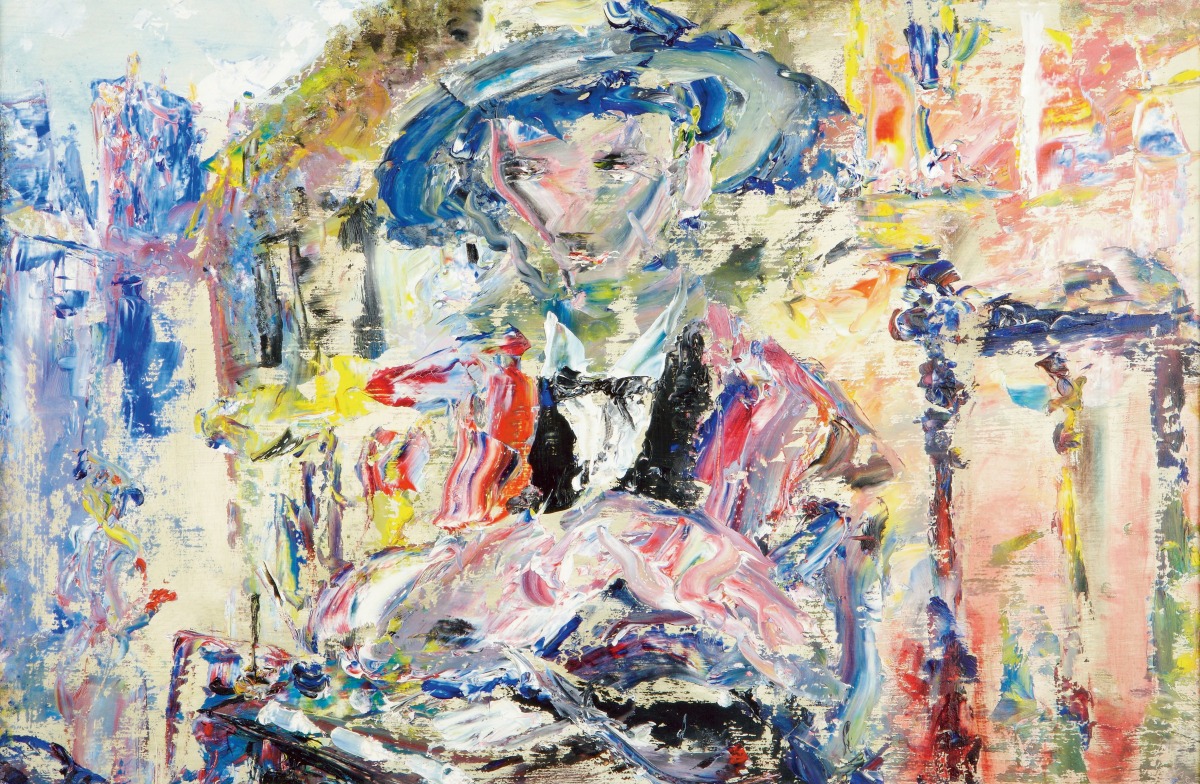
Jack began to take a serious interest in oils only after settling down in Ireland. After adopting the medium, however, it became his dominant artistic language. From the 1920s onward, his manner of painting became increasingly tactile and expressionistic, inspired by the Modernist movement. By the end of his life, he was producing vast canvases in oil in a highly idiosyncratic style, with increasing recourse to esoteric subjects from folklore and mythology.
With such a clearly definable narrative arc to his career, it is common for Jack B. Yeats’s work to be exhibited in a manner that emphasises his development from sketches, to watercolours, through to increasingly expressionist oil paintings. With this exhibition, however, Maguire and Rooney saw an opportunity to take a different tack
“We decided very early on that the show wouldn’t be hung chronologically”, Donal Maguire informed me. “Exhibitions give you the opportunity to look across a practice and see connections that are twenty, thirty, or forty years apart,” he said.
The theme of memory was chosen as the central focus of the exhibition. Oil was the material Jack B. Yeats painted with during the final half of his career, and paintings commonly feature scenes drawn from earlier periods in his life, particularly the experience of growing up in Sligo.
A non-chronological approach to laying out the paintings serves to emphasise the associative, non-linear quality of memory.
“Memory isn’t a linear thing,” Maguire observed. “It’s relational. You connect things from across different periods of your life. Certain things pop out, or are remembered more strongly than others.”
In each of the five rooms of the exhibition, works from different decades of Yeats’s life engage in a fascinating conversation with one another. The most striking example is the sequencing of ‘The Barrel Man’ (1912) and ‘Humanity’s Alibi’ (1946). Without the earlier, realist depiction of a rural festivity, involving a man fighting off sticks being aimed at him from the safety of a barrel, the origin of the expressionistic painting of the 1940s, with the headscratcher of a title, would be difficult to fathom.
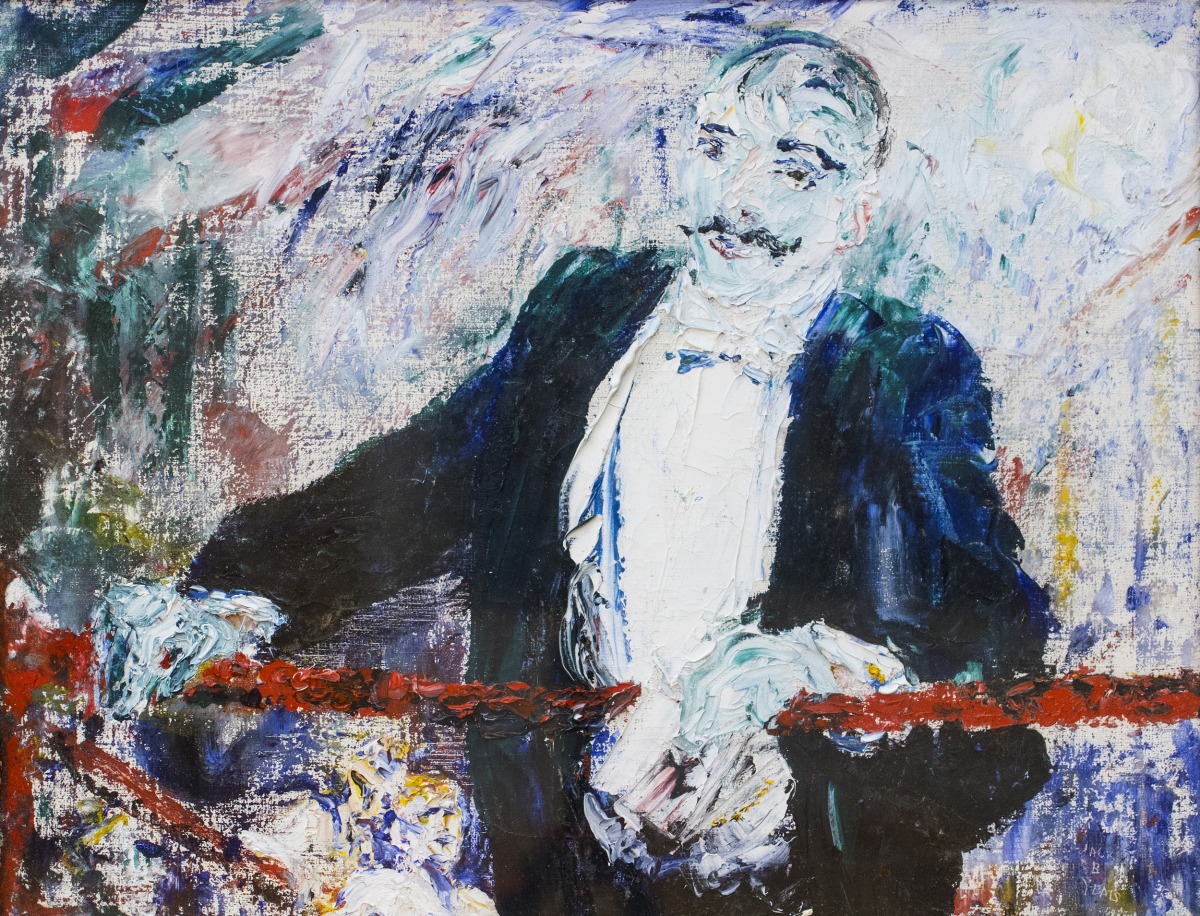
The remarkable ‘The Public Letter Writer’(1953) appears to be an example of what Maguire means by certain memories standing out more than others . He notes that this painting was “painted from a memory fifty years earlier that he never sketched. It was a memory of seeing this person on the street in New York, and fifty years later he decided to return to it.”
The vagueness of memory is conveyed by the hazy, almost hallucinatory character of the painting. The figure is less a real person than a character from a nightmare. Whereas the expressive depiction of the figure in ‘Humanity’s Alibi’ suggests a memory that has been mulled over beyond the point of reason – overloaded with metaphorical possibilities – the manner of ‘The Public Letter Writer’ is for Maguire suggestive of “a memory which isn’t fully formed.”
This is achieved through a particular technique according to Maguire:
He painted with thick paint, but also with very thin paint. It’s the contrast of the two that gives it this interesting effect. You have very thin brushstrokes, or dry brushstrokes, and then suddenly a very thickly applied stroke over it. There’s interesting layers of paint there, that seem very fragile at times, or without much structure, but they’re all held together by an overall picture.
Exhibitions of this sort require years of preparation. Ideally, Maguire told me, a three year lead in is required. It is thus difficult to read topical applications into its staging.
Before the interview, I had wondered if the exhibition of a quitessentially Irish artist was related to a drop off in foreign visitors to Dublin since the COVID-19 pandemic. As it happens, it is fortuitous that the National Gallery is giving Irish people a chance for introspection.
While the theme of memory reflects the preoccupation of the subject in Jack B. Yeats’s paintings, it also provokes us to interrogate what role the painter occupies in our cultural memory.
Jack, B. Yeats now occupies a rarefied position in Irish culture. His works are on the Leaving Cert Art curriculum, just as you’ll find his brother on the English curriculum. This stature was not self-evident in his own lifetime, however.
Bruce Arnold writes bluntly of Yeats’s career in the 1910s: ‘His work did not sell. From a professional point of view his and Cottie’s decision to settle in Ireland had not been a success.’ Even after critical acclaim in the 1920s, ‘the resources to buy [artwork] were thinly spread in Irish society at the time, particularly those interested in modernism, and Yeats’s work did not sell at all well. His output, substantial during the 1920s, fell off in the following decade, and in a mood of self-doubt he turned to writing.’
It wasn’t until a successful 1942 exhibition that he came to be regarded as a great Irish artist. Even then, his reputation declined after his death in 1957, until it was revived by a significant National Gallery exhibition in 1971.
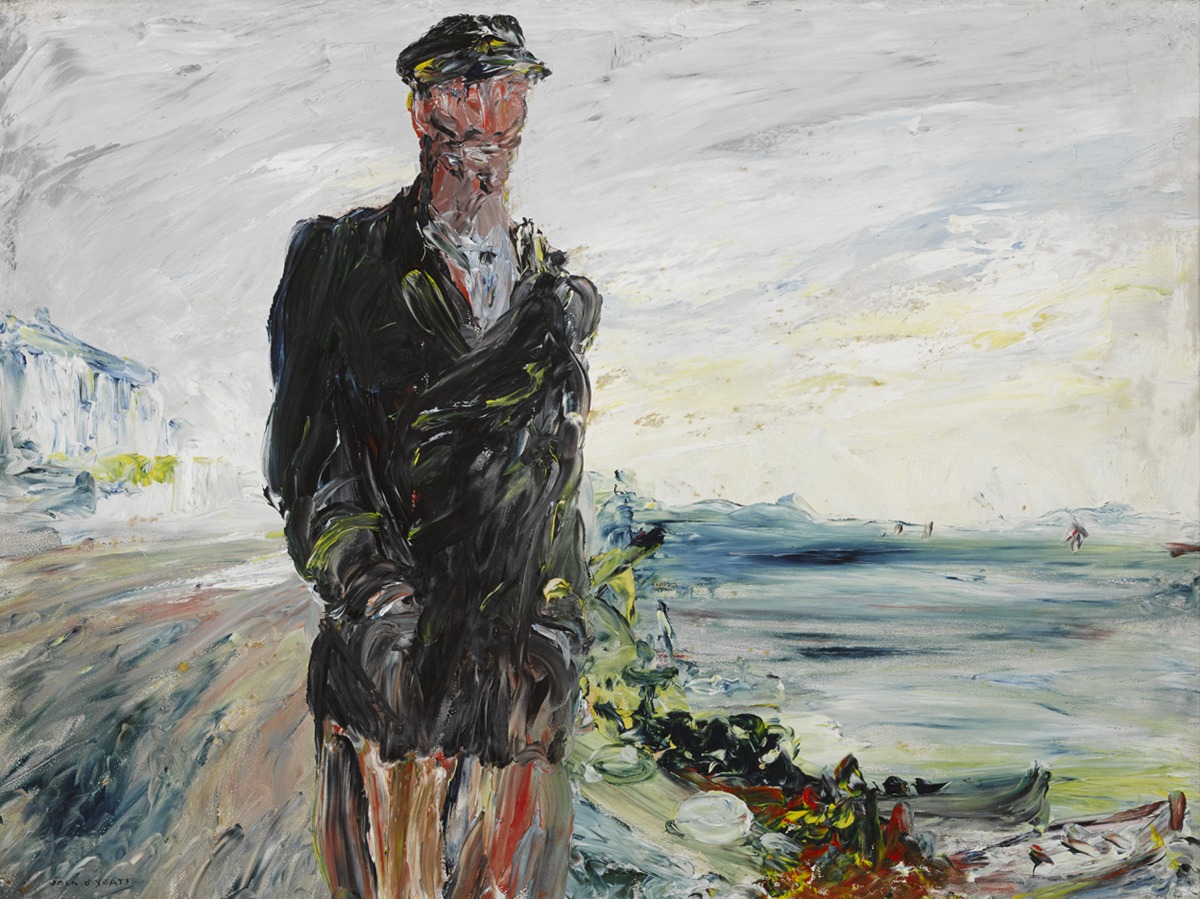
Fifty years on, the artist is still celebrated, but for perhaps different reasons than in the 1940s. We may still appreciate his ground-breaking work that reacted against sentimental nineteenth century depictions of rural life. But attention to curiosities of rural life might still be considered distasteful, even kitsch. Therefore, rather than being charmed by what may now be considered benignly nationalistic, it is the ambiguities within the oeuvre that still speak to us. Here we find the hallucinogenic letter writers; the sinister boatmen who stare the viewer down; the master of ceremonies chalky in the spotlight; an odd cast of characters that seem to stand with one foot in the thick of everyday life, and one foot in the most whimsical of dreams. Insofar as they are alien to us, these figures still have something to say.
Maguire explains Yeats’s enduring appeal to contemporary Ireland: “People enjoy the expression and experimentation and risk taking that’s in it.”
It might be this numinous quality that will ensure their longevity. “Yeats allows you to develop your own interpretation, through your own imagination, of what these pictures are about.” Maguire comments.
In many of Jack B. Yeats’s paintings, “He doesn’t give you a lot of information,” Maguire said, providing only enough information to pique your curiosity. Although “there are little clues to lead you in a particular direction, like with the title, a particular figure, or element in the picture. But there always seems to be some sort of secret there, or something that’s not being fully revealed.”
Even among those of us with visual cortexes fried by twenty-first century technologies, Jack B. Yeats’ works allow access to powerful imaginative vistas.
The use of colour at times astonishes, the character studies are fascinating, and the focus on everyday scenes allows for surprisingly personal moments of connection.
Maguire urges anyone going to avoid getting:
too distracted by the imagery of what he’s making, but allow yourself to appreciate how the painting is made as well. Not to be frustrated by, but to enjoy the technique and the brushwork, and the experimentation with the medium. How fragile it can seem, but at the same time very bold and expressive. It’s that material quality that people should really take time to enjoy in his work, because you can really lose yourself in it.
The exhibition runs until February 6th, 2022. Tickets range in price from €5 up to €17 for an adult weekend ticket. Discounted prices are available for students, jobseekers and pensioners. Tickets are significantly cheaper during the week than on weekends, and there’s even a chance to see the exhibition for free on Mondays between 11am and 2pm, if you can manage to book a slot during that period.
What do I want from you? Why do I write this text? Is it because I want to share something, or because I was told to? In considering how ‘you’ will read it, (‘you’ hopefully being someone other than ‘me,’) I would like to share some things relating to the development of viewership and audience engagement.
This is by no means a definitive list, rather, a haberdashery of sorts, my own narrative stitched through the history shelves into relevant spines, to prop up against my own bar, serving tall pints poured with personal narratives. How academic!
Good Performance
The majority of good performance dictates to its audience how they must act. Rather than being something written down in a pamphlet to digest and practice pre-show, the way you should watch the performance has been defined through the performance itself.
Live, in the moment. The only way to learn the new terms of engagement is to attend, to witness, to participate (or not participate), and most of all, to act.
It’s like ballroom dancing with a good dance partner, the leader leads, the viewer follows. Dance with a bad dancer, however, and you might be inclined to rebel, to revolt or to leave the dancefloor. I think it was Chekhov who said, show the audience a gun in the first act, you had better use it in the third.
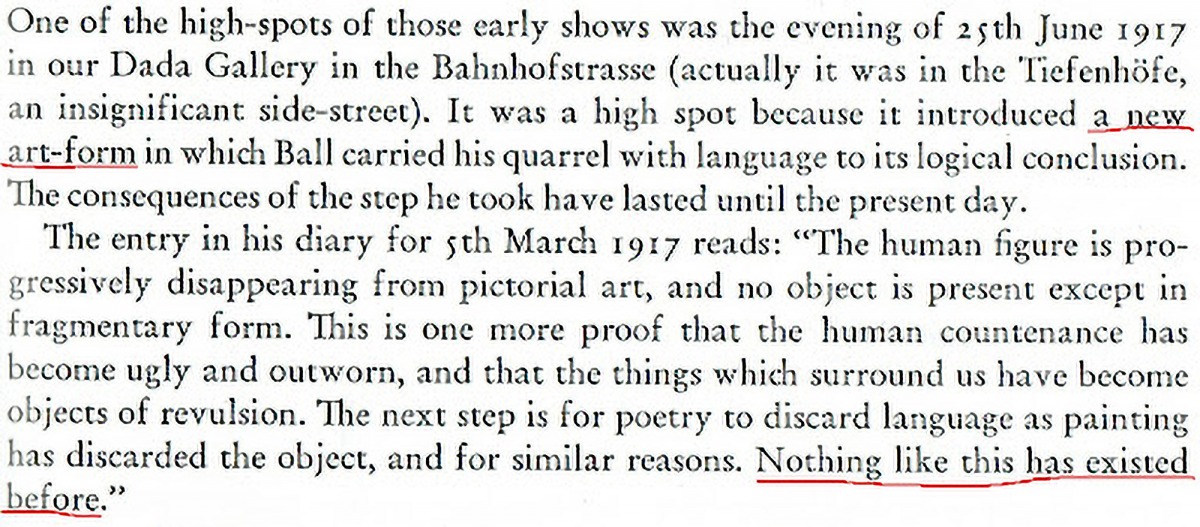
I draw your attention to Hugo Ball, dressed up in a cardboard cylinder to perform his abstract phonetic poem ‘O Gadji Beri Bimba.’ It caused chaos among audience members as they just did not know how to react, what to take seriously, how to engage.
Language, the motherload of culture, the determiner for how we think and communicate, whittled down into a collection of sounds chirruped and chanted by an obelisk shaped man. The ramifications were huge, to challenge the central pillar of communication, attacking it in such a way, also challenged the perspectives which we garner through language, behaviours, nationalism, politics, history, etc.
How do we perform (via language) in our everyday lives after that, knowing that it has been called out for being insincere? Ball wasn’t the first artist to use this medium, before him there was Marinetti, with his ‘Zang Tumb Tumb,’ and also Russian Futurist Aleksei Kruchenykh’s
Zaum language in ‘Victory Over the Sun.’
Language strikes again:
Hans Richter. Dada, Art and Anti-Art.
Marinetti and the Futurists
Marinetti and the Futurists welcomed heckling and shouts from their audience. The viewer was crucial to the performance, so much so that they would glue them to their chairs, patches of trousers and skirts screaming off as tempers tore.
They wanted to break the compliance of passive consumption, of blind acceptance, and so agitating the viewer towards a riot was a crucial factor in their performance. This focus on the role of the viewer as a fundamental component echoes throughout the twentieth Century, most notably with Bourriaud’s Relational Aesthetics. In stating that the only way to truly engage with an artwork was to be a part of it, this movement placed the viewer centre stage, the artwork’s legacy depending on their enthusiasm. Only then could the artist be sure that responsible viewing had been contracted.
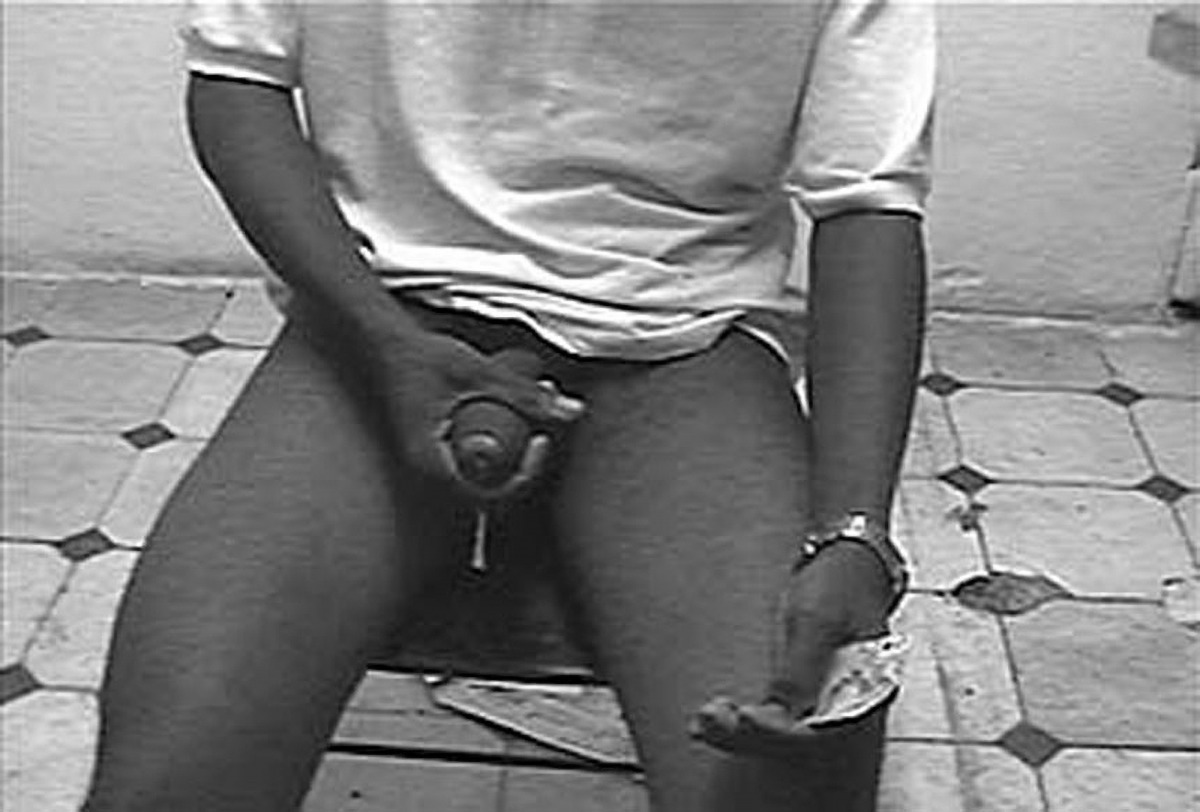
Relational Aesthetics also sought to display the network of relationships necessary in creating a work of art, to blur the boundaries between negotiating the piece as creator, and negotiating the piece as viewer. But, as Claire Bishop pointed out, simply making us aware of these negotiations does not necessarily introduce a form of criticality in that it does not define what types of relationships we are looking at, if they are equal, or democratic. She criticized the vagueness of many R.A artworks, but held up Santiago Sierra as a successful Relational Aesthetics artist, for showing the subversive, and sometimes unequal transgressions that happen in many negotiations.
‘Ten People Paid to Masturbate,’ Santiago Sierra. Cuba. 2000
Roman Britain
‘The Romans in Britain’ when staged in 1980 at the National Theatre was sued by Mary Whitehouse, who accused the director Mr Bogdanov, of procuring an act of gross indecency between two males actors in the play.
The fact that no act really happened, (there was a simulation of a male rape scene) did not seem to matter, nor did the fact that Mrs. Whitehouse never actually saw the play. Her moral stance overrode these factors, and she felt obliged to tackle the theatre for staging a play which she considered unnecessary and indecent.
Fortunately, the court ruled in favour of the theatre. It was the first male rape scene to ever appear on a stage in the UK. Accounts from the opening night speak of nine hundred audience members, not shouting or walking out, but sitting frozen for the remainder of the play. ‘The atmosphere was later compared to the night in London theatres when it was announced before curtain-up that JFK had died.’
There have been recent attempts by morality campaigners to ban theatrical productions (e.g. ‘Behzti’ UK, 2004, ‘Jerry Springer, The Opera,’ 2005, and ‘Sur le concept du visage du fils de Dieu’ Paris, 2011), which brings back to the forefront the question of censorship, and deciding what narratives are appropriate for audiences today.
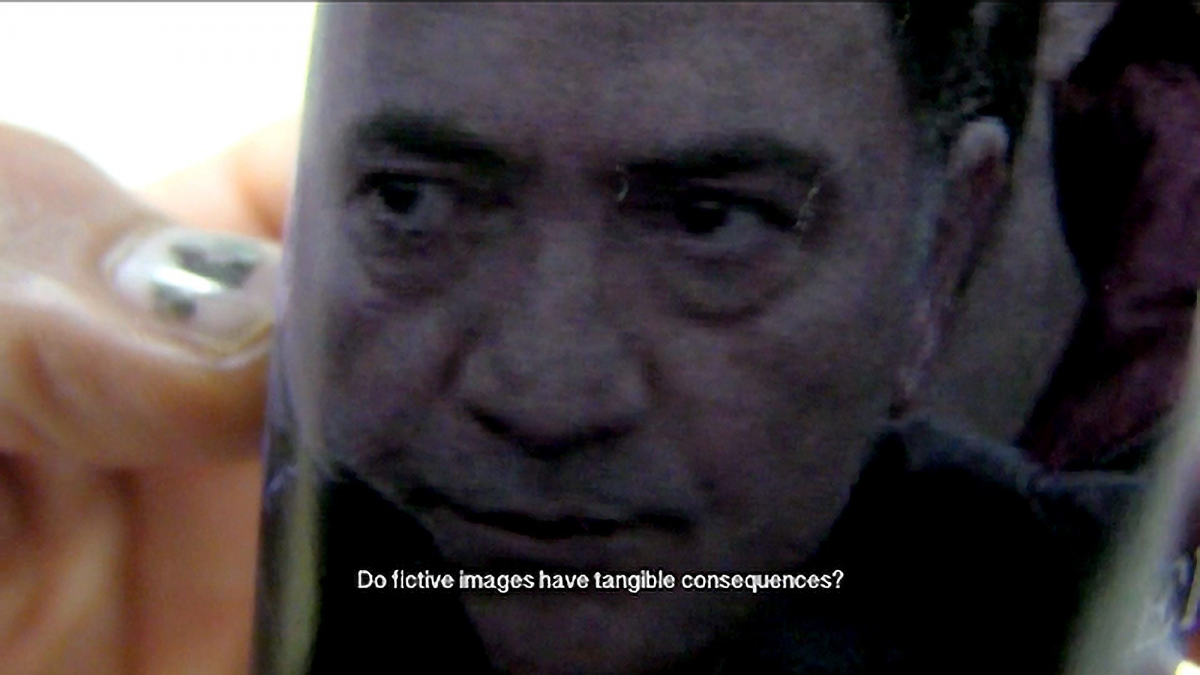
A group exhibition I was part of in Turkey 2016, ‘Post-Peace,’ was cancelled last minute by the institution, Akbank Sanat, deemed to be too culturally insensitive to stage. The offending artwork ‘Ayhan and me’ by Belit Sağ, is a video created from news archives which showed a Turkish police officer bragging about killing Kurdish people.
Belit Sağ. Ayhan and Me. 2016
In this age of fake news, and political correctness, it is more important than ever that we don’t treat audiences as children. Which begs the question; is engagement with morality absent from the modus operandi of our times?
Representing the Immoral
Art has a necessary role in presenting situations that challenge and provoke, it is through these provocations that a society sets its standards of behaviour. Rather than questioning the role of morality in art, (which doesn’t exist,) in order to be relevant, art must, to some extent, represent the immoral.
These provocations offer the possibility to stimulate reflection on and discussion around what is acceptable, and what is not, and why not. Without this avenue culture becomes something that we consume, the same way we consume McDonalds, or a Coca-cola.
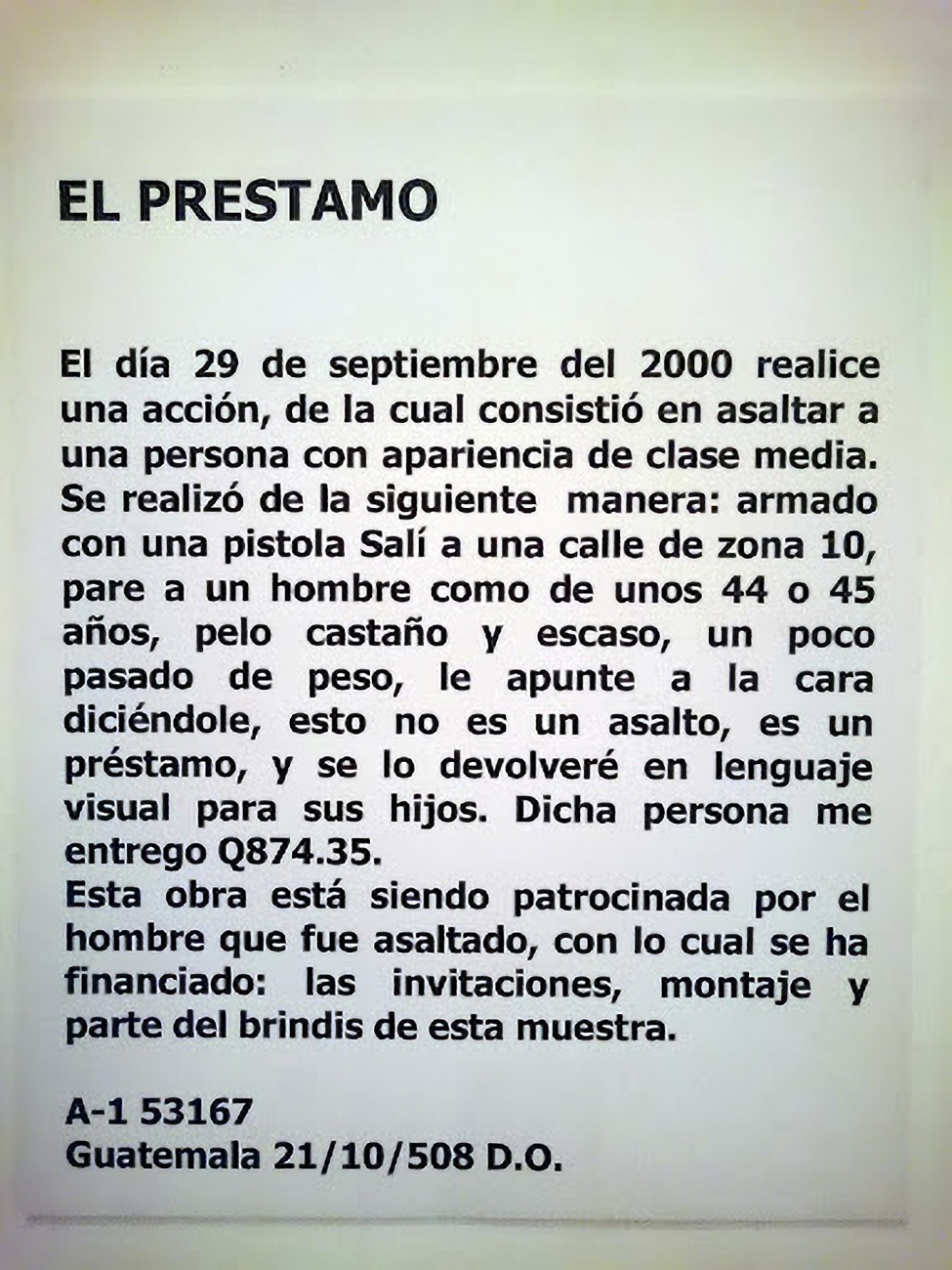
Placing the artwork in a way that the viewer can have the maximum opportunity to be aware of their role is, for me, the ideal. Here I think of Guatemalan artist Aníbal Lopez (a.k.a. A-1 53167.) For the piece ‘El Préstamo (The Loan) (2000)’ situated in Guatemala City, the artist robbed a citizen on the street at gunpoint, and used the stolen money to pay for an exhibition at Contexto. This included invitations, installation, a lavish opening reception, all paid for by this victim, now unwillingly performing as patron. Upon arrival at the exhibition, the audience learned these events through a poster on the wall, the only visual piece on display. The attending viewer became complicit in this crime by participating as viewer, and as consumer. Which makes me wonder about complicity and the act of spectating: Are not all audiences complicit?
THE LOAN. On the 29th day of September, 2000, I did an action, which consisted of assaulting a person with the appearance of middle class. It was performed in the following way: armed with a gun I went out to a street in zone 10, stopped such a man of about 44 or 45 years, brown hair and a little overweight, I pointed in his face and told him, this is not an assault, it is a loan, and will bring visual language to your children. Such a person I call Q874.35. This work is being sponsored by the man that was assaulted, who has funded: invitations, assembly and part of the toast of this sample. A-1 53167 Guatemala 21/10/508 D. O.)
Perhaps this is why the most popular form of viewing has remained the same for over a hundred years, since The Moscow Art Theatre reformed the relationship between the viewer and the stage.
Stanislavski nailed the fourth wall up and many have been banging it down ever since. The ramifications of this wave have crashed through into other art forms, television, cinema, and sometimes, contemporary art, with many collectives fighting its wake to establish other ways of viewing. This invisible wall, invented by this collective, removed the necessity of communicating directly with the audience, establishing instead an experience where the viewer is required to watch this bubbled environment, creating an altogether more realistic performance and allowing for suspension of disbelief. The audience arrive and become silent observers, flies on the wall with no responsibility.
It remains, however, the most popular way of watching something today, this disengaged mode and you may ask, should it be so?
At this moment, culture cannot serve as a salve for nervous souls, even if the (then) President elect tweeted his disapproval of Broadway actors for using the theatre to communicate their doubts about his future administration.
Art’s particular license to speak up, to misbehave, mock and imitate reality, to blur genres and disciplines, this freedom, as long as it lasts, must be deployed to prevent the normalization of the emerging authoritarian paradigm.
To recap…
Violate language and communicate it. Curse your audience and kiss their throats. Question what you’re watching. Attack ‘appropriate’ narratives by telling the truth. Replace complacence with awareness. Leverage weakness to break power. Attack acts of gross indecency by staging acts of gross indecency. Take an axe to axioms. Swallow bubbles for breakfast. Divorce disengagement.
Ask in the taking, instead of begging for scraps under the table, howl at the edges of town.
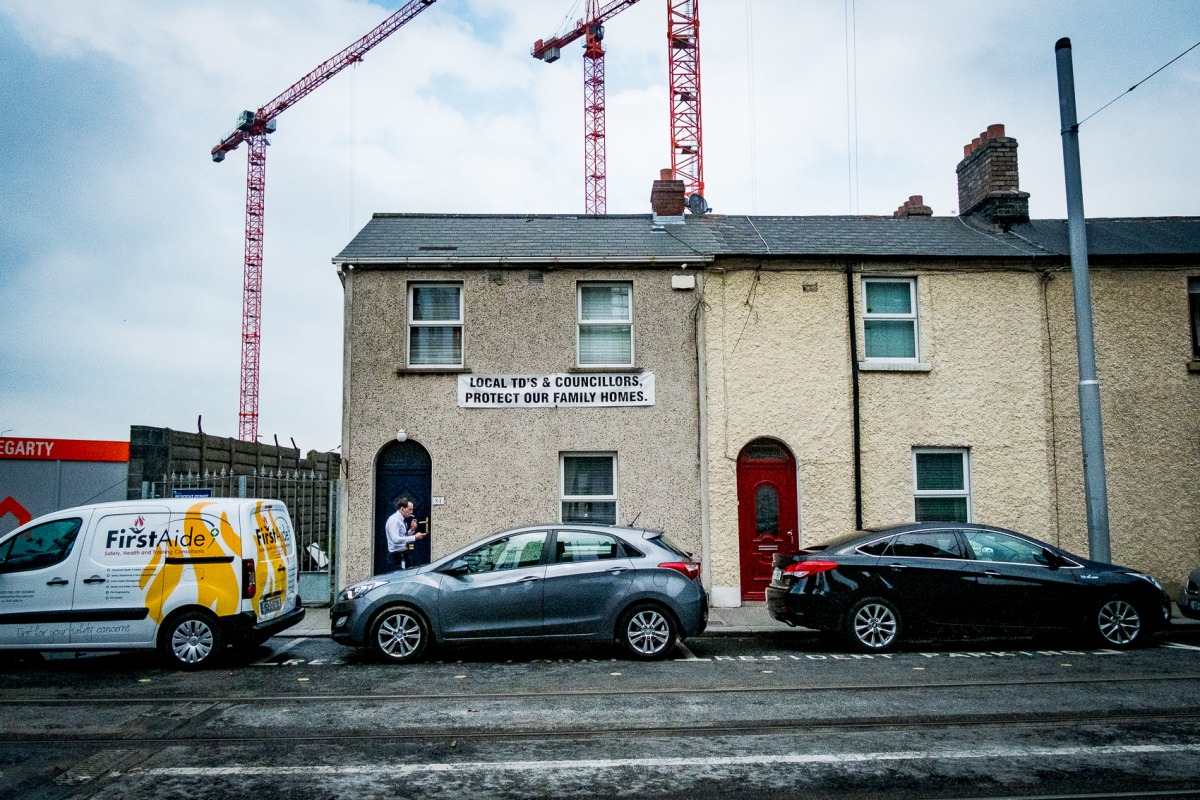
The penny drops as I listen to RTE’s Liveline. There’s a highly articulate woman in her fifties, who is renting. Holding out little hope for the future, she pleads with the powers that be to solve the Housing Crisis, in its entirety, no more sticking plasters: “Solve it for everyone,” she stresses, “even if 50,000 houses were built and delivered next year, I could not afford one.”
This leads to the following questions: first, assuming she has a regular wage, why can’t she affort to own a home as her parents and grandparents before her would have expected? And secondly, is the housing market really broken, or is that our financing market is broken?
Now let’s consider how we view the family homes market. Should we treat these as assets that appreciate in value and make us rich at the end of our lives, or something else?
Why should we become economically confident when house prices rise? If we have more than one child, and we want them to own their own house, any increase in the value of our homes will be lost when they come to buy; our gain is their loss.
Whenever a wealth manager – the financial advisor to a rich sophisticated investor – records a family’s net worth, they exclude the family home. This is because it is not a tradeable asset; it cannot be realised for alternative investments; it’s where a person lives and any investment strategy should not put that at risk; a roof over one’s head is a basic requirement after all.
If we are to have any chance of solving this crisis of housing insecurity for a growing number of our fellow citizens, then we must accept that family homes are not investments, not a substitute for a pension. In any case with rising life expectancy and care needs growing, it’s an asset many of us won’t be in a position to leave to our children.
It’s time to accept that family homes provide accommodation for the workers of this State. These are taxpayers who support the retired civil servants, and many other pensioners besides. It is vital that their cost of living is kept sufficiently low to ensure a decent quality of life, which ultimately underpins the productivity of labour in the State, and maintains the global competitiveness of our economy.
We need to return to how we treated family homes in the 1970s and 1980s. This is not to suggest that councils building homes is the only solution we have. But we should return to the idea that homes are not, and never should be, treated as investments.
Now ask yourself the question: how come our children and our fellow citizens cannot afford to purchase a home, but can service the commercial rent on the very same property?
Let’s be clear, we don’t need to ‘fix’ the housing crisis or ‘deliver’ affordable homes. We need to ensure that each tax paying citizen of this country has the basic security of a home. In order to do this they must be able to access financing that will put them on a par with Vulture Funds, thereby allowing them to compete for this scarce commodity.
Any solution must eliminate the inequality and injustice in such a way as to deliver home financing to our citizens. We therefore need to create a structure that can deliver competitive finance to all our taxpayers.
If foreign investors can borrow from the banks at 1.2% and first time buyers borrow at 3.99%, who do you think will be in a better position to purchase any houses and apartments that come on to the market?
Let me pose another question: why has the Central Bank of Ireland placed restrictions on our citizens, when buying a home, but placed no similar restrictions on commercial operators in the same market? This is grossly unfair. It is not a financial level playing field.
If you are going to interfere in the market, interfere in such a way that it affects all parties. Put another way: why would you put your savings in the local Irish bank at a return of 0% when your kids borrow from that very same bank to buy their home at 3.99%?
As things stand, I predict that there will be very few new housing developments delivered for sale directly to individuals over the next decade. Let me explain why I believe this.
When a developer purchases a property he obtains planning permission, then seeks finance. In Ireland we only have two commercial banks operating on any scale, and both have been severely hurt by developers in the past and now have tightened lending limits on exposures to this sector.
So the rational developer turns to international investors to finance a project. These international lenders are very cautious people, they don’t lend unless they are almost 100% sure they will be repaid in full; they don’t take punts. They also insist that the developer seeks out pre-sales. Pre-sales occur when the developer sells the entire complex or a significant element to an investment fund before it is built, thus eliminating the risk of the economy tanking, banks restricting their lending to individuals, a recession, a global pandemic, etc.
So, hardly any properties are delivered for individuals to purchase. Small builders cannot access this market, it’s all sown up.
This means that the generation growing up faces renting for the duration of their lives, and accumulating worries into their retirement years. This occurs even, sadly, when they could actually afford that property if there was a level financial playing field. I ask you: is this the kind of community you want to live in?
There is a sinister explanation for why certain individuals might not want to define and solve the problem of property ownership. The more fair a system is, the less profit exists for existing home owners.
Thus, there is an enormous conflict of interest right across the spectrum of those charged with this significant societal responsibility.
Now we, the home owners, all need to ask ourselves, are we willing to give up the vast paper wealth that accumulates over time from owning a home. Or at the very least, can we share it?
The airwaves are full of property experts, everyone has a view. But property is not just an asset, and no one ever talks about the financial aspects, and how we can improve access to finance.
The international investors are not primarily property experts, they are financial experts and investment bankers. The Irish experts talk about vacant property development, Cuckoos, affordable housing, discounts to market rent, homes over the shop, etc. etc. But all the Vultures know, is the value of money, and how they can deploy it effectively. Unfortunately the Irish public has not developed this financial literacy, meaning the institutions will win every single time, until, that is, we wake up and understand the problem.
In essence, we need to create a co-operative housing body which can access finance on the same basis as the Vultures, and thereby deliver inexpensive money to all tax payers without risking taxpayer’s money. This is possible without breaching EU State Aid rules, without upsetting the banks, but it will rightly piss off international profiteers.
I have a mild neurosis, situated in Utopian wish-fulfillment, of the ideal that I often step in a prelapsarian coppice with slats of warm-light breaking the gentle canopy and then filtering on down through the trees to come to a swirling perceptible rest and thus luxuriating golden on the forest floor.
The morning fontanelle, in its softwarm glade, peeping out, making way for noontide, and the ossified skull pivots towards Jupiter; my dumb-wondering skull swinging gallantly to the heavens, and then back again to the social world, where the overtly self-conscious auteur can record the very thing itself, Kantian logic. Which, is, seemingly, scant upon the ground these post-modern, non-ideological – apart from vast consumerism and neo-liberalist agenda(s) – days.
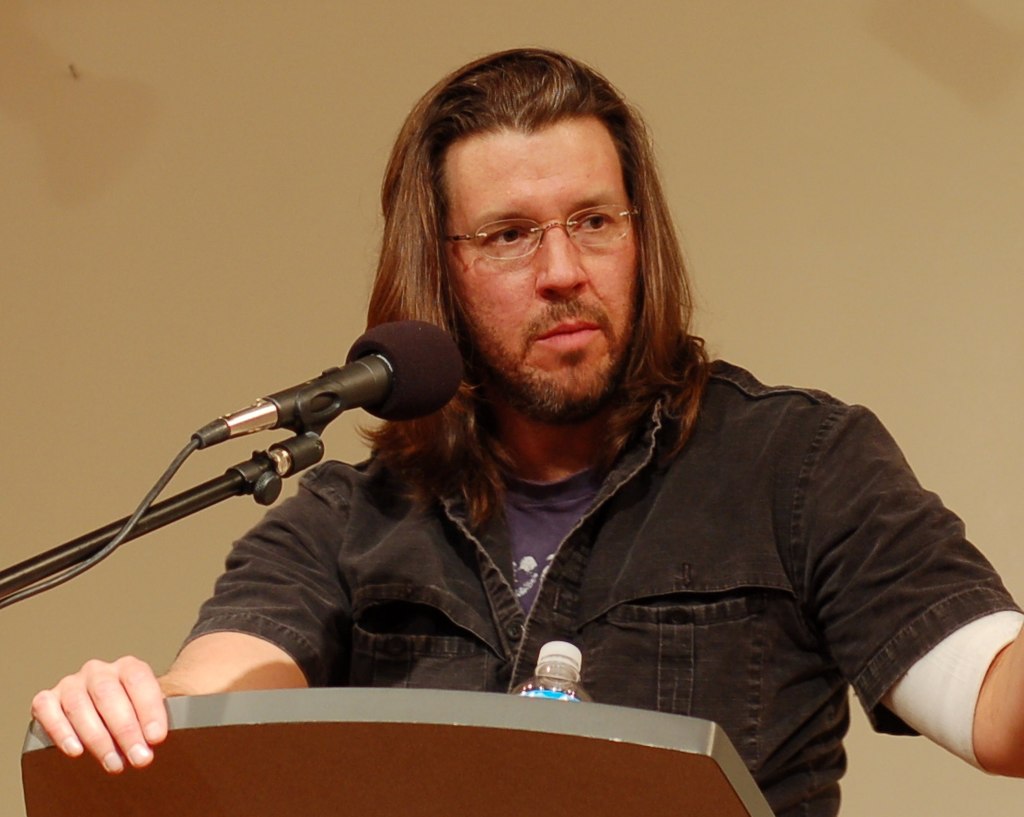
Recently, I looped the meta-modernist, hyper-realist circle and reached for David Foster Wallace’s encyclopaedic, metadata novel, Infinite Jest (1996); I figured that while sedate prose is at the behest of book sellers, and publishers, means – and modes of production for the masses – I thought “To hell with this, give me a novel with shtick.” So employing a reposed epidural, I plugged into Foster Wallace’s acicular vein, man, and plunged the diviner right on into the other side. And it is shtick all the way.
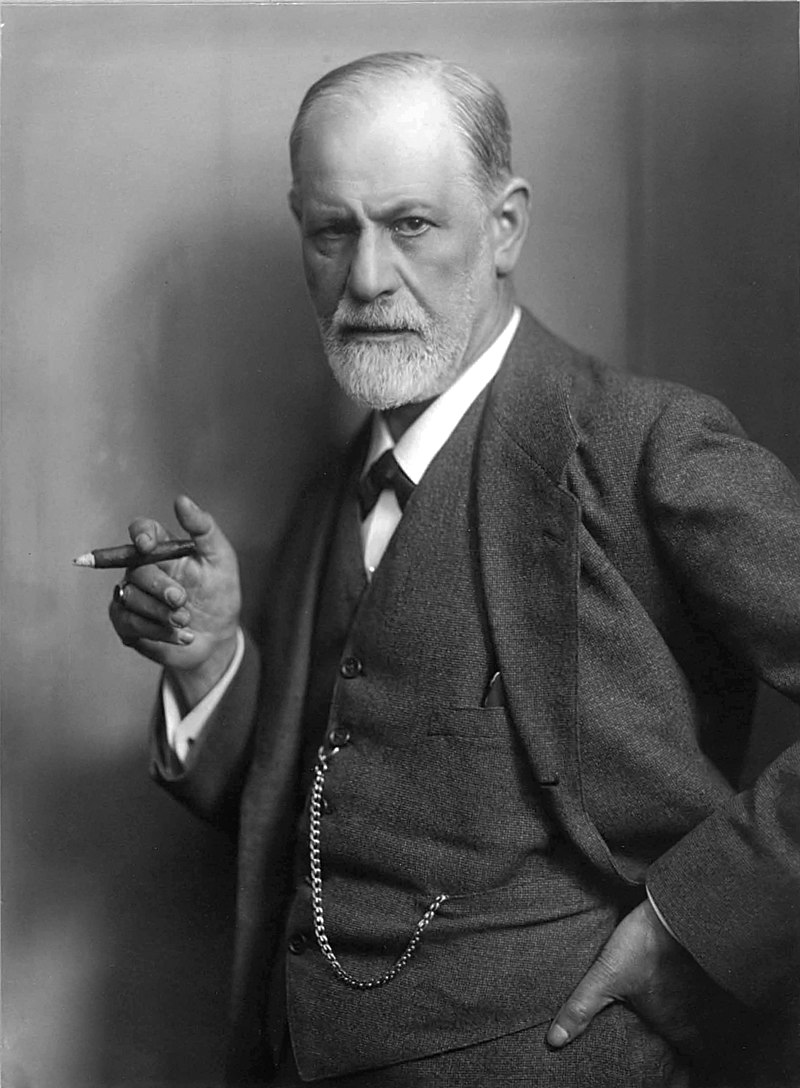
Sigmund Freud.
Civilized Sexuality
In section two of Sigmund Freud’s Civilization and its Discontents (1930) on ‘Civilized’ Sexuality Morality and Modern Nervous Illness he opens up by drawing a distinction between the ‘natural’ – rampant? – sexuality in the human, and the subservient, moral sexual behaviour in ‘civilized society,’ which delineates into sublimation, leading to one’s efforts being thrown wholly into Art and cultural activity.
One could assert that David Foster Wallace, straddled the tumescent, guilt-ridden world of the former and then found his comfort, and solace, in the latter, where the rotating, tangible Gods are more within one’s reach if they exert themselves and actually get down to it and, libidinal energies aside, write.
On social media, namely Twitter, a few people remarked that they had undertaken the David versus Goliath battle with Infinite Jest and retreated to safe passage, beaten some two hundred pages in. I suppose this may be permissible in others but not for anyone prepared to leave their comfort zone. So, with a slingshot in hand, I strapped on my leather sandals and headed out to the dusty milieu to grapple with the colossal swinging giant.
The plot is tertiary to Wallace’s intellect and ego in flux. In fact it is pure vaudeville to the main circus, big-top act which is the intellect of Foster Wallace himself, and the pre-frontal cortex mythology which he conspires to create and then exudes, seemingly, so effortlessly.
Did Foster Wallace write a capable work? That is down to the moral subjectivity of the reader, and relative comprehension of what literature is, and how far they are willing to travel to meet such a work.
This is not a linear prose tale as we know it. What I deduced, and I have to be honest here, I skim-read some of the work, but what I was able to perceive was that a protean plot; a Joycean attempt at a quotidian epic; an idea enough to shake anyone in their cotton socks and rubber-soled plimsolls.
David Foster Wallace.
Nomenclature
Foster Wallace’s reliance on nomenclature and acronyms are, well, trifling when you forget all the organisations he coins; we do know, for example, that O.N.A.N stands for Organization of North American Nations, a kind of dystopian superstate which is comprised of Mexico, the United States and Canada; and that the novel takes place during ‘The Year of the Depend Adult Undergarment’ Y.D.A.U.
It opens with tennis. Wallace was a court man, he liked to court tennis, and he schlongs his racket into being more often than enough into this work.
Primary locations include the Enfield Tennis Academy (‘ETA), Ennet House Drug and Alcohol Recovery House and a mountain location outside of Tucson, Arizona.
Many characters are students or faculty at the school or patients or else staff at the halfway house; there is a multi-part, philosophical conversation between a Quebec separatist and his US government contact, which occurs at the Arizona location.
The claustrophobic, proposed cannabis-deal waiting scene, near the start of the novel, is very telling about Wallace’s, one assumes, own neurosis’s about the partaking of cannabis, and the whole surrounding miasma of paranoia; the distinctive middle class, sweaty-palmed, heart-thumping moment-by-moment judgements formulated in the expectant mind of what is going on there in the less-than-fictional, delusionary, environmental ‘transaction.’
We find ourselves in his fastidiously tidy, and small, apartment with the narrator, the best kind of writing which Foster Wallace is known for, where he is at home with the foetal type of self-hatred and mild-drug use which enveloped his almost Jacobean, rebellious nature.
As regards technology, he talks about ‘cartridges’, film and the goal of the Americanised society; a cartridge, the end game; senseless cartridge which when one watches they become a stupefied, quivering wreck in front of the flickering images never to rise again – a kind of reverse Lazarus – dead-eyed and owned.
In terms of characterisation, there is the guy who is mad about tennis and optics, who sticks his head in a microwave, only to be superseded by his prodigal, talented son. Then there is Orin Junior. Mental Health sufferer; Kate Gompert – whom I believe is Foster Wallace spliced with Orin; Demerol aficionado Don Gately; and the whole Incandenza family clan.
There are four main plot themes to be mindful of: First, a fringe group of Quebecois radicals, the AFR, which plans a violent geopolitical coup, and is opposed by high-level US operatives. Next, various residents of the Boston area who reach ‘rock bottom’ with their substance abuse problems, and enter a residential drug and alcohol recovery program, where they progress in recovery through AA and NA. We also find students training and studying at an elite tennis academy run by James and Avril Incandenza, and Avril’s adopted brother Charles Tavis. Finally, the history of the Incandenza family unfolds, focusing on the youngest son, Hal.
More peripherally we have the minutiae of Foster Wallace’s comprehension of U.S pharmacology drugs, available for those requiring a hit. The theme of Québecois separatism. The City-scapes, wherein the psychogeography of the narrative feels sterile, offering a mish-mash of flimsy, dilapidated rooms in recovery house, Ennet House and the Tennis Academy, Enfield. We also find a transvestite junkie, in the toilet squirting and paranoid about voiding of the bowels.
Infinite Jest is not an easy novel to read. It is a half-empty, farmhouse grain-store of nine hundred and eighty-one pages, with additional footnotes, which Wallace could not crow-bar into the main text; you have to do a lot of the work yourself, which for the unattended, ephemeral mentality of the nowadays impatient-person may be a difficult concept to grasp.
This is a work that should come with a complimentary Dictionary and Thesaurus. One assumes that to write this David Foster Wallace swept out The Urals with a dustpan and hand brush. The event itself is not too masterful but the brushstrokes of ingenuity and dedication to his Art, were – are.
David Foster Wallace was a deck-side sailor who learned to bind his ropes tightly, then lash the rigging onto his work and raise it, creaking, up from the plumy depths, on up far into the azure, heady swirling heights, and this has to be applauded, the meridian of achievement in the literary field, for what Foster Wallace implemented was no easy feat – the writer, and the unyielding precipice of the empty page – and then to storm in and fill it with some, any, kind of syllogistic meaning, wow, just wow.
Is Infinite Jest a supercilious comment on American society? Of course, it is.
In response to COVID-19: how are we to explain people drawing starkly differing conclusions from the same data? To understand this requires a search for context and motivation.
In the second series of the Duffer Brothers Stranger Things, set not uncoincidentally in 1984, there is a critical scene in which the story reaches its conclusion. Murray Bauman, the experienced investigator and sceptic is confronted by Nancy and Jonathan, two of the series’ teenage characters. They present him with conclusive proof of events and happenings, apparently shattering all the certainties he had operated with until that point.
Pouring a large measure of vodka to steady himself, Murray contemplates what he has just heard before explaining to Nancy: “I believe you, but that’s not the problem… you need them to believe you… your priests, your postman, your teachers, the world at large. They won’t believe any of this.” He then clasps his drink close to his chest as if it’s a lifeline.
“You heard the tape,” Nancy insists, clearly frustrated.
“That doesn’t matter”, snaps back Bauman as he waves the glass in the air. People want to be comfortable, and this truth is uncomfortable. He takes another gulp of Vodka and grimaces. But it gives him an idea.
“The story,” he says. “We moderate it, just like this drink here, we water down the vodka … We make it more tolerable.”
The events that have unfolded since March 2020, when the pandemic began in Europe and the U.S., have been extraordinary by any standards.
After over seventy years of peace in the West, during which wars were fought on foreign lands, and apart from the occasional lurch to the left or right there has been political stability, democratic norms, a generally fair justice system and continuous growth in prosperity and education.
Moreover, infectious diseases have been all but conquered with new drugs and treatments. Combined with improvements in public health and nutrition we have seen life expectancy grow year on year in what appears a steady pattern. We have grown accustomed to continuous improvement in the standard of living and security. After seventy years of improvement, we have come to expect this to continue.
After such a prolonged period of peace even the idea of warfare – or it not being safe to walk the streets – is almost beyond our comprehension. Never before has humanity in the West been so removed from the terrors of war, the tyranny of oppressive regimes and the ravages of natural disasters or famine.
We get up each day expecting it to be exactly like the last and for tomorrow to be the same. We cannot contemplate a world that is not exactly like that of today.
Yes, we will have technological changes and workplaces will change, but fundamentally we expect everything to remain the same. Footballers will be paid too much money; screen stars will fall in and out of love with each other; war will break out in some far-flung land and a natural disaster will occur somewhere only to be forgotten and replaced in our consciousness by another somewhere else. Meanwhile, what really concerns us is reaching the gym on time after work, getting the kids to school and catching up on the latest Netflix mini-series.
So, what happened when we woke up one morning to a potentially fatal virus that was not happening on the other side of the world? By early March we had watched with indifference what was happening in China, but now it was here in our community.
Cases, first slowly but then steadily, began rising until on the March 11th 2020 we had our first death. Now it was for real; now for the first time in seventy years there was an immediate threat to our health and even our way of life.
We approached the pandemic within the paradigm of our world of seventy years of increasing prosperity and health. We believed we were invincible, that our medical community would protect us and that all lives were saveable.
For any illness there must be a drug. If we don’t have it today, we will have it tomorrow. We just need sufficient money and political will and it will be discovered. So, we laid down the challenge to the pharmaceutical industry to produce a vaccine, and all we needed to do was give them enough time to develop it, locking down hard until then.
In so doing, we revealed an aversion to risk and a failure to critically analyse the extreme, and erroneous, warnings on fatalities that were issued by politicians and scientists; strangely our media and politicians accepted the doomsayers and ignored optimistic assessments.
The WHO definition of health, as not just the absence of disease, but the physical, mental and social wellbeing of the individual, was ditched. We would get back to that once we found the vaccine and the virus was eliminated. The pharma industry took up the challenge and we sat at home watching Netflix until they told us they were ready.
Alternative approaches that involved natural immunity, and isolating the vulnerable as the Great Barrington Declaration advised, or applying early treatment with a range of therapeutic drugs were dismissed in a concerted attack by public health officials, doctors, universities, politicians, the media and in particular social media.
There was to be one response and no challenge would be allowed. Civil rights to freedom of movement and to bodily integrity were trampled on with barely a whimper in the mainstream media.
Emergency powers not contemplated since World War II were ushered through by the government without so much as a peep from the opposition or the media. Lockdowns were for the greater good; while the fear and panic that had been sowed ensured almost complete compliance and a demonisation of dissenting voices.
Compelling stories from reliable sources tell us of the more than reasonable possibility of the virus originating in the lab in Wuhan, but we don’t want to know. Valid alternative early-stage treatments, such as Ivermectin, shown to work in other parts of the world are not merely dismissed, but actively smeared.
Early stage VAERS data on vaccine safety, particularly in young males, is ignored based on thresholds that would have previously stopped approval of a vaccine. The fact that the vaccines have not passed long term safety trials is conveniently ignored.
Questions about how wide a spectrum of immunity is covered and the length of time immunity lasts is also overlooked. Boosters are unquestioningly accepted and used off-label, although no research exists on the possible impact to both short and long term health, and overall immunity. Public health concerns about the impacts of lockdown on society and other illnesses are forgotten. There is only one train leaving town and you are either in the vaccine carriage, or you are on your own.
So why did all this happen; why have we thrown away hard won civil rights; why have we allowed ourselves to be coerced into taking drugs, without what would normally be considered informed consent?
Why aren’t we desperately trying to investigate the origins of the disease? Why have we dismissed any and all alternative treatments? Why was the Swedish approach derided, and now treated as if it did not happen?
I guess it’s a case of too much, too soon. We craved the comfort of our old world so much that we accepted without question the solution offered; we were told this was simply “following the science”, as if “the science” was settled.
Once embarked on that path there could be no turning back. There could be no dissenting voices. There could be no alternative science. Voices straying from the perordained plan must be crushed at whatever cost.
So here we are now nineteen months later and it still not politically correct to say that perhaps we got it wrong. Most people are so desperate to return to our safe world, that to believe that, would be to recognise that we have been misled and badly informed throughout that time.
It would mean that doctors, much of the scientific community, public health officials, universities and the media have been participants or active orchestrators of the worst medical and public health mismanagement in modern history. That’s too much to take on board, the brain can’t compute, it overheats, dismisses, and attacks those who even suggest it.
So how will the story unfold? There is surely no question, but that the truth will out. As time passes we will acknowledge the errors. Then we will rue how it was ever possible for such catastrophic mistakes to occur.
I suspect posterity will not look kindly in particular on a medical community who, with a few honourable exceptions, sat back and watched the policies unfold. Who kept their head down and took the easy road.
As a society we invest in doctors, educating them and offering them considerable rewards. In return we expect them to look after our interests. We expect them to speak out on our behalf when they see injustice. After after what has just happened it may be difficult to regain that trust.
I wonder when will the serious post-mortem begin? When will data, evidence and outcomes start driving policies; when will marketing mantras and outright propaganda be left behind?
Will the story need to be watered down to become more tolerable? How much water do we need to add to the vodka?
Midway upon the journey of our life
I found myself within a forest dark,
For the straightforward pathway had been lost. Dante Alighieri
Religion is an emotional need of mankind. The rationalist may not want it, but he has to admit that other people may… Let’s not leave out a single god! […] Let’s be everything, in every way possible, for there can be no truth where something is lacking. Fernando Pessoa
The Taliban reconquest of Afghanistan came as a shock to Western consciousness. It was not merely that a U.S.-sponsored regime proved so fragile once the troops pulled out; but the apparent enduring appetite among Afghans for policies at least purporting to be Islamic flies in the face of a starry-eyed view of humanity steadily evolving towards a uniform set of customs and beliefs.
That is not to argue that common principles cannot be agreed by sovereign states – and peoples – but to expect uniformity in outlook across a global population living in starkly differing circumstances, and at varying historical junctures, appears naïve at best. Any globalisation project striving for homogeneity will surely fail.
In abandoning religious traditions – as many of us have done – it may be that we are losing ethical frameworks grounded in those traditions with profound consequences for relations among ourselves, and with Earth itself. It begs the question: at a critical juncture for humanity does faith, or transcendence, offer a path out of despair, and indeed a Theology of Hope? We may further ask whether, without this ethical grounding, if the direction of scientific research is guided by a reliable moral compass, or simply the exigencies of a Capitalist market?
Without subscribing to the banal equanimity of moral relativism disregarding gross human rights violations, we should question all military interventions in pursuit of peace. Saint Augustine in the City of God stated: ‘there is no man who does not wish for peace… even when men wish a present state of peace to be disturbed … they do so not because they hate peace but because they desire the present peace to be exchanged for one that suits their wishes.’ The Hippocratic Oath might be adapted in international relations whenever the invasion of another country is contemplated: ‘first do no harm.’
The idea of peace for eternity is an illusion. So Francis Fukuyama’s The End of History and the Last Man (1992) – where ‘the struggle for recognition, the willingness to risk one’s life for a purely abstract goal, the worldwide ideological struggle that called forth daring, courage, imagination, and idealism’ is ‘replaced by economic calculation, the endless solving of technical problems, environmental concerns, and the satisfaction of sophisticated consumer demands’ – now seems an increasingly absurd notion, formulated in a moment of peak post-Cold War hubris.
Likewise, a Marxist assumption that History will simply end, thereby removing a requirement for politics, or for difficult choices to be decided is also, sadly, Utopian; this is notwithstanding the continued relevance of Marxist analysis to current economic relations, in particular a seemingly inexorable widening in the gap between rich and poor in an age of technology; and the idea of metabolic rift, meaning, broadly: the alienation of exploited workers from their environment.
Thus, both Liberals and Marxists have fallen prey to an assumption that we are bound for a Promised Land governed by Enlightenment Values. In fact, Enlightenment philosophers such as David Hume called into question fundamental rights derived from an Aristotelian tradition, developed in Europe over centuries. Science only emerged as a distinct discipline in the 1830s, untethered from an ethical foundation in philosophy.
U.S. President Reagan meeting with Afghan mujahideen at the White House in 1983.
Religion in Global Diplomacy
The Taliban’s victory demonstrated that religious identity remains a galvanising force in politics, beyond even national identity, in the developing world especially. Although, it should be noted that the Taliban is largely drawn from the dominant Pashtun ethnic group. We may also safely assume a long Afghan tradition of resistance to foreign occupation remains an inspiration.
Nonetheless, as the case of ISIS also highlighted, and indeed the perseverance of the Religious Right in the U.S., we in Europe especially should reconcile ourselves to the endurance of belief systems other than our own dominant secularism. For, as the authors Philip McDonagh, Kishon Manocha, John Neary and Lucia Vázquez Medonza of a new work On the Significance of Religion for Global Diplomacy (Routledge, London, 2020) point out, it is a fallacy to equate ‘modernisation’ with a decline of religious observance.
This work provides an important guide to negotiate challenges in a world where those professing no religion amount to just 16% of the population. Globally, atheism is a strictly a minority taste, a point its often evangelical advocates are wont to ignore. Thus, in the half century since Iran’s Islamic Revolution in 1979, we have witnessed a succession of political movements emerge shaped by religious identities – if not the humane insights contained within all traditions.
Show on the life of Jesus at Igreja da Cidade, affiliated to the Brazilian Baptist Convention, in São José dos Campos, Brazil, 2017
Religion as a Force for Good and Ill
Anyone advocating in favour of a place for religion in the public sphere must grapple with a strong tendency for this to be expressed in fundamentalist politics – a word, incidentally, deriving from the description of Protestant sects of the early twentieth century. All too often, where religion lies behind political formations it has brought harsh ordinances, generally to the detriment of women – in terms of their status relative to men – in a patriarchal order.
In power as such, we have witnessed the crushing of dissent, or heresies. Indeed, the approach of many rulers claiming faith-based authority resembles that of the Grand Inquisitor from Fyodor Dostoyevsky’s The Brothers Karamoz, who Laurens van der Post described as ‘the visionary anticipation of Stalin and his kind.’ This tale or parable, which the character of Ivan Karamazov’s recounts in the novel, is set in post-Reformation Spain, where the all-powerful Inquisitor is visited by a resurrected Christ. The fearsome leader, however, dismisses the putative saviour, revealing that the Church has embraced the devil:
we have accepted from him what You had rejected with indignation, that last gift that he offered You, showing You all the kingdoms of the earth: we accepted Rome and the sword of Caesar from him, and we proclaimed ourselves the only kings on earth, the only true kings.
The Grand Inquisitor maintains that he is serving the common people, who will be lost if freedom of conscience is permitted. He thus banishes the saviour with the words: ‘we shall withhold the secret and, to keep them happy, we shall opiate them with promises of eternal reward in heaven.’[i]
Characteristics of the Grand Inquisitor’s approach were evident in the Irish Catholic Church after independence that opiated the people “with promises of eternal reward in heaven.” Thus, Ronan Sheehan describes a ‘Theology of Incarceration’ – associated in particular with the legacy of Matt Talbot in his visionary Dublin: Heart of the City (2016).
However, notwithstanding criminal actions of Catholic clergy, we may question whether contemporary Ireland is a more, or less, caring society. There are certainly greater opportunities for women – but in an increasingly two-tier society in housing, health and education it is a shrinking number that can avail of these.
In an increasingly neoliberal society political ambitions have given way to passivity. The authors of On the Significance of Religion for Global Diplomacy remind us that twentieth century history witnessed resistance to National Socialism, and plans for the Welfare State ‘inspired to a large extent by leaders who were religious leaders.’ There are numerous examples of religious leaders and movements in developing countries, from Gandhi to Hamas, that have emphasised the importance of social programmes. The Catholic Church under Pope Francis is also now engaging seriously with many of the profound social and environmental questions of our age.
Percy Bysshe Shelley 1792-1822.
Poetic Origins
A more acceptably entry to the idea of religion – for a younger generation anyway – is perhaps through poetry. The authors of On the Significance of Religion for Global Diplomacy locate religion in poetic inspiration, which has often arrived in response to tyranny, as in Percy Bysshe Shelley’s plea in ‘The Masque of Anarchy’ (1819):
Let a vast assembly be,
And with great solemnity
Declare with measured words that ye
Are, as God has made ye, free–
Shelley wrote the first public argument for atheism in England as a young student in Oxford, but this may be considered an undergraduate flourish, designed to provoke. As his career developed, according to his wife Mary Shelley, he became a ‘disciple of the Immaterial Philosophy of Berkeley. This theory gave unity and grandeur to his ideas, while it opened a field for his imagination.’[ii]
Shelley’s work emphasised a divine inspiration, and believed a poet’s ‘impartial care for the birth of situations’ reaches towards goodness. Likewise, Osip Mandelstam said ‘the consciousness of our rightness is dearer to anything else in poetry.’
Many poets maintain, at least in private, that their inspiration, including that conveying moral ideas, is in a sense, god-given, or at least derived from an ‘other’ world. Thus, the Ancient Greek poet Hesiod describes a certain kind of judge, touched by the Muses, who ‘can put a quick and expert end even to a great quarrel.’ Viewed as such, religion may yet offer a poetic space for developing empathy, imagining a new world, and holding on to what remains sacred in a dying planet.
For the authors of On the Significance of Religion for Global Diplomacy, the formulation of ‘a more just arrangement of human affairs’ comes about not only through philosophical reasoning, but also in a Theology of Hope. Thus, the say ‘the meaning or pattern in events shines out in the perspective of eternity.’ This is the faith of a Dietrich Bonhoeffer who believed that ‘something new can be born that is not discernible in the alternatives of the present.
Therefore, the authors ‘do not argue for theocracy in any form,’ and instead ‘argue merely that to try to exclude God and religion from the conversation would be about our global future is to aim deliberately low.’
Everything is Permitted?
Does the negation of religion – however tenuous and abstract – leave us operating within a moral void, where, as in the words of Ivan Karamazov: ‘everything is permitted,’ including murder? This is not to say that all atheists operate without moral scruples, but ultimate justifications for “rightness” or “goodness” may prove elusive in the absence of faith or transcendence. Through the character of Ivan in The Brothers Karamazov, Dostoyevsky wonders what deeds we are capable of in the absence of divine judgment.
More broadly, we may ask whether a new species of evil develops in a value-less neoliberal setting, where callous murders are increasingly commonplace – not least in the gangland shootings we have grown accustomed to in Dublin in recent times? Is it simply fear of being caught in the act that holds back more of us from committing heinous crimes?
Contemporary alienation has been powerfully expressed by Michel Houellebecq the French author of Atomised (1998) and other novels. His latest offering, Serotonin (2019) again plumbs the depths. Here, we find a narrator contemplating the murder of the four-year-old son by another father of the love of his life, after coming to the conclusion the child would stand in the way of a successful revival of their relationship.
His mind returns to his own feelings as a young child after a New Year celebration. Adopting a neo-Darwinian, (scientific?) outlook, he observes:
it was as that memory came into my mind that I understood Camille’s son, that I was able to put myself in his place, and that identification gave me the right to kill him. To tell the truth, if I had been a stag or a Brazilian macaque, the question wouldn’t even have arisen: the first action of a male mammal when he conquers a female is to destroy all her previous offspring to ensure the pre-eminence of her genotype. This attitude has been maintained for a long time in the human population.
He continues:
I don’t think that contrary forces, the forces that tried to keep me on track for murder, had much to do with morality; it was an anthropological matter, a matter of belonging to a late species, and of adhering to the code of that late species – a matter of conformity.
Overcoming “conformity”, ‘the rewards would not be immediate’ he says, ‘Camille would suffer, she would suffer enormously, I would have to wait at least six months before resuming contact. And then I would come back, and she would love me again.’[iii]
Houellebecq’s “contrary forces” represent an increasing loss of moral conviction. As the characters conformity diminishes, the “code” of our “late species” breaks down and the possibility of violence increases, as we see in the book’s characterisation of the violent response of farmers to a neoliberal order that is putting them out of business.
Ultimately, however, Houellebecq’s narrator proves incapable of pulling the trigger as he has intended, entering what he refers to as an endless night, ‘and yet’, he says:
deep within me, there remained something less than a hope, let’s say an uncertainty. One might also say that even when one has personally lost the game, when one has played one’s last card, for some people – not all, not all – the idea remains that something in heaven will pick up the hand, will arbitrarily decide to deal again, to throw the dice again, even when one has never at any moment in one’s life sensed the intervention or even the presence of any kind of deity, even when one is aware of not especially deserving the intervention of a favourable deity, and even when one realises, bearing in mind the accumulation of mistakes and errors that constitute one’s life, that one deserves it less than anyone.[iv]
Hope springs eternal it seems, even in a novelist-of-despair such as Houellebecq.
Moreover, if we refuse the temptation to pull the trigger and reset our lives; if we embrace an idea of hope; we may conceive the Earth itself to be sacred; a view shared by all religious traditions, which enjoin respect towards all life on the planet. One wonders whether a view of all life on Earth being sacred is shared by pure materialists. Moreover, untethered to any faith tradition is “everything permitted” in scientific research?
Niccolò Machiavelli 1469-1527.
The Political Craft
Contemporary politics often appears to operate within a moral vacuum, where warfare is conducted through drone strikes, and the planet reels under the impact of over-exploitation; while even in Advanced Economies, millions endure shocking poverty. New forms of propaganda have been unleashed via a social media that is removing agency, implanting ideas that distort politics. Most politicians claim to care, but as often as not they distract from the structural questions and emphasise issues of only peripheral relevance to the lives of ordinary people. In particular, identity politics has been used to divide and conquer, while the wealth of billionaires continues to accumulate.
The authors of On the Significance of Religion for Global Diplomacy come down squarely against the statecraft associate with Niccolò Machiavelli, which now appears ascendant in a contemporary politics of spin – where September 11 was ‘a good day to bury bad news’. Here, according to the authors: ‘Deceit, and even cruelty, are justified by results – by their results as measured over time – which requires very sharp judgment by the Prince if his recourse to realpolitik is not to undermine the moral standards of ‘ordinary people.’’ Means cannot easily be distinguished from ends, while the body politic is contaminated by mendacious politicians.
They argue: ‘Not to tell lies or to make contradictory promises would seem to be a rule of peace-building that we should never set aside.’ Lies erode trust in institutions and tend to catch up with political actors. Tony Blair and his 45-minuteclaims before the invasion of Iraq in 2003 is an obvious example, albeit one unmentioned in the book.
Image (c) Daniele Idini
Pandemic Response
A Populist wave emanating from the Americas has, thus far at least, failed to propel a European equivalent into power. Nonetheless, distrust in politicians and the media is probably at an all-time high, and with some justification. Moreover, all too often, scientists guiding government policy have adopted Machiavellian approaches that only fuel paranoia.
The origins of the pandemic itself are shrouded in mystery, amidst a growing suspicion that the COVID-19 virus is a product of so-called ‘gain of function’ research, involving US government agencies and China.
Attempts to supress this involvement – including by EcoHealth’s Peter Daszak, who jointly authored an article in The Lancet dismissing the idea out of hand at the beginning of the pandemic – generates serious concern. A recent slew of emails released under freedom of information: ‘indicate involvement by individuals with undisclosed conflicts of interest; limited peer-review; and a lack of even-handedness and transparency regarding the consideration of lab-origin theories within the scientific community.’
Would anyone who believes in the sacredness of life on Earth engage in work so fundamental to all life on Earth? It recalls the inventor of the Atomic Bomb Charles Oppenheimer’s quoting The Bhagavad Ghita: ‘I am death destroyer of worlds.’
Ethical debates in science would surely benefit from religious insights. As Laurens van der Post put it: ‘For me the passion of spirit we call ‘religion’, and the love of truth that impels the scientist, come from one indivisible source, and their separation in the time of my life was a singularly artificial and catastrophic amputation.’
Fauci speaks to the White House press corps on COVID-19 in April 2020.
Bioterror Czar
Damningly, in 2011, in the capacity of George Bush’s ‘bioterror czar’ the long-time Director of the National Institute of Allergy and Infectious Diseases (NIAID) and the Chief Medical Advisor to the President Anthony Fauci argued that the benefits of ‘engineered viruses’ made it a ‘risk worth taking.’
During the pandemic Fauci appeared as a rational antidote to the bleach-belching Trump, but is prone to an arrogance assuming he can do no wrong. This is epitomised by the remarkable statement: ‘A lot of what you’re seeing as attacks on me, quite frankly, are attacks on science.’ In other words, Le Science C’est Moi.
An early example of Fauci’s mendacity was his claim that he committed a ‘white lie’ in relation to the efficacy of masks. He said that he shaded the truth to avert a run on scarce equipment. Even if we take him at his word, why should the public believe what he is saying thereafter is not also a white lie? This is the attitude of a Grand Inquisitor who believes the little people cannot hope to understand the big questions. But this Machiavellian approach easily backfires.
In this testimony, as in much of his conduct over the past two years, Dr. Fauci was speaking “nothing but the truth.” Yet he was mindful of what Jesuits used to call a reservation.
A reservation, in this sense, is an unspoken qualification. The speaker telegraphs a public meaning, confident it will be misunderstood. He holds in reserve a private meaning whose release might damage a higher cause (a cause known to the speaker and God, of which God approves). For God, in this context, we should read: “US government institutions of scientific research.” Yet American support of catastrophically hazardous experimentation was by no means the only pertinent fact withheld from American citizens.
There are perhaps programmes that a government can justifiably occlude, but it enters dangerous territory in doing so. Fauci’s over-weening arrogance – tying his own fate to the credibility of science which is enshrined as the guiding light for humanity – appears to have led him to the moral failings of the Grand Inquisitors that we associate with religions in power.
Black Lives Matter Dublin Protest June 1st 2020.
A Point of Inflection
The authors of On the Significance of Religion for Global Diplomacy stress a need for preserving universal values, and institutions, while upholding a spirit of hopefulness in the face of seemingly insurmountable challenges for humanity. History shows that democratic institutions alone cannot be trusted, given the extent to which opinions are moulded using increasingly sophisticated propaganda. This is one reason why we have constitutions that purport to contain immutable and even transcendent values.
As the authors stress, ‘we have reached a point of inflection in the global story’ and if they are to address forthcoming challenges religions ‘need to make themselves understood in the common language of reason.’
The input of the billions of religious should be welcomed in our public discourse, and not associated with ignorance in a one-track view of development. In particular, the idea of all life on planet Earth being sacred should be affirmed, although tendencies towards authoritarianism and mendacity among representatives of religions requires attention.
In an age of science, where humans act as gods, altering the building blocks of life we can draw on wisdom contained within religious traditions on the sacredness of life. In a world of mounting challenges, even those of us who have dismissed religion from our lives may benefit from consideration of core principles contained therein. In any case, we must navigate a path through a world where, like it or not, religious belief remains the norm.
Featured Image: The Thinker in the Gates at the Musée Rodin
[i] Fyodor Dostoevsky, The Brothers Karamazov, translated by Ignat Avsey, Oxford World Classics (1994), p. 322-325
[ii] Kenneth Neill Cameron ‘Philosophy, Religion and Ethics’ in Shelley: The Golden Years, Cambridge, MA, Harvard University Press, 1971, p.151
[iii] Michel Houellebecq, Serotonin, translated by Shaun Whiteside, Penguin, London, 2019, p.265-266
For Christmas two years ago, my mother bought me a copy of Sally Rooney’s novel Normal People (2018). I tried to read it, I really did, but gave up after twenty pages. Looking back now, I can’t remember exactly what it was that turned me off it. I recall saying something along the lines of not liking the dialogue and the way the characters were realised.
Looking back, I think I disliked the social pressure exerted on me to read and admire Sally Rooney. You see, as a student in Trinity College Dublin, the figure of Sally Rooney loomed large.
Access to campus was restricted while a TV adaptation of her book was filmed. Her novels lined the windows of nearby book shops. Rave reviews appeared everywhere you looked online. She was the voice of the Irish millennial.
All of this, rather than encouraging me to embrace her work, raised my hackles and ensured that I would find fault in anything I read by her.
After laying Normal People aside, my girlfriend read it. After finishing it, she expressed the opinion that it was a good read, but nothing special in literary terms. Then she read reviews of it in well-respected publications, and began to experience a cognitive dissonance so severe I worried about her mental health.
“What is it I’m not seeing? Why is everybody praising it so highly? Am I not seeing something here?” she beseeched.
I tried to comfort her. “It’s the world that’s gone mad.” I said, “Your judgement was correct.”
“But everyone is saying it’s great!”
“It’s all just marketing! The whole industry is a sham!”.
Alas, my words offered scant comfort. It wasn’t until she saw some negative reviews in major magazines that she felt consoled.
‘A lot of press attention surrounded the publication,’ says a novelist character in Rooney’s new novel, ‘mostly positive at first, and then some negative pieces reacting to the fawning positivity of the initial coverage.’
For my girlfriend and me, the negativity was a justification. Maybe our generation’s aesthetic sense hadn’t atrophied after all. There was still hope.
“Why do you need other people to say something is bad before you can trust in your own judgement?” I asked.
“Let’s stop talking about this.” she replied.
After my girlfriend’s near loss of sanity, I resolved to maintain a safe distance from Sally Rooney. The best minds I knew assured me that Sally Rooney’s popularity was a product of marketing, and that her writing was nothing special.
A New Assignment
My life went on peacefully, untroubled by the exorcised spirit of Rooney, until two years later an editor challenged me to review Sally Rooney’s new novel, Beautiful World, Where Are You (2021).
“I’m afraid to say I’m not a big fan of Sally Rooney”, I said.
“All the better!” he replied, “She will get enough positive reviews as it is. Write what you really think!”
I left the office elated at first, but then an inner contrarian bristled. That’s right, I’m a contrarian even among other contrarians. If asked to criticise a mainstream work, I’m inclined to defend it.
Buying the book in Chapters, I felt immensely self-conscious at the bestsellers shelf. I scanned the shop before taking the blue paperback from the number one slot.
“If anyone I respect asks why I’m buying it”, I thought, “I’ll tell them I’m writing a review.”
Returning home, I sat down on the couch with the novel and a pen and notebook on hand. Upon reading the first page, I found an adjective that felt awkward, and I noted this down. On the next, I found a sentence I didn’t like, and then a character description that annoyed me. I noted these down too. Then I realised I wasn’t reading at all.
I laid aside the notebook and returned to the beginning. Time passed. A few times, I wanted to reach for the notebook, but resisted the impulse, accepting the text for what it was. Slowly, my ego disengaged, and I started to focus on the scenes, the characters, and the structure of the story. The afternoon slipped away.
On the second afternoon, I became even more deeply engaged. I found some of the ideas expressed by characters exciting. I laughed at parts, enjoying the romantic dynamic between different characters. When I wasn’t reading the book, I looked forward to when I would be again.
The pace of the novel appeared to slow in the final third however. By the end, I had lost some of the enthusiasm sparked earlier. I still enjoyed it, but believe it doesn’t amount to a substantive whole.
Summary
The novel primarily follows two Irish women in their late twenties/early thirties. Eileen works for a low-paying literary magazine, and is terribly jealous of her friend Alice, who is a successful novelist.
Alice lives in a beautiful house by the sea, has money and time to spare, yet never goes out of her way to visit Eileen. The novel alternates between chapters following Eillen or Alice individually, and chapters composed of email exchanges between the two friends.
The alternating structure is used very artfully. In the narrative sections, the narrator is extremely remote and impersonal: ‘He was wearing a black zip-up, with the zip pulled right up, and occasionally he tucked his chin under the raised collar, evidently cold.’ (p.216)
This is a very roundabout way of telling us a character is cold, but it maintains the sense of the narrator’s detachment. This technique is characteristic of Beautiful World, Where Are You. In the narrative sections, we watch the characters keenly, with an interested gaze, but we’re barred from access to their minds; nor does the narrator offer insights into the characters. Thus, for example:
The waitress from behind the bar had come out to mop down the empty tables with a cloth. The woman named Alice watched her for a few seconds and then looked at the man again. (p. 6)
Or,
When Felix saw Alice approaching, he stood up, greeted her, touched her waist, and asked what she would like to drink.” (p. 214)
There’s a clinical coldness to the narrator, but while fulfilling the role of a dispassionate eye, the descriptions of actions remain vague. It lacks, therefore, a truly realist attention to detail.
The rationale for this style seems to receive its most explicit justification around the midpoint, where the narrator says:
Their conversation seemed to have had some effect on them both, but it was impossible to decipher the nature of the effect, its meaning, how it felt to them at that moment, whether it was something shared between them or something about which they felt differently. Perhaps they didn’t know themselves, and these were questions without fixed answers, and the work of making meaning was still going on.(p. 126)
I am bound to ask: if a realist novel doesn’t offer readers insights into their lives then what is its purpose? Are the experiences of Dublin millennials really so profound that they can’t be explained in words?
The coldness in the narrative chapters emphasises the emotional warmth of the email correspondence between Eileen and Alice. The end of chapter five, for example, shows us an Alice aloof and withdrawn in conversation; whereas the next chapter opens with a forthright Alice telling Eileen: ‘Every day I wonder why my life has turned out this way.’
The emails allow floodgates to open kept firmly closed through the narrative chapters. In there, Alice and Eileen share their worries, hopes, and undergraduate analyses of our current predicament.
This is my favourite part of the book by far. Why? Because the opinions expressed by the characters show conspicuous self-awareness on Rooney’s part of her place in contemporary culture, and the role her novels play.
The contemporary novel is irrelevant (pp. 94 – 95); the cult of the author is philosophically groundless and dangerous but is maintained by marketing hacks (p. 55); the oppressor/victim complex in online discourse is more theological than political (p. 74); beauty died in 1976 (p. 75). These are ideas we can agree on, and I am glad to hear them voiced in a mainstream novel.
Ruthless Self-Examination
Beautiful World, Where Are You doesn’t need to be critiqued. It does that for you. At one point, the millenial novelist Alice laments her public image:
I keep encountering this person, who is myself, and I hate her with all my energy. I hate her ways of expressing herself, I hate her appearance, and I hate her opinions about everything. And yet when other people read about her, they believe she is me.(p. 55)
The ruthless self-examination offers Rooney salvation from her cultural sins. No longer do we need to critique her. She is doing it for us.
Now, you could view this cynically in two ways. First, consider Theodor Adorno’s idea that the culture industry actually feeds off its own critics.
Thus Punk came along and rails against Popular music, and then became the new Popular music. In a postmodern turn, the more you look into the myth of Punk, the more produced and insincere it seems.
The Sex Pistols were a punk-look-alike band, a few handpicked chaps that fitted the image of a Punk band, not a real group of rag-tag lads from the street as in Roddy Doyle’s The Commitments. Nirvana is a similar case. We’re sick of hair metal, let’s make music rock again, and then you’re on the front cover of Rolling Stone. The more you rebel against the industry, the more you’re playing into the angry rocker cliche. There’s no way out.
Top of the Food Chain
So, Sally Rooney’s novel can complain about how banal contemporary novels are, how useless and privileged its author is for spending her life writing such things, and through that self-critique, she secures her position at the top of the millennial novelist hierarchy.
Slavoj Žižek has discussed at length the role played by guilt and self-deprecation in our current discourse, evident in its most extreme form on Twitter.
If we are guilty of all the ills in the world, then we become, paradoxically, important. It all centres around us. Thus, Alice writes of going to a Dublin shop and thinking:
of all the rest of the human population – most of whom live in what you and I would consider abject poverty – who have never seen or entered such a shop. And thus, this is what all their work sustains! This lifestyle, for people like us! (p. 17)
She is highlighting her sense of guilt, and therefore her virtue, but it also reveals an arrogance. We are at the very top; we must be generous; we must be humble; we must be self-deprecating. Why? Because we are important.
Žižek refers to a marketing ploy used by Starbucks to sell their coffee The chain acknowledges it is more expensive than competitors, but every 10 cent goes to starving children in a far off country.
Therefore, to assuage your guilt about commodifying the planet to the detriment of the developing world, simply buy this particular commodity.
Likewise, if you feel defeated by the state of the contemporary novel, read a contemporary novel that complains about this too. It may be banal, but at least it will be ‘relatable’, and can we ask for anything more?
This is really the key issue. Rooney can articulate what is wrong with the contemporary novel, but can’t seem to write any differently for all that self-critique. The same dross is dished out, but now it’s served with a side of cringing humility.
The aperitif of self-criticism may eliminate the lingering dull flavours, but I’d rather have eaten some good food in the first place.
Possibly Insidious…
I was pleasantly surprised by the self-awareness exhibited in this novel, especially evident in the emails sent between Eileen and Alice, articulating how I feel about the contemporary novel and the cult of Rooney in a way better than I could myself.
These critiques are, however, ultimately unsatisfying, because they undermine rather than justify the narrative sections.
They don’t spur Rooney on to write superior work, or even anything different. Instead, they simply undermine the banality of the narrative in a possibly insidious way.
Why insidious? Because the critique of the mainstream fitting seamlessly into the mainstream really illustrates the failure of the critique to have any effect on the status quo. It becomes a pose, emotional venting that doesn’t amount to anything; failing to point to anywhere better, or just different.
Sally Rooney’s Beautiful World, Where Are You was published by Faber & Faber (London) on September 7th.