Blog

  • Love and Literature in Numbers

    Whenever I think about Literature I think about Love. Both are written with big Ls. The Elles. Like an enjambment of run on legs, going on ad infinitum.

    And when I think of Love I think also, inevitably, of betrayal. One cannot be without the other; the two legs upon which humanity stands. Only in their resolution can we find peace. So, Literature – like His story – is very personal. Let me tell you my own.

    It is a story about numbers, mainly Thee and Four. Here I am borrowing from Joyce and Beckett, both of whom in their turn drew from Giambattista Vico, the Neapolitan philosopher, a genius unjustly ignored in his lifetime. Even today, if you ask an educated people about Gimbattista Vico chances are most won’t know anything beyond his Three Ages of Man theory that helped Joyce formulate the structure of Finnegans Wake.

    Now let me go back to the women in my life. There were three, you see. I said that this was a story about the numbers Three and Four, but in order to tell this story, I first need to tell you about these three women.

    It is a story about Power; all history concerns Power after all.

    With the first I was in a situation of Power. I could do anything. Or so it seemed. She clung to me. She lay at my feet and looked up to me like I was a God. And I was too. For when you are so very young, you feel God-like. Such is youth!

    Look at them now, the youth of today, walking on the street! Love for them is the eternally INFINITE. That is why with youth there is still hope. As they are believers in the truth. It spreads out before them in space and time. Boundless. They are perpetually in a mindset ready for exploration. Of all kinds. This is why some of them love Art and Literature.
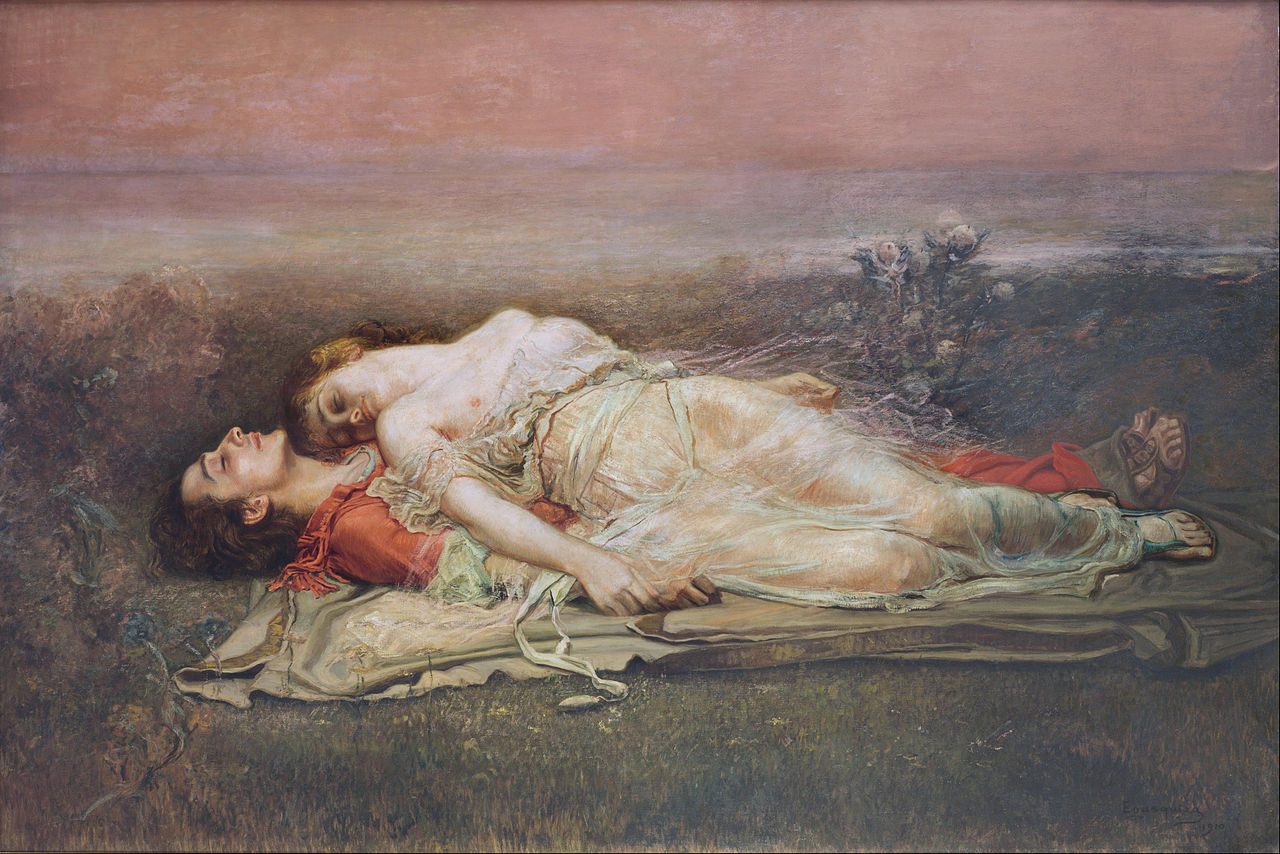
    Rogelio de Egusquiza‘s Tristan and Isolt (Death) (1910).

    Life Moves On

    I am in my fifties now. I no longer believe in infinity. For me things are all too FINITE. Where I once saw open space, I now see enclosure.

    She used to lie at my feet like I was a God. It’s a great feeling, isn’t it, to have that power! You stand above them like a God or a Goddess, looking down upon them, deciding on their fate.

    And of course – as we all know – with such power comes enormous responsibility. The only problem is that when you are young you rarely feel like being responsible. Then one day you decide to do a terrible thing. Everyone does it, at some point. You kill them!

    Metaphorically, at least. But this is the first real taste of death, and it is a truly terrible thing. Now, you have the taste of death upon your tongue. The one that you used to kiss. Now, s/he only tastes of poison.

    You move on.

    It is that simple. It’s called survival. Call this the first age when everything was divine and when you discovered metaphor and the apocalypse of dying.
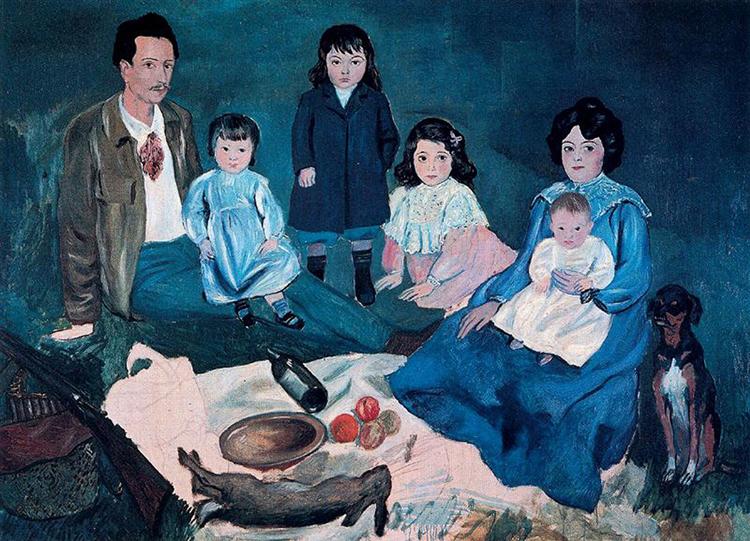
    The Soler Family, Pablo Picasso, 1903.

    Nemesis and Trinity

    So, time passes. You meet another one. Number Two. S/he is your Nemesis. For she will destroy you. Just like you destroyed number One, now your time too will come. Somehow this enters into our conception of justice. What goes round comes round. Karma.

    Just as you had looked down, all those years ago, on your first lover; just as you looked down on the one who crawled around at your feet, now you are in that very same position! Who would have thought it? There now, look at you! That miserable specimen down on both your hands and knees before Her, who is looking down upon you. Like she’s contemplating an insect. And, of course, She eventually squashes you under Her boot heels. She crushes and grinds you into the earth so that there is no longer any trace of you. You are extinguished. Finally. You are dead.

    There now. That is the story of numbers One and Two.

    What happens next? And what, by the way, does any of this have to do with Messrs Beckett and Joyce? Everything, my dears. Just wait. Be patient, as I will explain. I will take you by the hand and help you to join up all the dots.

    But first, let me introduce you to number Thee.

    Isn’t she a beauty? Now, remember the score is one-all now. Even Stephens, as we say. You are finally at the age of equality. It happens early on for some; for others later on. And for some poor buggers, it never even comes!

    You have to will it. But if s/he does come, you will finally have a chance to redeem yourself. For, like her, you too have been broken. You are no longer the youth you once were. Infinity has been clouded by impossible violence. You need to thread carefully now, and hold onto what you have with more caution.

    And you do. Whereas before your relationships – that is with numbers One and Two – may have lasted only five or so years, with number Three it is all-enduring. Before you know it, twenty years have passed and you have children growing up around you; who you now cherish as you once cherished your own life.

    This is the story of Three. The Trinity, if you will.

    Illustration by Malina/Artsyfartsy.

    How It Is

    Moving on to Samuel Beckett and a story from his How It Is (1961) that has obsessed me like no other in Literature. This novel by the Irish Modernist writer has obsessed me throughout most of my adult life. It acts like a portal into human history through Literature, travelling back to the Ancients of Greece, and Rome. But before exploring this, I must first tell you about Giambattista Vico.

    When talking about Giambattista Vico and Samuel Beckett, we must also consider James Joyce. The number three is there again! They form a triad. A holy Trinity. It was Joyce, after all, who asked the young Beckett to write an article about Work in Progress – the working title for Finnegans Wake (1939) – when they first met in Paris in 1928.

    This was when he wrote his famous essay Dante…Bruno.Vico..Joyce (1929), in which he singles out Vico – more than the other Italians mentioned in the title – for particular attention, and the important influence of this Neapolitan thinker on James Joyce, in particular on the structural composition of Finnegans Wake.

    But it also demonstrated Vico’s influence on Samuel Beckett, a point that has tended to be ignored by Beckett scholars.

    Let us consider the essence of Vico’s ideas on the Three Ages of Man, and how Joyce was to incorporate Vico’s theories on history into his epic final novel.

    In the La Scienza nouva or A New Science (1725), Vico attempts to break history down into a cyclical process, as natural as the four seasons. In fact, Vico’s Three Ages of Man idea actually contains four parts, and in this Joyce is a stickler. For this reason, though not alone, that Finnegans Wake is made up of four books. One being for each Age.
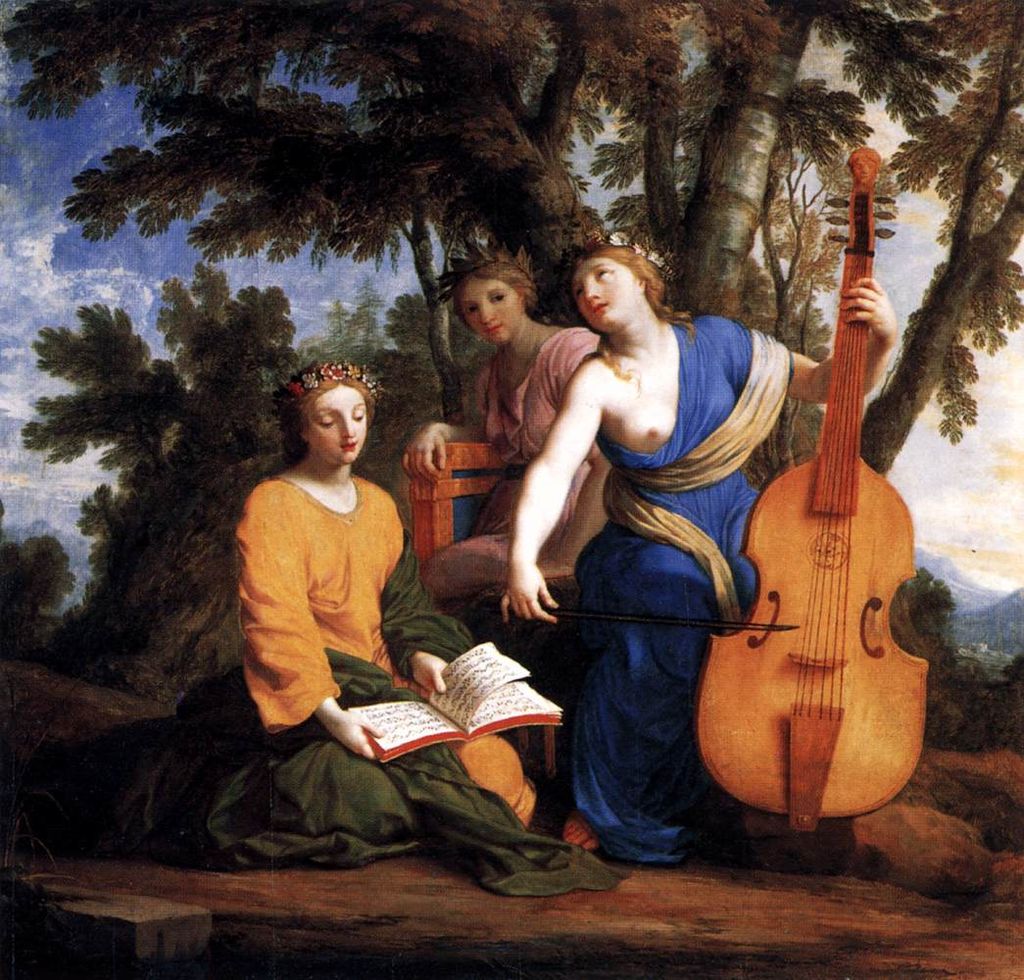
    The Muses Melpomene, Erato, and Polyhymnia, by Eustache Le Sueur, c. 1652–1655.

    The Four Ages

    What then are these Four Ages? The First is called the Divine Age and language in particular, but also laws, are divinely thought of, or God-given. God in this case is Jupiter, as we are in the Pagan era.

    Though, coming from a Christian era, we should recognise the intermediary nature of the Muse Uranus, mother of all the Muses, assigned the role of intermediary between God and man. However, She, in turn, needs a human vessel in order to transfer her God-given knowledge, and this, according to Vico, is where the poets come in.

    As it was a theological age, so all poets were theological, unlike today. That is to say, they were only concerned with divine matters.

    Language itself was divine. And metaphor played an incredibly important role, as signs and symbols were all-important.

    Vico singles out the bolt of lightning, for example, as the first sign of Jupiter. This is simply to show how terrified these primitive people were in the beginning. They lived in caves, like Home’s Cyclops. This was a period of epic wandering. Man was chaotic and unruly. The Muse, through her instruction, tamed him. Such are the divine origins of language.

    Joycean scholars have had great fun deciphering the various myths from the Bible and Antiquity that register in Book 1 of Finnegans Wake. It is indeed a really funny book – as Joyceans constantly highlight –full of puns referring back to famous figures, such as the Duke of Wellington and Ishtar, the ancient Babylonian Goddess of Love and War, and the Scottish empiricist philosopher David Hume, and so many more.

    It is a great sprawling narrative divided into eight chapters each one given over to one of the major characters who are called the Earwickers. Father and Mother – Humphry and Anna, and their three siblings Shem, Sham and Issy. The first chapter is a kind of prelude given over to history and the origins of the Muse.

    Beckett in How It Is begins his novel in similar fashion. Just as Joyce derives his ideas from Vico on the origins on human societies, Beckett too points to the Muse at the very beginning of the novel by starting with an invocation.

    Although unconventional, as you would expect from Beckett, that he uses the structural form tells us everything.

    The great Russian comparatist Mikhail Bakhtin, in The Dialogical Imagination (1975), is at pains to point out the origins of the novel as a genre and its debt to epic poetry, from which it took many structural features. Most novels are of tri-partite structure in theory, as Aristotle in his Poetics asserts, telling of events before, during and after – which is exactly what Beckett does in How It Is: events before Pim, with Pim and after Pim.

    Who is this Pim, you might be asking? To answer this we move on now to Vico’s Second Age, which is given over to violence.
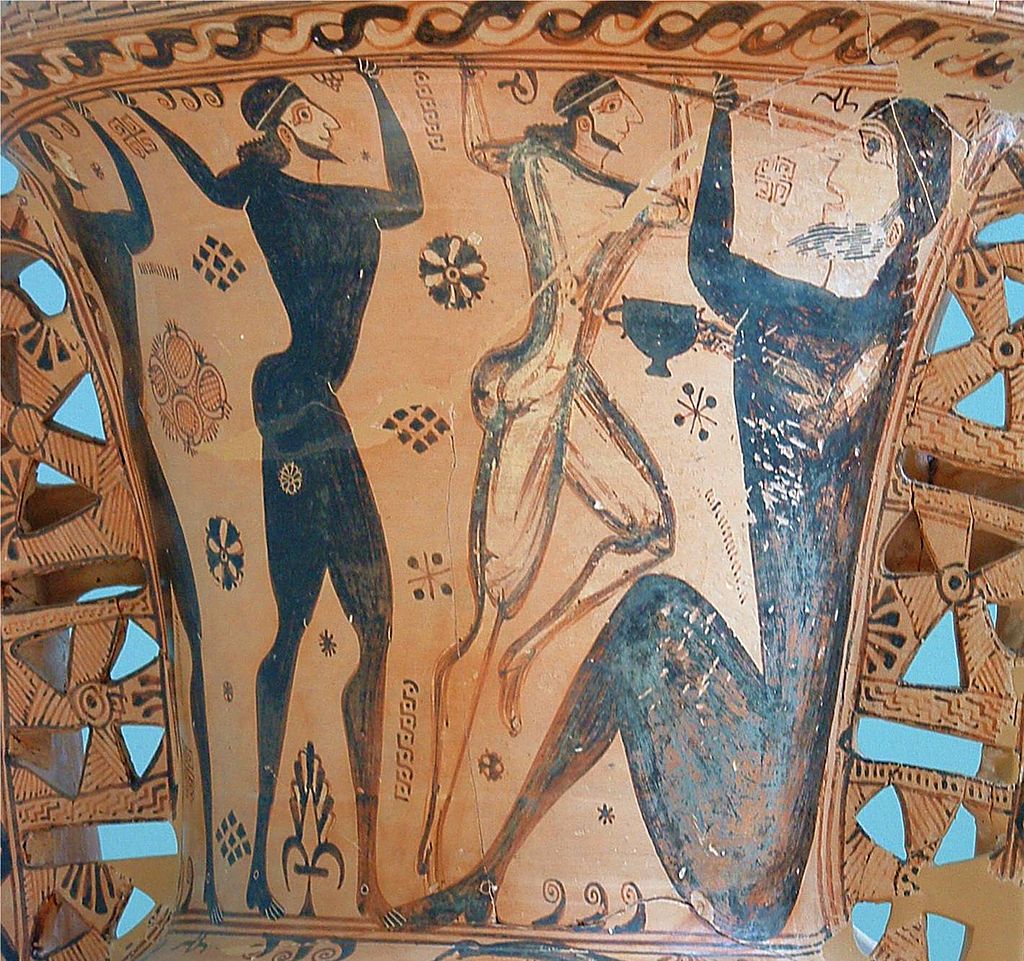
    Odysseus and his crew are blinding Polyphemus. Detail of a Proto-Attic amphora, circa 650 BC.

    Female Domination

    Recall my story with girl Number Two? How She kicked my sorry little ass! Yes, I am talking about Female Domination of the male species, just as I spoke about Male Domination of the female in the First Age. This is karma. Although with Beckett the characters are practically sexless.

    Similarly, Joyce parodies Hitler and the Nazis in Book 2 of Finnegans Wake, who were on the rise during Joyce’s lifetime. Book 2 of Finnegans Wake is full of wonderful puns at the expense of the Nazis, referencing particularly their atrocious treatment of Jews.

    Beckett in How It Is uses the most crude and forceful comedy. It is truly grotesque. The only comparison that I can think of in literature is a Satyr play – bringing us back to Ancient Greece.

    There is only one surviving Satyr play: The Cyclops by Euripides. Anyone who is familiar with this hilarious text will be aware that it is a parody of Homer’s Odyssey. A grotesque parody in the style of Rabelais.

    Essentially, Euripides takes the myth of Zeus and Ganymede which sees the king of the gods having his way the beautiful youth.

    Ganymede is synonymous with the submissive person in an amorous relationship. The Bottom, in short. As opposed to the Top. We here use the language of S&M, which is what we are talking about. Bottoms and Tops. Dominants and submissives. This is what Beckett is obsessed with in How It Is. This is what I have come to call the maths of rejection.

    Set Theory

    As the novel progresses, Beckett becomes more and more obsessed with the numbers Three and Four. In fact the quartet, not the trilogy, is the ideal set.

    I am using the mathematical term now, taken from set theory. As this is how Beckett chooses to enter into the subject matter. It went on to become a major obsession of his during his later writing career. Consider there were two decades between the publication of How It Is in 1961 and his play Quad, completed in 1981, although tit wasn’t published until three years later.

    Beckett spends the greater part of parts 2 and 3 of How It Is going over the innumerable permutations of movements. We are back with girlfriends One and Two, which started this small discourse on Love and Literature. Remember 1 + 2 = 3. Therefore, if we were to progress to 4, that would mean a return to 1 – to my mind anyway. Meaning I would have to become the bastard again.

    Beckett uses the terms Victim and Torturer. These are the two modes of so-called human behaviour. In Beckett’s world, or, at least in the universe of How It Is, you are one or the other. I wonder which one are you?

    This is a slight simplification, as the movement of the couples in How It Is is in permanent flux.

    Beckett was also obsessed by Heraclitus and Democritus, the crying and laughing philosophers who form the two masks of theatre showing both aspects, extreme poles of human nature: the Tragic and the Comic; the legacy of the Ancient Greeks, which Beckett – without a doubt the greatest playwright of the twentieth century – revitalized.

    What other playwright uses farce to such a violent advantage? Think of the Tramps Estragon and Vladimir contemplating hanging themselves from the tree, as a form of entertainment in Waiting for Godot; Nag and Nell consigned to the dustbins in Endgame; or Winnie up to her neck in it in Happy Days.

    In all the unforgettable imagery conjured in Beckett’s theatre we find unforgettable visual metaphors encapsulating, in their simplicity, human tropes, which endure eternal.

    In this Beckett is the poet of catastrophe and disaster, a role he inherited from the French poet Charles Baudelaire (1821-1867).

    Baudelaire was the first to mine the negative aspect in man to such a profound and relentless degree, in this sense Beckett is really his doppelgänger. It was Beckett’s genius to align himself so much to the dark side, as it were, which Baudelaire had ploughed so successfully in Les Fleurs Du Mal.

    Featured Image: Louis Jamnot (1814-1892), Le Vol de l’âme
  • Socio-Economic Rights Must Be Vindicated

    The noted American historian, and Putin critic,Timothy Snyder’s recent text Our Malady: Lessons in Liberty and Solidarity (2020) is a cri de coeur against almost non-existent healthcare rights in the U.S. – which the pandemic brought into sharp focus. The cossetted Yale professor saw the light, as his country failed to cope.

    Our Malady is about health care, but it is also an example of confessional literature about how health care provision, or lack thereof, begins to affect even those that are putatively privileged. The pandemic laid bare the limitations of the neoliberal order. But it is not just about healthcare, and not just about the United States, as the pandemic lays waste to income structure, life expectancies and perhaps a whole species’ expectations of the good life.
    We urgently require legal arguments in terms of justiciability, resource allocation and clarification of the limits and extent of judicial powers to enforce social and economic rights.  These arguments are no longer of cautious relevance given the gathering storm we confront. This is not the time for legal casuistry, or politeness either.

    https://vimeo.com/426871719

    In terms of the consensus as to what these rights are let me sketch a list, all of which are denuded or under threat:

    1. A right to adequate nutrition.
    2. A right to clean drinking water, and for bathing.
    3. A right to basic health care and, in particular, to emergency treatment.
    4. A right to housing or shelter; alongside a complimentary right to resist arbitrary eviction.
    5. A right to a minimum or adequate standard of living.
    6. A right to social security, leading to universal basic income.
    7. A right to a healthy environment, including air quality.
    8. A right to education, up to third level.
    9. A generalised right to dignity and self-expression in terms of expressing one’s identity.
    10. A right of a country to development.

    Crucially, there is a lively discussion as to which of such rights must be progressively realised, and which have a minimum content that are immediately realisable. Thus, the right to health care, both domestically and internationally, is progressively realisable, subject to resources.

    A right to emergency health care, however, is a minimum content right with direct enforceability, if justiciable.

    Similarly, the right to shelter is progressively realisable, but the international consensus is that forced or arbitrary evictions are directly enforceable again, if justiciable.

    Social and economic rights, in fact, have a long intellectual pedigree. Indeed, they are even evident in Thomas Hobbes’s enumeration of Natural Rights. Ancient Greek philosophers also identified such fundamental natural rights as inherent to membership of a polity.

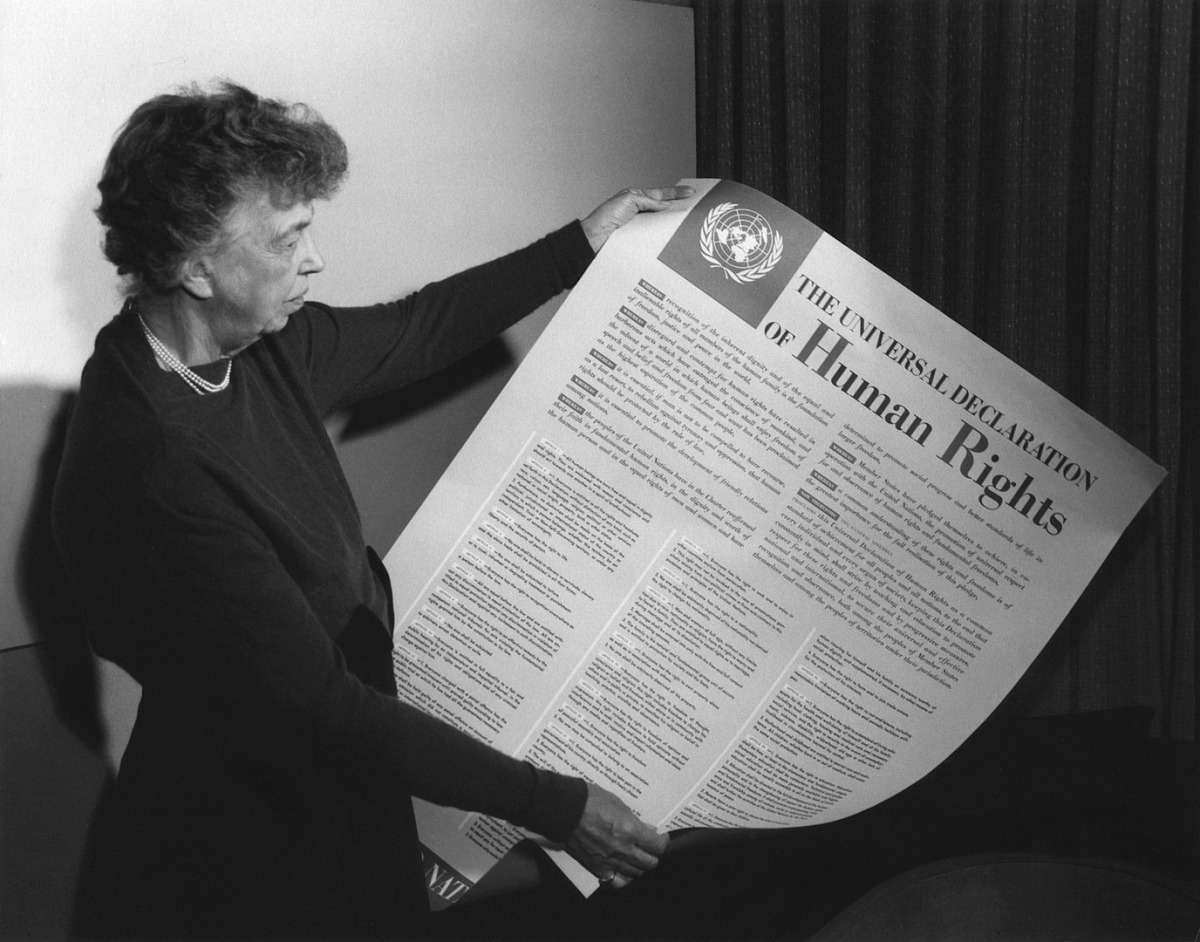
    Eleanor Roosevelt with the UN Universal Declaraion of Human Rights.

    The proposal to include them in the UN Charter was aborted by representatives of the developed world. They were reconstituted in the 1966 UN Covenant on Civil and Political Rights, but with limited effectiveness, even allowing for recent rights of individual petition. Now amidst a growing convergence between developed and developing societies in the neoliberal order, we are increasingly all in the same boat.

    Right to Life

    The Indian Supreme Court decision in Olga Tellis v. Bombay Municipal Corporation concerned public interest litigation by thousands of pavement dwellers of Bombay city.

    The plaintiffs argued that they could not be evicted from their squalid shelters without being offered alternative accommodation. They further argued that they had chosen a pavement or slum to live because it was nearest to their place of work, and that evicting them would result in deprivation of a right to a livelihood.

    The petitioners were to be evicted under the Bombay Municipal Corporation Act, which empowered the Municipal Commissioner to remove encroachments on footpaths or pavements over which the public have a right of passage or access.

    Olga Tellis, Ex Editor of Sunday Observer & Asian Age. Source YouTube.

    The relevant article of the Indian Constitution (modelled on Article 45 of the Irish Constitution) excludes the Directive Principles from judicial cognisance, yet the court opined, in finding that the right to life itself was informed by the Directive Principles; that Article 39(a) of the Constitution, which is a Directive Principle of State Policy, provides that the State shall, in particular, direct its policy towards ensuring that citizens have the right to an adequate means of livelihood.

    The court concluded that if there is an obligation upon the State to ensure citizens enjoys an adequate means of livelihood and the right to work, it would be an exercise in pedantry to exclude the right to livelihood from the content of the right to life.

    The judgement thus expanded the right to life guaranteed under Article 21 of the Indian Constitution to include within its scope the right to livelihood, which in this context translated into the right to be allowed to remain on the pavements.

    More remarkably in People’s Union for Civil Liberties v. Union of India & OR’s (2003), India’s Supreme Court derived the right to food from the right to life and ordered that that the Famine Code permitting the release of grain stocks in times of famine be implemented.

    The court ordered that the grain allocation for the food to work scheme be doubled and financial support for schemes be increased; that ration shop licensees stay open and provide the grain to families below the poverty line at a set price; that publicity be given to the rights of families below the poverty line to grain; that all individuals without means of support (for example older persons, widows, disabled adults) be granted an Anthodia Anna Yojana ration card for free grain; and that State governments should progressively implement the mid-day meal scheme in schools.

    In terms of stretching the bounds of acceptable judicial intervention this case could not be more dramatic, as the Court utilised mandatory policing orders and even inspectors in the field to ensure compliance with their orders, which have spread nationwide.

    With inflation in food prices already evident in the wake of the pandemic, will our judicial authorities oblige often reluctant, and even compromised, executive authorities to intervene in the market, and avert shortages? And in Ireland will the Court overcome a reluctance to vindicate a right to housing as part of a generalised right to life?

    Canadian Dissenting Opinion

    In Canada a similar conclusion that social and economic rights inform the content of the right to life is evident in a dissenting opinion in the Canadian Supreme Court case of Gosselin v. Attorney General of Quebec (2004).

    The case concerned the denial of unemployment assistance to those under thirty-five, who could do a form of workfare in lieu. The court addressed issues pertaining to discrimination and the right to life and security of the person under the Canadian charter. The majority found the law justifiable and in Thatcherite terms as an incentive for the young to work. “Get on your bike”, as Norman Tebbit would put it.

    Judge Louise Arbour dissented however, as indeed did Mr Justice Lahreux Herbe. Arbour J. derived a right to minimum social assistance from the right to life and indeed security of the person under Section 7 of the Charter, and drew a prudential distinction between corporate-commercial economic rights and economic rights fundamental to health and human survival.

    He indicated that the appeal makes it obvious why ‘those economic rights fundamentals to human life or survival’ should not be treated as akin to corporate commercial economic rights.

    Simply put, the rights at issue here are so intimately intertwined with one’s basic health (and hence ‘security of the person’) – and, at the limit, even of one’s survival (and hence ‘life’) — they could readily be accommodated under section 7 rights of ‘life, liberty and security of the person’, without the need to constitutionalize ‘property’ rights or interests.

    Notably, Arbour J also links the right to health to the guarantee of security of the person. He argued the expansion of the right to life in this fashion gave content to this right, which is to be protected in such a fashion so as to invest the State with a positive duty to protect life.

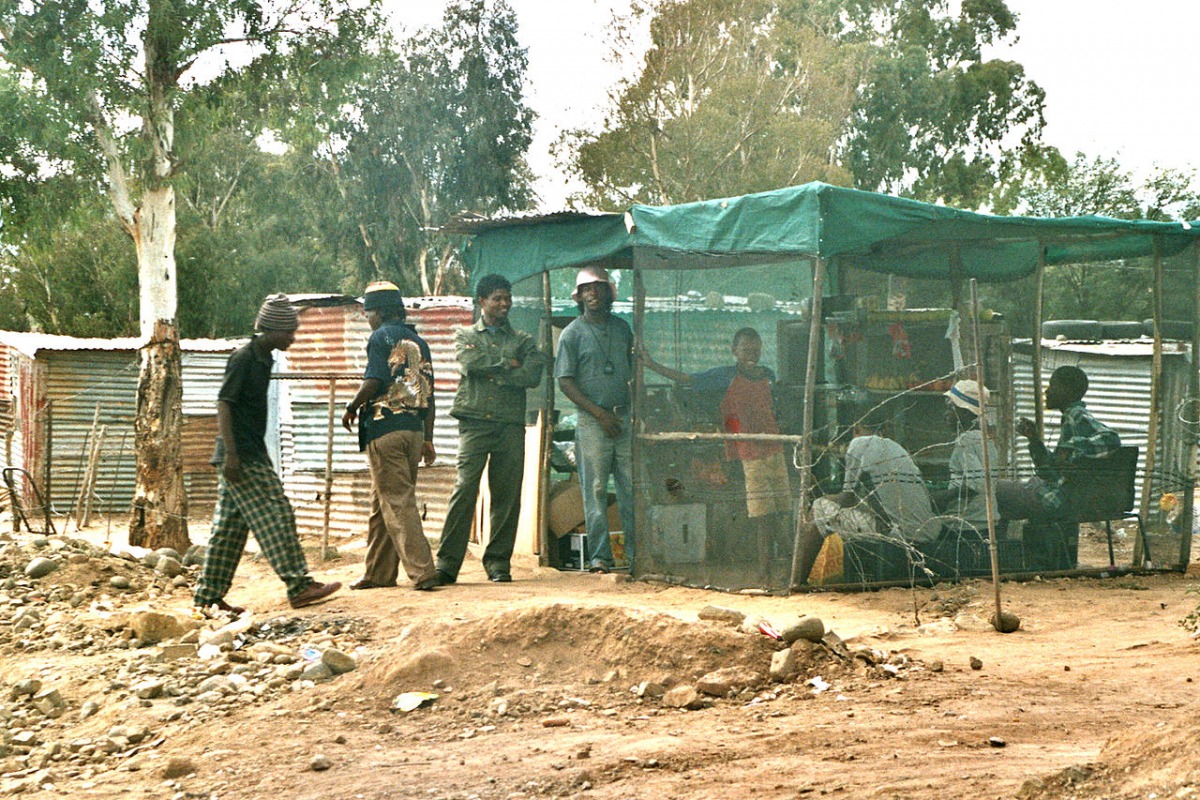
    Little shop on the main street of Dukathole, South Africa.

    South African Experience

    It might be noted that the South African experience is different in that social and economic rights are textual and thus inherently justiciable, with the word dignity mentioned in several places.

    The relevant housing provision explored in Government of the Republic of South Africa v Grootboom (2000) is Article 26 whereby:

    Everyone has the right to have access to adequate housing. The state must take reasonable legislative and other measures, within its available resources, to achieve the progressive realisation of this right. No one may be evicted from their home, or have their home demolished, without an order of court made after considering all the relevant circumstances. No legislation may permit arbitrary evictions.

    The South African Constitution also specifies an immediately enforceable specific minimum right against forced or arbitrary evictions. Such a right entails:

    1. Meaningful consultation prior to eviction.
    2. Alternative relocation if eviction proceeds.
    3. No eviction to proceed unless the land is being put to productive use.

    Nonetheless, the South African Courts have set down limits for their review and in general such rights are in the text of the document to be progressively realised.

    In Subramani v. Minister for Health (1997) for example the South African Supreme Court was very explicit about the large margin of discretion it would give to the State to set its budget.

    It also states that the court: ‘will be slow to interfere with rational decisions taken in good faith by the political organs and medical authorities.’

    Sachs J went further stating that:

    In open and democratic societies based upon dignity, freedom and equality, the rationing of access to life-prolonging resources is regarded as integral to, rather than incompatible with, a human rights approach to health care.

    However, if decisions taken are deemed unreasonable then the South African courts will step in. Thus, in the Minister of Health v Treatment Action Campaign (2002) and in Azbuka and Others v City of Johannesburg (2009) the extent of the right to water was litigated in South Africa after the case arose in Soweto.

    Justice Oregon writing for the Constitutional court found the City’s free basic water policy of twenty-five litres per person per day to be reasonable under section 27(1) of the Constitution, and that the introduction of prepaid water meters to be lawful, procedurally fair, and not unfairly discriminatory.

    The Court noted that the City was under no constitutional duty to provide any amount of free water, but merely to take reasonable measures to progressively realise that right. It said it could not fix a minimum core amount, as this would vary in terms of personal and local circumstances and would prevent context being considered.

    It also argued that this was not a determination for a court to make, as it was properly the role of the democratic branches of government to investigate conditions, having regard to the availability of resources, and to determine achievable targets.

    Irish Housing

    In Ireland, the housing market is chronically under-supplied with affordable units, particularly in Dublin, but increasingly elsewhere too. Many local councils appear reluctant to countenance building modular homes, and the rental market is out of control and extortionate.

    David McWilliams blithely advises homeowners to step away from the market, as there is no security for the mortgaged or rentier class, but for most finding a home to live in is not an investment.

    The Irish State is also tolerating rampant evictions by banks and Vulture Funds and negligently permitting unfair commercial practices to occur, often in breach of consumer protection.

    Thus, lenders have reneged on agreements bartered with consumers at a time of high ostensible economic prosperity by neglecting a contractual obligation to revert the consumer to a tracker mortgage after the expiry of a fixed rate period, or upping interest rates to the highest in the Eurozone, often aimed at those seeking to exit the country.

    Thus, lending institutions with no interest in Ireland such as Danske Bank and The Bank of Scotland simply left the room and disposed of their assets, hiking up the mortgage interest rate payments as they left and/or selling assets off to Vulture Funds.

    Ulster Bank has followed them out the door, while citizens are thrown out on the streets in spite of the pandemic.

    The old cry of the tenant farmer for the 3Fs: Fixity of Tenure; Free Sale and a Fair Rent falls on deaf ears in the era of the Vultures.

    The Sinnott Case

    In the Sinnott case (2001), comprising judgments from all seven members, the Supreme Court was asked inter alia to adjudicate on the legality of mandatory orders made in the High Court by Judge Peter Kelly. This precedent remains an important brake on the capacity of the Court to vindicate the right to life – which includes a right to shelter – of Irish citizens.

    In a leading judgment for the majority Adrian Hardiman, following a High Court decision of Justice Declan Costello in O’Reilly v Limerick UDC (1989) distinguished between commutative and distributive justice, the former bearing on relations between individuals such as found in contract and tort, with the latter involving the distribution of the resources of the State.

    In contrast to commutative justice which Hardiman considered central to the Court’s function, he held that the exercise of the Court’s jurisdiction over distributive justice was repugnant to the Separation of Powers.

    Despite Justice Costello demonstrating a willingness to countenance distributive justice in the subsequent case of O’Brien v Wicklow District Council (1994) Hardiman only brought to bear his arguments in O’Reilly, and sought to elevate non-justiciability to a constitutional principle.

    He said that the apportionment of resources ‘would lead the Courts into the taking of decisions in areas in which they have no special qualification or experience’; and were a judge to engage in ‘designing the details of policy in individual cases or in general, and ranking some areas of policy in priority to others, they would step beyond their appointed role.’ He did, however, allude to generalised ‘human rights to earn a livelihood and hold property.’

    It would appear to have been disingenuous for Hardiman to deny jurisdiction on the grounds of judicial incompetence in budgetary affairs. Detailed financial resolutions are, after all, already executed in the commercial arena. The test is one of proportionality, as the South African case law demonstrates.

    A paramount right to life under Article 40.3 should now require the Court to make mandatory orders, interceding on behalf of citizens whose health and life is threatened by this Housing Crisis, particularly in the presence of contagious disease. Where the executive and legislature fail to vindicate a right to life the Court must surely assume responsibility.

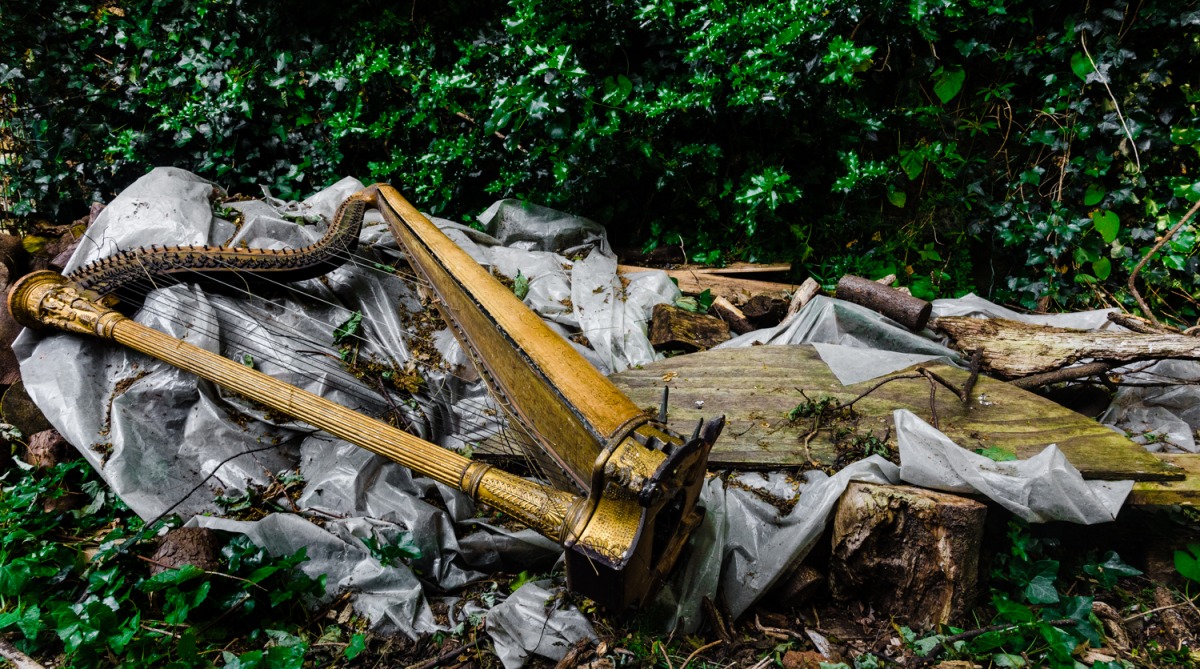
    The Harp needs more than tuning…

    A Constitutional Challenge

    To deal with homelessness and affordable housing a challenge needs to be made through the courts to establish a right to housing.

    The Irish Constitution through Article 45 and a generalised right to life contains minimum rights against forced or arbitrary evictions.

    Such a right should lead inter alia: to meaningful consultation begin given prior to any eviction; alternative relocation if eviction proceeds; no eviction proceeding unless the land is being put to productive use.

    An arbitrator should also be able to probe into what banks or Vulture Fund intend to do with this vital infrastructure, fundamental to the lives and livelihoods of citizens.

    Any arbitrator would of course reject spurious defences involving colossal amounts of borrowings, but should achieve a re-calibration of the system. establishing some equality of arms in the process, now desperately needed.

    Shelter from the Storm

    Without adequate shelter no one can live a dignified existence. A home – a place of one’s own – is intrinsic to the good life we have a right to expect. But housing is only one issue.

    Our social structure is unravelling through the hidden hand of American and Canadian Vulture and Cuckoo Funds. In the dystopian aftermath of the Pandemic, and Screen New Deal, once vibrant communities are fracturing, and social atomization is increasing apace.

    In the urban wastelands, we have entered the territory of Chile under Pinochet during the 1970s as Ireland becomes a test case for how much a people can endure.

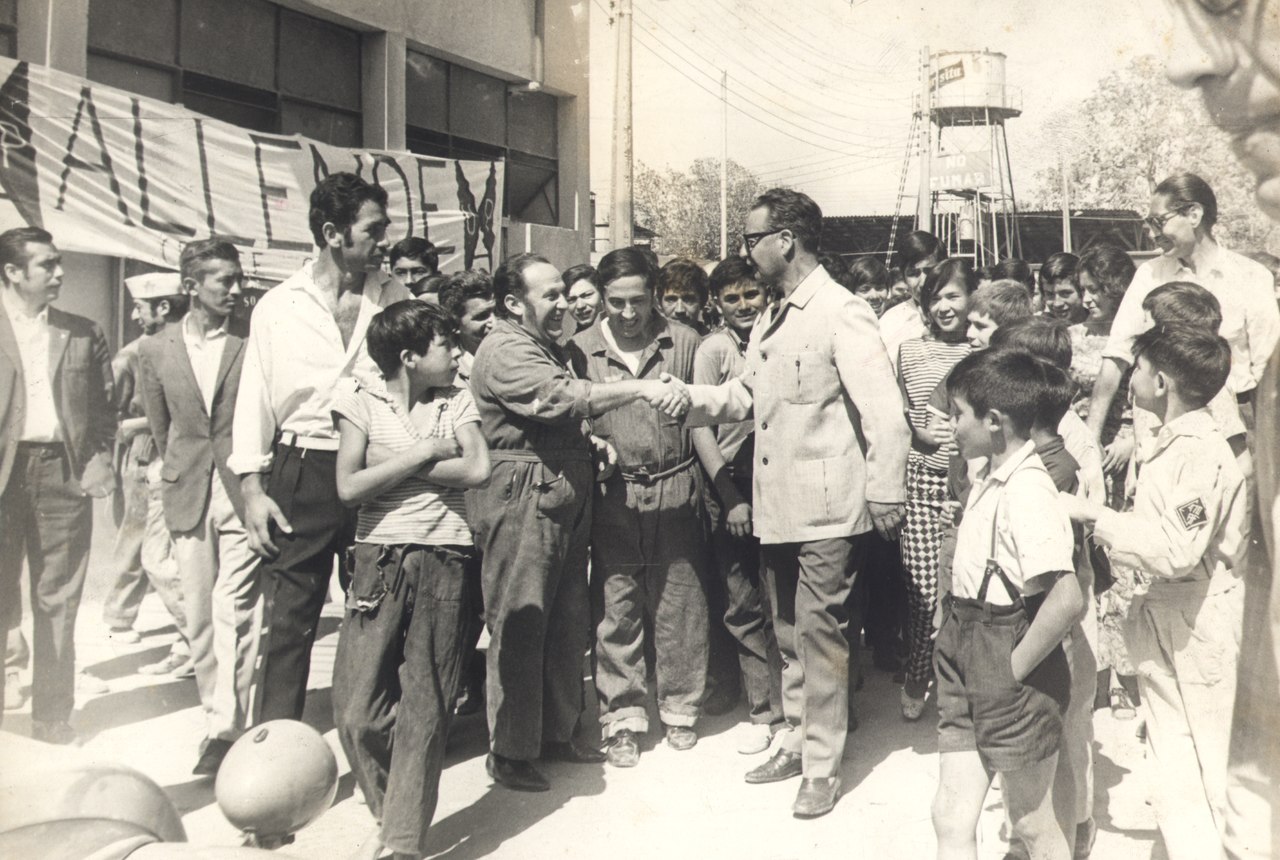
    Salvador Allende in 1972.

    In her recent novel A Long Petal in the Sea (2019), Chilean novelist Isabel Allende – a distant cousin of the murdered President Salvador Allende – describes the scene in Chile at the time, bearing increasing resemblance to our increasingly dysfunctional society:

    He called to tell them that on the surface the country was modern and prosperous, but one only had to dig down a little to see the damage underneath. The degree of inequality was staggering: three-quarters of the wealth was in the hands of twenty families. The middle class survived on credit; there was poverty for the many and opulence for the few; shantytowns contrasting with glass skyscrapers and mansions behind walls. Wellbeing and security for some; unemployment and repression for others. The economic miracle of recent times, based on absolute freedom for capital and a lack of basic rights for workers, had burst like a bubble.

    Similarly:

    The military government had decided public services should be in private hands. Health was not a right, but a consumer good to be bought and sold. In those years when everything that everything had been privatized had been, from electricity to airlines, a plethora of private clinics had sprung, with state-of-the art buildings and facilities for those who could afford them.

    One thinks of The Beacon Hospital and other facilities reserved for Ireland’s wealthy health consumers.

    Life depends on livelihoods, now threatened by disproportionate measures. There must be an alternative. Otherwise, suicide, shortened lives, poverty, inequality, social exclusion, and social fragmentation await, leading to fascism and extremism. In this respect, COVID-19 has been the perfect storm of opportunism, or a coalition of interests.

  • Housing: A Banker Speaks Out

    It is often said the current Irish housing crisis is mainly the result of a lack of supply of new houses; a supply that slowed down and never really fully recovered following the burst of the property bubble in 2008.

    Developers lament a lack of initiative in governments past and present; housing plans replace one another, at least in their facades. The latest example is the Fianna Fail Housing Minister Darragh O’Brien’s Housing for All replacing, or rather refining Rebuilding Ireland introduced under Fine Gael’s Eoghan Murphy – all while multiple cranes never really stopped crowning Dublin’s skyline.

    The spin is that this lack of supply, in turn, generates scarcity, which translates into higher prices.

    Thus far, the solution we have been served is to create a tax-friendly environment: a de-facto tax haven, to attract reliable (and well-resourced) institutional landlords and investment funds – commonly referred to as Vulture or Cuckoo Funds – to accelerate badly needed developments, besides keeping the Irish banking system afloat.

    Apparently, such entities are best placed to pursue ambitious housing schemes, and the management and maintenance of as much of the national housing stock as possible. And supposedly, as in the Housing for All plan, it is the market that is best equipped to understand and deliver the population’s needs, down to every neighbourhood and community.

    Unfortunately, however, the nature of this demand, might not be guided by the community’s needs, but the obligation of a certain profit margin for a financial instrument; held in a pension fund – perhaps owned by a kindly grandmother somewhere else in the world – while enriching the asset managers of these private equity juggernauts.

    What actually gets built, and at what price, is increasingly under the control of entities that hardly take into account the repercussions for society at large. In some cases they simply up sticks to gnaw on bones elsewhere. The Cuckoos have been here for a long time, locking in the spread between ever increasing rents and the financial costs.

    The influence of the banking and financial sector over the delivery of housing has become ever more evident. Thus, the quagmire of basic supply and demand arguments have little or no bearing on how a complex infrastructure such as housing is managed.

    It is within the banking sector, and regulations set by the ECB and Irish Central Bank that a substantial proportion of the residential properties of this country are held, packaged and repackaged, and sold in bundles to foreign investment funds in a process called securitization.

    For most people, despite the shocking revelations arising out the 2008-09 Crash, the inner workings of those dynamic sytems remain out of reach. We therefore find it necessary to look for guideance from someone who really understands the relationship between the current housing crisis, and the financial markets underpinning this.

    Ben Hoey has worked in commercial and investment banking for the past thirty years. After leaving Ireland in the 1980s, he went on to become CFO of Merrill Lynch International:, CFO of Bank of Ireland Capital markets in the wake of the 2008-09 crisis, and managing director of Kennedy Wilson Europe until 2015. Then, as he likes to put it, he failed to retire.

    He is now in the process of setting up his own Fintech business, aimed at creating a Rent to Buy structure.

    It was while analysing a distressed home loans portfolio on behalf of the Not-for-Profit organisation called Right2Homes, that he awoke to the full scale of banking misconduct, and mis-selling of the mortgages in the first place.

    Hoey contends that up to one-hundred-and=fifty-thousand mortgages may have been affected, including some currently in the Courts for repossession hearings, and others that have already been repossessed by banks and Vulture Funds.

    He is now taking approximately one hundred test cases of misconduct and mis-selling of mortgages before the Financial Services Ombudsman: and that seems to represent just the tip of the iceberg.

    Today, Irish interest rates remain, intentionally, the highest in the EU in order to increase bank profitability. This allows the Vulture Funds to purchase swathes of property and maximise their returns. Nowhere else in Europe offers such attractive rates, and hence Ireland is plagued by the funds, who see us as easy picking. Distressed mortgage holders are simply the low hanging fruit.

    How can we explain why an entire generation is paying the highest mortgage rates in the Eurozone, or being forced to rent at at more than double the rate compared to ten years ago? Extreme commodification of residential assets lies at the heart of this.

    Image: ©Daniele Idini

    Ben Hoey: It’s all about cash flow. Property, as an investment, is valued based on its ability to generate cash. Cash is king, and that’s why these Vultures, even the Cuckoo Funds, can access so much low cost leverage. No one has a hope against them. That’s what’s wrong with the world. Capital markets are so cheap now that they can buy anything. And if you think that the current government policies and Central Bank policies is putting free cash into the system, you need to recognise that free cash doesn’t go to you or I. Free cash flows to the banks to make sure they are solvent and healthy. And it’s the banks that make the fortune out of the free cash from quantitative easing.

    Cassandra Voices: What would be the average rate that Vulture Funds will buy loans for? Is there an average or is it dependent on the amount of NPLs versus performing loans if it’s a mixed package, for instance?

    Ben Hoey: No, it will never be mixed. Even when Nationwide Building Society was sold off, it was broken into different portfolios of loans depending on the ability of the debtor to pay. For simplicity, there was the complete deadwood, ‘haven’t heard from them in years‘; to the guy struggling; missing every couple of months; to the performing ones [the loans that were regularly being paid off]. So even within the Non Performing world, they split them into different categories and then they’re priced accordingly per portfolio.

    In 2018/19, the average pricing for Irish bank’s non-performing residential home loans was circa 65 cents on the dollar. And that’s per portfolio. Nothing is ever priced per loan because it’s all priced on the cashflow of the portfolio. Cash flow primarily generates what price they’re prepared to pay for the portfolio in total. Then, once they work out that, they apportion the price back across the portfolio for tax and regulatory reasons. Other factors such as equity in the home, negative equity, etc. do play a role, but they don’t care much about the price per loan, as each loan position will be managed individually and the portfolio will be managed and funded in its entirety; the objective being to maximise the cash flow on every loan.

    Image: ©Daniele Idini

    Cassandra Voices: The narrative supporting the presence of Vultures Fund in Ireland is that their investment is a necessary precondition for a stable banking market, and consequently construction industry. Why are we still seeing massive sell-offs of loan portfolios to Vulture Funds? Are the banks still in a sort of intensive care unit and in need of continuous injections of capital, as in the wake of the Crisis?

    Ben Hoey: I don’t think so. The banks are generally a cash cow. But what happened in 2009 is that there was a liquidity crisis as international investors and depositors withdrew their cash from the Irish banking system. NAMA was formed to solve that liquidity crisis in the banks. Most of the developer loans, which were completely dead in the water (with no cash flow), which were extensive relative to the rest of the banking market, were transferred to NAMA and again cheap, very cheap bonds were issued to support the purchase. All of those bonds were issued to the banks that transferred their loans. They effectively swapped their bad developer loans for low cost NAMA bonds which greatly improved their liquidity and capital position, as they could use those bonds to generate cash or liquidity in the market. NAMA was vital to addressing the liquidity issue in Irish Banking at the time.

    The interesting thing is that actually they didn’t start getting the residential loans off their books until about 2016, 2017 and 2018. So, there was clearly no rush as the liquidity crisis passed. The main reason that the banks in Ireland started to sell the residential loans was that the European Central Bank said: “guys, we are worried about the next crisis and you’re still living in the current crisis. So get your residential non-performing loans down below a certain percentage of your balance sheet.”

    It was typically seven percent on residential NPLs dropping to around five percent. So the Irish banks, faced with severe imposed capital costs, were strongly encouraged to sell their portfolios to hit these ratios. The European Central Bank brought in horrendous capital hits like a 100% reduction of your capital if you didn’t get below that level. So, for example, if you had a €100 million loan portfolio and you had provided say €60 million against it, your exposure to future losses was only 40, the ECB was saying: “if you don’t get below that ratio, then an ever increasing amount will be deducted from your capital, greatly limiting your ability to undertake new business.”

    We need a strong banking system which is ready for the next crisis. So after NAMA, there does not appear to have been a liquidity crisis for the Irish banks and, by their very nature, liquidity crises need to be solved immediately, as they are not like property and health service crises, which seemingly can go on for decades.

    In 2008-2009 the Irish government stepped in and did the craziest thing ever, which was to guarantee €400 billion of customer deposits, because all the international deposits were leaving the Irish banking system literally by the second. And they actually started to realize that, oh, my God, we have a bank account too that needs to be funded – and, they know, it’s going to run out of cash soon. And that was the problem. Nothing to do with lack of profitability. It was lack of cash or liquidity as it is better known in the industry.

    Cassandra Voices: So it was the withdrawal by investors, essentially a withdrawal of money by other banks or investors?

    Ben Hoey: By all the deposit base. Ok, not so much the Irish people, because they had access to the deposit guarantee scheme already. There was some stories of customers moving their cash to Switzerland and they all lost their shirts on the exchange rate. But no, in the main, it was the big institutional money that would have always chased the higher yielding banks. So, the Irish banks would have been paying a greater rate because they were less safe, because of country risk, etc. So as soon as those institutions got scared, they just pulled the cash out and the short term money markets closed to the banks. All right. And then that’s when the ECB had to allow Irish banks to start printing bonds. So they printed money. They issued bonds. But it was to save the banking system. Yeah, I think that was the bottom. Remember, you can only have a liquidity crisis over a short, very short, period. The liquidity crisis is a week or two weeks where – I always have to remind people – the truth is hard to establish, as each bank fights for survival and many assumptions have to be made by chief executives. It’s a very, very awkward position to be in.

    Cassandra Voices: Isn’t it the job of bankers to project a level of confidence that might exceed the reality of the picture?

    Ben Hoey:  The chief executive always has to take the optimistic view. Then, you know, you look at the Irish regulator at the time. He looked at that crisis. I don’t know where he got his information from. He came out and said that the Irish banks are well capitalised to weather the storm. So there was a man who wasn’t even a chief executive talking up the banking system in order to give it a chance of survival. I think a month later it was all over. But to have no liquidity is what kills a bank, not lack of profit, as the accounting rules are focused on the long-term profitability of the banking system.

    Image: ©Daniele Idini

    Cassandra Voices: But what happened to Iceland in your view? Did they do the right thing  when they more or less let their banks fail.

    Ben Hoey: They had no choice. There was no EU there to support them. You know what partially got us into the problem was joining the EU: the euro and cheap money coming into an economy that was used to expensive money. People thought, “I can service a million euros worth of tracker mortgage for six bob a week.” And so when we went into the crisis, the ECB helped us out. We are part of the euro. We couldn’t be brought down. But Iceland had no backstop. They were on their own. It was a common belief that the guarantee by the Irish Government of €400 billion of bank liabilities was stupid, but the markets ignored it. Do I think NAMA was a good thing. Yes, I think it saved the liquidity of the Irish banks.

    It’s after that period, after 2010, there was a tremendous opportunity for Irish banks to rebuild and innovate. And they didn’t. They just sank back in and took the cheap money and did the same thing day in and day out. And then they screwed their own customers, beat the shit out of them, treated everyone the same. Talked about moral hazard and how certain members of our community overborrowed and made a mess of it. I hope society never forgives them, but some people move on. So in answer to your previous question, after the liquidity crisis was solved they didn’t need to sell their NPLs, they wanted to sell them. They didn’t need the cash. In fact, the banks were overcapitalised in my view and wanted to repay capital.

    Cassandra Voices: So if the banks, after 2010, were not in need of cash, but they were forced by the ECB to sell most of their distressed loans nonetheless, why didn’t they consider more ethical solutions that would have protected family homes for example? Instead of selling to the American, Canadian or other international funds?

    Ben Hoey: Two reasons. Execution risk and moral hazard. The moral hazard in this case is: banks say we can’t give a discount to someone even though they might deserve it, or we may have lent them too much cash. We can’t restructure the loan fairly and write off some debt as their neighbours will want a debt write off too. You can argue all day as to whether that’s right or wrong, but that’s the moral hazard argument. So they have to sell to someone who would be seen to be not so fair. And there’s a lot of hassle and maybe a bit of shame. Moral hazard helps to embed that shame in people. So that’s the moral hazard,.

    Then there’s execution risk. If you consider, at the end of the day, you have a bank official charged with selling several billion euros worth of loans. So you have a small number of ambitious well paid people who want to continue to be successful. So do they sell to Brian Reilly and his not-for-profit initiative, who’s never done anything like this before, who appears to have the funding, but it’s never been executed? Or do I just give it to Cerberus, who will walk in the door with the cheque immediately?

    You know, the head of Lone Star, the richest Irishman in the world, John Grayken, visited some of the Irish banks selling assets, which is akin to Warren Buffett popping in for a chat; that’s powerful messaging to Irish bank officials who need a guaranteed sale. They are big talkers; you tell me the cheque you want and I’ll write it now. That’s execution risk. There’s no executive risks with the likes of Lone Star or Cerberus.

    Cassandra Voices: What do they ultimately want out of all of this if, at the end of the day, they’re buying something that’s not performing? The cash flow really isn’t there. Do they want the properties? What do they want out of this?

    Ben Hoey: The normal model was they would price the portfolio on the current cash flows and then, after the purchase, they would improve those cashflows or liquidate some loans, i.e. repossess. And, in certain cases, they do deals for guys to walk away. So, say the property was worth €100,000 for simplicity sake, and they gave the guy twenty grand to walk away. God knows what they bought the loan for, but they ask themselves: “is this the maximum cash we can get here?” So €100,000 sale price, minus the 20k that they gave them to walk away. That’s generated €80k today, and the today is very important. That would have fed into the model. So it’s all about maximizing the cash flow.

    When they couldn’t maximize the cash flow because the Irish courts didn’t cooperate, they minimized the cash outgoing. So, originally when you buy a non-performing loan book that actually has a bit of cash flow, you don’t use all your own money to buy it. You go to a London bank and they give you what’s called a loan on loan. So they lend you money, and probably at one and a half percent, up to 60 percent loan to value, secured on the loans you bought. So that’s really cheap. But your own equity needs are say, nine percent unlevered.

    After a while you think this is not going anywhere. I’ll just put the whole lot into securitization vehicle and then issue triple-A notes up to a high percentage, paying out 80 basis points. So, they drive down their funding costs, which again enhances the cash flow. Net cash flow.

    Yeah. It’s all about cash. Show me the cash. The trouble is that they couldn’t do deals with Irish people because there was so few who had any cash and had no access to cash. And the Courts wouldn’t allow them to repossess.

    Cassandra Voices: And what has all of this to do with the Housing Crisis? How does this affect supply and demand on the Irish housing market?

    Ben Hoey: You said “there’s no supply.” So how do you know that? Supply of what to who? No one has defined how many affordable and social houses our society can afford. We don’t actually know what supply we’re trying to meet. And, you know, like all journeys, if you start in the wrong place, you have no hope of getting to where you want.

    The pension fund, the Vultures, are just one mechanism of delivery. But who are we trying to supply to? The family paying a bit of tax, probably earning up to €80,000? They should be able to buy a home or rent it affordably. We’re not trying to supply housing to a German pension fund. They don’t need housing. They need profit.

    Cassandra Voices: But a larger section of society in Ireland actually needs housing. And instead, what you are saying is that we are supplying Vulture and Cuckoo Fund profits, through the delivery of housing for their needs, and not the Irish people?

    Ben Hoey: Can you imagine if Apple said they were going to build a new phone with special features and they were going to sell it to a German pension fund so they could sell it on to our citizens? That’s exactly what we’re doing here. We’re saying we’re building these houses for German and U.S. pension funds because they’re the only ones that can afford them. We put a profiteer in the middle – a middle man. And that’s what happens when you commodify an infrastructure, a key infrastructure like housing.

    Image: ©Daniele Idini

    Cassandra Voices: Is this by design where we are now in terms of housing?

    Ben Hoey: This is inevitable when you make something a tradable commodity. You’ve turned homes into an investment class. There’s no rules anymore. The cheapest money will get the deal. And that’s the fundamental issue.

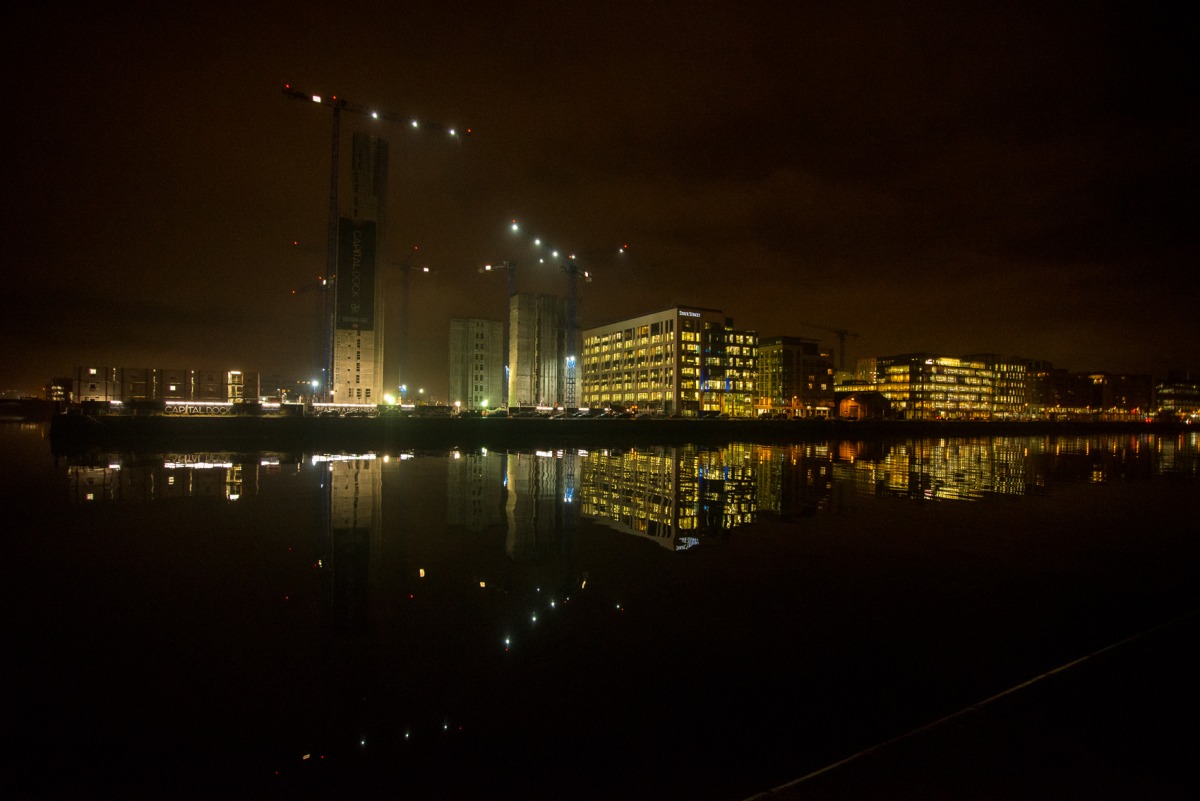
    What would happen if the Vultures took the airport over and were charging everyone €300 a head to get through? It wouldn’t happen because it’s so obviously wrong. But so is just about everything obviously wrong with the family home market. And you can see the effects. You go to Dublin, North Docks and South Docks; There are thousands of beautiful apartments, worth €600,000 to a million sitting empty because the German and U.S. pension funds want that type of housing, as they were told there’s loads of wealthy young people living in the city. How’s that worked out? Again, their money is so cheap that they can leave those apartments empty, and wait for rents to recover.

    There’s no crisis for them, even though their flats are empty. We’ve actually allowed a particular type of Vulture investor to dictate the supply of family homes to the Irish market.

    Back in the 1990s and early 2000s, we started building stuff all over the country where it wasn’t needed. We’ve learned from our mistakes, but we’re building the wrong sort of property in the right place: and this kills me as a capitalist to say it but… stop treating family homes as a commodity that can be traded. It will make the cost of labour very expensive and the country very unproductive.

    Image: ©Daniele Idini

    Cassandra Voices: Would it be possible to gradually stop treating the residential property market as a tradable commodity?

    Ben Hoey: No, I think you have to go back to basics and look at the complete supply chain: who ultimately is the rightful owner? Is it the individual, the government, or is it a commercial operation? And then you’ve got to put the right structure in place. And the funding naturally comes. Everyone looks out to different models such as the Austrian model etc. And they do work, but you can’t just pick and choose bits of them. You’ve got to look at the whole structure, holistically.

    Cassandra Voices: Ultimately it comes down to a vision of the society that we want to live in. And in order to define this we need a political environment that is willing to build an economic system that takes into account the needs of the population at large, and as you said is willing to define, in the first place, what those needs actually are. In the case of the Irish housing markets, the problem doesn’t seem to to be about access to financial resources, but again, who has access to it.

    Ben Hoey: When I was listening to you there, I was thinking about how we got rid of the British landlords in the past, who took the land with the backing of military power. And we’ve replaced them with, private equity, the Vultures who have employed not military power, but their cheap money. If only you knew the pain they go through before they decide to buy or to build. If you watch that pain, that risk mitigation, you realize how naive we are. The governments says build, build, build. But the clever money agonizes before it decides what to do. The Vultures know exactly what they want. But we don’t. So we end up being picked off.

  • Musician of the Month: Alain Servant

    Two months ago, after releasing my new album, Songs & Stories,Vol 1, I asked Irish composer Craig Cox to listen and offer his thoughts, without any prompting from me. Craig and I have worked together on several projects since I arrived in Ireland in 2012. His response resonated with me, so I will comment on parts of it here in order to explain my background, and what led me to write these songs.

    The music on Alain Servant’s new album is a synthesis of his years of artistic vagrancy.

    Vagrancy! This is a word that well summarises my artistic path. I started in theatre as an actor in my early teens and, at the age of sixteen, with eight friends, created a theatre company called ‘Tour de Babel’ (Tower of Babel). This adventure continued for over fifteen years. After moving from the Parisian underground scene to the French countryside, we created more than twenty shows, with the aim of meeting other cultures and using theatre as an intercultural laboratory. We always worked in collaboration with artists from other cultures, simultaneously immersing ourselves in them as we went along.

    As an actor, director and musician, I was able to incorporate practices and visions from the Mediterranean world (Lebanon and Tunisia), Central America (Guatemala, Honduras, Panama and Cuba), Asia (India and China) and Europe. I discovered Indian Classical music and started practicing the sarod

    Then the Turkish Oud.

    But all adventures must come to an end! The company split up and we all parted on our own paths. I next created a residency space for artists in the countryside in France where all arts and artistic movements were welcome to create and experiment. Over a period of ten years, I met and practiced with clowns, jugglers, acrobats, theatre makers, butoh dancers…

    The residencies continue.

    Then, I arrived in Ireland! This island has become for me not only a personal nest but also a place in which to focus my practice.

    Alain’s practice is fundamentally one based in narrative: his craft is the construction of worlds that hold up a warped mirror to the familiar, placing the listener inside an ethereal realm in which everything is distorted yet illuminated.

    I am a storyteller. I am also an actor, writer and musician. In Ireland, I found that songwriting was a way of merging my practices. My head is filled with myths and stories, and I found in Ireland a fertile land for my imagination to blossom.

    The dark earth and the cold sea have allowed the seeds of strange plants that I have carried all my life to take root in a peaceful garden, the poisonous and the medicinal growing side by side.

    I sit now in this garden, picking these fruits and becoming intoxicated with their smells and the memories they recall in me. I am present in the here and now, but many dimensions overlap. And I sing my perceptions as they arise.

    An appropriate adjective for this album is “multi-lingual”. Not simply in reference to the actual shifts between European tongues (so that the inherent musicality of language is demonstrated, it becoming a texture in itself), but also in reference to the musical world. 

    I have no real mother tongue. I spent my early childhood in Bolivia, speaking Spanish and listening the indigenous people speaking Quechua and Aymara. Arriving in France in Marseille, I learned French with a strong southern accent, then moved to Paris and, although fascinated by Classical French literature and poetry, I spent most of my time hanging around with the kids of my quartier learning argot, the Parisian slang that was very much alive at the time. And then English came for me, a language that seems to fit the songs I sing.

    A language is a way of seeing the world, as well as its music, different frequencies that don’t strike the soul’s strings in the same way. It is not necessarily the language that drives me, but rather the language revealing itself through whatever the subject is. A rock in a high mountain sings in Spanish, and a tree by a gentle river in French. What language would a bottle of whiskey lying in the gutter speak? I am this rock, this tree and this bottle of whiskey!

    House of the Pomegrantes (bandcamp). https://alainservant.bandcamp.com/album/a-house-of-pomegranates

    Moving through this album is like rolling through the shifting narrative structure of a dream, each track morphing into the next so that an overall tone manifests and an internal metaphorical logic constructed, with references to flowers, flowing water and undeath mushrooming and acting as way points that trick the listener’s memory while revealing the underlying subtext of an almost squalid hopefulness: a unique wisdom that weaves piss and vinegar parables, speaking reassurances in hoarse tones.

    For me, any creative act is a journey into the subconscious world. I jump into unknown depths and come back laughing, clutching some new treasures that become songs or something else. In these depths, I meet gods, kings and queens, slaves, even children playing with wild animals…

    Any new creation is a cathartic process that brings me back to a world of wonder. The logic emerges by itself with no conscious will. I try to follow the natural movement of expansion and contraction. And it can be hard work! As hard as the craft of the blacksmith at times. Because art is a craft, and demands skills, experience and practice.

    I would like to conclude with a word on collaboration. Collaboration is essential for me.  The creative process at times can be solitary, but becomes useless if there’s no transformation through exchange.

    I was lucky in Ireland to encounter John Linnane, one of the best musicians and performers I have ever met.

    Since 2017, we have worked together and performed together and I would like to thank him, not only because he’s a great artist, but also because he’s a great human being. It is an honour to have him beside me in this adventure.

    Link to most recent album: https://alainservant.bandcamp.com/

    Thanks to Zoë O’Reilly for corrections (and there were plenty!), and to Craig Cox for his text, the full version is here: https://www.facebook.com/alainservantmusic.

    Photo: Alain Servant & John Linnane
    Credit: Yoram Allon.

  • Poem: Questioning A Tank

    Questioning a Tank

    Into the shocked, shucked shell
    of the hospital at Kunduz, which

    for ten days past, in streaming light
    (the season’s slant of sun), has spilled

    a steaming trail of twisted bricks,
    chewed up rails, a grieving mist – the site

    where the counted, cradled sick
    burned up, the still un-

    bordered doctors tell, in beds
    the red-blue bombers targeted

    and turned to smoking tar –
    into the murdered spectacle,

    a spangled, metal beast, a tank,
    has since arrived, to crinkle

    underneath its feet
    the very residues of war,

    a mounting dust-heap mingled
    in its wake, whose quiet particles

    now drift and sway,
    dissolving in the blue –

    as the learned pugilographer
    appears in print, enrobed

    in points of lucidation, the buff
    and cleanly Michael Newton,

    who, pending
    Pentagon investigation, will clarify

    the one un-
    answered question
    thrice

    for all concerned:
    Who had control, that day,

    of base-defensive protocols?
    Why include

    a hospital
    among the targets pre-approved?

    And what, he wonders,
    happened on the ground?

    Feature Image: Kabul, Afghanistan. 5th Nov, 2015. The damaged sign of the Médecins Sans Frontières (Doctors Without Borders) hospital in Kunduz is displayed at a press conference in Kabul, Afghanistan, 5 November 2015. A month after the US airstrike on the Doctors Without Borders hospital in Kunduz, the aid organisation has repeated calls for an inquiry. PHOTO: MOHAMMAD JAWAD/DPA/Alamy Live News.

  • Housing: Enshrining the Gambler

    To understand the origins of the Irish Housing Crisis we also need to look beyond our shores, and excavate the substrate of the modern global financial order. This will reveal a slow journey towards the neoliberal financialisation of property as an asset today – overwhelmingly bought and sold regardless of the needs of society at large. Today, individuals act as private companies, but invariably lose out to better organised and resourced institutions, while the periodic burstings of speculative bubbles widen inequalities, and create conditions for Populist uprisings.

    In particular, it should be recognised that our capitalist system is not simply a market economy, of which there have been numerous variants through history, none of which, including our own, truly “free” in any meaningful sense. Capitalism in its current guise exhibits a dispassionate face, but ultimately relies on violent enforcement of interest-bearing loans by officers of the State. It arrived in the wake of widespread acceptance of what was previously considered the sin of usury – the practice of making unethical or immoral monetary loans that unfairly enrich the lender – by Protestant reformers during the Reformation.

    Markets in goods and services have existed since civilisations first emerged in the Middle East, but these were invariably softened by community solidarity, wherein laws and norms ensured trade was not conducted – as we see increasingly today – as an impersonal, zero-sum game between competing parties. Of course, there were various categories of people – including women and slaves – that were excluded from such commonwealths, nonetheless a sense of mutual obligation and reciprocity was more pronounced in the trading arrangements of pre-modern polities.

    It is only in recent history, as living standards have risen through technological advances, enhanced food supply and sanitation – along with the arrival of various forms of income redistribution associated with the welfare state – that property – in material terms shelter – has emerged as central to the achievement of a basic standard of living, and the good life we now expect. Its acquisition has become an all-consuming preoccupation in many countries, Ireland not least.

    Subsistence Level

    Even in Europe and North America, until the twentieth century the primary challenge for most families was to obtain sufficient food for survival. Due in part to a veneration of an economic philosophy of laissez faire, associated with Adam Smith, ample sufficiency was slow in arriving, despite increased supplies arising out of the Second Agricultural Revolution from the seventeenth century onwards; along with the arrival of subsistence crops from the Americas, including our beloved potato, and maize.

    In Europe, initially at least, the ascent of the bourgeois from the seventeenth century worked to the detriment of peasants and a new working class. Thus, despite technological developments, such as the invention in Europe of the printing press, and a more stable food supply in the years between 1500-1650 prices rose by 500%, but wages rose much more slowly.

    There were continuous interruptions to, and distortions of, food supply in a nascent capitalist market. The beginning of the seventeenth century witnessed grain surpluses in England as agricultural capacity exceeded the requirements of the population. Carryover inventories of food averaged between 33 and 42 percent of annual consumption. Therefore, in that period: ‘famines were man-made rather than natural disasters.’[i]

    The typical English subsistence crisis after the ascendancy of Henry VIII did not take place because of insufficiency but because ‘the demand for inventories pushed prices so high that labourers lacked the cash to purchase grain.’ In essence, merchants were hording, and the poor were starving.

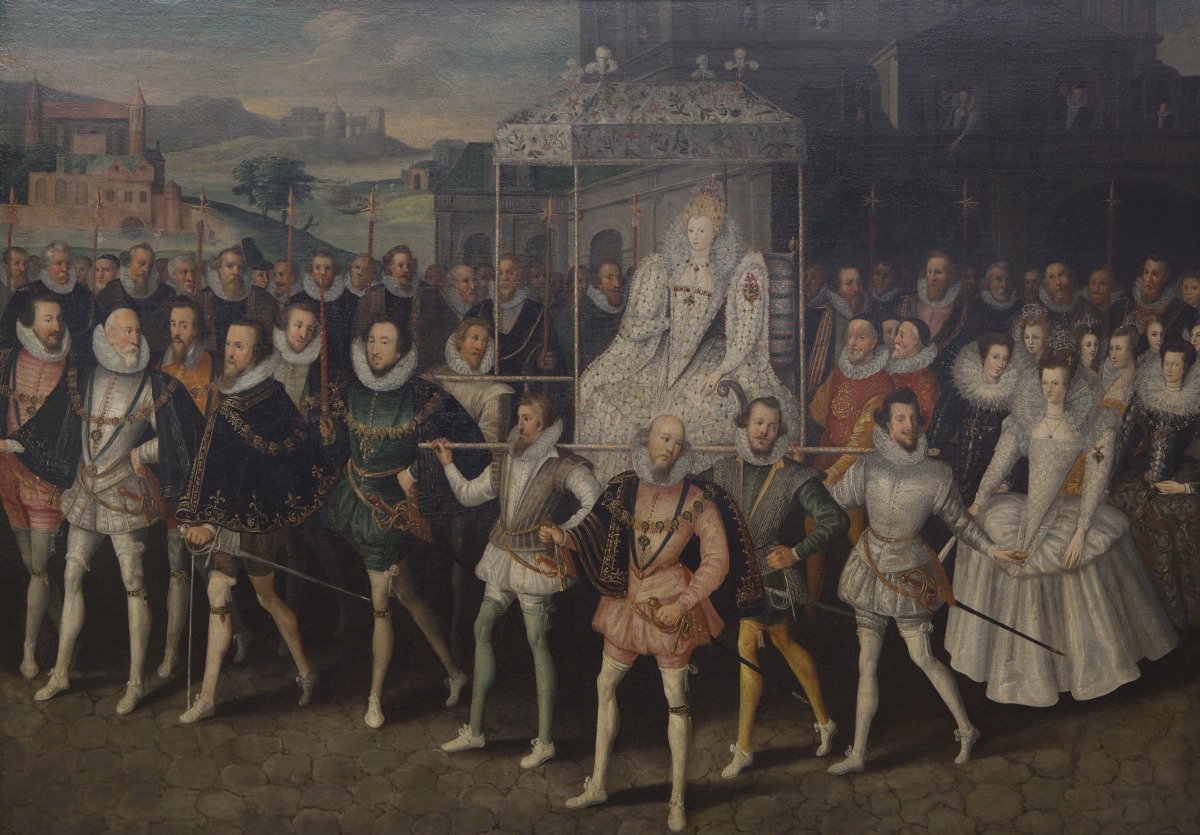
    The Procession Picture, c. 1600, showing Elizabeth I borne along by her courtiers.

    During the late Tudor period ‘paternalistic’ authorities recognised this and acquired surpluses, selling it on at prices affordable to the lower echelons of society, much to the annoyance of millers, brewers and bakers. That progressive market intervention unravelled during the Civil War of the 1640s, when Roundhead mercantile interests began to exert authority over government decision-making.

    It was only in the 1750s, in the wake of food riots of ‘unprecedented scope’, that the State began to subsidise grain once again. As a result, by the early nineteenth century, famines had been conquered in England ‘not because the weather had shifted, or because of improvements in technology, but because government policy… had unalterably shifted.’[ii] Sadly that policy did not extend to Ireland.

    Today, in order to achieve social harmony it seems likely that governments, including the Irish, will have to treat property as an essential commodity, similar to food, wresting control from a system that has enshrined the gambler.

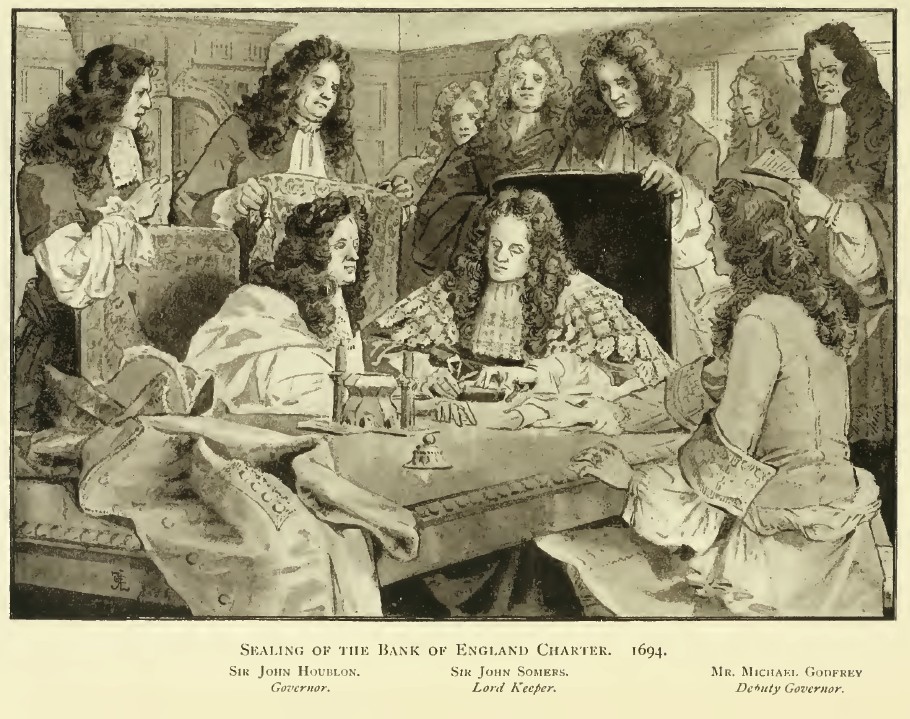
    Sealing of the Bank of England Charter (1694), by Lady Jane Lindsay, 1905

    Bank of England

    In the U.K. a financial system emerged associated with the creation of the Bank of England in 1693, when a consortium of bankers made a loan of £1,200,000 to the king. ‘In return’, according to David Graeber, ‘they received a royal monopoly on the issuance of banknotes … a right to advance IOUs for a portion of the money the king owed.’[iii]

    A system of credit enforced by military might went global during the colonial era, leading to the enrichment of a class of financiers operating out of the city of London in particular. Fernand Braudel characterises this form of capitalism as first and foremost the art of using money to get more money.[iv] The capacities of this system appear to have reached a perfect pitch in our contemporary era.

    But what system preceded this? And could there be an alternative? Prior to the arrival of paper money IOUs issued by the Bank of England, below the surface, older market systems based on mutual trust and solidarity operated. These were overwhelmed by the impersonal calculation that continues to characterise financial services, underpinned by the violent capacity of the State.

    Thus David Graeber observes: ‘Under the newly emerging capitalist order, the logic of money was granted autonomy; political and military power were then gradually reorganized around it.’[v]

    In his indispensable A History of Debt: The First 5000 Years, Graeber argues the ‘great untold story of our current age’ is of the destruction of an ancient credit system found in small towns and villages across England, and beyond. This was a complex market based not on coins, but on trust. In a typical English village: ‘the only people likely to pay cash were passing travellers, and those considered riff-raff.’ Reveallingly, he observes that ‘just about everyone was creditor and debtor’ and that ‘every six months there would be a public reckoning’ when the community would resolve their debts to one another based on a person’s ability to pay.[vi]

    Such a system reflects a passage in the New Testament (Matthew 20:1-16) in which a landowner pays workers the same sum at the end of the day despite each one working different hours. When one of the workers complains the landowner responds:

    ‘I am not being unfair to you, friend. Didn’t you agree to work for a denarius? Take your pay and go. I want to give the one who was hired last the same as I gave you. Don’t I have the right to do what I want with my own money? Or are you envious because I am generous?’

    So the last will be first, and the first will be last.

    In any community there are those less fortunate than others, and a pre-capitalist system of resolving debt, and rewarding work, acted as an impediment to excessive accumulation of resources in a few hands. Importantly it was not simply barter, as value was ascribed based on an ability to pay, and material needs, as much as on the labour or other input into the good or service. A cobbler might therefore produce shoes for an impoverished widow at a lower price than that set for a prosperous miller. No doubt it wasn’t idyllic, but it seems to have led to a fairer and more harmonious existence than what followed in its wake.

    Graeber argues that ‘this upsets our assumptions [as] we are used to blaming the rise of capitalism on something vaguely called the market’, but these ‘English villages appear to have seen no contradiction between the two.’[vii]

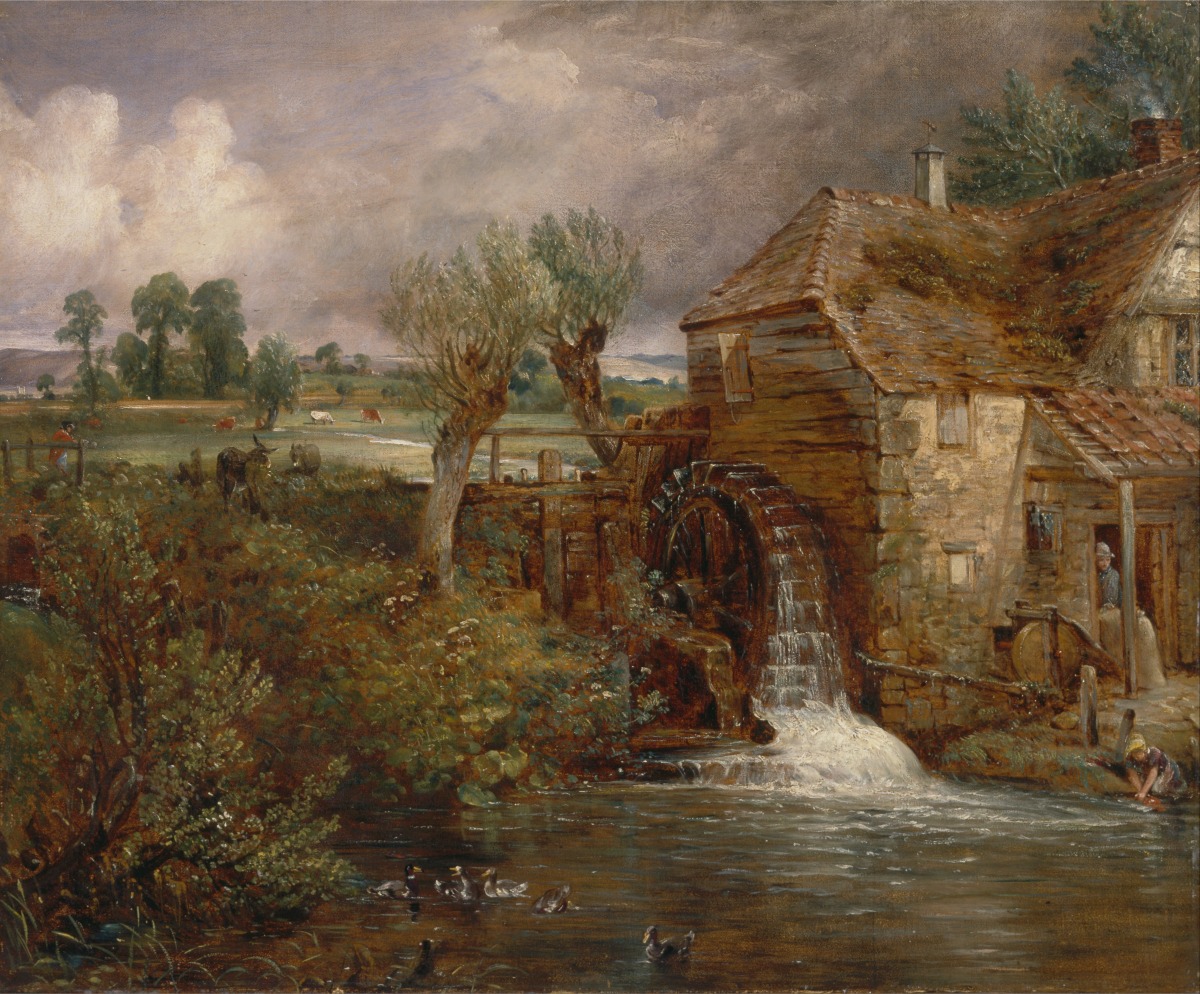
    John Constable – Parham Mill, Gillingham.

    Money was Trust

    In this world trust was everything: ‘Money literally was trust.’ Neighbours appeared he says ‘quite comfortable with the idea of buying and selling, or even with market fluctuations, provided they didn’t get to the point of threatening poorest families’ livelihoods.’ Thus Graeber describes the origin of capitalism as ‘the story of how an economy of credit was converted into an economy of interest.’

    The new legal order of strictly enforceable loans had serious consequences for debtors, a position which was connected to sinfulness, and led to imprisonment. Graeber goes so far as to argue that this amounted to  ‘the criminalization of the very basis of human society. It cannot be overemphasised that in a small community, everyone normally was both lender and borrower.’

    He also argued that this transition provided ample space for swindlers and cheats:

    What seems to have happened is that, once credit became unlatched from real relations of trust between individuals … it became apparent that money could, in effect, be produced simply by saying it was there, but when this was done in … a competitive market place, it would almost inevitably lead to scams … causing the guardians of the system to periodically panic and seek new ways to latch the value of the various forms of paper onto gold and silver.

    Moreover:

    Only the wealthy were insulated, since they were able to take advantage of the new credit money, trading back and forth portions of the king’s debt in the form of banknotes.[viii]

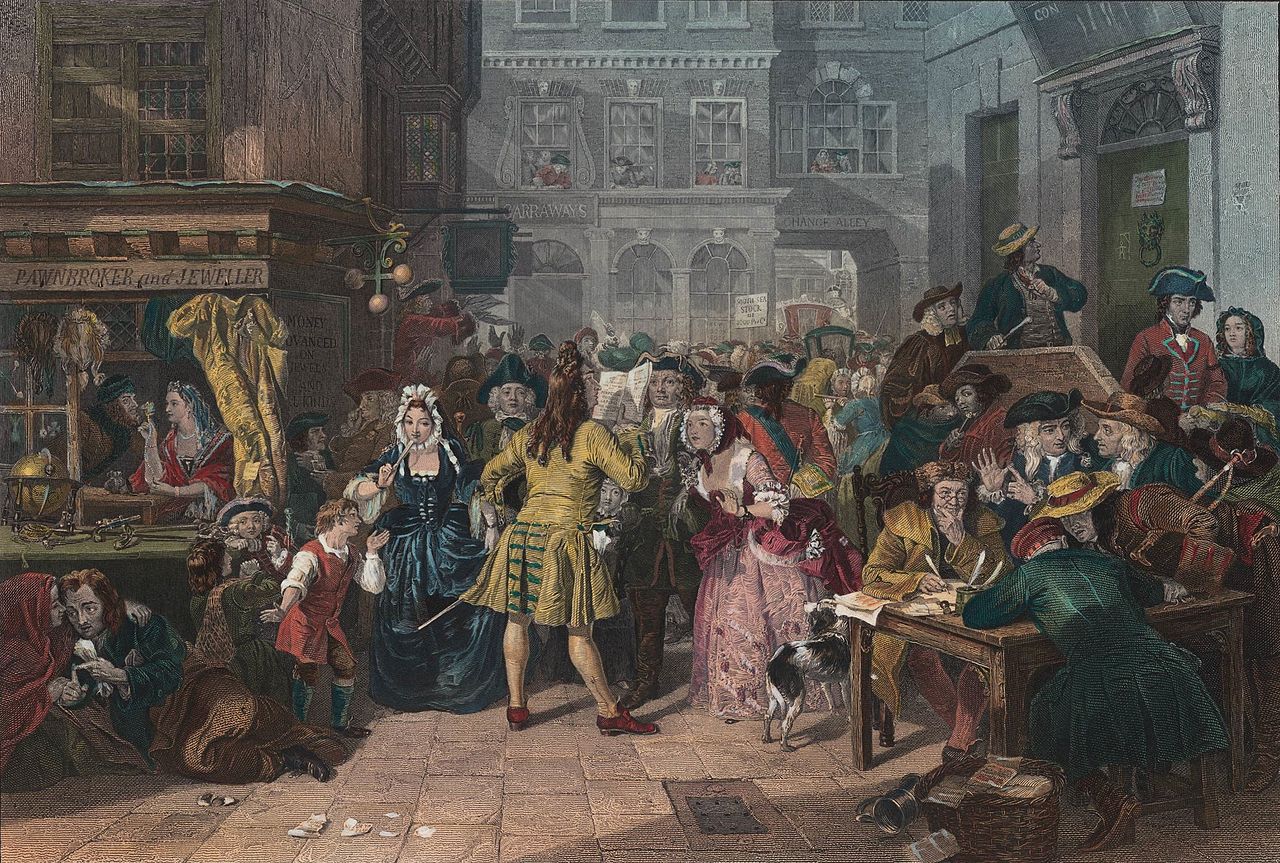
    Eventually the price of bank notes stabilized once notes became redeemable in precious metal. This is referred to as the Gold Standard, which emerged following the South Sea Bubble Crash of 1720. But this crash was far from the last in what appears an inherently unstable system. As Graeber puts it: ‘it does seem strange that capitalism feels the constant need to imagine, or to actually manufacture, the means of its own imminent extinction.’[ix]

    Hogarthian image of the 1720 “South Sea Bubble” from the mid-19th century, by Edward Matthew Ward.

    Separate Legal Personality

    Companies were established in canon law by Pope Innocent IV in 1250, and applied to monasteries, churches, guilds and other institutions, but were in no sense profit-seeking enterprises in the modern sense. However, according to David Graeber ‘once companies’, such as the East Indian Company, ‘began to engage in armed ventures overseas … a new era in history might be said to have begun.’[x]

    The inherent danger of profit-seeking corporations was once widely recognised. Thus, between 1720 and 1825 it was a criminal offence to start a company in England, during a period of rapid economic expansion.

    In the United States until the nineteenth century there were two competing ideas regarding the purpose of companies: the first involved those with charters restricted to the pursuit of objectives in the public interest, such as canal building; the other regime issued charters of a general character, allowing companies to engage in whatever business proved profitable.[xi]

    The latter category emerged triumphant, divorced from responsibility to fellow citizens; an unaccountable abstraction with separate legal personality established in the landmark 1897 case of Salomon v. Salomon. Thus capitalism discovered the perfect vehicle for wealth accumulation, and as wealth begets wealth, increasingly multinational companies overwhelmed smaller family-owned businesses as a wander down any high street today confirms.

    Moreover, as corporations have swelled in size, a chasm has opened up between the pay levels of senior officers and rank and file workers. Thus, whereas in the 1950s the CEO of General Motors, then the model of a successful US business, was paid 135 times more than assembly-line workers, fifty years later the CEO of Walmart earned as much as 1,500 times as much as an ordinary employee.

    Moreover, according to Theodore Zeldin: ‘In the twentieth century, the British colonial empire was replaced with a less visible but even more powerful financial empire compose of an archipelago of some sixty offshore tax havens presided over by the City of London.’[xii]

    As companies grow in size and internationalize, the pursuit of profit becomes an overriding purpose, and the connection between management and workers diminishes to a point where companies are no longer embedded in communities. This is particularly evident in financial services, where making money out of money has become a conjuror’s act, increasingly incomprehensible to the uninitated. It was surely only a matter of time before property would be adopted as a speculative asset to an all-consuming leviathan.

    Property Today

    For obvious reasons, throughout history land has been a paramount concern for peasant societies, primarily as a source of food, grown for subsistence and as a commodity. Agricultural land, however, must be worked, so speculation in rural land produces scant reward unless there is skilled labour and capital attached. A surviving aristocracy has continued to draw incomes from rural rents, but this has been severely dented by agrarian movements that emerged in Ireland and elsewhere to produce a class of petit bourgeois peasant proprietors.

    Similarly, at least until the end of World War II, in urban areas property brought significant trouble and relatively scant reward for any landlord, with tenancy considered a transitory existence associated with student years; while public housing schemes assisted the urban poor to leave tenement dwellings that had bedevilled many cities, including Dublin, which had the worst housing conditions of any city in the United Kingdom at the turn of the last century.

    However, since the post-War period workers, including those engaged in monotonous ‘unskilled’ work, joined forces to win a series of improvements to their conditions. These included a five-day week and eight-hour working day, along with aspirations to a living wage. It allowed scope for many, if not most, of those pointedly referred to as ‘the working class’ to enjoy a reasonable, and improving, standard of living across the Western world. Importantly, a steady job permitted home ownership.

    Moreover, in the wake of the so-called Green Revolution in agriculture after World War II – which led to a radical reduction in the cost of food – steadily rising living standards in the U.S and Europe brought a profusion of recreational activities including sports, and unprecedented access to the arts, especially film – the defining cultural form of the twentieth century – along with access to higher education, even for the children of the poor. In these circumstances property became an increasingly prized asset – pent-up demand ripe for exploitation if circumstances permitted.

    Crucially, from the 1970s, an ascendent neoliberalism led to governments around the world withdrawing from the housing market, leading to dramatic decreases in the stock of social housing. In 2015 in Ireland, for example, by which time economic growth for the year was at 7.8%, a mere 334 social and affordable units were built.[xiii]

    In the meantime, regular stock market crashes underline to financiers the reliabiity of bricks and mortar as an investment. Pension funds especially relish the assured income that property generates. Thus, even when there is a crash in property prices, as in Ireland, rents continue to be paid, and with assistance from the State – socialism for the rich – property prices rise once again.

    Throughout most of history the quest for a crust of bread has been the dominant struggle for the bulk of humanity. Today, in the Western world at least, somewhere to rest one’s head in a place of one’s own has become the overriding concern. At the heart of the housing crisis in Ireland, and elsewhere, lies a yearning for the good life that most us see as a right, but which is being exploited by a buccaneering class of financiers, many of whom survived the Crash of 2008, and continue to exert control over the institutions of the Irish state.

    It appears that just as governments had to regulate food supplies in order to avert famines and accelerate development in the early modern period, similarly today it has become necessary for states, especially the Irish State, to regulate a property market which is working to the detriment of a growing proportion of the population. More generally, whether we can do away with the rigidity of a capitalist system of debt enforcement, and return to a market based on greater social solidarity and reiprocity remains to be seen. But at least we should radically reform an inherently unstable and unfair housing market, which is failing to deliver the good life we have a right to expect.

    Feature Image: Stockbrokers, New York, 1966 from United States Library of Congress‘s Prints and Photographs division under the digital ID ppmsca.03199.

    [i] Roderick Floud, Robert W. Fogel, Bernard Harris, Sok Chul Hong, The Changing Body: Health, Nutrition, and Human Development in the Western World since 1700, Cambridge University Press, Cambridge, 2011, p.116

    [ii] Floud et al, pp.117-118

    [iii] David Greaber, Debt: The First 5,000 Years, Melville House, London, 2011, p.49

    [iv] Immanuel Wallerstein, ‘Braudel on Capitalism, or Everything Upside Down’ The Journal of Modern History Vol. 63, No. 2, A Special Issue on Modern France (Jun., 1991), pp. 354-361 (8 pages) Published By: The University of Chicago Press.

    [v] Graeber, 2011, p.321

    [vi] Graeber, 2011, p.327

    [vii] Greaber, 2011, 327

    [viii] Graeber, 2011, pp.328-341

    [ix] Graeber, p.360

    [x] Graeber, p.305

    [xi] Theodore Zeldin, The Hidden Pleasures of Everyday Life. A new Way of Remembering the Past and Imagining the Future, Maclehorse Press, Quercus, London 2015 pp.232-233

    [xii] Zeldin, 2015, p.109

    [xiii] Dan MacGuill, ‘FactCheck: How many social housing units were actually built last year?’, 9th of February, 2016, www.thejournal.ie, https://www.thejournal.ie/ge16-fact-check-election-2016-ireland-social-housing-2587923-Feb2016/

  • Poetry: Kevin Higgins

    This Is Not a Well Made Poem

    The well made poem puts on its dicky bow,
    walks to the top of the hill,
    and has what it calls an epiphany.

    The well made poem sees every side of the argument,
    except those proscribed by the BBC.

    The well made poem has between
    twelve and twenty five lines,
    all roughly the same length.

    The well made poem worries
    about Afghanistan (and before that
    Vietnam) only when the situation there
    might lead to the whole idea
    of the well made poem
    being vaporised
    by a device left at the side of the road.

    The well made poem plans to bury
    GK Chesterton, William Wordsworth, Sir John Betjeman
    and, eventually, Sir Andrew Motion
    under its sparkling new patio.

    The well made poem never mentions
    the puppy processing factory
    it knows you own, or your preference
    for televised inter gender wrestling.

    The well made poem believes
    nuclear weapons are necessary
    to keep poems like it safe
    from all the rough language
    gathered ungovernable at the border
    forever threatening to invade it.


    Feature Image: “Baker Shot”, part of Operation Crossroads, a nuclear test by the United States at Bikini Atoll in 1946.

  • What Next for Aghanistan?

    So where do we go from here? Better still how do we even begin to unravel the pain, sorrow and hardship, Afghans have endured over decades?

    Do we start with the American invasion twenty years ago? Its objective was to end terrorism as part of the ‘War on Terror’ after the September 11 attacks.

    Can we usefully employ a time line of American and NATO interference in the internal affairs of the Afghan people, and a prelude to the invasion of Iraq? Or should we look to events before 2001?

    If we cannot ignore the transgressions of the Taliban while in power, surely we cannot ignore how they came to power in the first place? So let us assess the period prior to the rise of the Taliban.

    Bloodless Coup

    After three Anglo-Afghan Wars between 1839 and 1919, a monarchy continued to rule Afghanistan, until a bloodless coup was led by General and former Prime minister Mohammed Daoud Khan on July 17, 1973.

    Daoud Khan, c. 1974.

    Born into the Royal family, he deposed the King and inaugurated a one-party political system, with himself as supreme leader and President of the Republic of Afghanistan.

    Economic reforms were promised but failed to materialise as events on the ground became unstable. As President, Khan purged the Soviet-aligned Peoples Democratic Party of Afghanistan. One of its leaders was assassinated and several of its officials arrested.

    Many went into hiding before a military coup on April 28, 1978 deposed Daoud Khan. He and his family were killed and a secular Communist government was established.

    Cold War

    With Afghanistan now led by a secular, pro-Soviet government at the height of a Cold War between U.S. capitalism and Soviet communist ideologies, the stage was set for a proxy war, financed by the United States to destabilise the country and trapping Soviet troops in a Vietnam-type quagmire of military entanglement.

    U.S. President Reagan meeting with Afghan mujahideen at the White House in 1983.

    Historians have claimed that the Central Intelligence Agency set out to recruit, arm, finance and train Islamic fundamentalists. These jihadists were adherents to the Wahabbi strain of Islam practiced in Saudi Arabia. This radicalised the indigenous population providing the impetus for an armed opposition against the government of Afghanistan. While opposition to the Communist government was already established, it was about to be financed by America, Saudi Arabia, and others. Pakistan was already a haven for the Afghan opposition.

    Under Operation Cyclone the Central Intelligence Agency of America financed and armed the Afghan opposition between 1979 and 1989

    The civil war that erupted was between the secular government of Afghanistan who had invited the Soviet Army into Afghanistan to help store order, and the so-called mujihadeen, led by among others, Ahmad Shah Massoud, and considered by Rober D. Kaplan to be one of the greatest guerrilla leaders of the twentieth century; joined later by Saudi Arabian, Osama Bin Laden, the so-called Arab-Afghanis what went on to form Al-Qaeda (the base).

    Ahmad Shah Massoud

    The protagonists were ready, the stage was set, and the actors employed, armed and financed, before the war began in earnest, culminating in the collapse of Mohammad NajiBullah’s Soviet-aligned regime in April 1992

    The mujahideen trained and financed by the American government had succeeded in destroying the secular government, before a government led by the Taliban (meaning ‘students’ or ‘truth seekers’) eventually seized Kabul in 1996.

    The Taliban emerged in the southern Afghan city of Kandahar around September 1994.

    From that point on human rights were repressed and women especially were forced to conform to a strict interpretation of Islamic law.

    America had won the proxy war. But their surrogate army repressed women and arguably de-evolved human rights by a hundred years. Yet the American administration remained full of self-congratulatory smugness in the wake of victory against a Cold War foe.

    Then began the systemic misrule of Afghanistan by the reactionary forces of Islam, the Taliban, supported by Pakistan.

    Within the mujahideen an internal struggle began between the so-called Northern Alliance forces and the Taliban. This struggle ended with the American-led invasion of 2001.

    Pakistan and its Inter-Services Intelligence agency ISI played a major role on behalf of America during the mujahideen revolt and harbored its leaders. Many of those who fought with the mujahideen were not Afghans but Islamic extremists, mostly from other Arab countries.

    In the wake of September 11th, amidst claims of Al-Qaeda Islamic militants training in Afghanistan, and the country a hotbed for fundamentalist Islamists, America blamed Bin Laden and others for the September 11 attacks on the Twin Towers.

    Although nearly all those accused of perpetrating the atrocity were Saudi Arabian, and the only planes allowed to leave America in the immediate aftermath of the attacks contained Osama bin Laden’s wealthy family, America duly attacked Afghanistan. This occurred despite claims the Taliban had offered to help America hold those responsible to account.

    The Taliban had been part of the mujahideen front which took control of Afghanistan. The Taliban now controlled 90% of the country, while various warlords and drugs gangs involved in the Northern Alliance controlled the countries northeast corner.

    The former puppets of American imperialism the mujahideen, now the Taliban, went from Washington’s brave fighters for freedom to the terrorists who needed to be rooted out and destroyed, when America and its allies bombed parts of Afghanistan back to the stone age.

    A twenty-year invasion and occupation, costing an estimated two trillion dollars alongside countless Allied and Afghan deaths has finally ended. Thus American troops withdrew in a humiliating retreat on August 31st, 2021.

    What next?

    I asked at the beginning of this piece, What next for Afghanistan? Well, I fear more violence destabilisation death, and destruction?=.

    The Taliban now claim they want to pursue national reconciliation with the Northern Alliance, but who would benefit from the disruption of this initiative?

    The new Sino-Soviet cooperation in rebuilding an economic supply line through a revitalised economic Eurasia – the Belt and Road Initiative – may become the real target of American, and European, sanctions.

    There may be no U.S. or NATO boots on the ground any longer but the economic cooperation policies pursued by China and Russia to include vast investment in infrastructure projects throughout Eurasia, including Afghanistan, may yet give rise to a new proxy war aimed at destabilising the Taliban government. In reality it will be yet another war against Russian, and now Chinese economic cooperation in the region. A continuation of the age old Great Game.

    Afghan tribesmen (in British service) in 1841

    The War on Terror is nothing more than a capitalist-imperialist attack on democracy and the freedom of sovereign nations, led by those who claim to cherish democracy and freedom yet continually bomb, invade, sanction, murder, displace and maim millions in the name of humanitarian intervention.

    I fear Afghanistan will not see peace and stability any time soon, and expect the Northern Alliance and even Al-Qaeda in Afghanistan (or ISIS-K) to be used and directed by America to disrupt China’s Belt and Road Initiative.

  • Cuban Love Songs Launch

    In a rousing introductory speech, retired diplomat Philip McDonagh described the publication of Cuban Love Songs as a ‘significant moment for the Irish province of the Republic Letters.’ He spoke of the ‘importance of the Republic Letters for us all’, that space where we ‘can explore intelligently and in a disinterested way both the world and our place in the world.’

    McDonagh also spoke about his concerns over the blockade against Cuba.  He argued that there had never been a level playing field to allow the Cuban economy to prove itself and looked forward to a better dialogue between Washington and Havana.

    Reflecting on a challenging period in international relations, McDonagh wondered:

    are we prepared to wait for the gifts of the muses, on political truths that do not depend on what Shelley called the calculating faculty? Are we prepared to work towards restoring the resonance of great fundamental words: mercy, discernment, justice, trust and hope?

    He said:

    we need the poets and the public authorities to come together in something like the Republic of Letters to practise humility and re-evaluate key aspects of our culture, and this must be done of course in freedom … where citizens are prepared to discuss public challenges on the basis of first principles.

    There were also readings from Anthony Colclough, Caoimhe Lavelle, Karl O’Neill, Anne Haverty, Luke Sheehan, and Ronan Sheehan.

    The event took place in Merrion Cricket Club and drew a colourful crowd.

    All images (c) Yaqoub BouAynaya (www.theconsciouscamera.com).

  • Magick or Rationale?

    the perpetuation of debt, has drenched the earth with blood, and crushed its inhabitants under burthens ever accumulating.
    Thomas Jefferson, 1813.

    Laura’s Decision

    Laura has not found the job that will make her happy – more accurately, she does not want a job. Her vocation is reading, playing the cello, and, maybe, teaching. She is serene and calm when she has a decent amount of money in her account. This allows her to do her job. But a job should produce an income, and her one does not: so she must get work that pays a salary, although such employment does not create a sense of self-realisation.

    Taking up those mundane jobs puts Laura on a spending track that leads to her contracting further debts with two credit card companies. This aggravates a need for her to keep up salaried employment. The money Laura earns just about allows her to repay those debts.

    It would make her very happy to have a lump sum, let’s say €10,000, that would eliminate them in one go. So, Laura’s desire is to obtain €10,000 to repay the outstanding balance on her credit cards.

    Laura lacks that amount of money, it seems impossible for her not to repay it; instead what seems unbearable to her is the slow pace of getting to €10,000; this is excruciating to her. Just thinking about it makes her anxious, and almost in a state of panic.

    The reality is she does not have that lump sum of €10,000. There are two ways to approach this problem: one is through Magick, the other is rationality. This latter approach involves repaying the sum weekly using her salary – which means that for a year or so she will have a deprived and miserable life.

    She could manage that if she was on her own. In fact, she has a family with needs and wants and this puts her under pressure. In other words, the context makes it harder for her to use her salary to pay back the credit card debt.

    Now the Magick approach is for her to use her mind to negate reality and believe that she already has €10,000.

    This second approach makes her happier but, while the first one seems feasible, the second one appears delusional. She dreams of dedicating herself to thinking, reading, playing the cello, and performing in concerts without a feeling that she is stealing time from someone or some other activity.

    She could use the affirmation I have €10,000 to pay off the outstanding balance on my credit cards which seems more realistic, or instead, use another approach exploring what are the steps to quickly gain €10,000? To be clear, borrowing must be avoided as one does not own the money one borrows.

    Last month Laura finished the repayment of another loan of €10,000, and she felt so good but the thought that she has still this other outstanding debt is making her anxious; the thought that it will take so long is very tough. It means regular work, restrictions, fights with her family over spending, etc. She must get €10,000 as soon as possible, but how?

    Laura is aware that this situation is due to errors she made in the past, and to the fact that she was previously made redundant and lost her job.

    Afterwards, she spent nearly two years without a proper income, living on welfare for a time and then on a grant. She did not manage her finances well either, overspending regularly; a certain laziness has contributed to the accumulation of that debt. In the last year, however, she has worked at a nine-to-five job which should continue until April.

    Unfortunately, she has started feeling frustrated and bored with the job itself, and all the rest. This is a very dangerous condition that threatens her efforts to maintain her present occupation.

    If she could just summon an indomitable will, she would be able to move up the career ladder. Then she would succeed in repaying her outstanding balance and keep her job, but she knows also that this is not going to happen without internal conflicts and quarrels. She will have to be rational and reflexive before taking any major step; she must avoid impulsive decisions and reactive behaviours.

    Picture This

    Is there anyone who has not dreamt of receiving life changing news of an unexpected sum of money that will radically change your life?

    This is a wish that can easily come true. You close your eyes; you picture your bank account with €10,000 more, and there it is!

    This Magick thinking is so beautiful. It carries the same fascination as falling in love at first sight. You meet someone and a few moments later your life is completely transformed. It is different from instant gratification in that one does not forego a future benefit in favour of an immediate but less rewarding satisfaction. It is by definition Magick thinking: creation out of nothing.

    We all live beyond our means, as we are incapable of controlling our desires. The entire economy is based on the masses contracting debts regularly, and the biggest illusion is that we cannot imagine life without debt: the individuals borrow; the companies and the State borrows.

    Any new-born has his share of debts already. Larger debts mean larger interests extracted out the individuals’ pockets.

    If we give birth to indebted beings, the future of the money lenders is assured. If we have a stable job the future of the banks and of the financial institutions is assurred: we ultimately work for them by contracting debts, by spending money we do not have.

    But have you spent any moment of your existence wondering what life would be like if we did not have debts?

    Imagine

    This can be your task for the next few weeks because if you can imagine your life debt-free, then you will see how delusional you are about your life with debts.

    Now you must choose. You cannot postpone anymore this decision. You will payback all the money you owe to the credit card companies in the shortest possible timeframe, and you will never borrow money any more at any cost. The only issue you have at present is how to accelerate the repayment.

    This is a common fate. Laura is certainly not the only person with some debts, although she is amplifying the gravity of the situation. It is now an ungrounded preoccupation. The anxiety derives from the desire to make the indebtedness disappear quickly. It makes her feel imprisoned in a rut. She tells herself: ‘Accept it and embrace it’.

    This is causing the repression of her desires. This reveals her timid personality, the tendency to mull over things, to retire into herself instead of looking at the bigger picture.

    There is another aspect to this, which is that Laura wants to prove that she is right because she is right! A life with debts is imprisonment. Repaying the debts gradually is painful.

    Magick is the best way, the one that she prefers and is in harmony with who she is. Do not expect her to go out there and get a highly paid job, or to organize a robbery, or to act boldly in any other way in order to acquire the €10,000 she needs quickly.

    Laura will do this through Magick, which she has been practicing for years. And this is not about the amount, it is about the power. If she can actualize this amount, she will be able to do it for any other amount. ‘Let’s get to work on this.’

    There is another aspect in following this path and it has to do with the image she projects onto her family, it is about her reputation. She must succeed.

    The image is clear in her mind. It has a sculptured appearance. It stands out against the dim background. She can nearly touch it. She can sense the reality of it. €10,000.

    Image: Daniele Idini