Blog

  • Irish Housing: Historic Roots of a Crisis

    As a UCD undergraduate I recall Professor Tom Bartlett likening Irish history to a pint of Guinness, ‘with black representing ownership of the land, and the white froth everything else, including all the political movements.’

    Old habits die hard. The issue of property remains a paramount concern. By the year 2004 Ireland’s rate of private home ownership was the highest in the OECD at approximately 82%, a proportion that only declined, to 69% in 2014, after the Crash from 2008, precipitated by reckless lending, often to ‘sub-prime’ borrowers. This reflects the ongoing effect of a global financialisation of property as a speculative asset from the 1980s, leading to the exclusion of a substantial proportion of a younger generation from home ownership across most of Europe, North America and beyond.

    Ireland’s housing crisis is a special case however. In order to understand its long term causes – Dublin is now the most expensive city in the euro area primarily due to staggeringly high rents – it is necessary to explore an historic relationship with land, arising out of a colonial experience. This has brought an economy where the land grabber reigns ascendant.

    Photo ©Daniele Idini

    Urbanisation

    A nation derives characteristics from its relationship to the land it inhabits. Over recent centuries, in Ireland, as elsewhere, mass urbanisation, disproportionately directed at Dublin, has occurred, but we have built our cities on historical patterns of land ownership.

    There are two defining, and intertwining, legacies of the Irish relationship to property that have seeped into the broader culture. The first is the impact of English colonisation, in particular the Plantations, beginning in the sixteenth century, and the subsequent partial de-colonisation through the Land Acts of the late nineteenth and early twentieth centuries.

    The second is the dominance of pastoral, livestock agriculture, particularly since the late nineteenth century under a system of individual land ownership – as opposed to treating property as a collective patrimony under Brehon Law in Gaelic Ireland.
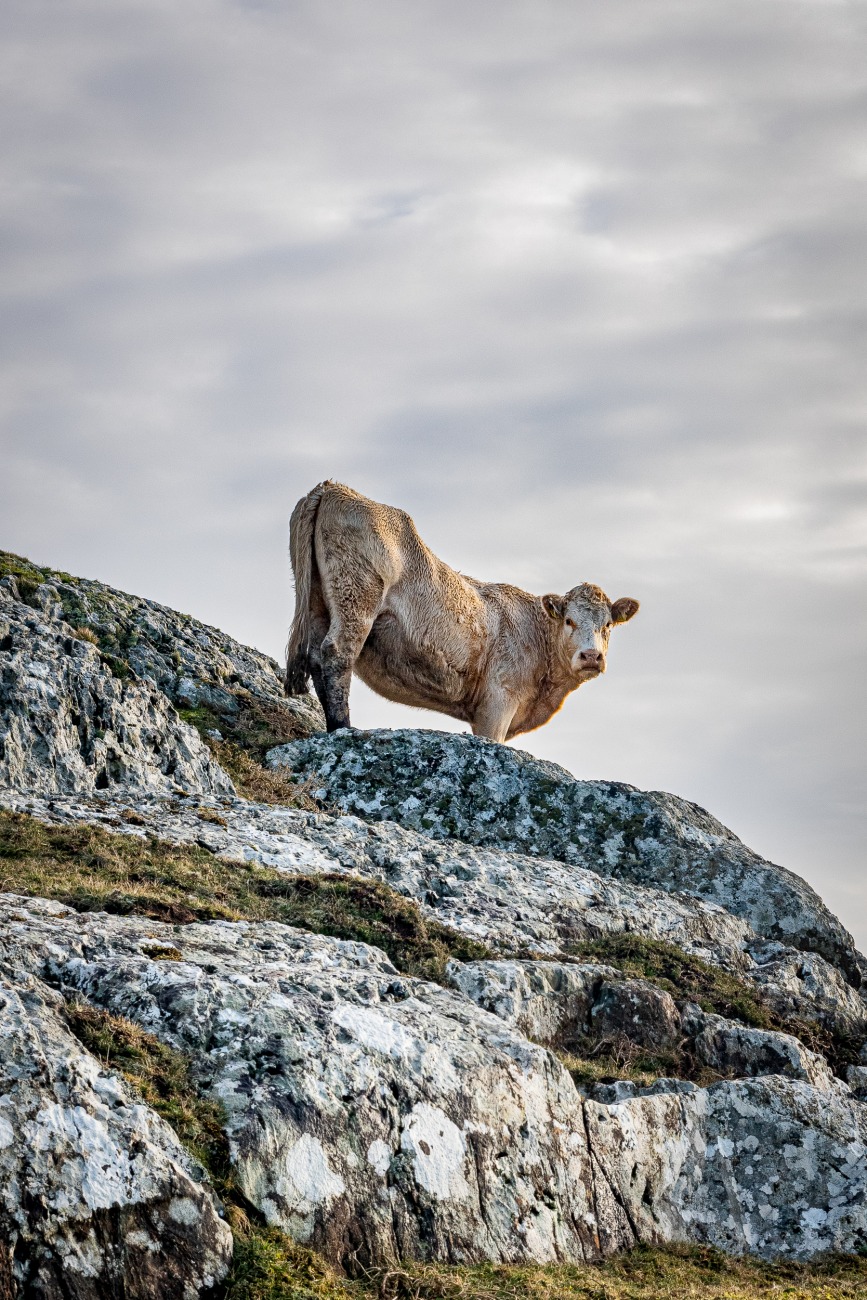
    Photo ©Daniele Idini

    It is incorrect to assume cattle-farming has always been the dominant form of agriculture in Ireland. Since the first human settlements emphasis has swung back and forth between tillage and pasture; and in earlier centuries cattle were kept for domestic milk production rather than to produce a (beef) commodity for export.

    Moreover, the introduction of the wonder crop of the potato from the seventeenth century created a novel opportunity for subsistence on small holdings, bringing marginal land into cultivation for the first time. Although, ominously, according to John Reader in The Untold Story of the Potato (2008), ‘the innocent potato has facilitated exploitation wherever it has been introduced and cultivated.’ It acted like cheap credit in generating a ready source of subsistence on small parcels of land, but the potato cannot be preserved for a long period like grain so cannot easily be traded, thereby impeding development.

    Over time, the impact of Irish agriculture, especially extensive grazing, on Ireland’s nature has been profound. According to Frank Mitchell in Reading the Irish Landscape (1997): ‘from about five thousand years ago when the first tree-felling axes made woodland clearance possible man’s hands have borne down ever more heavily on the Irish landscape.’ This left a mere twelve per cent woodland coverage by the 1400s, before the most intense period of colonisation at the end of the eighteenth century when a poet lamented:

    Cad a dhéanfaimid feasta gan adhmad? / Tá deireadh na gcoillte ar lár;
    Now what will we do for timber, / With the last of the woods laid low?
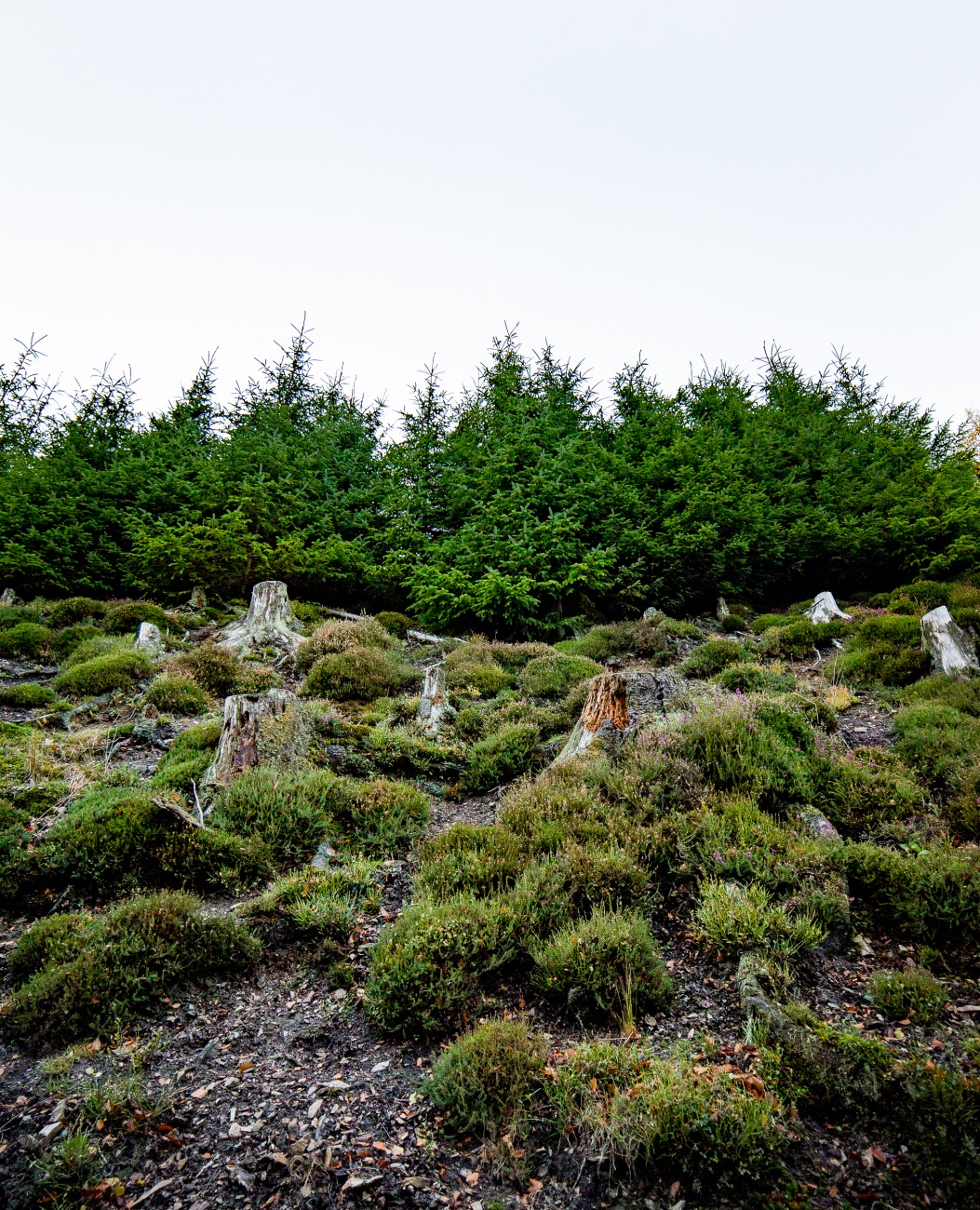
    Photo ©Daniele Idini

    Today among EU countries only Luxembourg has lower coverage, and much of our woodland is in the form of sitka spruce plantations that further degrade the land, while offering little scope for biodiversity.

    The sixteenth and seventeenth century Plantations trapped an overwhelmingly Catholic peasantry, denuded of a departed upper stratum of Gaelic society, in a Malthusian grip that culminated in the Famine.
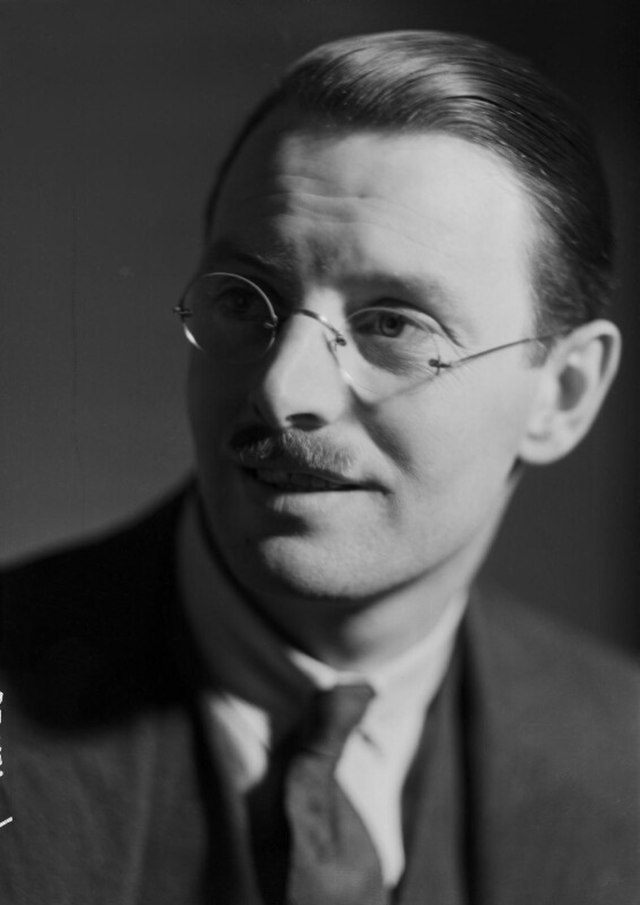
    Portrait of Seán Ó Faoláin by Howard Coster, 1930’s

    Describing the acquisition of annual leases by small farmers, who had previously held land in common under the Brehon Law system, Seán O’Faoláin wrote in The Irish (1947): ‘The thirst for security is, above all things, the great obsession of the peasant mind. And, in a long view, a deceptive obsession.’ Security of tenure under the new dispensation was illusory, as land became an asset to be bought and sold, rather than a collective patrimony.

    Trade conditions shifted in the nineteenth century. The raising of cattle, often exported ‘on the hoof’ to England for eventual slaughter, began to enjoy a comparative advantage over tillage as the British discovered cheaper sources of grain after Napoleon’s blockade ended with the Battle of Waterloo in 1815. Henceforth, the cheap labour of the Irish peasantry – a substantial proportion unconnected to the market economy – were an anachronism to the British administration in Ireland.

    The Famine (1845-1851) was, according to Charles Trevelyan the architect of Britain’s response ‘a direct stroke of an all-wise and all-merciful Providence’, which laid bare ‘the deep and inveterate root of social evil.’ Anticipating the Shock Doctrine, the Famine, he declared, was:

    the sharp but effectual remedy by which the cure is likely to be effected… God grant that the generation to which this great opportunity has been offered may rightly perform its part…
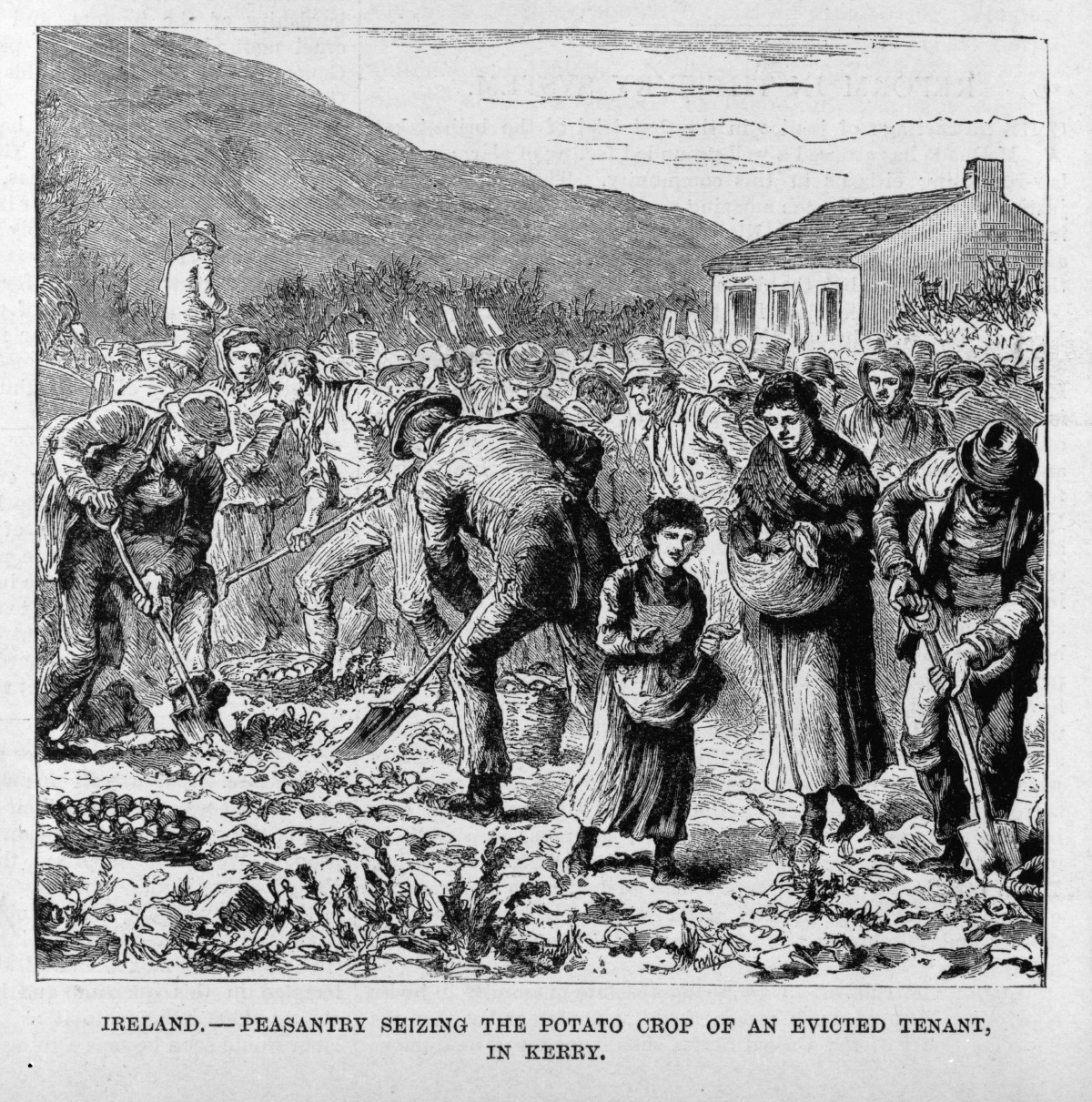
    Wood engraving, 1886. cc Library of Congress

    Strong Farmers

    The Famine was a catalyst for change that brought about the dominance of cattle agriculture, increasingly under the native so-called Strong Farmer. The key point about this mode of production was (and is) that profitability depends on a low labour input. It made no sense for numerous sons and daughters to remain on the land, and so the tsunami of emigration that formed during the Famine gave way to steady migratory waves. Over the long term this brought precipitous population decline throughout the nineteenth and twentieth century.

    As Joseph Connolly put it in his Labour in Irish History (1910): ‘Where a hundred families had reaped a sustenance from their small farms, or by hiring out their labour to the owners of large farms, a dozen shepherds now occupied their places.’

    This process should not, however, be attributed solely to remote authorities in Westminster working on behalf of absentee landlords, as is commonly assumed. Significant gains were made by Catholic Irish farmers holding farms above twenty acres. As Kerby A. Miller wrote in The Atlas of the Great Famine (2012): ‘an unknown but surely very large proportion of Famine sufferers were not evicted by Protestant landlords but by Catholic strong and middling farmers, who drove off their subtenants and cottiers, and dismissed their labourers and servants, both to save themselves from ruin and to consolidate their own properties.’

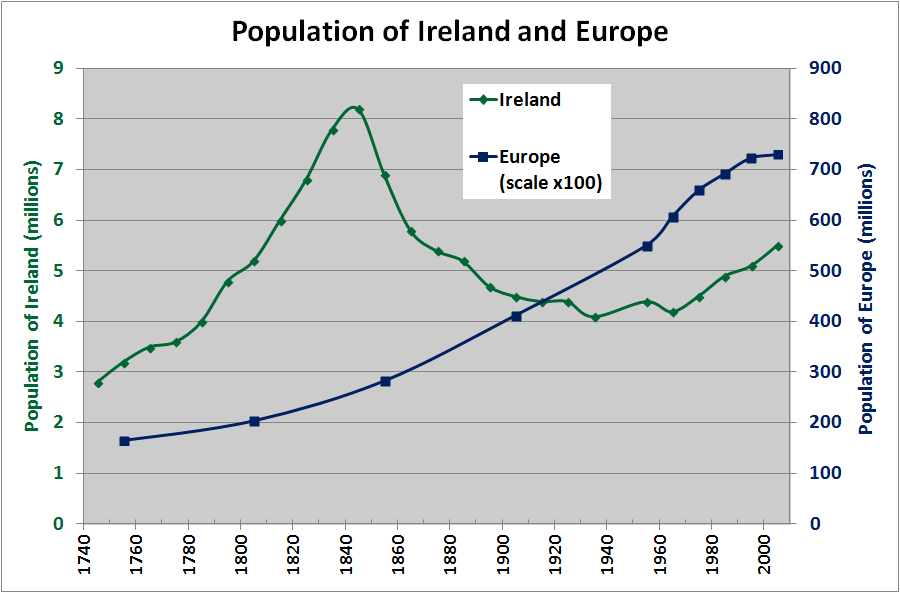
    As Ireland did not witness an Industrial Revolution, except in the North-East corner, this shift from tillage to pasture led to unprecedented population decline. Ireland is perhaps the only substantial country in the world with a lower population now than in the 1840s, when the population stood at almost nine million. In the same period the global population has increased seven-fold.
    National Independence

    The struggle for Irish independence was taken up by Strong Farmers, a comprador class selling their primary products on the Imperial market, who emerged with enlarged holdings after land clearances, to become the dominant faction of an overwhelming Catholic ‘nation’ at the end of the nineteenth century. Through a succession of legislative measures, culminating in Wyndham’s Land Act of 1903, the British administration sought, but failed, to ‘kill Home Rule with kindness’, allowing tenants to obtain freeholds over much of the country.

    This allowed their sons to set about dominating local government, the Irish Parliamentary Party, and later Sinn Féin. This cohort entered the professions, established a National University in 1908 (Maynooth University had also been established in 1796) and eventually won an independent state in 1922, wedded to an individualist and competitive approach to land, in contrast to collaborative arrangements typically associated with tillage, including the Clachan settlements of pre-Famine Ireland. The first Minister for Agriculture, Patrick Hogan (in office from 1922-32), was a cattle farmer, and duly aligned the national interest with the economic fortunes of his ‘grazier’ class.

    After independence in 1922, pastoral Strong Farmers continued to sell mostly cattle onto the Imperial market, notwithstanding the aspiration of idealists like Robert Barton, the first Director of Agriculture (1919-21), for a reversion to more labour-intensive tillage for domestic consumption; except, that is, for a period in the 1930s and 1940s when national survival demanded increased focus on growing subsistence crops.

    Photo ©Daniele Idini

    Individualist Outlook

    The outlook of the peasant-pastoralist has informed our laws and values since the inception of the State, spreading from rural Ireland into an increasingly urbanized society. As O’Faoláin put it:

    we have seen the common folk of Ireland rise like a beanstalk out of the Revolution of 1922 and, for a generation, their behaviour was often very unpleasant to watch.

    The arrival of mechanisation in the Green Revolution after World War II put tillage at a further disadvantage as, despite enjoying among the highest global yields, high levels of precipitation and humidity make Irish-grown cereals, apart from oats, unsuited to mechanised harvesting. The traditional method of ‘bindering’ – drying the harvest over months in stacks – became uncompetitive due to high labour inputs, and so the population drain form rural Ireland continued.

    Moreover, since the 1970s price supports from the European Community’s Common Agricultural Policy have reduced flexibility and dynamism in land use, by inflating values as farmers were guaranteed payments, even on poor land, without adequately addressing the associated population drain.

    Legal Protections

    As the sons and daughters of peasant-proprietors migrated to cities, especially Dublin, Ireland’s politics of clientelism embodied in the two main political parties took hold. An urban population with roots in raising livestock prizes land as an asset from which profit is derived, as opposed to a situation where crops are cultivated for the family table and traded within the community.

    An inherited skill in deal-making was readily applied to urban development, which is also reflected in strict judicial interpretations of private property, allowing enterprising developers to make a killing. Thus, State institutions have favoured the landed interest over the property-less, in a troubling reminder of a bygone era.

    In 1973 the Kenny Report recommended that land around the hinterland of Dublin should be compulsorily purchased by local authorities for 25% more than its agricultural value. According to Frank McDonald, the former Environment Correspondent of the Irish Times, Dr Garret FitzGerald, a member of the Fine Gael-Labour Coalition government that received the report could not remember why it wasn’t acted upon. ‘It just slid off the agenda’ he said, and no subsequent government acted upon it. McDonald said that ‘Ostensibly, the reason for this was that Kenny – a constitutional lawyer himself – had proposed something that would be unconstitutional. But no attempt was made to test this in the courts.’

    That was until Part V of the Planning Act 2000. This was referred to the Supreme Court which held that the acquisition of land for social and affordable housing did not offend against the Constitution. Unfortunately, however, that provision did little to ameliorate the housing crisis during the Celtic Tiger as developers evaded responsibility by paying over sums to local authorities, and successive Ministers watered down the provisions.

    The reluctance of politicians to implement the Kenny Report reflected a genuine fear that any such provision would fall foul of the Court, which has tended to vindicate a constitutional right to property under Articles 40.3.2 and 43.1.2 over competing interests of renters to security of tenure or a controlled rent.

    Thus, in 1981 the Supreme Court declared unconstitutional attempts to introduce rent controls under The Housing (Private Rented Dwellings) Bill, while the wide scope of Article 45 has been given little attention.

    This reflects a sectional bias as the common good (to which all constitutional rights are subject) should allocate a reasonable prospect of basic accommodation to all permanent residents.
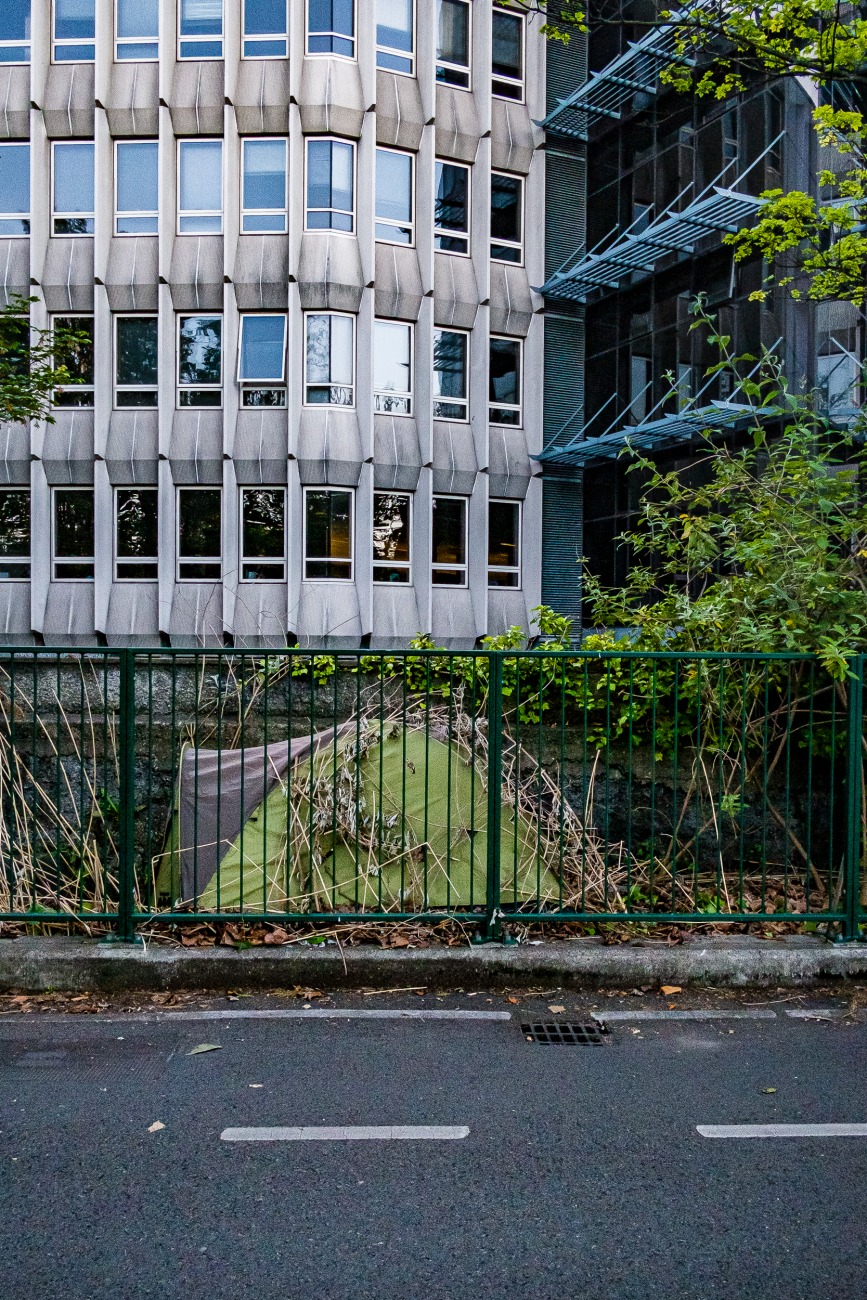
    Photo ©Daniele Idini

    Unenumerated Rights

    The idea of an ‘unenumerated’ Constitutional right – in that instance a right to bodily Integrity – was first identified by the same Justice Kenny in his landmark High Court judgment of Ryan v Attorney General (1965). A right to adequate shelter may also be unenumerated. For instance, Kenny’s seminal Ryan judgment cited the papal encyclical Pacem in Terris (1963) which states that: ‘every man has the right to bodily integrity, and to the means which are necessary and suitable for the proper development of life. These means are primarily food, clothing, shelter, rest, medical care and finally the necessary services.’ Yet the Court has avoided vindicating a basic human right to adequate shelter.

    Now, underpinned by legal and political deference to the property interest, we see huge swathes of land and buildings that have been left fallow in urban areas: a 2016 report in The Dublin Inquirer identified at least 389 derelict sites. We are unaccustomed to urban density, or community developments, except as a sign of poverty – with the 1930s schemes of Herbert Simms a rare and inspiring exception. Strict demarcation between properties, and a lack of community spaces, may be interpreted as a legacy of extensive cattle-rearing for the imperial market.

    Furthermore, the sons and daughters of nineteenth century pastoralists, accustomed to low-density living with few neighbours on the horizon, sought distance from their neighbours, and the assurance of owning a motor car. This accounts for the sprawl, and prevalence of needless boundary walls, in Irish suburbia; as well as a preference for one-off housing.

    The commercial culture can also be linked to the pastoral outlook. It is revealing that few successful Irish businesspeople have been technological innovators. Rather, success has been built on buying low and selling high, just as a cattle farmer buys a calf and seeks to sell him at a higher price – the entrepreneur Tony Ryan was quoted as saying ‘you make your profit the day you buy.’ Thus developers often purchase land at a low price and sit on this until financial conditions improve. The Irish dream is built on living off the fat of the land, creating conditions to the liking of the vulture and cuckoo funds our government now accommodates.
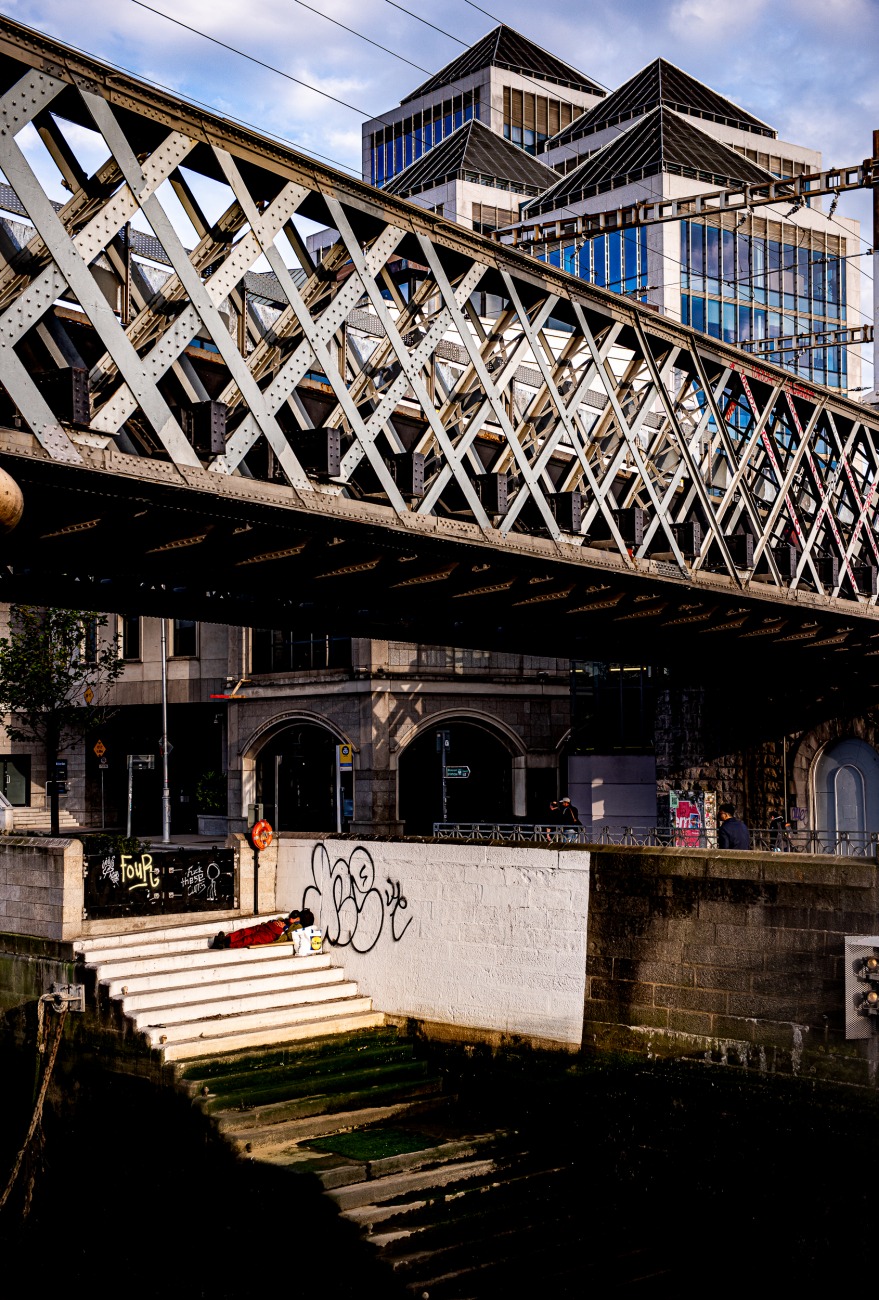
    Photo ©Daniele Idini

    Historic Failings

    No Western economy experienced growth, at least in the period 1995-2007, comparable to that of the Celtic Tiger, but this was achieved, at least in part, through the availability of cheap, and ultimately ruinous, loans, by unscrupulous bankers. But like the wonder crop of the potato, these loans generated ultimately ruinous growth.

    Failure of both property and potatoes emanated from America. In the case of the Famine it was the dreaded blight, phytophthora infestans, which first blackened the leaves and then reduced the crop to inedible mush. The pin that burst the Irish property bubble, a large boil on a global wart, was marked with another American sign, that of the ruinous Lehman Brothers. Both the potato blight and subprime mortgages afflicted other countries, but perhaps nowhere as severely as Ireland.

    The austerity that followed may be likened to the extreme Shock Doctrine practised by Charles Trevelyan, while the feeding frenzy that occurred through NAMA recalls the land-grabbing in the wake of the Famine.

    In order to address Ireland’s Housing Crisis we must face up to the sins of our fathers, including an enduring bias in favour of strict individual ownership preached by the two main political parties in government, as well as the judiciary.

    A version of this article appeared in Village Magazine.

    Title Image: House in proximity to Dog’s Bay, Connemara. ©Daniele Idini
  • Review: Strumpet City

    Picture the scene: the small backyard of a tiny working-class pub in Belfast at around 8pm on a dark Autumn night. I am smoking with a friend, older by a few years, and with way more life experience, talking about books. A dim-light is ebbing away, further subdued by the frosted glass of the bar-door. He looks at me and says: ‘Strumpet City (James Plunkett‘s 1969 novel) is a good book’. I did not take the time to ask about the work as the conversation was rolling along, covering other novels about Ireland which we had both read, and were reading, or intended to read.

    Here were two talking heads, tongues loosened and wagging after a couple of pints. Yet somewhere in the back, ploughed, crow-lifting fields of my sub-conscious, the adjective ‘Strumpet’ and the noun ‘City’ lodged as an unlikely pairing; lighting a candle of intrigue that would burn inside my brain. A decade has sailed past since then.

    Cut to a month ago, and I am in my local library with the mad literary hunger on me – the reading hunger. This is where one desires material to satisfy personal taste and preference. For me this is for a well-written and narrated book. And not what I find so demoralising: one that bends down on one knee to the easily accessible, clichéd fountain whose water(s) flow tepidly, and which is, in the beginning, saccharine sweet but gives way to a brackish and unpalatable torpor.

    I pick the work up and thumb through its 549 pages. A novel of heft, requiring dedication it seems. I bring it to the desk, and steal away into a showery, sun-lit Wednesday evening with the novel safely stowed inside my bag.

    Strumpet City is an historical-led novel which sets out… well… this is a work which, ostensibly, is about the Dublin Lockout(s) of the early twentieth century, narrating fictional, and real, lives of the people involved, including the almost mythological Union leader, Jim Larkin (1874-1947), who James Plunkett previously worked for as his secretary.

    This is a novel of coal, ash, and soot. Of wasps amongst blackberries; of hunger and of greed; a novel of slum dwellings and collapsing dockside houses; a work which radiates a stench of unclean bodies and souls, in dire need of cleansing and thorough rituals of purification brought to task.

    There is an alcoholic priest who loses his mind due to the drink, whiskey, and on one occasion, topples a coffin off its trestles. It tips over, and the enclosed incumbent resident, due to the lid springing open, falls out, rolling on to the floor. The widowed wife, upon seeing this, screams and two priests soon come over, calm her down and take her away from the morbid scene. The priest, a Father Giffley (memorably played by Cyril Cusack in a memorable 1980 RTE adaptation), is found, soon thereafter, prostrate at the foot of the altar, face-down, unaware of the immoral chaos he has just created and is dozing away.

    There is Rashers Tierney, the almost toothless, romantic wanderer who is dirt poor but in the ownership of a rarefied wit and tongue which darts rebuttals in defiance of perceived, and real, attacks; with his mongrel, Rusty, and a penny-whistle in tow. Rashers, as my Belfast friend would have said, ‘Hasn’t a bar in his grate.’

    Father O’Connor is the moral authority in the book, a ‘sky pilot’ who turned his back on the riches of a diocese more becoming of his class. He finds his spiritual bedfellow in the form of Mrs. Bradshaw, the face of female humility; in contrast to the encompassing greed of her ideologue, capitalist husband. However, there is an artifice to O’Connor too, which yields a quavering hatred to his position as sitting tenure in the local, disenfranchised, Dublin district which he does acknowledge but does not run away from, which would be the coward’s option. No. He has staying commendable power and you feel for him.

    There is a terrible accident at a coal yard and you feel empathy for big Mulhall and the further poverty his family will suffer in its wake.

    There are wonderful characters, including Fitz, Hennessy and Mary, set against the backdrop of the 1913 Lockout; striking dockers; the stamping foot(s) of the law and the piercing, shrill whistles of authority. This novel, let me tell you, has a social-economic range, and has it in abundance.

    This is not a work to compare to the quotidian, creative deliciousness’ of Joyce’s Ulysses. On this, I have read a good few books, and have many, many more to grapple with, but having read some of Tolstoy, Turgenev, Chekov, and other Russian masters’ creations, this work here, Strumpet City, is, in my view, the Irish equivalent, and a masterpiece.

    Feature Image: Jim Larkin

  • Death

    I’m of an age to be intrigued by death.

    My 84-year-old grandmother, widowed, came to live with our family, and took over my bedroom. I was forced to give up the room, to share instead with a sibling.

    The old woman was hale and hearty, retained her wits, preserved her down to earth assessment of life, had referred to her late, much loved husband – my favourite male relation – as ‘the old fool.’ One day she said to me: ‘Ye’re just waiting for me to die, aren’t ye? Well yiz’ll be waiting a long time.’ I was taken aback at her frankness. She died a year later.

    When my old friend Dinno was on his deathbed handled matter-of-factly by his ex-nurse wife Oonagh – I asked him what he was thinking of. He said: ‘Gone-ness. I’m wondering what gone-ness will be like,’ and did not need to elaborate. We had understood each other well.

    My father roared indignantly on his deathbed in the old Mater hospital. His wife and other children had gone home, reassured that he had survived the first heart attack and would survive until morning. I stayed and was the only witness to his last belligerent protest.

    My mother spent her last days carefully organising her own funeral and the disposal of her one asset (a house). She waited only for my return from Canada until, in my presence she removed the oxygen mask from her mouth and stopped gasping for breath.

    I am of an age to be intrigued by these quite normal  dramas. Love dies. Beauty dies. Everybody and every thing dies. As Woody Allen said: ‘I’m not afraid of death. I just don’t want to be there when it happens.’

    What he might have meant was: better to lose your mind before your body gives up.

    Dementia and altzheimers are tragedy for the nearest and dearest but a blessing for the sufferers because they don’t suffer at all; they are unaware of the impending disaster. What a way to go!

    One of my brothers died in that condition. I envied him. One of my sisters died, still worrying about it. Poor thing. Another sister, the eldest in the family, is fortunately still alive. She’s lucky too; has no idea whats going on around her, I think.

    The phenomenon is an everyday one and still we wonder at it: In what sense are we alive one day and gone the next, vanished without trace? No body. No soul. All disappeared, remembered briefly, forgotten forever. How extraordinary. Even when we breed frantically, seeking immortality, knowing our seed will also die, we still do it, procreating, making stains on life, producing work, writing, building solid bridges and skyscrapers, empires. All made of dust. Even dinosaurs lived a million years and now are merely known as skeletons.

    People invented the idea of heavenly immortality: wishful thinking. They even invented god.  We are at heart optimists.

    There is no sting in death without consciousness; and nobody knows yet of what precisely that consists of. Fortunately death can be simulated under the surgeons knife until we wake and are reminded by pain of what we have mindlessly endured. Think of that.

    Some people choose euthanasia but that’s a sin, we’re warned. It’s a cop out. We should be allowed to enjoy this once in a life experience. It is unique to each of us, just like our birth, to be celebrated as a never-to-be-repeated exercise. We are born astride a grave with, not a silver spoon, but a shovel in our hands.

    I once speculated that nobody dies. We are bundles of transformed energy – the frantic impulses of copulation when we are conceived. Food becomes our energy fuel. What happens this energy at the point of death? Energy cannot be destroyed, only transformed like breath into gas, into condensation, into water into ice into steam etc etc. So what happens to us – bundles of energy? My speculation involves the millions and billions of galaxies and further billions of stars in each galaxy. Each of us, I suggest, becomes a twinkling star in the endless infinity of the universe. There is room for everybody out there.

    There’s a happy thought. Perish our tiny worries. We are immortal. We just leave our egos behind. And good riddance.

    A number of chapters from Bob Quinn’s latest memoir A Monk Manqué, mixing moments of hilarity with profound statements on the state of the world, are available on Cassandra Voices.

    Prologue

    Thaura Mornton

    Making Films

    Early Days in RTÉ

    Waiting for Colonel Ghaddafi

    Culchies – An Excerpt from A Monk Manqué

    Last Days in RTÉ – ‘I have come to kill you’

    Lament for Áirt Uí Laoire

    The Conman and Correspondence with Kurt Vonnegut

    Old Man Talk – ‘I used to ride young wans in here’

    ‘what a young girl in love will say to keep her man’

  • Fiction: Train Station

    Awarded one of the Tidiest Towns in the nation, the place was profoundly inept and utterly corrupt. Indeed disturbing, because winning the competition was proof positive that the town represented how things operated in the entire country. In terms of organisation, it was the stuff of nightmare. Everything had to go through countless committees, and the people you’d want absolutely nothing to do with were the kind who joined the committees.

    When he did think about them, White merely pictured those broken plastic corrugated sheets which had been haphazardly assembled to form a makeshift roof over the old train station. Effectively it was the first view any observant person would have upon arrival. What did this tell you about the country? Here was the town voted, again by countless committees, as being the Tidiest Town in Ireland, and yet the minute you got off the train, you looked up at the train station itself, at these gaping holes in the shattered corrugated plastic sheeting. It was pathetic, thought White, as it revealed the corrupt nature of an entire island. The whole nation, by voting in this way, or rather the Committees who had voted for the town, by recommending that the town should receive the highest accolade in the land, were actually complicit in praising the most mediocre of towns. Mediocrity was their aim. It was as if, for White, these loose panels of plastic, which during winter would let in buckets of rain, while every year the town’s commuters sheltered under the awful structure, getting wet in the process, had become symbolic of the country’s lack of rigour. Its shambolic state.

    He understood why large sections of people in the North wanted nothing to do with the place. Because the level of ineptitude and corruption was shocking. There it was. Visible for all to see, pondered White, who stood under the atrocity. I mean corrugated plastic sheeting! Who in their right mind was going to use such a material to protect the town’s citizens and visitors from the elements? It was the first of many signs that discreetly whispered, These people dont really care about anyone in the first place. And, if a job was worth doing, it was worth doing badly. That was it, wasn’t it? The “Ah sure, it’ll do!” attitude his neighbour Stan was always banging on about whenever he spoke of the place. Stanley was rarely in country, spending the majority of his time working as a consultant around the world. About what, White didn’t actually know. It was kind of a mystery, but Stan made it very clear to White how much he hated the place and a lot of his fellow Irishmen.

    The open hole in the sheeting spread out in a star formation. It was frayed into bits. Where it was not broken, it was black with dirt, moss and other under growth. As if nobody had actually thought about cleaning it up, not to mention fixing it by replacing it with, at the very least, new sheets.

    “Ah, sure it will do!”

    “If a thing’s worth doing, it’s worth doing badly.” Stan would say. “Bunch of fucking morons!”

    Every word was spoken with that crisp nearly perfect enunciation that Stan possessed.  It would be the closing punch line in these sessions after having looked at and examined the problem from every possible angle. White had never before brought up the lamentable condition of the roof of the town train station with him before. You see, unlike White, Stan wasn’t a commuter. They inhabited very different worlds. Whereas White was grounded firmly in the everyday world that he saw around him, in other words that of the town, and the city beyond, where he worked, and which was only thirty minutes south by commuter train, Stan’s world was one of airports and hotels. Corporate zones. Stan was very corporate. He exuded the spirit and parlance of international corporatism. White was more about the local.

    Stan was unaware as to the everyday workings in a town where they both lived, and that never ceased to amaze White. While he looked at Stan with incredulity at times, about his innocence, Stan would throw White some pretty incredulous looks when in turn, his lack of savvy on certain matters at an international level was too obvious to ignore. Merging their knowledge of the micro and the macro, together, the two men were, in a sense, whole.

    But they discussed countless other issues together. No, the broken corrugated plastic sheeting hanging over the heads of commuters on the platform outside of the town’s train station was a topic from which he had spared Stanley. Smiling now, White, regarded the drab excuse for a roofing feature. The sheer gombeenism. The degree of decay on a shameless exhibition to all and sundry had to be seen to be believed.

    White put it down to Ireland’s post-colonial heritage. Casting a condescending glance at some of the town’s inhabitants as he did. For instance, if you looked at the actual railway station itself, apart from the roofing, it was a fine old building, as many of the old train stations were, having been designed and built by the former occupying power. There you had it then. The very infrastructure had been inherited. Nothing, not the laws of the land, nor the great buildings that housed their government and courts (bar one) had all just been taken over. That was a century and three generations ago. White’s own grandfather had fought in that war. The War of Independence, they called it. What a joke. They were no more independent of their so-called old enemy as the man in the moon.

    White looked at his watch. The train would be coming soon. He walked with a quick pace further down the platform. He wanted to get away from the broken corrugated plastic roofing. Another joke. And there were so many of them too. Sick jokes, that is.

    Once inside the train, White’s mood improved slightly. At least he had a seat. That was another thing. There were so few trains now that he noticed more and more people would have to stand, and starting with the commuters from the town just after his own. Imagine that, every day, five days a week, getting on the train with your commuter ticket that you had paid for and you would never have, or only rarely, the opportunity to sit down! That was more of it, the chronic sense that nobody really gave a shit about anyone or anything anymore. There was no sense of community. No civic pride. Why would there be? What had they done? In over a hundred years, what had they actually done to the country since their newfound freedom?

    While White sat there looking around him, the recorded voice came over on the intercom system. It announced the next town in Irish. Nobody spoke the language, or hardly anybody, and yet that was even more of it. The con. Our government printed every document out twice, first in Irish, which was the official language of the country, and then in English which was a language everyone actually spoke. Why they insisted on imposing the language in this way was all part of it. Keeping up Appearances. A great little nation, the Republic of Ireland, for keeping up appearances. Truth be told, White couldn’t stomach it. This Ireland created by all of its little committees. You couldn’t fart without some fucker complaining to a committee.

    He remembered reading somewhere that all revolutions were destined to fail. It was inevitable. Once a revolution had taken place, corruption set in from the word go. This was human nature. There would always be some kind of favouritism. And the types of people who got involved politically, no matter where you were, were always one and the same. Barring, of course, the very rare exception. Chancers who, for the most part, were merely looking out for number one. It was the same the world over. Why should Ireland be any better, or any worse.

    While the train slowed, pulling into the next town, White watched the disappointed faces of new commuters who boarded the train. And who had, as usual, missed the opportunity of sitting down. When he was much younger, White would no doubt have given up his seat to one of them. Women in particular, as that’s the way he’d been brought up. But not now. This was the age of equality. White looked hard at some of the women who were now standing up around him. Resigned faces staring out a window at the Irish sea. How did they like this brave new world? Sometimes, very rarely mind you, some guy would grow embarrassed and offer up his seat to one of them, but it was rare now. Pathetic. And all part of it. Everybody hermetically sealed in their own little bubble. Nobody speaking to anyone else. Addicted to their phones. Passive, they listened to radio propoganda or some endless podcast, or perhaps even watched a feature film. Not a sinner reading a real book.

    That was another myth, a nation of great readers! Ha! Cunts. Not one of them had read a book by James Joyce. His wife, an Italian who had studied both law and literature at university, worked in a busy solicitor’s office in the city centre. The ignorance of the people there had been appalling. Joyce was revered as essential reading, and yet here, in the cuntry of his birth, (a country from which he notoriously sought exile) hardly anyone at all had ever read him. Anything intellectual was immediately disdained. A myth? No, that was indeed the reality here.

    Joyce made White’s mind jump to an idiot who lived in the same town. He had met him under the plastic corrugated roofing on the train station one sunny morning. For some reason Joyce had come up in their brief discussion.

    “My opinion is as good as anyone else’s, isn’t it?” He had asked White.

    White just laughed, knowing that by the man’s own admission he’d hardly read him at all, and yet he felt compelled to ask such a ridiculous question. Not only that, but he genuinely believed it too. It simply beggared belief how stupid some people could be.  But as Stanley’s almost obnoxious North American drawl came crashing in. Every word was perfectly enunciated, to double the effect.

    “Bunch of fucking morons.”

    Just hearing somebody voice the truth out loud made White feel better. Smiling now from ear to ear, he decided that what made us human was the pleasure of sharing.

  • Poetry: Christoph Hargreaves-Allen

    KUNG FOOL
    •••••••••••••••

    So you think you’re the Master?
    Meet the Master of Disaster:
    Bring your whole crew!
    I’ll just steal all your shoes.

    I’ll shoot the boot with cold Krug.
    Wised up? Tooled up?
    Tribed up? Bribed up?
    Congratulations. You wanna medal too?
    Bring the Joker & I’ll see you with a Fool.

    Flying daggers. Kung Foolish matters.
    Maddest of the hatters. The Heinz, it splatters.
    I raise hell like Kane. I belong to no name.
    While you convert, all I do is subvert.
    I win every time ‘cos I don’t spend a dime.

    Don’t give a fuck about bread and I don’t count heads.
    Think you’re sleek? Meet my pet.
    He’s scaly as fuck, and his name’s Cryptique.
    He’s half rat crossed with snake and, boy, he likes to eat meat.

    Follow my moves, you’ll learn a thing or two.
    You won’t learn three cos I don’t rock the trinity.

    Every third step I make, I make to fake.
    My views are pure illusions, my cares just grand delusions.
    I’m here to fuck with you – and your whole crew too.
    Group think ain’t my thing.

    I belong to no one; I believe in nothing.
    I’m the void to your ‘droid.
    My favourite word is ‘destroyed’.
    Apple? Google?
    I prefer Bimbo and noodles.

    I already notched your plays, yesterday.
    You can’t step to me, you can’t get to me.
    I’m nothing but a trickster. I exist to magimix ya.
    Take your algo’s and blow.
    Shove ’em where the wind don’t go.

    So you think that you’re a hacker?
    You reckon you’re a tracker?
    Say hullo to the
    Grand Felonious Hijacker.
    Pirate from the seas,
    I eat up land like fried cheese.

    I already left this planet.
    Only returned to throw a spanner in it.
    I chill with snakes and street skeez’s.
    I suck up ozone like Febreze.

    I sleep in ironed sheets,
    Keep my mind firmer than concrete.
    I guess I’m some sorta wizard?
    A devil, yes. And a monitor lizard.

    All I do is react, that’s how I counteract.
    I preplay your grooves.
    I break vinyl in two
    When I’m a nasty mood.

    Hold your Aces, keep the whole pack.
    I fold green tables just to kick back.
    No, I don’t always play.
    I live to remove obstacles in my way.

    My homeboy is Godzilla.
    My mentality’s guerilla.
    I’m free like a condor.
    Once I start, I want it all.

    There’s no logic to my game,
    I just like to go insane.
    I choose madness over method,
    From time to time.

    I like to get hunch backed,
    Never had to throw a punch back.
    All I care about is winning.
    My day job’s all about sinning.
    Victory?
    It’s priced into my rhymes.

    Featured Image: Orson Welles as Citizen Kane (1941)

  • Interview: Belfast on the Twelfth

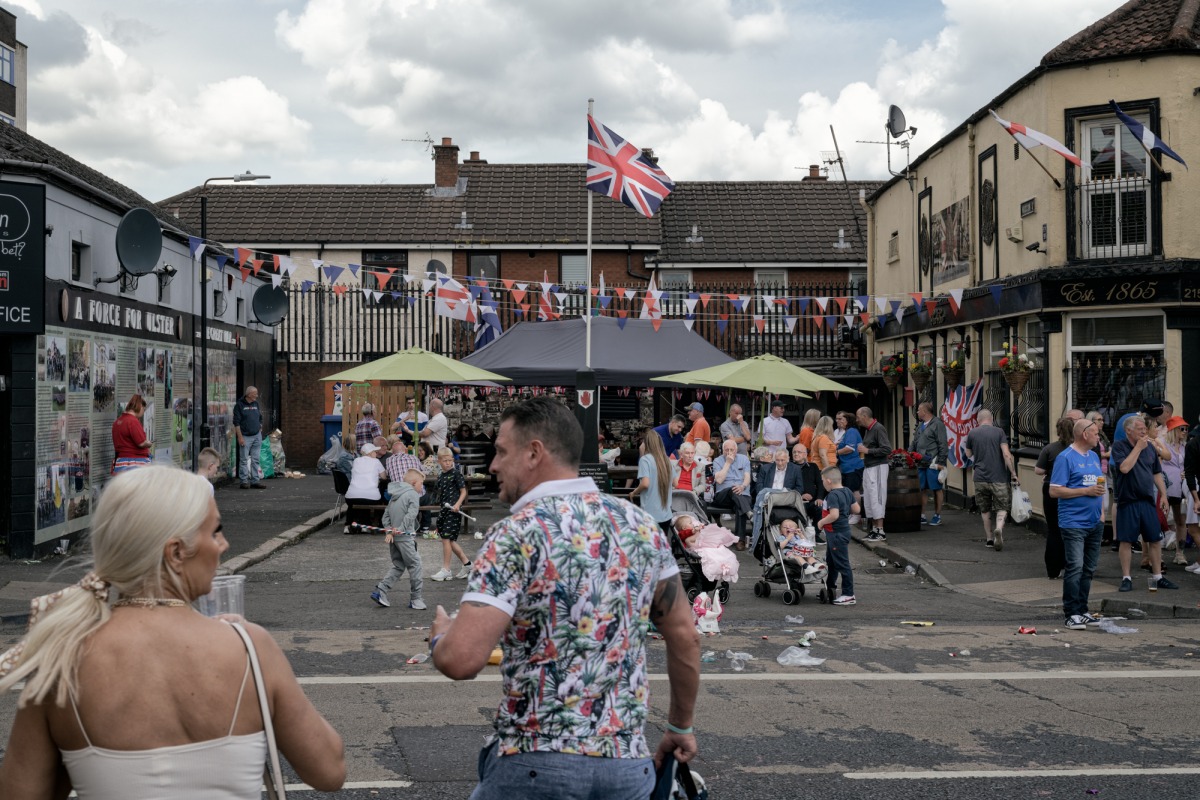
    In interview with Daniele Idini, photographer Graham Martin reveals he was drawn to cover the Twelfth in Northern Ireland after developing an interest in geopolitical events while living in Brazil. Before his trip North he expected trouble, but encountered a surprisingly welcoming atmosphere, even in hardcore Loyalist areas, although much of the iconography remains disconcerting to any visitor from the South.

    Daniele Idini: Are you a regular visitor to Northern Ireland?

    Graham Martin: No not really, and that’s part of why I wanted to go with a camera. As you know, photography is a great tool for attempting to explain things to others, but also to yourself. It’s a great way of coming to terms with things, understanding things and I, like many in the South am aware of all the stigmas attached to the North. Having been born in the 1980s I do remember going up with my parents as a kid and although already relatively peaceful, there was still a physical border and I can remember passing through the checkpoints, seeing the walls and turrets without fully understanding what it all meant. Since then, any visit I made up there and over the border was for a shopping trip or for touring the Giants Causeway and Antrim coastline. My initial impression crossing the border was how good the quality of the roads were compared to the South, the red letterboxes, or the Union Jack painted on the curbs. Later, when I had a cell phone, there was the network switching over; it always felt slightly surreal. It was only in later years, when I started to orientate my photography more towards photojournalism that I started taking an interest in geopolitical events. Mostly abroad at first (I really began to take photography seriously when I emigrated to live In São Paulo, Brazil from 2012 to 2016), but then, you start to become curious about your own backyard; which you mainly ignore at first, because it always seems like it’s something that you want to get away from. So, for me, this recent trip was the first time I went up looking at it in a new light, and that was because of photography.

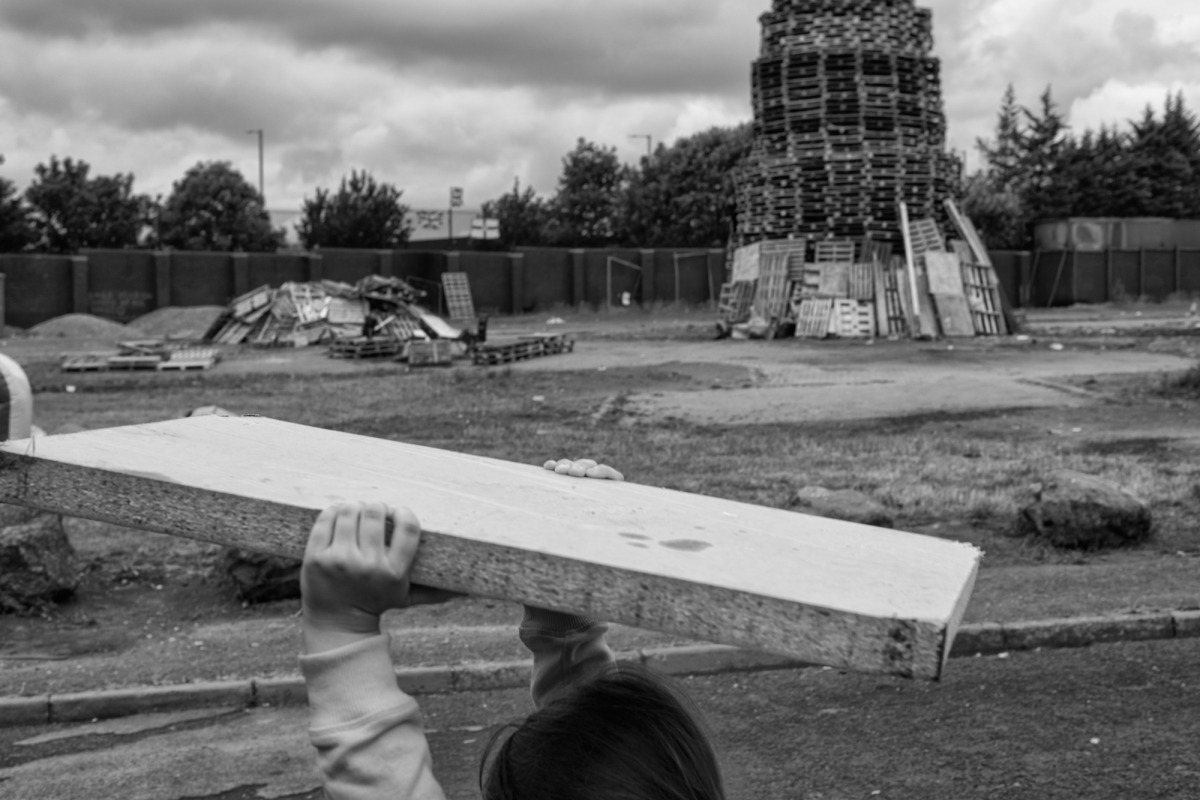
    A child adds to the pyre before the Eleventh Night bonfire at Mountview Street estate off the Crumlin Road

    Daniele Idini: In a previous article, which included interviews with a number of influential actors, we reported on rising tensions. We encountered a delicate situation, with a multitude of factors are at play. A combination of a Covid-19-related crisis; the effect of Brexit negotiations on the Good Friday Agreement, which was implemented in the context of the UK being a part of the European Union. What did you expect to happen on the Twelfth this year, and did it transpire?

    Graham Martin: I genuinely thought it could go either way. There was all this talk of it potentially being heated, and I did reach out to some contacts who are originally from the North, and from the Protestant community, to ask advice on where would be interesting for me to go to see the parades and what bonfires would be accessible to outsiders. They gave their advice and warned that it looks like it’s going to be quite a heated Twelfth this year, because of everything that is going on at the moment. The advice I received was generally like “So, you know, keep your distance, keep your accent down, be sharp, keep your wits about you”, that kind of thing. When you get that kind of advice from people who are from there and who know the place, that colours your perspective and perception of things. I still went with an open mind, but like with everything, whenever there’s a lot of discussion, build-up and anticipation, quite often it doesn’t quite end up amounting to much at all, which ended up kind of being the case. There were some contentious bonfires built close to peace walls and talk of the PSNI forcibly removing some, which ultimately they didn’t.

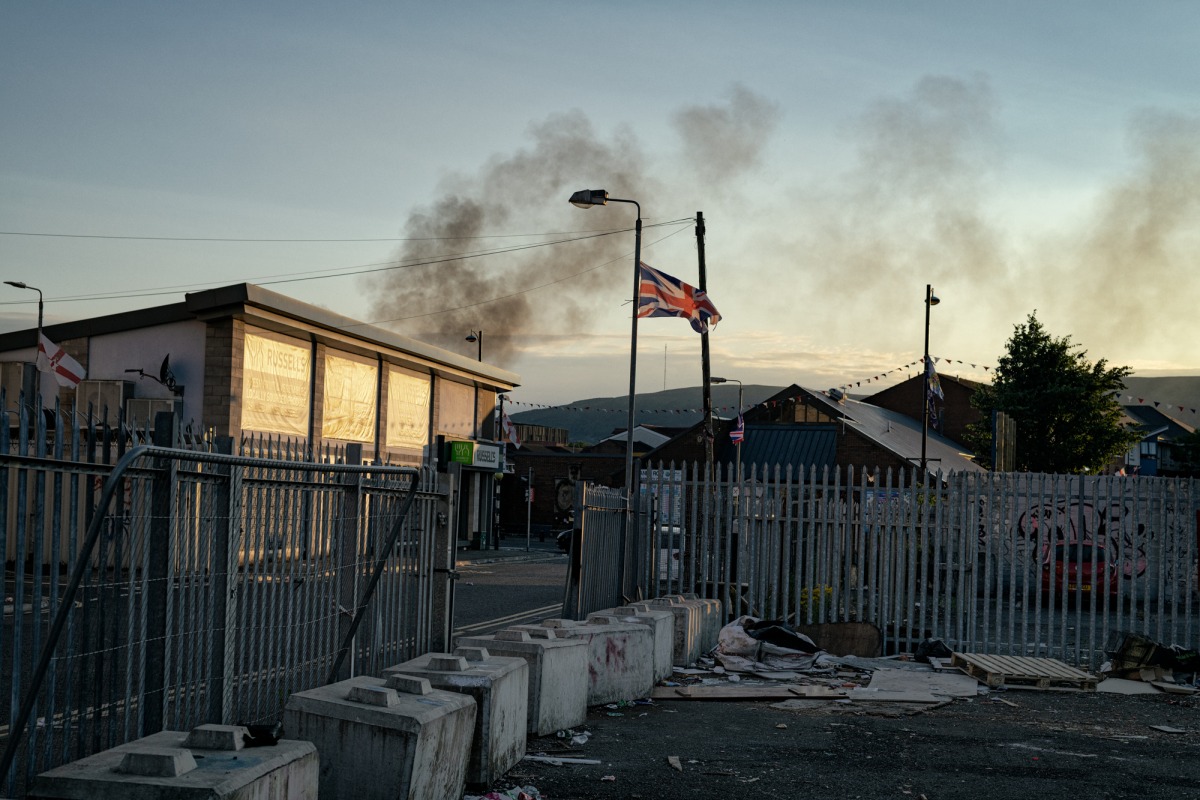
    Smoke rising in the Sandy Row area on July 10th indicates a pyre has been set alight a night early perhaps by Nationalists saboteurs…

    Some of the bonfires were set alight the night before and I think there was one youngster, of maybe fourteen years-of-age, who got badly burned, which is a separate issue, but that was kind of the extent of any major incidents or outbursts and I actually felt warmly welcomed there. Any kind of feeling of apprehension was ultimately my own based on preconceptions. I arrived there with my guard up and found that there was no real need for that. I could walk around freely, could photograph in any neighborhood, could approach and talk to people on the streets. Even on the Shankill, which is notoriously Loyalist, I was taking pictures of people openly and they would want me to send them to them by email.

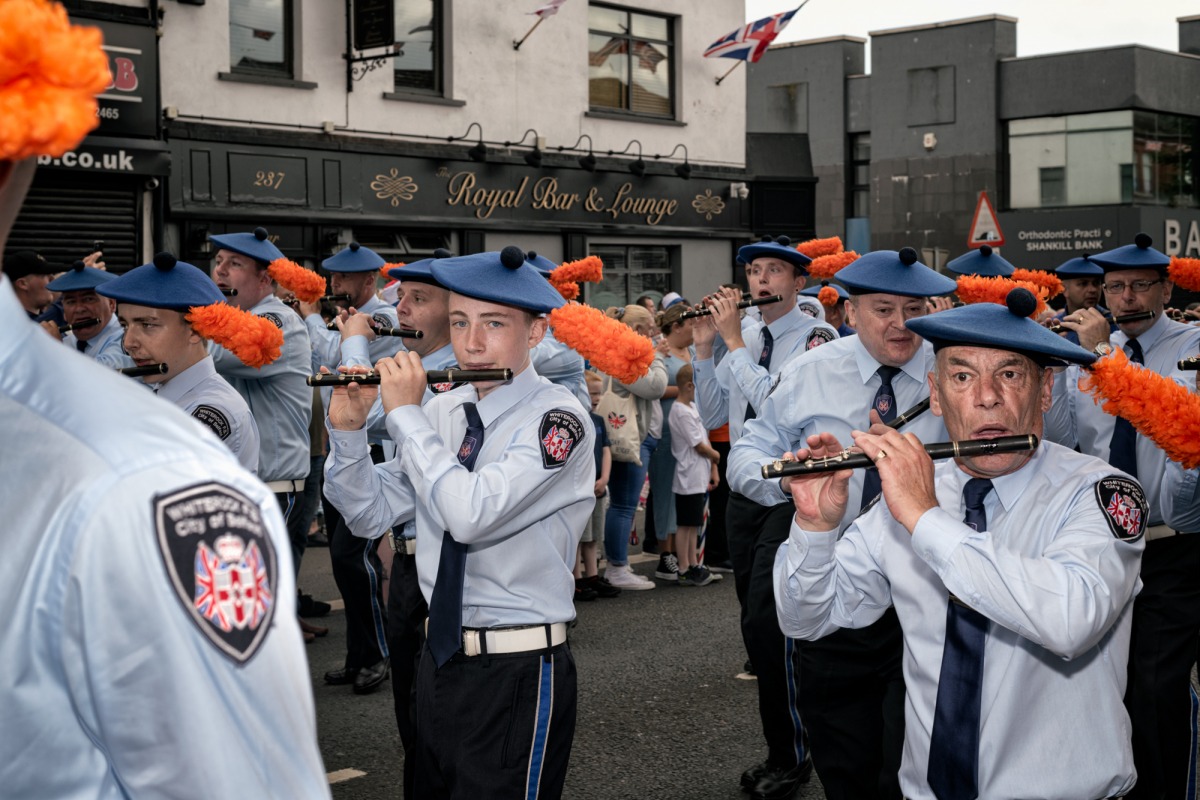
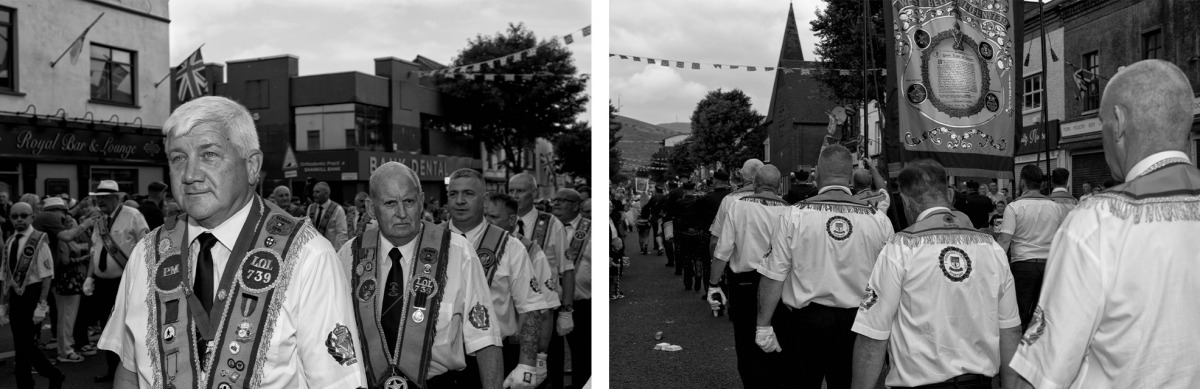
    Orangemen march down the Shankill Road on July 12th.

    There was a little bit of bemusement and surprise when they realised that I was from the South, but perhaps they respected that. So I got comments like “fair play to you” . You could say that that general calm I experienced was very much a planned thing, in light of everything in the news and I think there was a marked intention to keep things civil and peaceful.

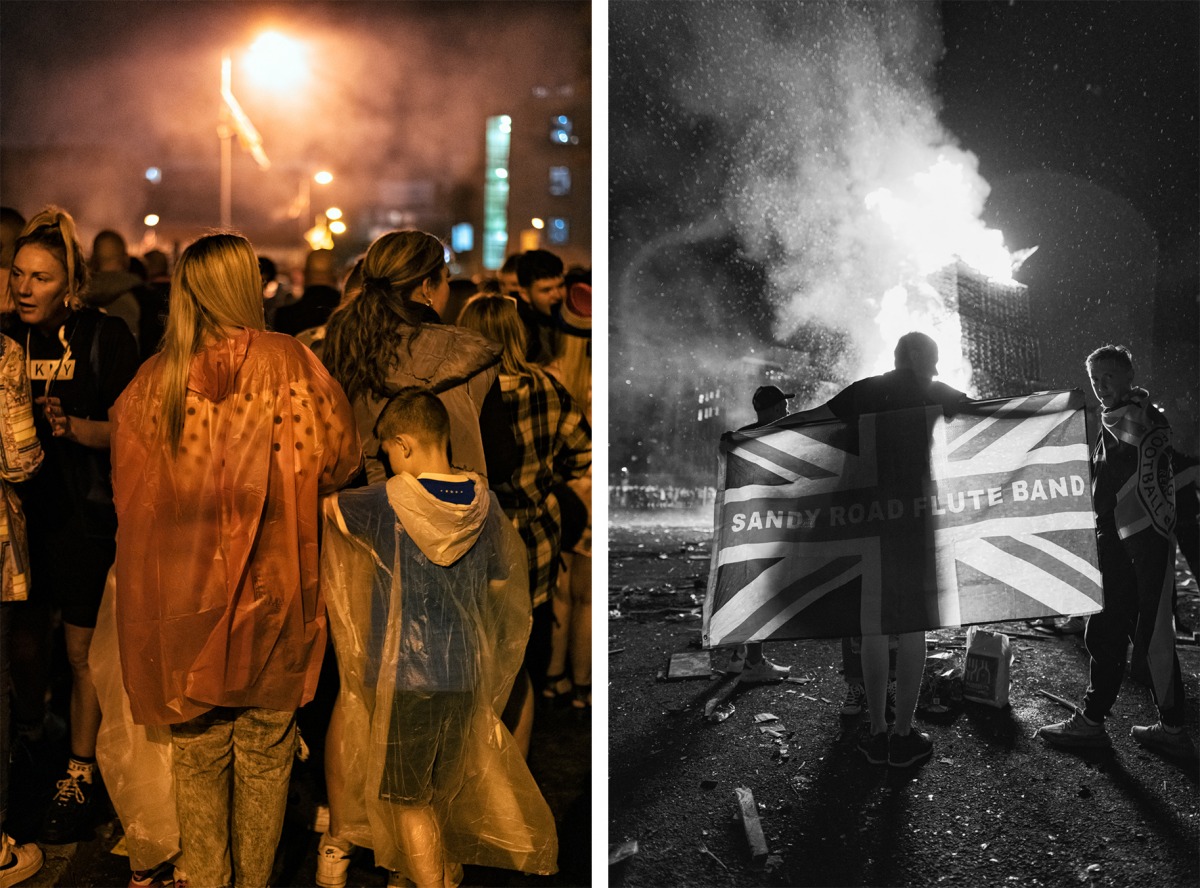
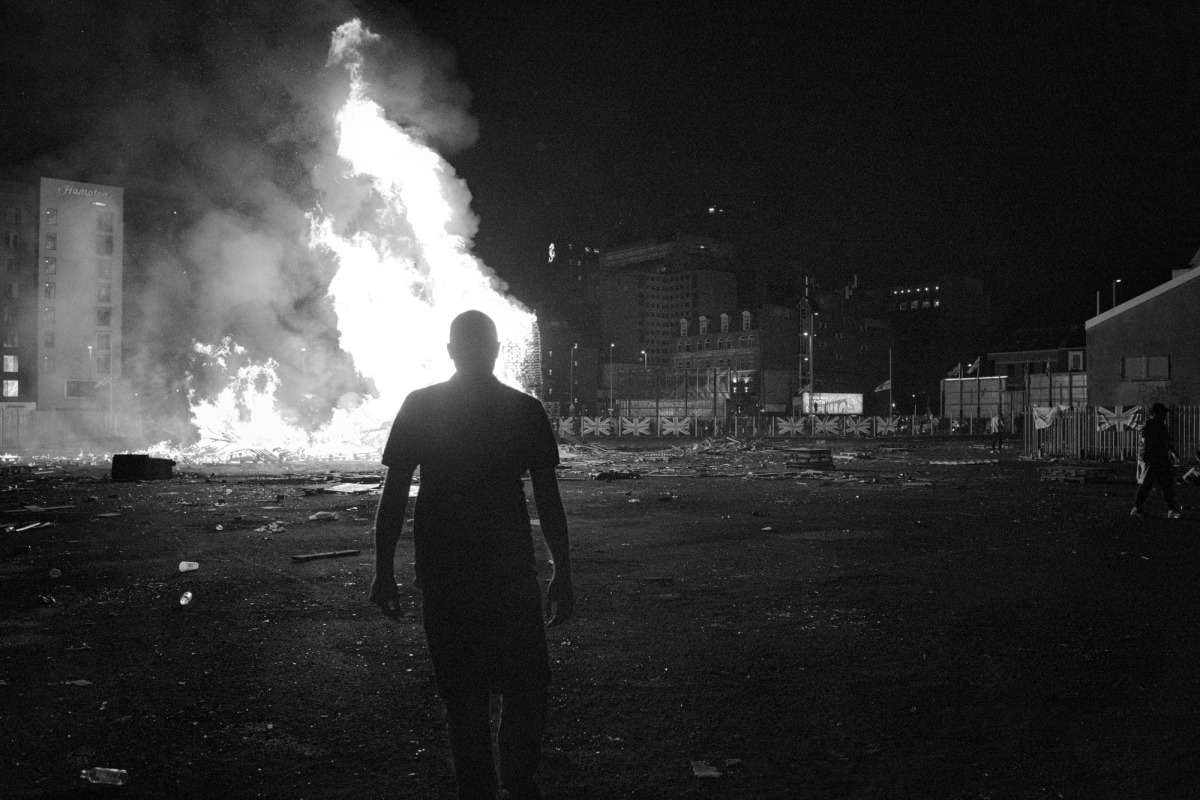
    Spectators at the Sandy Row bonfire on July 12th night.

    On seeing my camera one guy at the bonfire on Sandy Row came up to me  and said, “don’t go making this look like something it’s not. Nobody’s fighting here. Everybody’s happy. You know, everybody’s peaceful. There’s going to be no violence here. Don’t go back reporting something that it isn’t, like the papers tend to do.” They notice that this big night of the year for them is always marked with negative press, with criticism, and I think there was an intention overall to show people that the Twelfth could pass off peacefully, and there was going to be no tension.

    Orangemen march down the Shankill Road on July 12th.

    Daniele Idini: We can say then that there was an effort to keep the tension to a minimum. Yet, as I see from your pictures, there were some controversial messages and flag burning. What do these provocations, if we can call them this, really mean in this context?

    Graham Martin: Every year the same flags and slogans are burnt on the fires. The Irish tricolour is burnt. You have effigies of Bobby Sands burnt, the gay flag, the Palestinian flag. You have pro-Israel graffiti around on the walls, which is just as provocative. It seems paradoxical that they identify themselves with Israel as a kind of a small nation that has the right to be in that particular territory. It’s just very confusing to see the Tricolor and the Palestine flag up in flames, and yet the people are warmly welcoming. They’re quite civil in person, but at the same time you see graffiti around stating K.A.T. (“Kill All Taigs”). Taigs is what they call Catholic nationalists, the Irish. You’re walking around meeting people, photographing people, and to your left, there’s K.A.T. graffiti, to your right, there’s a big, multi-storey bonfire with your nation’s flag on!

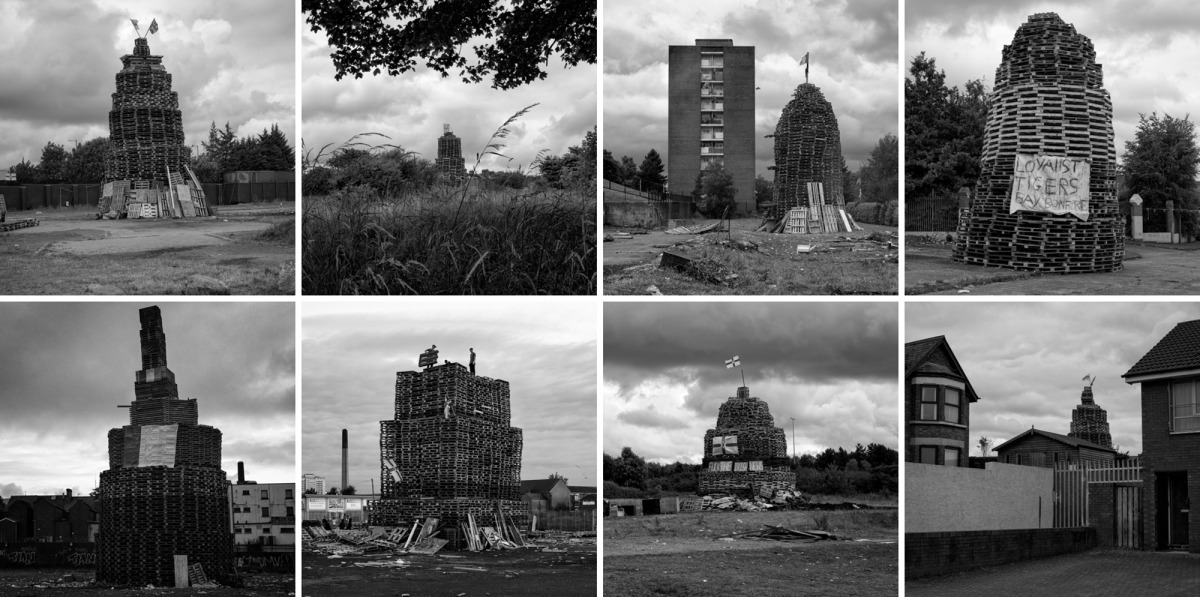
    Bonfire Pyres on July 10th ready for The Eleventh Night celebrations at Sandy Row, Shore Road, Tigers Bay and Donegal Pass.

    They’re demonstrating that they hate you and at the same time, they’re willing to open up and talk to you and shake your hands, so what’s the true feeling there? It’s very jarring. On the other side, when you walk through Catholic neighbourhoods like Ardoyne, not too far from the Shankill, in peace time, although IRA murals still exist, most of the more aggressive ones have been decommissioned. Many now are promoting sports and social community activities, environmental issues, and there are little or no flags. The odd tricolor maybe, but when you cross over onto the Shankill the murals feel more aggressive, more provocative. You’ve got those kind (such as the U.V.F murals and graffiti) up around the Shore Road, that would make you weary to enter into such areas. I walked up to one pyre as it was being built, the one that commenting on the Irish News (see image in grid “Fuck the Irish News”)* and there were a few guys hanging around finalising it’s construction. They basically told me to get the fuck out of there, so not such an open vibe. That’s the thing though; they put up these things, huge pyres with large signs and slogans that are clearly intended to seek attention, but then if you go and try and document it, you’re quickly warned to get the fuck out, so it’s quite challenging .

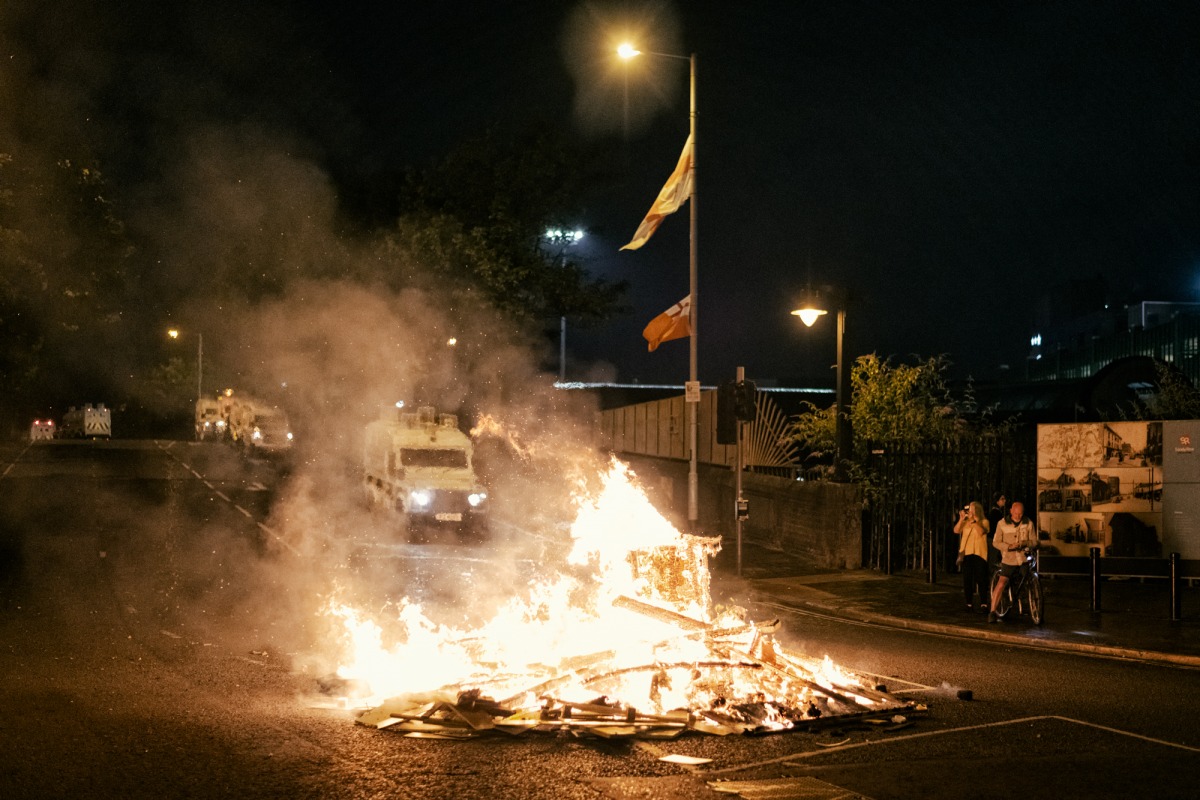
    A line of PSNI Land Rover Tangis approach passing a conflagration in the Sandy Row area.

    Daniele Idini: I guess it would depend on who is the intended audience for these displays. Some might include the press, but some, might be predominately intended for the community itself, and the aversion toward media is actually part of the message.

    Graham Martin: Essentially, you know, you’re seeing slogans that are saying ‘Kill Catholics’. It’s beyond provocation. They can say it’s their culture and “let us let us have our night”, but there has also been homophobic and other racist graffiti on the Protestant side, denouncing the Black Lives Matter campaign for example. There a lot of topical issues that they are intentionally taking a side on. So this seems to me like a statement and not just aimed at their own community. There are paralells with the global push to a more Populist, right-wing ideology, you’ve seen pre-Brexit with Nigel Farage, and with ethnic nationalism in the U.K.

    Spectator at the Sandy Row bonfire on the Twelfth.

    Daniele Idini: The discontent in Loyalist communities, still focused on the Partition question, now seems to be directed equally towards Westminster. There’s a feeling of betrayal aimed at the likes of Boris Johnson, a Conservative. It has created an identity crisis, wherein there’s a feeling of abandonment from the rest of the United Kingdom; which brings a sense of fragility.

    Graham Martin: It’s been building for years, I suppose. You’re talking about communities there that are really marginalised, under-developed and it doesn’t take a stretch of the imagination to see why they would be jumping on that kind of thing, and out of frustration picking on the Black Lives Matter campaign, Climate Change, or adopting the anti-masks / anti-vax campaigning. It’s really masquerading as something else. It’s a kind of rhetoric that it’s normalised that it doesn’t even get questioned anymore. The burning of flags, for example, could be seen as a form of hate crime, yet it’s completely normalised and permitted. Also, the bonfires aren’t regulated at all. There’s nobody in an official capacity to make sure they’re safe. If one falls over, which happens from time to time, it’s the size of a building falling, and on fire, It’s kind of surreal that it’s allowed to proceed as it does.

    Rex Bar, a well-known UVF (Ulster Volunteer Force, a loyalist paramilitary group) meeting place on on the Shankill Road, July 12th.

    Daniele Idini: I guess there is a level of negotiation going on with the authorities to try to keep the tensions to a minimum. To go back to the wider issues, Northern Ireland finds itself for the first time facing the possibility of a United Ireland that is being seen as not too remote of an option, and the result of Brexit’s negotiations is perceived by some as incompatible with the Good Friday agreement. It could be a treacherous path to save a peace treaty.

    Graham Martin: There needs to be good faith and efforts from both sides, and a period where controversies aren’t dug up from the past. The difficult thing for sure is that the Troubles are within living memory for many people still; it’s not ancient history. And it’s going to take a long time for people to forgive and forget. Now it’s the Sea Border that’s causing fresh tension, and the announcement of the Statute of Limitations on investigation into the Bloody Sunday Massacre. Who knows what it will be next. It seems like it’s such a consistently fractious and volatile situation.

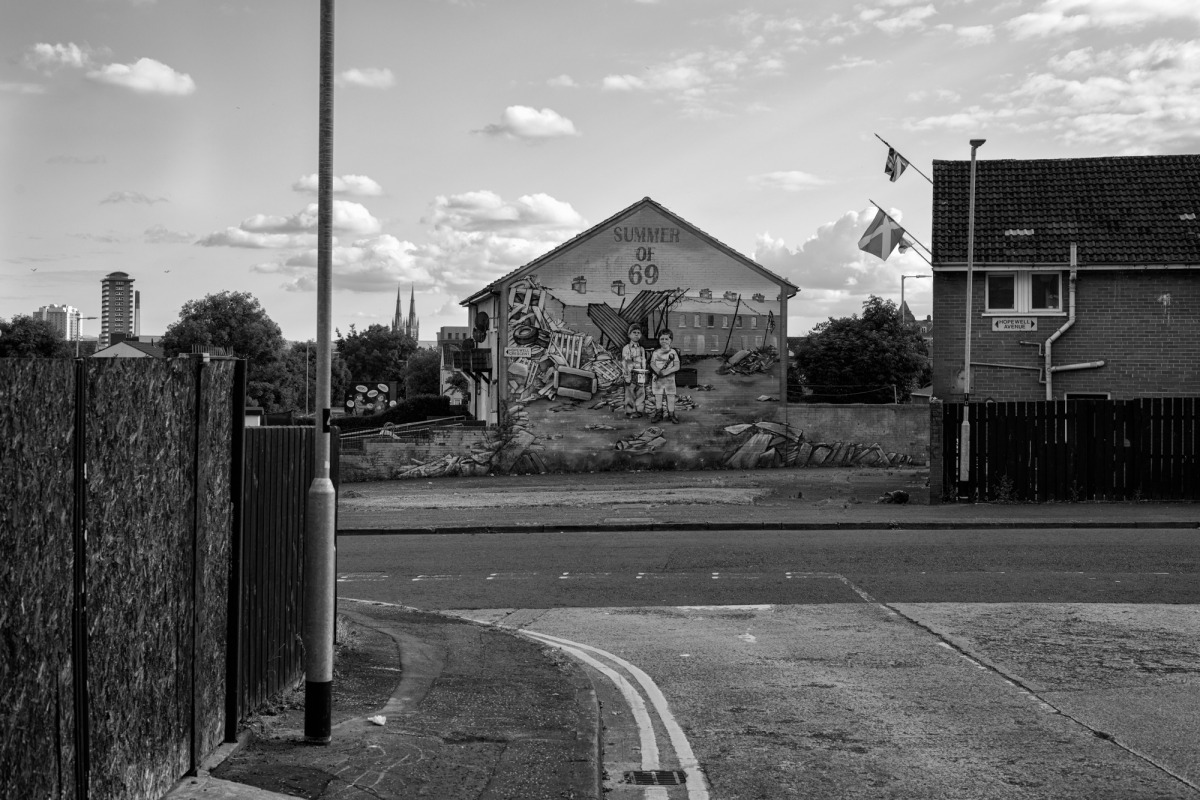
    ‘Summer of ’69’ mural on Hopewell Avenue in the Loyalist Shankill Road area, referencing the August 1969 violence which helped spark the Troubles.

    And it’s not about religion, of course, but the symbolism of the churches, and the ephemera surrounding the divided beliefs remains ever present in the murals, tattoos, and the wearing of either the Catholic Celtic or Protestant Rangers football shirts. I think it’s harmful to be carrying that around as a constant reminder of superficial dividing lines between communities. But I don’t think young people are really identifying with their own faith any more, or their religion they’re born into quite as much as they used to. I think there’s a move away from labelling people based on their beliefs. That might sound naively optimistic, but I think that’s going to help things there. People can inform themselves better with the Internet and the global exchange of information, and question ingrained fears or hatred of their neighbours. You’ve seen how such a turnaround can happen in Southern Ireland over the last twenty years, where the power of the Church has waned, and all positives that have come out of that with marriage equality and Repeal the 8th. That is happening in the North also: an easing of hardline traditions which are loaded with sectarianism. And I think it’s going to hopefully have positive knock-on effects in time.

    Graham Martin’s work is available below:

    www.grahammartinphotography.com

    https://www.instagram.com/graham.martin.photo/?hl=en

  • Greece: Refugee Pushback Award Withdrawn

    Continuing tensions in Greece over that State’s handling of the refugee crisis contradicts a carefully constructed public image the ruling right wing Nea Demokrita (New Democracy) wishes to project to a domestic and international audience. The issue of illegal ‘push-backs’ of migrants has continued to generate outrage, controversy, and outright denial in European media. This contradictory policy is reflected in events over this past week, as an attempt by the Greek President to honour a noted refugee-rescuer resulted in swift push-back by members of the ruling party keen to downplay such defiant gestures.

    Technically head of state – although her role is primarily ceremonial – Greece’s first female President Katerina Sakellaropoulou had issued a list of Greek citizens who were to be honoured for their contribution to society in various fields. The conferral ceremony was part of a wider series of events held last weekend commemorating the forty-seventh anniversary of the restoration of Greek Democracy.

    Those chosen to be honoured were drawn from various fields, including academia, medicine, and the arts.  Amongst them was activist Iasonas Apostolopoulos, who over several years has been working as a sea rescuer of refugees around the Mediterranean Sea. Currently working with Médecins Sans Frontières (Doctors without Borders) on such missions, Apostolopoulos has previously received honors for his humanitarian actions from the Mayor of Palermo, and the Danish Navy.

    He was invited to attend the ceremony on Saturday 24th of July at the Presidential Hall. According to his testimony, however, he received a phone call from the Ministry of the Exterior on Friday 23rd July –  after midnight – informing him he would not be decorated after all. Not only was this a highly unusual turn of events, but Apostolopolous had already been publically named as a recipient of this public honour. The cancellation was bound to stir controversy.

    Worryingly, hours before Apostolopoulos had been informed by phone news of the cancellation was leaked on Twitter and Facebook by Konstantinos Bogdanos, a member of parliament from the ruling party of Nea Dimokratia (New Democracy). In his post, Bogdanos described the refugee rescuer as an ‘aggressive critic of the border policy and our security corps,’ and attached social media posts of Apostolopoulos critical of the well-documented illegal push backs by the Greek authorities, which have been linked to refugees drowning at sea.

    The process of “pushing back” is designed to prevent migrants from arriving in a jurisdiction, or immediately returning them once they have arrived there. It prevents asylum seekers from declaring themselves as such, from presenting papers or other documents to the authorities, or even from receiving basic first aid or other essentials such as food, medicine and drinking water.

    The practice has become all too commonplace as ‘Fortress Europe’ attempts to prevent and discourage the movement of victims of war and its economic consequences, and, increasingly, climate change.

    Mediterranean countries such as Greece and Italy justifiably claim the burden of dealing with the refugee crisis has fallen disproportionately on them, a situation exacerbated by the regulations surrounding the Dublin Protocol and the increasing militarization of Frontex, the European Border Patrol Agency.

    This burden has also fallen on non-EU Turkey, which is commonly believed to be foisting refugees onto their Greek neighbours, who in turn are forcing these unfortunate travellers back into the jurisdiction of the Turkish Coast Guard. The fear, frustration and terror suffered by those on the receiving end of these often fatal tactics is unimaginable.

    Pushback by Greek security forces has received wide attention in the international media, and a recent Oxfam report from June 2021 described the practice of pushbacks at the Greek border are ‘persistent and systematic’.

    Nonetheless, Minister of Migration and Asylum, Notis Mitarachi, has claimed that these allegations are ‘clearly unfounded’, despite eyewitness testimony, mobile phone footage from on board migrant vessels being attacked, and the testimony of the Turkish Coast Guard and other authorities. The practice was also thoroughly investigated in a recent New York Times article, less than a week before Apostolopoulos was defamed as a traitor to his country.

    The influential journalist Elena Akrita attended the ceremony. The following Sunday, she posted her response on her Facebook page: ‘What is 100% cross referenced is that the entire Far Right section of Nea Dimokratia fell on top the issue. They riled up a big fuss and managed to take his name off the list.’

    The affair has brought a wave of outrage on social media, and is bound to reach the chambers of Parliament over the coming days and weeks, as left wing parties SYRIZA and MERA25, have already issued statement demanding explanations.

    To some extent Apostolopoulos’s exclusion has backfired on those behind it, as it has brought the issue of illegal pushbacks of refugees back into Greek public discourse, and indeed the wider world.

    The plight of refugees seems to be forgotten by those justifying the tactic of preventing safely landings on Greek territories such as Lesbos.

    In reponse to this controversy, Iason Apostolopoulos made the following statement to independent media The Press Project:

    Unfortunately, I don’t have a lot of time to deal with whatever is going on in Greece. At the moment I am in the central Mediterranean Sea on board the rescue boat Geo Barents, of Doctors Without Borders.
    Our priorities here are different. Since the 2nd of July, we are pinned down by Italian maritime police in Augusta port, they won’t let us sail, we can’t even come ashore and they keep us anchored.
    A few miles away, hundreds of people every day struggle for the lives on decrepit blow up boats, facing the waves but also the utter indifference of European authorities.
    Any people who manage to survive, are returned to the slave markets and torture centers of Libya, in joint operations of Frontex and Libyan Navy.
    This is the reality that we are experiencing and whoever doesn’t want us to talk about it, is covering up and essentially supporting a European border regime which everyday produces mass death, violence and misery.

    The debate over the tactics the EU is using to discourage migrants from attempting to reach its borders will continue. In the meantime, activists like Apostolopoulos can expect varying levels of opposition from state actors. Events in Greece this past week have shown how deep the divisions are between those seeking humanitarian solutions and those seeking complete control of the narrative around the refugee crisis.

    Feature Image: Felipe Lopes

  • Corporate Social Responsibility

    A business that makes nothing but money is a poor kind of business”
    Henry Ford.

    “Improving Employee Wellbeing”. “Creating Social Good”. “Sustainable Procurement and Consumption”. “Fair Pay for Fair Work”.

    These are just some of the slogans used by people talking about Corporate Social Responsibility (CSR, hereafter), which refers to practices benefitting society at large, or developing a fair and transparent working environment.

    The ‘people-planet-profit’ (3P or Triple Bottom Line) concept also falls within this ambit. It has been of great interest to businesses since the 1980s.

    However, Milton Friedman once said ‘the business of business is business’ and rightly so in many regards, since the primary objective and also the responsibility of a business is to survive as a profitable entity, regardless of how socially responsible (or irresponsible) it is.

    Nonetheless, one of the commonly ignored aspects of his work is that he added, “…shareholders want to make as much money as possible while conforming to their basic rules of the society”, and this brings the wider society into context.

    Friedman’s classic work on the ‘the social responsibility of business is to increase its profits gained significant traction throughout the 1970s and 1980s, but clearly the ideal situation is where a business is both profitable and also meet the needs of other stakeholders. This creates a ‘win-win’ scenario, in addition to ensuring business sustainability in the long run.

    Defining Corporate Social Responsibility

    CSR can be viewed as a form of business self-regulation with the aim of being socially accountable and – to more cynical – being seen as a ‘good’ social entity. We live in a conscientious and environmentally aware society, where employees, customers, suppliers, and civil society in general, places significant weight on choosing and supporting organisations that prioritise CSR. CSR is also a way for companies to measure and control their impact on society.

    CSR can be also be perceived as demonstrating how a business can be organised in a particular way that could empower them to act in a socially responsible way. So, indeed again, it could be seen as a form of self-regulation that could manifest in say, social or environmental initiatives or strategies, without compromising organisational goals and agreed stakeholder objectives.

    CSR does not have to be a distraction from a company’s main goal, and instead could aim simply at aligning a company’s social and environmental activities with its purpose and values. Many examples in recent years show that CSR activities can mitigate risks, enhance reputations, and even contribute to the bottom line.

    Contributions via CSR initiatives, therefore, can be both positive and negative (also known as externalities) to the economy, environment, and wider civil society.

    There is increasing realisation among business leaders that companies should not choose to be driven solely and exclusively by profit, and that they have a responsibility to do what’s right, not only for shareholders but also to hit the Triple Bottom Line, i.e., people, planet, and global civil society.

    Typically, CSR list four categories of responsibilities that organisations can cater for: environmental, ethical, philanthropic, and economic. Now we have examples of companies that rebranded themselves as B Corporation (B Corps), social purpose corporations (SPCs), low-profit limited liability companies (L3Cs), and a variety of ‘green companies’.

    Creating Social Good

    Research by Cone communication has shown that over 60% of US citizens expect businesses to participate in social and environmental change in the absence of government regulation. Interestingly, about 90% of surveyed consumers said that they would purchase a product because a company supported a social cause or environmental challenge that personally appeal to them.

    These initiatives could many forms, including: proactive environmental efforts (e.g., reducing carbon footprints, recycling innovation, managing e-waste); funding philanthropy (e.g., Tom Shoes whose slogan is ‘one for one’, whereby they donate one-third of net profits to various charities, supporting physical and mental health); ensuring ethical labour practices, i.e. treating employees fairly and ethically, including employment outsourced in the supply chain; or finally, through volunteering. Thus, how Vodafone World of Difference Challenge has assisted community development in most parts of the world already.

    There is an important caveat. While CSR may help brand the image of a company, if this does not come from a genuine moral conviction or altruism it can easily backfire, and lead to accusation of hypocrisy. So any approach has to be embedded in the core of what any company is doing.

    Examples of CSR initiatives creating ‘social good’

    An early ‘good’ CSR initiative was one taken up by Starbucks when they secured the ‘Fair Trade foundation’ certification. Thereafter all of their products had the Fair-Trade logo (resembling the Chinese ‘ying-yang’ sign) on them, this logo insists that farmers and everyone else in their supply chain are all paid fairly and are free from illegal exploitation.

    Starbucks remains the largest purchaser of fair-trade-certified coffee, globally. Fair-Trade initially started as a social movement, saying their goal was ‘to help producers in developing countries achieve better trading conditions and to promote sustainability.

    For businesses, it is a matter of being fully aware of their responsibilities towards the society as much as being about delivering value for business and society via creating social, environmental, or economic (similar to people-planet-profit) benefits, thereby ensuring the sustainability of a company.

    Interestingly, most of the business CSR initiatives these days are connected to SDGs or the global development goals. This could be about ensuring good health and well-being through a work-life balance, safety at the workplace, or supporting mental health of employees.

    Amongst other approaches are: decent work and economic growth (i.e. global goal 8), particularly in reference to the sharing or ‘gig’ economy. where the workers are not considered to be ‘employees’ and therefore not guaranteed benefits or entitlements; Responsible consumption and production (i.e. global goal 12), which does connect back to the Starbucks example, and also how certain University campuses in the US were terming ‘fair trade’ universities where students and academic faculty would only buy and consume products labelled fair-trade.

    Also, we have partnership for goals (i.e., global goal 17) where newer forms of institutional arrangements are created and sustained, moving on from the generic public-private partnership models, towards more inclusive and innovative ways of actor engagement via public-private-people partnerships.

    Build it and they will come…

    Lego has invested a fortune in addressing climate change, developing alternative energy usage, and reducing waste. Since this is also a part of the company’s philosophy, Lego’s environmentally conscious moves include reduced packaging, and also the use of sustainable materials.

    This is somewhat similar to Ben & Jerry’s, whose core goals have always revolved around supporting local dairy farmers and investing in the community where they have operations.

    Johnson & Johnson, another familiar brand, focuses heavily on reducing its environmental impact by investing in various renewable energy sources. At the global level, they also work towards providing cleaner and safer water to communities.

    Proctor and Gamble (P&G) is another example since their development of the two laundry products, Ariel and Tide, were sourced based on identifying environmental problems. Their research demonstrated that the most significant environmental impact that our laundry has is the energy used to heat the water in washing machines. 90% of the energy in a load of wash is expended on heating water, contributing to about two-thirds of all the greenhouse gas emissions in the Tide lifecycle. So, they developed products that could easily use cold water for washing, thereby reducing the total carbon emissions significantly as well as helping to save up to $150 a year on household energy bills.

    At the same time, it is not so much what the companies do, e.g. becoming environmentally friendly or ‘going green’ in its operations, it also about helping to generate a sufficient amount of awareness across society. For example, through adverts around packaging of P&G’s product Ariel would inform customers how to save energy by turning down the washing temperature on washing machines to thirty degrees Celsius.

    Similarly, Plan A by Marks and Spencer (M&S) has the goal of building a sustainable future by enabling their customers to have a positive impact on wellbeing, communities and also the planet through everything (process and product) that the company does. For example, in spring 2021 they launched their most sustainable denim range that was made using 86% less water, kinder chemicals and 100% responsibly sourced cotton. During the pandemic, the company distributed more than 11.8 million meals to those most in need and also raised £8.3m for NHS Charities Together in the UK through their M&S rainbow sale.

    No Longer Optional

    In recent years, however, companies cannot brag about ‘good’ practices and their ‘greenwashing’ philosophy anymore since the EU has now developed product requirements criterion; an environmental policy audit system for organisations; and EMAS certification, as a way of governing progress and control of eco-management.

    So, what was considered to be a ‘proactively good’ social action by a company is now somewhat mandatory by law. For example, the EU’s principles for global trade and sustainable development, development of sustainable development criteria and CSR in individual trade agreements can impact sustainability assessments of trade deals.

    Over the years, however, there has been numerous scandals around ‘brand image’. Among the questions we should be asking of businesses would be: What does a good corporate citizen mean? Is ‘profit’ a dirty word?  How much should society pick up the ‘external’ business costs such as pollution?  Does society really care about ‘fair trade’ or getting a good value in price and quality suffice?  How are ethical decisions made by businesses?

    Another important issue is how we address all these questions before jumping to conclusions based on subjective judgment and at times, situational ethics.

    Cases of workers exploitation, harsh working conditions, paying a wage that is lower than the statutory minimum wage are plentiful. From the customers’ perspective, organisations are not always transparent and honest. A plethora of issues include: false labelling, misleading pricing, quality differentiation, misleading information on packaging and advertising, and in worst cases, dumping products.

    Greenwashing

    The term ‘greenwashing’ was coined in 1980s by Jay Westervelt, which essentially means companies either misleading consumers about the green or environmentally-responsible credentials of a product or service, or misleading consumers about the environmental performance of the company.

    Then the question turns to whether companies ‘should’ tell customers everything. Corporate Governance plays a huge role in determining whether a school of thought that dismisses CSR altogether dominates.

    There is also a widespread assumption that businesses cannot be trusted, and that terms such as ‘sustainability’ or ‘community development’ are meaningless concepts for multinationals. It is interesting that the two key contrasting views that we come up with when reviewing CSR comes from two individuals, Milton Friedman and Edward Freeman.

    Briefly, Milton Friedman believed that businesses need to simply keep their shareholders and business owners satisfied, while Edward Freeman believed that businesses should be run for the benefit of all stakeholders (employees, customers, suppliers, civil society, government amongst many others).

    Stakeholders vs Shareholders

    The utilitarian philosopher Jeremy Bentham once opined that ‘action is best that produces the greatest good for the greatest number’.

    In the context of CSR, it is also a matter of fact that satisfying different stakeholders while maintaining profit isn’t everything, the idea of ‘contractarianism’ is equally relevant which is when no action by a business should cause uncompensated harm to ‘anyone’ else. So, it is also about the rights and responsibilities of a business. This is clearly not a black and white area, although dismissing CSR may seem an easy idea.

    For example, every stakeholder wants a ‘good deal’ for themselves. Employees want good pay, customers want value for money, suppliers expect a decent contract and fair prices. But this leads to inevitable friction. While customers want low prices, employees expect good wages. However, good wages lead to higher costs, thereby increasing the price of the products, which ultimately makes a customer unhappy.

    Similarly, suppliers want a good price for their supplies, which again could lead to higher costs (e.g. Starbucks works with the Fair-Trade Foundation), while a high price could leave a customer unhappy. Whether we take the example of a multinational or an SME, these challenges are common and unavoidable while also illustrating that a business cannot possibly satisfy all stakeholders. Therefore, the question becomes what CAN a business do?

    Three options, are possible: deliberately ignore all stakeholders, except shareholders, and go ‘flat-out’ for profit; pretend to take account of stakeholders and still go all out for maximum profit (e.g., ‘greenwashing’); engage with stakeholders and balance their ‘aspirations’ while not losing sight of profit.

    Bad Actions…

    Foxconn has been in the news with CSR scandals for over two decades now, particularly for violating employment laws.

    The company used to make Apple products in China and more recently Amazon’s Echo Smart Speakers and Kindle Devices. However, there have been reports of workers in hazardous factories run by Foxconn who are given sick or holiday pay. They can also be fired without notice during lulls in production. 40% of the staff that Foxconn used in their factories are ‘agency staff’ or ‘dispatch workers’. Those who worked overtime were paid at the normal hourly rate, which is illegal since both under Chinese law and even Amazon’s supplier code of conduct says that workers should receive time and half rate for such work.

    Foxconn has a history of worker exploitation, witnessed after a wave of workers committing suicide back in 2010, when Apple used to heavily outsource their manufacturing of iPhone and iPad to them. Besides, wage and worker exploitation, Foxconn also had serious factory accidents where workers died of electric shock in 2011, and also a factory explosion that killed four people and injured eighteen others in the same year.

    On top of that there have been frequent employee riots, use of underage (from as low as eight years-of-age) and illegal workers, along with violation of local laws. All of which has been to reduce costs.

    More recently, the company had invested in robotic technology to replace workers in manufacturing and to tackle the diminishing trust in the company name.  At some level we (as customers) should also wonder, how much and how badly do we really have to use the products of these giant companies such as Amazon and Apple?

    Just Do It?

    Similarly with Nike, 593,468 hours of overtime work went unpaid between 2010-2012 in Indonesia, which sent shockwaves through the Indonesian labour movement. Eventually after strikes and negotiations, Nike agreed to pay off $1 million to about 4,500 workers at a Nike plant in Serang, Banten in Indonesia.

    Again, there is nothing new about Nike’s labour exploitation and maintenance of sweatshops since the 1970s. From the early 1990s reports were flooding in detailing poor wages, child labour, and harsh working conditions in Nike’s outsourced factories (called ‘sweatshops’).

    After initially shrugging its shoulders, Nike said it was up to the outsourced parties. But subsequently, as the brand suffered, the company started auditing their factories for occupational health and safety. Their ‘bad reputation’ as an employer made them go to greater lengths than usual, while competitors adopted similar procedures.

    In the mid-2000s, several ‘anti-sweatshop’ groups were established, and at Brown University, Nike had to pull out of a contract with the Women’s ice hockey team after a student activist group demanded the company establish an ethical code of conduct. Similar cases occurred between 2010 and 2016 in Vietnam, Taiwan, Thailand, Indonesia, and China, while at the same time the community activities on these matters became stronger, through fair labour associations and workers’ rights consortiums which exposed how child labour represented 70-80% of their workforce.

    Further examples can be drawn from fast fashion companies such as Zara, H&M, Gap, Primark, who all adopted exploitative labour practices at one time or another.

    Balancing Priorities

    Multinationals mentioned in this article are major players in our economies. Many multinationals have exploited workers or like Google, Coca Cola, and Starbucks systematically exploited tax loopholes across the world over the years. Of course many of these companies have simultaneously done some ‘social good’ with their CSR or ‘responsible image’ campaigns. This makes any assessment of the role of CSR difficult and prevents us from drawing definitive conclusions, such as that multinationals are inherently bad, or perform a social good that may be a part of the company’s culture.

    CSR activities can be designed in such a way as to align with the companies’ business purpose, the values of the companies’ key stakeholders, while identifying the local or glocal needs that the company (local or global) can serve in a particular community where they have their operations, among other considerations.

    Thus, for example, in countries that lack sufficient government funding for public health, business organisations can step in with philanthropic funding to develop clean water and sanitation. A strategic CSR can still create various levels of continued ‘win-win/s’ for a company, its wider list of stakeholders, and the community.

  • Killing Kelly?

    The strange death of Dr. David Kelly was explored in celluloid at the premiere of Killing Kelly documentary at the Everyman Theatre, Muswell Hill, North London on Saturday, July 17 2021 at 9 pm.

    This is the second in what could well turn out to be a series of documentaries of collaborative works between George Galloway and director Sean Murray from Belfast.

    Murray has earned accolades for his documentaries including Unquiet Graves where he investigated the role of the British government in the murder of one hundred and twenty civilians in counties Armagh and Tyrone in Northern Ireland, between July 1972 and 1978. This involved the infamous Glenanne murder gang, with ties to loyalist paramilitaries, British intelligence, locally recruited soldiers and police.

    The role of British intelligence, its assets, and associated terror gangs has always been a part of the dirty war in Ireland. The counter-revolutionary strategy of successive British governments in Ireland, has had parallels throughout the world. With the mysterious death of David Kelly we appeared to be witnessing this approach in action on the British mainland.

    George Galloway is a former MP, and now a media presenter for a host of radio and television shows, to include the Mother of all Talk Shows on Sputnik Radio International and Kalima Horra on Lebanese Al Mayadeen television.

    The film draws on the book, The Strange Death of David Kelly by Norman Baker. Mr. Baker, Mr. Galloway, and Mr. Murray all made themselves available for questions and answers after the documentary presentation.

    Crowd-funded

    The film was crowd-funded through online donations, and follows the critically acclaimed The Killing$ of Tony Blair released in July 2016 by Mr. Galloway. This sequel, dealing with the same topic, is a timely addition to the history of Britain’s involvement in the illegal invasion of Saddam Hussein’s Iraq.

    The infamous Weapons of Mass destruction ‘sexed-up’ dossier was used by Blair to inform the British people and the British Parliament, that Iraq had the capability to target the United Kingdom with chemical weapons in just 45 minutes; and as such Iraq and Saddam Hussein could not be allowed to continue to both engineer and deploy these armaments, which were a direct threat to world peace. Blair was beating the drums of war.

    Once the darling of the US, UK, Israel, and NATO, Saddam had gone rogue. Despite sacrificing 800,000 troops in the Iran-Iraq War, a proxy fought on behalf of the West, following the successful Iranian revolution of 1979, by 2003 it was time for Saddam to go.

    Having committed no act of aggression against the West following his humiliating retreat from Kuwait, in the wake of 9/11 a plan was hatched to destroy Iraq.

    It is claimed in the film that Tony Blair and George W Bush conspired to create conditions for war and to prepare a narrative during Blair’s visit to President Bush. But a pretext was required to manufacture consent for military action. Thus, the dossier was used to frighten the UK and US public into accepting another intervention into the oil-rich region

    Daily Walks

    This film documentary is a testament to vigilant investigative journalism, including interviews with some of the major players involved at the time. Although the Kelly family, senior politicians, and military personnel declined to be interviewed, the facts speak for themselves.

    On the day of his death, Kelly headed off on one of his many daily walks, chatting to a neighbour he met on his way. His wife was at home having a nap and he had arranged to meet his daughter later that evening.

    A former head of Britain’s Porton Down chemical weapons research facility, Kelly was also one of UNSCOM’S chief weapons inspectors in Iraq from 1991 to 1998.

    On May 22nd, 2003, Kelly met with Andrew Gilligan a thirty-five-year-old defense and diplomatic correspondent for BBC Radio 4’s “Today”  program. According to Gilligan’s account, he asked how the dossier had been transformed, and Kelly replied with one word: “Campbell”; i.e. the claim that Iraq could launch weapons of mass destruction on the United Kingdom, within 45 minutes, was inserted into the dossier on Iraq’s military capability at the insistence of Alaisder Campbell, chief advisor to Tony Blair.

    Alastair Campbell lecturing at the LSE series ‘From Kennedy to Blair,’ 7 July 2003.

    These allegations formed part of an investigation by the Intelligence and Security Foreign Affairs Select committee. After giving evidence on July 15th, Dr. David Kelly was found dead two days later. Kelly may have been the unwitting fall guy for the political spin doctors of Tony Blair. Whatever else he could have exposed was taken with him to the grave.

    Death by Suicide

    The official death certificate records ‘death by suicide’, but certain facts remain elusive.

    When his body was discovered his knife was found lying beside him, with which, it was claimed, he had severed his ulnar artery. A bottle of tablets was found beside the body.

    The following timeline was reported in the Guardian newspaper: at 3 pm Dr. David Kelly received a phone call from the Ministry of Defense. He then left his home at 3.20 pm. Having not returned from his walk, the Kelly family contacted the police at 11.40 pm.

    Within 15 minutes three officers had arrived at the family home. A search operation started immediately, with a helicopter and search teams called in.

    The helicopter with equipment for body-sensory imaging failed to locate the body. But he was found by a volunteer search party the following morning. It seems implausible that body should have lain undetected not far from his home for over nine hours.

    His home was searched not once but twice by police and other investigating officers during that night. They took away many items including according to some reports the very wallpaper from the walls.

    The police were searching his home while he evidently was not there. They made the family leave the home during this period, preventing them from knowing exactly what was going on inside, and what they were taking.

    At the scene where the body was found, there is no evidence of significant blood loss consistent with a fatal wound to an artery. The medication he had ingested found in his stomach was a total of two tablets. The knife beside the body had no fingerprints nor did the bottle of tablets, and Dr Kelly was not wearing gloves

    Unknown Unknowns

    What occurred in the period between Kelly’s disappearance, just two days after giving evidence to a Parliamentary Inquiry, and the discovery of his body may never be known.

    The facts hardly support the official account that he committed suicide, nor even that he died where his body was found.

    The involvement of state operatives in his death cannot be ruled out, but official papers will remain classified for many decades.

    British troops looking at Baghdad, 11 June 1941.

    There are parallels with the suspension of inquests, and prosecutions relating to British state counter-insurgency in Northern Ireland, Iraq, and in Afghanistan – soon to be under a statute of limitations if proposed legislation comes into l\aw.

    The ruthlessness of their approaches around the world from Aden to Kenya and beyond, suggests that elements within the UK government would be prepared to create a pretext for war – such as the Iraq dossier – and possibly collude in the murder of one of its leading scientists. Blair’s government may indeed have given them a license to kill.

    Unusually after Davids’s body was found Tony Blair initiated a public Inquiry under Lord Hutton, which was widely condemned as a whitewash. A full Coroner’s Inquest would probably have elicited more information.

  • Literature: Ireland’s Last Minotaur

    In Ireland, North and South, the Arts Sector, currently, is a sinecure. Those middle-class mentalities which dominate, and, indeed, hold most high profile positions, would argue vehemently against such – as they would see it – an offensive statement, but nevertheless I believe it to be a fair characterisation.

    ‘Stephen says bitterly, “It is the symbol of Irish Art. The cracked lookingglass of the servant.” This was Stephen Dedalus’s view in Joyce’s modernist magnum opus, Ulysses, and we find this idiom pre-settling into an ‘independent’ Republic as a statement on colonial subjugation, and a lack of confidence in the national character. And since that imperial rule withdrew, neoliberal, self-serving attitudes, have moved – and settled – in as they have done across the Western World.

    With the arrival of mass market production, relentless advertising and consumerism, which took over Irish sensibilities around twenty years ago, Ireland became no different to elsewhere.

    Up to €7 for a pint of ‘Stout’ in Temple Bar?! Dublin rents going through the roof, past the cloud-clapped ivory towers and beyond into the dazzling astral heights, for pure unadulterated profit. This is an Ireland I do not care to recognise anymore. Everything, including morality, is up for sale.

    With the internet, one can purchase the ‘lookingglass’ and have it in your hand the next day if one so wishes; but it will, inevitably, end up being tossed away, into landfill, soon thereafter. We live in ephemeral ‘throwaway’ times. Qualities like validity, truth and morality are diminished – and indeed ‘blend’ into ‘fiction-meets-truth’ in an Orwellian-era of ‘fake news’, outright lies and endless spin.

    Ireland enjoys intellects but only if they are not overtly clever, and don’t create a sense of inferiority. Does the cracked lookingglass serve as a basis for the national character or identity?

    Indoctrination and Subjugation

    A deep resonance of shame bubbles up from oppressiveness, whether it is indoctrination through the Catholic Church and a State which could not separate the two; and, in the wake of centuries of Viking, Norman, and indeed Anglo-Saxon, subjugation a deep hurt has not even been addressed. The need for a healing process in the collective psyche has not been considered by the remote heads of the post-modernist, mildly liberal, and increasingly secularised state.

    Ireland was banished, but she was not razed and buried; she would return. And return she did onto her fertile isle, on the edge of Western Europe – the land of milk and honey, so rich in potential and verdant imagination.

    It is true: I am in love with Ireland as landscape; and the mythical potency brings to mind an unconforming otherness – which espouses freedoms that rouse the romantic variant in a wanderer.

    There is, however, now the prescient, palpitating and unresolved issue of the published writer: the ego, which conflates on the surface area of their proposed brilliance, leading to the belief that they, and their literary output, rival, and even surpasses the authors of literary Classics. In effect, canonising their own brand – this is where we are.

    Let me add, that the Western World’s Canonical Works are up there for a reason, they are regarded as ‘the Classics’ and should be read and championed as such. A ‘Classic’ can be considered a strongly composed noteworthy book.

    Among the writers who are generally considered the most important in Western literature are: Homer, Aeschylus, Euripides, Virgil, Horace, Geoffrey Chaucer, Dante Alighieri, William Shakespeare, François Rabelais, Jean Racine, Molière, Miguel de Cervantes, Michel de Montaigne, John Milton, Samuel Johnson, Johann Wolfgang von Goethe, William Wordsworth, Jane Austen, Stendhal, Walt Whitman, Gustave Flaubert, Emily Dickinson, Honoré de Balzac, Charles Dickens, Herman Melville, George Eliot, Leo Tolstoy, Henrik Ibsen, Sigmund Freud, Fyodor Dostoyevsky, Marcel Proust, Thomas Mann, James Joyce, Virginia Woolf, Franz Kafka, William Faulkner, Jorge Luis Borges, Pablo Neruda, Albert Camus and Samuel Beckett.

    First Usage

    The first writer to use the term ‘classic’ was Aulus Gellius, a second century AD Roman writer who, in the miscellany Noctes Atticae (19, 8, 15), refers to a writer as a classicus scriptor, non proletarius (‘A distinguished, not a commonplace writer’). Such classification began with the Greeks’ ranking their cultural works, with the word canon (‘carpenter’s rule’).

    Moreover, early Christian Church Fathers used canon to rank the authoritative texts of the New Testament, preserving them, given the expense of vellum and papyrus and mechanical book reproduction. Thus, being placed in a canon ensured a book’s preservation as the best way to retain information about a civilization.

    Contemporarily, the Western canon defines the best of Western culture. In the ancient world, at the Alexandrian Library, scholars coined the Greek term Hoi enkrithentes (‘the admitted’, ‘the included’) to identify the writers in the canon.

    If you are a writer with a couple of books in print, and if you deride these works because you are so high upon your stamping, nose-blustering, mighty charger, due to being published, I am sorry, but this is out-and-out naïveté. It is emotional, inferior narcissism and ego-led savagery and in its way, denigrates the reputations of great writers of the past and their output.

    Recently, reading an interview in which a writer stated that they did not, or could not, raise a little interest towards Jack Kerouac’s Beat Classic, On the Road, equating the experience with hitting one’s head ‘with a plastic spoon.’ – a petulant and unworthy response.

    Infantilised Youth Culture

    Infantilization of culturally accepted ‘norms’ through Happy Meals’ language, ‘LOLs’, and other solipsistic accepted ‘bant’ has led us down this cul-de-sac. Snowflake is used as a pejorative term. Other ‘trendy’ Smartphone-induced abbreviated terms such as ‘Merch’ and ‘Bae’: are now the common argot of an infantilised youth culture that permeates mainstream discourse.

    Any perceived ‘criticism’ of these so called ‘established writers’ i.e., a writer who has a recent published book on the shelves, is meted out with condemnations and calls the gallows! In this solidarity, an insidious, irrational, emotionally-charged cabal is missing the point.

    The media in Ireland love to promote long established writers and their works, but they routinely forget the Garret-based writers who slog bravely away by a figurative candle over their ‘Art’.

    Please, fellow scribes, do not ‘Drown’ your ‘book’ like Prospero. Do not become disheartened because you are not alone. Your magic is your own and do not let it die because of the success of mediocre fare, which publishing houses choose to release.

    Irish publishers, like UK publishers, and American publishers, are greedy for a quick return on profit and this mantra only serves their deity, the golden calf of money. Forget this wide-eyed, commandeering for a few hedonisms, and continue on.

    Yeatsian Revival

    Simply because Ireland has a vibrant literary-cultural inheritance – which came to the fore especially during the Yeatsian Irish Literary Revival from the turn of the twentieth century – should not, ergo, give prominence to literary reputations simply on the assumption they are part of a great tradition. Extreme reverence is the death-knell of strongly composed literature, which is kept in its primordial place for lack of oxygen, dragging itself off to the literary hinterlands, to peer through fissures of granite rock – redundant.

    There are simply too many Creative Writing Courses being run in universities, which gladly take a student’s money – assuming they pay it up front and often – in order to place their ego on a pedestal; but the massive issue with this kind of fawning is that it misses the whole point of literature, which is to enjoy the simple immersive experience of reading something new, fresh, challenging that sets you upon the unknown territories of an adventure, knapsack in tow.

    In Brian Friel’s Philadelphia, Here I Come, the main protagonist, ‘Gar’ Gareth O’Donnell, has a public and private self, played by two actors. The mimetic structures of the ego, in the Irish Literary Art’s Scene(s) do not allow for any logical critique – this kind of thought is placed in emotional narcissism, firmly rooted in insecurity: the public image of oneself in a position of power and the private self behind pulled chintz curtains. Seemingly, the paradoxical self is difficult for the Irish mentality to examine closely.

    The Commentariat

    Who are the Irish commentariat on which these assertions are based? One does not have to look too far: remember when Roddy Doyle, a decent Dublin novelist, took a few naïve swipes at Joyce’s masterpiece:

    Ulysses could have done with a good editor,’ Doyle told a stunned audience in New York gathered to celebrate the great man who is credited with inventing the modern novel.

    ‘You know people are always putting Ulysses in the top ten books ever written but I doubt that any of those people were really moved by it.’

    ‘I only read three pages of Finnegans Wake and it was a tragic waste of time,’ he added. ‘Dubliners was Joyce’s best work, but Ulysses was undeserving of reverence.”

    According to Richard Ellmann’s biography Joyce was once described as ‘A corner boy who spits in the Liffey.’ Jealously appears to lie behind denunciations such as Roddy Doyle’s.

    Working Class Writers

    The reality is that many aspiring Irish novelist are forced into work that prevents them from writing: no one doubts this, but many working class writers are living on the breadline; the cultural establishment response: ‘Ah, he’s grand’ desensitizes them to this struggle.

    They may console themselves, ‘Sure, he was rejected thirty-seven times.’ Well, Robert M. Pirsig’s Zen and the Art of Motorcycle Maintenance was rejected over a hundred times – so statistics have little relevance, especially considering a lot of agents don’t know their furnished onions from their hot potatoes? The author of Moby Dick, Herman Melville, died in abject poverty. Those who seek justification in ‘statistics’ lack in the cold reasoning of logic.

    The effete North – once a fertile ground for freedom of expression, and in around the harrowed fields of poetry, has been conquered by a small literary clique, who look out from their parapets, pouring scorn on anyone who dares to have the tenacity to write ‘good’ work – work which they see as threatening to their output.

    A few diminutive literary-based, artsy, types run pop-ups and suchlike, now and again, as an alternative to the mainstream, but some, most, fall like a bright star into the slopping wetness of the Lagan, or the Foyle, only to have their inner-core frazzled and inevitably extinguished – another avenue burnt-out.

    There will be those who will be quick to trot out, on horseback, with lances aloft, with ‘Ah, sure he has a chip on his shoulder,’ and other negative, quick-to-judge, comments. My riposte to this is: yes, I do have a chip, or rather the plural, ‘chips’, one on each shoulder, which helps balance me out. They will use the term ‘bitterness’, but ‘frustration’ is more apt. Ingratitude will be another conceited proclamation.

    Also, the Halo-Effect: this being the over-promotion of well-established writers, with no love left for the outsider, unknown writer. Ireland’s cultural media embargo on new and fresh writing is wan to say the least; anytime an important event comes along they wheel out figureheads. Michael Longley’s poem, ‘Ceasefire’ is often wheeled out upon a gurney; again to be speculated upon; again in times of conflict; but I can safely say Ulster Unionism, which Longley would identify himself with, would never get down upon their knees to kiss anyone’s hand except their aristocratic, they believe, betters.

    Ireland’s media has an infatuation with their well-established poets – poets who have been hanging around for thirty years –  waiting for them to come on stage to deliver homilies of breathy, dramatic words. A false panacea for ongoing violent times.

    The cult of literary reverence and priesthood in the Irish poetry scene is archaic, embarrassing, and non-progressive, and equates to the mystical sorcery in a Harry Potter inspired world of fakery. The ‘everyone wants to be famous’ and well-regarded, and thought highly of as a ‘writer’ is a trope which has simply gone too far.

    It is fine to have dreams and aspirations, but one has to put the hard work, through falling, in failure, by rejection, after derision, and in managing jealousy. One only has to look at the work which is coming out of university produced magazines to see this. Recently, I read a short story in an Irish newspaper, online edition, and I despaired. What I see is diaphanous clichéd fare time and time again.

    Given Up

    Not so long ago, I conversed with a very fine, and clever, female Irish poet who is not well known in Ireland. She told me that she has given up trying to have her work published in any Irish Arts-led magazines as her work is continually rejected.

    I have read her work, it is good, and all that I can summarise is that some of these Arts folk do not know what they are doing, but, or rather, what they really are doing is selecting the work of their chums and, indeed, the work of themselves, for publication.

    These are magazines which are supposed to have a fair-handed, even democratic, selection process for work which is submitted from the four tent-pegged corners of the island of Ireland. Nepotism is rife in the Irish Arts scene. If you are a friend of a friend, nudge-nudge, wink-wink, then you are ‘A-Okay, pal…I will get you published,’ literary merit notwithstanding.

    There are of course exceptions, with real talents. Colm Tóbín is up there with the alive Irish intelligentsia, as is John Banville, both are true novelists in the sense of sitting down to read, to learn, then to write their own work, in conformity with the traditional literary model, and they should be applauded for their due diligence. They have hauled long nets and reeled in empty lines for their patience and perseverance to their Art, to pay off in the end.

    What is to be done?

    Easy – read more books. Read the Classics. A good novel will lead you to a wood at dusk, whereupon you will find a finely woven thread of golden-silk, and, as night falls, slowly traverse the wood and feel, along with the golden-thread, a growing self-belief. That is the power of strong writing. Do not shy away from challenging yourself with any prejudicial assumptions around what a reading experience is, should, or could, be.

    Feature Image: Florine Stettheimer (1871–1944) Studio Party (Soirée).