Blog

  • Could Ivermectin End the Pandemic?

    The bacterium streptomyces avermitilis was discovered by Satoshi Omura at the Kitasato Institute in Japan in conjunction with William C. Campbell at MSD (Merck, Sharpe and Dome) in the early 1970s. From this compound the medicine Ivermectin was developed. Ever since, it has proved a wonder drug for the treatment of parasites in humans and animals.

    Most of these infections occur in Africa and Latin America, but it was nevertheless a lucrative drug for MSD. Nonetheless, in 1987 they provided the drug to the world free of charge as the Kitasato Institute gave up rights to any further royalties from its sale. This was an exceptionally generous gesture as it was a $1 billion per year product, and had been for several years. Its extensive and widespread use in humans has been described by Chris Whitty, Chief Scientific Advisor to the British government throughout the COVID-19 pandemic as ‘a drug with a good safety profile’, with a serious adverse drug reaction rate of 1/800,000

    Another paper says ‘Ivermectin was generally well tolerated with no indication of associated CNS (central nervous system) toxicity for doses up to 10 times the highest FDA approved dose of 200mcg/Kg’. In a nutshell, it is a safe drug, in use for a long time, and the nuances of clinical usage are therefore known to many physicians.

    A recent paper from India using ivermectin as a preventative used 15mg on average, twice per month at a cost of $1.20 per month in healthcare workers resulted in a 72% reduction in infections. In a recent online enquiry to a wholesaler in India I was offered 100 x 3mg tablets for $12. Yet remarkably this same dose in Ireland would cost €100 per month.

    As is well known by now, in early 2020 the WHO alerted the world to a pandemic virus that apparently emerged out of China, a virus for which there was no known treatment available and which was most dangerous in elderly patients with underlying conditions.

    The illness presented with cold-like symptoms that after a period of between five and eight days could develop into severe respiratory symptoms, requiring hospitalisation and sadly in some cases leading to death.

    Guidelines for General Practitioners

    The Irish College of General Practitioners stated in their guidelines to general practitioners in April 2020: ‘Clinicians should be aware of the potential for some patients to rapidly deteriorate one week after illness onset’ (members access only: https://www.icgp.ie/speck/properties/asset-Interim Guidance for General Practitioners).

    The same document lists those conditions and age groups in which this is a possibility. It goes on to state that ‘no medications have shown any therapeutic benefit on the progress of Covid-19 pneumonia.’

    This advice has not been updated since April 2020. So ‘do nothing until the patient turns blue’ appears to be the invaluable advice from a national body sixteen months into this crisis. However, in the spring of 2020 if you were unfortunate enough to find yourself in a nursing home your blue pallor would not summon the arrival of a flashing blue light, but instead you would receive midazolam and morphine, both respiratory depressants, whilst you awaited the Grim Reaper.

    GPs were discouraged from examining their patients. Even the use of the stethoscope was deemed unnecessary. Shades of blue were everything. The ‘do nothing’ approach is still supported in the guidelines issued by HIQA in February 2021, despite over forty studies demonstrating the efficacy of ivermectin in the intervening period.

    HIQA Advice

    HIQA currently advise that ‘individuals do not prescribe or use interventions for the treatment of COVID-19 that do not meet the necessary minimum criteria’, but don’t outline what these criteria are.

    They go on to ensure that ‘practitioners are not criticised for not prescribing these interventions.’ This latter is a somewhat curious statement if a body is so confident that their evaluation of the evidence is above reproach.

    Yet William C. Campbell co-discoverer of Ivermectin with Satoshi Omura – with whom he shared the Nobel prize – in a speech to the Royal Irish Academy in April 2020 stated: ‘there is the possibility that a safe dosage of Ivermectin might reduce the rate of viral replication in the mammalian body, or affect the virus in other ways that might be revealed by further research.’
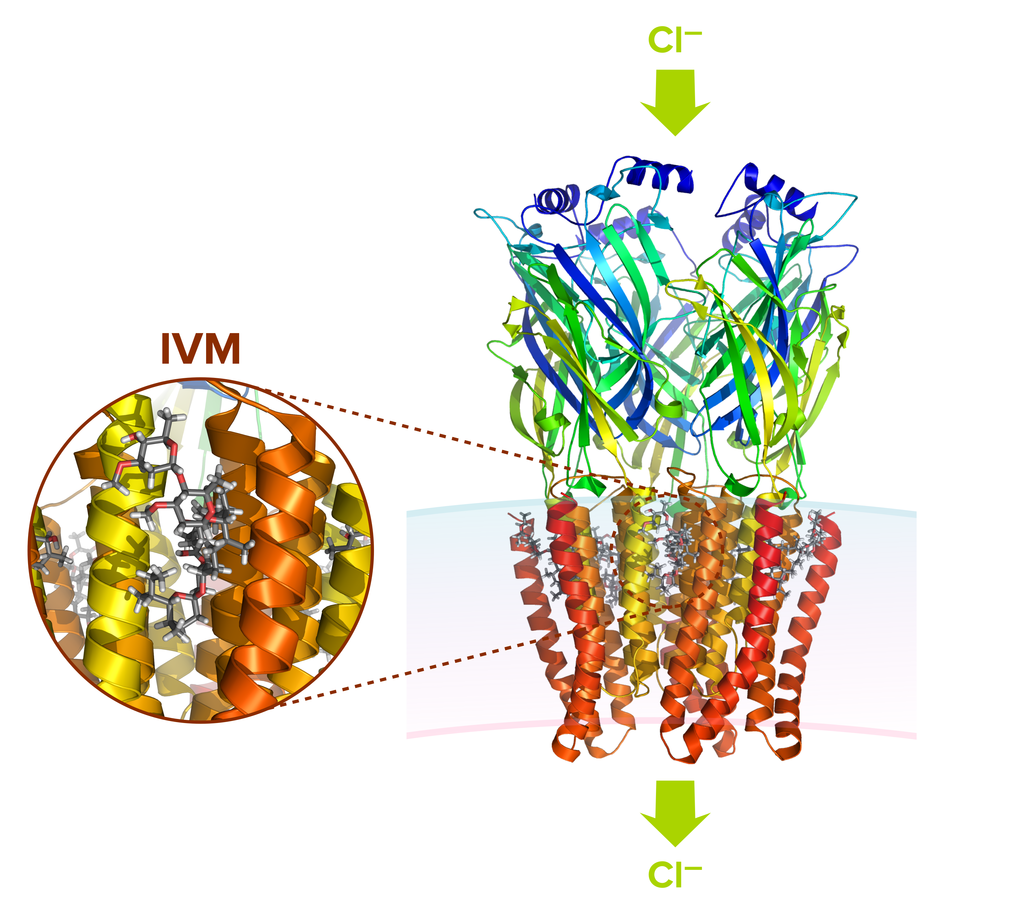
    Ivermectin (IVM) bound to a C. elegans GluClR.

    Fortunately for some Irish patients, a few brave GPs looked beyond this island for guidance. Asking doctors to do nothing, and specifically indicating certain actions that they should not take, is a restriction that disconcerts many experienced doctors, if not being a downright interference in the doctor-patient relationship.

    As GPs in the community we deal with people who are part of a family within a social setting. We are therefore cognisant of many features of health – which outsiders might consider superfluous to the ‘science of medicine’.

    Now I laugh each time someone juxtaposes those words, especially when I consider the absolute chaos that is general practice’s interaction with people. At the end of some consultations, I’m lucky to be able to spell my own name correctly, let alone apply the cold, steely, rational logic of science to solving any problems.

    But no matter how chaotic or complex, or even futile, medical interventions may be, one must never vanquish a patient’s hope. Even when close to death, hope – if not for further life at least for a peaceful death – is something the GP can bring to the situation.

    So who are these people in the ICGP or HIQA to say to GPs that there are no treatments available for their vulnerable patient who develops a SARS-CoV2 infection; to say ‘well let’s wait and see, and sure if you turn blue we’ll get an ambulance’?

    We won’t visit or examine you, and you won’t be coming to our surgeries, but we’ll look after you by proxy. So why were we as doctors advised to do nothing? Not even to try a cheap, effective and safe drug, if only to elicit the placebo effect?

    Criminal Charges

    In India WHO’s chief scientist Dr Soumya Swaminathan is facing criminal proceedings brought by the Indian Bar Association for disseminating disinformation about ivermectin and its effectiveness as a preventative and early treatment for SARS-CoV2 infection.

    Should those in HIQA who made recommendations to Irish doctors not face similar charges? Is this not a case of wilful blindness?

    In the USA two distinct groups of doctors-intensive care physicians lead by Drs Pierre Kory and Paul E. Marik set up the FLCCCA (Front Line Covid Critical Care Alliance), and community-based physicians led by Professor Peter McCullough of Texas A+M University, in conjunction with AAPS (American Association of Physicians and Surgeons), devised protocols in their respective fields using Ivermectin and other medications, deemed ineffective by the WHO.

    https://www.youtube.com/watch?v=dEmOCWOZPk8

    Their rationale was based on medical ethics and a professional desire to give their patients a fighting chance against this condition. They have faced vilification and attempted sanctions, as have doctors in Ireland who were simply trying to help their patients. And some patients even had the temerity to get better.

    I’m not sure what irked the Medical Council of Ireland more, the survival of the patients despite being given a HIQA/WHO proscribed substance, or some previous impotence at not being able to impose their second hand thoughts on all members of the medical profession.

    There is no money in helping patients as the current system is set up. One makes more money merely by ascertaining how ill someone is by using the phone. Even if these medications do nothing beyond the placebo effect why has there been a concerted effort to block the use of what has already been shown to be a relatively low risk intervention?

    Meta-Analysis

    The most recent Systematic Review, Meta-analysis, and Trial Sequential Analysis to Inform Clinical Guidelines by Laurie, Bryant et al in the American Journal of Therapeutics found a 62% reduction in death in a meta-analysis of fifteen RCTs. It concludes:

    Moderate-certainty evidence finds that large reductions in COVID-19 deaths are possible using ivermectin. Using ivermectin early in the clinical course may reduce numbers progressing to severe disease. The apparent safety and low cost suggest that ivermectin is likely to have a significant impact on the SARS-CoV-2 pandemic globally.

    The WHO’s own assessment of seven trials showing an 81% risk reduction was diminished in significance because of ‘imprecisions’ resulting in the WHO falling short of recommending the use of ivermectin. Fudge, fudge and more fudge.

    Let’s cut to the chase here with this and perhaps many other substances. There are powerful vested interests steering advisory bodies away from the evidence, buying up integrity and burying it in a deep dark place.

    The current vaccines are deemed to be the only safe and reliable treatments. This is ironic given that these products are all still in phase 3 trials, and safety data will not be fully available until late 2022 at the earliest.

    The fact is that emergency use authorisations (EUAs) issued by the FDA in America and the EMA in Europe are contingent on there being no other treatments available in a public health emergency deemed to be effective. This is about money, vast sums of money. It is about wilful blindness at the highest echelons of the WHO, national governments and so called scientific advisory bodies.

    It is about conflicts of interest, and the damaging and intellectually limiting dependency that science has placed on large corporations, and it would seem that now governments are in the same stranglehold.

    As it is often said, the first casualty of war is truth. Clearly this also applies to pandemics, where body counts mean money, power and influence. And as in war inflation of body counts has always been good for business. Death may evoke much front of camera hand wringing but behind the scenes there is even more palm rubbing and back slapping.
  • Does Ireland still have a Problem with Whistleblowing?

    Over the past few years, a broad consensus has emerged that in Ireland providing adequate protections for whistleblowing, and whistleblowers, is a lot more difficult to achieve in practice than in theory.

    In many fields, extreme real life consequences for a brave decision to go public with revelations of wrongdoing have been apparent. The protections currently in place do not shield individuals from repercussions in one’s personal and family life, or career. We are talking about losing a job, harassment, unwanted public exposure, grave false allegations and framing, protracted legal challenges, financial difficulties to name but a few. All too often, such individuals are dismissed as rats’. There follow death threats and even the potential for imprisonment. At any level such a decision is a life-changing event. In many cases it is traumatic.

    There are many examples: Garda John Wilson and Maurice McCabe’s ordeals are well recounted in a RTE in a documentary. Back in 2017, banking whistleblower Jonathan Sugarman testified to the Oireachtas that: “Official Ireland has absolutely and completely destroyed the lives of every single whistleblower who has come forward, from whatever walk of life they’ve come.” 

    Many others have come forward to expose misconduct they witness emanating from so-called ‘official Ireland,’ a term that broadly signifies the nexus of the Irish ruling class’s power, across the public and private sector. It is fair to say, as sources have revealed, that there were, and possibly are, many more people who feel unable to go down the whistleblowing path.

    Notwithstanding the Protected Disclosures Act 2014, the law should better regulate whistleblower disclosures and their protection, and encourage people to step forward when they witness wrongdoing.

    Even now in 2021, after much debate and revelations, and with Irish whistleblowing legislation being under the process of amendment in compliance with the EU Directive 2019/1937, it is alleged that a culture of ostracizing whistleblowers persists in the civil service, Garda, as well financial and other corporate institutions.

    If the legislation is there to protect individuals, why then, are some, or many unwilling to proceed? Why is it that after long pondering, and perhaps after seeking confidential advice from a lawyer or union, they find themselves unable to proceed with a disclosure?

    And what can the whistleblower expect to endure after making the brave decision? More to the point, does the proposed new legislation offer adequate protect form the extensive tentacles of ‘official Ireland’?

    I posed these questions to human rights barrister David Langwallner, who was asked by Sinn Féin to help draft a private member’s bill which they propose to introduce to Dáil Éireann by July 31st, 2021.

    Daneiel Idini (DI): David, can I ask you what’s happening these days with regard to whistleblowing in Ireland?

    David Langwallner (DL): What happened was and I’ve got to be a bit circumspect about this. I was approached by a former client of mine who’s a whistleblower, and that client indicated that the Oireachtas was about to introduce, in compliance with EU law, a newly amended protected disclosure legislation to pass in 2021. There is an existing Protected Disclosures Act 2014. But certain deficiencies were pointed out to me by the Sinn Fein party. I had a meeting with them, they’ve asked me to draft a private member’s bill that they propose to introduce by July 31th 2021, first because of perceived and actual deficiencies in the existing whistleblowing bill.

    DI: How long have you been dealing with the issue of whistleblowing concerning Ireland?

    DL: I have represented whistleblowers [in the inquiry into a bank inquiry.] I continue to represent Garda whistleblowers and corporate whistleblowers. I lectured for one semester whistleblowing, at Middlesex University and I have gathered extensive materials.

    DI: You have also written two articles, one in the Village magazine and one in broadsheets on the pitfalls of whistleblowing. And tell me what exactly is wrong with Ireland’s handling of whistleblowing.

    DL: I think a number of things. The first thing is that the new proposed act is seeking to introduce private whistleblower regulation. The real problem in Ireland is state corruption. So you need regulation for whistleblowing and provisions that deal with whistleblowers in the Police; whistleblowers in the Department of Civil Service; whistleblowers within the structure of inquiries; whistleblowers within the structure of the public health system; and indeed the prison service and the present bill does not address that fully.

    DI: Is that because of the fact the whistleblower is forced to refer to the top of the organization that he is trying to blow the whistle on?

    DL: So that is that deficiency, I suppose. But the other deficiencies, documents, and literature suggest that there is no point in having a structure where a whistleblower is subject to the necessity to follow internal procedures before they (feel safe) to go externally.

    The reason for this is that when internal procedures are usually invoked, there’s the risk that bullies, submission, demonization, can ostracize the whistleblower.

    The first recipients of the disclosure are usually the very people who want cover-up in the first place. And in a culture like Ireland’s one, there are very few independent people who take this seriously.

    So a whistleblower has to do a job. He has to be able to circumvent the internal processes and procedures of the corporate or public organization that they’re in.

    And that means a whistleblower has to be allowed to go outside that organization, to the press, for example. But the difficulty that we face in this Irish media context though, is that there is very little investigative press, anymore, who are not controlled by the established parties. The same parties are concealing all the levels of misconduct and wrongdoing.

    DI: So can you tell me in a nutshell in a few minutes exactly what the current legislation covers and if it tackles this “Culture” of antagonism towards whistleblowing?

    DL: Well, the current legislation covers things like criminal wrongdoing, corruption, bad financial administration, miscarriages of justice. It’s extensive to that extent. But the problem is that it doesn’t matter how extensive the coverage is in terms of protection If the culture is not receptive to whistleblowing.

    So, the person I represented to the inquiry into whistleblowing and audit the second day of the case,(the first effective third case,) the police got wind of this and they threatened the breach of the Official Secrets Act. So to intimidate to not go ahead. So even if you’ve got a culture of bullying, harassment, and intimidation, you could also, at the same time have, like the Soviets, a fabulous constitution that protected every right under the sun but it was utterly meaningless in practical terms.

    You could have a whistle-blowing statute that protects everything, but not when organizations such as the Department of Justice, Police, corrupt politicians get involved. I think what we need to do is create a more receptive culture. It means creating an independent ombudsman, allowing for external reportage.

    DI: Can you give me an example of what is the path that he has to follow to effectively become a whistleblower and therefore denounce what he saw?

    DL: Well say, for example, a senior police officer who sees that the police are actively framing people for child sex abuse, for example. The process of complaint in that particular context is that the police officer in question would have to make an internal complaint within the police. And those at the top police force were part of corruption.

    DI: Are you saying that there should be more protections for someone who makes the disclosure directly to an external, independent first recipient. Someone or a body that is not in the organization involved by the whistleblower disclosures?

    DL: There can be no barrier, statutorily, to someone going to an external body or agency or the press, having to have exhausted internal procedures. As they have to go through the hoops of internal procedures, those procedures would try to demonize and diminish them and have a vested interest.

    So you have to go first internally, and then go to an ombudsman, before you go to the press or external body.

    I think in conjunction with the whistleblower allegation, we need to build in a procedure where the whistleblower is almost immediately protected, and that I mean that there must be a party to go to that can give them a income structure if there were suspended from work, so that they don’t have to interact with people who are blowing the whistle on the workplace. The lack of such support is inherent in our culture of compliance, which is so amazing.

    For the purpose of clarification, I had further conversations with David on the last points touched on in the above interview as to the psychological impact that a whistleblower faces. If not properly addressed with, for example, access to therapeutic psychological support, as well as other forms of protection, even more stigmatization may be the result.

    I also discussed with him, as well as with other sources, that currently wish to remain anonymous, the procedures for disclosure that are in place for whistleblowers to use. It’s pretty obvious that internal procedures of disclosures, in some cases, can be painful as well as inefficient for all the reasons discussed above. But are alternatives offered, for example the Garda Ombudsman with regard to complaints about Gardai, allowing for the full protection available under the Act? And is the compensation scheme adequate, or should this include aggravated and exemplary damages?

    Should the protections, and possible compensation, also include redress to family members of whistleblowers, who might have suffered the consequence of this “culture”.

    We will continue to ask these and other questions, but in the meantime, there remains one important question for me to ask which is: has Ireland got any better for whistleblowing, after years of revelations, media coverage, and resignations; or are things pretty much as they always were, if not worse?

  • Automated Spirits

    They’ve been protesting now for three weeks outside the closed factory. I have to walk past them every day on my way into town. I know they think I’ve betrayed them by not joining them, but I can’t relate to my former coworkers’ problems. Our natures are just inalienably opposed. I can’t bring myself to sympathise with them. If I did go and join them, and pick up one of their many endearingly naïve picket signs, “Deceived by Hadley’s “Taoiseach! You Let Us Down!” or “We Fight for All Workers,” I would just be consolidating their delusions and the myths of national flagship industries, of corporate responsibility, of fair-play, and of my ex-colleagues´ strategy of hopeful, dignified indignation. As I pass by them, on the opposite side of the road, Glen, our old forklift operator, shouts over to me from the picket line.

    “Chris! Chris! It´s well for you, isn’t it? When you don’t have responsibilities! When you have no mortgage to pay! Or kids to be fed and watered and put through school!”

    I just nod to him, wave, and shout back, “Fair play, Glen! Keep up the good work.” This I can say fluently. My stutter, strangely enough, doesn’t come out when I shout. Or when I sing.

    But this isn’t what I really want to shout back to Glen. What I want to shout back, and would have shouted back too, if it wasn’t so long to get out of my mouth, is “Well Glen, as the venerable Father Fintan Stack once said, ‘I had my fun, and that´s all that matters.’” But why bother? Why antagonize him further? Best to keep it civil.

    During their first week of protesting they had all been chanting in unison,

    “We will not be! We will not be moved!”

    “We will not be! We will not be moved!”

    These days, still out in front of the closed factory gates, they just walk around and around in a circle in silence, as though part of a funeral procession. Their numbers have thinned. I´ve noticed that car horns aren’t beeped as much in support anymore. And I’m sure they’ve noticed this too. The townspeople have wearied of their presence. The protestors are a negative image now, like an open wasteground, or an illegal dumping site. An unsightly collection of pitiful human refuse. They are an eyesore on the main road into, and out of, what was once a prosperous and proud Tidy Town.

    Soon the protesting will die down, come to a final halt, and be dismantled. Soon the protest will be scrapped and recycled. The death of everything is but the patience of time. Besides, their opponent can never waver or weary. Their protest and their signs cannot appeal to it. Their opponent isn’t even human. Their opponent is the sovereign bottom line.

    On my way home from the pub at the end of the night, smelling of stout and carrying a bag of takeaway cans and a bag of steaming salt-and-vinegary chipper chips, I pass by the factory again. It’s quiet now, peaceful. No trace of hardship or injustice, no men or women with heads lowered, wandering around in circles. Nothing to suggest that anything at all is wrong. No trace of the consequences. No distortion of reality. Just a quiet factory in the steady orange glow of the streetlights. I open a can of stout and stand there for some time, leaning up against a lamppost, munching on my chips, euphoric with the stillness, with the utter perfection of the night.

    I see myself standing up on a soapbox, above my former coworkers, a megaphone in hand. Before me, a gathering of admiring, battle-weary, yet expectant faces. “Brothers and sisters. Comrades and friends. I come here. Not to speak in place of you. But to speak in favour of you. And to give you. You who cannot be heard. And you. You who don´t ever listen. These precious, fragrant winds. Machine brothers. Machine sisters. Consider the lily in the field…” I could see it and hear it all so clearly. It would be riveting.

    Of course, I’d be different, my entire life would be different, if I didn´t have a speech impediment. As it is though, I´m not going to win over an audience and hold them in raptures with “Bbbbbbbbb ‘rothers and sssssssssss….sssssssss….ssssssss ‘isters. Cu-cu-cu-cu-cu comrades…” Having a stutter sucks. Still though, it has made me a lot more sensitive to other people’s faults, to human frailties. It’s certainly given me character. Definitely made me more compassionate. Positively Christ-like in fact. Without it, I know I would have turned out to be a right insufferable, arrogant little prick. Definitely would have become a politician.

    I take a sup from my can and look at the factory, emptied of investment now, devoid of all human intention and feeling. I should write something about the factory closure for the local paper. Something about the thrilling desolation, and the sense of liberation, which comes with our being disabused of a collective fantasy. End it on an upbeat note too. Of difficult, but definitive, new beginnings. I drain my can of stout, crush it, and throw it away, satisfied that I have hit upon an idea. Thoughts to keep me company at least, on my long walk home.

    My walk home, back to the cottage and to Sarah, is seven miles outside of town. The last two miles are treacherous. Bending, narrow country roads, with neither a footpath on either side nor streetlights to light one´s way. Some nights, if I’m lucky, I might get the improbable beam of a high, full moon to guide me. It could be argued, I suppose, that those of us who walk these dangerous roads at night while drunk are looking for, or willing, “An accident” to occur. Looking for an easy out. A blameless way to die. Sometimes, if its particularly still, I hear the thundering hooves of a team of wild, riderless horses galloping through the dark of the fields. Mostly, I just keep my eyes up on the old leaning telephone poles, on their cruciform tops, appreciating how they advance toward me and retreat behind me. How they punctuate the distance at reassuring and satisfying intervals. I do this most nights, until I get back home.

    Sarah, my girlfriend, works in Bridgestone´s Restaurant and Wine Bar, the only upmarket wine bar of its kind in town. She also sleepwalks. A poet of sorts too, in her own unique and effortless way, she is certainly a medium for some stunning oracular speech. My ritual, when I get back home to our cottage, is usually to make sure that nothing sharp or breakable has been left out. I make sure to hide her house keys and her car keys and make sure that the cutlery drawer is still locked, that the key for it is still in its hiding place. After this is done, I light a fire in the stove in our living room, leave the living-room door open, and stay up drinking the rest of my cans while listening to music or watching some YouTube videos on my phone. I keep one earbud in, leaving the other ear free and sensitized to the stiller atmosphere of the cottage, attentive to any stirrings, sudden creaks, or of Sarah speaking. And I wait, hoping that this might be a night that she’ll get up out of bed and begin her round of ghostly somnambulation.

    Sure enough, at around three-fifteen, just as I´m dozing, I hear our bedroom door creak open. I get up off the couch and go and look out from the living room to see Sarah, in her pyjamas, with one bare foot and the other foot in a slipper, come hobbling out of our bedroom. The sound of her slipper drags on the tiles as she limps toward me.

    “There are twelve devils.” she says.

    “Where?”

    “Twelve devils.”

    “Where are the twelve devils, Sarah?”

    “They’re drowning.”

    “Where are they drowning?”

    “In the lake.”

    “In a lake? Which one?”

    “Yes. In a lake. Twelve devils drowning…in the lake inside our car.”


    About two months before the factory closed down, Kevin Walsh, from Human Resources, sent an email around asking all employees to write a page about who we were, where we came from, what we did before, what our roles were in the factory, what kind of relationship we had with our employer and what our aspirations were for the future. This was a new initiative that he was launching, he wrote, to help personalise his working relations. Now, I don’t think it would be too unkind to say that a lot of my coworkers only picked up a pen or a pencil to do a crossword or an arrow-word puzzle, or when in the bookie’s or at the Lotto stand. A number of them certainly weren’t comfortable with the idea of self-reflection, or of a company´s prying behind their curtains and into the musty folds of their soul. So, as one might expect, the request was met with either bafflement or coarse, contained opposition. There was groaning and complaining about it over the morning-break tea and coffee. At lunch, in the canteen, people muttered about it into their plates of subsidized mashed potatoes, beans and chips.

    In the smoking shed, Glen kicked over the ashtray bin and scattered six months’ worth of rotten cigarette butts all over the ground, so incensed he was at being asked to write something about himself.

    “Did you ever hear of such utter bollocks, Man?”

    Confusion, if not mild despair, was worn into some people’s faces, as they left the factory on the eve of when the one-page self-report was due in. Premonitions of a gloomy evening spent at home, at the kitchen table where, after dinner had been cleared away, the blank screen of a Word document, or a blank page taken for a child’s copybook would stare back at them, blankly.

    I, on the other hand, began straight away. I jotted down a quick plan on a torn piece of cardboard, giving each section a heading and five bullet points to be developed. Before I knew it the cardboard was covered in fluid and erratic arrows directing and redirecting me back and forth between the verso and recto sides where notes and elaborations and quick ideas spread and proliferated. There was an announcement on the PA for workers to hand in or email their written piece to HR first thing in the morning. I finished what stocktaking I had left and then retired to the farthest aisles, at the back of the warehouse, to continue my writing. When I got tired, I snuck in behind some boxes and took a nap on an emptied pallet and used my arms as a pillow. I awoke, like clockwork, three minutes before my shift was due to end, feeling refreshed and deeply satisfied with the day’s work I had done.


    Two days later I was sitting in Kevin´s office.

    Pale, tall and thin, Kevin was wearing a white shirt and the white and maroon club-tie of the local hurling team. His presence, from behind his desk, seemed faint and insubstantial. Maybe because Kevin had been copied from a crumpled schematic in Holy God´s pocket and had been sent down amongst us to take up posts like this all around the world. Kevin. Kevin-Kevin. Kevin-Kevin-Kevin-Kevin. An iteration of the quintessential, helpless, carbon-based bureaucrat. But this only endeared him to me further.

    “Chris, I don’t know what to say to you. I mean…what is this?”

    He was holding my page in his hands, looking over it again. He needed some time to take it in so I looked at his plastic fern plant, the mandatory grey filing cabinets, the obsequious, anally retentive neatness of his desk and, on the left wall, the black-framed picture of four men, silhouetted, in a row boat, rowing into the sunset on a mirror-still lake. The word TEAMWORK written in big white letters underneath. Through the cheap white blinds over Kevin’s shoulders, I could see that it looked dull outside. Dull, wet, cold and grey. The type of day that you can feel the rats inside you shivering and baring their teeth.

    Kevin cleared his throat, gave me a worried look, and started to read.

    “Chris Gallagher was born in Sligo General Hospital in 1985, and grew up in Cape Canaveral and The Bermuda Triangle. In 2003 he began a B.A in Fine Art in Toulouse. After graduating he toured Europe in a hard-rock cover-band called “Spider Hands and the Phantom Fingers.” Dissatisfied with life on the road, he returned to Ireland in 2010 and enrolled on a structured PhD course in Trinity College Dublin where he wrote his doctoral dissertation, “Towards The Radical Relief of a Post-Marxian Flatulent Hermeneutic: On the Utopian Impulses in “The Benefit of Farting Explained” by Jonathan Swift.” However, he abandoned a professorship after having fallen in love with a country girl, and they moved here to Ballymadfun, for the purpose of finding work. Chris applied for the position of Box Manager in a sober state, with a clean and clear conscience. He felt called to do this work by dullness, Jove and Fate. His tasks in Hadley’s Ltd. include looking at boxes, touching them, lifting them and setting them down, tagging them with stickers, loading them on to a palette lift, and shifting them into different places around the factory floor. On any given day you can find Chris moving boxes, cleaning the toilets, sweeping the floor, napping behind boxes, staring into space, feeding the little Capuchin monkey Maintenance have hidden in their cloak room, counting peanuts in the canteen, painting tiny frescos on the ceiling of the men’s toilets, reading poetry, conducting 4:32 by John Cage on the factory roof for an audience of culturally starved crows and seagulls, fantasizing about eternal life, of the myriad possibilities and worlds that may be awaiting him after death, and wondering what it means to love a girl who sleepwalks. Chris would like to thank you for giving him some money in exchange for some of his time, and is grateful that you have kept your smiles in your pockets while exploiting him thusly. Chris has absolutely no plans for the future as he can barely comprehend his present, because he is absolutely terrified of looking into his past. Many thanks and with the warmest of abject regards, Chris.”

    Kevin stopped reading and put the paper down flat on his desk in front of him. He positioned it carefully, making sure that the page was symmetrical, level and right. Foolishly, I started to wonder if maybe he liked the piece. A compliment surely, for showing initiative and industry where most, I was certain, had barely scratched the page, would not be entirely out of order. Kevin leant forward in his chair.

    “Chris,” he said, “do Declan and Ian have a monkey down in Maintenance?”

    “No,” I said smiling, “they du-du-…No, they don’t.”

    “Chris, is any of this, I mean, is anything that you’ve saying here…”

    I could see he was struggling, so I made an educated guess.

    “Some of it is true,” I said. “And su-su-su-sssss´ome of it is fufufufufufalse.”

    “But why did you, I mean, did you not understand…”

    “I did understand. It’s ju-just how I fufufufu-felt. It’s what I wwwwanted to say.”

    Kevin sat back in his chair and looked at me. He was going to say something but stopped himself. Through the walls I could hear machine-noise coming from the factory floor. Music without emotion is the rhythm of machines. Over Kevin´s shoulder, I watched and listened to the rain tapping persistently on windowpane, and smiled.


    I was asked to leave the following week. Not for what I wrote. My position, I was informed, had become redundant. I didn’t mind though. I spent my first week in bed, catching up on sleep and dreaming what I felt like were incredibly significant dreams. I started to keep a dream diary. I hadn’t dreamt so vividly in years. My second week I began to take walks down by the river where I watched unemployed men, and retirees, fishing by the bridge. I went to the cinema during the day. On my third week, I went to the pub more often, to drink on my own and to write in my notebook. The last thing I wrote in my notebook was, “If you sit on your laurels for too long, they’ll turn into cyanide and poison you.”

    Strangely enough, it was later that very evening Sarah came home from work with two bits of exciting news. The first was that the Bridgestone had received the Carmella Fitzpatrick Great Places to Eat Award. They would be getting a star put outside on their wall and the staff were going to have their picture taken for the local paper. The staff had also elected Sarah to be the one to be interviewed by the local reporter for a small features piece on the Bridgestone. Then she told me that she had overheard two customers, a middle-aged man and woman, who’d been sitting at the bar, talking about something called The McGuire Programme. Via her eavesdropping, Sarah had gathered from the man that he’d had a stutter all his life, but doing the McGuire Programme had utterly transformed him. He’d learned a technique called costal breathing, and he could now speak with confidence in public, as long as he employed that technique. Sarah had looked it up online. The next intensive course was being held in Galway, at the end of May. Three months away. I told her I´d think about it.

    In the meantime, I still wait up at night and follow Sarah around our cottage as she goes sleepwalking from room to room. There is an incredible stillness and poise about her sometimes, as she moves about in her pyjamas or stands, frozen-like, in the kitchen, with her head cocked to one side as though she were listening to the kettle, or to some ancient frequency deep inside of her. The idea of touching Sarah, in that possessed state, always fills me with a special kind of dread. Last night I watched her as she tried to open the cutlery drawer.

    “What are you doing, Sarah?”

    “I need a knife.”

    “Why do you need a knife, Sarah?”

    “There’s one devil left.”

    “A devil? Where is the devil, Sarah?”

    “He’s standing behind me.”

  • Covid-19: The View from Turkey

    On March 11th, 2020 the first case of Covid-19 was diagnosed in Turkey, followed by the first mortality on March 15th. Then on April 1st Health Minister Fahrettin Koca announced that cases had spread all over Turkey. So how has the pandemic been managed since? And how have measures affected people.

    A total of 5.34 million cases have been diagnosed by May 2021, with 48,795 people losing their lives. Various measures have been implemented in Turkey, with opinions divided on whether they have been too harsh or too lenient.

    The first restriction was placed on air travel, with the installation of thermal cameras on airlines. As of March 11th, 2020 flights from China to Turkey were put on hold. Also, an attempts were made to allow Turkish citizens to return to Turkey from Iran, but with an obligatory 14-day quarantine period in a government facility.

    Afterwards, passengers returning from Umrah for religious purposes were allowed to quarantine at home. This brought opposition amidst fears the disease would spread. In response student dormitories were used for those returning from Umrah. There was, however, a reaction to this from both students and those placed in quarantine, especially as the students were suddenly removed from their dormitories.

    Restrictions were also imposed on overland travel. The borders with neighbouring Iran were closed. After the initial period, restrictions continued to be imposed on various flights and areas within a framework of broader rules. In addition to the use of masks and similar precautions, the Ministry of Health in Turkey launched a mobile health app that was supposed to be used by everyone, called HES (Hayat EveSığar – Life Fits Into Home). This made access to airlines and similar places easier. However, question marks lingered around how well the system worked.

    Specific precautions were also taken in public areas as well. Schools, sports competitions and cultural and artistic events were suspended. Online education modules were offered to students. Restaurants, cafes and bars were also forced to close, and asked to switch to takeaway.

    Offices were recommended to work remotely. However, many workplaces unable to do so at that time attempted to protect themselves through their own initiatives.

    Restrictions were also imposed on working hours as a precautions for employees, although, measures were not followed strictly by many employers. The situation caused financial difficulties for many companies, especially restaurants and cafes. Many claimed that that the government support packages were insufficient.

    Alongside this, citizens aged sixty-five and over were asked to ‘cocoon’ from March 22nd, 2020. Those under the age of twenty were also subsequently required to quarantine. Later, a 48-hour lockdown was declared in thirty-one provinces. This was announced by the Minister of the Interior Süleyman Soylu just two hours before it applied, which caused a certain degree of panic.

    People rushed to markets and shops in surprise, and the crowds of people were unable to maintain social distance as crowding ensued in many markets and bazaars, which led to the resignation of the Minister. President Recep Tayyip Erdoğan refused to accept his resignment however. So the Minister kept his job.
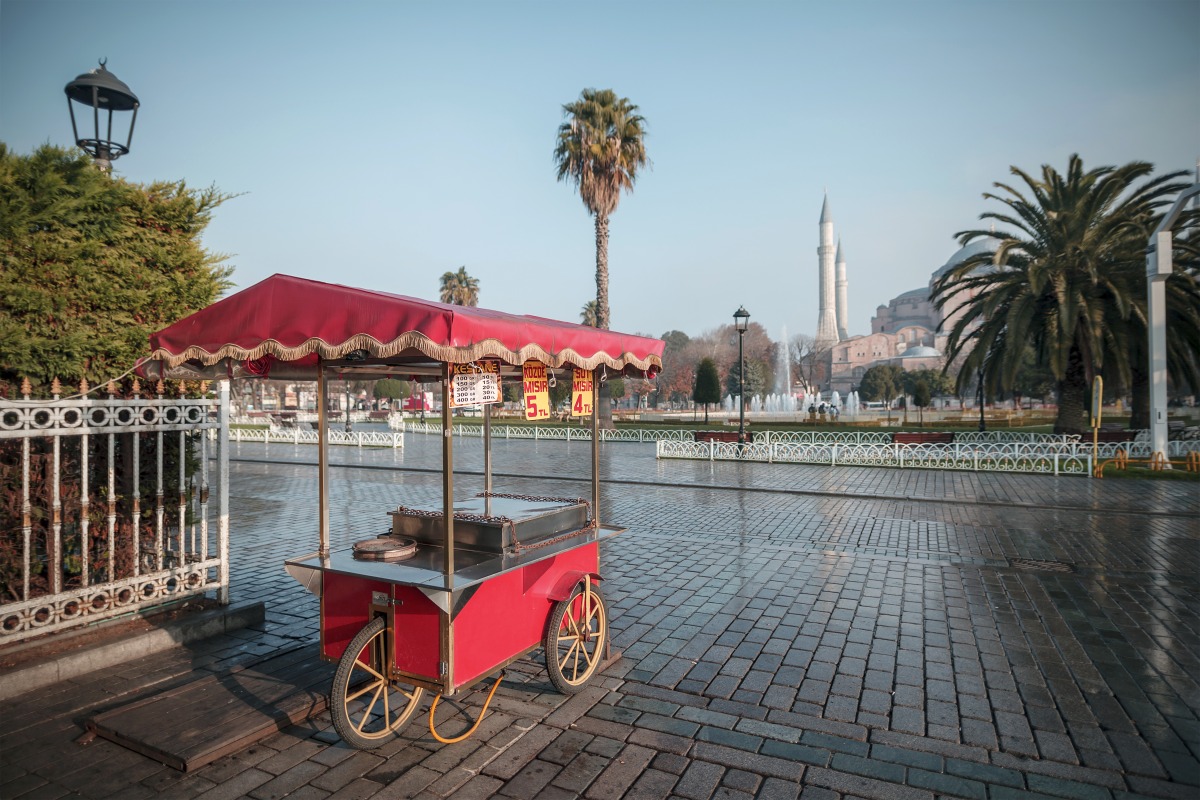

    On May 10th, 2020, the transition period to a controlled social life began. However, in reality for many the transition period had already been happening, as many, old and young had refused to obey the prohibitions in the first place. Retail stores in most shopping malls across Turkey were allowed to open from May 11th.

    On July 1st, 2020, venues such as cinemas, theatres, and cultural and artistic centres opened in accordance with various rules. Later, on July 21, 2020, restrictions on the hours of businesses such as cafes and restaurants were also lifted.

    By mid-July, however, case numbers has doubled, but this did not translate into an increase in the number of patients in hospitals. For this reason, the public began to question the authenticity of the number of cases.

    At the same time, the Minister of Health’s statement that only those who show symptoms should be considered sick created a question mark in people’s minds.

    On January 1st, 2021, Health Minister Fahrettin Koca stated that fifteen people had been detected with the so-called U.K. variant. As a result, the Minister of Health temporarily halted all arrivals from the U.K. By January 2nd, 2021, variants of the Covid-19 virus first detected in the U.K., South Africa and Brazil were discovered for the first time in Turkey. This has heightened anxiety in many people.

    From the beginning of 2020 vaccines developed by Pfizer/BioNTech, SinoVac, Moderna, Sputnik V and AstraZeneca became available around the world. Two vaccines were offered in Turkey, first SinoVac and then Pfizer/BioNTech.

    This led to questioning as to which one was more effective, and what were the side effects. Especially on social media, many articles and appeared about the side effects. Many worried about being vaccinated, while others wanted to get vaccinated as soon as possible.

    The government set up a priority list for who should be vaccinated. President Erdoğan himself received a first dose when the social vaccination process began on January 14th.

    Then, more than 250,000 health workers received their first dose. The vaccination process continued in line with the groups determined after health workers: people aged 65 and over started to be vaccinated according to their wishes.

    With the vaccination process being carried out through family doctors, some complained about over-crowding and disorder. Many just wanted to get their vaccinations and return home as soon as possible.

    Over time, teachers, soldiers and policemen were offered the jab. Afterwards, the vaccination process continued with the determined priority groups.

    A total of over 34.8 million doses of vaccine have been administered in Turkey. The number of fully vaccinated people stands at 13.8 million out of a population of over eighty million.

    However, the public has been worried about this vaccination process, and continues to be, amid rumours the vaccines don’t work, and worries around side effects.

    As in many countries, the pandemic has witnessed a shift towards online work in Turkey. Businesses and individuals have developed remote working methods. Transactions such as online meeting, e-commerce, onlinebanking and digital payment have increased.

    In short, we can say that Turkish people have moved more and more online. Also, in this period, with longer periods spent at home, many have also developed an increased interest in cookery, sharing recipes online for bread, yogurt and other dishes.

    Moreover, various hobbies such as sports moved online, as people got used to innovating. Despite social distancing and the use of masks, people have continued to live their lives. But normal activities are still missed. Everyone is certainly looking forward to the end of this process and full normalization!

  • Northern Ireland: Poots Booted Out

    The Democratic Unionist Party (DUP) was founded by the Reverend Dr. Ian Paisley in 1971. Paisley was an enigmatic figure in Northern Irish politics, offering a heady mixture of fundamentalist Christian values, Unionist rhetoric, and a cult of personality, culminating in a power sharing agreement with his greatest foes.

    Paisley was a maverick, non-establishment figure who appealed to biblical scripture and a Unionist siege mentality. His rallying cries – some would say war cries – were: ‘For God and Ulster’ and ‘No Surrender’.

    By ‘No Surrender’, he meant no surrender to ‘Papish’ Catholicism, and no dilution of the British identity which Ulster Protestants so obstinately cherish, and of course no diminution in British sovereignty over Northern Ireland. A more accurate description of this ‘No Surrender’ mantra could perhaps be no compromise.

    This meant no compromise with Irish nationalism, with Irish Republicanism, with the Catholic Church, the Irish Republican Army, the Irish government or anyone holding an Irish identity in Northern Ireland.

    Paisley also represented a branch of the global fundamentalist Christian Protestant Right, and its political voice became the Democratic Unionist Party (DUP). He would lead that party for thirty-five years. Never elected, he was nonetheless the supreme leader.

    Ultimately, however, he came in from the cold to lead the Northern Ireland Assembly as First Minister. The man who cried ‘No Surrender to the IRA’, eventually joined a power-sharing executive with Sinn Fein, the political faction associated with the IRA, which became the largest Nationalist party.

    Towards the end of his political career, Paisley was unceremoniously pushed aside, having lost the confidence of the party he had established. His son Ian Paisley junior seemingly still harbours a grievance about what he sees as a betrayal of his father, and his legacy.

    After Paisley senior’s resignation in 2008, the DUP leadership baton was passed on to Peter Robinson, Paisley’s long time protege; then Arlene Foster in 2016, and most recently to Edwin Poots before Jeffrey Donaldson assumed the mantle just three weeks later. Arlene Foster’s demise came about as a direct result of Britain’s exit from the European Union. Brexit had been endorsed by the DUP through its Westminister MPs, but ultimately their interests were ignored.

    Brexit has resulted in the Northern Ireland Protocol, which was agreed between the British Government and the European Union in order to preserve the Good Friday Agreement. The Northern Ireland Protocol creates a custom’s border between Northern Ireland and Britain. Thus, Northern Ireland remains within the European Common Market, creating a de facto border between Britain and Northern Ireland.

    Sections of Unionism, Loyalism, and the DUP view this border as a dilution of their Britishness. A DUP party fed on a diet of No Surrender of their British identity at any price is again circling the wagons. When Foster was seen as incapable of removing the Northern Ireland Protocol she was dismissed as weak and a sell-out.

    Ian Paisley junior is a DUP M.P. in Westminster who continues to represent his father’s old constituency of Antrim North. He seems to have been a driving force behind the coup that ousted Foster as leader.

    In a throwback to the leadership of Paisley senior, in its first democratic leadership election the party elected another Christian fundamentalist in Edwin Poots, by the narrowest of margins.

    Having been anointed by the ‘No Surrender’ brigade of the DUP Edwin Poots was chosen to resist any ‘surrender’ to the British government, and to continue the struggle over the Northern Ireland Protocol. Like King Canute, he stood against an unstoppable tide of forces beyond his control.

    In order for him to nominate a new Joint First Minister to the Northern Ireland Assembly after Foster’s resignation, he needed to have the agreement of Sinn Fein, the other party in government. Sinn Fein price for jointly nominating leaders and preventing the structures of government from collapsing, was the implementation of the Irish Language Act – an Act, which had been previously agreed to by the party, but never implemented.

    Poots, and Loyalists aligned to the party, would have no truck with the advancement of the indigenous language. They want no interaction with anything Irish. A settler-colonial identity refuses to contemplate the advancement of indigenous rights. But Poots also wanted to have his man elected as First Minister.

    In order to find a way of working around to the Irish Language Act Poots and his Assembly team leader came up with a plan to allow the British parliament to legislate for the Act. Thus, Poots and his designate Paul Girvan signed an agreement with Sinn Fein and the British government, handing Westminster the power and a mandate to approve the Irish Language Act, in some form at least.

    Poots and Girvan probably thought this would suffice to appease its base of voters, as the legislation would be the responsibility of the British government, rather than the Northern Executive including the DUP.

    Instead, it created a mass revolt in the party, and those who lost the party leadership election to Poots joined with his erstwhile fundamentalist supporters to force him out. Once again, the No Surrender, No Compromise brigade within the party had triumphed.

    Arlene Foster couldn’t renegotiate the Northern Ireland Protocol, a Loyalist and Unionist red line, and had to go. Seemingly even Poots had also sold out Unionism by permitting an Irish Language Act, which just goes to show how uncompromising the party has become.

    By agreeing to the Irish Languagte Act and nominating Paul Girvan as First Minister of the Northern Ireland Assembly without his party’s approval Poots had signed his political death sentence.

    In a year that sees the centenary of the establishment of Northern Ireland by Britain – when the island of Ireland was partitioned in 1921 – Unionism appears to be in complete disarray.

    With the DUP fragmenting, we may also be witnessing the enduring wrath of a scorned political legacy. Those who felt the party had betrayed Paisley senior’s message of ‘No Surrender and No Compromise briefly recaptured the party leadership, seemingly only to surrender it again with Donaldson’s election.

    Ian Paisley junior and those around him may be about to destroy the party his father created. Hell hath no greater fury than a political family scorned.

  • Featured Artist Marc di Saverio

    Marc di Saverio hails from Hamilton, Canada. His poems and translations have appeared internationally. In Issue 92 of Canadian Notes and Queries Magazine, di Saverio’s Sanatorium Songs (2013) was hailed as “the greatest poetry debut from the past 25 years.” In 2016 he received the City of Hamilton Arts Award for Best Emerging Writer. In 2017, his work was broadcasted on BBC Radio 3, his debut became a bestseller in both Canada and the United States, and he published his first book of translations: Ship of Gold: The Essential Poems of Emile Nelligan (Vehicule Press). On May 1st, 2020, Guernica Editions published Crito Di Volta. Di Saverio studied English and History at McMaster University, but never took a degree, due to illness. He is the son of Carlo Di Saverio, the scholar and teacher who studied Linguistics and Languages at University of Toronto (M.A.,1981). Di Saverio’s poem, “Weekend Pass”, was adapted into the movie, CANDY — directed by Cassandra Cronenberg, and starring the author himself — which was selected to the Toronto International Film Festival in 2013. In late 2020 he received Nobel Prize in Literature nominations, chiefly for CRITO DI VOLTA.

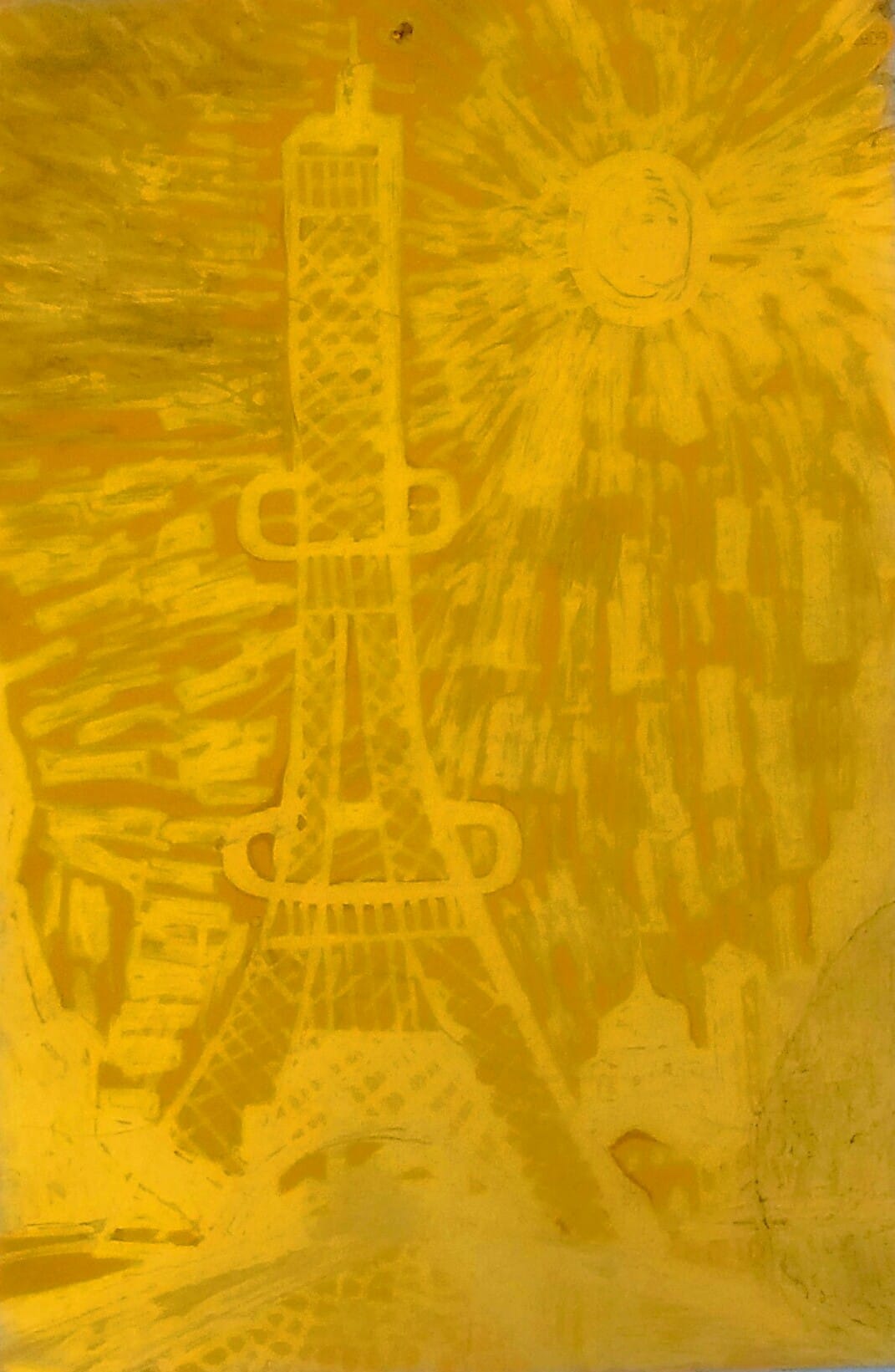
    1. THE EIFFEL TOWER AMID KINGDOM COME (mixed media on board)

    So, after a twenty year hiatus, I began painting and drawing again in 2018, due to a writer’s block that forced me into this earlier-studied realm of creativity. In this, one of my first of paintings, THE EIFFEL TOWER AMID KINGDOM COME, I envision Paris after the Second Coming of Christ, when peace, love and joy will reign supreme on earth, and there is no more war, famine, or strife. I portray a “Golden Age”, when Angels, saints, and believers in Christ will encompass the world during the thousand year period depicted in the Book of Revelation, in the New Testament of the Bible.

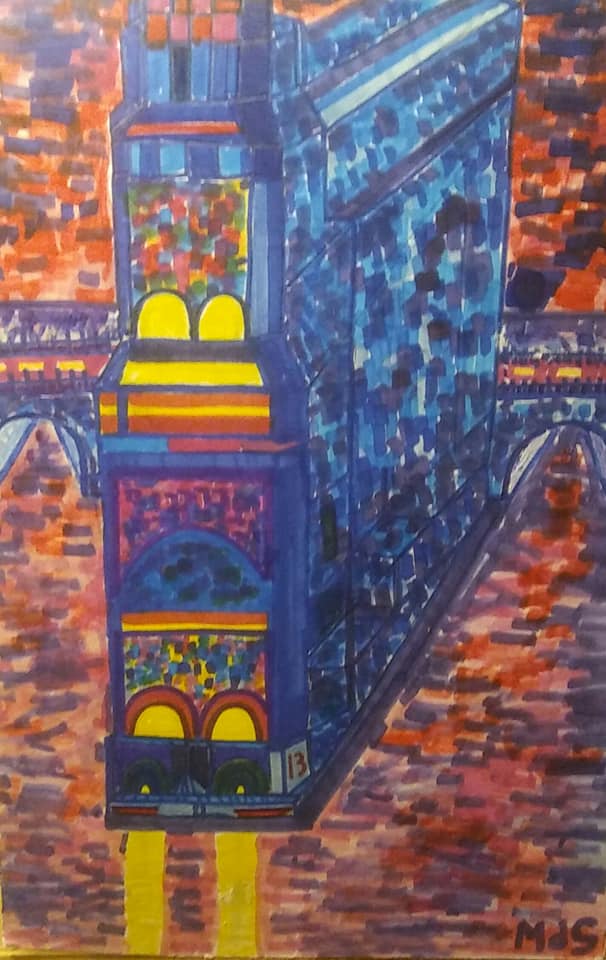
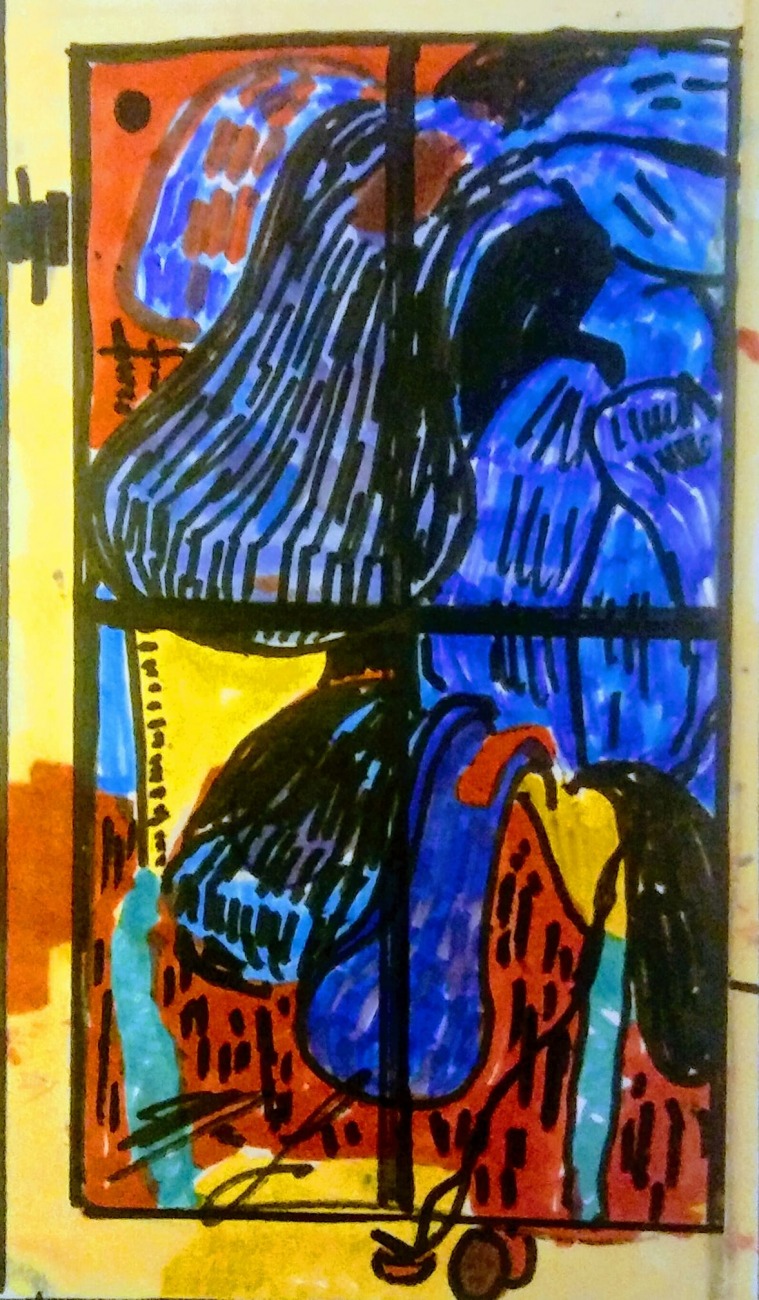
    2. A CITY IN THE KINGDOM OF HEAVEN (marker on board)

    In the painting, I imagine what a city in Heaven might look like, suspended on the air, the air of the sky moving under the bridge as though water. Of course, above the bridge, and below the bridge, we see the same colours, suggesting the elevation of this city-portion of Heaven. The structure in the painting came from my imagination, completely. I began to paint by imagination after seeing some of William Blake’s inspired paintings.

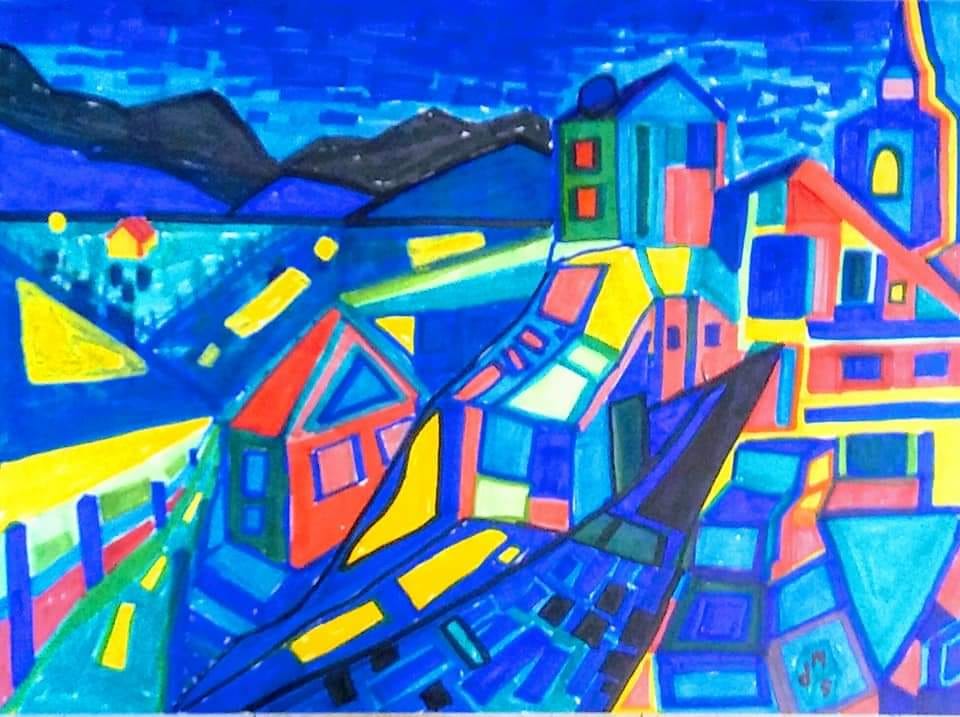
    3. A FUTURE FARMHOUSE AND ITS LAND (marker and gouache on board)

    This painting was, too, generated and painted from my imagination, wherein I saw what a future farmhouse and its land might look like in a hundred years, when there is a resurgence of divisionism, but not in just painting, but in reality, as displayed in this picture. Like a work by Escher, some parts seem impossible and both visually wonderful and visually impossible to fully understand or appreciate because of certain geometric anomalies in the painting, which was executed in late 2019, during a snowstorm.

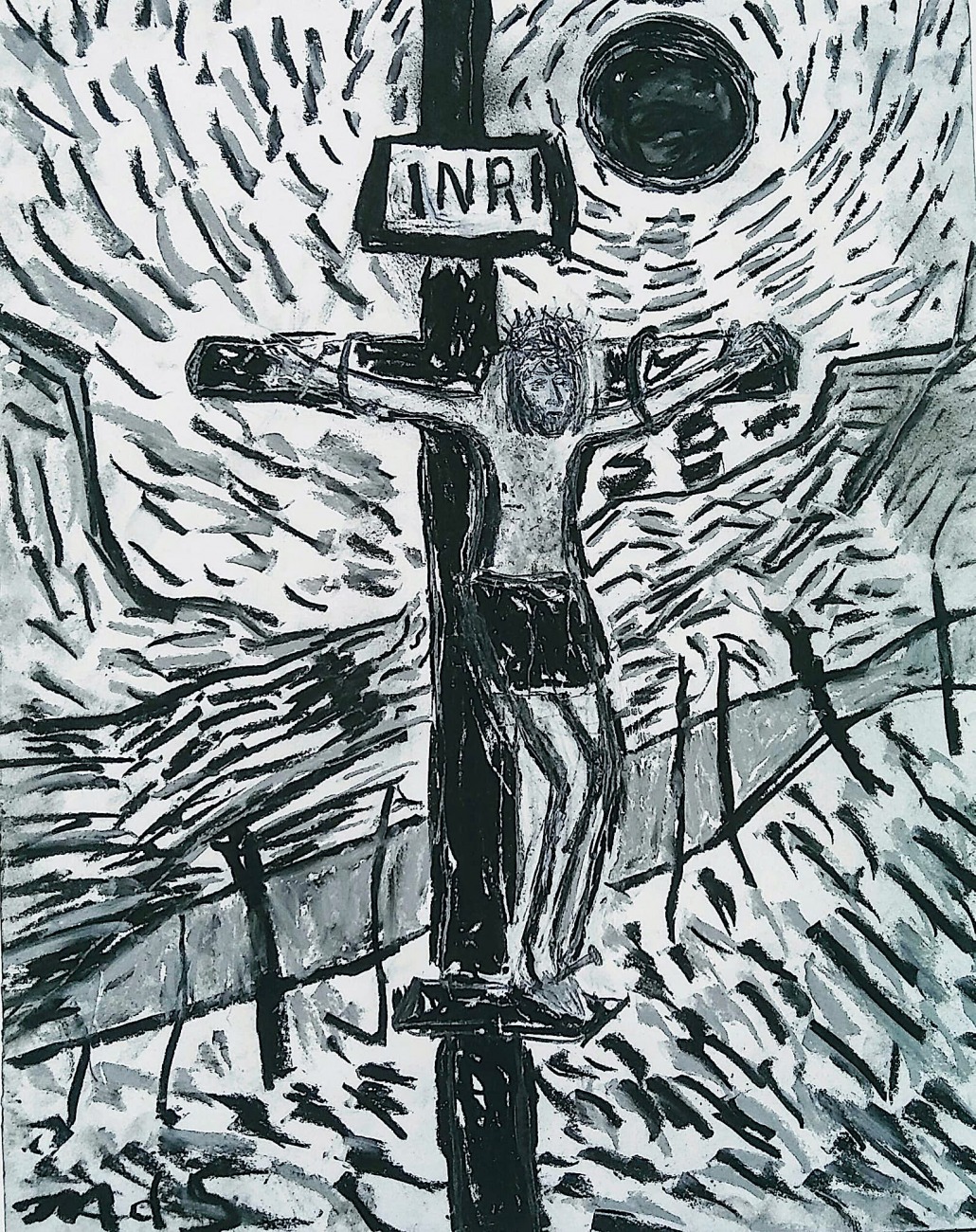
    4. CHRIST ON THE CROSS (soft pastel on board)

    Here is one of the first drawings I executed, in 2018, after twenty years hiatus from painting.  After having composed two other crucifixion scenes, in which Jesus was clearly harrowed, I wanted to create a picture of the crucifixion where Jesus Christ seems to be at peace, rather than in throes, because I wanted to be able to have a permanent vision of a Jesus who might have accepted his fate, or at least in this moment captured in the picture. The relative serenity in his face, considering his situation, expresses my aim exactly.

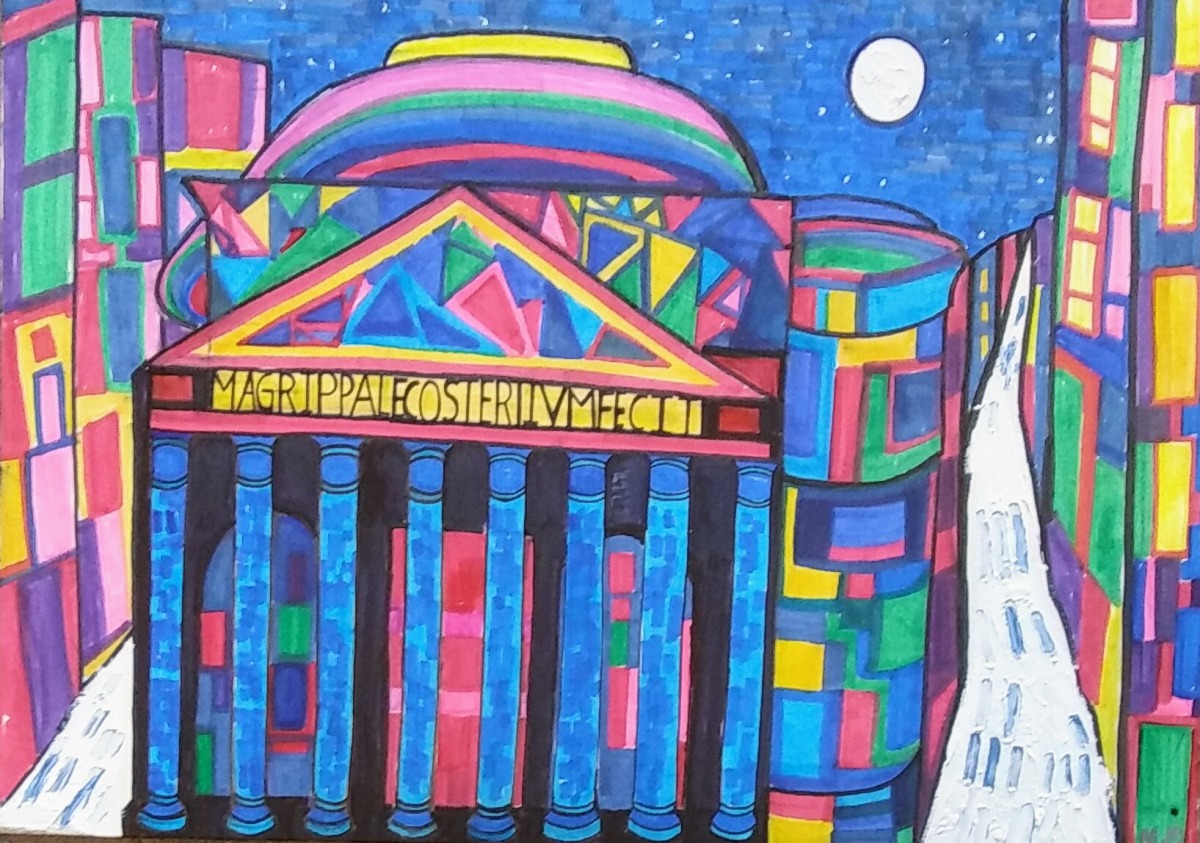
    5. THE PANTHEON AFTER A SNOWFALL (marker and oil on board)

    This painting was created in late 2019, during winter, in Canada. I had always wanted to see the Pantheon after a snowfall, so, I imagined just that, and then executed it upon a stretch of board. I added the white snow to lend the feeling of safety, peace and holiness to the viewer. Notice that, in contrast to the bland snow, the Pantheon and surrounding buildings are electrified with pure, neon colour, giving an updated, hyper-modern feel to the composition, while at the same time retaining the elegance and universality of the Pantheon.

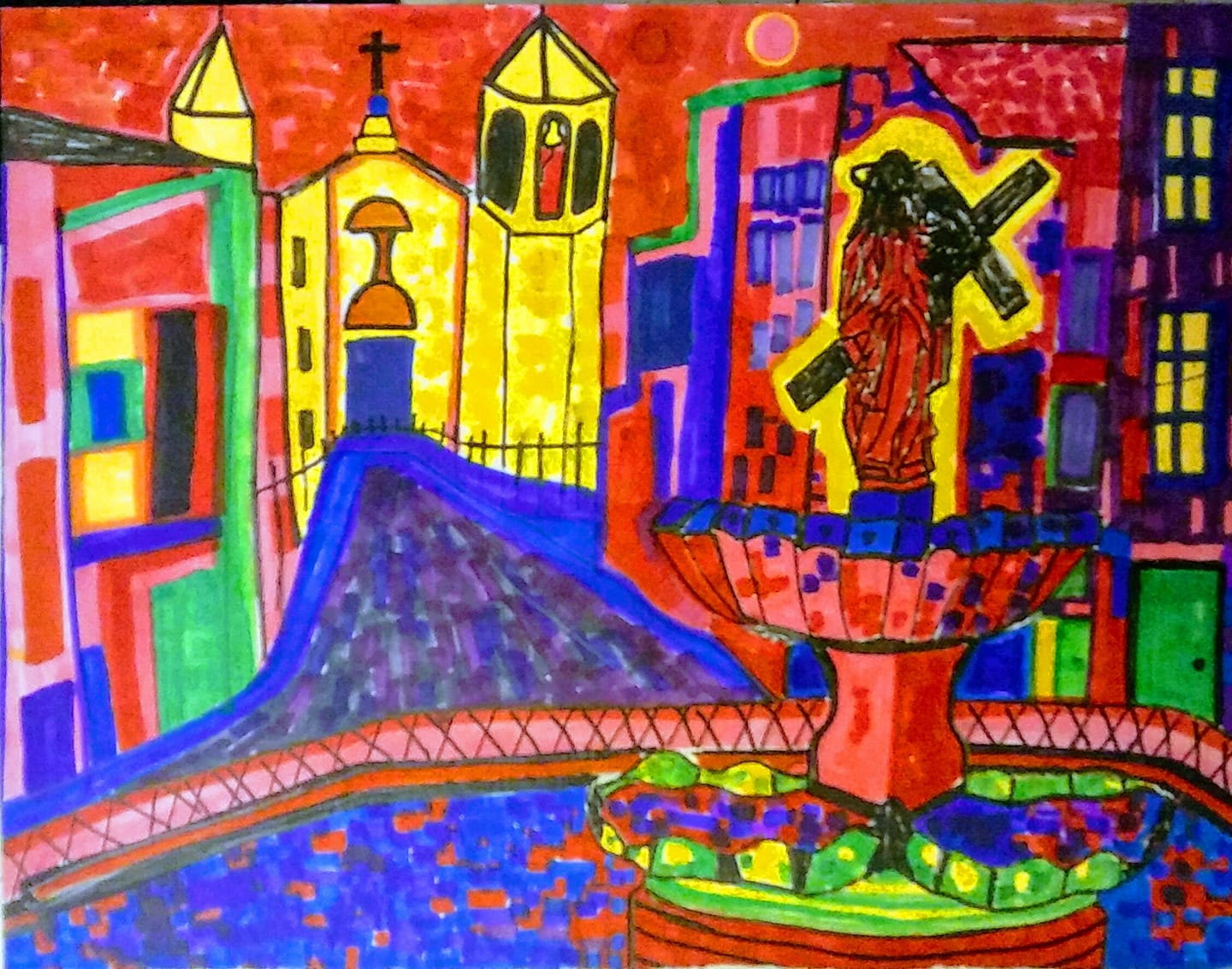
    6. THE FOUNTAIN OF IDENTITA IN RACALMUTO, SICILY (mixed media on board)

    The Fountain of Identita, which not longer exists — it was demolished in the late 20th century — once stood in the centre of Racalmuto, Sicily, wherefrom my mother and her side of the family came in the 1950’s. By way of imagination, and by way of imitating an old postcard of the Fountain, I created this painting, which I wanted to be so illuminated with pure colour that no one would ever forget the fountain, despite its nonexistence, today.

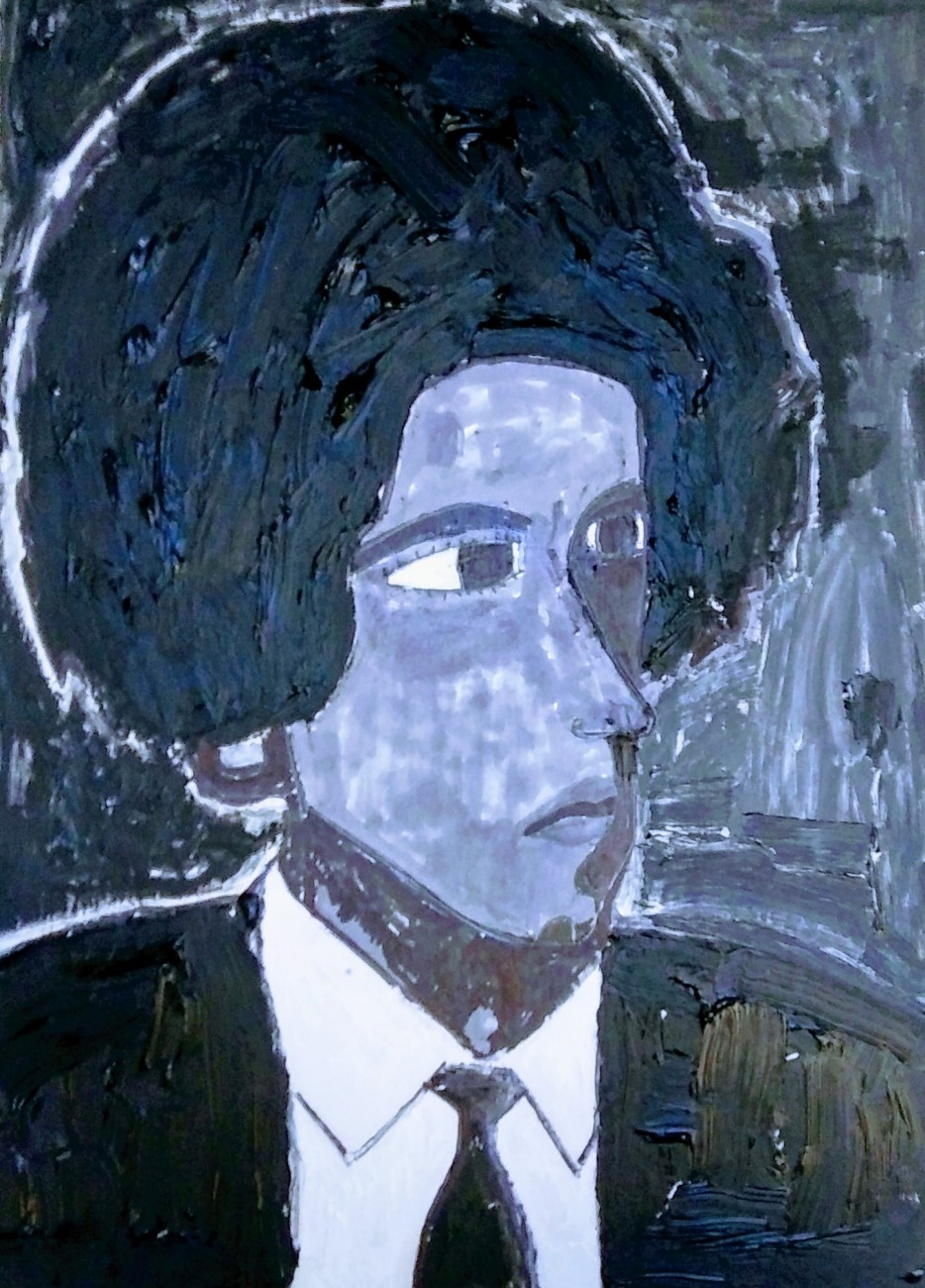
    7. SELF-PORTRAIT WITH LONG HAIR (marker, oil and gouache on board)

    In this, my first ever self-portrait — i painted it in 2019 — I attempted to transmit the image of my face from a photograph onto board. The photograph depicts me at the age of twenty-seven, when my hair, unlike today, was extremely “big”, thick, and long. Though I do not have the courage to grow my hair this long again, I figured I would at least capture it in painting. As you can see, I used to do my best to dress well in those days.

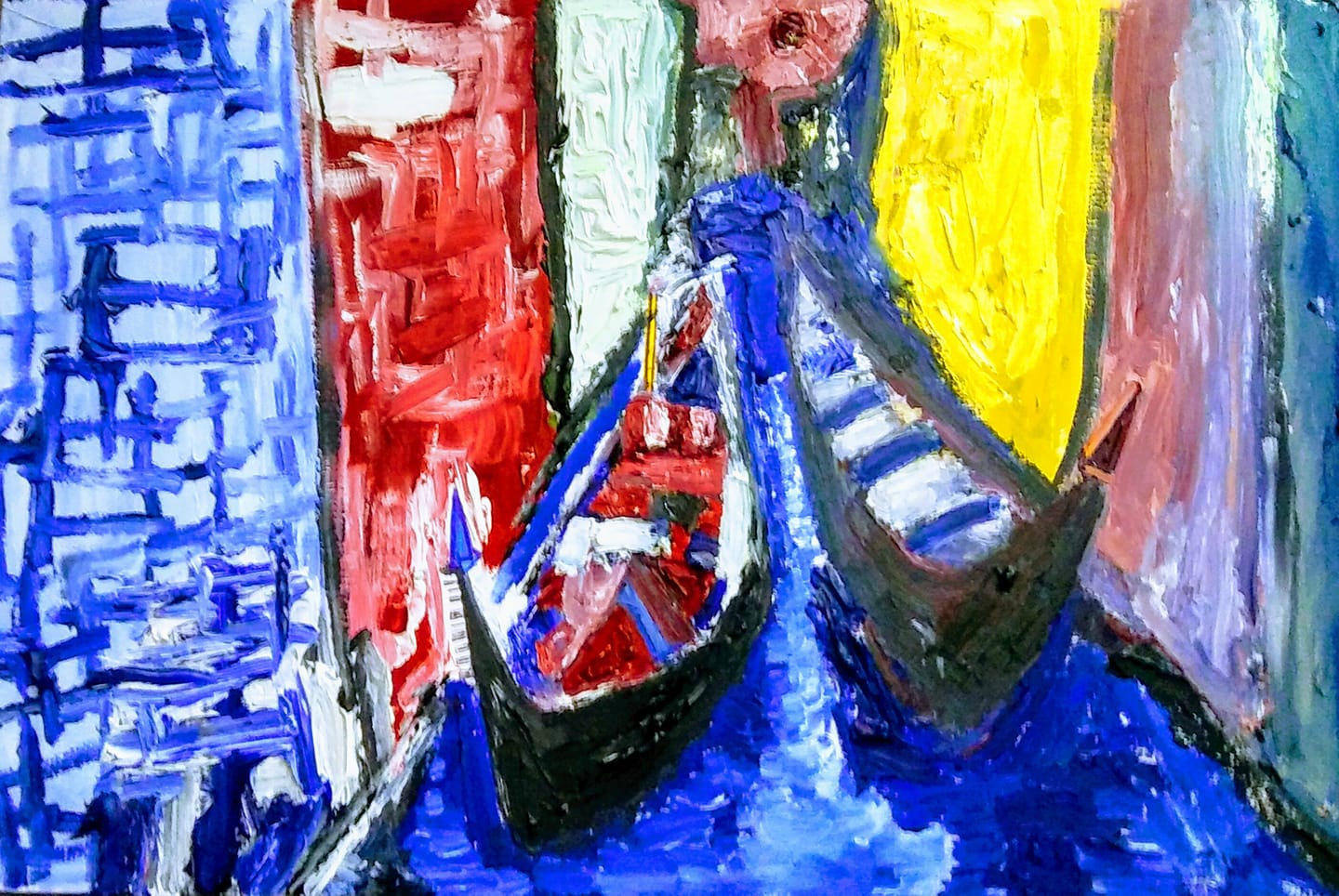
    8. A VENETIAN CANAL WITH GONDOLAS (Oil on Board)

    In this, my first pure oil painting in twenty years, I successfully, by way imitating a photograph i had taken in Venice, long ago, depicted two boats in a canal, at about sunset. The boats are not gonadliered, suggesting the day is at a close. I attempted to use an impasto style in the piece, in order to portray the denseness of the beauty in that immortal city.

    9. LIAM GALLAGHER, 1995 (mixed media on paper mounted on board)

    Here is a depiction of the Irish-blooded singer and superstar, Liam Gallagher, from the band Oasis (1991-2009) — a depiction of the rock star at his peak, in 1995, around the time when Wonderwall, their biggest hit, was released to the astonishment and happiness of Oasis fans. This is one of my few works that was BEGUN tweny years ago, but finished most recently, in 2020. My greatest challenge, here, was to truly achieve semblance of Gallagher, which I believe I have.

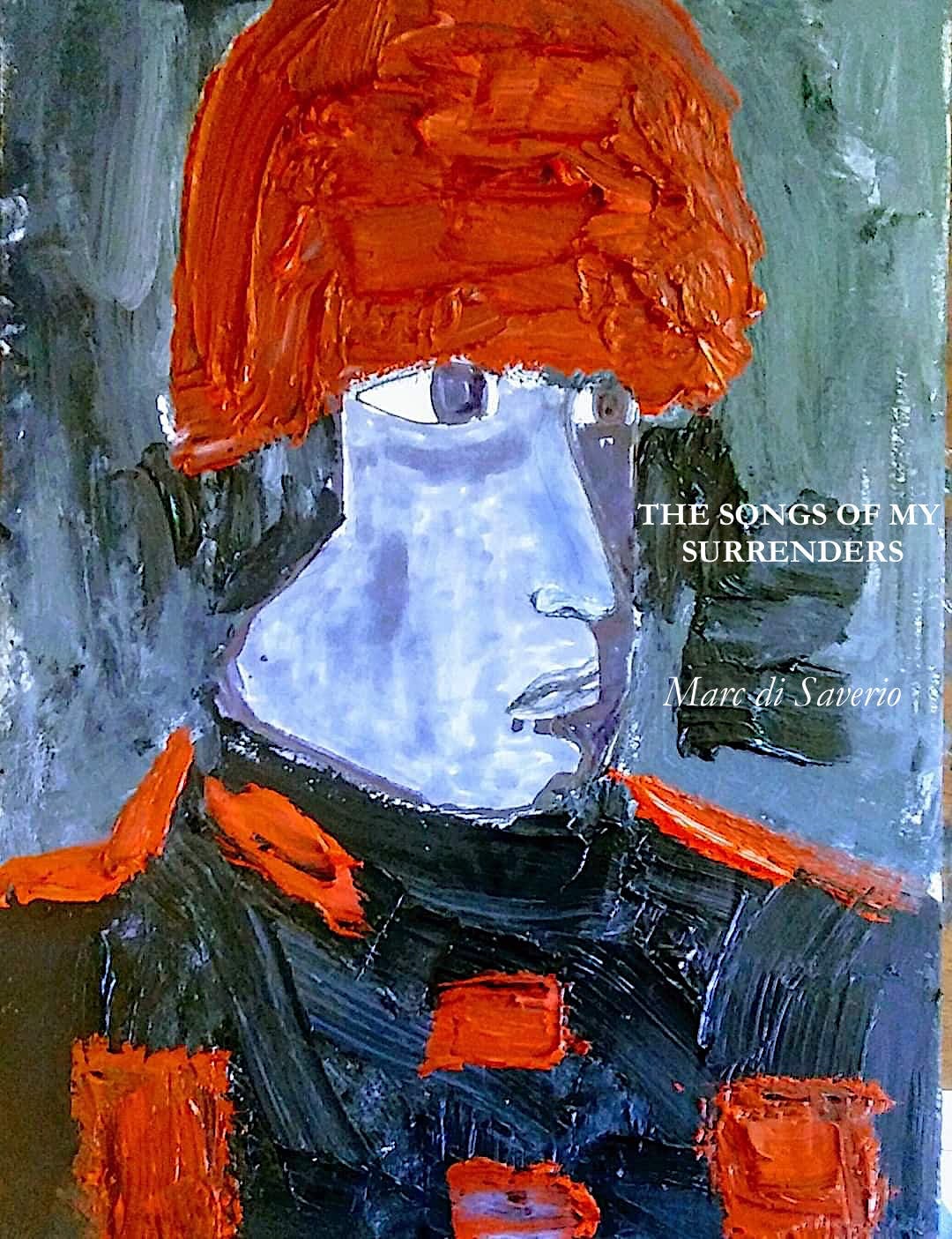
    10. SELF-PORTRAIT WITH RED HAT AND WINTER JACKET (Oil and Pen on Board)

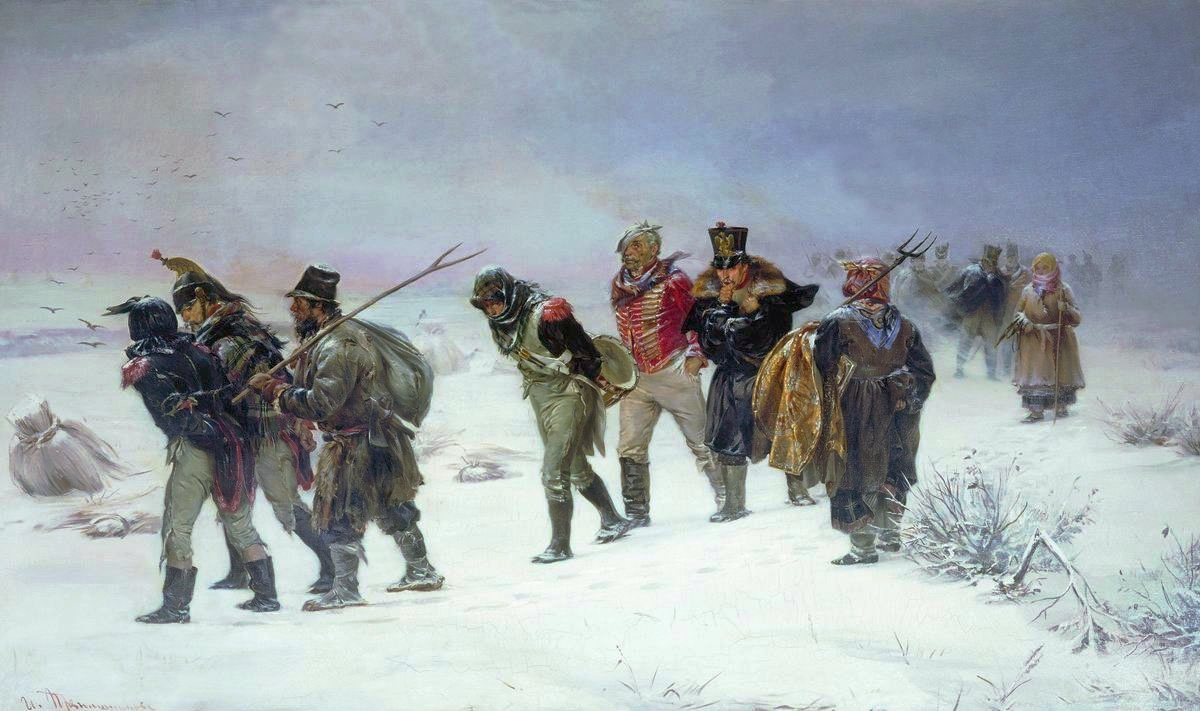
    Here is my second ever self-portrait, which depicts me in the present, as opposed to when i was twenty-seven, like in the aforementioned self-portrait in gray. As you can see, the Jacket almost looks like Napoleonic era military fatigues, but this was unintentional. All I wanted was to paint something that would resemble me — and my current coat — and i think I succeeded!

    11. QUARANTINE (Mixed Media On Paper Mounted On Board)

    This painting is designed to capture the feeling of isolation induced by the quarantine in which most of us have living, since the beginning of the Covid Pandemic, which has had untold effects upon the minds of so many. This painting reflects the psychological, rather than the physical effects of Covid, since, too often, the effects of the pandemic on the minds of millions have been overlooked, or, to me, underreported. 

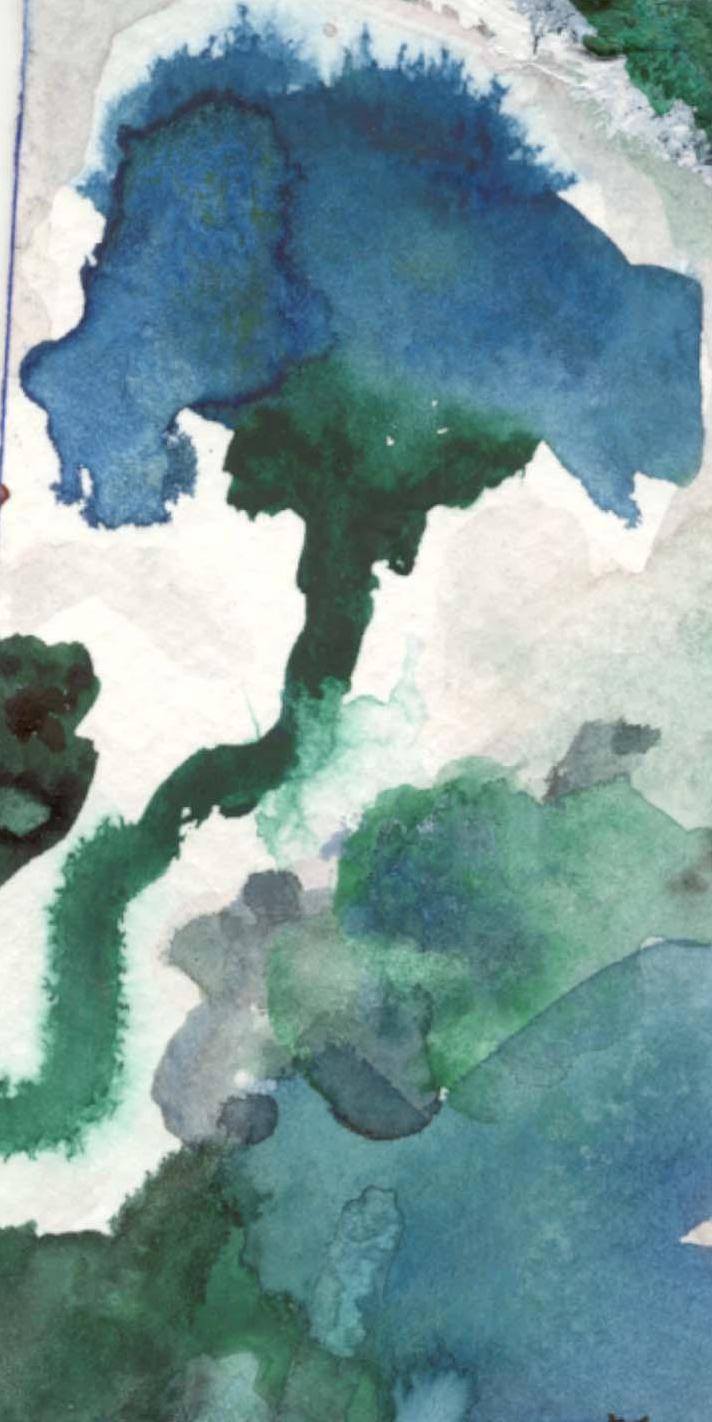
    12. ONE BLUE FLOWER (Watercolour on Paper)

    Finally — and for old time’s sake — here is an example of one of my paintings from the old days — from tweny years ago — when I had recently discovered painting. In those days, I was in love with the delicacy of watercolour, and had not yet explored oil painting, or even drawing, for that matter. The sublime uncontrollability — the riskiness — of watercolour, enthralled me. In this particular painting of a blue flower, the viewer is hopefully taken aback by not only the precision, but the acquiescence of the colours of work therein. I consider this my first real painting. I hope that you find as much pleasure in viewing it as I had in creating it.

  • Covid-19: Unanswered Questions

    Confusion and fear are to be expected in novel situations where experience is limited; this should fade as understanding grows. Such is the natural cycle. When governments employ behavioural psychologists to induce fears in order to control and coerce the population, however, we have to question their motives and methods.

    Initially we were advised that a zoonotic virus crossed species: horseshoe bat to pangolin and then to humans, via the food chain. Ghastly images were shown nightly of a range of exotic creatures that Chinese people – portrayed in somewhat xenophobic terms because of their, to us, foreign tastes – supposedly enjoy consuming. This outbreak witnessed sagacious, and wealthy, heads knowingly saying ‘I told you so.’

    And apparently we can expect much more, and worse, in the future because of the ways in which we live and eat. Last year any question of whether it could have come from any other source was shot down as absurd by dubious fact checkers, and freighted with conspiracy theory fairy dust.

    This despite Wuhan containing a level 4 BSL laboratory, and three members of its staff being hospitalised in November 2019 with coronavirus-like respiratory symptoms. Furthermore, this same laboratory was conducting gain of function research into coronaviruses, through a grant form EcoHealth Alliance, an organisation funded by U.S. National Institutes for Health. This type of research using viruses was banned by the Obama administration as being too risky.

    Weaponising

    This same research is not far removed from the process of weaponising a pathogenic organism. So why did NIH fund this laboratory to carry out this type of research, and who else knew of the potential risks, and incentives, for finding a novel infective agent and researching possible treatments and vaccines?

    The first we in the West learnt about any of this came from the videos on TV and social media of people dropping dead in the street – in hindsight clearly not coronavirus cases – and the Chinese locking down it citizens. Next there was Italy, with coffins being carted away by military trucks.

    These were all carefully orchestrated publicity stunts, but who was responsible? Who decided to broadcast uncritically these sensational images? The world took note, a pandemic was declared and governments around the world, almost uniformly, imposed harsh and unprecedented restrictive measures on their citizens.

    In Britain the initial plan was to protect the vulnerable, through cocooning, whilst awaiting herd immunity in the young. But there followed a swift turnaround in the face of public outcry. In Europe only Sweden resisted the clamour to lockdown and was pilloried in the international media. ‘Sweden has become the World’s Cautionary Tale’ declared The New York Times in July, 2020.

    The British government’s approach was strongly influenced by the epidemiological modelling of Imperial College’s Professor Neil Ferguson, of previous forecasting fiascos. For example, he predicted three to four million deaths from Swine Flu in 2009, which ultimately resulted in less than 300,000 global fatalities.

    Ferguson’s Imperial paper predicted 500,000 deaths in the U.K. in an unmitigated scenario, and on March 20th, told the New York Times that the ‘best case outcome’ for the U.S. was a death toll of 1.1 million, rising to 2.2 million in a worst case scenario. As of June, the U.S. has seen just over 600,000 deaths, and the U.K. 127,945, in circumstances where the attribution of death to Covid-19 is often deceptive.

    Further doom and gloom laden scenarios was provided by Professor Christian Drosten, head of the institute of virology, Charite university hospital, Berlin, while alternate modelling provided by Professor Michael Levitt, Stanford University and Nobel laureate was ignored.

    PCR Testing

    Dorsten’s main contribution to this story is his paper ‘Detection of 2019 novel corona virus by real time RT-PCR’ outlining the basis for the widely used Drosten-PCR test that has been criticised for multiple errors, and the haste with which it was published. This test is now the most widely used diagnostic test for Sars-CoV2.

    This is despite its invenor Kary Mullis’s – Nobel laureate for chemistry for his work with PCR – stating unequivocally ‘it doesn’t tell you if you are sick’.

    https://twitter.com/zaidzamanhamid/status/1384873889591873536

    There are a number of criticisms of the Drosten method in that he reportedly developed it using partial genetic sequences provided by the Chinese, in conjunction with sequences from other corona viruses. Furthermore, the test which according to Kary Mullis is a quantitative test, is not reported to clinicians this way.

    Instead a qualitative result ‘detected’ or ’not detected’ is reported without giving the cycle threshold, even after the WHO suggested physicians should be given this figure. The significance of the cycle threshold harks back to Kary Mullis’s ‘it doesn’t tell you if you are sick.’ Even Dr Anthony Fauci of the NIAID (National Institute of Allergy and Infectious Diseases) has stated that at ct values of greater than 35 it is unlikely that any live virus is present in the patient.

    https://twitter.com/jimgris/status/1326518250386063361?lang=en

    Why then did Irish laboratories use ct values as high as 45? And why did we go from testing inpatients with PCR, knowing the false positive rate, to the community setting and especially the asymptomatic, given asymptomatics are often ‘false positives’, leading to an inflated ‘case’ count.

    One has to wonder if the state’s spending of an estimated €400 million on PCR testing has been a case of noses in the trough not wanting to avoid the public smelling the coffee. Who were the people with vested or conflicted interests in this issue?

    Churchillian Speeches

    Most Western governments, including Australia and New Zealand, paraded their respective Prime Ministers before the cameras to make speeches of Churchillian gravity, implicitly likening the threat of Sars-CoV2 to World War II. Leo Varadkar even paraphrased Churchill in his first speech to the nation -’never will so many ask so much of so few,’ before imposing unprecedented draconian lockdown measures, based on fear.

    Along the way we have heard words of caution from notable academics including Stanford Professors John Ioannidis and Jay Bhattacharya, as well as Professor Sunetra Gupta of Oxford University. But these voices were hardly ever heard on Irish mainstream media.

    These authorities cautioned that measures would disproportionately hurt the poor and vulnerable; that severe illness was mainly confined to a recognisable cohort, and that there was no evidence for the efficacy of lockdown measures.

    Nobody listened. Instead the government closed schools, prevented people from earning a living, stopped all cultural and sporting activity, prohibited religious worship and confined travel to within five kilometres of home.

    For months elderly people languished alone in nursing homes and hospitals, some dying alone; women gave birth without their partners; funeral rites were severely curtailed, as basic civil rights were completely ignored in response to an illness with an estimated infection fatality rate of 0.05% for anyone under the age of seventy years.

    Every night the state broadcaster became the government’s harbinger of doom with the recitation of nightly death tolls. What purpose other than ratcheting up of fear did this serve?

    Through the diligent questioning of Michael McNamara TD, however, we know that the reported mortality figures included anyone testing positive in the previous twenty-eight days with a PCR test, no matter what their underlying condition. Deaths unassociated with Sars-CoV2 were obviously irrelevant.

    They turned out to be very relevant as the CSO annual death figures of 6.4 per 1000, which were little different to previous years, and even less than 2013. Why then, when death figures dropped, did reporting switch to the spurious concept of ‘cases’, defined by a positive PCR test? Why did the Irish government shamefully enlist the services of RTE in terrifying the nation, and why did the state broadcaster acquiesce? Answers on the back of a postcard…

    Disproportionately Affected

    The message ‘we are all in this together’ was a big lie. The disease disproportionately killed people over the age of eighty, especially those in nursing homes, many of whom were needlessly infected after being transferred to hospitals with testing withdrawn at the height of the pandemic in spring 2020. The obese, those with diabetes, chronic heart and lung diseases are also disproportionately affected.

    These pre-existing morbidities are more prevalent among lower socioeconomic groups in society. So we were clearly never all in this together.

    Civil servants, including politicians and the medical profession, those working in IT and for media corporations, could easily work from home, but nearly half a million people had to stop work for the duration, especially those in the tourism and hospitality sectors. These are mainly young people, and like children, most would only have been mildly effected by the virus. So why were they forced to suffer unnecessarily?

    Moreover, why did small retail outlets have to close for months on end, while off licenses and fast food chains were deemed essential services?!

    States of Fear

    The kind of Propaganda devised by Sigmund Freud’s grandson Edward Bernays who infamously made it fashionable for women to smoke, was evident in the government’s manipulation of the figures, and the media’s delivery. Bernays wrote in Propaganda (1928) ‘The conscious and intelligent manipulation of the organised habits and opinions of the masses is an important element in democratic society.’

    A host of celebrity scientists appeared, many with Conor McGregor levels of empathy, only better elocution, a gentler demeanour and less tattoos. Trite experiments were undertaken on popular TV shows, where we found dour funereal forecasts from infectious disease experts, who were invariably wrong in their predictions, and inane squeaking from a misplaced neuroscience.

    All of these ‘experts’ sang in unison. Dissenting voices were heard briefly and infrequently. Some lost their jobs merely for disagreeing with the bull-in-a-china shop approach taken by the HSE/NPHET/government.

    In her new book States of Fear Laura Dodsworth outlines how the UK government used behavioural psychologists, probably via their Nudge unit, to control the population through the deployment of carefully selected ‘experts’ and repetitive messaging on news broadcasting.

    This was substantiated in the recent testimonies by Dominic Cummings, the former chief adviser to Boris Johnson. ISAG were also familiar with scaremongering techniques, as intercepted emails highlight their tactic of targeting and discrediting individuals, and keeping fear ramped up as a tool in their ZeroCovid campaign.

    To quote Bernays again ‘there are invisible rulers who control the destinies of millions. It is not generally realised to what extent the words and actions of our most influential public men are dictated by shrewd persons operating behind the scene.’

    Using this sinister playbook, between them NPHET, ISAG and the government managed to sow a level of fear, suspicion and division in society that may take years to unravel.

    Flatten the Curve?

    Despite all the hype around flattening the curve to save the health service at the beginning of the pandemic, and the use of draconian measures to do so, alas nothing was done to treat patients at home.

    Several readily available, cheap and relatively safe products, were hypothesised to have positive benefits in the early stages of a Sars-CoV2 infection, but there were systematic efforts to steer physicians away from these.

    The ICGP guidelines for GPs on the treatment of early Sars-CoV2 amounts to do nothing, and wait for patients to get better, or if they fall really ill send them into hospital. Some doctors in the USA lost their licenses for prescribing these medications, and others in Ireland faced censure by the Medical Council.

    According to physicians like Peter McCullough, Professor of Medicine at Baylor University, Texas in conjunction with AAPS (The association of American Physicians and Surgeons), and separately Dr Pierre Kory of FLCCCA (Front Line Covid Critical Care Alliance) Sars-CoV2 was empirically treatable, especially in that first week before the patient became very unwell.

    https://vimeo.com/560523610

    So, despite a concerted effort to vilify them, they treated their patients. Why did Irish GPs, save for a few, fail to do so?

    In doing nothing did many patients needlessly died? With our widespread application of lockdowns and our disregard for focused protection measures, as advocated by the Great Barrington Declaration (which has garnered 850,000 signatures, including 43,000 from medical practitioners) coupled with our refusal to at least try and treat patients, have we done a great disservice to our patients?

    Silencing of Dissent

    Sweden did not adopt anything like the same draconian measures, and their economy and society has not been disrupted to anything like the same extent as Ireland’s. Yet their mortality figures compare favourably, especially when adjusted for the relative age of each population.

    Perhaps one of the main reasons for the concerted campaign to ensure that no other treatments were deemed suitable for the early treatment or prevention of the disease was the FDA criterion for an EUA (emergency use exemption).  No such exemption would have been granted to a product in such an early stage of development, without animal or human study data, except in what are deemed to be extraordinary circumstances.

    €26 billion – the amount Pfizer expects to earn this year after producing the first Covid-19 vaccine – might buy a lot of scientific validation, and political influence.

    The undue haste with which these vaccines have been rolled out demands sceptical enquiry, especially in relation to two particular cohorts: pregnant women and children. As clinicians we generally exercise extreme caution in these groups.

    So why is it that for a condition with an overall IFR of 0.15% have we discarded this caution? Linking vaccination status to the right to work, travel, attend cultural and sporting events is divisive, coercing those who wish to exercise a degree of caution and/or exercise autonomy over their health.

    Without the questionable concept that is asymptomatic spread, there is no justification for vaccinating anyone in low risk groups, and certainly no justification for using bully tactics.

    Despite all these glaring questions, there has been a deafening silence from the medical profession in Ireland, and those that have spoken out have been quickly silenced. Is this how we are going to deal with complex issues in future? Adopting binary, categorical approaches without nuance leaves no room for debate.

    RTE have paid lip service to the notion of an informed debate, hosting Martin Feeley and then later pitching Professors John Lee and Sunetra Gupta into debate with hand-picked stalwarts.

    Moneybags

    In Ireland today scepticism is viewed as a contagion to be eradicated, with compliance seen as the perfect state of health. As a nation we must ask: why have so many been so quiet; why has fear replaced reason, and groupthink taken over once again?

    One must question the role of doctors ‘stuffing their mouths with gold’ as Aneurin Bevan put it in relation to British doctors at the inception of the NHS. A quick look at the 2019 PCRS payments to GPs shows a healthy €85 million in government expenditure. This, however, mushroomed to over €200 million for the same period in 2020.

    Some were clearly making a killing during the pandemic. And whose idea was it to advise doctors not to see patients face-to-face during the pandemic? If a doctor won’t see you who will?

    Further to this windfall will be vaccination payments at a cool €60 per patient. Is it any wonder GPs want everyone vaccinated?

    There may even be boosters for variants required for everyone on the planet! The media should be asking the question: who is benefitting from this Monty-Pythonesque situation?

    Certainly any government with the slightest authoritarian bent, which it transpires appears to be most Western ‘democracies’. It really is worrying how little opposition there has been to Chinese-inspired lockdowns, with opponents dismissed as a far right fringe – even by the apparently left-wing opposition – despite the obvious damage these policies have done to the poorest, who were also least protected by the measures.

    Why did so many European governments fall into line so quickly, when even a passing familiarity with EU politics would indicate that it can take years for Member States to agree on the number of legs that the average cow possesses?

    If you intuit that something is just not right, and baulk at jingoistic phrases like ‘the new normal’ and ‘build back better’ ask yourself cui bono or ‘who benefits’, and don’t let the fear of being labelled a ‘conspiracy theorist’ dissuade you from asking reasonable questions.

    Feature Image: Daniele Idini

  • The Literary ‘Outsider’ Novel

    Does an age of frenetic online activity afford time for literary masterpieces, especially Outsider Novels, transcending what is considered ‘normal’?

    He whose vision cannot cover
    History’s three thousand years
    Must in outer darkness hover
    Live within the day’s frontiers.  

    The above stanza is from a twelve-book, poetry collection by Johann Wolfgang von Goethe, which was inspired by the work of fourteen century, Persian poet, Hafez.

    Rather than take the above stanza as concrete, it is worth taking it as an allegorical device, and metaphor, for what this piece sets out to champion: the work of the literary Outsider.

    With various electronic devices such as, the laptop, smartphone, iPad, and media outlets like Netflix, YouTube and other broadcasters, vying for our attention(s) – and successfully so – one must enquire into whether serious, attentive reading means anything anymore?

    Has the modern age – the tempered, electronic milieu – filtered out literary tomes?

    The very idea of ‘The Outsider’ literary work may be unnerving in what is an age of tantamount addiction to a frenetic social media; what the writer Will Self refers to as ‘bidirectional media.’ The resulting anxiety disinclines us to engage with what many may deem ‘difficult’ books, or ‘heavy’ tomes. Knocking the bottom out of the known literary universe.

    It might be said in relation to reading such books: who has aeons of uninterrupted time? In response you might say that the pandemic and lockdowns have afforded us such time. Note: no banana breads were harmed in the writing of this piece.

    Critics sometimes venture towards difficult literary works from a canon such as that identified in Harold Bloom’s tautological, yet, feverish and impassioned, The Western Canon: The Books and School of the Ages. These are the works of literature which ebb in from the external to the field of the Literary Arts, and which Bloom eulogises in his reviews.

    In 1812 by the Russian artist Illarion Pryanishnikov.

    War and Peace

    Who has read Tolstoy’s big bangers? War and Peace anyone? History’s frontiers fought over during the Napoleonic Wars, backed up with sweeping pastoral symphonies; with a charge of Russian calvary sweeping through the narrative, backed with Tchaikovsky’s 1812 Overture. A silver Samovar dispensing tea in the officers’ mess, the colour of unearthed rubies; tea sweetened with a cube of sugar, held between the drinker’s teeth.

    Or Tolstoy’s more subdued asides, with bucolic scenes of bleating lambs; and navvies sitting down in a wooded glade to consume their lunches. While out there in high summer, in the protracted Russian steppe, brown bears nosey along through tall grass to hallowed fishing grounds. With a scurry of gnats flitting at their ears.

    Or what about Joycean punnery – the nightbabble of Finnegans Wake – or Beckettian gurglespeak?

    If the safe, go-to novel is a halfway-house where thoughts run easily along the neuron-led rafters; where sable-eared bats hang, unruffled, in the belfry; where a forgotten greenhouse with cracked panes of burping green glass dwells in the back garden of the mind, they are there serving as a concrete, model village. Known territories; safe catch-all neighbourhoods, which imbue the reading-self with tangibility.

    There has been a loss of faith in big difficult books due to less than attentive mindsets; and upon latching on this, Mediocrity Inc., sweeps in to garner easier-to-read works, which dominate book charts. What does this say about the demographics so enamoured by ease of access?

    Literary, like most paradoxes, operate through conflating, and contracting, obligations. They are in a constant state of flux. (Not helpful for the binary-seeking world of the definite article, which Mediocrity Inc., often seek out to nail to the masthead.)

    Satan Arousing the Rebel Angels, William Blake (1808)

    Self-Made

    When all the joy of writing is being sucked out of it by marketing mentalities, then things are in a bad way; they are, rather, Miltonesque: bleak; morally obtuse. Greed has taken over the minds of formerly, we hope, reasonable people.

    Quality dissipates in such trends.

    If you put your faith in the superficial, then the meaning of actual literature – that with substance – is diluted. Worship at the golden calf and you cannot expect your palpating thirst to be quenched.

    However, the brave, writing for themselves, writer(s) will always venture out towards a different plane to help buck these acclamatory, accepted trends. The strongly composed novel could be summed up as a transference of the quotidian whereby one’s will becomes the whole of the fictional law in an expansive, infinite world.

    Will Self is such a writer whose output is ‘challenging’. A writer, thinker, who goes it alone and does not yield to the Mediocrity Inc., whose plaintive, rebellious, immature cries rail that they know better, but which do not.

    Outsider Novel

    The stolid mentalities who often quip, “I couldn’t get into it”, say this, because, I believe, they are not prepared to challenge their perceptions of what the Outsider Novel means to them – an ungraspable leviathan which slips away into the listless fog.

    Five or six literary Outsider ‘heavy’ novels from the Western Literary Canon dominate and stand on the rostrum; representing the cornerstones of the literary house that encapsulate the Canon.

    Two have already been alluded to, and then there is: Laurence Sterne’s The Life and Opinions of Tristam Shandy, Gentleman. Bellicose in its exposition from conception to the screaming infant through to his uncle’s nose and to maturity.

    One of the first ‘Outsider’ works, it is inspired by the Rabelaisian, and inhabits the world of the absurd and the fabulist. There are long paragraphs on his Uncle’s Toby’s European adventures with his servant, Trim, and of course, reams of information on the prowess of his conk. It will have you amused if not bewildered at the thought of how he got away with publishing it in the 18th century.

    James Joyce’s Ulysses is a tome in tribute to the mimesis of life, and everything which Joyce termed ‘A shout in the street.’ It takes the epic towards modernism, and a rebirth of consciousness in the early-to-mid twentieth century. There are diegetic elements to the inner monologues of the characters and the streets of Dublin. You will find an urban mammoth with its quarry caught upon its wide tusks, braced with metal struts to keep the weight of the tome from falling.

    This is no Cuneiform script to procrastinate over, it is a layered, complex novel to be discovered. Through two main characters, Leopold Bloom, and Stephen Dedalus we find an unparalleled commentary on twenty-four-hours in Dublin on June 16th, 1904. That is the plot. Simple. Yet, all-encompassing. Tributaries, feeding into the literary infinity pools of the Liffey, and further afield.

    Hopefully readings of Ulysses will soon resume in Sweny’s Pharmacy.

    Gravity’s Rainbow and Infinite Jest

    Thomas Pynchon’s Gravity’s Rainbow is thronged – absolutely imbued – with a myriad of characters, and a talking lightbulb. Each copy of Gravity’s Rainbow should include its own Philharmonic Orchestra to play alongside the running-hare-prose. It is about the Second World War and V Rockets and their trajectory before falling to Earth on the places where a main character is having coitus.

    Sounds mad, right? Yes. Quite, but fantastical and industrious. The prow of this literary Gridiron, in a reading, a universal, Manhattan bearing down on the sugary pap and mulch which is dished out – and is not at all, nourishing.

    Launch of a V-2 rocket.

    David Foster Wallace’s Infinite Jest is totemic in its appreciation of Philip K. Dick’s The Man in the High Castle, with a nod to Don DeLillo, and John Dos Passos’s U.S.A trilogy, mainly, The 42nd Parallel.

    The plot of Infinite Jest is initially tertiary to Wallace’s intellect and ego in fluidity. The beginning is pure vaudeville to the main circus, big-top act which is the intellect of Foster Wallace himself and the prefrontal cortex mythology, which he conspired to create and then exuded, seemingly, so effortlessly. But did Foster Wallace write a capable work? Yes he did, but it is an apostrophic set of hymnals on tennis, drug addiction and geo-political set-ups.

    I looped the meta-modernist, hyper-realist circle and went along for the ride on David Foster Wallace’s encyclopaedic, metadata novel; figuring that while sedate prose is at the behest of book seller’s, and publishers – means and modes of production for the masses – I thought ‘To hell with this, give me a novel with shtick.’

    So, by means of reposed epidural, I plugged into Foster Wallace’s acicular vein, man, and plunged the diviner right on into the other side. And it is shtick all the way.

    Foster Wallace’s reliance on using nomenclature, acronyms are, well, trifling when you forget all the organisations he coins; we do know, for example, that O.N.A.N stands for Organization of North American Nations, a kind of dystopian superstate which is comprised of Mexico, the United States and Canada, and that the novel takes place during ‘The Year of the Depend Adult Undergarment’ Y.D.A.U. It opens with tennis. Wallace was a court man, he liked to court tennis and he schlongs his racket into being more often than enough in this work.

    This is not a linear prose tale as we know it.

    Transcendental Idealism

    These literary works fail to fall into the crushing jaws of a Western, ‘easy’ read sunset; they transcend the ‘normal’.

    The oddity of the largess of such peripatetic works are still revered by committed readers. Literature, and indeed, great literature was, and is, and will forever be, a magical portal which has the power to transport consciousness into another realm. Some works, some bigger, well-crafted works exist outside the normally accepted coda of what is regarded as ‘the novel,’ and do so by existing beyond the ‘day’s frontiers’, beyond paragraphs, in marginalia.

    And out there beyond the environs of ‘known-knowns’ lies the quotidian, infinite in its readiness to bypass the grassy verges of rhetoric, and up beyond ionosphere and stratosphere.

    On the y-axis of a line-graph in the evolutionary trajectory of the Outsider Novel, one could hope for, works which operate outside the perceived, ‘normative’ structures of the known, easy to digest novel. In a sense they occupy the strata of the strange, the unfamiliar; their tentacles reach into the dark nooks and cervices of the mind and bring lax grey-matter in there forward, and into pulsating, roving life.

    Kant’s house in Königsberg (now Kaliningrad).

    If one postulates further, and looks at Kant’s Transcendental Idealism in The Critique of Pure Reason, it can be said that space and time are merely formal features of how we perceive objects; not things in themselves, existing independently of ourselves, or properties or relations among them.

    Objects in space and time are said to be ‘appearances’, and Kant argues that we know nothing of substance about the things in themselves, of which they are appearances. He calls this doctrine (or set of doctrines) ‘transcendental idealism.’

    Ignorance along the lines of myopic conjecture about a novel one has not read, is the syphilitic chancre on the body of literature – based on appearances and perceived conjecture on what a novel is, without taking the trouble to read it. This is harmful, detracting from the creativity behind such a work.

    Literary Keys

    There are literary keys available to break those harder to ‘crack’ literary tomes. Those keys are in other books; yes, books which help you with books. Isn’t that what a dictionary is for, or a thesaurus for that matter?

    Take, again, Finnegans Wake, the indolent reader’s worst nightmare – they start by gambolling around in search of the missing apostrophe ignoring the entrée; and hell, they proclaim it to be the most difficult of books.

    In Christopher Marlowe’s adaptation on the stories of Faust, Doctor Faustus says, ‘Hell is just a frame of mind.’ The demonic Mephistopheles in Doctor Faustus does, however, imply a similar idea by saying that losing his place in heaven gives him experience of hell wherever he is:

    Why this is hell, nor am I out of it.
    Think’st thou that I who saw the face of God,
    And tasted the eternal joys of Heaven,
    Am not tormented with ten thousand hells,
    In being depriv’d of everlasting bliss?

    If one was to take the evolution of the novel, we could look at Sterne, Joyce then David Foster Wallace and who knows where the creative literary genre will head next?

    To Ducks, Newburyport by Lucy Ellmann?

    Maybe the form has hit its parabolic arc, and now needs to descend for a while from its illustrious meridian.

    Break the mould – escape the insular, self-created Hell and free yourself. Read as far and as wide as the splendid sun, and beyond.

    Feature Image: Marilyn Monroe reading Joyce’s Ulysses in 1955 by Eve Arnold.

  • Restoring Wild Literature

    L’histoire naturelle, ce n’est rien autre que la nomination du visible.
    Michel Foucault – Les mots et les choses

    Walking with my dog this morning, I was struck by the various rewilding projects which certain aspects of my local community have been embracing. For example my twelve-year-old daughter’s primary school, in its wisdom, has decided to carve out niches in its grounds for ‘Managed Wildlife’, otherwise known as rewilding projects.

    What does this mean? Well, whereas previously the grass would have been meticulously trimmed like a tight haircut, thus permitting no wildlife to blossom or bloom, be it wildflowers or grass, the latest trends is to encourage the wild to grow again.

    Any botanist will tell you that in the absence of wild flowers and long stemmed grasses the biodiversity of our green spaces suffer. An absence of flowers lead to less insects and less insects to less birds, and on and on.

    Now, instead of regimented green empty spaces a profusion of wild flowers and grasses grow, roped off so school children cannot run amok, and destroy the phenomenal growth on display. I also noticed that the local council has adopted similar rewilding practices along the green spaces by the roadsides. This has increased bird song all around, which is really quite wonderful.

    While Argo, my Jack Russel of four years seemed quite content sniffing the blossoming flowers, and as I extracted the biodegradable poop bag in anticipation of his morning’s delivery, I couldn’t help but think how our own culture would benefit from a similar rewilding process.

    The Wild Ones

    When was the last time that you read a book that was described as ‘Wild?’ Yeah, that’s what I thought. We never read such an adjective alongside a work of contemporary literature any longer. And why is that? Why are there no more Flann O’Briens, Thomas Bernhards or William Burroughs? Where are all the wild men and women of literature?

    William S. Boroughs

    You don’t hear about them anymore. Why is that? And more importantly, what does this say about contemporary society? These are just some of the questions that I considered while looking at the rewilding projects this morning.

    One of the things you will read about, on a similar topic, in both the mainstream media and on social media sites is the apparent decline of Western culture. There is a lot of rhetoric, particularly promoted in far-right media that are waging a cultural war against what they see as the fundamental destruction of Western values by what they perceive as the inexorable rise of political correctness or ‘Woke’ culture. Why is this? And could there be any truth in what they are saying?

    Having completed the paragraph above, I now enter the political minefield of the culture wars. This article could be dismissed as yet another text advocating a far-right agenda, but hear me out, as I can assure you that I am not a Populist, and have nothing to do with exclusionary ideas, Yet nether am I an apologist for the political left. So, what am I then?

    I am, first and foremost, a Writer. Yes, with a capital W. And that means that I am a champion of free speech. This is extremely important as it seems to me that we are at a cultural impasse in the West because publishers are so afraid of the negative feedback that they refuse to publish anything deemed offensive,

    As a result, these days, there is practically nothing of any interest going on in contemporary literature. This probably sounds very polemical, but I ask the question again; when was the last time that you read anything remotely Wild lately?

    I am reminded of Rabelais, now, particularly. His bawdy sense of humour which was to cause so much shock, and yes, offence to some. That was the whole point! There was a time when to publish meant shocking people out of their comfort zones.

    If literature or writing could ever be described as having a function then it is to shock people out of their day-to-day existence, and get them to sit up and question it. That is to say, question the society in which they are living.

    But that is not the case today because there are no wild writers any more. They have all been silenced. The great blanket of fear has gently stolen over a whole civilisation, and now everyone is looking over their shoulders. Nobody has the guts to say anything difficult or troubling, without necessarily believing in it, any more, as no publishers has the guts to publish it for fear of a backlash from the politically correct ‘Woke’ brigade.

    How did we get here?

    It is a particularly disturbing phenomenon for me as an Irish writer who grew up in Cork during the 1980s, which was a period of incredible repression, mainly due to collusion between Church and the State.

    Image: Richard Tilbrook (wikicommons)

    I eventually escaped the awful cultural conformity and went to live in Paris like so many writers and artists before me. Globalisation and the boom eventually blew away that culture of fear, and I returned to live in Ireland on the eve of the millennium in order to experience first hand the most historic cultural shifts that have taken place on this island since independence one hundred years ago.

    The boom years had an enormous effect on every single aspect of Irish life, in particular the influence the Church which gave way to a newfound secularisation.

    But what has happened in the intervening years? Consider education and the huge changes that have happened there. I remember while studying for a PME in one of Ireland’s leading universities a few years ago being advised to drop history as a subject if I wanted to have any real chance of getting a job. Instead I was encouraged to train to become a religious teacher. It was as if we had come full circle!

    As an Irish writer, with over ten publications behind me, I seriously worry about the future. In the last couple of years, I have had to reject offers of working with commercial publishers, both here and abroad, who wanted me to make major changes to books that I had written as they were too scared to take them on in their current form. My best selling book, for example, More Micks than Dicks despite selling a thousand copies in its first year of publication remains out of print as the content is considered to ‘wild’ for current tastes.

    This is sad. The satirical book is a send up of academia in the spirit of Beckett and yet remains out of print as it may ‘offend’ certain sensibilities. On that basis, I ask the question: would Beckett have had a single one of his books published today? This question must be considered not only by the world of literature but society at large, if there is to be any significant change.

    Recently, I was looking at a European website offering courses for teachers and students alike which were being financed in part by the European Union. I found the contents of the majority of the courses truly shocking, as they amplified these newfound sensitivities. A lot of buzz words, without any real substance. You know you have a serious problem when your system of education is actually offering you nothing of any real substance.

    Of course, gardens and ideas, more specifically philosophical systems, have been around for as long as man has been cultivating nature.

    Royal Hospital Kilmainham.

    One only has to think of the exquisite formal gardens at the Royal Hospital in Kilmainham here in Dublin. These formal gardens, the only ones of their kind on the island, are a beautifully ornate reconstruction of the gardens one would fine typically anywhere in Europe during the period of the Enlightenment in the 17th and 18th centuries.

    The gardens, rather like the rational mind, were symmetrically ordered into very carefully refined partitions, labyrinthian yet clearly purposeful and well-defined, so that in the botanical body we can find man’s most elaborate and refined expression of his development of order in nature.

    The grasses and hedges are so neatly trimmed, so tidy are they that a team of gardeners are required to keep on top of the work, ensuring that an apparently disorderly nature does not predominate. Indeed, one merely has to peer over the walls of the garden and look onto some of the common land that surrounds the Royal Hospital at Kilmainham to be reminded of a wilder nature when she is not maintained by man.

    And there you have a prefect illustration of the mind body duality characteristic of the Enlightenment. Nature on her own is chaotic and man, being a part of nature, must keep a firm hold on himself, subduing his wild passions. Such was the moral instruction, at least, behind the formal gardens at the Royal Hospital in Kilmainham.

    But we should remember their historical origins also: the gardens were to be a place for peaceful contemplation for reposing soldiers recuperating from the various wars they had borne witness to. Indeed, one only has to visit the Hospital grounds and walk along its carefully laid out lanes to appreciate the solace and contentment that the gardens must have brought to the poor, suffering men.

    However, the appreciation of gardens and nature is a very subjective experience. What may bring clarity and peace to one – the formal garden for example – may be the stuff of nightmares for others.

    To get a better demonstration of the multiple facets of human personality, I would recommend a stroll through your nearest allotments like where my wife spends the greater part of her days. There, here again in Skerries, you can see the very rich profusion of plants in some of the organic plots.

    She cultivates numerous species of tomato growing in her polytunnel: Black Russian, Brandywine, Cherokee Purple, Chocolate Cherry, Hillbilly, Jubilee, Ukrainian Purple and Old German each one as distinctly ornate and tasty as the next. The very diversity of nature, cultivated or otherwise, is simply remarkable. Surely a similar form of diversity should be reflected in our nation’s literature? Yet is it?

    And so I ask the question again. Where are all the wild women and men of literature gone? The truth of the matter is we are killing our Western Culture, just as we killed our environment. This is one of the principle reasons why the West is in decline, and it is in decline. You can see the evidence everywhere; it is in our schools, in our work places, it has even crept into our pubs, the places of our supposed relaxation.

    I shall leave you with a question: if you don’t have any freedom worth speaking of, any real freedom to speak your mind, what freedom are you actually fighting for? This is a very serious question and its importance, as far as I can see, is only going to grow in stature over the coming months and years.

    Here is another: where were YOU when it died? And another: what did you do exactly to protect her?

  • Our Barmy Bread

    The appeal of exotic cuisines and esoteric diets has done little to diminish bread’s status as the primary foodstuff of the Western world, and many areas besides. Symbolic as the ‘staff of life’ and ubiquitous, the Oxford English Dictionary describes it in wholesome simplicity as a ‘well-known article of food prepared by moistening, kneading, and baking meal or flour, generally with the addition of yeast or leaven’.

    But charges of adulteration have long been laid against the baker, the miller and the farmer. Today, more than ever, bread has departed from the purity of its essential elements: flour, water and usually salt for flavour. In the early modern era, however, fast-acting yeast, derived from brewers’ barm, began to replace the traditional sourdough leaven: simply flour and water containing a live culture similar to yoghurt. The addition of yeast was the beginning of a downward spiral culminating in today’s industrial loaves, products of the insidious Chorleywood Bread Process.

    A list of the ingredients, wheat apart, of a familiar brand of sliced white bread reads like pharmacopoeia: Emulsifiers, E471, E472e, Soya Flour, Preservative, Calcium, Propotionate (added to inhibit mould growth), Flavouring, Flour Treatment Agents, Ascorbic Acid (Vitamin C), E920, Dextrose. Such bland uniformity and chemical defilement led the great cookery writer Elizabeth David to muse: ‘A technological triumph factory bread may be. Taste it has none. Should it be called bread?’[i]

    The quality of loaves from an Irish market worth €1.9 billion in 2019 should be a matter of public concern, as the consequence for our health of inferior bread is devastating. Perhaps more importantly, the satisfaction derived from the breaking of quality bread approaches the divine.

    Wheat

    The most commonly used grain (or ‘corn’ as this was referred to historically) for bread is wheat. A grass native to the Fertile Crescent of the Middle East, where agriculture and civilization originate, it is now cultivated across the globe, though often in marginal climatic zones. Worryingly, the last century has seen erosion of the genetic variety of wheat strains, and dependence on artificial fertilization.

    From the 1940s Norman E. Borlaug and his collaborators developed new strains of wheat, correcting a structural deficiency in the stalk which couldn’t support heavy grains. Previously the most fruitful plants collapsed under the weight of their own seeds, before maturity. Borlaug’s group developed dwarf strains that could stand up to the weight of bulbous grains, thereby more than doubling yields.

    Today, almost every kernel of wheat consumed by man and beast is derived from Borlaug’s selective breeding. But the resulting monocultures require greater use of pesticides than genetically diverse plants, while farmers must purchase hybrid seeds from large corporations.

    Animal waste and crop rotation – traditional methods of restoring nitrogen to the soil after each growth cycle – are insufficient for the dwarf strains, which require synthetic fertilization. Wheat is now dependent on human intervention, just as modern domestic turkeys are generally unable to reproduce unless artificially inseminated.

    The manufacture of synthetic fertilizer requires natural gas, both for heat and as a source of hydrogen. According to Fraser and Rimas ‘without a secure supply of nitrogen the world would starve’.[ii] Our agricultural model, and perhaps survival, is hopelessly dependent on a finite fossil fuel.

    Further, it is said that stressed vines make better grapes. The same principle applies to today’s pampered wheat crop, insulated from any struggle with nature by human intervention. The diverse strains of wheat from yesteryear offered superior nutrition, and more varied flavours.

    Two Methods

    Notwithstanding the use of unleavened bread in Western (though not Orthodox) Christian ritual, it might be argued that such bread is not deserving of the the name, as the flour is not fermented before baking. Fermentation is achieved using one of two agents: the age-old sourdough leaven method, or through the addition of yeast.

    Sourdough is a combination of yeast and bacterial culture, which aids digestion of the grain. This compensates for our relatively short intestines compared to dedicated herbivores like cattle. Human ingenuity has produced what amounts to an external stomach.

    Good bread, like Swiss Cheese, contains holes or ‘eyes’ left by carbon dioxide produced by fermentation and trapped by glutinous flour. This is especially apparent in strong white flours with a high gluten content; lower-protein ‘soft’ flour is usually reserved for cakes and biscuits, although it is now used in mass-produced breads.

    A late-seventeenth century French journal succinctly describes the two methods of fermentation in use at the cusp of modernity:

    the most commonly used one, called French leaven, is dough made with only water and flour and kept until it becomes sour… The other, which is called yeast, is the foam released from beer when it ferments. French leaven acts more slowly, causes the dough to rise less, and makes a heavier, denser bread. Yeast ferments more quickly, makes it rise more, and the bread it makes is light, delicate and soft.[iii]

    These same methods are in use today, though since the breakthroughs of Louis Pasteur (1822-1895), brewers’ barm (usually derived from barley beer) has been replaced by cultured yeast with the same fast-acting effect but greater consistency.

    Sourdough bread, leavened by a fermented dough ‘starter’ which has ‘caught’ yeast from the air, is denser than yeast bread. This starter contains a lactobacillus culture with sufficient yeast for bread to rise, though it is less active than pure yeast. The acetic note – its extent depending on the culture and method used – emanates from lactobacilli assisting the benign bacteria in our digestive tract.

    Lactobacillus

    Police Enquiry

    In the seventeenth century, bread was a vital element of the diet for the average poor Parisian, who ate an impressive kilo-and-a-half per day. Indeed, the price of bread was one trigger of the French Revolution, inspiring Marie Antoinette’s famous – though apocryphal – solution: ‘let them eat cake’.

    The perceived adulteration of bread with barm was, therefore, controversial. A dispute between guilds of bakers and innkeepers over the sale of bread brought the matter to a head. Innkeepers claimed that traditional sourdough Gonesse bread, purchased from out-of-town traders for retail, was superior to the yeasted ‘Queen’s bread’ sold by bakers. This bread, the innkeepers alleged, was a corruption of pure bread, i.e. dough made with only water and flour and kept until it became sour.

    This early health scare led to the formation of an expert medical panel to address the issue of the use of barm, mostly imported from breweries in Flanders, sometimes in a state of autolysis. The origin of the adjective ‘barmy’ recalls the distrust, even in beer-friendly Britain, for this puzzling, fizzing substance. At that time, as today, wine was the preferred beverage in France and the inclusion of barm from beer in bread making was considered unpatriotic.

    Following the debate between the guilds, a French police inquiry observed that one could take precautions against bread that was visibly poorly baked, but added: ‘It is not the same with fermentation, which makes the dough rise; which refines it and makes it lighter. Because the worst is sometimes what gives bread the best appearance of goodness.’[iv]

    This echoes the sentiments of Elizabeth David centuries later in relation to the deceptive scent of baking, as she put it: ‘it is a fact of life that all bread, homemade, factory-made, bakery-made, good, indifferent, gives out a glorious smell, but to buy bread on its smell while hot is asking for disillusion.’ It seems that human senses are not always equipped to immediately discern good quality bread. Quality is revealed not just by sight, smell, or even taste, but through digestion, or rather the extent to which micro-organisms have already digested it. This accords with the oft-misrepresented Epicurus, who argued that one should avoid those foods which, though giving pleasure at the time, afterwards leave one feeling deprived.

    Peasants sharing bread, from the Livre du roi Modus et de la reine Ratio, France, 14th century.

    In condemning the use of yeast, the leading medical expert in the case Gui Patin stated:

    To say, as those who defend it do, that they have not seen anyone drop over sick or dead from eating this bread is not a good way to clear it of the faults with which it has been charged. It is like sugar refined with lime or alum, or heavily salted, peppered and sliced meats, or wines in which one tosses lime or fish glue, or other things bad in themselves which men concerned about their health avoid, even if none of these things causes death or threatens one’s health on the day it is ingested.

    In spite of this advice the Paris parliament maintained a policy of laissez faire. The preference for yeast may be explained by its faster action than leaven, and in truth many still prefer the fluffiness it imparts. Today in France pain au levain is less common than baguette de tradition française made with yeast, which is now, ironically, a symbol of France. In most countries fast-acting yeast has taken the place of the slow action of traditional leaven. Yet worse was to follow with advances in industrial technology.

    Elizabeth David.

    Caustic Assessment

    Elizabeth David’s English Bread and Yeast Cookery, first published in 1977, provides an outstanding contribution to the subject of baking, exploring the history, science and practice of the craft. It offers a caustic assessment of the baking industry that remains as vital today as when first published, though one limitation is that most recipes call for yeast rather than sourdough leaven.

    David wrote in the wake of the Chorleywood Bread Process, invented in 1961, and known in chilling Orwellian language as the ‘no-time method’. Eighty-percent of bread in the U.K. is currently prepared using this method, which involves a super-quick fermentation; the slow maturation of dough is replaced by a few minutes of intense mechanical agitation in special high-speed mixers. This sounds miraculous, but solid fat is necessary to prevent the loaf collapsing and a large quantity of yeast is added: David asserts that sixteen times as much yeast is used with the CBP as in some traditional recipes; a bit barmy really.

    Such a huge amount of yeast is used in order to speed up the process, and to increase volume by maximizing dough expansion. Powdered gluten may also be added to lower-protein soft flour. Admittedly this has reduced the U.K.’s dependence on the ‘harder’ strains of wheat imported from warmer countries. Writing in the wake of the CBP, Elizabeth David remarked: ‘It will be interesting to see the efforts of the milling industry to sell us bread which is more suitable for cake, or at any rate for cattle cake.’

    In fact preparing bread with soft British and Irish wheat strains is possible using artisanal methods, it just requires a longer fermentation period to develop the gluten. Perhaps as a result, over-worked bakers in the past acquired a reputation for being strong, and dumb. But the convenience of modern methods comes at a nutritional cost.

    Give Us Our Bread

    In the early feudal period a lord of the manor held a milling monopoly over grain grown within his domain. But by the late fourteenth century the situation had changed with the emergence of independent millers, who acquired a reputation for unscrupulous behaviour.

    Robin the miller, unknown 15th century artist.

    Thus, in Chaucer’s The Canterbury Tales (c.1400), millers are lampooned as cheats who over-charge for grinding corn. This is an enduring stereotype revealing resentment against the wealth of an emerging capitalist class of millers, at a time when field crops formed 80% of the diets of poorer sections of society.

    Our bread-dependent civilization has tended to generate and perpetuate social hierarchies dependent on the ownership of land, milling technology and the storage conditions required to preserve a year round supply, and sufficient seed for the following year.

    Until recently, when health authorities recognised the importance of roughage in our diets, white or, more accurately, a yellowish-shade of bread was more expensive and reserved for the wealthy. This snobbery against darker loaves can be explained by their common adulteration with inferior grains, unground husks, and even indigestible matter.

    Relative whiteness indicated purity, though the bran and wheatgerm was never entirely extracted using pre-industrial techniques. The first roller mill was opened in Glasgow in 1872 and since then white bread has been affordable for the masses, who assumed the bread esteemed by their social superiors was of a superior quality. Soon bread was even being bleached to conform to the consumer’s expectation for pristine whiteness, though most bleaching agents are now banned under E.U. (though not U.S.) law.

    Oven Ready

    The oven is the last piece in the jigsaw of technology and accumulated wisdom required in bread-making. Bread may be baked in a pan over an open fire in the form of ‘griddle cakes’, but a hot oven serves best, filled with steam which gelatinizes the outer layer of bread to give it a firm crust. A critical mass of population and wealth is, however, required for such ovens to be built, and the necessary fuel gathered. Thus, less technologically developed societies usually heat a cauldron over an open fire, consuming grain in the form of soup called frumenty and other stir-a-bouts.

    The Second Agricultural, beginning in the seventeenth, which preceded the Industrial Revolution, led to the demise of most domestic bread-making in Britain: the Enclosure Acts denied rural communities access to common land where fuel could be gathered; it was too expensive for urban households to maintain ovens; and coal which came into widespread use billows black smoke unconducive to baking.

    George Russell (Æ)

    Over the course of the nineteenth century, shop-bought bread became the norm, especially as many women joined the labour force. In Ireland this process occurred in the latter half of the nineteenth century. In 1913 George Russell Æ observed the effect of the transition in Ireland:

    There is no doubt that the vitality of the Irish people has seriously diminished, and that the change has come about with a change in the character of the food consumed. When people lived with porridge, brown bread and milk as the main ingredients in the diet, the vitality and energy of the people was noticeable, though they were much poorer than they are now… When one looks at an Irish crowd one could almost tell the diet of most of them. These anaemic girls have tea running in their veins instead of blood. These weakly looking boys have been fed on white bread.[v]

    Cultural Indicator

    The story of bread is like a Russian doll, a multi-layered revelation exposing a great deal of our civilization. Perhaps above any other food it requires human ingenuity in agriculture, engineering and cuisine. No wonder it provides the metaphor of transubstantiation.

    Sadly, the dominance of indigestible white bread from unmatured dough has been a nutritional and gastronomic calamity. Constipation is the large and rather pained elephant clambering about the room, and bread is now marked with the dreaded sign of fat, as a contributor to the global obesity pandemic. But it shouldn’t be this way: unadulterated sourdough bread combines nutritional benefits with supreme gustatory enjoyment, in the true Epicurean sense.

    One issue for us to consider is an over-reliance on hard wheat strains, considering other grains are more suited to our growing conditions. The present fluctuating climate recommends diversity, and as omnivores this is to our nutritional benefit.

    The Classical Greek author Atheneaus records seventy-two varieties of bread baked in his time. Today we expect homogeneity. The spectre of food shortages looms, however, due to over-reliance on finite fossil fuels.

    Individuals and communities can begin to take control of their own bread supply. Domestic baking is tricky but rewarding. In Denmark all schoolchildren are taught how to bake, a valuable lesson that could be introduced to our schools.

    With more time on our hands during lockdown may have shown a willingness to make bread to a reasonable standard. Apart from saving money, this shouldn’t be too labour-intensive as sourdough keeps well without preservatives, and can be baked in batches. For most of us bread is a com-pan-ion for life, and nothing less than the best should suffice.

    Feature Image: Daniele Idini

    [i] Elizabeth David, English Bread and Yeast Cookery Cookbook, Grub Street, London, 2010,

    [ii] Evan D. G. Fraser and Andrew Rimas, Empires of Food , and the Rise and Fall of Civilizations, Free Press, New York, 2014, p.2

    [iii] Madeleine Ferrières, Sacred Cow, Mad Cow: A History of Food Fears, (translated by Jody Gladding), pp.111-133

    [iv] Ibid, Ferrières

    [v] Leslie Clarkson, Margaret Crawford, Feast and Famine: Food and Nutrition in Ireland 1500-1920 Oxford University Press, Oxford, 2001, p.238