Janet is pregnant and alone. Her boyfriend is god knows where and her dad is having none of it and wants to marry her off to a man of his choosing. She’s having none of that, and wants an abortion. And she’s damned if any man will tell her what to do. It is any time between the eleventh and the sixteenth century, in Scotland.
Frankie Baker loved her boyfriend Allen Britt but she shot him anyway. Her gun was a .38 pistol, and when the time came, her aim was true. By the time Allen died, slowly and painfully in hospital days later, from a single shot wound to his stomach, a ballad about the event was already selling on street corners. It told a story in notes that swung, capturing the imagination of generations. It just wasn’t her story.
A .38 pistol. In ‘murder’ ballad ‘Frankie and Johnny’, the real-life perpetrator of the shooting, Frankie Baker, was unhappy with how she was represented. Among other things was the gun detail. ‘It wasn’t a .44,’ she said, ‘it was just a little old Harrington & Richardson .38. And it couldn’t have gone roota-toot-toot, ’cause I only shot once.’ My new song ‘Don’t Do Me Wrong’ sets the record straight on the events of that fateful night in 1899.
The old woman who lived in the woods killed a baby. We don’t know why she was left holding it, just that she was. Her chorus is a keening wail, a weile-weile-waile that rises from the depths of the well. It is so transcendent, so collective, that others can carry out its ancient, visceral work. Locate the cry in Famine times and its echoes might offer a clue to the circumstances that gave to it.
Lily goes to war to be with her lover, which means pretending she’s a man. Into the bargain she saves his life. She gets to be a soldier and a heroine of the battlefield. You have to hand it to her. But I’m not completely convinced she set out on her heroine journey just to be with her guy. Perhaps she believed in the cause. Perhaps she was just deathly bored with her lot and craved some action.
Polly Amorous
Polly was savagely murdered while pregnant, by her boyfriend, who threw her body in a hole in the ground he’d chillingly spent the night before digging. She had it coming, he saw how other men looked at her – how would he ever truly possess such a woman? He goes off to sail the seas, but her ghost is furious and manifests on his ship, in her arms a revenant child. And he will not resist her beauty now, of this she makes sure, as she lures him to his death among the waves using the temptress charms of his projection.
These were some of the voices that called out to me, as I set about exploring women’s experience in the folk music canon two years ago, voices that were captured at a moment in time, that shape-shifted according to its passage, and that carry with them its cultural and social context. As a singer-songwriter interested in and inspired by women’s perspectives, explored in such songs as ‘Finest Flower’ and ‘Trouble Come Find Me’, I hungered to know them, to explore their possibilities, their hidden aspects, their hearts. Were there new expressions asking to emerge?
Live recording of ‘Trouble Come Find Me’, inspired by the life of pioneering midwife Philomena Canning, with whom Ciara campaigned for justice for five years, until Philomena’s death in 2019:
‘Frankie and Johnny’
It began with ‘Frankie and Johnny’. First written in 1899 in St Louis, Missouri, it was my grandmother’s party piece, the unlikely star of a repertoire that was more readily identified by rousing rebel songs of bold Fenian men, and mournful ballads to Cathleen Ni Houlihan, penned by her beloved uncle, songwriter Peadar Kearney.
But Frankie and Johnny, telling the story of a cheating man and his jealous girlfriend, was the favourite of us kids, with its bold declaration that ‘there ain’t no good in men’, inevitably delivered with finger-pointing gusto by my grandmother Kay Considine. When I later discovered that the ballad was based on real-life events, I wanted to know more.
Through available writings, along with newspaper reports and court documents of the time, I pieced together an alternative tale, which shifted it from a crime of passion into an act of survival, for a young black woman, a sex worker, who was the breadwinner in the relationship and asked in exchange for respect.
The song, created in the direct aftermath of this pivotal event in her life and which dogged her until its end, failed to reflect an important fact, one which led to her acquittal on Friday 13th of October, 1899. (According to Frankie’s testimony, being granted her freedom on this most damned of dates had the welcome bonus of vanquishing her superstitious ‘omens black’.)
As for what happened: Allen had entered Frankie’s bedroom in the small hours of the morning drunk, angry and wielding a knife. She shot in self-defence.
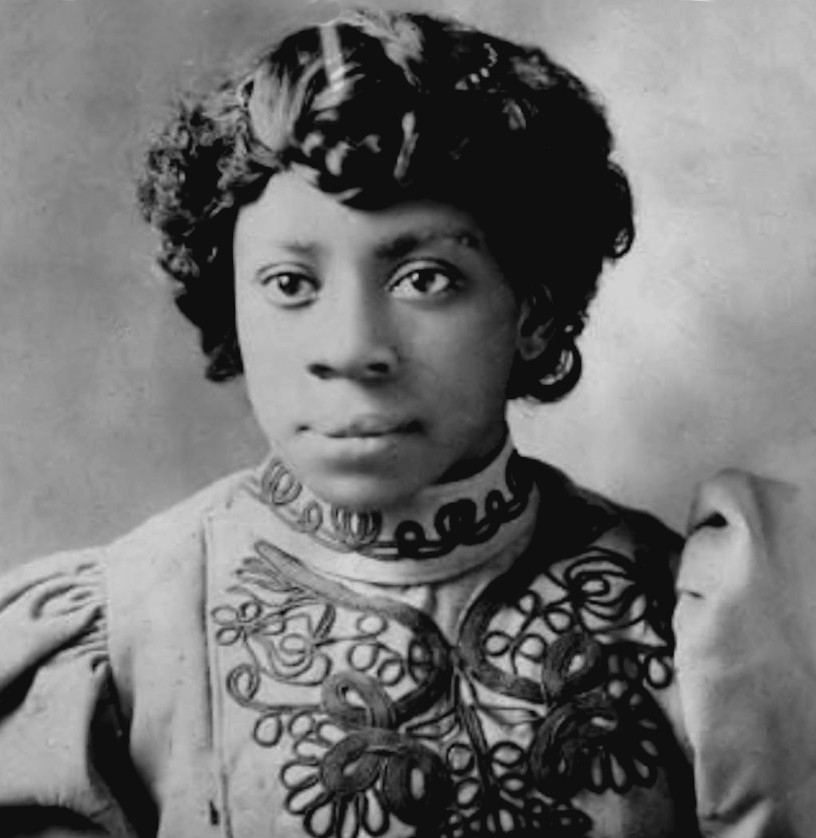
Frankie Baker.
This seemingly small detail blew me away. As I stared at my computer screen into the arresting, disquieting gaze of this queenly young woman – finely dressed, notably composed – I felt deep love for her memory.
Later in life – ground down by events, unable to shake off the story that had been landed upon her, no matter where she went, and powerless over its representation of her (she even tried to sue two movie studios, to no avail) – she would live out her last days in penury, in an asylum.
‘Don’t Do Me Wrong’ is an homage to Frankie Baker and gives life to her perspective of the fateful night in 1899 when her young lover met with an early grave.
Menstruation
As I explored the folk music archives deeper – an uninvited, self-styled confidante of Her – I felt alive and open to nuance, to the spaces between the lines, to that which could not be spoken, and my love for the embattled heroine expanded.
Her blood is lavishly spilled in folk balladry, but there is no mention of menstruation. Her body is readily filled with extra-marital pregnancies that locate her as an outcast, and yet there is no mention of male responsibility.
She is raped and left bereft, and there is no justice. She commits infanticide in extreme desperation, and is cast as a crazed crone. All of women’s struggles through time – the desperate lot of wounded or deprived agency – find expression in our song heritage, and at times I wondered at how deep our keening goes, and if it is indeed as bottomless as a well. Yet her endurance, inner strength and tenacity reminds us that just as a wrecking ball can turn a world to rubble, something new can always be created from the ruins.
The songs of Blood Sex Death platform heroines whose brave, often embattled, lives are offered new expression in unexpected ways, where Gothic tragedy, twisted tenderness and fierceness abound.
A grant from the Department of Tourism, Culture, Arts, Gaeltacht, Sports and Media as administered via the Music Industry Stimulus Package 2020 enabled me to begin recording this six-song EP of original material inspired by her voice, and once I secure funding to complete them, I look forward to releasing and performing the new material.
Musical Origins
As to how I came to music, perhaps motherhood was the metaphorical wrecking ball out of whose rubble I located my creative desire, and pursued it. In the new world order of an upended life, as two babies slept I fought maternal panic and exhaustion with poor guitar skills, an ear for melody and the strangely solid sensation that came from writing lyrics. Late-night bouts of songwriting alone in the kitchen were, my husband sensed, something urgent and tension-laced, not to be disturbed, even if it meant distance and loneliness for us both.
And he was right. It was only through an imagined creative life being ripped from me as easily as a wet Band-Aid that I knew I’d been sleepwalking. A living heroine, Joni Mitchell, spoke of her grandmother’s descent into madness, and I sensed thwarted creativity in its mix.
Fear can be a great motivator, and the chaos of early motherhood an effective stoker of its flames, especially when you’ve long had a nose for the smoky scent of female madness-terror. It was time to wake up from the dream. There is never a good time to start, so I might as well start now.
Over a decade and two albums on, both independently produced, I can’t say it has been an easy road, but it has been a fascinating and rich one that has led me to places I could not have dreamed of in that kitchen space, late at night, afraid for what I would become if I hadn’t found a means of artistic expression. I’ve gotten to steer a course in music through a career in book publishing, motherhood, and activism, and keep on keeping on, through highs and lows.
My latest project ‘Blood Sex Death’ feels like a coming of age. As I move steadily towards my half-century birthday, some might say it’s about time. For a late developer like me, dabbling in songs hundreds of years in the making, perhaps it is right on course.
My split infinitives clearly the work of a man
who dries his clothes recklessly,
sometimes not emptying the lint tray
two cycles in a row.
At the height of my experiments with formal verse
I once drove a Ford Focus
at a tantalising twenty nine kilometres per hour
when the legal limit was thirty.
During my decadent prose-poem phase
I tiptoed past a locked apartment door,
behind which, I’m pretty sure,
there was an orgy going on.
Under the influence of Samuel Taylor Coleridge,
I once took one more Paracetamol
than I should have.
In a rare outbreak of concrete poetry,
I yesterday regrouted the shower tiles myself.
Trying to mimic Rimbaud vanishing in Abyssinia,
back when I was young and even more foolish
than this, I once accidentally went
to Dorset.
My contribution to metaphor
in the twenty first century
is at least as important
as the cat yawning.
Risk, for me, is going
to a different garden centre
at least once every five years.
I see everything as if it were under a magnifying glass, so clear that it hurts. My thoughts race to and fro. Ideas drop as ingredients would, into the mix. Into a boiling cauldron. Then as popcorn does, they fly out, across the counter, and all over the floor. Trying to contain this is futile. That buzzing sound they emit is driving me mad. Add to this my impatience and an indecisive nature.
I’m painfully aware of what’s entailed in attempting to follow through with a single idea. The details of which are tedious and delay any potential progress. But after a glass or two… it all becomes manageable. I cease to worry about the details and start imagining my success. After a bottle or two, I even think that I might find someone who could collect the bricks that are my ideas and with them, build me a palace.
Waiting for something to happen is unbearable. So, to relax, I have another drink. Preferably two. I really need to drink a lot to drown any unwelcome thoughts. If anyone is going to bring up any obstacles, I will lose my temper. I don’t need that. I need clever people to carry out my plans, but clever people tend to have their own ideas, and don’t want to be bothered with mine. It’s so frustrating… but the wine is going down well. Floating on cushy clouds, I’m feeling no pain. There is nothing that needs to be done. Finally, I can fall asleep.
When I wake up in the morning, whatever the weather is, I’m fine. Weather doesn’t get me down. It’s people who do. If my wife doesn’t greet me with a smile, I get upset. But of course, she had a rough evening, listening to me getting angry because it takes so long to get anything done. So, the smile isn’t there. Everything is clear again, crystal clear. It’s excruciating and I’m beginning to think that a nice glass of something would be nice. But, it’s not even noon.
I can’t stand the fact that she isn’t on my side. If she continues to sulk, I won’t be able to think. I get emotional and my brain becomes mush. She doesn’t realize what she is doing to me. Suppose I’ll have to apologize. That’s it. I’ll apologize. I don’t know what I said last night, but it must have been bad.
She says it’s ok. But I’m not ok with ok. I want my wife to radiate goodwill. I want her to listen to my ideas and take over. Put them into practice. At least write them down.
It’s hard to find people who will turn your ideas into reality. Very hard. Because people are so stupid. They lack vision.
Many of my friends have such successful businesses. I know that I can be even more successful than they. I’ve more brainpower in my little finger than most of them. Their success, well, it’s like a slap in the face. Soon it will be time for lunch and I can’t wait to have a drink. My friends might ask my advice. That would help to wipe away any doubts I have about myself.
My wife is exceedingly clever in one way and quite stupid in another. She says that you don’t need to be clever to make money. She’s of the opinion that if you want money badly enough you will get it. That said, you’ll have to work and build up a business. That means more details. Lots and lots of dots and knots. I need money, but hate to work. The idea that I would have to start from the bottom up sounds ludicrous to me. Start at the bottom? Me? The idea could drive me to drink.
I’m busy most mornings. Making important decisions. Don’t bother me with unpaid bills. Distractions like that will only derail my chances at success. The urgent decision right now is where to have lunch today. I call my friends to see where they are going. If it’s not to my liking, I suggest another place. Once this is sorted out, I can relax and give my wife a list of things to do. She will sort her own lunch. I’m not worried about that. My lunch is business. You never know what will crop up.
If you aren’t successful, who are you? You’re a nobody. And that scares the hell out of me. I’ve had some financial success. But not on the scale I aspire to. You’ve got to keep your cards close to your chest. This way at least your friends see you as a success. I often remind my wife to keep her trap shut. I’m not a bully. But I feel the need to repeat it, because I’m never sure if she’s understood me. She says I drive the point home so hard, that it comes out the other side.
I don’t like it when I see her talking to someone, and I can’t hear what she’s saying. What is she saying? She’s giving something away. So naïve, and laughing a little too enthusiastically. She should maintain her composure and behave like a lady.
That man she’s talking to is touching her arm. This is outrageous! I’ll have to do something about it. I feel as if it’s not her, but me he is touching in his patronizing way. He is laughing at me. He’s saying “See how easy it is to touch your wife? And she likes it.” No! He won’t get away with this. I’ll put a stop to it now.
I walk over and pull his hand away. She shoots me a look of dismay when I say it’s time to go home. She isn’t happy and I’m positively furious. What’s wrong with her? Can’t she see that she’s let me down? I don’t need this.
I have a lot on my mind.
So, I give her a piece of my mind.
“You’re drunk!” she says.
How dare she. Doesn’t she realize what she is doing to me? This is why I’m in the hole I’m in.
“Just because someone touched my arm as we were chatting? It’s normal. People do it all the time.”
“People? We aren’t just any people. A lady doesn’t behave like that.
“Well, if being a lady means no one can touch my arm, then I don’t want to be a lady.”
This is hopeless. I now see. And I despair. She points out that I’m paranoid. That I read something into it which wasn’t there.
“I wasn’t flirting”, she says.
“Anyway, he’s your friend. If you question his intentions, then don’t be his friend.”
What really kills me is that he’s a nobody! Absolutely nobody. It would be different if he was successful. Then that would be a compliment. When a somebody finds your wife attractive, well, that’s a whole different ball game.
My wife thinks success isn’t all about money. Maybe she’s wise, but I couldn’t live like that. I spend money. To impress people. So, I need it. It’s not necessary to accumulate it. I just want to walk about unhindered. Yet, no matter how much money I manage to come into, it slips through my fingers. When I have money, it triggers a frenzy of shopping. My wife goes bananas trying to stop me. But there’s no stopping me. I’m like a criminal. On the run.
In fairness, I love beautiful things. Things of quality. She doesn’t understand that it’s an investment. I did well in the past but would she give me credit? Nowadays, I’m not bothered to sell my acquisitions. I have a position to maintain. It’s too demeaning to haggle over the price. After a few drinks, if I’m trying to sell something, I get the price wrong. And once you get it wrong, there’s no righting it. Oh, I don’t know. Perhaps subliminally, I didn’t want to sell it in the first place. People may let you down, but beautiful things are always there for you.
I don’t see why my wife won’t look after my debts. It’s not a bottomless pit. She suggested I speak to Monsieur So-and-So. Plead with him to wait a little bit longer to be paid. So-and-So doesn’t bother calling me anymore, because I don’t bother answering when he does. But he’s begun to call her. There’s no point talking to him. Have you ever seen his eyes? They’re small and cold. Like two bullets sticking out of their sockets.
“Nonsense,” she says. “He is a kind and understanding man. Just give him a reasonable explanation and a time frame for paying him back.”
But I haven’t the slightest idea when I’ll be able to pay him back. If I make more money, there will be things I’ll want to buy. If I can’t look forward to getting something new, life just isn’t worth living.
A kind person would just forget that I owe him anything. If someone owes me and can’t pay, I don’t push.
“Don’t be silly,” she says. “You’ve got to pay your debts and vice versa.”
What baffles me is why I can’t get away with murder … when so many other people do.
Breaking news from The Kimmage Chronicle: everything you need to know about live music and €9 lunches in the shifting Covid-19 landscape.
Following rigorous retrials in the Flann O’Brien Laboratory, the €9 lunch – hitherto thought to be just a step too far in terms of potentially spreading Covid-19 – has been found to be safe.
Food, ranging from the modest ‘soup and sambo’ combo to more complex multi-calorie three course meals were systematically cross-referenced in terms of price, calorie count and potential infectiousness.
Volunteers, who are now all on intensive slimming and exercise programmes, were fed multiple meals that ranged in price from €6 to €54 (six times the potency of the €9 threshold).
The temperature monitoring of participants followed swiftly after each meal consumed, and the volunteers were suitably napkined by lab researchers, and wearing suits designed by NASA, while conducting tasks.
The results are startling. Volunteers reported feeling a definite ‘sense of the absence of hunger’ after consuming those meals that fell into the lower price range, whereas the mid-range meals produced both ‘an absence of the sense of hunger and also a deep feeling of gastronomic satisfaction.’
Lunches above €30 uniformly produced unsettling emotions among all volunteers such as ‘being ripped off’; ‘being made feel inadequate by words I didn’t understand on the menu’; and ‘a sense of peer pressure to eat beyond my means in places recommended by the Irish Times.’ Physical symptoms included participants feeling ‘bloating and drowsiness..’ Remarkably, all participants tested negative for COVID-19 in each of the price categories.
Now, at the government’s bequest, the Flann O Brien Laboratory is carrying out extensive musical research on volunteers as they work off the calories.
Three distinct live music experiences have been set up, along with cutting edge gym equipment for the volunteers, allowing them to exercise while being exposed to potentially infectious music.
Live Classical Music
This is without doubt the most expensive experiment ever undertaken by the Flann O’Brien Laboratory. It involves the RTE Symphony Orchestra with featured soloist Finghin Collins playing Beethoven’s ‘Emperor Concerto.’ Each member of the orchestra was flown to Cape Canaveral, where Astral Tailors designed suits for them that entirely sealing their bodies, save for fingers or lips where necessary for playing their designated instruments. Circled around the orchestra is the gym equipment where the volunteers vigorously work out. Their body temperatures are taken at the end of the concerto’s three movements. The test is being run nine times.
Collins said: ‘This is definitely a Beethoven Marathon like no other. The adagio, famously used in ‘Picnic at Hanging Rock’ may induce feelings of almost unbearable melancholy, but hopefully without transmission of Covid-19. Who knows how we will feel after playing it nine times or indeed how the volunteers will feel having to listen to it nine times over the course of a single day, while simultaneously lifting weights and doing press ups! It’s an audience like no other. This is History!’
The Jazz Improvisation Group
To protect the Jazz musicians, NASA’s Astral Tailors joined forces with suit makers ‘Brooks Brothers,’ purveyors of the most dapper jazz attire ever conceived, to design sealed suits that wouldn’t look out of place in The Village Vanguard. Style meets the absence of gravity like never before!
An assemblage of work out equipment has been placed around the Jazz stage. The quartet is led by tenor saxophonist Michael Buckley, who will play through John Coltrane’s entire ‘Giant Steps’ album, nine times, just as the Symphony Orchestra are doing with Beethoven.
‘Forget touring the world with Glen Hansard and playing ‘Falling Slowly’ a million times over, no, this is my greatest challenge ever,’ said Buckley. He concluded: ‘Playing through Coltrane’s changes on the seven album tracks, nine times in one day, is the toughest task I’ve ever been set, I love my new suit though!’
Researchers are especially keen to ascertain if there are any signs of infection or changes in temperature between the tempo shift in a ballad like ‘Naima’ and the complex up tempo chordal changes of the opening title ‘Giant Steps.’
Techno/Dance
Here, NASA have collaborated with Daft Punk’s design team to come up with an innovative sealed costume for turntable maestro Johnny Moy. There will be no gym equipment here as volunteers will be administered with a dose of lab-tested MDMA, which will keep them dancing without pause for nine hours. Researchers are especially keen to discover if, during the Techno Test, volunteers will refrain from hugging each other and declaring their undying love. Moy said ‘Am well up for it! A nine hour set is a fuckin’ dream come true, I’ve got ten bags of bangers packed here, bring it on!’
Preliminary data from these tests, subject to peer review, indicate we can expect the NCH to open before The Electric Picnic (which NEPHT want to see rebranded as ‘The Acoustic Brunch’) is allowed to relaunch. Jazz as always is being overlooked. Buckley and his combo are running through ‘Giant Steps’ for the eighth time now and researchers are monitoring each segue very closely.
Contemporary marketers must simultaneously think global, local, and glocal factors in order to stay ahead of the curve, or just keep up, given evolving market conditions and a growing attention to ‘bespoke’ needs.
The IT revolution – plus the possibilities that AI, deep and machine learning have to offer – have washed away static approaches to marketing.
Moreover, although it is widely known that internationalisation is a process of firm expansion into new markets, the importance of marketing is often overlooked. There are cultural, regional norms, leadership and change, and also cross-cultural branding amongst others that need to be prioritised while planning.
While in the past, trade was undoubtedly conducted internationally, never before has it had the broad and simultaneous impact on nations, firms and individual households as today. What is more, global trade has been consistently outperforming domestic transactions over the past few decades. As a result many new countries and firms, especially in emerging markets, now prioritise international markets.
Internationalisation of trade has been accelerated and facilitated by rapid technological advances through 2G to 3G to 4G, and now 5G. In many respects, this has reduced the world to a Global Village where producers, customers and other stakeholders can all engage collaboratively.
Global Village, Dubai.
Differentiating global, international, and glocal marketing…
There is a crossover between what is commonly referred to as international marketing and global marketing, which are terms often used interchangably. International marketing is simply the application of marketing principles to more than one country. That is to say, International marketing is a simple extension of exporting, whereby the marketing mix is simply adapted in some way to take into account differences in consumers and market segments.
Global marketing, on the other hand, takes a more standardised approach to world markets and focuses upon sameness, in other words, commonalities in consumers and market segments.
Evidently, international business expanded at lightning speed over the past decade. The reasons for this rapid growth can mainly be found in new technologies, but also supportive institutions, the openness of many economies, as well as intensified competition in many sectors.
Finally, a significant difference between domestic marketing andinternational marketing is that in the former case business remains confined to the political region’s jurisdiction, where government rules and regulations are generally consistent; while in the latter case, once cross-border trade begins it is subject to the rules and regulation of the host country, making the situation far more complex.
When marketing domestically, a company can have the same policies and strategies, while international marketing calls for varying strategies when promoting products and services.
As every country has distinct laws, firms must develop an awareness of the codes, practices and norms that apply. Moreover, consumer tastes and preferences may also differ, so marketing strategies should be formulated with different consumers in mind.
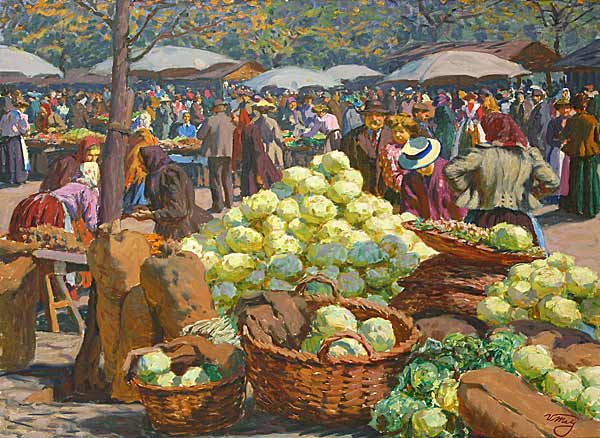
Cabbage market by Václav Malý.
The Customer Remains King
Both globalization and glocalisation have led to more companies pursuing the same customers, while at the same time, customers have become more sophisticated (often seeking whatever is ‘bespoke’), while information technology enables analysis of competing products, allowing consumers to make informed (and sometimes ‘rational’) choices.
Historically, during any crisis such as the pandemic today, consumers expect proactive action, not only from their government, civil society, and local neighbourhood, but also the brands they purchase.
For a business aiming to remain financially successful, and sustain a good reputation it is often not about the products and services, but more importantly: a corporate identity.
During the pandemic, certain global companies invested heavily in new market analytics in order to adapt rapidly to new trends. A COVID-19-ready ‘client-agency’ relationship is the new norm for customer relationship managers and marketing teams.
Once again, recalibration is required through innovative product design, packaging and also pricing models to survive in the ‘new normal.’ Among the new ‘differentiators’ for brands is ‘health and safety’ protocols, offering bookable shopping times, fully sanitised delivery, and at-home ‘make-up’ experiences. This phase of marketing innovation is, however, costly for firms.
Firms will surely be able to operate once against under radiant blue skies, after the dense clouds of masks and hand-sanitisers slowly fade over time.
COVID-19 didn’t bring an end to competition; and any forthcoming slump seems likely to accentuate it. Most firms, particularly those with an established ‘brand’, will need to have multiple plans ready to go.
They must, however, be willing to let go of an existing idea of what is ‘the right way to go’ and devise innovative ways to reach customers, suppliers, civil society, and others. This should lead to the prioritisation of people, planet and profit.
Over the course of the crisis we have been bombarded with video ads, emails and other digital outreach initiatives. But with all the noise, especially on social media, consumers seem likely to be drawn towards a softer, more subtle, tone.
Some brands have opted to move slowly as markets reopen, ‘playing it safe’ on the path towards reactivity. Then there are those who remain conservative, considering the sensible choice to be unadventurous, amidst continuing uncertainties around how long the crisis will last. Although the show must go on, many entrepreneurs have slowed down on marketing and PR activities.
Leveraging #workfromhome
Little fresh content is being created in this phase, notwithstanding how many creative ‘zoom’ screens appear in the ‘lockdown creativity’ slots on popular news channels. Most creative companies and marketers are spending the time building new campaign narratives, initial creative, copy, and baseline graphics.
This can be a fertile period during which creative staff from media, R&D, marketing and sales are encouraged to engage in ‘blue sky thinking’ – brainstorming without limits – so as to deliver consequential output when the right time arrives. Executing new campaigns post-pandemic will demand muscle memory, not mental horsepower.
Business marketing over the years has demonstrated that leveraging genuine empathy can be a real asset. Think of the 90s ads for Nescafe and the story building ads of ‘a lot can happen over coffee.’
During the pandemic some companies have appealed directly to the issue. In the automobile sector for example Jeep released positive messages to encourage social distancing and ‘stay at home’ practices. It also says in online commercial that ‘with a little patience, the views will get better.’
Company databases retain the customer feedback and other date from research programs. This is an opportune time to develop an understanding of the emotions underlying people’s shifting attitudes and behaviours in the market.
Instead of repeating adverts, companies need to ensure they understand the process of customer engagement. The cultural and cognitive connection is equally important.
Best Practices Shared? Further examples…
There are some prominent examples to share in light of the above. Thus Dove created a slot shining a light on the courage of health care workers.
Also, in some developed countries, there is growing appreciation that the ‘retail heroes’ who have often been working around the clock during the period of lockdown – a period that has strangled the capacity and also ability of the supply chain to function effectively.
While regrettably severe job cuts have already happened all over the planet, big-box retailers in Canada such as Loblaw and Save-on-Food have been paying extra wages to their front-line staff as a gesture of appreciation for their efforts. And they are certainly ensuring customers are up to date with these initiatives.
It is a good time to take stock and recalibrate. This is a period of inaction in many sectors, which at least gives a space for businesses to rethink their messages in newsletters, and how ‘new content’ on social media can be created; along with considering how all the adverts, emails, webinars and podcasts may be overhauled in light of current consumer priorities.
Marketing campaigns are known to have solid long-term goals, especially in the case of brand management. This pandemic has asked us to rethink some of our fundamentals afresh. For example, short term planning and incremental innovation may work wonders in the immediate post-pandemic stage.
Therefore, there will be new markets created, and new products introduced factoring in new demand amidst altered consumer patterns and long-term behavioural changes. Relying on detailed long-range planning may actually hurt an institution.
With rapidly changing market dynamics survival may become the priority rather than turnover (of profit and not of employees) to ensure a firm’s viability. As markets, and the nature of markets, evolve with e-tails (Amazon, Alibaba, etc.), AI-driven SMEs, green supply chain etc., the essence of marketing and its channels must realign with company goals and values. They cannot simply rely on on flooding inboxes and other ways of dominating our screens.
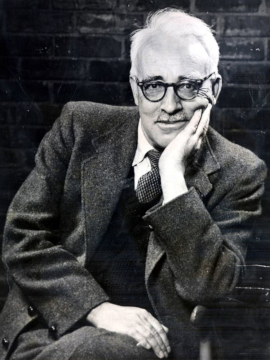
Surveying the demise of the Celtic Tiger, Fintan O’Toole devoted an opening essay ‘‘Do you know what a republic is?’ The Adventure and Misadventure of an Idea’ in Up the Republic! Towards a New Ireland (2012) to assessing the health of the Irish Republic. He considered its vitality based on the presence, or otherwise, of three indicators: Non-Domination; Mixed Government and tolerance of Obstreperous Citizens.
These features of a healthy republic, he wrote, diverge from a narrow form of republicanism associated with Rousseau ‘which argues for the notion of a single, sovereign popular will: ‘the People’ effectively taking the place of the king in a monarchy.’ Up to that point in Ireland, O’Toole argued, this latter, narrow version had predominated, which he associated ‘in vulgar terms’ with appeals being made to ‘pull on the green jersey’’; and where ‘an idea of accountability implicit in mixed government is ditched.’
‘For most of the history of the state’, O’Toole concluded that the state ‘failed miserably in the basic task of ensuring citizens were free from subjection to the arbitrary will of others.’[i]
Now, as Ireland slowly unwinds from an interminable lockdown that tendency of Irish governments to pull on the green jersey, avoid accountability, reject obstreperousness and a conspicuous failure to ensure that citizens are free from the subjection to the arbitrary will of others, is evident once again. This regression has arrived especially through what O’Toole himself described on April 28th, 2020 as the ‘top-down, command-and-control approach’ of the National Public Health Emergency Team (NPHET), which the elected government has deferred to throughout most of the pandemic.
The COVID-19 pandemic is likely to reshape the Irish political landscape, eroding foundational certainties of left and right. When the dust settles new formations may crawl from the debris, with democracy itself in peril, as the coalition government chooses to extend emergency powers until November, while other countries such as Denmark aim for a swift return to normality.
In terms of the pandemic’s wide-ranging impact, there are parallels with the outbreak of a global war. As Hannah Arendtput it: ‘The days before and the days after the first World War are separated not like the end of the an old and the beginning of a new period, but like the day before and the day after an explosion.’[ii]
Placing billions under lockdown around the world had a shuddering effect on daily routines, altering intimate exchanges and gestures, besides radically reducing the ambit of daily peregrinations. It’s a very modern form of trench warfare that confined most of us to within 5km of barracks – spilling out invective on (anti-)social media.
In Ireland, with the advent of bigger government, there is a confidence among some on the left that their time has arrived, and that a relatively youthful population will vanquish age-old privileges of wealth and caste through a permanently enlarged state.
However, as Eric Hobsbawm records, one reason Engels (and even the late Marx) ‘began to turn away from calculations that the international war might be an instrument of revolution was the discovery that it would lead to ‘the recrudescence of chauvinism in all countries’ which would serve the ruling classes.’[iii]
Similarly, nationalism chauvinism – ‘excessive or prejudiced support for one’s own cause, group, or sex’ – has been witnessed throughout the pandemic in Ireland. This is perhaps unsurprising as, historically, infectious diseases have given rise to, and fed, plagues of prejudice and outright racism; the diseased ‘other’ at the gates of the city is a recurring theme. Ruling classes have often put forward strongman rulers to harness this xenophobic sentiment.
Since March 2020 we have poured over spreadsheets of daily deaths, infections, testing rates and vaccine roll outs to determine how ‘we’ are doing relative to ‘them.’ In Ireland we tend to measure achievements and failures against the noisy neighbour next door, whose boorish leader has somehow managed to transform one of the world’s highest death tolls per capita from Covid-19 into a great British victory pageant, through a rapid vaccine rollout. Boris now looks unassailable, notwithstanding Brexit storm clouds, Dominic’s revenge, Indian variants; and just the suspicion that the vaccine may not prove quite the panacea it seems now in winter 2022. Time will tell.
Indeed, the narrative arc of Boris Johnson’s response to the pandemic should serve as a warning to the Irish left that ruling classes can easily steal their best clothes. In this respect, Johnson operated with far greater flexibility than Donald Trump, shifting from a ‘take on the chin’ herd immunity approach in March, 2020 to championing what he would have previously decried as a ‘nanny state’ lockdown. He and his chumocracy used the pandemic as a pretext for introducing draconian legislation againstprotest and civil disobedience, apparently aimed at movements such as Extinction Rebellion.
The End of American Leadership by Christopher Parkison FDR said there was nothing to fear but fear itself, while JFK asked what you can do for your country; now Donald Trump resorts to blaming foreigners.#FDR#JFK#Trump#TrumpMeltdownhttps://t.co/JrJupSJhKI@broadsheet_ie
Similarly, though less dramatically, Leo Varadkar resuscitated his political career after Fine Gael’s disastrous performance in General Election 2020, donning proverbial scrubs for the initial phase of the pandemic. Having identified himself with “early-rising” middle class voters Varadkar was smart enough to realise that his preferred Thatcherite policy of reliance on an Invisible Hand of market forces could lead to a public health disaster during a pandemic.
Since entering the coalition, Fine Gael Ministers have emphasised a law and order approach – Simon ‘TikTok’ Harris was quick off the blocks denouncing as ‘disgusting, grotesque and obscene’ a comparatively unobstreperous anti-lockdown protest in Dublin by European standards. Fine Gael have also allowed Fianna Fail to act as a mudguard for a failing system of public health: Ireland’s health expenditure is the third highest in the EU, yet we have only 5 ICU beds per 100,000, compared to 35 in Germany and 28 in Austria.
Fine Gael represents itself as a centrist party, placing emphasis on its belated support for marriage equality and abortion referendums, which obscures from a failure in government to address structural inequalities and ongoing environmental damage. Replacing James Reilly as Minister for Health in 2015 Leo Varadkarpromptly abandoned universal health insurance (UHI).
After becoming leader of Fine Gael and Taoiseach, Leo Varadkar claimed he would represent thrusting early risers – tantamount to saying he would not alter structural inequalities that are most apparent in access to housing. In combination with Fianna Fail, Fine Gael has represented the dominant interest of large property owners, indifferent to whether their wealth is maintained via independent corporate entities, the state, or as in Ireland’s case increasingly, a corporate-state nexus.
Simple distinctions of left and right are often misleading. Thus, when considering the virtues, or otherwise, of big government it should be clear that administrative levers and patronage may drive inequality; most obviously through mind-boggling salaries, such as the €420k paid to the Director General of a dysfunctional HSE, Paul Reid – ironically a former Workers’ Party activist. Reid has no medical or scientific qualifications, and previously acted as chief executive of Fingal County Council.
Moreover, left-wing politicians and their supporters are often drawn from higher income groups; a tendency that within Fine Gael circles used to be referred to as noblesse oblige – accompanied by the obligatory glass of fine Cognac – of which the Just Society was the apotheosis. But a left-wing identity may be superficial, as the distribution of state largesse, or patronage, apart from being expressed in high public sector salaries, often benefits established professional elites of lawyers, academics and indeed doctors.
Big government patronage motors along fine in Ireland for all concerned as long as the tech and pharma sectors do the heavy economic lifting. This is the ‘Leprechaun Economics’ that Paul Krugman referred to dismissively. But now the Biden administration’s taxation proposed changes to the global tax system may make the current Irish model unworkable. The ECB is also likely to desist eventually from quantitative easing, with inflation looming.
Renewed fiscal rectitude and the prospect of multinationals leaving a perpetually unaffordable capital city for workers, will place increasing reliance on those indigenous SMEs that have endured the Crash of 2008, and the unprecedented challenges of the pandemic. Yet whole sectors have been furloughed for over a year, with some such as events and tourism wondering whether they have a future at all. The Central Bank has warned that one in four firms could fail when pandemic payments cease.
It should be unsurprising, therefore, for a small businessperson living from transaction to transaction to be wary of parties promising higher taxation on the left, and instead be attracted to politicians on the right, or even far-right, that are acquainted with the language of commerce, however superficial this may be, in the case of Leo Varadkar at least, whose concern for SMEs has disappeared after his supportive comments proved unpopular last October.
'None of those people would have faced being on #PUP, none of them have to tell someone they are losing their job, none of them will have to shutter a business for the last time' – Tánaiste Leo Varadkar on #NPHET#cblivepic.twitter.com/ZAw7sDxGLo
An objective for a progressive left should be to attract support from an increasingly marginalised mercantile class, emphasising that a favourable environment for entrepreneurship, as in Scandinavia, is enabled by efficient public service, including a one-tier, functioning health system. The left can argue that leaving healthcare to market forces – as in the U.S. – is not only deeply unfair, but also, crucially, leads to greater costs than a functioning one tier public system which also – as in most European countries – delivers better outcomes overall.
The inherent danger of Ireland’s two-tier model, where health care provision is subject to market forces is epitomised by a question recently posed by a Goldman Sachs executive: “Is curing patients a sustainable business model?” In an age of profound health insecurities – which are amplified through subtle advertising cues – market forces will continue to distort public health priorities.
It was the father of economics Adam Smith who warned: ‘People of the same trade seldom meet together, even for merriment and diversion, but the conversation ends in a conspiracy against the public, or in some contrivance to raise prices.’ However, while resisting a buccaneering tendency in the delivery of a vital government service such as healthcare, the left cannot afford to dismiss the dynamism of entrepreneurship in society at large. Just imagine the food you would be served if the government was running all the restaurants.
Following Public Health Guidance
While there are a range of financial supports available to SMEs, the world-beating length of Ireland’s lockdown has made trade impossible for many businesses, some of which may never recover. The failure of the two centre-right parties in government to represent their concerns arguably, lies at the heart of Ireland’s deeply flawed response to the pandemic.
From March to June, 2020, 96% of additional deaths related to COVID-19 in Europe occurred in patients aged older than 70 years. Yet, despite having the youngest population in the Union, according to a Reuters by February Ireland had endured 163 days of workday closures. This was the highest, by some measure, of all the European countries surveyed at that point. By contrast, Denmark had lost just fifteen days, having experienced a death toll almost half that of Ireland’s per capita.
The uncritical attitude of mainstream Irish left wing parties towards public health officials should also be reconsidered. Recall the major mistakes in particular by Chief Medical Officer Tony Holohan, who saw nothing wrong with fans going to Cheltenham in early March, 2020, ordered care homes to re-open to visitors that same month, and then transferred 4,500 untested patients back into care homes – surely contributing to the second highest level of care home mortality in the world during the first wave. Yet Irish left wing politicians have consistently complained about the government failing ‘to follow public health advice,’ despite Holohan’s long history of cock-ups and cover-ups.
Even before Christmas NPHET – a body composed primarily of career civil servants and notably short on scientific expertise – seemed to have been all on board for the ’meaningful Christmas’ of Micheal Martin’s imagination. The only significant deviation between the government’s approach and NPHET’s advice was that the latter preferred to permit household gatherings rather than opening the hospitality sector. Cue raucous Christmas house parties, as opposed to what were mainly orderly affairs in pubs and restaurants.
In fact, Ireland’s ‘third’ wave, which coincided with the more transmissible B.119 variant (although apparently not more lethal as was widely reported) actually commenced in week 48 of 2020 (22/11/2020), while the country was still under Level 5 Lockdown restrictions, according to a report by the HSPC.
Sadly, public health obscurantism has also brought denial of their own data, which said outdoor transmission of Covid-19 is about as frequent as curlew sightings.
The latest embarrassment over NPHET refusing to acknowledge the benefits of antigen testing, underlines that if left-wing politicians are slavishly going ‘to follow the public health advice,’ and whatever Yes Minister civil servant advises then we won’t see radical reforms in Ireland any time soon.
Frank O’Connor
Guests of the Nation
Over the course of the pandemic Irish attitudes have hardened against the free movement of people in and out of the country, culminating in the introduction of mandatory hotel quarantines for some foreign, including EU, arrivals at the end of February.
Contemporary Irish attitudes to hardworking foreigners resident in Ireland recall Frank O’Connor’s classic 1931 short story ‘Guests of the Nation.’ Set during the War of Independence 1919-21 it portrays a bond of friendship that grows up between two IRA men, Bonaparte (the narrator), and Noble, who are detailed to guard two captured English soldiers Belcher and ‘Awkins who have a natural affinity with the country:
I couldn’t at the time see the point of me and Noble being with Belcher and ‘Awkins at all, for it was and is my fixed belief you could have planted that pair in any untended spot from this to Claregalway and they’d have stayed put and flourished like a native weed.
Ultimately ‘Awkins and Belcher are sacrificed at the altar of of a narrow nationalism, just as a today the Populist appeal to ‘protect our own people’ has ordained that the rights of immigrants in Ireland, and abroad, to see their families was disregarded.
"We need to protect our own people. We have a duty to protect our own people to the maximum. This legislation fails to do that"✖️
That's why we have proposed an amendment to make hotel quarantine mandatory for everyone travelling here with the exception of essential travel 🛬 pic.twitter.com/wwaFueUbvz
This appears to stem from a widespread notion that ‘we,’ like faraway New Zealand and Australia, can eliminate the disease from ‘our’ shores altogether – devolving into the juvenile #wecanbezeros hashtag adopted by some politicians on the left. The problem is that ‘we’ are a society with lots of ‘them’ immigrants living here, and an enormous diaspora of ‘us’ beyond the shores of an island divided into two jurisdictions, highly dependent on international trade in goods arriving on trucks (with drivers).
Moreover, apart from the extreme geographic isolation and sparse populations of Australia and New Zealand, ‘we’ in Ireland have legal obligations to preserve freedom of movement under European treaties and the Good Friday Agreement, enshrining a porous open land border. Apart from committing economic hari-kari, pursuit of ZeroCovid appears legally impossible, unless of course we want to pursue an Irexit and build a wall along the Northern border.
Nonetheless, egged on by febrile – ‘if it bleeds it leads’ – coverage in a national media increasingly reliant on government advertising, a prevailing view is that all deaths from Covid are essentially preventable; emanating from the failing of the state, or the reviled Covidiot, rather than being the tragic consequence of a pandemic, the death toll from which has been systematically exaggerated.
Moreover, intercepted correspondence within the ZeroCovid ISAG group of independent scientists – who have taken on the Opus Dei role to the Catholic hierarchy of NPHET – reveals, among other disturbing insights, that they were looking ‘for ways to increase insecurity, anxiety and uncertainty.’ As these revelations first appeared in right-wing Gript, however, the left-wing echo chamber refuses to acknowledge it is being played.
Are you right there Michael?
Nonetheless, a number of politicians have come forward representing an anti-authoritarian left, concerned by the harms of lockdown and favouring a targeted approach – protecting the elderly – and building up ICU capacity. In a recent blistering Twitter attack the independent (and former Labour) TD for Clare, barrister Michael McNamara – who as chair of the Oireachtas Committee on Covid-19 Response became as well acquainted as any Irish politician with diverging epidemiological assessments of the pandemic – identified a recurring Irish deference to vested authority.
In response to a Fintan O’Toole article critiquing the DUP McNamara wrote: ‘Instead of criticising unionism, let’s look at the complete mess we’ve made of Irish nationalism and nationhood. We’re ruled by a junta of medics, just as we were Rome Ruled for 7 decades. The Orthodoxy changes but the crawthumping remains the same.’
He continued: ‘If it wasn’t for Unionism, we’d be like Hoxha’s Albania now. There’d be no way off this island. But there is a beacon. Belfast Airport and Larne are beyond the reach of NPHET, just as surely as the rule of the Archbishop’s palace in Drumcondra didn’t pass the bridge in Portadown.’
He added more controversially:
‘We can’t blame the medics for their experimental therapy, any more than we could blame the clergy for their zeal. Successive governments have abdicated their democratic responsibility throughout this State’s short history. So why would Unionists want to be “governed” by Dublin?’
Instead of criticising unionism, let's look at the complete mess we've made of Irish nationalism and nationhood. We're ruled by a junta of medics, just as we were Rome Ruled for 7 decades. The Orthodoxy changes but the crawthumping remains the same. https://t.co/05VbBmHnSI
It was a fair question, when one considers the North is reopening far sooner than the Republic. Although this has arrived after a rapid vaccine rollout, the experimental nature of which McNamara raises problems with.
Facing Up to Errors
Here we come to the crux of an unhelpful cultural division between left and right that the ruling parties will use to divide and conquer. This is the new identity politics arising out of the pandemic, epitomised by attitudes towards face masks.
For too many on the left the science on this issue is proven as opposed to followed. Wearing a face mask now appears to have become an article of faith. Yet a recent report by the European Centre for Disease Control and Prevention entitled ‘Using face masks in the community: first update – Effectiveness in reducing transmission of COVID-19’ stated:
The evidence regarding the effectiveness of medical face masks for the prevention of COVID-19 in the community is compatible with a small to moderate protective effect, but there are still significant uncertainties about the size of this effect. Evidence for the effectiveness of non-medical face masks, face shields/visors and respirators in the community is scarce and of very low certainty.
Additional high-quality studies are needed to assess the relevance of the use of medical face masks in the COVID-19 pandemic.
Moreover, the Irish left should consider our dependence on pharmaceutical behemoths that jealously guard intellectual properties, notwithstanding huge state aid grants, and indemnification against adverse reactions. It is akin to the dependence of small farmers in developing countries on genetically modified seed, under a model of Philanthrocapitalism overseen by Bill Gates, who according to a recent article by Alexander Zaitchik has shown “a lifelong ideological commitment to knowledge monopolies,” and devotes hundreds of millions of dollars each year to whitewashing his reputation through “charitable” media grants.
Moreover, all too often, media debates around Covid-19 fail to acknowledge the link between pre-existing morbidities – ‘underlying conditions’ – and morbidity and mortality from Covid-19. Thus, US Studies have shown that having a BMI over 30—the threshold that defines obesity—increases the risk of being admitted to hospital with covid-19 by 113%, of being admitted to intensive care by 74%, and of dying by 48%, making it almost as relevant a consideration as having been vaccinated.
In Ireland, moreover, Mayo coroner Patrick O’Connor recently questioned the attribution of deaths to Covid-19, saying: ‘In reality, a lot of people have terminal cancer or multiple other serious co-morbidities. People can die from Covid and or with Covid. I think numbers that are recorded as Covid deaths may be inaccurate and do not have a scientific basis.’
Furthermore, by embracing ZeroCovid Utopianism many on the Irish left failed to focus on the failings of a decrepit Irish health system. This epitomises a tendency among politicians to dance to the tune of a corporate media that has placed relentless focus on the disease itself, regularly interviewing mendacious ISAG figures, while generally ignoring underlying social and environmental factors that drive morbidity and mortality.
The canard that Ireland could simply shut its borders and reach ZeroCovid perhaps points to the need for reform of an Irish secondary educational system, which according to the a rather unkind assessment from the OECD’s Andreas Schleicher is designed to produce ‘second-class robots.’ Perhaps too many of us are lacking the requisite critical faculties to look beyond news headlines.
In fact a radically different, defiantly left-wing approach to the pandemic been put forward by, among others, Harvard epidemiologists Katherine Yih and Martin Kuldorff in The Jacobin. They pointed out:
Elites have seen their stock portfolios balloon in value, and many professionals have been able to keep their jobs by working from home. It is the country’s poor and working-class households, particularly those with children, who have borne a disproportionate share of the burden. Lower-income Americans were much more likely to be forced to work in unsafe conditions, to have lost their livelihoods due to business and school shutdowns, or to be unable to learn remotely.
Beyond ZeroCovid, the Irish left should emphasis the harms of Ireland’s reliance on lockdowns, and harness the malcontents of the poorest, including small business owners. Otherwise they court irrelevance as the traditional ruling parties have already taken on the role of ‘caring’ for the people, while retaining the power to ease restrictions in the face of opposition from the left.
Science and Technology are not Neutral
Also, as opposed to running in fear from being labelled anti-vaxxers by a cheerleading corporate media, the left might at least consider the wisdom of foisting vaccines that have been granted under emergency use conditions on all age groups. Indeed, many on the left in Ireland seem unwilling to question dominant institutional narratives, a tendency recently criticized by the Greek socialist Panagiotis Sotiris in The Jacobin, who said: ‘What is missing here is something that used to be one of the main traits of the radical left, namely, an insistence that science and technology are not neutral.’
It remains unclear whether universal immunization will bring about long-term ‘herd’ immunity; while in the absence of long-term safety data the benefits to young, healthy subjects of vaccination may not outweigh the cost in terms of adverse events from treatments granted under emergency use licences. Sober assessment seems to have given way to an ideological and, at times, a coercive approach.
In terms of the efficacy of the Pfizer vaccine, writing in the British Medical Journal, Peter Doshi, pointed to how in the media ‘a relative risk reduction is being reported, not absolute risk reduction, which appears to be less than 1%’ for severe disease.’ Ollario et al in The Lancet referred to absolute risk reductions of ‘1·3% for the AstraZeneca–Oxford, 1·2% for the Moderna–NIH, 1·2% for the J&J, 0·93% for the Gamaleya, and 0·84% for the Pfizer–BioNTech vaccines.’ The authors also pointed to how ‘considerations on efficacy and effectiveness are based on studies measuring prevention of mild to moderate COVID-19 infection; they were not designed to conclude on prevention of hospitalisation, severe disease, or death, or on prevention of infection and transmission potential.’
Doshi has also objected to the undermining of ‘the scientific integrity of the double-blinded clinical trial the company—and other companies—have been conducting, before statistically valid information can be gathered on how effectively the vaccines prevent hospitalizations, intensive care admissions or deaths.’ This came after Pfizer pleaded an ‘ethical responsibility’ to unblind its trial and offer those who received a placebo the opportunity to receive its vaccine.
Doshi argued that ‘there was another way to make an unapproved vaccine available to those who need it without undermining a trial. It’s called “expanded access.” Expanded access enables any clinician to apply on behalf of their patient to the FDA for a drug or vaccine not yet approved. The FDA almost always approves it quickly.’
An alternative policy would be to reserve vaccines for those most susceptible to severe symptoms – the old and the obese – along with healthcare workers and others unavoidably working around the world in congested environments. Devoting scarce resources to increasing ICU provision to bring us into line with European averages might be a better approach than relying exclusively on the quick fix of the vaccine.
The Irish left should now desist from identity politics around vaccine uptake that the centre-right is relishing. ‘Tiktok’ Harris previously stoked tensions with talk of mandatory vaccines and promoting vaccine passports. The left should resist vaccine apartheid, nationally and globally, while demanding the release of patents earned through state supports.
On the Horizon
Ireland can expect significant social problems to emerge out of our world-beating lockdown strategy that recalls a prior devotion to austerity; a mental health pandemic and mass youth unemployment are upon us already. Moreover, the young are currently denied the safety valve of an easy hop to another English-speaking country for work. This may be a recipe for radicalism, but unfortunately genuinely dark forces on the far-right are ready to pounce on malcontents.
It is surely vital that we maintain our European connections, thereby scrapping Mandatory Health Quarantine that is an insult to immigrant groups in Ireland, as well as the diaspora. 90% of scientists believe that Covid-19 will be with us forever, so it seems there will always be ‘variants of concern’ to contend with, just as there are with influenza.
As a country Ireland has serious work to get on with in terms of addressing a housing crisis and improving our environment. A narrow focus on the pandemic should not be allowed to derail these efforts. This may be like a war but it is not a war. Even prior to vaccines, this is a virus with an infection fatality rate of less than 0.2% in most locations. Moreover, up to 86% of those infected may not have symptoms, such as cough, fever, or loss of taste or smell, according to a UK study from October. We require better provision of public health and an adequate plan to address the ongoing obesity pandemic.
We also need to start thinking more critically — and speaking more cautiously — about Long Covid, considering ‘at least some people who identify themselves as having Long Covid appear never to have been infected with the SARS-CoV-2 virus.’
The pandemic calls for a new social contract to be negotiated in Ireland that acknowledges republican values of Non-Domination; Mixed Government and tolerance of Obstreperous Citizens. The French COVID-19 Scientific Council led the way in a paper for The Lancet:
it is time to abandon fear-based approaches based on seemingly haphazard stop-start generalised confinement as the main response to the pandemic; approaches which expect citizens to wait patiently until intensive care units are re-enforced, full vaccination is achieved, and herd immunity is reached.
They continue:
Crucially, the new approach should be based on a social contract that is clear and transparent, rooted in available data, and applied with precision to its range of generational targets. Under this social contract, younger generations could accept the constraint of prevention measures (eg, masks, physical distancing) on the condition that the older and more vulnerable groups adopt not only these measures, but also more specific steps (eg, voluntary self-isolation according to vulnerability criteria) to reduce their risk of infection. Measures to encourage adherence of vulnerable groups to specific measures must be promoted consistently and enforced fairly. Implementation of such an approach must be done sensitively and in conjunction with the deployment of vaccination across the various population targets, including all generations of society.
They argue against reliance on lockdowns:
Using stop-start general confinement as the main response to the COVID-19 pandemic is no longer feasible. Though attractive to many scientists, and a default measure for political leaders fearing legal liability for slow or indecisive national responses, its use must be revisited, only to be used as a last resort.
To date, many on the Irish left appear to have had their heads in the sand promoting a Utopian ZeroCovid solution. This should give way to a more balanced appraisal that considers the interests of all of Irish society. With the youngest population in Europe, and as one of the richest countries, the Irish government could have preserved a far higher standard of living for the population during the pandemic. We now need to draw up a social contract that takes a more balanced approach.
Featured Image: Daniele Idini
[i] O’Toole, Fintan (editor), Up The Republic: Towards a New Ireland. Faber and Faber, London, 2012, p.1-52.
[ii] Arendt, Hannah, The Origins of Totalitarianism, Penguin, London, 1966, p.22
[iii] Eric Hobsbawm, How to Change the World, Tales of Marx and Marxism, Little, Brown, London, 2011, p.79
Self-defence, blood lust, ethnic cleansing, disproportionate response, mowing the lawn, genocide, death from the sky. It’s up to you however you wish to describe the unparalleled violence unleashed on Gaza.
I describe it as shooting or in this case bombing Palestinians in a barrel. Let’s have a brief resume of what’s happened.
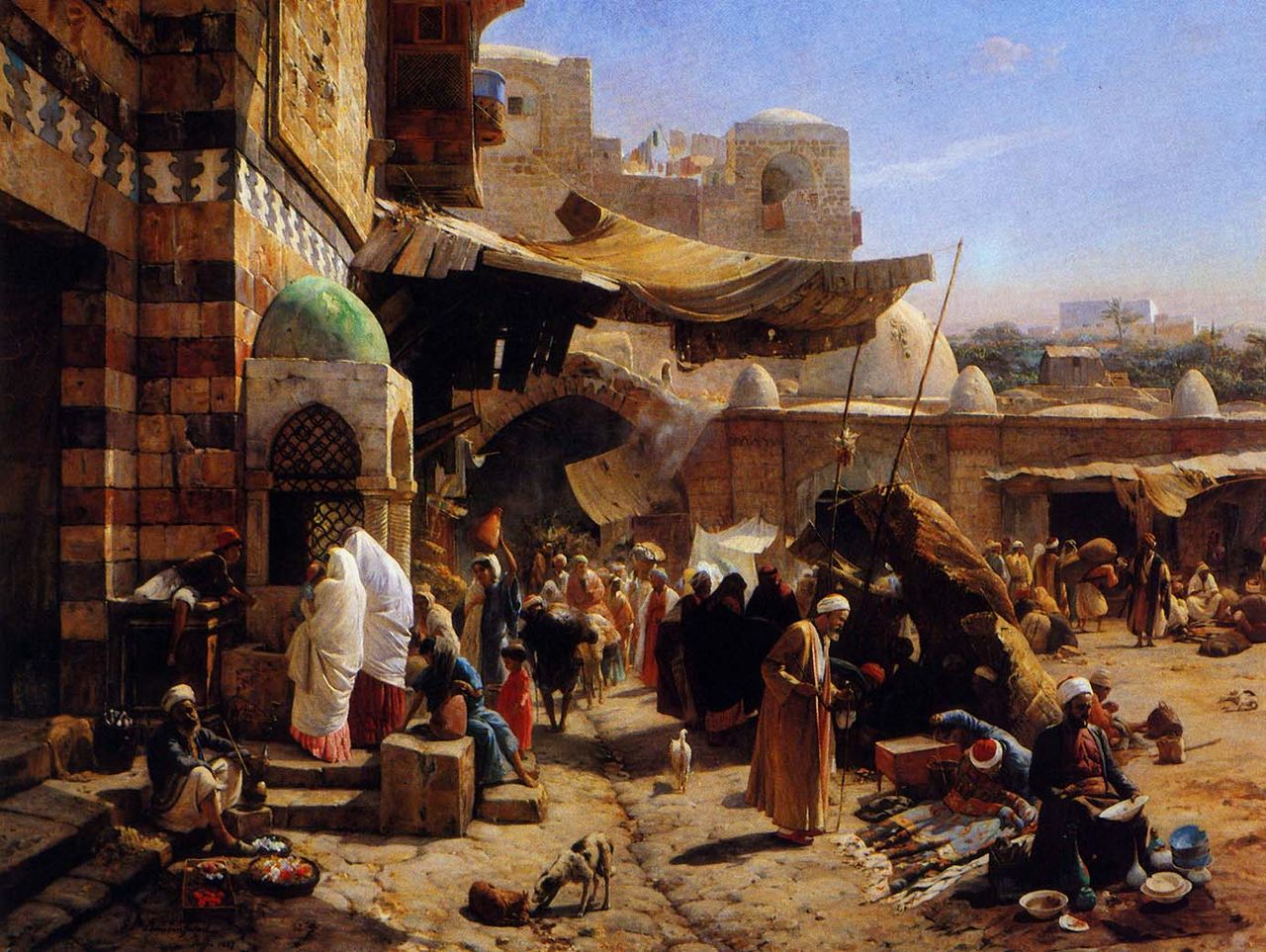
The district of Sheikh Jarrah is in East Jerusalem, which was the proposed capital of a Palestinian state. The signing of the Oslo Agreement in 1993 led to further Israeli expansion into the West Bank. Since then areas like Silwan and Sheikh Jarrah have been systematically targeted by the illegal Jewish Settler movement, which uses Israeli courts to award Zionist Jews the homes and land currently occupied by Palestinians.
If you take nothing else from this article please remember the Occupation is illegal under international law, therefore every decision taken by the Occupation army, the illegal settlers. Yet the Apartheid Israeli judiciary routinely sends Palestinian including young children to prison on extracted false confessions, many made under duress, under physical threat.
In some cases children are handed false confessions written in Hebrew, which they cannot understand, and are told these are official release forms. The kids sign them thinking they are going home but in reality, these are confessions that will condemn them to jail.
Add to this ‘Administrative Detention’, Imprisonment without trial, and we have the flawed corrupt Apartheid regimes conveyor belt to jail. All of this is illegal.
As a result many Human Rights organisations describe Israel as an apartheid state. This is because Zionism, a political ideology is inherently Apartheid.
Israelis protest against Netanyahu outside his official residence in Jerusalem on 30 July 2020.
Corruption Charges
Israel’s Prime Minister Benjamin Netanyahu is now facing corruption charges. A former Israeli Knesset member during a CNN interview accused him of inciting the current round of violence by continuing Israel’s expansionist, illegal land grabs in the Occupied West Bank, and also through the attacks on people at prayer, men, women and children at the Al-Aqsa mosque, towards the end of the holy month of Ramadan.
Is seems conceivable that the leader of the seventh largest military force on Earth would engineer a state of conflict between Israel and a people without an army, air force or navy, to protect themselves. All they have is local militias, composed of the fathers and sons, mothers and daughters of the local community.
But if an Israeli Knesset member says exactly that, then it must carry some weight.
The Dust Settles
So, where are we now and who won and who lost?
As the bloodletting ends, as it must, the dead are buried and the dust settles over the destroyed building, like a shroud over Gaza.
The reality is, everything will be the same and yet everything has changed utterly.
I have always been sceptical when I heard claims following previous attacks on Gaza that the resistance has won.
I genuinely thought it was just bravado for the masses. When we see the death toll, the numbers injured and the devastating damage to civilian homes, hospitals and the infrastructure, I have to ask how have they possibly won?
The loss of life alone is unimaginable in such a small environment. Twenty-five miles by six miles, that is the size of the Ards Peninsula in Northern Ireland, with the equivalent of the entire two million population of Northern Ireland squeezed into it.
Thus far, the destruction in Gaza is an incredible scale.
The targeting and killing of whole families is a war crime in itself.
The systematic destruction of all roads leading to the main hospitals in Gaza, preventing ambulances and victims from accessing acute services is another war crime. The wanton destruction of family homes, farms, places of worship and work are too.
The Resistance has Won
The latest Blitzkrieg on Gaza is just another Zionists war on civilians that will never be forgotten. Israel claims its aims were to degrade the military capabilities of Hamas and other resistance groups in Gaza. It cites rockets fired from Gaza as the pretext.
Under international law, however, with Israel illegally occupying the West Bank and enjoying control air, sea and land borders around Gaza, the Palestinians have a right to resist the Occupation, by any means necessary, including armed resistance.
Then this David versus Goliath battle is one of the Palestinian David with rocks and rockets legally resisting an illegal Goliath occupation, which uses gunboats, tanks, artillery shells, drones and F16, F35 jets to bomb and murder Gazans at will, and without any recourse to the rules of war.
The reality is that Israel will only end the bloodshed once it has expended the armaments supplied to it by America France Britain and the EU.
Yet Israel has failed again in its stated objective to destroy the ability of the resistance in Gaza to challenge the Occupation. It did not have the courage to commit ground troops as the cost in Israeli soldiers lives was deemed potentially to be too high.
The resistance groups retain both the ability, and the will, to continue to resist the illegal Occupation and siege by any and all means necessary.
The attacks on Gaza are a proxy threat to other nations in the region. We will do the same ‘to you’ is the message from Israel. Indeed, Israel routinely bombs Syria in another example of its illegal war crimes, while their military leaders have stated on numerous occasions that they will bomb Gaza back into the stone age.
I know, it’s hard to believe, but the resistance has won! Gaza may have been levelled: the suffering of the dead, the injured and the dying is unfathomable.
But while Gaza has been destroyed, the spirit of resistance embodied in the people has survived. This provides the impetus to continue demands for equality, peace, freedom and justice for Palestinians and Palestine survives, not just in Gaza but in East Jerusalem, in Sheikh Jarrah, in the West Bank, in Al-Aqsa and across historic Palestine, which Zionists call Israel.
Netanyahu has only succeeded in uniting Israelis in their demand for his prosecution for corruption and united Palestinians for the first time in a generation in their defence of Al-Aqsa, East Jerusalem, Sheikh Jarrah and Gaza. A new generation of resistance has been born, united and unified from the river to the sea.
Did Netanyahu help create the conditions that made this latest attack on Gaza inescapable? Is the shedding of blood in Gaza simply a political gambit aimed at a domestic audience?
Is it a case of: he or she who kills the most Palestinians getting the most votes?
Alas, history certainly bears that perspective out to be true.
Moving Forward
What Gaza needs is financial support, rebuilding materials, medicine, hope and solidarity in equal measures.
What it will get is another 50,000 or more refugees, many of whom were previously refugees from the Israeli murder and bombing campaigns of 2014/2009/1967/1948.
This further degrades Palestinian civil society’s ability to respond to the damage to lives, homes, infrastructure and the economy.
Egypt is complicit in the siege. It will not help Gaza or Palestine. The humanitarian catastrophe will continue apace
Israel sells Gaza water, gas, oil and electricity. It makes a profit from all of these utilities. The profits of Occupation.
And yet the spirit of Resistance has prevailed once again. But the price of resisting the continued illegal Zionist Israel occupation of Palestine is a continued loss of liberty and life for Palestinians.
The continues loss of life, homes, farms, workplaces, mosques, schools, hospitals, clinics, the loss of innocence in the young, their hopes dashed for the future, and their dreams of a life free from violent occupation, imprisonment, death from the skies. This is a psychological trauma seemingly without end.
When the bombs stop flying in the east the people stop protesting in the West. Will you stand with Palestine. Or simply melt away like snow on a ditch until the next murderous bombing raids occur?
Peace needs you now. Palestinians need you now. The future generations being born into captivity need you now.
What will you do to help end the madness of a rogue Apartheid state and bring peace to the people of the Middle East and West Asia? It is in your hands
Feature Image: Destroyed house in Gaza City, December 2012.
Most Irish people could not imagine what links their country with Colombia, or even the extent to which their electricity is still comes from coal into the 21st century. But the Electricity Supply Board (ESB), and therefore Ireland as a whole, is complicit in human rights violations, as well as ongoing air and water pollution occurring in a Colombian region.
Cerrejón
To understand better what I am talking about we need to go to the north east of Colombia, to La Guajira region, just before the border with Venezuela. Here we find the largest coal mine in South America – and one of the largest in the world – in operation since 1985, which produces, on average, approximately thirty-two million tonnes of coal a year.
All of this coal is exported, principally to Europe thanks to a Free Trade agreement highly beneficial to multinational corporations, under a neoliberal global economic model where developing countries in the Global South provide cheap natural resources for the Global North’s energy production, through mining and extractive industries.
In most cases this model is highly destructive. The company and the mine, both called Cerrejón, have changed owners throughout its thirty-six years of operation and are now owned in equal parts by the multinational companies Glencore, BHP Billiton and Anglo-American, which run many other mega-mining projects all over the world.
Many local and international activists and organizations, including a UN Human Rights expert in September 2020[i], have been demanding a halt to mining on the grounds of human rights violations.
Over thirty indigenous, Afro-Colombian and campesino communities were displaced due to the coal mining project. Of these communities only a few have been resettled in urban areas, where they do not belong, and promised a series of measures – services, financial aid, school bursaries – which are mostly inadequate.
If the company justifies resettlement as a measure of protection of the local communities’ health and safety, no other choice is given to them: they have to leave the land that they have been occupying for thousands of years, since before the arrival of the European settlers.
In most cases their economy was based on agriculture and livestock, so without access to the land and without the possibility of employment in cities, the subsistence of these people, and of their cattle, is at immense risk.
In fact, drought is another big issue in this semi-arid to arid region. The main source of water, which the local communities rely directly upon, is the Ranchería river and its tributaries: the mine has been accused of drying seventeen of these waterways throughout the years. For instance, in 2017, Cerrejón proceeded with the diversion works of the Bruno stream even though the Colombian constitutional court ruled that the company had to consult all twelve of the communities affected before starting the works.
Wayuu
The Wayuu, or Guajiros, are an Amerindian ethnic group of the Guajira Peninsula, including the northernmost part of Colombia and northwest of Venezuela. A study reported by Human Rights Watch in 2017[ii] that one Wayuu child dies every week on average because of malnutrition; 5000 Wayuu children died of hunger between 2010 and 2018.[iii]
Children and youth are certainly the most vulnerable[iv], but are not the only ones suffering respiratory problems due to their proximity to pollution from the mine.
In particular, the high concentration of substances such as Sulphur, Chromium, Copper, Bromine, Nickel, Manganese and Zinc in the air, as stated in the Colombian Constitutional Court Ruling T-614/19,[v] and the contamination of rivers and bodies of water in the area.
High concentration of metals has also been found in the blood of people from the communities surrounding the mine: this can lead to DNA damage, skin lesions, lung cancer, respiratory and heart diseases.
Furthermore, the Wayuu people and organisations have suffered harassment and death threats as a result of dissent and resistance to the coal extraction practices. For example, the local organisation Fuerza de Mujeres Wayuu (Wayuu Women’s Force) has been reporting death threats against them from the far-right paramilitary group Aguilas Negras since 2019.
a reflection of the best of Colombia: a world-class operation committed to the sustainable development of La Guajira […] in areas such as education, health, culture, sports, productive projects, the environment, infrastructure enhancement, training, employment and basic sanitation for our neighbouring communities, including the native Wayuu people.
Ireland
Moneypoint Power Station By GavinZac – Own work, CC BY-SA 3.0, https://commons.wikimedia.org/w/index.php?curid=7582681
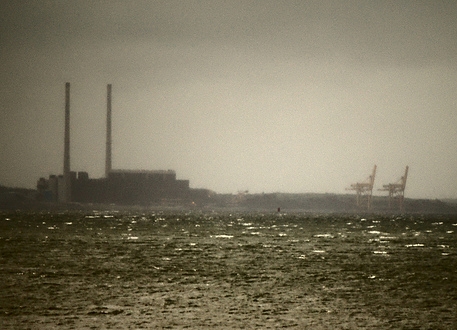
Moneypoint, located on the River Shannon in County Clare, near Kilrush, is Ireland’s largest electricity generation station. The power station is run by the ESB, the semi-state electricity company – 95% owned by the Irish government – and it is the only coal-fired power station in Ireland, and the largest emitter of greenhouse gases in the country.
It has relied entirely on imported coal since 2011, 90% of which has been imported from Colombia, mostly from the Cerrejón mine, and it has been polluting Ireland too. Coal represents 14% of the country’s total energy mix.
The ESB claims that it has been purchasing only a small percentage of the Cerrejón mine’s total output and that senior managers personally visited the site and met workers, community leaders and trade union officials; while the company committed to remain vigilant on the issues.
In 2018 the Irish Department of Climate, Environment and Communications announced that Moneypoint would phase out coal burning by 2025[vi] and in 2019 the Irish government launched its Climate Action Plan,[vii] including a commitment to stop burning coal, so far no concrete details have been provided on what technologies will be used to replace coal, or alternatives for Moneypoint employees.
In 2018 the Irish government acknowledged the impact of coal mining on human lives in La Guajira and the human rights abuses connected to the supply chain, but no formal action has been taken still on the situation by the government,[viii] nor by the ESB.
In the last few years, on the one hand, Ireland, like other European countries, has contributed aid towards developing countries to tackle climate change and to the Colombian peace process; yet on the other hand, it hasn’t stopped importing environmentally destructive coal that involves human rights violations.
But Ireland is responsible also for another reason: CMC, the exclusive marketer of Cerrejón coal, which coordinates the sale and delivery of this coal globally, has its headquarters in Dublin, thanks to the well-known corporate tax regime that has made Ireland such a popular destination for multinational corporations.
Recent Developments
In January 2021, GLAN (Global Legal Action Network), supported by a coalition of Colombian, International and Irish human rights and environmental groups, including Christian Aid Ireland, lodged a formal complaint to the Organisation for Economic Co-operation and Development (OECD) through their national contact point in Ireland.[ix]
They claimed that Cerrejón and the ESB were in breach of their human rights responsibilities by continuing to import coal and failing to take necessary actions to identify and prevent the harms caused by the operations, i.e. human rights abuses; air and water pollution and displacement of local communities.
Simultaneous complaints have also been filed to OECD representatives in Australia, the UK and Switzerland against the three corporations involved and against ESB and CMC. The OECD will now have to investigate if the multinational companies are in compliance with with the OECD’s Guidelines, and take action accordingly.
For the same reasons Irish organisations such as Stop Blood Coal Ireland and Terra Justa – based in Bolivia but with staff members in Ireland and the UK – have been calling on the Irish government to stop purchasing Cerrejón coal on human rights grounds. Compensation to communities affected for more than three decades, as well as support for basic rights and resources in La Guajira, including transition measures to support mine workers, are also demanded.
Furthermore, very recently, in March 2021 Still Burning, a ‘network fighting against the global hard coal industry’, also launched the book Coal, Colonialism & Resistance, which centralises the voices of affected communities and warns of ‘false green solutions’, highlighting the colonial entanglements of coal.
The Irish organisation, Latin American Solidarity Centre, based in Dublin, is now hosting two webinars on land defenders along with the Department of Spanish, Portuguese and Latin American Studies of the University College Cork (UCC).
On the 13th and 20th of May the Irish organisation, Latin American Solidarity Centre, based in Dublin, hosted two webinars on land defenders along with the Department of Spanish, Portuguese and Latin American Studies of the University College Cork (UCC).
The second session, ‘Law, threats and criminalization’, analysed the threats that land defenders face. The two panellists, Jakeline Romero, from the Fuerza de Mujeres Wayuu in La Guajira, and Isabel Matzir, from the Resistencia de Cahabón in Alta Verapaz (Guatemala), explained the state and corporate strategies and practices used to criminalize them and delegitimize their struggle. Within Colombian distorted system, threats and violence from the state and corporations against indigenous people are still taking place with total impunity. And the reason is simple, as claimed by Jakeline Romero, “they have interests; economic and political power are in their hands,” so they can still declare nothing of what has been denounced is real.
She claims also that the recent repression against peaceful protesters has a lot in common with the emblematic violence against the indigenous, Afro-descendent and campesino communities in Colombia. The is the same military response from the state. The government does not recognise either their rights or their cultural difference, but local organisations like Fuerza de Mujeres Wayuu keep on defending the land and denouncing the systematic human rights violations. As it is not always possible to denounce these injustices nationally – people in the territories often fear for their lives – and local communities cannot do everything on their own, international exposure and support are essential.
“People have to know that the coal arriving in Europe is bloodstained, it’s against human life,” says Jakeline. She adds that the pandemic has been used by the government to legislate against the indigenous people, and in general against the people in Colombia. To repress more than ever on the street of the Colombian cities, as well as in the indigenous areas.
The past is a foreign country, they do things differently there.
L.P. Hartley
The earliest written accounts of war portray a merciless and vicarious world where the deeds of men are steered by the caprice of malicious gods, and the deeds of warriors are frequently elevated to the plane of the gods. Indeed one of the first historical accounts of war, the battle of Megiddo 1479 BC, portrays the Pharaoh, Thutmose III, as a sort of indestructible God figure.
The deific depiction of the ‘hero’ is similarly featured in the mythological portrayals of conflict in the Celtic epic of The Táin and the Trojan epics of the Greeks. The extraordinary feats of CúChullain and Achilles raise the archetype of war to the plane of the supernatural.
The Greeks, under the bloodthirsty warlord, Agamemnon, despoil the plains of Troy and relish the viscera of indiscriminate slaughter. All the while the gods entwine fate and death in a mythological fabric.
The Táin, an Irish epic set in the time of Christ, has the same archetypical representation of the supernatural personality of death and slaughter that the Trojan epic portrays, including a vain and capricious God: the Morrigan.
The 12th Century accounts of The Battle of Clontarf (track 8) again represents the battlefield encounter with mortality as a supernatural narrative containing a mythological manifestation, or personification, of Death.
Excerpt from Njáls saga in the Möðruvallabók (AM 132 folio 13r) circa 1350
An intriguing metaphor of death is given in an Icelandic account of Clontarf, in Njáls saga. It describes a scene of Valkyries meeting in a cottage to weave the fate of the champions of the battle with a warp and weft of the entrails of the fallen. This is witnessed by a farmer named Dörruðr who describes the scene:
“Men’s heads were the weights, but men’s entrails were the warp and weft, a sword was the shuttle, and the reels were arrows.”
In the Gaelic account, ‘The Badb’ [baw -v] (the Raven of Death) hovers over the battle. Into this visceral arena, demons and spectres cram, tearing at the warriors, while The Badb decides which souls to pluck from the slaughter.
This representation of a supernatural fate directed by the hands of capricious gods is the mythological embodiment of violence – what some psychologists have termed ‘the death instinct’.
It is the opposite of reason. It is an attempt to feed our imaginative understanding, and an attempt to give an essentialist grasp of the cruelty of nature. It stipulates that man and nature are entwined, and that man is therefore slave to unpredictable nature.
The ‘heroic’ mode of being in these epic poems has been described conversely as role fulfilment, and as an assertion of will. The latter is encapsulated by Nietzsche as an individual existence that struggles toward the ‘Overman’. Nietzsche represented this in the extraordinary scene in Thus Spoke Zarathustra where the acrobat walks between buildings on a tightrope.
it is the process that makes the hero – the adventurous space between his departure and his return. He stands firmly only on the towers, but what defines him as a ‘skilful’ or a ‘clumsy’ acrobat is the walk. The ‘fabulous forces’ that this Nietzschean hero must encounter are the “spirit of gravity,” the ‘nausea,’ and the figure of the ‘jester’.
The role of the jester is essential in this heroic model.’ The acrobat, by living outside of the constraints of history; by transcending through his heroic struggle in the uncertain space between the buildings, is given a greater horizon and an insight that is not open to the watchers in the square. By assuming the heroic role he ascends to the place of the ‘Overman’. The same is true of the ‘Hero’ in the epic poems of the Táin and the Trojan Epic. It is not so much that they transcend linear history, but that they transcend an archetype that is ever present in a parallel view of history. In this view, the past, the present, the future, are simultaneous.
In the ‘heroic’ society, death is a form of defeat but not necessarily so. The ceremonies of burial bridge between the role of the hero and the immortal afterlife; whilst a desecrated corpse is a supernatural death. Sophocles took this idea and created the tragedy of Antigone where King Creon punishes the dead Polyneices by prohibiting his burial. In doing so he is murdering the corpse of the hero. The consequence of this are societal-shattering, as were the new ideas of philosophy for the ancient Greeks.
In the ancient Homeric world, as in the Celtic heroic world described in The Táin, the slave is symbolically dead, because the Slave cannot take the heroic course of action (this notion was carried through to the first conceptions of democracy in ancient Athens where only citizens could take part in civic life).
In this world-view, to supplicate oneself is death in the same sense, as it is a relinquishing of the role of the warrior. There is an intriguing paradox told in The Iliad after Achilles desecrates the corpse of Hector by dragging it behind his chariot on the plains below the city wall. Priam, the king of Troy and father to Hector, supplicates himself before Achilles so that he may tend to the corpse of Hector.
The role of Hector as a heroic character is at stake here. If he is accorded the funerary rights of the heroic, his heroism remains symbolically alive, whereas the desecration of his corpse is the death of his heroic character. We see the remnants of this psychology in honour cultures.
Priam, Hector’s aged father, gives up his own heroic life by becoming a supplicant. Priam dies, so that Hector lives.
Priam killed by Neoptolemus, detail of an Attic black-figure amphora, ca. 520–510 BC
But, if we were to look at this episode through Christian eyes we would say that Priam has gained eternal life by relinquishing his public role as king, for that of grieving parent. This is a new concept of virtue, where virtuous action is not defined by role, but is universal and objective.
In the heroic poem a virtue is a quality which enables a person to act in their well-defined social role: the warrior king, for instance. The Homeric idea of virtue can only be determined after we know the roles expected of the character. The concept of what anyone filling that role ought to do is a-priori to what is virtuous.
In Njáls saga – the Icelandic account of the Battle of Clontarf – we are given another alternative on the conception of virtue and the way to act in the world.
During the rout of the Viking host, one of their warriors, Thorstein Hallsson, stopped running and tied up his shoe-thong. An Irish warrior, Kerthjalfad, asked him why he was not running.
“Because,” said Thorstein, “I cannot reach home tonight, for my home is out in Iceland.”
This was seen as a very human assessment of the facts, and so Kerthjalfad spared his life.
It’s interesting that as the modern era of reason progressed, along with the ability to control our conditions of living, the mythologising of death and the representation and acceptance of cruelty has declined. It seems that the death instinct so often remarked upon, is not an innate part of the psychology of man. The Gods in these ‘heroic’ stories are projections of deep social adaptations of their age.
Compare this search for a mythological “will to power” with Solzhenitsyn’s search for truth and what he termed the dividing line between good and evil “that runs through every human heart”. Solzhenitsyn clarifies something revolutionary, which was earlier echoed by St. Paul in his letter to the Romans: That hell is created within the corrupted soul.
Hell is the perversion of human nature through the unfettered feeding of the darkest of human propensities. The Russian cartoonist Danzig Baldaev dealt with his immersion in hell by recording the casual sadism he witnessed daily as a gulag camp guard.
Image from Danzig Baldaev’s Drawings from the Gulag.
Danzig had to deal with two terrors: The sadism of his fellow guards, which was inflamed by a malevolent system corrupted to its very core by the philosophy of Marx. And secondly; his complicity within this network of evil.
Danzig dared not make the slightest protest against the evil in which he was immersed, because to do so would have placed him within the ranks of the victims. One way to survive was to live a demoralizing lie as Danzig did.
Danzig fought the lie by recording his images in coded hieroglyphs that only he could understand. He redid his drawings with all their horrific realism when the danger of discovery abated after the death of Stalin.
His drawings from the Gulags are testimony to observations made by both John Paul Sartre and C.S. Lewis. While Sartre said that “hell is other people”, Lewis more astutely observed that “the door of hell is locked from the inside.
What all these have discovered is that evil is separated from good by a philosophical perversion. There is nothing irrational in going from the acceptance of nihilism to becoming a guard of the gulag. It’s the fundamental values we hold that determine the morphospace of possible social relationships and systems. Solzhenitsyn went further than Danzig in his exploration of the ethics of deception. He determined that the only way to combat untruth was to live truthfully. His greatest achievement, The Gulag Archipelago, is a monumental testimony to his realisation.
The evolved ethical sense in the age of Gods and Heroes is different to that in the modern age of reason. What is adjudged ‘good’ in the heroic age – the act of slaughter in battle for instance – has no common fundamental with the modern ethic of ‘good’; where moral pre-eminence is given to an empirical view of the world. These fundamental psychosocial understandings of the correct way to behave – for which we sometimes use the intangible proxy of ‘good’ – shift with philosophical revolutions. This shifting of the perspective is a constant feature. It is hard to say that the perspective of the age is the definitive and final destination. The postmodern ontological view has shifted the view of ‘good’ away from empiricism and reason, and may yet have catastrophically regressive effects. One thing for sure is that we have not reached “the end of history.”
Band Photography | Musicians | | Holst Photography Ireland
An Bhuatais & The Meaning of Life is available through:
More than a quarter of a century ago a man-child called Kevin retired from politics as he turned twenty seven. He had joined the then somewhat notorious Trotskyist group, the Militant Tendency[i], at the age of fifteen. After twelve years of activism, which began as a member of Galway West Labour Youth the month the Falklands War kicked off and fizzled like the saddest of fireworks in London in the aftermath of Mrs Thatcher’s Poll Tax, against which he had been a somewhat obsessively focused campaigner, it was over. “Retirement” was the face-saving word he used to describe his departure from politics. From the inside it felt like a personal tragedy. And it was. After more than a decade as a fiercely loyal ‘comrade’, Kevin had had enough of Militant and they had had enough of him. Dialectics being the contradictory beast it is, a total exit from active politics may have been the best thing that could possibly have happened to him right then. But it didn’t feel like that to him. Instead of world socialist revolution, with which history had refused to oblige him, the spectres haunting the little part of Europe with which Kevin was then mostly concerned were, from his point of view, disappointing: Tony Blair and the Celtic Tiger, which got given its name the same year Blair became UK Labour leader: 1994.
Kevin sloped back to Galway from London via the Holyhead ferry that April with a mouthful of bad teeth; he wasn’t much of a one for looking after himself then. Though would march to defend the NHS for other people until his shoes disintegrated; he did not partake of such services himself. Kevin arrived in Galway with no particular plans, apart from a notion that he might do something artistic. Not artistic in the prettifying sense; he had no interest in describing the rocks around Connemara and the like. Indeed, he had little interest in any kind of beauty. Or so he thought. He wanted to express things he had been unable to say during his years as a (partly-self appointed) leader of the vanguard of the North London semi-lumpen proletariat. Mostly, this would involve going into some detail about all the people and ideas and institutions he was against. It was no small list. High on it was his endlessly self-sacrificing former self, who had worked himself some of the way towards a possible early grave, in an attempt to fight the political tide of the early 1990s that was, in the end, more about masochism than socialism. By “doing something artistic”, he meant stuff to do with words – songs, poems, maybe plays, novels… In the last years of his activism, when he was Chair of Enfield Against The Poll Tax in the North London Borough then represented in the House of Commons by, among others, Michael Portillo[ii], he had become increasingly focused on how best to say what needed to be said. It wasn’t enough to say it. It had to be said well. And, if possible, said wittily. He didn’t know it at the time but writing political letters with a satirical bent to the local papers in Enfield in the very early 1990s was his beginning as a poet.
This Kevin, who was of course me, hoped to escape politics via poetry but also harboured illusions that he might somehow find a way of combining the two. It is a contradiction I have been working out ever since. From the inside it has felt more to be a case of this obvious contradiction working itself out using me as a somewhat extreme public example. Of late this contradiction has grown starker and as a result perhaps been somewhat resolved. In the course of my work as a poet, I regularly meet that strange creature, the literary liberal, who ascribes to themselves every progressive and humane value while at the same time apparently finding no place in their imaginations for even the possibility of a world not run in the interests of Jeff Bezos, Elon Musk, and Apple Inc. They are the sort of people who, if they didn’t necessarily agree with her, would at least have understood where artist Tracy Emin was coming from when she called David Cameron’s coalition of 2010-15 “the best government…that we’ve ever had”. Politically, Emin may be an ignoramus. But her incontinent mouth is useful in that it makes her spell out what others in the arts are only brave enough to occasionally think. It has been my experience that, post 2008, most established literary creatives cannot imagine as possible a world in which a substantial percentage of the populations of countries such as Ireland, Britain, and the United States don’t live in Victorian levels of poverty. Just look at the queues of homeless being fed each Friday night outside the GPO in Dublin by the charity Muslim Sisters of Éire. Despite such images, the idea of properly taxing the super-wealthy, and making sure they don’t find a way of avoiding that tax, is seen by your average sensible member of the literary classes as a notion only seriously held by annoying teenagers and people who think it’s still 1975. According to this broad school of thought, if it can be called thought, there never was any other possible solution to 2008 but spending less on the lower orders and using that money to bail out JP Morgan, Anglo-Irish, and the Royal Bank of Scotland in the hope that the pre-slump status quo could somehow be restored. So your average literary stuffed jacket, or pants-suit, tends to quietly cut characters such as Varadkar, Obama, and Cameron a huge amount of slack. As long as they give them things like a side of same-sex marriage to go with all those hungry schoolchildren and people sleeping in wet cardboard boxes. The same lit-libs who, should your criticism of things as they now are become too harsh, will leap to list off the (actually very short) list of good things people like ‘Barack’ and ‘Leo’ did while leading their respective countries, and then pull the sort of face one does while having a catheter inserted if you dare suggest some bit of communist craziness such as that, to pay for the Covid crisis, Ireland should consider increasing its notoriously low corporation tax rate from the current 12.5% to, say, 13% for the next five years. An increase of just 0.5%. Once the pain of the metaphorical catheter insertion passes from their hugely tolerant face, it will be replaced by the faraway, superior look of a 1980s Irish religion teacher trying to move past the appalling fact that one of their students just said the word “abortion”. Then they will look at you and say something like:“but you’ve always thought that, haven’t you.” It’s a variant of Mandy Rice-Davies’[iii] “He would say that, wouldn’t he.”
They offered similar responses if they thought one was getting irresponsibly enthusiastic about the movements around Jeremy Corbyn and Bernie Sanders, or Syriza in Greece in 2015, or the successful anti-water privatisation movement in Ireland or, if they are that particular sort of American, the idea of Medicare for all or a minimum wage of $15 per hour. It’s a way of reducing what the person to their left is saying to a collection of perceived dogmas they no doubt think one has held to fanatically, like some dusty bedsit socialist ten commandments, since Arthur Scargill[iv] were a lad.
Nothing could be further from the truth. Marxism is something I spent several years actively trying to get away from. But couldn’t. Precisely because the ideas that dominate the mostly middle class poetry world, in which I have been immersed for two decades, are so absurd in comparison. It is precisely because of this lack of intellectual seriousness, which looks increasingly obscene set against events; not to mention its by product: the almost comical chancerism and opportunism which literary liberals call “networking”, that has led me to start acting and thinking in an overtly Marxist way again, since around or about 2014. The networking phenomenon lately reached possible apotheosis with one of Ireland’s premier literary resource organisations using its website to advise beginner writers to get a professional headshot taken and some business cards made. It went on to suggest new writers take a course with said organisation which would, among other things, help them in building their “brand” as a writer. Marx predicted capitalism would, in time, magic everything into a commodity. And now an Irish state funded arts organisation proves him right by overtly urging young writers to see themselves as commodities from the start. I am though a different kind of Marxist to the one I was thirty years ago, far less party orientated, far more concerned with the broader movement. I again have people all around the world who I consider comrades. People who, though their faults may be many, try to resist the current fashion for putting oneself up for sale at what usually turns out to be a pretty low price.
From about 2006 to at least 2012 I was what can best be described as a collapsed Marxist. Not collapsed (and also a little bit Marxist) in the sense that Brendan Behan sometimes was due to the presence of too little blood in his Champagne. Rather, still Marxist in the way I viewed the world but collapsed in the sense I could see no way of applying it to the stuff happening around and about me. Socialism, what little remained of it, appeared to have fallen in love with its own marginality. A good minority of those who remained on the socialist left on the eve of the global financial coronary of 2008 seemed to me to be oddballs and cranks who had nowhere better to be; or, at the very least, to have developed an excessive tolerance for such refugees from reality. This perception was hardened greatly by the fact that a couple of stage four literary cranks with leftist pretensions happened to operate right here in Galway. And the pre-2008 Left locally was only delighted to opportunistically clutch said oddballs to its haggard bosom.
Every time the Arts Council declined to fund some bit of pseudo-literary crankery – the sort of events to which no one turns up and then someone runs screaming out the door – the Left lined up to sign petitions and letters protesting this outrage. It was one of those classic romances between two lonelies, driven primarily by the fact that almost no else wanted to know either of them by that point. I know my reaction to it was excessive. It led me for a period to dismiss everything the Left, which at bottom was still my tribe, had to say. Hugo Chavez and Eva Morales[v] clearly weren’t to blame for weird letters every other week in the Connacht Tribune from minor poets with issues. Yet, in my mind, the two became conflated. My reaction did spring from material reality. I felt let down by the obvious stupidity of what was supposed to be, broadly speaking, my own side. Why should I believe a word they said about Venezuela or Bolivia or Iraq when they talked what I knew to be raw horseshit every other month in the local media, and online, about funding for the arts in Galway?
It wasn’t just little local neuroses that made Marxism seem inapplicable in the pre-2008 world of up, up and away capitalism. As Terry Eagleton wrote in his introduction to Marxist Literary Theory in 1997: “Marxism, then [after the collapse of the Soviet Union in 1991] was taken to be less disproved than discredited, out of the question rather than out of arguments.” This was the intellectual atmosphere in which, by then, twenty eight year old me, who’d spent 40% of his life as an active Marxist, began writing poetry. My first two poetry collections The Boy With No Face (2005) and Time Gentleman, Please (2008), which established me as a poet, whatever ‘established’ exactly means in this context, were both entirely written between 1996 and 2007, years when the neo-liberal strain of the capitalist virus was the only ideological infection in town. To such an extent that one hardly ever heard anyone saying the c word. Capitalism wasn’t a system particular to a time and place, in which we just happened to be living. Rather, it was just how things are, and how they would always be, like the Divine Right of Kings in seventeenth century France. Only more so. For in the mid seventeenth century Louis XIV[vi] for a time faced a formidable challenge across the Channel in the form of the republican government in England, in which the poet radical John Milton was an advisor and was commissioned by Oliver Cromwell to write Defensio Secunda, a pamphlet in defence of Parliamentary government. When I started writing poetry, even to say the word ‘capitalism’, or to write poetry which acknowledged said system’s existence marked one out as some sort of ex-Marxist peculiarity because if you knew the word capitalism you could only have been taught it by socialists. One felt like an alien. I remember attending an open-mic poetry reading at the Apostasy Cafe in Galway in 1998 and talking to an alluring young lady with a gold standard south of England accent. She informed me, without blinking once, that she and the then recently late Princes Diana shared the same astrological sign and that, as a result, she had a profound and personal connection with the late Princess’s soul. I said nothing. But looked at her and then around the room at the assembling crowd and knew that my ideas about the world would, to most people there, have seemed far more eccentric than hers.
Spanish Arch, Galway
These days, I often have a similar feeling of being a strange life form who has somehow landed in the Irish poetry world from another dimension. But I view the fact that I am now semi-detached, some days almost entirely detached, from Irish poetry, while also being in a sense part of its establishment, via the readings I co-organise, the reviews I write, and the workshops I run, as a radical success, and an outcome my much younger self would have enthusiastically endorsed. About eight years ago I began publishing more and more poems, especially contentious political poems, online, usually on political and news websites and blogs, places in which poetry is unusual. I couldn’t see the point waiting weeks or, more usually, months, for a journal editor to get back to me when the poem seemed to demand that it get out into the world more urgently than that. Plus, the internet now offered the possibility of thousands of readers for a poem, particularly through building a connection with people interested in political action as well as talk. In 2013, five years before the 8th Amendment was repealed here, I published my then new poem ‘Irish Government Minister Unveils Monument to Victims of Pro-Life Amendment’ on the website of Dublin Fingal TD, Clare Daly[vii], who has been a friend of mine since our time together in Militant. I wrote the poem shortly after the death of Savita Halappanavar who died after being refused an abortion in our local hospital, which you can see from our kitchen window. The poem has been re-published many times and in 2014 I was passing a small boarded up building at the very bottom of Quay Street in Galway and noticed that someone had, without my knowledge, made a poster of the poem and pasted it onto one of the boarded up windows. The fact that whoever it was went to the trouble of printing the poem out and pasting it there clearly meant that it spoke to them, independently of the gatekeepers who like to think they decide what poetry is. I was happy to bring poetry into the heat of what was then a contentious political battle. I could have sent this poem, which later appeared in my collection The Ghost In The Lobby, to Poetry Ireland Review or some other top magazine. But what would have been the point? I know that there are many poets who take the opposite view and think it better to be read by less people, if said people are of a ‘better quality’.
Walter Benjamin wrote of the Surrealists, who began as a movement of poets, that they sought to construct a literature where “the ‘best’ room is missing”. My grandmother’s house had a best room which always seemed cold because a fire was hardly ever lit in there. It was where her dusty fine China cups resided. When she had the Stations Mass in the house every few years, as was the custom at the time, the priest and the men were always served breakfast afterwards in that best room. These days when I pick up quality literary journals, or read the programmes of literary festivals that consider themselves ‘elite’, I think of my grandmother’s version of Walter Benjamin’s best room and update it to have some poet, who everyone else in that chilly little room agrees is marvellous – for that is the price of admission – taking the place of the priest. If the choice is to either have one’s poems pasted illegally on boarded up buildings or to be well thought of by those who inhabit that room, I’ll choose the former. Though, such binary choices aside, if you run a literary festival, or top magazine, and wish to invite me to dine, I will likely accept and my table manners will be impeccable. I will eat everything you put before me.
Increasingly, though, what first strikes me when I read contemporary poetry is not that it is either particularly good or particularly bad but that it mostly doesn’t matter. It is of course hugely important to the participants in the poetry networking game in the way that the Best Kept Garden competition is of great import to those residents of Midsomer[viii] who participate. Much contemporary poetry seems to me to be paralysed by an absurd respect for existing institutions and, in particular, the sacred institution of private property. This didn’t matter much in the pre-crisis years, when history was supposed to over and socialism in the cemetery. But it matters now. Most of a century ago, the French poet Paul Eluard, who was first a leading Surrealist then a committed Communist, wrote the following, the translation is by David Gascoyne:
Critique of Poetry
Of course I hate the reign of the bourgeois The reign of cops and priests But I hate still more the man who does not hate it As I do With all his might
I spit in the face of that despicable man Who does not of all my poems prefer this Critique of Poetry.
It is impossible to imagine any member of the self-selecting Irish poetry top table publishing such a poem. And the idea that such a poem would ever be allowed pour its glorious contempt from the main stage at any of our posher literary festivals is laughable. In the crisis years since 2008, literary festivals have, among other things, become places Irish Times readers go to be reassured that, despite Trump, despite Brexit, despite the yobbos of the anti-water charges movement, everything is going to be alright. Such gatherings are increasingly the intellectual equivalent of a pampering spa with a seaweed bath, places people with above average incomes – and sometimes sons and daughters of theirs who aspire to be writers – go to retreat from ugly realities and remind themselves how progressive they are.
There are recent poems which resist this trend. ‘The People Died’, from Dublin poet Karl Parkinson’s most recent book, Sacred Symphonies is a most blatant example:: “They died eating Coco Pops, and starting the day with an Actimel/…They died while tweeting lies about immigrants and queers/…They died jerking off to Tik Tok in their one bedroom council flat/…They died of cervical cancer they were told they did not have…” And then Parkinson takes fabulous aim at the current occupants of the best room: “You are the murderers of poetry: / your lines wait like creeps in alleyways, /… your stanzas so boring they make a glory of ironing…” It is those later lines that will most likely debar Parkinson from the room, though he is, in truth, generous in his judgement, for the typical literary networker is in all likelihood far more mercenary than the average creep in an alleyway. Working class poets will be allowed in, as long as they ditch barbed critiques of the Parkinson/Eluard variety, acquire an agent, and join what I call the My Old Man’s A Dustman school. The government funded bouncers who guard poetry’s best room quite enjoy non-threatening verse anecdotes about life among the lower orders, especially when told in a suitably charming inner-city accent.
Other poems, such as Jane Clarke’s ‘Who Owns The Field’, from her debut collection The River (Bloodaxe, 2015) and Ruth Quinlan’s ‘The Corrib Great Southern Hotel’ which appeared in the most recent edition of The Stinging Fly challenge the assumptions of the occupants of Irish poetry’s best room, particularly those who consider themselves to be in favour of equality, and are, as long as that equality remains entirely abstract and doesn’t get in the way of their quiet worship of those who own things. Clarke’s poem is influenced by Kavanagh, for sure. But, to me, the question it politely, but directly, asks has as much in common with the radical realism of 19th century French painters such as Millet:
Who Owns The Field
Is it the one who is named in the deeds
whose hands never touched the clay
or is the one who gathers the sheaves,
takes a scythe to the thistles, plants the beech, digs out the dockweed, lays the live hazel?
Most of those who dwell permanently in Irish literature’s best room will listen to this poem, while sipping sugary tea from a fine cup, and pretend they side, obviously, it goes without saying, with the one who “takes a scythe to the thistles”. In reality, if someone like this turned up at a poetry reading, their skin would crawl just a little. Even if he had the manners to leave his scythe at home. And if someone with such an obvious lack of bourgeois refinement were given a spot at a poetry open-mic to read one of his own poems, they would discover they urgently had to leave. As they swept out the door, probably sporting some sort of cloak with a Celtic design on it, they’d make a mental note to remind themselves to suggest at the next meeting of the arts organisation board they are a member of that “the one who is named in the deeds”, mentioned at the start of Jane Clarke’s poem, be invited onto said board as a representative of the “business community”. Quinlan’s ‘The Corrib Great Southern, 2020’ takes a look at the catastrophe sometimes imposed upon communities by “the one who is named in the deeds”. The Corrib Great Southern was a huge, successful hotel on the eastern outskirts of Galway City. It was originally one of a chain of state owned hotels. As well as being a hotel, its bar and restaurant were much used by people on Galway’s east side, which is not very well served in such matters. Then it was sold off because that was the Progressive Democrat[ix] thing to do. In 2007 it ceased to be a functioning hotel because the dashing local entrepreneur who bought it had better ideas. But then 2008 came and said entrepreneur was much in need of government help, which he got. But the Corrib Great Southern, which you can’t miss as you enter Galway via the Dublin Road, was left to rot. It is now to be demolished but its demolition has been delayed due to Covid. During its almost decade and a half of dereliction, it has been stripped of everything of value, and become a favourite haunt of arsonists:
The scavengers come, Egyptian plovers that pluck debris from between the teeth of this bloated, stranded reptile,
this grounded giant that bequeathed its wings as verdigris sails to the building next door. It has surrendered to waiting for death
by a hundred attempts at arson, until the inferno that cracks its bones back down to the rebar marrow.
Quinlan’s poem is an Irish ‘Ozymandias’. But unlike Shelley’s Ozymandias, whose power was so distant as to be beyond memory – the Pharaoh’s monument to himself sinking into the sand vainly shouting: “My name is Ozymandias, King of Kings; / Look on my Works, ye Mighty, and despair!” – the developer genius who shut the Corrib Great Southern down in 2007 still stalks the business community like so many other zombies and has lately been chosen as the “preferred bidder” for Galway’s proposed new “Ceannt Quarter” on land currently owned by CIE[x]. This development may, apparently, include some “arts space”. Ruth Quinlan’s poem works in the negative, it doesn’t envisage alternatives, but it takes the first crucial step by graphically imagining this giant local symbol of the existing Fine Fail/Fianna Gael order going up in flames its owners brought upon it.
Most of the poems that have emerged from Irish poetry’s best room over the past decade imagine no such flames. It is a failure of the imagination, a sign in some cases of terminal decadence, that after more than a decade of economic and social crisis most ‘serious’ contemporary Irish poetry appears unable to imagine any possibility other than the ongoing rule of people like the aforementioned “preferred bidder”. For the most part, the question seems not to even cross its mind. The only explanation for this is a Marxist one: the literary wing of Ireland’s establishment, deep down in its faintly pumping heart, agrees that there is, in the words of the late Margaret Thatcher, no alternative. Yes, there will be occasional bleating about the need for better ethics legislation and the like. And poems about the undeniable sins and abuses of the Ireland of yesterdecade are available by the truckload. But when it comes to our actual present day rulers, people like the guy who made the Corrib Great Southern a place fit only for rats and arsonists, a hush falls over most of the distinguished occupants of Irish poetry’s best and, if truth were told, silliest room. The result is a lot of well written poems which mostly seem to me to be beside the point. Contemporary Irish poetry is very brave when it comes to kicking long dead Archbishops.
— Kevin Higgins – poet (@KevinHIpoet1967) April 9, 2021
Of course there is more than one way to get the occupants of the best room not-very-quietly grinding their teeth. While Karl Parkinson does so by reminding the assembled casual jackets and trousers suits just how conservative they really are, poets such as Rachel Coventry and Patrick Chapman do so primarily by appearing to reject the alleged interestingness – held sacrosanct in some of the best room’s better quality armchairs – of the lives and attitudes of the liberal humanists who infest academia, the arts, and ‘quality’ media, for whom having once been against Apartheid, or being for ending Direct Provision[xi], or Repealing The 8th Amendment, were/are less about overturning bourgeois society than about hopefully getting themselves invited on the Marian Finucane Show[xii] (RIP) and perhaps eventually being appointed as a member of the Arts Council by some ‘progressive’ future Minister, probably on the same day the government finally decides to cut the pretence and abolish corporation tax altogether, and to incentivise investment further by offering visiting Facebook executives complimentary use of high end sex workers dressed in Irish dancing costumes.
The North London squatters, heroin users, and lifestyle anarchists who largely populate Rachel Coventry’s debut Afternoon Drinking In The Jolly Butchers (Salmon, 2018) share one thing in common with the people in Karl Parkinson’s poems: if they came anywhere near one of Irish poetry’s quality armchairs, the Gardaí would be called. Coventry doesn’t romanticise – her portraits do not eschew brutality – but neither does she condemn by implying, as others would, that all the characters in her poems need to do to solve their lives is move to Tudor Lawn, and spend their evenings googling the cheapest possible car insurance. In her first collection at least, Coventry is closer to Baudelaire than she is to the aforementioned quality armchairs, the title poem brings to brilliant life the world of people most polite society considers “wasters”, and what’s more shows some of those wasters to be at least as intelligent as your average car insurance googler:
They tell me now each decision
opens a rift between this world and a possible one.
Even trivial stuff a tea or a latte splits us endlessly so now you and me as we turned out are galaxies apart from the last time we agreed the last time you asked me
shall we have another one?
In the late eighties and early nineties I lived a few miles up the road from Coventry, though I didn’t know her then, and participated in such discussions, though in those days my answer was always a political one because back then I knew everything. I can see the jukebox in that pub, I can taste the chicken and chips we’d get on the way back to someone’s gaff as our great debate continued. This poem made me miss the people I knew back there; and this is a rare thing, for such people hardly ever turn up in contemporary Irish poems, to which such hardened ‘wasters’ are, generally speaking, not admitted.
Ever since the publication of his early collections almost thirty years ago, Patrick Chapman has been quietly working to ensure his more or less permanent exclusion from the best room. An early collection was titled The New Pornography (Salmon, 1996). Clear evidence that Chapman, despite his gentle, unthreatening manner was a likely bringer of unseemliness rather than a potential poet-priest of the sort Official Irish Poetry is always on the lookout for. In a short poem from that collection Chapman disturbs the peace of post-Cold War liberal euphoria by writing in ‘The Communist’:
I am buying dead atlases – drawn up Before a port wine stain became our map – To stack them, thousands tall, Like bricks in some new Berlin Wall.
Back then, in their super-confident high summer of the 1990s, the liberal humanists could safely chuckle at such a piece of literary mischief. Now, given the considerable nostalgia for Stalinism in Russia, parts of Eastern Europe, and indeed elsewhere, the liberal humanist is less likely to chuckle than s/he is to start spluttering conspiracy theories about how Hilary was robbed by Putin and Putin’s evil side kick: Julian Assange. Chapman, though, is, like Coventry, more in the school of Baudelaire (with bit of JG Ballard thrown in to bring things up to date) than he is in the school of Brecht/Swift. His 2007 collection Breaking Hearts and Traffic Lights (Salmon) is entirely made up of love poems, each of them written to a different person, and one of them titled ‘Mercy Fuck’. Chapman’s most recent collection Open Season On The Moon (Salmon, 2019) includes ‘Zen Strangler’:
to kill is an act of three perfect moves it takes rare precision to
execute in one instant the trained assassin must break the windpipe
there is no second attempt either the target is ended or not
a killing has no tenses no rhyme no season the master moves like
lightening strike be gone he cannot make a proper kill if he’s not
always prepared he sits in his Zen rockery all day everyday
meditating on the moment his hands are so attuned to even
the slightest flutter of a cherry petal…
The poem’s mockery of the Zen pretentions of many wealthy European and North American post-Christians is emphasised by the fact the poem is written as a series of Haiku (or near Haiku). After reading it, I closed my eyes and visualised Elon Musk reciting Chapman’s poem, while rattling a tiny tambourine, during his 4am daily meditation. Poetry’s best room is littered with ageing post-Christians who have a great fondness for eastern promise of the sort disturbingly, and brilliantly, lampooned by Chapman. He shouldn’t expect to be invited into the sanctum any time soon.
Dave Lordan is a rarity in Irish poetry, an open revolutionary socialist who is also a poet of sublime skills. His work combines the beautiful brutality of the Brecht/Swift school with the couldn’t-give-a-shit shrug of the Baudelaire school. Lordan’s first collection The Boy In The Ring (Salmon, 2007) won both the Patrick Kavanagh Award and the Strong Award for Best first collection. In 2012, after the publication of his second book Invitation to a Sacrifice (Salmon, 2010), Lordan was awarded The Chair of Ireland Poetry Bursary. The title poem from his 2014 collection Lost Tribe of The Wicklow Mountains (Salmon, 2014) provided the lyrics for a song which featured on Christy Moore’s 2016 album Lily. Having won every award available to a new Irish poet, and also achieved a readership (and listenership) that stretched well beyond the usual, Lordan appeared to be on his way to being allowed rest his glutes in one of this fine armchairs.
Lordan’s initial mainstream success was a way literary Ireland could demonstrate the enormity of its own tolerance. But as the political situation here became more unstable with the emergence of the anti-water privatisation movement in 2014-16 – a movement which as well as defeating water charges also put an at least temporary stop to austerity – the tolerance of the arts libs was at an end. The alternative literature blog, The Bogman’s Cannon, which Lordan co-edited with Karl Parkinon throughout 2015 and 2016, relished in the (to us) thrilling new political situation. This provoked the raw hatred of many government funded arts liberals, and a few of those who aspire to be government funded. These people are, of course, all for equality as long as equality is something to be parcelled out to those in need of it by committees of people like themselves. But the anti-water charges movement was viewed by most arts libs as being a rather aggressive movement of smelly people which, like Republicanism in the North, needed to be put back in its box so that civilisation could continue. The way Lordan combined activist socialism of the non Ivana Bacik variety with the business of being a poet, made it essential he be ejected. It is a loss because it now means that the official list of best Irish poets now writing is basically a lie. But then such lists often are a lie. And Lordan’s exclusion from it puts him in esteemed company. The brilliantly innovative Scottish poet, Tom Leonard, author of the hilarious satire on the BBC ‘The Six O’Clock News’ (1970) was similarly not invited to sit at the top table for many years, before his death in 2018, for reasons that appear to be entirely political. American poet Muriel Rukeyser (1913-1980), whose gloriously dismissive poem ‘More of A Corpse Than A Woman’ I often use in workshops, was a leading young poet of the 1930s but fell dramatically out of favour during the political witch-hunts of the late 40s and early 1950s because of her communist sympathies. Closer to home, Thomas Kinsella suddenly became much less famous after the publication in 1972 of his poem ‘Butcher’s Dozen’, an unceremoniously Swiftian attack on the Widgery Tribunal’s[xiii] obvious cover up of the massacre by the British Army of civil rights protestors in Derry. A giant historical example of such politically motivated marginalisation of a poet was that inflicted on John Milton after the restoration of the monarchy in 1660. Milton was jailed for a time and in serious fear of his life, given his role as Cromwell’s Latin Secretary during the Commonwealth, in which capacity he wrote the legal justification for the execution of Charles I. His great epic ‘Paradise Lost’, itself an allegory for the failure of his faction to turn England into a Republic, was published in an almost underground fashion in 1667. And the monarchists still haven’t forgiven Milton; as recently as 1936 that well known bestower of kisses on royal and high Anglican bottoms, T.S. Eliot, was arguing that Milton was a “bad influence” on the poets of subsequent centuries. Eliot pretended that his hostility to Milton was politically disinterested. Just like the high priests and priestesses of the (entirely government funded) best room today like to let on that their non-election of Lordan is a matter devoid of politics. It is in the company of such giants that Lordan’s poetry must eventually take its place. But for now the poetry quangocrats still wield their bit of power, like latter day Zhdanovs[xiv] , only with far inferior politics and without those superb buttoned jackets. Though there is dissent from the prevailing wish of most of the occupants of the best room that Lordan, and his poetry, should just cease to exist. Áosdána member and almost universally respected poet Thomas McCarthy recently had this to say:
I feel ashamed that he [Lordan] is not more widely celebrated. He really deserves to be. His is a very new voice, developing a new method, less attached to Auld Decencies and old venerable names in poetry but more attached to the pulsing, angry, precise moment; sometimes emotionally overwhelmed by the very choice of hard material, but overwhelmed in the best way as he’s dealing with new sensibilities in an exiled Joycean way; and new, detached, bleak insights into the sheer cruelty of Irish life and how this life has betrayed a generation – a generation of demotic provincials as well as the educated travelled young of the cities.
Another poet who has equivalent skills and similar politics to Lordan, though a somewhat milder poetic persona, is Ciarán O’Rourke, whose debut The Buried Breath was published by Irish Pages in 2018. O’Rourke is a more controlled, less brash, poet than Lordan. For me, the tone of some of his work calls to mind the surgical accuracy of great Eastern European poets such as Zbigniew Herbert or, at times, the fabulist lyricism of Neruda, rather than the louchness of Baudelaire or the brazen attempt to appeal to a wide non-literary public of writers of the Brecht/Swift school. O’Rourke is a profoundly literary poet. The Buried Breath includes translations of Virgil and Catullus and “variations” on poems by Rubén Darío, Antonio Machada, and Roque Dalton. On evidence of his poem ‘The Revolutionist’, if the Fine Gael[xv] wing of poetry’s best room, those now permanently attached to its grandest chairs, ever get to organise McCarthy style ‘investigations’ into poets suspected of being secretly okay with Ireland’s corporate tax rate being increased to 13%, O’Rourke can expect a subpoena:
And so I say the earth is beautiful,
and belongs like poetry or bread
to all of us, who despite love’s
poisoned battleground are believers still
in the pungent roots that smell like tears,
in the streaming grain or tomorrow’s skies,
in the billowing verb of the blood we share –
we who have faced the hungry future singing,
the earth belongs to all of us, like poetry, like bread.
There is a revolutionary call to, if not arms, then certainly action implicit in O’Rourke’s poem. This will not go down well among the shakers and movers in the room. And it’s not that they think revolution is impractical or utopian; it’s that the bulk of them don’t want to even begin imagining a time when “the earth belongs to all of us, / like poetry, like bread” because they think the earth, and poetry, should belong to people like them. The word “us” is used by the average poetry networker far less often than the word “me”. It would be wrong to say that such people have no politics at all, they do; mostly still subscribing to the pre-2008 mirage that, if only Ireland could have a few more tribunals of investigation into political corruption and past abuses by the church, then it might, as the IRA and the Catholic Church vanish, become something called a Modern European Democracy, which mostly seems to mean some imaginary version of Belgium or Denmark which exist only in the heads of Irish liberal humanists. This imaginary Modern European Democracy would continue to be a loyal colony of the European Union, loyally nodding its agreement to things like the starving of Greece into submission in 2015 and would be prepared to allow a few more of its citizens to die of Covid (possibly including me[xvi]) rather than go outside the EU structure and buy the Russian Sputnik vaccine. The Modern Democratic Ireland they imagine would also continue to gratefully present the annual bowl of shamrock to whatever corporate shill or assorted maniac inhabits the White House that St. Patrick’s Day. Most crucial of all its corporate tax rate would remain – for all eternity world-without-end Amen – 12.5%, and a lot less for Google.
The work of contemporary Irish poets such as Parkinson, Quinlan, Coventry, Chapman, Lordan, and O’Rourke has helped me stay, to some extent, sane as I have moved ever further away from poetry’s best room over the past decade. Revolutionary songs such as Dominic Behan’s ‘McAlpine’s Fuseliers’ and Moving Hearts’ ‘No Time For Love’ have also been a sustaining resource. For me, they are two of the best Irish political poems since the Second World War. Similarly, working with my poetry workshop groups has been a great source of sanity retention. Whatever their subject, there is something inherently liberating, revolutionary even, about the first few breakthrough poems a poet writes. Though that revolution will slowly be overthrown if, having become aware of its existence, the poet decides they must do what needs to be done, say what needs to be said, to get into the best room. I have also found valuable allies among the dead, who have one huge advantage: they never argue back. Particularly crucial in this regard have been the examples of my personal hero Swift, Bertolt Brecht, and of on my zanier, more disgraceful, days, Andre Breton and Baudelaire.
During that time some first rate new Irish poets have established themselves and being given their due recognition. A standout is Ailbhe Darcy who in her T.S. Eliot Award nominated second collection Insistence (Bloodaxe, 2018) – particularly in her formally audacious twenty page poem ‘Alphabet’ – is prepared to at least countenance the entirely plausible notion that we just might all be doomed:
We are not doomed yet juggle the numbers
some of us are doomed but not the 3 of us
or not the three of us just yet
or maybe 1 of us, the smallest,
the 1 of us still learning numbers,
who doesn’t know what 2 of us are keeping to ourselves…
The spiky wit that is Martina Evans has, since the publication of her The Windows of Graceland: New & Selected Poems (Carcanet, 2016), begun to get something like proper acknowledgment. She writes brilliantly about things like having a tooth rather brutally pulled and lowers the tone in a way of which I entirely approve by giving her poems titles such as ‘Fine Gael Form a Coalition Government with Labour, March 1973’. In many ways Evans is the poet Paul Durcan could still be, if he hadn’t spent since around 1989 slowly becoming a poetic teddy bear for Conor Cruise O’Brien[xvii] fans who can’t decide between voting Green and converting to Anglicanism, and are hoping Fintan O’Toole will give them some spiritual guidance on the matter.
Elsewhere, new reputations are inflated by the incessant behind the scenes puffing of the best room’s Lord and Lady Archbishops. In the words of Alexander Pope: “Slight is the subject, but not so the praise”. The new poets go up like helium balloons only to wait to be replaced by the next helium balloon who’ll be along soon. And this is by no means an exclusively Irish phenomenon. In January, liberal humanists worldwide were brought to a state of simultaneous almost orgasm by the poem Amanda Gorman recited at the Biden inauguration. The New Yorker called Gorman’s poem “a stunning vision of democracy”. Jane Hirschfield got altogether more carried away, saying:
“The Hill We Climb felt to me just the perfect answer for this moment, its needs and its questions…New politics need new persons, and new poets…Amanda Gorman has invented something new here and in earlier poems, a kind of hybrid form: half poem, half spoken essay (a word that means, first, “to try” and has to do with thinking your way forward sentence by sentence). Her writing sits at a cloverleaf intersection, moving between lyric intensity and interiority, spoken-word and hip hop’s combination of fluid rhyming and fierce examination of the world around us, and carrying the benevolence, eloquence, and hope-offering that can come from both podium and pulpit (at their best).”
Well, indeed. Objectively, ‘The Hill We Climb’ is a rhythmical collection of warmed over Obamaesque platitudes; devoid, so far as I could see, of one single original metaphor or simile: “we lift our gazes not to what stands between us, but what stands before us. / We close the divide because we know, to put our future first, we must first / put our differences aside”. It goes on. But you get the idea. The politics underpinning it are also banal in that it seems to imply, and more than imply, that all America now needs do is return is to business as usual as it was between 2008-16, when Barack Obama presided over the largest ever transfer of wealth upwards from the pockets of the 99% into the bank accounts of the 1%. In an interview with George Stephanopoulos[xviii] in 2013, Obama himself agreed that “95% of income gains from 2009 to 2012 went to the top 1% of the earning population”. But none of this matters because Gorman now has a modelling contract and has been interviewed for Time magazine by Michelle Obama.
In the past, the saving grace the occupants of poetry’s best room could claim for themselves was that they and they alone were a kind of insurance against bad political poetry which was all and only about being on message. No more. The inauguration poem was every bit as bland as the poetry promoted by Commissar Zhdanov in his heyday and, if truth were told, probably a little worse. But from the best room it provoked mostly liberal humanist cheers or, in a few cases, silence, because, to paraphrase the character CJ from the Fall and Rise of Reginald Perrin[xix], they didn’t get where they are by publicly contradicting Jane Hirshfield.
Stranded in this strange world, what then is one to do? Keep going in the opposite direction. In the autumn of 2014 I received a Facebook message from Rhona McCord, who then worked for one of the left wing TDs in Leinster House. She jokily asked me where my poem about the exploding anti-water charges movement was? I started writing and the result was ‘Irish Air: Message From The CEO’, a modest proposal in which an apparently insane government spokesperson outlined plans to start charging people for air. The poem was shared on his Facebook page by MEP Luke ‘Ming’ Flanagan[xx] on the morning of one of the huge anti-water charges demos and went almost viral. It later appeared in my New & Selected Poems. In 2015, the day after Ed Miliband’s defeat by David Cameron in the UK general election a visiting friend read from his phone that Tony Blair had an article in that Sunday’s Observer newspaper arguing that UK Labour need to move back to the centre ground i.e. to be more for colonial wars and protecting the interests of the haves and the have mores than they already were. I said that I would rather make love to John Prescott[xxi], a large man who is not my type, than read Blair’s article. Then I posted a comment to that effect on Twitter. Danny Morrison, the former Sinn Féin publicity director and spokesman for Bobby Sands during his hunger strike, replied that me declaring my preference for being taken by Lord Prescott, if the alternative was reading what Tony Blair had written, belonged in a poem. I subsequently wrote ‘Blair’s Advice’, a poem which spoke in the voice of the sort of deranged pro things-as-they-were-in-1997 centrist who has been a permanent fixture on the political scene of late. The poem was published on The Bogman’s Cannon, where I was satirist-in-residence at the time. It also appeared on the UK based site Socialist Unity. Within a few days The Morning Star newspaper got in touch to ask if they could also publish it. And then when it appeared there, the Irish Times asked it they could run the poem, and a short piece about it, on their online pages. In accepting Rhona McCord and Danny Morrison’s suggestions/challenges to write the poems that became ‘Irish Air: Message From The CEO’ & ‘Blair’s Advice’ I was doing the opposite of what Seamus Heaney once famously did. It was with Danny Morrison that Heaney had the exchange on a train during the dirty protests, which preceded the 1980 and 1981 hunger strikes, that is infamously poeticised in Heaney’s poem ‘Flight Path’:
So he enters and sits down
Opposite and goes for me head on.
‘When, for fuck’s sake, are you going to write
Something for us?’ ‘If I do write something,
Whatever it is, I’ll be writing for myself.’
And that was that. Or words to that effect.
Seamus Heaney
In the book of interviews with Heaney, Stepping Stones by Dennis O’Driscoll, published in 2009, Heaney admits: “I make the speaker a bit more aggressive than he was at the time.” Such exaggerations are what poets do. All of us. For us that is not a sin. Though our victims may not always see it that way. In a 2006 interview with Gavin Esler on the BBC to mark the 40th anniversary of the publication of his debut collection Death of A Naturalist, Heaney had this to say about his tendency to resist giving support to any given political cause: “Once a writer is levied or enlisted you have lost your self respect, which is a writer’s only passport to the future”. There are different ways in which a poet can be enlisted, though. Almost every major English speaking political corpse this side of Henry Kissinger and Mother Teresa has chosen to publicly quote Heaney’s “hope and history” line. That is not his fault. But it is proof that, despite wishing to maintain one’s political neutrality, one can be enlisted nevertheless. Not writing poems “for us” can lead to a poet being co-opted by them.
Since 2014, I have written many poems which are “for us” rather than for them. But I am not worried about becoming a party hack. A good section of the left least is at least suspicious of me, for the shots I took at them in poems between 2008 and 2014. But when I write what Dave Lordan has called “interventionist poems” I don’t write poems to support particular little political factions. I write them to support, and just as importantly to record, the progressive movements of our time. The Repeal the 8th Amendment movement, the Ant-Water Charges movement, the Corbyn movement, the Bernie movement, Black Lives Matter, the radical end of the Extinction Rebellion movement, and whatever comes next.
The occupants of Irish poetry’s best room are most of them pretty clearly enlisted in the broadly centrist faction who’d like things to calm down and to see some decorum restored to our public discourse so that Eamon Ryan and Joan Burton no longer get laughed at on Twitter. I have no such desire for calmness or decorum. Indeed, my satirical poems aim to make the laughter louder and, hopefully, a little more stylish. I still write many poems which are not at all overtly political. But many of them are far too disgraceful to be considered applications to be let into the best room.
I am happy where I am. The last few years have been politically thrilling times. And the chance to respond to them in poems has been a dark joy. Covid times have been particularly tough for me, though. One of my favourite things in the world is poetry world gossip. It’s one of the things I have most missed. And it’s just not the same online. I look forward to the next few years when I fully expect most of the little liberal poets, every one of them desperate for an invitation to read one of their poems to the President of somewhere, to slowly turn into the late Marion Finucane, still kicking the occasional dead Archbishop every so often as they go, just to prove how edgy they are. Respected pillars of things as they absolutely must be (above all our unmentionably holy 12.5% corporate tax rate). Or, if they are too male for their atrophy to take that particular physical form, they’ll likely become versions of the guy who entered Neachtains Bar in Galway about thirty five years sporting a big ‘left wing’ beard with a good dose of grey in it. Teenage me was there with a slightly older friend who turned and whispered: “that guy probably thinks he’s a Trotskyist but also thinks that, right now, the best we can hope for is Garret Fitzgerald[xxii].” The next few years are, in the words of Miranda’s[xxiii] mother, going to be “such fun!” I can’t wait.
[i] Trotskyist organisation which worked inside the Irish & UK Labour Parties, particularly during 1970s & 80s
[ii] Member of Margaret Thatcher’s later governments
[iii] Welsh-born model best known for her her role in the Profumo affair, which discredited the Conservative government of British Prime Minister Harold Macmillan in 1963
[iv] President of the UK National Union of Mineworkers during their 1984-5 strike
[xxii] Irish Prime Minister (Taoiseach) for much of 1980s who presided over mass unemployment, austerity, the return of emigration, and attempted liberal social reforms
[xxiii] Main character in eponymous UK television comedy farce 2009 onwards