I have a story for all kinds of weird sleep-related shenanigans. Walking, talking, singing, dancing, fucking, wanking.
One of my earliest memories is of sleep misadventures. Waking in my parents’ bathroom, freezing cold, alone in the blue predawn hue. The long narrow room, icily humid like all 90s Irish lavatories, except filled with a fear I didn’t yet know. No Video Nasty I had seen inappropriately young felt like this. This was real. I was afraid to call for help, early onset male ego: it’s ok to die, just don’t be caught whinging about it.
Some of said issues have been worse than others.
Take sleep paralysis. Stephen Hawkinged to the bed, seeing everything in black and white, entombed in my mind, while in the corner of the ceiling the witch in grey is glued like spiderman, supersonic wailing at me, the dimensions of the wall palpitating somehow bringing her closer to me with every pulse.
As frightening as that was, I don’t count it as full on binge-induced sleep paralysis because it only felt like a twenty minute experience. Everyone else says it feels like hours. Maybe they’re just pussies. Maybe the taste of madness that psychosis gives us chosen ones hardens us up to comparatively mundane horrors of everyday life.
I’ve seen videos of after parties where my legs are more alive to the beat, passed out on the couch, than they ever were in the club earlier in the night before finding their way to this den of street urchins. Oddly, I could gum a 50 bag of Mandy or unwrap 25 dollars of sneachta from a folded single to the back of my skull with ferocious snorting, and sleep like it was a benzo treated suicide Tuesday.
This particular story all started with atypical innocence. Laying down to sleep in San Francisco with Evelin, the lady I shared some nights with during that period of my life.
As off the rails as my drinking had been – and rails being fitting as the joy of blow will knock the fear of drink dependence out of your mind as long as the ocht liathróid will roll, it being a barometer of a weekend’s deviance – I had responsible adulting nailed down that night. It was a rare night of sobriety. I know this because I remember burritoing myself up in the lightly chilled duvet, or comforter, when in Rome. You know the kind where the fabric is so cold it feels slightly damp. I panic set my alarms with one eye open, hanging off the bed, and then rapid fire flipped the pillow to the frosted side, to join my face with it in a deep passionate embrace.
Then I was blinking myself awake. On the toilet. At the end of a shite I didn’t even realise I was having. Boxers around my ankles, pondering whose toilet am I in again? as I wiped. I stood up and pulled my boxers up in one motion – I’m a busy 21st century man – splashed hands with water in the way us men commit to the bare minimum of hygiene when and where we can get away with it. I stepped out into the hall, sleep falling out of my eyes, where an angry man, speaking American in an angrier Arabic twang demanded:
’Who the fuck are you? What the fuck are you doing in my house??’
‘Relax”, I said, speeding out the door of what I assume was his home, ‘I was just taking a shit.’
On the street I thought, I don’t know that man, where I am, or what I’m doing on the street in my boxers. A much deeper cool washed over me, with no pleasantry of the pillow, and I started to run. Internally crying, fuck fuck fuck fuck fuck. I run as fast as my drug induced malnourished legs will take me. I jump over broken glass, I dodge a traffic cone used as near always for construction site safety purposes, me the real hazzard, I use a tree to steady my panicked pacing speed wobbles. I run like Forest Gump, only signs could stop me:
Cross street?
CROSS STREET. Quickly calculate where I am.
THE MISSION
I slept in Evelin’s ‘til now! Where does she live again? But where is her house? Oh. The opposite direction.
The mission district was, and maybe still is, one of the greater parts of San Francisco. Historically it was a Latina district. I say Latina as I favour Latina porn. I do not like Latino porn, if he’s not fat enough to be a Mexican wrestler, he’s so ludicrously over-chiselled to be an MMA, but not ultimate fighter. On the day labour sites, us Micks used to affectionately joke
‘What’s the difference between a Mexican American, and a gay American? About 4 corona and lime’ . To which my favoured brothers in back breaking labour would reply
‘How many potatoes does it take to kill a Paddy? None.’
And if not too low on brain cells from the previous night, we’d chase back:
‘ANDELE ANDELE ARRIBA’
My reason for staying there (other than the party reputation of the place) was that I didn’t want to spend too much time with my ancestral brethren. It would take from the traveling experience: prevent the expansion of my mind, the myriad cultural influences, the chance of having sex with women that weren’t Irish. Within a fortnight I was on a middle name basis with all the bog folk in the region who’d escaped the fields.
I kept running. The tree looks and lunges for me more menacingly, the traffic cone is judgmental this time, the broken glass wants to kill me, the mirrored tracks of classic arcade racers were always more sinister.
Back past angry troll’s dwelling, I ran, flop-sweating like I had been bingeing hard– something I suddenly and seriously felt I needed. The harbinger pre-dawn fiasco started earlier this time than at 5 years of age. It was the depth of night, black, yet. Fewer homeless people frequented this street, which I found strange, as its darkness and quiet would make a better place to rest your hat, if they were fortunate enough to own one. The residential street was poorly lit compared to the main street and its tributaries, streets of odd industries, bars, churches, dollar stores, 24 hour pie, blended into a shake. Or those hotdog stands that appear out of nowhere, and the between-the-lines dealers that pop up at the perfect times, both like other realm folklore magical traders.
Evelin’s place was one of those three story bay windowed houses repurposed into naff flats. They seemed so charming at first. Maybe my labouring jobs in the swankier homes spoiled them, where afterwards I went home to shit in one wardrobe and wash my hands in another.
When I got to her house there was a long thin streak of excrement running down the low wall before the gate. Not uncommon in cities with large numbers of intravenous drug users, or a crack epidemic as the case was in San Francisco, but I would put my life on it being mine.
I was a shit altogether. I was a junkie, but the kind living in a house with a bed and clean dishes, and my drugs went up my nose and down my trap or sometimes absorbed through the soft defenceless skin of my cavities.
Thank the lord, sleepwalking me left the door ajar. I raced up the stairs to Evelin’s room. All was ok in there, my clothes still laid out on the floordrobe. But I was terrified. The room, at least how I was seeing it, awash blue like the onset of a stress-induced psychotic break. The illumination reminiscent of my parents’ bathroom, the sun rises and falls so much faster than the west of Ireland. I made the decision to dress and go home to attempt sleep, preparing myself for all the fears and endless scenarios that kept me awake at night. Not before having another cautionary wipe though, I’m not an animal.
I texted Evelin to say I had to go home to take my upset stomach medication, which was true. I wasn’t lying, only leaving out information, just like when I tell a chosen few people this story I leave out the part about definitely shitting on a wall outside this good lady’s house.
Walking, yet again, by the angry Arab man’s house, who deserved to be fucking furious, I threw up my hood and saw him speaking to the cops. Such an American image: furious man on his stoop, blue and red cycling flashes. Me on the verge of feeling the brunt of the militarized police force’s personal PTSD vent. Even if you’re white, you can’t read the news and not fear the American po po five-o yo. It’s hardly Spain, but I have enough Irish mates who have received beatings to found that fear, and I fucking deserved it.
The greatest of all walks of shame in my life, and I’ve hardly walked any other way. Strolling home into the horizon of sun rise was of no pride that day, I shared the city streets with no one but sleeping homeless people. Hotdog foil dusted the streets, excess mustard and long since sweated onions with charred edges. The city -or at least the Mission seemed in that moment more dangerous to me than it ever had done before. Fortunately, I was too empty to actually shit myself. Utterly horrific wretches brought on by self-contempt were yet to greet me at home after my adventure.
I don’t think that was any sign of the drinking problem that was flowering like an invasive weed at that stage in my life, I had a sensible head laid down on the bed that night, but it sure as shit scared the shite out of my sleep walking problem.
For the purpose of perspective, I should like to carry out a short comparative study of two poems treating the subject of the sea. The first poem I should like to focus on is the great sonnet by Charles BaudelaireL’Homme et la Mer, whose composition dates back to 1852. The second poem is a poem I wrote sometime last year, L’Homme et la Merde, in which I use the poem by Baudelaire, as an obvious starting point, in order to attempt to underline the epic social and ecological shifts which have occurred in the time frame of the composition of both poems.
So, to be absolutely clear, the period of time that separates both poems is one-hundred-sixty-three years. Without further ado, here is the poem by Buadelaire, followed by my transversion into English of his great poem; ….[1]
XIV. – L’HOMME ET LA MER
Homme libre toujours tu chériras la mer ! La me rest ton mirroir; tu contemples ton âme Dans le déroulement infini de sa lame, Et ton esprit n’est pas un gouffre moins amer.
Tu te plais à plonger au sein de ton image; Tu l’embrasses des yeux et des bras, et ton cœur Se distrait quelque fois des sa propre rumeur Au bruit de cette plainte indomitable et sauvage.
Vous êtes tous les deux ténébreux et discretes; Homme, nul n’a sonde le fond de tes abîmes ; O mer, nul ne connaît tes richesses intimes, Tant vous êtes jaloux de garder vos secrets!
Et cependent voila des siècles innombrables Que vous vous combattez sans pitié ni remord, Tellement vous aimez le carnage et la mort, O lutteurs éternels, ô frères implacables!
XIV. – Man and the Sea
Man, free, you will always cherish the sea! The sea is your mirror; when you stand before it And contemplate your fate, before its infinite movement, Your poor mind, brine wracked, couldn’t be more bitter.
Yet, you enjoy plunging into the heart of yourself; Distracted by the immensity before you, and which Makes you forget, momentarily mesmerised by such Sheer force, your own apocalypse riding before you, wave bound.
You are both just as dark and fathomless; Man, like the sea, nobody has reached your depths, yet; Both of you guard jealously your great secrets, Which you both refuse to give up, without some savage consequence.
For innumerable millennia you have both now been struggling With one another for survival, both just as pitiless, Both of you loving, as you do, carnage and violence. O you two blood brothers, eternally vying…
Baudelaire’s poem has all of the hallmarks of late nineteenth century romanticism, written as it was just one year after the publication of Herman Melville’s Moby Dick (1851), and just forty-eight years after Beethoven’s composition of the Pastoral (1804) , his symphony number six. All three works are primarily concerned with man and his extremely precarious place in nature.
Ahab’s apocalyptic fate in Melville’s epic account of the hunt for the great white whale has become emblematic of humanity itself, in our own relentless pursuit to harness nature for our own ends, without thinking about the consequences. Beethoven’s storm in the sixth taking on a very ominous nature when listened to today, as our own climate continually shifts into extremes as a consequence of the impact of our society on the planet, and particularly so within the time frame of the last fifty or so years.
Image: Daniele Idini.
Indeed, today we are aware of the extremely negative impact our collective behaviour is having on the planet; be it as a direct or indirect consequence of global deforestation, industrial waste (atomic or other) or the continuing emissions from fossil fuels. We are now all collectively responsible for the state of both the immediate world in which we find ourselves living in today, in other words our own particular microcosm, as well as the greater macro-environment which we communally share, for as long as we humanly can. And, of course, this is the huge question looming over us all today:
If we continue living as we are without each of us making dramatic changes to our lifestyles in terms of how we eat, spend etc. these so – choices we make every second of each day – how much longer will the Earth be able to support us before we are all completely annihilated?
In order to frame the question better, I should like to introduce the second poem now L’Homme et la Merde, which I wrote shortly after having been diagnosed with chronic ulcerative colitis early last year.
For the purpose of clarity, the medical condition known as colitis is a terrible affliction caused to the intestine and the bowels, in which the sufferer loses all control of their system, causing unimaginable horror and distress. It is classified as a disease and it is on the increase in countries all around the Western hemisphere; interestingly in Asia, where people have a radically different type of diet, and lifestyle, people suffer from it far less. In my own case, the elimination of gluten is what stopped, eventually, the horrendous impact that this sickness was causing to me and my family.
I wrote a lot of poems of a very scatological nature, while suffering from colitis, although the poem L’Homme et la Merde is, without doubt, the most troubling of them. This poem reflects an apocalyptic vision of the future of our seas, if we do not do something now to change the way in which we are living.
This can be indicated quite simply. For example, one June weekend, here in Skerries, north county Dublin, the front beach had to be closed to swimmers due to a possible leakage of effluents into the sea. It was a terrible thing to experience, as the sun was out that June weekend, and people had come from all parts of Dublin, and possibly beyond, to enjoy a day by the sea. Instead, they had to be informed by the lifeguards that if they wished to swim in the sea, they would be putting themselves at risk of getting very sick due to the effluent which was now polluting our once beautiful coast.
— Irish Wildlife Trust (@Irishwildlife) June 10, 2019
In fact, in Skerries it is a well- known thing – the risk of contamination – as for a couple of years now the town has lost its blue flag due to such incidents related above. But this is just one story, and on a local level. Now add to it every coastal town in the inhabited world, as you can be sure that we are not alone. Imagine the collective damage that is being done?
Why, during the twenty first century, are we still allowing sewage, and other toxic matter, to be pumped into our seas? This is just a basic question, yet which needs an immediate response. Particularly when one considers how the harnessing of bacteria, found in faeces, can create biofuels potentially saving billions; plans are already afoot in Washington D.C. in an attempt to create alternative ways of making energy in order to generate electricity in the city, using faecal matter![2]
And that is besides poisoning ourselves: our bodies are not designed to tolerate enormous quantities of gluten. What hope do we possibly have of saving the planet around us if we cannot preserve our own health?
Ignorance, it would appear, is our greatest enemy. And, here is the hope, as this is something we can all start changing, immediately. All we need is the desire.
L’Homme et la Mer-de
Sheep, a ghastly consommé, to the swirling form of cupcakes. These vertiginous constellations, floating like malignant nebula In the solid throne at the end of your hall… Shit, excrement, stools, Call them what you will. Yet, these grotesque floaters
Will be the very last trace of you. How apt, being a member Of a species which would appear to be shit-infected. Le mot de Cambrone; MERDE Le merde qui est partout.
The shitty structures which we maintain and perpetuate. Up to our necks in it. Won’t be happy till we’re literally Drowning in it.
“Now man,” through these sweetened dumplings Nature seems to be whispering to you, “Embrace The imperium of your turbulent, khaki -coloured oceans.”
[1] O’ Neill, Peter: The Enemy, Transversions from Charles Baudelaire, Lapwing, Belfast, 2015.
[2] Shaver, Katherine ( 2015-10-07 ). “ D.C. Water begins harnessing electricity from every flush”. The Washington Post.
Never before have I felt so far from my country of origin as when I heard that Italy would be added to the list of countries from which arrivals are mandated to enter a hotel quarantinefor twelve days on arrival in Ireland. Now any trip to my family will cost almost two grand, and that’s before accounting for the flights and numerous tests.
That’s quite a spike in price compared to the few hundred euro I needed prior to April 15th. In pure economic terms, it further diminishes the purchasing power of a particular section of immigrants, as well as Irish citizens living abroad; even if only for a particular item, such as the opportunity to visit loved ones occasionally, and to return for a short stay in case of an emergency.
For many of us, living from pay cheque to pay cheque, the inflated price of the hotel stay is a serious impediment to reaching one’s country of origin; and that’s without considering the dread we feel about spending almost two weeks under hotel arrest, without even access to a kitchen. I wonder how healthy it is to eat takeaway food for twelve days in a row?
One may argue that the measure is a proportionate response to a public health emergency and that the right to travel abroad does not come before the right of a country to remain Covid free. But this ignores whether we test negative on arrival and show no symptoms and, more broadly, the rights of European citizens living in another member state.
Under Article 45 of the charter of the fundamental rights of the European Union, as citizens we enjoy a right to freedom of movement. Every citizen of the Union has the right to move and reside freely within each member states’ territory. There has to be a very compelling (and proportionate) reason for this right to be withdrawn.
The time for extreme restrictions on the right to travel was March 2020, when some member states including Denmark and Poland temporarily closed their borders. But at this stage any restrictions surely should be decided on a case-by-case basis, and not applied indiscriminately. Ireland isn’t exactly Covid-free New Zealand at this stage, and the Irish government is not aiming for a Covid-free status. What’s more the number of exceptions – including for politicians, and elite athletes in all likelihood – demonstrates the law is being applied unfairly.
I wonder if this is another aspect of our pre-Covid life that we have to reluctantly accept has disappeared – in order to protect the weak and vulnerable? Or so it is argued. Even if that means uselessly undermining the rights of immigrants living in Ireland now confronted with draconian barriers to movement.
One can understand – confronting the pressure the pandemic has put on healthcare capacity all over the world – why authorities might consider any means possible to stop the spread. But even working from that assumption, it is really difficult to find justification for mandatory hotel quarantine if an individual tests negative on departure and after five days on arrival, for example.
In any case, regardless of its arguable necessity, this measure’s immediate effect is to further alienate foreign communities living in Ireland and, I suspect, Irish ex-pats abroad, even though the data shows that foreign travel has had a miniscule effect – just one percent of cases according to Leo Varadkar in January – on the spread of the disease.
Regarding the Irish media’s coverage of this issue, it is disturbing that sympathy seems to be reserved for Irish citizens returning home to loved ones, but silence on how this will affect other EU citizens, and non-EU nationals. It sends out a clear message about how much the political and media establishment value foreign workers living in this country who cannot vote in national elections.
The effect is to place a prohibitive price tag on returning to countries of origin for communities that are already massively economically disadvantaged by the pandemic; not to mention the housing crisis, and more generally, a widening inequality that too many in the political establishment of this country seem to accept as “the way things are.”
Now this political establishment has no shame in implementing Populist measures, which seem aimed at gathering political support from a terrorized audience that dreams of a ZeroCovid approach, after being treated to a partially informed debate for months.
It is a curious paradox that the internationalist establishment left in Ireland has no objection to sealed borders, and the effect this will have on immigrant minorities, many of whom are living on the margins of society.
Often, the most useless measures to tackle a problem reveal where the real problem lies. In this instance, the cynical alienation shown by NPHET and politicians in proposing and implementing such policies that have major impacts on communities with whom they normally have no contact, apart from well-orchestrated photo ops with appropriately smiling immigrants.
The question now becomes: for how long will this policy of internment last?
I was so tired, Tuesday night. Don’t sleep well when I get that tired. I have obsessive dreams and wake up later than usual. And sleeping in always makes my head hurt. I was clumsy tired, where you bump into things; and getting into bed, I whacked it. The big clunky picture frame hanging over my headboard.
I like the picture a lot. That’s why I put it there. Bruegel’s Hunters in the Snow, it looks so cold and ancient, a somber blackish sky, intrepid hunters with their intrepid dogs, and the polder lakes below dotted by tiny skaters. On hot August nights I switch on the lamp, look at it, and feel cold enough to sleep.
But Tuesday night, hanging there, that painting wasn’t a positive presence. I hit my head on it. Which hurt until I fell asleep. And in my sleep, how aware I was of this thing dangling! Over me. Waiting to drop, and in the process, dash my brains out. Quite a long time ago, while I was away from home, a wooden bracket, bearing a ceramic vase, tumbled on to my sleeping head, and that incident is probably what made me so preoccupied by the painting. Much later, in a dopey semi-consciousness, I began groping at the wall above my head, trying to protect myself from the picture’s pointy frame.
Of course, I only managed to whack it again, so hard it swung wildly on the nail, and suddenly I was wide awake. Something cold had fallen on my neck.
I pawed the wet substance off: crystalline, frigid, and unmistakable. Put some in my mouth. Snow. In a sealed bedroom. In May. Wallowing upright, I clutched the side of my neck where the last tiny flakes were with every instant turning to water, and reached for the lamp. In its gift of sight, I looked left, right, up, and down, finding no possible source for the little flurry, until I became aware of an icy draught behind my shoulders.
Twisting round, I discovered, with a glee I only hope to feel again at Resurrection, that the draught was puffing out of the Brueghel picture.
The inner edges of the frame were furred with hoarfrost, and on the carved outer face of the lower frame, slush fused into bright drops from the room’s warmth, remnants of the snow-flinging disturbance that had awakened me. I was now aware of a curious low, broken whistling that I mistook at first for wind. Then a sharp little bark undeceived me. It was in miniature, the far-off baying of those hunting dogs. The three dark figures of hunters, against white snow, moved with hampered steps, leaving profound footprints, to the brow of a steep foreground hill, and in their descent slowly disappeared, followed by their entire pack of restless dogs, whose howls and deep barks diminished. The party left only churned, dirty snow. My gaze sought other figures, distant peasants around a bonfire in the left mid-ground; they moved rhythmically, poking at the blaze, sometimes pausing to hold hands toward it. I could just hear their minute voices in sporadic, unintelligible exchanges, by leaning very near the frame. On the far-removed polder lakes, skaters rotated, flailed, traversed the slate-grey ice in total silence.
My first wild yearning was to climb into it. This proved undoable: the cold breathing from the frame was so intense, it had me goose-fleshed in my underwear; and its frame was too small to admit me, unless I broke it. Somehow, I feared losing the whole scene if I did that. My second instinct was to tell some other human what was happening, make someone else believe it, so that I could. There was no second thought as to whom I would tell: my high-school art instructor, Dick Carey.
Enthusiastic, but an astute reasoner, good-natured enough to answer the phone in the middle of the night, he was batty about the Flemish Masters, and also the man who had introduced me to Bruegel. I still had his number. Feeling for it in my jeans, I pulled my cell phone from a pocket.
“Hello?” He didn’t sound sleepy at all. Probably up reading art criticism at this unearthly hour.
“Hi, Mr. Carey?” (I’ll never have the gall to call him Dick.) “I’m sorry to disturb you so late. Something weird has happened. With a Bruegel painting.” There, now I had him. He didn’t interrupt me once as I described the phenomenon.
“Mr. Carey, did this… I’m not pulling your leg. Have I ever pulled your leg before? Is this happening? Is this real?”
I heard that little rumble in his chest. Anyone who’s ever been in his classes knows that that rumble means an avalanche is coming, an avalanche of rock-like reasoning and information. I held the phone tight to my head, feeling glad. And warmer.
“You wonder if that can be happening. You’re not the only one of us who’s wondered! You’re questioning empirically what I’ve questioned in the abstract for decades. But you’re the only one still wondering. Listen. Bruegel was a realist, a representationalist. I’ve always respected them most, always will. Shakespeare said the purpose of art is to show reality to itself, “Hold up the very mirror,” of reality. He did it so well, his work is still blurring the line between representation and reality, people are still literally living his work in order to touch and understand life itself! Now, Bruegel… he’s a kind of Shakespeare, I’ve always maintained that. Not just because they were contemporaries. The work of a realist, listen, is to reproduce life, more accurately, and more accurately, and always more accurately. The mistake of art criticism is to suppose the process endless, with infinite space for improvement. But, technically, it has to be finite. That’s what I figured out. There is an end to that quest, anyone can see, the goal is reality itself. Now, if such huge strides can be made toward that goal, like the stride between say, late Medieval manuscript illuminations, and Bruegel, think about that contrast! Do you realize that the stride between Bruegel and reality itself, is smaller?”
I felt quivery and shaky, the more so because this thing behind my back was still exhaling below-zero air at me. “Why… Why is it happening to me?”
“Ha! Because… If you were a Polynesian who’d never seen either snow or people in full clothes, would you believe Hunters in the Snow depicts something real? Probably not. Recognizing realism in art has a huge component of belief. Now you, you’ve lived with that painting for years, you say, and it’s become internalized with you, love is the first part of belief… and now, in a state of impaired consciousness, you encounter it again, and wham, your defenses are down, you believe, and Bruegel, the last person to believe it, finally has a successor, an understander, and his vision is seen.”
“Th-thanks,” I breathed. “Mr. Carey… if you’ll excuse me, I want to be alone with it.”
“I understand. Wish I was you. It’s alright. I’ll see Bruegel one day.”
But when I was alone, I was afraid to turn around and face it again.
Every waft of cold on my back was joy. How could this be! How marvelous!
… But why was I so happy? What did this mean, for me, or anyone? A great barrier had been crossed. But what barrier? And was its crossing a good thing?
What barrier, but that mankind had never been able to create before, only manipulate the already-created. Now a man with a marten-hair brush had removed a thought from his head, and look, the thought was real; not an imagined form transferred to preexisting objects, but the imagined objects, themselves, stood in the round.
Previously, only God could do that.
‘Well, they used to say angels were the only rational creatures that fly, and now people can fly,’ I said to myself. ‘That was a good thing. And this is a good thing.’
But this was a different thing.
‘A barrier is broken. The realists, in every form of art, have been trying to break it since time began. Now it’s broken, and… what does it mean? Are we any nearer to the fulfillment of every wish?’
But wishes could be divided, I thought, into two types—wishes that were part of maintaining life in the body, and wishes for the thing that made life worthwhile. Wishes to live, and when alive, wishes for love. And no earthly love could ever meet all those wishes, that was why people became religious. And this thing behind me, spewing cold air, was not a direct path to the end of all wishes, but a round path going nowhere: because it did not go to the God they say is love, but bypassed him. Man could create.
I pulled the blanket over my head, to protect myself from that kind of cold.
I woke up late, and my head hurt from sleeping in. Behind me on the wall was a somber, dingy old print of a flat painting, with flyspecks on the snow. I grabbed the cell phone and looked through Recent Calls.
No outgoing call to Dick Carey last night. Of course not. Carey had been dead five years.
Te Deum Laudamus.
Featured Image: Pieter Bruegel the Elder – Hunters in the Snow
Editor’s Note: Having previously published Vaccination: A Matter of Trust with Caveats, we now anticipate objections from some readers to an article that may provoke vaccine hesitancy, at a point when rapid rollout to the entire adult population is widely touted as the only path out of interminable lockdowns. The author of this article, Dr. Marcus de Brun, however, is a medical doctor, and prior to his resignation last year– in protest against the government’s handling of the pandemic – a member of the Irish Medical Council. He also holds a first class degree in microbiology from TCD. Thus, we believe it is incumbent on Cassandra Voices as ‘a home for independent voices to inspire new thinking’ to provide this platform for him to articulate fully a public stance that he would not vaccinate a healthy person with any of the four vaccines currently on offer in Ireland. All the more so in a period of crisis, we maintain it is vital to give space to informed arguments that go against the grain. We invite comment and/or rebuttal, and ask if you appreciate this article that you offer a contribution to this publication, either through signing up with us on Patreon or through a single donation Buy Me A Coffee.
Having recently stated publicly that I would ‘not administer a genetic-vaccine to a healthy animal, never mind a ‘healthy human being,’ I have been asked by friends (and foes) to clarify this statement, and will attempt to do so here.
Speaking as a qualified Microbiologist, l would NOT administer an mRNA vaccine to a healthy animal, never mind a healthy human being.
At present, vaccines produced by four companies (Pfizer, Moderna, Astra Zeneca and Johnson & Johnson) are available on the European market. All four are ‘genetic vaccines’ in that they are composed of synthetic DNA or RNA that is contained within a membrane or shell. In construction and appearance the vaccine is very similar to the SARS-CoV-2 virus responsible for the coronavirus disease known as Covid-19. The vaccine gains entry to human cells by a process that is almost identical to the manner by which a virus generally gains access to host cells. This process is called ‘transfection’.
Each of these vaccines work by introducing either DNA or RNA into host cells. The genetic material then instructs host cells to make a piece of the coronavirus (the spike protein) that is then released into the blood stream or tissues. There, the spike protein will trigger an immune response. Following this immune response, the vaccinated individual will retain some immunity; they will have antibodies and white cells that can now recognise Covid-19 and attack it before it has a chance to cause a serious infection.
The AstraZeneca and Johnson & Johnson vaccines are DNA vaccines,[i] which transfect DNA into the Nucleus of host cells. The Pfizer and Moderna Vaccines are RNA vaccines, these transfect their RNA into the cytoplasm of host cells. The difference will be explained later; however, the initial process is the same: human cells take up synthetic viral genes, those genes then direct those cells to begin manufacturing the spike-protein of Covid-19. The cells will then release the nascent spike-protein into the bloodstream or tissues, where it will then function as a ‘traditional vaccine.’
In essence, the distinction between genetic-vaccines and ‘traditional vaccines’ is that the latter would involve a person being injected with killed or inactive virus or spike-protein, which would then cause our immune systems to mount a response. Each of these novel genetic-vaccines however, insert genetic material into human cells. These synthetic genes then ‘hijack’ those cells or ‘convert’ them to manufacture and release the spike-protein. With a genetic vaccine, pharma does not make the vaccine, our own cells are programmed to do the work instead, a process entirely different from that of a ‘traditional vaccine’.
Out with the Old…
For the first time in my medical career of some twenty years, I am presented with the apparent necessity of vaccinating young healthy people with experimental vaccines, against a disease for which they have little or no risk of suffering life-threatening,[ii] or even serious long-term[iii] illness. The vast majority of ‘vulnerable’ people to whom they might pass Covid-19 have already been either vaccinated or been exposed to the virus.[iv]
I have an article today in @statnews making the case that we need to start thinking more critically, and speaking more cautiously, about “Long COVID.” https://t.co/WCGxyxKe37
In Ireland according to our Central Statistics Office, during the past 12 months up to the end of January 2021; amongst the entire population of 1-24yr olds, there have been 55,565 PCR confirmed cases of Covid-19. Out of those cases, there has not been a single death recorded; from, by, or associated with Covid-19.[v] It has been reported that a single Covid-related death in this cohort (1-24yrs) did occur in February of this year. However, this has yet to appear in the figures published by the CSO.
Young nurses, medical staff, care workers, are being pressured into taking a vaccine they probably don’t need themselves, despite residents under their care having been almost all vaccinated already. Now Covid-19 genetic-vaccines are being tested upon children as young as six months old.[vi]
We are where we are today because of the GREATEST Political and Scientific Blunders in History!
Please support Cassandra Voices as an honest and unbiased alternative to RTE.
A Scarcity of Serious Questions? Or a Scarcity of Serious Media?
The justification for many, if not most, policies during this crisis has largely been based on ‘mortality data’. In contrast, Swedish authorities have enforced relatively few restrictions, nor made masks mandatory. In Ireland, the CSO indicate that 92% of all Covid-related deaths have occurred in those over 65 years of age.[vii]
In Sweden that cohort of their population is 3.17 times greater Ireland’s. Thus, if we roughly compare the Swedish mortality total (at the time of writing) of 13,262, to the Irish total of 4588, and if we then multiply the Irish mortality total by 3.17, we arrive at a figure of 14,544, which is significantly higher than the comparable Swedish total.
We are crudely, but reasonably, comparing ‘like with like’ to reveal glaring potential problems with our own relatively draconian Covid policies. When compared with Sweden, our own version of lockdown seems to have had no benefit in terms of preventing mortality. It might not be unreasonable to assert that our stricter policies may have contributed to a relatively higher mortality. Yet, perhaps the biggest question here is: why are there so few questions being posed in the media in respect of the efficacy of masks, lockdowns or vaccination policies?
On the rare occasion questions are raised in our national media, it as if an ‘anti-vaxxer’, ‘right-wing loon’, or political extremist is trying to gate crash what might otherwise be a rather sedate and respectable party.
Pro-Vaxxer
In the good old days before Covid, in Ireland, and around the world, we only vaccinated those who were vulnerable to, or at risk from a specific disease. We still vaccinate children against an array of illnesses that adults have not been, and are not routinely vaccinated against; Rotavirus and Meningitis B are but two obvious examples. Adults are equally susceptible to infection by either, but they are not as vulnerable to serious illness, and so are not vaccinated. Previously, we only ever vaccinated the vulnerable and those at risk; recently, however, that good science and common sense has been turned on its head.
It is suggested that we should vaccinate young healthy people who have little if anything to fear from Covid-19. A paediatric genetic-vaccine is expected to be available later this year. It is argued that even though children are generally not susceptible to serious disease, they should be vaccinated in order to protect the vulnerable and achieve ‘herd-immunity.’ In the meantime, the vulnerable have in large part already been either been vaccinated already, exposed or sadly passed away.
If getting the disease does not give immunity, how do you think that a vaccine that makes the same spike protein as the virus makes will give immunity?
If getting the disease does not give immunity, how do you think that a vaccine that makes the same spike protein as the virus makes will give immunity? https://t.co/UGlSeE8LhW
Between March and June, 2020, 96% of additional deaths related to COVID-19 in Europe occurred in patients aged older than 70 years[ix] We have clearly lost sight of whom we are trying to protect, and what we are trying to protect them from. Presently we have a national obsession with conformity, and an ostensible adherence to guidelines. Despite empirical truths, and substantial contrary evidence, we are being corralled into what increasingly appears to be a specific belief-system surrounding Covid-19, and its threat to the entire population.
Those who have read George Orwell’s Animal Farm (1945) will be familiar with the threats issued to the hapless animals: ‘Jones the farmer will return, and destroy all of your good work!’ In contemporary parlance, he will return with ‘Long Covid,’[x] and frightening ‘New Variants’ with him.
Politicians have applied policies that are in keeping with this notion of ‘universal severity’ in response to a virus where 86% of those infected did not have virus symptoms, such as cough, fever, and loss of taste or smell., according to a UK study from October.[xi] Many of our Covid policies arrive with the benefit of preserving established governments from demonstrations and assemblies calling for policy revisions and or enquiries.
My own calls for a public enquiry into nursing home deaths, or my pleas on behalf of common sense and natural science, are at best ignored by media. As are those of colleagues who feel and believe as I do, including Limerick GP Dr. Pat Morrissey, and Wexford GP Dr Gerry Waters, who was recently suspended by the Medical Council for refusing to adhere to and promote current public health guidance. Others who have openly spoken out against current policies have been subjected to investigation by the Medical Council, and ongoing vilification by many of our peers. Speaking out returns precious few short term dividends.
Throughout much of Europe since the outset of the crisis, governments, like our own, are presently controlled by proxy scientific-panels or unelected expert committees. Governments claim to be simply ‘following their scientists advice,’ whilst the scientists insist that they are merely informing the government and not directing government policy. In this apparently blameless political ‘no man’s land’, the stage is perfectly set for blameless political atrocities.
War of the Words: ‘Genetic vs ‘Traditional’
Many scientists and physicians prefer to describe most Covid-19 vaccines as ‘gene therapy’. It is a phrase that no doubt serves as much to antagonise proponents, as it does to inform them. However, it is as good a place as anywhere to start.
Genetic vaccines are certainly not ‘traditional’ vaccines. The licence for their use against Covid-19 throughout Europe was granted under emergency legislation that permits manufacturers to skip phase 4 safety trials that would have otherwise delayed their distribution. Advocates insist that skipping this final phase was absolutely necessary to resolve the current crisis.
There is much to this argument, and we will not dive into it here. However, one point should be made. There are at least two off-patent (cheap and safe) drugs, Hydroxychloroquine and Ivermectin, that may be effective in treating Covid-19. These drugs are not, however, licensed for use in treating Covid in many Western countries, (particularly the wealthier ones who can afford the novel vaccines).
If either, or both, drugs had been licensed, this might have proved an obstacle to the granting of emergency use licences for Covid-19 vaccines. The reason for this is that grounds for emergency licensing of genetic-vaccines are substantially reinforced, as long as there are no other pharmacological treatments available at the time.
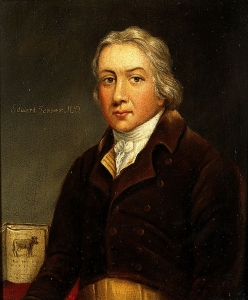
Edward Jenner (1749-1823)
A Traditional ‘Vaccine’
In China the practice of inoculation against diseases such as smallpox was established as far back as 200 BC.[xii] It is likely that traditional medicine, tribesmen and ancient civilisations used, or at least inadvertently ‘knew’ something of the benefits of limited exposure to a disease, in order to establish some degree of immunity.
Our own modern era of the ‘traditional’ vaccine begins when Edward Jenner (1749-1823) noticed that milkmaids appeared to be relatively immune to smallpox, a viral illness that was, in Jenner’s day, responsible for widespread suffering and death.
Jenner observed that something was being transmitted from the cows to the milkmaids, effectively protecting them against smallpox. Cows contract cowpox. It’s not the same disease as smallpox, but as the respective viruses are so similar, whenever the hands of a milkmaid came into contact with a blister or pox on the udder of a cow infected with cow-pox; the milkmaid would be exposed to this very similar virus.
In these instances the cowpox virus or ‘pieces’ of it, would enter the milkmaid’s blood stream through a cut or minor abrasion on her hands. The virus would be identified by her immune system as a ‘pathogen’ or disease-causing agent. White cells would attack the cowpox virus, causing it to break apart. Those same white cells would manufacture antibodies; little Y-shaped proteins that will stick to surface-proteins on the virus, and cause it to be directly destroyed, or recognised by other white cells that will mobilise to destroy it.
All of this complex immunology would of course be occurring within the milkmaid’s blood, whilst she happily milked her cows. She might notice a slight blister, a little pus, or minor swelling around one of the abrasions on her overworked hands. The slight redness might be ignored, and would inevitably fade away. However this localised reaction would have heralded exposure to cowpox. The cowpox antibodies would then persist in her blood, remaining attached to the surface of many of her circulating white blood cells; protecting her or “vaccinating” her against small-pox.
If the milkmaid should later come into contact with smallpox, those newly formed cowpox antibodies would be ready to mount an early and more efficient immune response. Her antibodies to the cowpox virus could attach to the smallpox virus, recruit other white cells – killer t-cells etc – onto the scene, and mount a pre-emptive response. This would be fast enough to eradicate the smallpox infection before it had an opportunity to spread and cause severe illness or death. It was Jenner’s genius that ultimately brought this reality to light.
Jenner collected some of the pus that oozed from the udders of cows infected with cowpox. He swirled it about in a drop of water, placed it in a glass vial and then offered it to the world as the prevention for small-pox. Half a century later Louis Pasteur coined the phrase ‘vaccination’ after vacca, the Latin for cow. The paradigm in respect of human medicine and public health had shifted forever.
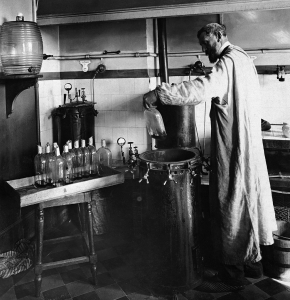
Louis Pasteur.
Perhaps the real hero of the vaccination story was an eight-year-old boy by the name of James Phipps, the son of Jenner’s gardener. On May 14th 1796, Jenner made a small incision into James’s arm, and rubbed in a drop of his magical ‘pus-paste’, making little James the first to be given a vaccine in the modern sense.
Thankfully, little James proved immune to the various small-pox ‘exposures’ and challenges that Jenner then came up with. At the time small-pox was responsible for almost 10% of annual deaths in England. Jenner sent his results in a paper to the Royal Society for publication, but his paper was ignored.
Having had the audacity to suggest pus from an infected cow’s udder, as a cure for smallpox, Jenner was at first dismissed as an eccentric by his peers. Yet, rather than disappearing into obscurity, he persisted. He vaccinated a further twenty-three people, and having seen little James survive, he even included his own eleven-month old son Robert, in this first ever vaccine trial.
At that stage the medical establishment found it impossible to ignore his findings, which soon attracted widespread interest amongst the medical fraternity. However, it was not until 1840, some forty-four-years after his first attempt to publish his results, that the British Government began offering Jenner’s vaccination, free of charge, to the general public.
The same but different
Since Jenner’s day, ‘traditional vaccines’ have functioned in precisely the same way. Pharmaceutical companies take a virus or bacterium, they break it up, kill it, or leave it intact but render it weaker or ineffective ‘the same but different.’ They then take the bug (or pieces of the bug), swish them around in a little drop of water, add in a few elements that act as preservatives and immune-stimulants; then we doctors inject those pieces into people, thereby preventing many from succumbing to various infective diseases. The vaccination exposes us to a bug or pieces of a bug causing our immune system to generate antibodies and white blood cells that will persist in our circulation and be ready to launch a pre-emptive strike against the bug or a similar bug if it is encountered again: we have, in essence, become immune.
So what is different about genetic-vaccines? Well here’s where the story becomes a little nuanced. Let’s try to put it in terms we might relate to.
To begin with we must remind ourselves that: all living things are composed of cells, which is perhaps the most basic tenet of biology.
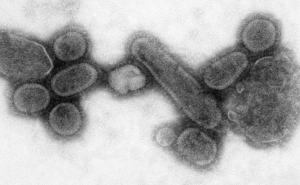
Image of a recreated 1918 influenza virus.
Viruses are not considered ‘living things’, because they are not ‘cells’ and neither are they made up of cells. They are formally referred to as ‘obligate intracellular parasites.’ They only become ‘alive;’ and can only replicate, after entering host cells, at which point they replicate or multiply within host cells. Once inside a cell the virus hijacks the cell’s own processes for making things that the cell needs for itself. The infected cell then becomes a virus factory, it swells with new virus particles, until it bursts, dies, and releases its payload of new virions into the bloodstream, or fluid outside of the cell membrane.
It is only when a virus is outside the cell, within the blood stream or tissues, that it might be recognised by white cells or antibodies, and become the subject of an immune response. When a virus is inside one of our cells, there are some discrete ways this cell can let other cells know that it has become infected; there are means by which the immune system detects that one of our own cells has a virus inside it. However, these are comparatively slow, indefinite and uncertain processes and will not be discussed here. The major and most important way the immune system clears viruses is by getting at them before they get inside our cells.
Once a virus is inside a cell, for the most part, it is hidden from the immune system. This point will be crucial to understanding the distinction between a genetic vaccine, and a traditional vaccine.
All Cells Look a Little, or a Lot, Like a Fried Egg:
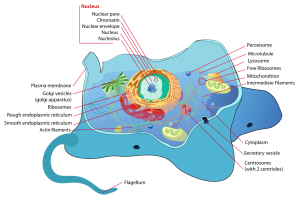
Under a microscope, all cells appear a little like fried eggs. Almost all of them have the same basic plan, the yellow yolk being the nucleus; the white of the egg, the ‘cytoplasm;’ and the outer margin of the fried egg (the crispy brown edge) being the ‘cell membrane’ or wall surrounding the cell. To learn the basics of how genetic vaccines work, we need only refer to this analogy, but we must understand our ‘egg’ a little better before we put the toast on.
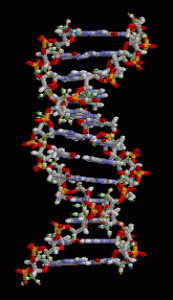
The yellow yolk, or nucleus, contains all of our DNA. To understand what DNA looks like, imagine your fly, not the one buzzing at the window, but the zip on your trousers. It is composed of two sides or strands that are linked together when your zipper is up, and separated when your zipper is down.
DNA is like an extremely long length of closed zip. Imagine this super long ‘zip’ coiled into individual space-saving packages, like neat balls of wool. Each of these little packages is called a chromosome and (with the exception of sperm cells and egg cells) the nucleus of each of our cells contains forty-six of these little balls of wool; twenty-three from mum, and twenty-three from dad.
All forty-six are packed into the nucleus, the yellow yolk of our analogous egg. When we, or one of our cells, needs something; a protein, a hormone, a replacement part etc., the information to make what the cell needs (the recipe for all of life’s necessities) is coded for in that length of closed zip, our DNA.
Each of the ‘teeth’ along the length of the zip strands, represent a single letter of the genetic code. An entire message may contain many letters, or teeth, along a specific length or piece of the zip. The lengths of zip that contain messages (or recipes) are called our ‘genes.’
The ‘message’ within a gene is like a recipe in a cookbook. It contains a coded instruction for how to make the protein, enzyme etc., or whatever it is that the cell wants or needs. The DNA code is in the nucleus, and the basic ingredients are located in the cytoplasm, and it is in the cytoplasm (the egg-white) where the item required is assembled and manufactured. The raw materials for manufacture get into the cytoplasm, when they are absorbed across the cell membrane (the crispy brown bit at the edge of our fried egg). These raw materials are the amino-acids, sugars and vitamins etc., that we receive in our diet.
To kick off the process, when a cell needs to make something, a signal is sent from the white of the egg (the cytoplasm) into the nucleus. That signal makes its way to the ball of wool or chromosome that contains the particular recipe, or code for the ingredients that will make up whatever is needed by the cell. When the signal reaches the chromosome containing the particular recipe or gene, the ball of wool is loosened slightly, and a relatively small length of closed zip (or DNA containing that recipe), is unzipped. One side of the opened zip is then copied into a piece of mRNA.
That copy of one side of the unzipped zip is called messenger RNA. In most textbooks it (the mRNA) looks exactly as I have described it: a single side of a zip. This messenger RNA then exits through pores in the nucleus. It enters the white of the egg, where this mRNA ‘recipe’ is then read or translated, and whatever it is the cell needs can now be manufactured within the cytoplasm or the white of the egg.
The Ribosome
When the strand of messenger RNA leaves the nucleus and enters the cytoplasm it is immediately found by a fascinating little cytoplasmic protein called a ‘ribosome’. The ribosome attaches to the mRNA. It then slides along this single strand of zip, and as it does so, ‘reads’ the code, and then makes a little strand, like a bead of pearls (a polypeptide). That strand of polypeptide then curls and folds itself into a little ball or blob; and this little blob of protein, is the very thing that the cell was looking for in the first place.
It might be a structural protein, an enzyme, a building block, a replacement part, or whatever. When the ribosome slides along the piece of mRNA it makes this new little string that will ultimately fold upon itself to become the required product. This wonderful orchestral process is as ancient as life itself and is called ‘translation.’
It is one of the rare occasions when jargon makes sense, for the little piece of mRNA, has indeed been ‘translated’ into a protein or ‘final product’ by the ribosome. The cell has now manufactured the thing that it needs, and after a few translations, the mRNA then degrades. No more ribosomes can attach to it, and no further product can be manufactured from it. If the cell wants another product it must send another message into the nucleus and call for another mRNA copy to be made in the nucleus and sent into the cytoplasm. It is a beautifully organised process, integral not simply to human life but to all life on the planet.
How Does a Genetic-Vaccine Work?
If you got all of that, you have grasped some of the fundamentals of cell biology and we are now able to ask: how does a genetic vaccine work?
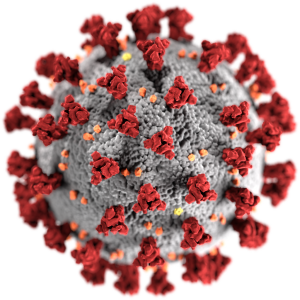
Most of us have seen an image or an artist’s impression of what a coronavirus looks like. A little ball, covered in spikes, like a medieval weapon swung from the end of a chain. Inside this little ball are the virus’s own genes. These genes are in the form of strands of RNA; the same type of RNA that is made in the nucleus of our cells, and sent into the cytoplasm for the manufacture of all ‘things’ that the cell needs.
SARS-CoV-2
The main difference between the RNA strands within a coronavirus, and those that naturally emerge from the nucleus of our own cells, is that coronavirus RNA does not code for ‘things’ that our cells might need. On the contrary, it codes for pieces that make up the coronavirus itself.
When a coronavirus binds to the outside of one of the cells in our respiratory tract, it releases its RNA into those cells – into the white of the egg – and there, instead of making proteins that are needed by our cells, our ribosomes attach to their viral RNA and begin to manufacture (or translate) proteins that make up the physical structure of the virus. The host cell has now becomes a virus-making factory; the cytoplasm swells with viral particles; the cell bursts, and thousands of new viruses (virions) are released into the bloodstream, or the fluid that lies outside of the cell membrane.
A genetic vaccine looks like, and functions, in almost exactly the same manner as the coronavirus itself. If a genetic vaccine could be visualised, it would look like a little sphere that encapsulates a piece of viral RNA or DNA (depending on which of the four vaccines we are considering). The role of the sphere is to protect the RNA or DNA inside the vaccine, and, most importantly, to bind it to human cells in a manner that will allow the piece of RNA or DNA to enter host cells at the site where the ‘vaccine’ is injected.
For an RNA containing vaccine (Pfizer & Moderna) once the vaccine RNA gets inside our cells, our ribosomes attach and translate the RNA into a piece of the virus (one of the spike proteins). The host cell will then swell with spike proteins, and release them into the blood stream or body fluids outside the cell. There, the spike-protein will trigger the same immune response that Jenner and the traditional vaccines make use of.
For DNA vaccines (Johnson & Johnson, AstraZeneca) the vaccine-DNA makes its way into the nucleus of our cells where it begins working (and is treated the same as our own DNA). It is copied into a piece of mRNA that will then travel into the cytoplasm and be translated by ribosomes into spike-proteins. Because genetic vaccines cannot infect cells, the process whereby a genetic-vaccine enters host cells is referred to as ‘transfection’.
It is only after the transfected host cell releases spike-protein into the blood stream that our genetic-vaccine begins working in the ‘traditional’ way. In reality, it is the cellular process for the manufacture of things which has been hijacked, and the ‘traditional vaccine’ is being made inside one’s own cells. The ‘vaccine’ is released into our blood stream in the same way that a cell infected with a virus releases new virus into the blood stream or tissues.
The final result might be the same, however, where a genetic-vaccine is different is in its mechanism it operates inside cells at a level of intimacy that Jenner could never have imagined. Because DNA vaccines enter the nucleus of our cells, and are treated as our own DNA, they come with a risk of damaging our own DNA, causing mutations, including, potentially, cancer. The potential is indeed an established fact. It is no less established than the fact that there is a link between smoking and cancer.
Consider when a piece of synthetic DNA comes within intimate proximity of a relatively enormous coiled ball of DNA that is dynamically unwinding and unravelling in response to the daily activities of the cell. Is there a chance that this relatively small piece of synthetic DNA might become incorporated into or interfere with the normal function of our own DNA? Before Covid, the answer was an emphatic yes. However of late, the mere suggestion will undoubtedly be treated as something of a ‘conspiracy theory’.
It is for this and other reasons that genetic-vaccines have not been previously licensed for use in humans prior to the current crisis. Thus, a 2013 paper[xiii]published in Germs, the respected Journal of Infectious Diseases lists the established disadvantages of DNA vaccines.
Of the 4 Genetic Vaccines currently available, 2 are RNA based (Pfizer/Moderna), & 2 are DNA based (AstraZen/J&J). Here's what non-bias (pre-covid) Science, states about the disadvantages of DNA Vaccines:
Very limited forms of gene therapy are available in the treatment of terminal cancers. However, pharmaceutical companies have not been able to market this form of medicine, outside of the laboratory, on human populations.[xiv] A cynic might reasonably argue that companies are exploiting the current crisis in order to expedite safety trials and open the market for ‘gene-therapy’.
There is nothing new here, this type of therapy, whereby patients are administered the gene for a missing or desired product, has been in development for several decades. The major difficulty for pharmaceutical companies has been how to get it out of the laboratory and past the paralysis of safety trials. It is certainly easy to see that if our cells are programmed to make and release spike-proteins, they can also be programmed to release other kinds of proteins, drugs and potential therapies directly into the human blood stream or tissues.[xv] Getting this type of therapy past regulators, and avoiding meaningful debate, has, (for better or worse), clearly been accomplished within the context of the current crisis.
From a simple economic perspective, if human cells can be programmed to take on the role of manufacturing the ‘drug’, numerous difficulties in respect of production, costs, delivery, and even safety trials, are relatively easily overcome. The paradigm shift that resulted from Jenner’s development of vaccination could pale into insignificance compared to the potential game changer of genetic-vaccine.
If, indeed, these vaccines are going to protect people from Covid-19, and they come with the added benefit of paving the way for novel therapies, why are people like me getting our proverbial knickers in a twist?
Again the answer is not that complicated. The cellular process of ‘translation’ that is being ‘hijacked’ by the relevant pharmaceutical companies, does not belong to them, to our respiratory cells, or even human cells. As mentioned already, it is a process that belongs to ALL cells, in ALL species. In essence it ‘belongs’ to all living things in Nature.
If anything happens to go wrong, the consequences are not limited to human beings, as the process being ‘hijacked’ is not exclusive to us. It ‘belongs’ to all life on Earth. The consequence of error, may extend further than a little nausea or swelling at the injection site.[xvi] Potential consequences extend to all cells that utilize the same process, and come in contact with the manufactured DNA or RNA.
DNA or RNA? Red or White?
Whilst the potential for either of the two available DNA vaccines to integrate into, or damage, human DNA is well established; there is an argument being made that this cannot possibly occur with the two available RNA vaccines.
Generally speaking within our cells once RNA is copied or made in the nucleus it moves into the cytoplasm. It does not travel backwards. RNA does not move back inside the nucleus and incorporate into our DNA. However, the key words here are: ‘generally speaking.’
Nature (generally speaking) blocks this possibility because the copied RNA that exits the nucleus, is different to DNA. It is an RNA copy of the DNA, the RNA cannot bind or interact with DNA. In the first instance RNA is a single stranded copy of one side of the zip. In the second instance the ‘teeth’ on the newly copied RNA are slightly different. They are tweaked with a sugar molecule called ribose, they are ‘ribosylated’ and therefore cannot readily recombine with DNA. (The ‘R’ in RNA simply means Ribosylated Nucleic Acid.)
The RNA does indeed code for the same message that is contained within the DNA, but the teeth, or the letters of the RNA code, are slightly different. RNA does not travel backwards and interfere with DNA. Generally speaking they are incompatible, and cannot interfere with each other. Therefore, when the vaccine makers insist that the pieces of RNA that they have transfected into our cells do not interact with our DNA; well, they aren’t spoofing. It doesn’t normally happen that RNA interferes with DNA.
So that’s what it says on the tin. However, there are two points that must be considered before we take this claim at face value. The first is a question of ‘precedence’ and the second is a question of scale.
Does it happen in humans and in Nature that RNA can travel backwards into the nucleus and interfere with or incorporate into DNA? The simple answer to this question is a definite yes! RNA can and does travel backwards to incorporate itself into our DNA. This retrograde move, (where RNA sequences become incorporated into DNA) is called reverse-transcription. The reason for the use of ‘retro’ in the word retrovirus, is because retroviruses, and many other viruses, make use of reverse-transcription, converting RNA into DNA that will then integrate into our own DNA.
HIV and HTLV (a human virus that causes t-cell leukaemia) are examples of viral infections, where RNA is converted backwards into DNA which then ‘interferes’ with our own DNA inside the nucleus of our cells. These viruses contain RNA, and they also carry an enzyme called ‘reverse transcriptase’. This enzyme converts RNA backwards into DNA. Retroviruses and other viruses (such as Hepatitis B) introduce the reverse-transcriptase enzyme into our cells when they infect them.[xvii] Furthermore, our own cells normally produce and use this enzyme (reverse transcriptase) inside the nucleus, where it has some ‘house-keeping’ roles in maintaining our own DNA.[xviii]
Perhaps even more interesting is the fact that within the human genome some 8% of our DNA is composed of DNA that was originally viral RNA. Infections with RNA viruses whose genes have since become permanently incorporated into our own DNA. These sequences are called ‘Human Endogenous Retroviral Sequences’ or HERVS.[xix] Many of them persist within our genome because they may code for proteins or things that are likely to be of some benefit to us; genes brought into our genome from outside the cell, via the natural, dynamic interaction between viruses, retroviruses and human DNA.
Many more of these endogenous retroviral (originally RNA) sequences are mysteriously redundant, and science is yet to learn of their function in sickness or in health. The fact remains that they are present; been present for countless millennia; may be integral to our evolution as a species; and are certainly with us ‘until death do us part.’ They should serve to remind us that there is a long established history of communication between viral and human genetics; an interaction that we should attempt to understand before it is blindly manipulated.
Interconnectedness
Too often viruses are portrayed as static structures, distinct from our own genetic material and distinct from one another. This is quite simply a rather primitive concept, the same kind of thinking that removes human beings and the consequence of our actions from Nature. It is part of the reason we remain largely incapable of seeing and appreciating the vast web of interconnectedness that dependently joins us to whales, rain forests, and even viruses.
We depend upon viruses for our genetics, as we depend upon yeast for our beer. Often viruses depend upon each other to cause infection. In certain instances, if a particular virus is missing something, a part or component (without which it is defective or deficient), the missing part is supplied by another helper-virus. There are helper-viruses, and there is an entire family of viruses (dependoviruses) that are entirely dependent upon assistance from helper-viruses. For example, in Humans, Hepatitis D virus is activated, only in the presence of Hepatitis B virus. Essentially, in order to function, the D-virus ‘borrows’ some missing parts from the B virus.
In short, viruses are not ‘monogamous recluses’: interacting with each other; helping each other; interacting with our genetic material within the cytoplasm and within the nucleus. It does not matters if that genetic material has come from the nucleus of our own cells, or been synthesized in the labs at Johnson and Johnson.[xx]
A Question of Scale
There is no such thing as a ‘perfect process’. Do something for the first time and you might do it right, do it right enough times, and you will eventually do it wrong.
When vaccine RNA or DNA hijacks a natural cellular processes and transforms the cell to vaccine or spike-protein production; how many times does this ‘event’ occur in the tissue of the person who has thus been vaccinated? Thousands, or several thousands of times? How many times has it occurred when several billion people are vaccinated? I don’t know the answer to this question. However, when a process is repeated billions of times, mistakes are no longer ‘possible’, they are inevitable. Such mistakes or mutations are not only inevitable but are essential, lying at the heart of evolution itself.
The End is Nigh?
There is certainly a mountain of spin and delusion on either side of the ‘genetic-vaccine’ or ‘gene-therapy’ debate, and we must keep matters in perspective. Genetic modification is here to stay, for better or for worse. The argument in respect of unforeseen genetic consequence to ourselves and/or other species is an old one. It began with ‘Dolly’ the sheep, and has raged for some time around the desirability of genetically modified foods.
Ironically, the introduction of synthetic genes into vegetables, created something of an international furore, yet the transfection of synthetic genes into millions of regular human beings has created far less controversy. Debate or discussion on the subject of genetic modification or therapy, its necessity, utility, or potential harm, is long overdue; although perhaps it might be a case of too little, too late.
Today, many of the foods we eat have been genetically modified to some degree. Genetically modified food is, however, met with and processed by the acid and digestive enzymes in our guts. The synthetic genes in GM products do not (as far as we know) enter our cells, they do not attempt to manipulate our own cellular or genetic processes.
There is clearly an urgent need to revisit this debate in light of these new vaccines. The battle may have been lost in respect of GM crops, but there is a reasonable argument to be advanced this time round as ‘human genetic processes’ are being tampered with, rather than sheep, beetroot or soya beans.
The Right Hashtag?
In recent years discourse and protest have become strangely predictable, organised around or stimulated by whatever happens to be trending on social media. It seems the right hashtag hasn’t been developed for ‘debate’ in respect of current pandemic policy, even as that policy extends into the function of our own cells.
How many people in Ireland, or around the world, know how a Covid vaccine work? How many clinicians are aware for that matter? When debate does erupt in relatively small pockets around the country it is hijacked by extremists or dismissed as being organised and attended by extremists. Social media appears to be moderating our behaviour to a greater degree than even genetics.
The health of our society depends far more on constructing a more honest and happier version of ourselves. We need to re-evaluate materialism, define happiness, reduce consumption, eat less (or no) meat, take plastics out of our food chain and ecosystems, restore and preserve habitats, protect and understand a biodiversity upon which we are entirely dependent. All of this, and more, is not contingent on genetic modification, no more than it is dependent on us getting to Mars.
Therefore, for the reasons I have outlined, I would not inject a healthy animal with an experimental genetic-vaccine, never mind a healthy human being.
[i] Jonathan Corum and Carl Zimmer, ‘How the Oxford-AstraZeneca Vaccine Works,’ New York Times, March 22nd, 2020, https://www.nytimes.com/interactive/2020/health/oxford-astrazeneca-covid-19-vaccine.html
[ii] Smriti Mallapaty, ‘The coronavirus is most deadly if you are older and male — new data reveal the risks’ August 28th, 2020, https://www.nature.com/articles/d41586-020-02483-2
[iii] Adam W. Gaffney, ‘We need to start thinking more critically — and speaking more cautiously — about long Covid’ Statnews, March 22nd, 2021, https://www.statnews.com/2021/03/22/we-need-to-start-thinking-more-critically-speaking-cautiously-long-covid/
[iv] Conor Pope, Vivienne Clarke, ‘Vaccination rollout in nursing homes almost complete, HSE says,’ February 12th, 2020, Irish Times, https://www.irishtimes.com/news/health/vaccination-rollout-in-nursing-homes-almost-complete-hse-says-1.4483250
[vi] Moderna Announces First Participants Dosed in Phase 2/3 Study of COVID-19 Vaccine Candidate in Pediatric Population https://investors.modernatx.com/news-releases/news-release-details/moderna-announces-first-participants-dosed-phase-23-study-0
[ix] ‘Immune evasion means we need a new COVID-19 social contract’, The Lancet, February 18th, 2021, https://www.thelancet.com/journals/lanpub/article/PIIS2468-2667(21)00036-0/fulltext
[x] Jeremy Divine, ‘The Dubious Origins of Long Covid’, Wall Street Journal, March 22nd, 2021, https://www.wsj.com/articles/the-dubious-origins-of-long-covid-11616452583
[xi] Angela Betsaida B. Laguipo, ‘86 percent of the UK’s COVID-19 patients have no symptoms,’ News Medical Life Sciences, October 9th, 2020, https://www.news-medical.net/news/20201009/86-percent-of-the-UKs-COVID-19-patients-have-no-symptoms.aspx
[xii] The History of Vaccines, Chinese Smallpox Inoculation, https://www.historyofvaccines.org/content/early-chinese-inoculation
[xiv] Kristina Fiore, ‘Want to Know More About mRNA Before Your COVID Jab?’ Medpage Today, December 3rd, 2020, https://www.medpagetoday.com/infectiousdisease/covid19/89998
[xv] Nature Reviews Drug Discovery volume 17, pages261–279(2018)
[xvi] Nicola Davis, ‘Covid vaccine side-effects: what are they, who gets them and why?’ The Guardian, March 18th, 2021, https://www.theguardian.com/world/2021/mar/18/covid-vaccine-side-effects-what-are-they-who-gets-them-and-why
[xvii] Medical Microbiology. 4th edition (Chapter 62).Galveston (TX): University of Texas Medical Branch at Galveston; 1996.
[xviii] Proc Natl Acad Sci U S A. 1986 Apr; 83(8): 2531–2535.
doi: 10.1073/pnas.83.8.2531, https://www.nature.com/articles/1205081
[xix] PMCID: PMC7139688 PMID: 32155827 Human Endogenous Retroviruses (HERVs): Shaping the Innate Immune Response in Cancers.
[xx] Knipe, David M.; Howley, Peter M. (2007). Fields Virology (5th ed.). Lippincott Williams & Wilkins. pp. 126–7.
Hannah sat deep in thought waiting for the reception room’s red light to turn green indicating she could open the door to Dr. Dysart’s interior space. She was trying to decide what to talk about – the love bombing or green. Green was her favorite color and had been ever since she had learned the word verdant was a variety of green. As in lush. She was feeling lush and new and full of herself this sunny spring day.
She had built her vocabulary by acquiring a new word or term every day, employing them with anyone she wanted to impress, and was determined to make an impression on her psychiatrist. Because she was in love. When the light turned green, Hannah inhaled, and turning the door handle, entered his office on the exhale.
Smoking a Dunhill, Dr. Dysart sat behind the desk he had bought from a New Orleans antique dealer. He smiled and then pursed his lips releasing a ring of smoke that rose and settled above his head like a nimbus. And why not. He was her god. Hadn’t he performed miracles much like Jesus had done for Mary Magdalene, his most beloved disciple?
“Why you look like a specter today, Dr. Dysart.”
“I see we’ve learned another word, Hannah. Where did you find this one?”
Sauntering over to her designated place on the couch directly across from him, she replied, “In some research for my Victorian lit class.”
“What were you reading?”
Hannah stood up from her seat and after an exaggerated curtsey, launched into a short recitation of a poem she had located in a nineteenth-century Ladies Home Journal called The Difference:
Cried the grim spectre Death: “Time is a thief, Who, with each passing breath, Lightening grief, Takes from men all their fears.” Love merrily Laughed, “In a thousand years Time robs not me.”
Imagining herself one of the literati, Hannah reversed her steps toward the couch with an unceasing stare. She might not be rich, but like any woman in her family, she was a reader. So, when she felt his sofa’s dark green damask caress the back of her calves, she asked, “What do you think about that, Doctor?“
The psychiatrist took a long look at his precocious patient and snuffed out the cigarette in a crystal ashtray. Without leaving her gaze, he walked from behind the desk to take his place on a wingback chair adjacent to the couch. This was one of his strategies for disarming an ego defense.
He examined Hannah at close range. She was blonde and brilliant. Dangerous only to herself. He knew she was in love. This too was part of his strategy with histrionic patients. Especially a female one.
Except this time, she did not giggle as she had done before. She stared back at him. And while the doctor settled in for their prescribed fifty-minute rendezvous, Hannah began to fidget with her shoulder bag, which he noticed she placed not beside her, but in her lap.
“What’s going on, Hannah?”
“Nothing special.”
“What’s the fidgeting about, then.”
Startled, Hannah willed her hands to stop, slipping the right one into the bag on her lap. Her eyes dropped down to fix on the various shades of green spirals in the damask upholstery. Verdant she thought, now letting her eyelids flutter closed.
“Hannah…,” he whispered into her left ear. On the couch next to her now, Dysart had been waiting for this moment. She was calm enough and would permit him to say,
“Come back to your body, Hannah.” As he spoke Dysart placed his hand on her thigh. “Come back to the present, Hannah.” She opened her eyes. Looking straight ahead and not at him, Hannah’s hidden hand tightened around the handle of a box cutter. A gift from her brother.
Dysart’s hand moved up her thigh. Hannah closed her eyes and began counting her breaths as he had coached her to do when anxious. Inhale . . . one . . .two . . .three. . .four. Exhale . . .one . . .two . . . three . . .four . . .five. When his fingers reached the sweet spot, he felt her involuntary shudder. Dysart’s warm breath was on her throat before his lips landed there. He kissed the neck, making his way up to the cheek, and she turned toward him, her hand exiting from the bag to embrace him.
His final kiss landed in full on her mouth. A vital force energy traveled up from Hannah’s second chakra to the third flying right by the fourth. Filling her throat, it formed and then released two words, petite mort.
This experience of tantric love bombing startled both doctor and patient. Now drowning in Hannah’s wide open green eyes, Dysart did not move a muscle. A nanosecond into it, he could feel the cold sharpness of a box cutter’s blade penetrating flesh just above his carotid artery. “Hannah,” he whispered. “You don’t want to do this.”
Deep in thought about where she might have heard petite mort, Hannah put the box cutter back into its hiding place without reply. Dysart’s apparent astonishment left her feeling like a mature woman. Casting one last look at the damask’s green spirals, she rose from the couch and strode for the door.
Heading out of his office, Hannah reminded herself that she must go look up petite mort, and its meaning, in her French dictionary. She also wondered, Should I tell Mama about Dr. Dysart? Aboutthe love bomb and how much I love him. Or wait… to bring up in our next session? In the end, Hannah waited.
Two words that strut confident of
their own historical inevitability.
Everyone in time meets them,
though hopefully not both
ringing your door bell
the same day,
unless your name is
Nagasaki or Vietnam;
or you’re the first village
no-one’s ever heard of
successfully abolished
from thirty thousand feet
by a transgender person
pressing a button;
or you’re the first Somali in history
proudly turned into a pile of burning mince
by a drone designed by a woman of colour;
or you’re the wrong type of Australian
whose computer told us the names
of the obliterated
and so can only leave prison
in a fair-trade white cardboard box;
or you’re me, delighted
to expire unvaccinated rather
than spark a diplomatic kerfuffle
by sticking in my bicep
something as sinister sounding as Sputnik
without written permission from Brussels
who’ll surely deliver
a keynote speaker to my grave
to thank my corpse for its contribution,
and find a plausible way of saying:
I’m down here, getting acquainted with the snails
so they can be up there, polishing their idea of themselves.
Feature Image: Original #banksy ‘Civilian Drone Strike’ in East London ahead of London arms fair opening.
For the things we have to learn before we can do them, we learn by doing them. Aristotle, The Nicomachean Ethics
“That’s how you learn. But after you make the same mistake one, or two, or five times, you’ll eventually get it. And then you’ll make new mistakes.” Louis Sachar, The Card Turner (2010)
Managing and Nurturing the New Workplace Culture
A recent report from the International Labour Organization provides evidence that employees are more productive when they work outside a conventional office.[i] They are, however, more vulnerable to longer working hours, a more intense pace of work, work-home interference, and elevated stress.
Mark Twain
Other research indicates that common problem for remote workers[ii] include: ‘unplugging after work’ (38%); as well as loneliness (19%); lack of collaboration (17%); distractions at home (10%); managing and coping with time zones (8%); and last but not the least, Staying motivated (8%).
Mark Twain once said: ‘If the first thing you do each morning is to eat a live frog, you can go through the day with the satisfaction of knowing that that is probably the worse things that is going to happen to you all day long. Your ‘frog’ is your biggest, most important task, the one you are most likely to procrastinate on if you don’t do something about it.’
So, I list two recommendations for managing expectations while we survive the #workfromhome phase.
Focus on a few things, and do them well. The ‘Eisenhower matrix’ is often used to avoid unnecessary time-wasting tasks and know which tasks to do next. Ideally plan to do just one big thing, three medium things, and five small things per day,[iii] the 1-3-5 rule.
Managing energy is more important than managing time: Keep track of how much you’ll be able to focus at different points of the day. You improve by pushing your practice, not yourself during periods of low energy.
‘Given the lack of face-to-face interaction and heavy reliance on technology, the intent of what someone wants to communicate might be misconstrued.’
Communication (a lack of it or too much of it) generally improves when a collaborative work management platform is used to centralise all communication and collaboration. Suggestions would include using Trello or Asana to Basecamp or Wrike – they are inclusive in keeping managers in the loop and on top of what is happening.[iv]
An MIT Sloan study shows that employees were twice as likely to discuss the quality of communication by top leaders in positive terms during the months of the pandemic than they were a year earlier. In fact, they were 88% more likely to write positively about leaders’ honesty and transparency (46%). Employees also expressed more positive sentiment about transparency (42%) and communication (35%) in general.[v]
One of the most important themes that stand out in the months of the pandemic is the degree and quality of communication by leaders. A recent study shows that employees of Culture 500 companies gave their corporate leaders much higher marks in terms of honest communication and transparency, during the first six months of the pandemic compared to the preceding year.[vi]
On the other side of the coin, when you work from home, you no longer have a clear geographic division between workspace and personal space. It is for this very same reason, once again, difficult to switch off when both personal and professional worlds operate under the same roof. With constant remote work in action, the boundaries between working and not-working start to fade rapidly.
Home-based workers do not tend to receive signals about when to switch off. Therefore, leaders need to communicate clearly on the ‘time for work’ and ‘time for play’ model, which would help smooth everybody’s work model and conduct.
No Place Like Home
Fundamentally, one’s home is a place of relaxation, safety, and security. It’s a place where you subconsciously slip into a calm, easy-going state of mind, putting the stresses of the workday behind. However, working from home punches a hole right through that neat division. Many telecommuters complain they feel like they’re never off the job. They always feel a compulsion to check email or get “just one last thing done.”
So how to set the rules of engagement and boundaries?
Remote work becomes more efficient and satisfying once managers set expectations for the frequency, means, and ideal timing of communication for their teams. For example using videoconferencing for daily check-in meetings, but using IM when something is urgent.
Also, if leaders can allow employees to specify their hours to be contacted and equally importantly, when not to be. Finally, it is important for leaders to keep an eye on communication among team members to ensure that they are sharing information as needed.
Additionally, leaders need to do more frequent check-ins to see how they can support their people in moving forward. Since, above all, leaders need to build trust. During this period managers in certain industries have enjoyed a bit more autonomy within companies to take ownership of projects and complete these how they see fit. A responsible degree of empowerment and delegation is what came out of the process when done with purpose.
Consequently, there’s also been a huge shift in flexibility in this period, with firms having to acknowledge – often for the first time – that their employees have complex lives, which sometimes incorporate children, ageing parents, health concerns, and poor housing, to name but a few of the challenges the pandemic has brought to the fore.
The Art of Learning (by doing)
According to Erin Driver-Linn of Harvard University: ‘Experiential learning is participative—for example, either making or doing … What do we need to understand, as a learner, which is conceptual? And what do we need to understand by experiencing things in a different way?’[vii]
Managing talents and the right selection followed by allocation of relevant resources are attributes that a good institution requires. The core skills any individuals who wants to thrive in an innovative business environment or organisation come down to the following: creativity, problem-solving and continuous improvement skills, developing attitudes and behaviours that are needed to frame and solve problems, and generate new ideas on a continual basis.
Additionally there is risk-assessment and risk-taking skills; the mindset to manage these has to be solidified over time. Upgrading these skills depends heavily on effective planning and implementation.
Managing the ‘New Normal’ Workplace Culture
‘People find meaning in their daily rituals of getting ready to leave home, commuting, grabbing their cup of coffee, and filling their water bottle before sitting at their desk.’[viii]
Broadly, organisational culture is defined by the collective norms of behaviour exhibited by the individuals within an organisation. Since the first, almost global, lockdown of early 2020, there was a shared buzz, online and otherwise, that #wfh would be a recipe for disaster when it comes to maintaining stable company culture.
Among the questions that leaders and managers pondered were:
Will the company culture take a hit because people can’t meet in person, making it harder to solidify their shared beliefs?
Will they be less able to use the company culture as a roadmap for making sensible decisions during tumultuous times?
How can companies continue to build and leverage their culture while all operations are functioning remotely?
At least we seem to be wasting less time now. A working paper from the National Bureau of Economic Research claims that even though we’re attending more meetings in the Zoom era, the average meeting length is shorter and we’re collectively spending less time in them.[ix] Most firms claim to have increased communication, meaning that employees might be feeling more connected.
Besides communication and trust exercise, leaders also need to establish and maintain discipline and boundaries. People working alone tend to become less productive over time, even if they work longer hours than they did in the office. This has less to do with productivity than losing their frame of reference and task orientation. As is often the case, it comes down to mindset. While some of this is innate, other aspects are derived from situational and environmental conditions.
Social media giant Twitter was one of the first companies that decided that their workers could work from home when COVID-19 cases began rising in March 2020.[x] With foresight, Jack Dorsey (CEO of Twitter and Square) also stated that employees will potentially have the option to work remotely indefinitely.
In addition to being ahead of the game, Twitter also provided employees with day-care reimbursements, continued to pay contract workers[xi] whether they’re able to work or not, and banned all in-person events for the rest of 2020. This is the situation to this day.
American graphic artist Harvey Ball.
Put a Human Face on your Organisation
Especially in the context of an abrupt shift to remote work, it is important for leaders to acknowledge stress, listen to employees’ anxieties and concerns, and empathize with their struggles. If a newly remote employee is clearly struggling, but failing to communicate stress or anxiety, ask them how they’re doing.
Even a general question such as: “How is this remote work situation working out for you so far?” can elicit important information that you might not otherwise hear.
Once you ask the question, be sure to listen carefully to the response, and briefly restate it back to the employee to ensure that you understood their answer correctly. Let the employee’s stress or concerns (rather than your own) be the focus of this conversation.
Cut to Credits!
Successful organizations need effective leaders. With the aging of the workforce and imminent retirement of the Baby Boomers, U.S. organizations are experiencing a shortage of skilled leaders and a significant need for leadership training. Skilled leadership affects the entire workforce; numerous studies indicate that one of the key reasons for employees leaving their jobs is because they are uncomfortable with the working environment created by a direct supervisor. Successful organizations need effective, parental, and democratic leaders at this juncture.
Leadership training could reduce turnover at all levels in an organization, the focus remains on learning and managing adaptability, interpersonal people skills, self-awareness, developing and maintaining a sense of purpose, timely and effective decisiveness, as well as collaborative skills. The basic aim of training and development programmes is to help the organization to achieve its mission and goals by improving individual and, ultimately, organizational performance.
In light of the initiatives of prominent global businesses as well as small businesses at a domestic and local level, the concept of a virtual workplace has been redefined in the past twelve months. This is a useful time to document the process as at a later stage we will need to look back and take lessons from this period.
Virtual bonding is helping many to come emotionally closer to their colleagues. Some have seen a marked reduction in the communication gap between themselves and their senior. This insight may not seem like rocket science, but a key lesson for companies is to work out ways of avoiding toxicity and recognise the supreme importance of fairness and kindness.
Research into emotional intelligence and emotional contagion tells us that employees look to their leaders for cues about how to react to sudden changes or crisis situations. If a manager communicates stress and helplessness, this will have what Daniel Goleman calls a ‘trickle-down’ effect on employees.
Effective leaders[xii] generally take a two-pronged approach, both acknowledging the stress and anxiety that employees may be feeling in difficult circumstances, but also providing affirmation of confidence in their teams. We are all in this together, and we will get through it – perhaps we should see it as a time to get to know ourselves a bit better.
[i] ‘Working anytime, anywhere: The effects on the world of work’, Eurofound, http://www.ilo.org/wcmsp5/groups/public/—dgreports/—dcomm/—publ/documents/publication/wcms_544138.pdf
[iii] Deen Dayal Yadav, ‘How to cope up with the challenges of remote working?’ Thrive Global, May 6th, 2020, https://thriveglobal.com/stories/how-to-cope-up-with-the-challenges-of-remote-working/
[v] ‘STUDY: Organizations Rising to the Challenge of COVID-19 Communications, but Needs Persist; Leaders Must Address Concerns and Demonstrate Transparency, Clarity and Openness’ BusinessWire, April 3rd, 2020. https://www.businesswire.com/news/home/20200403005278/en/STUDY-Organizations-Rising-to-the-Challenge-of-COVID-19-Communications-but-Needs-Persist-Leaders-Must-Address-Concerns-and-Demonstrate-Transparency-Clarity-and-Openness
[vi] Donald Sull and Charles Sull, ‘How Companies Are Winning on Culture During COVID-19’ October 28th, 2020, https://sloanreview.mit.edu/article/how-companies-are-winning-on-culture-during-covid-19/
[vii] ‘Innovation & discovery skills for ‘innovention’ managers’ The Sentinel, February 14th, 2021, https://www.sentinelassam.com/editorial/innovation-discovery-skills-for-innovention-managers-524593
[viii] James Thomas, ‘How the pandemic can change workplace culture for the better’ Strategy&, https://www.strategyand.pwc.com/m1/en/articles/2020/how-the-pandemic-can-change-workplace-culture-for-the-better.html
[xi] Jack Kelly, ‘Twitter CEO Jack Dorsey Tells Employees They Can Work From Home ‘Forever’—Before You Celebrate, There’s A Catch’, May 13th, 2020, https://www.forbes.com/sites/jackkelly/2020/05/13/twitter-ceo-jack-dorsey-tells-employees-they-can-work-from-home-forever-before-you-celebrate-theres-a-catch/?sh=32caf77a2e91
[xii] ‘Daniel Goleman, ‘An EI-Based Theory of Performance’ Consortium for Research on Emotional Intelligence in Organisations, 2000, http://www.eiconsortium.org/reprints/ei_theory_performance.html
Another night fifth in a row
unsettled but unfrozen
thinking I get it I get it
(I don’t, but I have skin and nerves):
Whatever sustains someone doing what you do,
I mean never mind the privations! that unseen hand,
Shoulder cupped, steering towards the leper colony –
the Big Bewk saints, the Seenitalls, Tell-you-what-I’d
do-if-I-were-yous…
(enthusiasts who sleep one to a room
and who if we just roll up that sleeve
for a couple hundred spare months)
yes that too. If we just….
And you break away and plod on
As they foretell your grit will kill you.
Well this too, a mile away: Perpetual Motion!
Wind or tide or compressed chipboard or wherever they’re
frisbeeing the tax breaks this current? cycle?
into laps of pals slash creditors ABCing
a redesigned polity, where battery tech –
Sorry – Nology – excuseme, will…
(impilmentated across the economy)
Will save…
The child in the lithium mine, fingers
deformed, the first knuckle gone.
Overheads, always overheads.
But we’ll outsource to Europa
when the talent pool is Exhausted.
Which will take a while yet.
Half a mile away:
Our Vegan Monday grinners,
Off setting off in the fake jeep,
Eerie silence til the gas kicks in
Over Charlemont bridge, arc of
Our hero stolidly crossing,
Dashboard screams, driver jolts,
keels, (rest of car buried in phones)
“Watch where YOU’RE going!” he starts
To shout
As the eyes turn
the whole corpus twists
toward him and through him –
an air-conditioner chill then gone,
no trace in the rear-view.
He tells himself he dodged, but…
This has been happening
More often lately. Overtired, that’s all.
Newstalk. And an early night tonight.
They sleep eight hours.
Belatedly, worry entered their guts
once they had genetic skin in the game, but
Ours will be fine: Business Cantonese, crypto,
Young Scientist, fun size beers (better
they’re in the house than eff-knows-where) and
The Talk About…
They sleep nine hours.
A theatrical yawn.
Back to the salt mine, conference call.
I get it in the sense that I wouldn’t either,
I think you’re right, and if I had your honed instincts
and scalpel humour—
But on days such as this, fifth and counting
Surely a den of thieving fuckers is better
than another wet gutter screaming match
with a fifteen hour night?
Husband your fuel and your wits. Arm yourself
with a rock or a crunched up can
in your goto pocket. Breathe out, finish anything you’ve left,
stride towards the LED light.
Don’t be late, they’ll lock you out to die.
“you’ve made your point
you holy few
you’ve made your point!”
Jesus Christ, like.
I mean Jesus Christ, they’d fling you in
the Liffey stamp “buried at sea” on the docket—
Quickly – pick three: Psychiatric History, Known to Gardaí,
Mintil Hilth™, Engagement Izzyous – which is why –
Refusal, Reluctance, the cracks – and again this is
Again why – yet another – yet
Another No Fixed Address – sponge, waste, nosh Abel
for…For?
Well, whether the brown liar was once his thing,
He wasn’t using: he wins. He haunts at his pleasure.
Remember that as ever decimating rootless scum
was an inexpensive way to impress upon sit-in
students down a year of Law, sneering at
the empty Jay One cancellation threat: –
“Australia America Canada New Zealand,
we will see them all while you’re here minding
Your handicapped kids, you inbred bogscum” but
but what if – surely a contingent?:
Cracks invisible under carpeted floors,
The weight of Relying On You, son,
And such a long way down.
“We know you’ll get your act together.
Perhaps you’re just overthinking, your—”
Fogged vocation? or, The base fear:
marooned and slowly draining amid the dying
amongst the dying in between the bonesunk husks,
our holy dying knackers dying at midday without a fuss,
town on a weekday, going peaceful after years howling
into their mobiles their streets those trams,
dying for no reason, dying without ever even
presuming to arrogate a version of what same
Artsblock Stephen Heroes claim’s birthright
to lose, yet perhaps too they’re just
dying for a lungful of a dreamt cracked Rome:
nicotine and subway vents and rumour.
Harlem, The Bowery, The Hands That.
Twenty years later the bootlace daredevils’
Conspicuous Return: Lo! It Can Be Done Son, says
the cute one, a quiet deal on a struggling licence
(add strip lighting, carvery, Guinness mid-strentt’)
While the others…
Vanished Camden or Rockaway or Justfuckedoff,
never left the tower no matter how far they fled
from the ripped places those ripped up were next sent,
those banished home staring at the wall of unsaid,
sleepless over decisions unmade, failed
stabs at intercession with mute smiling friends
that went early on,
back when the junk suddenly dropped from the sky
like manna – sufficient for each day
turns out most people don’t want to die,
so explain it to me again.
*Concurrent to the events depicted in noted docu-drama Rambo III, western cities were flooded with cheap Afghan heroin. Dublin – largely unfamiliar with opiates –came out of it badly.
When the Federal Convention of 1878 had completed its work on the U.S. Constitution in Philadelphia, Benjamin Franklin described its result as, “A Republic, Madam, if you can keep it”.
Not much later, John Philpot Curran gave a similar warning, now usually summarised as “Vigilance is the price of liberty”.
Each was saying that a written Constitution describes how a country should be governed, but does not promise that it will be. If we want to keep the system we have chosen, we must be vigilant. A single departure may not seem very significant, but if we ignore it we may realise too late that it was a step in undermining our system of government. It is not enough for political leaders to be alert. In a democracy we are all political leaders, our system of government and the freedoms it promises belong to us, and if we want to keep them we must be vigilant to protect them.
This country has a democratic Constitution. Article 5 declares that it is to be a democratic state, and other Articles, read together, deliver on that promise. The Dáil is to be the dominant power in the Oireachtas. Elections for it must be held at regular intervals, so that we can dismiss political leaders who do not serve us as we wish. Elections must be by single transferable vote. The “sole and exclusive power of making laws for the State” is vested in the Oireachtas, the only limit being that its laws may not be “repugnant to the Constitution”. Laws are made in public, at sittings the public can attend and the media can report.
That our only lawmakers are those the People choose is the foundation of our democracy, as of every representative democracy. By adopting a Constitution that said that the only people who could shape the country by making law were those we had elected, we gave ourselves a democracy in 1937 – if we could keep it.
Leinster House the meeting place of Dáil Eireann.
Have we? Partly seems to be the best answer. The Oireachtas is no longer our sole and exclusive lawmaker. In the 1960s Irish judges began to adopt what is called “judicial activism”, the view that judges should play an active role in shaping the law. In 1965 the High Court advanced that view in the Gladys Ryan case. The Oireachtas had decided that it would be good for our dental health if piped drinking water contained a tiny proportion of fluoride, and enacted the Health (Fluoridation of Water Supplies) Act, 1960, under which piped drinking water was and is fluoridated. Mrs Ryan complained that this meant she and her children had to drink contaminated water, and took High Court proceedings to have the Act annulled. After a hearing lasting many months Judge John Kenny decided she had not proved that fluoridated water was injurious to health and dismissed her claim. But he made it clear that if he had formed a different view he would have annulled the Act.
That the case went to hearing is surprising. As we noted above, our Constitution vests in the Oireachtas the “sole and exclusive power of making law for the State”. Those words seem to mean that if a citizen thought an Act was defective her only resource would be to campaign to have the Oireachtas repeal or amend it. If another authority within the State could examine the reasons that led the Oireachtas to pass the law, disagree with them and annul the legislation, the power of the Oireachtas to make law would not be “sole and exclusive”. Those words seem to mean that the judge should not have heard the claim, because he had no authority to interfere with legislation that was consistent with the text of the Constitution. The Attorney General seems not to have made that argument. If so, he effectively abandoned the Constitutional authority of the Oireachtas as our sole and exclusive lawmaker. It seems never since to have been asserted in any Court.
The Judgment was a blow to the authority of the Oireachtas in another way. The effect of Judge Kenny’s decision was: “The Constitution includes a list of rights it guarantees to citizens, and the list is clearly not intended to be complete. Other rights may be added. The Oireachtas can add them. So can judges. A judge of the High Court or Supreme Court may decide to recognise a right that a citizen claims but the Constitution does not mention and deem that right to be part of the Constitution, as though it had been included in the document the People adopted in 1937. An Act of the Oireachtas or a Section of an Act that is incompatible with a right a judge has decided to recognise will be annulled as if it were repugnant to the Constitution, even though it is not”. (Rights so identified later came to be called “unenumerated rights, and we will use that term, for simplicity.)
The Ryan decision changed how we are governed, in three ways. First, judges could examine why the Oireachtas had passed legislation and interfere if they disagreed with its reasons. Secondly, the Oireachtas’ authority to make laws was no longer sole and exclusive, because judges might decide to recognise and enforce an “unenumerated right”. Thirdly, such a decision by a judge would override legislation enacted by the Oireachtas. That may seem to be a transfer of power from one organ of State to another, but it was an erosion of our democracy, because representative democracy depends on laws being made by those we have elected and by nobody else. Authorising people we had not elected and could not get rid of to override decisions of those we had elected was and is inconsistent with our claim to be a democratic state.
The Ryan decision also undermined our authority in a less obvious way. Our Constitution provides that only we, the People, may amend it, but when judges import “unenumerated rights” into it they in effect amend it. Our authority to do so is no longer sole and exclusive.
Separation of Powers.
Finally, it effectively changes the meaning of “separation of powers” and “separation of functions”. These used to mean that each of the three organs of government, the legislative, executive and judicial, had its separate function in which neither of the others should interfere. It now seems to mean only that the legislature and executive may not interfere in the judicial function.
There was no protest. We did not show vigilance in defence of our freedom.
Judges have invoked the “doctrine of unenumerated rights” (a “doctrine” is more impressive than a “theory”) many times since 1965. Unlike legislators, judges deal only with issues others bring before them, so they produce new “doctrines” or “rights” only if litigation gives them the opportunity. However, a substantial number of unenumerated rights have been established and a substantial amount of legislation annulled in the last thirty-six years. For example:
Although all of the rights the Constitution lists except Habeas Corpus are promised only to citizens, that is only to people who, as it says, owe loyalty to the Nation and fidelity to the State, the Supreme Court decided to grant an “unenumerated right” to a non-citizen. (V.H. v. Minister for Justice Supreme Court No 31 & 56/2016)
It forbade the Dáil to conduct an inquiry into matters of public concern that might call for legislative intervention. (Maguire and others Seán Ardagh and others [2001] No. 329 JR; S.C. Nos. 324, 326, 333 and 334 of 2001] – the “Abbeylara case”.)
On dubious grounds it invalidated legislation designed to protect young girls from sexual exploitation. C. v. Ireland & ors [2006] IESC 33
It refused to hear a Habeas Corpus claim by a citizen who claimed to be unlawfully imprisoned, although the Constitution promises that right to anyone to making such a claim. (Edward Ryan v. Governor of Midland Prison [2014] IEHC 338)
In a puzzling decision, it held that a police officer who is asked to approve a search warrant must act “judicially”, and that an officer involved in the relevant investigation cannot do so. The essence of us acting judicially is hearing both sides before reaching a conclusion. That does not seem to be what the Court meant, but it did not explain what it did mean. (Damache V. DPP {2012] IESC 11
Although tradition and the Constitution both say that elected legislators in the Dáil or Seanad are to be free to perform their duties without judicial oversight, the Supreme Court decided that someone who claimed to have been injured by what had been said to her in a Dáil committee could pursue a claim. Kerins v. McGuinness & Ors. [2019] IESC 110
One Supreme Court judge, Judge O’Donnell, complained in a written Judgment of the quality of legislation, in language reminiscent of an irritated employer complaining about incompetent subordinates. (Clarke O’Gorman [2014] IESC 72)
Each of these decisions further undermined the Oireachtas, and, through the Oireachtas, the Irish People’s power to shape the country we live in. Two of them, N.V.H. and Edward Ryan, are incompatible with the text of the Constitution. The list shows how much of our lives, which we agreed in 1937 should be governed by our elected legislators are now subject to the Court’s intervention – or interference. Again we have not shown vigilance.
Nor did those we elected to represent us. On the contrary, they have recently enacted the Judicial Council Act, which, after bringing the Council into existence, invited it to prepare “Guidelines” for compensation to be paid to successful plaintiffs in personal injury claims.
Superficially, that may have seemed rational. Individual judges decide what money should be paid as compensation for injury, so why should not judges as a group agree Guidelines to be applied, or at least consulted, in all cases? The answer is simple. Deciding what compensation should be paid to an injured plaintiff is administering justice, which is the role of judges. Guidelines to be consulted in all cases have the effect of law, even if they are given another name. Judges have no role in making law. Only the Oireachtas has. So in passing the Act the Oireachtas declined to perform a function that the Constitution imposes on it, and delegated it to a body that has no authority to perform it. This also meant that questions that elected parliamentarians should have teased out will not get the attention they need. Here are some examples. Readers may think of others.
Personal injuries actions operate on an assumption that pain, past present and prospective, can be compensated for by money, and only by money. Is that assumption valid?
If it is, is it right to assume that the extent of the pain, not the circumstances of the sufferer, determines the amount of compensation? €10,000 might seem a life-saver for a young couple struggling with high rent or mortgage and household bills, but be next to useless to a retired person living on an adequate pension.
Our system protects a wrong-doer from having to address and acknowledge the consequences of his or her wrong-doing, because insurance companies forbid any contact between their insured and his or her victim. Does that serve us well? Would we drive more carefully if we knew we would have to confront personally the consequences of any carelessness?
The criminal court of justice, Dublin. Daniele Idini/Cassandra Voices
Most Superior Court judges nowadays are “Judicial activists” as described above. The concept is obviously attractive to judges and perhaps to others who believe trained intellects shape a society better than “ordinary people” could. But it is incompatible with democracy. That the Oireachtas invited a Council of judges to make law and the judges agreed tells us how far this country has travelled from the democratic ideals set out in our Constitution. Incidentally, the Guidelines emerged only after judges had circulated among themselves documents that they discussed in private, and that we did not get to see. With limited exceptions, our Constitution requires the Oireachtas and the judges to do their work in public, but, understandably, it did not consider how judges should do the work of the Oireachtas.
This article is critical of judicial decisions, and might seem to be hostile to our judiciary. Not so. Most of our judges are admirable men and women, with a deep understanding of the law and a strong commitment to justice. The purpose of each decision mentioned above (except the refusal of Habeas Corpus, which still seems incomprehensible) was to do justice. For a dedicated judge to deny someone justice, because our legal structure does not permit it must be disagreeable, almost like a physician refusing treatment to someone who needs it. Most judicial decisions were well motivated and most were beneficial to the community.
So, the argument that our precious democracy has been and is being eroded by decisions of judges does not mean we should denounce them. It would be wiser to suggest to them, politely, that our country would be better served if they respected the authority of our legislature more than they do at present, recognising that even a little judicial activism risks putting the judiciary in competition with the legislature and that carried to extremes it is inconsistent with democracy. If judges came to accept that, we can be sure they would act to address the problem. They are used to examining and evaluating evidence and arguments, and if the arguments stand up and are supported by the evidence, we should expect our judges to accept them, consider what they need to do to remedy the situation, and do it. If they accept that an imbalance has grown up between our organs of government that threatens our democracy, we can be confident that change will follow.
But if they do not, we should remember what Franklin and Curran taught us.