Blog

  • The Most Natural Thing in the World (I)

    Build me a cabin in Utah
    Marry me a wife, catch rainbow trout
    Have a bunch of kids who call me “Pa”
    That must be what it’s all about
    That must be what it’s all about
    Bob Dylan, ‘Sign On The Window’, from New Morning (1970)

    When I was eighteen, during a summer spent working as a bus conductor while waiting on Leaving Certificate results, I thought I’d got my then girlfriend pregnant. Through a warm, endless July, she crept from two to three to four weeks ‘late’.

    Finally, one evening, a phone call came with the good news that she was happily surfing the crimson wave, and there was great relief all around. It must have just been prolonged exam stress, we agreed. But the strange thing is, while obviously not quite ready to be a father then, I have never really been as open to the possibility of parenthood since.

    During the extended period of waiting for her period to arrive, we discussed what we might do if worse came to worst. She contemplated an abortion – a big deal in Ireland in 1979, even if she was, rather too neatly symbolically, nine months older than me, and already in college; as was, if you can believe it, the very fact of having premarital teenage sex itself – while I was prepared to abandon all immediate plans for further studies and instead get a job to support her and our offspring. Never such innocence, or foolhardiness, again. It must have been Love.

    Throughout my twenties, I hardly ever gave much thought to reproduction, unless it was as to how to forestall it. Of course, there were girlfriends, but I was never with anyone with the underlying agenda of ‘getting married, settling down and having a family’ (or any combination thereof). That was something I put off, along with having a proper career, until my thirties – if at all. The procreative function of sexuality would have come a severely poor second to the pleasure involved, and its pursuit. Enjoy yourself while you’re young. (Or at least give it your best shot.) You won’t be young for ever. (So get your kicks before you get too old.) You can’t have fun all your life. (So have as much as you can now.)

    Perhaps such attitudes are not so unusual among the under-thirties, and even more so now than then (in the 1980s’). Yet, as I approach my sixtieth birthday, and having even experienced the establishment of a stable relationship which led to marriage, I can confirm that this viewpoint has still not changed significantly and, if anything, has only solidified into a worldview.

    While my sexual needs may be marginally less clamorous than they were when I was a younger man, it is time to make the bald, bold declaration: the urge to replicate one’s genes is an impulse I don’t understand. The reflections that follow are an attempt to understand why that might be, to unravel the reasons for this mindset within myself, in the context of the culture which surrounds me.

    Extraordinary Lengths

    Walk down any street, enter any populated space, public or private, go anywhere where there are people: almost every person you see is the result of an act of sexual intercourse, and a subsequent pregnancy and birth. Propagation of the species is clearly popular. Or, at least, sex is. Multiplication/That’s the name of the game/And each generation/They play the same.

    Some people go to extraordinary lengths to have children, if they find it doesn’t come easily, what with the rigours and disappointments and sometimes multiple pregnancies associated with IVF treatment. Observant Christians, Muslims and Jews will all tell you that their God commanded them to “be fruitful and multiply”.

    Indeed, for strict adherents of the Judeo-Christian and Islamic traditions, procreation is the only function of sexuality, and sex for its own sake, much less as a good in itself, is sinful. Atheists will argue that child-bearing and child-rearing are more basic than that: they are biological imperatives. The drive to reproduce is part of how scientists define living matter.

    Why do I not feel this biological imperative? It is, apparently, the most natural thing in the world. So why do I feel such a general indifference, and even a personal aversion, to the concept? And in how much of a minority am I, in this regard? But also, conversely, if the topic doesn’t really matter all that much to me, why do I care enough to spend time thinking about it, and go to the bother of trying to write something cogent about it, in the first place?

    My choosing, or at least accepting, a child-free existence must worry me, at some level, if I feel a need to defend my position. Is that because it has now become part of my biography, even my identity? Perhaps, but the more obvious answer probably lies in the familial and societal pressure and expectation that one will reproduce (“Do you have any kids (yet)?”), and should very much want to reproduce.

    This ‘to do’ list approach to human existence – albeit the result of cultural mores, religious teachings, socially engineering legislation, economic necessity or prosperity, and a myriad other prisms through which it can be viewed – becomes internalised, no matter how unconcerned with or questioning of society’s norms and agendas one regards oneself as, and is by all accounts felt even more intensely by women than men. (Forget about the biological imperative, what about the biological clock?) But a little reading around reveals that the naysayers are no longer such a tiny minority, if they ever were. To be anti-natalist is not to be unnatural. Nor is being child-free.
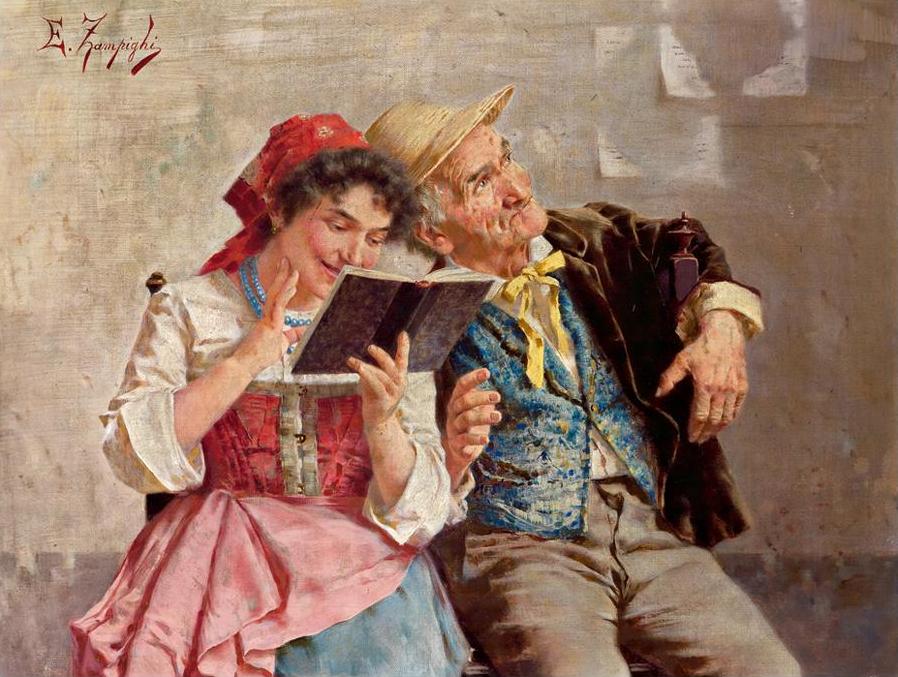
    Eugenio Zampighi

    Misanthropic and Philanthropic

    Before we go any further, and risk becoming mired in ambiguity or contradiction, let’s define our terms, and where I would locate myself in the current state of the debate. Being ‘child-free’ (as opposed to the involuntary ‘childless’) is a choice that could be made for financial, physical, emotional, or any other number of reasons, whereas the more extreme ‘anti-natalism’ is a distinct philosophical position, as argued for by South African philosopher David Benatar in his 2006 book, Better Never To Have Been: The Harm of Coming Into Existence. Anti-natalists feel it is unfair to the children who are born and then left with the mess we leave behind.

    There are two general categories of anti-natalism: misanthropic and philanthropic. Misanthropic anti-natalism is the standpoint that humans have a presumptive duty to desist from bringing new members of our species into existence because they cause harm.

    Ecological anti-natalism (sometimes called environmental anti-natalism) is a subset of misanthropic anti-natalism that believes procreation is wrong because of the inherent environmental damage caused by human beings and the suffering we inflict on other sentient organisms.

    The Voluntary Human Extinction Movement is representative of this type of anti-natalism. Philanthropic anti-natalism is the position that humans should not have children for the good of the (unborn) children because, in bringing children into the world, the parents are subjecting them to pain, suffering, illness and, of course, eventual death. Why become a cog in this endless cycle? Of course, there is a lot of room for misanthropic and philanthropic anti-natalism to overlap.

    Furthermore, far from being the purview of some weirdo outliers, this essentially tragic worldview is a perfectly respectable literary-philosophical tradition, espoused to varying degrees by writers and philosophers as diverse as Sophocles, Flaubert, Poe, Schopenhauer, Nietzsche, Lovecraft, Beckett, Cioran, Larkin, Peter Wessel Zapffe and the anhedonic Thomas Ligotti. (Season One of the HBO series True Detective (2014) drew heavily on Lovecraft’s and Ligotti’s pessimistic, anti-natalist philosophy, as expressed by the character Rust Cohle.)

    In The Myth of Sisyphus, Albert Camus posits that the only serious philosophical problem is that of suicide: having been born, is life worth living? One could counterargue that perhaps an even more serious philosophical problem is that of parenthood: rather than deciding whether or not to end a life that is already in existence, to decide whether or not to bring a life into existence in the first place.

    Of course, most people don’t even give such a weighty problem a second thought. Or, if they do, it’s all part of their plan.  Nor is it only men who can be less than enthusiastic about propagating the species, for social or personal reasons. Apart from obvious examples like Simone de Beauvoir – for whom marriage, child-rearing and family life represented a prison house for women – thirteen of the writers who contributed to Selfish, Shallow, and Self-Absorbed: Sixteen Writers on The Decision Not To Have Kids (2015), edited by Meghan Daum, were women.

    More recently, Sheila Heti’s autofictional novel Motherhood is framed around a choice between having a child and writing a book. Exhibit Number One, regarding the outcome of this dilemma, is the object we are holding in our hands as we read. We should add the qualification that this dichotomous set-up is at best fallacious and at worst false, since many if not most writers – even female ones – somehow manage to do both. (How do they do it?) However, that the topic provides the focus for a bestseller is in itself noteworthy.
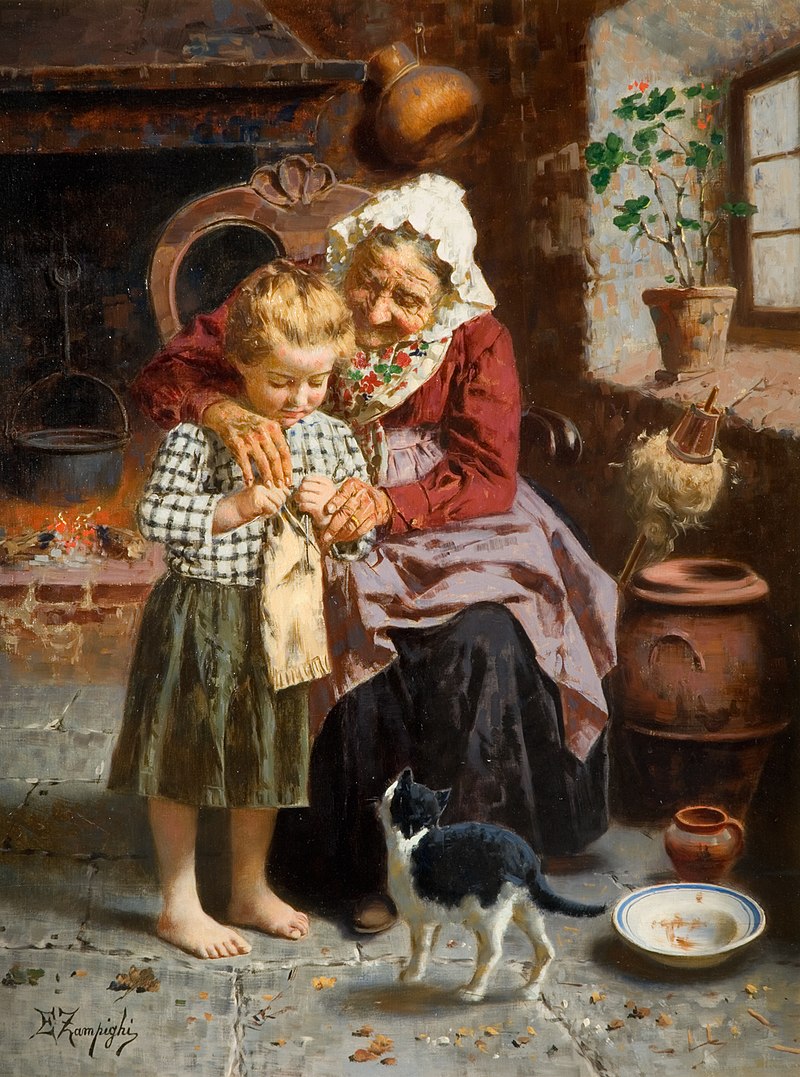
    Eugenio Zampighi

    To Each Their Own

    Where do I lie on this scale? Well, what began as carefree child-freedom has probably hardened over time, and with some thought – as these things often will, into full-blown anti-natalism, roughly equal parts mis- and phil-. However, I should qualify the last assertion by saying that I am not prepared to go to war with anyone who fervently wants to have children: to each their own.

    I am not about to undertake a crusade, or even launch a campaign, against those desperate to reproduce. I have never understood people who want you to be like them, or do as they do, who elevate their personal preferences into a modus vivendi for all.

    I would only question their choices and beliefs to the same extent that they would question mine. The basic tenet of anti-natalism is simple but, for most of us, profoundly counterintuitive: that life, even under the best of circumstances, is not a gift or a miracle, but rather a harm and an imposition. According to this logic, the question of whether or not to have a child is not just a personal choice but an ethical one – and the correct answer is always no. So, if genuine anti-natalism means opposing all births, under all circumstances, then I am still of the merely child-free persuasion. I don’t necessarily consider all procreation to be unethical: I just believe in the individual’s right to choose.

    I have had personal, up-close experience of this pressure to propagate, as applied not so much by my parents – as is generally the case – but by an ex-sister-in-law, and a brother-in-law.

    Aged twenty-six, I had brought my then girlfriend, an Italian woman I had met during a sojourn teaching there, back to the homestead for a visit. In our sitting room one evening, in front of said girlfriend, then sister-in-law chose to launch into what she probably thought of as a homily, but I took to be a tirade, about how I should settle down and start a family, as though this was the only possible course of action now open to me. (Said lady had in the past opined, “I don’t want people like you teaching my children” – although I never quite worked out what was meant by ‘people like me’.)

    She even went so far as to culminate in querying indignantly, “What do you believe?” Is there really any sane, let alone succinct, counter to this line of inquiry? Did she think she was establishing some sort of solidarity with my girlfriend? Similarly, when I was in my forties and married, my brother-in-law, of the fundamentalist evangelical Christian persuasion, while doing some tradesman work in the house I shared with my wife, started pontificating about the necessity of having children if you are married.

    One is, it seems, not respecting the sacrament of marriage if one doesn’t. I subsequently complained to my sister about her husband’s behaviour, not least about the upset it had caused my wife, and we didn’t see him again for a very long time. Again, I ask: why does everyone else want you to be like them? Is it because they feel threatened by, or envious of, other, different lifestyles? Or because they are so sure they are right? Because accepting the same burdens and responsibilities they have taken on will make you a better person (in their eyes, anyway)? Could it even maybe be because they are happy, or think they are, and they want you to be happy too?

    My own reading of these events is that, given the severe socio-religious strictures against pre-marital sex, and the shame and suffering of pregnancy ‘outside wedlock’, I guess in early 1960s Ireland (and elsewhere), when these people were courting, the only way to have guilt-free sex was to get married; and so, given the lack of available contraception, as a corollary that meant no option but to have children – whether you wanted them or not. Hence the Irish Family. So these people became seriously invested in the nuclear family as a universal norm. They had no other choice, except abstinence; and they certainly didn’t want you having something they never had. Heaven forbid, you might even enjoy it.

    ‘The Surprise Baby’ 

    From the foregoing, it will be surmised that my brother and sister are somewhat older than me. This is indeed the case: the brother is twenty-one years my senior, and the sister has seventeen years on me. I am the youngest of three, by a considerable stretch: the afterthought, the heart’s scald, perhaps even a mistake. (And colloquially, in some circles, ‘the shakings of the bag’. Although also known in Swedish, I’m reliably informed, relatively more benignly if not entirely unambiguously, as ‘the surprise baby’.)

    My brother and sister have four kids and six kids respectively. Looking back, I can see now that maybe my place in this familial structure took the onus off me to continue the lineage, and even that my own lack of motivation to have a family could have been an equal and opposite reaction to their extreme fecundity. I also retrospectively realise that, despite my parents’ relative reticence, the act of my bringing a girl home signified to them that my ‘intentions were honourable’, and that I was probably serious about marrying her.

    Now that this essay has taken an unfortunately autobiographical turn, I recognise that the psychologists in the audience (both amateur and professional) will look to my childhood and adolescence, and my experience of being parented, as a revealing explanation for my indifference to procreation, rather than my having a genetic predisposition towards a certain frame of mind and worldview.

    Maybe it’s how I was nurtured, rather than my nature? Perhaps they may even be right. Was my mother a monster? Did my parents have a fractious relationship? Were they neglectful, or did they regard their issue as a luxury they could ill-afford? While I recoil at the prospect of making this meditation on childlessness all about me, it occurs to me that I would have to field accusations of evasiveness were I not to engage with how my own formation has influenced my current thinking.

    My father was twenty-four when my brother was born, and my mother was twenty-one. They were twenty-nine and twenty-six, respectively, when my sister came along. They were forty-five and forty-two when I rocked up. Do the sums. That is quite a chasm in the so-called generation gap. In fact, it is more like two generations, and growing up with my parents was a little like the reported experience of many people who are reared by their grandparents: they may love you, but they don’t exactly prepare you for dealing with the contemporary world, or help you to negotiate it.

    Of course, as a child you are not aware of such anomalies at the time, and even into adolescence and adulthood you mostly just try to get on with things and play the hand you’ve been dealt.

    It is only very gradually that the singularity of one’s own background becomes apparent to oneself, and can be crushing. It many ways, it is a lifelong, ongoing, realisation, constantly refined into old age. We are all works-in-progress.

    Not that my parents were especially old school. In many ways they were more liberal than my brother and sister – who as young parents themselves, married and gone from the family home and starting their own families by the time I was four, were already becoming responsible authority figures, according to their own lights. Actually, it is more appropriate to write of my father and mother as separate entities, since they never exactly operated in tandem.

    My father was traditional, conservative and dogmatically religious; but he was also kind. It is difficult to conceive of today, but he organised annual pilgrimages to Knock shrine for his colleagues, the busmen of C.I.E. He was praying the rosary in the front room while I was listening to The Sex Pistols in the kitchen. It broke his heart when, in my early teens, I announced that I didn’t want to go to Mass anymore.

    My mother was a reader, and therefore could possibly be described as more open-minded and, if nothing else, she probably helped to inculcate in me a love of literature (although, curiously, not music – at least not the kind of music I was interested in: rock’n’roll was the work of Satan, and she put as many obstacles as possible into my path when I was trying to pursue a career in it; of course, she may well have been right, in that rock’n’roll is the Devil’s music, at any rate it is if you are doing it right – but she saw this as a bad thing, while I thought it was great), but she was domineering, exigent, and prone to exaggeration (‘The Queen of Hyperbole’ I dubbed her); she was also strict.

    She was creative – a brilliant knitter and designer – but, like many intelligent and talented women of her generation, frustrated by domesticity, even if she would never have admitted it openly, or even to herself. Plus, we were working-class and poor, with the concomitant money worries and lack of opportunity and limited horizons.

    As well as not having economic capital, there wasn’t much social or cultural capital knocking around either. Neither of them had got beyond primary school. I’m sure they’d had hard lives, struggling to make ends meet, with a boy born in 1939 and a girl in 1944, neatly parenthesising the privations of the Second World War, which continued into the dour 1950s.

    However, while for a small child any given reality is accepted as normal and taken for granted, looking back from an adult vantage point, with some experience of observing other parent/child relationships, I would define my mother as simultaneously both distant and overbearing – or overbearingly distant, or distantly overbearing.

    There is some history here: while expecting me, she moved out of the family home and decamped to a damp flat above Walton’s Music Shop on North Great Frederick Street, Dublin, taking my brother and sister with her (thus disrupting the former’s accountancy studies), apparently amid accusations from my father concerning her ‘clandestine inclinations’ (my old man had a very superior vocabulary, for a busman), the implication being that I wasn’t his child.

    I suspect this was a complete fabrication on my mother’s part, although he would not have been above fits of jealousy. More likely (and for reasons I don’t fully comprehend), he was shamed by ribbing from his work colleagues about becoming a father again aged forty-five. Or perhaps it was these co-workers who, for a laugh, planted seeds of doubt in his mind regarding her fidelity and my paternity.

    While these complexities are shrouded in mystery and the mists of time to me, accessible only through often conflicting second-hand retellings, it is certain she did have some cause for grievance. It is acknowledged that he would come in late from work when the rest of the family were in bed asleep, and bang around the kitchen making as much noise as possible, all the while taking protracted silences with his spouse when they did happen to meet up. (Joke: it was a typical Irish marriage – they spoke to each other once a year, whether they needed to or not.)

    But then again, apart from his workmates preying on his insecurities, maybe he had his reasons too. As a simple working man, maybe he would have just appreciated having some dinner left out for him, after working double-days on the back of a bus. Taking silences was also my mother’s métier, for expressing her frequent displeasure, again alternating with loud, vehement outbursts of anger. I was much subjected to this parenting method, even as a small child.
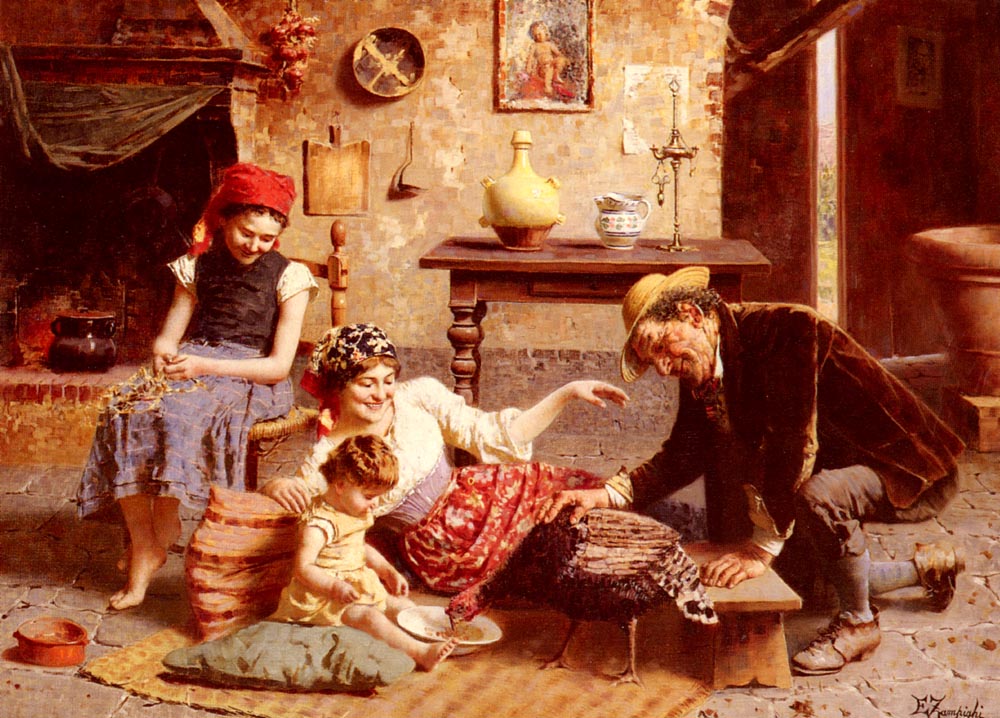
    Eugenio Zampighi

    ‘Dutch Uncle’ 

    Guilt came early, and was ladled from a great height, for anything construed as misbehaviour – like innocently being too boisterous when playing with my nieces and nephews. It was as though she always, sometimes faintly and sometimes outrightly, disapproved of me at some basic level. (What did she expect an eight-year-old boy who didn’t get out all that much to do when said nieces and nephews were around? Just sit there in silence, minding my own business, or venturing occasionally to make polite conversation?) She talked to me, as she used to say herself, ‘like a Dutch uncle’.

    I used to think the phrase meant someone who talked at length. Only recently did I find out that it is an informal term for a person who ‘issues frank, harsh or severe comments and criticism to educate, encourage or admonish someone…thus, a “Dutch uncle” is the reverse of what is normally thought of as avuncular or uncle-like (indulgent and permissive).’ But, predominantly, silence was the air she moved in, and its ambience extended to all and everything around her, at least when we were home alone together, which was a lot of the time. (Conversely, when in other company, and doubtless as a form of unconscious overcompensation, she could be loquacious to the point of tedium – there was rarely a happy medium.)

    Dad was too busy working long hours, topped up with copious amounts of overtime, trying to keep the show on the road. She would quickly lose interest in being cooped up with a small boy for days on end. Consequently, I spent a good deal of time as a little lad in solitude, more than average for a child of that age, and was left to my own devices. I had to make my own fun. I was lavished with toys, but other humans – even those of around my own age – were strange, otherworldly creatures.

    While I largely welcomed them when they invaded my world, I wasn’t always sure how to deal with them. (‘How do I work this new toy?’) Later, when I was around nine or ten, she went out to work, as a seamstress in the linen room of a hotel, and then as a general operative in a local pharmaceutical factory, and my aloneness was complete.

    I came home every day from school to an empty house. But my mother’s greatest sin, as an extremely manipulative individual, who fought strenuously to control the family narrative (in which my role was to become the rebellious bad boy) was that she sought to turn me against my father (easily enough accomplished, due to his long, work-related absences and her being the chief caregiver – when the humour took her), but then later and depending on her mercurial moods, as if by fiat, she would blame me for disrespecting him. Being a powerless pawn caught in this crossfire between the king’s limited movement and vulnerability, and the queen’s infinite space and resources, would be enough to wreck anyone’s head. I was just another means for them to get at each other in their ongoing war of attrition, collateral damage in our bizarre love/hate triangle.

    I’m thinking of Raymond Carver’s very short short story ‘Popular Mechanics’, in which an argument over custody between a departing husband and his wife concludes thus: ‘She would have it, this baby. She grabbed for the baby’s other arm. She caught the baby around the wrist and leaned back. But he would not let go. He felt the baby slipping out of his hands and he pulled back very hard. In this manner, the issue was decided.’

    Christmas Morning

    A memory, of Christmas morning, when I was aged about ten or eleven. The scene, my sister and brother-in-law’s house, where my mother had decamped for the duration, with me in tow, in another of her flits from my supposedly tyrannical father. I remember her eyes on me, watching me as I opened my presents from Santa, and I was conscious of the obligation to perform happiness and joy for her, because she was having such a sad life, and as her young dutiful son I was obliged to cheer her up.

    It struck me, even then, that this was not how most of my contemporaries were required to behave, and it marked me apart. But there was always something performative about my mother, and those interacting with her. She spoke frequently of Love, but she used the apportioning of it as a form of punishment and reward. She constantly felt that others – not least her youngest child – should strive to gain her approval. In turn, I felt a constant pressure to show that I was having a happy childhood, and an equal pressure not to be any trouble – at least until adolescence hit.

    This giving and withdrawing of affection, a constant tightrope walk of appeasement, has definitely made its mark on the quality of my adult relationships, especially with women: I associate people loving me with people wanting something from me, and with it arbitrarily being taken away if they don’t get what they want. Perhaps this experience of love is not so different from most people’s – for how often is any love offered unconditionally?

    It is, however, one of the foundational and enabling myths of parenthood that parents are supposed to love their children more than themselves. But how many do? My mother did not love me more than herself. Maybe my father did. If work is love in action, he certainly slogged his guts out to keep us in the comfort to which we had no right to become accustomed. She, on the other hand, far from providing unconditional love, instead veered towards viewing me as a needless vexation and a thankless nuisance.

    I can see now that, as a good-looking and quick-witted young woman, my mother thought she could have done much better in the marriage stakes, but she had been cajoled by her parents into a very early alliance with my father, because he was a kind man and they knew he would do his best to look after her. Which, understandably, wouldn’t have made my father feel great, especially since she was the love of his life.

    Did I mention that she’d given birth to a stillborn girl, carried to full term, a year or two before I was born? She hadn’t expected me to live. When I was born healthy, and did live, I was ‘a miracle’. But then she had to deal with the consequences of this miracle. She left the grubby flat in North Frederick Street, diagonally opposite the Rotunda Hospital where I first saw the light of day (damn, my real dirty little secret is finally out: although I was bred on the Southside, I was born on the Northside – which side of the river is more opprobrious I will leave it to readers, informed by their own personal prejudices, to decide), and returned to the suburban council house I was brought up in, because it had taps with hot running water.

    Did I also mention that she fell ill with double pneumonia after I was born? My seventeen-year-old sister looked after me for the first few months of my life – fed me, burped me, changed my shitty nappies, all the things it is assumed mothers do with their new-borns. I have the impression that my mother never bonded properly with me.

    Despite her previous maternal experience, she didn’t know how to be around me. To a degree that was unhealthy, she wanted to be wooed – by her son rather than by her husband. Or, failing that, she wanted to be placated. I harbour the notion that my mother harboured the notion that she would have had some great second act to her life, had I not been born.

    I also harbour the notion that she was suspicious of those who had ‘notions’ – especially her children – because she had never been given the opportunity to indulge her own notions. She embodied avant la lettre, and would certainly have been an enthusiastic appreciator of, The Cult Of The Difficult Woman. But, as Jia Tolentino astutely argues in her essay of that title, these days it is not so difficult to be a difficult woman. Be that as it may, I can categorically state: as a very small child, having a disappointed menopausal and/or post-menopausal mother, is not a good thing. And not just not good for the child, but also for the mother.

    I very much doubt my mother was up for the sleepless nights, and the many other demands of child-rearing, at her age, in her delicate state of health, and having done it all before and thought it was all over. I was not, as a psychiatrist once asked me – clearly ignorant of the history of access to contraception in Ireland, due in no small part to the acquiescence of her profession in the machinations of the great church/state sponsored lie – a planned pregnancy.

    Candidates for Divorce

    If you love someone, you want to have children with them, it is said. As will be surmised from the foregoing, in my opinion, if my parents had been living now, and been more solvent, they would have been prime candidates for divorce, and very likely much better off for it. Or, at least, I would have been. During a discussion between the Ma and me on contraception and the ‘risks’ of pre-marital sex (still a hot topic in the early 1980s), she informed me that I was the result of ‘one lousy intercourse’.

    Somehow, I don’t think I figured greatly in her plans. In a similar disquisition on the whys and wherefores of abortion (although now at long last safely legal in Ireland, still something of a red rag to a bull in some quarters) she revealed, “You could have been an abortion”, to which, if I’d had enough presence of mind, I should have countered, “Well, if I had been, I wouldn’t have known about it.” (Echoes here of the perennial cri de coeur of teen angst: ‘I didn’t ask to be born.’)  What things for any mother to say to her son!

    I have heretofore been ashamed of airing these exchanges for public consumption, possibly in an effort at blocking out the damage they would have done to the still evolving me, and a refusal to acknowledge how singularly and egregiously brutal they were. After all, the first love in your life is supposed to come from your mother. But I am ashamed no longer. I am too old now for it to matter what other people think of me, or of my mother, or of our troubled relationship, or of her memory.

    Apropos: I am writing this as personal memoir because if I tried to write it as fiction, no one would believe it. I am used to not being believed. You decide whether or not you believe me now.

    Defining ‘Natural’

    Was my mother ‘unnatural’ in her attitude to motherhood? Well, that very much depends on your definition of ‘natural’, doesn’t it? In this regard, it is instructive to quote from Laura Kipnis’s essay in the aforementioned anthology, Selfish, Shallow, and Self-Absorbed: Sixteen Writers on The Decision Not To Have Kids, entitled ‘Maternal Instincts’:

    …despite my proven talents at nurturing, I don’t believe in maternal instinct because as anyone who’s perused the literature on the subject knows, it’s an invented concept that arises at a particular point in history (I’m speaking of Western history here) – circa the Industrial Revolution, just as the new industrial-era sexual division of labor was being negotiated, the one where men go to work and women stay home raising kids. (Before that, pretty much everyone worked at home.) The new line was that such arrangements were handed down by nature. As family historians tell us, this is also when the romance of the child begins – ironically it was only when children’s actual economic value declined, because they were no longer necessary additions to the household labor force, that they became the priceless little treasures we know them as today. Once they started costing more to raise than they contributed to the household economy, there had to be some justification for having them, which is when the story that having children was a big emotionally fulfilling thing first started taking hold.

    All I’m saying is that what we’re calling biological instinct is a historical artifact – a culturally specific development, not a fact of nature. An invented instinct can feel entirely real (I’m sure it can feel profound), though before we get too sentimental, let’s not forget that human maternity has also had a fairly checkered history over the ages, including such maternal traditions as infanticide, child abandonment, cruelty, and abuse.

    I might add, similarly, that belief in a God or the gods was rather more popular in the past – and, in fact, for most of recorded history – than it is today. All life comes from God, the believers tell us: that is why they are ‘Pro-Life’. Are we contemporary godless atheists somehow, then, wrong?

    My mother would have looked askance and jeered at today’s required standards of parenting. One time, when I was around twenty-two, she presented me with an itemised bill she had taken the trouble to compile, for how much it had cost to rear me.

    It was high time I started paying it back. “There’s no return in you” was a common theme. Do I not have kids because I thought they would have cost me too much, because I could not afford them? “We did our best for you,” she told me another time. And perhaps they did. “I reared two gentlemen and a lady,” the Da would often boast. Except you don’t need to be well-off to praise and encourage your children. You just need to love them, and want what’s best for them. Never mind loving them more than yourself.

    Featured Image: Idyllic Family Scene with Newborn by Eugenio Zampighi (1859-1944)
  • Anger at Hillary Clinton’s Appointment at Queen’s University in Belfast

    A protest organised by Lasair Dhearg, and involving representatives from People Before Profit and Academics Against Apartheid, gathered on University Road in Belfast on the morning of September 24th, 2021 as Hillary Rodham Clinton posed for journalists and television crews covering her inauguration as the first female Chancellor of Queen’s University Belfast.

    Chants of ‘shame on Queen’s’, and ‘Hillary you should be at the Hague’, rang through the air as Clinton walked the short distance from the campus entrance to nearby Whitla Hall for the inauguration.

    Several speakers addressed the assembled protestors calling into question her record as U.S. Secretary of State under President Barack Obama, including support for intervention in Libya that has brought anarchic conditions, illegal drone strikes over western Asia and Africa, and unequivocal support for Israel.

    The promotion of Clinton to a seat of learning must surely be, at the very least, controversial. In a televised interview Clinton once joked about the brutal murder of Colonel Muammar Gadaffi, the leader of Libya, saying, “We came, we saw, he died,” before laughing.

    Considering her apparent heartless disregard for human life, why would Queen’s University offer Clinton such a prestigious post as Chancellor?

    In October, 2018, the University invited Mark Regev, the Israeli Ambassador to the United Kingdom to speak, which drew a protest of hundreds of students. This was followed by a visit from Hilary Clinton, coinciding with the establishment of the Hillary Rodham Clinton Award in Peace and Reconciliation studies bursary at Queen’s. She also received an honorary doctorate for her ‘exceptional public service in the US and globally, and for her contribution to peace and reconciliation in Northern Ireland.’ This appears to have been a precursor to her instalment as Chancellor.

    Modern universities are no longer only seats of learning, but are businesses run for profit, with huge salaries for those running the organisations, and significant grants available, especially from technology and pharmaceutical companies.

    In order to benefit from research and development grants and encourage greater ties between American corporations and the University, Queen’s seem to be whitewashing Clinton’s record.

    Hillary Clinton has history in Ireland. Her husband, former President Bill Clinton, visited Belfast and is seen as a central figure in the negotiations that led to the Good Friday Agreement of 1998.

    She is now milking this for all it’s worth, portraying herself as a mentor, who still has something to offer the youth of Ireland. Yet she has blood on her hands, and an unhealthy disregard for democracy, human rights and the sanctity of life.

    Students across the Western hemisphere are increasingly calling for Justice for Palestine, even as the Israeli lobby works hard to censor and dismiss academics who call Israel an Apartheid state. Indeed, writer Sally Rooney recently declined to have her new novel translated into Hebrew in protest against the conduct of Israel. Queen’s University Belfast now appears to be on the wrong side of history in appointing Hilary Clinton.

    Lasair Dhearg’s Pól Torbóid, who helped organise and also spoke at the event, said,

    Queen’s University’s complicity in the whitewashing of Hillary Clinton and her war crimes further epitomises the university’s role in an international framework of imperialism that sees it not only glorify warmongers like Clinton, but have immense financial investment in military contracts and companies guilty of immense environmental destruction.

    He added:

    As US secretary for war, she authorised over 400 drone strikes across multiple nations, which overwhelmingly killed civilians and even children at a proportion of almost 90%.

    She labelled black men ‘super-predators’ when she helped lobby for the 1994 US Clinton Crime Bill, which was immensely important in creating the mass incarceration levels that exists today in the US to benefit the prison-industrial complex – which is a system of slavery by new means.

    A Zionist, Hillary Clinton has shown herself to be an enemy of Palestinian liberation, siding with the oppressor every time it mattered, like during the 2014 Israeli bombing campaign of Gaza. She increased annual US funding to Israel from 2.5billion, to 3.1 billion US dollars whilst she was US Secretary of State, and she stated that countering the BDS movement globally should be a priority for Israel’s defence.

    Unfortunately all these arguments are falling on deaf ears as Queen’s University appears to have entered into a Faustian pact with corporate America in appointing Hillary Clinton as Chancellor.

    Feature Image: Clinton, along with members of the national security team, receive an update on Operation Neptune Spear in the White House Situation Room on May 1, 2011. Everyone in the room is watching a live feed from drones operating over the Osama bin Laden complex.

    An earlier version of this article appeared in Al Mayadeen.

  • Halloween

    I’m sitting down on the steps of an old derelict townhouse, across the road from what used to be my old local. I’m rolling a joint, a packed-out little pinner, and looking at the carrying on that is going on outside the pub. Three kids on bikes have stopped to get a buzz off a guy, probably in his late forties or early fifties, who’s pissed out of his head and is holding himself up by a lamppost, around which he is slowly spinning himself. The guy´s wearing a shiny grey suit that has definitely seen better days. His white shirt, open at the neck, has a dirty big half-pint of stout stain down the front of it. With one hand holding the lamppost, stretched out at arms-length, and his feet planted against the base, the guy is leaning so far out that he´s at a near forty-five-degree angle. He spins himself slowly, around and around the lamppost. Like Gene Kelly in “Singing in the Rain”.
    “I´m a dirty swinger, Lads!” the guy shouts.

    It´s getting late in the evening and Halloween is fast approaching. Bangers are going off, booming like bombs in the distance, sometimes closer, echoing and reverberating throughout the streets. High above the pubs, takeaways, bookies and closed-up shops, fireworks screech up into the sky, pop and fizzle out. Reflected in the third and fourth story windows opposite, I catch bits and pieces of the soft explosions. Pulsating yellows. Exploding whites. Terrific blues. Glittering greens. Fountain-sprays of red. The smell of gunpowder and the barks and yelps of terrorized dogs enliven the chill autumn air. Gangs of kids, sometimes ten or twelve strong, drag pallets down the footpaths and street. Cars blare their horns and swerve around them but the kids just throw the finger and let loose a chorus of profanities. Sometimes, when a car has gotten a safe enough distance away, an egg or two are thrown after it. Pagan mischief has descended upon the city again and taken over the streets. And the people in cars know better than to stop.

    “I´m a swinger, Lads!” the guy shouts again, turning himself around and around on the lamppost. “I´m a dirty fucking swinger!”

    But the three kids on their bikes have lost interest. They are looking in through the window of a Chinese Takeaway, Shangri La, at the little Chinese woman who sits behind the counter, her head hovering beside that little golden kitty which perpetually waves it´s pawl. It looks warm inside the takeaway. Every now and then I think I get a whiff of food when a customer or a delivery guy enters or leaves: Spring Rolls, Chung Po Prawns, Roast Duck in Plum Sauce. But the thought of all that greasy food makes me a little queasy. One of the kids gets up on his bike and starts circling around his two friends.
    “I speak Chinese now,” he shouts, “Kim Poo Kak! Po Cum Kim! Chong Chong Chiny Chong!”
    Another kid starts to mimic the golden kitty, levering his arm up and down, waving and staring in at the woman behind the counter.
    “Gizza look inside your fortune cookie!” he shouts.
    “Cum Young Son!” shouts the third kid.
    “I´m a dirty swinger, Lads!” the man spinning around the lamppost shouts again, “And I´m going to box the fucking head off the next prick I see!”

    The few people who are passing up and down the street are paying no attention to any of this. Those who do see what is coming up ahead of them have marked it as trouble and crossed over to the other side of the street in order to avoid passing the guy. He’s still swinging himself around this lamppost, and the kids on bikes are now blocking the footpath. People have become weary of this part of town. It’s been so for a while now. And people are especially weary when night is moving in, especially at this time of year.

    A Brazilian student arrives at the bus stop just in front of me. He has white earbuds in his ears and is texting on his phone. When he looks up from his phone at the bus stop’s electronic timetable and seeing that it has been smashed in, he shakes his head and moves on. I light my joint and take three quick puffs on it. From my inside jacket pocket, I take out my naggin of whisky, spin the cap and drink down a good, deep, gut-warming measure, recap it and put it away. I’m invisible to those across the street. I have willed it so. But that could all change in a split second. I´ve packed out the joint and after two more quick hits off it has taken effect. I take another enormous hit and hold it in. Playing traffic lights with myself, I wait until I´m nearly lightheaded before slowly blowing out the smoke. I pull my thick woolly hat down snugly on my head.

    With a sizzling sparkler in each hand, a tall, painfully thin girl comes skipping right past me. No more than ten years of age, she’s dressed all in black and her long blonde hair is tied up in a ponytail. I lean out from the steps and watch her as she goes by. Wearing a little black leather jacket, she launches herself into the air, landing and springing up again. Her ponytail lifts and falls above the back of her black leather jacket, where white Coca-Cola style letters spell out “Trouble-Maker” over a red heart pierced by an arrow. Twirling her sparklers, this little impish cheerleader of mayhem skips on down the street, slowing only to turn right at O’Mahony’s butchers. She disappears around the corner where, in black marker on the white wall of the butchers, someone has drawn a huge cock and balls complete with four lines for the jizz spurting out in a graceful arc. In red marker underneath it, and probably by a different hand, is written, “Mandy is a fucking tramp.” And beside that in black marker, “The Pope is a pedo.” Staring at all this, I’m convinced that none of it had been there twenty minutes ago.

    A kid comes stumbling down opposite side of the street. By the look of his Seventies getup, I figure that he´s come from the rock bar, The High Stool, just a few doors up. The High Stool is one of the last few havens for young bands to play in and they’re known to go easy on I.D. The kid has long, curly black hair, a light bumfluff moustache and wears a blue denim jacket with band-patches sown on to it, and tight grey jeans. He is no more than seventeen. The rocker-kid totters down the street and stops. He takes out a twenty box of Marlboro red from his jacket pocket, puts one in his mouth and drops the box back into his right-hand inside pocket. Swaying slightly, he tries to light his cigarette, flicking his lighter in his cupped hand, before tottering off again, oblivious to where he is.

    Having lost interest in the Chinese takeaway, the kids on bikes lean over their handlebars in quiet conference. They look over their shoulders, up and down the street. Finally, the young rocker gets his cigarette lit. He becomes absorbed by it, puffing at it, then looking at it, then lovingly puffing at it again. Throwing his head back, he exhales huge clouds of smoke.

    The swinger has switched gears, and now using his right hand, slowly winds himself counter-clockwise, around the lamp post. Just as the rock-kid comes within range and, without breaking the momentum of his turning or taking his hand from the lamp post, the guy tips his weight in such a way that he picks up speed and, in one fluid movement, comes back around and throws a thick, meat-and-bone fisted punch, landing it squarely on the right side of the young rocker-kids face. The sound of it carries across the street.
    “Whoa!”
    “Ho-ho!”
    “Wha´?”
    One of the kids has had his back to it all but he turns around just in time to see the rocker-kid, blind-sided and stunned, staggering backwards a good four-to-five steps before his legs buckle and give out from under him and he falls back, down on his hands and ass. I missed which way the cigarette flew from his mouth.
    “Down in one!”

    The kids on their bikes roar with laughter and the swinger doesn’t say a word. Just keeps turning around and around on the lamp post. Eyes closed, he smiles to himself, his face serene. Miles away now. He’s Elsewhere. The Champ. First round. K.O. Raising his belt for the world to see. But on his third revolution the smile was gone. Opening his eyes, he surveys the street before letting go of the lamp post. He walks over to where the kid is lying on the footpath, propped up on forearm and elbow. He swings a kick at the kid’s face, like his head was a football hovering in the air, begging to be volleyed. The sound this makes sickens my heart. Thrown back beneath the bookie’s window, the kid’s face is ghost-white now. He opens his eyes wide and blinks once. By the second blink his eyes are heavier. Blood pours from where his nose and mouth used to be. When he closes his eyes for a third time, they don´t open again and his head sinks down slowly into his chest. He´s either out cold, or dead.

    “Job oxo, Lads,” the guy in the grey suit says to the kids on their bikes. The kids look at him, each of them now standing up straight, hands gripping their handlebars. They watch him as he walks back into the pub, my old local. The kids look at each other, then at the rocker kid on the ground. One by one they get up on their pedals and go cycling out blindly on to the street. Cars blare their horns at the kids as they go racing down the road, zig-zagging each other, shouting and hollering.

    The last two hits off the joint burn my fingers and scorch my lips before I throw it away. My eyes feel hot and bloodshot. I take another big drink from my naggin, to steady myself, but make sure there is enough left for three or four big mouthfuls later. I pick up my rucksack, stand up, and swing it around my back and over my shoulders. My legs feel feeble. Car lights zip past on the road. There is no one around, just an old man, bent-double, with a walking-stick on the opposite side, down by the boarded up Centra on the corner. He’s so doubled over that he can only look at the ground. So, it will take him a good ten minutes to cover the same amount of ground it will take me fifteen seconds. Despite waiting for a break in the traffic I nearly get knocked down crossing the road.
    Making sure my back covers us from the road, I hunker down in front of the rocker-kid, without touching him. His head is still slumped into his chest. The blood gushing from his nose and mouth has covered his chin. Three bloodied teeth nestle in the folds of his faded black t-shirt now darkened, drenched with his own blood. Looking around, I reach into his inside pocket. And in that very moment, when my hand clutches the package of cigarettes, to pull them free, I´m waiting for someone to walk out of the pub and see us, or for a heavy hand to fall on my shoulder. But, no. No one comes.

    Hurrying down the street, I stride past the old, question-mark shaped man who can see nothing but the footpath, his feet and the end of his walking stick, dog-shit and broken glass. My heart is beating so hard I can feel it in my dry throat. But I´m out. I´m gone. I´m free. I squeeze the box of cigarettes in my hand and I can feel by it that it´s pretty much a full, fresh pack. It´s the best luck I´ve had all week.

    I pass by a boarded-up pharmacy, the graffitied hoardings of a closed-down sushi restaurant and an African barber. Being open, the barbershop is still lit up, but inside, every chair is empty. Only two cigarettes have been smoked from the pack. Sparking one up, I turn down a darkened side street, and slacken my pace. A few of the streetlights have been smashed. A row of brownstone townhouses are uninhabited, their windows black and For Sale signs displayed on every facade. Near the street’s end, I stop beneath the fitful flicker of a streetlight. Leaning against the lamppost I smoke and wait for the calm to return. For my hands to stop shaking.

    There´s a church across the street I´ve never noticed before. Looking at it, I consider going inside for a while. A few minutes of peace and warmth. Maybe some song. A choir. Some candles, some nightlights, might be got. A reading from the Book of Jeremiah. Ezekiel. Or Ecclesiastes. A reading from the Gospel of St. John. A fiver, or a tasty tenner passed around in the tray. When goods abound, my brothers and sisters, parasites abound. But I come among you to pray. To shake the warm and clammy hands of other weary sinners. To ask forgiveness. To confess and to repent. And be not lost. Lord hear us. In your grace, Lord, hear us. To sit in silence. Then kneel in prayer. Close my eyes. A God´s body dissolving inside of me. And hope that, in prayer, my mind might be drawn toward higher things.

    Curious as to the name of the church, I search for the sign and behind the spike-topped black railings, I spot it. Spade Enterprise Centre. In the windows I see the ghostly glow of two computer monitors, the green hills and blue skies of their screensavers. Disgusted, I flick away the end of my cigarette and keep moving.

    My boots crunch against shards of glass on the ground from the smashed-in windows of the Citizen Information Centre. Spray painted graffiti, cryptic tags and slogans, run the length of the building, jump onto the next shop-front, and the next, and continue on across the battered iron shutters of an old, burn-out Post Office. “Take Back the Streets”. “Vote Maybe.” “God is Love.” “Take Back the Streets.” “Live Dublin. Die Young.” “Let it Come. Let It Go.” At the top of Smithfield, a pink pram has been left on the street. An empty pouch of rolling tobacco and a black woolly hat on its seat. Two pieces of bloodied white tissue paper lay on the ground beside it.

    Smithfield Square is all lit up. A Third Reich modernity about it. The green light at the top of the distillery look-out tower. The huge light-standards all lit up red for Halloween. If only the flaming torches on top of them were lit. Triumph of the Financial Will. Hotel room lights all lit up. Apartment windows all lit up. All warm and lived in. All the windows look down on to the Square. Smithfield Square structures the night and holds it at bay. People walk about across the Square. Going out, coming home. Groups of friends, couples, clutches of tourists. Going out to pubs. Going out to restaurants. A Halloween Horror double-bill in The Lighthouse. “What are you having?” “What you wanna go see?” “I´m getting this one in, put your money away”.

    I stand and watch the revolving ads on the motorized billboard. “Tell your girlfriend to get stuffed. Chicago Take Away Pizza” “You got a big future ahead. D.I.T. Open Day 30th November – Sat. 1st of December” “It´s the blend that counts. Tullamore Dew”. There´s more in my naggin than I´d thought. I take another drink and go around to the other side of the billboard and watch the ads roll up and roll back. In dramatic, eye-catching, black-and-yellow bio-hazard style design “Renting and worried about losing your home”.

    Outside the Fresh Store a woman´s white-framed bike, with a wicker basket on front, is stood up on its kickstand in gentle repose. Unlocked. But I´m tired. And the thoughts of being chased exhaust me. When was the last time I was even on a bike? And a woman´s bike at that. Across cobbles stones too. And nowhere to go or to bring it. Forget it. I go over to the tiers of concrete steps on the Square and sit down. From my jacket pocket I take out my black fingerless gloves and put them on. I light another cigarette and I look up at the windows of the hotel rooms and the apartments. The cold is starting to bite. Like a vampire I have a lust. I have a need. I have a want to be invited in. See me. See me. Come to the window and see me.
    Look down and wave.
    Invite me up.
    Invite me in.

    I sat here one night and watched a Conor McGregor fight on about half a dozen huge, flat-screen TVs mounted up high on the living room walls, through a number of the windows of third and fourth floor apartments. A lot of people were out on their balconies before the fight. Talking, laughing, drinking, smoking. Taking pictures. I was so close to shouting up at them. I could have shouted up too. “Hey! Hey! Can I come up and watch the fight? Came down without my keys and locked myself out like a spa. I know. Sickened. Of all the nights. I got some coke!” They might have taken me in too. For the laugh. More the merrier. Just to watch the fight. And why not. Neighbourly neighbours. Ah yeah. Good souls. Good skins. And I had it all planned out too. Get in. Get to the kitchen. Dump out some coke. Rail it out. Generous like. Grateful. Gratitude. Get that immediate friendly welcome then. Comradery on tap. “Help yourself, Man. Happy Days. Thanks for having me. Yeah, can´t get a fucking locksmith ´til tomorrow”. Accept a beer. Take a shot. Compliment the gaff. Get to the bathroom then when they´re all roaring at the TV. One-minute shower. Nick bit of shampoo. Bit of shower gel.  I could do it in forty seconds. Dry off. Bit of toothpaste. No need to be a total scald. I have my own toothbrush and everything. No one would have copped it at all.

    But I left them to it and watched the fight through the windows instead. And I could see a good bit of it too. Few bumps of coke gave a fluency to my own running commentary. I had a great time. I felt capable and alive. Mercifully distracted from the sharp cold of empty hours.

    Two kids walk past. One with his hands down the front of his grey tracksuit pants. They slow down when they clock the unlocked bike. They take a quick scan around and they see me, looking at them. They keep walking and I flick the end of my cigarette away.

    Tied by a luminous green leash to the chalkboard outside of Fresh is a little dog so small that I hadn´t seen it when I first sat down. I get a rush of recognition when I see it. My stupid blood thrills at the sight of that little fucking dog. That´s Aido´s dog. Definitely. Little Jack Russel-Chihuahua. And the red and the black brace around it for the leash. It fuckin is an´all. No mistake. I take off my woolly hat and let the cold air at my head. I take a look at myself. A once over. I fix my hair and smell myself. I stand up and stretch the tension, the anxious anticipation, out of my extremities. I start a little pacing then, to and fro, in front of the steps.

    “Aido. How are things? Alright Aido. Long time.”
    Speech doesn´t seem slurred. A cold shiver runs up my spine and I shake myself. Giddy as a fuck. Thought you were done though. Thought you were done. But this is chance happening. Street Magic. I sit back down on the steps. My right leg is jigging up and down with a kind of sprung rapidity. I slide my rucksack off my back without taking my eyes off the door and place it down next to me on the left. From my back jeans pocket, I take out my little baggy and, holding in down in between my knees, I tear off enough for two fat joints from the pungent bud. I put the makings, loose, in my right-side jacket pocket and put the baggy back in the pocket of my jeans. I suck the taste from my fingers, fix my eyes on the doors of Fresh, and wait.
    Sure enough, out walks Aido carrying a bag of shopping. Tracksuit pockets bulging too. He leans forward, talking to his dog, unties the leash from around the chalkboard and starts walking away.
    “Aido!”
    He stops and turns around. He peers over.
    “Who´s tha?”
    “Andy, Man.”
    Tugging on the leash, he walks over.
    “Alrigh?”
    “Ye man. Good, good. Good to see ya man. Been ages.”
    “Been a while, alrigh.”
    “Hello Floopy. Haven´t seen you around for a bit.”
    “Ah yeah, was away for a bit.”
    “Ah right. I never heard. You back into it?”
    “Ah, doin a bit you know. Wha ya after?”
    “Meant to ask you. Did your sister-in-law ever do that exam?”
    “Christina?”
    “Yeah.”
    “Fucked if I know, Man. They´re gone to Canada.”
    “No way.”
    “Yeah, over in Calgary. Doin’ the business.”
    “Nice…just eh, remember that, when I said I´d do those classes with her…for free?”
    “When was tha? A year ago?”
    “About that yeah, I think.”
    Aido sniffs his nose and spits a tangley mess of phlegm up on to the grass behind me.
    “And…you remember I said…I said I´d cash in with you sometime, when I was stuck?”
    “Wha, you got nothing on ya at all? I´ve nice stuff there for a score.”
    “I´m skint man. But here. You´d be doing me a solid. I won´t ask again.”
    “This shit doesn´t run, Pal.”
    “That´s alright.”
    Aido looks down at me and changes the bag and leash, behind his back, to the opposite hands.
    “You sick for it these days or somethin’?”
    “No…not at all. Are you still smoking?”
    “Yeah, course. But there´s no green around here man. Nothing for the last two days. It´s a fucking joke, so it is.”
    “Here…I have enough for two nice big spliffs. I was gonna save it. It´s the last bit I have…”
    “Do ya yeah? Where´d you get tha?”
    “An old mate of mine, Phil, in town, there. He harvested a batch last month and that is the last of it. He´s not doing any more. He´s getting paranoid.”

    Aido moves and comes and sits down on the steps beside me. He smells fresh, of deodorant and aftershave, of warm spin-dried clothes. Floopy totters across and smells my boots, and the ends of my jeans.
    “Blue Cheese.”
    “Is it yeah?”
    “Fucking lovely stuff.”
    “Yeah, I´ve had it before. Throw it out there.”
    I put the bud on the ground between us. Aido picks it up and smells it.

    A big, round-bodied young woman comes out from Fresh, carefully carrying a big Halloween pumpkin under one arm. With her free hand she holds the door open behind her for a builder in a high-viz jacket whose going in to the shop. The woman shifts the pumpkin around to her front so that she can carry it better, in two hands, and heads off down Smithfield Square. Every now and then she looks down at the pumpkin, making sure it´s alright.

    “Cheers, Pal.”
    Aido stands up then and my heart sinks.
    “I´ll be getting tar in the day after tomorrow. Twenty-five a pop, alrigh?”
    “I´ll defo take two, three off you for sure man, nice one. And I´ll have the cash…could I just get that one off you now though…remember when I said –”
    “Yeah, yeah, yeah…fuckin memory banks here.”
    Aido sticks a finger into his mouth as though he were going in to pull out a rotten tooth. He throws it at me. It bounces off my knee and falls right in front of the dog. Floopy goes for it too. But before she can get her little nose or tongue to it Aido pulls at the leash, hard, and the little dog yelps and runs back behind her master´s legs.
    “Ya thick,” Aido says.
    I don´t know if he´s talking to the dog or to me.
    “Thanks, Man,” I say, holding the little warm wet ball tightly between finger and thumb. “Thanks a mill.”
    “G´luck.”
    “See ya…and…yeah, day after tomorrow too, right?”
    “Yup,” Aido says, without looking back. “Twenty-five.”
    “I´ll have it man,” I say. “Definitely.”
    I wait until Aido has moved on, then get up and split from the square.

    There is music in me now. I´m in tune with everything. I look up to the sky to thank the stars but see only heavy grey overcast cloud. Thank you, I say, quietly to myself. To the beneficent spirit who walks beside me. Shouts and screams up ahead, from the playground area. A woman shouting. That woman I´d seen. She´s shouting in Portuguese on her phone. Looking around her for someone to help. She points down to towards the Smithfield Luas stop. I look and see the backs of two, maybe three kids on bikes, zig-zagging each other, quickly disappearing out of sight. People pass by the woman, ignoring her distress. On the ground beside her, the smashed-in head of her pumpkin, it´s bright, orange, pulpy sweet brains a mess on the cold, dark cobblestones. I veer away.

    A huge black and white mural on the wall. Dublin, City of Homeless Families. The Council won´t be long in coming around to attack that with their cherry-picker and grey paint. Can´t be having that.

    At the end of Burges Lane, that tough-looking fucker I always see around is holding himself up with a hand against the wall, and is bent over, retching, hosing the ground good with cidery vomit. He´s always in the same pale blue jeans and black hoody with the tacky design on the back of it: the silvery mountain wolf howling at a blue moon. When he finishes, he pushes himself back off the wall, wipes his mouth with his sleeve and stumbles backwards, staggering, cock-eyed. Hasn´t a clue where he is. He holds his arms out, then folds them around a body of air, as though he were embracing an invisible dancing partner. He staggers backward, waltzes around and around, babbling about something I can´t make out. He continues to stagger backward and is nearly clipped by a Luas too as it goes by, its bell ringing, its windows all lit up in the dark. The last three carriages of the Luas are all splattered and splashed with vivid pink paint.

    Down Coke Lane, I keep my eyes on the ground. One night, I found an eight of hash down here. Another time, two twenty-euro notes, folded into one another. Thought it was just the one. Double score. I scan the ground. Wide-eyed. Avid-eyed. Seeing all that I can see. If there´s something here I´ll see it. My eagle eyes are notorious. I´ve got this intuition. Divining senses. A compass. I can feel it. A magnetism for all the lost and forgotten things.

    Up ahead the red neon of Frank Ryan´s pub. People sitting at two cheap pine picnic tables, drinking beer and eating pizza from the pop-up, stone-bake oven housed inside of a brightly lit smoky white gazebo. Three people who look like they´ve been here since after work are drinking beside the big potted shrub. A guy stands on his own under the awning, smoking, looking down into the glow of his phone. I smell weed, not as good as mine, as I pass by and head straight in the backdoor.

    The old warm boozy tavern air hits me with a bang of beer, sweat and incense. Blues music plays loudly through the speakers. The place is dark. It is always dark. Save for the classic canopy light pulled down low over the pool table. This is the brightest part of the pub, just inside the back door. This pub is always dark and loud around this time. That´s why I like it. Drinkers sit around small tables and have to sit close in together, intimate like, to hear themselves talk over the music. The candles on the tables dazzle their tipsy, glassy eyes. Whether amorous or platonic, a little dancing shadow and candlelight on the face is seductive. It keeps them blinkered.

    What happened took no more than four or five steps to accomplish. My wits lit up the second I crossed over the threshold. No one, thankfully, had been playing pool. A couple were in the corner at the far end of the pool table, too busy canoodling to see anything but themselves. Their pool cues discarded on the table. On the right, as I walked in, were three empty bar stools at the wooden counter. Its own little alcove. Two near-empty pint glasses and a full glass of red wine.

    I don´t look out of place in a pub like this if I keep moving. Just passing through. Don´t catch the bartender’s eye. I narrow my way past people, polite and smiling as I go, standing back at times to let others pass by me. I set the now empty wine glass back down at the end of the bar, and follow a young guy out the front door who, without looking back, holds it open for me. The door bangs shut behind me, unexpectedly, and it makes me jump. A little red wine dribbles from my mouth down to my chin. Quickly across the road, between traffic and blaring car-horns, I am past the Dice Bar and half-way down Benburb Street before I swallow the last of the wine. They´re just lucky they didn´t leave a coat or a bag or a phone behind them. I look around behind me but I know I´m safe. And what of it? Five fifty. Six fifty a glass. Put the next round on your card. Not looking where I´m going I nearly trip over the stripped skeleton frame of a mountain-bike that, still chained to a lamp post, is lying dead on the ground. With a quick step and a skip, I right myself and look around. But no one has seen me. Goodnight, Ladies and Gents. Thank you and goodnight.

    When I get back to the bridge, I see that the light above the door of James Joyce House is still on. I´ll have to wait a while longer. I take up my place on the concrete seat in the middle of the bridge, look down into the river, at the ghoulish green lights under the arches of Queen Street bridge, and wait. I squeeze the pack of cigarettes in my hand in my pocket. Press my elbow against me to feel the naggin, still safe in my inside pocket. In my jeans pocket, I roll the little ball of powered warmth and comfort between my forefinger and thumb. Eyes become unfocused. I zone out. Soon the world and I within it become a seamless, pointless blur…

    This bridge over the Liffey, and this long stone seat upon it, is the day-time seat of the Dublin City Shadow Council. Each morning, between seven and eight, Franky, Charlie and Des appear, take up their seat overlooking the river and wait for the off-licenses to open. They buy what they need, then reconvene to the bridge again and are here, usually, and without interruption, until their curfew at six in the evening.

    Franky is the biggest one and the most silent. He looks like a medieval executioner who has lost his black hood. Not five minutes pass in the day that he doesn´t get up off the stone seat on the bridge and start looking down on the ground around him for something he seems to have lost, before sitting back down again and taking a worried drink from his can, squinting at the brightness of the day. Franky´s huge, about six foot three, fat, and has long black hair, balding on the crown. A big black grizzly beard hides most of his face apart from his brow which is smooth, pale, unfurrowed, unblemished, almost babyish. His t-shirts never come all the way down over his big pale beer-barrelled belly and, when he walks, it seems like he is being lead in every direction by his belly, behind which the rest of him must slowly follow. He´s gone through at least three pairs of cheap black runners that always seem to burst at the front so you can see his dirty socks, or sometimes his big, rusty brown-nailed toes.

    Charlie is smaller, about five four. Under his faded navy corduroy paddy cap, squats his small, soured, red face and those hard, bitter, pale blue eyes. A thin, little black and grey moustache. He walks stiff-legged, bowlegged and with the help of a brown walking stick. His clothes are always a motley combination of charity shop donations. Purple cardigans, grey jumpers, and dark blue jeans. He looks a little like Charlie Chaplin. All he needs is the bowler hat.

    Yesterday, around lunch time, Charlie was lying on the footpath, on the corner of the bridge, at the junction on the quays, right where people usually pause to press the button on the traffic lights and wait for the traffic to stop. A young guy in his mid-thirties, in a business suit, was standing over him and talking on his mobile phone. He was calling an ambulance, or the police. Charlie´s walking stick was lying on the ground beside him. As I walked past, I heard Charlie whining from the ground. “It´s shit. It´s all shit…and I¨m shit too.” And I kept on walking.

    This afternoon he was back on the bridge, sitting on his seat overlooking the river, a can of cider in one hand, his other hand balancing and steadying himself on his walking stick between his legs, his eyes tightly closed, and he was belting out a song I didn´t recognize. A middle-aged, curly red-haired woman was sat beside him with a freshly swollen black-eye that looked like a plum. She was singing too. They were having a great old time. Franky was sat beside them, squinting at the river and beside him was Des.

    Des is tall and thin. He never changes his clothes. He wears a faded black wax-jacket that´s covered in slobber and stains. Beneath his wax-jacket he wears a faded black suit, faded black trousers and his old black shoes are stained too. He has sore-looking red and brown-green scabs on his head and the few spare teeth he has are surrounded by browned and blackened tarry gum-holes. Des doesn´t drink. He sits cross-legged and chain-smokes rollies. He rolls them with too much tobacco. His shaky, agitated, black-nailed spidery fingers are smoked-stained, orange and burnished yellow. He never uses filters. He slobbers the end and puffs in silence. He usually throws half of the rollie away…and starts rolling again. Over the course of a day Des will usually only ask two questions. “Cigarette?” and “What time is it?” He will usually answer yes to any questions. “Are you cold Des?” “Yes.” “Are you tired Des?” “Yes.” “Are you alright Des?” “Yes.” By way of conversation, he may say. “I´m tired.” The most he´ll say is. “They should let us sleep on in the morning. Six a.m. Too early to be woken up.” Throughout the day, as the rest of the city goes on living busily around him, he´ll frequently say, to no one in particular, “I´m tired.” Sometimes he´ll stop smoking, lean forward and hold his head in his trembling hands. Des looks like a mortician that is slowly turning into a corpse.

    And so, if it´s company I want during the day, this is the company I keep. It´s the most regular company I have. It´s enough to come and sit among them. As long as these meetings of the Dublin City Shadow Council can continue each day, that they’re allowed to sit here, unmolested, and are allowed to continue their sessions, I can feel as though the balance in the world is being upheld.

    But this afternoon there was a new addition, someone I didn´t like. A properly dangerous fucker. Young fella. Shaved red hair. Vicious scar down the side of his head. Hate-filled-killer-eyes. One of his legs was gone at the knee. His tracksuit was rolled up and tied in a knot so it looked like a cocktail sausage. He had crutches, crossed over his lap. When I came and sat down, he was changing his sock. He balled up the old one and threw it over the bridge and into the river. As he was putting on a fresh sock, he took one look at me and said “Oi. Casper. Roll me a joint.”
    “I don´t have any.”
    “I know you do, you rangy fucker.” He took up his crutch and pointed it at my face. “I won´t tell you again. I know what you have. Roll me a fucking joint.”
    “I don’t have anything.”
    “I´ll cut your fucking leg off!” The sudden force in his voice and his look made the blood turn cold in my guts. I got up and walked away. He threw his crutch at me and hit me lightly on the back of my legs. “You´re fucking dead!”

    But I kept going. I wanted to go back though. Pick up his crutch and beat the fuck out of him. Continue what the scar had started and crack the rest of his fucking skull in. Force my thumbs in through his eye sockets and wriggle the jelly about inside. But I knew, just by looking at him, that he was connected to a network of murderous fuckers. That look he gave me stuck to me. It followed me across the road and into the Spar. Before I knew what I was doing I was back out of the shop and walking away from the bridge, down the quays, drinking from a naggin of whisky. Arming myself for a fight I didn´t want.

    A massive explosion in the distance shakes me out of my thoughts. The quarter sticks of dynamite are out now. The stone seat I´m sitting on is cold again. The light in the James Joyce House is still on. Another huge explosion in the distance. Kids are starting to put bangers in glass bottles, putting them out on the streets or up on walls and lighting them when they see people coming. Little fuckers have graduated to roadside bombs. IEDs. Some kid running home screaming, a hand covering his face, blood and burst eyeball gore streaming through his fingers. Happy Halloween.

    I look over at the house again and stare at it.
    That´s the security light that´s on.
    No one is in there.
    No one had been in there all this time.

    I get up off the concrete seat and leave the green-lit arches of the bridge and the lonesome cold of the night.
    “It´s shit like this that´ll do you in in the end…stupid prick…pay attention…fucking pay attention…or that will be the end of you…Do you hear me…? Pay-a-fuc-king-tention… Stupid shit.”

    I jump the spiked black railing at the James Joyce House and disappear down the iron stairs to the basement, out of sight from the streets. Doesn´t look like anyone has been down. Nothing seems to have been disturbed. That won´t last. But for now, it´s good. For now, it´s still mine. I start to get the place ready for the night. I cleaned up the mess that was down here. Spent a good long time at it too. Must be two weeks ago or so. Just before dawn and worked ´til the afternoon. Got two big black bags from the Brazilain guys over at the Spar. Filled them bags full of crushed beer cans and energy drinks. Plastic bottles and spirit bottles. Crisp packets and sweet packets. An old mangled umbrella. Two rancid condoms. An old weathered, sad-looking, mildewed, black Converse runner-boot. An old filthy election poster. Maire Higgins. Vote Labour. It took me a long time. Worried about getting spiked by a dirty needle, I went slowly through the carpet of refuse, picking up everything, carefully, between forefinger and thumb. Pulled up weeds too from out of the ground that had grown through the concrete and from out of the walls. Above my head, as I worked, morning traffic had picked up on the quays. People passing on their way to work. No one stopped to ask me what I was doing. A glimpse down might have suggested a landscaper, or a volunteer. I never turned my face to look up. Few people, if any, saw me. Maybe no one saw me at all. I had willed it so. Don´t see me. Don´t disturb me. Leave me be. Let me work in peace. I kept my eye on the prize. A clean, concealed space of my own. Off the streets. Easily overlooked.

    Got rid of the black bags into a skip in Burges Lane. Skip full of smashed concrete. Old cream-coloured computer monitors and keyboards. Old fire extinguishers. Telephones. Stacks of expired Yellow Pages still wrapped in plastic. Everything I needed and more. All on my doorstep too.

    After the big clean up, I was even able to get a loan of heavy yard-brush and dust-pan from the mechanics a few doors down. It was the mechanic’s mother who loaned them to me. Elderly woman, salt of the earth Dub. She reminds me of my grandmother. I´d known her to see. Out every morning, afternoon and evening, in her navy diamond quilted vest jacket, sweeping the ground outside of their garage. She keeps the place spotless. When I returned the brush and pan, she had a cup of tea and a ham sandwich waiting for me. She told her son, who was working under an old black Honda with white racing stripes on it, to let me use the toilet to wash my hands. “Go on” he said, without looking back at me. He wasn’t at all pleased.
    When I came out, he was standing under the car, working it´s oily guts back to health. I sat with his mother on one of the two seats she had brought out and set just inside the big, open, double doors of the garage. I took off my rucksack and sat beside her. I drank my tea and ate my sandwich, watching the traffic pass by on the quays outside. She didn´t pry. She didn´t look for reasons or explanations. She just knew. She just sat there in a way that let me knew that if I wanted to speak, or say something, that I could. But I had nothing to say. Despite myself I could still hear myself rehearsing responses, like “This crash was worst the last.” And, “I mistook myself for an exception.” She did say one thing though. “It´s a crime,” she said, “what they´ve done to this country…it´s an absolute disgrace.”

    After she had finished her tea, the old woman, I never did ask her name, got up and put her cup down on the chair, then took her brush that I had returned from behind the door and started sweeping the already spotless, smooth garage floor. I was careful not to get any crumbs on the ground around me or let slip any of the big slices of ham from out of my sandwich. I was careful too not to spill any of my tea. The cup of tea in my hands was like a warm prayer.

    I sat there, just out of the daylight, out of the fresh autumn sunshine and slowly made my way between my sandwich and my tea. Another small bite. Another few small sips of the good warm tea. I listened to the loud, short bursts of drilling coming from under the car and to the sound of the rough bristles of the heavy yard brush sweeping the smooth concrete garage floor. It was good to be indoors for a bit, with my bag off my back and sitting down. I made it last.

    “Thank you very much for the tea and sandwich.” “You’re welcome,” the old woman said, looking down at the brush as she continued to sweep. “You’ve been very good to me.” I knew she could tell something more was coming. “I was wondering, if by any chance, you might have some tarpaulin, or a heavy plastic sheet or covering…where I am at the moment, it’s a bit exposed…I just want to try and stay dry…I’m sorry for asking.” “Paul…Paul!” The drilling stopped under the car. I looked down at my boots. “Tarpaulin?” “What about it?” “Do you have a bit to spare?” “You serious?” I could feel them looking at each other. “Out back.” “Out back,” the old woman said, and she started sweeping again. “Thank you.” Paul disappeared again under the car. The clicking of bolt tightening began as I ghosted past him.

    Out back was a small concrete yard. High grey breeze-block walls crowned with loops of razor-wire. The yard was full of old dead car parts. Axels, exhausts, engines, batteries. Tall columns of thick black tyres. The shell of an old windowless and doorless rusty red Hiace van. Old signs from years ago that used to hang over the garage doors, propped up on their ends, leaning against the walls. An old, green, paint-peeled shed. It´s two windows covered over with black bags. The ground was strewn with rusty bolts and strews, nails and springs of various sizes. Some of the springs were huge. Heavy rusty springs with a deadly pointed sharp end that would do some serious damage.
    I found some tarpaulin behind the back of the shed, in the tight space between it and the wall. I pulled it out. It was grey and heavy and dry. It didn´t look old or dirty or torn and there was plenty of it. The fact the Paul hadn´t told me where it was and the fact that I had found it myself made it feel like it was now rightfully mine. I flung it out, like a bedsheet, holding it by the two corners, with my arms fully stretched and flapped it once, twice, and then laid it out on the ground. I couldn´t help but admire it. I squatted down and moved around it, smoothing it out as I went. The sun was warm on my back and my shadow was beside me, working with me, keeping me company. It was like laying out the groundsheet of my tent on the first day of a music festival.

    After a full and thorough inspection, I managed to fold the tarpaulin up and compress it so that it was no bigger than a suitcase under my arm. It was important to me that it looked neat and that I looked like I knew what I was doing. On my way back through the noisy, cool gloom of the garage, I was nearly back out of the big open double doors, after stopping to pick up my rucksack and sling it over my shoulder, when the work under the car stopped and I heard the heavy ratchet being put down on a stainless steel tray. My plate and cup had been taken from the chair I had been sitting on and the chair had been put away. The yard brush was stood up against the wall, just to the side and behind the garage door. “Here.” I stopped, turned around, tightened my grip on my tarpaulin and walked back to Paul. “Thanks very much for this Paul…I didn´t…” But I stopped when I saw the look on his face. Paul, the mechanic, walked right up close to me. “Listen to me carefully and keep your fucking voice down when you answer me, alright. Nice and soft, like I´m speaking. Do you get me pal? “I do”. “If I ever catch you in here again…or if I hear you´ve been coming round…I´ll cripple ye…do you hear me? Do you?” “Yes, I hear you. I wouldn´t…” “Shut the fuck up and let me finish…if you ever try and lift anything out here, I swear to God, I´ll burst you´re head open for ye. Do you hear that too?” “Yes, I hear you.” “Good. Now fuck off and don´t come back.”

    Bedding down now for the night inside my little compact tarpaulin hut, cosy in my cock-pit, my fox-hole, my bunker, now it´s all set up. I found two planks of wood down here when I was cleaning up so I kept those. I stash them close, lie them down on the ground, up against the street-side wall so no one can see them. I prop them up then every night I come down, stand them up and lean them against the wall. Then I take out the tarpaulin from out of a little hole in the stone wall, just under the iron stairs. It´s dry in there. I put the tarpaulin over the two planks of wood. There´s enough tarpaulin to give me a wall of it behind my back. Protection. Between my back and the stone wall. There is a little left over too to cover the ground so I´m not sitting on the concrete. There is just a flap then for the door, on the right hand side. The tarpaulin doesn´t reach all the way to the ground. Try and fix that tomorrow. Maybe redesign the whole layout. That´s where the cold gets in. And it is getting colder. But I´m off the streets. Out of sight. Down here in the shadow and the protection of the cellar of the gaunt, neglected house of The Dead. Natural shelter. Above my head, outside my little hut, sparse night-time traffic rolls by. Cars, buses, articulated trucks. But it´s getting quieter now. Dying down.
    I have a red bicycle light. Click once for red light, click twice for blinking red light, click again for darkness. I keep the red light on. Makes the place look like an underground club. Or a dark-room. Everything red and black. Warm colour tricks the brain. And my woolly hat too. It´s good enough. Sleeping bag on the ground under me. My rucksack to my right to block the draft and cold coming in from the door. I go through my bag every night. If I remember. If I´m able. I forget about half the shit I have sometimes. I go through my bag and keep one ear with me all the time while my other ear is up there, out on the street, keeping sus. Listening.

    Gloves to the left. Pack of Marlboros. Sixteen left. Lighter. The last of the naggin. My little bit and my weed. My own pack of rolling tobacco. Skins and filters. That´s all there. All sorted. Nice little pile. Still have my little handy length of wood. My beating stick. Don´t like knifes. Can´t stand them. Hate the thought of having to drive a knife into someone. Or getting stabbed in the side, up under the ribs. Or into the chest. Or having my neck slashed. Or my face. I prefer the stick. It´s heavy enough too. If there´s trouble I run. But down here I´m cornered. One on one, ok. Two on one, maybe. Three on one, I´m fucked. Has to be the stick though in all cases. Has to be fast and brutal. But not fatal. Well. That will depend. Three black t-shirts. Can´t smell them but they seem clean enough. One long white-sleeved t-shirt. Old red jumper. Two pairs of boxers. Three. Four pairs of odd socks. Toothbrush. Toothpaste. Need to get more. Deodorant too. And candles. Do all that tomorrow. Put all that shit over there for now. Copy of Dracula. Four euro eighty. From the Secret Book Store. Promised myself I´d read it before Halloween. Good edition too. Oxford World Classics. Nosferatu on the cover. Following the shadow his clawed hand up the stairs. Looks even better in this red light. Notes at the back. An Introduction. It passes the time. Going through my bag. Something about it I like. Something military about it. An orderly inventory. This is my bag. There are many like it but this one is mine. No bookmark in the book. No dog-eared pages. “…modern subjectivity, mysterious to itself, labyrinthine…” No. Save it. But read it this time. Sit in the park tomorrow with a coffee and read it. All of it. The whole way though. Start to finish. Don´t use it for bog-roll. Jesus, that was rough. Still. Had to be done. What one was that? Was that not newspaper? Torn up, shit stained pages. Here´s another one. William James? On a Certain Blindness in Human Beings. Jesus. Where did that come from? Lovely little book. Where the fuck? Hodges Figgis price tag. Six eight. No idea. Five little essays. “Is Life Worth Living?” Page thirty-three. “…to the profounder bass note of life. Let us search the lonely depths for an hour together, and see what answers in the last folds and recesses of things our question finds.” I need a pen. A pencil. Do I? No. I do. Front pocket of the bag. I´ll study this. But for now, put it to the left. What else is there? Pair of jeans. Raincoat. I have loads. More than most.
    “Ah! No way!”
    Kinder Egg. Nice! Bit melted. Bit dented. But still good. Forgot about that too. Found that, must have been the day before yesterday. On the ground, behind the Four Courts. Little surprise inside. Breakfast tomorrow. First thing when I wake up. Little mascot then. Hope it´s one you put together. Little robot or something.
    Bottom on the bag now.

    Still there. Still safe. Still wrapped in the Lidl bag. The old glasses case. Fresh works and the rest. Fucking Aido and his shit that won´t run. God bless M.Q. And the three other little baggies. Looking especially passable in this light too. And nothing but torn up, shredded Yellow Pages. Crazy how much it looks like fluffy weed. Learnt that from three Mexicans that ripped me off in Seattle. Years and years ago. Drunk of course. Downtown at three a.m. looking to score something. Anything. One of them had a bandage around his upper arm. “New tattoo?” “Got stabbed ese” He actually said ese. They seemed legit anyways. Hooked me up too. Took myself back to the Motel. Baggie all fluffy and soft. That was with Fergus. London Fergus. Lying on the other bed drinking gin and tonic and watching TV when I came back in. “We´re smoking tonight amigo.” “Fuck off. You actually found some? You fucking mad man!” Sat at the table, at the little desk in the motel room, and got everything ready. Then just looked at it. Properly. Stumped. Burnt. But impressed. “What´s up?” I looked at the stuff. Unrolled a soft shred of yellow-green something. Saw printed numbers and a dash. Looked like a bit of a phone number. “Well played lads. Well played. That´s actually fucking genius. I bet they call them tourist baggies. It´s Yellow Pages dude. Fucking torn up, shredded bits of Yellow Pages.” I threw the shit in the bin. Fergus was hysterical. Too right in fairness to them. Back when I had money to blow. But now. For me. That´s anything from a hundred to a hundred and fifty quid right there. My rainy day fund. Still a few more full pages folded up in the bag somewhere too. I can make what, a few hundred quid if I´m lucky and smart and space it out over the next few months. Can´t be going around flooding the market with Yellow Pages. Know my face. “That´s the guy!” Funny though how it always plays out the same way. The script and the product, in fairness, are golden. At night, under the street lights, to drunken eyes, it looks like weed. And to tourists. Only to tourists. Never hit the locals. Dame Lane is good. Andrews Lane. Down on the boardwalk. I´ll start varying places soon. “Should be fifty, Man but I have to get rid of it. Got mad bulk delivery and have to shift it. You´d be doing me a favour…Well, what can I say? You caught me in a good mood tonight. I´m feeling generous. Spread the wealth right. Can do it for twenty-five actually. Fuck it. Just need to get some cash to get a cab home. Fucking lost my wallet somewhere tonight. Come on we walk this way. Think I recognize some plain clothes there.” Quick exchange. Can´t be beat. But it´ll catch up with me one day. Always sprinkle a little bit of my own shit on the top. If they go sniffing while I´m still there with them. “Yeah man. Blue Cheese. Go easy on it man. Mad shit…Enjoy…Have a good night.” I´ll get something anyway for Halloween. Replenish the funds. Fifty to Aido and get that tar. Twenty-five walking around money. Sorted. Now. Everything back in the bag. One by one. This is a happy bag. This is my bag. Full of tricks and treats.

    Packed-out pinner rolled and put behind my ear for later. Cigarette behind the other. Nothing on my sleeping around me now. Just the naggin, pack of cigarettes and gloves. All belted up. Didn´t want to be back on the spike again and needle dancing. Fucking Aido and his shit. Fuck it. Still a bit shaky. Giddy hands. Giddier veins. Chill. That injecting workshop in M.Q. probably saved me from a few trips to A&E anyways. Or worse. Never knew you could shoot it up your arse. Don´t see that in the movies. Could try that with the tar. Bit of a waste though. This shit won´t be worth it, I´d say. But. If you´re gonna to shoot up, learn to shoot yourself. And if you´re gonna shoot, always, always, shoot in the direction of the heart. Right. Fuck it. Half. And see. Then half again. If you can. It´s been a while. Right. Might want to look away…just…ah…haha…o-kay…fuck…sweet Christ on a bike…Fuck me…quick…click of the light…dark…

    I´m standing with two or three or President Lincoln´s advisors by the window of a pinewood cabin. Out the window I can see a coastline far below. Two Pterodactyls fly over the surf in the distance. One of the advisors turns to me and says “Ah, I see the sharks are back…”

    I´m in an outdoor food market. Through the crowd I can see two old friends, Phil and Jo. Phil is wearing a black velvet jacket and old-fashioned grey tweed trousers. Jo is wearing a purple dress. They have bags of shopping and look like a couple out enjoying the weekend markets. When I see them through the crowds, I´m happy but feel embarrassed too, for some reason. When I get close, we greet each other and I say, “Don´t worry, I wasn´t following you…”

    I´m with someone´s father. I know he is anxious about his son. I know the son is in trouble. I know that the trouble is that the son is suicidal. I´m helping the father search a house. It´s day time. We move from room to room. There is a feeling, like a hum, a strange ominous hum in the atmosphere all around us. In every room. We go up the stairs and into another room. It feels like a new room, recently added to the house. It´s a big room. Bright. Out the window, I can see green trees. I can tell that this room is to be used as a walk-in closet. On the threshold, we hear movement inside. The son is in there. “We´re coming in,” the father says. “Don´t point the gun at us” I say. “And don´t point it at yourself, ok? Don´t point the gun at flesh.” The father follows me into the room. The room is bare besides the carpet. New, baby blue carpet. From behind an alcove the son walks out backwards, a rifle held in his two hands, one down on the trigger and one around the barrel. The barrel is pointed into his open mouth. We freeze. He walks backwards and stops. His head doesn´t move but his eyes look at us. He pulls the trigger. Nothing happens. But on the sound of the click his father beside me faints and falls to the floor.

    I wake up cold in the darkness…a sour reek of vomi
    …don´t know where I am…
    …voices…above my head…
    …up on the footpath…
    …three of them…
    …talking…
    …I hear them…
    “You say there´s anyone down there?”
    “Where?”
    “Down there. Look.”
    “Oh shit! Yeah! Look at that! Fucking hell man, it´s getting worse and worse around here, isn´t it?”
    “Come on to fuck will ye. It´s fucking freezing out.”
    “No. Hang on a sec.”
    “Shhh. There might be someone in it.”
    “What you mean shush? I hope they can hear me…Hey! Hey! Sleepy head! Wakey wakey!”
    “Dave, Man, shut the fuck up will ya and come on.”
    “Nah, hang on. Is there someone in it?”
    “Hey! Come here! Look! We´re after winning big in the casino tonight…we´d like to share our winnings with you…yes, You. You down there…come on out…I´ve enough here for you to buy yourself a big warm jacket…maybe up-grade you to a tent…No? No takers? Alright. Suit yourself…”
    “They´re going to be building a new treatment centre next to us here”
    “Another one?”
    “Triple the size of the one already there.”
    “For fuck sake!”
    “There goes the neighbourhood. That´ll bring down your value, won´t it?”
    “Maybe. I don´t know. Tenants are having an emergency meeting about it next week.”
    “Lads, there´s no one down there. Let´s go.”
    “I fucking bet there is man.”
    “Could be a fucking psycho, Man. Come on!”
    “Hey! Come on out! Don´t be scarred! We´re your friends.”
    “Lads, I´m going…”
    “Alright, alright.”
    “I´d say there´s two scaldy heads inside, sleeping together in their own filth.”
    “That´s rotten.”
    “´Member the one we saw outside Dara´s gaff? The silver paint all around her mouth from huffin´ and she was taking a shit outside his gaff…manky granny fanny on her…”
    “And the long pair of shitty granny knickers there on the street for weeks.”
    “The hack of her.”
    “Ah lads, for fuck sake. Will ye come on? I´m headin´.”
    “Come on, we all hop down and take a looksy. We´ll call down for a cuppa, a night cap, with our new neighbour…Here! Slap on the kettle down there will ya?”

    …I touch the place around me…through the darkness…feel the sleeping bag…feel the wet…I can´t…I wouldn’t be able to…my bag…where is it…no…be still…there is nothing down here….no one…nothing but peace…and stone…and darkness…nothing…emptiness…

    “Will we jump down?”
    “Nay, fuck that man. Come on. We´re just around the corner here.”
    “Finally!”
    “Alright alright…just give me a second…”
    “What are you up, Man?”
    “What the fuck, Dude?”
    “Are ye not recording this?”
    “You´re fucking tapped man.”

    …I hear it start to rain…raining on my tarpaulin…just above my head…pouring rain…pissing rain…it´s hosed down on top of me…he´s making sure he´s covering as much of the area as possible…up and down…and all around…foul musical rain…he must be writing his name…drawing shapes…piss-painting…a smiley face…marking his territory…it streams and flows and drips down outside on to the concrete…close to me…all around me…it sounds like another joins in…
    “Don´t cross the streets man! Don´t cross the streams!”
    …their piss thunders down aggressively…the force of it concentrated just above my head…I close my eyes and slowly…slowly…slide down onto my side….and slowly turn onto my back…I fold my arms like an X over my chest…like a vampire…palms flat…fingers touching my shoulders…I lie still…dead still…silent…and invisible…

    …´tis the season…for pissing on graves…smashing headstones…for general desecration…I bare my teeth…a quiet snarl in the darkness…I can barely hear the rain…
    …I´m drifting…
    …falling…
    …slowly dissolving…
    …behind my eyes I see fireworks exploding…colourful…dazzling…sparkling arrays…burning up bright in a night sky that only I can see…terrific blues… exploding whites…pulsating yellows…glittering greens…fountain-sprays of red…fizzling out…fading away…
    …just let me lie here…
    …let me sleep…
    …but come find my corpse…
    …on Halloween…

  • Is This Where We Are Heading?

    As a journalist, I receive a variety of emails, Facebook messages and text messages almost every day alerting me to this problem, that conspiracy, or whatever the government is doing. Many ask me to report on, or at least take notice of, what they see as important. While I would like to investigate everything, the truth is that I would need a team of researchers to get through these requests.

    With that said, I was really struck by a piece written by Lithuanian citizen-journalist Gluboco Lietuva and decided to look more deeply into what initially seemed over the top claims about the Lithuanian government seriously infringing the human rights of individuals choosing not to take a COVID-19 vaccine.

    To say I was gobsmacked is an understatement. What is happening there is a stark warning of how much control a government is prepared to exert over the lives of an individual declining to take a COVID-19 vaccine.

    It should be noted that this article is not concerned with of the jab itself, but with how an EU government has withdrawn civil rights and forced businesses to choose between profit and a citizen’s right to privacy and bodily integrity, enshrined under Article 8 of the European Charter on Fundamental Rights.

    Gluboco reported that the Lithuanian Pass system prevents him and his family from entering shopping centres to purchase food, banks, clothes shops, or to conduct business in government buildings; or enter book stores, second-hand shops, hairdressers, barber shops, phone repair shops, or even art supply shops. Nor can an unvaccinated person visit a relative or loved one in a hospital or nursing home.

    In promulgating this law it seems the Lithuanian government is pitting one group of people against another after a recent surge in cases. The worry is that such a draconian measure won’t be confined to Lithuania either, as we can see from what is happening in Italy and France.

    The ‘Opportunity Pass’

    According to Gluboco in Lithuania the Covid Pass is called the ’Opportunity Pass’, as it offers the ‘opportunity’ to participate in society. The ’Opportunity Pass’ or Freedom ID is available to Lithuanians who are able to present a vaccination certificate, a recent negative PCR test, or proof of COVID-19 immunity (after having recovered). However, the government is considering excluding people with a negative test.

    Without this Pass rights are seriously restricted. Gluboco went on to say: “My wife and I don’t have the Covid Pass. We refuse to accept authoritarianism and control of the new regime. So, we’ve lost our jobs and been banished from most of society. It’s been six weeks so far.”

    He revealed, furthermore, that there is no end date planned for the new regime. With no Pass, he may only enter small shops with street entrances that mainly sell essential goods: food, pharmaceuticals, optics, or farm/pet supplies. Every other store must, by law, ban people without the Pass.

    In Lithuanian, the Pass is referred to as the Galimybių pasas, abbreviated as “GP”. By law, GP signs must be displayed at the entrance to stores and public buildings to signal compliance with government policy. You must also provide photo ID to prove that the “Opportunity Pass” is your own.

    As an example of the level of control that the state exerts, a construction worker went into a small supermarket to buy breakfast before his morning shift. After using his boss’s QR code he was reported to the police by a staff member and fined €5,000.

    Gluboco went on to say that Lithuania’s Covid Pass started in May as a temporary measure, the goal being to facilitate economic activity. In August, the temporary measure, justified in order to restore the economy, became a permanent law, all but banishing certain people from participation in society.

    Lithuania’s Covid Pass law does not ban specific activities. Instead, it prohibits people without an Opportunity Pass from all services and economic activities involving human contact, apart from limited rights, such as purchasing food in small shops.

    This represents an inversion of traditional rights. In a free society, within reason, you can expect to do whatever you want, unless a law specifically forbids it. Under Lithuania’s new Covid Pass regime, however, the presumption is reversed to the extent that you can’t perform normal activities unless the state allows it.

    In an EU member state, almost every business is forced to comply with the Opportunity Pass and enforcement seems to be strict. Gluboco indicates that many of those who initially opposed the Pass now acquiesce. People grow accustomed to coercion it seems.

    Further to this, he goes on to say: “In just 6 weeks, the Covid Pass has transformed my country into a regime of totalitarianism, control and segregation. This is the new society created in Lithuania, the nation furthest along the path towards authoritarianism confronting all countries which have imposed a Covid Pass regime.”

    “I hope they will die out on their own.”

    What is happening in Lithuania is a warning to those who choose not to take the jab no matter what country you live in. It begs question: could we see this level of coercion, human rights infringement and control introduced into the Ireland and the rest of Europe eventually? The aim appears to be to punish people economically and socially for non-compliance.

    There are also questions in regard to the use of data collected through the Covid-19 digital passes, held jointly by private companies and the relevant EU state which are supposed to abide by GDPR legislation. A citizen’s private data is kept on file by the state and could form the basis of a national identity card.

    I leave you with the chilling words of ex-Lithuanian parliamentarian and now TV host Arúnas Valinskas who said: “There are people who deliberately take sides with the enemy… In times of war, such people were shot. But there is no need to shoot the anti-vaxxers, I hope, they will die out on their own.”

    Featured Image: Lithuanian Army soldiers marching with their dress uniforms in Vilnius (2012).

  • Icarius’s Daughter

    Introductory Note

    “Icarius’s Daughter” celebrates Penelope, Odysseus’s wife and heroine of Homer’s Odyssey.

    In the Odyssey, two narratives are woven together by means of changes of scene and frequent flashbacks. In the first strand of the plot, Odysseus has many dire adventures as he makes his way home to Ithaca from the siege of Troy. In the second strand, covering events on Ithaca, Odysseus returns in secret, reveals his identity, and overcomes the Suitors. In the very last four lines of the epic (24.545–548), the goddess Athene reconciles the factions on Ithaca and restores peace.

    The Suitors are wealthy hereditary lords. They mix competition and cooperation as they pursue Odysseus’s wife, waste his resources, exploit his workers, and plot against his son Telemachus. Unlike Odysseus, who was a good king, the Suitors have nothing to offer the people of Ithaca.

    Today we might describe their regime using two Greek words: oligarchy and kleptocracy. That Odysseus has a home, an estate, and a kingdom to return to, and that a path remains open to legitimate government, is thanks to the role played by his wife Penelope. In a striking passage in the Odyssey, Penelope is compared to a good king.  In a roundabout way, she becomes an icon of good governance (19. 107 – 114).

    At the centre of the story is that Penelope, under tremendous pressure, has promised to marry one of the Suitors as soon as she finishes weaving a burial shroud for her father–in–law Laertes.  Her plan is to keep unravelling her own work by night, thereby keeping everything open for a while longer. This ruse is finally exposed as the epic moves towards its climax.

    Penelope’s courage through the years of uncertainty and despair is rooted in her love of Odysseus – and also in her loyalty to the values of her upbringing.

    The Odyssey was composed (possibly) around the year 700 BCE.  Penelope, a Spartan princess, reminds me of the epitaph for the Spartan “300” who went to their deaths at Thermopylae in 480: “Go, stranger, and tell them in Sparta that we lie here having kept faith with their laws” (my translation of Simonides).

    The Bible was rendered into Greek in the 3rd century BCE. The New Testament is written in Greek. The early followers of the “way” of Jesus needed to make sense of the Greek literary tradition. A view emerged that in Greek literature we find seeds of a fuller truth revealed subsequently in the New Testament.

    The present poem tries to take this insight further.  I assume that there are “structural” questions about human life that arise independently within all traditions.  A reasoned examination of these questions is part of what we call “revelation”.  Homer’s portrayal of Penelope’s faithfulness anticipates in important respects a Christian conception of vocation.

    “Icarius’s Daughter” is constructed out of building blocks of three kinds: a single, brief proem or introduction; “real–life” scenes based on incidents or images in Homer; and sequences in which we hear the inner voice of Penelope. Penelope is intended to represent any woman who acquires a coherent view of life through long experience.

    The proem has eight lines. Each of the ten stanzas that follow is in sonnet form. I leave it to the reader to discover where scenes from life segue into the meditations of Penelope. In many stanzas, the octet is the scene from life, the sestet a soliloquy.  In stanzas VII, VIII, and IX, we hear Penelope’s voice throughout. In stanza X, the scene and the soliloquy merge.

    At the end of this document, I offer some notes on the background to each part.  Readers may wish to review these notes briefly before reading the poem itself.


    Icarius’s Daughter

    For Darine on her 60th birthday

    Proem 

    Donne ch’avete intelletto d’amore:
    The women who have come to know love’s meaning
    Were Dante’s team. They helped him to ignore
    Some things and do others. And so, Darine,
    To mark your birthday, a wise, loyal wife
    Inhabits this verse; famous, too, for coping
    With crises patiently. Dante’s New Life
    Depends on the women–artisans of hope.

    I

    Those powerful men, grim in their cross–purposes,
    View and review her. Their adulterate eyes
    Fix on a face and figure. Who she is,
    Where she will turn – this she can dramatize,
    Acting her chosen part. They imagine her theirs.
    They bond, amid the clattering cups and cheers.
    A fold falls by her cheek. She climbs the stairs;
    Collapses, an unwanted puppet, in tears.

    So many things are matters of the will:
    That put–up job, night after night; forgiveness;
    How even today, each day, I’m scheming still:
    I shelve the toys of memory, to live.
    My glory was never the shine in others’ eyes.
    Nor in my own. Mine is a greater prize.

    II

    There in the harbour, an apron of dressed stone.
    Odysseus is tossing orders to his men.
    The urgency of doing has outgrown
    All the old doubts. “They may come not again
    From Troy, these long–oared ships.” She could have died
    Right on the spot. “Await me until the day
    The beard has come to that child’s cheek.” That child.
    “Then marry well.” And still he’s looking away.

    Waiting for sleep, my thoughts were numerous
    As notes the nightingale produces, lonely
    In darkness. Laneways near my father’s house
    Entered my dreams. Each morning there was only
    Ithaca. The vague mist, the barren scree.
    I too have wandered a weather–beaten sea. 

    III

    “Others besides Odysseus were lost in Troy.”
    As if the memories his mother stored
    For all their sakes stood in his way. A boy
    Essaying the sharp impatience of a lord.
    An instant destiny, to have a son.
    Abyss of love and dread, all your life through.
    The nothing you would ever leave undone,
    Weighing against the nothing you can do.

    Sometimes, you smile.  One day, a meowing sends me
    Into the yard. The trough. More wild contortions.
    Knowing that seconds count, I move. A frenzy
    Of mother–love surrounds a half–drowned morsel.
    A cleavage in the clouds. A quick reaction
    Wrenching the wheel of nature off its axle.

    IV

    Hours given to her son were never wrong.
    Like this, as a young girl, she would sit and spin,
    Delving in the unwoven stuff of longing,
    Trusting in life. Like this, as years close in,
    Ageing, unkempt Laertes is content.
    His vines and orchards give him a new prime,
    Far from the palace and old arguments.
    A mind at play knows no hard edge of time.

    That his lost father would come back to us,
    Here to our home, away from the world’s harms,
    Is what I was praying for, for Telemachus.
    Acting the hero in a goddess’ arms,
    Odysseus yearned for this hearth, mortal embers:
    That brush with human love a man remembers.

    V

    So deep is their embrace, it seems that Dawn,
    collusively, holds back.  “Our wedding gifts,
    I polished them last year until they shone,
    Which pleased the older servants.” Her man shifts
    To face her. “Look, we’re winning. That’s why
    Tomorrow I move inland to find support.
    Later, we know it from a prophesy,
    There’s one more journey. Of a trickier sort.”

    Daybreak. I stir myself in the chill air.
    The maids and I are getting his trunk ready,
    His practised voice is carrying everywhere.
    I think of our immoveable carved bed.
    Here will I lie. Wherever the wind blows,
    It starts from here, this life that I have chosen.

    VI

    “The junction of this world with the unreal
    Or real world of life after death. The queen
    All empathy as I deliver my spiel.
    Achilles, a shadow of what he once had been.
    Ajax, with whom I clashed in life, estranged,
    Unwilling to accept a simple hug,
    Once, twice, three times. No gleam, even of danger,
    For thwarted Sisyphus. Eternal fug.”

    Odysseus bounces back to his round of tasks.
    “As long as the sun shines, I must be active.”
    Within, like a sustaining loaf and flask,
    I hear a softer voice. Your gifts are intact.
    Now take your way towards measurable good
    And testify to all you have understood.

    VII

    I often think back on my hard departure
    From home and my poor father, Icarius.
    Once that idea of our living in Sparta
    Failed, as I knew it had to, he would fuss
    Endlessly over our going; day by day,
    And almost hour by hour, he would alight
    On gifts or tokens for my going away.
    If candles could bewitch the encroaching night!

    Inevitable that Antinoē,
    My maid, should quit her outhouse in the palace,
    Not for a man, but to accompany me.
    This was our law, which we termed “natural”.
    Ordained for servants by all–seeing Zeus.
    Or un–thought out, impersonal, abusive?

    VIII

    Eumaeus would point out that they dispensed
    With everyday skills: building, ploughing, planting.
    This he compared to their indifference
    To children and the homes they took for granted.
    The suitors had been lifelong specialists
    In power and unearned income. Towards the poor,
    Their laws on property were like closed fists.
    All eyes were dazzled by the cult of war.

    Odysseus facing Scylla. Long acquainted
    With conflict, his one tactic was to fling
    Spears even at ogres. Our wide planet painted
    By poets is hungry for a homecoming.
    Facing time’s monster, we unfriend our peers.
    Angry and small and armoured, we wave spears. 

    IX

    So much was there on that one perfect morning
    In Pylos. I remember the well–built
    Citadel empty. A session on the shore
    Of the whole populace. The ample, gilt
    Wine–cups. The welcome. Joy, to have our fill
    Of sunshine and good food. In this equation,
    Prayers to the gods were ineliminable.
    The way we shared our time was a libation;

    In the dark forest of a leaden Age,
    A glade of peace.  No staked–out paradigm
    Or single rule explains events. To gauge
    What’s going on within some frame of time,
    And where the meaning is gentle, to take part
    Trustingly, equally, is the great art.

    X

    The walk to the old quay is getting too steep.
    Besides, no ship will come now. She mutters,
    Daylight is not forever, we fall asleep.
    It’s time I gave my fine possessions to others.
    Helen went out and came back. Calibrated
    Poorly, in some dark hour, inscrutable signs,
    For all it matters now. I wept and waited.
    My modesty in presence of the Divine.

    Beneath the landscape of our daily hurt,
    All broken down into particulars,
    There runs the constant river from which blurt
    Fountain–like moments, juxtaposed like stars.
    I am resolved, whatever the future brings,
    To thank God for my being and for his things.

    NOTES ON THE BACKGROUND TO “ICARIUS’S DAUGHTER”  

    Title and images

    In Greek legend, Icarius was Penelope’s father. They lived in Sparta around the time of the Trojan War.  Penelope’s relationship with her nymph–mother is less well defined in the stories than her relationship with Icarius.

    Helen (“Helen of Troy”) was Penelope’s first cousin. In Homer, Penelope is aware of the very different trajectories of her life and Helen’s.

    The first image (title) of Penelope is a painting by Domenico Beccafumi from c. 1514. Penelope contemplates her loom, as if to invite reflection on her character and capabilities. For nearly thirty years, Beccafiumi directed work on the pavement of the cathedral in Siena.

    The second image is another early 16th century painting from Siena, Pinturicchio’s work of 1509 known as “The Return of Odysseus.” We see Penelope, the returning Odysseus and the displaced Suitors. As in Beccafiumi’s painting, Penelope’s use of the loom is a key to understanding her character. On the cathedral pavement, Pinturicchio’s representation of two Greek philosophers at the summit of the “Mountain of Wisdom” is a significant statement about the relationship between Christianity and classical culture.. 

    Proem

    A proem (Greek: pro–oimion) is the introduction to a song.

    Donne che avete intelletto d’amore (which I translate in line 2 as “women who have come to know love’s meaning”) is a line from one of the poems woven into Dante’s short prose work Vita Nuova (“New Life”). The Vita Nuova is quasi–autobiographical. Dante comes to accept that his love for Beatrice will never lead to a relationship or to marriage. Instead, Dante is drawn, through Beatrice, towards a vision of human life in the round. Dante the troubadour becomes the philosophical poet of the Divina Commedia.

    The “wise, loyal wife” referred to here is, of course, Penelope.

    Stanza I

    A fold falls by her cheek: “the daughter of Icarius, wise Penelope” makes her first appearance in the Odyssey (1. 329) when she descends from her upstairs room to face the suitors. With two maids in attendance, she takes her stand by a pillar, drawing a fold of her headscarf across her face. Finally, she returns to her room and collapses in tears (“she wept for Odysseus, her beloved husband …”). As we move with Penelope to the bed chamber, Homer notes the continuing noise from below, from the men who wanted to sleep with her (1. 365). 

    Stanza II 

    Await me until the day …:  these eight lines are based on a flashback (18. 259) in which Penelope describes the circumstances of Odysseus’s departure many years before.  In the sestet, the image of the suffering nightingale is borrowed from Homer (19. 518).

    The urgency of doing has outgrown / All the old doubts. One tradition tells us that Odysseus initially tried to avoid joining the expedition to Troy. In the Iliad, the Greeks’ motives for fighting are ambivalent. This is brought out early in the poem when Thersites accuses the leaders of the expedition of being interested mainly in booty. There are misgivings on the Trojan side as well, centred on the never fully tested possibility of negotiating an end to the siege.

    Stanza III

    Others besides Odysseus …: Telemachus rebukes his mother in this way in the first scene in which we see them together (1. 354). Telemachus’s coming–of–age (and growing assertiveness) is an important theme in the Odyssey. In this stanza, the “scene from life” occupies only four lines. The remaining ten lines of the stanza are devoted to Penelope’s memories and reflections.

    Stanza IV

    The first eight lines picture three forms of contemplative or creative activity. The “young Penelope,” imagined in line 2, is based on the portrait of the princess Nausicaa in Odyssey, Book 6. The determined gardening of Laertes, Odysseus’s widowed father, is described in most detail in the last book of the Odyssey (24. 226).

    We know from the Odyssey (23.333) that Odysseus spoke to Penelope about Calypso.  At the beginning of the Odyssey, we find Odysseus entrapped by Calypso, a beautiful goddess, on her remote island.  So far from taking advantage of Calypso’s promises, Odysseus longs to see again “even the threads of smoke rising from the homesteads of his own country” (1. 58).

    Stanza V

    Dawn,/ Collusively, holds back: in Homer, the surreal holding back of “rosy-fingered dawn” by the goddess Athene prolongs the great recognition scene in which Odysseus and Penelope fall into one another’s arms (23. 239). Odysseus almost immediately starts to talk about his future plans. These include a mysterious journey he must undertake before his old age. We first learn of this additional tasking of the hero in Book 11 when Odysseus meets the prophet Teiresias at the edge of the underworld.

    Our immoveable carved bed: Odysseus’ and Penelope’s carved bed was immoveable because it had been constructed (by Odysseus himself) around a living olive tree (23. 190).

    Stanza VI

    The queen/ All empathy as I deliver my spiel:  the queen is Queen Arete of the Phaeacians. Odysseus is reliving for Penelope the presentation he had made at the Phaeacian court. The pinch of salt implied in the word “spiel” is already there, I feel, in Homer.

    The junction of this world with the unreal/Or real world of life after death: as a prelude to making his way home and overthrowing the corrupt order that has developed in Ithaca in his absence, Odysseus is obliged to travel to the edge of the known world to a place where it is possible to meet with the souls of the dead. These encounters seem to me to shape the “existential” context of the whole story.  There is life after death. The gods are concerned with justice. On the other hand, life in the “other world” is much inferior to life in this world.  What happens after death is difficult to understand, interpret, or rely on. This sense of the inaccessibility of ultimate truth is reinforced by Homer’s technique. Odysseus’s experiences of the “beyond” or near “beyond” are narrated not by the inspired poet (“Tell me, Muse …”) but indirectly by Odysseus himself as a character in the poem.

    Like a sustaining loaf and flask: when the prophet Elijah loses confidence in himself he awakes to find a loaf and a flask at his side. A voice instructs him to resume his work. In the Odyssey, a divine influence can help us get through what might otherwise be too hard (cf. the daimōn or spirit in 3.27). The sestet in the stanza reflects Penelope’s inner thoughts on hearing Odysseus talk about God.

    Stanza VII 

    In this stanza and stanzas VIII and IX, there is no observed event or scene from the Odyssey that triggers Penelope’s meditation. We hear her own voice throughout.

    That idea of our living in Sparta: in the Greek literary tradition, Icarius was heartbroken that Penelope was leaving Sparta. However, his plan to persuade Odysseus to set up home in Sparta was unrealistic. Odysseus was an ambitious king whose base was in Ithaca.

    Antinoē:  Antinoē is one of several slaves mentioned by name in the Odyssey.  Eurycleia, Odysseus’s old nurse, and Eumaeus, the swineherd, were born in freedom. They are victims of raids (like St. Patrick at a later period) and of the slave–trade. Laertes never exercises his prerogative, as master, to sleep with Eurycleia when she is a young woman (1.433). Eumaeus is cared for by Odysseus almost as if he were his own child (14.140). Neither Eurycleia nor Eumaeus fits the profile of the “natural slave,” whose limitations and unavoidable dependence on others supposedly justify the institution of slavery.

    Eumaeus makes a couple of comments that are significant in this context. In book 17, he states that “all–seeing Zeus takes half the virtue out of a man on the day when he becomes a slave” (17.322) – in other words, what might be thought of as poor or dependent behaviour in a slave is shaped by the harsh treatment he has received. Eumaeus also states (13.59) that “it is the dikē of a serf to live in fear.” Dikē appears to mean something like “lot in life” or “place in nature.” Homer engages with the institution of slavery and understands the perspective of slaves, serfs, and the abject poor (ptōchoi, a word that recurs in the Sermon on the Mount).

    The Odyssey provides a solid background, I would argue, to the last three lines I give Penelope in this stanza, including line 12: “This was our law, which we termed ‘natural’.”

    Stanza VIII

    They dispensed/ With everyday skills: this phrase is based on a conversation in Book 14 of the Odyssey between Eumaeus and Odysseus. Posing as a stranger (the scene is marked by dramatic irony), Odysseus describes a certain type of privileged person (male) who despises the skills and virtues necessary to create a good home. The central word is oikōpheliē (14.222), derived from two words meaning “household” and “help”. In Homer, perhaps the most attractive feature of Odysseus’s elusive personality is his mastery of all kinds of skills such as carpentry, agriculture, seafaring, and even public performance. In this, he is very different from the elite warriors of the Iliad, who do no work other than fighting. In lines 1 – 4 of the stanza, I imagine Eumaeus drawing on his conversation with the disguised Odysseus in a subsequent discussion with Penelope about the suitors.

    Odysseus facing Scylla: in Book 12 of the Odyssey, Odysseus must sail past the whirlpool Charybdis and the monster Scylla. Scylla uses her six heads to seize six men (or given time, twice six) off every passing ship; she is violence personified, her mother’s name, Cratais, suggesting “force”.  In common with some other dangers faced by Odysseus on his journey (the Sirens, the Cyclops), Scylla and Charybdis cannot be faced down by organised military strength. Circe is explicit in her advice to Odysseus: deeds of war  (polemēia erga) will achieve nothing against Scylla (12. 116). Odysseus disregards this warning. He puts on full armour, grabs two spears, and stands on the forecastle deck as the ship sails between the whirlpool and the monster. Acting according to the instincts of a warrior, Odysseus is powerless. Scylla seizes and gobbles up six of his comrades.

    We unfriend our peers.  Odysseus fails to forewarn his comrades about Scylla (12.223).  His guile has a purpose, to ensure that his men keep rowing and are not distracted by fear. Perhaps the posturing on deck with the spears is intended to serve a similar psychological purpose.

    Stanza IX

    This stanza draws on two religious ceremonies in Pylos described in Book 3 of the Odyssey. The first takes place on a beach in the early morning and involves all or most of the citizens of several towns. (Did this inspire Keats? What little town by river or seashore …) The second ceremony, inside the palace, includes Nestor’s daughters and his sons’ wives. Women are not mentioned as being present in Homer’s account of the liturgy by the seashore. However, they are so obviously part of the second liturgy that I find it reasonable for the Penelope of my poem to recollect a ceremony by the sea. My account is intended to carry a small echo of the miracle of the loaves and fishes.

    A leaden Age. In Hesiod, phases of history are identified, symbolically, with reference to metals. The Golden Age is the  ideal.

    Stanza X

    In the final stanza, I take one last look at Penelope “from outside,” picturing her in old age, probably widowed, as she takes her regular walk to the pier in the bay from which Odysseus set out for Troy so many years before.

    In some dark hour:  for Penelope, Troy is the “unmentionable place.” Nevertheless, Penelope’s unjudgmental and even kindly attitude to Helen is true to Homer (23.218).

    Modesty in presence of the Divine: according to a later author (Pausanias), Icarius, on Penelope’s leaving home, raised a shrine to Aidōs in her honour. Aidōs means “shame” or “modesty”. It refers to the disposition in a human person to respect the laws of God.

    Constant river: the image of a “constant river” surfacing here and there is inspired by the Greek belief that the fountain Arethusa in Syracuse sprang from an underground river originating in Arcadia in the Peloponnese.

  • The Zenith of Pessoa

    In how many garrets and non-garrets of the world
    Are self-convinced geniuses at this moment dreaming.

    Álvaro de Campos, ‘The Tobacco Shop’, 1928

    In the early days of the Internet – end of the 1990s for me – while a history student in UCD, a friend took a passionate interest in a volatile political situation beyond Ireland’s shores. Although aroused by injustices perpetrated by both sides, the drama itself also seemed to be a source of entertainment. He participated, in a small way, by adopting email aliases that represented varying, even opposing, viewpoints.

    In a time before the arrival of a fully-fledged ‘social’ media, friends might call into his smoke-filled non-garret room to find him participating in online fora. There, we might encounter bursts of laughter and guffaws – to the bemusement of anyone lacking an intimate understanding of his predilection.

    These were not simply pseudonymous accounts. In creating and projecting characters that seemed to reflect his own uncertainties my friend had, unconsciously, adopted a version of a dramatic form of communication – the heteronym – invented, or at least fully realised, by the Portuguese poet Fernando Pessoa (1888-1935). This approach is of enduring interest given the extent to which multiple selves prevail in online communication, including in the common use of anonymous handles on Twitter that often depart from a primary, mild-mannered self, into a more transgressive, ‘other’ personality.

    A new, ground-breaking biography of Fernando Pessoa in English by Richard Zenith, Pessoa: An Experimental Life (Allen Lane, London, 2021) brings into the mainstream – to the English-speaking world at least – a Portuguese poet, whose extraordinary capacity for invention, sensitivity to language, and, ultimately, attention to human liberation places him in the highest echelon of a discipline he recast in his own images.

    Moreover, unlike other Modernist writers of his generation, Pessoa is profoundly accessible. As Zenith puts it: ‘We don’t need to look up words, hunt down references, or read up on some period of history or current of philosophy to follow his poetic trains of thought and feeling. (p.324)’ Indeed, Pessoa expressed reservation regarding the art of James Joyce, which he described in 1933 as ‘a literature on the brink of dawn’ that was ‘like that of Mallarmé… preoccupied with method. (p.831)’

    Pessoa was inspired by aspects of the Irish Literary Revival of the early twentieth century, and even drafted a complimentary letter to W.B. Yeats, whose esoteric tastes he shared. However, as Zenith puts it, lacking Yeats’s ‘grand ambitions and conviction, Fernando Pessoa was more like a jazzman of higher, occult truth, improvising on standard doctrines of the esoteric repertoire and introducing his own variations, without staying in any one place for long. (p.849)’

    It is the combination of Fernando Pessoa’s simplicity of expression and an apparently endless capacity for experimentation that make him such a valuable guide to our confused and uncertain time.

    Lisbon, Portugal, 2019.

    The Heteronyms

    The poet is a feigner
    Who’s so good at his act
    He even feigned the pain
    Of pain he feels in fact
    Fernando Pessoa-Himself, ‘Autopsychography’, 1931

    Distinguishing pseudonymous works from heteronymous works in 1928, Pessoa wrote that ‘Pseudonymous works are by the author in his own person, except in the name he signs; heteronymous works are by the author outside his own person. They proceed from a full-fledged individual created by him, like the lines spoken by a character in a drama he might write. (p.xviii)’

    Pessoa wrote to a relatively small reading public in the early decades of the twentieth century – in 1910 up to 70% of Portuguese adults  were illiterate (when it was just 2 percent in England p.291)  and his work hardly reached Brazil or other parts of the Portuguese-speaking world. He completed just one book – a visionary work of poetry infused with Romantic nationalism called Mensagem (Message) in 1934 – in his lifetime. Now Zenith’s extensive autobiography, masterfully capturing the historical context, brings global attention to an author whose ‘literary dispersion faithfully mirrors our ontological instability and the absence of intrinsic unity in the world we inhabit. (p.xxvi)’

    From his earliest days, Pessoa produced a bewildering array of heteronyms – often as a form of play – amounting to well over seventy throughout his life. Some hardly assumed a life at all, including a personal favourite, the contradictory Friar Maurice: ‘a mystic without God, a Christian without a creed. (p.254)’

    These became, according to Zenith, ‘ingenious vehicles for producing literature,’ and ‘also paths to self-knowledge. (p.119)’ The self-fragmentation seemed to come at a serious cost to Pessoa himself, however. Towards the end of his life he remarked: ‘Today I have no personality: I have divided all my humanness among the various authors whom I’ve served as literary executor. (p.41)’

    From the outset, Pessoa’s poetry was identified with fingimento, a difficult word to translate, which can mean a kind of ‘feigning,’ ‘faking,’ ‘pretending ’ or forging (which has the double entendre of making and counterfeiting). This extended into an apparent unwillingness, or perhaps inability, to ever consummate a love affair, including his courtship of the forlorn Ofélia Queiroz, his only girlfriend; or to act on apparent homosexual urges – ‘the love that dare not speak its name’ – that pepper his work.

    Throughout his life, according to Zenith there was ‘no clear lines of demarcation between’ the heteronyms, or ‘between fiction and reality. (p.146)’ Perhaps, unsurprisingly alcohol featured prominently – he died aged forty-seven after a life of excess – although contemporaries insist he always maintained an appearance of sobriety, perhaps his greatest pretence of all.

    According to Zenith, Pessoa was ‘monosexual, androgynously so. The heteronyms can be seen as the fruit of his self-fertilization. (p.871)’ Thus, ‘daunted by the expectation of the world all around him’, he ‘preferred to inhabit the story of his heteronym. (p.192)’

    Notably also: ‘Pessoa’s communicators, on at least a couple of occasions, gave him not merely poetic metaphors but actual poems. They were his impromptu muses, vivid manifestations from the spiritual realm where – he liked to think – his poetry and his heteronyms originated. (p.516)’

    Alentejo, Portugal, 2019.

    Alberto Caeiro

    I have no philosophy, I have senses …
    If I speak of Nature it’s not because I know what it is
    But because I love it, and for that very reason,
    Because those who love never know what they love
    Or why they love, or what love is.
    Alberto Caeiro from The Keeper of Sheep, 1914.

    In later years Pessoa revealed that Alberto Caeiro began life as a joke figure of ‘a rather complicated bucolic poet’. He claimed he wrote ‘thirty-some poems at one go, in a kind of ecstasy I’m unable to describe. (p.379)’ But Pessoa – ever the feigner – was an unreliable witness. Zenith reveals that a thorough examination of his archive revealed ‘a rather different literary genesis. (p.379)’

    Nonetheless, the invention of Caeiro in 1914 brought a creative release for Pessoa; liberating him from what Zenith describes as the ‘chrysalis formed by so much learning’ which had, until that point, inhibited him from coming ‘into his own as an astonishingly original poet’. Albeit this was a status ‘he would never have attained without the chrysalis. (p.159)’ He certainly fully understood the forms and rules of poetry, before breaking them.

    Having spent ten years of his life, and schooling, in Durban, South Africa where he gained fluency in English, Pessoa had been vacillating between writing in Portuguese or English. Zenith maintains that Pessoa ‘did not know how to intensely feel in English; his poetic diction in this language was, oddly enough, too “poetical” (p.148)’, although he did produce a chap book of verse that was reviewed favourably in the London Review of Books no less.

    One can imagine Pessoa in South Africa as a slightly effete adolescent surpassing his peers in academic learning, but whose accent always marked him as an outsider, a status which he unconsciously absorbed, and which generated a lifelong antipathy to the British Empire.

    Caeiro therefore represented a form of homecoming – a statement of ‘Portugueseness’ – for a cosmopolitan young man struggling to form an identity. In this sense, Pessoa may be likened to W.B. Yeats, who also spent many years of his development in a country, which he ultimately rejected for an Irish mistress in Cathleen Ni Houlihan.

    Caeiro, according to Zenith was also ‘a reaction against Fernando Pessoa – against all learning and incessant intellectual wrangling (p.386)’, thus the heteronym writes: ‘I lie down on the grass / And forget all I was taught.

    Lisbon, Portugal, 2019.

    Ricardo Reis

    Let us also make our lives one day,
    Consciously forgetting there’s night, Lydia,
    Before and after
    The little we endure.
    Ricardo Reis, July, 1914

    Richard Zenith observes of Ricardo Reis – the second of Pessoa’s three main heteronyms and fictional disciples of Alberto Caeiro – that he ‘espoused a revival of Greek moral, social, and aesthetic ideals, and the introduction of a new paganism, adapted to the contemporary mentality. (p.404)’

    In part, Reis represents Pessoa’s view that ‘Religion is an emotional need of mankind (p.541)’, but also – having rejected doctrinaire Christianity, along with monarchy, in his youth – the imaginative possibilities of undogmatic polytheism, alongside a lifelong dedication to astrology and the occult.

    Pessoa urged: ‘Let’s not leave out a single god! … Let’s be everything, in every way possible, for there can be no truth where something is lacking.’ Thus, according to Zenith, over the course of his life Pessoa, ‘groped like a blind man in maze of occult mysteries that, by definition, could never be fathomed. (p.541)’

    The persona of Reis also represented a stoicism reconciled to the ‘slings and arrows of outrageous fortune’. Acceptance of fate, and the remote tragedies we encounter in news reports, is memorably conveyed in ‘The Chess Players’ (1916), where two protagonists play a game while around them a city is ransacked by an invading army. This is a kind of acceptance of events  we generally cannot control that we might do well to learn from Ricardo Reis.

    Notably, Ricardo Reis attained a literary afterlife in Portuguese Nobel laureate José Saramago’s 1984 novel The Year of the Death of Ricardo Reis, in which the heteronym returns to Lisbon from Brazil in 1935 to meet his death alongside Fernando Pessoa. A film based on the book was released in 2020.

    Lisbon, Portugal, 2019.

    Álvaro de Campos

    Faint vertigo of confused things in my soul!
    Shattered furies, tender feelings like spools of thread children play with,
    Avalanche of imagination over the eyes of my senses,
    Tears, useless tears,
    Light breezes of contradiction grazing my soul …
    Álvaro de Campos ‘Maritime Ode’, 1915

    The last and most important of Pessoa’s heteronyms, Álvaro Campos, was born, in Pessoa’s imagination at least, on Friedrich Nietzsche’s birthday. According to Zenith he represents ‘the Dionysian impulse – the intoxicating affirmation of life, felt in all its pains and pleasures. (p.397)’ In profound contrast to Pessoa, who regarded sex as dirty, Campos’s motto was to ‘To feel everything in every way possible. (p.521)’

    The open-minded de Campos could be the liberated person Pessoa would never become: ‘Have fun with women if you like women’ he recommended, ‘have fun in another way, if you prefer another way. It’s all fine and good, since it pertains to the body of the one having fun … morality is the ignoble hypocrisy of envy” for “not being loved. (p.626)’

    Yet the ghost of de Campos inhibited Pessoa, as ‘he’ attempted to get in the way of a relationship with the tragic Ofélia. ‘Today I’m not me, I’m my friend Álvaro de Campos, (p.589)’ he would warn his only meaningful girlfriend.

    According to Zenith, Álvaro de Campos’s appetites in Freudian terms personified Pessoa’s id. Then perhaps the phlegmatic Ricardo Reis operated as ego, mediating the unrealistic id’s relationship to the world. These figures emerge under the tutelage of their acknowledged master, the Zen-like Alberto Caeiro – who was according to de Campos, ‘The Great Vaccine – the vaccine against the stupidity of the intelligent. (p.388)’

    Thus, Caeiro can may be seen the superego, the ethical touchstone of a tripartite personality built around his universal Portuguese personality; similar to that constructed around the universal Russian character in Dostoyevsky’s Brother Karamazov that seemed to have informed Freud’s original understanding of these characteristics.

    Lisbon, Portugal, 2019.

    The Book of Disquiet

    Dead we’re born, dead we live, and already dead we enter death. Composed of cells living off their disintegration, we’re made of death.
    The Book of Disquiet
    , Bernardo Soares

    Fernando Pessoa described the main author of The Book of Disquiet, Bernardo Soares, as a semi-heteronym, or ‘mutilation (p.721)’ of his personality, and as such The Book of Disquiet served as a semi-factual autobiography. Of course, nothing is ever as it seems with Pessoa, so the character of Soares is an unremarkable bookkeeper who endeavours to avoid contact with the bustling world around him, while Pessoa himself was a relatively sociable bachelor.

    Bernardo Soares he confided: ‘always appears when I am sleepy or drowsy, such that my qualities of inhibition and logical reasoning are suspended; his prose is an endless reverie. (p.870)’

    In a sense, The Book of Disquiet is a book of the night, if not of quite of dream time, then of solitary down time and retreat. According to Zenith the book, which took years for scholars to reassemble from often scrawled notes, ‘never ceased being an experiment in how far a man can be psychologically and affectively self-sufficient, living only off his dreams and imagination. (p.364)’

    It is a book of ideas and self-analysis. Thus, Soares reveals: ‘We never love anyone. What we love is the idea we have of someone. It’s our own concept – our own selves – that we love,’ and also, of self-reliance in solitude, where the intellect rises above material limitations.

    It displays a belief in the magical quality of words. At one point he remarks – triggered by Walter Pater’s description of Mona Lisa’s smile containing: ‘the animalism of Greece, the lust of Rome, the mysticism of the middle age with its spiritual ambition and imaginative loves, the return of the Pagan world, the sins of Borgias’ – ‘How much more beautiful the Mona Lisa would be if we couldn’t see it. (p.670)’

    In his imagination Soares/Pessoa is ‘the naked stage where various actors act out various plays.’ Thus, The Book of Disquiet, according to Zenith ’magnificently illustrates the uncertainty principle that runs throughout his written universe. (p.xxiii)’

    Also, in a time when we are urged to fulfil our potential, as a Capitalist economy demands constant self-improvement, the Book of Disquiet reconciles us to anonymity and the inner life of the imagination that we may rely on in times of adversity.

    Alentejo, Portugal, 2019.

    Political Commentator

    The dazzling beauty of graft and corruption,
    Delicious financial and diplomatic scandals,
    Politically motivated assaults on the streets,
    And every now and then the comet of a regicide
    Lighting up with Awe and Fanfare the usual
    Clear skies of everyday Civilisation!
    Álvaro de Campos, ‘Triumphal Ode’, June, 1914,

    Hired as a columnist for the newspaper O Jornal in 1925, Fernando Pessoa, writing as himself, proclaimed that ‘only superficial people have deep convictions.’ insisting that a modern intellectual ‘has the cerebral obligation to change opinion … several times in the same day.’ This person, presumably himself, might, for instance, be ‘a republican in the morning, and a royalist at dusk. (p p.450-51)’

    Abiding by this injunction, Pessoa presented a dazzling array of viewpoints in the 1920s, having renounced Catholicism in his youth, and embraced republicanism prior to the Revolution of 1910. He also acquired a distaste for British imperialism while living in Durban, albeit not necessarily imperialism itself.

    Pessoa was a roving provocateur, who, according to Zenith, ‘had a fondness for ardently defending a certain idea one day and then attacking it the next, with equally impassioned arguments. (p.340)’ Confrontationally, he opined in Nietzschean terms that the ‘plebeian class should be the instrument of the imperialists, the dominating class,’ and ‘linked to them through a community of national mysticism, such that it is voluntarily their slave. (p.453)’ The feigner’s tendency towards outlandish, objectionable views should be taken with a grain of salt, however, as the artist often played with literary tropes in political statements.

    This applies to a frankly disturbing 1916 pronouncement that ‘Slavery is logical and legitimate; a Zulu or Landim [an indigenous Mozambican] represents nothing useful to the world. (p. p.533)’ Importantly, however, according to Zenith, who devotes considerable attention to the theme of race he never ‘publicly supported any racist ideology, (p.534)’ and in the 1920s remarked that ‘Mahatma Gandhi is the only truly great figure that exists in the world today, (p.78)’ while he was opposed to fascism from the beginning.

    Until the 1930s Pessoa’s political views were in a chrysalis of café talk, untested by real authoritarianism, including censorship and a nascent police state under the dictator António Salazar.

    Moreover, Pessoa was expressing his views during the chaotic first Portuguese Republic (1910-26), which experienced a series of political convulsions generating forty-four ministries and nine presidents, with frequent political assassinations. As Zenith puts it: ‘[t]he nation’s political centre, rather than being caught in a tug-of-war between ideological extremes, was caving in on itself. p.220)’

    Pessoa was disgusted by the chaos, and rejected ‘the positivist project of certain republicans, who envisioned a science-based society of secular citizens illuminated by the twin virtues of order and progress. (p.424)’ ‘All radicalism fosters reaction,’ he warned, ‘since the informing spirit is the same. (p.312)’ In response, he developed his own reactionary idea an aristocratic republic. Progress, he argued, ‘could be achieved only through an aristocracy of superior individuals’ that, mercifully, have ‘nothing to do with blue blood or inherited privilege. (p.412)’

    In 1928 he published The Interregnum: Defense and Justification of Military Dictatorship in Portugal where he argued that Portugal required a new political system but that this system had first to be discovered, and until then a military dictatorship was the best alternative. However, according to Zenith he ‘set himself apart from those who favoured a long-term authoritarian solution. (p.700)’

    Only when put to the test would he display his true qualities, dismissing narrow appeals to national identity – proclaiming (as Bernando Soares) ‘My nation is the Portuguese language (p.791)’ – and defending individuals ‘whom he regarded as the true creators and only deserving beneficiaries of civilization. (p.742)’

    Alentejo, Portugal, 2019.

    Under Salazar

    Ah, what a pleasure
    To leave a task undone,
    To have a book to read
    And not event crack it!
    Reading is a bore,
    And studying isn’t anything.
    Fernando Pessoa-Himself ‘FREEDOM’, 1935

    According to Zenith, Pessoa ‘smelled a rat in Mussolini (p.640).’ The Italian dictator had become a popular figure among the Portuguese intelligentsia of the period in search of a solution to the country’s catastrophic instability.

    Zenith writes: ‘Pessoa continually oscillated between a Promethean impulse to help humanity, to be involved in the world, and a contrary inclination to retreat and seek perfection in the artistic space of a poem. (p.217)’ Confronting dictatorships across Europe in the 1930s he ceased feigning and honoured that Promethean impulse, at a significant cost to his career.

    Pessoa opined, in the heteronym of Thomas Crosse, that Mussolini, Hitler, Stalin and Salazar were all ‘unbalanced characters,’ whose ‘limited vision of reality’ might, he acknowledged, make them effective but they shared the same ‘hatred of intelligence, because intelligence discusses.’ They were all, therefore, ‘enemies of liberty’, which if ‘not individual, is nothing,’ and saliently observed that, by nature, dictators ‘are unhumorous, because a sense of humour preserves a man from that maniac confidence in himself by which he promotes himself dictator (p.841).

    The priest-like – another lifelong bachelor – Salazar may have been a less monstrous character than other dictators of that era, but his “interregnum” would last almost fifty, stultifying years. A trained economist, who summarily banned gambling halls in Lisbon on taking power, before introducing austerity measures that appear suspiciously similar to those inflicted during our neoliberal era. A motto of ‘faith, moral guidance, and the spirit of sacrifice (p.705)’ is also reminiscent of public health exhortations under lockdown.

    According to Zenith, Pessoa ‘instinctively bristled when he was expected to be a willing and even joyous participant in a mass movement, whatever it was. (p.293)’ Unsurprisingly, he reacted against propaganda projecting a ‘myth of a peaceful, bucolic Portugal where peasants joyfully hoed corn, tended cattle, picked grapes and wove baskets, while singing traditional songs and dancing in their spare time. (p.892)’

    As a writer he was also infuriated by Salazar’s demand that literary works should observe ‘certain limitations,’ and embrace ‘certain guidelines’ defined by the New State’s ‘moral and patriotic principle.’ Salazar said that writers should be ‘creators of civic and moral energies’ rather than ‘nostalgic dreamers of despondency and decadence. (p.880)’ This remark seemed to have been aimed at Pessoa himself.

    In response, he caustically observed that the word Salazar was made up of sal (salt) and azar (bad luck), and that rain had long ago dissolved the sal, leaving Portugal with nothing but azar (p.883). He would also write a sarcastic poem wishing that for once the radio announcer would tell listeners ‘what Salazar did not say (p.891).

    By the time of his death in 1935 Pessoa had come around ‘full circle’ according to Zenith ‘returning to the high-minded and large-hearted ambitions of his youth (p.903)’, arguing democratically that the nation is ‘worth the sum of its individuals (p.914).’

    In response to Mussolini’s invasion of Abyssinia in 1936, Pessoa would ask: ‘what are we all in the world if not Abyssinians?’ Between us and them he saw a ‘vast and broad human fraternity (p.915)’

    In response to the censorship of an article he wrote condemning Mussolini’s invasion, as well as discrimination against openly gay poets such as António Botto and the banning of the Freemasons and other secret societies, he took the dramatic decision to quit publishing in Portugal. In return for this he received an unwelcome visit from Salazar’s secret police, although he was largely left to his own devices until his death aged just forty-seven.

    Lisbon, Portugal, 2019.

    In History

    No, I don’t want anything.
    I already said I don’t want anything

    Don’t come to me with conclusions!
    Death is the only conclusion.

    Don’t offer me aesthetics!
    Don’t talk to me of morals!
    Take metaphysics away from here!
    Don’t try to sell me complete systems, don’t bore me with breakthroughs
    Of science (of science, my God, of science!)–
    Of science, of the arts, of modern civilization!

    Álvaro de Campos ‘Lisbon Revisited’ (1923)

    What to make of an artist such as Fernando Pessoa almost a century on from his death?

    First, huge credit goes to his biographer Richard Zenith, who has assiduously assembled the parts of an extraordinarily complex life. Readers may feel daunted by such a weighty tome, but this represents a bible for English speakers, at least, conjuring a literary titan, deserving our attention alongside Shakespeare, and few others, such is his contribution to world literature.

    Once suspects that Zenith himself must have struggled to maintain a coherent sense of self in the face of such a fecund imagination as Fernando Pessoa’s.

    In the characters of the three heteronyms, the semi-heteronym and Pessoa as himself we find spiritual resources that may guide us – like Virgil in Dante’s Divine Comedy – through the labyrinth of an increasingly mediated age of increasing homogenisation and fake authenticity in the arts. And, like Virgil perhaps, he takes us to the gates of heaven, and no further.

    With Alberto Caeiro – the vaccine against the stupidity of the intelligent – we may see nature in its glorious parts, at a remove from crippling intellectual conceits. Or we may dance with Ricardo Reis, maintaining order and composure in the face of chaos and deceit. That arch-sensualist, Álvaro de Campos, meanwhile, demands we appreciate all aspects of our journey through life, while taking aim at hypocrisy when required.

    Then Bernardo Soares should be appreciated for his self-sufficiency and celebration of the interior world of the mind. Lastly, Fernando Pessoa as himself represents a narrative arc, wherein a true love of humanity, and human wellbeing, eventually asserts itself in the face of tyranny.

    All these voices, and more, are what make Fernando Pessoa an essential poet for age.

    Poetry translated by Richard Zenith, Fernando Pessoa, A Little Larger Than the Entire Universe, Penguin Classics, London, 2006.

    With thanks to Bartholomew Ryan for editorial assistance.

    Featured Image: Image of Ser Poeta by Florbela Espanca in Lisbon, Portugal (2019).

  • The Black Hand Cafe

    My ear is pressed up against the past as if to the wall of a house that no longer exists.
    Richard Brautigan

     At 2pm on Friday the seventh of May, 1971, as Peter “Flipper” Groat coasted gently on his customized Triton 650 into the gravel car park to the rear of The Black Hand transport café, a red-winged cinnabar moth alighted on his acne-scarred nose. As the hapless Groat’s eyes momentarily crossed, attempting to get a better view of his diurnal visitor, the front wheel of the Triton lost its grip and slowly slipped sideways on the loose gravel.

    Two truanting schoolgirls sitting at a mossy picnic table eating Pineapple Ripples giggled as the Groat tried to counterbalance the motorbike. In slow motion it inexorably toppled.

    Plunked unceremoniously on the gravel, Flipper Groat sat, legs askew, with the motorcycle on his lap. Beneath the shadow cast by his German military helmet the cinnabar moth steadfastly remained on the Groat’s nose. It was as if the plucky Lepidoptera had at long last found its natural habitat.

    The Black Hand Café was a low, flat-roofed building situated in a layby on the A road that linked my provincial market town to the nearby coastal resorts that looked out over the Channel. This once-busy thoroughfare had recently been by-passed by a two-lane motorway and already the roadside café had begun to display signs of neglect and encroaching obsolescence. The layby, like the car park at the rear, was tufted with couch grass and ragwort. The pre-molded concrete streetlamp flickered on and off throughout the day and remained resolutely off at night. No longer did coaches filled with singing holidaymakers and “happy wanderer” OAPs pull up for Lyons Maid Raspberry Mivvis or mugs of Reg’s foul Dividend Tea. Already the Black Hand Café seemed doomed by its isolation. But all was not yet lost. Lorry drivers still pulled in for greasy early morning breakfasts and the country bus crews used the cafe as an unofficial resting spot, especially if they were ahead of schedule. Then there were the old ladies from the village who waited in the café for the bus. They would be travelling to the town to collect their pensions or heading off to the coastal resorts to waste their coppers on bingo, penny arcades and nylon bloomers.

    Reggie Jilkes was the proprietor. A tall gaunt man with sunken cheeks and a sepulchral Bela Lugosi pallor, he was mostly silent, going about his business behind the counter in an old-fashioned grocer’s coat. Inexplicably Reg wore a black leather glove on his left hand. No one knew the reason for the glove, and no one ever asked. The real name of the café was The Egg and Spoon, and you could still see the remains of the name in flaking yellow and red paint above the wooden façade. But nobody ever called it The Egg and Spoon. It was The Black Hand Café and that was that. If Reg objected to that nomenclature he certainly never voiced it. And to be fair to Reg, he never objected to the “Rockers” and their motorbikes, or even to us, that is until the incident with Jimmy O’Keefe and the old ladies’ tea – but more of that in a while.

    Flipper Groat dusted himself down, parked the Triton alongside the line of other bikes in car park and entered the café by the rear entrance. The two schoolgirls were still giggling.

    I was sitting at the table by the rear window with the twin sisters Evelyn and Yolanda. Our group always sat there unless the bus drivers bagged the spot before we arrived. We had witnessed the Groat’s tumble. He limped past our table.

    “Are you alright, Flipper?” asked Evelyn.

    Looking straight ahead the Groat mumbled an obscenity out of the corner of his mouth and limped across the café to the pinball machine. Clustered around the machine on high stools were several of his fellow leather-clad Rockers who comprised The Night Hawks MCC.

    I had always felt sorry for Flipper Groat. Although we had attended the same secondary school our paths rarely crossed as he was in the lowest stream. What struck me back in those schooldays was that he never seemed to have any friends. He came from those deprived narrow streets at the railway end of town behind the gasworks, with its old back-to-back terraced housing. You could tell his family was poor. He was a short stout boy, always dressed in the same shabby dark clothes. I would see him sometimes as I walked to school in the mornings. He would be in front of me shuffling along with his flat left foot flipping out awkwardly. Sometimes he would stop and peer down as if searching for something on the pavement. He would then blow out spittle from his curled tongue. He wore round national health spectacles with one lens covered with a grubby bandage. He had a “lazy eye”.  With the casual cruelty only found in schoolboys, the Groat was nicknamed “Flipper” and it stuck. I guess he accepted it in the end, and perhaps one could say it was oddly prophetic, as he became a serious player on the Black Hand’s pinball machine in later years. And it was during in these later years that the Groat, just like the cinnabar moth, found his natural habitat. The Night Hawks MCC accepted Flipper Groat as one of their own and looked out for him.

    With their studded black leather jackets, oily denims and Nazi war regalia, the Rockers were already an anachronism. The Mods were long gone, mostly married off, working their lives away as pen pushers or home insurance salesmen, slotting easily back into the niches society had ordained for them. The more extravagant Modernist stream had, however, evolved into something else. Meshing with art students, Carnaby Street dandies and rhythm and blues fans, they metamorphosed into a sub-sect of fashion-conscious hippies. And there were other folk-devils about now. The skinheads were a dissident group, entrenched in their urban working-class identity and despising the bourgeois element they perceived in the “underground” movement. They could be found lurking in the back-alleys of the towns or stalking the fringes of pop festivals, seething with resentment and looking for bother. We kept out their way as much as possible and left them to harry the Pakistanis.

    If the Night Hawks and their ilk were in a cultural cul-de-sac, they were self aware enough to know they were going through a phase. The aggression and American pattern of outlaw biker rebellion no longer interested them. Fast and dangerous riding was the way they demonstrated their power. Even without US style freeways or the European autobahns, their catalysts remained always “on the road”, with its ribbons of glittering cat’s eyes and out-of-town roadside cafes. Maybe the Rockers still had the power to frighten the whey-faced families crammed into Vauxhall Vivas as they thundered past on Bank Holiday traffic jams, but by now that was an unintended consequence. They were largely indifferent to those outside their group, except, of course, the police. They avoided pubs, and wouldn’t have been served anyway. Instead, when not huddled together around Formica tables in greasy transport cafes or speeding through suburban back-roads in the dead of night, they preferred to gather around wasteland bonfires, drinking cans of warm beer and getting their wives and girlfriends to take their tops off.

    The bikers didn’t bother us and we didn’t bother them. I guess you could say there was some kind of mutual regard. It was obvious to them that we didn’t belong to conventional society, the “straight” world, but they knew we weren’t hippies as such. I don’t think they could place us really. Their world was straightforward and solid. Although suffocated by small-town life, they were no longer interested in challenging wider society. Wider society was there, a fact of life.  And as such, they had a conformist attitude to work. Work for them was a necessity. Beneath the threatening exterior the Night Hawks were plumber’s mates, sewage farm workers and garage hands.

    The pinball machine was squeezed into a dark corner of the café. A kind of floral metal grill, festooned with a tangled string of broken fairy lights, separated the machine from the dining area. The serving counter took up the rest of that wall. Reg sometimes had help in the café. Miriam was a homely lady from the local village. She was cheerful and friendly, and was a welcome antidote to Reg’s blank indifference.  Through the steam of beverages and boiled milk, and behind the cluttered stacks of chipped crockery, you would get an occasional glimpse of the serving hatch to the kitchen. It was here that Reg’s wife bobbed about in an opaque haze of blue fry-up fumes, rustling up the breakfasts, burnt toast and bacon sandwiches. She was the tiniest woman ever seen, and completely round like a football. Just like Reg, she never seemed to speak. It was said that she was a Native American. How she ended up here in this provincial backwater with Reg is anyone’s guess. One of the bus drivers once mentioned that Reg had been in the merchant navy. Maybe that’s how he met his wife. They lived in an old converted railway carriage nestled at the rear of the car park in a tangled ruin of blackthorn and briar. Occasionally you would see two moon-faced children peering blankly out of the smeared windows of the carriage like ghosts. I guess they went to school and had some kind of a life, but I never saw them out and about. I did ask Miriam about the kids once. She indicated her disapproval with a slow shake of her head.

    The leader of the Night Hawks was a lanky longhaired man named Spanner, better known to his mother as Albert Crouch. Spanner was older than the other bikers. He’d been around since the time of the “ton-up boys” and as such commanded the respect of a veteran. Although he never interacted with us, he would always acknowledge us with a nod when he strode into the café. What he didn’t know is that I remembered him from years back when I was a schoolboy.

    It happened like this. Some ten miles north east of The Black Hand Cafe as the crow flies was Mr. P’s farm. At that time it was a still sizable spread before Mr. P starting selling off a field here and there to make ends meet. It was mainly fruit, twenty acres of apples, a cherry orchard, and then the two potato fields. Mr. P was a good chap, rotund and jolly, and he would give us boys bits and pieces of work during the summer holidays. Lifting potatoes was a tough backbreaking job, and we were never really adept at it. Sometimes we would have to clear stones off the fields after they were harrowed. That was an easier task for kids. Mr. P didn’t seem to mind what we did, and was always happy to pay a reasonable rate for what little work we undertook. It was only pocket money really, and Mr. P said it kept us out of trouble.

    The women did the real work in the fields. There were six or seven of them, sometimes accompanied by a gaggle of small feral children. They came down from the village of Hothfield every morning in a battered old Commer van driven by Harry Hearn, a toothless old Gypsy. The women were Gypsies too. A couple of them were young but the others were old girls who’d been at the fields for years. And they were experts, stopping only twice a day when Harry opened up the back of the van. The women would then have tea with bread and cheese, and smoke roll up cigarettes. Mr. P’s orchard man, Flaky John, would appear a couple times throughout the day on the tractor. Our job would be to load the trailer while Flaky John filled in the ladies’ tally books. The women would tease us boys a little, but it was poor Flaky who really got it. They were merciless. ‘Just because you are the only one that can read and write don’t you be trying to pull no tricks on us’, they would say. This would be followed with ribald cackling and aspersions regarding Flaky John’s sexual prowess. And then they would quickly get back to the potato ridges, digging and lifting.

    I remember being fascinated by these women and their endless banter as they worked the fields. They spoke in Angloromani but I could follow most of it, the dialect was a common parlance in this part of Kent. The head picker was the most formidable woman imaginable. A giantess with a mane of black hair tied up in a paisley headscarf, hooped earrings and flashing gold teeth, Narissa Penfold was a legendary figure. She had picked hops in the old days before the machines took over, and could out-pick the experienced Cockneys who came down from the East End in droves during the season.  She was known as the Cackleberry Queen, and woe betides those who crossed her. Rumour had it that she never wore knickers. Another rumour was that she had once given Flaky John “a good seeing to” in the apple orchard. This apocryphal tale hung like an albatross around Flaky’s neck for the rest of his life, but he seemed to take it well and would sometimes grin sheepishly whenever the rumour was resurrected. The Cackleberry Queen ruled the fields.

    Looking back to those boyhood days, it always seemed to be summer. But I remember this day well, it was really was a hot one. Flaky John had brought a barrel of water out on the trailer for the pickers.  The woman had no children with them, but there was a lad I’d never seen before. He was in his late teens or early twenties, with straw-coloured hair and a long neck like a giraffe. He avoided us altogether, sticking closely to the women. It was obvious that he had never worked the fields before. The day stretched out and the flies plagued us. The women didn’t seem to mind at all, but we thrashed about waving our arms like windmills. As the day got hotter and hotter the flies would eat you alive. There were blowflies, and blue flies and green bottle flies, but it was the horse flies that worried us most. One bite and you could swell up for days.

    The heat made the potato fields shimmer like a desert. I heard the motorbikes before I saw them. Three or four bikers had pulled up at the gate. They dismounted and walked across the furrows through the heat-haze towards the pickers. I thought they looked faintly ridiculous striding out in their leathers and helmets in this heat. One of the women looked up and said ‘Aye, aye. What’s this then?’ She called out to the Cackleberry Queen, ‘Look up, Narissa. See the mushes?’

    The moment the boy with the giraffe’s neck saw the bikers he was up and away. He ran across the field with astonishing speed and dived through a gap in the hedgerow like a fox on the run. The bikers tried to run after him, but they had no chance as they stumbled about on the crusted potato ridges in their heavy boots, helmets and leathers. The boy was gone. They turned to walk back only to find themselves face to face with the Cackleberry Queen and the other women. Words were exchanged and I can still recall how the flattened Kentish vowels of the bikers’ speech made them sound more like country bumpkins than storm troopers.  Suddenly the Cackleberry Queen landed a punch on one of them. It was Spanner. Stunned, he staggered backwards, his arms flailing wildly like some kind of giant bird. And as he fell the German helmet flew off his head. Landing unceremoniously on the ground Spanner sat for a second or two seemingly not sure what to do next. But the women decided for him. A hail of potatoes and stones rained down on the bikers as they fled back across the field to their bikes. ‘Go on, you bastards!’ roared the Cackleberry Queen in her cracked voice.

    The bikers thundered off on their machines and the women laughed and cackled like jackdaws. The incident had made their day and they were delighted with themselves. ‘Did you see them mushes run?’ Old Harry Hearn clambered out of the van and did a strange jig-like dance. Ever mindful of the day’s tally, the women soon resumed work. The giraffe-neck boy didn’t return and we never learned what it was that he had done to anger the bikers. I guess he owed them money or perhaps he had stolen a motorbike. But Spanner’s German helmet did remain, lying half-buried in the turd-coloured earth like the battlefield relic of a long-dead soldier.

    Meanwhile, ten year’s later, back in the Black Hand cafe, it was April 1971. For some peculiar reason Reg had recently decided in install one of those Italian-style coffee machines. Perhaps it was a last-ditch desperate attempt to modernize the place, to catch up with the contemporary, but poor old Reg was ten years behind the time. To be sure, the Black Hand was a kind of social space, especially for us and for the bikers, but would the bus crews and lorry drivers succumb to the froth of espresso coffee with their fry-ups? Perhaps Reg was attempting to compete with the high street Italian espresso bar back in the town, but his infernal machine got on everyone’s nerves. It was the overwhelming noise as much as the coffee. It would drown out any conversation and made the jukebox redundant. Even Gene Vincent and his Blue Caps couldn’t compete with that Gaggia Pro. The only respite came when the machine broke down, which often happened. Eventually a strange little repairman with bulging eyes like Peter Lorre would turn up and slide behind the counter with a bag of tools. He would fiddle about with the machine until it started whistling and steaming again. It was Miriam’s job to work the Gaggia as Reg seemed wary of it. I think the harsh rasps and violent jets of hissing steam frightened him. ‘Get rid of it Reg!’ the bus drivers would call out from their table. And the bikers had no truck with it at all. That cappuccino stuff was for Mods, foreigners and homosexuals as far as they were concerned. We were the only ones who would drink the coffee, but god knows why. It was a hellish concoction of mocha and scalding milk that made you feel all bloated and queasy for the rest of the day.

    And it was on this day, the day when Flipper Groat fell off his Triton 650 in the car park, that Jimmy O’Keefe and the Mole came into the Black Hand. They had arrived on the Mole’s Vespa, but were savvy enough to park it further down the road outside Mrs. Entwhistle’s grocery shop. I was surprised to see Jimmy here. The Black Hand café was not his habitual haunt. In fact I’d never seen him here before. And as luck would have it the bikers had just left for the day. They would have had no truck with the likes of these two scooter boys, and if nothing else, it could have created a bit of an atmosphere.

    ‘Hello Jiminy,’ I said. ‘What brings you out here?’

    ‘Been to London to see the Queen, old bean,’ said Jimmy as he and the Mole sat down at our table feasting their eyes on Evelyn and Yolanda. The twins were unimpressed and quickly gathered up their bags and clutter. They didn’t like the cut of these boys’ jibs, and besides, they had a bus to catch.

    ‘Don’t leave on our account, my lotus blossoms,’ said Jimmy as the girls headed out in a haughty swirl of scarves and crushed velvet. The Mole just grinned like an idiot, his pointed face poking out from the top of his black Crombie.

    ‘So what are you up to Jimmy?’ I asked apprehensively. It had been years since I’d heard mention of the Queen, also known as Mother Hubbard, a terrifying West Indian cross-dressing drug dealer who held court in a dingy top-floor flat hidden in the back streets of Camberwell.

    ‘That’s for me to know and you to find out, me old liverwort,’ said Jimmy as he rustled about in the deep pockets of his parka.

    He always spoke in this manner, and I guess that was one of the reasons he grated on some people. He got on people’s nerves to be sure, but I liked him. I’d known him on and off for years, since we were school kids, and most of the time found him amusing.

    ‘I give up Jimmy.’

    ‘Take a gander, old fruit,’ he said as he surreptitiously slipped a plastic bag under the table.

    The Mole gazed up at the ceiling with a look of forced nonchalance as I peered into the bag on my lap. I swiftly passed it back to Jimmy like a hot potato just as Miriam cruised by collecting plates and cups from the tables.

    ‘Jesus Jimmy! You’ll get us locked up!’ I hissed, as a momentary sense of déjà vu surged through me.

    ‘Relax old fruit. Who’s going to see?’ Jimmy cast his eyes to the two old ladies sipping tea at the next table. ‘Hello Aunties! Bingo tonight?’

    The thing about Jimmy was that he didn’t give a hoot about what people thought. He had always been like that since he was a boy. You had to accept Jimmy on his own terms and understand that he occupied a different kind of space. In a way I found that an admirable quality and I envied him for it. But with a bag full of Duraphet capsules sitting on my lap I can say with great certainty that I felt no envy for Jimmy’s bravado at that particular moment. I hadn’t seen black bombers for years, and the very sight of those shiny little black capsules instantly dried out my mouth and brought back flashing paranoid images of drug squads, police cells and juvenile detention centres.

    ‘Roche tens,’ said Jimmy as if he was sharing some secret esoteric knowledge with me.

    ‘A thousand of them,’ added the Mole.

    ‘See…The Mole can count.’ Jimmy winked at me. ‘Get the coffees in Mole, old fruit.’

    The Mole shuffled off to the counter.

    So while the Mole has gone to get the coffees in let me momentarily digress and tell you something of Jimmy O’Keefe so you can perhaps understand him a little.

    Jimmy and I grew up on the same council housing estate. He was a year or so younger than me, and had a twin sister who looked nothing like him.  The O’Keefe family was well known in our town. Jimmy’s father was market trader, and had a stall selling fruit and vegetables in the weekly marts around the area. He was an amiable giant of a man and well respected. Not for him the “rollup rollup” market banter of those hollering Cockney traders. He was a softly spoken Irishman who quietly got on with his selling, and knew all of his customers by name. The O’Keefes were the first family on the estate to own a colour television. They were a hard working household and reasonably well off. And I think Jimmy was a little bit spoiled. Jimmy’s mother was a striking looking woman with jet-black hair and olive skin. She spoke with a slight accent and I think she may have been Italian by birth. As a child I was slightly frightened by her, but she was a decent woman. Sometimes I would call round to their house to see if Jimmy was coming out to play. ‘You boys behave yourself,’ she would say. ‘Do you know what happens to naughty boys? The policeman will put a black spot on your bottom.’ This prospect always terrified me.

    Our family eventually moved away from the housing estate. My parents bought a detached 1930s house on the other side of town and I lost touch with Jimmy. And then in the late-sixties, at the fag end of the Mod era, lads that we had known as children, at primary school and on the housing estates, boys we had lost touch with, began to reacquaint.  We were in our teens now, and it was drugs, amphetamines to be specific, that drew us all together. Speed. We were small-town boys and village kids, out-of-towners and suburban sophisticates, country bumpkins and juvenile delinquents, and speed was the central component of our recreational activities.

    And it was during this transitional period that Jimmy O’Keefe resurfaced. He was unchanged, still the same old Jimmy, except for one thing; he now had a disconcerting dark blemish on the cornea of his left eye. ‘What happened to your eye Jimmy?’ And strangely for Jimmy, he would be reticent, brushing the question aside. It was only later that I learned from his sister what had happened. His parents had bought him a pet monkey for his birthday. The family always seemed to keep exotic pets, and I remember they had a terrifying green parrot called Colin who lived in a cage in their kitchen. You could hear it squawking a mile away. That parrot frightened the life out of me, especially the way it looked at you when you entered their kitchen. The bird would suddenly go quiet, and you could sense it had a keen and baleful intelligence as its cold fish eyes followed you around the room.

    Well according to Jimmy’s sister, Colin contracted some kind of avian ailment and dropped dead in his cage. Jimmy was so devastated that his parents promised him a new pet for his birthday. Inevitably the monkey caused chaos in the household. It lived in Jimmy’s bedroom but always managed to escape and scamper about the place knocking things over and stealing food from the kitchen. Jimmy would spend hours chasing the creature around the house trying to catch it and return it to his room. And then one day Jimmy accidently slammed a door shut on the monkey’s tail. The monkey flew up off the ground shrieking and bit Jimmy in the eye. Jimmy was lucky, as it could have been worse. He spent time in the children’s hospital with a bandaged eye and then was sent home. The monkey was not so fortuitous.  It was during Jimmy’s hospital sojourn that the critter managed to escape from the house. For a few weeks it was seen swinging about in Pike’s Wood, a midge-infested patch of wooded scrubland behind the housing estate, notorious as a hangout for perverts and hedgerow masturbators. But eventually the monkey got frazzled on the high-voltage power lines sagging from the electricity pylons that stalked the area. Its blackened leather corpse hung up there for months and local kids would go there to throw stones at it trying to knock it off of the crackling cables.

    And so it was, many years later, that Jimmy O’Keefe paid a visit to the Black Hand Café. As the Mole shuffled back to our table with two Pyrex cups of coffee spilling into the saucers, Jimmy fixed me with his one good eye saying ‘I could do you a good deal, old fruit.’

    ‘A good deal?’ I replied blankly, knowing what was coming next.

    ‘A good deal on a hundred of these beans. You’d knock them out in no time, me old china. Your hippie pals love a spot of speed now and then. Just think. You could buy yourself a new lute. Are you still playing?’

    ‘I’m playing a bit here and there, but I’ll have to reluctantly pass on your very kind offer. To be honest with you it’s not really my pigeon Jimmy, and besides, I wouldn’t know the market for them.’  All I wanted was a quiet life, to play a few songs here and there on my battered twelve-string in the pubs and folk clubs, and hopefully earn a crust to pay the rent on the dilapidated caravan I rented in Mr. P’s farmyard. The thought of running about the place trying to knock out Jimmy’s “beans” was absurd. Those days were long gone and I had no desire to revisit them. Jimmy was beginning to seem like a bad penny and what’s more, I was feeling oddly guilty about this.

    I wanted to change the subject.

    ‘So what are you listening to these days, Jimmy.’ One of the things Jimmy and I had in common back in those early teenage years was our passion for Ska and Blue Beat. The first LP I ever bought was Prince Buster’s “I Feel the Spirit”. I remember well the excitement I felt when the copy I ordered arrived in Record Corner, the basement music store at the end of our high street.

    ‘I don’t have much time to listen these days, old chum. Always busy, aren’t we Mole?’

    The Mole was an odd fish. He was too was around in the old days, always buzzing about the town on a scooter with Jimmy on the pillion. Jimmy christened him the Mole when they were at primary school together on account of the fact that he really did look like a mole. Later, during the teenage years he also became known as Two-Bean Ted due to the fact that he would never take more than two pills at a time – he’d pretend to swallow a handful so as not to lose face. Everybody knew his game and he’d deny it until someone would pounce on him and retrieve the hidden pills that he had slid surreptitiously into his pockets. The poor old Mole would get a terrible ribbing, but he’d take it well. He was a harmless lad really, but easily led astray by the likes of Jimmy O’Keefe.

    Jimmy took a sip of his coffee and grimaced. ‘What’s this then? Are you sure you asked for coffee, Mole?’ The Mole peered over his cup at us. A frothing galaxy of dung-coloured bubbles clung to his nose.

    ‘This is the worst coffee I’ve ever tasted in my life, old newt’, said Jimmy as he pushed the cup away.

    ‘Well it’s not really a coffee type of establishment, Jimmy’, I said.

    ‘You can say that again, me old flower’, said Jimmy. ‘But back to business’.

    ‘Listen Jimmy,’ I began. But I was immediately cut short. Jimmy had helped himself to one of the digestive biscuits left on a plate by Evelyn and Yolanda in their haste to get away. He momentarily glanced down at his coffee before leaning across to the old ladies’ table and dipping his biscuit into one their teas. To say I was mortified is an understatement. I clutched my head and covered my eyes. There was absolutely nothing I could do to remedy this sudden and dreadful situation. I was powerless. Peeking through my fingers like a frightened child, I could see the two old aunties, their powdered parchment faces frozen in astonishment and outrage.

    ‘Oh Jimmy, what have you done?’ I uttered through clenched teeth like a ventriloquist.

    The two old ladies left their table immediately and reported us to Reg. I can still see him behind the counter listening intently to the old dears, all the while looking down to us. Miriam was promptly dispatched our table and we were politely asked to leave. I was always fond of Miriam, she was a good egg, and I could never countenance upsetting her in anyway. And so, swiftly ushering the wretched Jimmy and Mole in front of me, we duly left the Black Hand cafe.

    I knew at that moment that this was the end of something, the end of an era perhaps. Being thrown out of the Black Hand, not for dealing drugs, not for smoking hash or any other nefarious activities, but because of a biscuit, was undoubtedly a sign. Maybe it was time to move on; and perhaps Reg knew this too. One year later the Black Hand Café burned down. Evidently a faulty appliance started the fire in the middle of the night. I wonder if that accursed Gaggia Pro was culprit?

    I bumped into Miriam a few years later when she was collecting her pension in the town post-office. She told me that Reg had opened another café somewhere down on the Romney Marsh. The business didn’t go well for him and he became ill. He died in hospital a short while later. Miriam said his wife struggled on with the café for a few months before calling it a day and taking herself and the children back to America.

    And what of the Night Hawks? Spanner died in a motorcycle accident involving a milk float on the outskirts of Tunbridge Wells. Although the bike boys disdained religion, a memorial service was held at the church in Monks Horton, Spanner’s home village. Even though I didn’t know him at all really, I went to the service to pay my respects. Over a hundred bikers from clubs all over the country attended the church, and there was a formal signing of the memorial book. I was surprised to learn that Spanner was fifty-five years old when he died and that he had two grandchildren. Flipper Groat was there and I went up to him after the service. He was equable and seemed pleased to see me. He told me he had hung up his leathers for good a while back, and had joined the Salvation Army. He was looking after his elderly mother at home and had a part-time job as a park keeper for the county council. The Night Hawks MCC soon disbanded. It was as if Spanner’s death on a motorbike had called a sudden halt to the bikers’ timeless world. Since their quest had no grail, there was no sense of collective failure. The Night Hawks had made their point. Now it was time to move on.

    Featured Image: Illustration by Burcu Dundar Venner.

  • Poetry: Haley Hodges

    The Sacred Mundane

    1

    We might say with confidence that the world
    is a lovely catastrophe—paradise
    buried in a rubbish heap; devilish, angelic,
    perishing, precious, priestly, proud;
    one home to the light that is oil and the water that
    is darkness,

    this poor dazzling Earth a jar cracking
    with the strain of their dueling dual containment,
    each repelling ceaselessly the other, each true and
    each toiling, warring for truest.

    Us? We sip from the strange chalice
    of these shocking simultaneities. The draught
    makes us dance, and weep, and worship
    and slay, and curse, and kiss, and pray.

    2

    This rainfall spends and spends itself
    on the ground that can only receive it,
    and my thoughts spent with it are hardly
    a poet’s thoughts – I wonder is there anything
    else like rain, and decide at last that nothing is,
    but the conclusion makes me think
    in this regard rain is like God, and have made
    myself a paradox.

    And then I think of your second name,
    a challenge, fierce in its declaration
    ‘Who is like God,’ and fiercer still
    in the silence that is the only true answer,
    and the rain falls steady with my unsteady
    thoughts; they are paired today in a dance
    strange and tuneless, and breaking
    over me like a jar of perfumed oil
    is the thought ‘I get to be here,’
    and the cosmic unfathomable voice
    of the rain says this also, and with
    the same measure of delight.

    3

    I passed the Dairy Corner on route 7–
    it was evening and a storm had
    begun in earnest and without apology,
    yet the Dairy Corner stood neon and unblinking,
    oblivious, resolute beneath relentless hammer blows
    of rain. I can’t say just why,
    but it warmed my soul to see the people
    (and these were not oblivious)
    huddled in a merry mass under the insufficient
    awning, drenched with their sundaes and cones,
    who–perhaps without even intending to–
    counted it all joy.

  • Poetry: Nicholas Battey

    Leaf-ladder to the Sky

    Dusk drums down the harbour,
    Seagull sirens sound alarms,
    A quiet motor sings;
    Shards of mingling words slip away
    Where huddled houses hug the bay;
    A fish flops on the scalloped sea,
    Ripples spreadly ring,
    Ring, and ring, diminishing, to me:
    Here are all enchantments reined,
    Stowed within this compassed, solitary brain,

    Haven to the slopes of coastal trees
    Quiffed by parching westerlies;
    Also, yellow leontodon,
    Speckled on banks like sodium stars,
    Where dreadlocked gorse gives way to grass;
    Sheep-clipped sward; sun-lidded eyes; Doppler flies;
    Various winds playing on and on,
    While brambles leaf-ladder to the sky:
    Here are all enchantments lain,
    Meaningless, but marvellous, just the same.

    Half-moon, bling of eventide
    Hauls on saps which flow in time
    To an ancient pulse;
    Wyrt and weed together hear
    The chuckle of the inner sphere;
    Clackery of wind in rigging
    Sees strait waters salsa,
    Slap; soon sea-swells serry unforgiving:
    Here are all enchantments made;
    Out there, the consequences born, and paid.

    Roses like suns arise and grow
    Across the ramshackle brow;
    A heavy scent
    Swallows on the drooping air,
    Is gone, recalled as summer
    In the addled world behind,
    Where wishes, sentiment
    And bamboozling nature recombine;
    Hence are all enchantments lulls,
    Hummed by puzzled gardeners of the skull.

    Featured Image: Daniele Idini

  • Musician of the Month: Justina Jaruševičiūtė

    I sit at the piano and a melody flows smoothly from my mind. I think “How great,” and quickly write it down, then continue playing and writing, playing and writing. Feels like I came up with something special this time. I become emotional with excitement and am very pleased. Then a moment passes, and nothingness. Thick darkness appears in front of me, as I realize that I am lying warm and cosy under the black sheets on my bed.

    It was just a dream, again. And again I awaken, unable to remember the notes I had just dreamily composed. This is getting exhausting. A nightmare in reality. Again.

    These dreams happen frequently when I am unable to compose for a period. Naturally, having downtime to put thoughts and emotions together is necessary for every artist. But sometimes the pause is much too long. The more I think in music, the more I feel in music, the more it builds in my head and must be released.

    Sometimes I’m not even sure if I want to write music, or if I have to. Most of the time, it feels as though I have no choice. Melodies and harmonies; they take up so much space in my head. Growing and developing inside, they need to come out. And I have little control over it, so I comply and write it down.

    The most joyful feeling I have is when I say to myself “Ok, looks like I have finished this piece.”

    My debut album ‘Silhouettes’ contains ten pieces for string quartet. You will find a vivid example of my compulsion to write music in a piece called ‘Warum?’. The story behind this composition is sad, yet philosophical. Walking in a small Berlin park at the side of a cemetery, I came to a wall beside a few small gravestones lying in a row. Looking closer, I noticed from the dates that there were small children buried there.

    Nearby, I hear many kids running around, laughing. Observing children happily playing and joyfully screaming with their peers under ground was a surreal moment. The juxtaposition engendered such strong emotions that I ran home to write them out of myself.

    Another piece, called ‘Prayer’, came about spontaneously on a dark and rainy autumn evening. My mind was strained by feelings of longing and hopelessness, sadness and madness. I let them gush out, in tears and notes.

    Most of my inspiration to write music comes from the world that surrounds me. I observe it daily on walks, in talks and relationships, reading news and watching events unravel. My music reflects all these emotions. Often, however, global events, leave me too upset to compose.

    On these occasions I wish to hide from it all, to calm down. I like to imagine myself living on a farm somewhere, far away from everything, with a cat and a dog, growing my own vegetables.

    It probably sounds like I have a love/hate relationship with music, but ‘Silhouettes’ was a turning point in my life – the fruition of a lifelong road in composition. The album was a long time coming despite a connection to music from early childhood, when my parents first took me to the music school.

    Naturally, neither of them could have imagined the path I would take, nor would either of them have wanted me to have fallen under this spell. Now, after years of singing in choirs and playing many instruments (piano, guitar, violin, percussion, bagpipes), I fondly remember myself as a young teenager, sitting at the piano, writing my first pieces, thinking how I wanted to become a composer or a conductor.

    I knew, even then, that I was not a performer, or at least I wasn’t able to discover MY instrument. But I always felt strongly that music was something I wanted to be connected to, that I wanted to dig deep into; that I wanted to understand from other perspectives – that I wanted to create.

    https://soundcloud.com/pianoandcoffeerecords/reminiscence?si=66ba5b8d20c2413490bdc140f2b3694f

    Back then, perhaps I was afraid of the powerful feelings composing awakens. I don’t know. In the end, I selected sound design and engineering and dove deep into my studies. It was those significant experiences that are still helping me in many professional and conventional situations today.

    Unfortunately, working with sound was never very comfortable for me. I spent my life looking to lose myself in one activity or another (I am still very passionate about photography, for example), but have since seen that nothing works as well for my mind as writing music.

    At one time, I wanted to become a tattoo artist. I had been drawing and painting for many years and had even tattooed my own legs. For whatever reason, I left this idea behind (at least for now, but who knows in the future?).

    I still regularly paint and draw, trying out different styles. It’s an important activity for me. I enjoy using watercolours and acrylics the most. Painting has one enormous benefit: I can listen to music while creating.

    My musical taste may seem a little strange since I enjoy looping the same albums or songs, for hours or even days. But I can’t listen to music simply in the background – even when I loop something. I live the music every single time.

    Throughout childhood, I listened more to classical music and different metal bands. But over the last few years, my playlists consist mostly of contemporary classical music, black metal, and Nick Cave. Recently, I’ve added a little techno, ambient and drone. But, one thing has always been clear to me: silence is the best music. And rain.

    For two years, after completing my studies, I managed concerts in a classical music concert hall in Klaipeda. It was amazing working with musicians and composers from all over the world, as well as seeing two or three concerts a week.

    Now I think about how every concert I’ve been a part of and all of the music I’ve listened to were lessons in themselves. They have directly contributed to my current compositional work.

    In 2018, after many ups and downs and changing cities every two years (who wants to hear about my experience living in Moscow?), I began to seriously devote myself to composing. Leaving my past behind, I moved from Lithuania to Berlin, a city that I had only visited twice before, and where I didn’t know another person.

    So I began writing music upon my arrival and in the early days of 2020 I released my first piece for strings, ‘Rituals’, which was inspired by Baltic mythology, folk music, and nature.

    One year on came the release of the aforementioned debut album, ‘Silhouettes’, under the wonderful care of the Piano and Coffee Records label. I’m glad to say that the album was very well received and continues to touch people’s hearts. That makes me extremely happy, and certainly motivates me to keep moving forward.

    As regards the future, to quote Jonas Mekas: ‘I have no idea what winds are driving me and where.’ Now, I am just grateful to be able to work on what I want. Whether it’s writing a new piece or allowing myself to live a slow life. I realise that this is a luxury for many and feel lucky to be able to enjoy it.

    What comes later I do not know. But one thing is certain: new music will be coming out and hopefully soon.

    Follow Justina Jaruševičiūtė on:

    Bandcamp

    Spotify

    Instagram

    Facebook