The ongoing criminal investigation into an alleged breach by Tánaiste Leo Varadkar – while Taoiseach in 2019 – ofcorruption legislation and the Official Secrets Act (OSA) should be broadened to include members of the permanent Government; especially the Secretary General to the Department of the Taoiseach, Martin Fraser. Instead, he is set to be become Ireland’s next ambassador to the U.K., despite having no diplomatic experience.
Serious charges of corruption were first levelled against Varadkar in Village Magazinein October, 2020, but this article primarily focuses on the importance of the OSA investigation pertaining to the responsibilities of top civil servants. The OSA requires the relevant civil servants to perform a formal authorisation process before the release of a confidential official document.
The weight of responsibility for upholding the State, its assets, institutions, and statutes in perpetuity falls to civil servant members of the permanent government. The formidable powers vested in senior civil servants are commensurate with their responsibilities.
Chain of Movement
We know that a confidential draft G.P. contract was acquired by Leo Varadkar through his own Department of the Taoiseach, which received it from the Department of Health, and that, bizarrely, this was couriered from the Taoiseach’s Department to Baldonnel Aerodrome to the then Taoiseach.
It is safe to assume that that this unorthodox chain of movement involved the State’s most senior civil servant, Martin Fraser, and perhaps then Secretary General of the Department of Health Jim Breslin.
Notably, an official in the Department of Health warned that ‘Unilateral publication of the Agreement, in the absence of confirmation from the IMO that it is satisfied with the final text, would represent a serious breach of trust.’ The leaking by Varadkar of the document to his friend Dr Maitiu O Tuathail, the President of the rival National Association of General Practitioner (NAGP) surely “represented a serious breach of trust.”
Moreover, according to the FOI received by Sinn Féin TD Pearse Doherty even ‘the line Minister responsible for the negotiations [then Minister for Health Simon Harris] was unable to obtain the contract from his officials.’
If the draft contract had been acquired by Leo Varadkar from a more junior official it would not be the subject of a criminal probe, as there would have surely first been an internal inquiry under the Secretary to the Government, Martin Fraser.
We can therefore take it for granted that the release of the document to Leo Varadkar was authorised by the State’s most senior civil servant: Martin Fraser. If so, it begs the question why Fraser would have permitted this to happen.
Legal Obligations
What then were Martin Fraser’s legal and constitutional obligations?
First, as the State’s most senior civil servant he should have satisfied himself and informed the Cabinett under 2018 anti-corruption legislation and the OSA, that Varadkar was not acquiring a highly sensitive document for corrupt and unlawful purposes. An apparent failure by Fraser– who originally joined the Department of the Taoiseach as finance officer in 1999 under Bertie Ahern – to interrogate why Varadkar sought a hard copy to be delivered to him at Baldonnel displayed an unacceptably permissive approach, at the very least.
Secondly, Fraser had an obligation as Cabinet Secretary to inform the Cabinet that Varadkar had acquired the confidential G.P. contract under the OSA. Any decision to release such a sensitive document should have followed normal Cabinet procedures, or at least the advice of the Attorney General should have been sought.
That the roles of Fraser, and, to a lesser extent, Breslin do not form part of the Garda investigation sets a dangerous precedent, with the potential to destabilise the legislative basis of the State itself. The powers of the civil service operate in perpetuity via a constellation of interacting legislation, of which the Ministers and Secretaries Act, the OSA and civil servants’ contracts are integral parts.
Many now consider the leaking of the G.P. contract to have been relatively harmless, and question whether Leo Varadkar had anything to gain from it. But that the Gardai have given it the status of a criminal investigation demonstrates the gravity of the matter. Any breach of the OSA casts doubt over the integrity of senior officials – especially Martin Fraser – and by extension state institutions.
These processes are not now being interrogated in what appears an alarmingly narrowly focused investigation.
Despite repeated attempts to bring this matter to the attention of senior members of the Gardaí, I have received no response to date.
Ambassador Role
If he was under investigation, Fraser would surely not be departing for the role of Ambassador to the U.K..
That he was proposed in July 2021 for the London posting, while the investigation was underway – and where it had been raised to criminal status encompassing the OSA since April 2021 – gives rise to serious concern.
That appointment process calls into question the judgement of the current Taoiseach, Micheál Martin the Tánaiste, Leo Varadkar and the Minister for Foreign Affairs, Simon Coveney. Formal democratic decision making is being sidestepped, amidst the horse-trading of a tripartite coalition that devolves to the permanent, unelected government. The botched secondment of Tony Holohan – in which Martin Fraser is also implicated – confirms this impression.
As in Holohan’s case, with Fraser’s appointment to London, executive decisions appear to have been made in violation of normal procedures. Indeed, Fraser has no prior experience as a diplomat with the Department of Foreign Affairs.
From what we know of what is in the public domain, Fraser was among a suite of names proposed for various overseas positions, which were brought to the Cabinet for consideration on July 27, 2021, just as the controversial proposal to appoint Katherine Zappone as UN special envoy was unravelling.
The Irish Times carried a story that afternoon stating that Fraser had been “proposed” that day for the London Embassy job, but it remains unclear when the Cabinet actually signed off on this appointment.
The Irish public now have a right to know whether Fraser knew the purpose for which Varadkar was obtaining the sensitive contract in an unorthodox fashion; and if not, why didn’t he attempt to ascertain this.
The role of Martin Fraser – along with the then Secretary General of the Department of Health Jim Breslin who should have received any such instructions in writing – should form part of this criminal investigation.
The prize painting in the National Gallery of Ireland is, without a doubt, Caravaggio’s depiction of The Taking of Christ. The painter presents us with an iconic image of Judas in the act of betraying Christ with the sign of a kiss, as previously arranged with Roman legionaries, who are depicted in costumes from Caravaggio’s own time.
In fact, Caravaggio even depicts himself in this great work, bearing a lantern so that he might better see the image of Christ.
I am always reminded of the Rolling Stones song on Exile of Main Street in which Jagger sings ‘don’t talk to me about Jesus, I just want to see his face!’ And of course, Oscar Wilde’s unforgettable lines taken from The Ballad of Reading Goal:
Yet each man kills the thing he loves,
By each let this be heard,
Some do it with a bitter look,
Some with a flattering word,
The coward does it with a kiss,
The brave man with a sword!
So, betrayal in art, and particularly embodied in the Biblical figure of Judas, is nothing new. In fact, when I first saw some of Michael Corrigan’s Judas poems, which was around this time two years ago, while co- editing the April edition of Live Encounters Poetry and Writing with Mark Ulyseas, I was immediately reminded of Brendan Kennelly’s Book of Judas (Bloodaxe Books, 1991) .
So, I was intrigued. It was high time – twenty year separates the publication of these books – that a poet from this most treacherous of isles penned a few poems treating of the monumental and time-honoured theme of betrayal.
Indeed, James Joyce never stopped harping on about how Irish history was full of tales of treachery. A Portrait of a Young Man as an Artist (1916) begins with the parents of the young artist in question arguing over the betrayal of Charles Stewart Parnell.
Continuing on the political scene – as a Cork man – how could I miss an opportunity to bring up the assassination of Michael Collins…!
But enough, if I keep enumerating all the treacherous, low down dirty deeds that have been committed down through Irish history and immortalised by writers, and artists I’ll never get started on this review!
But one final word: isn’t it interesting that both Michael Corrigan’s book and Brendan Kennelly’s were published in the UK?
Achtung, “The best way to serve the age is to betray it”…. The Book of Judas. Brendan Kennelly. 17/4/36-17/10/21. RIP. – Bono pic.twitter.com/S7rWFC6kHG
The title poem of the book greets the reader on the first page, here is the final verse.
On the night I sold you to the wolves of respectability,
in Gethsemane where sleeping olives dreamed of rain,
I pressed my face to the loamy earth and beneath a moon too cold
to touch, I believe I heard her mournful sigh;
“nothing is new, nothing is new,
I have seen it all before.”
The poet, imagining himself as Judas makes the figure contemporaneous, which he also does quite successfully with other Biblical figures in the collection, such as Maryfrom Magdala. This last poem offers a really poignant insight into the Bible’s most notorious harlot who washes the feet of Jesus with her hair; indeed it is said by some to be that she was the sexual partner of the man from Nazareth – he the son God, the lover of a prostitute! Say what you like, but by God that book (the Bible) is a cracker. No wonder it’s a bestseller!
In Ephesus her end of days,
nights shallow with shortening breath,
a mill beneath the small bare room,
millstones grinding, dark sea lapping at her door.
I also love how in the first verse the poet informs the reader of Mary’s wealthy origins. As an Irishman, Corrigan understands people’s innate prejudices; as we are far more likely to forgive someone coming from a ‘good’ home, in other words a wealthy family, than a person from a poor background.
This goes back to Max Weber, who recognised a correlation between wealth and respectability, perversely conflated in the West with spirituality. This idea of respectability, signalled very early on in the very first poem – see again above – underscores the whole collection The Love Poetry of Judas Iscariot; especially how such a notion, being respectable, makes traitors or ‘Judases’ of us all. It is into this constantly recurring idea that the poet mines, to wonderful effect.
She sang sea music, fluent in the rise and fall,
knew deep, dark places that calved the biggest waves.
From the flat roof of a prosperous house in Magdala, Galillee,
watched the purple gather of every winter storm
chase small boats to harbour before an angry swell.
I don’t know how historically accurate any of the above is, nor do I particularly care. Poets were never well known, or appreciated, for their attention to facts, at least in days of yore; metaphor being their quarry to a far greater extent.
It is only recently, I believe, that poets actually have had to literally embody their work in both life and deed, literally breathing words of blessed scripture. Good lord, good luck to them!
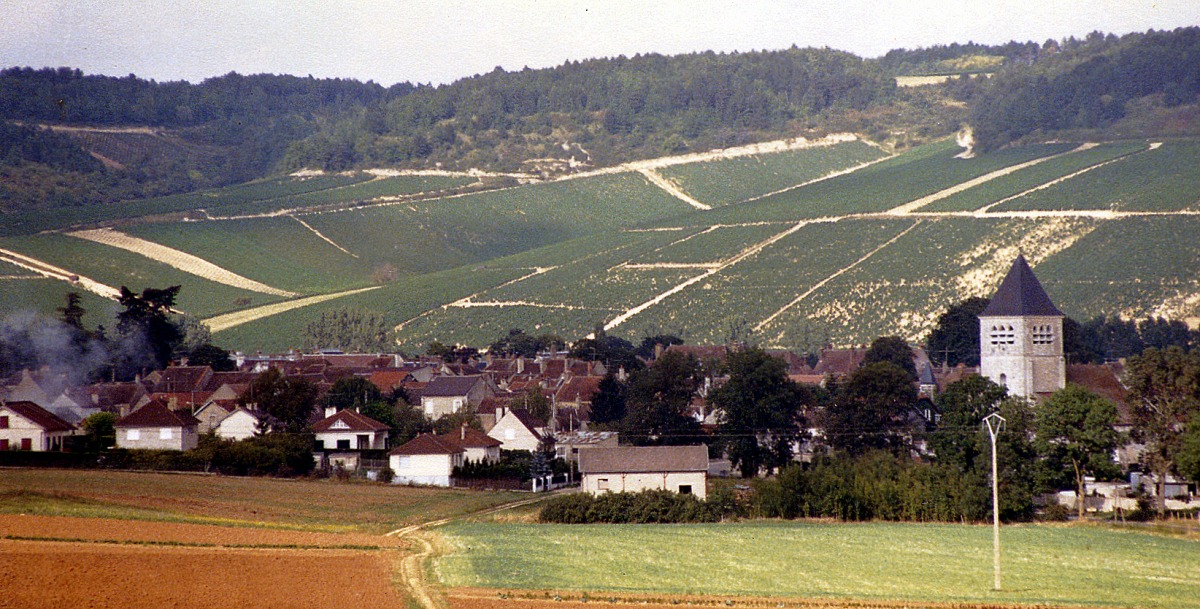
Vineyards in the Champagne region of France.
Terroir
Another particular feature of what, I believe, is Mister Corrigan’s second superlative collection is the irreverent and humorous nature of some of the poems.
At times, I was reminded of another stalwart in the recent Irish literary canon, and that is Paul Durcan. Michael Corrigan, being but a few years older than myself, is of that generation that grew up during the Depression in 1980s Ireland, and his humour is deeply informed by the experience of busts and booms, in that particular order.
This is something that you simply cannot imitate. The French have the term terroir which is particular to their culture. They use it principally to describe the distinctive flavour and taste of a certain cheese or wine that can be traced to the particularities of weather and soil of the place it comes from in France.
Champagne is an obvious example of this cultural phenomenon. No other sparkling white wine can use the term unless it comes from this specific region. The French feel other sparkling drinks, such as Prosecco, come from very different terroirs with different soil and climates and so cannot possibly be described using the term.
The particular terroir that Michael Corrigan comes from is a feature informing the aesthetic of his work; like the shells in the soil that inform that old white wine that comes from Bordeaux and whose name escapes me now…
When the dark waters of sleep
close across my resting butch face
and I become a fat Ophelia
floating down the weedy slope
of memory, hope and duck billed platitudes,
back to childhood, back to faith,
where a diarrhoea fountain
of bare-knuckled nationalism
provides us with its dullard troops
each one trained to shit on sight,
the brightest and best promoted to teach
in the places that smelled of failure and feet.
There are many so-called poets who are praised for their satirical nature. Many is the time that I have read their work and wondered what all the fuss was about.
Poetic trends, like any, come and go . But verse such as the above would certainly qualify as satire of the very highest order. God knows every particular cuntry has its own exasperating strains, and dear old Ireland is no exception.
Embracing Mediocrity
I remember being at an exhibition in one of the older more established art galleries in Dublin and a very famous photographer, who had made his career abroad, commented on how in the Republic we make a point of embracing mediocrity
It is this particular phenomenon, again, that I think Mr Corrigan is particularly good at eking out. Begrudgery being another!
when masters came to class tooled up
and the biggest looters wore the best suits,
Every society has its particular issues. I’ve lived long enough in France to spot some there, and having lived with an Italian for over twenty years, I am qualified to identify that country’s or rather its peoples, foibles.
What Corrigan is particularly good at putting his finger on here (both of the above quotes are taken from Unlearning my Place) is the atrocious competitiveness produced by living on a small island, where everybody is fighting for their portion of the land.
You also find it in the novels of Andrea Camilleri describing Sicily. The cold, brutal violence of the mafia in his case. In the Republic of Ireland, things are a lot less dramatic. Dead is the word. Everybody is caught in a kind of entropy that James Joyce identified on page one of Dubliners – PARALYSIS.
The disease has not gone away. Irish society, in general, is still plagued by it. The absolute awfulness of social convention. The tiresome scene that informs everything. Even poetry!
Choose friends wisely,
enemies will self-select,
smiling like tigers or growling like bears,
an arm around your shoulder
while pissing down your leg,
the welcome will be warm
before you’re taken out and shot.
The indirect nature which seems to govern everybody’s speech, the coded chatter, the back stabbing nature that it all creates. All the atrocious hallmarks of the ‘Irish’ when at home; behind the smiling eyes: the daggers in their bones.
The Love Poetry of Judas Iscariot – Poems by Mick Corrigan is a wonderful collection of both poetry and verse. The first is infused with Biblical insight and learning, while the latter is concocted with sharp and bitter knowledge won, no doubt, first-hand by the author who thinks so little of the slights by now that he has made it the stuff of polished rhymes and memorable phrases.
The Love Poetry of Judas Iscariot: Poems by Mick Corrigan Dionysia Press Ltd, 2021
59 pages – £15.50
As events in Ukraine demonstrate, ineluctably, war diminishes our humanity, possessing men – and mostly men – of a callous disregard for life, and a capacity for often inexplicable cruelty.
As such, the invasion of one state by another without a casus belli – as we have witnessed in Russia’s essentially unprovoked invasion of Ukraine and also with the US invasion of Iraq in 2003 and other incursions since – has long been considered an injustice: any aggressor thus bears a level of responsibility for what follows.
This does not, however, absolve an injured party from guilt for mistreatment, or worse, of prisoners of war, or other breaches of the Geneva Convention; notoriously described as ‘quaint’ by George W. Bush’s Attorney General Alberto Gonzales, with apparently horrifying consequences.
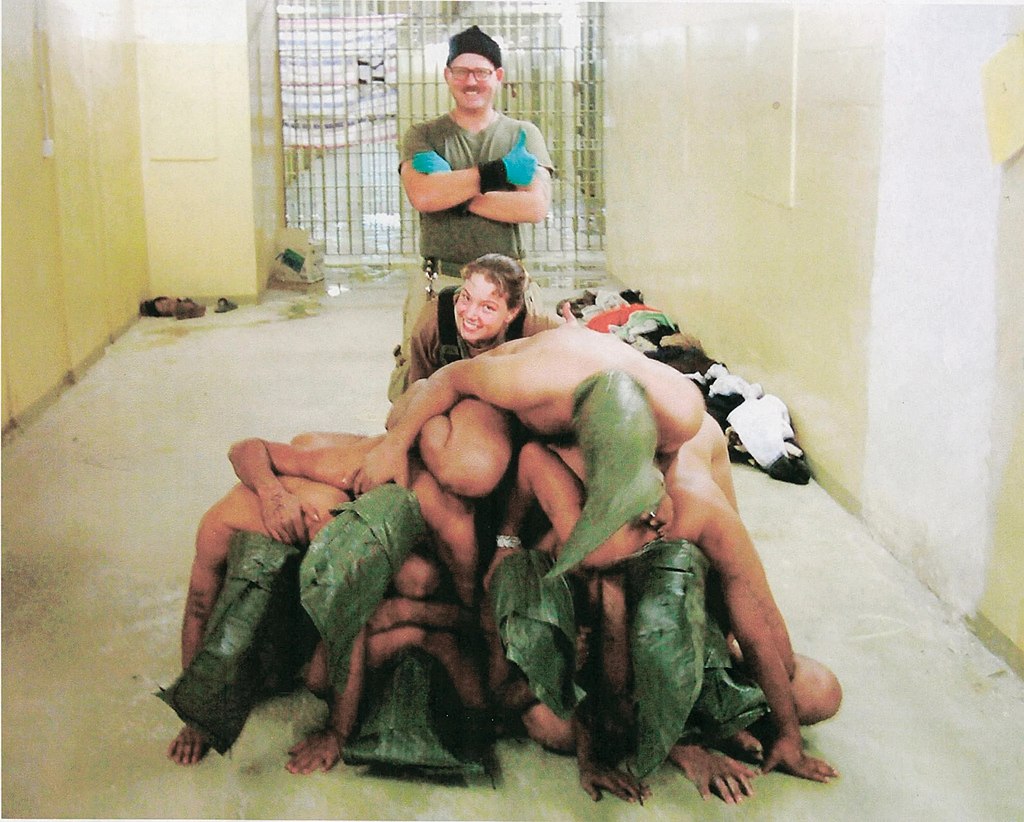
Sabrina Harman poses for a photo behind naked Iraqi detainees forced to form a human pyramid, while Charles Graner watches.
A Single Murder
In peacetime the violent ending of a single life is newsworthy, but during a military conflict the deaths of thousands are often defined as mere casualties, calculated to diminish one side or another’s capacity to wage war. A cold-blooded logic often underpins such strategic analysis.
‘What was a single murder’ Stefan Zweig asked of World War I, ‘within the cosmic, thousand-fold guilt, the most terrible mass destructive and mass annihilation known in history?’
Beyond the mindless trench warfare of World War I, the twentieth century also produced the exquisite evils of World War II, when the carnage reached the civilian sphere as never before; the leading industrial nations harnessing advanced technologies to produce Concentration Camps, Gulags, carpet bombing, and of course – supposedly bringing wars between Great Powers to an end – the atomic bomb.
In that war’s wake there emerged a new understanding of international law, previously dominated by an insistence that this should only apply between states, as opposed to allowing individual rights to be enforced against officials of an offending state in a foreign jurisdiction.
This traditional understanding was emphasised by a British official during negotiations prior to the Treaty of Versailles after World War I: ‘The new League of Nations must not protect minorities in all countries,’ he complained, or it would have ‘the right to protect the Chinese in Liverpool, the Roman Catholics in France, the French in Canada, quite apart from the more serious problems such as the Irish.’
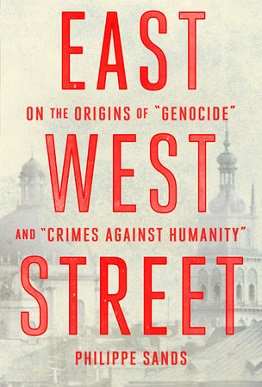
According to Phillipe Sands: ‘Britain objected to any depletion of sovereignty – the right to treat others as it wished – or international oversight. It took the position even if the price was more injustice and oppression.’ [i]
But the depravities of World War II changed the global mood, even if Hermann Goering could persuasively assert that ‘the victor will always be the judge and the vanquished the accused.’ Indeed, there is a reasonable argument that Russian, American and British officials should also have been in the dock to account for what occurred in Katyn, Hiroshima, Bengal and elsewhere.
Nonetheless, the universal ambit of human rights was one of the great advances of the post-Second World War period, culminating in the Universal Declaration of Human Rights. In theory at least, it was no longer permissible for states to act with impunity even within their borders, as the Rule of Law gained universal jurisdiction, at least where atrocities were concerned.
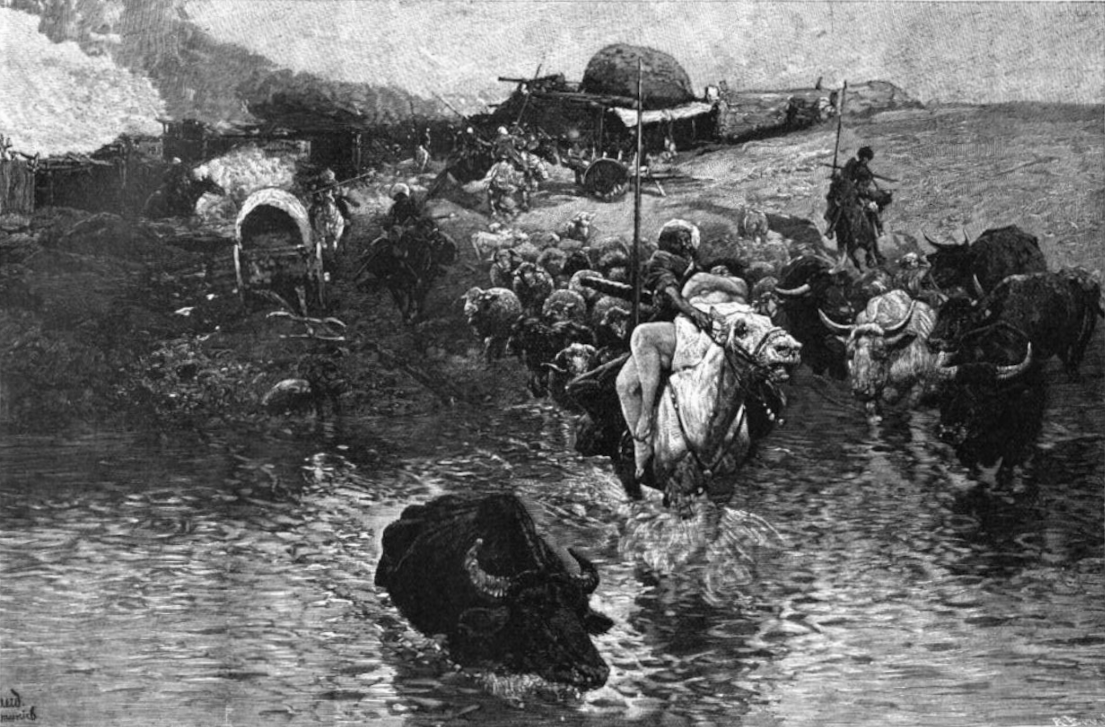
Looting of an Armenian village by the Kurds, 1898 or 1899.
Genocide v. Crimes Against Humanity
Thus, charges of Crimes Against Humanity and, arguably more problematically, Genocide, were laid against leading Nazi at the Nuremberg trials.
Coincidentally, the two Polish-Jewish jurists Raphael Lemkin and Hersch Lauterpacht responsible for developing these novel concepts both studied in the University of Lwów, a Polish city between the Wars, before being annexed by the USSR at the end of World War II. Today Lviv, as it is now called, is the main city of Western Ukraine.
Amidst accusations of war crimes, including that of Genocide, being levelled against Russia, it is worth considering important distinctions between Crimes against Humanity and Genocide.
The author of the former concept, Hersch Lauterpacht argued that ‘The well-being of an individual is the ultimate object of international law.’ In contrast, in his 1944 book, Axis Rule in Occupied Europe Rafael Raphael Lemkin adopted an approach which aimed to protect groups, for which he invented the new crime of ‘Genocide.’
In response, Lauterpacht worried that the protection of groups would undermine the protection of individuals. He challenged the ‘omnipotence of the state,’ suggesting atrocities against individuals should be referred to as Crimes Against Humanity, whereby no longer would officials from any state be free to treat their people with impunity.
Lemkin also wrote of the misdemeanours of the ‘Germans’ rather than the Nazis, arguing that the ‘German people’ had ‘accepted freely’ what was planned, participating voluntarily, and profited from their implementation. This was similar to the War Guilt Clause contained in the Versailles Treaty after World War I, which was deeply resented by Germans.
Genocide concerned acts ‘directed against individuals not in their individual capacity, but as members of national groups.’ For Lemkin Germany’s terrible acts reflected a militarism born of the innate viciousness of the German racial character. He selectively included a quotation from Field Marshall Gerd von Rundstedt who noted that one of Germany’s mistakes in 1918 was to ‘spare the civil life of the enemy countries’[ii] and that one third of the population should have been killed by organised under-feeding, but not all Germans shared this mentality.
Collective Guilt
The difficulty, therefore, with the crime of Genocide is that in purporting to protect one national, ethnic or religious group it often implicates another via its ruling authority; this may perpetuate racial stereotypes, such as innate viciousness, and contains a potential for indiscriminate reprisals, or even further wars.
Under the original conception of the crime of Genocide, any Russian, even an expatriate opposed to Putin, might be held responsible for the conduct of the Russian army in Ukraine. This idea of collective guilt – a species of Original Sin attached to a national or racial group – generally based on supposedly timeless national characteristics, could also permit crippling sanctions and even bombing campaigns impacting on civilian life.
Punishing an entire nation for the conduct of its government – even if that government is democratically elected – is therefore unjust, not least as it tends to bolster the authority of belligerent elements within a state – who may point to the aggressor posture of the opponent – diminishing the likelihood of lasting peace.
Far less problematic is the idea of Crimes Against Humanity, which simply asserts a universal jurisdiction for atrocities committed by the officials of any state, including ‘legally’ against their own people.
But charging Russian officials with Crimes Against Humanity might lead us to consider whether the leaders of other nations, including the US – which along with Russia (and Ukraine) is not a party to the International Criminal Court – should be similarly indicted.
Drone Strikes
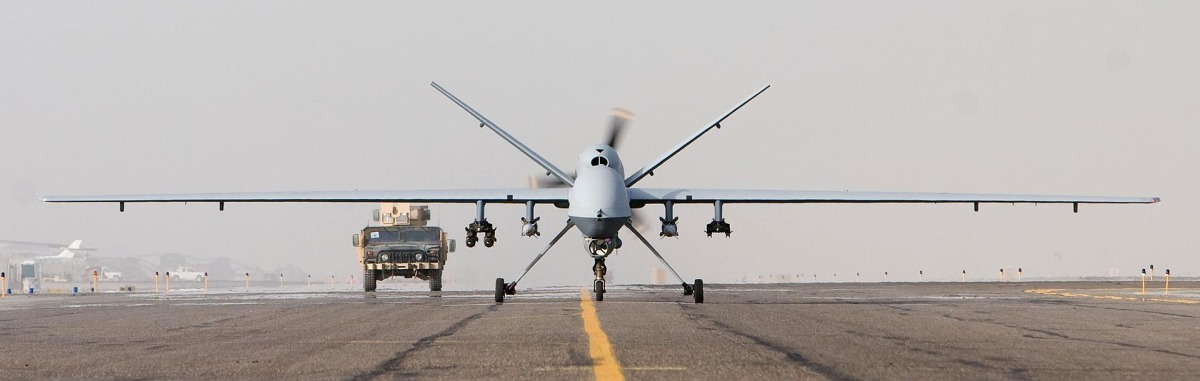
Since the beginning of the twenty-first century the US has been waging warfare through extra-judicial assassination operations: drone strikes, aimed at suspected ‘terrorists’ living in some of the world’s most deprived and defenceless countries. As of 2021, the Bureau of Investigative Journalism claims that there have been at least 13,072 confirmed drone strikes on Afghanistan alone since 2015.
These remote attacks represent a new phase in the cruelty of warfare, as the leading Superpower maintains a social distance from each hit. The consequences, or ‘collateral damage’ is rarely investigated by a mainstream media that now howls in anger at Russia’s excesses.
As LSE’s Maarya Raabani puts it: ‘Buoyed by mainstream media, an alarming preponderance of metaphors and passive-voice reporting have denied any chance to hold drone atrocity perpetrators to account.’
Moreover, ‘Drone strike casualty estimates are substituting for hard facts and information about the drone program,’ said Naureen Shah, Acting Director of the Human Rights Clinic at Columbia Law School. ‘These are good faith efforts to count civilian deaths, but it’s the U.S. government that owes the public an accounting of who is being killed, especially as it continues expanding secret drone operations in new places around the world.’
In July 2021, U.S. President Biden announced the adoption of an ‘over the horizon’ counterterrorism strategy. According to the Brookings Institution:
The new plan would rely on armed unmanned aerial vehicles — or drones — to respond to terrorism threats around the globe without deploying American boots on the ground. But although the strategy was designed to overhaul policies that had kept the United States embroiled in conflict for 20 years, it failed to address the unintended consequences of counterterrorism strikes, namely civilian casualties. On August 29, 2021, with most U.S. soldiers withdrawn from Afghanistan and regional bases shuttered, this challenge became clear. The U.S. military conducted a strike that killed 10 civilians, including women and children, rather than the intended target.
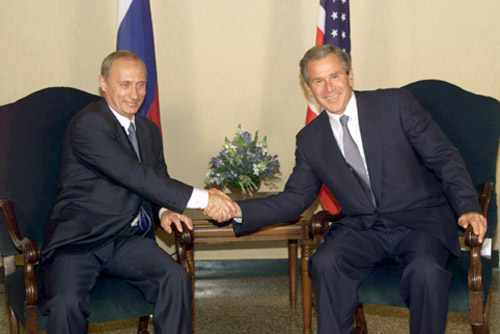
TAS13: GENOA, JULY 22. Russian President Vladimir Putin (left) and US President George Bus.
In striking unison, mainstream media in the West has reacted to the invasion of Ukraine with outrage, and conveyed statements of the President of Ukraine with uncritical approval. Russia certainly deserves opprobrium for his war of aggression against Ukraine – and its officials may be responsible for war crimes – but the failure to interrogate the actions of the US and its allies including Israel and Saudi Arabia over many years makes the self-righteousness ring hollow.
Russia is operating in a context established by the US’s illegal invasion of Iraq in 2003 that destabilised the Middle East causing hundreds of thousands of unnecessary deaths. Putin exploited the anarchy in the international system with his invasion of Georgia in 2008, having divined that the rules of the game had changed. There is a continuum between Russia’s attacks against Georgia, the Donbass and Crimea campaign in 2014, and this latest invasion of Ukraine.
Once Western leaders and their allies are also held accountable for their actions we may move to an environment where the Rule of Law attains a universal character; then the invasion by one state of another without a legitimate casus belli may become unthinkable.
Unlike during the period of the USSR, Russia exerts little ‘soft’ power. Putin’s propaganda relies on the hypocrisy of the West, especially the US which continues to baulk at becoming a party to the International Criminal Court and allies with rogue actors such as Saudi Arabia and Israel. Confronting Russia should also involve Western governments pursuing morally consistent foreign policies.
[i] Phillipe Sands, East West Street: On the Origins of Genocide and Crimes Against Humanity, (Knopf, New York, 2016) p.72
We all see things with different eyes and it gets you nowhere hoping that one in a thousand will see things your way. J. L. Carr, A Month in the Country (1980).
In his droll 1999 essay, ‘Reader’s Block’, Geoff Dyer describes suffering from what he calls a creeping condition whereby he finds himself staring blankly at his bookshelves noting all the books he hasn’t read and thinking “there’s nothing left to read”.
Such was Dyer’s malady that even so-called “quality fiction” seemed a waste of time. He was forty-one. Back in his twenties he had imagined he would spend his middle age reading the books he didn’t have the patience to read when he was young. But it was not to be, and now he found himself resigned to leafing through the pages of the in-flight magazine when traveling abroad rather than reading the books he brought for the journey.
Being roughly the same age as Dyer, I identified wholly with his piece back then, and in a way still do. But my malady, my “reader’s block”, is more specific: it was fiction that got on my nerves at the onset of middle age, and years later it still does. I don’t suffer from reader’s block, but rather fiction reader’s block, or to be more precise, novel reader’s block.
Occasionally some fiction does slip through the net. Jennifer Potter and Ferdinand Dennis are on my bedside table alongside the handful of old favourites that I occasionally revisit: Sam Selvon, Chester Himes, Shelagh Delaney, Stuart Dybek, W.G.Sebald and Ann Quin. But it is to non-fiction that I mostly turn and have done for over twenty years.
Currently I’m engrossed in Patrick Wright’s monumental The Sea View Has Me Again, an extraordinary telling of the German writer Uwe Johnson’s lost decade on the Isle of Sheppey. Johnson drank himself to death in bleak surrounds of the Sheerness Sea View Hotel in the 1984.
But what is this affliction? It’s not laziness or distraction, nor the inability to concentrate on anything that doesn’t offer immediate gratification. Patrick Wright’s multi-layered opus is a densely packed seven hundred page micro-history of both Sheppey and Uwe’s self- exile, and is not remotely daunting. Likewise, Speak, Silence, Carole Angier’s detailed study of Sebald’s life and work comes in at over six hundred pages, and is not a page too long in my view.
In interviews the highly-regarded contemporary writers Kevin Barry and Rob Doyle can be interesting, but the preoccupations they display in their fictions are those of young men and are of no interest to me at all at my stage in life.
Now to be sure, I’m of the wrong demographic for Sally Rooney or Nicole Flattery, but I can’t hack the imagined worlds of the Colm Toibins or John Banvilles either – in form and content they’re just not my cup of tea. It is of course a question of taste, but I can’t abide the narrative armature of story-driven literary fiction with those wretched character arcs – as Shakespeare fully understood, people do not change.
My inability to read literary fiction doesn’t bother me, and I don’t need my ideas of the world to be shaped. My view of the world is fully formed and doesn’t need to be textually generated or reinforced.
But I am a reader, and always have been, even though I grew up in a non-reading household. Even when I was boy, I knew where to look for my reading material. I was a discriminating reader. As an eleven-year old I knew Edgar Allan Poe was good and H.P. Lovecraft was bad. I could see that, unlike Henry James, William Golding wrote in clear, straightforward prose to elucidate complex themes.
As a young adult in the counter-culture era of the late 60s, I recognized that Mervyn Peake was a singular talent and a great stylist, and that Tolkien was a dull and pedestrian writer. Jean Cocteau, even in translation was great and Burroughs’ debut Junky/Junkie was a fine example of taut, economical writing that surpassed his later experimental fiction.
Recently I was chatting with an old friend. He’s an exiled Corkonian living in Italy, and an erudite man of letters. We spoke about my aversion to fiction and he echoed my sentiments. Somehow our conversation turned to Flannery O’Connor. I’m an admirer of her short fiction but now find myself confused and a little wary of her after the revelations in 2014 of the racist views expressed in her correspondence.
My friend had never read O’Connor. Could O’Connor be saved from herself? I don’t have the answer, but her fiction can stand alone. I told my friend how in the 1950s reviewers were constantly vexed by her characters’ lack of interiority. My friend lit up at this: “I like the sound of that! I can’t stand being told what characters think and feel. I just want a description of where they go and what they do.” Simply and succinctly put.
In The Lonely Voice, Frank O’Connor wrote that for some reason he could only guess at, “the novel is bound to be a process of identification between the reader and the character. One character at least in any novel must represent the reader in some aspect of his own conception of himself”.
It is this process, embedded in the mechanics of fiction, of identification and absorption into a psychological world, that in time becomes for me recognizable and tedious. So maybe it is a case that non-fiction – and certain rare types of fiction that bypass identification in favour of evocation of a world and its details – doesn’t use itself up in the telling. It stays with us. And so, in the meantime and undoubtedly for the rest of my life, I will follow my instincts, knowing that non-fiction will more likely give me what I want.
There’s a strangeness to singing in a language you don’t understand, akin, perhaps, to the sensation that comes with remembering, vividly, a person who has died. In both cases, you can almost touch the life recalled, even as the shadow glimpsed in that one word, “almost”, clouds your every sense.
Whenever I hear a song, an eddy of radio-speak, a casual exchange, unfurling in Irish, I go quiet, caught in the webs of a faltering familiarity. Likewise, when I return to them, I find that the recollections I have of my grandparents are locked in a grammar of (often palpable) absences: I’ll not see their like again.
By choosing Irish placenames as titles for a number of poems in my new collection, Phantom Gang, linking the elegies I had composed for my grandparents with the landscapes I associated with them in north Leitrim, I was trying to register, in outline, the forms of loss under which the poems had been written: the twin river-banks – an unreachable language, an irretrievable time – between which my memories had flowed since their deaths.
So in “Achadh Bhuachaill” (meaning, literally, ‘Boy’s Field’, and transliterated to ‘Aghavoghil’ in English), the townland’s emotional cartography begins to shift, as the poem slowly unearths a seldom mentioned incident from the local past, relayed to me by my granduncle: “The land here / dreams in silhouettes // our bodies learn to read”.
The relationship between land (and its changes) with the memories that mark it, of course, is as old as poetry itself. It recurs as a shaping concern in the work of John Clare (1793-1864), the so-called ‘peasant poet’ of the late Romantic period. “Oh, words are poor receipts for what tie has stole away”, he wrote, remembering the open commons he had known in the Northamptonshire of his youth, one of many areas in rural England directly affected by the 1801 Inclosure Consolidation Act, converting communally tended landscapes into real estate. “There once were days, the woodman knows it well”, he said, “When shades e’en echoed with the singing thrush”:
There once were lanes in nature’s freedom dropt, There once were paths that every valley wound – Inclosure came, and every path was stopt[.]
This truncation, and the subsequent disappearance, of the much-cherished social and ecological terrain of his upbringing, can be sensed in the knotted, quickening language of Clare’s pastoral poems, often scintillating in their natural notations, even as they crackle under the weight of the vexed environmental histories they record. The communal fields and woods, the trilling heaven of the poet’s boyhood, seemed increasingly irrecoverable to Clare, having been carved up, indelibly, “[in] little parcels little minds to please”, leaving “men and flocks imprisoned, ill at ease.”
Phantom Gang attempts to pay tribute to this distant figure, a “loss-eyed wilder-man”, who was also, at different points in his life, a kind of “hierophant // of dirt-in-bloom / and revelry”. Tuning in to the fierce, burnished weathers of his work, the book simultaneously tries to sift through the swarming static of contemporary history to a new zone of clarity, where the spectres (of poverty, displacement, homelessness, environmental corrosion) that so ruled Clare’s world, two centuries ago, might be recognised afresh in our own – “our age / of wilting seas // and homesick, lock-out blues.”
In all of this, among other things, I discovered that reading poetry is not so very different from the writing of it. We bring what we have – our small store of hopes and memories – to the threshold of another life, trusting in the possibility of recognition or discovery. The words on the page, I now believe, form a living monument to that possibility, creating a space where lost presences might be acknowledged, where the vitality and freedoms of an uprooted world can be sensed anew, pressing through the topsoil of everything left over, no matter how scarce. That, I think, is what the poem, “The Commons” (dedicated to Clare), reaches towards, near the collection’s close:
To feel at all: an act of intimate dissent,
as gentle-hearted heretics have ever felt and known.
Is this, then, our one inheritance, the ache where voices grow?
My poem’s a lifted echoing, as if they might continue.
Feature Image: Lough Melvin, County Leitrim, Ireland.
Do you know the feeling of wanting to discover secrets that aren’t being spoken aloud?
For a while I thought it was an esoteric way of preserving knowledge. I imagined there were savants to seek out, to turn to.
And in search of traces, I became passionate about chasing and searching for the threads of various human cultures, intertwined for thousands of years, starting from the perspective of Sicily, an island in the middle of the Mediterranean.
At a certain point I began to realize that the secrets were no longer alive: the people were gone, without leaving a cultural legacy behind.
Impossible, you will say. Everyone leaves an enduring oral imprint on the people around them. And yet, through passages less emphatic than the burning of books, or the eradication of cultural witnesses, a culture may be overwhelmed and deleted by a dominant culture, leading to the progressive decay and then complete disappearance of a cultural legacy over a few generations.
Cultural Imperialism
We are the result of five thousand years of cultural imperialism, which has slowly led to the affirmation of the strongest and most violent group, which now presents itself as an international, global monoculture that has drastically overwhelmed all others. It is the culture of today’s contemporary globalized world: capitalist, patriarchal, monotheistic and consumerist, in which a few cultural differences found at various latitudes appear almost as commercial nuances – variations on stimulating consumption.
As soon as I realized that I was living in an era directed by a total cultural monopoly, I began frenziedly passing on, divulging, recomposing and reviving those shreds of a subaltern culture that I could find; whether they were dying, or perhaps already immortalized by a lone enthusiast, annotated and then recorded over the past centuries; although often in forms not suitable for preserving the enduring ferments in the material of oral tradition.
I sought the secrets “between the lines” of verses or stories: after all, we know that this way has always been used to preserve and pass on things: concealing them in a joke, a rhyme, a riddle, a bell, or a proto-memory.
I searched inside song traditions, oral stories, and in the repertoire of oral tradition, which they have not been able to completely eradicate from memory: precisely the songs of oral tradition which has the potential to preserve and pass on secrets about the meaning of life, the most important baggage that generations have the burden to pass on – at all costs and through all possible stratagems – in case of censorship and oppression.
Women’s Songs in the Sicilian Tradition
In the last few years I have been primarily interested in Women’s Song in the Sicilian tradition, which constitutes an even more fragile niche in the midst of the general fragility of the heritage of tradition, since it suffers in addition from the perpetual minority suffered by the patriarchal cultures that have followed one another since the third millennium B.C..
It is a repertoire scarcely paid attention to, liminal to other stronger and more manifest repertoires, more excavated and documented; and in any case predominantly investigated from a male perspective; from a point of view that is still and always hegemonic, in terms of the gender question.
This is the most fertile repertoire for those who, like me, are in search of handed-down secrets: women represent a particular segment of social reality, in which the needs of the private and family sphere interpenetrate uniquely with the needs of the public, socio-economic sphere; women have the task of ensuring the survival and growth of the social actors of the future, the children, and women, have the task of turning the economic wheel of the family micro-society. Always.
Lullabies
The musical repertoire of women is often a mixture of different genres that refer both to the classic cycle of life – including lullabies, engagement, wedding songs and funeral laments – and to the sphere of work, as well as to the religious sphere, in a diversified way according to the religion of reference.
Often the added value that we find in the fragments of female repertoire is that there is a greater purity and resistance to the assimilation of the hegemonic cultures, alongside a tendency towards fusion.
Having been maintained and handed down in an intimate and private setting, and almost always in the absence of musical instruments, they have not been subject to admixture and transformation to adapt to changing tastes and fashions, resulting in the loss of content and precision of message.
In the repertoire of female gender, the first place – cultural universal – is entrusted to the chapter of maternity. That is to the lullabies and dirges that women in every part of the world sing to their children to quieten them and accompany them in their sleep.
The lullaby is the song of intimacy and privacy, it remains contextualized to the intimacy of the mother-daughter relationship.
I am convinced that the valorization – the patrimonialisation of this enormous cultural baggage, immaterial heritage of the human race – restores strength, health and richness to the woman, and to her social role. It is a wide and shared documentation of this infinite repertoire, allowing for the patrimonialisation of a real hidden and almost unused treasure.
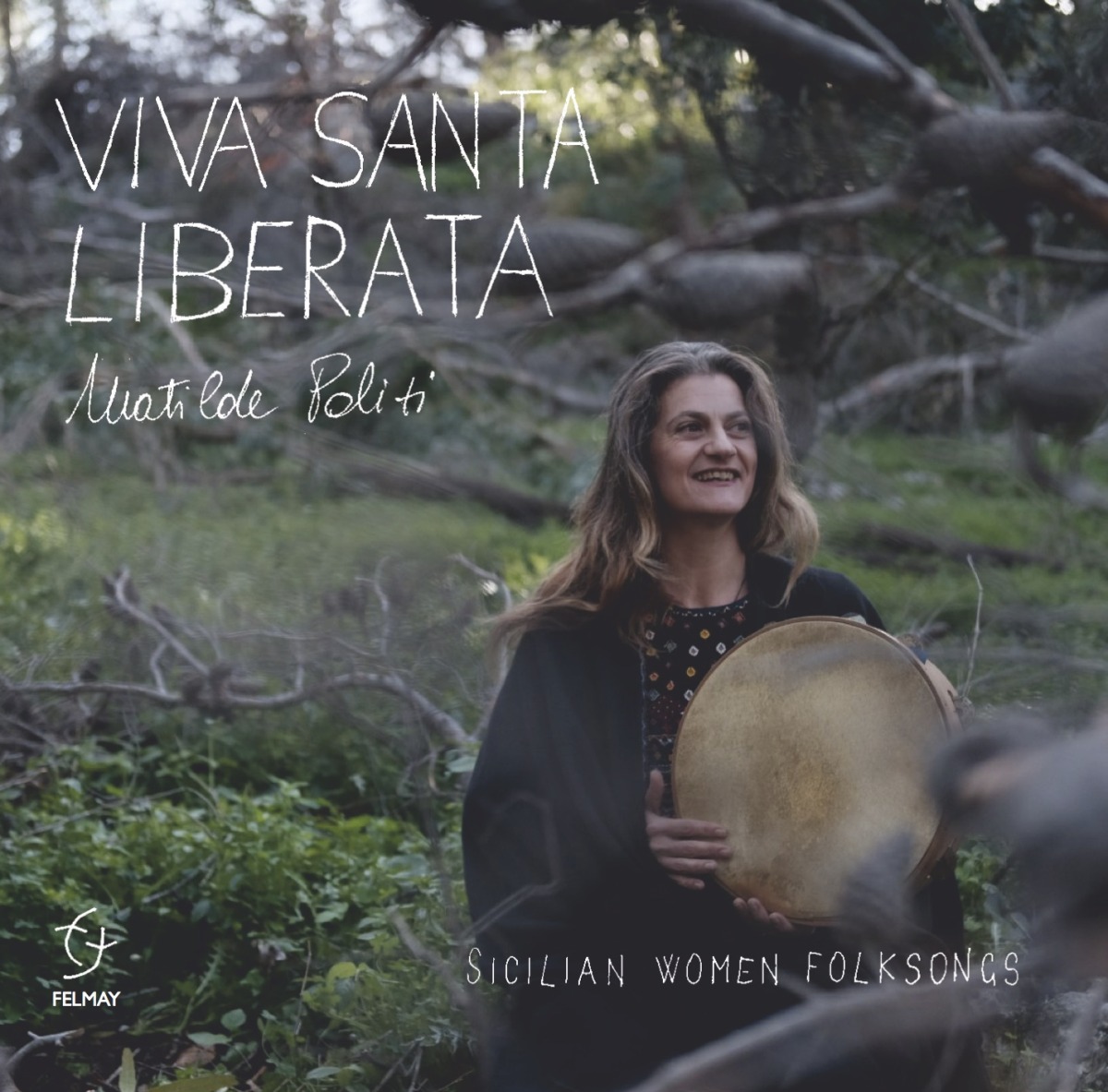
My two latest albums from 2019: Dormi, a matri. Ninne nel Mediterraneo and of 2020: Viva Santa Liberata. Sicilian Women Folksongs, are dedicated to the traditional female repertoire. They are the culmination of many years of research – an audio production project investigating, witnessing, and passing on this repertoire.
The path of research on lullabies has been going on for twenty years. It includes field research, the testimonies of women in the first person through intercultural workshops, archival research, and even authorship in some cases.
Above all it has come about in meetings, not only with women but also often with sensitive men who have a strong sense of the magical power of the lullaby.
Collaborators
The opportunity to record an album of lullabies presented itself in 2018. Thankfully, the idea received a warm welcome from the singer friends to whom I proposed a collaboration, under my artistic direction (Simona Di Gregorio, Costanza Paternò, Clara Salvo, the very young Rawen Laid).
Each had the task of testifying some traditional lullabies, not only Sicilian but looking to a wider Mediterranean culture for inspiration, with freedom of choice in the type of processing and repurposing; the disc: Dormi, a matri. Ninne nel Mediterraneo (2019) represents one more instrument with which to carry out the project.
VIVA SANTA LIBERATA is a record that was created as a tribute to women’s singing, in particular narrative singing, another branch of the female repertoire that has fallen into almost total disuse.
The songs of mothers and daughters, grandmothers and mothers-in-law, sisters and aunts, cummari, majare and soothsayers, midwives and nannies, complainers, healers; the song of girls and ‘teachers of water.’
The title was born from a provocative play on words in relation to the iconography of the feminine in Christian cultures, proposing a synthesis of the dualism between virginal sacrifice and chastity on the one hand, and self-determination and sexual freedom on the other.
Santa Liberata
Santa Liberata claims her atavistic freedom, starting from sexual freedom, the source of all her other powers connected to life and its balance, in the cyclical nature of time, and her source is the fountain of Living Water.
Santa Liberata (in Sicilian “Libbirata”) is the character that continues to guide my work in the last two years. She presents herself in appearance as the Catholic saints, and requires the usual celebrations reserved for the patron saints, such as Santa Rosalia in Palermo and Santa Agata in Catania, that is, required at the annual preparation of a Fistinu, in which her qualities and merits are magnified and her precepts divulged.
PART II – A World Music Festival in Sicily
But the Fistinu is not only this, it is an enterprise involving dozens of artists, workers and associations that have joined my adventurous proposal to build an event around the music, which puts at the centre the idea of a healthier community: a mixed community in which identities and traditions intersect, intertwine and develop; a concrete community that integrates with the natural world; that welcomes it in a symbiotic and non-competitive way, rebuilding the good traditional ecological practices.
It is the heritage of our ancestors; a community of individuals aware of their right to well-being, to care for themselves according to their own free choice, as symbolized by the medicinal hemp, symbol and ornament of Santa Libbirata; an idea of liberation of conscience that starts from the liberation of women, and for this Santa Libbirata.
The Fistinu is an event in which people can find the beneficial dimmension of the participatory FESTIVAL, using the traditional techniques of music, song and dance.
The feast is an occasion in which people dance together, as a communal rite of reintegration of well-being ‘individual through the collective and collective through the individual.’
The popular or folk music has among its functions to bring together the community in a particular occasion, merging together in an experience of total participation, physical, mental and emotional, with the support of rhythm and song; each tradition retains its key to open the doors of participation through dance and song, a ritual and archaic dimension that helps to recreate social harmony and community well-being.
We endeavoured to recreate a tradition of FESTIVAL in Sicily, which in addition to supporting itself through the indigenous cultural traditions, such as the contradanza or the ballittu, inevitably recreates itself by opening and dialoguing with other musical traditions, the cultures that coexist in Sicily today, which can point a magnifying glass on the processes of migration and cultural metissage.
Cultural Crossroads
Looking at the past, centuries of real experience of cultural cross-fertilization between different and distant traditions – including Arabs, Vikings, Greeks, French, Turks and Americans – are the basis on which Sicily’s own musical tradition, the most archaic, has been constituted.
Looking at the present, Sicily is the junction and crossroads of the great migrations of the third millennium, on its territory different experiences and cultural languages continue to meet, dialogue and merge.
Since the third millennium A.D. began we have witnessed the transformation of the whole world. There are no longer borders for information, culture, fashions (unfortunately still too many borders for the dignity of human beings on the move): inevitably the transformation leads to global métissage.
The culture of global métissage is like a river in which everything is mixed; if the course is too wide, values sink and rot at the bottom, the surface becomes one sterile insignificant reality, enslaved to the market and the economic system; but if the course is alive, the identity of our ancestors does not fade in the midst of everything, but is enlivened alongside the others – roots that intertwine and strengthen each other.
Then the métissage becomes our strength, the new strength of the individual of the future.
SI LU CHIù FORTI A’SSIRI SCANNATU
LU CHIù DIBULIDDU E VOGGHIU ESSIRI
SI LA PETRA FERMA A’SSIRI MARTIDDATA
COMU ACQUA CHI CURRI E VOGGHIU ESSIRI
C’ARRIFRISCANNU SCURRI E UNN’è DI NUDDU
L’ACQUA CURRI SUPRA LA MUNTAGNA
SCURRI LENTA MA PASSANNU CANCIA
CANCIA IDDA E CANCIA LA MUNTAGNA
LENTAMENTI L’ACQUA LA TRASFORMA
The music of cultural identity, of the roots, the language and the words of our ancestors, contain within themselves a permanent force. This is like water that flows and slowly manages to shape even the rock, which can allow us women and men of today to face the contemporary world with love, to bring our positive contribution to the creation of the society that is currently getting out of hand.
Micro Identity
That’s why I want to continue to sing in Sicilian, and not only in Sicily, in Italy, and in the whole world. The micro-identity doesn’t close, doesn’t stop and doesn’t die out, but can be offered to the world without fear, allowing us to open up and confront each other, bringing knowledge, esteem and enrichment that strengthens all our resolve.
And I want to meet and get to know closely your stories in your dialects and your songs and dances, to be able to see the strength of the recognition of the message: Acqua di stu chiaru fonti, that secret that has been handed down to us from the past of generations by our Ave.
CU VIVI ACQUA DI STU CHIARU FONTI
S’APRI LU CIELU E CALANU LI SANTI
FUNTANA DI BIDDIZZI E D’ACQUA CHIARA
CA CU CI BIVI CI LASSA LA MENTI
UNDI CAMINI TU L’ARIA SCARA
PERNI E DOMANTI SU LI TO SBANNENTI
DI TUTTI LI FUNTANI SI CHIù RARA
E SUNNU L’ACQUI TOI LI CHIù LUCENTI
PRI TIA LA TIRRA STISSA SI PRIPARA
LARGA LU MARI CISSANU LI VENTI
CU VIVI ACQUA DI STU CHIARU FONTI
S’APRI LU CIELU E CALANU LI SANTI
FUNTANA DI BILLIZZI ED ACQUI ARANCI
NA BEDDA COMU A VUI NUN SI PO PINCIRI
FUNTANA DI BILLIZZI ED ACQUI D’ANCILI
CUI PASSA DI STA STRATA LU FA MPINCIRI
TU SI FUNTANA DI TUTTI BILLIZZI
NTRA LU TO STICCHIU C’E LA MIDICINA
QUANTU MALATI C’è TANTU NNI SANA
C’A LI MALATI LIVATI LA SITI
A CHIDDI MORTI LI RISUSCITATI
CU VIVI ACQUA DI STU CHIARU FONTI
S’APRI LU CIELU E CALANU LI SANTI
Speaking to the Ancestors
But from what past are the ancestors speaking to us? Or rather, how far back is this past from which these rhymes emerge? The rhymes speak of a feminine entity superior to the human dimension, whom one addresses face to face, like a mother or a companion, but whose praises are sung in music, as to a Goddess. It is an emergence of the prehistoric Mediterranean Culture of Mothers.
Digging into history, I wondered when it happened, and how such an unbalanced way of life took over; I was lucky enough to discover the work of prehistoric archaeology by Marija Gimbutas, who reinterpreted prehistory, in particular the time period between 3000 and 2000 BC.
This was before a prolonged period of invasion, when a different culture was widespread throughout the Mediterranean and Europe, up to Ireland. From the archaeological data, she concluded this was non-hierarchical, mutualistic, and based on the balance with the natural elements, in which women kept the most valuable skills related to survival, and were responsible for the welfare of the community.
Wayne Dyer called this Gilanic culture, joining equally the Greek roots: -gyn feminine and -an masculine with the unifying letter lambda.
Extra-Europeans
There was a time when those who now pretend to be the original indigenous citizens of Europe were only the new comers, the ‘Extra-Europeans’ of the past. They established their presence by means of wars and violence, trying to destroy or to exploit for their own aims the civilisation they found. They have been trying since then to impose their own single set of truths, values, gods. Now we can say that they failed in doing so at least for two basic reasons: first, we are still here to prove the existence of that earlier civilization, the goddess civilization, because they cut and burnt the trees but didn’t eradicate their/our roots; secondly, what has been achieved through violence and a monocentric male paradigm of dominance is a society based on malaise, destruction and death without regeneration and growth. Now we need a new science, a new politics and a new history, that is no more just his–story.
What have been called disdainfully ‘matriarchal studies’ indicate that egalitarian forms of social structures have existed in the past and are still in existence today in some parts of the world. In ‘matriarchies’ women are at the centre of culture without ruling over other members of society: their aim is not to have power over other people and over the natural world, but to have the power to nurture cultural life based on mutual respect.
…
Our task, therefore, is to transform the hope originating from all these discoveries about our Archaic Past into bursting energy to Realize now, as Mary Daly calls it, our Archaic Future.
Luciana Percovich, Barcelona, 2003.
So I found the tangle of the skein, and what’s more, I found myself with the thread in my hand. When a woman finds herself with a thread in her hand, the archaic instinct is to start weaving.
And from time immemorial, you have to involve others to weave together, if the fabric is endlessly wide.
Weaving then, it is in that time that songs are born: it is there that the story is always made goddess.
This is what Percovich means by Her-story. But let’s go in order.
Tangle of the Skein
The tangle of the skein is in this nebulous prehistory, out of which for decades now has emerged a new truthful narrative that speaks of a better world, or at least another possible one, through the archaeological evidence of a culture that refers to and strongly overlaps with the Utopia of the twentieth century, a better world, Huxley’s Island.
It opens a glimmer of hope: they almost convinced us that we are losers, utopians for an equalitarian and mutualistic world, they corroded our confidence in the ideal, and instead we have the archaeological evidence of the Neolithic, up to the Minoan culture in Crete, as witnesses of a better world.
And we know that this culture that was its bearer has been overwhelmed and prevaricated by an invading culture, which continues to prevail.
Once we have assumed this fact, the rest is all downhill, we simply need to reinterpret all that we known, and all that we will still learn with a new key, free from the intent of the dominant culture to make us slaves and oppressed, forgetting our identity. We haven’t been taught and told where we really came from, now we have to sew up the whole thread of history, to regain strength and courage, and self-confidence, and build our better world. Our archaic-future.
The Culture of the Mothers
The thread, I was saying, I found it in my hand. Digging into the archaeology of Sicilian songs, we can find these poetic fragments clearly ascribable to the spirituality of this culture of the Mothers, gilanic, and connected to the cult of Water and Waters: they are the retropapiri of our spiritual and ritual repertoire!
They can be a nucleus around which to sew up the fragments of memories of songs that have managed to reach us from this archaic culture, and by recomposing a fabric, we contribute to the re-emergence of a cultural identity in which we can feel at ease and heartened by our true roots.
Sicily is like a cauldron, the seething cauldron in which the cultural interactions between the migrant populations of history and the wandering of the merchants in the Mediterranean have stratified: among the sediments there are traces of cultural persistence of an ancient, prehistoric culture that unites us and reflects us: the culture of the Mothers.
It is the land of the golden apples, perhaps here rests hidden the Fata Morgana. If she is resting here, she is resting behind a magic mirror, and Circe is singing to call back from sleep all the sirens of the sea and invite them to a feast.
Women, says the song, let’s take back our customs, the feast must be done at least once a year, the feast where we can sing and dance and meet to tell our stories and our songs. In order not to disappear, to prevent our culture from dying out.
It is for this reason that from Sicily SANTA LIBERATA SENDS AN APPEAL.
From Sicily to all the islands, both territorial and cultural: sisters we are, capitals of cultural persistence!
In us is the germ of resistance, if after so many millennia we can still resist with a memory of the stories, voices and songs of our ancestors, who handed down their island culture.
We bring together in a project a path of meetings of songs and sharing, a project of permanent chorus of the archaic feminine, we constitute an OPIRA OF PUPE.
Singers and performers, bearers of traditions, passionate, willing weavers, Santa Liberata is building the road, from Rome to Sicily. Spring 2022.
A month on from Russia’s invasion of Ukraine, European states, including Ireland, are faced with some of the most significant challenges in decades. How should the West react? With humanitarian aid? With issuing a welcome to refugees? With weapons? With direct military interventions such as imposing a ‘no fly zone’ and therefore potentially extending the conflict beyond Ukraine’s borders?
It’s a pity that the European Union has in effect forfeited a potential diplomatic role, due to the decision of some member states to supply arms to one of the belligerents (albeit the victim of aggression), to the extent that diplomatic efforts at securing a settlement are being hosted by Turkey under Erdogan, which is not exactly a country renowned for protecting civil liberties or democratic values.
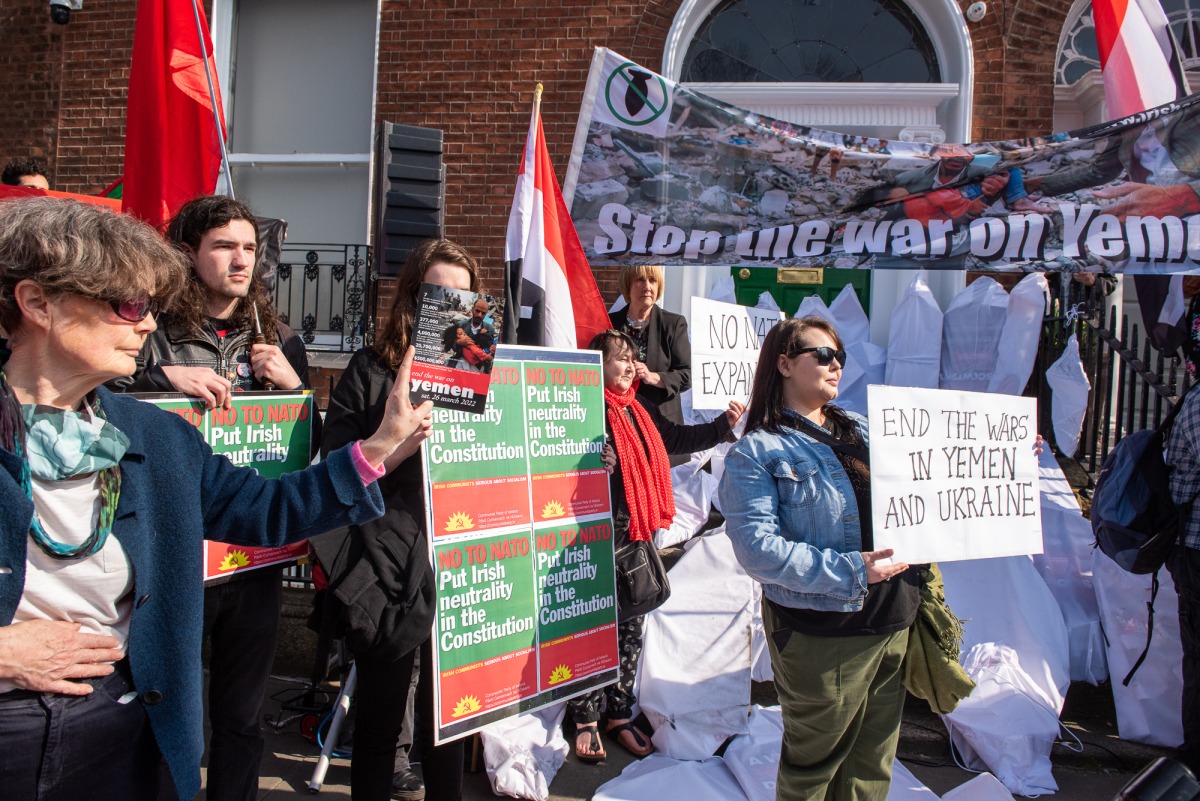
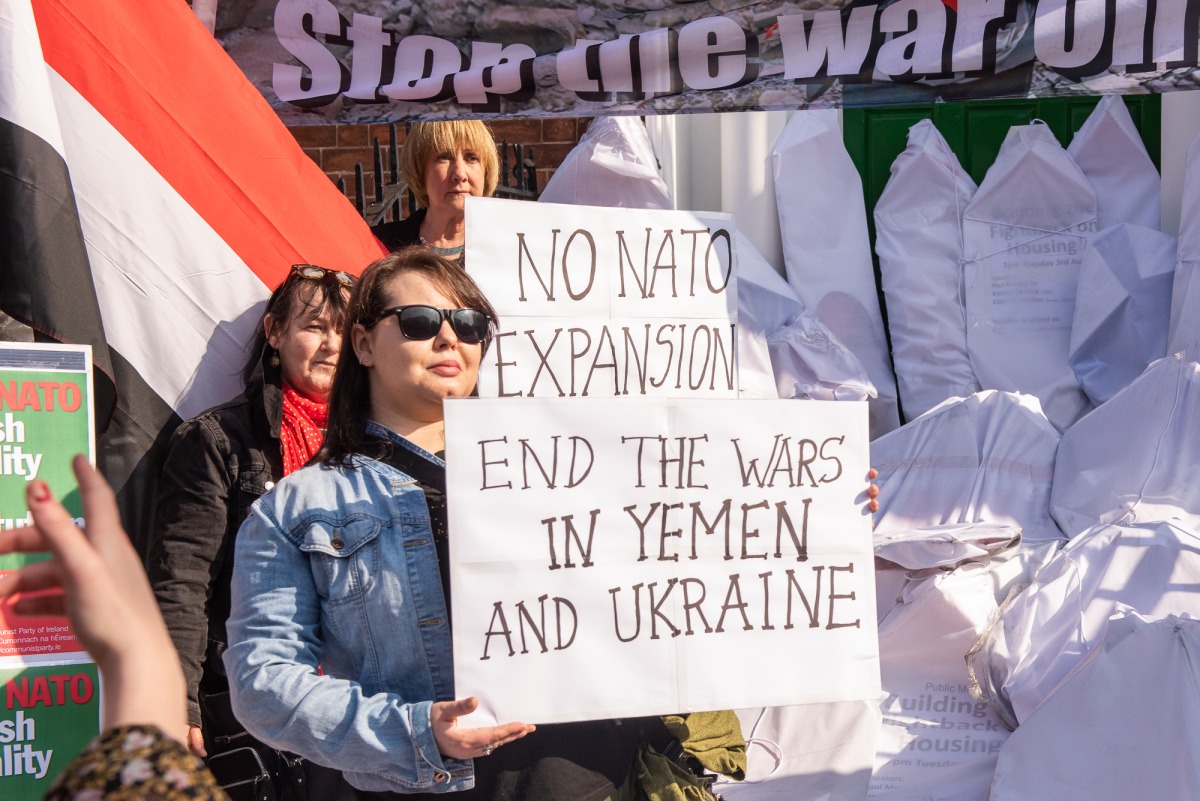
It’s also a pity that the popular uproar greeting Putin’s invasion has not been seen in the past few years in response to other conflicts, including the war in Yemen which has raged, without an end in sight, since 2014.
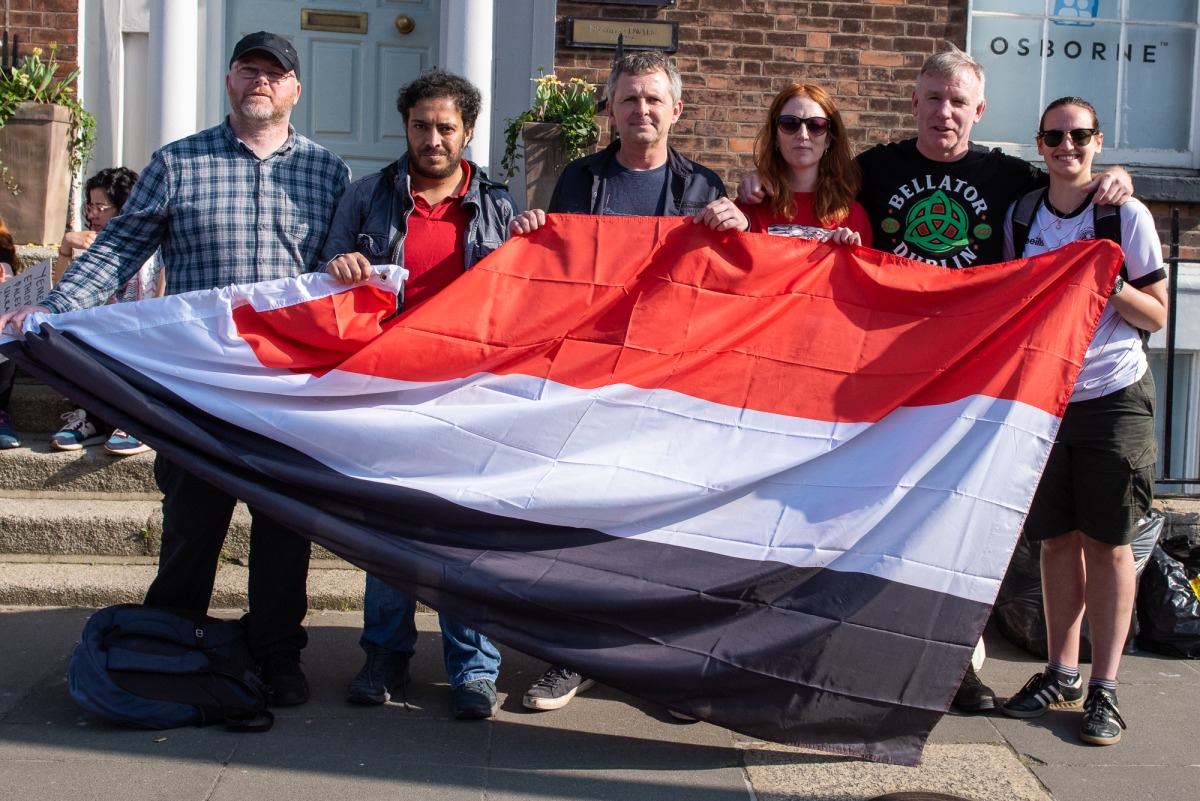
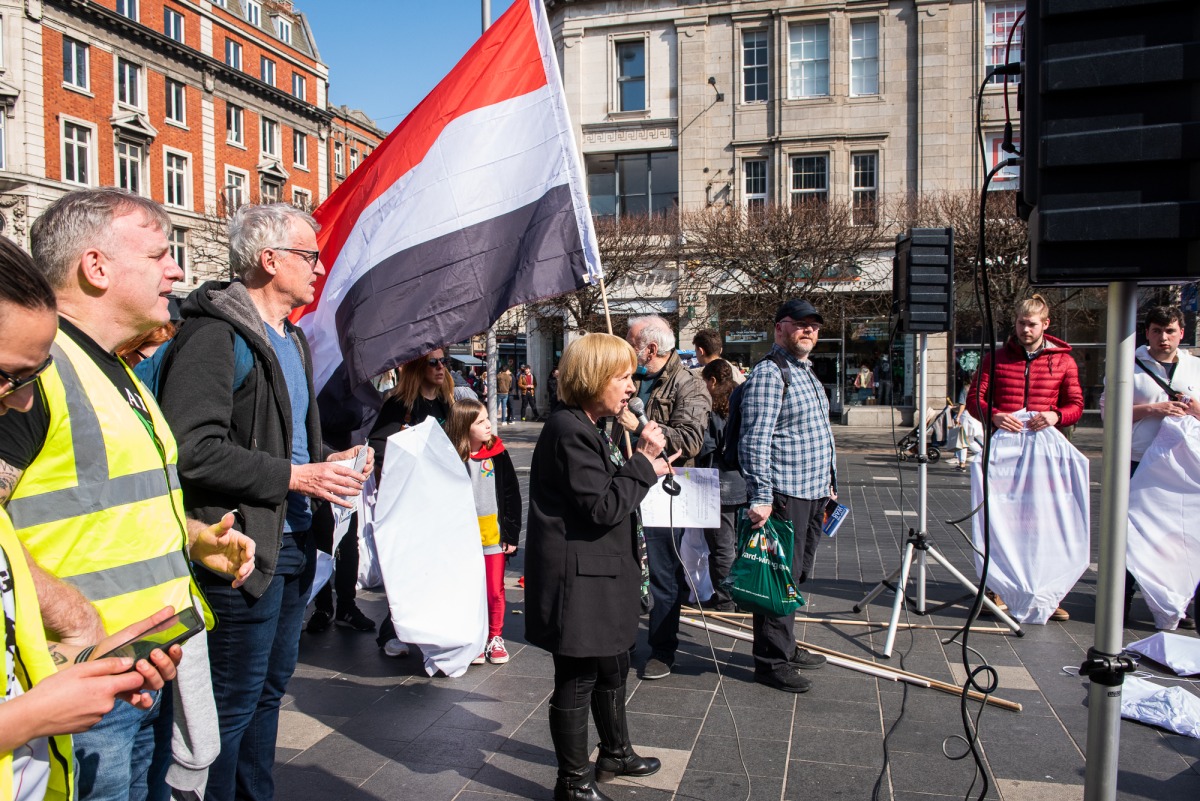
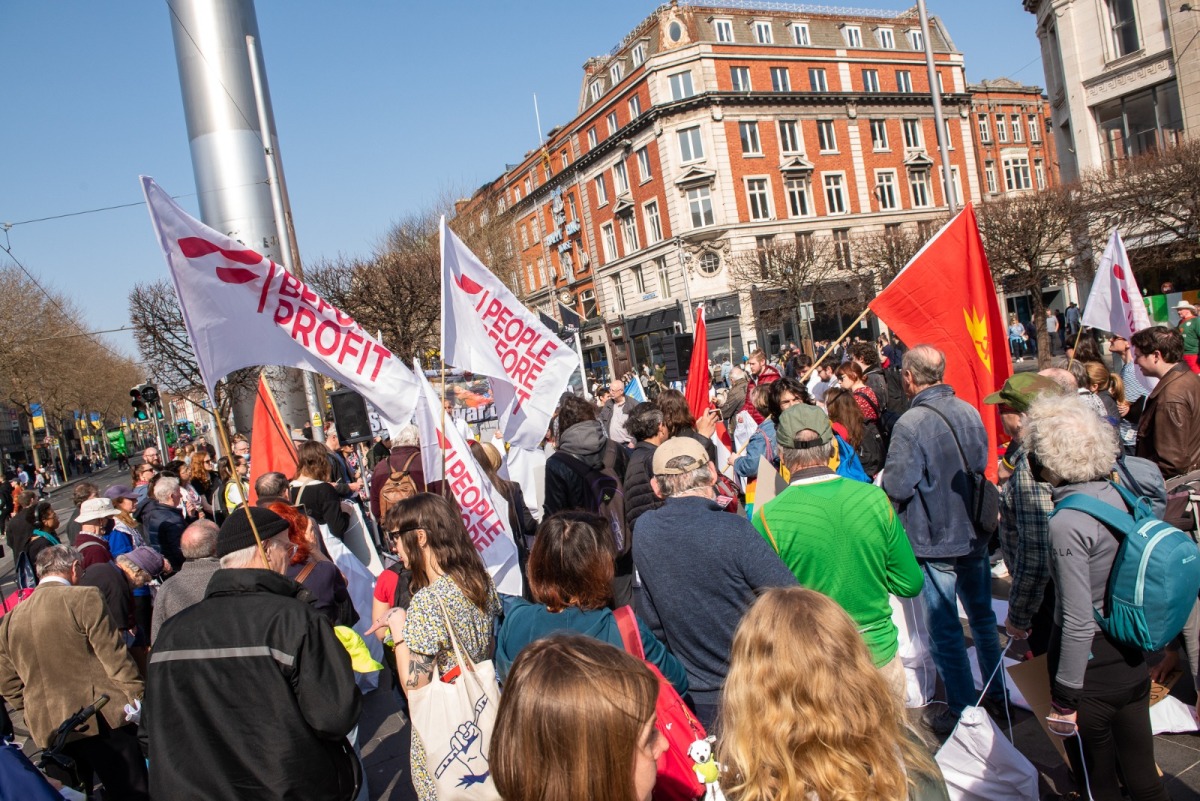
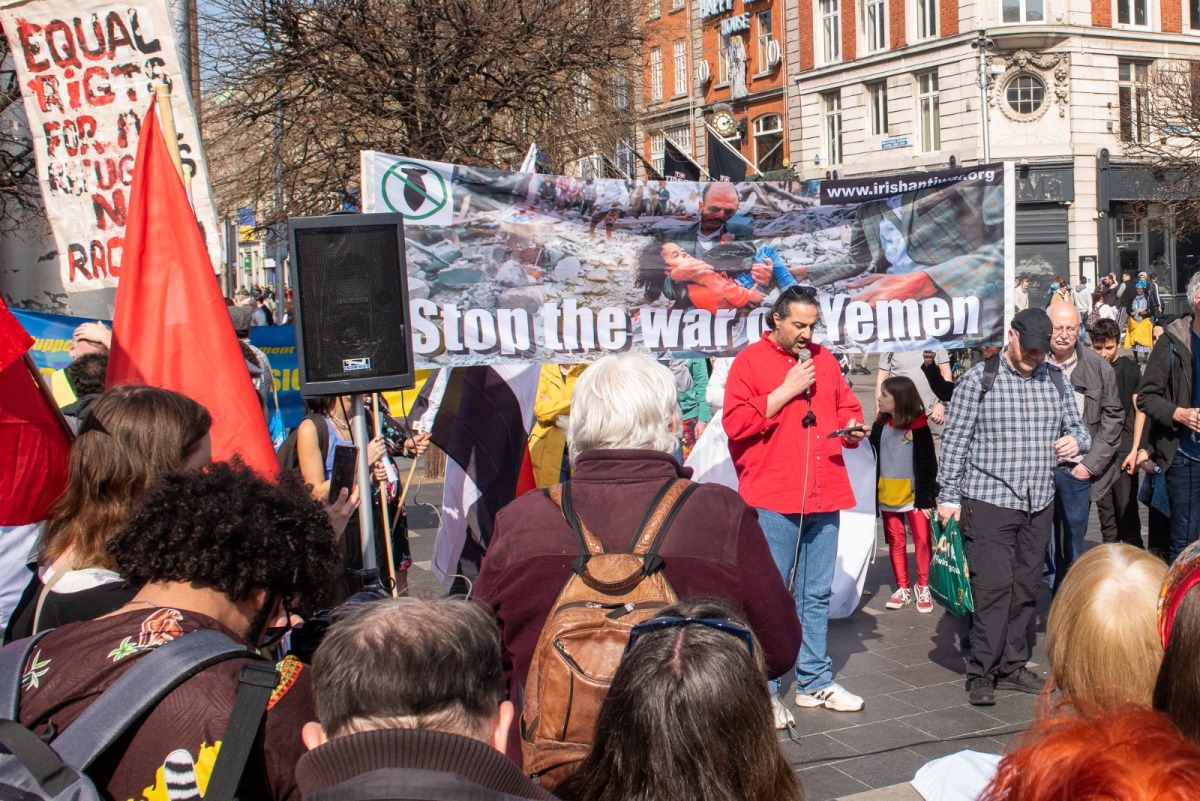
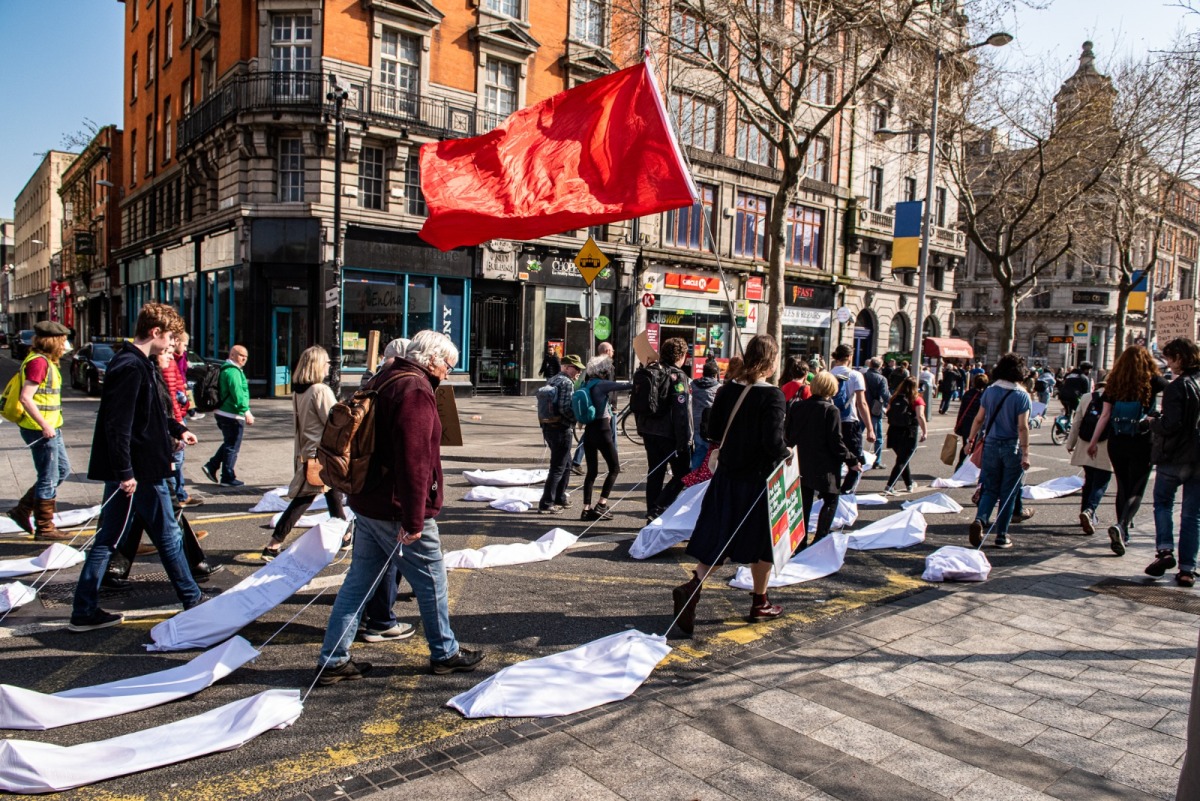
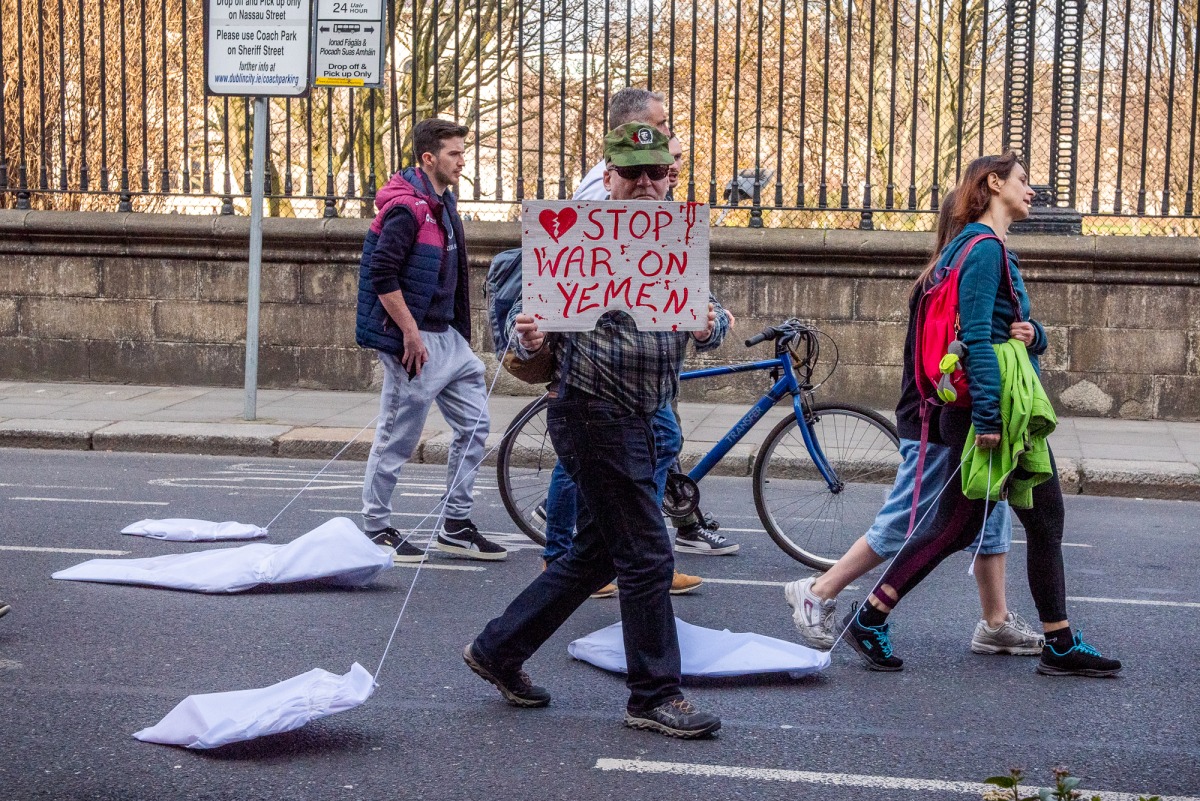
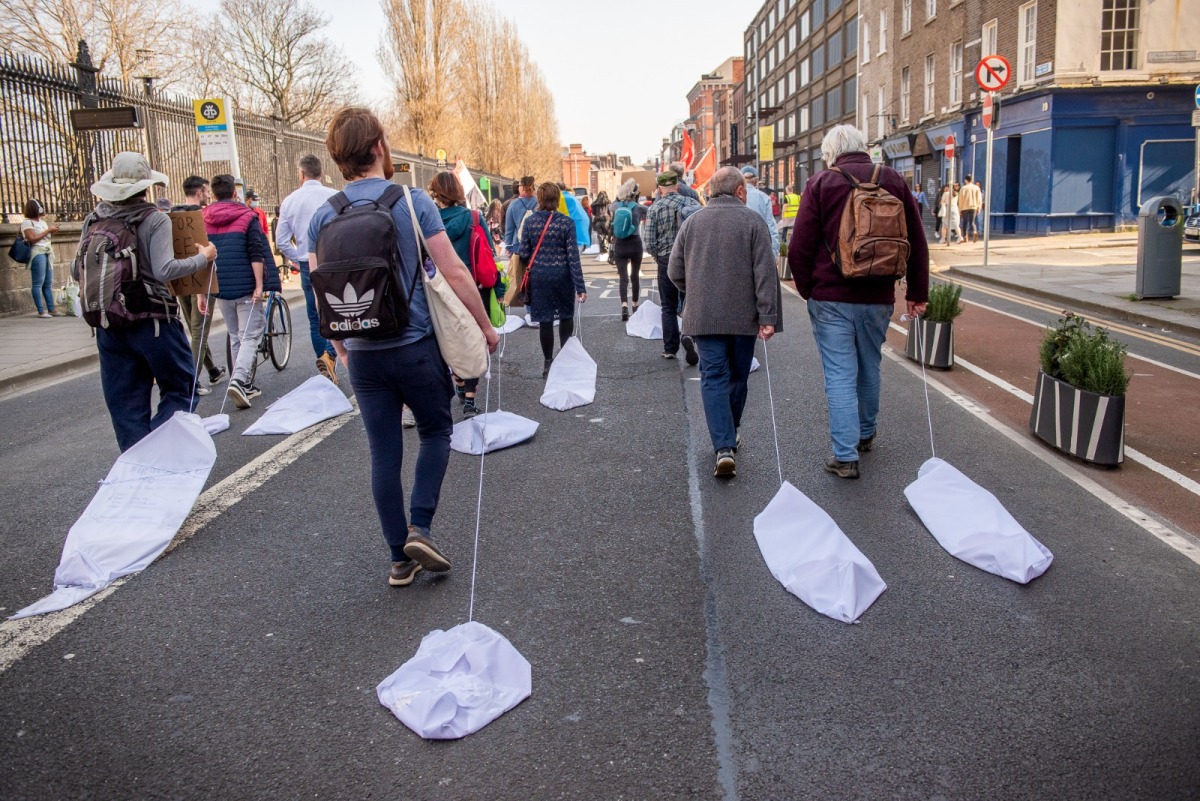
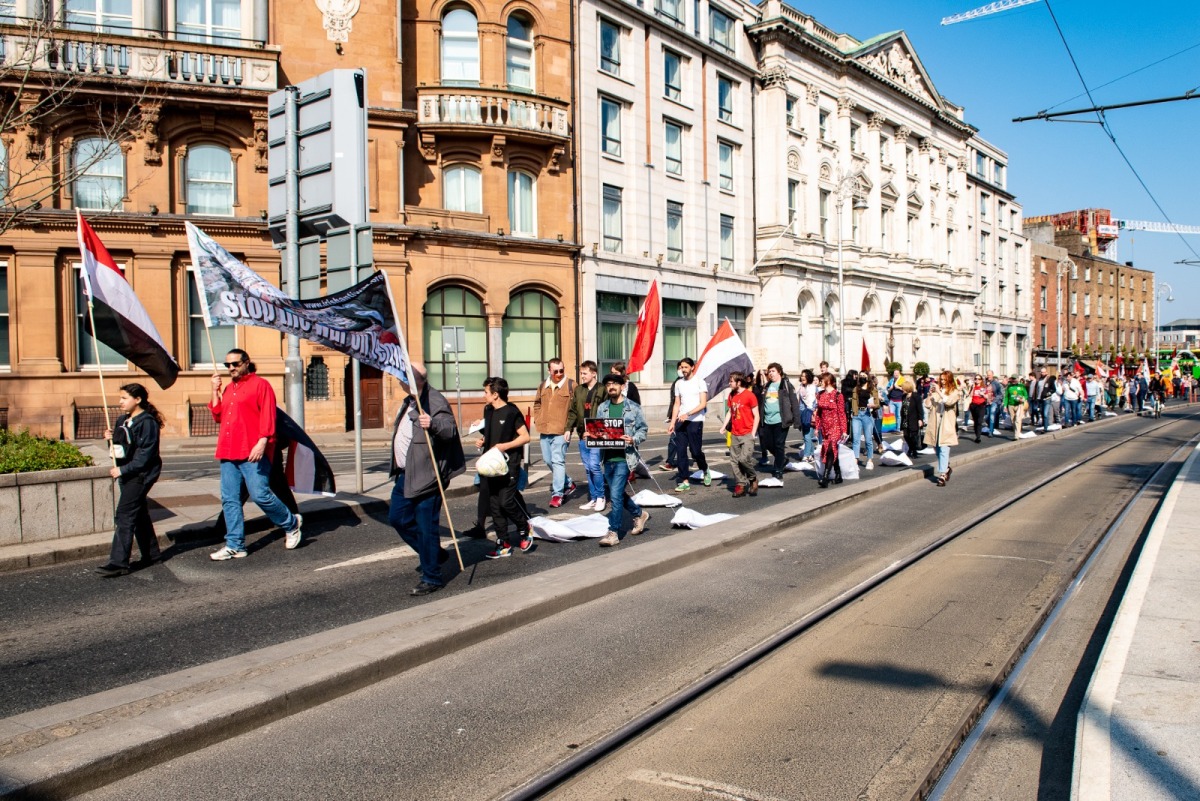
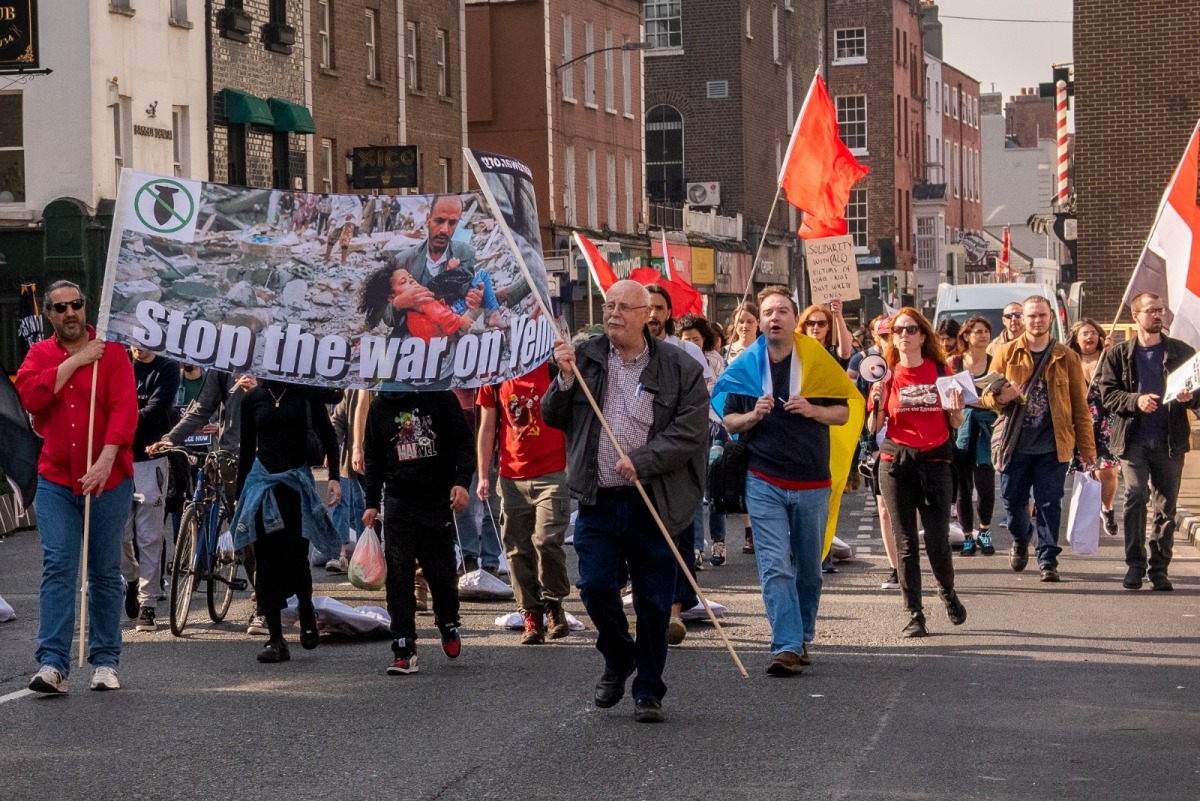
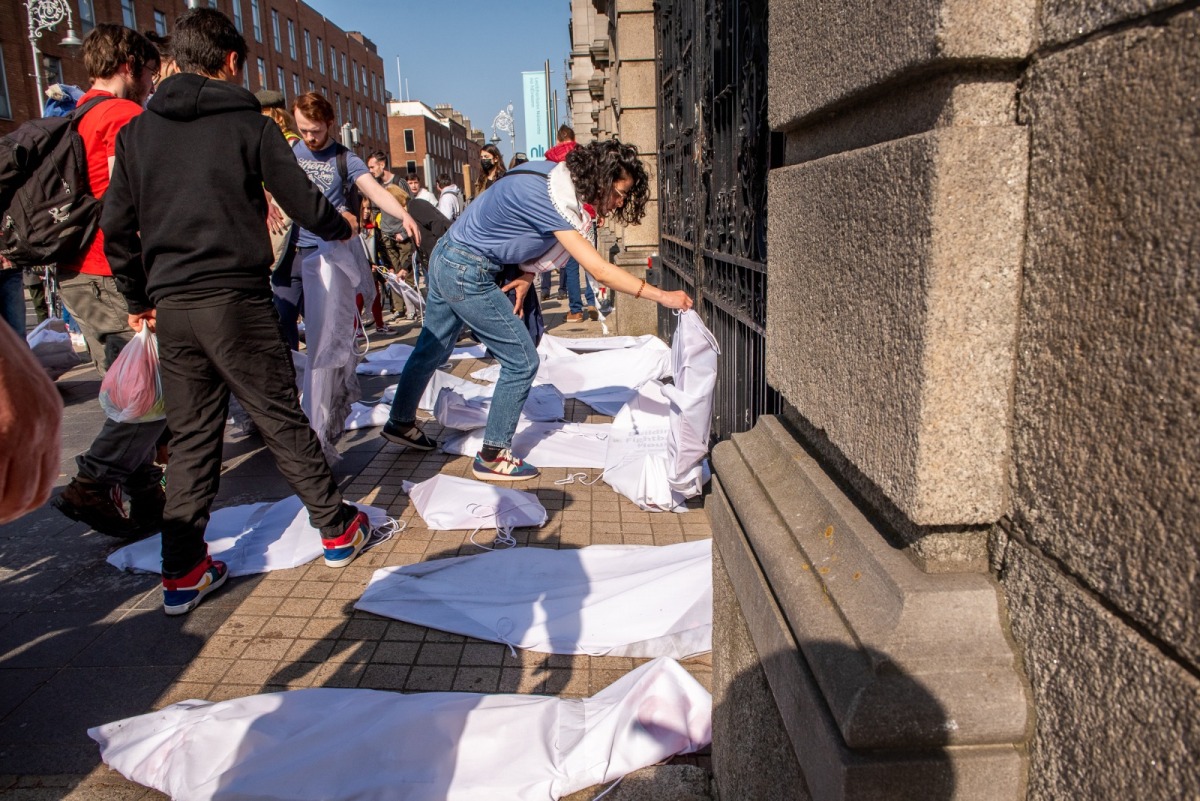
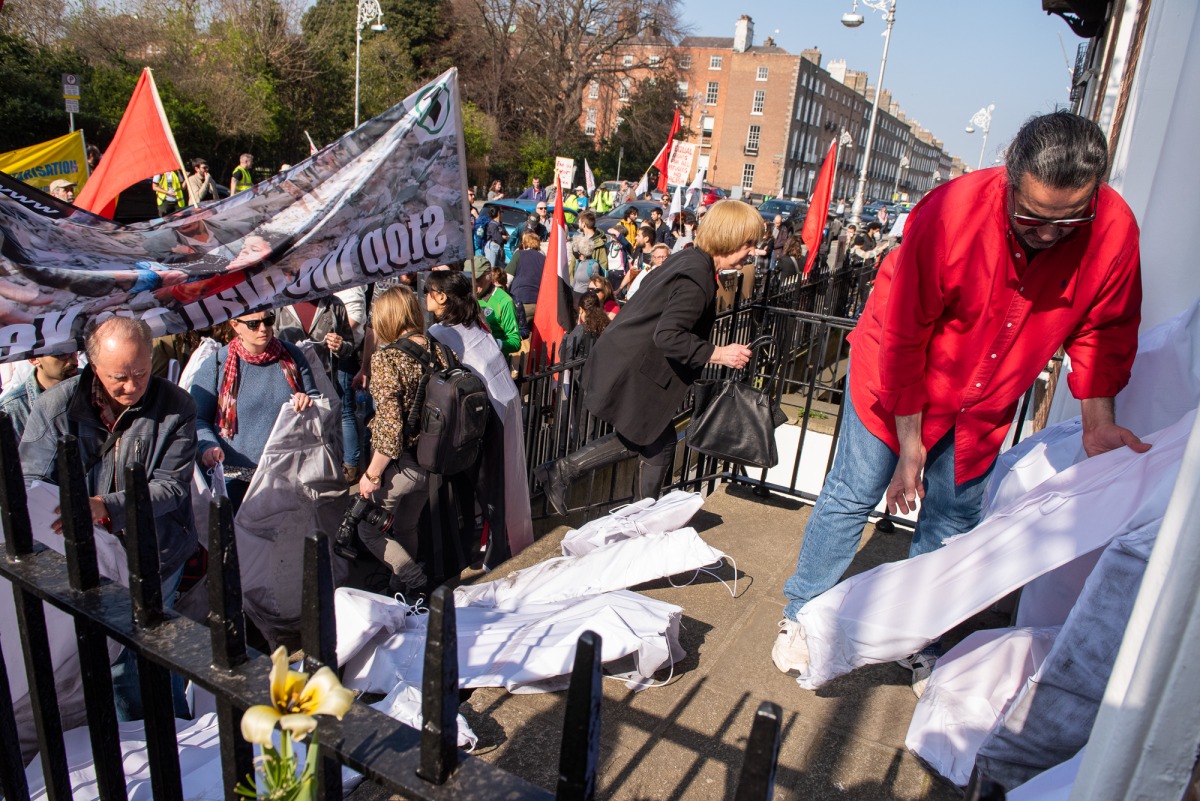
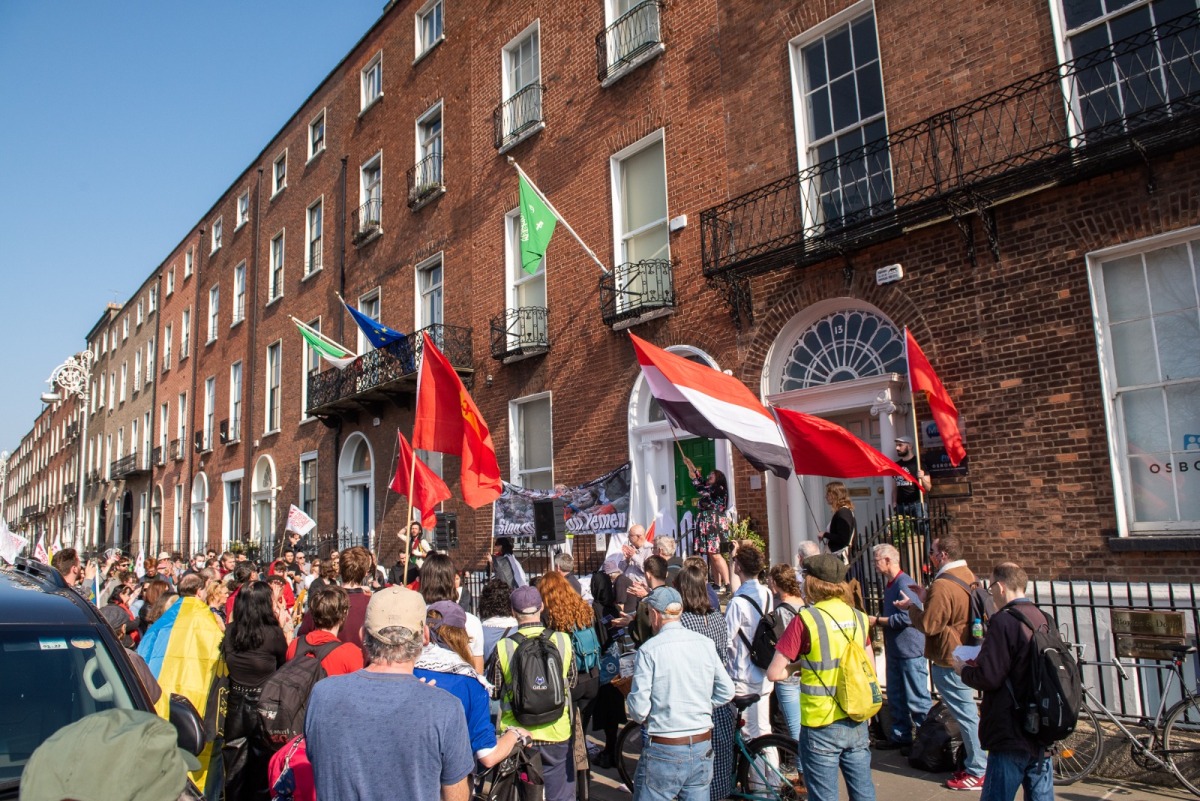
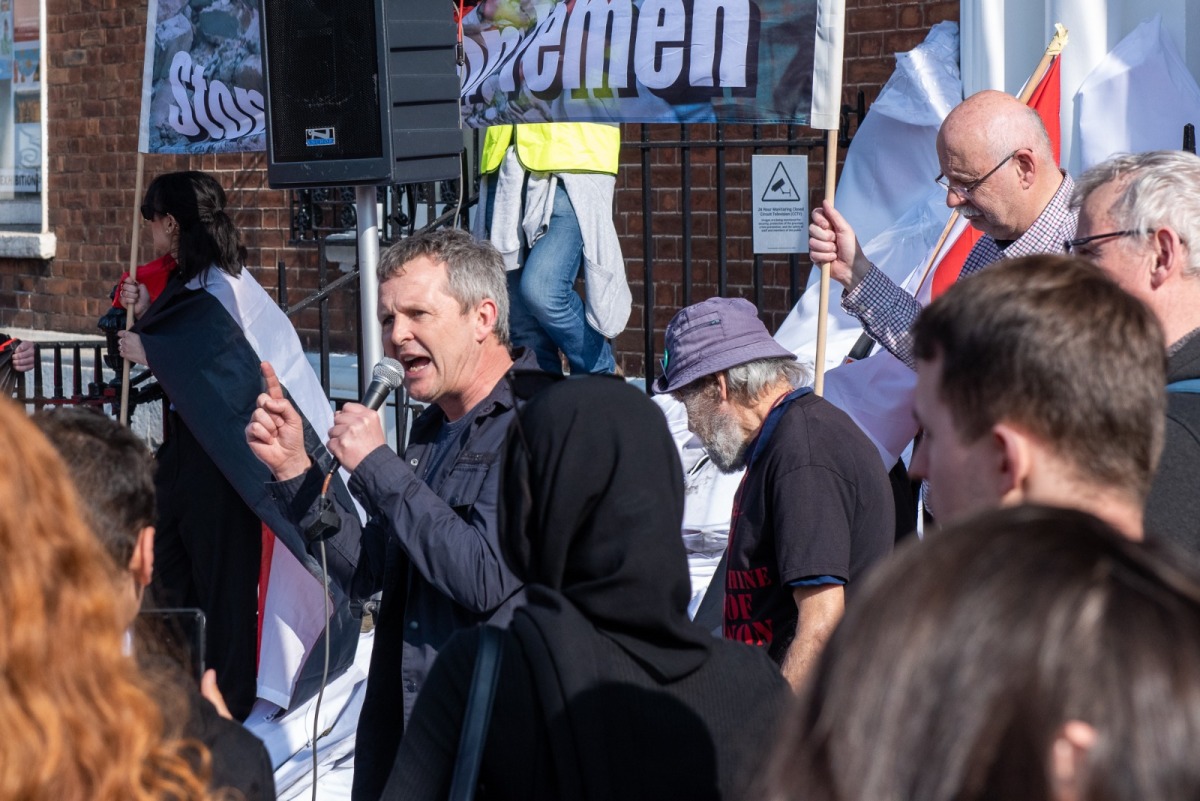
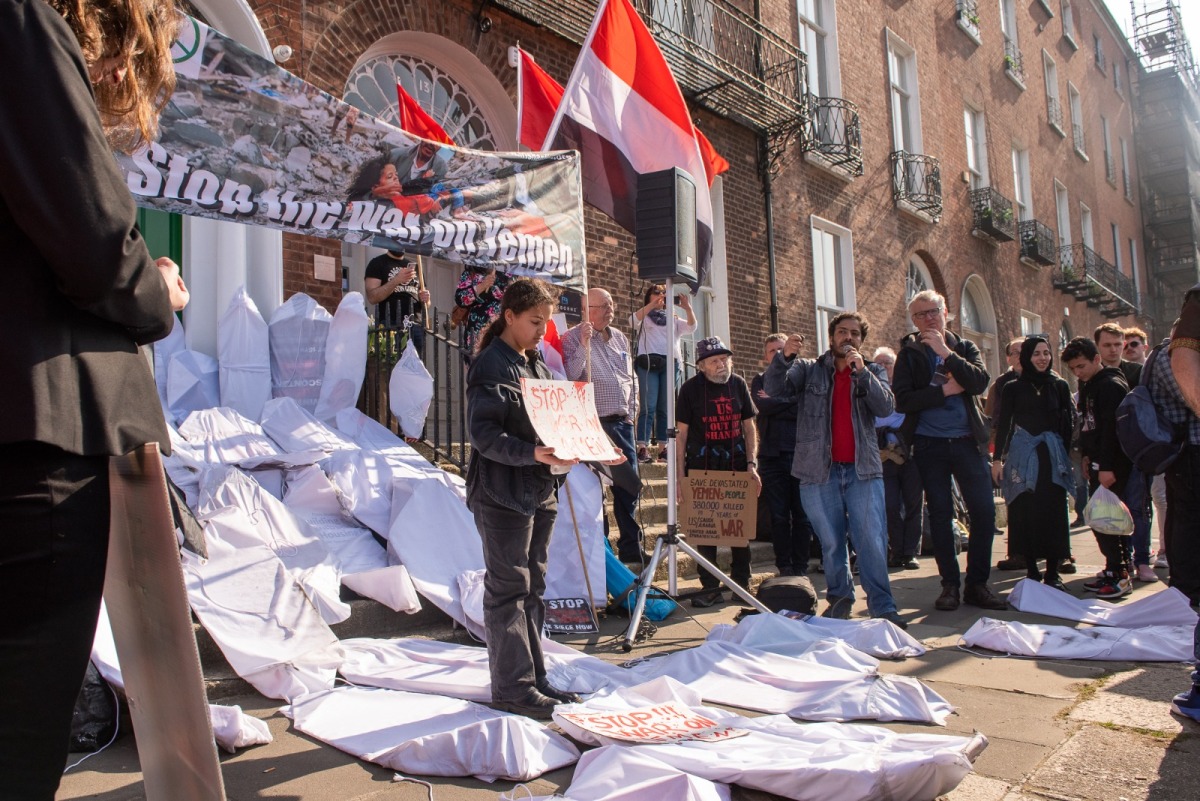
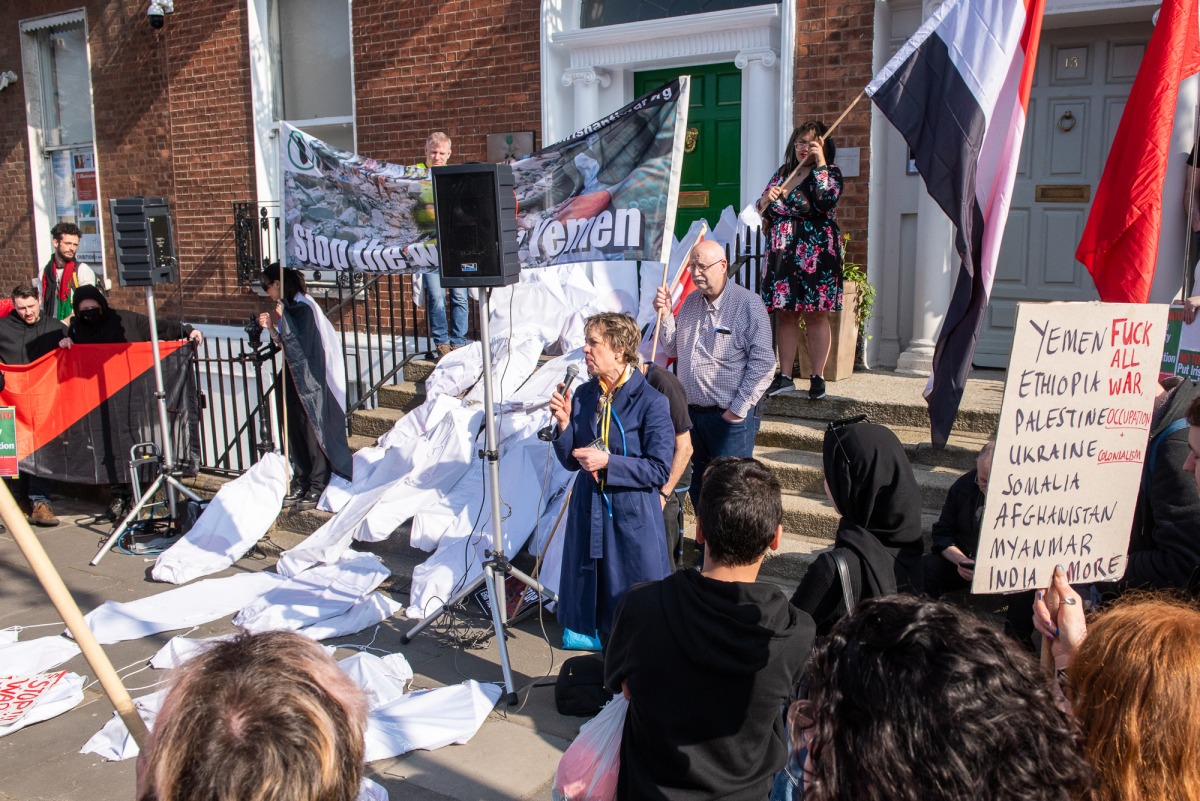
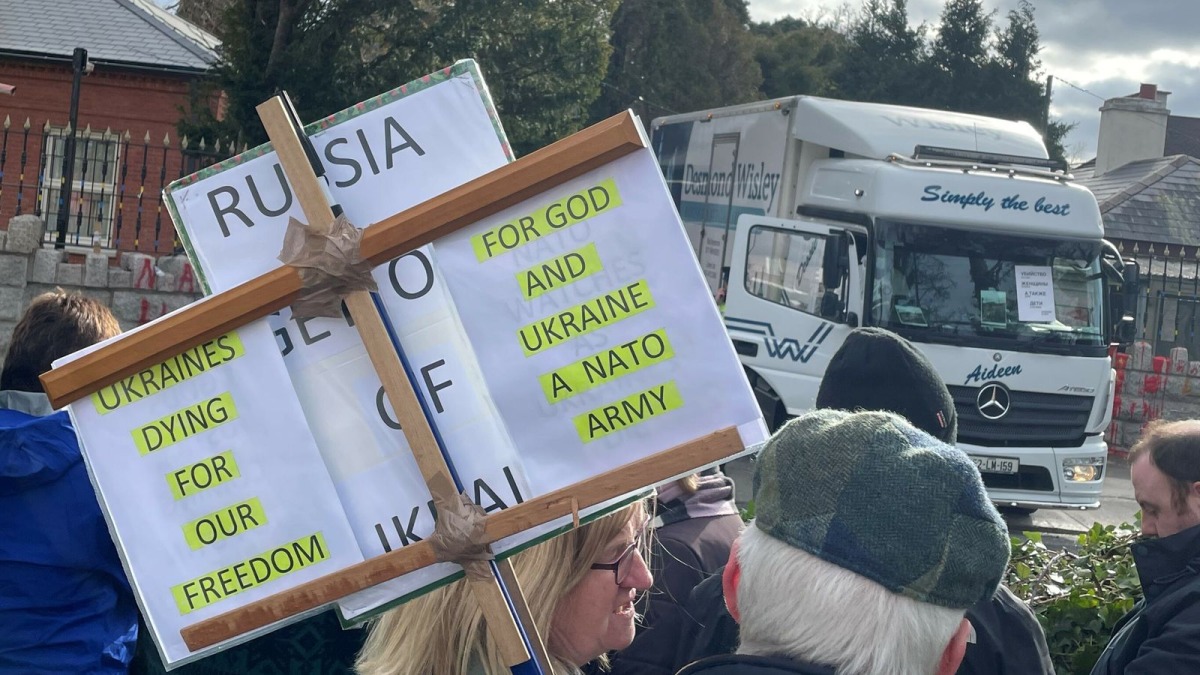
The pictures shown here are of a protest organized by theIrish Anti-War Movementin an effort to raise awareness of the tragedy Yemenis are still experiencing, as well as a call for Ireland’s neutrality or non-alignment to be maintained. They hope instead that the State can play a major role in leading necessary diplomatic efforts to resolve conflicts around the world, including the war in Ukraine.
There now seems to be a concerted efforts on the part of the political establishment to push to formally abandon the country’s neutral status, already strained by past and current use of Shannon Airport by NATO forces.
The Irish Anti War Movement @IrishAntiWarMvt are holding a protest at 6PM at the Dáil in solidarity with Ukraine for peaceful solutions to the war and to defend Ireland's neutrality.
Patricia McKenna addressing the crowd at the Irish anti-war movement on the 26/03/22 in front of the GPO, Dublin.Crowd at the Irish anti-war movement on the 26/03/22 in front of the GPO, Dublin.Ibrahim Hashem addressing the crowd at the Irish anti-war movement on the 26/03/22 in front of the GPO, Dublin.Crowd marching at the Irish anti-war movement on the 26/03/22 in towards the Saudi Embassy, Dublin.
Crowd at the Irish anti-war movement on the 26/03/22 marching towards the Saudi Embassy, Dublin.Crowd at the Irish anti-war movement on the 26/03/22 in front of the Dáil Éireann, Dublin.
crowd at the Irish anti-war movement on the 26/03/22 in front of the Saudi Embassy, Dublin.Richard Boyd Barrett TD addressing the crowd at the Irish anti-war movement on the 26/03/22 in front of the Saudi Embassy, Dublin.Abdulaziz Almoayyad addressing the crowd at the Irish anti-war movement on the 26/03/22 in front of the Saudi Embassy, Dublin.Ivana Bacik TD addressing the crowd at the Irish anti-war movement on the 26/03/22 in front of the Saudi Embassy, Dublin.
In our latest podcast Ben Pantrey interviews former musician of the month Bartholomew Ryan in Lisbon. They discuss his new album ‘Jabuti’ composed while on retreat in Brazil, just prior to the pandemic, as well as the creative process and the importance of loafing.
We previously published the lyrics to Ryan’s song ‘Iguatu‘.
Ben also recites an important passage from Milan Kundera‘s 1995 novel Slowness which served as the original inspiration for Ryan’s musical project.
Why has the pleasure of slowness disappeared? Ah where have they gone, the amblers of yesteryear? Where have they gone, those loafing heroes of folk song, those vagabonds who roam from one mill to another and bed down under the stars? Have they vanished along with footpaths, with grasslands and clearings, with nature? There is a Czech proverb that describes their easy indolence in a metaphor: ‘They are gazing at God’s windows’. A person gazing at God’s windows is not bored; he is happy. In our world, indolence has turned into having nothing to do, which is a completely different thing: a person with nothing to do is frustrated, bored, is constantly searching for the activity he lacks.
Enjoy!
Join us on Patreon to receive podcasts in advance of general release!
We need to sing again. We need to be Irish.
We need to socialise.
We need to be ourselves.
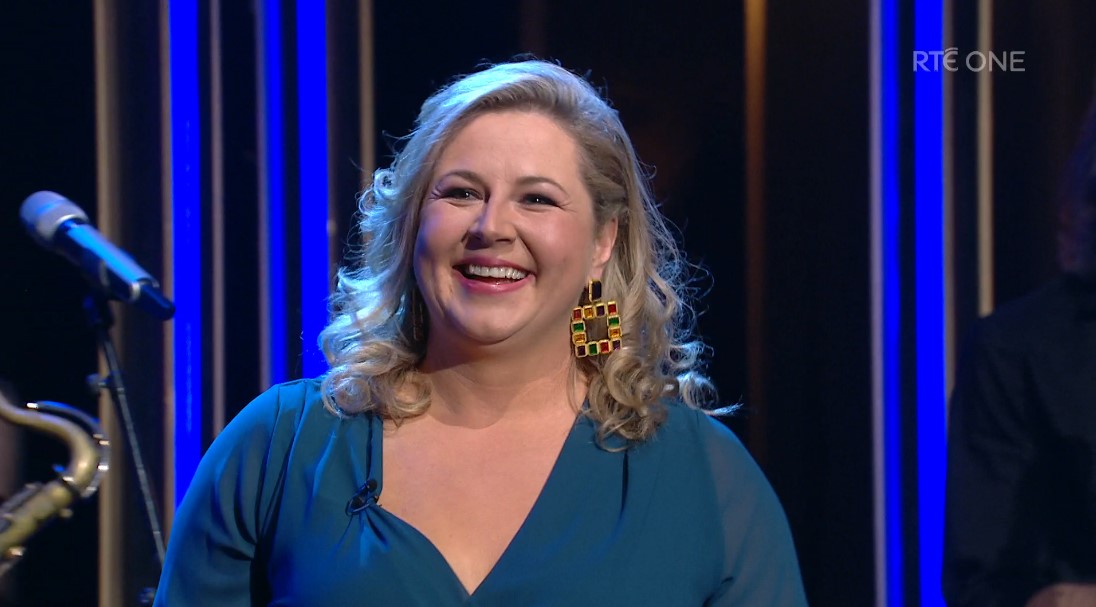
So said Sarah, professional singer and mother from Ballina, County Tipperary, on the Late Late Show, only a few hours after Taoiseach (Prime Minister) Micheal Martin’s address to the nation and his surprise announcement that most of the Irish State’s Covid-19 restrictions were to be lifted with almost immediate effect.
The Late Late Show, for the uninitiated, is one of the world’s longest-running talk shows, gracing Irish television screens, courtesy of state broadcaster RTE, every Friday evening since the 1960s.
Sarah’s comments, coming just after she’d performed a rousing showband style rendition of Ike and Tina Turner’s ‘River Deep – Mountain High’, seemed to capture the official (i.e. state-sanctioned) mood of the nation and prompted host Ryan Tubridy to gush “That is good stuff! Congratulations Sarah!”
Operation Transformation’s Sarah on the Late Late Show.
So why was Sarah from Tipperary opening the Late Late Show on this particularly momentous occasion? Sarah, as it turns out, is one of the ‘leaders’ of this year’s iteration of RTE’s diet and fitness show Operation Transformation (or OT as it is known to cult members). A staple of Irish TV since 2008, OT has become, much like the Late Late Show itself, something of a national institution.
Each year, the programme features five contestants. These are ordinary Irish people who want to lose weight, kick unhealthy habits and get fit. The show refers to these participants as ‘leaders’; the idea being that, through inspirational example, the contestants will ‘lead’ the diet-and-exercise-hesitant Irish public into the promised land of health and fitness.
The leaders are assisted in their endeavours by a panel of four ‘experts’: a dietician, a personal trainer, a clinical psychologist and a GP, who, between them, design individually tailored diet and fitness plans for each leader. The leaders’ homes and fridges are then kitted out with webcams so that we, the audience, gain an intimate view of their struggles.
Even better, every Wednesday evening we see how much progress our leaders have made – if any – or to enjoy the veritable bollocking they will receive from the panel of experts. We can also download the OT app and follow the diet and fitness plans of whichever leader we choose to follow. There are national OT fitness event extravaganzas and ‘partnerships’ with most Irish supermarkets.
2022 Operation Transformation Contestants.
As I said, an institution. Supported by another institution: the Irish State. The Department of Health has spent €230,000 sponsoring Operation Transformation, and its logo is prominently displayed throughout the show.
Sarah is also the first leader whose progress we get to see the following Wednesday. As OT host Kathryn Thomas remarks of Sarah’s performance on The Late Late Show, “You just captured that moment that everybody was feeling! It was a moment of celebration!”
But while four of our leaders are feeling celebratory and enjoying their state-sanctioned return to freedom, things aren’t looking quite so rosy for the fifth, salon-owner Kathleen, who, along with her farmer husband Tony, lives on a farm in Carrignavar, County Cork. Terrifyingly, Kathleen and Tony had both tested positive for covid the previous week.
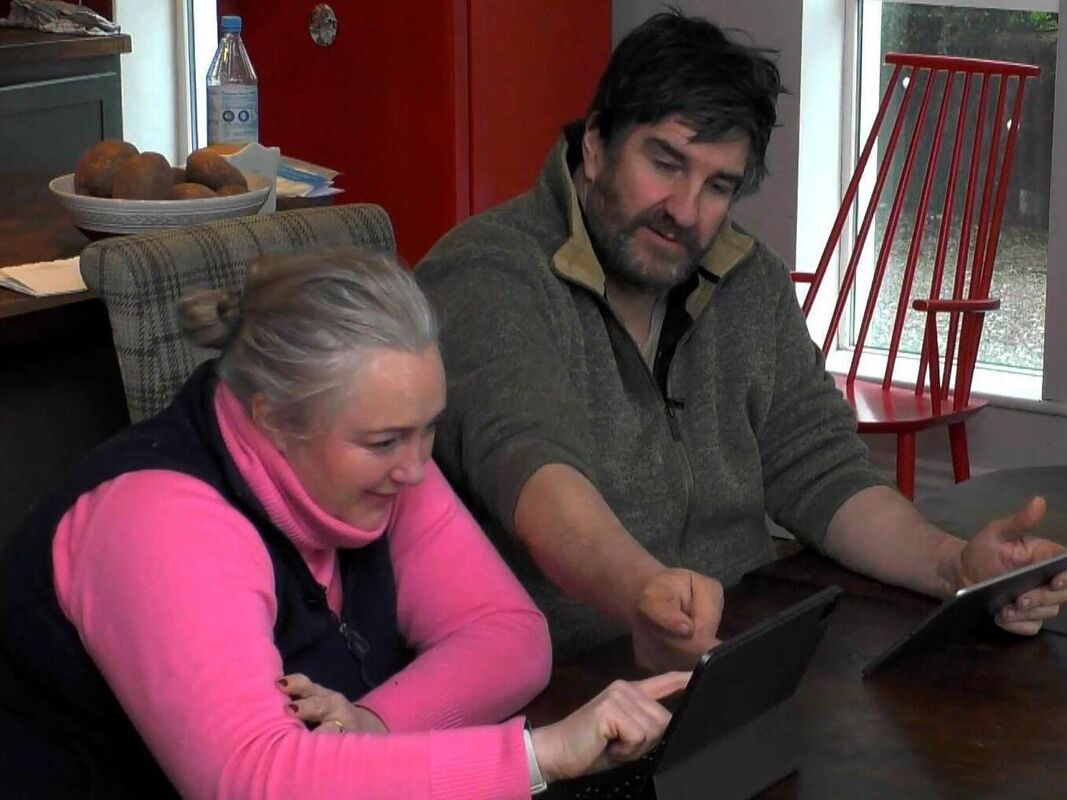
As Kathleen explains, “One of my main symptoms of covid is that I’ve been completely bored”, while Tony is more philosophical about their predicament, remarking that “Well, I’ve kind of been isolating for the past 40 years anyway.”
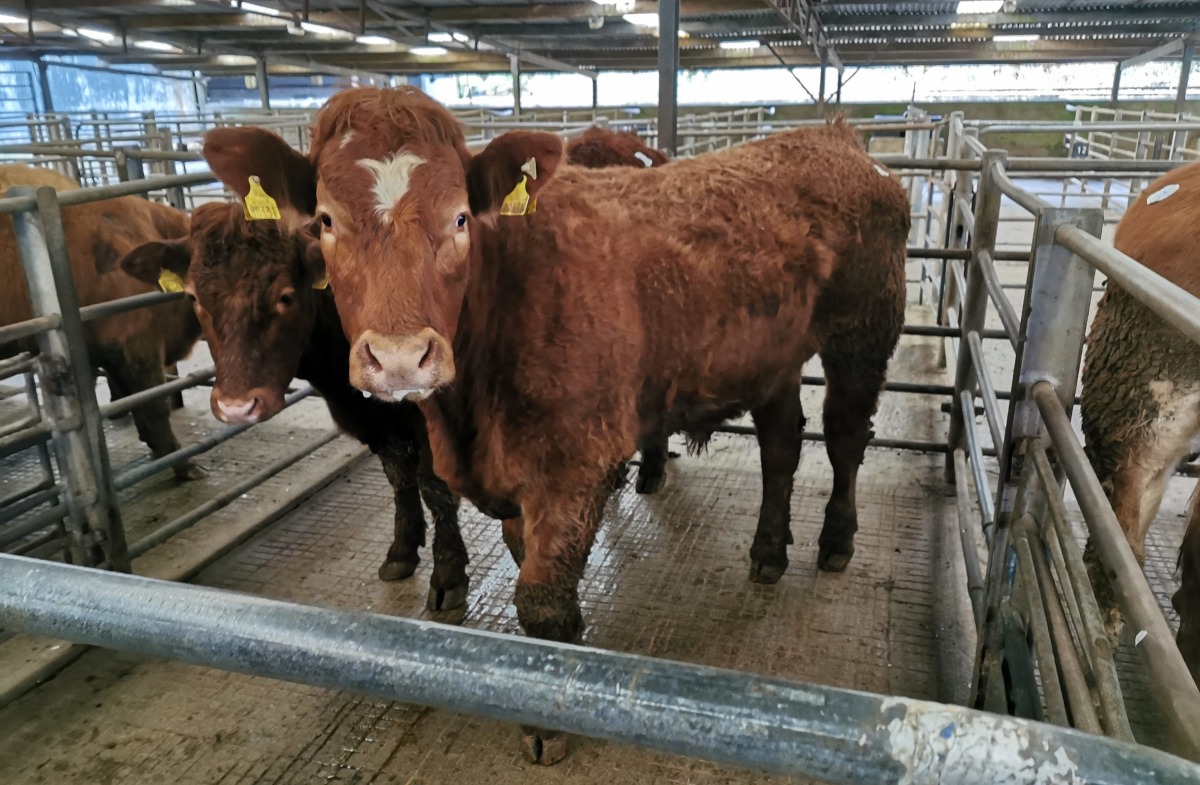
Kathleen and Tony are regulars at their local cattle mart but, because of covid restrictions and lockdowns, they have had to make do with virtual visits on their tablets. This is not an entirely satisfactory alternative, however. As Kathleen notes to Tony of one animal they are considering buying, “She’s a much poorer looking cow on your screen than on mine.” The couple also lament that, in the age of virtual cattle-trading, “The human interaction isn’t there.”
Cattle Mart.
OT host Kathryn Thomas uses this as a cue to joke, “But at least one thing wasn’t in short supply in the house….” She’s referring to antigen tests. We are then treated to a montage of Kathleen and Tony shoving nylon-tipped plastic swabs up their nostrils while making squirming faces, all to an R&B soundtrack. This seems to be particularly traumatic for poor Tony, who needs to sit down and have his wife perform the procedure for him each time. And who can blame him? After all, this is no man flu. This is Covid-19.
Later, Kathleen has a video call with OT fitness expert Karl Henry, who wants to find out how she’s doing. “I feel great. I feel fine,” she says, “the only thing is the boredom of it all and the isolation of it all. The feeling is (as) if I nearly have leprosy for some reason!” Karl has a good chuckle at Kathleen’s analogy (even though she doesn’t seem to be joking) and assures her she is not the only one feeling this way, stating that, “What you’re going through, people around the county are going through. It’s a really normal thing!”
Nevertheless, Karl and the other OT experts are taking no chances. When it’s Kathleen’s turn to have her weekly check-in, she has to do it remotely, despite having come out of her required isolation period. “Just to be extra cautious”, she is told.
Remarking again that “This isolation from the outside world hasn’t sat with me very well”, Kathleen is once more reassured by the experts that her feelings of unease and boredom are nothing to be concerned about, with the show’s GP, Sumi Dunne, telling her “that flat effect…is just a reaction to the circumstances.”
Kathleen and Tony looking at cows.
This episode of Operation Transformation is a microcosm of what has been going on, regarding Covid-19, in the rest of the country and indeed the world as a whole: the constant and repetitious normalising of behaviour which only two years ago would have been considered at best neurotic and at worst deeply psychologically problematic.
Remember when we used to joke about somebody having man flu? That curiously culturally acceptable form of sexism which, according to the Harvard Health Blog, describes “a constitutional character flaw of men who, when felled by a cold or flu, embellish the severity of their symptoms.”
Nowadays, the whole world seems to be suffering from man flu. The only difference is that, with a case of Covid-19, you don’t even need any symptoms to embellish; all you need is a positive antigen or lateral flow test, items which have become as much a staple of our weekly supermarket trips as a sliced pan, two litres of milk and a six-pack of cheese and onion crisps.
As Kathleen herself said, “I had absolutely none of the symptoms of covid, but at the same time I was aware that I had it because obviously I tested positive. So I was even watching my heart rate increasing, and saying ‘ok, I won’t go too far or even push my body at all’.”
A man embellishing flu symptoms.
There are several more occasions in the episode when Kathleen refers to the abnormality of the situation she finds herself in and how uncomfortable she feels being isolated from other people. Yet, every time her concerns are brushed off by the experts (including, as mentioned, a clinical psychologist and a doctor) who tell her that this is “normal” or that the majority of people in the country are also experiencing something very similar.
When people like me (and by that I simply mean anyone who questions the status quo on covid) talk of the mainstream media, for the most part we are referring to the news media. But of course the flagrant bias and propaganda doesn’t stop there. It has infiltrated all forms of media: it’s there in the soap operas we follow, the chat shows, televised sporting events, health and lifestyle programmes, children’s television, social media platforms, social media influencers, and so on ad nauseum.
As others have pointed out, television programmes and social media do not simply provide entertainment, they also greatly influence our ideas about the world and provide a model for our attitudes and behaviour: certain individuals and their actions are presented approvingly and in a positive light, while others are presented negatively, with disapproval. Some behaviours and opinions are shown to be typical, normal and to be emulated, while others are shown to be strange, problematic and to be avoided. As such, TV shows and social media provide a powerful example of what is acceptable in a society and what is not. And far from simply reflecting reality, these forms of media are instrumental in the building and shaping of it.
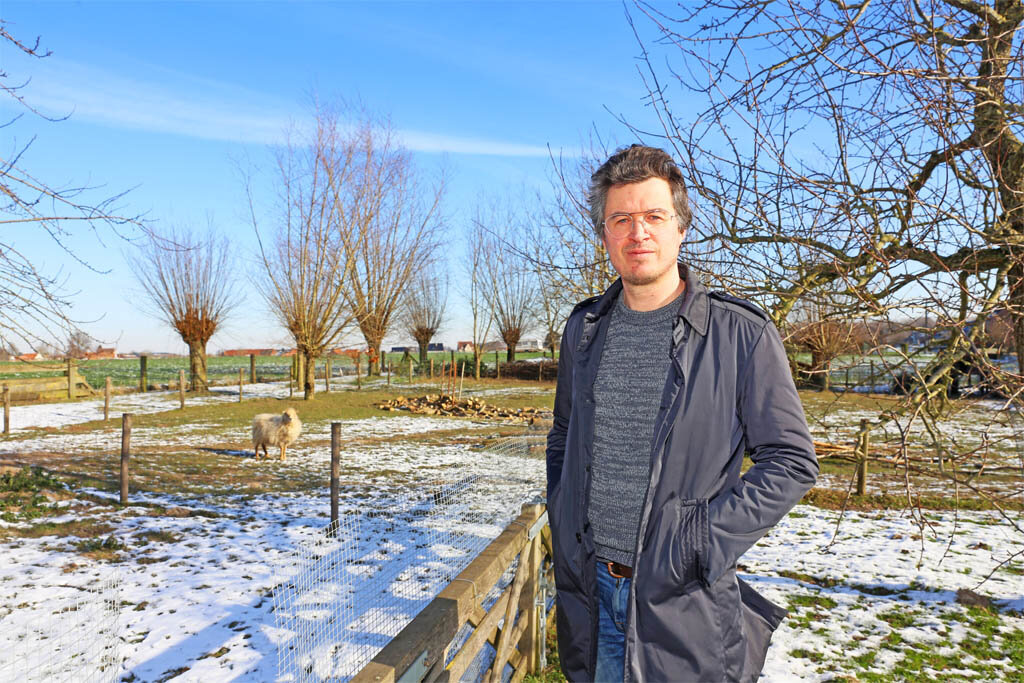
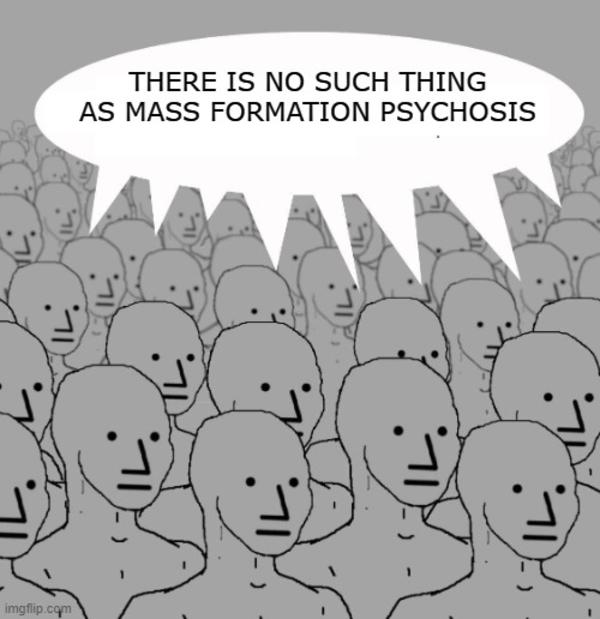
If you are somebody who has questioned the mainstream narrative about covid, you’ll no doubt be aware of Belgian clinical psychologist Mattias Desmet and his theory of mass formation. This compelling theory is a useful tool for analysing our current situation. If you are unfamiliar with it, I recommend looking at this video in which Professor Desmet explains the idea himself.
In a nutshell, mass formation describes the process whereby a large part of the population subconsciously disengages its rational and critical faculties in order to participate in a form of groupthink, the focus of which is usually one small point or issue. Mass formation is a phenomenon that typically occurs in the emergence of totalitarianism. It can occur spontaneously, as in Nazi Germany, or be intentionally created by the state, as was the case in the Soviet Union. Mass formation can only take place when four very specific conditions are met.
These are as follows: a substantial number of people in the population have to feel socially isolated; a substantial number of people have to feel an essential lack of meaning in their lives; a substantial number of people have to experience what he calls “free-floating anxiety” (in other words, anxiety or stress which is not connected to a mental representation – feeling anxious but not knowing why) and finally, a large percentage of the population has to experience free-floating frustration and aggression.
Professor Mattias Desmet.
The four conditions were already in place, in Desmet’s opinion, when the pandemic was first announced by the WHO back in March 2020. According to one studypublished before the pandemic in The American Sociological Review, 25% of Americans reported they didn’t have a single close friend. A Gallup poll, which included participants from a number of industrialised countries, found that nearly 50% of those questioned stated they didn’t have a single meaningful relationship and that they only connected to other people through the internet or through technology. As Desmet asserts, “A connection through the internet doesn’t make you resonate in the same way with other people.”
This isolation or lack of social bond leads into the second condition: a feeling that life is generally meaningless or senseless. In his 2018 book, Bullshit Jobs, anthropologist David Graeber states that 50% of people reported that their job was ’not at all meaningful’.” A Gallup poll from 2012, which included people from 142 countries, shows that 63% of respondents, in Desmet’s words, “admitted to being so disengaged at work that they were sleepwalking through their day, putting time but not passion into their work.”
This combination of social isolation and the impression that life has no meaning produces a kind of anxiety which is “free floating.” Unlike a phobia, which pinpoints a specific object of fear (for example spiders or confined spaces), free floating anxiety is not connected to anything tangible. Feeling anxiety without understanding its cause produces profound “psychological discontent.” Desmet notes that each year in Belgium 300 million doses of antidepressants are administered to a population of only 11 million people. This doesn’t even take into account antipsychotics, sleeping tablets or anxiety medication. Indeed, the World Health Organisation has reported that one in five people have an actual anxiety disorder.
The fourth condition, what Desmet calls “free-floating frustration and aggression”, is a result of the isolation, lack of meaning and consequent anxiety. Furthemore, it is extremely problematic because people simply don’t understand what is causing them to feel aggression or frustration.
When these four conditions are in place, all that is needed for mass formation to occur is for the mainstream media to produce a narrative which highlights “an object of anxiety” (in this case, a virus) and to simultaneously provide a strategy to deal with this object of anxiety (lockdowns, masks, vaccination, etc.).
For Desmet, identifying the object of anxiety and participating in a strategy to deal with it gives people both a sense of control and, perhaps more significantly, a sense of connection. And it is this feeling of strong solidarity and connection which enables, “an extraordinary willingness…to participate in the strategy…no matter how absurd the measures or the narrative becomes.”
We now live in a world of absurd contradictions: governments and media assert repeatedly that Covid-19 vaccines are effective, yet many more people have contracted and spread the virus since getting the jab than before the vaccine rollout. We were told that masks and social distancing would curb the spread of Covid-19 but have never been offered unequivocal evidence to that effect. And, of course, the biggest fraud of all: the idea of asymptomatic spread. It is now a commonly held belief that a perfectly healthy individual who feels well and has no symptoms of any illness is a danger to others. Consequently, they must be cordoned off and isolated from the rest of society in order to be approved of or accepted by that same society.
For me, one of the most fascinating elements of Desmet’s theory is how he describes the nature of the social bond that emerges during mass formation. As he says, “this is never a social bond between individuals. It is always a social bond between an individual and the collective.” Furthermore, the longer the mass formation continues, the more “a radically paranoid atmosphere” is established which “destroys the connection between individuals.”
So when Kathleen from Operation Transformation talks about being bored and missing social contact with other people, she is talking about the personal relationships she has with other individuals, whether that be family, friends, colleagues or acquaintances. However, a positive antigen test demands that she must sacrifice these personal connections in order to maintain and participate in the much larger (and faceless) relationship she now has with society as a whole. And the thing that most defines that relationship is to virtue signal, in the most public way possible, that you are keeping others safe by adhering to government guidelines, no matter how absurd or illogical those guidelines may be.
Imagine if, only two years ago, someone you knew told you they had just got a flu shot in order to protect, not just themselves, but you and everyone else from influenza. Or that they were spending 50 to 60 euro a week to test themselves and their family on a daily basis for colds or flu, despite feeling perfectly healthy. Or that, if one of those tests gave a positive result, they would not go into work for 5-10 days and isolate themselves in their home, completely avoiding contact with the outside world. You would have thought your hypochondriac friend had finally lost the plot, and maybe even suggested they get some psychiatric help for that Howard Hughes-style obsessive compulsive disorder.
Antigen testing.
In fact, Desmet suggests that many of the Covid-19 measures put in place by governments around the world “are without pragmatic meaning” and function in a ritualistic way, demanding “a sacrifice from the individual; a sacrifice through which the individual shows that the collective is more important” than his or her own interests. Moreover, “people, without knowing it, will continue to buy into the narrative just because, as a social being, there is nothing more painful than to be profoundly and thoroughly socially isolated.”
And what would the point of a sacrifice be if it were not acknowledged or rewarded in some way? Kathleen’s isolation because of a positive antigen test result is applauded by the experts on the show. Her reward is the public acknowledgment of that sacrifice: she has willingly done everything within her power to keep others safe, despite having absolutely no symptoms of any illness.
Operation Transformation has a huge following in Ireland and it is very clear from watching only a few episodes that one of its main attractions is the sense of belonging and acceptance that both participants and the audience gain from taking part in or following the show. One woman, who planned to get involved in the Operation Transformation 5k run in Dublin’s Phoenix Park, went as far as to remark, “I don’t feel like Mrs Nobody anymore, and I’d encourage anybody not to feel like that.”
Unsurprisingly, considering it is sponsored by the Department of Health and broadcast on RTE, there is an implicit acceptance by Operation Transformation that the State’s removal of our fundamental rights was absolutely necessary, that in doing so the State kept us all safe, and that the reestablishment of some of these rights is something for which we should be grateful. Another talking head on the show, Frank Greally of Athletics Ireland, says, of the recent OT 5k (the first OT event of this nature in nearly two years), that “when you join in something (like this) and participate, it’s an outpouring of gratitude” and that “we’re back on freedom road again!”
So what does being “back on freedom road again” look like in the weeks since Michael Martin’s surprise announcement? When you use public transport or go into a supermarket, most people are still wearing a mask. Many school children continue to be masked up, sitting in freezing classrooms with open windows in the middle of winter. Mentally handicapped adults are still wearing facemasks in their day centres. The elderly in care homes, despite being triple-jabbed, can be locked down at a moment’s notice as soon as any resident or member of staff tests positive for covid. Tens of thousands of people just like Kathleen continue to test themselves on a daily basis.
More worryingly, the State has doubled down on its campaign to vaccinate children despite acknowledged dangers. Other parents, just like this man, will suffer the horror of their child having a heart attack, and then be told by so-called medical experts that it had nothing to do with the experimental gene therapy that was administered shortly beforehand. Furthermore, unconstitutional and draconian legislation that was put in place back in March 2020 remains on the statute book. Minister for Health, Stephen Donnelly, could decide (using statutory instruments that do not require legislative oversight) to reinstate all restrictions, or add a few more, just as quickly as he removed them.
In recent weeks, there’s also been a state and media pivot. The object of anxiety has shifted with breathtaking rapidity from Covid-19 to war in the Ukraine. And the strategy to deal with this new anxiety is to virtue signal your unconditional support for Ukraine and unquestioningly condemn everything Russian.
The shift in narrative has been seamless. Just as the world’s media, in lockstep, uncritically presented Covid-19 as a simple morality tale, they now do the same with the Ukraine crisis. And the public appears, once more, to be lapping it up.
The yellow and blue of Covid-19 public health advertising has given way to the yellow and blue of Ukraine’s national colours. Significant buildings in most European cities are now lit up yellow and blue, and you see the Ukrainian flag everywhere. In Dublin, a member of the public, to much applause, deliberately drove his lorry through the gate of the Russian embassy; soon afterwards, local councillors announced their intention to change the name of the street in which the embassy is located from Orwell Road to Free Ukraine Road.
Protestors outside the Russian embassy in Dubln.
At the centre of this new object of anxiety is evil incarnate Vladimir Putin and his dastardly plan to destroy Ukraine, and democracy more generally. In less than a week the number of Irish households offering accommodation to Ukrainian refugees has leapt from 5,000 to 14,500, with the State pledging that Ireland will offer sanctuary to 100,000 Ukrainians fleeing their country. That’s nearly a 2% increase in population for a country already facing a housing crisis and spiralling homelessness.
But if you dare question any of this, then just like those that dared to question the covid narrative, you will be roundly condemned and ridiculed. Any form of critical thinking will have you branded, once again, as some kind of far-right, bigoted, conspiracy nutjob.
All of Ukraine’s well-documentedhuman rights abuses in the Donbas, and the distubing presence of neo-Nazimilitia groups in that country’s armed forces, have not just been forgiven, but have, in fact, been whitewashed by the new media narrative. And despite his severely limited political experience, former comedian and current president of Ukraine, Volodymyr Zelensky, has been hailed as the new Churchill.
Operation Transformation has become Operation Mass Formation, and this most recent manipulation of public opinion over the Ukraine crisis shows that we are still in the thick of a very problematic and unyielding kind of groupthink.
So yes, Sarah from Operation Transformation, it may well be the case that Irish people need to sing and dance again, socialise and be themselves, but it was never the business or prerogative of the State to tell us that we couldn’t, and no matter what nonsense the government has come out with about ‘covid bonuses’ and ‘dividends’ for our obedience, it is certainly not their business to tell us that we can now.
Until all the legislation that underpins the mandates is repealed, and until we make sure that such measures can never be inflicted on the population again, we are deluding ourselves if we think we are free. The current mono-narrative being presented to the public about war in Ukraine should be a red flag to us all that we no longer live in functioning democracies.
It’s easy to despair in the face of our species’ (homo sapiens: ‘wise man’) apparent unwillingness to recognise environmental constraints. The facts of life on planet Earth have been laid bare to most of us by now. We cannot go on consuming as many of us do in the West indefinitely, especially with populations in developing countries increasingly adopting our lifestyles.
Denial is the default, including by chipping away at the edges of an incontrovertible proposition that humans are out of balance with nature; but also in terms of how we satisfy our desires individually – sure a little more won’t do any harm. There is always some excuse or other available to avoid taking responsibility for our actions.
Pope Francis previously described a dysfunctional relationship with Mother Earth:
This sister now cries out to us because of the harm we have inflicted on her by our irresponsible use and abuse of the goods with which God has endowed her. We have come to see ourselves as her lords and masters, entitled to plunder her at will.
Russia’s brutal invasion of Ukraine ought to bring this serious imbalance home to us. Underlying the aggressive posturing in response – and crazed talk of no-fly zones that could precipitate nuclear war – is a hard-nosed recognition that European countries will continue to purchase oil and gas from Russia. So, how should conscientious individuals respond to the impasse?
Ludwig Wittgenstein’s statement comes to mind: ‘Whereof one cannot speak, thereof one must be silent.’ In moments of crises holding back from holding forth is often appropriate.
The reflection required is also facilitated by viewing Bob Quinn’s short (16 minutes, 48 seconds) film ‘Bog Graffiti’, which mostly wordlessly documents the co-existence of his art work and nature on land he has regenerated in Conemara. The unspoken context is climate change. Another of the old masters, pioneering electronic music composer Roger Doyle provides a score that artfully integrates the elements.
Art in nature in Bog Grafitti.
Bob Quinn explained the concerns animating the film in a 2019 blog post:
The desertification of the Sahara happened suddenly.
Six thousand years ago northern Africa had as temperate a climate as Europe, had two lakes as big as Munster. It was fertile enough to support a settled agricultural population and their gods. There were fauna too, antelope, rhinoceros, hippopotamus, crocodile roaming as freely as the human animals.
Over a couple of centuries – the blink of a geologist’s eye, according to a computer simulation (Milutin Milankovic Medal, 2005) – a combination of local vegetative and atmospheric changes in the area (recorded in deep land and sea cores) caused a local climate event – the Sahara event.
It should not surprise us. During another of this planet’s many interglacial warming periods , alligators thrived at the north pole; there are fossils to prove it.
A blindspot of our species is that we confuse weather with climate. Humans do not cause destructive climate events; we accelerate and intensify their frequency. Unexpected change follows unregulated ‘progress’: our cars, our holiday flights, our excessive consumption.
Present climate change is, like politics, global but people experience it in local terms: a drought in one place, a tsunami in another, forest fires here and there. Tough luck on poor people, faraway. It couldn’t happen here?
Alas, homo sapiens is all the one, seven billion of us, all on the same tiny planet, as voracious and unthinking as mice sailing on a ship of cheese.
The film puts on a display of the natural world, from bees to butterflies, in all its glory, and gore. A poignant moment is the sight of a bat writhing in agony in a pool of cooking oil. At least we are a little more aware now that the bat may yet have its revenge, over humankind at least.
A bat fails to recover its flight in ‘Bog Grafitti’.
Filmed in 2019 at a point when – prompted by a certain teenager from Sweden – many of us were facing up to the challenge of climate change, it is appropriate perhaps that the scenes in the film are seen through the eyes of a young girl – Bob Quinn’s granddaughter Sasha May Quinn. She seems destined to inherit this Garden of Eden, but as we see in the film, storms are moving in – interspersed with scenes of motor cars, cattle marts and aeroplanes demonstrating the excesses of consumption. It begs the question: what will remain for the generation to come?
Bog Graffiti is the work of a master craftsman teaching us what we know already in our hearts but generally fail to acknowledge in our conscious actions. The film ends with the Latin motto: ars longis, vita brevis ‘skilfulness takes time and life is short,’ which originates in a Greek text, Aphorismi written by the Father of Medicine, Hippocrates.
Appropriately perhaps, the lines following from that text state: ‘The physician must not only be prepared to do what is right himself, but also to make the patient, the attendants, and externals cooperate.‘ Thus, art such as Bob Quinn’s can impart a lesson, but it remains to be seen whether we take this on board in our actions and deeds.